Article

Frontal Lobe and Subregional Volumetric Alterations Across Alzheimer’s Disease, Amnestic Mild Cognitive Impairment, and Vascular Dementia: An MRI Volumetry Study

Faculty of Medicine, University of Novi Sad, 21000 Novi Sad, Serbia
*
Author to whom correspondence should be addressed.
Brain Sci. 2026, 16(3), 317; https://doi.org/10.3390/brainsci16030317
Submission received: 10 February 2026 / Revised: 5 March 2026 / Accepted: 14 March 2026 / Published: 16 March 2026
(This article belongs to the Special Issue Using Neuroimaging to Explore Neurodegenerative Diseases)

Abstract

Background: Frontal lobe involvement represents an important but heterogeneously expressed feature across neurodegenerative and vascular cognitive disorders. While frontal atrophy has been described in Alzheimer’s disease (AD), detailed volumetric assessment of frontal subregions across Alzheimer’s disease, amnestic mild cognitive impairment (aMCI), and vascular dementia (VaD) remains insufficiently characterized. The aim of this study was to evaluate frontal lobe and frontal subregional volumetric alterations across these diagnostic groups using automated MRI-based volumetry. Methods: This cross-sectional study included 120 participants divided into four groups: AD, VaD, aMCI, and cognitively healthy controls (n = 30 per group). All participants underwent standardized neuropsychological assessment and 3T brain MRI. Automated volumetric analysis of the frontal lobe and its subregions was performed using the Vol2Brain pipeline. Group differences in total intracranial volume–adjusted frontal volumes were assessed using analysis of covariance, controlling for age and sex, followed by Bonferroni-corrected post hoc comparisons. False discovery rate (FDR) correction was applied across subregional comparisons. Results: A significant main effect of diagnostic group was observed for total frontal lobe volume, with lower adjusted volumes in patients with AD compared with aMCI and cognitively healthy controls. After correction for multiple comparisons, only total frontal lobe volume remained statistically significant. At the nominal level, group differences were observed in several frontal subregions, predominantly involving prefrontal and orbitofrontal areas. However, these findings did not survive FDR correction and should be interpreted as exploratory. No consistent frontal volumetric pattern was observed in VaD. Receiver operating characteristic analysis demonstrated moderate discriminatory ability of total frontal lobe volume for distinguishing AD from cognitively healthy controls. Conclusions: Automated MRI-based volumetry revealed global frontal lobe reduction in Alzheimer’s disease, whereas subregional findings were exploratory after correction for multiple testing. Frontal volumetric measures did not demonstrate a characteristic pattern in VaD. Global frontal volume may provide complementary structural information within clinically define cognitive disorders.

1. Introduction

Dementia represents a major global public health challenge and is among the leading causes of mortality worldwide. It is a progressive and irreversible neurodegenerative condition characterized by a decline in multiple cognitive domains, ultimately resulting in loss of functional independence. Approximately 57 million people are currently living with dementia globally, and this number is projected to exceed 150 million by 2050 [1]. The growing prevalence of dementia, together with its profound impact on patients, families, and healthcare systems, has intensified research efforts aimed at identifying risk factors, enabling early detection, and developing strategies to delay disease onset and progression [2]. The Lancet Commission on dementia prevention, intervention, and care has reported that up to 40% of dementia cases could potentially be prevented or delayed through modification of known risk factors [3]. Nevertheless, improving understanding of the disease etiology and refining diagnostic approaches remain central goals in dementia research. Within the diagnostic algorithm, advanced neuroimaging techniques, particularly structural magnetic resonance imaging (MRI), play a pivotal role in detecting brain changes at early stages, often before overt clinical manifestations become evident. Among the various dementia subtypes, Alzheimer’s disease (AD) and vascular dementia (VaD) represent the most prevalent and clinically significant entities.
Structural magnetic resonance imaging (MRI) is a fundamental component of dementia assessment, enabling in vivo evaluation of brain atrophy. Quantitative volumetric analysis provides objective and reproducible measurements of parenchymal loss and increases sensitivity to subtle morphometric changes [4,5]. The adoption of automated segmentation pipelines has facilitated large-scale volumetric studies by reducing operator dependency and the analysis time [6,7]. These advances have positioned automated MRI-based volumetry as an important tool for investigating disease-related patterns of neurodegeneration.
The frontal lobe plays a central role in executive control, attention, working memory, and behavioral regulation [8]. Impairment of these domains is common across cognitive disorders. Evidence indicates that frontal structures are affected in both AD and VaD, although the extent and distribution of involvement may differ between these entities [9,10]. Vascular pathology frequently disrupts frontal–subcortical networks, whereas AD is associated with more diffuse cortical degeneration that increasingly involves frontal regions as the disease progresses [11,12]. These observations highlight the frontal lobe as a clinically relevant target for quantitative neuroimaging investigations in dementia.
Although volumetric MRI studies have substantially advanced understanding of brain atrophy in dementia, most of the existing literature has primarily focused on medial temporal lobe structures, particularly the hippocampus, as key imaging biomarkers [13,14,15]. In contrast, frontal lobe involvement has received comparatively less detailed subregional investigation and is often treated as a composite region, rather than examined at the subregional level [16,17]. This approach may obscure disease-specific patterns within distinct frontal subregions, such as orbital, medial, and lateral frontal areas or motor-related cortices. Furthermore, only a limited number of studies have performed detailed subregional frontal volumetric analyses [18]. Direct volumetric comparisons across Alzheimer’s disease, mild cognitive impairment, and vascular dementia within a unified automated MRI-based framework and single cohort remain limited. In particular, few studies have systematically contrasted region-specific frontal vulnerability patterns across these clinically defined entities under identical methodological conditions. As a result, it remains unclear whether frontal involvement differs primarily in magnitude, in distribution, or in both across AD, aMCI and VaD.
Accordingly, the aim of the present study was to perform a comprehensive volumetric analysis of the frontal lobe and its subregions in patients with AD, amnestic mild cognitive impairment (aMCI), and VaD, compared with cognitively healthy controls. An automated MRI-based segmentation pipeline was used, and all regional volumes were normalized to total intracranial volume. We hypothesized that patients with AD would demonstrate the most pronounced global and subregional volume reductions, that aMCI would show milder and more selective alterations relative to AD, with partial preservations compared with controls, and that VaD would exhibit a different pattern of frontal involvement compared with AD, reflecting distinct underlying pathophysiological mechanisms rather than a simple gradient of atrophy.

2. Materials and Methods

This cross-sectional study was approved by the Ethics Committee of the Faculty of Medicine, University of Novi Sad, Serbia. Written informed consent was obtained from all participants prior to inclusion in the study.

2.1. Participants

A total of 120 participants were included and divided into four groups (n = 30 per group):
  • The Alzheimer’s disease (AD) group consisted of 30 participants (8 males, 22 females; mean age 73.3 ± 6.0 years) diagnosed with probable AD according to the National Institute on Aging–Alzheimer’s Association (NIA-AA) criteria [19].
  • The vascular dementia (VaD) group consisted of 30 participants (12 males, 18 females; mean age 67.9 ± 7.0 years) diagnosed with probable subcortical VaD according to the National Institute of Neurological Disorders and Stroke—Association Internationale pour la Recherche et l’Ensignement en Neurosciences (NINDS-AIREN) criteria, supported by clinical assessment and MRI findings [20].
  • The amnestic mild cognitive impairment (aMCI) group consisted of 30 participants (7 males, 23 females; mean age 69.3 ± 7.0 years) diagnosed with aMCI according to the NIA-AA criteria [19].
  • The control group consisted of 30 cognitively healthy individuals (9 males, 21 females; mean age 69.7 ± 4.8 years) with no history or clinical evidence of neurodegenerative, vascular, inflammatory, infectious, or metabolic brain disease, as well as no history of significant head trauma. The absence of pathology was additionally confirmed by neuropsychological assessment and brain MRI.
All clinical diagnoses were established by an experienced neurologist specializing in cognitive disorders, based on established diagnostic criteria, comprehensive neurological examinations, detailed neuropsychological assessments, and structural MRI findings to exclude alternative causes of cognitive impairment.

2.2. Neuropsychological Assessment

All participants underwent comprehensive neuropsychological assessment performed by an experienced clinical psychologist. Tests were administered and scored according to standardized procedures. Global cognitive functioning was evaluated using the Mini-Mental State Examination (MMSE) and the Addenbrooke’s Cognitive Examination Revised (ACE-R) [21,22]. Language abilities were assessed with the Boston Naming Test (BNT) and verbal fluency tasks [23]. Visuospatial abilities and visual organization were evaluated using the Hooper Visual Organization Test (HVOT) and the Rey–Osterrieth Complex Figure Test (ROCFT) [24,25]. Executive functions and attention were assessed with the Trail Making Test parts A and B (TMT-A, TMT-B), the Wisconsin Card Sorting Test (WCST), and the Executive Interview (EXIT) [26,27,28]. Verbal learning and memory were assessed using the Rey Auditory Verbal Learning Test (RAVLT) and the Wechsler Memory Scale–Revised (WMS-R) [29,30]. Depressive symptoms and behavioral changes were evaluated using the Beck Depression Inventory (BDI) and the Neuropsychiatric Inventory (NPI) [31,32]. Neuropsychological findings were used to support clinical diagnoses and group classification.

2.3. MRI Acquisition and Volumetric Analysis

All participants underwent brain MRI on a 3T scanner (Siemens Magnetom Trio, Erlangen, Germany) using a standard 64-channel head coil. The conventional protocol included T1-weighted, T2-weighted, FLAIR (fluid attenuated inversion recovery), and DWI (diffusion weighted imaging) sequences for diagnostic evaluation. For volumetric analysis, a high-resolution three-dimensional T1-weighted magnetization-prepared rapid gradient-echo (3D T1W MPRAGE) sequence with isotropic voxels and no interslice gap was acquired (TR/TE = 1530/2.97 ms, slice thickness 1 mm, field of view 25.8 cm, matrix 256 × 256, acquisition time 5:12 min). Only the 3D T1-weighted MPRAGE sequence was used for automated volumetric processing.
Volumetric analysis of brain structures was performed using the volBrain system, an automated online platform for segmentation and quantification of brain structures based on three-dimensional T1-weighted MRI scans (https://volbrain.net) [33]. For volumetric processing, three-dimensional T1-weighted MPRAGE images of all participants were converted from DICOM (Digital Imaging and Communications in Medicine) format to NIfTI (Neuroimaging Informatics Technology Initiative) format using the dcm2nii tool included in the MRIcron software package (version 1.0.20190902, accessed 2 September 2019, https://www.nitrc.org/projects/mricron/), as required by the volBrain platform.
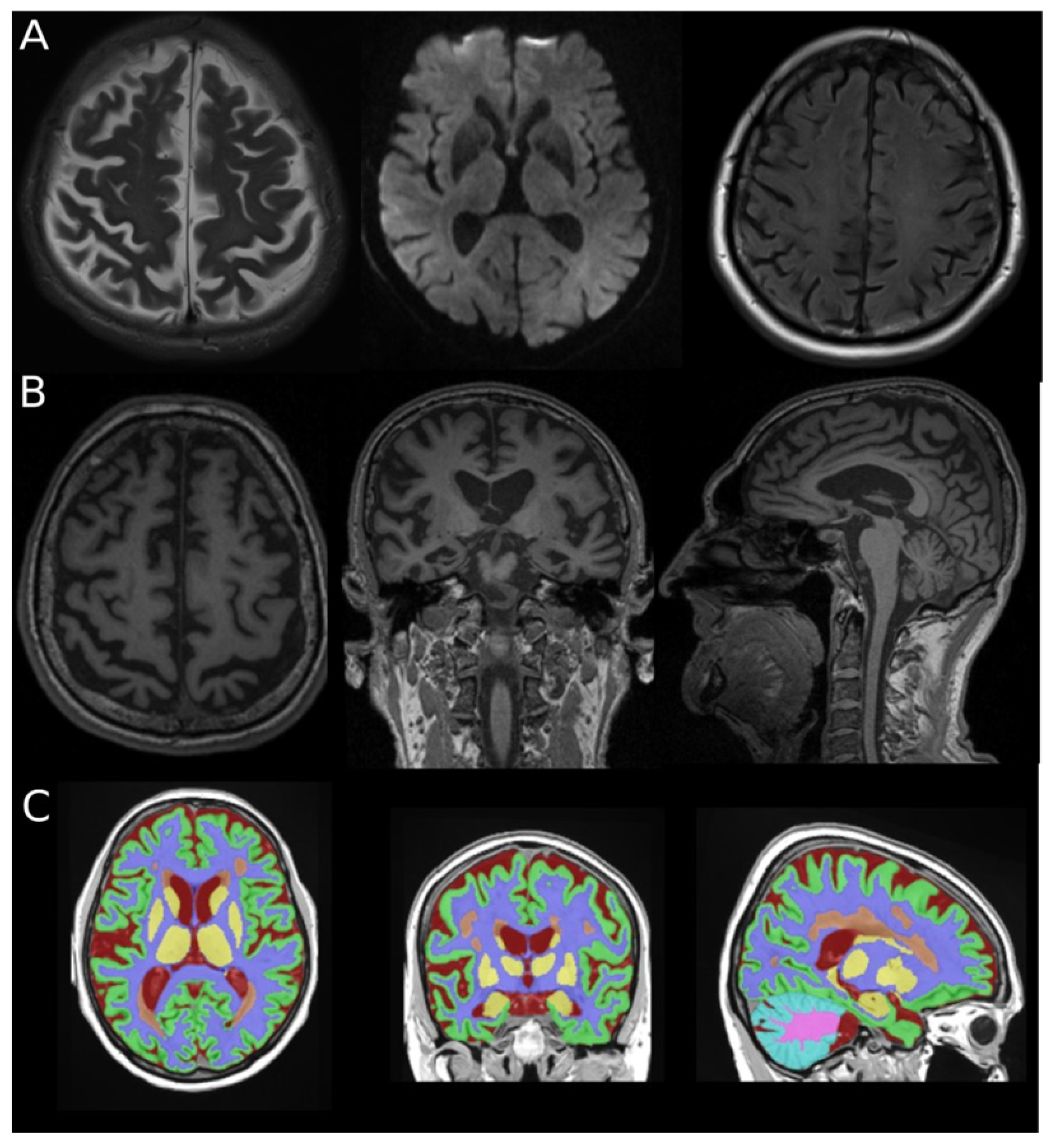
Image processing and segmentation were performed using the Vol2Brain pipeline and included the following steps: noise reduction (denoising), correction of intensity inhomogeneity (bias field correction), registration to the Montreal Neurological Institute (MNI) standard space, skull stripping, tissue classification into gray matter, white matter, and cerebrospinal fluid, intensity normalization, and anatomical segmentation [34,35,36,37,38]. Anatomical segmentation is based on a combination of multi-atlas labeling and patch-based methods, enabling parcellation of the brain into 135 anatomically defined regions [39,40]. For each segmented structure, relative volumes normalized to total intracranial volume (TIV) were calculated. The total intracranial volume was automatically estimated by the Vol2Brain pipeline during segmentation processing and used for normalization of regional volumes. The Vol2Brain pipeline performs automated tissue classification and atlas parcellation based on T1-weighted signal characteristics. White matter hyperintensities are not explicitly segmented as separate lesions within this framework but are incorporated into the automated tissue classification process. An illustrative example of the MRI protocol and automated segmentation is shown in Figure 1. Automated segmentation outputs generated by the volBrain platform were visually inspected using the system generated reports to confirm anatomical plausibility and the absence of gross tissue misclassification. No cases required exclusion due to segmentation failure.
Vol2Brain was selected due to its fully automated cloud-based processing, minimal operator intervention, and previously reported validation against established neuroimaging pipelines. The average processing time per case was approximately 15–20 min, depending on the server workload.
In the present study, volumetric measures were extracted for the total frontal lobe and the following frontal subregions: frontal pole, gyrus rectus, superior frontal gyrus (including medial segment), middle frontal gyrus, inferior frontal gyrus subregions (opercular, orbital, and triangular parts), anterior, posterior, lateral, and medial orbital gyri, precentral gyrus (including medial segment), supplementary motor cortex, and subcallosal area.

2.4. Statistical Analysis

Statistical analyses were performed using IBM SPSS Statistics software (version 27.0.1, IBM Corp., Armonk, NY, USA). The normality of distribution of the volumetric parameters was assessed using the Shapiro–Wilk test and visual inspection of histograms, box plots, and stem-and-leaf plots. The homogeneity of variances was evaluated using Levene’s test.
Group differences in demographic characteristics were analyzed using one-way analysis of variance (ANOVA) for continuous variables and the chi-square test for categorical variables. Comparisons of relative volumes of the examined brain structures between diagnostic groups were performed using analysis of covariance (ANCOVA), with age and sex included as covariates in all models. Relative volumetric measures normalized to total intracranial volume (TIV) were used for all analyses. The total intracranial volume was not entered as an additional covariate in the ANCOVA models, as all regional volumes were already normalized to the TIV.
When a significant main effect of a diagnostic group was observed, Bonferroni-corrected post hoc tests were applied to identify pairwise group differences. The effect size was expressed as the partial eta squared (η2). According to conventional benchmarks, partial eta squared values of approximately 0.01, 0.06 and 0.14 are considered small, medium and large effects respectively. The level of statistical significance was set at p < 0.05. The detailed results of covariate effects and post hoc comparisons are provided in the Supplementary Materials.
Receiver operating characteristic (ROC) analyses were performed to assess the discriminatory performance of the total frontal lobe volume. ROC curves were constructed for AD versus cognitively healthy controls and AD versus vascular dementia (VaD). Area under the curve (AUC) values with 95% confidence intervals were calculated using nonparametric methods.
To control for multiple comparisons across frontal subregional analyses, the Benjamini–Hochberg false discovery rate (FDR) procedure was applied (q = 0.05). The total frontal lobe volume was defined as the primary outcome measure, while subregional analyses were treated as exploratory.

3. Results

3.1. Participant Characteristics

A total of 120 participants were included (AD, VaD, aMCI, and cognitively healthy controls; n = 30 per group). A significant difference in age was observed among groups (one-way ANOVA, F(3,114) = 3.536, p = 0.017), whereas the sex distribution did not differ significantly (χ2(3) = 2.22, p = 0.528). Accordingly, all volumetric comparisons were performed using ANCOVA models including age and sex as covariates in all analyses. The demographic data are summarized in Table 1.

3.2. Frontal Lobe Volumetry

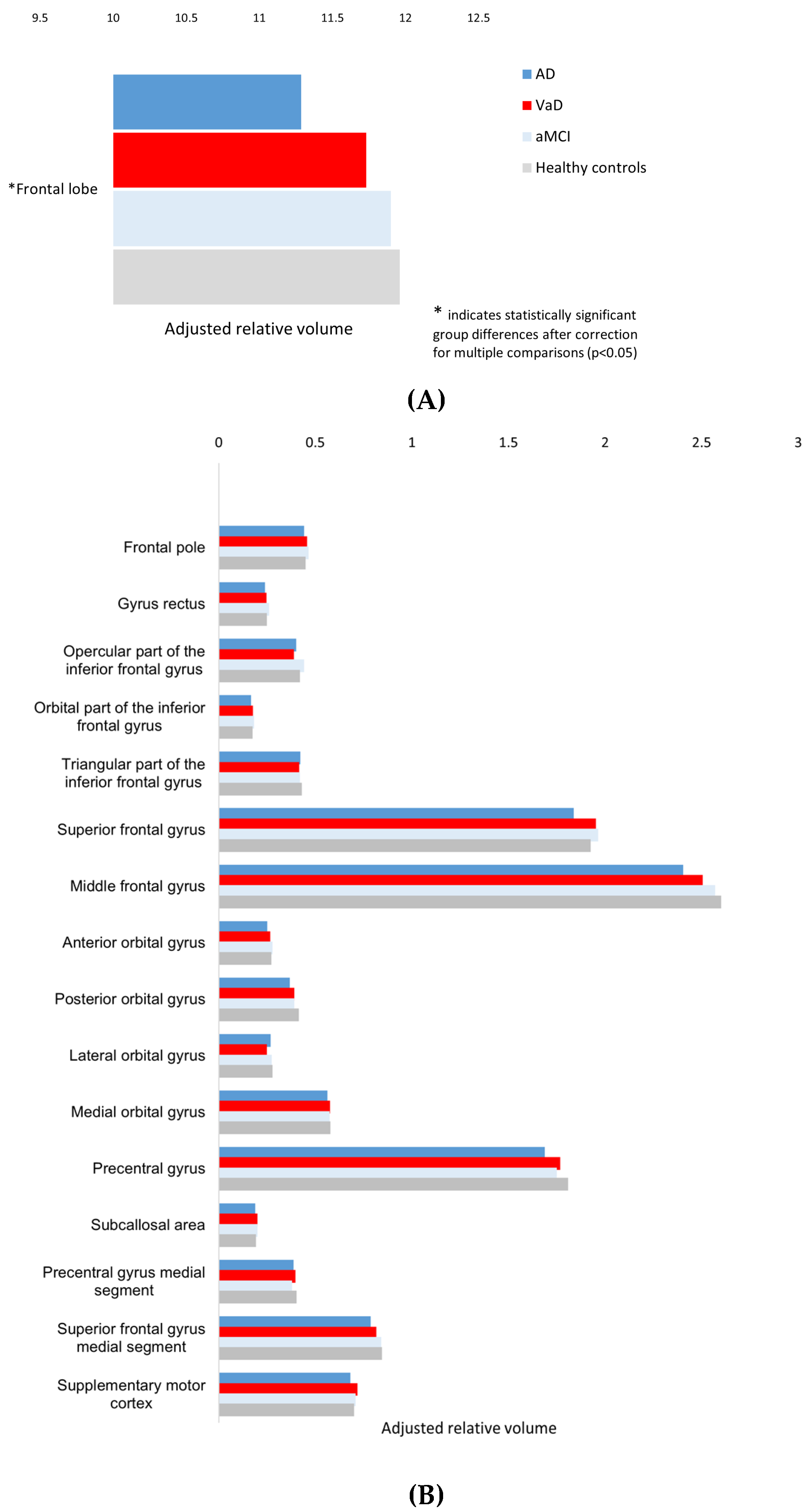
Overall, nominal main effects of diagnostic group were detected for the total frontal lobe volume and several frontal subregions. Group-level patterns across frontal lobe volumes are illustrated in Figure 2A, while Figure 2B presents the distribution of the adjusted volumes across frontal subregions.
The main volumetric results are presented in Table 2, with detailed Bonferroni-adjusted pairwise post hoc comparisons provided in Supplementary Table S1, and the effects of age and sex are reported in Supplementary Table S2. Ninety-five percent confidence intervals for estimated marginal means and group differences are provided in Supplementary Table S3.
After controlling for multiple comparisons using the Benjamini–Hochberg procedure (q = 0.05), only the total frontal lobe volume remained statistically significant. Accordingly, subregional findings should be interpreted as exploratory.
A significant main effect of diagnostic group was observed for the total frontal lobe volume, with lower volumes in patients with Alzheimer’s disease compared with individuals with aMCI and cognitively healthy controls (Table 2; Supplementary Table S1). No significant differences were detected between the VaD group and AD and cognitively healthy controls.
At the nominal level (uncorrected ANCOVA main effects), group differences were observed in several frontal subregions. Within the orbitofrontal cortex, nominal effects were detected for the anterior and posterior orbital gyri. Volumes of the anterior orbital gyrus were higher in the aMCI group compared with AD, while posterior orbital gyrus volumes were lower in AD relative to cognitively healthy controls. However, these findings did not remain significant after FDR correction.
Similarly, nominal group effects based on uncorrected comparisons were observed for the opercular part of the inferior frontal gyrus, as well as for the superior frontal gyrus, middle frontal gyrus, and precentral gyrus. In these regions, AD was generally associated with lower adjusted volumes compared to cognitively healthy controls and in some instances to aMCI. These subregional differences did not survive FDR correction and should therefore be interpreted cautiously.
No group differences were observed for the frontal pole, gyrus rectus, triangular or orbital parts of the inferior frontal gyrus, lateral of medial orbital gyri, medial segment of the superior or precentral gyri, supplementary motor cortex, or subcallosal area.

3.3. Discriminator Performance of Total Frontal Lobe Volume

Receiver operating characteristic analysis demonstrated that the total frontal lobe volume significantly discriminated AD from cognitively healthy controls (AUC = 0.773, 95% CI 0.653–0.892, p < 0.001).
In the comparison between AD and VaD, the total frontal lobe volume showed modest but statistically significant discriminatory ability (AUC = 0.677, 95% CI 0.539–0.814, p = 0.019).
Detailed ROC metrics are presented in Table 3.

4. Discussion

The present study examined subregional frontal lobe volumetric alterations across AD, aMCI, VaD, and cognitively healthy controls using automated MRI-based segmentation. At the global level, AD was associated with a significantly reduced frontal lobe volume compared with aMCI and controls, whereas VaD demonstrated relative preservation of the overall frontal volume. At the subregional level, nominal volumetric reductions in AD were observed in several prefrontal and orbitofrontal regions. However, these findings did not remain significant after correction for multiple comparisons.
In contrast, VaD did not demonstrate a consistent or regionally specific pattern of frontal volumetric involvement. Collectively, these findings suggest a pattern of regional involvement that warrants replication in larger cohorts. Formal discriminatory analysis demonstrated that the global frontal lobe volume represents the most robust and statistically supported marker in the present cohort.
Consistent with these findings, the frontal lobe volume differed significantly across diagnostic groups, with AD patients showing the lowest volumes. In contrast, aMCI demonstrated relative preservation of the overall frontal lobe volume, with values comparable to cognitively healthy controls. VaD did not show statistically significant differences in the frontal lobe volume compared with AD, aMCI, or cognitively healthy controls. This pattern is consistent with the predominantly cortical neurodegenerative nature of AD, whereas frontal involvement in VaD is thought to be mediated primarily through disruption of frontal–subcortical circuits rather than primary cortical degeneration [41,42]. Previous volumetric MRI studies have similarly reported frontal lobe volume reductions in AD, while frontal changes in aMCI are typically less pronounced and more variable across cohorts [43,44,45]. Together, these findings indicate that the global frontal lobe volumetry reflects the overall disease burden, which demonstrated statistically significant discriminatory ability in the present cohort. However, the effect sizes indicate that it should not be interpreted as a standalone diagnostic marker. Receiver operating characteristic analysis further demonstrated that the total frontal lobe volume significantly discriminated AD from cognitively healthy controls (AUC = 0.773) and showed modest but statistically significant discrimination between AD and VaD (AUC = 0.677). These findings indicate that global frontal atrophy carries measurable diagnostic information, although its discriminatory performance remains moderate.
Beyond global frontal lobe volume loss, nominal differences across several frontal subregions were observed in AD, suggesting a possible regionally patterned distribution. At the nominal level, lower adjusted volumes were observed in several prefrontal gyri, including the middle and superior frontal and the opercular part of the inferior frontal gyrus, as well in selected orbitofrontal regions, namely the anterior and posterior orbital gyri. Previous voxel-based and volumetric MRI studies have similarly reported atrophy of the middle and superior frontal gyri and inferior frontal regions in AD, supporting the preferential vulnerability of associative prefrontal cortices [46,47,48]. In addition, frontal volume reductions have been linked to neuropsychiatric and behavioral symptoms in AD, underscoring the clinical relevance of prefrontal degeneration [49]. Nominal differences involving anterior and posterior orbital gyri are compatible with previously reported orbitofrontal involvement, which is critically involved in behavioral regulation, decision-making, and socio-emotional processing [48,49]. Orbitofrontal atrophy has likewise been associated with neuropsychiatric manifestations and disease severity in AD [49]. Nominal differences in the precentral gyrus may reflect the extension of neurodegenerative changes toward motor and premotor networks or broader disruption of frontal network integrity in AD [50]. Collectively, these nominal findings are compatible with previously described patterns of prefrontal and orbitofrontal involvement, although they require confirmation in larger samples. Given the multiple-comparison burden, these findings should be interpreted as exploratory.
Compared with AD, aMCI was characterized by the relative preservation of frontal subregions, with only subtle and heterogeneous volumetric alterations. This cross-sectional pattern is compatible with established clinical staging frameworks in which aMCI is described as a transitional diagnostic category. However, the present design does not permit inference regarding longitudinal progression. In the present study, aMCI did not exhibit widespread frontal subregional atrophy and demonstrated only nominal differences relative to AD. At the nominal level, the differences between AD and aMCI were confined to the superior frontal gyrus, whereas differences in the middle frontal gyrus were primarily observed between AD and cognitively healthy controls. Notably, frontal volumes in aMCI were largely comparable to those of cognitively healthy controls, suggesting relative preservation of frontal structural integrity in this group. Previous MRI studies indicate that early structural changes in aMCI predominantly affect medial temporal lobe regions, whereas frontal involvement is less consistent and typically milder [51,52,53]. In particular, volumetric alterations of the entorhinal cortex have been reported in aMCI, underscoring the prominent involvement of medial temporal structures in the Alzheimer’s disease spectrum [54]. Nevertheless, voxel-based and surface-based morphometry studies have demonstrated that a subset of aMCI individuals may exhibit limited frontal cortical involvement, including the middle frontal gyrus and lateral orbital cortex [54,55,56]. This finding further supports the heterogeneity of the aMCI phenotype. Collectively, these nominal findings suggest that aMCI does not display a stable frontal subregional atrophy pattern. Subtle frontal alterations, when present, may reflect region-specific vulnerability patterns, as described in previous research.
In our cohort, the VaD group did not show significant differences in total frontal lobe volume compared with AD, aMCI, or cognitively healthy controls. Across frontal subregions, no consistent VaD-related volumetric reductions were detected relative to the other diagnostic groups. At the nominal level, a post hoc difference involving VaD was observed in the opercular part of the inferior frontal gyrus, where the aMCI group showed a higher relative volume than the VaD group, without evidence of a broader regional pattern. These findings indicate that frontal involvement in VaD is not characterized by a consistent pattern of cortical volumetric loss. Given that our VaD cohort consisted of patients with probable subcortical VaD according to NINDS-AIREN criteria, these findings may be compatible with current conceptual models of subcortical VaD, in which cognitive impairment is frequently attributed to the disruption of fronto-subcortical and cortico-thalamic networks rather than to primary cortical neurodegeneration [57,58]. However, as vascular lesion burden (e.g., white matter hyperintensities or lacunar infarcts) and other markers of small vessel disease were not quantitatively assessed in the present study, mechanistic interpretation should be considered speculative. Cortical thickness studies in subcortical vascular cognitive impairment and subcortical VaD have reported frontal cortical involvement, particularly within prefrontal and cingulate regions, as well as associations between frontal cortical integrity and executive or working memory performance [59,60]. However, our volumetric results suggest that such changes may not necessarily manifest as robust reductions in frontal subregional volumes.
Overall, our findings indicate that the diagnostic groups differ in the magnitude of frontal lobe involvement, while nominal differences suggest potential variation in subregional patterns. Alzheimer’s disease was characterized by the most consistent frontal volumetric reductions, whereas aMCI showed milder and more selective changes, and VaD did not demonstrate a robust frontal volumetric signature. Taken together, these results support the relevance of a global frontal volumetric reduction in AD, while nominal subregional patterns may offer complementary descriptive information that warrants replication in larger cohorts. These interpretations remain grounded in clinically defined diagnostic categories rather than biomarker-confirmed disease entities. In addition, the present study allows the direct comparison of AD, aMCI and VaD within a single cohort, using a standardized automated segmentation framework and uniform statistical modeling. This design supports the consistent evaluation of frontal involvement across clinically defined diagnostic groups under comparable methodological conditions.

4.1. Clinical Implications

The present findings suggest that, although only the global frontal lobe volume remains statistically robust after correction, subregional frontal lobe volumetry may provide complementary descriptive information regarding structural profiles across clinically defined etiologies of cognitive impairment, However, direct structure–function relationships with neuropsychological measures were not assessed in the present study. By applying the same automated volumetric pipeline across all diagnostic groups, the study reflects a framework that may be feasible in routine clinical research settings and supports reproducible structural assessment. Detailed frontal volumetric evaluation may complement clinical assessment when interpreted within a broader multimodal complex. Frontal volumetric measures should not be considered standalone diagnostic markers. Instead, they should be integrated with clinical presentation, cognitive testing, and conventional neuroimaging findings to support comprehensive patient evaluation.

4.2. Methodological Strengths

This study benefits from a standardized and fully automated MRI segmentation approach, which reduces operator dependence and enhances reproducibility. The use of a subregional frontal lobe analysis allows more detailed characterization of structural changes than global volumetric measures alone. In addition, normalization of regional volumes to intracranial volume improves the validity of inter-individual comparisons. Finally, the inclusion of well-defined diagnostic groups and the use of appropriate covariates strengthen the robustness of the presented findings. The use of a unified automated pipeline across all diagnostic groups further enhances methodological consistency and enables direct group comparison under identical analytical conditions.

4.3. Limitations

Several limitations of this study should be acknowledged. The relatively modest sample size and single-center design may limit the generalizability of the findings. In addition, the age differed significantly between groups at the univariate level. Although age was included as a covariate in all ANCOVA models, residual confounding related to age-related frontal volume decline cannot be entirely excluded. No a priori power calculation was performed. Although the group sizes were comparable to those reported in similar neuroimaging studies, the sample size may limit the statistical power to detect small to moderate subregional effects. Consequently, the possibility of both type I and type II errors cannot be fully excluded, particularly for exploratory subregional analyses. In addition, the cross-sectional nature of the study precludes the assessment of longitudinal changes in and trajectories of frontal volumetric alterations. The absence of molecular biomarkers (e.g., amyloid, tau, or CSF-based measures) limits biological validation of the clinical diagnoses. Although established diagnostic criteria were applied, the lack of biomarker confirmation introduces the possibility of misclassification, particularly within the aMCI group. Consequently, etiological inferences regarding disease-specific frontal patterns should be interpreted with caution. In addition, the vascular lesion burden (including white matter hyperintensities or lacunar infarcts) was not quantitatively evaluated, precluding direct assessment of small vessel disease severity and structural network disruption in the VaD group. Given the number of subregional comparisons performed, and despite application of FDR correction, the subregional findings should be interpreted as exploratory, particularly as only the global frontal measure remained significant after correction for multiple testing. Direct analyses linking frontal subregional volumes to neuropsychological performance were not performed. Such analyses could provide additional insight into the clinical and behavioral relevance of the observed structural patterns. Therefore, the clinical implication of subregional volumetric findings should be interpreted with appropriate caution. Finally, although a validated and automated segmentation pipeline was used, reliance on a single software tool may introduce method-specific effects, and future studies could benefit from cross-validation across different segmentation approaches.

4.4. Future Directions

Future studies should aim to validate these findings, particularly subregional patterns, in larger multicenter cohorts and to explore longitudinal changes in frontal subregional volumes across disease stages. The integration of multimodal imaging approaches, including diffusion- and functional-based techniques, may provide additional insight into network-level mechanisms underlying frontal dysfunction. Furthermore, combining subregional volumetric measures with neuropsychological and molecular biomarker data may help clarify the relationships between structural alterations and clinical phenotypes.

5. Conclusions

In summary, this study demonstrates that global frontal lobe involvement differs across clinically defined etiologies of cognitive impairment, with pronounced global frontal volumetric reductions in Alzheimer’s disease, predominantly nominal subregional changes in aMCI and the absence of consistent frontal volumetric loss in VaD. This pattern may partly reflect the heterogeneity of vascular lesion burden, distribution, and disease stage among individuals with VaD. These findings highlight the potential descriptive value of subregional frontal volumetric analysis in characterizing structural pattern across diagnostic groups, while underscoring the need for multimodal approaches to clarify the underlying neurobiological mechanisms. Overall, a detailed assessment of frontal subregions may contribute to a more integrated understanding of structural differences observed across major causes of cognitive impairment.

Supplementary Materials

The following supporting information can be downloaded at https://www.mdpi.com/article/10.3390/brainsci16030317/s1, Table S1: Post hoc Bonferroni analysis; Table S2: Effects of age and sex covariates; Table S3: Bonferroni-adjusted pairwise comparison with 95% CI for regions showing significant main effects in ANCOVA.

Author Contributions

Conceptualization, S.S. and K.K. (Katarina Karher); methodology, S.S., D.K., M.V., S.S.B. and K.K. (Katarina Koprivšek); software, S.S. and K.K. (Katarina Karher); validation, S.S., K.K. (Katarina Karher), D.K., S.S.B., M.V. and K.K. (Katarina Koprivšek); formal analysis, S.S., D.K., M.V., S.S.B. and K.K. (Katarina Koprivšek); investigation, S.S., K.K. (Katarina Karher) and M.V.; resources, S.S. and D.K.; data curation, S.S., D.K., M.V., S.S.B. and K.K. (Katarina Koprivšek); writing—original draft preparation, S.S. and K.K. (Katarina Karher); writing—review and editing, S.S., D.K., M.V., S.S.B. and K.K. (Katarina Koprivšek); visualization, S.S., K.K. (Katarina Karher) and M.V.; supervision, D.K., S.S.B. and K.K. (Katarina Koprivšek); project administration, D.K. and K.K. (Katarina Koprivšek); funding acquisition, D.K. All authors have read and agreed to the published version of the manuscript.

Funding

The study has been supported by the Provincial Secretariat for Higher Education and Scientific Research, Autonomous Province of Vojvodina, Republic of Serbia, number 003873711 2025 09418 003 000 000 001 04 004.

Institutional Review Board Statement

The study was conducted in accordance with the Declaration of Helsinki and approved by the Ethics Committee of the Faculty of Medicine, University of Novi Sad, Serbia.

Informed Consent Statement

Informed consent was obtained from all subjects involved in the study.

Data Availability Statement

The human data supporting the findings of this study are not openly available due to privacy and sensitivity concerns. They are available from the corresponding author upon request.

Acknowledgments

The authors would like to thank all the participants who took part in this study.

Conflicts of Interest

The authors declare no conflicts of interest.

Abbreviations

The following abbreviations are used in this manuscript:
3Dthree-dimensional
ACE-RAddenbrooke’s Cognitive Examination Revised
ADAlzheimer’s disease
aMCIamnestic mild cognitive impairment
ANCOVAanalysis of covariance
ANOVAanalysis of variance
BDIBeck Depression Inventory
BNTBoston Naming Test
DICOMDigital Imaging and Communications in Medicine
DWIdiffusion-weighted imaging
EXITExecutive Interview
FLAIRfluid-attenuated inversion recovery
HVOTHooper Visual Organization Test
MNIMontreal Neurological Institute
MPRAGEmagnetization-prepared rapid gradient-echo
MRImagnetic resonance imaging
NIfTINeuroimaging Informatics Technology Initiative
NIA-AANational Institute on Aging–Alzheimer’s Association
NINDS-AIRENNational Institute of Neurological Disorders and Stroke–Association Internationale pour la Recherche et l’Enseignement en Neurosciences
NPINeuropsychiatric Inventory
RAVLTRey Auditory Verbal Learning Test
ROCFTRey–Osterrieth Complex Figure Test
SDstandard deviation
TEecho time
TIVtotal intracranial volume
TMT-A/TMT-BTrail Making Test parts A and B
TRrepetition time
VaDvascular dementia
WCSTWisconsin Card Sorting Test
WMS-RWechsler Memory Scale–Revised

References

  1. GBD 2019 Dementia Forecasting Collaborators. Estimation of the global prevalence of dementia in 2019 and forecasted prevalence in 2050: An analysis for the Global Burden of Disease Study 2019. Lancet Public Health 2022, 7, e105–e125. [Google Scholar] [CrossRef]
  2. Kalaria, R.; Maestre, G.; Mahinrad, S.; Acosta, D.M.; Akinyemi, R.O.; Alladi, S.; Allegri, R.F.; Arshad, F.; Babalola, D.O.; Baiyewu, O.; et al. The 2022 symposium on dementia and brain aging in low- and middle-income countries: Highlights on research, diagnosis, care, and impact. Alzheimer’s Dement. 2024, 20, 4290–4314. [Google Scholar] [CrossRef]
  3. Stephan, B.C.M.; Cochrane, L.; Kafadar, A.H.; Brain, J.; Burton, E.; Myers, B.; Brayne, C.; Naheed, A.; Anstey, K.J.; Ashor, A.W.; et al. Population attributable fractions of modifiable risk factors for dementia: A systematic review and meta-analysis. Lancet Healthy Longev. 2024, 5, e406–e421. [Google Scholar] [CrossRef]
  4. Schmidt, M.F.; Storrs, J.M.; Freeman, K.B.; Jack, C.R., Jr.; Turner, S.T.; Griswold, M.E.; Mosley, T.H., Jr. A comparison of manual tracing and FreeSurfer for estimating hippocampal volume over the adult lifespan. Hum. Brain Mapp. 2018, 39, 2500–2513. [Google Scholar] [CrossRef] [PubMed]
  5. Giorgio, A.; De Stefano, N. Clinical use of brain volumetry. J. Magn. Reson. Imaging 2013, 37, 1–14. [Google Scholar] [CrossRef]
  6. Schoemaker, D.; Buss, C.; Head, K.; Sandman, C.A.; Davis, E.P.; Chakravarty, M.M.; Gauthier, S.; Pruessner, J.C. Hippocampus and amygdala volumes from magnetic resonance images in children: Assessing accuracy of FreeSurfer and FSL against manual segmentation. NeuroImage 2016, 129, 1–14. [Google Scholar] [CrossRef] [PubMed]
  7. Goto, M.; Abe, O.; Hagiwara, A.; Fujita, S.; Kamagata, K.; Hori, M.; Aoki, S.; Osada, T.; Konishi, S.; Masutani, Y.; et al. Advantages of using both voxel- and surface-based morphometry in cortical morphology analysis: A review of various applications. Magn. Reson. Med. Sci. 2022, 21, 41–57. [Google Scholar] [CrossRef]
  8. Chayer, C.; Freedman, M. Frontal lobe functions. Curr. Neurol. Neurosci. Rep. 2001, 1, 547–552. [Google Scholar] [CrossRef]
  9. Paroni, G.; Bisceglia, P.; Seripa, D. Understanding the amyloid hypothesis in Alzheimer’s disease. J. Alzheimer’s Dis. 2019, 68, 493–510. [Google Scholar] [CrossRef] [PubMed]
  10. Litak, J.; Mazurek, M.; Kulesza, B.; Szmygin, P.; Kamieniak, P.; Grochowski, C. Cerebral small vessel disease. Int. J. Mol. Sci. 2020, 21, 9729. [Google Scholar] [CrossRef]
  11. Alzheimer’s Association. 2025 Alzheimer’s disease facts and figures. Alzheimer’s Dement. 2025, 21, e70235. [Google Scholar] [CrossRef]
  12. Kalaria, R.N. The pathology and pathophysiology of vascular dementia. Neuropharmacology 2018, 134, 226–239. [Google Scholar] [CrossRef] [PubMed]
  13. Quek, Y.E.; Fung, Y.L.; Cheung, M.W.; Vogrin, S.J.; Collins, S.J.; Bowden, S.C. Agreement between automated and manual MRI volumetry in Alzheimer’s disease: A systematic review and meta-analysis. J. Magn. Reson. Imaging 2022, 56, 490–507. [Google Scholar] [CrossRef]
  14. Jack, C.R., Jr.; Vemuri, P.; Wiste, H.J.; Weigand, S.D.; Aisen, P.S.; Trojanowski, J.Q.; Shaw, L.M.; Bernstein, M.A.; Petersen, R.C.; Weiner, M.W.; et al. Evidence for ordering of Alzheimer disease biomarkers. Arch. Neurol. 2011, 68, 1526–1535. [Google Scholar] [CrossRef]
  15. Abrigo, J.; Shi, L.; Luo, Y.; Chen, Q.; Chu, W.C.W.; Mok, V.C.T.; Alzheimer’s Disease Neuroimaging Initiative. Standardization of hippocampus volumetry using automated brain structure volumetry tool for an initial Alzheimer’s disease imaging biomarker. Acta Radiol. 2019, 60, 769–776. [Google Scholar] [CrossRef] [PubMed]
  16. Koikkalainen, J.R.; Rhodius-Meester, H.F.M.; Frederiksen, K.S.; Bruun, M.; Hasselbalch, S.G.; Baroni, M.; Mecocci, P.; Vanninen, R.; Remes, A.; Soininen, H.; et al. Automatically computed rating scales from MRI for patients with cognitive disorders. Eur. Radiol. 2019, 29, 4937–4947. [Google Scholar] [CrossRef]
  17. Mårtensson, G.; Ferreira, D.; Cavallin, L.; Muehlboeck, J.S.; Wahlund, L.O.; Wang, C.; Westman, E.; Alzheimer’s Disease Neuroimaging Initiative. AVRA: Automatic visual ratings of atrophy from MRI images using recurrent convolutional neural networks. NeuroImage Clin. 2019, 23, 101872. [Google Scholar] [CrossRef] [PubMed]
  18. Shi, C.; Deng, H.; Deng, X.; Rao, D.; Yue, W. The structural changes of frontal subregions and their correlations with cognitive impairment in patients with Alzheimer’s disease. J. Integr. Neurosci. 2023, 22, 99. [Google Scholar] [CrossRef]
  19. Jack, C.R., Jr.; Bennett, D.A.; Blennow, K.; Carrillo, M.C.; Dunn, B.; Haeberlein, S.B.; Holtzman, D.M.; Jagust, W.; Jessen, F.; Karlawish, J.; et al. NIA-AA Research Framework: Toward a biological definition of Alzheimer’s disease. Alzheimer’s Dement. 2018, 14, 535–562. [Google Scholar] [CrossRef] [PubMed]
  20. Román, G.C.; Tatemichi, T.K.; Erkinjuntti, T.; Cummings, J.L.; Masdeu, J.C.; Garcia, J.H.; Amaducci, L.; Orgogozo, J.M.; Brun, A.; Hofman, A. Vascular dementia: Diagnostic criteria for research studies: Report of the NINDS-AIREN International Workshop. Neurology 1993, 43, 250–260. [Google Scholar] [CrossRef] [PubMed]
  21. Folstein, M.F.; Folstein, S.E.; McHugh, P.R. “Mini-mental state”. A practical method for grading the cognitive state of patients for the clinician. J. Psychiatr. Res. 1975, 12, 189–198. [Google Scholar] [CrossRef]
  22. Mioshi, E.; Dawson, K.; Mitchell, J.; Arnold, R.; Hodges, J.R. The Addenbrooke’s Cognitive Examination Revised (ACE-R): A brief cognitive test battery for dementia screening. Int. J. Geriatr. Psychiatry 2006, 21, 1078–1085. [Google Scholar] [CrossRef]
  23. Kaplan, E.F.; Goodglass, H.; Weintraub, S. The Boston Naming Test, 2nd ed.; Lea & Febiger: Philadelphia, PA, USA, 1983. [Google Scholar]
  24. Boyd, J.L. A validity study of the Hooper Visual Organization Test. J. Consult. Clin. Psychol. 1981, 49, 15–19. [Google Scholar] [CrossRef]
  25. Rey, A. L’examen psychologique dans les cas d’encephalopathie traumatique (les problèmes). Arch. Psychol. 1941, 28, 215–340. [Google Scholar]
  26. Tombaugh, T.N. Trail Making Test A and B: Normative data stratified by age and education. Arch. Clin. Neuropsychol. 2004, 19, 203–214. [Google Scholar] [CrossRef] [PubMed]
  27. Monchi, O.; Petrides, M.; Petre, V.; Worsley, K.; Dagher, A. Wisconsin Card Sorting revisited: Distinct neural circuits participating in different stages of the task identified by event-related functional magnetic resonance imaging. J. Neurosci. 2001, 21, 7733–7741. [Google Scholar] [CrossRef]
  28. Stokholm, J.; Vogel, A.; Gade, A.; Waldemar, G. The executive interview as a screening test for executive dysfunction in patients with mild dementia. J. Am. Geriatr. Soc. 2005, 53, 1577–1581. [Google Scholar] [CrossRef] [PubMed]
  29. Bishop, J.; Knights, R.M.; Stoddart, C. Rey Auditory-Verbal Learning Test: Performance of English and French children aged 5 to 16. Clin. Neuropsychol. 1990, 4, 133–140. [Google Scholar] [CrossRef]
  30. Elwood, R.W. The Wechsler Memory Scale-Revised: Psychometric characteristics and clinical application. Neuropsychol. Rev. 1991, 2, 179–201. [Google Scholar] [CrossRef] [PubMed]
  31. Beck, A.T. Depression: Causes and Treatment; University of Pennsylvania Press: Philadelphia, PA, USA, 1972. [Google Scholar]
  32. Cummings, J.L.; Mega, M.; Gray, K.; Rosenberg-Thompson, S.; Carusi, D.A.; Gornbein, J. The Neuropsychiatric Inventory: Comprehensive assessment of psychopathology in dementia. Neurology 1994, 44, 2308–2314. [Google Scholar] [CrossRef]
  33. Manjón, J.V.; Coupé, P. volBrain: An online MRI brain volumetry system. Front. Neuroinform. 2016, 10, 30. [Google Scholar] [CrossRef]
  34. Manjón, J.V.; Romero, J.E.; Vivo-Hernando, R.; Rubio, G.; Aparici, F.; de la Iglesia-Vayá, M.; Coupé, P. vol2Brain: A new online pipeline for whole brain MRI analysis. Front. Neuroinform. 2022, 16, 862805. [Google Scholar] [CrossRef]
  35. Manjón, J.V.; Coupé, P.; Martí-Bonmatí, L.; Collins, D.L.; Robles, M. Adaptive non-local means denoising of MR images with spatially varying noise levels. J. Magn. Reson. Imaging 2010, 31, 192–203. [Google Scholar] [CrossRef]
  36. Tustison, N.J.; Avants, B.B.; Cook, P.A.; Zheng, Y.; Egan, A.; Yushkevich, P.A.; Gee, J.C. N4ITK: Improved N3 bias correction. IEEE Trans. Med. Imaging 2010, 29, 1310–1320. [Google Scholar] [CrossRef] [PubMed]
  37. Ashburner, J.; Friston, K.J. Unified segmentation. NeuroImage 2005, 26, 839–851. [Google Scholar] [CrossRef]
  38. Romero, J.E.; Manjón, J.V.; Tohka, J.; Coupé, P.; Robles, M. NABS: Non-local automatic brain hemisphere segmentation. Magn. Reson. Imaging 2015, 33, 474–484. [Google Scholar] [CrossRef]
  39. Lötjönen, J.M.; Wolz, R.; Koikkalainen, J.R.; Thurfjell, L.; Waldemar, G.; Soininen, H.; Rueckert, D.; Alzheimer’s Disease Neuroimaging Initiative. Fast and robust multi-atlas segmentation of brain magnetic resonance images. NeuroImage 2010, 49, 2352–2365. [Google Scholar] [CrossRef]
  40. Coupé, P.; Manjón, J.V.; Fonov, V.; Pruessner, J.; Robles, M.; Collins, D.L. Patch-based segmentation using expert priors: Application to hippocampus and ventricle segmentation. NeuroImage 2011, 54, 940–954. [Google Scholar] [CrossRef]
  41. Scheltens, P.; Blennow, K.; Breteler, M.M.; de Strooper, B.; Frisoni, G.B.; Salloway, S. Alzheimer’s disease. Lancet 2016, 388, 505–517. [Google Scholar] [CrossRef] [PubMed]
  42. Shiino, A.; Akiguchi, I.; Watanabe, T.; Shirakashi, Y.; Nozaki, K.; Tooyama, I. Morphometric characterization of Binswanger’s disease: Comparison with Alzheimer’s disease. Eur. J. Radiol. 2012, 81, 2375–2379. [Google Scholar] [CrossRef] [PubMed]
  43. Koenig, L.N.; LaMontagne, P.; Glasser, M.F.; Bateman, R.; Holtzman, D.; Yakushev, I.; Chhatwal, J.; Day, G.S.; Jack, C.; Mummery, C.; et al. Dominantly Inherited Alzheimer Network (DIAN). Regional age-related atrophy after screening for preclinical Alzheimer disease. Neurobiol. Aging 2022, 109, 43–51. [Google Scholar] [CrossRef]
  44. Hu, Y.; Zhu, T.; Zhang, W. The characteristics of brain atrophy prior to the onset of Alzheimer’s disease: A longitudinal study. Front. Aging Neurosci. 2024, 16, 1344920. [Google Scholar] [CrossRef]
  45. Chaudhary, S.; Zhornitsky, S.; Chao, H.H.; van Dyck, C.H.; Li, C.R. Cerebral volumetric correlates of apathy in Alzheimer’s disease and cognitively normal older adults: Meta-analysis, label-based review, and study of an independent cohort. J. Alzheimer’s Dis. 2022, 85, 1251–1265. [Google Scholar] [CrossRef]
  46. Rami, L.; Solé-Padullés, C.; Fortea, J.; Bosch, B.; Lladó, A.; Antonell, A.; Olives, J.; Castellví, M.; Bartres-Faz, D.; Sánchez-Valle, R.; et al. Applying the new research diagnostic criteria: MRI findings and neuropsychological correlations of prodromal Alzheimer’s disease. Int. J. Geriatr. Psychiatry 2012, 27, 127–134. [Google Scholar] [CrossRef]
  47. Möller, C.; Vrenken, H.; Jiskoot, L.; Versteeg, A.; Barkhof, F.; Scheltens, P.; van der Flier, W.M. Different patterns of gray matter atrophy in early- and late-onset Alzheimer’s disease. Neurobiol. Aging 2013, 34, 2014–2022. [Google Scholar] [CrossRef]
  48. Lv, L.; Guo, H.; Zhao, Z.; Zhao, X. Structural and microstructural changes in white and gray matter across the Alzheimer’s disease continuum. Front. Aging Neurosci. 2025, 17, 1693840. [Google Scholar] [CrossRef] [PubMed]
  49. Vasconcelos, L.G.; Jackowski, A.P.; Oliveira, M.O.; Flor, Y.M.; Bueno, O.F.; Brucki, S.M. Voxel-based morphometry findings in Alzheimer’s disease: Neuropsychiatric symptoms and disability correlations—Preliminary results. Clinics 2011, 66, 1045–1050. [Google Scholar] [CrossRef]
  50. Zhang, Y.; Dong, Z.; Phillips, P.; Wang, S.; Ji, G.; Yang, J.; Yuan, T.F. Detection of subjects and brain regions related to Alzheimer’s disease using 3D MRI scans based on eigenbrain and machine learning. Front. Comput. Neurosci. 2015, 9, 66. [Google Scholar] [CrossRef] [PubMed]
  51. Rami, L.; Gómez-Anson, B.; Monte, G.C.; Bosch, B.; Sánchez-Valle, R.; Molinuevo, J.L. Voxel-based morphometry features and follow-up of amnestic patients at high risk for Alzheimer’s disease conversion. Int. J. Geriatr. Psychiatry 2009, 24, 875–884. [Google Scholar] [CrossRef] [PubMed]
  52. Driscoll, I.; Davatzikos, C.; An, Y.; Wu, X.; Shen, D.; Kraut, M.; Resnick, S.M. Longitudinal pattern of regional brain volume change differentiates normal aging from mild cognitive impairment. Neurology 2009, 72, 1906–1913. [Google Scholar] [CrossRef]
  53. Kwon, C.; Kang, K.M.; Byun, M.S.; Yi, D.; Song, H.; Lee, J.Y.; Hwang, I.; Yoo, R.E.; Yun, T.J.; Choi, S.H.; et al. Assessment of mild cognitive impairment in elderly subjects using a fully automated brain segmentation software. Investig. Magn. Reson. Imaging 2021, 25, 164–172. [Google Scholar] [CrossRef]
  54. Li, Q.; Wang, J.; Liu, J.; Wang, Y.; Li, K. Magnetic resonance imaging measurement of entorhinal cortex in the diagnosis and differential diagnosis of mild cognitive impairment and Alzheimer’s disease. Brain Sci. 2021, 11, 1129. [Google Scholar] [CrossRef]
  55. Han, Y.; Lui, S.; Kuang, W.; Lang, Q.; Zou, L.; Jia, J. Anatomical and functional deficits in patients with amnestic mild cognitive impairment. PLoS ONE 2012, 7, e28664. [Google Scholar] [CrossRef]
  56. Zhao, H.; Li, X.; Wu, W.; Li, Z.; Qian, L.; Li, S.; Zhang, B.; Xu, Y. Atrophic patterns of the frontal-subcortical circuits in patients with mild cognitive impairment and Alzheimer’s disease. PLoS ONE 2015, 10, e0130017. [Google Scholar] [CrossRef] [PubMed]
  57. Caruso, P.; Signori, R.; Moretti, R. Small vessel disease to subcortical dementia: A dynamic model interfacing aging, cholinergic dysregulation, and the neurovascular unit. Vasc. Health Risk Manag. 2019, 15, 259–281. [Google Scholar] [CrossRef]
  58. Wardlaw, J.M.; Smith, E.E.; Biessels, G.J.; Cordonnier, C.; Fazekas, F.; Frayne, R.; Lindley, R.I.; O’Brien, J.T.; Barkhof, F.; Benavente, O.R.; et al. STRIVE v1. Neuroimaging standards for research into small vessel disease and its contribution to ageing and neurodegeneration. Lancet Neurol. 2013, 12, 822–838. [Google Scholar] [CrossRef] [PubMed]
  59. Seo, S.W.; Ahn, J.; Yoon, U.; Im, K.; Lee, J.M.; Kim, S.T.; Ahn, H.J.; Chin, J.; Jeong, Y.; Na, D.L. Cortical thinning in vascular mild cognitive impairment and vascular dementia of subcortical type. J. Neuroimaging 2010, 20, 37–45. [Google Scholar] [CrossRef] [PubMed]
  60. Kang, S.H.; Park, Y.H.; Kim, J.P.; Kim, J.S.; Kim, C.H.; Jang, H.; Kim, H.J.; Koh, S.B.; Na, D.L.; Chin, J.; et al. Cortical neuroanatomical changes related to specific neuropsychological deficits in subcortical vascular cognitive impairment. NeuroImage Clin. 2021, 30, 102685. [Google Scholar] [CrossRef]
Figure 1. Example of MRI protocol and vol2Brain analysis. Images are provided for methodological illustration only and were not used for quantitative analyses. (A) T2-weighted, DWI and FLAIR. (B) 3D T1-weighted MPRAGE displayed in axial, coronal and sagittal planes. (C) Example of vol2Brain segmentation.
Brainsci 16 00317 g001
Figure 2. Estimated marginal means of relative volumes for the frontal lobe and its subregions across diagnostic groups, adjusted for age and sex. (A) Adjusted mean total frontal volumes. Figure (B) Adjusted mean volumes of frontal subregions.
Brainsci 16 00317 g002
Table 1. Demographic characteristics of study groups.
GroupADVaDaMCIControlp-Value
Number of subjects30303030
Age (mean ± SD)73.31 ± 6.0368.13 ± 6.9669.30 ± 6.9769.73 ± 4.830.017
Sex (M/F)8/2212/187/239/210.528
Table 2. Volumes of total frontal lobe and frontal subregions across diagnostic groups.
STRUCTUREGroupxSDEstimated xSE95% CIF(3,114)pη2
LowerUpper
Frontal lobeAD11.220.9211.2870.13211.02611.5485.3870.0020.124
VaD11.760.6111.7300.13011.47211.988
aMCI11.920.7311.9000.12811.64612.154
Control11.970.5011.9620.12811.70912.215
Frontal poleAD0.4360.0560.4410.0100.4220.4611.0290.3820.026
VaD0.4610.0550.4570.0100.4380.477
aMCI0.4670.0560.4650.0100.4460.485
Control0.4510.0490.4500.0100.4310.470
Gyrus rectusAD0.2370.0260.2400.0050.2300.2502.4180.0700.060
VaD0.2490.0280.2480.0050.2370.258
aMCI0.2600.0300.2600.0050.2490.270
Control0.2500.0280.2500.0050.2400.260
Opercular part of the inferior frontal gyrusAD0.3970.0780.4010.0120.3770.4253.6680.0140.088
VaD0.3920.0510.3890.0120.3650.413
aMCI0.4410.0650.4410.0120.4180.465
Control0.4200.0630.4200.0120.3960.443
Orbital part of the inferior frontal gyrusAD0.1670.0380.1670.0080.1510.1830.6360.5930.016
VaD0.1770.0450.1770.0080.1610.193
aMCI0.1830.0350.1820.0080.1670.198
Control0.1760.0490.1760.0080.1610.192
Triangular part of the inferior frontal gyrusAD0.4180.0630.4220.0090.4030.4400.4540.7150.012
VaD0.4180.0420.4160.0090.3970.434
aMCI0.4220.0520.4200.0090.4020.438
Control0.4320.0440.4310.0090.4120.449
Middle frontal gyrusAD2.3790.2572.4040.0422.4242.5884.3610.0060.103
VaD2.5200.2302.5060.0422.3212.487
aMCI2.5780.2362.5690.0412.4882.650
Control2.6030.1822.6010.0412.5202.682
Superior frontal gyrusAD1.8370.2161.8380.0331.7721.9042.9600.0350.072
VaD1.9510.1351.9530.0331.8882.018
aMCI1.9680.1731.9650.0321.9012.029
Control1.9250.1661.9250.0321.8621.989
Anterior orbital gyrusAD0.2500.0380.2510.0060.2530.2793.4090.0200.082
VaD0.2670.0290.2660.0060.2380.264
aMCI0.2790.0390.2790.0060.2660.291
Control0.2730.0310.2730.0060.2610.286
Posterior orbital gyrusAD0.3670.0520.3680.0090.3500.3873.9310.0100.094
VaD0.3920.0480.3910.0090.3720.409
aMCI0.3910.0400.3910.0090.3730.410
Control0.4140.0570.4140.0090.3950.432
Lateral orbital gyrusAD0.2640.0570.2680.0090.2500.2871.9540.1250.049
VaD0.2520.0540.2500.0090.2320.268
aMCI0.2760.0370.2750.0090.2570.293
Control0.2780.0460.2780.0090.2600.296
Medial orbital gyrusAD0.5600.0570.5620.0090.5440.5810.6180.6050.016
VaD0.5770.0360.5760.0090.5580.594
aMCI0.5760.0490.5750.0090.5580.593
Control0.5730.0490.5790.0090.5610.597
Precentral gyrusAD1.6850.1801.6880.0281.6311.7453.0610.0310.075
VaD1.7660.1491.7670.0291.7111.823
aMCI1.7530.1381.7500.0281.6951.805
Control1.8080.1351.8080.0281.7531.753
Subcallosal areaAD0.1890.0290.1880.0050.1780.1981.4470.2330.037
VaD0.2010.0190.2010.0050.1910.211
aMCI0.1990.0310.2000.0050.1910.210
Control0.1930.0270.1930.0050.1840.203
Precentral gyrus medial segmentAD0.3840.0430.3870.0080.3710.4031.7070.1700.043
VaD0.3990.0500.3970.0080.3810.413
aMCI0.3790.0400.3790.0080.3630.395
Control0.4020.0400.4020.0080.3860.418
Superior frontal
gyrus medial segment
AD0.7820.0990.7870.0170.7530.8202.4470.0670.060
VaD0.8190.0990.8160.0170.7830.850
aMCI0.8420.0830.8400.0170.8070.873
Control0.8440.0770.8440.0160.8110.876
Supplementary motor cortexAD0.6780.0640.6820.0130.6560.7081.3820.2520.035
VaD0.7230.0730.7190.0130.6930.745
aMCI0.7100.0740.7080.0130.6820.733
Control0.7020.0710.7010.0130.6760.726
Table 3. ROC analysis of total frontal lobe volume.
ComparisonAUC95% CIp-Value
AD vs. control0.7730.653–0.892<0.001
AD vs. VaD0.6770.539–0.8140.019
Disclaimer/Publisher’s Note: The statements, opinions and data contained in all publications are solely those of the individual author(s) and contributor(s) and not of MDPI and/or the editor(s). MDPI and/or the editor(s) disclaim responsibility for any injury to people or property resulting from any ideas, methods, instructions or products referred to in the content.