

Sleep Duration and Physical Activity as Predictors of Executive Function in Adolescents: A Longitudinal Study

 , , ,
, , ,  and
and
Highlights
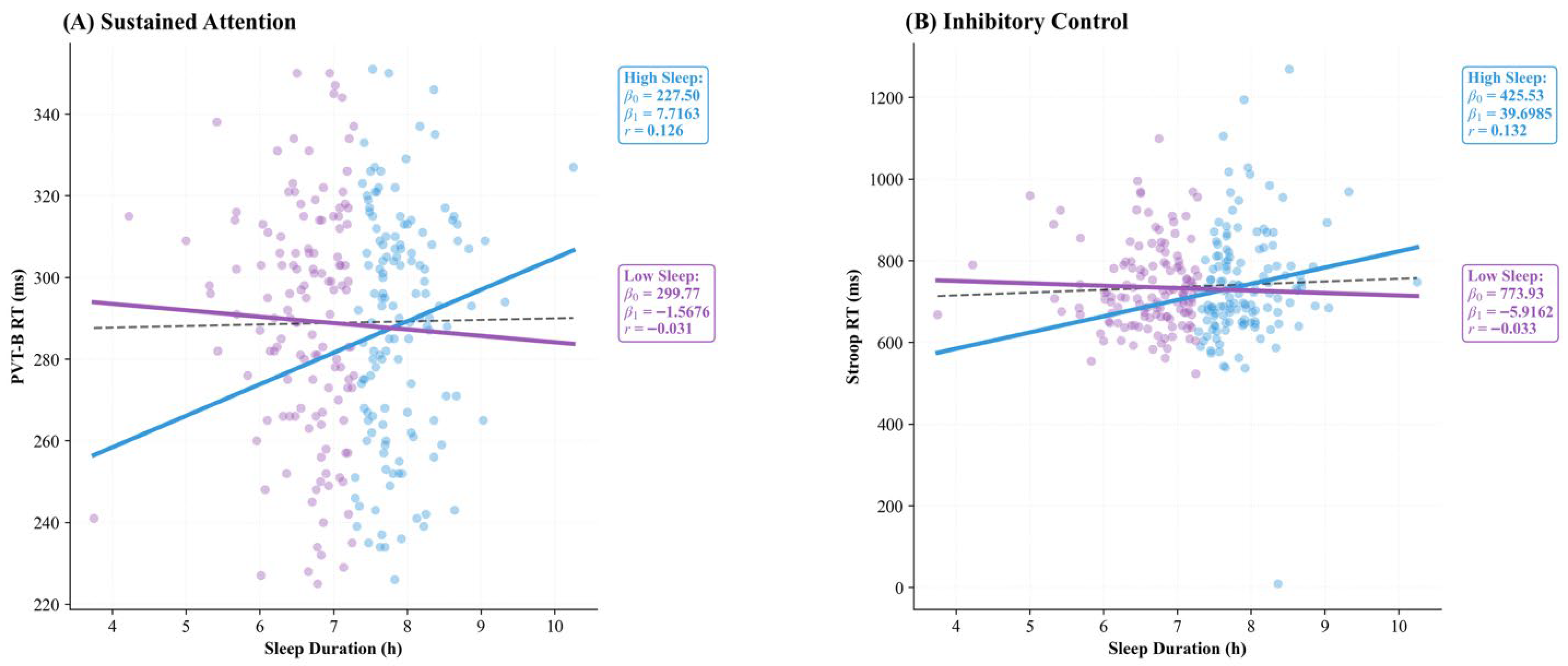
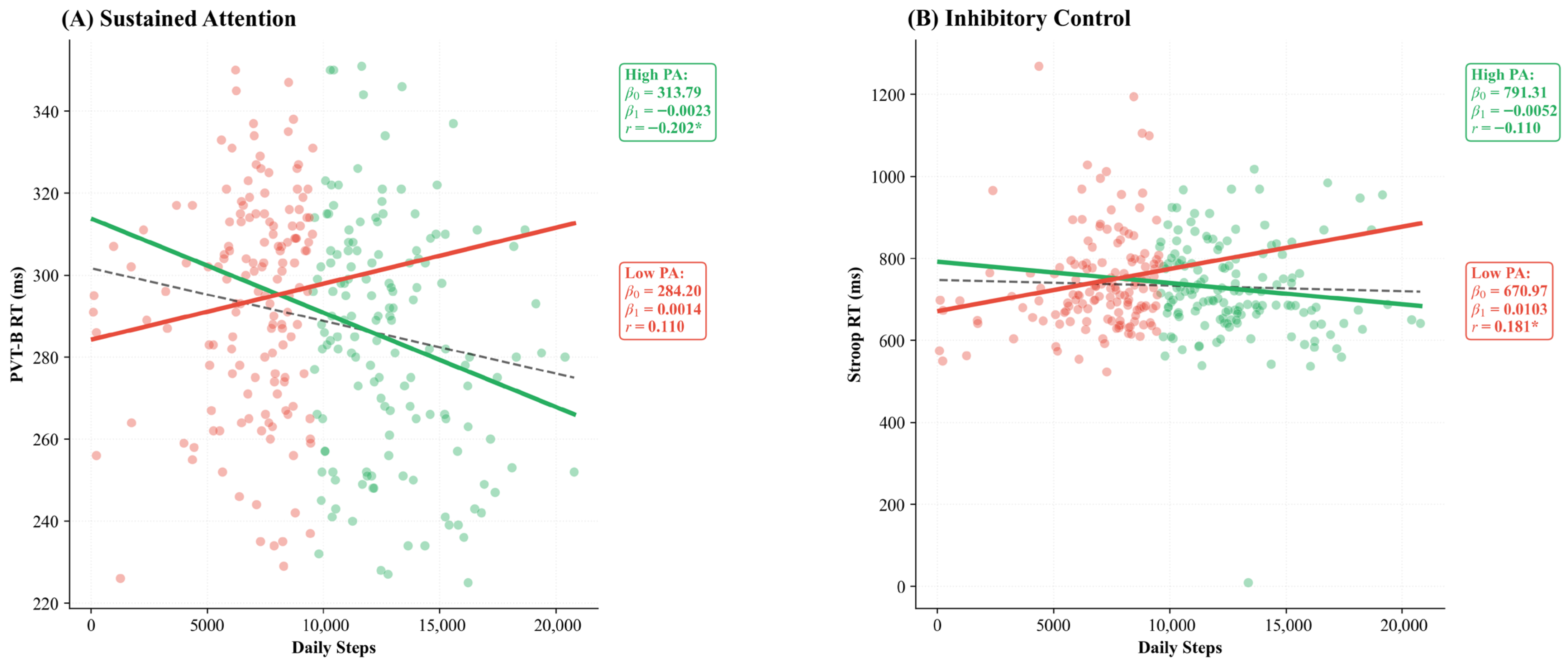
- Objective physical activity predicted faster reaction times in inhibitory control and fewer lapses in sustained attention, whereas sleep duration showed no significant effects.
- In the low-activity subgroup, higher daily steps were unexpectedly associated with slower inhibitory control, possibly reflecting confounding factors or differential physiological adaptation.
- Habitual physical activity should be prioritised in educational settings to enhance adolescent cognitive efficiency.
- Future research must assess circadian timing and sleep variability, rather than relying solely on total sleep duration.
Abstract
1. Introduction
1.1. Sleep and Cognitive Function
1.2. Physical Activity and Executive Function
1.3. Current Study
- Higher sleep duration would predict better performance on tasks requiring cognitive flexibility and vigilance, with weaker or null associations for inhibitory control.
- The sleep–EF relationship would be domain-specific, with stronger associations for vigilance-related outcomes than for inhibitory control or working memory.
- Higher physical activity levels would predict faster reaction times, greater accuracy and fewer attentional lapses across all executive function domains.
- The PA-EF relationship would be particularly pronounced in the high-activity subgroup, reflecting threshold effects consistent with neurobiological adaptation models.
2. Materials and Methods
2.1. Participants
2.2. Outcomes and Instruments
2.2.1. Sleep and Physical Activity Monitoring
2.2.2. Executive Function Assessment
2.3. Procedures
2.4. Statistical Analysis
3. Results

| Variable | Type | Comparison | p | d | CI (95%) |
|---|---|---|---|---|---|
| Stroop RT (ms) | Inter-group (M1) | High_Sleep vs. Low_Sleep | 0.433 | 0.12 | [−0.19, 0.43] |
| Inter-group (M2) | High_Sleep vs. Low_Sleep | 0.701 | 0.06 | [−0.26, 0.38] | |
| Intra-group | M1 vs. M2 (High_Sleep) | <0.001 *** | −0.42 | [−0.75, −0.09] | |
| Intra-group | M1 vs. M2 (Low_Sleep) | 0.038 * | −0.28 | [−0.60, 0.05] | |
| Stroop Acc (%) | Inter-group (M1) | High_Sleep vs. Low_Sleep | 0.325 | −0.16 | [−0.47, 0.15] |
| Inter-group (M2) | High_Sleep vs. Low_Sleep | 0.709 | 0.06 | [−0.26, 0.38] | |
| Intra-group | M1 vs. M2 (High_Sleep) | 0.868 | −0.02 | [−0.34, 0.30] | |
| Intra-group | M1 vs. M2 (Low_Sleep) | 0.052 | −0.18 | [−0.51, 0.14] | |
| PVT-B RT (ms) | Inter-group (M1) | High_Sleep vs. Low_Sleep | 0.824 | −0.04 | [−0.35, 0.28] |
| Inter-group (M2) | High_Sleep vs. Low_Sleep | 0.938 | 0.01 | [−0.31, 0.33] | |
| Intra-group | M1 vs. M2 (High_Sleep) | 0.185 | −0.14 | [−0.47, 0.18] | |
| Intra-group | M1 vs. M2 (Low_Sleep) | 0.401 | −0.10 | [−0.43, 0.23] | |
| PVT-B Lapses (n) | Inter-group (M1) | High_Sleep vs. Low_Sleep | 0.311 | −0.16 | [−0.48, 0.15] |
| Inter-group (M2) | High_Sleep vs. Low_Sleep | 0.818 | 0.04 | [−0.28, 0.36] | |
| Intra-group | M1 vs. M2 (High_Sleep) | 0.144 | 0.16 | [−0.17, 0.49] | |
| Intra-group | M1 vs. M2 (Low_Sleep) | 0.748 | −0.04 | [−0.38, 0.29] | |
| PASAT RT (ms) | Inter-group (M1) | High_Sleep vs. Low_Sleep | 0.464 | −0.12 | [−0.43, 0.19] |
| Inter-group (M2) | High_Sleep vs. Low_Sleep | 0.109 | −0.26 | [−0.58, 0.06] | |
| Intra-group | M1 vs. M2 (High_Sleep) | <0.001 *** | −1.05 | [−1.42, −0.69] | |
| Intra-group | M1 vs. M2 (Low_Sleep) | <0.001 *** | −0.95 | [−1.31, −0.59] | |
| PASAT Acc (%) | Inter-group (M1) | High_Sleep vs. Low_Sleep | 0.476 | 0.11 | [−0.20, 0.42] |
| Inter-group (M2) | High_Sleep vs. Low_Sleep | 0.020 * | 0.38 | [0.06, 0.71] | |
| Intra-group | M1 vs. M2 (High_Sleep) | <0.001 *** | 0.96 | [0.60, 1.32] | |
| Intra-group | M1 vs. M2 (Low_Sleep) | <0.001 *** | 0.59 | [0.25, 0.93] |
4. Discussion
4.1. Sleep Duration and Executive Function: Interpreting Null Findings
4.2. Physical Activity as a Robust Predictor of Executive Performance
4.3. Strengths, Limitations and Future Directions
4.4. Practical Applications
- Active breaks: Implementation of brief (5–10 min) bouts of moderate-intensity PA between lessons. Mechanistically, these bouts enhance cerebral blood flow and neural efficiency, facilitating the restoration of attentional resources depleted by prolonged cognitive effort [69]. Empirical evidence confirms that such breaks significantly improve students’ “on-task” behaviour and academic engagement [70,71], serving as an effective countermeasure against the mental load accumulation typically observed in school settings [17].
- Active commuting: Promoting walking or cycling to school as a daily PA opportunity that also serves as a circadian zeitgeber [72].
- Curriculum-integrated movement: Incorporating kinaesthetic learning activities (e.g., movement-based mnemonics, standing desks) into lesson plans. Recent meta-analyses indicate that integrating physical activity directly with academic content yields greater academic and behavioural benefits than non-integrated movement, likely through embodied cognition mechanisms [71,73].
5. Conclusions
Author Contributions
Funding
Institutional Review Board Statement
Informed Consent Statement
Data Availability Statement
Acknowledgments
Conflicts of Interest
Abbreviations
| EF | Executive Function |
| PA | Physical Activity |
| BDNF | Brain-Derived Neurotrophic Factor |
| LMM | Linear Mixed Models |
| PVT-B | Psychomotor Vigilance Task-Brief |
| PASAT | Paced Auditory Serial Addition Test |
| RT | Reaction Time |
| PPG | Photoplethysmography |
| ICC | Intraclass Correlation Coefficient |
| SE | Standard Error |
References
- Diamond, A. Executive Functions. Annu. Rev. Psychol. 2013, 64, 135–168. [Google Scholar] [CrossRef]
- Belluardo, G.; Meneo, D.; Cerolini, S.; Baglioni, C.; De Bartolo, P. Sleep, Physical Activity, and Executive Functions in Students: A Narrative Review. Clocks Sleep 2025, 7, 47. [Google Scholar] [CrossRef] [PubMed]
- Sewell, K.R.; Erickson, K.I.; Rainey-Smith, S.R.; Peiffer, J.J.; Sohrabi, H.R.; Brown, B.M. Relationships between Physical Activity, Sleep and Cognitive Function: A Narrative Review. Neurosci. Biobehav. Rev. 2021, 130, 369–378. [Google Scholar] [CrossRef] [PubMed]
- Dewald, J.F.; Meijer, A.M.; Oort, F.J.; Kerkhof, G.A.; Bögels, S.M. The Influence of Sleep Quality, Sleep Duration and Sleepiness on School Performance in Children and Adolescents: A Meta-Analytic Review. Sleep Med. Rev. 2010, 14, 179–189. [Google Scholar] [CrossRef] [PubMed]
- Crowley, S.J.; Acebo, C.; Carskadon, M.A. Sleep, Circadian Rhythms, and Delayed Phase in Adolescence. Sleep Med. 2007, 8, 602–612. [Google Scholar] [CrossRef]
- Crowley, S.J.; Wolfson, A.R.; Tarokh, L.; Carskadon, M.A. An Update on Adolescent Sleep: New Evidence Informing the Perfect Storm Model. J. Adolesc. 2018, 67, 55–65. [Google Scholar] [CrossRef]
- Galan-Lopez, P.; Domínguez, R.; Gísladóttir, T.; Sánchez-Oliver, A.J.; Pihu, M.; Ries, F.; Klonizakis, M. Sleep Quality and Duration in European Adolescents (The Adoleshealth Study): A Cross-Sectional, Quantitative Study. Children 2021, 8, 188. [Google Scholar] [CrossRef]
- Gradisar, M.; Gardner, G.; Dohnt, H. Recent Worldwide Sleep Patterns and Problems during Adolescence: A Review and Meta-Analysis of Age, Region, and Sleep. Sleep Med. 2011, 12, 110–118. [Google Scholar] [CrossRef]
- Paruthi, S.; Brooks, L.J.; D’Ambrosio, C.; Hall, W.A.; Kotagal, S.; Lloyd, R.M.; Malow, B.A.; Maski, K.; Nichols, C.; Quan, S.F.; et al. Consensus Statement of the American Academy of Sleep Medicine on the Recommended Amount of Sleep for Healthy Children: Methodology and Discussion. J. Clin. Sleep Med. 2016, 12, 1549–1561. [Google Scholar] [CrossRef]
- Molińska, M.; Złotogórska, A. Sleep Deficits and Executive Functions at Different Developmental Stages—Meta-Analysis. Pol. J. Aviat. Med. Bioeng. Psychol. 2017, 22, 27–38. [Google Scholar] [CrossRef]
- Cunningham, J.E.A.; Jones, S.A.H.; Eskes, G.A.; Rusak, B. Acute Sleep Restriction Has Differential Effects on Components of Attention. Front. Psychiatry 2018, 9, 499. [Google Scholar] [CrossRef] [PubMed]
- Prince, S.A.; Adamo, K.B.; Hamel, M.E.; Hardt, J.; Connor Gorber, S.; Tremblay, M. A Comparison of Direct versus Self-Report Measures for Assessing Physical Activity in Adults: A Systematic Review. Int. J. Behav. Nutr. Phys. Act. 2008, 5, 56. [Google Scholar] [CrossRef] [PubMed]
- Kiss, O.; Shaska, A.; Müller-Oehring, E.M.; Hasler, B.P.; Franzen, P.L.; FitzGerald, D.H.; Clark, D.B.; Baker, F.C. Assessment of Sleep Measures and Their Agreement: Youth-Reported, Caregiver-Reported, and Fitbit-Derived Data in a Large Early Adolescent Cohort. Sleep 2025, 48, zsaf065. [Google Scholar] [CrossRef] [PubMed]
- de Zambotti, M.; Goldstone, A.; Claudatos, S.; Colrain, I.M.; Baker, F.C. A Validation Study of Fitbit Charge 2TM Compared with Polysomnography in Adults. Chronobiol. Int. 2018, 35, 465–476. [Google Scholar] [CrossRef]
- Doheny, E.P.; Renerts, K.; Braun, A.; Werth, E.; Baumann, C.; Baumgartner, P.; Morgan-Jones, P.; Busse, M.; Lowery, M.M.; Jung, H.H. Assessment of Fitbit Charge 4 for Sleep Stage and Heart Rate Monitoring against Polysomnography and during Home Monitoring in Huntington’s Disease. J. Clin. Sleep Med. 2024, 20, 1163–1171. [Google Scholar] [CrossRef]
- Bull, F.C.; Al-Ansari, S.S.; Biddle, S.; Borodulin, K.; Buman, M.P.; Cardon, G.; Carty, C.; Chaput, J.P.; Chastin, S.; Chou, R.; et al. World Health Organization 2020 Guidelines on Physical Activity and Sedentary Behaviour. Br. J. Sports Med. 2020, 54, 1451–1462. [Google Scholar] [CrossRef]
- Díaz-García, J.; González-Ponce, I.; Ponce-Bordón, J.C.; López-Gajardo, M.Á.; Ramírez-Bravo, I.; Rubio-Morales, A.; García-Calvo, T. Mental Load and Fatigue Assessment Instruments: A Systematic Review. Int. J. Environ. Res. Public Health 2022, 19, 419. [Google Scholar] [CrossRef]
- Van Cutsem, J.; Marcora, S.; De Pauw, K.; Bailey, S.; Meeusen, R.; Roelands, B. The Effects of Mental Fatigue on Physical Performance: A Systematic Review. Sports Med. 2017, 47, 1569–1588. [Google Scholar] [CrossRef]
- Chaddock-Heyman, L.; Erickson, K.I.; Kienzler, C.; Drollette, E.S.; Raine, L.B.; Kao, S.C.; Bensken, J.; Weisshappel, R.; Castelli, D.M.; Hillman, C.H.; et al. Physical Activity Increases White Matter Microstructure in Children. Front. Neurosci. 2018, 12, 950. [Google Scholar] [CrossRef]
- Cefis, M.; Chaney, R.; Wirtz, J.; Méloux, A.; Quirié, A.; Leger, C.; Prigent-Tessier, A.; Garnier, P. Molecular Mechanisms Underlying Physical Exercise-Induced Brain BDNF Overproduction. Front. Mol. Neurosci. 2023, 16, 1275924. [Google Scholar] [CrossRef]
- Edman, S.; Starck, J.; Corell, L.; Hangasjärvi, W.; von Finckenstein, A.; Reimeringer, M.; Reitzner, S.; Norrbom, J.; Moberg, M.; von Walden, F. Exercise-Induced Plasma Mature Brain-Derived Neurotrophic Factor Elevation in Children, Adolescents and Adults: Influence of Age, Maturity and Physical Activity. J. Physiol. 2025, 603, 2333–2347. [Google Scholar] [CrossRef] [PubMed]
- Baum, G.L.; Ciric, R.; Roalf, D.R.; Betzel, R.F.; Moore, T.M.; Shinohara, R.T.; Kahn, A.E.; Vandekar, S.N.; Rupert, P.E.; Quarmley, M.; et al. Modular Segregation of Structural Brain Networks Supports the Development of Executive Function in Youth. Curr. Biol. 2017, 27, 1561–1572.e8. [Google Scholar] [CrossRef] [PubMed]
- Hillman, C.H.; Erickson, K.I.; Kramer, A.F. Be Smart, Exercise Your Heart: Exercise Effects on Brain and Cognition. Nat. Rev. Neurosci. 2008, 9, 58–65. [Google Scholar] [CrossRef] [PubMed]
- Dixon, S.; Tempest, G.D.; Hettinga, F.; Khudair, M.; McCullogh, N. The Impact of an Acute Bout of Physical Activity on Executive Function and Academic Achievement in Preadolescent Children: A Systematic Review and Meta-Analysis. Ment. Health Phys. Act. 2025, 28, 100685. [Google Scholar] [CrossRef]
- Youngstedt, S.D.; Elliott, J.A.; Kripke, D.F. Human Circadian Phase–Response Curves for Exercise. J. Physiol. 2019, 597, 2253–2268. [Google Scholar] [CrossRef]
- Miyake, A.; Friedman, N.P.; Emerson, M.J.; Witzki, A.H.; Howerter, A.; Wager, T.D. The Unity and Diversity of Executive Functions and Their Contributions to Complex “Frontal Lobe” Tasks: A Latent Variable Analysis. Cogn. Psychol. 2000, 41, 49–100. [Google Scholar] [CrossRef]
- Faul, F.; Erdfelder, E.; Buchner, A.; Lang, A.G. Statistical Power Analyses Using G*Power 3.1:Tests for Correlation and Regression Analyses. Behav. Res. Methods 2009, 41, 1149–1160. [Google Scholar] [CrossRef]
- Menghini, L.; Yuksel, D.; Goldstone, A.; Baker, F.C.; de Zambotti, M. Performance of Fitbit Charge 3 against Polysomnography in Measuring Sleep in Adolescent Boys and Girls. Chronobiol. Int. 2021, 38, 1010–1022. [Google Scholar] [CrossRef]
- Scarpina, F.; Tagini, S. The Stroop Color and Word Test. Front. Psychol. 2017, 8, 557. [Google Scholar] [CrossRef]
- Stroop, J.R. Studies of Interference in Serial Verbal Reactions. J. Exp. Psychol. 1935, 18, 643–662. [Google Scholar] [CrossRef]
- Basner, M.; Mollicone, D.; Dinges, D.F. Validity and Sensitivity of a Brief Psychomotor Vigilance Test (PVT-B) to Total and Partial Sleep Deprivation. Acta Astronaut. 2011, 69, 949–959. [Google Scholar] [CrossRef] [PubMed]
- Wiens, A.N.; Fuller, K.H.; Crossen, J.R. Paced Auditory Serial Addition Test: Adult Norms and Moderator Variables. J. Clin. Exp. Neuropsychol. 1997, 19, 473–483. [Google Scholar] [CrossRef]
- Meltzer, L.J.; Montgomery-Downs, H.E.; Insana, S.P.; Walsh, C.M. Use of Actigraphy for Assessment in Pediatric Sleep Research. Sleep Med. Rev. 2012, 16, 463–475. [Google Scholar] [CrossRef] [PubMed]
- Acebo, C.; Sadeh, A.; Seifer, R.; Tzischinsky, O.; Wolfson, A.R.; Hafer, A.; Carskadon, M.A. Estimating Sleep Patterns with Activity Monitoring in Children and Adolescents: How Many Nights Are Necessary for Reliable Measures? Sleep 1999, 22, 95–103. [Google Scholar] [CrossRef] [PubMed]
- Heck, R.H.; Thomas, S.L. An Introduction to Multilevel Modeling Techniques: MLM and SEM Approaches; Routledge: London, UK, 2020; Volume 3, ISBN 978-0-367-18242-7. [Google Scholar]
- West, B.T.; Welch, K.B.; Galecki, A.T. Linear Mixed Models: A Practical Guide Using Statistical Software, 3rd ed.; Taylor & Francis Group: Oxford, UK, 2022; ISBN 978-1-032-01932-1. [Google Scholar]
- Cohen, J. Statistical Power Analysis for the Behavioral Sciences, 2nd ed.; Lawrence Erlbaum Associates: Mahwah, NJ, USA, 1988; ISBN 0-8058-0283-5. [Google Scholar]
- Tudor-Locke, C.; Craig, C.L.; Beets, M.W.; Belton, S.; Cardon, G.M.; Duncan, S.; Hatano, Y.; Lubans, D.R.; Olds, T.S.; Raustorp, A.; et al. How Many Steps/Day Are Enough? For Children and Adolescents. Int. J. Behav. Nutr. Phys. Act. 2011, 8, 78. [Google Scholar] [CrossRef]
- Adams, M.A.; Johnson, W.D.; Tudor-Locke, C. Steps/Day Translation of the Moderate-to-Vigorous Physical Activity Guideline for Children and Adolescents. Int. J. Behav. Nutr. Phys. Act. 2013, 10, 49. [Google Scholar] [CrossRef]
- Kuula, L.; Pesonen, A.K.; Heinonen, K.; Kajantie, E.; Eriksson, J.G.; Andersson, S.; Lano, A.; Lahti, J.; Wolke, D.; Räikkönen, K. Naturally Occurring Circadian Rhythm and Sleep Duration Are Related to Executive Functions in Early Adulthood. J. Sleep Res. 2018, 27, 113–119. [Google Scholar] [CrossRef]
- Bei, B.; Wiley, J.F.; Trinder, J.; Manber, R. Beyond the Mean: A Systematic Review on the Correlates of Daily Intraindividual Variability of Sleep/Wake Patterns. Sleep Med. Rev. 2016, 28, 108–124. [Google Scholar] [CrossRef]
- Taillard, J.; Sagaspe, P.; Philip, P.; Bioulac, S. Sleep Timing, Chronotype and Social Jetlag: Impact on Cognitive Abilities and Psychiatric Disorders. Biochem. Pharmacol. 2021, 191, 114438. [Google Scholar] [CrossRef]
- Chellappa, S.L.; Morris, C.J.; Scheer, F.A.J.L. Daily Circadian Misalignment Impairs Human Cognitive Performance Task-Dependently. Sci. Rep. 2018, 8, 3041. [Google Scholar] [CrossRef]
- Lo, J.C.; Ong, J.L.; Leong, R.L.F.; Gooley, J.J.; Chee, M.W.L. Cognitive Performance, Sleepiness, and Mood in Partially Sleep Deprived Adolescents: The Need for Sleep Study. Sleep 2016, 39, 687–698. [Google Scholar] [CrossRef]
- Wallace, A.L.; Aguinaldo, L.; Thomas, M.L.; McCarthy, M.J.; Meruelo, A.D. Preliminary Findings on Caffeine Intake, Screen Time, Social Factors, and Psychological Well-Being: Their Impact on Chronotype and Sleep Health in Hispanic Adolescents. Sleep Adv. 2025, 6, zpaf019. [Google Scholar] [CrossRef] [PubMed]
- Calamaro, C.J.; Mason, T.B.A.; Ratcliffe, S.J. Adolescents Living the 24/7 Lifestyle: Effects of Caffeine and Technology on Sleep Duration and Daytime Functioning. Pediatrics 2009, 123, e1005–e1010. [Google Scholar] [CrossRef] [PubMed]
- El-Sayes, J.; Harasym, D.; Turco, C.V.; Locke, M.B.; Nelson, A.J. Exercise-Induced Neuroplasticity: A Mechanistic Model and Prospects for Promoting Plasticity. Neuroscientist 2019, 25, 65–85. [Google Scholar] [CrossRef] [PubMed]
- Li, L.; Smith, D.M. Neural Efficiency in Athletes: A Systematic Review. Front. Behav. Neurosci. 2021, 15, 698555. [Google Scholar] [CrossRef]
- Guzmán-Muñoz, E.; Concha-Cisternas, Y.; Jofré-Saldía, E.; Castillo-Paredes, A.; Molina-Márquez, I.; Yáñez-Sepúlveda, R. Physical Activity and Its Effects on Executive Functions and Brain Outcomes in Children: A Narrative Review. Brain Sci. 2025, 15, 1238. [Google Scholar] [CrossRef]
- Aly, M.; Kojima, H. Relationship of Regular Physical Activity with Neuroelectric Indices of Interference Processing in Young Adults. Psychophysiology 2020, 57, e13674. [Google Scholar] [CrossRef]
- Brooks, S.J.; Parks, S.M.; Stamoulis, C. Widespread Positive Direct and Indirect Effects of Regular Physical Activity on the Developing Functional Connectome in Early Adolescence. Cereb. Cortex 2021, 31, 4840–4852. [Google Scholar] [CrossRef]
- Menting, S.G.P.; Khudair, M.; Elferink-Gemser, M.T.; Hettinga, F.J. Unraveling the Role of (Meta-) Cognitive Functions in Pacing Behavior Development during Adolescence: Planning, Monitoring, and Adaptation. Med. Sci. Sports Exerc. 2023, 55, 1894–1904. [Google Scholar] [CrossRef]
- Tamnes, C.K.; Fjell, A.M.; Westlye, L.T.; Østby, Y.; Walhovd, K.B. Becoming Consistent: Developmental Reductions in Intraindividual Variability in Reaction Time Are Related to White Matter Integrity. J. Neurosci. 2012, 32, 972–982. [Google Scholar] [CrossRef]
- Scantlebury, N.; Cunningham, T.; Dockstader, C.; Laughlin, S.; Gaetz, W.; Rockel, C.; Dickson, J.; Mabbott, D. Relations between White Matter Maturation and Reaction Time in Childhood. J. Int. Neuropsychol. Soc. 2014, 20, 99–112. [Google Scholar] [CrossRef]
- Latino, F.; Tafuri, F. Physical Activity and Cognitive Functioning. Medicina 2024, 60, 216. [Google Scholar] [CrossRef] [PubMed]
- Daly, M.; McMinn, D.; Allan, J.L. A Bidirectional Relationship between Physical Activity and Executive Function in Older Adults. Front. Hum. Neurosci. 2015, 8, 1044. [Google Scholar] [CrossRef] [PubMed]
- Lubans, D.R.; Leahy, A.A.; Mavilidi, M.F.; Valkenborghs, S.R. Physical Activity, Fitness, and Executive Functions in Youth: Effects, Moderators, and Mechanisms. In Current Topics in Behavioral Neurosciences; Springer Science and Business Media Deutschland GmbH: Berlin/Heidelberg, Germany, 2022; Volume 53, pp. 103–130. [Google Scholar]
- McPherson, A.; Mackay, L.; Kunkel, J.; Duncan, S. Physical Activity, Cognition and Academic Performance: An Analysis of Mediating and Confounding Relationships in Primary School Children. BMC Public Health 2018, 18, 936. [Google Scholar] [CrossRef] [PubMed]
- Rakesh, D.; Lee, P.A.; Gaikwad, A.; McLaughlin, K.A. Annual Research Review: Associations of Socioeconomic Status with Cognitive Function, Language Ability, and Academic Achievement in Youth: A Systematic Review of Mechanisms and Protective Factors. J. Child Psychol. Psychiatry 2025, 66, 417–439. [Google Scholar] [CrossRef]
- Tomporowski, P.D. Effects of Acute Bouts of Exercise on Cognition. Acta Psychol. 2003, 112, 297–324. [Google Scholar] [CrossRef]
- You, Y.; Liu, J.; Wang, D.; Fu, Y.; Liu, R.; Ma, X. Cognitive Performance in Short Sleep Young Adults with Different Physical Activity Levels: A Cross-Sectional FNIRS Study. Brain Sci. 2023, 13, 171. [Google Scholar] [CrossRef]
- Lambourne, K.; Tomporowski, P. The Effect of Exercise-Induced Arousal on Cognitive Task Performance: A Meta-Regression Analysis. Brain Res. 2010, 1341, 12–24. [Google Scholar] [CrossRef]
- Mitáš, J.; Frömel, K.; Valach, P.; Suchomel, A.; Vorlíček, M.; Groffik, D. Secular Trends in the Achievement of Physical Activity Guidelines: Indicator of Sustainability of Healthy Lifestyle in Czech Adolescents. Sustainability 2020, 12, 5183. [Google Scholar] [CrossRef]
- Turrisi, T.B.; Bittel, K.M.; West, A.B.; Hojjatinia, S.; Hojjatinia, S.; Mama, S.K.; Lagoa, C.M.; Conroy, D.E. Seasons, Weather, and Device-Measured Movement Behaviors: A Scoping Review from 2006 to 2020. Int. J. Behav. Nutr. Phys. Act. 2021, 18, 24. [Google Scholar] [CrossRef]
- Bandera-Campos, F.J.; Grao-Cruces, A.; Camiletti-Moirón, D.; Martín-Acosta, F.; Muñoz-González, R.; González-Pérez, M.; Ruiz-Hermosa, A.; Vaquero-Solís, M.; Padilla-Moledo, C.; Sánchez-Oliva, D. Effectiveness of a Multicomponent Intervention to Promote Physical Activity during the School Day: Rationale and Methods of the MOVESCHOOL Study. Front. Public Health 2025, 13, 1565914. [Google Scholar] [CrossRef] [PubMed]
- Usán, P.U.; Bordás, C.S.; Mejías Abad, J.J. Relationship between Emotional Intelligence, Academic Burnout and School Performance in Adolescent Students. Rev. CES Psicol. 2020, 13, 125–139. [Google Scholar] [CrossRef]
- Liu, H.; Yao, M.; Li, J. Chinese Adolescents’ Achievement Goal Profiles and Their Relation to Academic Burnout, Learning Engagement, and Test Anxiety. Learn. Individ. Differ. 2020, 83–84, 101945. [Google Scholar] [CrossRef]
- Grao-Cruces, A.; Sánchez-Oliva, D.; Padilla-Moledo, C.; Izquierdo-Gómez, R.; Cabanas-Sánchez, V.; Castro-Piñero, J. Changes in the School and Non-School Sedentary Time in Youth: The UP&DOWN Longitudinal Study. J. Sports Sci. 2020, 38, 780–786. [Google Scholar] [CrossRef]
- Erickson, K.I.; Hillman, C.; Stillman, C.M.; Ballard, R.M.; Bloodgood, B.; Conroy, D.E.; Macko, R.; Marquez, D.X.; Petruzzello, S.J.; Powell, K.E. Physical Activity, Cognition, and Brain Outcomes: A Review of the 2018 Physical Activity Guidelines. Med. Sci. Sports Exerc. 2019, 51, 1242–1251. [Google Scholar] [CrossRef]
- Mahar, M.T.; Murphy, S.K.; Rowe, D.A.; Golden, J.; Shields, A.T.; Raedeke, T.D. Effects of a Classroom-Based Program on Physical Activity and on-Task Behavior. Med. Sci. Sports Exerc. 2006, 38, 2086–2094. [Google Scholar] [CrossRef]
- Mavilidi, M.F.; Pesce, C.; Benzing, V.; Schmidt, M.; Paas, F.; Okely, A.D.; Vazou, S. Meta-Analysis of Movement-Based Interventions to Aid Academic and Behavioral Outcomes: A Taxonomy of Relevance and Integration. Educ. Res. Rev. 2022, 37, 100478. [Google Scholar] [CrossRef]
- Ruiz-Hermosa, A.; Álvarez-Bueno, C.; Cavero-Redondo, I.; Martínez-Vizcaíno, V.; Redondo-Tébar, A.; Sánchez-López, M. Active Commuting to and from School, Cognitive Performance, and Academic Achievement in Children and Adolescents: A Systematic Review and Meta-Analysis of Observational Studies. Int. J. Environ. Res. Public Health 2019, 16, 1839. [Google Scholar] [CrossRef]
- Bedard, C.; St John, L.; Bremer, E.; Graham, J.D.; Cairney, J. A Systematic Review and Meta-Analysis on the Effects of Physically Active Classrooms on Educational and Enjoyment Outcomes in School Age Children. PLoS ONE 2018, 14, e021863. [Google Scholar] [CrossRef]
- Telford, D.M.; Meiring, R.M.; Gusso, S. Moving beyond Moderate-to-Vigorous Physical Activity: The Role of Light Physical Activity during Adolescence. Front. Sports Act. Living 2023, 5, 1282482. [Google Scholar] [CrossRef]
- van Sluijs, E.M.F.; Ekelund, U.; Crochemore-Silva, I.; Guthold, R.; Ha, A.; Lubans, D.; Oyeyemi, A.L.; Ding, D.; Katzmarzyk, P.T. Physical Activity Behaviours in Adolescence: Current Evidence and Opportunities for Intervention. Lancet 2021, 398, 429–442. [Google Scholar] [CrossRef]
- Cassar, S.; Salmon, J.; Timperio, A.; Naylor, P.J.; Van Nassau, F.; Contardo Ayala, A.M.; Koorts, H. Adoption, Implementation and Sustainability of School-Based Physical Activity and Sedentary Behaviour Interventions in Real-World Settings: A Systematic Review. Int. J. Behav. Nutr. Phys. Act. 2019, 16, 120. [Google Scholar] [CrossRef]


| Variable | Group | M1 (Emmean ± SE) | M2 (Emmean ± SE) | Main Effect | F | p | η2p |
|---|---|---|---|---|---|---|---|
| Stroop RT (ms) | High_Sleep | 760.67 ± 13.70 | 715.38 ± 11.90 | Time | 10.66 | 0.001 ** | 0.034 |
| Low_Sleep | 743.58 ± 16.82 | 709.26 ± 10.54 | Group | 0.81 | 0.369 | 0.003 | |
| Group × Time | 0.35 | 0.555 | 0.001 | ||||
| Stroop Acc (%) | High_Sleep | 98.72 ± 0.30 | 98.61 ± 0.37 | Time | 0.07 | 0.796 | 0.000 |
| Low_Sleep | 99.22 ± 0.41 | 98.42 ± 0.33 | Group | 0.79 | 0.373 | 0.003 | |
| Group × Time | 1.53 | 0.217 | 0.005 | ||||
| PVT-B RT (ms) | High_Sleep | 289.29 ± 3.32 | 286.92 ± 3.29 | Time | 1.18 | 0.278 | 0.004 |
| Low_Sleep | 290.35 ± 3.35 | 286.58 ± 2.95 | Group | 0.01 | 0.916 | 0.000 | |
| Group × Time | 0.00 | 0.971 | 0.000 | ||||
| PVT-B Lapses (n) | High_Sleep | 16.09 ± 1.59 | 18.28 ± 1.43 | Time | 1.91 | 0.167 | 0.006 |
| Low_Sleep | 18.46 ± 1.71 | 17.82 ± 1.40 | Group | 1.13 | 0.288 | 0.004 | |
| Group × Time | 1.55 | 0.213 | 0.005 | ||||
| PASAT RT (ms) | High_Sleep | 2056.04 ± 36.49 | 1745.71 ± 30.13 | Time | 117.43 | <0.001 *** | 0.277 |
| Low_Sleep | 2093.46 ± 35.63 | 1817.37 ± 32.74 | Group | 0.93 | 0.336 | 0.003 | |
| Group × Time | 0.46 | 0.497 | 0.002 | ||||
| PASAT Acc (%) | High_Sleep | 76.38 ± 1.57 | 88.92 ± 1.25 | Time | 57.10 | <0.001 *** | 0.157 |
| Low_Sleep | 74.49 ± 2.11 | 83.69 ± 1.84 | Group | 0.89 | 0.344 | 0.003 | |
| Group × Time | 0.89 | 0.345 | 0.003 |
| Variable | Group | M1 (Emmean ± SE) | M2 (Emmean ± SE) | Main Effect | F | p | η2p |
|---|---|---|---|---|---|---|---|
| Stroop RT (ms) | High_PA | 727.81 ± 14.90 | 700.70 ± 10.17 | Time | 3.08 | 0.079 | 0.010 |
| Low_PA | 776.85 ± 15.43 | 724.25 ± 12.12 | Group | 7.40 | 0.007 ** | 0.024 | |
| Group × Time | 2.69 | 0.101 | 0.009 | ||||
| Stroop Acc (%) | High_PA | 98.52 ± 0.48 | 98.30 ± 0.37 | Time | 0.27 | 0.604 | 0.001 |
| Low_PA | 99.44 ± 0.15 | 98.73 ± 0.32 | Group | 3.17 | 0.075 | 0.010 | |
| Group × Time | 0.80 | 0.370 | 0.003 | ||||
| PVT-B RT (ms) | High_PA | 286.60 ± 3.19 | 282.88 ± 3.15 | Time | 1.83 | 0.176 | 0.006 |
| Low_PA | 293.21 ± 3.44 | 290.72 ± 3.03 | Group | 2.05 | 0.152 | 0.007 | |
| Group × Time | 0.15 | 0.695 | 0.001 | ||||
| PVT-B Lapses (n) | High_PA | 14.72 ± 1.39 | 16.27 ± 1.31 | Time | 1.12 | 0.291 | 0.004 |
| Low_PA | 19.92 ± 1.85 | 19.87 ± 1.48 | Group | 6.05 | 0.014 * | 0.020 | |
| Group × Time | 0.62 | 0.430 | 0.002 | ||||
| PASAT RT (ms) | High_PA | 2047.41 ± 37.88 | 1738.04 ± 32.32 | Time | 114.41 | <0.001 *** | 0.272 |
| Low_PA | 2103.25 ± 33.86 | 1826.32 ± 30.15 | Group | 1.89 | 0.169 | 0.006 | |
| Group × Time | 0.11 | 0.740 | 0.000 | ||||
| PASAT Acc (%) | High_PA | 77.62 ± 1.66 | 88.00 ± 1.41 | Time | 42.38 | <0.001 *** | 0.122 |
| Low_PA | 73.18 ± 2.04 | 84.58 ± 1.75 | Group | 4.08 | 0.043 * | 0.013 | |
| Group × Time | 0.49 | 0.485 | 0.002 |
| Variable | Type | Comparison | p | d | CI (95%) |
|---|---|---|---|---|---|
| Stroop RT (ms) | Inter-group (M1) | High_PA vs. Low_PA | 0.024 * | −0.36 | [−0.67, −0.05] |
| Inter-group (M2) | High_PA vs. Low_PA | 0.138 | −0.24 | [−0.56, 0.08] | |
| Intra-group | M1 vs. M2 (High_PA) | 0.152 | −0.19 | [−0.51, 0.13] | |
| Intra-group | M1 vs. M2 (Low_PA) | <0.001 *** | −0.51 | [−0.85, −0.17] | |
| Stroop Acc (%) | Inter-group (M1) | High_PA vs. Low_PA | 0.068 | −0.29 | [−0.60, 0.02] |
| Inter-group (M2) | High_PA vs. Low_PA | 0.377 | −0.14 | [−0.46, 0.17] | |
| Intra-group | M1 vs. M2 (High_PA) | 0.698 | −0.04 | [−0.36, 0.28] | |
| Intra-group | M1 vs. M2 (Low_PA) | 0.123 | −0.26 | [−0.59, 0.07] | |
| PVT-B RT (ms) | Inter-group (M1) | High_PA vs. Low_PA | 0.160 | −0.23 | [−0.54, 0.09] |
| Inter-group (M2) | High_PA vs. Low_PA | 0.075 | −0.29 | [−0.61, 0.03] | |
| Intra-group | M1 vs. M2 (High_PA) | 0.167 | −0.16 | [−0.48, 0.16] | |
| Intra-group | M1 vs. M2 (Low_PA) | 0.453 | −0.08 | [−0.42, 0.25] | |
| PVT-B Lapses (n) | Inter-group (M1) | High_PA vs. Low_PA | 0.025 * | −0.37 | [−0.69, −0.05] |
| Inter-group (M2) | High_PA vs. Low_PA | 0.071 | −0.30 | [−0.61, 0.02] | |
| Intra-group | M1 vs. M2 (High_PA) | 0.236 | 0.15 | [−0.18, 0.47] | |
| Intra-group | M1 vs. M2 (Low_PA) | 0.913 | −0.01 | [−0.35, 0.32] | |
| PASAT RT (ms) | Inter-group (M1) | High_PA vs. Low_PA | 0.274 | −0.17 | [−0.48, 0.14] |
| Inter-group (M2) | High_PA vs. Low_PA | 0.048 * | −0.33 | [−0.65, −0.00] | |
| Intra-group | M1 vs. M2 (High_PA) | <0.001 *** | −0.96 | [−1.31, −0.61] | |
| Intra-group | M1 vs. M2 (Low_PA) | <0.001 *** | −1.07 | [−1.44, −0.69] | |
| PASAT Acc (%) | Inter-group (M1) | High_PA vs. Low_PA | 0.092 | 0.27 | [−0.04, 0.58] |
| Inter-group (M2) | High_PA vs. Low_PA | 0.129 | 0.25 | [−0.07, 0.57] | |
| Intra-group | M1 vs. M2 (High_PA) | <0.001 *** | 0.73 | [0.39, 1.07] | |
| Intra-group | M1 vs. M2 (Low_PA) | <0.001 *** | 0.74 | [0.39, 1.09] |
Disclaimer/Publisher’s Note: The statements, opinions and data contained in all publications are solely those of the individual author(s) and contributor(s) and not of MDPI and/or the editor(s). MDPI and/or the editor(s) disclaim responsibility for any injury to people or property resulting from any ideas, methods, instructions or products referred to in the content. |
© 2026 by the authors. Licensee MDPI, Basel, Switzerland. This article is an open access article distributed under the terms and conditions of the Creative Commons Attribution (CC BY) license.
Share and Cite
Ayuso-Moreno, R.; Rubio-Morales, A.; Llanos-Muñoz, R.; García-Calvo, T.; González-Ponce, I. Sleep Duration and Physical Activity as Predictors of Executive Function in Adolescents: A Longitudinal Study. Brain Sci. 2026, 16, 302. https://doi.org/10.3390/brainsci16030302
Ayuso-Moreno R, Rubio-Morales A, Llanos-Muñoz R, García-Calvo T, González-Ponce I. Sleep Duration and Physical Activity as Predictors of Executive Function in Adolescents: A Longitudinal Study. Brain Sciences. 2026; 16(3):302. https://doi.org/10.3390/brainsci16030302
Chicago/Turabian StyleAyuso-Moreno, Rosa, Ana Rubio-Morales, Rubén Llanos-Muñoz, Tomás García-Calvo, and Inmaculada González-Ponce. 2026. "Sleep Duration and Physical Activity as Predictors of Executive Function in Adolescents: A Longitudinal Study" Brain Sciences 16, no. 3: 302. https://doi.org/10.3390/brainsci16030302
APA StyleAyuso-Moreno, R., Rubio-Morales, A., Llanos-Muñoz, R., García-Calvo, T., & González-Ponce, I. (2026). Sleep Duration and Physical Activity as Predictors of Executive Function in Adolescents: A Longitudinal Study. Brain Sciences, 16(3), 302. https://doi.org/10.3390/brainsci16030302