PTSD and Audio Vestibular Symptoms: A Two-Way Street Driven by the Amygdala? A Speculative Hypothesis
 , ,
, ,  and
and
Abstract
1. Introduction
2. Materials and Methods
2.1. Search Strategy
2.2. Study Selection Criteria
2.3. Data Extraction
2.4. Risk of Bias Assessment
3. Results
3.1. Details of Included Studies
3.2. Details About Population Included in This Study
4. Discussion
4.1. Analysis of Included Study
4.2. Analysis of Population
4.3. MRI Studies in PTSD, Tinnitus and Vertigo and Neuroinflammation
4.4. The Role of Amygdala and Possible Therapeutical Options
4.5. Study Limitations
5. Conclusions
Supplementary Materials
Author Contributions
Funding
Institutional Review Board Statement
Informed Consent Statement
Data Availability Statement
Conflicts of Interest
Abbreviations
| PTSD | Post Traumatic Stress Disorder |
| AV | Audio Vestibular |
| PPPD | persistent postural perceptual dizziness |
| STG | Superior Temporal Gyrus |
| dACC | Dorso Anterior Cingulate Cortex |
References
- Thakur, T.; Gupta, V. Auditory Hallucinations; StatPearls Publishing: Treasure Island, FL, USA, 2023. Available online: https://www.ncbi.nlm.nih.gov/books/NBK557633/ (accessed on 30 December 2025).
- Toh, W.L.; Richards, S.; Fernyhough, C.; Longden, E.; Moseley, P.; Ramachandran, P.; Thomas, N.; Rossell, S.L. Hearing voices and other altered perceptual experiences across psychotic, mood, and anxiety disorders: From phenomenology and mechanisms to future directions. Schizophrenia 2025, 11, 121. [Google Scholar] [CrossRef] [Scilit]
- Gurvich, C.; Maller, J.J.; Lithgow, B.; Haghgooie, S.; Kulkarni, J. Vestibular insights into cognition and psychiatry. Brain Res. 2013, 1537, 244–259. [Google Scholar] [CrossRef] [Scilit]
- Brandt, T. Psychiatric disorders and vertigo. In Vertigo; Springer: New York, NY, USA, 2003. [Google Scholar]
- Kim, C.H.; McCray, L.R.; Nguyen, S.A.; Staab, J.P.; Jafri, S.; Rizk, H. Anxiety and Depression in Adults with Vestibular Disorders: A Systematic Review and Meta-Analysis. Laryngoscope 2025, 136, 535–546. [Google Scholar] [CrossRef] [Scilit]
- Shoham, N.; Lewis, G.; Favarato, G.; Cooper, C. Prevalence of anxiety disorders and symptoms in people with hearing impairment: A systematic review. Soc. Psychiatry Psychiatr. Epidemiol. 2019, 54, 649–660. [Google Scholar] [CrossRef] [Scilit]
- Graham, M.K.; Staab, J.P.; Lohse, C.M.; McCaslin, D.L. A Comparison of Dizziness Handicap Inventory Scores by Categories of Vestibular Diagnoses. Otol. Neurotol. 2021, 42, 129–136. [Google Scholar] [CrossRef] [Scilit] [PubMed]
- Baguley, D.M.; Cope, T.E.; McFerran, D.J. Chapter 32—Functional auditory disorders. Handb. Clin. Neurol. 2016, 139, 367–378. [Google Scholar] [PubMed]
- Albernaz, P.L.M.; Zuma e Maia, F.; Carmona, S.; Cal, R.V.R.; Zalazar, G. Functional Vestibular Disorders. In The New Neurotology; Springer: Cham, Switzerland, 2019. [Google Scholar]
- Ressler, K.J.; Berretta, S.; Bolshakov, V.Y.; Rosso, I.M.; Meloni, E.G.; Rauch, S.L.; Carlezon, W.A., Jr. Post-traumatic stress disorder: Clinical and translational neuroscience from cells to circuits. Nat. Rev. Neurol. 2022, 18, 273–288. [Google Scholar] [CrossRef] [Scilit]
- Holle, D.; Schulte-Steinberg, B.; Wurthmann, S.; Naegel, S.; Ayzenberg, I.; Diener, H.C.; Katsarava, Z.; Obermann, M. Persistent Postural-Perceptual Dizziness: A Matter of Higher, Central Dysfunction? PLoS ONE 2015, 10, e0142468. [Google Scholar] [CrossRef] [Scilit] [PubMed]
- Popkirov, S.; Staab, J.P.; Stone, J. Persistent postural-perceptual dizziness (PPPD): A common, characteristic and treatable cause of chronic dizziness. Pract. Neurol. 2017, 18, 5–13. [Google Scholar] [CrossRef] [Scilit]
- Mueser, K.T.; Butler, R.W. Auditory hallucinations in combat-related chronic posttraumatic stress disorder. Am. J. Psychiatry 1987, 144, 299–302. [Google Scholar] [CrossRef] [Scilit]
- Grigsby, J.; Kaye, K. Incidence and correlates of depersonalization following head trauma. Brain Inj. 1993, 7, 507–513. [Google Scholar] [CrossRef] [Scilit] [PubMed]
- Fagelson, M.A.; Smith, S.L. Tinnitus Self-Efficacy and Other Tinnitus Self-Report Variables in Patients with and Without Post-Traumatic Stress Disorder. Ear Hear. 2016, 37, 541–546. [Google Scholar] [CrossRef] [Scilit]
- Hoffer, M.E.; Balaban, C.; Gottshall, K.; Balough, B.J.; Maddox, M.R.; Penta, J.R. Blast exposure: Vestibular consequences and associated characteristics. Otol. Neurotol. 2010, 31, 232–236. [Google Scholar] [CrossRef] [Scilit]
- Liu, Y.F.; Hu, J.; Streelman, M.; Guthrie, O.W. The epworth sleepiness scale in the assessment of sleep disturbance in veterans with tinnitus. Int. J. Otolaryngol. 2015, 2015, 429469. [Google Scholar] [CrossRef] [Scilit] [PubMed]
- Geddes, G.; Ehlers, A.; Freeman, D. Hallucinations in the months after a trauma: An investigation of the role of cognitive processing of a physical assault in the occurrence of hallucinatory experiences. Psychiatry Res. 2016, 246, 601–605. [Google Scholar] [CrossRef] [Scilit]
- Haber, Y.O.; Chandler, H.K.; Serrador, J.M. Symptoms Associated with Vestibular Impairment in Veterans with Posttraumatic Stress Disorder. PLoS ONE 2016, 11, e0168803. [Google Scholar] [CrossRef] [Scilit]
- Nygaard, M.; Sonne, C.; Carlsson, J. Secondary psychotic features in refugees diagnosed with post-traumatic stress disorder: A retrospective cohort study. BMC Psychiatry 2017, 17, 5. [Google Scholar] [CrossRef] [Scilit] [PubMed]
- Swan, A.A.; Nelson, J.T.; Swiger, B.; Jaramillo, C.A.; Eapen, B.C.; Packer, M.; Pugh, M.J. Prevalence of hearing loss and tinnitus in Iraq and Afghanistan Veterans: A Chronic Effects of Neurotrauma Consortium study. Hear. Res. 2017, 349, 4–12. [Google Scholar] [CrossRef] [Scilit]
- Fox, A.; Riska, K.; Tseng, C.L.; McCarron, K.; Satcher, S.; Osinubi, O.; Helmer, D. Dizziness, Vertigo, and Mental Health Comorbidity in Gulf War Veterans. J. Am. Acad. Audiol. 2019, 30, 764–771. [Google Scholar] [CrossRef] [Scilit]
- Hinton, D.E.; Reis, R.; de Jong, J. Ghost Encounters Among Traumatized Cambodian Refugees: Severity, Relationship to PTSD, and Phenomenology. Cult. Med. Psychiatry 2020, 44, 333–359. [Google Scholar] [CrossRef] [Scilit]
- MacGregor, A.J.; Joseph, A.R.; Dougherty, A.L. Prevalence of Tinnitus and Association with Self-Rated Health among Military Personnel Injured on Combat Deployment. Mil. Med. 2020, 185, e1608–e1614. [Google Scholar] [CrossRef] [Scilit]
- Terhaag, S.; Phelps, A.; Howard, A.; O’Donnell, M.; Cowlishaw, S. A Longitudinal Exploration of Self-Reported Hearing Loss, Tinnitus, and Posttraumatic Stress Disorder Treatment Outcomes in Australian Veterans. Psychosom. Med. 2021, 83, 863–869. [Google Scholar] [CrossRef] [Scilit] [PubMed]
- Moring, J.C.; Resick, P.A.; Peterson, A.L.; Husain, F.T.; Esquivel, C.; Young-McCaughan, S.; Granato, E.; Fox, P.T.; Strong Star Consortium. Treatment of Posttraumatic Stress Disorder Alleviates Tinnitus-Related Distress Among Veterans: A Pilot Study. Am. J. Audiol. 2022, 31, 1293–1298. [Google Scholar] [CrossRef] [Scilit]
- Sonstroem, A.; Thapa, S.; Pigott, K.; Henry, J.A.; Schultz, J.; Esquivel, C.; Carlson, K.F.; Hullar, T.E.; Reavis, K.M. Prevalence and Risk Factors of Self-reported Dizziness in Post-9/11 Service Members and Veterans. Mil. Med. 2023, 188, 511–519. [Google Scholar] [CrossRef] [Scilit]
- Cengiz, D.U.; İnceoğlu, F.; Karababa, E.; Polat, A.P.; Yılmaz, T.; Kuntman, B.D.; Men, A.F.; Hızal, E. Effects of the Kahramanmaras, Turkey 2023 earthquakes on balance perception, dizziness and post-traumatic stress: A relational screening model between subjective balance problems and post-traumatic stress. Auris Nasus Larynx 2024, 51, 531–536. [Google Scholar] [CrossRef] [Scilit]
- Dudley, R.; White, S.; Miskin, R.; Oakes, L.; Longden, E.; Steel, C.; Swann, S.; Underwood, R.; Peters, E. Hallucinations across sensory domains in people with post-traumatic stress disorder and psychosis. Psychiatry Res. 2024, 342, 116229. [Google Scholar] [CrossRef] [Scilit]
- Geronimo-Hara, T.R.T.; Belding, J.N.; Warner, S.G.; Trone, D.W.; Rull, R.P. Incidence and Risk Factors for Tinnitus Among Military Service Members in the Millennium Cohort Study. Am. J. Audiol. 2025, 34, 330–343. [Google Scholar] [CrossRef] [Scilit]
- Bansal, S.; Preetam, C.; Patnaik, A.; Sahu, R.N. Assessment of Hearing Loss in Minor Head Injury: A Prospective Study. Asian J. Neurosurg. 2022, 17, 595–599. [Google Scholar] [CrossRef] [Scilit] [PubMed]
- Henry, J.A.; Roberts, L.E.; Caspary, D.M.; Theodoroff, S.M.; Salvi, R.J. Underlying mechanisms of tinnitus: Review and clinical implications. J. Am. Acad. Audiol. 2014, 25, 5–22. [Google Scholar] [CrossRef] [Scilit] [PubMed]
- Radziej, K.; Schmid, G.; Dinkel, A.; Zwergal, A.; Lahmann, C. Psychological traumatization and adverse life events in patients with organic and functional vestibular symptoms. J. Psychosom. Res. 2015, 79, 123–129. [Google Scholar] [CrossRef] [Scilit]
- Khitha, V.; Tayade, S. Application of Deep Brain Stimulation in Refractory Post-Traumatic Stress Disorder. Cureus 2023, 15, e33780. [Google Scholar] [CrossRef] [Scilit] [PubMed]
- Bremner, J.D. Traumatic stress: Effects on the brain. Dialogues Clin. Neurosci. 2006, 8, 445–461. [Google Scholar] [CrossRef] [Scilit] [PubMed]
- Seeley, W.W.; Menon, V.; Schatzberg, A.F.; Keller, J.; Glover, G.H.; Kenna, H.; Reiss, A.L.; Greicius, M.D. Dissociable Intrinsic Connectivity Networks for Salience Processing Executive Control. J. Neurosci. 2007, 27, 2349–2356. [Google Scholar] [CrossRef] [Scilit] [PubMed]
- Chen, Y.C.; Li, X.; Liu, L.; Wang, J.; Lu, C.Q.; Yang, M.; Jiao, Y.; Zang, F.C.; Radziwon, K.; Chen, G.D.; et al. Tinnitus and hyperacusis involve hyperactivity and enhanced connectivity in auditory-limbic-arousal-cerebellar network. elife 2015, 4, e06576. [Google Scholar] [CrossRef] [Scilit]
- Chen, Y.C.; Zhang, J.; Li, X.W.; Xia, W.; Feng, X.; Gao, B.; Ju, S.H.; Wang, J.; Salvi, R.; Teng, G.J. Aberrant spontaneous brain activity in chronic tinnitus patients revealed by resting-state functional MRI. Neuroimage Clin. 2014, 6, 222–228. [Google Scholar] [CrossRef] [Scilit]
- Jimoh, Z.; Marouf, A.; Zenke, J.; Leung, A.W.S.; Gomaa, N.A. Functional Brain Regions Linked to Tinnitus Pathology and Compensation During Task Performance: A Systematic Review. Otolaryngol.–Head Neck Surg. 2023, 169, 1409–1423. [Google Scholar] [CrossRef] [Scilit]
- Chen, Y.C.; Bo, F.; Xia, W.; Liu, S.; Wang, P.; Su, W.; Xu, J.J.; Xiong, Z.; Yin, X. Amygdala functional disconnection with the prefrontal-cingulate-temporal circuit in chronic tinnitus patients with depressive mood. Prog. Neuro-Psychopharmacol. Biol. Psychiatry 2017, 79, 249–257. [Google Scholar] [CrossRef] [Scilit]
- Indovina, I.; Passamonti, L.; Mucci, V.; Chiarella, G.; Lacquaniti, F.; Staab, J.P. Brain Correlates of Persistent Postural-Perceptual Dizziness: A Review of Neuroimaging Studies. J. Clin. Med. 2021, 10, 4274. [Google Scholar] [CrossRef] [Scilit]
- Storm, R.; Wrobel, V.; Frings, A.; Helmchen, C. Functional brain activity in persistent postural-perceptual dizziness (PPPD) during galvanic vestibular stimulation reveals sensitization in the multisensory vestibular cortical network. Sci. Rep. 2025, 15, 27355. [Google Scholar] [CrossRef] [Scilit]
- Maywald, M.; Pogarell, O.; Levai, S.; Paolini, M.; Tschentscher, N.; Rauchmann, B.S.; Krause, D.; Stöcklein, S.; Goerigk, S.; Röll, L.; et al. Neurofunctional differences and similarities between persistent postural-perceptual dizziness and anxiety disorder. Neuroimage Clin. 2023, 37, 103330. [Google Scholar] [CrossRef] [Scilit]
- Castro, P.; Bancroft, M.J.; Arshad, Q.; Kaski, D. Persistent Postural-Perceptual Dizziness (PPPD) from Brain Imaging to Behaviour and Perception. Brain Sci. 2022, 12, 753. [Google Scholar] [CrossRef] [Scilit]
- van Mook, W.N.; Rennenberg, R.J.; Schurink, G.W.; van Oostenbrugge, R.J.; Mess, W.H.; Hofman, P.A.; de Leeuw, P.W. Cerebral hyperperfusion syndrome. Lancet Neurol. 2005, 4, 877–888. [Google Scholar] [CrossRef] [Scilit] [PubMed]
- Simpson, D.S.A.; Oliver, P.L. ROS Generation in Microglia: Understanding Oxidative Stress and Inflammation in Neurodegenerative Disease. Antioxidants 2020, 9, 743. [Google Scholar] [CrossRef] [Scilit] [PubMed]
- Sun, Y.; Qu, Y.; Zhu, J. The Relationship Between Inflammation and Post-traumatic stress disorder. Front. Psychiatry 2021, 12, 707543. [Google Scholar] [CrossRef] [Scilit]
- Salim, S. Oxidative stress and psychological disorders. Curr. Neuropharmacol. 2014, 12, 140–147. [Google Scholar] [CrossRef] [Scilit] [PubMed]
- Apweiler, M.; Saliba, S.W.; Sun, L.; Streyczek, J.; Normann, C.; Hellwig, S.; Bräse, S.; Fiebich, B.L. Modulation of neuroinflammation and oxidative stress by targeting GPR55—New approaches in the treatment of psychiatric disorders. Mol. Psychiatry 2024, 29, 3779–3788. [Google Scholar] [CrossRef] [Scilit] [PubMed]
- Katrinli, S.; Oliveira, N.C.S.; Felger, J.C.; Michopoulos, V.; Smith, A.K. The role of the immune system in posttraumatic stress disorder. Transl. Psychiatry 2022, 12, 313. [Google Scholar] [CrossRef] [Scilit]
- Hori, H.; Kim, Y. Inflammation and post-traumatic stress disorder. Psychiatry Clin. Neurosci. 2019, 73, 143–153. [Google Scholar] [CrossRef] [Scilit]
- Dantzer, R.; O’connor, J.C.; Freund, G.G.; Johnson, R.W.; Kelley, K.W. From Inflammation to Sickness and Depression: When the Immune System Subjugates the Brain. Nat. Rev. Neurosci. 2008, 9, 46–56. [Google Scholar] [CrossRef] [Scilit]
- Lee, D.H.; Lee, J.Y.; Hong, D.Y.; Lee, E.C.; Park, S.W.; Lee, M.R.; Oh, J.S. Neuroinflammation in Post-Traumatic Stress Disorder. Biomedicines 2022, 10, 953. [Google Scholar] [CrossRef] [Scilit]
- Silvin, A.; Uderhardt, S.; Piot, C.; Da Mesquita, S.; Yang, K.; Geirsdottir, L.; Mulder, K.; Eyal, D.; Liu, Z.; Bridlance, C.; et al. Dual ontogeny of disease-associated microglia and disease inflammatory macrophages in aging and neurodegeneration. Immunity 2022, 55, 1448–1465.e6. [Google Scholar] [CrossRef] [Scilit] [PubMed]
- LeDoux, J.E. Emotion circuits in the brain. Annu. Rev. Neurosci. 2000, 23, 155–184. [Google Scholar] [CrossRef] [Scilit]
- Balaban, C.D. Neural substrates linking balance control and anxiety. Physiol. Behav. 2002, 77, 469–475. [Google Scholar] [CrossRef] [Scilit] [PubMed]
- Balaban, C.D.; Thayer, J.F. Neurological bases for balance-anxiety links. J. Anxiety Disord. 2001, 15, 53–79. [Google Scholar] [CrossRef] [Scilit]
- Zald, D.H. The human amygdala and the emotional evaluation of sensory stimuli. Brain Res. Brain Res. Rev. 2003, 41, 88–123. [Google Scholar] [CrossRef] [Scilit]
- Šimić, G.; Tkalčić, M.; Vukić, V.; Mulc, D.; Španić, E.; Šagud, M.; Olucha-Bordonau, F.E.; Vukšić, M.; RHof, P. Understanding Emotions: Origins and Roles of the Amygdala. Biomolecules 2021, 11, 823. [Google Scholar] [CrossRef] [Scilit]
- Cenkner, D.P.; Burgess, H.J.; Huizenga, B.; Duval, E.R.; Kim, H.M.; Phan, K.L.; Liberzon, I.; Klumpp, H.; Abelson, J.; Horwitz, A.; et al. Morning light treatment for traumatic stress: The role of amygdala reactivity study protocol. PLoS ONE 2022, 17, e0269502. [Google Scholar] [CrossRef] [Scilit]
- Yi, L.; Lian, Y.; Ma, N.; Duan, N. A randomized controlled trial of the influence of yoga for women with symptoms of post-traumatic stress disorder. J. Transl. Med. 2022, 20, 162. [Google Scholar] [CrossRef] [Scilit] [PubMed]
- Veening, J.G.; Barendregt, H.P. The effects of Beta-Endorphin: State change modification. Fluids Barriers CNS 2015, 12, 3. [Google Scholar] [CrossRef] [Scilit]
- Belo, T.C.A.; Santos, G.X.; da Silva, B.E.G.; Rocha, B.L.G.; Abdala, D.W.; Freire, L.A.M.; Rocha, F.S.; Galdino, G. IL-10/β-Endorphin-Mediated Neuroimmune Modulation on Microglia during Antinociception. Brain Sci. 2023, 13, 789. [Google Scholar] [CrossRef] [Scilit]
- Di Stadio, A.; Angelini, C. Microglia polarization by mitochondrial metabolism modulation: A therapeutic opportunity in neurodegenerative diseases. Mitochondrion 2019, 46, 334–336. [Google Scholar] [CrossRef] [Scilit]
- Quirk, G.J.; Gehlert, D.R. Inhibition of the amygdala: Key to pathological states? Ann. N. Y. Acad. Sci. 2003, 985, 263–272. [Google Scholar] [CrossRef] [Scilit] [PubMed]
- Patterson, Z.R.; Holahan, M.R. Understanding the neuroinflammatory response following concussion to develop treatment strategies. Front. Cell. Neurosci. 2012, 6, 58. [Google Scholar] [CrossRef] [Scilit] [PubMed]
- Wu, J.; Ren, R.; Chen, T.; Su, L.D.; Tang, T. Neuroimmune and neuroinflammation response for traumatic brain injury. Brain Res. Bull. 2024, 217, 111066. [Google Scholar] [CrossRef] [Scilit] [PubMed]
- Scholfield, D.W.; Chandrasekharan, D.; Bahra, A.; Williams, M.; Patel, N. Functional ear symptoms referred to an otology clinic: Incidence, co-morbidity, aetiological factors and a new experience-driven clinical model. J. Laryngol. Otol. 2023, 137, 143–150. [Google Scholar] [CrossRef] [Scilit]



| Author, Year, Country | Design of the Study | Sample Size (n) | Gender (n) | Age (Mean, Year) | Cohort | Symptom/s | Findings |
|---|---|---|---|---|---|---|---|
| Mueser et al., 1987, United States [13] | Retrospective | 36 | 36 M | Not available | Veterans | Auditory hallucinations | The preliminary observations suggest that the presence of auditory hallucinations in posttraumatic stress disorder relate to higher combat exposure and more severe PTSD. Moreover, veterans with auditory hallucination were more refractory to PTSD treatments. |
| Grigsby et al., 1993, United States [14] | Prospective | 70 | 40 F, 30 M | 34.7 | Psychiatric population | Vertigo | 10 patients presented vertigo associated with PTSD |
| Fagelson, 2007, United States [15] | Prospective | 103 | 100 M, 3 W | Not available | Veterans | Tinnitus | Individuals with tinnitus and concurrent PTSD reported significantly poorer tinnitus self-efficacy and more handicapping tinnitus effects when compared to individuals with other psychological conditions or those with tinnitus alone. The sound-triggered exacerbation of tinnitus was more common for patients with PTSD than patients with tinnitus only. |
| Hoffer et al., 2010, United States [16] | Prospective | 81 acute, 25 subacute, 42 chronic | 81 (80 M, 1 W); 25 M; 42 unspecified | 24, 26, 25 | Military exposed to trauma | Dizziness, Vertigo, Hearing Loss (HL) | Among patients evaluated in the acute phase, dizziness was reported in 98% (n = 79), vertigo in 2% (n = 2), and HL in 33% (n = 27). In subacute and chronic conditions, 50 patients reported dizziness, 25 vertigo, and 14 HL. PTSD was observed in 2% of acute cases, 20% of subacute cases, and 44% of chronic patients. |
| Liu et al., 2015, United States [17] | Retrospective | 94 | 93 M, 1 W | 62 | Veterans | Dizziness, Vertigo, Hearing Loss (HL) | 90 had HL, 74 had tinnitus, 24 had vertigo, and 77 had PTSD. The result of Tinnitus Handicap Index (THI) showed that THI < 38 was associated with PTSD in 58.8% of patients, whether >38 with 91.8% PTSD. |
| Geddes et al., 2016, United Kingdom [18] | Prospective | 106 | 27 W, 79 M | 34.4 | Interpersonal assaulted patients | Auditory hallucinations | Cognitive processing during trauma (lack of self-referential processing and dissociation), beliefs about permanent negative change, self-vulnerability and self-blame and cognitive response styles (thought suppression, rumination and numbing) were significant predictors of later hallucinations. The way in which trauma is processed may partly determine the occurrence of hallucinations. |
| Haber et al., 2016, Germany [19] | Prospective case-control | 50 | 3 W, 47 M | 43 | Veterans | Vestibular symptoms | The findings indicate that veterans with worse PTSD symptoms report increased vestibular related symptoms. Additionally, veterans with PTSD reported three times more dizziness-related handicap than veterans without PTSD. Veterans with increased avoidance reported more vertigo and dizziness-related handicap than those with PTSD and reduced avoidance. |
| Nygaard et al., 2017, Denmark [20] | Retrospective case-control | 181 | 77 W, 104 M | 45 | Refugees | Auditory hallucinations | Most symptoms identified were auditory hallucinations (66.2%; 120 people) and persecutory delusions (50.0%). |
| Swan et al., 2017, United States [21] | Retrospective | 570,248 | Not available | 57.1 | Veterans | Tinnitus +/− HL; HL +/− tinnitus | 7.78% (44,379) of the patients were diagnosed with hearing loss alone, 6.54% (37,306) with tinnitus alone, and 6.24% (35,583) with both hearing loss and tinnitus. Comorbid TBI, PTSD, and depression were significantly associated with increased rates of hearing loss, tinnitus, or both conditions together. Older individuals, males and those with TBI, PTSD or vertigo/dizziness were significantly more likely to have hearing loss, tinnitus or both. To provide more holistic post-deployment support, this multitude of conditions should be carefully considered in the planning of clinical care and beyond. |
| Fox et al., 2019, United States [22] | Prospective | 50 | 4 W, 46 M | 49.4 | Veterans | Dizziness | Ninety percent of participants scored above the Vertigo Symptom Scale (VSS) threshold, suggesting “severe dizziness.” The most endorsed symptom on the VSS was “headache or pressure in the head”. |
| Hinton, 2020, United States [23] | Prospective | 90 | not available | Not available | Veterans | Auditory hallucinations | The survey revealed that 42% (38/90) had auditory hallucinations (AHs) in the last month. Of those with AHs, 87% (33/38) had PTSD, whereas, of those without AHs, 31% (16/52) had PTSD, giving a chi square of 27.8, p < 0.001, odds ratio 14.8 (4.8–45). Most AHs were of a “ghost summoning” (khmaoch hao), considered an exhortation to go with a ghost (e.g., hearing “Please come with me, younger sister”), experienced by 73% percent of patients with AHs. The voices were always exterior and usually loud and clear. AHs were heard most often during hypnagogia (i.e., upon falling asleep or awakening), experienced by 72% of patients with AHs, whereas 28% of patients with AHs experienced AHs when fully awake. |
| MacGregor et al., 2020, United States [24] | Prospective | 1026 | 51 W, 975 M | Not available | Veterans | Tinnitus | Those with battle blast injury had the highest prevalence of tinnitus, with 19.1% (196) and 31.3% (318 people) on the first and second health assessments, respectively. In a multivariate model adjusting for combat exposure, concussion, post-traumatic stress disorder and other covariates, tinnitus was associated with lower self-rated health for both the first (odds ratio [OR] = 3.31, 95% confidence interval [CI] = 2.07–5.30, p < 0.001) and the second assessment (OR = 2.52, 95% CI = 1.76–3.61, p < 0.001). |
| Terhaag et al., 2021, Australia [25] | Longitudinal | 523 | 38 W, 343 M | 47.4 | Veterans | HL and tinnitus | More than half of veterans on PTSD treatment self-reported doctor-diagnosed hearing loss or tinnitus (277 subjects), whereas 43% (119) reported both. However, 75% reported subjective mild to moderate hearing impairment, and only 1% reported severe impairment. Service-related factors, such as longer length of service and exposure to explosions, were risk factors for having any hearing condition. |
| Moring et al., 2022, United States [26] | Retrospective | 112 | Not available | Not available | Veterans | Tinnitus | Half of participants with tinnitus demonstrated severe impairment. Correlational analyses indicated that reexperiencing, avoidance, negative emotions and cognitions and hyperarousal PTSD symptoms were significantly related to many factors of tinnitus-related distress, including intrusiveness of tinnitus, perceived loudness, awareness and annoyance. Participants with severe tinnitus demonstrated significantly greater reexperiencing, negative mood/cognitions, hyperarousal and PTSD total severity compared to those with mild or moderate tinnitus. |
| Sonstroem et al., 2023, United States [27] | Prospective | 916 (424 Military and 492 Veterans) | Military: 271 M, 153 W; Veterans: 417 M, 75 W | 34.6 Military: 34.1 Veterans | Military and Veterans | Dizziness | Overall, 22.4% of military (95 subjects) and 30.5% of veterans (150 people) self-reported dizziness. Compared to those with neither TBI nor blast exposure history, both service members and veterans with TBI (with or without blast) were three to four times more likely to self-report dizziness |
| Cengiz et al., 2024, Turkey [28] | Prospective | 1004 | 680 W, 324 M | 28.55 | Earthquake | Dizziness | 480 people presented dizziness, and dizziness was correlated with worse PTSD |
| Dudley et al., 2024, United Kingdom [29] | Prospective | 67 | 34 W, 33 M | 40.8 | Psychiatric population | Auditory hallucinations | There were high levels of reported auditory (89.6%; 60 people), visual (58.2%) and tactile (46.3%) hallucinations. Hallucinations in two or more modalities were the norm (71.6% of participants). The number of hallucination modalities was moderately associated with a greater number of past traumas and PTSD symptoms. The linkage between trauma and auditory hallucinations extends to other sensory domains. |
| Geronimo-Hara et al., 2025, United States [30] | Prospective | 23,830 | 6891 W, 16,639 M | Not available | Veterans | Tinnitus | New-onset tinnitus was self-reported by 10.7% (n = 2527) of participants, while 3.5% (n = 511) had a medical record tinnitus diagnosis. Tinnitus risk was associated with multiple characteristics, including active-duty service, being a member of the Army or Marine Corps, combat deployment experience, combat specialist occupation, prior history of mild traumatic brain injury, panic/anxiety, posttraumatic stress disorder (PTSD) alone, and PTSD comorbid with depression. |
| Author, Year, Country | Quality Score Assessment |
|---|---|
| Mueser et al., 1987 [13], United States | Poor |
| Grigsby et al., 1993 [14], United States | Fair |
| Hoffer et al., 2010 [16], United States | Good |
| Liu et al., 2015 [17], United States | Fair |
| Geddes et al., 2016 [18], United Kingdom | Good |
| Haber et al., 2016 [19], Germany | Good |
| Fagelson, 2017 [15], United States | Poor |
| Swan et al., 2017 [21], United States | Fair |
| Fox et al., 2019 [22], United States | Good |
| Nygaard et al., 2017 [20], Denmark | Good |
| Hinton, 2020 [23], United States | Fair |
| MacGregor et al., 2020 [24], United States | Good |
| Terhaag et al., 2021 [25], Australia | Good |
| Moring et al., 2022 [26], United States | Poor |
| Sonstroem et al., 2023 [27], United States | Good |
| Dudley et al., 2024 [29], United Kingdom | Fair |
| Geronimo-Hara et al., 2025 [30], United States | Good |
| Cengiz et al., 2024 [28], Turkey | Good |
| Mueser et al. 1987 [13] | Grigsby et al. 1993 [14] | Fagelson et al. 2007 [15] | Hoffer et al. 2010 [16] | Liu et al. 2015 [17] | Geddes et al. 2016 [18] | Haber et al. 2016 [19] | Nygaard et al. 2017 [20] | Swan et al. 2017 [21] | Fox et al. 2019 [22] | Hinton et al. 2020 [23] | MacGregor et al. 2020 [24] | Terhaag et al. 2021 [25] | Moring et al. 2022 [26] | Sonstroem et al. 2023 [27] | Cengiz et al. 2024 [28] | Dudley et al. 2024 [29] | Geronimo et al. 2024 [30] | Total | |
|---|---|---|---|---|---|---|---|---|---|---|---|---|---|---|---|---|---|---|---|
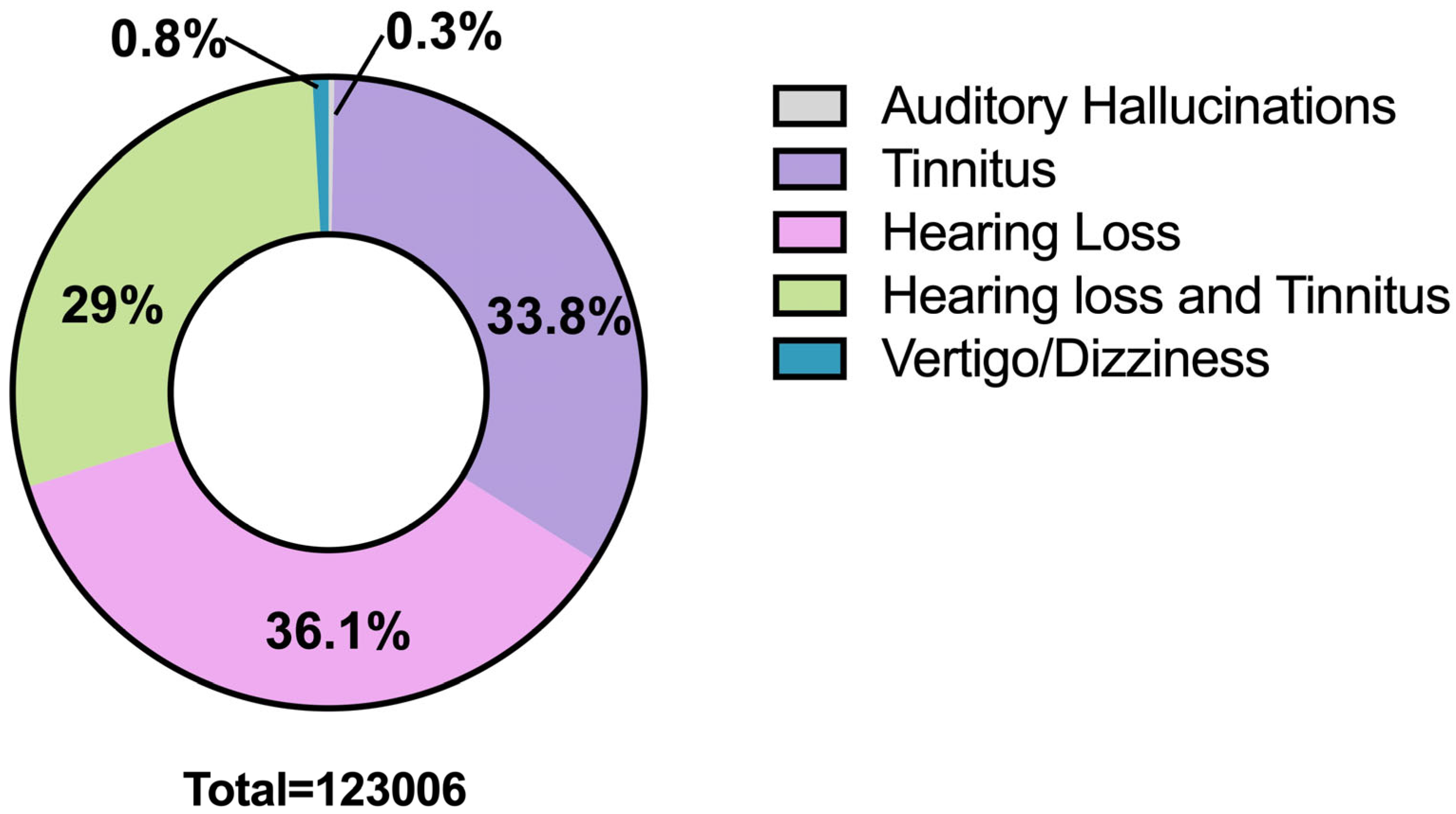
| Auditory Hallucinations | 36 | n/a | n/a | n/a | n/a | 106 | n/a | 120 | n/a | n/a | 38 | n/a | n/a | n/a | n/a | n/a | 60 | n/a | 360 |
| Tinnitus | n/a | n/a | 103 | n/a | 74 | n/a | n/a | n/a | 37,306 | n/a | n/a | 514 | 277 | 112 | n/a | n/a | n/a | 3038 | 41,424 |
| Hearing loss + Tinnitus | n/a | n/a | n/a | n/a | n/a | n/a | n/a | n/a | 35,583 | n/a | n/a | n/a | n/a | n/a | n/a | n/a | n/a | n/a | 35,583 |
| Hearing loss | n/a | n | n/a | 41 | 90 | n/a | n/a | n/a | 44,379 | n/a | n/a | n/a | n/a | n/a | n/a | n/a | n/a | n/a | 44,510 |
| Vertigo/ Dizziness | n/a | 10 | n/a | 156 | 24 | n/a | 50 | n/a | n/a | 45 | n/a | n/a | n/a | n/a | 245 | 480 | n/a | n/a | 1010 |
Disclaimer/Publisher’s Note: The statements, opinions and data contained in all publications are solely those of the individual author(s) and contributor(s) and not of MDPI and/or the editor(s). MDPI and/or the editor(s) disclaim responsibility for any injury to people or property resulting from any ideas, methods, instructions or products referred to in the content. |
© 2026 by the authors. Licensee MDPI, Basel, Switzerland. This article is an open access article distributed under the terms and conditions of the Creative Commons Attribution (CC BY) license.
Share and Cite
Roccamatisi, D.; Indovina, I.; De Luca, P.; Ralli, M.; Kaski, D.; Di Stadio, A. PTSD and Audio Vestibular Symptoms: A Two-Way Street Driven by the Amygdala? A Speculative Hypothesis. Brain Sci. 2026, 16, 282. https://doi.org/10.3390/brainsci16030282
Roccamatisi D, Indovina I, De Luca P, Ralli M, Kaski D, Di Stadio A. PTSD and Audio Vestibular Symptoms: A Two-Way Street Driven by the Amygdala? A Speculative Hypothesis. Brain Sciences. 2026; 16(3):282. https://doi.org/10.3390/brainsci16030282
Chicago/Turabian StyleRoccamatisi, Dalila, Iole Indovina, Pietro De Luca, Massimo Ralli, Diego Kaski, and Arianna Di Stadio. 2026. "PTSD and Audio Vestibular Symptoms: A Two-Way Street Driven by the Amygdala? A Speculative Hypothesis" Brain Sciences 16, no. 3: 282. https://doi.org/10.3390/brainsci16030282
APA StyleRoccamatisi, D., Indovina, I., De Luca, P., Ralli, M., Kaski, D., & Di Stadio, A. (2026). PTSD and Audio Vestibular Symptoms: A Two-Way Street Driven by the Amygdala? A Speculative Hypothesis. Brain Sciences, 16(3), 282. https://doi.org/10.3390/brainsci16030282