
Achievement Motivation, Meaning in Life, and Well-Being Among Video Game Players


Abstract
1. Introduction
2. Materials and Methods
2.1. Participants and Procedure
2.2. Demographics
2.3. Achievement Motivation
2.4. Meaning in Life
2.5. Well-Being
2.6. Statistical Analysis
3. Results
3.1. Basic Descriptive Characteristics
3.2. Correlation of Achievement Motivation, Meaning in Life, and Well-Being
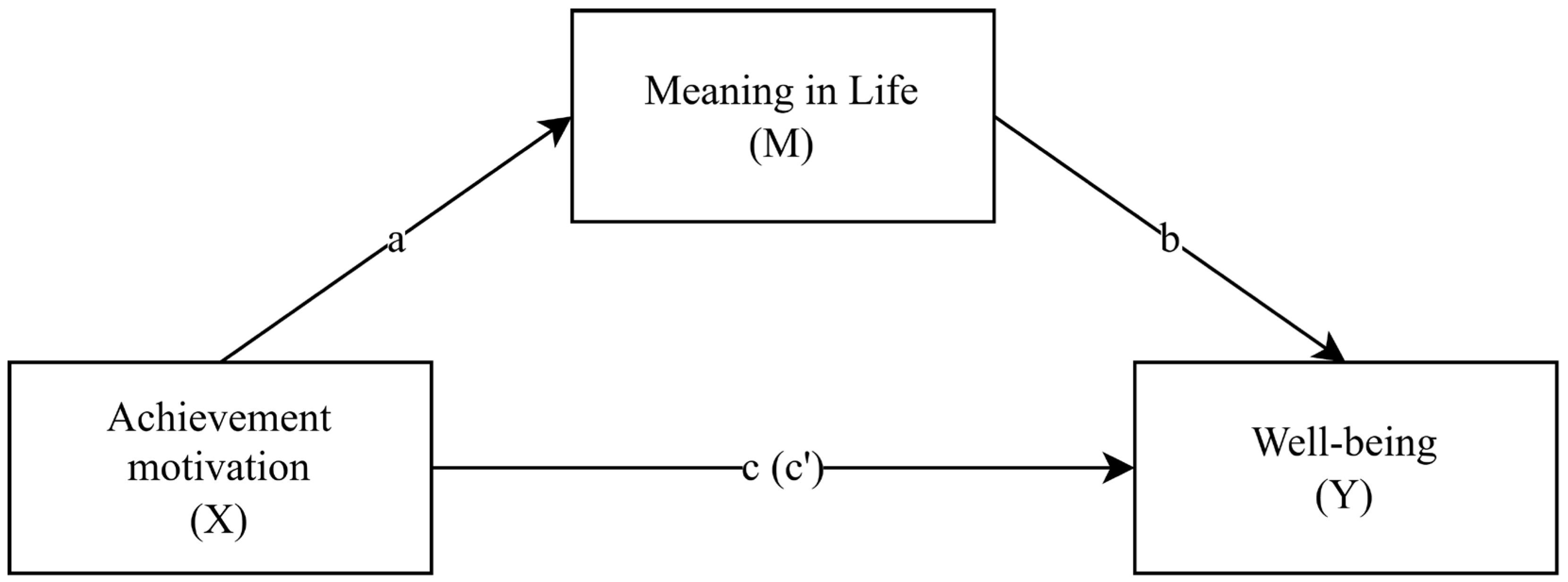
3.3. Mediation Analyses
3.4. Approach- and Avoidance-Motivation Group Comparisons
4. Discussion
5. Limitations and Future Directions
6. Conclusions
Author Contributions
Funding
Institutional Review Board Statement
Informed Consent Statement
Data Availability Statement
Acknowledgments
Conflicts of Interest
References
- Clement, J. Number of Steam MAU 2021. Available online: https://www.statista.com/statistics/733277/number-stream-dau-mau/ (accessed on 10 November 2024).
- Inaltun, U.; Ileri, M. OP-001 Adolescents’ digital game-playing habits and evaluation of game features. BMJ Paediatr. Open 2024, 8, A1–A116. [Google Scholar] [CrossRef]
- Kochetkov, N.V. Internet addiction and addiction to computer games in the work of Russian psychologists. Soc. Psychol. Soc. 2020, 11, 27–54. [Google Scholar] [CrossRef]
- Mikhailova, O. High school students involved and not involved in MMORPG: Creativity and innovativeness. Int. J. Cogn. Res. Sci. Eng. Educ. 2019, 7, 29–39. [Google Scholar] [CrossRef]
- Rahman, M.W.U.; Foxman, M.; Markowitz, D.M. Games as cognitive recreation: User perspectives on brain-training apps. Int. J. Hum. Comput. Interact. 2024, 41, 2312–2322. [Google Scholar] [CrossRef]
- Voiskounsky, A.; Yermolova, T.; Yagolkovskiy, S.; Khromova, V. Creativity in online gaming: Individual and dyadic performance in Minecraft. Psychol. Russ. State Art 2017, 10, 144–161. [Google Scholar] [CrossRef]
- Maraza-Quispe, B.; Traverso-Condori, L.C.; Torres-Gonzales, S.B.; Reyes-Arco, R.E.; Tinco-Túpac, S.T.; Reyes-Villalba, E.; Carpio-Ventura, J.D.R. Impact of the use of gamified online tools: A study with Kahoot and Quizizz in the educational context. Int. J. Inf. Educ. Technol. 2024, 14, 132–140. [Google Scholar] [CrossRef]
- Kilmer, E.; Spangler, J.; Kilmer, J. Therapeutically applied Minecraft groups with neurodivergent youth. F1000Research 2023, 12, 90. [Google Scholar] [CrossRef]
- Makalatia, A.; Matveeva, L. Subjective factors that influence children and adolescents to be attracted by computer games. Natl. Psychol. J. 2017, 1, 15–24. [Google Scholar] [CrossRef]
- Peterson, M. Computer games and learning. In Computer Games and Language Learning; Palgrave Macmillan: London, UK, 2013; pp. 3–19. [Google Scholar] [CrossRef]
- Ribeiro, T.; Veloso, A.; Brinson, P. Be a gamer: A psycho-social characterization of the player. In Advances in Human Factors, Business Management, Training and Education; Kovács, Z.T., Németh, A.D., Eds.; Springer: Cham, Switzerland, 2023; pp. 331–340. [Google Scholar] [CrossRef]
- Stępnik, A. E-sport z perspektywy teorii sportu. Homo Ludens 2009, 1, 213–222. [Google Scholar]
- Kiili, K.; Lindstedt, A.; Ninaus, M. Exploring characteristics of students’ emotions, flow and motivation in a math game competition. In Proceedings of the 2nd International GamiFIN Conference, Pori, Finland, 21–23 May 2018. [Google Scholar]
- Hazel, J.; Kim, H.M.; Every-Palmer, S. Exploring the possible mental health and wellbeing benefits of video games for adult players: A cross-sectional study. Australas. Psychiatry 2022, 30, 541–546. [Google Scholar] [CrossRef]
- Huang, S.-C.; Etkin, J.; Jin, L. How winning changes motivation in multiphase competitions. J. Pers. Soc. Psychol. 2017, 112, 813–837. [Google Scholar] [CrossRef] [PubMed]
- Vahlo, J.; Välisalo, T.; Tuuri, K. Informal learning and wellbeing outcomes of gameplay and their associations with gameplay motivation. Front. Psychol. 2023, 14, 1176773. [Google Scholar] [CrossRef] [PubMed]
- Abrudan, M.-C.; Voina, A.; Lăpuște, A. Computer role-playing games: Player motivations, preferences, and behavior. Stud. Univ. Babeș-Bolyai Ephemer. 2021, 66, 5–32. [Google Scholar] [CrossRef]
- Przybylski, A.K.; Rigby, C.S.; Ryan, R.M. A motivational model of video game engagement. Rev. Gen. Psychol. 2010, 14, 154–166. [Google Scholar] [CrossRef]
- Yee, N. Motivations for play in online games. Cyberpsychol. Behav. 2006, 9, 772–775. [Google Scholar] [CrossRef]
- Atkinson, J.W. Motivational determinants of risk-taking behavior. Psychol. Rev. 1957, 64, 359–372. [Google Scholar] [CrossRef]
- Wojdyło, K. Model integracyjny motywacji osiągnięć (MIMO). Now. Psychol. 2007, 4, 25–45. [Google Scholar]
- Dweck, C.S. Motivational processes affecting learning. Am. Psychol. 1986, 41, 1040–1048. [Google Scholar] [CrossRef]
- Elliot, A.J.; Church, M.A. A hierarchical model of approach and avoidance achievement motivation. J. Pers. Soc. Psychol. 1997, 72, 218–232. [Google Scholar] [CrossRef]
- Elliot, A.J.; McGregor, H.A. A 2 × 2 achievement goal framework. J. Pers. Soc. Psychol. 2001, 80, 501–519. [Google Scholar] [CrossRef]
- Steger, M.F.; Frazier, P.; Oishi, S.; Kaler, M. The meaning in life questionnaire: Assessing the presence of and search for meaning in life. J. Couns. Psychol. 2006, 53, 80–93. [Google Scholar] [CrossRef]
- Steger, M.F.; Oishi, S.; Kesibir, S. Is a life without meaning satisfying? The moderating role of the search for meaning in satisfaction with life judgments. J. Posit. Psychol. 2011, 6, 173–180. [Google Scholar] [CrossRef]
- Onyekachi, B.N.; Aliche, J.C.; Mefoh, P.C.; Ogbu, O. Relationship between social support, meaning in life, depression, and suicide behaviour among medical students. Curr. Psychol. 2023, 43, 13749–13757. [Google Scholar] [CrossRef]
- Huda, N.; Lala, B.; Suneel, I. Meaning in life and life satisfaction among university students. J. Prof. Appl. Psychol. 2023, 4, 181–189. [Google Scholar] [CrossRef]
- Demir, S.; Isgör, I.Y.; Yilmaz, Y. Predictive Effect of Meaning of Life on Psychological Well-Being and Happiness among University Students. Educ. Policy Anal. Strateg. Res. 2023, 18, 27–48. [Google Scholar] [CrossRef]
- Park, C.L.; Knott, C.L.; Williams, R.M.; Clark, E.M.; Williams, B.R.; Schulz, E. Meaning in life predicts decreased depressive symptoms and increased positive affect over time but does not buffer stress effects in a national sample of African-Americans. J. Happiness Stud. 2020, 21, 3037–3049. [Google Scholar] [CrossRef]
- Rasheed, N.; Fatima, I.; Tariq, O. University students’ mental well-being during COVID-19 pandemic: The mediating role of resilience between meaning in life and mental well-being. Acta Psychol. 2022, 227, 103618. [Google Scholar] [CrossRef]
- Michaelson, J.; Mahony, S.; Schifferes, J. Measuring Wellbeing: A Guide for Practitioners; New Economics Foundation: London, UK, 2012. [Google Scholar]
- National Research Council. Subjective Well-Being: Measuring Happiness, Suffering, and Other Dimensions of Experience; National Academies Press: Washington, DC, USA, 2014. [Google Scholar]
- Jarden, A.; Roache, A. What is wellbeing? Int. J. Environ. Res. Public Health 2023, 20, 5006. [Google Scholar] [CrossRef]
- Abbas, N.; Raza, M.; Hussain, W.; Abbas, K. Aristotle’s eudemonia and its impact on human well-being in modern psychology: A critical analysis. Int. J. Contemp. Issues Soc. Sci. 2024, 3, 2307–2318. [Google Scholar]
- Wnuk, M. Hedonizm, eudajmonizm oraz przepływ/zaangażowanie jako trzy nurty badań nad szczęściem. Hygeia Public Health 2013, 48, 285–288. [Google Scholar]
- Ryff, C.D. Happiness is everything, or is it? Explorations on the meaning of psychological well-being. J. Pers. Soc. Psychol. 1989, 57, 1069–1081. [Google Scholar] [CrossRef]
- Akbar, A.; Cahyani, F. Integrating sport psychology in grassroots football: Enhancing performance and well-being. J. Patriot. 2024, 6, 82–88. [Google Scholar] [CrossRef]
- Eőry, A.; Radvanyi, K.; Kudrinko, S.; Vajda, G.; Rózsa, S.; Kellermayer, M. Components of well-being and distress that foster resilience in medical students. Eur. Psychiatry 2024, 67, S236. [Google Scholar] [CrossRef]
- Pfund, G.; Springstein, T.; Willroth, E. Associations Among Well-Being Components and Big Five Personality Domains: Nomothetic and Idiographic Perspectives; OSF: New York, NY, USA, 2024. [Google Scholar] [CrossRef]
- Yuen, M.; Lee, Q.; Chung, Y. Meaning in life, connectedness, and life skills development in junior secondary school students: Teachers’ perspectives in Hong Kong. Pastor. Care Educ. 2021, 39, 67–83. [Google Scholar] [CrossRef]
- Ahmad, L. A comparative study of the meaning of life, academic motivation, learning styles, study habits, and academic achievement between university and college students in different educational institutions. Migr. Lett. 2024, 21, 525–544. [Google Scholar] [CrossRef]
- Ahmadi, E.; Kohl, H. Role of meaning of life and spiritual intelligence in predicting the mental well-being of students. Spiritual. Res. Health Sci. 2023, 1, 107–119. [Google Scholar] [CrossRef]
- Zang, W.; Zhang, C. The influence of college students’ sense of life meaning on psychological well-being: The mediating roles of positive emotions and life adaptation. Nurture 2024, 18, 302–314. [Google Scholar] [CrossRef]
- Jianhua, Z.; Huebner, E.; Tian, L. Longitudinal associations and mechanisms between achievement goals and subjective well-being in school in Chinese adolescents. Sch. Ment. Health 2020, 12, 12–24. [Google Scholar] [CrossRef]
- Chen, C. Incremental validity of achievement goals in predicting subjective well-being among university students. J. Cogn. Educ. Psychol. 2015, 14, 38–53. [Google Scholar] [CrossRef]
- Bailey, T.H.; Phillips, L.J. The influence of motivation and adaptation on students’ subjective well-being, meaning in life and academic performance. High. Educ. Res. Dev. 2016, 35, 201–216. [Google Scholar] [CrossRef]
- Park, C.L. Making sense of the meaning literature: An integrative review of meaning making and its effects on adjustment to stressful life events. Psychol. Bull. 2010, 136, 257–301. [Google Scholar] [CrossRef] [PubMed]
- Csikszentmihalyi, M. Flow: The Psychology of Happiness; Rider: London, UK, 2022. [Google Scholar]
- King, D.L.; Delfabbro, P.H.; Griffiths, M.D. Video game structural characteristics: A new psychological taxonomy. Int. J. Ment. Health Addict. 2010, 8, 90–106. [Google Scholar] [CrossRef]
- Juul, J. The Art of Failure: An Essay on the Pain of Playing Video Games; MIT Press: Cambridge, MA, USA, 2013. [Google Scholar]
- Rigby, S.; Ryan, R.M. Glued to Games: How Video Games Draw Us in and Hold Us Spellbound; Praeger: Santa Barbara, CA, USA, 2011. [Google Scholar]
- Granic, I.; Lobel, A.; Engels, R.C.M. The benefits of playing video games. Am. Psychol. 2014, 69, 66–78. [Google Scholar] [CrossRef] [PubMed]
- Wojdyło, K.; Retowski, S. Kwestionariusz Celów związanych z Osiągnięciami (KCO)–konstrukcja i charakterystyka psychometryczna. Przegląd Psychol. 2012, 55, 9–28. [Google Scholar]
- Kossakowska, M.; Kwiatek, P.; Stefaniak, T. Sens w życiu. Polska wersja kwestionariusza MLQ (Meaning in life. Polish version of MLQ). Psychol. Jakości Życia 2013, 12, 111–131. [Google Scholar] [CrossRef]
- World Health Organization. Wellbeing Measures in Primary Health Care/The Depcare Project; WHO Regional Office for Europe: Copenhagen, Denmark, 1998. [Google Scholar]
- Cichoń, E.; Kiejna, A.; Kokoszka, A.; Gondek, T.; Rajba, B.; Lloyd, C.E.; Sartorius, N. Validation of the Polish version of WHO-5 as a screening instrument for depression in adults with diabetes. Diabetes Res. Clin. Pract. 2020, 159, 107970. [Google Scholar] [CrossRef]
- Hayes, A.F. Introduction to Mediation, Moderation, and Conditional Process Analysis: A Regression-Based Approach; Guilford Publications: New York, NY, USA, 2017. [Google Scholar]
- Havlicek, L.L.; Peterson, N.L. Robustness of the Pearson correlation against violations of assumptions. Percept. Mot. Ski. 1976, 43, 1319–1334. [Google Scholar] [CrossRef]
- Mishra, P.; Pandey, C.M.; Singh, U.; Gupta, A.; Sahu, C.; Keshri, A. Descriptive Statistics and Normality Tests for Statistical Data. Ann. Card. Anaesth. 2019, 22, 67–72. [Google Scholar] [CrossRef]
- Seifert, T.L.; O’Keefe, B.A. The relationship of work avoidance and learning goals to perceived competence, externality and meaning. Br. J. Educ. Psychol. 2001, 71, 81–92. [Google Scholar] [CrossRef]
- Hygen, B.; Wendelborg, C.; Solstad, B.; Stenseng, F.; Øverland, M.; Skalicka, V. Gaming motivation and well-being among Norwegian adult gamers: The role of gender and disability. Front. Med. Technol. 2024, 6, 1330926. [Google Scholar] [CrossRef]
- Wang, H.-Y.; Cheng, C. The associations between gaming motivation and internet gaming disorder: Systematic review and meta-analysis. JMIR Ment. Health 2022, 9, e23700. [Google Scholar] [CrossRef]
- Schippers, M.C.; Ziegler, N. Life crafting as a way to find purpose and meaning in life. Front. Psychol. 2019, 10, 2778. [Google Scholar] [CrossRef]
- Couper, M.P.; Zhang, C. Helping respondents provide good answers in Web surveys. Surv. Res. Methods 2016, 10, 49–64. [Google Scholar] [CrossRef]
- MacCallum, R.C.; Zhang, S.; Preacher, K.J.; Rucker, D.D. On the practice of dichotomization of quantitative variables. Psychol. Methods 2002, 7, 19–40. [Google Scholar] [CrossRef]
- Spurk, D.; Hirschi, A.; Wang, M.; Valero, D.; Kauffeld, S. Latent profile analysis: A review and “how-to” guide of its application within vocational behavior research. J. Vocat. Behav. 2020, 120, 103445. [Google Scholar] [CrossRef]


| Variable | Research Sample (N = 296) | Players with Approach Motivation (n = 142) | Players with Avoidance Motivation (n = 154) | |||
|---|---|---|---|---|---|---|
| n | % | n | % | n | % | |
| Sex | ||||||
| Men | 192 | 64.9 | 98 | 69.0 | 94 | 61.0 |
| Women | 104 | 35.1 | 44 | 31.0 | 60 | 39.0 |
| Education level | ||||||
| Vocational | 6 | 2.0 | 2 | 1.4 | 4 | 2.6 |
| Secondary | 207 | 69.9 | 88 | 62.0 | 119 | 77.3 |
| Higher | 83 | 28.0 | 52 | 36.6 | 31 | 20.1 |
| Size of Place of Residence | ||||||
| Rural area | 61 | 20.6 | 27 | 19.0 | 34 | 22.1 |
| Town up to 50,000 inhabitants | 41 | 13.9 | 18 | 12.7 | 23 | 14.9 |
| Town from 50,000 to 100,000 inhabitants | 38 | 12.8 | 18 | 12.7 | 20 | 13.0 |
| City from 100,000 to 500,000 inhabitants | 86 | 29.1 | 45 | 31.7 | 41 | 26.6 |
| City over 500,000 inhabitants | 70 | 23.6 | 34 | 23.9 | 36 | 23.4 |
| Variable | Min. | Max. | M | SD | Skewness | Kurtosis | W |
|---|---|---|---|---|---|---|---|
| Mastery-Approach Goals | 6 | 42 | 30.11 | 6.71 | −0.78 | 0.79 | 0.96 *** |
| Performance-Approach Goals | 5 | 35 | 16.25 | 6.87 | 0.37 | −0.32 | 0.98 *** |
| Mastery-Avoidance Goals | 5 | 35 | 21.30 | 7.39 | −0.23 | −0.82 | 0.97 *** |
| Performance-Avoidance Goals | 4 | 28 | 13.44 | 5.82 | 0.38 | −0.49 | 0.97 *** |
| Meaning in Life | 10 | 70 | 45.70 | 10.42 | −0.40 | 0.75 | 0.98 ** |
| Presence of Meaning in Life | 5 | 35 | 21.19 | 8.02 | −0.10 | −0.87 | 0.97 *** |
| Search for Meaning in Life | 5 | 35 | 24.51 | 6.31 | −0.86 | 0.84 | 0.95 *** |
| Well-being | 1 | 25 | 13.02 | 4.94 | 0.04 | −0.60 | 0.99 * |
| 1 | 2 | 3 | 4 | 5 | 6 | 7 | |
|---|---|---|---|---|---|---|---|
| M-AP (1) | - | ||||||
| P-AP (2) | 0.35 *** [0.25, 0.45] | - | |||||
| M-AV (3) | 0.41 *** [0.32, 0.50] | 0.23 *** [0.12, 0.33] | - | ||||
| P-AV (4) | 0.33 *** [0.22, 0.43] | 0.56 *** [0.47, 0.63] | 0.57 *** [0.48, 0.64] | - | |||
| MLQ (5) | 0.19 *** [0.08, 0.30] | 0.13 * [0.02, 0.24] | −0.08 [−0.19, 0.04] | −0.02 [−0.14, 0.09] | - | ||
| MLQ-P (6) | 0.13 * [0.02, 0.24] | 0.08 [−0.04, 0.19] | −0.30 *** [−0.40, −0.19] | −0.13 * [−0.24, −0.02] | 0.80 *** [0.75, 0.84] | - | |
| MLQ-S (7) | 0.15 ** [0.04, 0.26] | 0.12 * [0.01, 0.23] | 0.25 *** [0.14, 0.35] | 0.13 * [0.02, 0.24] | 0.64 *** [0.57, 0.70] | 0.05 [−0.07, 0.16] | - |
| WB | −0.02 [−0.14, 0.09] | 0.06 [−0.06, 0.17] | −0.41 *** [−0.50, −0.31] | −0.19 *** [−0.30, −0.08] | 0.44 *** [0.34, 0.53] | 0.55 *** [0.47, 0.63] | 0.02 [−0.09, 0.14] |
| Model | a | b | c | c’ | Indirect | 95% CI | |
|---|---|---|---|---|---|---|---|
| LL | UL | ||||||
| Mastery-Approach Goal Model | 0.30 *** [0.12, 0.47] | 0.22 *** [0.17, 0.27] | −0.02 [−0.10, 0.07] | −0.08 * [−0.16, −0.01] | 0.07 | 0.02 | 0.12 |
| Performance-Approach Goal Model | 0.20 * [0.02, 0.38] | 0.01 [−0.07, 0.26] | 0.04 [−0.04, 0.16] | 0.21 *** [0.16, 0.26] | 0.04 | −0.01 | 0.09 |
| Variable | Approach (n = 142) | Avoidance (n = 154) | F | t | g | ||
|---|---|---|---|---|---|---|---|
| M | SD | M | SD | ||||
| MLQ | 48.42 | 10.92 | 43.20 | 9.30 | 3.50 | 4.44 *** | 0.52 |
| MLQ-P | 23.84 | 7.80 | 18.75 | 7.44 | 0.36 | 5.74 *** | 0.67 |
| MLQ-S | 24.58 | 6.53 | 24.45 | 6.12 | 0.98 | 0.18 | 0.02 |
| WHO-5 | 14.59 | 4.57 | 11.57 | 4.84 | 0.32 | 5.52 *** | 0.64 |
Disclaimer/Publisher’s Note: The statements, opinions and data contained in all publications are solely those of the individual author(s) and contributor(s) and not of MDPI and/or the editor(s). MDPI and/or the editor(s) disclaim responsibility for any injury to people or property resulting from any ideas, methods, instructions or products referred to in the content. |
© 2026 by the authors. Licensee MDPI, Basel, Switzerland. This article is an open access article distributed under the terms and conditions of the Creative Commons Attribution (CC BY) license.
Share and Cite
Wierzbicki, M.; Rodzeń, W. Achievement Motivation, Meaning in Life, and Well-Being Among Video Game Players. Brain Sci. 2026, 16, 86. https://doi.org/10.3390/brainsci16010086
Wierzbicki M, Rodzeń W. Achievement Motivation, Meaning in Life, and Well-Being Among Video Game Players. Brain Sciences. 2026; 16(1):86. https://doi.org/10.3390/brainsci16010086
Chicago/Turabian StyleWierzbicki, Maciej, and Wojciech Rodzeń. 2026. "Achievement Motivation, Meaning in Life, and Well-Being Among Video Game Players" Brain Sciences 16, no. 1: 86. https://doi.org/10.3390/brainsci16010086
APA StyleWierzbicki, M., & Rodzeń, W. (2026). Achievement Motivation, Meaning in Life, and Well-Being Among Video Game Players. Brain Sciences, 16(1), 86. https://doi.org/10.3390/brainsci16010086