
Methods of Computational Modelling in Studies of Transcranial Direct Current Stimulation (tDCS) in Adults to Inform Protocols for Tinnitus Treatment: A Scoping Review
 , , , , and
Abstract
1. Introduction

1.1. Aims
1.2. Rationale
1.3. Objectives
- (i).
- the stimulation parameters reported in current modelling studies of tDCS,
- (ii).
- the different approaches and steps taken in current modelling,
- (iii).
- the predicted current intensity measured at the cortical level.
2. Materials and Methods
2.1. Eligibility Criteria
2.2. Search Strategy
2.3. Title and Abstract Screening
2.4. Full Text Screening
2.5. Data Charting
2.6. Data Items
3. Results
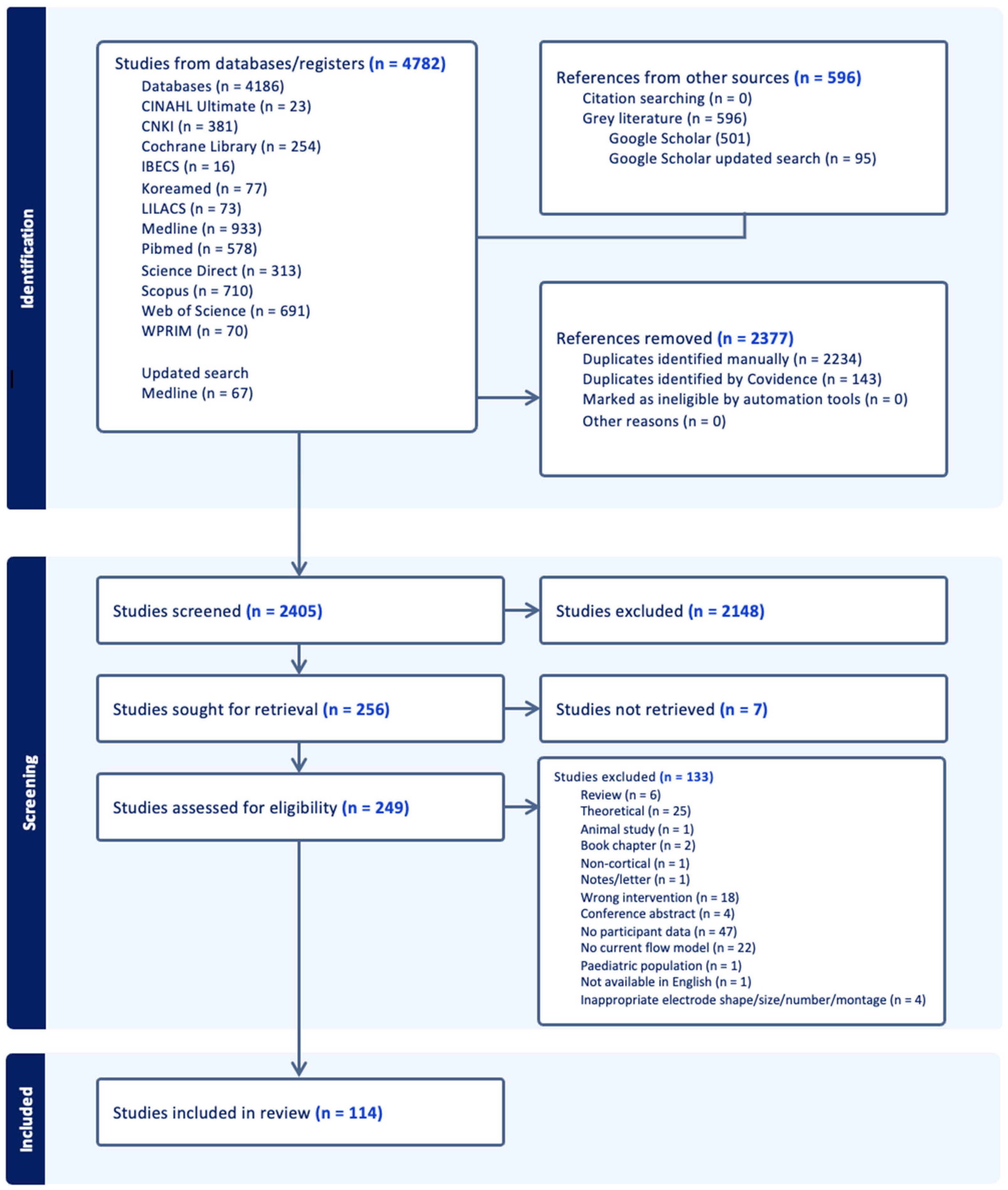
3.1. Selection of Sources of Evidence
3.2. Characteristics of Sources of Evidence
3.3. Region of Interest (ROI)
3.4. Conditions and Contexts of Study
3.5. Factors Influencing tDCS-Induced Electric Field
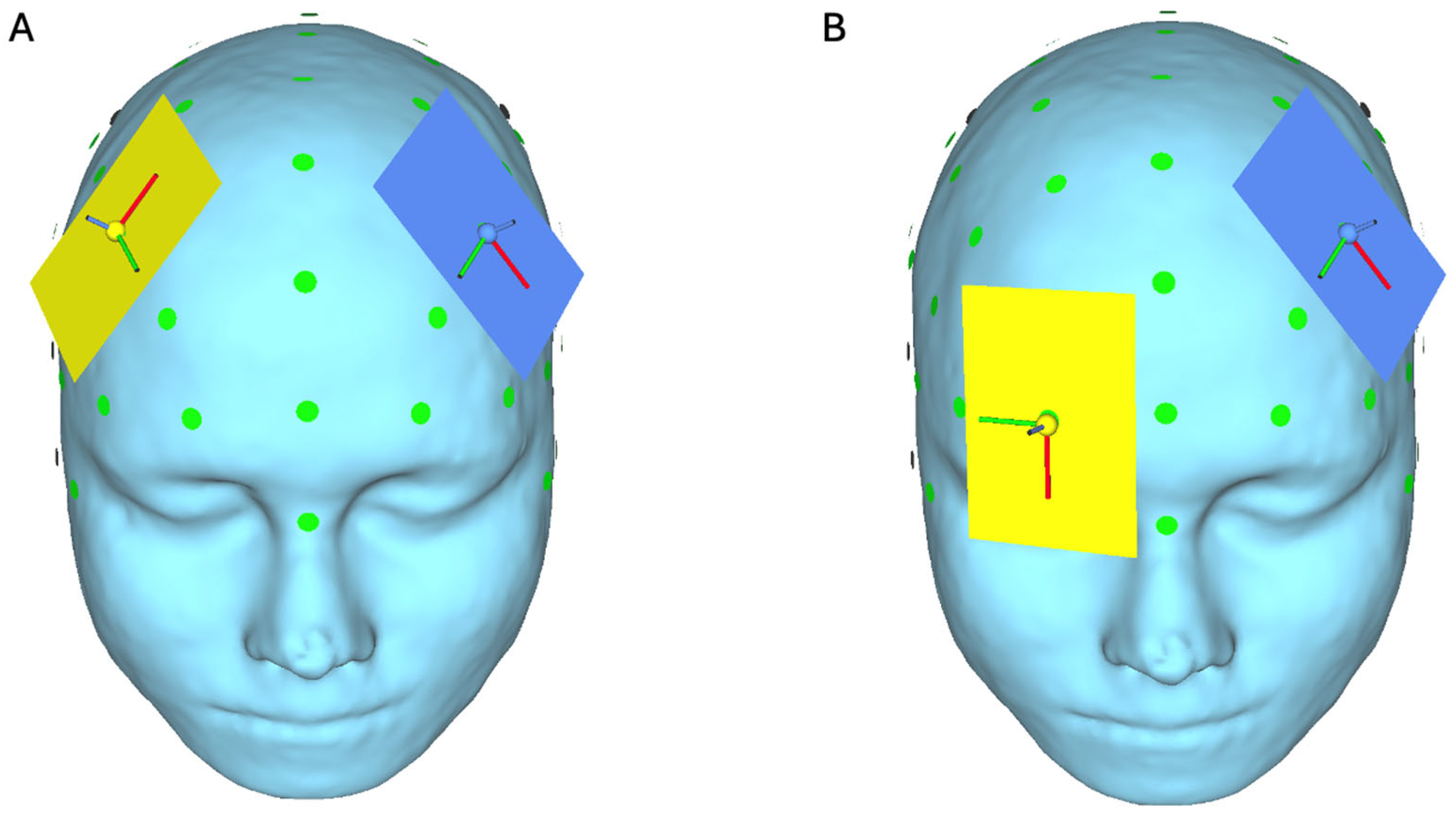
3.6. Electrode Montage, Materials, and Dimensions
3.7. MRI Acquisition
3.8. Segmentation
3.9. Modelling Pipeline
3.10. Applied Current Intensity
3.11. Target Current Intensity
3.12. Peak Current Intensity
3.13. Analysis and Visualisation
4. Discussion
4.1. Data Origin
4.2. Individualised Head Models
4.3. Stimulation Parameters
4.4. Impacts for Non-Programming Experts
- Use an open-source package such as SimNIBS or ROAST. These packages bring together and automate all the toolboxes necessary to complete the modelling pipeline and provide a wealth of support, datasets, tutorials, and documentation with few inequities in software accessibility. If there is a preference or possibility to use proprietary software, it is advisable to use a package that encompasses and automates as much of the process as possible, such as Neurophet tES Lab, and provides extensive support for users.
- Make use of the package documentation. The authors provide comprehensive instructions that can be followed without programming knowledge, as well as pre-written scripts for the standard uses of the packages.
- For segmentation, use both T1- and T2- weighted anatomical MR images and convert them to NiFTI format (can be performed using software such as MRIcron v1.0 or MRIcroGL v1.2). This produces a more robust segmentation than using only T1-weighted images, particularly for the boundaries of the skull.
- If the software allows, check the segmentation visually for errors and correct if necessary (e.g in FreeSurfer).
- Make use of the GUI. Use of a model setup which is consistent with active stimulation. The GUI allows the user to visualise electrodes to ensure they are modelled with the same orientation, position and size that may be used on participants.
- Use the default conductivity values, as these are based on physiological studies of tissue conductivity. Similarly, use the default mesh settings as these are sufficient for standard use.
- Set the electrode dimensions, position, and orientation as they would appear for active stimulation. This includes defining whether gel or saline is used, and the thickness at which they will be applied.
- Minimum reporting includes the peak electric field magnitude and current density.
4.5. Outcome Reporting
4.6. Inter-Individual Differences
4.7. Future Directions
4.8. Limitations
5. Conclusions
Supplementary Materials
Author Contributions
Funding
Institutional Review Board Statement
Data Availability Statement
Conflicts of Interest
Abbreviations
| AMED | Allied and Complementary Medicine Database |
| APA | American Psychological Association |
| CENTRAL | Cochrane Central Register of Controlled Trials |
| CINAHL | Cumulative Index to Nursing and Allied Health Literature |
| CNKI | China National Knowledge Infrastructure |
| CSF | Cerebrospinal fluid |
| DICOM | Digital imaging and communications in medicine |
| DLPFC | Dorsolateral prefrontal cortex |
| FEM | Finite element model |
| GM | Grey matter |
| GUI | Graphical use interface |
| HD-tDCS | High definition transcranial direct current stimulation |
| IBECS | Indice Bibliográfico Español en Ciencias de la Salud |
| LILACS | Latin American and Caribbean Health Sciences Literature |
| M1 | Primary motor cortex |
| MRI | Magnetic resonance image |
| NIfTI | Neuroimaging Informatics Technology initiative |
| ROI | Region of interest |
| SPM | Statistical parametric mapping |
| tDCS | Transcranial direct current stimulation |
| tES | Transcranial electric stimulation |
| WM | White matter |
| WPRIM | Western Pacific Region Index Medicus |
References
- Langguth, B.; Kreuzer, P.M.; Kleinjung, T.; De Ridder, D. Tinnitus: Causes and clinical management. Lancet Neurol. 2013, 12, 920–930. [Google Scholar] [CrossRef]
- De Ridder, D.; Schlee, W.; Vanneste, S.; Londero, A.; Weisz, N.; Kleinjung, T.; Shekhawat, G.S.; Elgoyhen, A.B.; Song, J.J.; Andersson, G.; et al. Tinnitus and tinnitus disorder: Theoretical and operational definitions (an international multidisciplinary proposal). Prog. Brain Res. 2021, 260, 1–25. [Google Scholar] [CrossRef]
- Jastreboff, P.J. Phantom auditory perception (tinnitus): Mechanisms of generation and perception. Neurosci. Res. 1990, 8, 221–254. [Google Scholar] [CrossRef]
- Adjamian, P.; Hall, D.A.; Palmer, A.R.; Allan, T.W.; Langers, D.R.M. Neuroanatomical abnormalities in chronic tinnitus in the human brain. Neurosci. Biobehav. Rev. 2014, 45, 119–133. [Google Scholar] [CrossRef] [PubMed]
- Cima, R.F.F.; Kikidis, D.; Mazurek, B.; Haider, H.; Cederroth, C.R.; Norena, A.; Lapira, A.; Bibas, A.; Hoare, D.J. Tinnitus healthcare: A survey revealing extensive variation in opinion and practices across Europe. BMJ Open 2020, 10, e029346. [Google Scholar] [CrossRef]
- Fregni, F.; El-Hagrassy, M.M.; Pacheco-Barrios, K.; Carvalho, S.; Leite, J.; Simis, M.; Brunelin, J.; Nakamura-Palacios, E.M.; Marangolo, P.; Venkatasubramanian, G.; et al. Evidence-Based Guidelines and Secondary Meta-Analysis for the Use of Transcranial Direct Current Stimulation in Neurological and Psychiatric Disorders. Int. J. Neuropsychopharmacol. 2021, 24, 256–313. [Google Scholar] [CrossRef] [PubMed]
- Priori, A. Brain polarization in humans: A reappraisal of an old tool for prolonged non-invasive modulation of brain excitability. Clin. Neurophysiol. 2003, 114, 589–595. [Google Scholar] [CrossRef]
- Piccolino, M. Animal electricity and the birth of electrophysiology: The legacy of Luigi Galvani. Brain Res. Bull. 1998, 46, 381–407. [Google Scholar] [CrossRef]
- Nitsche, M.A.; Paulus, W. Excitability changes induced in the human motor cortex by weak transcranial direct current stimulation. J. Physiol. 2000, 527, 633–639. [Google Scholar] [CrossRef]
- Nitsche, M.A.; Paulus, W. Sustained excitability elevations induced by transcranial DC motor cortex stimulation in humans. Neurology 2001, 57, 1899–1901. [Google Scholar] [CrossRef] [PubMed]
- Labree, B.; Hoare, D.J.; Gascoyne, L.E.; Scutt, P.; Del Giovane, C.; Sereda, M. Determining the Effects of Transcranial Direct Current Stimulation on Tinnitus, Depression, and Anxiety: A Systematic Review. Brain Sci. 2022, 12, 484. [Google Scholar] [CrossRef]
- Hoare, D.J.; Shorter, G.W.; Shekhawat, G.S.; El Refaie, A.; Labree, B.; Sereda, M. Neuromodulation Treatments Targeting Pathological Synchrony for Tinnitus in Adults: A Systematic Review. Brain Sci. 2024, 14, 748. [Google Scholar] [CrossRef]
- Evans, C.; Bachmann, C.; Lee, J.S.; Gregoriou, E.; Ward, N.; Bestmann, S. Dose-controlled tDCS reduces electric field intensity variability at a cortical target site. Brain Stimul. 2020, 13, 125–136. [Google Scholar] [CrossRef] [PubMed]
- Opitz, A.; Paulus, W.; Will, S.; Antunes, A.; Thielscher, A. Determinants of the electric field during transcranial direct current stimulation. NeuroImage 2015, 109, 140–150. [Google Scholar] [CrossRef] [PubMed]
- Van Hoornweder, S.; Cappozzo, V.; De Herde, L.; Puonti, O.; Siebner, H.R.; Meesen, R.L.J.; Thielscher, A. Head and shoulders—The impact of an extended head model on the simulation and optimization of transcranial electric stimulation. Imaging Neurosci. 2024, 2, imag-2-00379. [Google Scholar] [CrossRef] [PubMed]
- Dyke, K.; Kim, S.; Jackson, G.M.; Jackson, S.R. Intra-Subject Consistency and Reliability of Response Following 2 mA Transcranial Direct Current Stimulation. Brain Stimul. 2016, 9, 819–825. [Google Scholar] [CrossRef]
- Arksey, H.; O’Malley, L. Scoping studies: Towards a methodological framework. Int. J. Soc. Res. Methodol. 2005, 8, 19–32. [Google Scholar] [CrossRef]
- Tricco, A.C.; Lillie, E.; Zarin, W.; O’Brien, K.K.; Colquhoun, H.; Levac, D.; Moher, D.; Peters, M.D.J.; Horsley, T.; Weeks, L.; et al. PRISMA Extension for Scoping Reviews (PRISMA-ScR): Checklist and Explanation. Ann. Intern. Med. 2018, 169, 467–473. [Google Scholar] [CrossRef]
- Jacquemin, L.; Shekhawat, G.S.; Van De Heyning, P.; Mertens, G.; Fransen, E.; Van Rompaey, V.; Topsakal, V.; Moyaert, J.; Beyers, J.; Gilles, A. Effects of Electrical Stimulation in Tinnitus Patients: Conventional Versus High-Definition tDCS. Neurorehabilit. Neural Repair 2018, 32, 714–723. [Google Scholar] [CrossRef]
- Mezger, E.; Brunoni, A.R.; Hasan, A.; Häckert, J.; Strube, W.; Keeser, D.; Padberg, F.; Palm, U. tDCS for auditory verbal hallucinations in a case of schizophrenia and left frontal lesion: Efield simulation and clinical results. Neurocase 2020, 26, 241–247. [Google Scholar] [CrossRef]
- Halko, M.; Datta, A.; Plow, E.B.; Scaturro, J.; Bikson, M.; Merabet, L.B. Neuroplastic changes following rehabilitative training correlate with regional electrical field induced with tDCS. Neuroimage 2011, 57, 885–891. [Google Scholar] [CrossRef]
- Im, S.; Park, G.Y.; Kim, T.W.; Lim, S.H. Optimized trans-cranial direct current stimulation for prolonged consciousness disorder in a patient with titanium mesh cranioplasty. Neurol. Sci. 2024, 45, 3513–3516. [Google Scholar] [CrossRef]
- Dasilva, A.F.; Datta, A.; Mendonca, M.E.; Zaghi, S.; Lopes, M.; DosSantos, M.F.; Spierings, E.L.; Bajwa, Z.; Bikson, M.; Fregni, F. Chronic migraine alleviation by tDCS is predicted to be associated with current flow through pain-related (SUB)cortical regions. Cephalalgia 2011, 31, 41. [Google Scholar] [CrossRef]
- Oostendorp, T.F.; Hengeveld, Y.A.; Wolters, C.H.; Stinstra, J.; van Elswijk, G.; Stegeman, D.F. Modeling transcranial DC stimulation. In Proceedings of the 2008 30th Annual International Conference of the IEEE Engineering in Medicine and Biology Society, Vancouver, BC, Canada, 20–25 August 2008; Volume 2008, pp. 4226–4229. [Google Scholar] [CrossRef]
- Bhattacharjee, S.; Kashyap, R.; Goodwill, A.M.; O’Brien, B.A.; Rapp, B.; Oishi, K.; Desmond, J.E.; Chen, S.A. Sex difference in tDCS current mediated by changes in cortical anatomy: A study across young, middle and older adults. Brain Stimul. 2022, 15, 125–140. [Google Scholar] [CrossRef] [PubMed]
- Datta, A.; Thomas, C.; Huang, Y.; Venkatasubramanian, G. Exploration of the Effect of Race on Cortical Current Flow Due to Transcranial Direct Current Stimulation: Comparison across Caucasian, Chinese, and Indian Standard Brains. In Proceedings of the 2018 40th Annual International Conference of the IEEE Engineering in Medicine and Biology Society (EMBS), Honolulu, HI, USA, 18–21 July 2018; pp. 2341–2344. [Google Scholar]
- Marcus, D.S.; Wang, T.H.; Parker, J.; Csernansky, J.G.; Morris, J.C.; Buckner, R.L. Open Access Series of Imaging Studies (OASIS): Cross-sectional MRI data in young, middle aged, nondemented, and demented older adults. J. Cogn. Neurosci. 2007, 19, 1498–1507. [Google Scholar] [CrossRef] [PubMed]
- Kim, J.-H.; Kim, D.-W.; Chang, W.-H.; Kim, Y.-H.; Im, C.-H. Inconsistent outcomes of transcranial direct current stimulation (tDCS) may be originated from the anatomical differences among individuals: A simulation study using individual MRI data. In Proceedings of the 2013 35th Annual International Conference of the IEEE Engineering in Medicine and Biology Society (EMBC), Osaka, Japan, 3–7 July 2013; pp. 823–825. [Google Scholar] [CrossRef]
- Boayue, N.; Csifcsák, G.; Puonti, O.; Thielscher, A.; Mittner, M. Head models of healthy and depressed adults for simulating the effects of non-invasive brain stimulation. F1000Research 2018, 7, 704. [Google Scholar] [CrossRef]
- Pancholi, U.; Dave, V. Quantification of electric field strength of tDCS in alzheimer’s and mild cognitive impairment patients. Int. J. Adv. Technol. Eng. Explor. 2021, 8, 1168–1182. [Google Scholar] [CrossRef]
- Rasmussen, I.D.; Mittner, M.; Boayue, N.M.; Csifcsák, G.; Aslaksen, P.M. Tracking the current in the Alzheimer’s brain—Systematic differences between patients and healthy controls in the electric field induced by tDCS. Neuroimage Rep. 2023, 3, 100172. [Google Scholar] [CrossRef]
- Seibt, O.; Brunoni, A.R.; Huang, Y.; Bikson, M. The Pursuit of DLPFC: Non-neuronavigated Methods to Target the Left Dorsolateral Pre-frontal Cortex With Symmetric Bicephalic Transcranial Direct Current Stimulation (tDCS). Brain Stimul. 2015, 8, 590–602. [Google Scholar] [CrossRef] [PubMed]
- Soleimani, G.; Kuplicki, R.; Camchong, J.; Opitz, A.; Paulus, M.P.; Lim, K.O.; Ekhtiari, H. Are we really targeting and stimulating DLPFC by placing transcranial electrical stimulation (tES) electrodes over F3/F4? Hum. Brain Mapp. 2023, 44, 6275–6287. [Google Scholar] [CrossRef]
- Soleimani, G.; Saviz, M.; Bikson, M.; Towhidkhah, F.; Kuplicki, R.; Paulus, M.P.; Ekhtiari, H. Group and individual level variations between symmetric and asymmetric DLPFC montages for tDCS over large scale brain network nodes. Sci. Rep. 2021, 11, 1271. [Google Scholar] [CrossRef]
- Soleimani, G.; Saviz, M.; Towhidkhah, F.; Ekhtiari, H. Group-level analysis of tDCS induced electric field with different electrode montages in participants with methamphetamine-use disorders. In Proceedings of the 2019 26th National and 4th International Iranian Conference on Biomedical Engineering (ICBME), Tehran, Iran, 27–28 November 2019; pp. 129–133. [Google Scholar]
- Soleimani, G.; Towhidkhah, F.; Saviz, M.; Ekhtiari, H. Cortical Morphology in Cannabis Use Disorder: Implications for Transcranial Direct Current Stimulation Treatment. Basic Clin. Neurosci. 2023, 14, 647–662. [Google Scholar] [CrossRef]
- Louhikoski, L. Development of tDCS Skin Contact Materials and Their Measurement Setup. Master’s Thesis, Aalto University, Espoo, Finland, 27 December 2024. [Google Scholar]
- Yachou, Y.; Bouaziz, N.; Makdah, G.; Senova, Y.-S.; Januel, D.; Pelissolo, A.; Mallet, L.; Leboyer, M.; Houenou, J.; Opitz, A.; et al. Transcranial direct current stimulation in patients with depression: An electric field modeling meta-analysis. J. Affect. Disord. 2025, 374, 540–552. [Google Scholar] [CrossRef] [PubMed]
- Albizu, A.; Indahlastari, A.; Suen, P.; Huang, Z.; Waner, J.L.; Stolte, S.E.; Fang, R.; Brunoni, A.R.; Woods, A.J. Machine learning-optimized non-invasive brain stimulation and treatment response classification for major depression. Bioelectron. Med. 2024, 10, 25. [Google Scholar] [CrossRef] [PubMed]
- Caulfield, K.A.; George, M.S. Optimized APPS-tDCS electrode position, size, and distance doubles the on-target stimulation magnitude in 3000 electric field models. Sci. Rep. 2022, 12, 20116. [Google Scholar] [CrossRef]
- Datta, A.; Truong, D.; Minhas, P.; Parra, L.C.; Bikson, M. Inter-Individual Variation during Transcranial Direct Current Stimulation and Normalization of Dose Using MRI-Derived Computational Models. Front. Psychiatry 2012, 3, 91. [Google Scholar] [CrossRef]
- Raffa, G.; Picht, T.; Büki, A.; Germanò, A. nTMS, Connectivity and Neuromodulation in Brain Tumor Patients. Front. Neurol. 2022, 13, 885773. [Google Scholar] [CrossRef]
- Laakso, I.; Mikkonen, M.; Koyama, S.; Hirata, A.; Tanaka, S. Can electric fields explain inter-individual variability in transcranial direct current stimulation of the motor cortex? Sci. Rep. 2019, 9, 626. [Google Scholar] [CrossRef]
- Laakso, I.; Tani, K.; Gomez-Tames, J.; Hirata, A.; Tanaka, S. Small effects of electric field on motor cortical excitability following anodal tDCS. iScience 2024, 27, 108967. [Google Scholar] [CrossRef]
- Lang, S.; Gan, L.S.; McLennan, C.; Kirton, A.; Monchi, O.; Kelly, J.J. Preoperative transcranial direct current stimulation in glioma patients: A proof of concept pilot study. Front. Neurol. 2020, 11, 593950. [Google Scholar] [CrossRef] [PubMed]
- Lu, H. P 39 MRI-based geometric modeling for transcranial current stimulation in mild cognitive impairment converters. Clin. Neurophysiol. 2022, 137, e37–e38. [Google Scholar] [CrossRef]
- Mikkonen, M.; Laakso, I.; Tanaka, S.; Hirata, A. Cost of focality in TDCS: Interindividual variability in electric fields. Brain Stimul. 2020, 13, 117–124. [Google Scholar] [CrossRef] [PubMed]
- O’Brien, A.T.; Amorim, R.; Rushmore, R.J.; Eden, U.; Afifi, L.; Dipietro, L.; Wagner, T.; Valero-Cabre, A. Motor Cortex Neurostimulation Technologies for Chronic Post-stroke Pain: Implications of Tissue Damage on Stimulation Currents. Front. Hum. Neurosci. 2016, 10, 545. [Google Scholar] [CrossRef] [PubMed]
- Silva-Filho, E.; Okano, A.H.; Morya, E.; Albuquerque, J.; Cacho, E.; Unal, G.; Bikson, M.; Pegado, R. Neuromodulation treats Chikungunya arthralgia: A randomized controlled trial. Sci. Rep. 2018, 8, 16010. [Google Scholar] [CrossRef] [PubMed]
- Suh, H.S.; Lee, W.H.; Kim, T.-S. Influence of anisotropic conductivity in the skull and white matter on transcranial direct current stimulation via an anatomically realistic finite element head model. Phys. Med. Biol. 2012, 57, 6961–6980. [Google Scholar] [CrossRef]
- Thomas, C.; Ghodratitoostani, I.; Delbem, A.C.B.; Ali, A.; Datta, A. Influence of gender-related differences in transcranial direct current stimulation: A Computational Study. In Proceedings of the 2019 41st Annual International Conference of the IEEE Engineering in Medicine & Biology Society (EMBC), Berlin, Germany, 23–27 July 2019; pp. 5196–5199. [Google Scholar] [CrossRef]
- Van Hoornweder, S.; Caulfield, K.A.; Nitsche, M.; Thielscher, A.; Meesen, R.L.J. Addressing transcranial electrical stimulation variability through prospective individualized dosing of electric field strength in 300 participants across two samples: The 2-SPED approach. J. Neural Eng. 2022, 19, 056045. [Google Scholar] [CrossRef]
- Antonenko, D.; Thielscher, A.; Saturnino, G.B.; Aydin, S.; Ittermann, B.; Grittner, U.; Flöel, A. Towards precise brain stimulation: Is electric field simulation related to neuromodulation? Brain Stimul. 2019, 12, 1159–1168. [Google Scholar] [CrossRef]
- Laakso, I.; Tanaka, S.; Koyama, S.; De Santis, V.; Hirata, A. Inter-subject Variability in Electric Fields of Motor Cortical tDCS. Brain Stimul. 2015, 8, 906–913. [Google Scholar] [CrossRef]
- Laakso, I.; Tanaka, S.; Mikkonen, M.; Koyama, S.; Hirata, A. Variability in TDCS electric fields: Effects of electrode size and configuration. In Proceedings of the 2017 32nd General Assembly and Scientific Symposium of the International Union of Radio Science (URSI GASS), Montreal, QC, Canada, 19–26 August 2017; pp. 1–4. [Google Scholar]
- Mosayebi-Samani, M.; Jamil, A.; Salvador, R.; Ruffini, G.; Haueisen, J.; Nitsche, M.A. The impact of individual electrical fields and anatomical factors on the neurophysiological outcomes of tDCS: A TMS-MEP and MRI study. Brain Stimul. 2021, 14, 316–326. [Google Scholar] [CrossRef]
- Saturnino, G.B.; Antunes, A.; Thielscher, A. On the importance of electrode parameters for shaping electric field patterns generated by tDCS. NeuroImage 2015, 120, 25–35. [Google Scholar] [CrossRef]
- van der Cruijsen, J.; Dooren, R.F.; Schouten, A.C.; Oostendorp, T.F.; Frens, M.A.; Ribbers, G.M.; van der Helm, F.C.T.; Kwakkel, G.; Selles, R.W. Addressing the inconsistent electric fields of tDCS by using patient-tailored configurations in chronic stroke: Implications for treatment. NeuroImage Clin. 2022, 36, 103178. [Google Scholar] [CrossRef]
- Yoon, M.-J.; Park, H.J.; Yoo, Y.J.; Oh, H.M.; Im, S.; Kim, T.-W.; Lim, S.H. Electric field simulation and appropriate electrode positioning for optimized transcranial direct current stimulation of stroke patients: An in Silico model. Sci. Rep. 2024, 14, 2850. [Google Scholar] [CrossRef] [PubMed]
- Wartman, W.A.; Weise, K.; Rachh, M.; Morales, L.; Deng, Z.D.; Nummenmaa, A.; Makaroff, S.N. An Adaptive H-Refinement Method for the Boundary Element Fast Multipole Method for Quasi-static Electromagnetic Modeling. bioRxiv 2023. preprint. [Google Scholar] [CrossRef] [PubMed]
- Ashikhmin, A.V.; Aliev, R.R. Modelling of the electric field distribution in the brain during tDCS. Russ. J. Numer. Anal. Math. Model. 2016, 31, 239–252. [Google Scholar] [CrossRef]
- DaSilva, A.F.; Truong, D.Q.; DosSantos, M.F.; Toback, R.L.; Datta, A.; Bikson, M. State-of-art neuroanatomical target analysis of high-definition and conventional tDCS montages used for migraine and pain control. Front. Neuroanat. 2015, 9, 89. [Google Scholar] [CrossRef]
- McCann, H.; Beltrachini, L. Does participant’s age impact on tDCS induced fields? Insights from computational simulations. Biomed. Phys. Eng. Express 2021, 7, 045018. [Google Scholar] [CrossRef] [PubMed]
- Datta, A.; Baker, J.M.; Bikson, M.; Fridriksson, J. Individualized model predicts brain current flow during transcranial direct-current stimulation treatment in responsive stroke patient. Brain Stimul. 2011, 4, 169–174. [Google Scholar] [CrossRef]
- Im, C.; Song, C.-B.; Lee, J.; Kim, D.; Seo, H. Investigating the effect of brain atrophy on transcranial direct current stimulation: A computational study using ADNI dataset. Comput. Methods Programs Biomed. 2024, 257, 108429. [Google Scholar] [CrossRef]
- Song, B.; Wen, P.; Ahfock, T.; Li, Y. Numeric Investigation of Brain Tumor Influence on the Current Distributions During Transcranial Direct Current Stimulation. IEEE Trans. Bio-Med. Eng. 2016, 63, 176–187. [Google Scholar] [CrossRef]
- Johnstone, A.; Zich, C.; Evans, C.; Lee, J.; Ward, N.; Bestmann, S. The impact of brain lesions on tDCS-induced electric field magnitude. bioRxiv 2021. preprint. [Google Scholar] [CrossRef]
- Kalloch, B.; Weise, K.; Lampe, L.; Bazin, P.-L.; Villringer, A.; Hlawitschka, M.; Sehm, B. The influence of white matter lesions on the electric field in transcranial electric stimulation. NeuroImage Clin. 2022, 35, 103071. [Google Scholar] [CrossRef]
- Indahlastari, A.; Albizu, A.; Boutzoukas, E.M.; O’Shea, A.; Woods, A.J. White matter hyperintensities affect transcranial electrical stimulation in the aging brain. Brain Stimul. 2021, 14, 69–73. [Google Scholar] [CrossRef] [PubMed]
- Albizu, A.; Fang, R.; Indahlastari, A.; O’Shea, A.; Stolte, S.E.; See, K.B.; Boutzoukas, E.M.; Kraft, J.N.; Nissim, N.R.; Woods, A.J. Machine learning and individual variability in electric field characteristics predict tDCS treatment response. Brain Stimul. 2020, 13, 1753–1764. [Google Scholar] [CrossRef] [PubMed]
- Klaus, J.; Schutter, D. Putting focus on transcranial direct current stimulation in language production studies. PLoS ONE 2018, 13, e0202730. [Google Scholar] [CrossRef] [PubMed]
- Laakso, I.; Tanaka, S.; Mikkonen, M.; Koyama, S.; Sadato, N.; Hirata, A. Electric fields of motor and frontal tDCS in a standard brain space: A computer simulation study. NeuroImage 2016, 137, 140–151. [Google Scholar] [CrossRef]
- Albizu, A.; Indahlastari, A.; Huang, Z.; Waner, J.; Stolte, S.E.; Fang, R.; Woods, A.J. Machine-learning defined precision tDCS for improving cognitive function. Brain Stimul. 2023, 16, 969–974. [Google Scholar] [CrossRef]
- Bikson, M.; Grossman, P.; Thomas, C.; Zannou, A.L.; Jiang, J.; Adnan, T.; Mourdoukoutas, A.P.; Kronberg, G.; Truong, D.; Boggio, P.; et al. Safety of Transcranial Direct Current Stimulation: Evidence Based Update 2016. Brain Stimul. 2016, 9, 641–661. [Google Scholar] [CrossRef]
- Kashyap, R.; Bhattacharjee, S.; Arumugam, R.; Bharath, R.D.; Udupa, K.; Oishi, K.; Desmond, J.E.; Annabel Chen, S.H.; Guan, C. Focality-oriented selection of current dose for transcranial direct current stimulation. J. Pers. Med. 2021, 11, 940. [Google Scholar] [CrossRef]
- Indahlastari, A.; Albizu, A.; O’Shea, A.; Forbes, M.A.; Nissim, N.R.; Kraft, J.N.; Evangelista, N.D.; Hausman, H.K.; Woods, A.J. Modeling transcranial electrical stimulation in the aging brain. Brain Stimul. 2020, 13, 664–674. [Google Scholar] [CrossRef]
- Windhoff, M.; Opitz, A.; Thielscher, A. Electric field calculations in brain stimulation based on finite elements: An optimized processing pipeline for the generation and usage of accurate individual head models. Hum. Brain Mapp. 2013, 34, 923–935. [Google Scholar] [CrossRef]
- Amani, A.; Yousefian, M.; Seyedarabi, H.; Farhoudi, M. Effect of triangular electrode schemes on Broca’s cortical stimulation: Conventional and HD-tDCS study. Med. Biol. Eng. Comput. 2021, 59, 913–924. [Google Scholar] [CrossRef]
- Radecke, J.-O.; Sprenger, A.; Stockler, H.; Espeter, L.; Reichhardt, M.-J.; Thomann, L.S.; Erdbrugger, T.; Buschermohle, Y.; Borgwardt, S.; Schneider, T.R.; et al. Normative tDCS over V5 and FEF reveals practice-induced modulation of extraretinal smooth pursuit mechanisms, but no specific stimulation effect. Sci. Rep. 2023, 13, 21380. [Google Scholar] [CrossRef]
- Bai, S.; Dokos, S.; Ho, K.-A.; Loo, C. A computational modelling study of transcranial direct current stimulation montages used in depression. NeuroImage 2014, 87, 332–344. [Google Scholar] [CrossRef] [PubMed]
- Hamajima, H.; Gomez-Tames, J.; Uehara, S.; Otaka, Y.; Tanaka, S.; Hirata, A. Computation of group-level electric field in lower limb motor area for different tDCS montages. Clin. Neurophysiol. 2023, 150, 69–78. [Google Scholar] [CrossRef]
- Galletta, E.E.; Cancelli, A.; Cottone, C.; Simonelli, I.; Tecchio, F.; Bikson, M.; Marangolo, P. Use of Computational Modeling to Inform tDCS Electrode Montages for the Promotion of Language Recovery in Post-stroke Aphasia. Brain Stimul. 2015, 8, 1108–1115. [Google Scholar] [CrossRef] [PubMed]
- Indahlastari, A.; Dunn, A.L.; Pedersen, S.; Kraft, J.N.; Someya, S.; Albizu, A.; Woods, A.J. The importance of accurately representing electrode position in transcranial direct current stimulation computational models. Brain Stimul. 2023, 16, 930–932. [Google Scholar] [CrossRef]
- Thielscher, A.; Antunes, A.; Saturnino, G.B. Field modeling for transcranial magnetic stimulation: A useful tool to understand the physiological effects of TMS? In Proceedings of the Annual International Conference of the IEEE Engineering in Medicine and Biology Society (EMBC), Milan, Italy, 25–29 August 2015; pp. 222–225. [Google Scholar] [CrossRef]
- Li, X.; Morgan, P.S.; Ashburner, J.; Smith, J.; Rorden, C. The first step for neuroimaging data analysis: DICOM to NIfTI conversion. J. Neurosci. Methods 2016, 264, 47–56. [Google Scholar] [CrossRef]
- Friston, K.J. Statistical Parametric Mapping: The Analysis of Functional Brain Images; Elsevier: Abingdon, UK, 2007. [Google Scholar]
- Nielsen, J.D.; Madsen, K.H.; Puonti, O.; Siebner, H.R.; Bauer, C.; Madsen, C.G.; Saturnino, G.B.; Thielscher, A. Automatic skull segmentation from MR images for realistic volume conductor models of the head: Assessment of the state-of-the-art. NeuroImage 2018, 174, 587–598. [Google Scholar] [CrossRef]
- Puonti, O.; Van Leemput, K.; Saturnino, G.B.; Siebner, H.R.; Madsen, K.H.; Thielscher, A. Accurate and robust whole-head segmentation from magnetic resonance images for individualized head modeling. NeuroImage 2020, 219, 117044. [Google Scholar] [CrossRef] [PubMed]
- Fischl, B. FreeSurfer. NeuroImage 2012, 62, 774–781. [Google Scholar] [CrossRef]
- Radecke, J.-O.; Kuhn, A.; Erdbrugger, T.; Buschermohle, Y.; Rashidi, S.; Stockler, H.; Sack, B.; Borgwardt, S.; Schneider, T.R.; Gross, J.; et al. Multimodal personalization of transcranial direct current stimulation for modulation of sensorimotor integration. NeuroImage 2025, 317, 121327. [Google Scholar] [CrossRef]
- Mosayebi Samani, M.; Firoozabadi, S.M.; Ekhtiari, H. Consideration of individual brain geometry and anisotropy on the effect of tDCS. Iran. J. Med. Phys. 2017, 14, 203–218. [Google Scholar]
- Bhalerao, G.V.; Sreeraj, V.S.; Bose, A.; Narayanaswamy, J.C.; Venkatasubramanian, G. Comparison of electric field modeling pipelines for transcranial direct current stimulation. Neurophysiol. Clin. 2021, 51, 303–318. [Google Scholar] [CrossRef]
- Puonti, O.; Saturnino, G.B.; Madsen, K.H.; Thielscher, A. Value and limitations of intracranial recordings for validating electric field modeling for transcranial brain stimulation. NeuroImage 2020, 208, 116431. [Google Scholar] [CrossRef]
- Geuzaine, C.; Remacle, J.-F. Gmsh: A 3-D finite element mesh generator with built-in pre- and post-processing facilities. Int. J. Numer. Methods Eng. 2009, 79, 1309–1331. [Google Scholar] [CrossRef]
- COMSOL Group. COMSOL Multiphysics®, version 6.3; COMSOL Group: Stockholm, Sweden, 1986.
- Indahlastari, A.; Albizu, A.; Kraft, J.N.; O’Shea, A.; Nissim, N.R.; Dunn, A.L.; Carballo, D.; Gordon, M.P.; Taank, S.; Kahn, A.T.; et al. Individualized tDCS modeling predicts functional connectivity changes within the working memory network in older adults. Brain Stimul. 2021, 14, 1205–1215. [Google Scholar] [CrossRef]
- Sabio, J.; Ballard, T.; Filmer, H.L.; Dux, P.E. The influence of tDCS on the speed-accuracy tradeoff and metacognitive decision making. Neuropsychologia 2025, 211, 109130. [Google Scholar] [CrossRef]
- Katoch, N.; Kim, Y.; Choi, B.K.; Ha, S.W.; Kim, T.H.; Yoon, E.J.; Song, S.G.; Kim, J.W.; Kim, H.J. Estimation of brain tissue response by electrical stimulation in a subject-specific model implemented by conductivity tensor imaging. Front. Neurosci. 2023, 17, 1197452. [Google Scholar] [CrossRef] [PubMed]
- Russell, M.; Goodman, T.; Wang, Q.; Groshong, B.; Lyeth, B.G. Gender differences in current received during transcranial electrical stimulation. Front. Psychiatry 2014, 5, 104. [Google Scholar] [CrossRef] [PubMed]
- Razza, L.B.; De Smet, S.; Van Hoornweder, S.; De Witte, S.; Luethi, M.S.; Baeken, C.; Brunoni, A.R.; Vanderhasselt, M.A. Investigating the variability of prefrontal tDCS effects on working memory: An individual E-field distribution study. Cortex 2024, 172, 38–48. [Google Scholar] [CrossRef]
- Pancholi, U.; Dave, V. Analysis of electric field strengths and focality for healthy and neurologically impaired subjects upon multiple tDCS stimulation protocols. Res. Biomed. Eng. 2023, 39, 991–1006. [Google Scholar] [CrossRef]
- Evans, C.; Johnstone, A.; Zich, C.; Lee, J.S.; Ward, N.S.; Bestmann, S. The impact of brain lesions on tDCS-induced electric fields. Sci. Rep. 2023, 13, 19430. [Google Scholar] [CrossRef]
- Antonenko, D.; Grittner, U.; Saturnino, G.; Nierhaus, T.; Thielscher, A.; Floel, A. Inter-individual and age-dependent variability in simulated electric fields induced by conventional transcranial electrical stimulation. NeuroImage 2021, 224, 117413. [Google Scholar] [CrossRef]
- Mizutani-Tiebel, Y.; Takahashi, S.; Karali, T.; Mezger, E.; Bulubas, L.; Papazova, I.; Dechantsreiter, E.; Stoecklein, S.; Papazov, B.; Thielscher, A. Differences in electric field strength between clinical and non-clinical populations induced by prefrontal tDCS: A cross-diagnostic, individual MRI-based modeling study. NeuroImage Clin. 2022, 34, 103011. [Google Scholar] [CrossRef]
- Niemann, F.; Riemann, S.; Hubert, A.-K.; Antonenko, D.; Thielscher, A.; Martin, A.K.; Unger, N.; Flöel, A.; Meinzer, M. Electrode positioning errors reduce current dose for focal tDCS set-ups: Evidence from individualized electric field mapping. Clin. Neurophysiol. 2024, 162, 201–209. [Google Scholar] [CrossRef]
- Lu, H.N.; Lam, L.C.W.; Ning, Y.P. Scalp-to-cortex distance of left primary motor cortex and its computational head model: Implications for personalized neuromodulation. CNS Neurosci. Ther. 2019, 25, 1270–1276. [Google Scholar] [CrossRef]
- Wagner, T.A.; Zahn, M.; Grodzinsky, A.J.; Pascual-Leone, A. Three-dimensional head model Simulation of transcranial magnetic stimulation. IEEE Trans. Biomed. Eng. 2004, 51, 1586–1598. [Google Scholar] [CrossRef]
- Gabriel, C.; Peyman, A.; Grant, E.H. Electrical conductivity of tissue at frequencies below 1 MHz. Phys. Med. Biol. 2009, 54, 4863. [Google Scholar] [CrossRef]
- Qianqian, F.; Boas, D.A. Tetrahedral mesh generation from volumetric binary and grayscale images. In Proceedings of the 2009 IEEE International Symposium on Biomedical Imaging: From Nano to Macro, Boston, MA, USA, 28 June–1 July 2009; pp. 1142–1145. [Google Scholar]
- Dular, P.; Geuzaine, C.; Henrotte, F.; Legros, W. A general environment for the treatment of discrete problems and its application to the finite element method. IEEE Trans. Magn. 1998, 34, 3395–3398. [Google Scholar] [CrossRef]
- Brabenec, L.; Kovac, D.; Mekyska, J.; Rehulkova, L.; Kabrtova, V.; Rektorova, I. Short-term effects of transcranial direct current stimulation on motor speech in Parkinson’s disease: A pilot study. J. Neural Transm. 2024, 131, 791–797. [Google Scholar] [CrossRef]
- Schroeder, P.A.; Svaldi, J. Food-Related Inhibitory Control and Transcranial Direct Current Stimulation: Bilateral Prefrontal or Excitatory Right-Hemispheric Stimulation? Neuromodulation Technol. Neural Interface 2025, in press. [Google Scholar] [CrossRef]
- Vergallito, A.; Feroldi, S.; Pisoni, A.; Romero Lauro, L.J. Inter-Individual Variability in tDCS Effects: A Narrative Review on the Contribution of Stable, Variable, and Contextual Factors. Brain Sci. 2022, 12, 522. [Google Scholar] [CrossRef]
- Fernández, G.; Weis, S.; Stoffel-Wagner, B.; Tendolkar, I.; Reuber, M.; Beyenburg, S.; Klaver, P.; Fell, J.; De Greiff, A.; Ruhlmann, J.; et al. Menstrual Cycle-Dependent Neural Plasticity in the Adult Human Brain Is Hormone, Task, and Region Specific. J. Neurosci. 2003, 23, 3790–3795. [Google Scholar] [CrossRef] [PubMed]
- Yankova, M.; Hart, S.A.; Woolley, C.S. Estrogen increases synaptic connectivity between single presynaptic inputs and multiple postsynaptic CA1 pyramidal cells: A serial electron-microscopic study. Proc. Natl. Acad. Sci. USA 2001, 98, 3525–3530. [Google Scholar] [CrossRef] [PubMed]
- Segal, M.; Murphy, D. Estradiol Induces Formation of Dendritic Spines in Hippocampal Neurons: Functional Correlates. Horm. Behav. 2001, 40, 156–159. [Google Scholar] [CrossRef] [PubMed]
- De Sousa Fernandes, M.S.; Ordônio, T.F.; Santos, G.C.J.; Santos, L.E.R.; Calazans, C.T.; Gomes, D.A.; Santos, T.M. Effects of Physical Exercise on Neuroplasticity and Brain Function: A Systematic Review in Human and Animal Studies. Neural Plast. 2020, 2020, 8856621. [Google Scholar] [CrossRef]


| Inclusion Criteria | Exclusion Criteria |
|---|---|
| Participants aged 18 and over | Participants under 18 years |
| Cortical tDCS | Non-cortical tDCS, other neuromodulation techniques, and HD-tDCS |
| Any year of publication | Review papers |
| Human participants | Animal models or purely theoretical/computational models |
| No exclusion based on existing health condition | |
| Written in English | Not published in English |
| Search Terms | Search Engine |
|---|---|
| (tDCS OR transcranial direct current stimulation) AND (computation* OR mathematical model* OR current flow model* OR current simulation OR ROAST OR SimNIBS OR FEM OR finite element*) | Medline (AMED, APA PsycInfo, OVID, Embase), PubMed, Web of Science, Cochrane Library, CINAHL ultimate, Scopus, IBECS, WPRIM |
| (tDCS OR transcranial direct current stimulation) AND (computation OR mathematical model OR current flow model OR current simulation OR ROAST OR SimNIBS OR finite element) | Science Direct |
| (tDCS OR transcranial direct current stimulation) AND (computational modelling OR mathematical modelling OR current flow modelling OR current simulation OR ROAST OR SimNIBS OR FEM OR finite element method) | LILACS, KoreaMed, CNKI, Google Scholar |
| Database | Reference |
|---|---|
| Alzheimer’s disease neuroimaging initiative (ADNI) | https://adni.loni.usc.edu/ |
| Cambridge Centre for Ageing and Neuroscience (Cam-CAN) | https://opendata.mrc-cbu.cam.ac.uk/projects/camcan/ |
| Human Connectome Project (HCP) | https://www.humanconnectome.org/. HCP, WU-Minn Consortium (Principal Investigators: David Van Essen and Kamil Ugurbil; 1U54MH091657) funded by the 16 NIH Institutes and Centres that support the NIH Blueprint for Neuroscience Research; and by the McDonnell Centre for Systems Neuroscience at Washington University. |
| Ischemic Stroke Lesion Segmentation (ISLES) | https://www.isles-challenge.org/ |
| National Alliance for Medical Image Computing (NAMIC: brain multimodality) | https://www.na-mic.org/wiki/Downloads |
| Neurodevelopmental MRI database | https://www.nitrc.org/projects/neurodevdata/ |
| Open fMRI database | https://openfmri.org/ |
| Simulated brain database of Brainweb | http://www.bic.mni.mcgill.ca/brainweb/ |
| Sleepy Brain Project | https://openneuro.org/datasets/ds000201/versions/1.0.3 |
| XNAT database or Open Access Series of Imaging Studies (OASIS) | https://sites.wustl.edu/oasisbrains/ Open Access Series of Imaging Studies (OASIS): Cross-Sectional MRI Data in Young, Middle Aged, Nondemented, and Demented Older Adults [27]. |
Disclaimer/Publisher’s Note: The statements, opinions and data contained in all publications are solely those of the individual author(s) and contributor(s) and not of MDPI and/or the editor(s). MDPI and/or the editor(s) disclaim responsibility for any injury to people or property resulting from any ideas, methods, instructions or products referred to in the content. |
© 2025 by the authors. Licensee MDPI, Basel, Switzerland. This article is an open access article distributed under the terms and conditions of the Creative Commons Attribution (CC BY) license.
Share and Cite
Tudor, K.; Labree, B.; Dewey, R.S.; Hoare, D.J.; Kaiser, M.; Sereda, M. Methods of Computational Modelling in Studies of Transcranial Direct Current Stimulation (tDCS) in Adults to Inform Protocols for Tinnitus Treatment: A Scoping Review. Brain Sci. 2026, 16, 44. https://doi.org/10.3390/brainsci16010044
Tudor K, Labree B, Dewey RS, Hoare DJ, Kaiser M, Sereda M. Methods of Computational Modelling in Studies of Transcranial Direct Current Stimulation (tDCS) in Adults to Inform Protocols for Tinnitus Treatment: A Scoping Review. Brain Sciences. 2026; 16(1):44. https://doi.org/10.3390/brainsci16010044
Chicago/Turabian StyleTudor, Kaitlin, Bas Labree, Rebecca S. Dewey, Derek J. Hoare, Marcus Kaiser, and Magdalena Sereda. 2026. "Methods of Computational Modelling in Studies of Transcranial Direct Current Stimulation (tDCS) in Adults to Inform Protocols for Tinnitus Treatment: A Scoping Review" Brain Sciences 16, no. 1: 44. https://doi.org/10.3390/brainsci16010044
APA StyleTudor, K., Labree, B., Dewey, R. S., Hoare, D. J., Kaiser, M., & Sereda, M. (2026). Methods of Computational Modelling in Studies of Transcranial Direct Current Stimulation (tDCS) in Adults to Inform Protocols for Tinnitus Treatment: A Scoping Review. Brain Sciences, 16(1), 44. https://doi.org/10.3390/brainsci16010044