3.2. Overall Tendencies
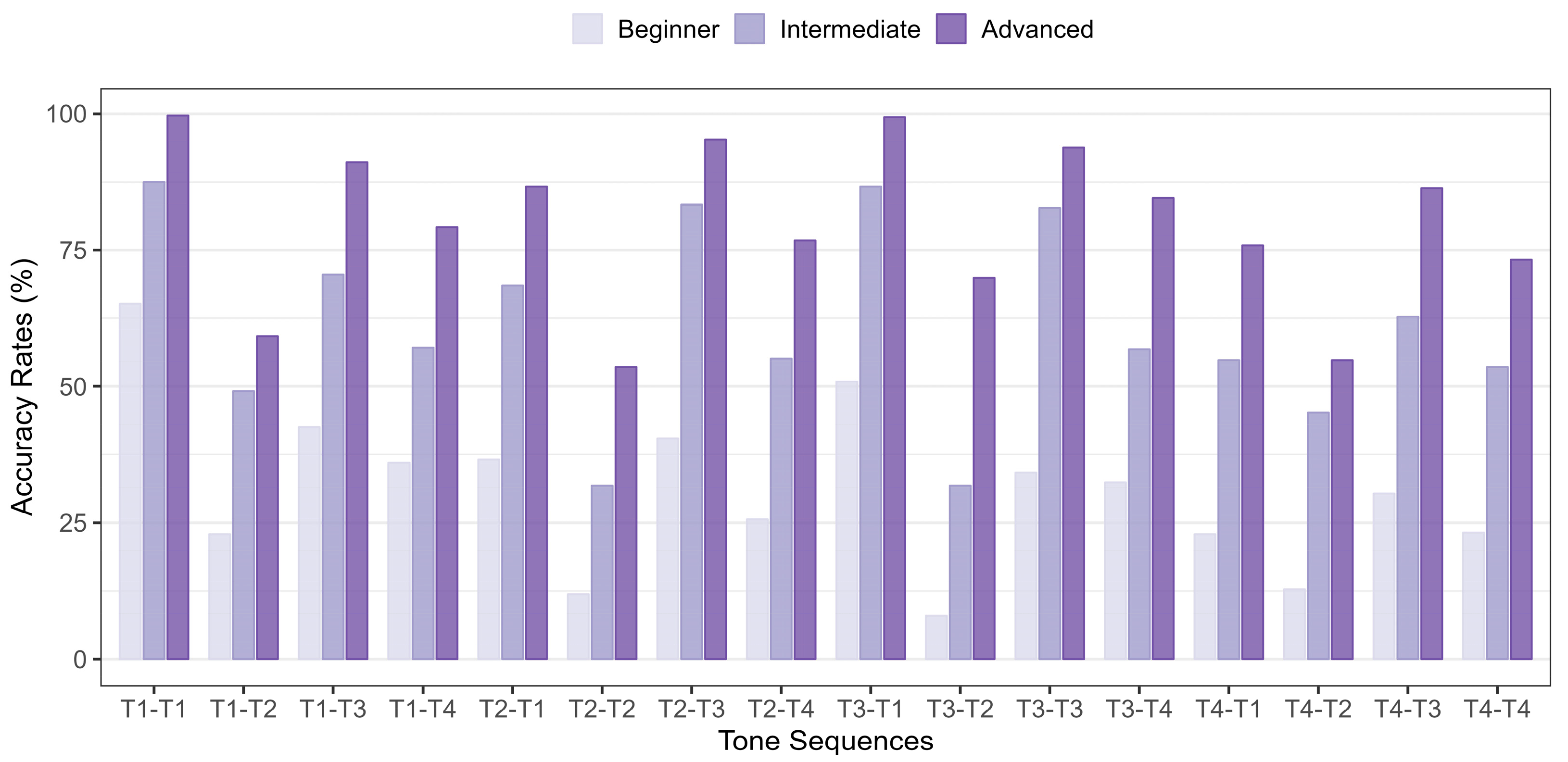
Figure 2 presents the accuracy rates of 16 tone sequences as produced by beginner, intermediate, and advanced Korean learners of Mandarin. The
x-axis represents the tone sequences, while the
y-axis indicates the accuracy rates assessed by the three judges. Two notable trends emerge from the results. First, accuracy rates generally increased as learners progressed from beginner to intermediate and then to advanced. Second, sequences containing Tone 2—particularly when it appears in the second syllable, except for T2−T3—consistently showed the lowest accuracy rates across all three learner groups.
Table 4 ranks the accuracy rates of 16 tone sequences across the three learner groups. Despite differences in proficiency, all groups exhibited similar patterns in the relative ease and difficulty of tone sequence production. For beginner learners, tone sequences with Tone 2 in the second syllable were the most challenging, particularly T3−T2 (8.0%) and T2−T2 (11.9%). In contrast, the easiest sequences were T1−T1 (65.2%), T3−T1 (50.9%), T1−T3 (42.6%), and T2−T3 (40.5%). A similar pattern was observed among intermediate learners, with T3−T2 (31.8%) and T2−T2 (31.8%) remaining the most difficult, while T1−T1 (87.5%), T3−T1 (86.6%), T2−T3 (83.3%), and T3−T3 (82.7%) had the highest accuracy rates. Advanced learners also struggled with T2−T2 (53.6%) and T4−T2 (54.8%). However, their accuracy rates for T1−T1 (99.7%) and T3−T1 (99.4%) were nearly perfect in producing these sequences.
Based on the results in
Table 4, we conducted a binary logistic regression analysis to examine whether the production of the 16 sequences differed across the three learner groups. The analysis revealed a strong interaction effect between proficiency level and tone sequence (X
2 = 1078.3, df = 47,
p < 0.001). To further investigate this interaction, we performed separate analyses for each tone sequence across the three learner groups, all of which showed significant differences (
p < 0.001). Additionally, post hoc multiple comparisons were conducted to determine whether accuracy rates for each tone sequence significantly varied among the three groups.
Table 5 presents the results of these comparisons, displaying only estimate coefficients (Est) and
p-values for brevity. As shown in
Table 5, significant differences were found between advanced and beginner learners, as well as between beginner and intermediate learners. While most tone sequences also exhibited significant differences between advanced and intermediate learners, two sequences—T1−T2 and T4−T2—did not show statistically significant differences between these two groups (
p = 0.321 and
p = 0.58, respectively).
The statistical results above confirm that the three learner groups differed considerably in their production of the 16 tone sequences. To further investigate these differences, we conducted a binary logistic regression analysis to determine whether the production of the tone sequences varied within each learner group. The results revealed a highly significant main effect on accuracy rates across all three groups (Advanced: X
2 = 387.5, df = 15,
p < 0.001, Intermediate: X
2 = 392.8, df = 15,
p < 0.001, Beginner: X
2 = 257.0, df = 15,
p < 0.001). To identify which tone sequences exhibited significant differences, post hoc multiple comparisons within each learner group were performed across all possible sequence pairs within the 16 sequences, yielding a total of 105 pairwise comparisons. These comparisons provided a detailed assessment of how specific tone sequences were distinguished or confused within each learner group, offering insights into patterns of production difficulty. However, since displaying such a large number of comparisons is neither practical nor informative, we selected only the five easiest and five most difficult tone sequences (based on the rankings in
Table 4). These sequences were used to assess which tone sequences learners found easier or more challenging to produce. The results are presented in
Table 6,
Table 7 and
Table 8 below, organized by proficiency level from beginner to advanced learners.
Table 6 presents the results of post hoc multiple comparisons assessing differences in production accuracy among selected tone sequences within the beginner group. The table is divided into two sections: Easiest and hardest tone sequences, indicating which sequences were more or less challenging for learners to produce. The statistical results reveal clear distinctions in the production difficulty of different tone sequences for beginner learners. In the easiest tone sequences, several significant differences were observed, particularly in comparisons involving T1–T1, such as T1–T1 vs. T1–T3 (
p < 0.001), T1–T1 vs. T2–T3 (
p < 0.001), and T1–T1 vs. T2–T1 (
p < 0.001). These results suggest that T1–T1 was the easiest sequence overall for the beginner group. In contrast, comparisons such as T3–T1 vs. T1–T3 (
p = 0.732) and T3–T1 vs. T2–T3 (
p = 0.464) did not reach statistical significance, indicating that these sequences posed a similar level of difficulty for beginners to produce. In the hardest tone sequences, fewer significant differences were observed. The contrast T1–T2 vs. T3–T2 (
p = 0.001) was the only statistically significant comparison, suggesting that T3–T2 was the most challenging sequence to produce in the beginner group. However, most other comparisons, such as T4–T1 vs. T1–T2 (
p = 0.998) and T4–T2 vs. T3–T2 (
p = 0.978), did not reach significance, indicating that these sequences were produced with comparable difficulty. Notably, sequences ending in Tone 2, such as T4–T2, T3–T2, and T2–T2, were among the most challenging sequences to produce, as reflected in the lack of significant differences in many of the pairwise comparisons of each T2-final sequence (T4–T2, T3–T2, T2–T2) with the other tone sequences.
Table 7 presents the results of post hoc multiple comparisons evaluating differences in production accuracy among selected tone sequences within the intermediate learner group. In the easiest tone sequences, most comparisons did not yield significant differences, indicating that these sequences were perceived with similar accuracy levels. However, the contrast between T3-T1 and T1–T3 (
p = 0.041) reached statistical significance, suggesting that intermediate learners produced these two sequences more accurately than the others. Among the hardest tone sequences, significant differences were observed, particularly in comparisons involving T4–T4 vs. T3–T2 (
p = 0.002) and T4–T4 vs. T2–T2 (
p = 0.001). These results indicate that T3–T2 and T2–T2 were among the most challenging sequences to produce for intermediate learners, as their accuracy rates were significantly lower when compared to T4–T4. However, other comparisons among sequences ending in Tone 2 did not reach statistical significance, indicating that these sequences were similarly difficult for intermediate learners to produce.
Table 8 presents the results of multiple comparisons for tone sequences produced by advanced learners. Among the easiest tone sequences, all comparisons yielded non-significant differences (
p > 0.05), suggesting that advanced learners produced these sequences with similar accuracy levels. In contrast, several significant differences emerged among the hardest tone sequences. In particular, the contrasts T4–T4 vs. T4–T2 (
p = 0.004) and T4–T4 vs. T2–T2 (
p = 0.004) indicate that T4–T2 and T2–T2 were among the most challenging sequences to produce. Additionally, T3–T2 vs. T2–T2 (
p = 0.002) suggests that T2–T2 was particularly difficult compared to T3–T2. However, some comparisons, such as T1–T2 vs. T4–T2 (
p = 1.000) and T4–T2 vs. T2–T2 (
p = 1.000), did not reach significance, indicating that these sequences were produced with comparable difficulty. Overall, the results indicate that even at the advanced proficiency level, tone sequences ending in Tone 2 remain particularly difficult to produce. This finding may have implications for targeted pronunciation training, which will be further discussed in
Section 4.
To improve the accessibility of the multiple-comparison results reported in
Table 6,
Table 7 and
Table 8, we provide a summary that highlights the key patterns observed across proficiency levels.
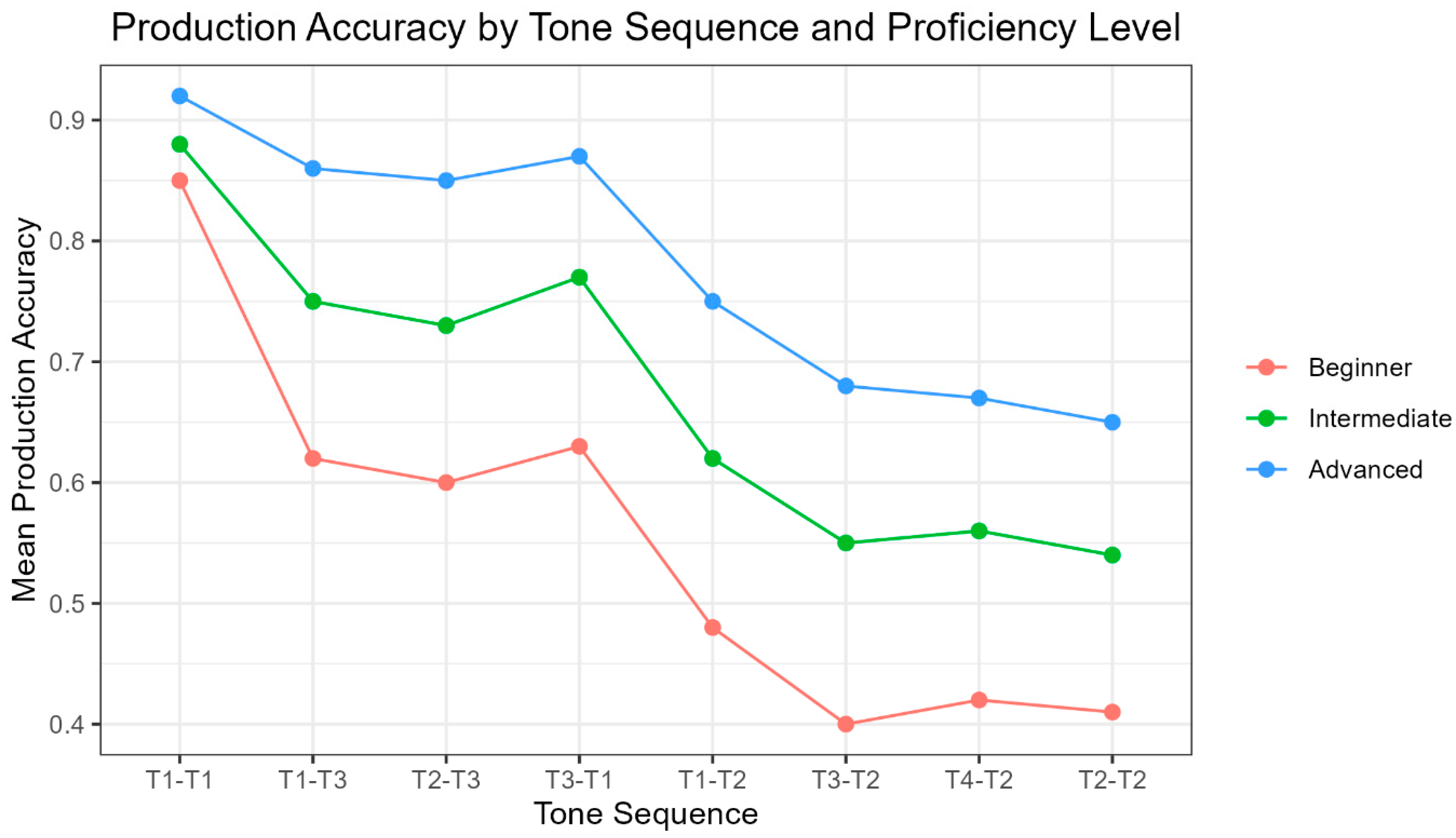
Figure 3 presents selected tone sequences representing the easiest, hardest, and intermediate levels of difficulty. Mean production accuracy increases with proficiency across all sequences. Advanced learners consistently outperformed intermediate and beginner learners. T1–T1 was produced with the highest accuracy, whereas sequences ending in Tone 2 (T1–T2, T3–T2, T4–T2, and T2–T2) showed the lowest accuracy. Sequences such as T1–T3 and T2–T3 fell between the easiest and hardest sequences across all groups.
3.3. Error Patterns
As demonstrated in
Section 3.1, all sequences with T2 in the second syllable showed a significantly lower accuracy rate compared to other sequences. To provide a more detailed view of these patterns, we present error patterns for each learner group in
Table 9,
Table 10 and
Table 11, offering insights into both correct and incorrect productions. In each table, the rows represent the target tone sequences, while the columns list the four most frequent productions in descending order. The fifth column consolidates all other productions. Numbers in brackets indicate response percentages. For instance, “T1–T1 (65.2)” in the first row signifies that T1–T1 was correctly produced 65.2% of the time, whereas “T1–T4 (21.1)” indicates that T1–T1 was misproduced as T1–T4 in 21.1% of cases.
Table 9 shows that beginner learners had an overall accuracy rate of 31.4% across the 16 target tone sequences. They produced a wider range of variant forms for the same sequences, with each target sequence yielding more than five different variants. Misproductions were particularly frequent when T2 and T4 appeared in the second syllable. For example, T3–T2 had the lowest accuracy rate (8.0%) and was often mistaken for T2–T3 nearly a third of the time (32.4%), T3-T1 in 20.5% of cases, and T1–T3 in 11.9%. The sequence with the second-lowest accuracy rate (11.9%), T2–T2, was frequently misread as T2–T3 (26.8%) and as T1–T3 (12.5%). T4–T2, which had the third-lowest accuracy rate (12.8%), was most commonly confused with T4–T3 (24.1%) and T1–T3 (18.5%). Finally, T1–T2, with the fourth-lowest accuracy rate (22.9%), was mispronounced as T1–T3 in 36.3% of cases. Additionally, T4 was sometimes produced as T1, though these errors occurred less frequently compared to the misproduction of T2 as T3. For instance, T1–T4 was most frequently confused with T1–T1 (36%), T3–T4 with T3-T1 (33.3%), and T4–T4 with T4–T1 (27.1%).
Table 10 shows that intermediate learners had an overall accuracy rate of 57.1% across the 16 target tone sequences, which was 25.7% higher than that of beginner learners (31.4%). They produced fewer variant forms than beginners for the same tone sequences, though each target sequence still elicited more than five different variants. Mispronunciations remained common, particularly when T2 and T4 appeared in the second syllable. For example, T2–T2 and T3–T2 had the lowest accuracy rate (31.8%). T2–T2 was most frequently mistaken for T2–T3 (51.8%) and, to a lesser extent, T3–T2 (5.1%). T3–T2 was confused with T2–T3 in 49.7% of cases and with T3-T1 in 11.9%. The sequence with the third-lowest accuracy rate, T4–T2 (45.2%), was most often misproduced as T4–T3 (35.4%) and T1–T3 (11.9%). Finally, T1–T2, which had the fourth-lowest accuracy rate (49.1%), was misread as T1–T3 in 36.6% of cases. As in the beginner group, T4 was sometimes confused with T1, though these errors were less frequent than the misproduction of T2 as T3. For instance, T4–T4 was most commonly mistaken for T4–T1 (40.5%), T3–T4 for T3-T1 (36.6%), and T1–T4 for T1–T1 (36.3%).
As shown in
Table 11, advanced learners achieved an overall accuracy rate of 79.95% across the 16 target tone sequences, which was 22.85% higher than that of intermediate learners (57.1%). They produced fewer variant forms for the same tone sequences compared to intermediates—only two for T1–T1, three each for T2–T1, T3-T1, and T3–T4, and four each for T1–T4, T2–T2, T2–T3, T2-T4, T4–T2, T4–T3, and T4–T4—whereas intermediate learners exhibited more than five variants for each sequence. This reduction in production variation suggests that advanced learners made notable progress in correctly producing Mandarin tone sequences. Nevertheless, some persistent errors remained, particularly the tendency to confuse T2 with T3 and T4 with T1. The former, especially in the final syllable, was evident in the misproduction of T1–T2 as T1–T3 (39.3%). Other frequently observed confusions included T2–T2 misread as T2–T3 (45.5%), T4–T2 mistaken for T4–T3 (36.3%), and T3–T2 misproduced as T2–T3 (25.6%). This consistent mispronunciation of T2 as T3 highlights an ongoing challenge, even for advanced learners—a point that will be further explored in
Section 4.
3.4. Accuracy Rates in Each Syllable
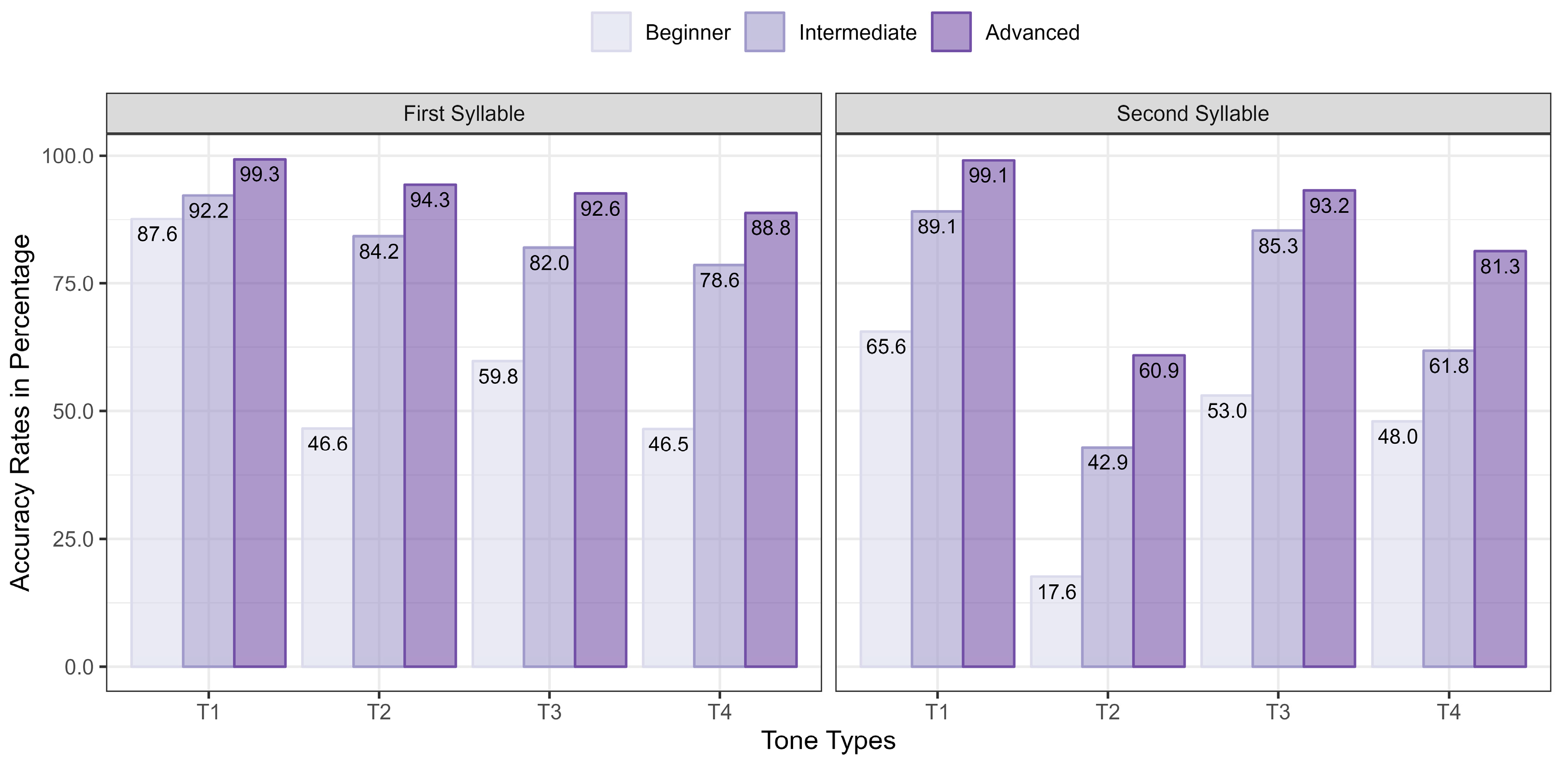
Figure 4 illustrates the accuracy rates for each tone in the first and second syllables across proficiency levels. Advanced learners consistently achieved the highest accuracy, followed by intermediate learners and then beginners. In the first syllable, both intermediate and advanced learners had accuracy rates exceeding 80% and 90%, respectively, for all tones except T4. Beginners, however, showed a noticeable gap compared to the other groups, except for T1. Their accuracy rate for T3 was 59.8%, while for T2 and T4, it dropped to 46.6% and 46.5%, respectively. In the second syllable, accuracy rates generally declined, with T2 showing particularly low accuracy. Advanced learners achieved a 60.9% accuracy rate for T2, whereas beginners’ accuracy dropped significantly to 17.6%. Intermediate learners’ accuracy fell between the two groups.
The binary logistic regression revealed a strong three-way interaction among proficiency level, tone sequence, and position (X2 = 2169.4, df = 23, p < 0.001). Separate analyses for each group indicated a strong two-way interaction between tone sequence and position (Beginner: X2 = 769.9, df = 7, p < 0.001, Intermediate: X2 = 736.1, df = 7, p < 0.001, Advanced: X2 = 616.2, df = 7, p < 0.001). According to the post hoc analysis, beginners showed the highest accuracy for T1 in the first syllable (p < 0.001). T3 was more accurate than T2 (p < 0.001), but there was no significant difference between T2 and T4 or between T3 and T4 (p > 0.1). In the second syllable, T1 was significantly more accurate than all other tones (p < 0.001), while T3 and T4 had similar accuracy levels (p > 0.1). T2 had the lowest accuracy (p < 0.001). Intermediate and advanced learners exhibited similar patterns. In the first syllable, T1 was significantly more accurate than all other tones (p < 0.001). T2 was more accurate than T4 (p < 0.001) but did not differ significantly from T3 (p > 0.1), while T3 and T4 showed no significant difference (p > 0.1). In the second syllable, T1 again had the highest accuracy (p < 0.001). Among intermediate learners, T1 and T3 did not differ significantly (p > 0.1). In both groups, T2 was markedly less accurate than T3 and T4 (p < 0.001), with T3 being more accurate than T4 (p < 0.001).