
Mental Imagery in Fencing: Improving Point Control and Lunge Distance Through Visualization


Abstract
1. Introduction
2. Materials and Methods
2.1. Participants
2.2. Grouping
2.3. Pre-Test Procedures
2.4. Point Control Test
2.5. Lunge Distance Test
2.6. Visualization Exercise
2.7. Post-Test Procedures
2.8. Statistical Analysis
3. Results
3.1. Demographics
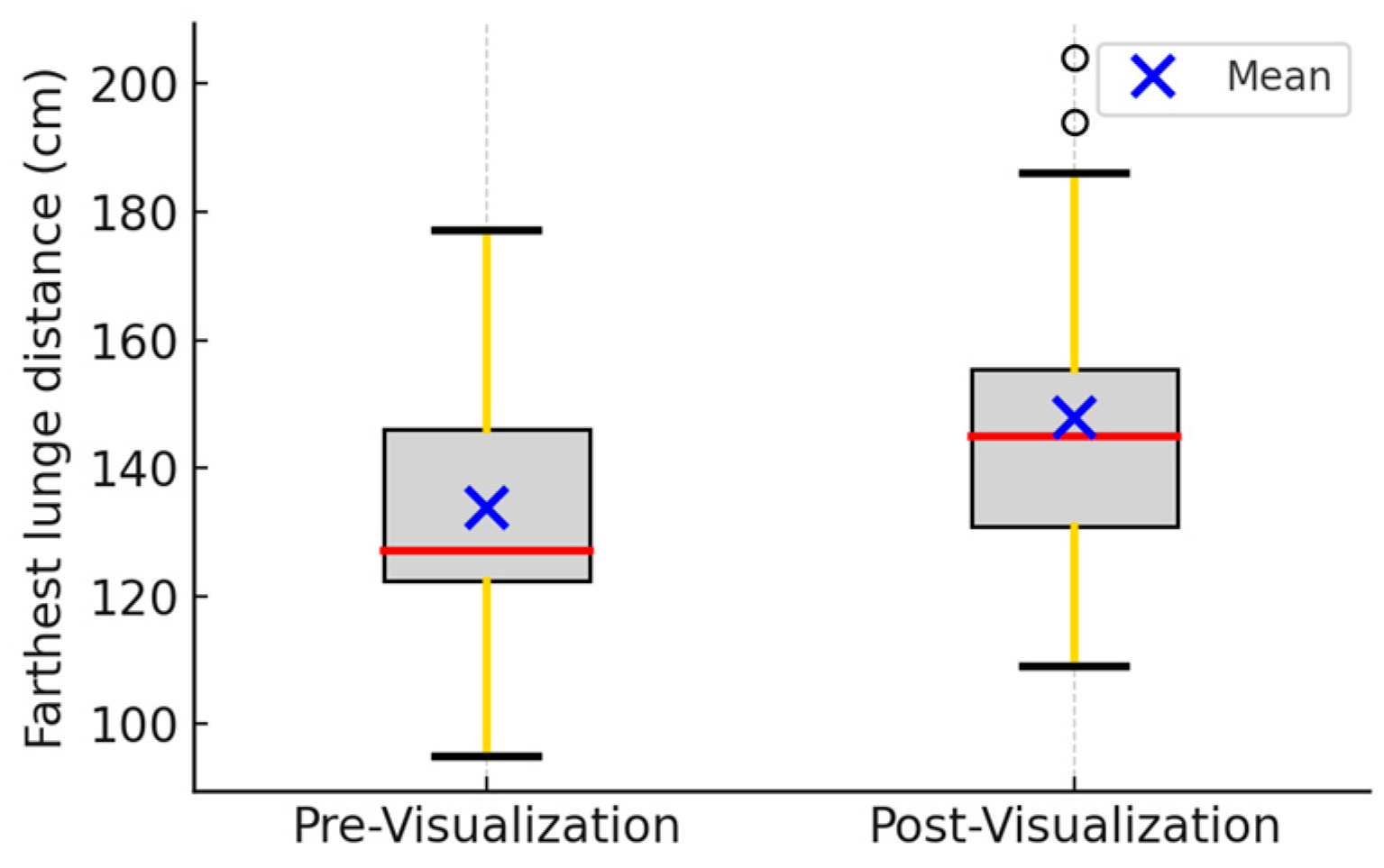
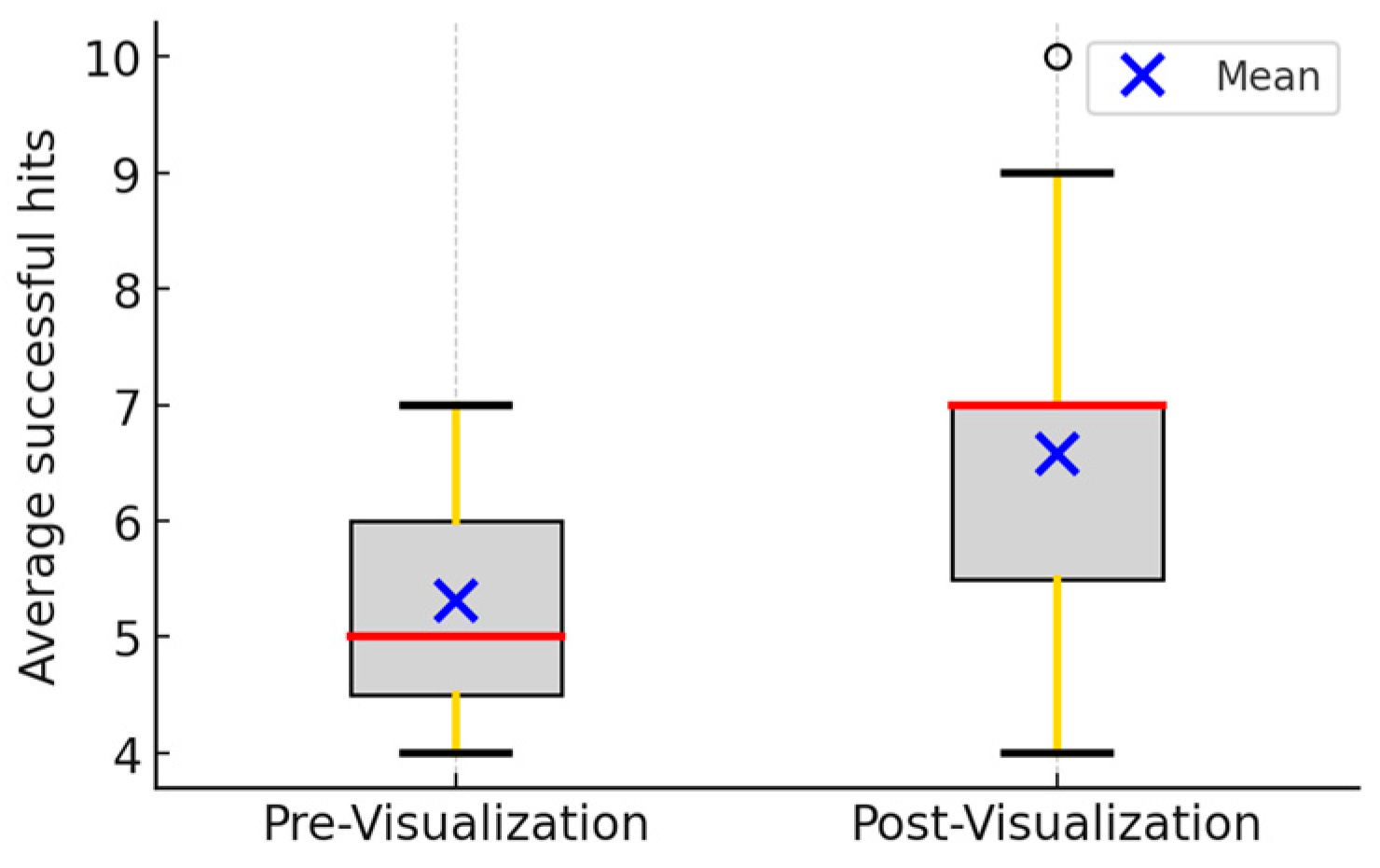
3.2. Overall Effects of Visualization
3.3. Effects of Training Experience
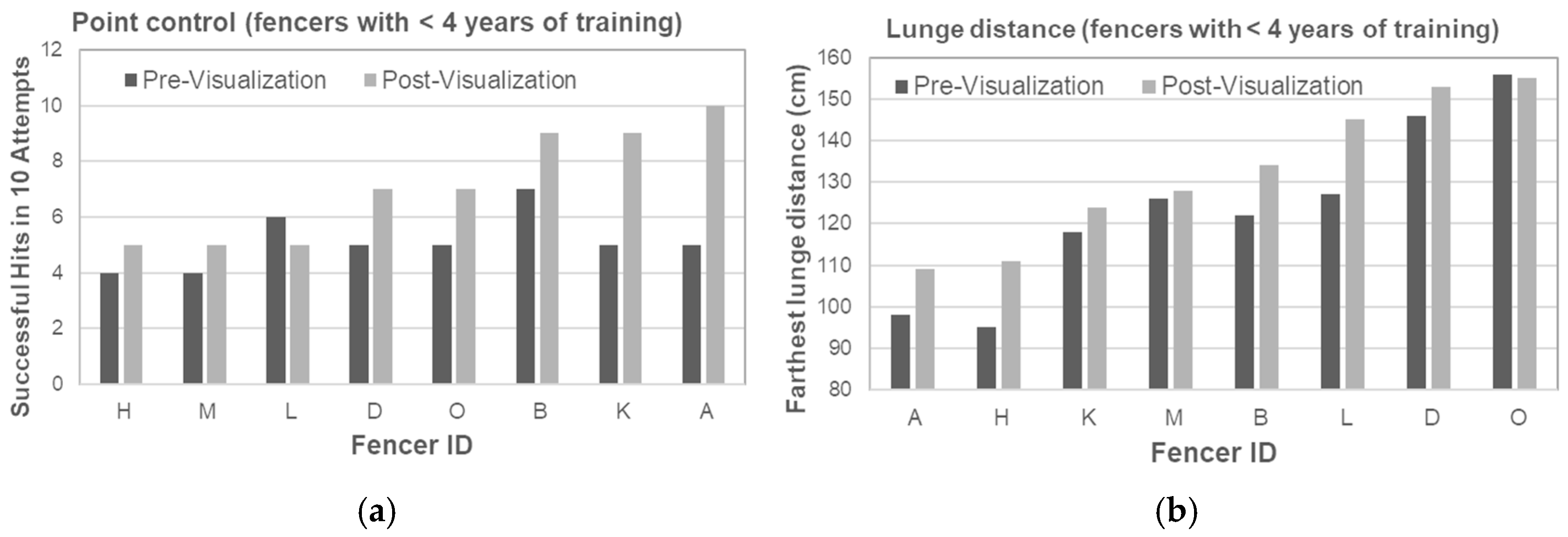
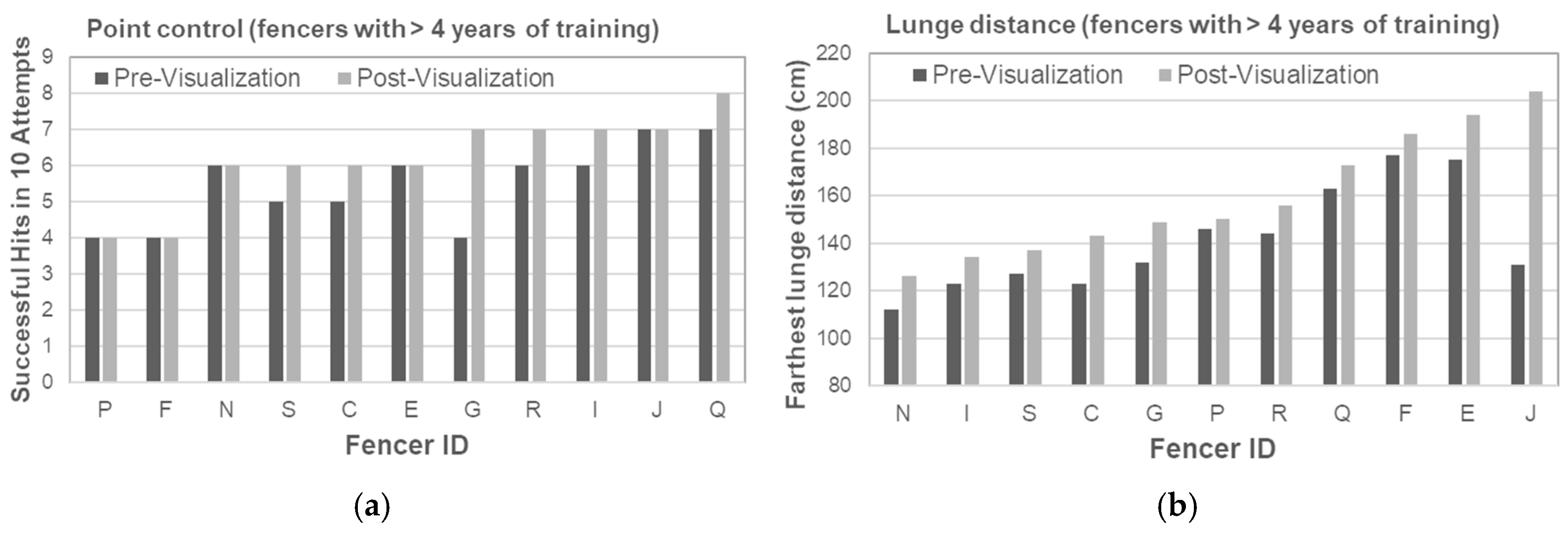
- Point Control: Fencers with <4 years of experience showed greater improvement, increasing from 5.1 to 7.1 hits (39.0%) (Table 3, Figure 3a). Those with ≥4 years of experience improved from 5.5 to 6.2 hits (14.8%) (Table 4, Figure 4a). These differences are consistent with evidence that novices benefit most from visualization in skill acquisition [3,4].
- Lunge Distance: Fencers with <4 years of experience improved by 8.9 cm (7.2%) (Table 5, Figure 3b). Fencers with ≥4 years of experience, improved by 18.1 cm (12.8%) (Table 6, Figure 4b). This aligns with previous findings that experienced fencers use imagery to refine explosive actions, such as lunges [20].

| Fencer ID | Pre | Post | Difference | Percent Improvement |
|---|---|---|---|---|
| Fencer H | 4 | 5 | 1 | 25.00% |
| Fencer M | 4 | 5 | 1 | 25.00% |
| Fencer L | 6 | 5 | −1 | −16.67% |
| Fencer D | 5 | 7 | 2 | 40.00% |
| Fencer O | 5 | 7 | 2 | 40.00% |
| Fencer B | 7 | 9 | 2 | 28.57% |
| Fencer K | 5 | 9 | 4 | 80.00% |
| Fencer A | 5 | 10 | 5 | 100.00% |
| Average | 5.1 | 7.1 | 2.0 | 39.0% |
| Fencer ID | Pre | Post | Difference | Percent Improvement |
|---|---|---|---|---|
| Fencer P | 4 | 4 | 0 | 0.00% |
| Fencer F | 4 | 4 | 0 | 0.00% |
| Fencer N | 6 | 6 | 0 | 0.00% |
| Fencer S | 5 | 6 | 1 | 20.00% |
| Fencer C | 5 | 6 | 1 | 20.00% |
| Fencer E | 6 | 6 | 0 | 0.00% |
| Fencer G | 4 | 7 | 3 | 75.00% |
| Fencer R | 6 | 7 | 1 | 16.67% |
| Fencer I | 6 | 7 | 1 | 16.67% |
| Fencer J | 7 | 7 | 0 | 0.00% |
| Fencer Q | 7 | 8 | 1 | 14.29% |
| Average | 5.5 | 6.2 | 0.7 | 14.8% |
| Fencer ID | Pre | Post | Difference | Percent Improvement |
|---|---|---|---|---|
| Fencer A | 98 | 109 | 11 | 11.22% |
| Fencer H | 95 | 111 | 16 | 16.84% |
| Fencer K | 118 | 124 | 6 | 5.08% |
| Fencer M | 126 | 128 | 2 | 1.59% |
| Fencer B | 122 | 134 | 12 | 9.84% |
| Fencer L | 127 | 145 | 18 | 14.17% |
| Fencer D | 146 | 153 | 7 | 4.79% |
| Fencer O | 156 | 155 | −1 | −0.64% |
| Average | 123.5 | 132.4 | 8.9 | 7.2% |
| Fencer ID | Pre | Post | Difference | Percent Improvement |
|---|---|---|---|---|
| Fencer N | 112 | 126 | 14 | 12.50% |
| Fencer I | 123 | 134 | 11 | 8.94% |
| Fencer S | 127 | 137 | 10 | 7.87% |
| Fencer C | 123 | 143 | 20 | 16.26% |
| Fencer G | 132 | 149 | 17 | 12.88% |
| Fencer P | 146 | 150 | 4 | 2.74% |
| Fencer R | 144 | 156 | 12 | 8.33% |
| Fencer Q | 163 | 173 | 10 | 6.13% |
| Fencer F | 177 | 186 | 9 | 5.08% |
| Fencer E | 175 | 194 | 19 | 10.86% |
| Fencer J | 131 | 204 | 73 | 55.73% |
| Average | 141.2 | 159.3 | 18.1 | 12.8% |
3.4. Control Group
3.5. Between Group Comparisons
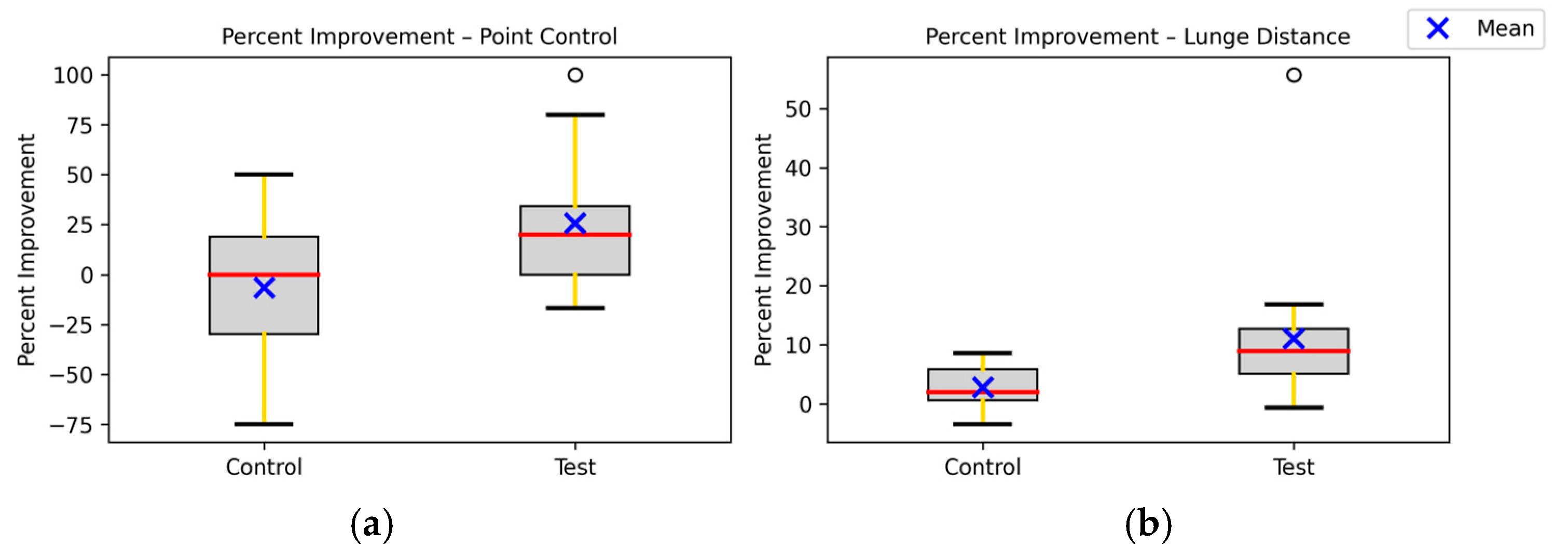
- Lunge Distance: Improvements in the visualization group were also significantly greater than those in the control group (Welch t-test, p = 0.0072).
4. Discussion
4.1. Visualization and Point Control
4.2. Visualization and Lunge Distance
4.3. Comparison with Control Group
4.4. Practical Applications
4.5. Limitations and Future Directions
5. Conclusions
Author Contributions
Funding
Institutional Review Board Statement
Informed Consent Statement
Data Availability Statement
Acknowledgments
Conflicts of Interest
Appendix A
Appendix A.1. Point Control
- 1.
- Determination of Individual Lunge DistanceEach participant assumed an en garde stance in front of a wall-mounted target (Microfiber Self-Training Fencing Target with Five Bullseyes, LEONARK). Participants established their individualized lunge distance, defined as the maximal distance from which they could contact the target comfortably while maintaining balance and avoiding overextension of either leg. The rear-foot position corresponding to this distance was marked with a cone for consistent foot placement across trials.
- 2.
- FamiliarizationParticipants were allotted one minute to practice striking the wall-mounted target. The target consisted of four concentric circles with radii decreasing in one-centimeter increments.
- 3.
- Target SelectionBased on their prior fencing experience, participants selected one of the circles as their target zone for subsequent trials.
- 4.
- Baseline Trial
- Participants completed ten attempts of the practiced action. A successful attempt was defined as a strike in which the blade tip landed on or within the circumference of the selected circle. Each attempt began with the rear foot aligned to the cone marking the predetermined lunge distance. Participants maintained their position briefly after each strike, and attempts were recorded using an iPhone camera for later verification. If the blade tip initially contacted the target zone but subsequently deflected to another area, the initial point of contact was used for scoring.
- If the number of successful attempts fell below 4 or exceeded 7 out of 10, the target difficulty was adjusted accordingly to achieve an average success range of 4–7. Adjustments were discontinued if the participant was already using the easiest or the hardest target.
- 5.
- Intervention Phase
- Test Group: Participants completed a one-minute guided visualization exercise. They placed their epee aside, closed their eyes, and vividly imagined performing the task with flawless execution. Participants were instructed to incorporate multisensory details, such as the feel of the blade in the hand, and to mentally break down the movement sequence (arm extension, blade alignment, and accurate target contact). Visualization was performed from a first-person perspective.
- Control Group: Participants completed a two-minute non-fencing-related break. They put away their epee and jogged up and down the fencing strip for two minutes.
- 6.
- Post-Intervention TrialThe baseline procedures described in Step 4 were repeated exactly, regardless of group assignment.
Appendix A.2. Lunge Distance Task
- 1.
- Warm-UpParticipants were given one minute to stretch in preparation for the task.
- 2.
- Starting Position AlignmentThe participant’s front toe was aligned with the en garde line on the fencing strip. This initial toe position was marked with a cone.
- 3.
- Distance CalibrationA measuring tape was aligned such that the 0 cm mark corresponded to the cone marking the initial foot position.
- 4.
- Baseline Trial
- From a standard en garde stance, participants executed a maximal forward lunge while maintaining balance and appropriate fencing technique. Each participant completed three attempts. The distance traveled—from the initial front-foot position to the landing position—was measured in centimeters.
- The farthest of the three attempts was recorded as the participant’s baseline lunge distance.
- 5.
- Intervention Phase
- Test Group: Participants engaged in one minute of focused visualization. They were instructed to mentally rehearse performing the lunge with maximal explosiveness, emphasizing pushing off the back leg, extending the front leg, and maintaining balance during landing. To enhance imagery vividness, participants were encouraged to use metaphors (e.g., being propelled from a cannon or possessing unlimited flexibility). Visualization was performed from a first-person perspective.
- Control Group: Participants completed a two-minute non-fencing-related break, during which they jogged along the fencing strip.
- 6.
- Post-Intervention TrialThe baseline procedures described in Step 4 were repeated with identical preparation and execution for both groups.
Appendix B
Q-Q Plots of Analysis and Results of Statistical Tests

| Measure | Group Comparison | Statistical Test | Test Statistic | p -Value |
| Successful Hits (Pre vs. Post) | Control | Wilcoxon Signed-Rank | W = 43.50 | p = 0.341 |
| Successful Hits (Pre vs. Post) | Test | Wilcoxon Signed-Rank | W = 4.50 | p = 0.002 |
| Lunge Distance (Pre vs. Post) | Control | Paired t-test | t = −3.60 | p = 0.0019 |
| Lunge Distance (Pre vs. Post) | Test | Paired t-test | t = −4.04 | p = 0.00077 |
| Improvement in Hits (ΔHits) | Control vs. Test | Mann–Whitney U | U = 93.0 | p = 0.0057 |
| Improvement in Lunge Distance (ΔDistance) | Control vs. Test | Welch t-test | t = −2.98 | p = 0.0072 |
References
- Guillot, A.; Moschberger, K.; Collet, C. Coupling Movement with Imagery as a New Perspective for Motor Imagery Practice. Behav. Brain Funct. 2013, 9, 8. [Google Scholar] [CrossRef]
- Macintyre, T.E.; Moran, A.P.; Collet, C.; Guillot, A. An Emerging Paradigm: A Strength-Based Approach to Exploring Mental Imagery. Front. Hum. Neurosci. 2013, 7, 104. [Google Scholar] [CrossRef]
- Maring, J.R. Effects of Mental Practice on Rate of Skill Acquisition. Phys. Ther. 1990, 70, 165–172. [Google Scholar] [CrossRef]
- Feltz, D.; Landers, D. The Effects of Mental Practice on Motor Skill Learning and Performance: A Meta-Analysis. J. Sport. 2007, 5, 25–57. [Google Scholar] [CrossRef]
- Khatra, O.; Shadgan, A.; Taunton, J.; Pakravan, A.; Shadgan, B. A Bibliometric Analysis of the Top Cited Articles in Sports and Exercise Medicine. Orthop. J. Sports Med. 2021, 9, 2325967120969902. [Google Scholar] [CrossRef]
- Park, I.; Jeon, J. Psychological Skills Training for Athletes in Sports: Web of Science Bibliometric Analysis. Healthcare 2023, 11, 259. [Google Scholar] [CrossRef]
- Milley, K.R.; Ouellette, G.P. Putting Attention on the Spot in Coaching: Shifting to an External Focus of Attention with Imagery Techniques to Improve Basketball Free-Throw Shooting Performance. Front. Psychol. 2021, 12, 645676. [Google Scholar] [CrossRef] [PubMed]
- Prasomsri, J.; Thueman, B.; Yuenyong, P.; Thongnoon, C.; Khophongphaibun, N.; Ariyawatcharin, S. Effectiveness of Motor Imagery on Sports Performance in Football Players: A Randomised Control Trial. Hong. Kong Physiother. J. 2024, 44, 29–37. [Google Scholar] [CrossRef] [PubMed]
- Hall, C.R.; Mack, D.; Paivio, A.; Hausenblas, H. Imagery Use by Athletes: Development of the Sport Imagery Questionnaire. Int. J. Sport Psychol. 1998, 29, 73–89. [Google Scholar]
- Hijazi, M.M.K. Attention, Visual Perception and Their Relationship to Sport Performance in Fencing. J. Hum. Kinet. 2013, 39, 195–201. [Google Scholar] [CrossRef] [PubMed]
- Cordani, C.; Preziosa, P.; Gatti, R.; Castellani, C.; Filippi, M.; Rocca, M.A. Mapping Brain Structure and Function in Professional Fencers: A Model to Study Training Effects on Central Nervous System Plasticity. Hum. Brain Mapp. 2022, 43, 3375–3385. [Google Scholar] [CrossRef]
- Witkowski, M.; Bojkowski, Ł.; Karpowicz, K.; Konieczny, M.; Bronikowski, M.; Tomczak, M. Effectiveness and Durability of Transfer Training in Fencing. Int. J. Environ. Res. Public Health 2020, 17, 849. [Google Scholar] [CrossRef]
- Williams, L.R.; Walmsley, A. Response Amendment in Fencing: Differences between Elite and Novice Subjects. Percept. Mot. Ski. 2000, 91, 131–142. [Google Scholar] [CrossRef] [PubMed]
- Feng, Y.; Zhou, C.-L.; Zhang, J.-C.; Tian, M.-L. Neural Mechanisms of Intuitive Tactical Decision-Making Predominance of High-Level Fencing Athletes. J. Med. Biol. Eng. 2010, 30, 47–56. [Google Scholar]
- Turner, A.N.; Marshall, G.; Phillips, J.; Noto, A.; Buttigieg, C.; Chavda, S.; Downing, W.; Atlay, N.; Dimitriou, L.; Kilduff, L. Physical Characteristics Underpinning Repetitive Lunging in Fencing. J. Strength. Cond. Res. 2016, 30, 3134–3139. [Google Scholar] [CrossRef] [PubMed]
- Watanabe, R.; Higuchi, T. Behavioral Advantages of the First-Person Perspective Model for Imitation. Front. Psychol. 2016, 7, 701. [Google Scholar] [CrossRef]
- Mulder, T. Motor Imagery and Action Observation: Cognitive Tools for Rehabilitation. J. Neural. Transm. 2007, 114, 1265–1278. [Google Scholar] [CrossRef]
- Pearson, D.G.; Deeprose, C.; Wallace-Hadrill, S.M.A.; Burnett Heyes, S.; Holmes, E.A. Assessing Mental Imagery in Clinical Psychology: A Review of Imagery Measures and a Guiding Framework. Clin. Psychol. Rev. 2013, 33, 1–23. [Google Scholar] [CrossRef] [PubMed]
- USA Fencing. USA Fencing Age and Rating Eligibility; 2025-26; USA Fencing: Colorado Springs, CO, USA, 2025. [Google Scholar]
- Schack, T.; Essig, K.; Frank, C.; Koester, D. Mental Representation and Motor Imagery Training. Front. Hum. Neurosci. 2014, 8, 328. [Google Scholar] [CrossRef]
- Di Corrado, D.; Guarnera, M.; Guerrera, C.S.; Maldonato, N.M.; Di Nuovo, S.; Castellano, S.; Coco, M. Mental Imagery Skills in Competitive Young Athletes and Non-Athletes. Front. Psychol. 2020, 11, 633. [Google Scholar] [CrossRef]
- Jose, J.; Joseph, M. Imagery: It’s Effects and Benefits on Sports Performance and Psychological Variables: A Review Study. Int. J. Physiol. Nutr. Phys. Educ. 2018, 3, 190–193. [Google Scholar]
- Quinn, J.G.; McConnell, J. The Interval for Interference in Conscious Visual Imagery. Memory 2006, 14, 241–252. [Google Scholar] [CrossRef] [PubMed]
- Brown, A.W.; Kaiser, K.A.; Allison, D.B. Issues with Data and Analyses: Errors, Underlying Themes, and Potential Solutions. Proc. Natl. Acad. Sci. USA 2018, 115, 2563–2570. [Google Scholar] [CrossRef]
- Frank, C.; Land, W.M.; Schack, T. Perceptual-Cognitive Changes During Motor Learning: The Influence of Mental and Physical Practice on Mental Representation, Gaze Behavior, and Performance of a Complex Action. Front. Psychol. 2015, 6, 1981. [Google Scholar] [CrossRef] [PubMed]
- Rhodes, J.; Nedza, K.; May, J.; Clements, L. Imagery Training for Athletes with Low Imagery Abilities. J. Appl. Sport. Psychol. 2024, 36, 831–844. [Google Scholar] [CrossRef]
- Ruffino, C.; Truong, C.; Dupont, W.; Bouguila, F.; Michel, C.; Lebon, F.; Papaxanthis, C. Acquisition and Consolidation Processes Following Motor Imagery Practice. Sci. Rep. 2021, 11, 2295. [Google Scholar] [CrossRef]

| Fencer ID | Age | USA Fencing Age Category | Gender | Years of Fencing Experience | Group |
|---|---|---|---|---|---|
| Control A | 12 | Y12 | Male | 4 | Control |
| Control B | 17 | Junior | Male | 6 | Control |
| Control C | 12 | Y12 | Female | 4 | Control |
| Control D | 11 | Y12 | Female | 3 | Control |
| Control E | 16 | Cadet | Male | 8 | Control |
| Control F | 16 | Cadet | Male | 8 | Control |
| Control G | 17 | Junior | Female | 8 | Control |
| Control H | 16 | Cadet | Male | 8 | Control |
| Control I | 12 | Y12 | Male | 6 | Control |
| Control J | 15 | Cadet | Male | 10 | Control |
| Control K | 15 | Cadet | Male | 7 | Control |
| Control L | 16 | Cadet | Male | 5 | Control |
| Control M | 50 | Vet-50 | Male | 0 | Control |
| Control N | 47 | Vet-40 | Female | 0 | Control |
| Control O | 12 | Y12 | Male | 4 | Control |
| Control P | 16 | Cadet | Male | 7 | Control |
| Control Q | 14 | Y14 | Male | 4 | Control |
| Control R | 51 | Vet-50 | Male | 2.5 | Control |
| Control S | 15 | Cadet | Male | 4 | Control |
| Control T | 13 | Y14 | Female | 4 | Control |
| AVE | 20 | - | - | 5 | - |
| STDEV | 13 | - | - | 3 | - |
| Test A | 54 | Vet-50 | Men | 0.5 | Test |
| Test B | 15 | Cadet | Women | 2 | Test |
| Test C | 17 | Junior | Men | 11 | Test |
| Test D | 15 | Cadet | Men | 4 | Test |
| Test E | 19 | Junior | Men | 12 | Test |
| Test F | 32 | Senior | Men | 22 | Test |
| Test G | 12 | Y12 | Women | 5 | Test |
| Test H | 57 | Vet-50 | Men | 0 | Test |
| Test I | 27 | Senior | Men | 15 | Test |
| Test J | 31 | Senior | Men | 20 | Test |
| Test K | 14 | Y14 | Men | 4 | Test |
| Test L | 12 | Y12 | Men | 4 | Test |
| Test M | 13 | Y14 | Women | 2.5 | Test |
| Test N | 10 | Y10 | Men | 5 | Test |
| Test O | 14 | Y14 | Men | 4 | Test |
| Test P | 16 | Cadet | Men | 7 | Test |
| Test Q | 15 | Cadet | Men | 10 | Test |
| Test R | 56 | Vet-50 | Men | 5 | Test |
| Test S | 14 | Cadet | Women | 6 | Test |
| AVE | 23 | - | - | 7 | - |
| STDEV | 16 | - | - | 6 | - |
| Fencer ID | Point Control | Lunge Distance (cm) | ||||||
|---|---|---|---|---|---|---|---|---|
| Pre | Post | Difference | % | Pre | Post | Difference | % | |
| A | 5 | 10 | 5 | 100.00% | 98 | 109 | 11 | 11.22% |
| B | 7 | 9 | 2 | 28.57% | 122 | 134 | 12 | 9.84% |
| C | 5 | 6 | 1 | 20.00% | 123 | 143 | 20 | 16.26% |
| D | 5 | 7 | 2 | 40.00% | 146 | 153 | 7 | 4.79% |
| E | 6 | 6 | 0 | 0.00% | 175 | 194 | 19 | 10.86% |
| F | 4 | 4 | 0 | 0.00% | 177 | 186 | 9 | 5.08% |
| G | 4 | 7 | 3 | 75.00% | 132 | 149 | 17 | 12.88% |
| H | 4 | 5 | 1 | 25.00% | 95 | 111 | 16 | 16.84% |
| I | 6 | 7 | 1 | 16.67% | 123 | 134 | 11 | 8.94% |
| J | 7 | 7 | 0 | 0.00% | 131 | 204 | 73 | 55.73% |
| K | 5 | 9 | 4 | 80.00% | 118 | 124 | 6 | 5.08% |
| L | 6 | 5 | −1 | −16.67% | 127 | 145 | 18 | 14.17% |
| M | 4 | 5 | 1 | 25.00% | 126 | 128 | 2 | 1.59% |
| N | 6 | 6 | 0 | 0.00% | 112 | 126 | 14 | 12.50% |
| O | 5 | 7 | 2 | 40.00% | 156 | 155 | −1 | −0.64% |
| P | 4 | 4 | 0 | 0.00% | 146 | 150 | 4 | 2.74% |
| Q | 7 | 8 | 1 | 14.29% | 163 | 173 | 10 | 6.13% |
| R | 6 | 7 | 1 | 16.67% | 144 | 156 | 12 | 8.33% |
| S | 5 | 6 | 1 | 20.00% | 127 | 137 | 10 | 7.87% |
| Average | 5.3 | 6.6 | 1.3 | 25.50% | 133.7 | 147.9 | 14.2 | 11.06% |
| Fencer ID | Point Control | Lunge Distance (cm) | ||||||
|---|---|---|---|---|---|---|---|---|
| First | Second | Difference | % | First | Second | Difference | % | |
| A | 5 | 3 | −2 | −40.00% | 129 | 132 | 3 | 2.33% |
| B | 6 | 5 | −1 | −16.67% | 156 | 165 | 9 | 5.77% |
| C | 7 | 6 | −1 | −14.29% | 122 | 124 | 2 | 1.64% |
| D | 7 | 5 | −2 | −28.57% | 128 | 131 | 3 | 2.34% |
| E | 4 | 1 | −3 | −75.00% | 146 | 157 | 11 | 7.53% |
| F | 3 | 3 | 0 | 0.00% | 130 | 131 | 1 | 0.77% |
| G | 7 | 4 | −3 | −42.86% | 110 | 109 | −1 | −0.91% |
| H | 4 | 4 | 0 | 0.00% | 140 | 148 | 8 | 5.71% |
| I | 4 | 2 | −2 | −50.00% | 102 | 101 | −1 | −0.98% |
| J | 3 | 4 | 1 | 33.33% | 119 | 120 | 1 | 0.84% |
| K | 6 | 7 | 1 | 16.67% | 139 | 141 | 2 | 1.44% |
| L | 6 | 9 | 3 | 50.00% | 141 | 143 | 2 | 1.42% |
| M | 6 | 4 | −2 | −33.33% | 101 | 108 | 7 | 6.93% |
| N | 4 | 5 | 1 | 25.00% | 81 | 86 | 5 | 6.17% |
| O | 7 | 9 | 2 | 28.57% | 120 | 119 | −1 | −0.83% |
| P | 10 | 9 | −1 | −10.00% | 155 | 160 | 5 | 3.28% |
| Q | 8 | 8 | 0 | 0.00% | 114 | 122 | 8 | 6.67% |
| R | 8 | 8 | 0 | 0.00% | 89 | 97 | 8 | 8.57% |
| S | 8 | 10 | 2 | 25.00% | 147 | 142 | −5 | −3.45% |
| T | 9 | 9 | 0 | 0.00% | 99 | 99 | 0 | 0.00% |
| Average | 6.1 | 5.75 | −0.35 | −6.61% | 123.4 | 126.7 | 3.31 | 2.76% |
Disclaimer/Publisher’s Note: The statements, opinions and data contained in all publications are solely those of the individual author(s) and contributor(s) and not of MDPI and/or the editor(s). MDPI and/or the editor(s) disclaim responsibility for any injury to people or property resulting from any ideas, methods, instructions or products referred to in the content. |
© 2025 by the authors. Licensee MDPI, Basel, Switzerland. This article is an open access article distributed under the terms and conditions of the Creative Commons Attribution (CC BY) license (https://creativecommons.org/licenses/by/4.0/).
Share and Cite
Song, T.T.; Liu, A.; Liu, K. Mental Imagery in Fencing: Improving Point Control and Lunge Distance Through Visualization. Brain Sci. 2025, 15, 1338. https://doi.org/10.3390/brainsci15121338
Song TT, Liu A, Liu K. Mental Imagery in Fencing: Improving Point Control and Lunge Distance Through Visualization. Brain Sciences. 2025; 15(12):1338. https://doi.org/10.3390/brainsci15121338
Chicago/Turabian StyleSong, Troy Tianxing, Adam Liu, and Kun Liu. 2025. "Mental Imagery in Fencing: Improving Point Control and Lunge Distance Through Visualization" Brain Sciences 15, no. 12: 1338. https://doi.org/10.3390/brainsci15121338
APA StyleSong, T. T., Liu, A., & Liu, K. (2025). Mental Imagery in Fencing: Improving Point Control and Lunge Distance Through Visualization. Brain Sciences, 15(12), 1338. https://doi.org/10.3390/brainsci15121338