


Resilience as a Mediator Between Childhood Trauma and Adult Psychopathology: The Moderating Role of Harm Avoidance in Korean Adults
 , ,
, ,
Abstract
1. Introduction
2. Materials and Methods
2.1. Participants and Procedure
2.1.1. Recruitment, Eligibility, and Data Collection
2.1.2. Participant Characteristics
2.2. Measures
2.2.1. Childhood Trauma
2.2.2. Harm Avoidance
2.2.3. Resilience
2.2.4. Depressive Symptoms
2.2.5. Anxiety Symptoms
2.3. Statistical Analysis
3. Results
3.1. Correlations Among Main Variables
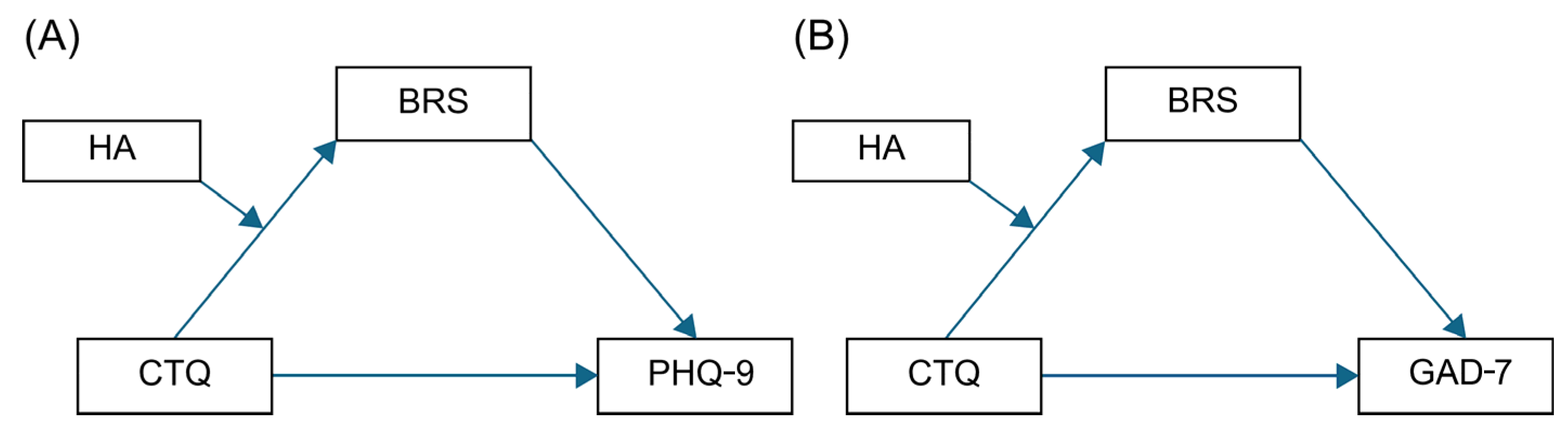
3.2. Mediation and Moderated Mediation Analyses
3.2.1. Model Fit
3.2.2. Depression Model (PHQ-9)
3.2.3. Anxiety Model (GAD-7)
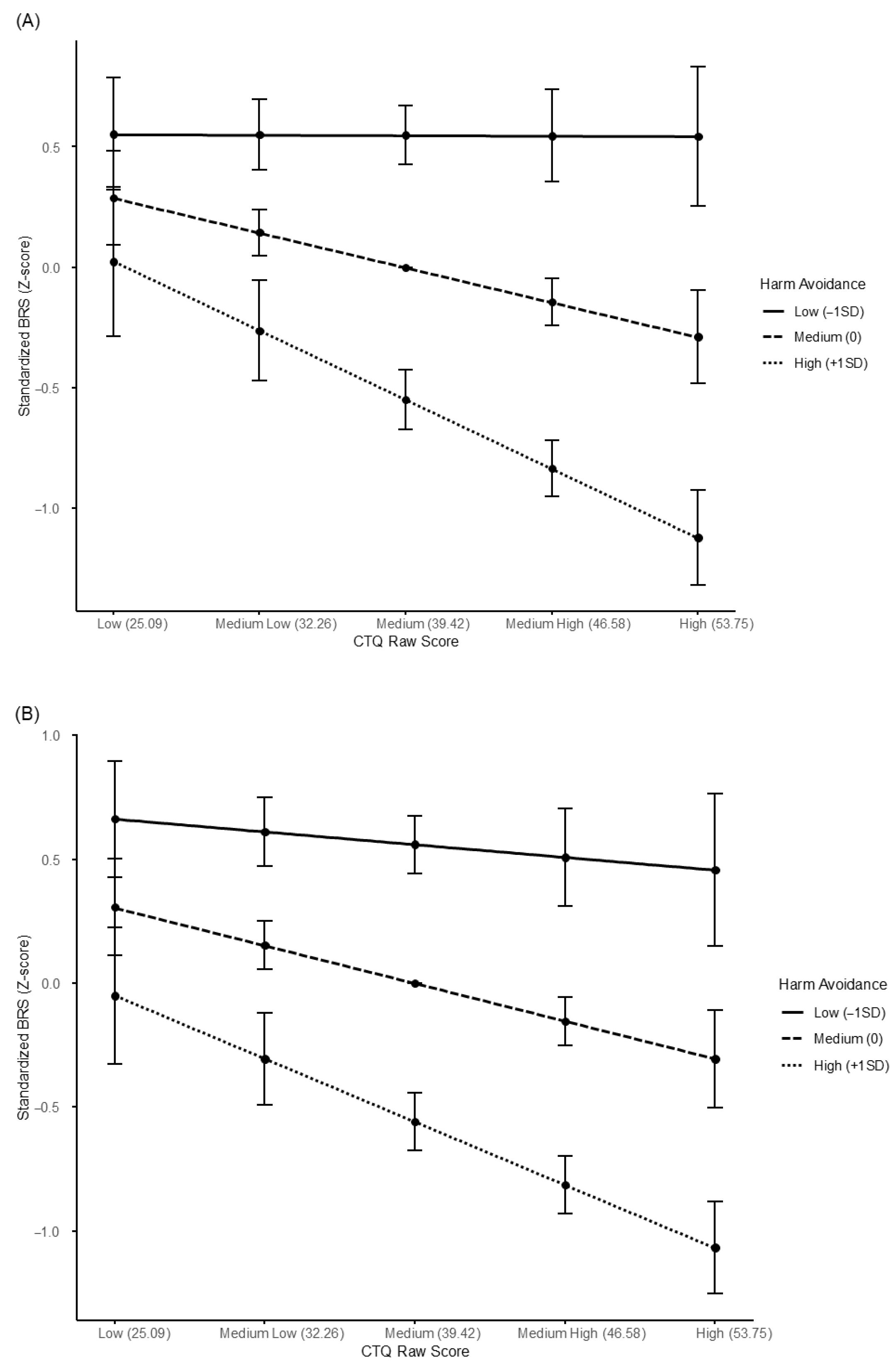
3.3. Conditional Effects of HA
4. Discussion
5. Conclusions
Supplementary Materials
Author Contributions
Funding
Institutional Review Board Statement
Informed Consent Statement
Data Availability Statement
Acknowledgments
Conflicts of Interest
Abbreviations
| BRS | Brief Resilience Scale |
| BRS-K | Brief Resilience Scale—Korean version |
| CFI | Comparative Fit Index |
| CI | Confidence Interval |
| CTQ | Childhood Trauma Questionnaire |
| GAD-7 | Generalized Anxiety Disorder-7 |
| HA | Harm Avoidance |
| PHQ-9 | Patient Health Questionnaire-9 |
| RMSEA | Root Mean Square Error of Approximation |
| SD | Standard Deviation |
| SEM | Structural Equation Modeling |
| SRMR | Standardized Root Mean Square Residual |
| TLI | Tucker–Lewis Index |
| β | Standardized Regression Coefficient |
References
- Hughes, K.; Bellis, M.A.; Hardcastle, K.A.; Sethi, D.; Butchart, A.; Mikton, C.; Jones, L.; Dunne, M.P. The effect of multiple adverse childhood experiences on health: A systematic review and meta-analysis. Lancet Public Health 2017, 2, e356–e366. [Google Scholar] [CrossRef]
- Whitten, T.; Tzoumakis, S.; Green, M.J.; Dean, K. Global prevalence of childhood exposure to physical violence within domestic and family relationships in the general population: A systematic review and proportional meta-analysis. Trauma Violence Abus. 2024, 25, 1411–1430. [Google Scholar] [CrossRef] [PubMed]
- Baldwin, J.R.; Wang, B.; Karwatowska, L.; Schoeler, T.; Tsaligopoulou, A.; Munafò, M.R.; Pingault, J.B. Childhood maltreatment and mental health problems: A systematic review and meta-analysis of quasi-experimental studies. Am. J. Psychiatry 2023, 180, 117–126. [Google Scholar] [CrossRef] [PubMed]
- Grummitt, L.; Baldwin, J.R.; Lafoa’i, J.; Keyes, K.M.; Barrett, E.L. Burden of mental disorders and suicide attributable to childhood maltreatment. JAMA Psychiatry 2024, 81, 782–788. [Google Scholar] [CrossRef] [PubMed]
- Norman, R.E.; Byambaa, M.; De, R.; Butchart, A.; Scott, J.; Vos, T. The long-term health consequences of child physical abuse, emotional abuse, and neglect: A systematic review and meta-analysis. PLoS Med 2012, 9, e1001349. [Google Scholar] [CrossRef]
- Mayer, S.E.; Surachman, A.; Prather, A.A.; Puterman, E.; Delucchi, K.L.; Irwin, M.R.; Danese, A.; Almeida, D.M.; Epel, E.S. The long shadow of childhood trauma for depression in midlife: Examining daily psychological stress processes as a persistent risk pathway. Psychol. Med. 2021, 52, 4029–4038. [Google Scholar] [CrossRef]
- Paganin, W.; Signorini, S.; Sciarretta, A. Bridging early life trauma to difficult-to-treat depression: Scoping review. BJPsych Bull. 2024, 48, 1–12. [Google Scholar] [CrossRef]
- Copeland, W.E.; Shanahan, L.; Hinesley, J.; Chan, R.F.; Aberg, K.A.; Fairbank, J.A.; Van Den Oord, E.J.; Costello, E.J. Association of childhood trauma exposure with adult psychiatric disorders and functional outcomes. JAMA Netw. Open 2018, 1, e184493. [Google Scholar] [CrossRef]
- Murphy, F.; Nasa, A.; Cullinane, D.; Raajakesary, K.; Gazzaz, A.; Sooknarine, V.; Haines, M.; Roman, E.; Kelly, L.; O’Neill, A.; et al. Childhood trauma, the HPA axis and psychiatric illnesses: A targeted literature synthesis. Front. Psychiatry 2022, 13, 748372. [Google Scholar] [CrossRef]
- Spinelli, S.; Chefer, S.; Suomi, S.J.; Higley, J.D.; Barr, C.S.; Stein, E. Early-life stress induces long-term morphologic changes in primate brain. Arch. Gen. Psychiatry 2009, 66, 658–665. [Google Scholar] [CrossRef]
- Armbruster-Genç, D.J.N.; Spilger, E.; Basten, U. Emotion regulation after childhood maltreatment: Suppression tendency and reappraisal capacity. Child Abus. Negl. 2025, 166, 107511. [Google Scholar] [CrossRef]
- Dvir, Y.; Ford, J.D.; Hill, M.; Frazier, J.A. Childhood maltreatment, emotional dysregulation, and psychiatric comorbidities. Harv. Rev. Psychiatry 2014, 22, 149–161. [Google Scholar] [CrossRef] [PubMed]
- Hosseini-Kamkar, N.; Varvani Farahani, M.; Nikolic, M.; Stewart, K.; Goldsmith, S.; Soltaninejad, M.; Rajabli, R.; Lowe, C.; Nicholson, A.A.; Morton, J.B.; et al. Adverse life experiences and brain function: A meta-analysis of functional magnetic resonance imaging findings. JAMA Netw. Open 2023, 6, e2340018. [Google Scholar] [CrossRef] [PubMed]
- Werner, E.E. Vulnerable but invincible: High-risk children from birth to adulthood. Acta Paediatr. Suppl. 1997, 422, 103–105. [Google Scholar] [CrossRef] [PubMed]
- Fares-Otero, N.E.; Carranza-Neira, J.; Womersley, J.S.; Stegemann, A.; Schalinski, I.; Vieta, E.; Spies, G.; Seedat, S. Child maltreatment and resilience in adulthood: A systematic review and meta-analysis. Psychol. Med. 2025, 55, e163. [Google Scholar] [CrossRef]
- Nestler, E.J.; Russo, S.J. Neurobiological basis of stress resilience. Neuron 2024, 112, 1911–1929. [Google Scholar] [CrossRef]
- Moe Yu, M.; Pinyopornpanish, K.; Wongpakaran, N.; O’Donnell, R.; Wongpakaran, T. Psychological resilience buffers depression and post-traumatic stress disorder due to childhood trauma in Thai seniors. Medicina 2025, 61, 1355. [Google Scholar] [CrossRef]
- Wingo, A.P.; Ressler, K.J.; Bradley, B. Resilience characteristics mitigate tendency for harmful alcohol and illicit drug use in adults with a history of childhood abuse: A cross-sectional study of 2024 inner-city men and women. J. Psychiatr. Res. 2014, 51, 93–99. [Google Scholar] [CrossRef]
- Lee, D.; Yu, E.S.; Kim, N.H. Resilience as a mediator in the relationship between posttraumatic stress and posttraumatic growth among adult accident or crime victims: The moderated mediating effect of childhood trauma. Eur. J. Psychotraumatol. 2020, 11, 1704563. [Google Scholar] [CrossRef]
- Kim, J.; Jeong, H.G.; Lee, M.S.; Lee, S.H.; Jeon, S.W.; Han, C. Reliability and validity of the Korean version of the brief resilience scale. Clin. Psychopharmacol. Neurosci. 2023, 21, 732–741. [Google Scholar] [CrossRef]
- Park, J.Y.; Lee, C.W.; Jang, Y.; Lee, W.; Yu, H.; Yoon, J.; Oh, S.; Park, Y.S.; Ryoo, H.A.; Lee, J.; et al. Relationship between childhood trauma and resilience in patients with mood disorders. J. Affect. Disord. 2023, 323, 162–170. [Google Scholar] [CrossRef] [PubMed]
- Kim, J.W.; Lee, H.K.; Lee, K. Influence of temperament and character on resilience. Compr. Psychiatry 2013, 54, 1105–1110. [Google Scholar] [CrossRef] [PubMed]
- Kim, J.H.; Kim, J.E.; Won, S.H.; Rim, H.D.; Kim, B.S.; Lee, S.J. The role of childhood trauma on early maladaptive schema domain. J. Korean Neuropsychiatr. Assoc. 2013, 52, 334–341. [Google Scholar] [CrossRef]
- Garmezy, N.; Masten, A.S.; Tellegen, A. The study of stress and competence in children: A building block for developmental psychopathology. Child Dev. 1984, 55, 97–111. [Google Scholar] [CrossRef]
- Rutter, M. Resilience as a dynamic concept. Dev. Psychopathol. 2012, 24, 335–344. [Google Scholar] [CrossRef]
- Southwick, S.M.; Bonanno, G.A.; Masten, A.S.; Panter-Brick, C.; Yehuda, R. Resilience definitions, theory, and challenges: Interdisciplinary perspectives. Eur. J. Psychotraumatol. 2014, 5, 25338. [Google Scholar] [CrossRef]
- Eley, D.S.; Cloninger, C.R.; Walters, L.; Laurence, C.; Synnott, R.; Wilkinson, D. The relationship between resilience and personality traits in doctors: Implications for enhancing well being. PeerJ 2013, 1, e216. [Google Scholar] [CrossRef]
- Crestani Calegaro, V.; Canova Mosele, P.H.; Lorenzi Negretto, B.; Zatti, C.; Miralha da Cunha, A.B.; Machado Freitas, L.H. The role of personality in posttraumatic stress disorder, trait resilience, and quality of life in people exposed to the Kiss nightclub fire. PLoS ONE 2019, 14, e0220472. [Google Scholar] [CrossRef]
- Hansenne, M.; Ansseau, M. Harm avoidance and serotonin. Biol. Psychol. 1999, 51, 77–81. [Google Scholar] [CrossRef]
- O’donovan, A.; Slavich, G.M.; Epel, E.S.; Neylan, T.C. Exaggerated neurobiological sensitivity to threat as a mechanism linking anxiety with increased risk for diseases of aging. Neurosci. Biobehav. Rev. 2013, 37, 96–108. [Google Scholar] [CrossRef]
- Ahola, A.; Rautio, N.; Timonen, M.; Nordström, T.; Jääskeläinen, E.; Miettunen, J. Premorbid temperament as predictor of onset of depression: 23-year follow-up. Compr. Psychiatry 2023, 121, 152359. [Google Scholar] [CrossRef]
- Chapman, A.L.; Gratz, K.L.; Brown, M.Z. Solving the puzzle of deliberate self-harm: The experiential avoidance model. Behav. Res. Ther. 2006, 44, 371–394. [Google Scholar] [CrossRef]
- Yoon, S.J.; Jun, C.S.; An, H.Y.; Kang, H.R.; Jun, T.Y. Patterns of temperament and character in patients with posttraumatic stress disorder and their association with symptom severity. Compr. Psychiatry 2009, 50, 226–231. [Google Scholar] [CrossRef] [PubMed]
- Zhang, W.; Lu, J.; Ni, Z.; Liu, X.; Wang, D.; Shen, J. Harm avoidance in adolescents modulates late positive potentials during affective picture processing. Int. J. Dev. Neurosci. 2013, 31, 297–302. [Google Scholar] [CrossRef] [PubMed]
- Rende, R.; Plomin, R. Diathesis–stress models of psychopathology: A quantitative genetic perspective. Appl. Prev. Psychol. 1992, 1, 177–182. [Google Scholar] [CrossRef]
- Kim, E.S.; Kim, Y.T.; Oh, K.S.; Shin, Y.C.; Jeon, S.W.; Shin, D.W.; Cho, S.J.; Slavich, G.M.; Kim, J. The stress and adversity inventory for adults (Adult STRAIN) in Korean: Initial validation and associations with psychiatric disorders. Brain Sci. 2024, 15, 32. [Google Scholar] [CrossRef]
- Yu, J.; Lee, C.; Kwon, S.M. Validation of the Korean version of the Childhood Trauma Questionnaire and its implications for counseling and therapeutic intervention. Korean J. Health Psychol. 2009, 14, 563–578. [Google Scholar]
- Min, B.B.; Oh, H.S.; Lee, J.Y. Temperament and Character Inventory—Family Manual; Maumsarang: Seoul, Republic of Korea, 2007; pp. 6–14. [Google Scholar]
- Kim, M.; Jung, S.; Park, J.E.; Sohn, J.H.; Seong, S.J.; Kim, B.S.; Chang, S.M.; Hong, J.P.; Hahm, B.J.; Yeom, C.W. Validation of the Patient Health Questionnaire-9 and Patient Health Questionnaire-2 in the general Korean population. Psychiatry Investig. 2023, 20, 853–861. [Google Scholar] [CrossRef]
- Ahn, J.K.; Kim, Y.; Choi, K.H. The psychometric properties and clinical utility of the Korean version of GAD-7 and GAD-2. Front. Psychiatry 2019, 10, 127. [Google Scholar] [CrossRef]
- Kline, R.B. Principles and Practice of Structural Equation Modeling, 4th ed.; The Guilford Press: New York, NY, USA, 2016. [Google Scholar]
- Rytilä-Manninen, M.; Haravuori, H.; Fröjd, S.; Marttunen, M.; Lindberg, N. Mediators between adverse childhood experiences and suicidality. Child Abus. Negl. 2018, 77, 99–109. [Google Scholar] [CrossRef]
- Hu, T.; Zhang, D.; Wang, J. A meta-analysis of the trait resilience and mental health. Pers. Individ. Dif. 2015, 76, 18–27. [Google Scholar] [CrossRef]
- Havnen, A.; Anyan, F.; Hjemdal, O.; Solem, S.; Gurigard Riksfjord, M.; Hagen, K. Resilience moderates negative outcome from stress during the COVID-19 pandemic: A moderated-mediation approach. Int. J. Environ. Res. Public Health 2020, 17, 6461. [Google Scholar] [CrossRef]
- First, J.M. Post-traumatic stress and depression following disaster: Examining the mediating role of disaster resilience. Front. Public Health 2024, 12, 1272909. [Google Scholar] [CrossRef] [PubMed]
- Boden, J.M.; McLeod, G.F. Resilience and psychiatric epidemiology: Implications for a conceptual framework. Behav. Brain Sci. 2015, 38, e95. [Google Scholar] [CrossRef]
- Kalisch, R.; Russo, S.J.; Müller, M.B. Neurobiology and systems biology of stress resilience. Physiol. Rev. 2024, 104, 1205–1263. [Google Scholar] [CrossRef] [PubMed]
- Köhler-Forsberg, O.; Keers, R.; Uher, R.; Hauser, J.; Maier, W.; Rietschel, M.; McGuffin, P.; Farmer, A.E.; Aitchison, K.J.; Mors, O. Dimensions of temperament and character as predictors of antidepressant discontinuation, response and adverse reactions during treatment with nortriptyline and escitalopram. Psychol. Med. 2023, 53, 2522–2530. [Google Scholar] [CrossRef] [PubMed]
- Schlund, M.W.; Cataldo, M.F. Amygdala involvement in human avoidance, escape and approach behavior. Neuroimage 2010, 53, 769–776. [Google Scholar] [CrossRef]
- Roeckner, A.R.; Oliver, K.I.; Lebois, L.A.; van Rooij, S.J.; Stevens, J.S. Neural contributors to trauma resilience: A review of longitudinal neuroimaging studies. Transl. Psychiatry 2021, 11, 508. [Google Scholar] [CrossRef]
- Berens, A.E.; Jensen, S.K.G.; Nelson, C.A. Biological embedding of childhood adversity: From physiological mechanisms to clinical implications. BMC Med. 2017, 15, 135. [Google Scholar] [CrossRef]
- Na, E.; Lee, K.; Jeon, B.H.; Jo, C.; Kwak, U.H.; Jeon, Y.; Yang, K.; Lee, E.J.; Jeong, J. Acceptance and commitment therapy for destructive experiential avoidance (ACT-DEA): A feasibility study. Int. J. Environ. Res. Public Health 2022, 19, 16434. [Google Scholar] [CrossRef]
- Allen, A.B.; Leary, M.R. Self-compassion, stress, and coping. Soc. Personal. Psychol. Compass 2010, 4, 107–118. [Google Scholar] [CrossRef]
- Chin, B.; Lindsay, E.; Creswell, J.D. Psychological mechanisms driving stress resilience in mindfulness training: A randomized controlled trial. Health Psychol. 2019, 38, 759–767. [Google Scholar] [CrossRef]
- Grabbe, L.; Miller-Karas, E. The trauma resiliency model: A “bottom-up” intervention for trauma psychotherapy. J. Am. Psychiatr. Nurses Assoc. 2018, 24, 76–84. [Google Scholar] [CrossRef]
- Masten, A.S. Ordinary magic: Resilience processes in development. Am. Psychol. 2001, 56, 227–238. [Google Scholar] [CrossRef]
- Luthar, S.S.; Cicchetti, D.; Becker, B. The construct of resilience: A critical evaluation and guidelines for future work. Child Dev. 2000, 71, 543–562. [Google Scholar] [CrossRef]
- Ungar, M. The social ecology of resilience: Addressing contextual and cultural ambiguity of a nascent construct. Am. J. Orthopsychiatry 2011, 81, 1–17. [Google Scholar] [CrossRef]

| Characteristic | Total |
|---|---|
| (N = 218) | |
| Age (years) | 29.5 ± 6.02 |
| Sex | |
| Male | 79 (36.24) |
| Female | 139 (63.76) |
| Level of education (years) | 14.90 ± 1.73 |
| Occupational status | |
| Employed | 171 (78.44) |
| Unemployed | 47 (21.56) |
| Psychiatric Scale | |
| CTQ | 39.42 (14.33) |
| Emotional Abuse | 7.59 (3.69) |
| Physical Abuse | 8.04 (3.94) |
| Sexual Abuse | 5.67 (2.16) |
| Emotional Neglect | 10.60 (5.16) |
| Physical Neglect | 7.51 (3.05) |
| TCI | |
| Novelty Seeking | 35.46 (12.25) |
| Harm Avoidance | 42.46 (15.63) |
| Reward Dependence | 43.53 (11.02) |
| Persistence | 41.27 (11.40) |
| BRS | 19.82 (5.37) |
| PHQ-9 | 5.01 (5.48) |
| GAD-7 | 4.44 (4.52) |
| Variables | CTQ | HA | BRS | PHQ-9 | GAD-7 |
|---|---|---|---|---|---|
| CTQ | 1 | ||||
| HA | 0.381 | 1 | |||
| BRS | −0.421 | −0.638 | 1 | ||
| PHQ-9 | 0.525 | 0.561 | −0.596 | 1 | |
| GAD-7 | 0.432 | 0.588 | −0.573 | 0.736 | 1 |
| Path | β | SE | 95% CI | p-Value |
|---|---|---|---|---|
| Mediated model (Dependent variable: BRS) | ||||
| CTQ → BRS | −0.147 | 0.057 | [−0.255, −0.033] | 0.011 |
| HA → BRS | −0.561 | 0.055 | [−0.657, −0.441] | <0.001 |
| CTQ × HA → BRS | −0.161 | 0.041 | [−0.222, −0.062] | <0.001 |
| Outcome model (Dependent variable: PHQ-9) | ||||
| CTQ → PHQ-9 | 0.068 | 0.079 | [−0.088, 0.222] | 0.395 |
| BRS → PHQ-9 | −0.830 | 0.120 | [−1.071, −0.600] | <0.001 |
| Effect decomposition (CTQ→PHQ-9) | ||||
| Total effect | 0.190 | 0.062 | [0.067, 0.308] | 0.002 |
| Direct effect | 0.068 | 0.079 | [−0.088, 0.222] | 0.395 |
| Indirect effect (via BRS) | 0.122 | 0.054 | [0.015, 0.226] | 0.025 |
| Path | β | SE | 95% CI | p-Value |
|---|---|---|---|---|
| Mediated model (Dependent variable: BRS) | ||||
| CTQ → BRS | −0.156 | 0.057 | [−0.264, −0.042] | 0.007 |
| HA → BRS | −0.570 | 0.054 | [−0.666, −0.453] | <0.001 |
| CTQ × HA → BRS | −0.115 | 0.038 | [−0.177, −0.026] | 0.008 |
| Outcome model (Dependent variable: GAD-7) | ||||
| CTQ → GAD-7 | −0.091 | 0.081 | [−0.249, 0.067] | 0.260 |
| BRS → GAD-7 | −1.027 | 0.122 | [−1.281, −0.801] | <0.001 |
| Effect decomposition (CTQ→ GAD-7) | ||||
| Total effect | 0.069 | 0.060 | [−0.049, 0.186] | 0.255 |
| Direct effect | −0.091 | 0.081 | [−0.249, 0.067] | 0.260 |
| Indirect effect (via BRS) | 0.160 | 0.066 | [0.029, 0.289] | 0.017 |
Disclaimer/Publisher’s Note: The statements, opinions and data contained in all publications are solely those of the individual author(s) and contributor(s) and not of MDPI and/or the editor(s). MDPI and/or the editor(s) disclaim responsibility for any injury to people or property resulting from any ideas, methods, instructions or products referred to in the content. |
© 2025 by the authors. Licensee MDPI, Basel, Switzerland. This article is an open access article distributed under the terms and conditions of the Creative Commons Attribution (CC BY) license (https://creativecommons.org/licenses/by/4.0/).
Share and Cite
Kim, E.S.; Shin, Y.C.; Kim, Y.T.; Oh, K.-S.; Jeon, S.-W.; Shin, D.-W.; Kim, J. Resilience as a Mediator Between Childhood Trauma and Adult Psychopathology: The Moderating Role of Harm Avoidance in Korean Adults. Brain Sci. 2025, 15, 1308. https://doi.org/10.3390/brainsci15121308
Kim ES, Shin YC, Kim YT, Oh K-S, Jeon S-W, Shin D-W, Kim J. Resilience as a Mediator Between Childhood Trauma and Adult Psychopathology: The Moderating Role of Harm Avoidance in Korean Adults. Brain Sciences. 2025; 15(12):1308. https://doi.org/10.3390/brainsci15121308
Chicago/Turabian StyleKim, Eun Soo, Young Chul Shin, Yun Tae Kim, Kang-Seob Oh, Sang-Won Jeon, Dong-Won Shin, and Junhyung Kim. 2025. "Resilience as a Mediator Between Childhood Trauma and Adult Psychopathology: The Moderating Role of Harm Avoidance in Korean Adults" Brain Sciences 15, no. 12: 1308. https://doi.org/10.3390/brainsci15121308
APA StyleKim, E. S., Shin, Y. C., Kim, Y. T., Oh, K.-S., Jeon, S.-W., Shin, D.-W., & Kim, J. (2025). Resilience as a Mediator Between Childhood Trauma and Adult Psychopathology: The Moderating Role of Harm Avoidance in Korean Adults. Brain Sciences, 15(12), 1308. https://doi.org/10.3390/brainsci15121308

