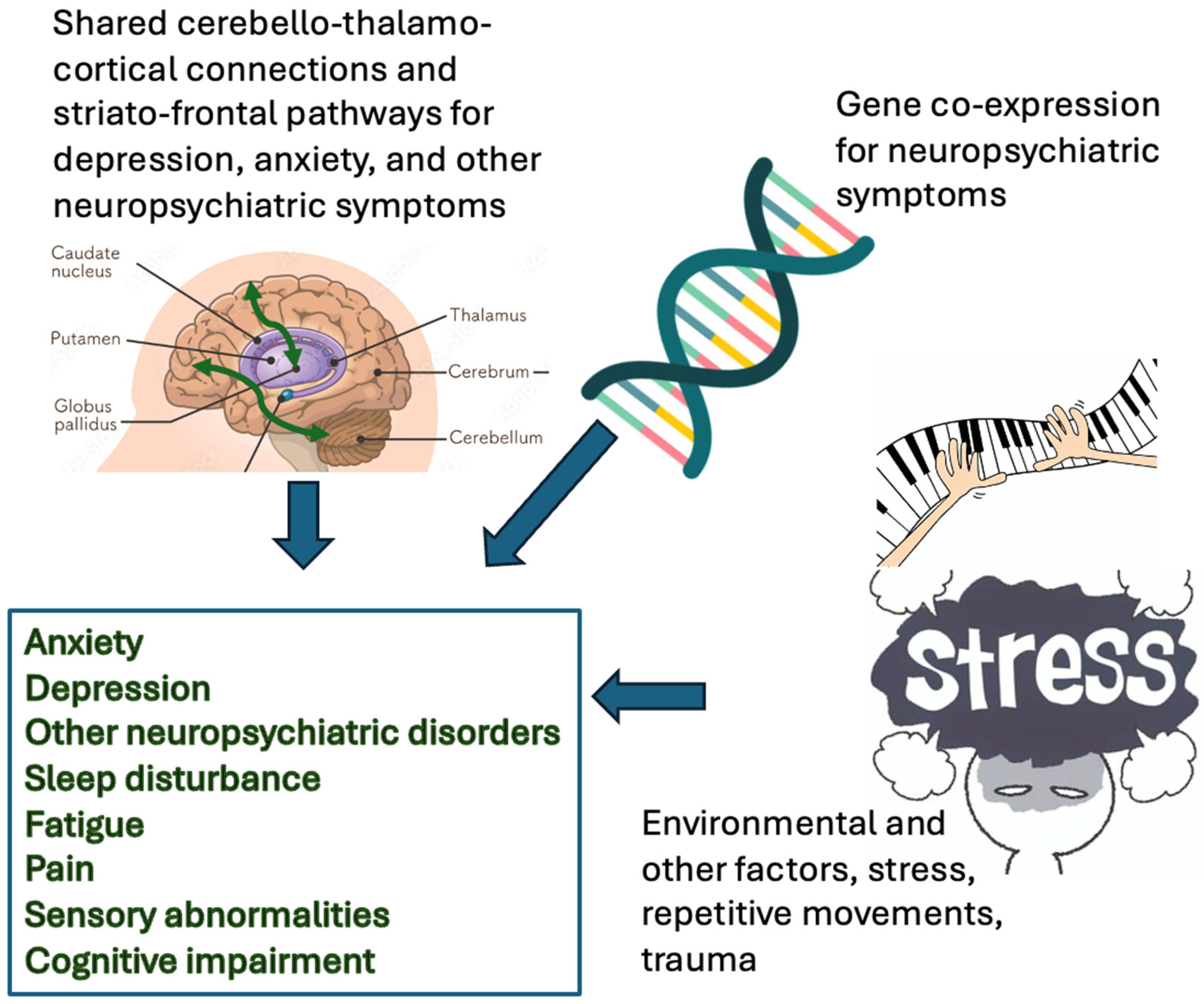


More than a Movement Disorder: Non-Motor Features and Future Directions in Dystonia Research
Abstract
1. Introduction
2. Pathophysiological Mechanisms of Non-Motor Symptoms
3. Neuropsychiatric Symptoms in Dystonia
4. Cognitive Impairment in Dystonia
5. Sleep Disorders and Fatigue
6. Pain and Sensory Symptoms
7. Quality of Life and Functional Impact

| Author | Year | Country | Sample Size | Key Findings |
|---|---|---|---|---|
| Neuropsychiatric symptoms | ||||
| Fabbrini et al. [18] | 2010 | Italy | n = 89, HC = 62 | High frequency of depressive disorders in dystonia patients compared to controls. |
| Medina Escobar et al. [19] | 2021 | Multicentre (systematic review and meta-analysis) | n = 12,635 | Pooled prevalence of depressive symptoms/disorders is 31.5% cervical dystonia and 29.2% cranial dystonia. |
| Bailey et al. [20] | 2022 | UK | n = 52,589, HC = 216,754 | High rates of psychiatric diagnoses and psychiatric medication prescriptions in dystonia patients compared to controls. |
| Martino et al. [21] | 2020 | Sweden | n = 2958, HC = 6,841,937 | Dystonia patients and their siblings had higher rates of depression, anxiety disorders or suicide attempts compared to controls. |
| Berman et al. [22] | 2017 | International multicentre | n = 478 | High rates of anxiety and depression amongst all dystonia patients. Anxiety highest in cervical and laryngeal subgroups. |
| Medina Escobar et al. [23] | 2021 | Multicentre (systematic review and meta-analysis) | n = 6919 | Pooled prevalence of clinically relevant anxiety symptoms and anxiety disorders was 40% for cervical dystonia and 25% for cranial dystonia. |
| Heiman et al. [25] | 2004 | USA | n = 96 (manifesting carriers), n = 60 (non-manifesting carriers), n = 65 (non-carriers) | Manifesting carriers of DYT1 mutation and non-manifesting carriers had increased risk of major depressive disorder when compared to non-carriers. |
| Lane et al. [26] | 2021 | UK | n = 544 (dystonia patients), n = 263 (control subjects with medical comorbidity), HC = 115 | Study subjects with DYT-SGCE appeared at higher risk of psychiatric comorbidity than controls. |
| Cognitive symptoms | ||||
| Niccolai et al. [28] | 2020 | USA | n = 25, HC = 25 | Dystonia patients performed worse on measures of global cognitive function, attention, memory and conceptualisation compared to controls. |
| Maggi et al. [30] | 2019 | Italy | n = 53, HC = 30 | Selective deficit in prospective memory in focal dystonia patients. |
| Bastos et al. [33] | 2021 | Brazil | n = 50, HC = 50 | Impaired visual processing speed, divided attention and selective attention in cervical dystonia patients compared with controls. |
| Chillemi et al. [34] | 2017 | Italy | n = 23, HC = 12 | Biased spatial attention in patients with cervical dystonia compared to controls. |
| Alemán et al. [35] | 2009 | Argentina | n = 20, HC = 17 | Impairment in visuospatial working memory, complex moving planning and sustained attention was found in patients with blepharospasm compared to controls. |
| Burke et al. [36] | 2020 | Ireland | n = 46, HC = 46 | Patients with cervical dystonia were found to have impaired basic social cognition, recognition and delayed recall when compared to controls. |
| Rinnerthaler et al. [37] | 2005 | Austria | n = 32, HC = 32 | Patients with dystonia showed isolated deficits in the recognition of disgust compared to controls. |
| Nikolova et al. [38] | 2011 | Germany | n = 30, HC = 30 | Compared to controls, dystonia patients showed impaired processing of emotional prosody. |
| Baione et al. [39] | 2021 | Italy | n = 22, HC = 19 | Patients with cervical dystonia showed impaired postural control compared to controls. |
| Crisafulli et al. [40] | 2021 | Italy | n = 17, HC = 19 | Patients with cervical dystonia showed slower gait speed, longer stance time and increased dual-task cost when compared to controls. |
| Sleep | ||||
| Bailey et al. [43] | 2023 | UK | n = 241, HC = 964 | Accelerometry measurements revealed later sleep times, reduced time in bed and shifts in circadian rhythms in dystonia patients compared with controls. |
| Paus et al. [46] | 2011 | Germany | n = 221, HC = 93 | Impaired sleep quality was found in 44% patients with cervical dystonia, 46% patients with blepharospasm and 20% controls. |
| Yang et al. [47] | 2016 | China | n = 120, HC = 60 | Dystonia patients showed impaired sleep quality when compared with controls. |
| Wagle Shukla et al. [48] | 2015 | USA | n = 91 | 43% of dystonia patients had moderate to severe fatigue, which negatively impacted quality of life even when adjusted for depression. |
| Smit et al. [49] | 2016 | The Netherlands | n = 44, HC = 43 | In patients with cervical dystonia, fatigue was found to be independent of psychiatric comorbidity and a significant influence on quality of life. |
| Tomic et al. [50] | 2022 | Croatia | n = 60 | 67% of dystonia patients reported fatigue. |
| Pain | ||||
| Kutvonen et al. [51] | 1997 | Finland | n = 39, HC = 18 | Two-thirds of patients with cervical dystonia reported continuous or intermittent recurrent pain. |
| Chan et al. [52] | 1991 | USA | n = 266 | 75% patients with cervical dystonia reported pain. |
| Quagliato et al. [55] | 2010 | Brazil | n = 24 | Botulinum Toxin therapy was associated with improvements in pain in patients with cervical dystonia. |
| Camargo et al. [56] | 2011 | Brazil | n = 28 | Botulinum Toxin is an effective therapy for pain in patients with cervical dystonia. |
| Kulisevsky et al. [57] | 2000 | Spain | n = 2 | Case reports showing temporal dissociation between pain and motor improvements. |
| Lobbezoo et al. [58] | 1996 | Canada | n = 9, HC = 5 | Reduced pain-pressure thresholds in patients with cervical dystonia compared to controls. |
| Pérez-de-Heredia-Torres et al. [59] | 2022 | Spain | n = 12, HC = 12 | Patients with hand dystonia had greater subjective pain compared to controls. |
8. Therapeutic Approaches Targeting Non-Motor Symptoms
9. Future Directions and Research Gaps
10. Conclusions
Author Contributions
Funding
Institutional Review Board Statement
Informed Consent Statement
Data Availability Statement
Conflicts of Interest
References
- Batla, A. Dystonia: A Review. Neurol. India 2018, 66, S48–S58. [Google Scholar] [CrossRef]
- Dressler, D.; Altenmüller, E.; Giess, R.; Krauss, J.K.; Adib Saberi, F. The Epidemiology of Dystonia: The Hannover Epidemiology Study. J. Neurol. 2022, 269, 6483–6493. [Google Scholar] [CrossRef] [PubMed]
- Medina, A.; Nilles, C.; Martino, D.; Pelletier, C.; Pringsheim, T. The Prevalence of Idiopathic or Inherited Isolated Dystonia: A Systematic Review and Meta-Analysis. Mov. Disord. Clin. Pract. 2022, 9, 860–868. [Google Scholar] [CrossRef] [PubMed]
- Albanese, A.; Bhatia, K.P.; Fung, V.S.C.; Hallett, M.; Jankovic, J.; Klein, C.; Krauss, J.K.; Lang, A.E.; Mink, J.W.; Pandey, S.; et al. Definition and Classification of Dystonia. Mov. Disord. 2025, 40, 1248–1259. [Google Scholar] [CrossRef] [PubMed]
- Page, D.; Butler, A.; Jahanshahi, M. Quality of Life in Focal, Segmental, and Generalized Dystonia. Mov. Disord. 2007, 22, 341–347. [Google Scholar] [CrossRef]
- Pekmezovic, T.; Svetel, M.; Ivanovic, N.; Dragasevic, N.; Petrovic, I.; Tepavcevic, D.K.; Kostic, V.S. Quality of Life in Patients with Focal Dystonia. Clin. Neurol. Neurosurg. 2009, 111, 161–164. [Google Scholar] [CrossRef]
- Sugar, D.; Pirio Richardson, S. Treating Non-Motor Symptoms in Dystonia: A Systematic Review. Dystonia 2025, 4, 14545. [Google Scholar] [CrossRef]
- Thomsen, M.; Lange, L.M.; Zech, M.; Lohmann, K. Genetics and Pathogenesis of Dystonia. Annu. Rev. Pathol. Mech. Dis. 2024, 19, 99–131. [Google Scholar] [CrossRef]
- Corp, D.T.; Joutsa, J.; Darby, R.R.; Delnooz, C.C.S.; van de Warrenburg, B.P.C.; Cooke, D.; Prudente, C.N.; Ren, J.; Reich, M.M.; Batla, A.; et al. Network Localization of Cervical Dystonia Based on Causal Brain Lesions. Brain 2019, 142, 1660–1674. [Google Scholar] [CrossRef]
- Shakkottai, V.G.; Batla, A.; Bhatia, K.; Dauer, W.T.; Dresel, C.; Niethammer, M.; Eidelberg, D.; Raike, R.S.; Smith, Y.; Jinnah, H.A.; et al. Current Opinions and Areas of Consensus on the Role of the Cerebellum in Dystonia. Cerebellum 2017, 16, 577–594. [Google Scholar] [CrossRef]
- Batla, A.; Sánchez, M.C.; Erro, R.; Ganos, C.; Stamelou, M.; Balint, B.; Brugger, F.; Antelmi, E.; Bhatia, K.P. The Role of Cerebellum in Patients with Late Onset Cervical/Segmental Dystonia?—Evidence from the Clinic. Park. Relat. Disord. 2015, 21, 1317–1322. [Google Scholar] [CrossRef] [PubMed]
- Jinnah, H.A.; Neychev, V.; Hess, E.J. The Anatomical Basis for Dystonia: The Motor Network Model. Tremor Other Hyperkinet. Mov. 2017, 7, 506. [Google Scholar] [CrossRef]
- Poston, K.L.; Eidelberg, D. Functional Brain Networks and Abnormal Connectivity in the Movement Disorders. Neuroimage 2012, 62, 2261–2270. [Google Scholar] [CrossRef]
- Stamelou, M.; Edwards, M.J.; Hallett, M.; Bhatia, K.P. The Non-Motor Syndrome of Primary Dystonia: Clinical and Pathophysiological Implications. Brain 2012, 135, 1668–1681. [Google Scholar] [CrossRef]
- MacIver, C.L.; Jones, D.; Green, K.; Szewczyk-Krolikowski, K.; Doring, A.; Tax, C.M.W.; Peall, K.J. White Matter Microstructural Changes Using Ultra-Strong Diffusion Gradient MRI in Adult-Onset Idiopathic Focal Cervical Dystonia. Neurology 2024, 103, e209695. [Google Scholar] [CrossRef]
- Mencacci, N.E.; Reynolds, R.; Ruiz, S.G.; Vandrovcova, J.; Forabosco, P.; Sánchez-Ferrer, A.; Volpato, V.; UK Brain Expression Consortium; International Parkinson’s Disease Genomics Consortium; Weale, M.E.; et al. Dystonia Genes Functionally Converge in Specific Neurons and Share Neurobiology with Psychiatric Disorders. Brain 2020, 143, 2771–2787. [Google Scholar] [CrossRef]
- Peall, K.J.; Dijk, J.M.; Saunders-Pullman, R.; Dreissen, Y.E.M.; van Loon, I.; Cath, D.; Kurian, M.A.; Owen, M.J.; Foncke, E.M.J.; Morris, H.R.; et al. Psychiatric Disorders, Myoclonus Dystonia and SGCE: An International Study. Ann. Clin. Transl. Neurol. 2015, 3, 4–11. [Google Scholar] [CrossRef]
- Fabbrini, G.; Berardelli, I.; Moretti, G.; Pasquini, M.; Bloise, M.; Colosimo, C.; Biondi, M.; Berardelli, A. Psychiatric Disorders in Adult-Onset Focal Dystonia: A Case-Control Study. Mov. Disord. 2010, 25, 459–465. [Google Scholar] [CrossRef]
- Medina Escobar, A.; Pringsheim, T.; Goodarzi, Z.; Martino, D. The Prevalence of Depression in Adult Onset Idiopathic Dystonia: Systematic Review and Metaanalysis. Neurosci. Biobehav. Rev. 2021, 125, 221–230. [Google Scholar] [CrossRef]
- Bailey, G.A.; Rawlings, A.; Torabi, F.; Pickrell, W.O.; Peall, K.J. Longitudinal Analysis of the Relationship between Motor and Psychiatric Symptoms in Idiopathic Dystonia. Eur. J. Neurol. 2022, 29, 3513–3527. [Google Scholar] [CrossRef]
- Martino, D.; Brander, G.; Svenningsson, P.; Larsson, H.; Fernández de la Cruz, L. Association and Familial Coaggregation of Idiopathic Dystonia With Psychiatric Outcomes. Mov. Disord. 2020, 35, 2270–2278. [Google Scholar] [CrossRef]
- Berman, B.D.; Junker, J.; Shelton, E.; Sillau, S.H.; Jinnah, H.A.; Perlmutter, J.S.; Espay, A.J.; Jankovic, J.; Vidailhet, M.; Bonnet, C.; et al. Psychiatric Associations of Adult-Onset Focal Dystonia Phenotypes. J. Neurol. Neurosurg. Psychiatry 2017, 88, 595–602. [Google Scholar] [CrossRef] [PubMed]
- Medina Escobar, A.; Martino, D.; Goodarzi, Z. The Prevalence of Anxiety in Adult-Onset Isolated Dystonia: A Systematic Review and Meta-Analysis. Eur. J. Neurol. 2021, 28, 4238–4250. [Google Scholar] [CrossRef] [PubMed]
- Paracka, L.; Wegner, F.; Escher, C.; Klietz, M.; de Zwaan, M.; Abdallat, M.; Saryyeva, A.; Krauss, J.K. Body Concept and Quality of Life in Patients with Idiopathic Dystonia. Brain Sci. 2020, 10, 488. [Google Scholar] [CrossRef] [PubMed]
- Heiman, G.A.; Ottman, R.; Saunders-Pullman, R.J.; Ozelius, L.J.; Risch, N.J.; Bressman, S.B. Increased Risk for Recurrent Major Depression in DYT1 Dystonia Mutation Carriers. Neurology 2004, 63, 631–637. [Google Scholar] [CrossRef]
- Lane, V.; Lane, M.; Sturrock, A.; Rickards, H. Understanding Psychiatric Disorders in Idiopathic and Inherited (Monogenic) Forms of Isolated and Combined Dystonia: A Systematic Review. JNP 2021, 33, 295–306. [Google Scholar] [CrossRef]
- Peall, K.J.; Berman, B.D.; Bruggemann, N.; Defazio, G.; Gimeno, H.; Jinnah, H.A.; Perlmutter, J.S.; Richardson, S.E.P.; Roze, E.; Schrag, A.; et al. Non-Motor Symptoms in Dystonia: From Diagnosis to Treatment. Dystonia 2023, 2, 11860. [Google Scholar] [CrossRef]
- Niccolai, L.; Aita, S.L.; Walker, H.C.; Martin, R.C.; Clay, O.J.; Crowe, M.; Triebel, K.L. An Examination of the Neurocognitive Profile and Base Rate of Performance Impairment in Primary Dystonia. J. Clin. Neurosci. 2020, 74, 1–5. [Google Scholar] [CrossRef]
- O’Connor, S.; Hevey, D.; Burke, T.; Rafee, S.; Pender, N.; O’Keeffe, F. A Systematic Review of Cognition in Cervical Dystonia. Neuropsychol. Rev. 2024, 34, 134–154. [Google Scholar] [CrossRef]
- Maggi, G.; D’Iorio, A.; Mautone, G.; Peluso, S.; Manganelli, F.; Dubbioso, R.; Esposito, M.; Santangelo, G. Cognitive Correlates of Prospective Memory in Dystonia. Park. Relat. Disord. 2019, 66, 51–55. [Google Scholar] [CrossRef]
- Bailey, G.A.; Martin, E.; Peall, K.J. Cognitive and Neuropsychiatric Impairment in Dystonia. Curr. Neurol. Neurosci. Rep. 2022, 22, 699–708. [Google Scholar] [CrossRef]
- Tinazzi, M.; Priori, A.; Bertolasi, L.; Frasson, E.; Mauguière, F.; Fiaschi, A. Abnormal Central Integration of a Dual Somatosensory Input in Dystonia. Evid. Sens. Overflow. Brain 2000, 123 Pt 1, 42–50. [Google Scholar] [CrossRef]
- Bastos, M.S.C.; Nickel, R.; Camargo, C.H.F.; Teive, H.A.G. Patients with Cervical Dystonia Demonstrated Decreased Cognitive Abilities and Visual Planning Compared to Controls. Mov. Disord. Clin. Pract. 2021, 8, 904–910. [Google Scholar] [CrossRef]
- Chillemi, G.; Formica, C.; Salatino, A.; Calamuneri, A.; Girlanda, P.; Morgante, F.; Milardi, D.; Terranova, C.; Cacciola, A.; Quartarone, A.; et al. Biased Visuospatial Attention in Cervical Dystonia. J. Int. Neuropsychol. Soc. 2018, 24, 22–32. [Google Scholar] [CrossRef]
- Alemán, G.G.; de Erausquin, G.A.; Micheli, F. Cognitive Disturbances in Primary Blepharospasm. Mov. Disord. 2009, 24, 2112–2120. [Google Scholar] [CrossRef]
- Burke, T.; Monaghan, R.; McCormack, D.; Cogley, C.; Pinto-Grau, M.; O’Connor, S.; Donohoe, B.; Murphy, L.; O’Riordan, S.; Ndukwe, I.; et al. Social Cognition in Cervical Dystonia: A Case-Control Study. Clin. Park. Relat. Disord. 2020, 3, 100072. [Google Scholar] [CrossRef] [PubMed]
- Rinnerthaler, M.; Benecke, C.; Bartha, L.; Entner, T.; Poewe, W.; Mueller, J. Facial Recognition in Primary Focal Dystonia. Mov. Disord. 2006, 21, 78–82. [Google Scholar] [CrossRef] [PubMed]
- Nikolova, Z.T.; Fellbrich, A.; Born, J.; Dengler, R.; Schröder, C. Deficient Recognition of Emotional Prosody in Primary Focal Dystonia. Eur. J. Neurol. 2011, 18, 329–336. [Google Scholar] [CrossRef]
- Baione, V.; Ferrazzano, G.; Celletti, C.; De Rosa, M.; Belvisi, D.; Fabbrini, G.; Galli, M.; Camerota, F.; Conte, A. Attention-Demanding Cognitive Tasks Worsen Postural Control in Patients With Cervical Dystonia: A Case-Control Study. Front. Neurol. 2021, 12, 666438. [Google Scholar] [CrossRef]
- Crisafulli, O.; Trompetto, C.; Puce, L.; Marinelli, L.; Costi, S.; Abbruzzese, G.; Avanzino, L.; Pelosin, E. Dual Task Gait Deteriorates Gait Performance in Cervical Dystonia Patients: A Pilot Study. J. Neural Transm. 2021, 128, 1677–1685. [Google Scholar] [CrossRef]
- Silvestri, R.; De Domenico, P.; Di Rosa, A.E.; Bramanti, P.; Serra, S.; Di Perri, R. The Effect of Nocturnal Physiological Sleep on Various Movement Disorders. Mov. Disord. 1990, 5, 8–14. [Google Scholar] [CrossRef] [PubMed]
- Antelmi, E.; Ferri, R.; Provini, F.; Scaglione, C.M.L.; Mignani, F.; Rundo, F.; Vandi, S.; Fabbri, M.; Pizza, F.; Plazzi, G.; et al. Modulation of the Muscle Activity During Sleep in Cervical Dystonia. Sleep 2017, 40, zsx088. [Google Scholar] [CrossRef] [PubMed]
- Bailey, G.A.; Hubbard, E.K.; Fasano, A.; Tijssen, M.A.; Lynch, T.; Anderson, K.N.; Peall, K.J. Sleep Disturbance in Movement Disorders: Insights, Treatments and Challenges. J. Neurol. Neurosurg. Psychiatry 2021, 92, 723–736. [Google Scholar] [CrossRef] [PubMed]
- Hertenstein, E.; Tang, N.K.Y.; Bernstein, C.J.; Nissen, C.; Underwood, M.R.; Sandhu, H.K. Sleep in Patients with Primary Dystonia: A Systematic Review on the State of Research and Perspectives. Sleep Med. Rev. 2016, 26, 95–107. [Google Scholar] [CrossRef]
- Bailey, G.A.; Wadon, M.E.; Komarzynski, S.; Matthews, C.; Davies, E.H.; Peall, K.J. Accelerometer-derived Sleep Measures in Idiopathic Dystonia: A UK Biobank Cohort Study. Brain Behav. 2023, 13, e2933. [Google Scholar] [CrossRef]
- Paus, S.; Gross, J.; Moll-Müller, M.; Hentschel, F.; Spottke, A.; Wabbels, B.; Klockgether, T.; Abele, M. Impaired Sleep Quality and Restless Legs Syndrome in Idiopathic Focal Dystonia: A Controlled Study. J. Neurol. 2011, 258, 1835–1840. [Google Scholar] [CrossRef]
- Yang, J.; Shao, N.; Song, W.; Wei, Q.; Ou, R.; Wu, Y.; Shang, H.-F. Nonmotor Symptoms in Primary Adult-Onset Cervical Dystonia and Blepharospasm. Brain Behav. 2017, 7, e00592. [Google Scholar] [CrossRef]
- Wagle Shukla, A.; Brown, R.; Heese, K.; Jones, J.; Rodriguez, R.L.; Malaty, I.M.; Okun, M.S.; Kluger, B.M. High Rates of Fatigue and Sleep Disturbances in Dystonia. Int. J. Neurosci. 2016, 126, 928–935. [Google Scholar] [CrossRef]
- Smit, M.; Kamphuis, A.S.J.; Bartels, A.L.; Han, V.; Stewart, R.E.; Zijdewind, I.; Tijssen, M.A. Fatigue, Sleep Disturbances, and Their Influence on Quality of Life in Cervical Dystonia Patients. Mov. Disord. Clin. Pract. 2017, 4, 517–523. [Google Scholar] [CrossRef]
- Tomic, S.; Kuric, T.G.; Popovic, Z.; Zubonja, T.M. Fatigue Is Related to Depression in Idiopathic Dystonia. Neurol. Sci. 2022, 43, 373–378. [Google Scholar] [CrossRef]
- Kutvonen, O.; Dastidar, P.; Nurmikko, T. Pain in Spasmodic Torticollis. Pain 1997, 69, 279–286. [Google Scholar] [CrossRef]
- Chan, J.; Brin, M.F.; Fahn, S. Idiopathic Cervical Dystonia: Clinical Characteristics. Mov. Disord. 1991, 6, 119–126. [Google Scholar] [CrossRef]
- Barbanti, P.; Fabbrini, G.; Pauletti, C.; Defazio, G.; Cruccu, G.; Berardelli, A. Headache in Cranial and Cervical Dystonia. Neurology 2005, 64, 1308–1309. [Google Scholar] [CrossRef] [PubMed]
- Rosales, R.L.; Cuffe, L.; Regnault, B.; Trosch, R.M. Pain in Cervical Dystonia: Mechanisms, Assessment and Treatment. Expert Rev. Neurother. 2021, 21, 1125–1134. [Google Scholar] [CrossRef] [PubMed]
- Quagliato, E.M.A.B.; Carelli, E.F.; Viana, M.A. A Prospective, Randomized, Double-Blind Study Comparing the Efficacy and Safety of Type a Botulinum Toxins Botox and Prosigne in the Treatment of Cervical Dystonia. Clin. Neuropharmacol. 2010, 33, 22–26. [Google Scholar] [CrossRef] [PubMed]
- Camargo, C.H.F.; Teive, H.A.G.; Becker, N.; Munhoz, R.P.; Werneck, L.C. Botulinum Toxin Type A and Cervical Dystonia: A Seven-Year Follow-Up. Arq. Neuropsiquiatr. 2011, 69, 745–750. [Google Scholar] [CrossRef]
- Kulisevsky, J.; Lleó, A.; Gironell, A.; Molet, J.; Pascual-Sedano, B.; Parés, P. Bilateral Pallidal Stimulation for Cervical Dystonia: Dissociated Pain and Motor Improvement. Neurology 2000, 55, 1754–1755. [Google Scholar] [CrossRef]
- Lobbezoo, F.; Tanguay, R.; Thon, M.T.; Lavigne, G.J. Pain Perception in Idiopathic Cervical Dystonia (Spasmodic Torticollis). Pain 1996, 67, 483–491. [Google Scholar] [CrossRef]
- Pérez-de-Heredia-Torres, M.; García-Bravo, C.; Huertas-Hoyas, E.; Martínez-Piédrola, M.R.; Serrada-Tejeda, S.; Martínez-Castrillo, J.C. Sensitivity and Pain in Focal Dystonia of the Hand. Neurol. (Engl. Ed.) 2022, 37, 711–716. [Google Scholar] [CrossRef]
- Tinazzi, M.; Squintani, G.M.; Bhatia, K.P.; Segatti, A.; Donato, F.; Valeriani, M.; Erro, R. Pain in Cervical Dystonia: Evidence of Abnormal Inhibitory Control. Park. Relat. Disord. 2019, 65, 252–255. [Google Scholar] [CrossRef]
- Kuyper, D.J.; Parra, V.; Aerts, S.; Okun, M.S.; Kluger, B.M. Nonmotor Manifestations of Dystonia: A Systematic Review. Mov. Disord. 2011, 26, 1206–1217. [Google Scholar] [CrossRef]
- Tinazzi, M.; Rosso, T.; Fiaschi, A. Role of the Somatosensory System in Primary Dystonia. Mov. Disord. 2003, 18, 605–622. [Google Scholar] [CrossRef]
- Pelosin, E.; Avanzino, L.; Marchese, R.; Stramesi, P.; Bilanci, M.; Trompetto, C.; Abbruzzese, G. Kinesiotaping Reduces Pain and Modulates Sensory Function in Patients with Focal Dystonia: A Randomized Crossover Pilot Study. Neurorehabil. Neural Repair 2013, 27, 722–731. [Google Scholar] [CrossRef] [PubMed]
- Berardelli, A.; Rothwell, J.C.; Hallett, M.; Thompson, P.D.; Manfredi, M.; Marsden, C.D. The Pathophysiology of Primary Dystonia. Brain 1998, 121 Pt 7, 1195–1212. [Google Scholar] [CrossRef]
- Bradley, D.; Whelan, R.; Kimmich, O.; O’Riordan, S.; Mulrooney, N.; Brady, P.; Walsh, R.; Reilly, R.B.; Hutchinson, S.; Molloy, F.; et al. Temporal Discrimination Thresholds in Adult-Onset Primary Torsion Dystonia: An Analysis by Task Type and by Dystonia Phenotype. J. Neurol. 2012, 259, 77–82. [Google Scholar] [CrossRef] [PubMed]
- Molloy, F.M.; Carr, T.D.; Zeuner, K.E.; Dambrosia, J.M.; Hallett, M. Abnormalities of Spatial Discrimination in Focal and Generalized Dystonia. Brain 2003, 126, 2175–2182. [Google Scholar] [CrossRef] [PubMed]
- Girach, A.; Vinagre Aragon, A.; Zis, P. Quality of Life in Idiopathic Dystonia: A Systematic Review. J. Neurol. 2019, 266, 2897–2906. [Google Scholar] [CrossRef]
- Ben-Shlomo, Y.; Camfield, L.; Warner, T.; ESDE Collaborative Group. What Are the Determinants of Quality of Life in People with Cervical Dystonia? J. Neurol. Neurosurg. Psychiatry. 2002, 72, 608–614. [Google Scholar] [CrossRef]
- Jahanshahi, M.; Marsden, C.D. Body Concept, Disability, and Depression in Patients with Spasmodic Torticollis. Behav. Neurol. 1990, 3, 117–131. [Google Scholar] [CrossRef]
- Jahanshahi, M.; Marsden, C.D. Psychological Functioning before and after Treatment of Torticollis with Botulinum Toxin. J. Neurol. Neurosurg. Psychiatry 1992, 55, 229–231. [Google Scholar] [CrossRef]
- Han, V.; Skorvanek, M.; Smit, M.; Turcanova Koprusakova, M.; Hoekstra, T.; van Dijk, J.P.; Tijssen, M.A.J.; Gdovinova, Z.; Reijneveld, S.A. Prevalence of Non-Motor Symptoms and Their Association with Quality of Life in Cervical Dystonia. Acta Neurol. Scand. 2020, 142, 613–622. [Google Scholar] [CrossRef]
- Mulroy, E.; Ganos, C.; Latorre, A.; Terkelsen, A.J.; Balint, B.; Agarwal, P.A.; Batla, A.; Bhatia, K.P. Self-Concocted, Curious and Creative Coping Strategies in Movement Disorders. Park. Relat. Disord. 2021, 83, 140–143. [Google Scholar] [CrossRef]
- Zoons, E.; Tijssen, M.A.J.; Dreissen, Y.E.M.; Smit, M.; Booij, J. The Effect of Escitalopram on Central Serotonergic and Dopaminergic Systems in Patients with Cervical Dystonia, and Its Relationship with Clinical Treatment Effects: A Double-Blind Placebo-Controlled Trial. Biomolecules 2020, 10, 880. [Google Scholar] [CrossRef]
- Zoons, E.; Booij, J.; Delnooz, C.C.S.; Dijk, J.M.; Dreissen, Y.E.M.; Koelman, J.H.T.M.; van der Salm, S.M.A.; Skorvanek, M.; Smit, M.; Aramideh, M.; et al. Randomised Controlled Trial of Escitalopram for Cervical Dystonia with Dystonic Jerks/Tremor. J. Neurol. Neurosurg. Psychiatry 2018, 89, 579–585. [Google Scholar] [CrossRef]
- Costanzo, M.; Belvisi, D.; Berardelli, I.; Maraone, A.; Baione, V.; Ferrazzano, G.; Cutrona, C.; Leodori, G.; Pasquini, M.; Conte, A.; et al. Effect of Botulinum Toxin on Non-Motor Symptoms in Cervical Dystonia. Toxins 2021, 13, 647. [Google Scholar] [CrossRef] [PubMed]
- Elshebawy, H.; Ramzy, G.M.; Salama, M.; El-Jaafary, S. Assessment of Quality of Life in Patients with Cervical Dystonia and Hemifacial Spasm after Botulinum Toxin Injections. Acta Neurol. Belg. 2025, 125, 707–716. [Google Scholar] [CrossRef] [PubMed]
- Moriarty, A.; Rafee, S.; Ndukwe, I.; O’Riordan, S.; Hutchinson, M. Longitudinal Follow-Up of Mood in Cervical Dystonia and Influence on Age at Onset. Mov. Disord. Clin. Pract. 2022, 9, 614–618. [Google Scholar] [CrossRef] [PubMed]
- Krause, P.; Koch, K.; Gruber, D.; Kupsch, A.; Gharabaghi, A.; Schneider, G.-H.; Kühn, A.A. Long-Term Effects of Pallidal and Thalamic Deep Brain Stimulation in Myoclonus Dystonia. Eur. J. Neurol. 2021, 28, 1566–1573. [Google Scholar] [CrossRef]
- Stavrinou, L.C.; Liouta, E.; Boviatsis, E.J.; Leonardos, A.; Gatzonis, S.; Stathis, P.; Sakas, D.E.; Angelakis, E. Effect of Constant-Current Pallidal Deep Brain Stimulation for Primary Dystonia on Cognition, Mood and Quality of Life: Results from a Prospective Pilot Trial. Clin. Neurol. Neurosurg. 2019, 185, 105460. [Google Scholar] [CrossRef]
- Pillon, B.; Ardouin, C.; Dujardin, K.; Vittini, P.; Pelissolo, A.; Cottencin, O.; Vercueil, L.; Houeto, J.-L.; Krystkowiak, P.; Agid, Y.; et al. Preservation of Cognitive Function in Dystonia Treated by Pallidal Stimulation. Neurology 2006, 66, 1556–1558. [Google Scholar] [CrossRef]
- Hao, Q.-P.; Zheng, W.-T.; Zhang, Z.-H.; Liu, Y.-Z.; Ding, H.; OuYang, J.; Liu, Z.; Wu, G.-Y.; Liu, R.-E. Subthalamic Nucleus Deep Brain Stimulation in Primary Meige Syndrome: Motor and Non-Motor Outcomes. Eur. J. Neurol. 2024, 31, e16121. [Google Scholar] [CrossRef]
- Liu, J.; Ding, H.; Xu, K.; Liu, R.; Wang, D.; Ouyang, J.; Liu, Z.; Miao, Z. Pallidal versus Subthalamic Deep-Brain Stimulation for Meige Syndrome: A Retrospective Study. Sci. Rep. 2021, 11, 8742. [Google Scholar] [CrossRef] [PubMed]
- Wadon, M.E.; MacIver, C.; Winter, M.; Peall, K.J. Internet-Based Cognitive Behavioural Therapy as a Feasible Treatment of Adult-Onset, Focal, Isolated, Idiopathic Cervical Dystonia. Clin. Park. Relat. Disord. 2021, 5, 100121. [Google Scholar] [CrossRef] [PubMed]
- Prudente, C.N.; Zetterberg, L.; Bring, A.; Bradnam, L.; Kimberley, T.J. Systematic Review of Rehabilitation in Focal Dystonias: Classification and Recommendations. Mov. Disord. Clin. Pract. 2018, 5, 237–245. [Google Scholar] [CrossRef] [PubMed]
- Kamo, H.; Nagaki, K.; Kraus, A.R.; Warren, L.; Wagle Shukla, A. Neurorehabilitation in Dystonia Care: Key Questions of Who Benefits, What Modalities, and When to Intervene. Dystonia 2025, 4, 14695. [Google Scholar] [CrossRef]
- van den Dool, J.; Visser, B.; Koelman, J.H.; Engelbert, R.H.; Tijssen, M.A. Long-Term Specialized Physical Therapy in Cervical Dystonia: Outcomes of a Randomized Controlled Trial. Arch. Phys. Med. Rehabil. 2019, 100, 1417–1425. [Google Scholar] [CrossRef]
- Ly, A.; Mushtaheed, A.; Soliman, M.E.; Karp, B.; Cho, H.J. A Narrative Review: Clinical Trials in Therapeutic Interventions for Dystonia (2020–2025). Dystonia 2025, 4, 14547. [Google Scholar] [CrossRef]
- Morigaki, R.; Miyamoto, R.; Matsuda, T.; Miyake, K.; Yamamoto, N.; Takagi, Y. Dystonia and Cerebellum: From Bench to Bedside. Life 2021, 11, 776. [Google Scholar] [CrossRef]
- Klingelhoefer, L.; Chaudhuri, K.R.; Kamm, C.; Martinez-Martin, P.; Bhatia, K.; Sauerbier, A.; Kaiser, M.; Rodriguez-Blazquez, C.; Balint, B.; Untucht, R.; et al. Validation of a Self-completed Dystonia Non-Motor Symptoms Questionnaire. Ann. Clin. Transl. Neurol. 2019, 6, 2054–2065. [Google Scholar] [CrossRef]
- Strickland, K.; Baguley, F. The Role of the Community Nurse in Care Provision for People with Multiple Sclerosis. Br. J. Community. Nurs. 2015, 20, 6–10. [Google Scholar] [CrossRef]

| Author | Year | Country | Sample Size | Study Design | Intervention | Key Findings |
|---|---|---|---|---|---|---|
| Treatment studies | ||||||
| Zoons et al. [73] | 2020 | The Netherlands | n = 18 (10 intervention, 8 placebo) | Double-blind RCT | Escitalopram vs. placebo | No measurable effect on mood or psychiatric symptoms during 6-week period. |
| Zoons et al. [74] | 2018 | The Netherlands | n = 53 | Double-blind randomised crossover trial | Escitalopram vs. placebo | No significant difference in psychiatric symptoms between groups. |
| Costanzo et al. [75] | 2021 | Italy | n = 45 | Prospective | BoNT | In cervical dystonia patients, BoNT resulted in improvements in psychiatric symptoms, pain and disability. |
| Elshebawy et al. [76] | 2025 | Egypt | n = 40 | Prospective | BoNT | In cervical dystonia and hemifacial spasm patients, BoNT was associated with improvements in psychiatric symptoms, pain and sleep quality. |
| Moriarty et al. [77] | 2022 | Ireland | n = 53 | Prospective | BoNT | No significant difference in psychiatric symptoms, quality of life or pain in cervical dystonia patients treated with BoNT over a 24-month period. |
| Krause et al. [78] | 2021 | Germany | n = 7 | Retrospective | DBS of globus pallidus internus | No improvement in mood symptoms in dystonia patients treated with DBS. |
| Stavrinou et al. [79] | 2019 | Greece | n = 10 | Prospective | DBS of GPi | No improvement in psychiatric symptoms, but improvement in phonemic verbal fluency, which was retained 12 months post-operatively. |
| Pillon et al. [80] | 2006 | France | n = 22 | Prospective | Bilateral pallidal DBS | Improvements in executive function and memory. No improvement in psychiatric symptoms. |
| Hao et al. [81] | 2023 | China | n = 30 | Prospective | Bilateral subthalamic nucleus(STN) DBS | No improvement in cognitive function or sleep quality after 3 years of stimulation. |
| Liu et al. [82] | 2021 | China | n = 42 | Prospective | GPi or STN DBS | No improvements in psychiatric symptoms or sleep quality at 12 months. |
| Wadon et al. [83] | 2021 | UK | n = 20 | Randomised non-blinded trial | 8-week internet-based cognitive behavioural (iCBT) therapy vs. standard treatment | No statistically significant difference in anxiety or depression, although trends towards improvement at 3 months in iCBT group |
| van den Dool et al. [86] | 2019 | The Netherlands | n = 72 | Single-blinded RCT | Specialised physical therapy vs. regular physical therapy programme | Both groups showed significant improvements in anxiety and depression, with no between-group difference observed. |
Disclaimer/Publisher’s Note: The statements, opinions and data contained in all publications are solely those of the individual author(s) and contributor(s) and not of MDPI and/or the editor(s). MDPI and/or the editor(s) disclaim responsibility for any injury to people or property resulting from any ideas, methods, instructions or products referred to in the content. |
© 2025 by the authors. Licensee MDPI, Basel, Switzerland. This article is an open access article distributed under the terms and conditions of the Creative Commons Attribution (CC BY) license (https://creativecommons.org/licenses/by/4.0/).
Share and Cite
Rampes, S.; Batla, A. More than a Movement Disorder: Non-Motor Features and Future Directions in Dystonia Research. Brain Sci. 2025, 15, 1293. https://doi.org/10.3390/brainsci15121293
Rampes S, Batla A. More than a Movement Disorder: Non-Motor Features and Future Directions in Dystonia Research. Brain Sciences. 2025; 15(12):1293. https://doi.org/10.3390/brainsci15121293
Chicago/Turabian StyleRampes, Sanketh, and Amit Batla. 2025. "More than a Movement Disorder: Non-Motor Features and Future Directions in Dystonia Research" Brain Sciences 15, no. 12: 1293. https://doi.org/10.3390/brainsci15121293
APA StyleRampes, S., & Batla, A. (2025). More than a Movement Disorder: Non-Motor Features and Future Directions in Dystonia Research. Brain Sciences, 15(12), 1293. https://doi.org/10.3390/brainsci15121293