Cognitive Gain in Digital Foreign Language Learning



Abstract
1. Introduction
- Does digital language learning contribute to cognitive gains in foreign language education?
- What are the pedagogical implications for cognitive improvement in digital foreign language education?
2. Materials and Methods
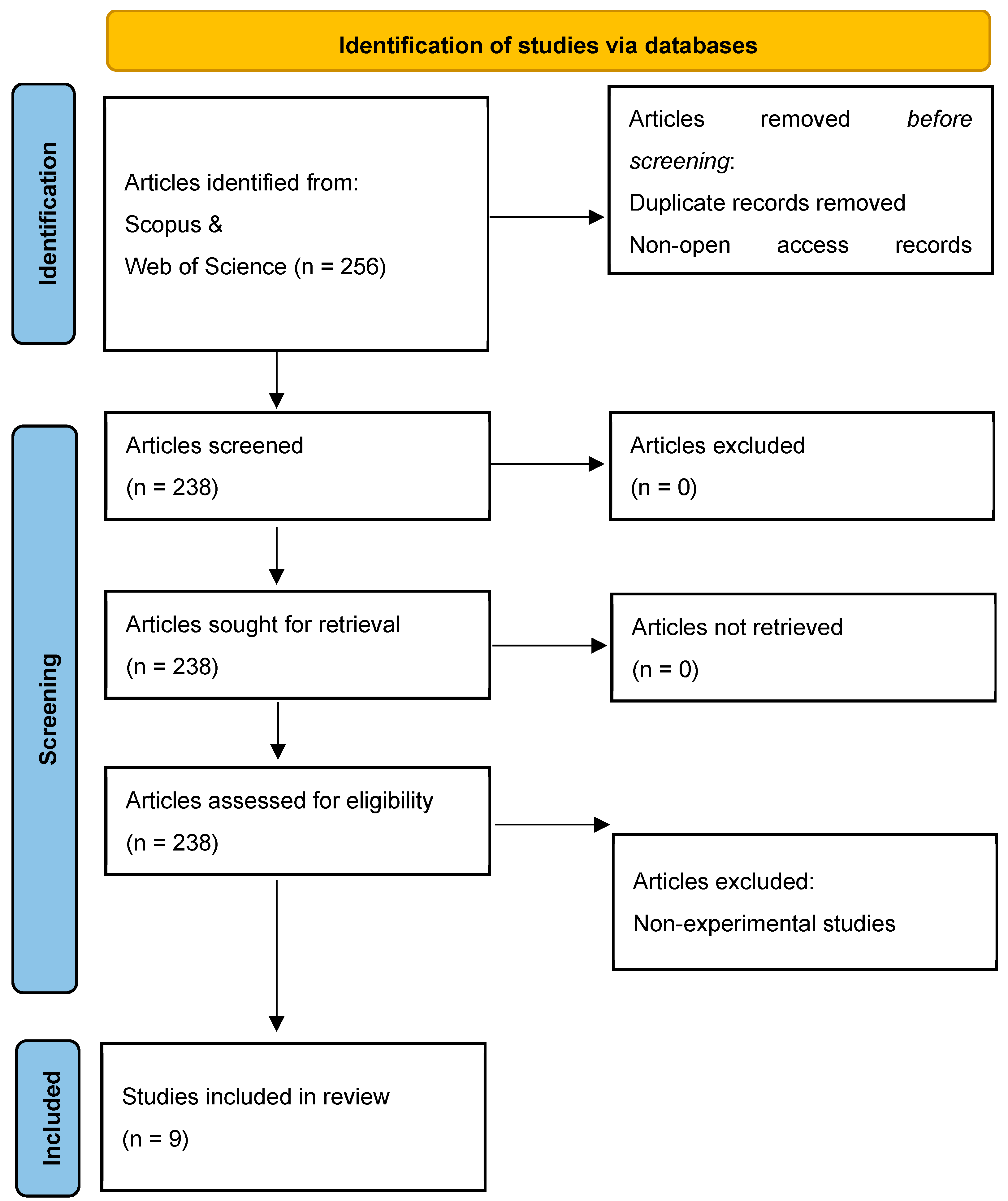
(“cognitive gain *” OR “cognitive improvement *” OR “cognitive benefit *”) AND (language AND (education OR acquisition OR teaching OR learning OR foreign OR second))
- Journal articles in the English language;
- Empirical research articles;
- EFL/ESL/L2 context;
- Articles published after the year 2000;
- Foreign language learning supported by any kind of digital tool;
- Open access articles.
- Conference proceedings, book chapters, editorials;
- Other languages;
- Descriptive studies, theoretical studies, reviews, commentaries;
- Other context than digital foreign language learning.
3. Results
4. Discussion
- Implementing such a technique or a strategy that would best suit students’ language needs in a digital foreign language environment, be it pen and paper or flipped classroom;
- Exposing students not only to one technique but to several that would activate most of their senses that have a positive impact on cognitive gains;
5. Conclusions
Author Contributions
Funding
Institutional Review Board Statement
Informed Consent Statement
Data Availability Statement
Conflicts of Interest
References
- Poláková, P.; Klímová, B. Vocabulary mobile learning application in blended English language learning. Front. Psychol. 2022, 13, 869055. [Google Scholar] [CrossRef] [PubMed]
- Zhang, C. The advantages and disadvantages of learning a second language early. Adv. Soc. Sci. Educ. Humanit. Res. 2021, 631, 32–37. [Google Scholar]
- Klimova, B.; Pikhart, M. Current research on the impact of foreign language learning among healthy seniors on their cognitive functions from a positive psychology perspective—A systematic review. Front. Psychol. 2020, 11, 765. [Google Scholar] [CrossRef]
- Cao, J.; Bhuvaneswari, G.; Arumugam, T.; Aravind, B.R. The digital edge: Examining the relationship between digital competency and language learning outcomes. Front. Psychol. 2023, 14, 1187909. [Google Scholar] [CrossRef] [PubMed]
- Park, J. Vocabulary learning through a daily task of cooking in the digital kitchen. Lang. Learn. Technol. 2022, 26, 1–22. [Google Scholar]
- Shafiee Rad, H.; Roohani, A.; Rahimi Domakani, M. Flipping EFL learners’ writing classroom through role-reversal and discussion-oriented models. Lang. Learn. Technol. 2021, 25, 158–177. [Google Scholar]
- Yang, J.; Yin, C.X.; Wang, W. Flipping the classroom in teaching Chinese as a foreign language. Lang. Learn. Technol. 2018, 22, 16–26. [Google Scholar]
- Peterson, M.; White, J.; Mirzaei, M.S.; Wang, Q. A review of research on the application of digital games in foreign language education. In New Technological Applications for Foreign and Second Language Learning and Teaching; Kruk, M., Peterson, M., Eds.; IGI Global: Hershey, PA, USA, 2020; pp. 69–92. [Google Scholar] [CrossRef]
- Klimova, B.; Kacetl, J. Efficacy of computer games on language learning. TOJET 2017, 16, 19–26. [Google Scholar]
- Di Giacomo, D.; Ranieri, J.; Lacasa, P. Digital learning as enhanced learning processing? Cognitive evidence for new insight of smart learning. Front. Psychol. 2017, 8, 1329. [Google Scholar] [CrossRef]
- Klimova, B. Are there any cognitive benefits of computer-based foreign language training for healthy elderly people?—A mini-review. Front. Psychol. 2021, 11, 573287. [Google Scholar] [CrossRef]
- Bećirović, S.; Brdarević-Čeljo, A.; Delić, H. The use of digital technology in foreign language learning. SN Soc. Sci. 2021, 1, 246. [Google Scholar] [CrossRef]
- Haleem, A.; Javaid, M.; Qadri, M.A.; Suman, R. Understanding the role of digital technologies in education: A review. Sustain. Oper. Comput. 2022, 3, 275–285. [Google Scholar] [CrossRef]
- Bancha, W.; Tongtep, N. Enhancing vocabulary memorization and retention through LMS and MultiEx game platforms among Thai tertiary students. Int. J. Learn. Teach. Educ. Res. 2021, 20, 173–192. [Google Scholar] [CrossRef]
- Lai, J.W.M.; De Nobile, J.; Bower, M.; Breyer, Y. Comprehensive evaluation of the use of technology in education—Validation with a cohort of global open online learners. Educ. Inf. Technol. 2022, 27, 9877–9911. [Google Scholar] [CrossRef] [PubMed]
- Ng, D.T.K.; Leung, J.K.L.; Su, J.; Ng, R.C.W.; Chu, S.K.W. Teachers’ AI digital competencies and twenty-first century skills in the post-pandemic world. Educ. Technol. Res. Dev. 2023, 71, 137–161. [Google Scholar] [CrossRef] [PubMed]
- Gherheș, V.; Stoian, C.E.; Fărcașiu, M.A.; Stanici, M. E-learning vs. face-to-face learning: Analyzing students’ preferences and behaviors. Sustainability 2021, 13, 4381. [Google Scholar] [CrossRef]
- Zamborová, K.; Stefanutti, I.; Klimová, B. CercleS survey: Impact of the COVID-19 pandemic on foreign language teaching in Higher education. Lang. Learn. High. Educ. 2021, 11, 269–283. [Google Scholar] [CrossRef]
- Saarinen, A.; Lipsanen, J.; Hintsanen, M.; Huotilainen, M.; Keltikangas-Järvinen, L. The use of digital technologies at school and cognitive learning outcomes: A population-based study in Finland. Int. J. Educ. Psychol. 2021, 10, 1–26. [Google Scholar] [CrossRef]
- Page, M.J.; McKenzie, J.E.; Bossuyt, P.M.; Boutron, I.; Hoffmann, T.C.; Mulrow, C.D.; Shamseer, L.; Tetzlaff, J.M.; Akl, E.A.; Brennan, S.E.; et al. The PRISMA 2020 statement: An updated guideline for reporting systematic reviews. BMJ 2021, 372, 71. [Google Scholar] [CrossRef]
- Chiu, L.L.; Liu, G.Z. Effects of printed, pocket electronic, and online dictionaries on high school students’ English vocabulary retention. Asia-Pac. Edu. Res. 2013, 22, 619–634. [Google Scholar] [CrossRef]
- Mangen, A.; Anda, L.G.; Oxborough, G.H.; Brřnnick, K. Handwriting versus keyboard writing: Effect on word recall. J. Writ. Res. 2015, 7, 227–247. [Google Scholar] [CrossRef]
- Pikhart, M.; Klimova, B.; Ruschel, F.B. Foreign language vocabulary acquisition and retention in print text vs. digital media environments. Systems 2023, 11, 30. [Google Scholar] [CrossRef]
- Roussel, S.; Galan, J.P. Can clicker use support learning in a dual-focused second language German course? Lang. Learn. Technol. 2018, 22, 45–64. [Google Scholar]
- Liao, S.; Kruger, J.; Doherty, S. The impact of monolingual and bilingual subtitles on visual attention, cognitive load, and comprehension. J. Spec. Transl. 2020, 33, 70–98. [Google Scholar]
- Umejima, K.; Ibaraki, T.; Yamazaki, T.; Sakai, K.L. Paper notebooks vs. mobile devices: Brain activation differences during memory retrieval. Front. Behav. Neurosci. 2021, 15, 634158. [Google Scholar] [CrossRef]
- Vnucko, G.; Klimova, B. Exploring the potential of digital game-based vocabulary learning: A systematic review. Systems 2023, 11, 57. [Google Scholar] [CrossRef]
- Huang, S.; Willson, V.; Eslami, Z. The effects of task involvement load on L2 Incidental vocabulary learning: A meta-analytic study. Mod. Lang. J. 2012, 96, 544–557. [Google Scholar] [CrossRef]
- Li, Z.; Li, J. Using the flipped classroom to promote learner engagement for the sustainable development of language skills: A mixed-methods study. Sustainability 2022, 14, 5983. [Google Scholar] [CrossRef]
- Öztürk, M.; Çakıroğlu, Ü. Flipped learning design in EFL classrooms: Implementing self-regulated learning strategies to develop language skills. Smart Learn. Environ. 2021, 8, 2. [Google Scholar] [CrossRef]
- Cornillie, F.; Clarebout, G.; Desmet, P. The role of feedback in foreign language learning through digital role-playing games. Procedia-Soc. Behav. Sci. 2012, 34, 49–53. [Google Scholar] [CrossRef]
- Klimova, B.; Pikhart, M. Application of corrective feedback using emerging technologies among L2 university students. Cogent Educ. 2022, 9, 2132681. [Google Scholar] [CrossRef]
- Aldhafeeri, F.M.; Alotaibi, A.A. Effectiveness of digital education shifting model on high school students’ engagement. Educ. Inf. Technol. 2022, 27, 6869–6891. [Google Scholar] [CrossRef] [PubMed]


| Study | Objective | Research Sample and Procedure | Outcome Measures | Findings |
|---|---|---|---|---|
| Bancha and Tongtep [14] Thailand | To explore whether vocabulary lessons plus LMS exercises and vocabulary lessons plus MultiEx games enhance short-term vocabulary memorization and long-term vocabulary retention. | A total of 72 first-year Thai students (37 females and 35 males); with a low level of English; divided into two study groups: face-to-face lessons + LMS exercise and face-to-face lessons + MultiEx Game groups learning new English words, which were based on the Test of English for International Communication (TOEIC). This lasted 10 weeks. | Pre-test, immediate post-test, delayed post-test, statistical processing. | The results showed a higher mean score for the MultiEx game group in both the immediate post-tests and the delayed post-test. However, both groups improved their language proficiency. |
| Chiu and Liu [21] Taiwan | To examine the impact of using printed dictionaries (PD), pocket electronic dictionaries (PED), and online type-in dictionaries (OTID) on English vocabulary retention among junior high school students. | A total of 33 seventh graders (19 males and 14 females) were asked to use all three types of dictionaries to finish reading tasks (three articles, each 200 words long, adapted from a widely used English learning magazine published in Taiwan). | Pre-test, immediate post-tests, delayed post-test of vocabulary, questionnaires, and interviews. | Results indicate that although electronic dictionaries (OTID and PED) temporarily attract junior high school students’ attention, PD helps them retain target words more effectively. |
| Liao, Kruger, and Doherty [25] Australia | To investigate the impact of bilingual subtitles on cognitive load and comprehension in L2. | A total of 20 Chinese native postgraduate program students who used English as their second language (L2); fourteen females and six males; each saw four videos only, i.e., either English narration with Chinese subtitles (CS); or English narration with English subtitles (ES); or English narration with both Chinese and English subtitles (BS); or English narration without subtitles (NS). | Biographical questionnaire, cognitive load questionnaire, eye tracking, statistical processing. | Bilingual subtitles are more beneficial when compared with no subtitles as they provide linguistic support to make the video easier to comprehend and facilitate the learning process. However, they do not result in cognitive overload and impede comprehension as a result of increased redundancy. |
| Mangen, Anda, Oxborough, and Brřnnick [22] Norway | To explore the impact of writing modality on word recall and recognition. | A total of 36 females aged 19–54 years; they were college students or staff at a middle-sized Norwegian university; participants were required to use handwriting, a physical laptop keyboard, and an iPad virtual touch keyboard, each to write down a different word list. | Word list paradigm, statistical processing. | The results were significantly better for free recall of words written in the handwriting condition, compared to both keyboard writing conditions. |
| Park [5] China | To investigate the impact of a technology-enhanced real-world environment on foreign vocabulary acquisition. | A total of 48 adult participants of 20 different nationalities, living in Newcastle, UK (aged between 19 to 49 years; 16 males and 32 females) had two cooking sessions: one in a kitchen using real objects and the other in a classroom looking at photos. All were learning basic Korean. | Pre-test, immediate post-test, delayed post-test, statistical processing. | Engaging all senses in a technology-enhanced environment is more powerful for vocabulary learning than using only a few senses. |
| Pikhart, Klimova, and Ruschel [23] Czech Republic, Brazil | To evaluate vocabulary retention in L2 when using print text in contrast with digital media. | A total of 122 university students (66 males and 56 females); divided into two groups to learn 60 new phrasal verbs in 4 weeks; one group of them used a standard print text, and the other used the same text displayed and annotated on their digital devices. The level of students’ English was B2 to C1 according to the Common European Reference Framework for languages. | Vocabulary memory post-tests; statistical processing. | The findings indicate that students using the print text performed better in both tests. |
| Roussel and Galan [24] France | To examine the effect of clicker use to support learning in a dual-focused second language German course. | A total of 36 Law School students and German language learners (Levels B1–C1); students answered questions with or without clicker use during the 10-week semester. Five sessions were conducted with clickers and five sessions without. | Pre-test and post-test questionnaire, statistical processing. | The clicker group outperformed the non-clicker group with regard to a post-test concerning legal terminology. The findings illustrate that clicker use enhances the cognitive load induced by learning both new terminology and content. |
| Shafiee Rad, Roohani, and Rahimi Domakani [6] Iran | To assess the effectiveness of a technology-enhanced flipped classroom on English language learners’ expository writing skills. | A total of 60 female students of English as a foreign language, aged between 23 to 38 years; all had an advanced level of English; they were divided into the control group (17 students) and experimental groups: discussion-oriented flipped group/classroom (n = 19) and role-reversal flipped group/classroom (n = 24). | English placement test, pre-test, and post-test, questionnaire, semi-structured interviews, and statistical processing. | The experimental groups were more effective than the control group in writing gains. In addition, the role-reversal group outperformed the discussion-oriented group in the writing gains in the post-test expository essays. |
| Yang, Yin, and Wang [7] USA | To explore the application of the flipped learning approach in the instruction of Chinese as a foreign language. | Two first-year Chinese classes; one traditional, face-to-face class (nine students) and the other flipped (online) class (eight students) learning basic Chinese during one semester. | Oxford Language Aptitude Test, Chinese placement test, final oral and written test, questionnaire. | Students in the flipped class outperformed those in the traditional class students in speaking. |
Disclaimer/Publisher’s Note: The statements, opinions and data contained in all publications are solely those of the individual author(s) and contributor(s) and not of MDPI and/or the editor(s). MDPI and/or the editor(s) disclaim responsibility for any injury to people or property resulting from any ideas, methods, instructions or products referred to in the content. |
© 2023 by the authors. Licensee MDPI, Basel, Switzerland. This article is an open access article distributed under the terms and conditions of the Creative Commons Attribution (CC BY) license (https://creativecommons.org/licenses/by/4.0/).
Share and Cite
Klimova, B.; Pikhart, M. Cognitive Gain in Digital Foreign Language Learning. Brain Sci. 2023, 13, 1074. https://doi.org/10.3390/brainsci13071074
Klimova B, Pikhart M. Cognitive Gain in Digital Foreign Language Learning. Brain Sciences. 2023; 13(7):1074. https://doi.org/10.3390/brainsci13071074
Chicago/Turabian StyleKlimova, Blanka, and Marcel Pikhart. 2023. "Cognitive Gain in Digital Foreign Language Learning" Brain Sciences 13, no. 7: 1074. https://doi.org/10.3390/brainsci13071074
APA StyleKlimova, B., & Pikhart, M. (2023). Cognitive Gain in Digital Foreign Language Learning. Brain Sciences, 13(7), 1074. https://doi.org/10.3390/brainsci13071074