Brief Report

Imputing the Number of Responders from the Mean and Standard Deviation of CGI-Improvement in Clinical Trials Investigating Medications for Autism Spectrum Disorder

1
Department of Psychiatry and Psychotherapy, School of Medicine, Technical University of Munich, 81675 Munich, Germany
2
Department of Experimental and Clinical Medicine, Psychiatric Clinic University Hospital ‘Gaspare Rodolico’, University of Catania, 95125 Catania, Italy
3
Department of Child and Adolescent Psychiatry, Mardin State Hospital, 47100 Artuklu, Mardin, Turkey
4
Department of Forensic and Neurodevelopmental Sciences, Institute of Psychiatry, Psychology & Neuroscience, King’s College London, London WC2R 2LS, UK
5
Department of Child and Adolescent Psychiatry, Institute of Psychiatry and Mental Health, Hospital General Universitario Gregorio Marañón, 28003 Madrid, Spain
6
School of Medicine, Universidad Complutense, 28040 Madrid, Spain
*
Author to whom correspondence should be addressed.
Brain Sci. 2021, 11(7), 908; https://doi.org/10.3390/brainsci11070908

Submission received: 8 June 2021 / Revised: 5 July 2021 / Accepted: 7 July 2021 / Published: 9 July 2021
(This article belongs to the Special Issue Understanding Autism Spectrum Disorder)

Abstract

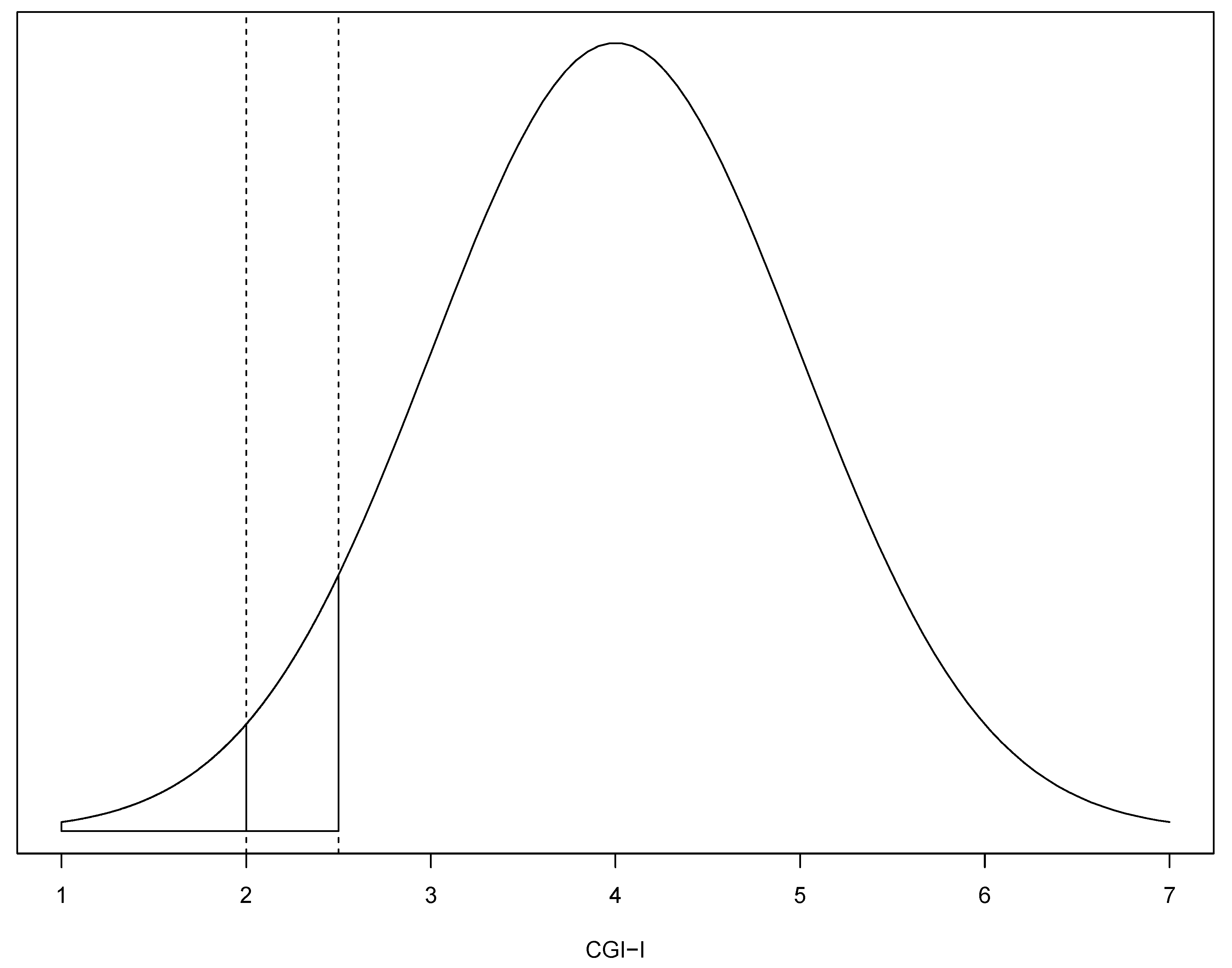
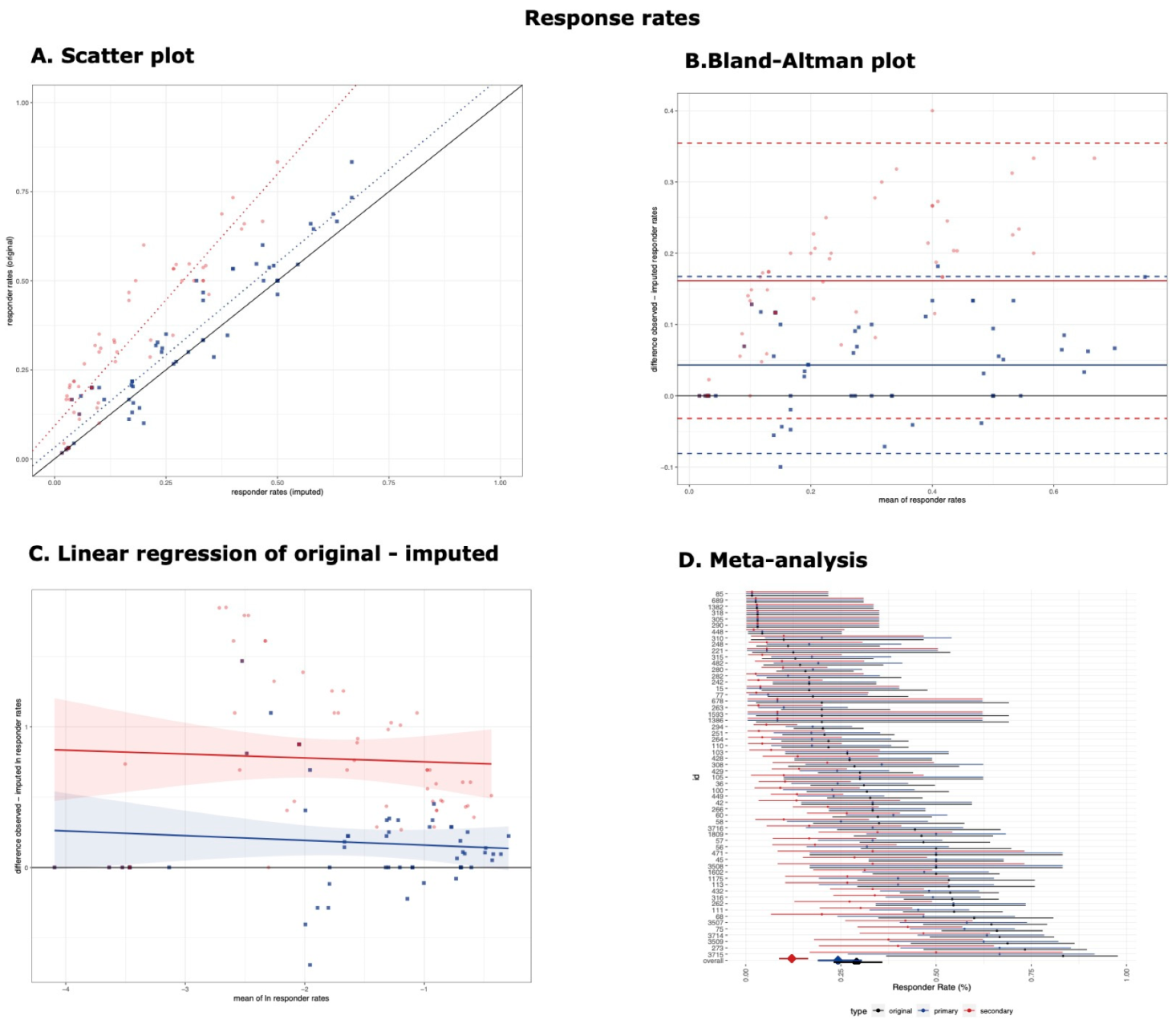
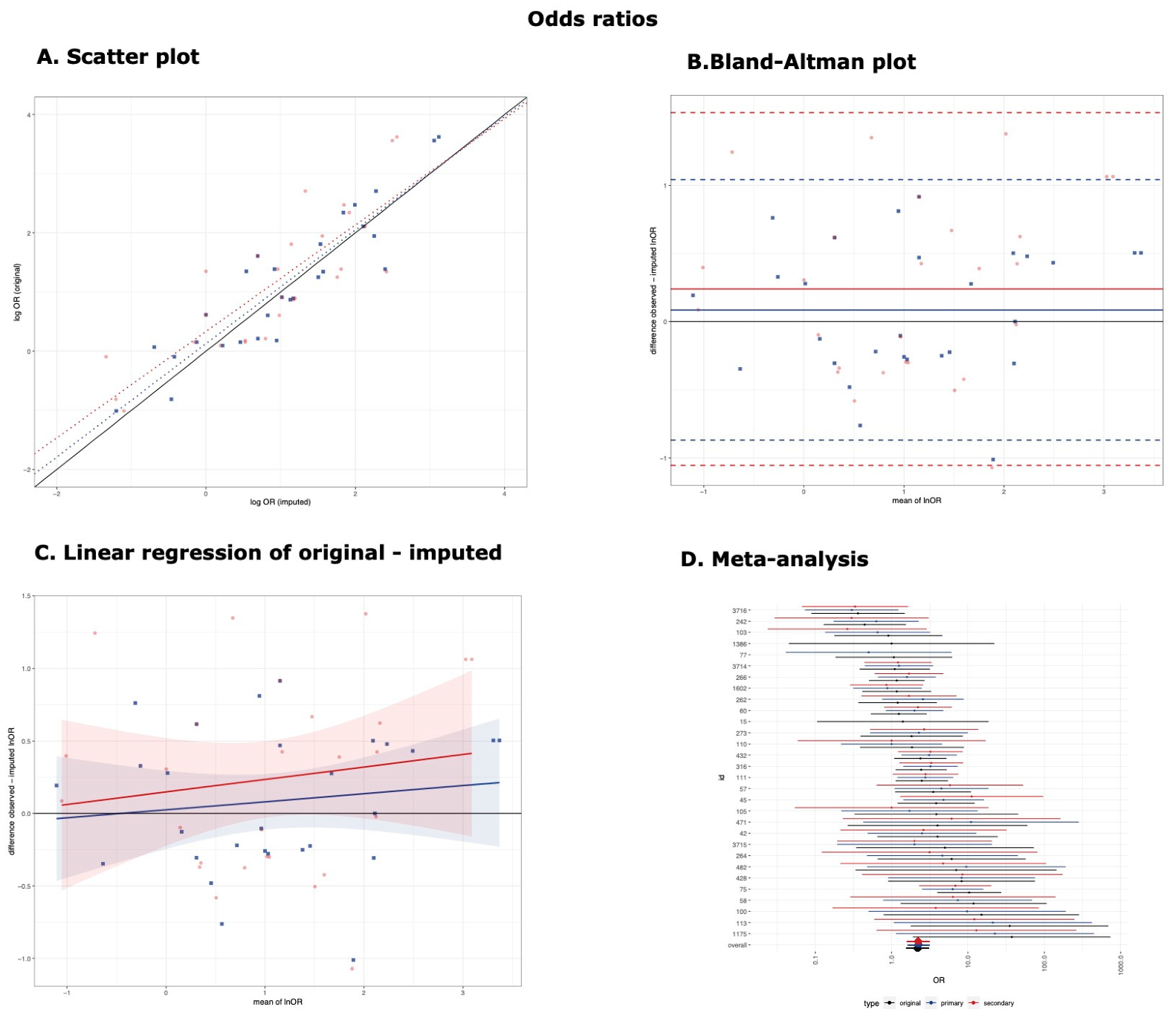
Introduction: Response to treatment, according to Clinical Global Impression-Improvement (CGI-I) scale, is an easily interpretable outcome in clinical trials of autism spectrum disorder (ASD). Yet, the CGI-I rating is sometimes reported as a continuous outcome, and converting it to dichotomous would allow meta-analysis to incorporate more evidence. Methods: Clinical trials investigating medications for ASD and presenting both dichotomous and continuous CGI-I data were included. The number of patients with at least much improvement (CGI-I ≤ 2) were imputed from the CGI-I scale, assuming an underlying normal distribution of a latent continuous score using a primary threshold θ = 2.5 instead of θ = 2, which is the original cut-off in the CGI-I scale. The original and imputed values were used to calculate responder rates and odds ratios. The performance of the imputation method was investigated with a concordance correlation coefficient (CCC), linear regression, Bland–Altman plots, and subgroup differences of summary estimates obtained from random-effects meta-analysis. Results: Data from 27 studies, 58 arms, and 1428 participants were used. The imputation method using the primary threshold (θ = 2.5) had good performance for the responder rates (CCC = 0.93 95% confidence intervals [0.86, 0.96]; β of linear regression = 1.04 [0.95, 1.13]; bias and limits of agreements = 4.32% [−8.1%, 16.74%]; no subgroup differences χ2 = 1.24, p-value = 0.266) and odds ratios (CCC = 0.91 [0.86, 0.96]; β = 0.96 [0.78, 1.14]; bias = 0.09 [−0.87, 1.04]; χ2 = 0.02, p-value = 0.894). The imputation method had poorer performance when the secondary threshold (θ = 2) was used. Discussion: Assuming a normal distribution of the CGI-I scale, the number of responders could be imputed from the mean and standard deviation and used in meta-analysis. Due to the wide limits of agreement of the imputation method, sensitivity analysis excluding studies with imputed values should be performed.
Keywords: response; meta-analysis; continuous outcomes; dichotomous outcomes response; meta-analysis; continuous outcomes; dichotomous outcomes