You are currently viewing a new version of our website. To view the old version click .
Applied Sciences
  • Review
  • Open Access

19 November 2019

Hybrid Micro-Grids Exploiting Renewables Sources, Battery Energy Storages, and Bi-Directional Converters

,
and
1
Dipartimento di Ingegneria della Informazione, Università di Pisa, via G. Caruso 16, 56122 Pisa, Italy
2
Faculty of Engineering, Østfold University College, Kobberslagerstredet5, 1671 Fredrikstad, Norway
*
Author to whom correspondence should be addressed.
This article belongs to the Special Issue DC & Hybrid Micro-Grids

Abstract

This paper analyzes trends in renewable-energy-sources (RES), power converters, and control strategies, as well as battery energy storage and the relevant issues in battery charging and monitoring, with reference to a new and improved energy grid. An alternative micro-grid architecture that overcomes the lack of flexibility of the classic energy grid is then described. By mixing DC and AC sources, the hybrid micro-grid proposes an alternative architecture where the use of bi-directional electric vehicle chargers creates a micro-grid that directly interconnects all the partner nodes with bi-directional energy flows. The micro-grid nodes are the main grid, the RES and the energy storage systems, both, on-board the vehicle and inside the micro-grid structure. This model is further sustained by the new products emerging in the market, since new solar inverters are appearing, where a local energy storage for the RES is available. Therefore, the power flow from/towards the RES becomes bi-directional with improved flexibility and efficiency.

1. Introduction

The need to reduce CO2 and greenhouse emissions, and the aim of achieving zero-energy or near-zero-energy buildings, have sustained the research, development, and adoption of Renewable Energy Sources (RES) for buildings and for electrified propulsion of vehicles [1,2,3,4,5].
As far as buildings are concerned, either, public (e.g., offices, schools…) or private photovoltaic (PV) sources have mainly been used. On the electric vehicle side, plug-in hybrid electric vehicles (PHEV) or full electric vehicles (PEV) are gaining market shares [1], mainly using battery-based energy storage rather than using fuel cells and hydrogen tanks.
Increasing the amount of low-carbon energy production means a larger diffusion of small-scale generation sites are based on RES and located at the distribution grids. In order to take full advantage of available RES, Energy Storage Systems (ESSs) are also necessary. This results in a scenario full of complex systems with numerous active elements that need to properly be managed and controlled. Every level of the above described scenario must be considered, starting from the individual power converters and their control of new business schemes that are necessary to fulfill.
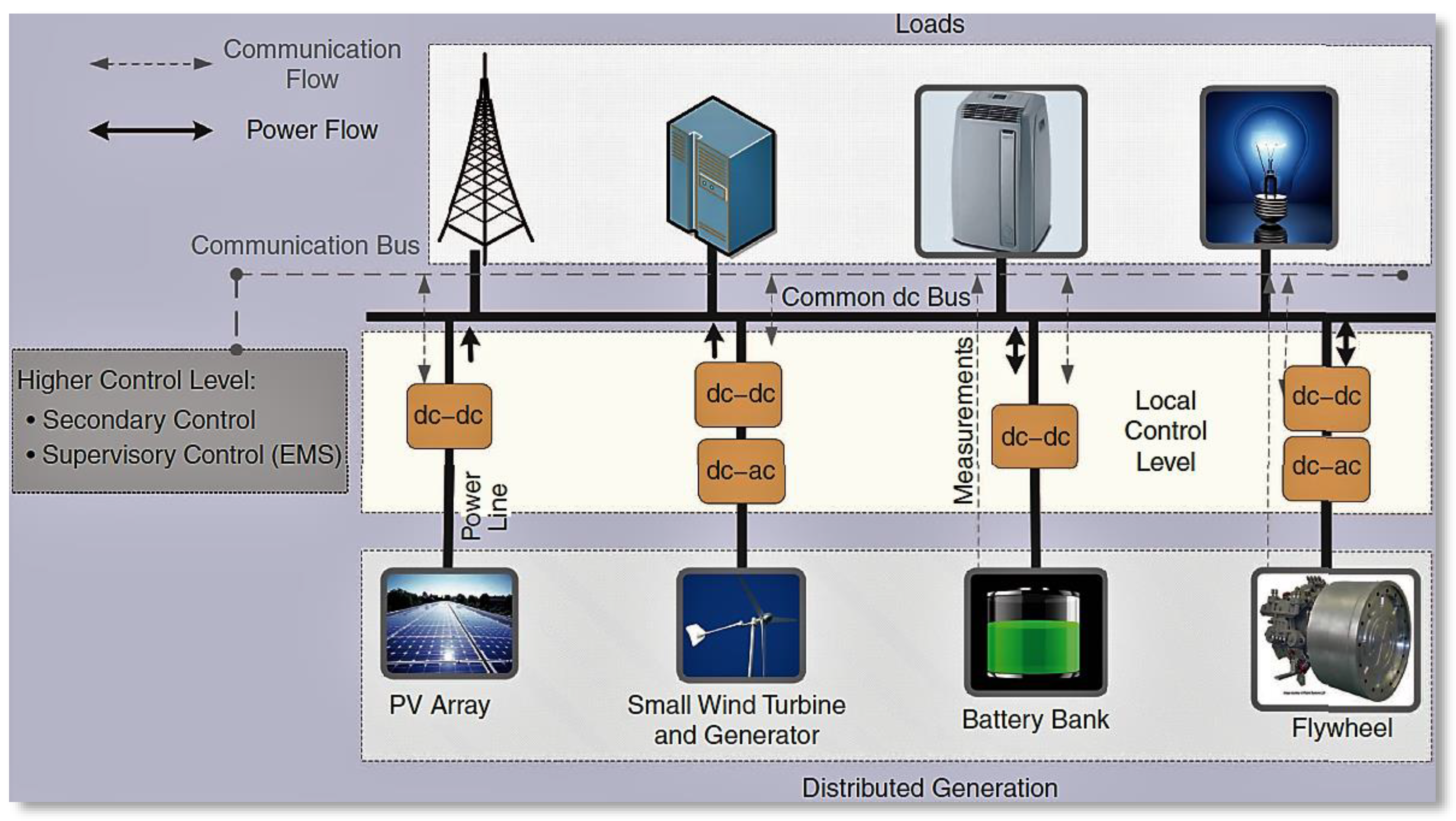
The concept of micro-grids with classification schemes as a solution for reliable integration of Distributed Energy Resources (DERs), including energy storage systems and controllable loads, can be found in various literature, such as in [6,7,8,9,10,11]. Although the common configuration of micro-grids is AC, a huge interest in DC micro-grids has been shown for some advantages, such as no reactive power or synchronization need, and the increasing number of available smart DC devices and DC loads. However, hybrid micro-grid combines the best aspects of the two configurations.
Hybrid micro-grids combine RESs with diesel gen-sets and energy storage technologies, mainly used as backup systems to deliver clean, cost-effective electricity to remote locations, with limited or no access to reliable utility power systems. These hybrid systems, based on RES, can contain several parallel-DERs, which are able to operate in both islanded and grid-connected modes [12,13,14,15]. These configurations have the advantages of improving environmental performances as well as resiliency and reliability, providing uninterruptible power supply to critical loads while meeting customer satisfaction at a reduced cost by providing autonomy, safety and security for all actors involved. Advanced hybrid micro-grids are also able to balance electrical demand of RES, scheduling the dispatch of resources and preserving the grid reliability, managing the integration and interoperability of complex configurations of distributed generation, storage and controllable loads, demand response and EMS (energy management systems) [16,17,18].
In order to control the load sharing among AC and DC sources, hybrid micro-grids operation requires stable and appropriate power management strategies, which are mainly based on droop control. There are valid conventional solutions for the power management of different generating resources. The emerging number of distributed generation (DG) nodes can be handled by aggregators considering the energy market aspects. Considering that most of the inverter-based resources are located at the distribution network, the capacity of the local grid may be a bottleneck.
It is well known that the power electronic converters play an important role in the hybrid micro-grids in the context of conversion, generation, distribution and power flow control as well as for energy management and energy efficiency issues and integration capabilities [19]. Recently, power switches manufactured with silicon-carbide (SiC) and gallium nitride (GaN) transistors can further increase the efficiency and power control stability, reducing at the same time the size of the power electronic modules and systems [20,21,22,23].
Vehicle to Grid (V2G) is considered an innovative and disruptive solution that could strengthen the development and wide spreading of the energy management in micro-grids. The possibility for aggregated car owners to provide balance services to the grid will give a benefit (and revenue stream) that allows the gaps to be filled with conventional transport.
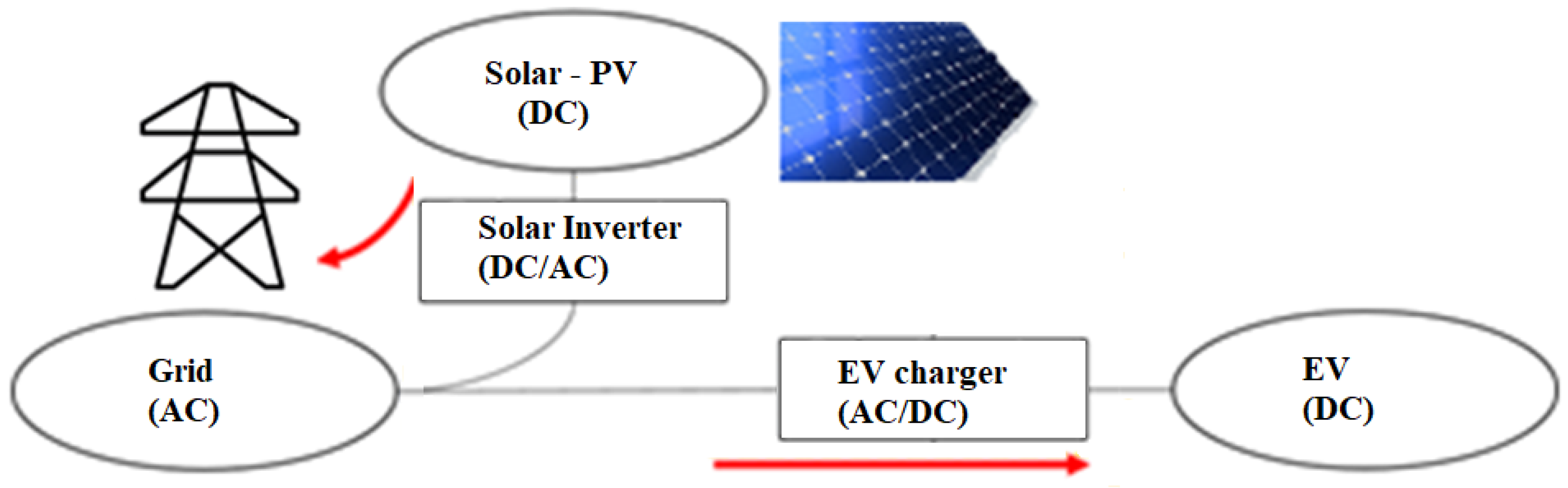
The grid organization typically follows a scheme like in Figure 1, where there is no direct energy flow or communication among the RES, e.g., PV panels with relevant solar inverter mounted on the roof of the building, and the energy storage system installed on-board the vehicle. All communications and energy flows are typically implemented between the RES sub-system and the main grid (managed by a national electricity provider, e.g., ENEL in Italy) and between the main grid and the vehicle to be recharged. The energy flows in Figure 1 are mainly unidirectional: From PV source towards the grid node, due to a solar inverter (DC/AC energy conversion); and from the main grid to the energy storage (battery pack) on-board the vehicle for EV recharging, due to an AC/DC power conversion.
Figure 1. Classic local grid where RES and EV charger nodes are only connected to the main grid and with unidirectional energy flows. RES: renewable-energy-sources; EV: full-electric vehicles; PV: photovoltaic.
This classic approach has some limits that have not yet been overcome. RESs are intermittent in nature. For example, the produced energy is limited at night-time, in case of cloudy days or during less sunny seasons, when using PV sources. Moreover, when a recharged car is parked (e.g., during office time), the energy stored on-board cannot be used as a source to fulfill the energy requirements of other loads. The lack of flexibility of the classic energy grid in Figure 1 can be overcome by a new energy grid concept, that is described in this survey paper in Section 4. By mixing DC and AC sources, the hybrid micro-grid in Section 4 proposes an alternative architecture where the use of bi-directional EV chargers may allow a micro-grid to be created by directly interconnecting with bi-directional energy flows all the nodes: The main grid node, RES node, energy storage nodes, both on-board the vehicle, and inside the micro-grid structure. This model is further sustained by the new market products, since new solar inverters are appearing [2], e.g., from ABB, where a local energy storage for the RES is foreseen, and hence, the power flow from/towards the RES becomes bi-directional.
Hereafter, Section 2 reviews trends in RES, power converters and controllers. Section 3 analyzes trends in battery energy storage and the relevant issues in battery management and charging. Section 4 presents an alternative micro-grid architecture. Conclusions are finally drawn in Section 5.

3. The Role of Energy Storage in Micro-Grids

A fundamental partner of the micro-grid improved architecture is the ESS embedded in the architecture, which is described in Section 4. Even if the batteries of the EVs connected to the grid may be used according to the V2G paradigm, an embedded ESS is necessary to provide the grid with at least a minimum amount of storage. The ESS is useful as a tank where the excessive energy arising from the production side can be stored, or by which the lacking energy to sustain a user request can be found. The ESS, thus, acts as a mediator between the energy production and the energy consumption sides, providing several advantages [37]. First of all, the ESS provides a peak shaving function that is useful from both sides. If the peaks in the power demand are sustained by the ESS (e.g., during the fast charge of an EV connected to the grid), the power requirements towards the grid can be relaxed with beneficial effects in both, grid connection costs and technical constraints. On the other hand, ESS will store the peaks in RES energy production due to favorable weather conditions, when the user demand is low or the energy introduction in the main grid is not profitable or even costly. To fully exploit the beneficial effects of the presence of an ESS, a controller that manages the three-way bi-directional energy fluxes is mandatory. The control of the energy fluxes should consider the expected level of energy production (even with possible short and middle term forecasts), the expected demand coming from the user side and the costs, both positive and negative, associated with the power exchange toward the grid. The open research problem is in finding the optimal algorithms with which the energy fluxes are managed and considering the constraints given by the limits in maximum power and maximum energy, which characterize the ESS used in the micro-grid [38,39,40,41,42,43,44,45].

3.1. Energy Storage System Technologies for Micro-Grids

The energy storage technology, that is presently widely acknowledged as the best to use in micro-grids, is based on electrochemical components, in particular rechargeable batteries [12]. Li-ion chemistry is emerging and consolidated as the most used battery technology. The intrinsic advantages of Li-ion batteries with respect to lead-acid stand as the larger values of the energy and power densities with respect to both unit weight (Wh/kg and W/kg) and unit volume (Wh/L and W/L) [46]. The net results are ESSs that are more compact in size and weight, more efficient for the larger number of charge/discharge cycles possible, and even cost-effective in long-term applications. These advantages are only marginally counterbalanced by the larger cost of the battery cells and the poor intrinsic safety of some sub-chemistries of the Li-ion family, which requires an accurate monitoring and management of the battery, in order to keep every cell constituting it in its Safe Operating Area (SOA) [47].
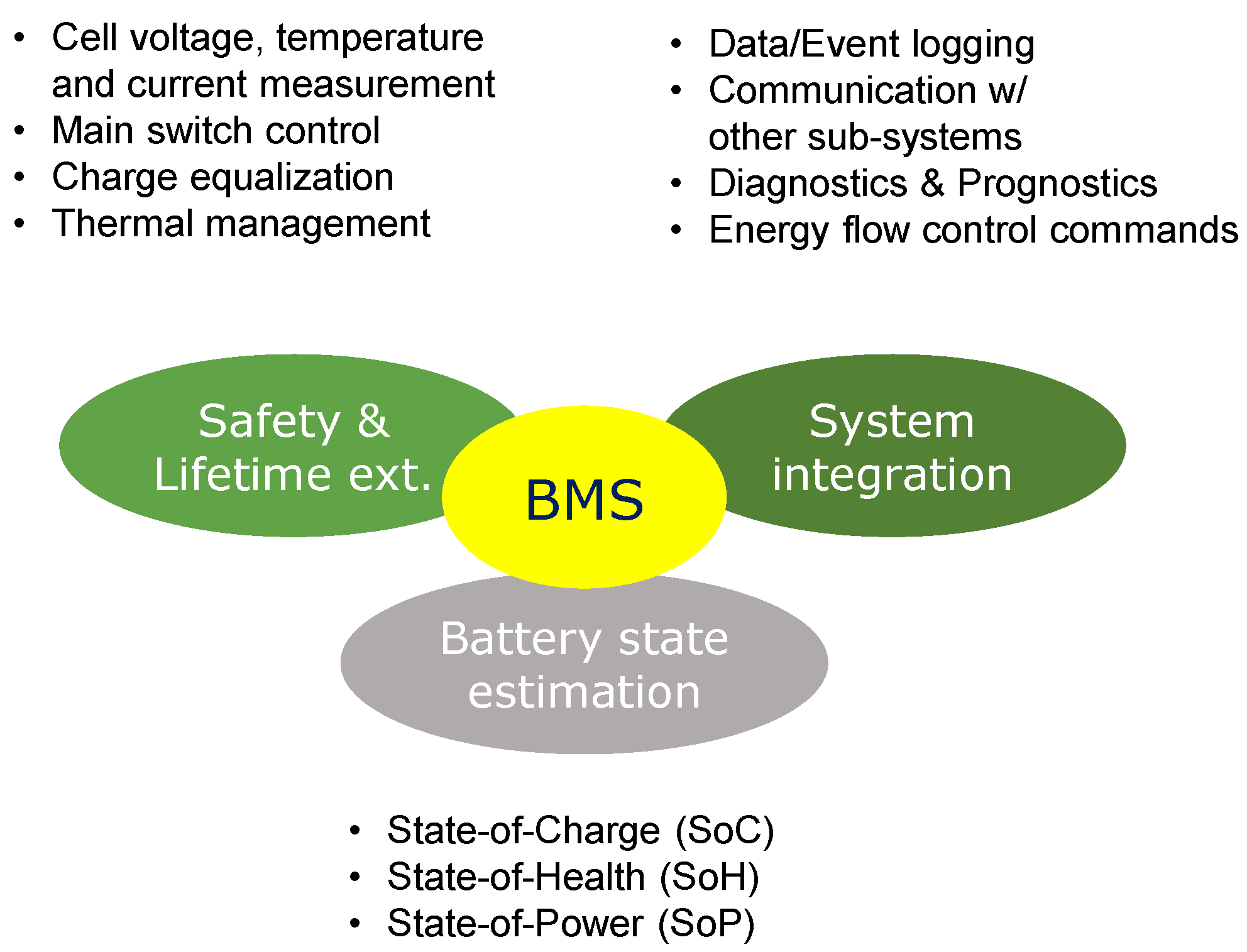
If the Li-ion cell costs are progressively decreasing due to the everyday larger number of applications in which they are used, the development of BMSs, capable of optimally monitoring and managing a Li-ion battery, is still open [48]. Several electronic circuits mainly based on application specific integrated circuits (e.g., battery monitor ICs) are being developed and utilized as BMSs [49,50,51]. The main and fundamental function of a BMS is to measure most of the battery quantities, and in particular, the voltage and temperature of each cell, the battery current and any other useful parameter, and to operate to maintain every cell of the battery inside the SOA. It is well known that exceeding the SOA limits may lead to dangerous and even catastrophic consequences [52]. Therefore, the BMS must be able to limit or even interrupt the battery current when a potentially dangerous situation is detected. Moreover, the BMS is required to carry out other more advanced functions, such as the charge balancing between the cells to compensate possible mismatches, the estimate of the residual charge available in the battery, the estimate of the state of health of the battery cells, and to perform all the diagnostic functions useful to reveal the battery status and prolong battery life [53]. The battery temperature management is another task in charge of a BMS, usually carried out by activating fans for the battery cooling or even heaters, when the battery operates at very low temperatures and needs to be pre-heated before being fully operational. BMSs are sometimes also asked to dynamically manage the battery architecture [54,55], by controlling the parallelization of battery strings when the battery architecture is modular, and the battery capacity in ampere-hour can be selected and adapted to the application requirements by choosing the number of strings to be connected in parallel. Even part of the battery module series, that increase the battery voltage, can be excluded by the BMS with a bypass switch, in order to allow the module substitution or maintenance without interrupting the energy storage service [56]. Finally, the BMS provides the communication functions required to insert the ESS in the micro-grid network, by which, the grid management functions and the policies regarding the energy flux management, are carried out. In conclusion, the BMS is an electronic system that provides very powerful and fundamental functions. The BMS realization is based on electronic platforms that must be sufficiently powerful but, at the same time, compatible in size and cost affordable for the considered application. Microcontroller-based and even-FPGA (Field Programmable Gate Array) based platforms, when complex algorithms have to be executed, are the most useful solutions as BMS realizations [57]. Figure 4 shows the main functions performed by a BMS, grouped in the three fields of Safety and Lifetime Extension, Battery State Estimation and System Integration.
Figure 4. Main functions performed by a Battery Management System (BMS).

3.2. Non Lithium Battery Technologies for Micro-Grids

Besides lead acid batteries, other electrochemical technologies are being used as storage systems in stationary applications. Sodium-sulfur and sodium-metal halide batteries (also known as ZEBRA batteries [58]) have been applied in installations beside utility factories and PV fields [59]. These technologies may also be useful in smaller stationary applications, such as in micro-grids, because of the intrinsic safety of the technology, which does not require the accurate and safe management of the cells. The technologies are based on the conduction of sodium ions through a beta-alumina electrolyte, and thus, employ a low-cost material as sodium that is abundant in nature. The only disadvantage is the necessity to operate the battery at an inner temperature of at least 250 °C to allow the liquefaction of the sodium and the ion conduction. Therefore, heaters consuming useful energy are required to maintain the operation of the battery. An interesting feature of sodium-metal halide batteries is that when a cell fails, it results in a short circuit that maintains the continuity and the operation of a series connected string, even if with a slightly lesser overall voltage. Unfortunately, the technology is promising but has not reached full development yet, in order to deeply penetrate the market. Further improvement in cell reliability and BMSs are needed to fully exploit the possible technology advantages [60].

3.3. Advanced Battery Management Systems

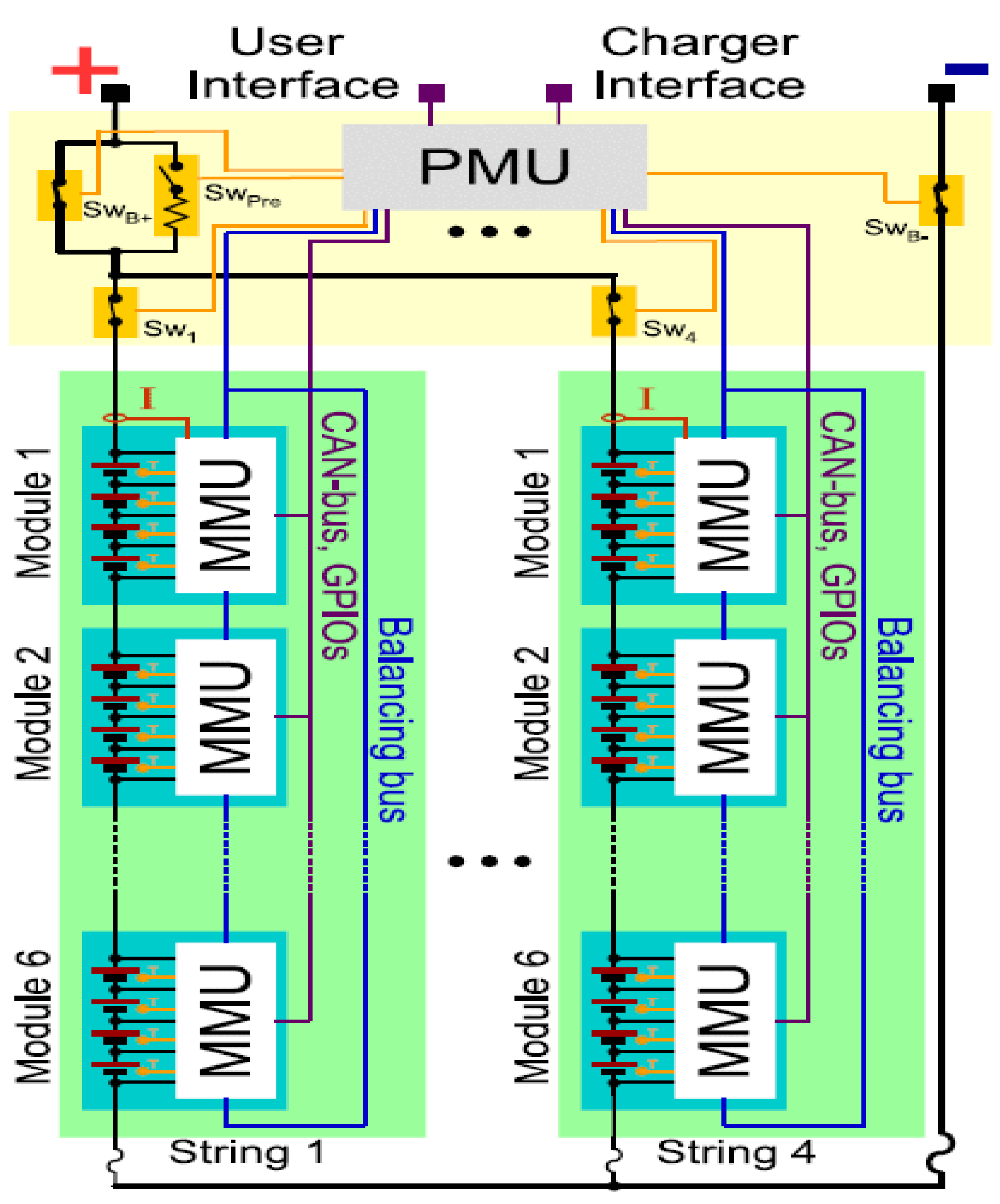
As pointed out in Section 3.1, the BMS plays a fundamental role in every energy storage system [61], particularly those based on Li-ion technology. Besides the basic monitoring and management functions mentioned above, there are advanced functions that updated BMS is required to perform. First of all, the BMS architecture must be designed to fit to different configurations of the battery, that usually consists of cells, modules (usually series connected), and strings (usually parallel connected). The BMS functions may be spread among the various layers of the BMS architecture [62]. Typical architectures span from a single master BMS that controls the entire battery, to hierarchical distributed ones, by which the BMS hardware is distributed over the battery modules and even down the individual battery cells [63,64]. Figure 5 shows a typical BMS hierarchical architecture that matches the parallel/series structure of the battery cells [49,65].
Figure 5. Hierarchical architecture of a BMS matching the battery structure consisting of four paralleled strings of 6 series connected modules each. The Pack Management Unit (PMU) is the master BMS, connected to the lower layer slave BMSs (MMUs) [49].
The State of Charge (SoC) of a battery is a fundamental quantity as it indicates the residual charge remaining in the battery, and thus, gives indications on the residual support provided by the ESS to the application. Moreover, the SoC estimate must be carried out on every cell of the battery, as the battery cells may be mismatched, and that mismatch may increase with ageing. Unfortunately, SoC is a quantity not directly measurable, but it must be calculated from other quantities, e.g., by integrating, in time, the current flowing in the battery. As in every non-ideal integration process, offsets or inaccuracies in the current sensor readings rapidly lead to a calculation of the integral that is affected by increasing and unacceptable errors. Many alternative approaches to the so-called Coulomb counting technique have been proposed [66,67]. Most of them are based on a model of the battery that is subjected to the same load and operating conditions of the real battery. The status of the battery, estimated from the model calculation, resembles the status of the real battery. Therefore, the SoC and other battery parameters can be estimated by the model. The most popular models are electrical models. They provide acceptable accuracy, together with affordable computation complexity. The battery is represented by an electromotive force (the so-called Open Circuit Voltage) that varies as a function of SoC, a series resistance, that models the internal losses, as well as a series of some resistor-capacitor parallel groups, which model the relaxation phenomena in the battery. The BMS is, thus, required to solve the model-based circuit to obtain an accurate estimate of the SoC. A further effect, that makes the SoC estimate tougher, is the variation of the model parameters. In fact, the values of the electrical components, which make up the battery model, vary in time, according to the state of charge, temperature, the environmental conditions, and the health status of the battery. A further challenge for an advanced BMS is, thus, to identify and track the parameter changes, only by observing the current, voltages, and temperatures of the battery cells.
Several state estimation and parameter identification techniques have been applied in the literature, starting from the moving window least square methods, to filtering, such as Extended Kalman Filters and Particle Filters. In any case the choice of the estimation technique must be traded off between the computation complexity required and the accuracy needed.
An even tougher task for a BMS is the evaluation of the health status of a battery [68,69]. The battery ageing is a complex process that depends on the utilization of the battery in term of operating temperatures, load profiles, and the number of charge/discharge cycles. It typically results in the progressive fading of the maximum capacity of the battery and the increase of the series resistance, which determine the increased internal losses and reduced power capability. The knowledge of the battery health status, together with the expected operational profile, may lead the BMS to estimate the Residual Useful Life of the battery.

3.4. Battery Charging Process

Battery cell manufacturers usually provide the user with constraints about the appropriate recharging process of the battery. The suggested charging profile is the Constant-Current Constant-Voltage (CC-CV) one [70]. It consists of a first phase in which the battery is charged with a constant current. The current value depends on the cell technology, and it is in the order of the battery capacity C expressed in ampere. Fast charging usually exceeds 1 C, whereas slow charging spans from 0.1 C to 0.5 C. The faster the charging, the higher the internal cell temperature and thus the possible stress that may determine ageing. The second phase starts when the battery voltage reaches the float value. The charger keeps the voltage constant since then, to gradually fill the battery up the maximum charge level. The process ends when the decreasing current reaches a threshold, usually a rather low fraction of the battery capacity expressed in ampere. The battery inserted in the multi-source/sink micro-grid scenario, depicted in Figure 6, cannot fully adhere to the above described charging process. Instead, as the charging and discharging phases are defined according to the overall management of the energy fluxes, the BMS should verify the manufacturer constraints in terms of current, temperature, and individual cell voltages. Should it happen, the bi-directional DC/DC converter, that connects the battery to the power bus (see detailed circuit schematic in Figure 7), must be driven in such a way as to reduce the charging current and to withstand the manufacturer’s limits. As the battery is not subjected to full discharge/charge cycles, the accurate knowledge of the battery SoC is mandatory to fully exploit the established energy flux policy mentioned in Section 2.3.
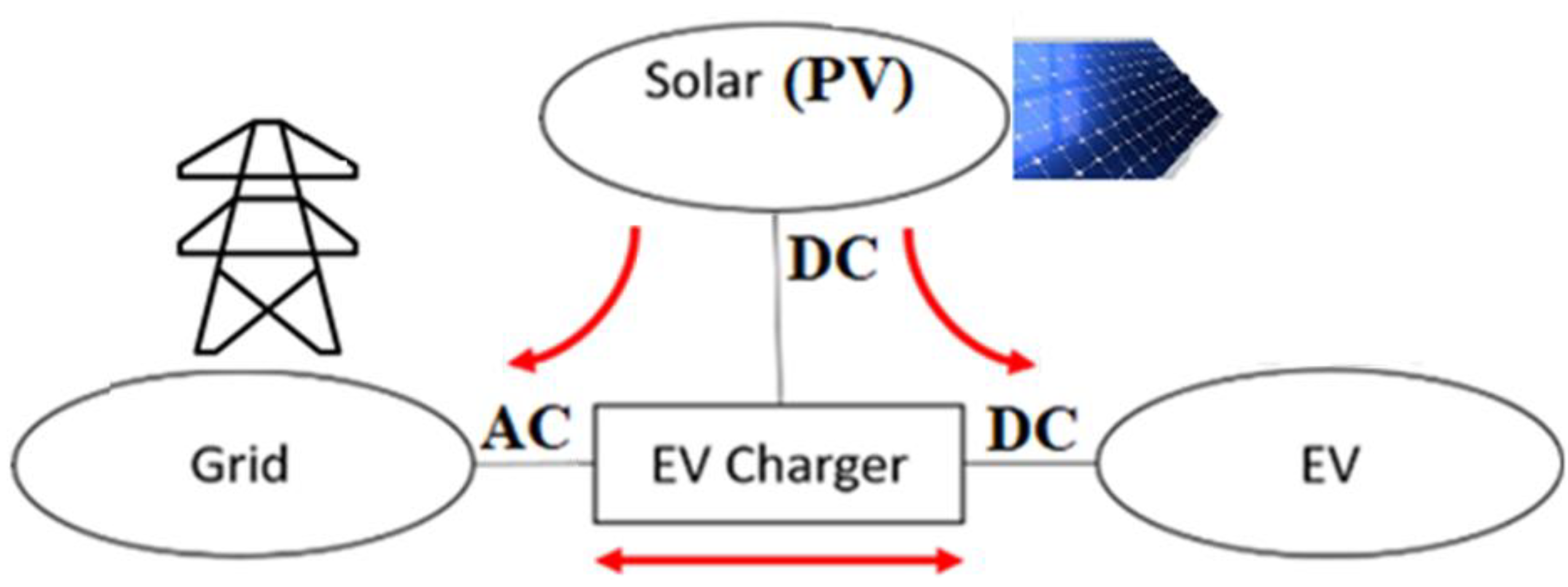
Figure 6. New hybrid micro-grid with full connectivity among RES node (DC), EV node (DC) and main grid node (AC) and relevant bi-directional flows. EV: Electric Vehicle.
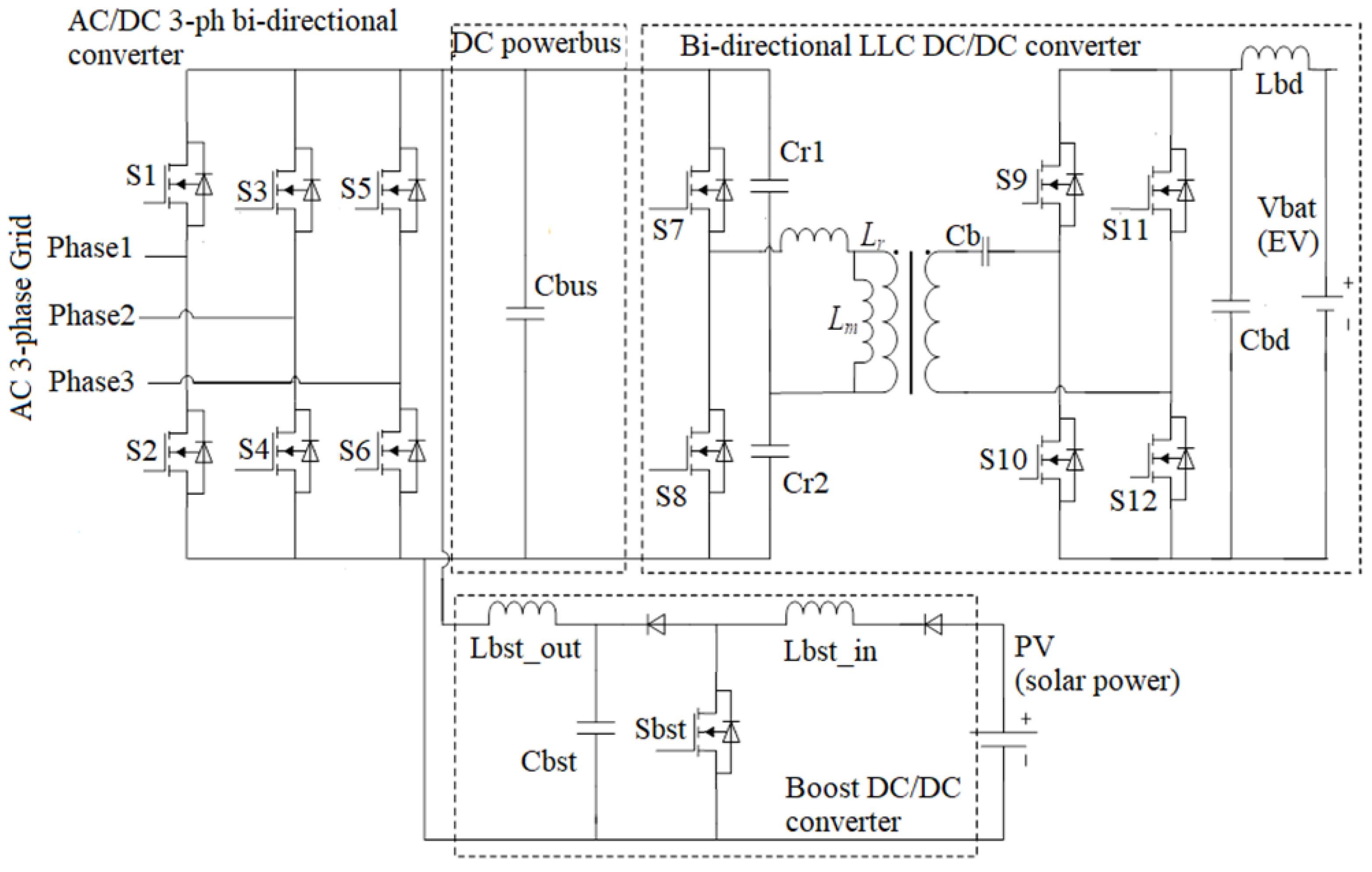
Figure 7. Circuit schematic of the bi-directional converter (1 AC grid port and 1 DC EV battery bidirectional ports; 1 DC unidirectional solar power port).

4. Innovative Micro-Grid with Bi-Directional Flows for RES and EV Charging

As anticipated above, a new micro-grid architecture is described in this Section (see Figure 6), which exploits bi-directional EV charger plus RES to overcome the flexibility limit of the architecture, as shown in Figure 1. Section 3 has shown why Li-ion batteries are being widely used for the high power and energy densities. Thus, they serve as energy storage unit connecting to the smart grid and to a RES such as PV panels in our focused application. This leads to a hub connection discussion: The current industry devices lack an efficient integrated connection system, since PV panels are not directly connected to the EV charger. Typically, they are first connected to the grid via a unidirectional DC/AC solar inverter, then a traditional unidirectional EV charger is used to connect the grid with the EV implementing an AC/DC conversion. This means that energy flows over two paths in a conventional solar-powered EV charging system, resulting in extra power losses and higher system cost. Instead, a novel bidirectional EV charger system is proposed in Figure 6 to build a direct connection between PV panels and the EV, and to create a V2G path. Therefore, reduced power loss and lower system cost features are achieved from a highly integrated power electronics system with high efficiency and high-power density.
The idea of the system scheme in Figure 6, as further detailed in the circuit scheme of Figure 7, is having a central DC power bus, plus a bidirectional flow between the AC grid and the power DC bus thanks to a 3-phase bidirectional converter, and a bidirectional flow between the DC battery on-board the EV and the DC power bus thanks to a bidirectional DC/DC converter. A unidirectional flow is still foreseen from the PV solar panel sub-system towards the DC power bus, using a boost DC/DC converter to adapt the output solar PV level to the DC power bus level.
The DC power bus voltage is typically in the range from 250 V to 600 V, e.g. it has been sized at 400 V in [3] in case of a 10 kW bidirectional EV charger and at 450 V in case of a 1.65 kW bidirectional EV charger in [71]. In [72,73,74], as special optimization case, a bidirectional EV charger is proposed where the value of the DC power bus can be sized from 500V to 840V. The AC grid is typically a 3-phase 380Vac one.
In the detailed circuit schematic of the EV bidirectional charger in Figure 7 the bidirectional 3-phase AC/DC converter and the boost DC/DC converter follow classic circuit solutions. For the isolated bi-directional DC/DC converter in Figure 7, instead of using a dual-active bridge topology as in [71,72,73,74] (see Figure 8B), a half-bridge series resonant LLC topology is proposed (that of Figure 8A). This approach allows reducing the number of active switches to be used and hence it makes more convenient the adoption of SiC power Mosfets (e.g., Cree C2M0040120D adopted in [3]) instead of classic Si power Mosfets (e.g. Infineon IPW60R045CP adopted for the primary stage in [71]). Indeed, SiC power Mosfets are more expensive than Si power Mosfets: a market analysis on stocks from 100 to 1000 devices for the power mosfets in Table 1 has shown that the selling price for each SiC power device is 1.7 to 3.5 times higher than that of Si power device. Hence, a circuit solution like that in Figure 8A that minimizes the use of active devices make more convenient the adoption of SiC power Mosfets.
Figure 8. Bi-directional DC/DC converter: (A) half-bridge at the primary stage; (B) dual-active bridge topology.
Table 1. Power Mosfets performance comparison (same package and current), SiC in [3] vs. Si in [71].
As shown in Table 1, for the same package (T0-247) and hence the same occupied area on a printed circuit board, and the same rated current IDmax, SiC power Mosfets double the sustained voltage vs. Si power Mosfets (1200 V vs. 600 V), improve the typical figure of merit RDSon x QG [75] by reducing both the RDSon and the total gate charge (QG), and remarkably reduce ton/off-delay time (tdON/tdOFF) and reverse recovery time (trr) of the integrated diode.
From a switching frequency point of view, the solutions proposed in [3,71] for bidirectional DC/DC conversion are in the order of 100 kHz, more in detail up to 140 kHz in [71] and up to 150 kHz in [3]. As discussed in [72,73,74], by using wide bandgap power devices like SiC and GaN the typical frequencies of power Si devices of about 100 kHz can be increased above 300 kHz. For example, a 500 kHz switching frequency is used for a 6.6 kW CLLC DC/DC resonant converter in [72,73,74] where a bi-directional EV charger is proposed by cascading a first AC/DC stage (switching at 300 kHz) followed by the 500 kHz CLLC DC/DC converter stage. The higher the frequency, the lower the size and weight of the inductive passive devices (inductors, transformers).
As far as the selection of the active devices is concerned the work in [72,73,74] proposes a mix of 650 V GaN and 1.2 kV SiC power switch devices. Particularly, since in [72,73,74] the power DC Bus of the EV charger is sized for values ranging from 500 VDC to 840 VDC (when the battery on board the EV is 250 VDC to 420 VDC) it is necessary to change the 650V GaN devices with 1.2 kV SiC Mosfets in the AC/DC stage and in the primary side of the DC/DC stage of the bidirectional EV charger. 650V GaN devices are used in [72,73,74] only for the secondary stage of the bidirectional DC/DC converter. A full 650 V GaN devices solution is discussed in [74] but limited to applications where the DC power bus is 450 V at maximum.
Summarizing, compared with Si devices, the absence of reverse recovery charge in wide-bandgap devices (GaN and SiC) enables bidirectional operation with simplified converter structures. Moreover, wide-bandgap devices have better figure of merit [75] than Si devices and hence for a given ON-resistance and breakdown voltage, wide-bandgap devices require smaller die size, which translates into smaller gate charge and junction capacitance. These characteristics allow increasing switching frequency (above the 100 kHz typical of converters with power SI devices) and reducing the switching loss. From reported results [3,72,73,74] of recent bi-directional EV chargers, 650 V GaN devices may allow a higher switching frequency than 1.2 kV SiC devices, but the latter become mandatory to manage in a reliable and efficient manner DC power bus of 500 VDC or above.
With the larger battery capability in EVs, power flow between the EV and the grid is exploited in a bi-directional fashion. It is especially useful in applications using renewables such as solar generation as in [3]. Its flow chart is viewed in Figure 6, in contrast to the traditional way shown in Figure 1. In the bi-directional power flow interaction, the solar power can flow either from the PV panel to the grid or to the EV, and the battery charging power can flow from grid to vehicle (G2V) or vice versa (V2G). Two additional power flows are provided and managed in Figure 6 if compared to the unidirectional mode in Figure 1. Moreover, a further partner of the new architecture can also be the ESS, discussed in Section 3, located inside the residential installation that may or may not be included in the above described scenario.
The proposed approach in Figure 6 has several main advantages. First, there is an increase in system flexibility. V2G power flow implies the power can be drawn from the battery serving as the electric source in [4], which has significant benefits in the future applications such as powering house during the electricity shutdown. Moreover, the system becomes quite simpler after applying the bi-directional power flow method, and its benefits can be summarized in these two points: (i) Direct access to solar generation and EV battery; (ii) efficiency maximization.
Concerning the direct access to solar generation and EV battery, thanks to the two additional power flow path—solar power to EV charging and EV back-feed to the grid-(see Figure 6 compared to Figure 1), the system becomes more valuable in the energy usage and transfer. The system integrates the functionality of solar inverter and battery charging into one system, by providing direct access between each power element, which significantly reduces the system size.
Concerning efficiency maximization, the overall system efficiency can be improved of about 4% by comparing the bi-directional power flow method with the traditional unidirectional power flow method. From the perspective of fairness, their measured efficiency data are based on same metrics of power electronics system experiment: EV charger data are taken from [3], and solar inverter data are taken from [5]. If for example the power converters (solar inverter and unidirectional converter in Figure 1, and bi-directional converter in Figure 6) have an efficiency of 96%, the scheme in Figure 1 will result in an overall efficiency of 92% less than the efficiency of 96% achieved with the scheme in Figure 6.
The 4% improvement is a substantial saving on the economics of electricity usage, besides the materials cost saving from one compact integrated system, compared to two bulky systems separated systems. The only hardware requirement to implement the circuits and systems proposed in Figure 6 and Figure 7 is the use of bi-directional capable semiconductor switches in [3], based on the today available SiC technology. Since SiC is becoming a mature technology, the proposed approach adds trivial circuit complexity as shown in the circuit in Figure 7, which has been implemented and characterized in [3,21,22,23]. The bi-directional converter in Figure 7 has been tested with battery packs of 400 V and charging/discharging power levels in the range from 1 to 10 kW.
It is worth noting that the scheme in Figure 6, and hence the circuit in Figure 7, can further be improved in terms of flexibility since it is possible to exploit as ESS, not only where available in the EV side, but also that available at RES side. Indeed, new solar energy sources are available in the market [2], where a high-voltage Li-ion battery energy storage is integrated with capacity scalable from 4 kWh up to 12 kWh. The energy storage in [2] can sustain DC voltage inputs from 170 V to 575 V at the battery port side, where each basic battery module of 4 kWh can be charged/discharged at maximum charge power of 1.6 kW, and maximum discharge power of 2 kW. By parallelizing the modules, we obtained an overall energy storage up to 12 kWh with maximum charge power of 4.8 kW and maximum discharge power of 6 kW. In this way, new additional modes with respect to Figure 6 can also be enabled, with power flowing also towards, and not only from, the solar power node. Moreover, the new products appearing on the market for energy production, conversion and storage are equipped with advanced connectivity and diagnostic features [76,77], helping the integration phase in micro/smart grids.

5. Conclusions

The cost-reducing techniques of RES components used in micro-grids are mainly PV systems and WTs, and these provide new possibilities for clean, reliable, and affordable systems in micro-grid configurations. New hybrid micro-grid systems can quickly and cost-effectively be implemented in remote locations, thus, opening new opportunities to investigate the new concepts as alternatives to conventional power systems.
ESS components, particularly batteries based on Li-ion or sodium technologies, are identified as a key technology for the integration of intermittent RES. This, in turn, introduces major challenges to the control system for the appropriate management of this resource.
The integration of an energy management system in a future micro-grid, for optimizing future aggregators’ assets, should be coordinated through an advanced ICT data hub platform that allows DSOs and aggregators to deal with innovative aspects of their distribution network operation and planning with smart energy storage solutions. This would include V2G integration, power electronics-based interface with bi-directional power control of DER and ESS, and integrating IoT (Internet of Things) into the Smart Grids.
With reference to a new and improved energy grid, this paper first reviewed trends in RES, power converters, and control strategies, and analyzed trends in battery energy storage and the relevant issues in battery charging and BMS. An alternative micro-grid architecture was then proposed to overcome the lack of flexibility of the classic energy grid. By mixing DC and AC sources, the hybrid micro-grid shows an alternative architecture where the use of bi-directional EV chargers may allow the creation of a micro-grid directly interconnecting all the nodes with bi-directional energy flows: Main grid node, RES node, energy storage nodes, both on-board the vehicle and inside the micro-grid structure. The proposed model is also sustained by the new products emerging in the market, such as new solar inverters that include are appearing [2], where a local energy storage for the RES and hence can enable bidirectional power flows from/towards the RES.

Author Contributions

Research: S.S., R.S., and L.M.-P. Writing: S.S., R.S., and L.M.-P.

Funding

This work was partially supported by Tuscany Region under “Progetto SUMA” and partially supported by CrossLab project, University of Pisa, funded by MIUR “Department of Excellence” program.

Acknowledgments

Discussions with K.J., L.C., W.X. from MIT, US under the MIT-UNIPI seed fund program are gratefully acknowledged.

Conflicts of Interest

The authors declare no conflict of interest.

References

  1. Mihet-Popa, L.; Saponara, S. Toward Green Vehicles Digitalization for the Next Generation of Connected and Electrified Transport Systems. Energies 2018, 11, 3124. [Google Scholar] [CrossRef]
  2. Available online: https://new.abb.com/power-converters-inverters/solar/photovoltaic-energy-storage/react-2 (accessed on 16 November 2019).
  3. Wang, X.; Jiang, C.; Lei, B.; Teng, H.; Bai, H.K.; Kirtley, J.L. Power-loss analysis and efficiency maximization of a silicon-carbide MOSFET-based three-phase 10-kW bidirectional EV charger using variable-DC-bus control. IEEE J. Emerg. Sel. Top. Power Electron. 2016, 4, 880–892. [Google Scholar] [CrossRef]
  4. Jain, P.; Jain, T. Impacts of G2V and V2G power on electricity demand profile. In Proceedings of the 2014 IEEE International Electric Vehicle Conference (IEVC), Florence, Italy, 17–19 December 2014. [Google Scholar]
  5. Wall, S.; Ruan, R.; Wang, C.; Xie, J. Evaluation of three-phase solar inverters using SiC devices. In Proceedings of the IEEE EPE’16 ECCE Europe, Karlsruhe, Germany, 5–9 September 2016. [Google Scholar]
  6. Olivares, D.E.; Mehrizi-Sani, A.; Etemadi, A.H.; Cañizares, C.A.; Iravani, R.; Kazerani, M.; Hajimiragha, A.H.; Gomis-Bellmunt, O.; Saeedifard, M.; Palma-Behnke, R.; et al. Trends in Micro-grid Control. IEEE Trans. Smart Grid 2014, 5, 1905–1919. [Google Scholar] [CrossRef]
  7. Hirsch, A.; Parag, Y.; Guerrero, J. Micro-grids: A review of technologies, key drivers, and outstanding issues. Renew. Sustain. Energy Rev. 2018, 90, 402–411. [Google Scholar] [CrossRef]
  8. Sánchez-Miralles, M.M.F.; Rivier, A.M. A literature review of micro-grids: A functional layer based classification. Renew. Sustain. Energy 2016, 62, 1133–1153. [Google Scholar]
  9. Vadi, S.; Padmanaban, S.; Bayindir, R.; Blaabjerg, F.; Mihet-Popa, L. A Review on Optimization and Control Methods Used to Provide Transient Stability in Micro-grids. Energies 2019, 12, 3582. [Google Scholar] [CrossRef]
  10. Ganesan, S.; Padmanaban, S.; Varadarajan, R.; Subramaniam, U.; Mihet-Popa, L. Study and Analysis of an Intelligent Micro-grid Energy Management Solution with Distributed Energy Sources. Energies 2017, 10, 1419. [Google Scholar] [CrossRef]
  11. Ton, D.; Reilly, J. Micro-grid Controller Initiatives. IEEE Power Energy Mag. 2017, 15, 24–31. [Google Scholar] [CrossRef]
  12. Xavier Saury, F.; Tomlinson, C. Hybrid Micro-Grids: The Time Is Now; CATERPILLAR-LEXE0904; Peoria, IL, USA, 2016; Available online: https://www.cat.com/en_US/by-industry/electric-power-generation/Articles/White-papers/white-paper-hybrid-microgrids-the-time-is-now.html (accessed on 28 September 2019).
  13. Xiao, Y.; Ren, C.; Han, X.; Wang, P. A generalized and mode-adaptive approach to the power flow analysis of the isolated hybrid AC/DC micro-grids. Energies 2019, 12, 2253. [Google Scholar] [CrossRef]
  14. Han, Y.; Li, H.; Shen, P.; Coelho, E.A.A.; Guerrero, J.M. Review of active and reactive power sharing strategies in hierarchical controlled micro-grids. IEEE Trans. Power Electron. 2017, 32, 2427–2451. [Google Scholar] [CrossRef]
  15. Unamunon, E.; Barrena, J.A. Hybrid AC/DC microgrids-Part II: Review and classification of control strategies. Renew. Sustain. Energy Rev. 2012, 52, 1123–1134. [Google Scholar] [CrossRef]
  16. Mani Venkata, S.S.; Shahidehpour, M. Microgrid Controllers: The Brain, Heart, & Soul of Microgrid Automation. IEEE Power Energy Mag. 2017, 15, 16–22. [Google Scholar]
  17. Colak, I.; Kabalci, E.; Fulli, G.; Lazarou, S. A survey on the contributions of power electronics to smart grid systems. Renew. Sustain. Energy Rev. 2015, 47, 562–579. [Google Scholar] [CrossRef]
  18. Mohammed, A.; Refaat, S.S.; Bayhan, S.; Abu-Rub, H. AC Microgrid Control and Management Strategies-Evaluation and review. IEEE Power Electron. Mag. 2019, 6, 18–31. [Google Scholar] [CrossRef]
  19. Shen, X.; Tan, D.; Shuai, Z.; Luo, A. Control techniques for bidirectional interlinking converters in Hybrid Microgrids. IEEE Power Electron. Mag. 2019, 6, 39–47. [Google Scholar] [CrossRef]
  20. Bhalla, A. Electromagnetic interference mitigation in wide-bandgap power conversion. IEEE Power Electron. Mag. 2019, 6, 32–35. [Google Scholar] [CrossRef]
  21. Adan, A.O.; Tanaka, D.; Burgyan, L.; Kakizaki, Y. The current status and trends of 1200-V commercial silicon-carbide MOSFETs. IEEE Power Electron. Mag. 2019, 6, 36–47. [Google Scholar] [CrossRef]
  22. Bindra, A. Wide-bandgap power devices: Adoption gathers momentum. IEEE Power Electron. Mag. 2018, 22–27. [Google Scholar] [CrossRef]
  23. Mookken, J. SiC MOSFETs enable high frequency in high power conversion systems. Bodo’s Power Syst. 2016, 28–32. Available online: https://www.richardsonrfpd.com/docs/rfpd/SiC_MOSFET_Article.pdf (accessed on 16 November 2019).
  24. International Energy Agency-IEA. Renewables 2018. Market Analysis and Forecast from 2018 to 2023, October 2018; ISBN 978-92-64-36998-6. Available online: https://www.iea.org/renewables2018/ (accessed on 16 November 2019).
  25. International Energy Agency-IEA. Renewables 2019. Market Analysis and Forecast from 2019 to 2024, October 2019; ISBN 978-92-64-30684-4. Available online: https://www.iea.org/renewables2019/ (accessed on 16 November 2019).
  26. Shivarama Krishna, K.; Sathish Kumar, K. A review on hybrid renewable energy systems. Renew. Sustain. Energy Rev. 2015, 52, 907–916. [Google Scholar] [CrossRef]
  27. Rocabert, J.; Luna, A.; Blaabjerg, F.; Rodríguez, P. Control of power converters in AC microgrids. IEEE Trans. Power Electron. 2012, 27, 4734–4749. [Google Scholar] [CrossRef]
  28. Zang, M.; Li, Y.; Peng, Y.; Li, W.; Liu, F. A control architecture to coordinate DG inverters a series-LC-filter hybrid active filter for power quality improvement in Micro-Grid. In Proceedings of the 2017 IEEE International Conference on Environment and Electrical Engineering and 2017 IEEE Industrial and Commercial Power Systems Europe (EEEIC/I & CPS Europe), Milan, Italy, 13 July 2017. [Google Scholar]
  29. Cirrincione, M.; Pucci, M.; Vitale, G. A single-phase DG generation unit with shunt active power filter capability by adaptive neural filtering. IEEE Trans. Ind. Electron. 2008, 5, 2093–2110. [Google Scholar] [CrossRef]
  30. Yu, Y.; Guerrero, J.M.; Sun, L.; Li, H. Modeling and stability analysis of CCIs- and VCIs- Based Hybrid Microgrids operating in Grid-Connected Modes. In Proceedings of the 2018 International Conference on Smart Energy Systems and Technologies (SEST), Sevilla, Spain, 10–12 September 2018. [Google Scholar]
  31. Luo, F.; Loo, K.H.; Lai, Y.M. A Hybrid AC/DC Microgrid Control Scheme with Voltage-Source Inverter-Controlled Interlinking Converters. In Proceedings of the 18th European Conference on Power Electronics and Applications, EPE 2016 ECCE Europe, Karlsruhe, Germany, 5–9 September 2016. [Google Scholar]
  32. Peyghami, S.; Mokhtari, H.; Blaabjerg, F. Autonomous operation of a Hybrid AC/DC Microgrid with multiple interlinking converters. IEEE Trans. Smart Grid 2018, 19, 6480–6488. [Google Scholar] [CrossRef]
  33. Liu, Q.; Caldognetto, T.; Buso, S. Flexible control of interlinking converters for DC Microgrids coupled to smart AC power systems. IEEE Trans. Ind. Electron. 2019, 66, 3477–3485. [Google Scholar] [CrossRef]
  34. Guerrero, J.M.; Loh, P.C.; Lee, T.L.; Chandorkar, M. Advanced control architectures for intelligent microgrids—Part II: Power quality, energy storage, and AC/DC microgrids. IEEE Trans. Ind. Electron. 2013, 60, 1263–1270. [Google Scholar] [CrossRef]
  35. Sadeghkhani, I.; Golshan, M.E.H.; Mehrizi-Sani, A.; Guerrero, J. Low voltage ride-through of a droop-based three-phase four-wire grid-connected microgrid. IET Gener. Transm. Distrib. 2018, 12, 1906–1914. [Google Scholar] [CrossRef]
  36. Mihaylov, M.; Razo-Zapata, I.; Rădulescu, R.; Nowé, A. Boosting the Renewable Energy Economy with NRGcoin. In Proceedings of the 4th International Conference on ICT for Sustainability (ICT4S), Amsterdam, The Netherlands, 29 August–1 September 2016. [Google Scholar]
  37. Beaudin, M.; Zareipour, H.; Schellenberg, A.; Rosehart, W. Energy Storage for Mitigating the Variability of Renewable Electricity Sources. Energy Storage Smart Grids 2010, 14, 302–314. [Google Scholar]
  38. Zhao, T.; Ding, Z. Cooperative Optimal Control of Battery Energy Storage System under Wind Uncertainties in a Micro-grid. IEEE Trans. Power Syst. 2018, 33, 2292–2300. [Google Scholar] [CrossRef]
  39. Xie, H.; Teng, X.; Xu, Y.; Wang, Y. Optimal Energy Storage Sizing for Networked Micro-grids Considering Reliability and Resilience. IEEE Access 2019, 7, 86336–86348. [Google Scholar] [CrossRef]
  40. Khodabakhsh, R.; Sirouspour, S. Optimal Control of Energy Storage in a Micro-grid by Minimizing Conditional Value-at-Risk. IEEE Trans. Sustain. Energy 2016, 7, 1264–1273. [Google Scholar] [CrossRef]
  41. Ju, C.; Wang, P.; Goel, L.; Xu, Y. A Two-Layer Energy Management System for Micro-grids With Hybrid Energy Storage Considering Degradation Costs. IEEE Trans. Smart Grid 2018, 9, 6047–6057. [Google Scholar] [CrossRef]
  42. Qi, X.; Bai, Y.; Luo, H.; Zhang, Y.; Zhou, G.; Wei, Z. Novel Distributed Optimal Control of Battery Energy Storage System in an Islanded Microgrid with Fast Frequency Recovery. Energies 2018, 11, 1955. [Google Scholar] [CrossRef]
  43. García Vera, Y.E.; Dufo-López, R.; Bernal-Agustín, J.L. Energy Management in Microgrids with Renewable Energy Sources: A Literature Review. Appl. Sci. 2019, 9, 3854. [Google Scholar] [CrossRef]
  44. Ross, M.; Abbey, C.; Bouffard, F.; Joós, G. Micro-grid Economic Dispatch with Energy Storage Systems. IEEE Trans. Smart Grid 2018, 9, 3039–3047. [Google Scholar] [CrossRef]
  45. Faisal, M.; Hannan, M.A.; Ker, P.J.; Hussain, A.; Mansor, M.B.; Blaabjerg, F. Review of Energy Storage System Technologies in Micro-grid Applications: Issues and Challenges. IEEE Access 2018, 6, 35143–35164. [Google Scholar] [CrossRef]
  46. Nadeem, F.; Hussain, S.S.; Tiwari, P.K.; Goswami, A.K.; Ustun, T.S. Comparative Review of Energy Storage Systems, Their Roles, and Impacts on Future Power Systems. IEEE Access 2019, 7, 4555–4585. [Google Scholar] [CrossRef]
  47. Rahimi-Eichi, H.; Ojha, U.; Baronti, F.; Chow, M.-Y. Battery Management System: An Overview of Its Application in the Smart Grid and Electric Vehicles. IEEE Ind. Electron. Mag. 2013, 7, 4–16. [Google Scholar] [CrossRef]
  48. Brandl, M.; Gall, H.; Wenger, M.; Lorentz, V.; Giegerich, M.; Baronti, F.; Fantechi, G.; Fanucci, L.; Roncella, R.; Saletti, R.; et al. Batteries and battery management systems for electric vehicles. In Proceedings of the 2012 Design, Automation & Test. in Europe Conference & Exhibition (DATE), Dresden, Germany, 12–16 March 2012. [Google Scholar]
  49. Analog Device 12 Channel Multicell Battery Monitor with Addressable Interface. Available online: https://www.analog.com/media/en/technical-documentation/data-sheets/680412fc.pdf (accessed on 16 November 2019).
  50. Maxim Integrated MAX14920 High-Accuracy 12-/16-Cell Measurement Analog Front Ends. Available online: https://datasheets.maximintegrated.com/en/ds/MAX14920-MAX14921.pdf (accessed on 16 November 2019).
  51. Texas Instruments bq76PL455A 16-Cell Industrial Integrated Battery Monitor with Passive Cell Balancing. Available online: http://www.ti.com/lit/ds/symlink/bq76pl455a.pdf (accessed on 16 November 2019).
  52. Lahiri, A.; Shah, N.; Dales, C. Building a safer, denser lithium-ion battery. IEEE Spectr. 2018, 55, 34–39. [Google Scholar] [CrossRef]
  53. Omariba, Z.B.; Zhang, L.; Sun, D. Review of Battery Cell Balancing Methodologies for Optimizing Battery Pack Performance in Electric Vehicles. IEEE Access 2019, 7, 129335–129352. [Google Scholar] [CrossRef]
  54. Ci, S.; Lin, N.; Wu, D. Reconfigurable Battery Techniques and Systems: A Survey. IEEE Access 2016, 4, 1175–1189. [Google Scholar] [CrossRef]
  55. Lin, N.; Ci, S.; Wu, D.; Guo, H. An Optimization Framework for Dynamically Reconfigurable Battery Systems. IEEE Trans. Energy Convers. 2018, 33, 1669–1676. [Google Scholar] [CrossRef]
  56. Baronti, F.; Fantechi, G.; Roncella, R.; Saletti, R. Design of a module switch for battery pack reconfiguration in high-power applications. In Proceedings of the 2012 IEEE International Symposium on Industrial Electronics (ISIE), Hangzhou, China, 28–31 May 2012; pp. 1330–1335. [Google Scholar] [CrossRef]
  57. Morello, R.; Baronti, F.; Tian, X.; Chau, T.; Di Rienzo, R.; Roncella, R.; Saletti, R. Hardware-in-the-loop simulation of FPGA-based state estimators for electric vehicle batteries. In Proceedings of the IEEE International Symposium on Industrial Electronics, Santa Clara, CA, USA, 8–10 June 2016. [Google Scholar] [CrossRef]
  58. Sudworth, J.L. Zebra batteries. J. Power Sources 1994, 51, 105–114. [Google Scholar] [CrossRef]
  59. Moseley, P.T.; Rand, D.A. Chapter 15-High-Temperature Sodium Batteries for Energy Storage. In Electrochemical Energy Storage for Renewable Sources and Grid Balancing, 1st ed.; Moseley, P.T., Garche, J., Eds.; Elsevier: London, UK, 2015; pp. 253–268. ISBN 978-044-462-616-5. [Google Scholar]
  60. Li, G.; Lu, X.; Kim, J.Y.; Lemmon, J.P.; Sprenkle, V.L. Improved cycling behavior of ZEBRA battery operated at intermediate temperature of 175 °C. J. Power Sources 2014, 249, 414–417. [Google Scholar] [CrossRef]
  61. Lawder, M.T.; Suthar, B.; Northrop, P.W.; De, S.; Hoff, C.M.; Leitermann, O.; Subramanian, V.R. Battery Energy Storage System (BESS) and Battery Management System (BMS) for Grid-Scale Applications. Proc. IEEE 2014, 102, 1014–1030. [Google Scholar] [CrossRef]
  62. Kim, H.; Shin, K.G. DESA: Dependable, Efficient, Scalable Architecture for Management of Large-Scale Batteries. IEEE Trans. Ind. Inform. 2012, 8, 406–417. [Google Scholar] [CrossRef]
  63. Steinhorst, S.; Lukasiewycz, M.; Narayanaswamy, S.; Kauer, M.; Chakraborty, S. Smart Cells for Embedded Battery Management. In Proceedings of the 2014 IEEE International Conference on Cyber-Physical Systems, Networks, and Applications, Hong Kong, China, 25–26 August 2014. [Google Scholar]
  64. Baronti, F.; Fantechi, G.; Roncella, R.; Saletti, R. Intelligent cell gauge for a hierarchical battery management system. In Proceedings of the 2012 IEEE Transportation Electrification Conference and Expo (ITEC), Dearborn, MI, USA, 18–20 June 2012; pp. 1–5. [Google Scholar] [CrossRef]
  65. Di Rienzo, R.; Baronti, F.; Vellucci, F.; Cignini, F.; Ortenzi, F.; Pede, G.; Saletti, R. Experimental analysis of an electric minibus with small battery and fast charge policy. In Proceedings of the 2016 International Conference on Electrical Systems for Aircraft, Railway, Ship Propulsion and Road Vehicles and International Transportation Electrification Conference, ESARS-ITEC, Toulouse, France, 2–4 November 2016. [Google Scholar] [CrossRef]
  66. Rivera-Barrera, J.P.; Muñoz-Galeano, N.; Sarmiento-Maldonado, H.O. SoC Estimation for Lithium-ion Batteries: Review and Future Challenges. Electronics 2017, 6, 102. [Google Scholar] [CrossRef]
  67. Xiong, R.; Cao, J.; Yu, Q.; He, H.; Sun, F. Critical Review on the Battery State of Charge Estimation Methods for Electric Vehicles. IEEE Access 2018, 6, 1832–1843. [Google Scholar] [CrossRef]
  68. Berecibar, M.; Gandiaga, I.; Villarreal, I.; Omar, N.; Van Mierlo, J.; Van den Bossche, P. Critical review of state of health estimation methods of Li-ion batteries for real applications. Renew. Sustain. Energy Rev. 2016, 56, 572–587. [Google Scholar] [CrossRef]
  69. Ungurean, L.; Cârstoiu, G.; Micea, M.V.; Groza, V. Battery state of health estimation: A structured review of models, methods and commercial devices. Int. J. Energy Res. 2017, 41, 151–181. [Google Scholar] [CrossRef]
  70. Lin, Q.; Wang, J.; Xiong, R.; Shen, W.; He, H. Towards a smarter battery management system: A critical review on optimal charging methods of lithium ion batteries. Energy 2019, 183, 220–234. [Google Scholar] [CrossRef]
  71. Hillers, A.; Christen, D.; Biela, J. Design of a Highly Efficient Bidirectional Isolated LLC Resonant Converter. In Proceedings of the 2012 15th International Power Electronics and Motion Control Conference (EPE/PEMC), Novi Sad, Serbia, 4–6 September 2012. [Google Scholar]
  72. Gadelrab, R.; Yang, Y.; Li, B.; Lee, F.C.; Li, Q. High-Frequency High-Density Bidirectional EV Charger. In Proceedings of the IEEE Transportation Electrification Conference and Expo (ITEC) 2018, Long Beach, CA, USA, 13–15 June 2018. [Google Scholar]
  73. Li, B.; Li, Q.; Lee, F.C. A Novel PCB Winding Transformer with Controllable Leakage Integration for a 6.6 kW 500 kHz High Efficiency High Density Bi-Directional On-Board Charger. In Proceedings of the 2017 IEEE Applied Power Electronics Conference and Exposition (APEC), Tampa, FL, USA, 26–30 March 2017; pp. 2917–2924. [Google Scholar]
  74. Li, B.; Li, Q.; Lee, F.C.; Liu, Z.; Yang, Y. A High-Efficiency High-Density Wide-Bandgap Device-Based Bidirectional On-Board Charger. IEEE J. Emerg. Sel. Top. Power Electron. 2018, 6, 1627–1636. [Google Scholar] [CrossRef]
  75. Ejuri, J. How to Compare the Figure of Merit (FOM) of MOSFETs. In Infineon Application Note; 2003; Available online: http://cdn14.21dianyuan.com (accessed on 2 October 2019).
  76. Saponara, S.; Fanucci, L.; Bernardo, F.; Falciani, A. Predictive diagnosis of high-power transformer faults by networking vibration measuring nodes with integrated signal processing. IEEE Trans. Instrum. Meas. 2016, 65, 1749–1760. [Google Scholar] [CrossRef]
  77. Saponara, S.; Bacchillone, T. Network architecture, security issues, and hardware implementation of a home area network for smart grid. J. Comput. Netw. Commun. 2012, 2012, 534512. [Google Scholar] [CrossRef]

Article Metrics

Citations

Article Access Statistics

Multiple requests from the same IP address are counted as one view.