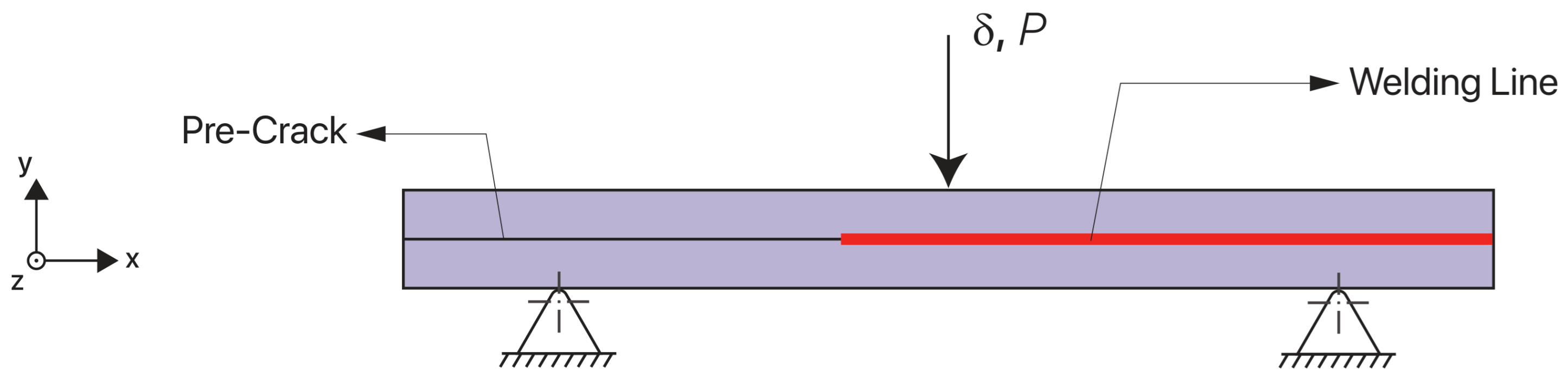
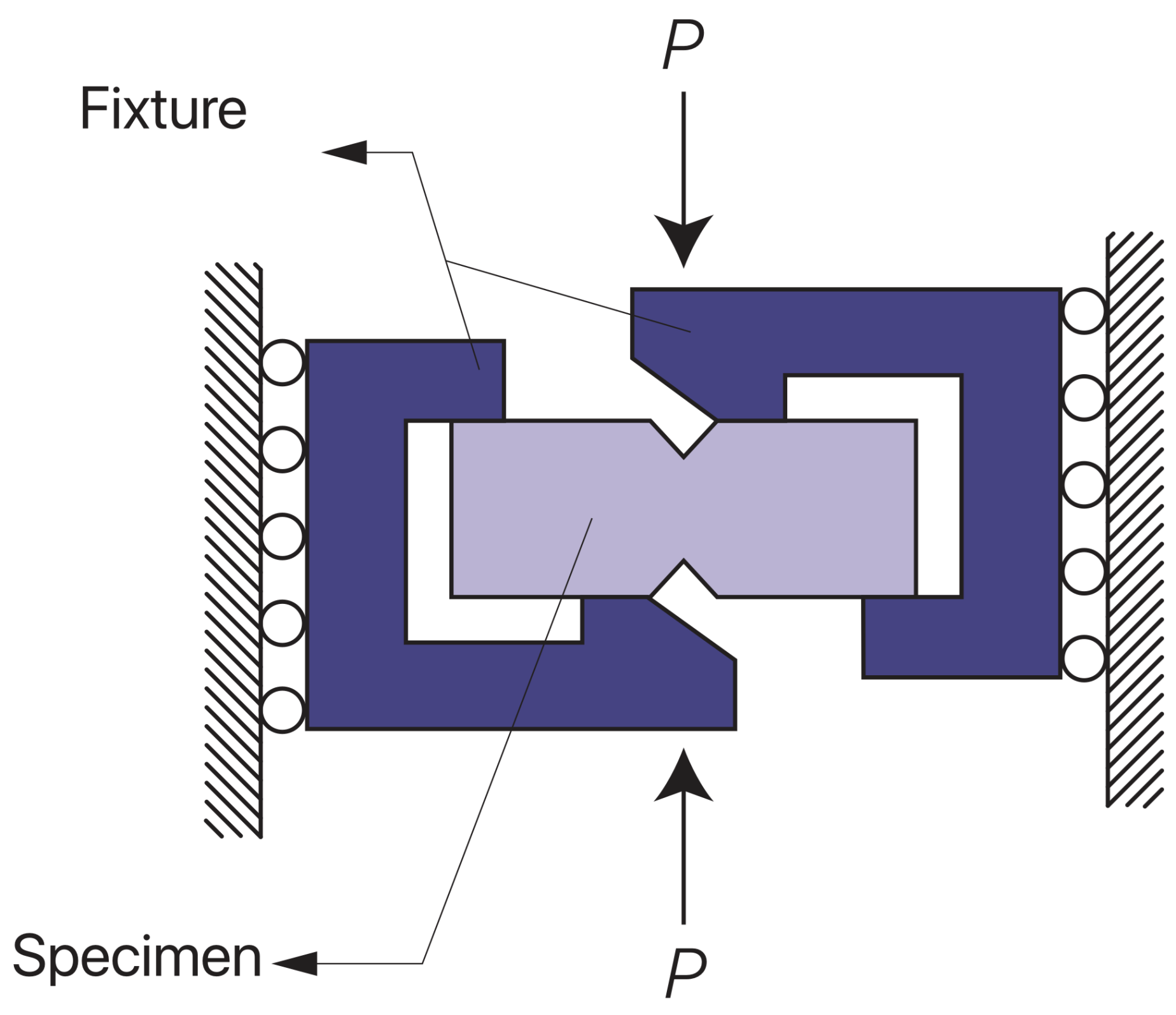
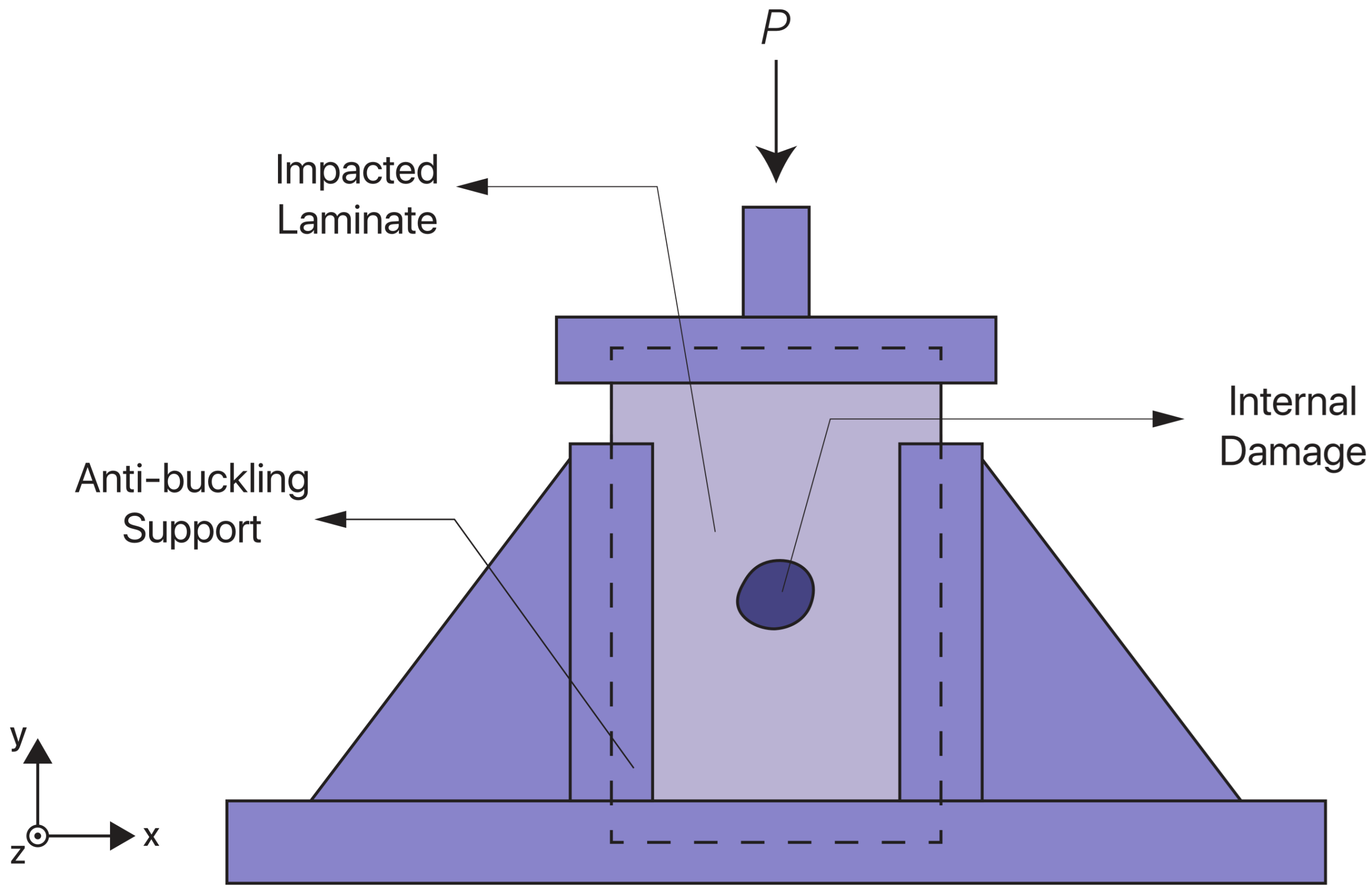
Advanced Interface Modeling and Characterization of Thermoplastic Fusion Bonds for Sustainable Structural Applications: An In-Depth Review




Abstract
1. Introduction
1.1. General Background
1.2. Problem Statement and Formulation of the Research Questions
- •
- RQ1: How do variations in process parameters across different fusion bonding techniques dictate the resulting interfacial microstructure and the ultimate mechanical performance of TPC joints?
- •
- RQ2: In what ways can experimental characterization be integrated with numerical modeling to overcome the current limitations in determining the fracture toughness and damage initiation of welded interfaces?
- •
- RQ3: What are the primary challenges in testing and simulating these joints, and what are the future trajectories for standardizing their structural assessment?
1.3. Scopes and Contributions of This Work
1.4. Organization of the Manuscript
2. Thermoplastics and Fusion Bonding
2.1. The Evolutionary Transition from Thermosetting to Thermoplastic Matrices
2.2. Classification of TPC Joining Methodologies
2.3. Theoretical Mechanisms Governing the Fusion Bonding Process
2.3.1. Intimate Contact Development
2.3.2. Autohesion
2.3.3. Coupled Bonding Model
2.4. Classification of Fusion Bonding Techniques
- •
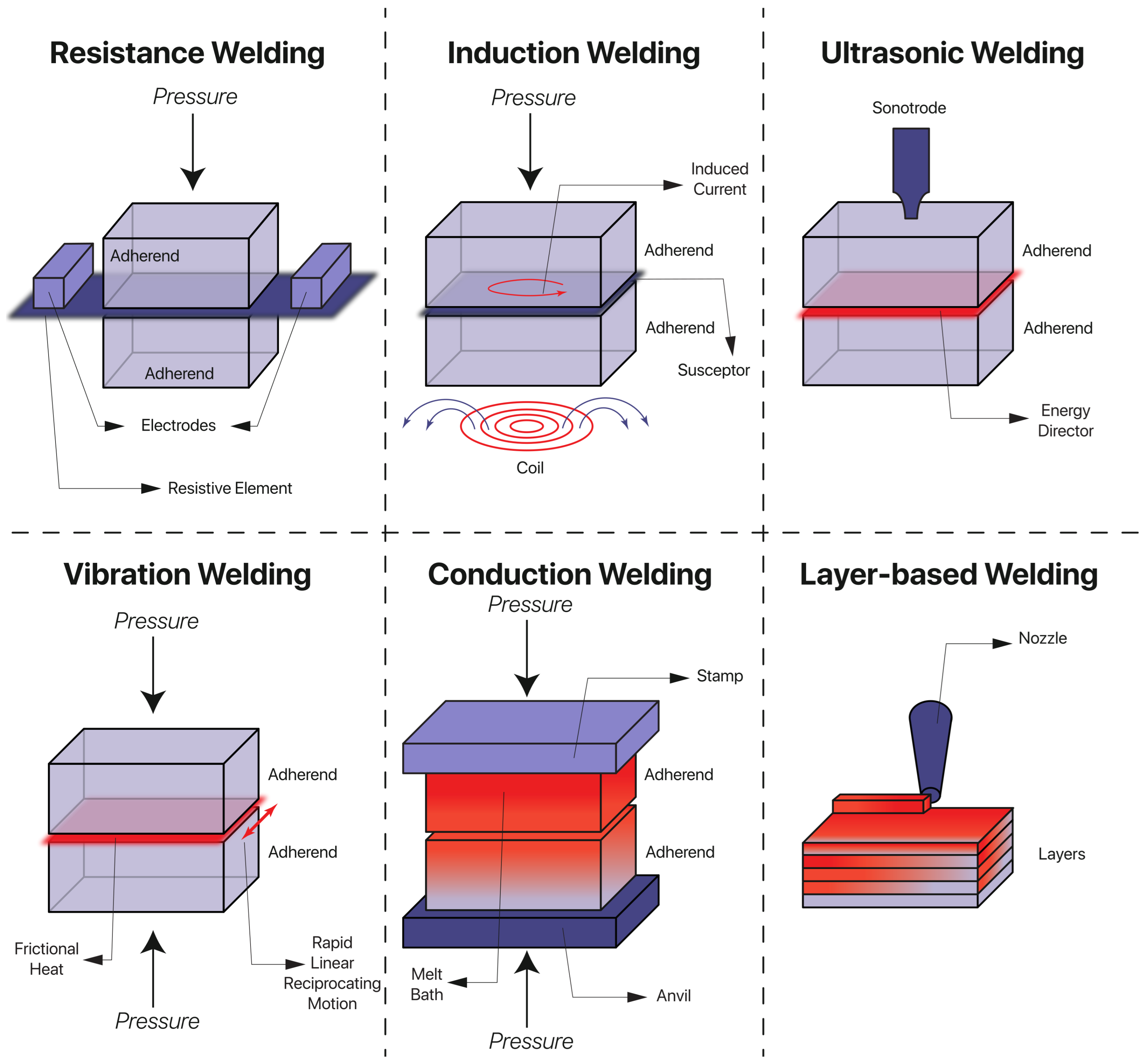
- Bulk heating. These techniques involve bringing the entire component, or large sections of it, to its melting temperature. While effective, this usually requires complex tooling to maintain pressure on the structure and prevent de-consolidation [17].
- –
- –
- –
- •
- Frictional heating. These methods generate localized heat at the joint interface through mechanical work performed under pressure [17,52].
- –
- Spin welding. Specifically suited for components with circular mating surfaces, where one part is rotated at high speed against a fixed part [8].
- –
- –
- •
- Electromagnetic heating. These techniques utilize electromagnetic fields to excite conductive, magnetic, or dielectric materials positioned at the interface [8,17].
- –
- –
- –
- Dielectric welding. Heat is generated by the rapid polarity reversal of a high-frequency electric field acting on polymers with a high dielectric loss factor [8].
- –
- •
- •
- Layer-based techniques. These methods rely on the localized melting and deposition of thermoplastics to build structures layer by layer [67,68].
- –
- Fused Filament Fabrication (FFF). Also known as Fused Deposition Modeling (FDM), this is a material extrusion process in which a spooled thermoplastic filament is heated to a flowable state in a hot extruder and deposited through a small nozzle onto a build platform to construct parts layer by layer [67,69].
- –
- Fused Granular Fabrication (FGF). It is an advanced 3D printing technology that directly processes granular or pelletized feedstock rather than filaments, offering cost efficiency and material versatility [68].
3. Historical Perspective
3.1. Overview
3.2. Mid-to-Late 20th Century
3.3. From 2000s to 2015
4. In-Depth Literature Review Methodology
4.1. Generality
4.2. Implementation of the Methodology
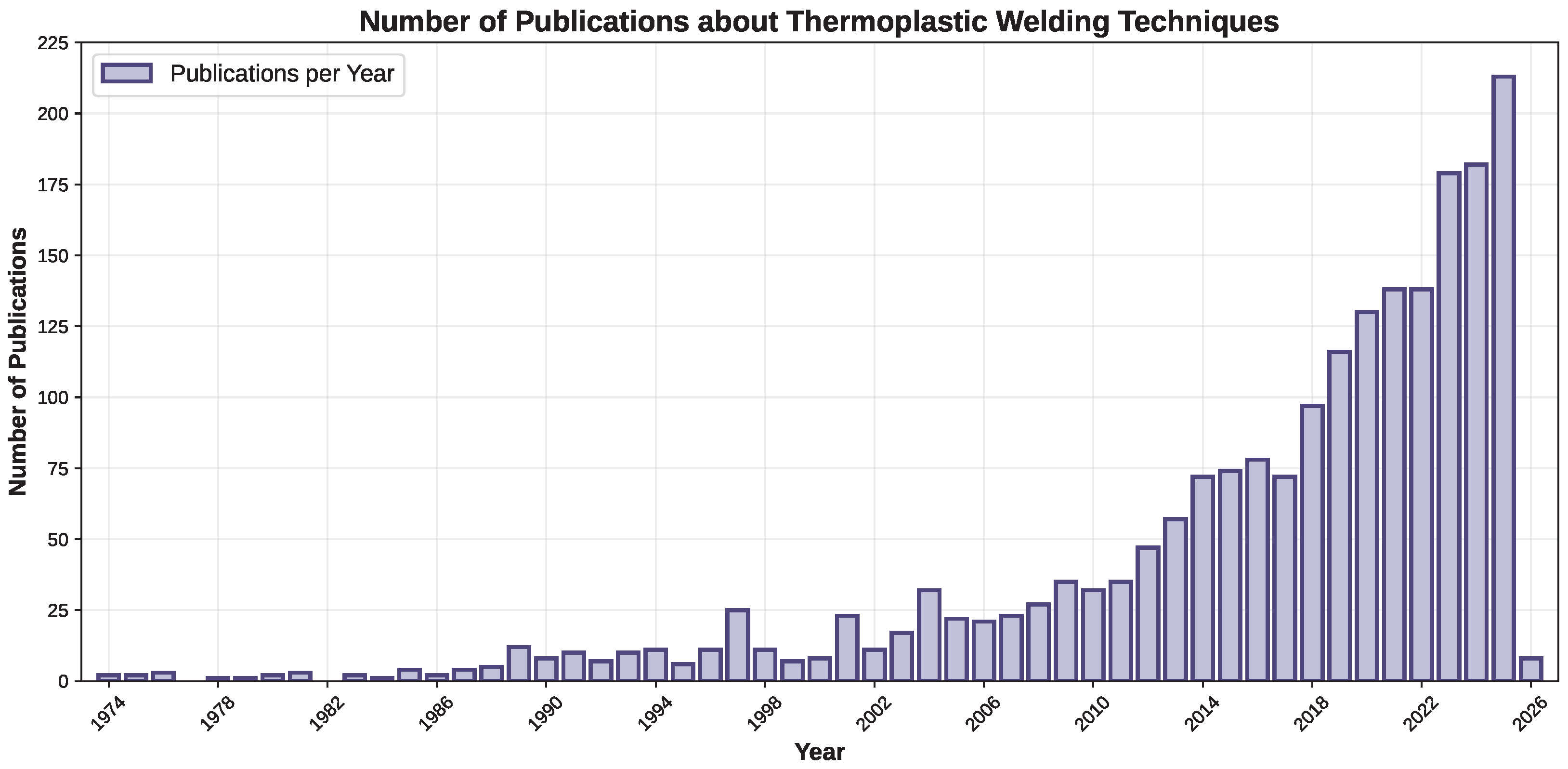
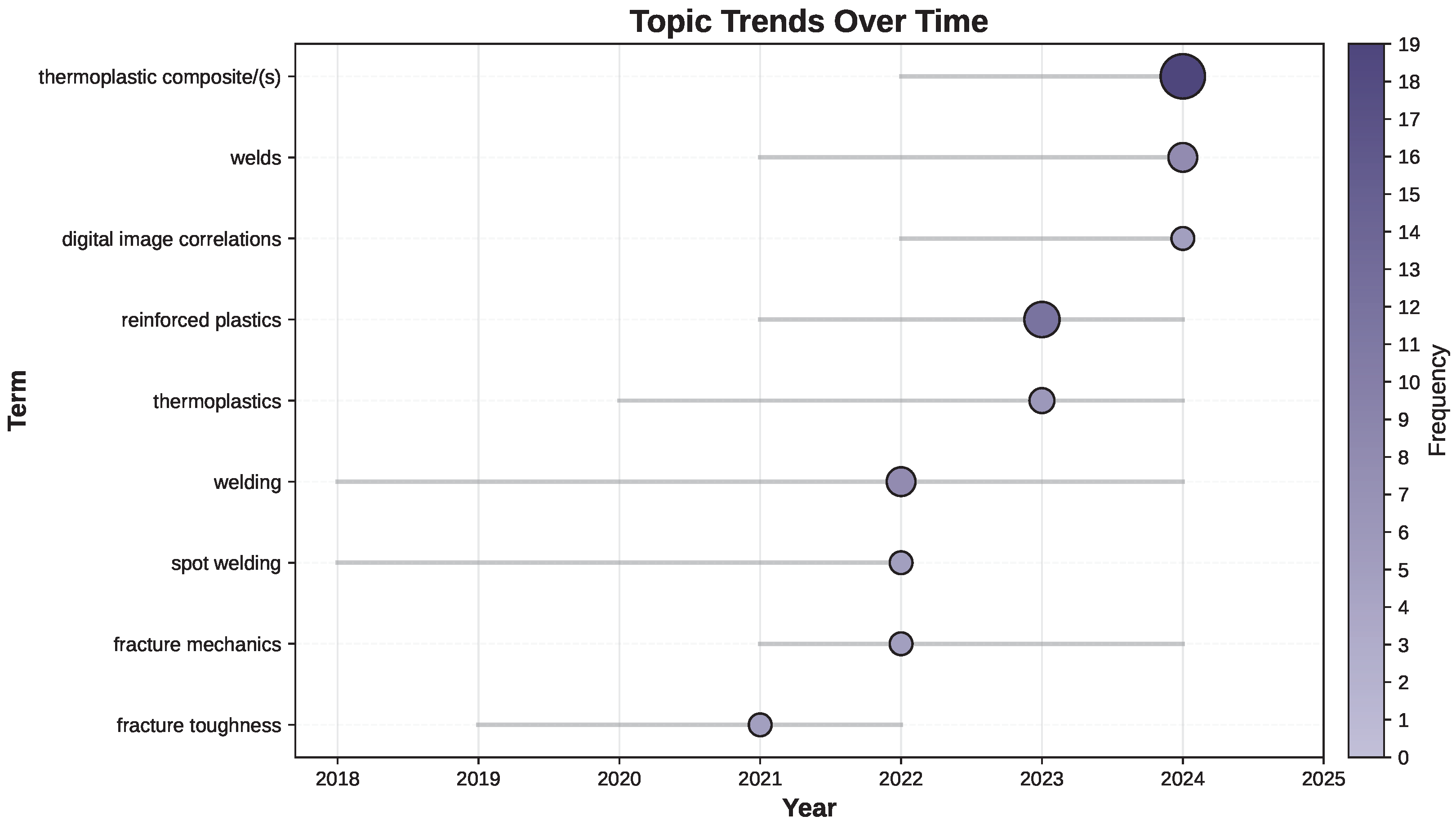
4.3. Bibliographic Analysis
5. Fundamental Issues
5.1. Summary
5.2. Influence of Process Parameters on Junction Properties
5.2.1. Resistance Welding
5.2.2. Induction Welding
5.2.3. Conduction Welding
5.2.4. Vibration Welding
5.2.5. Ultrasonic Welding
5.2.6. Co-Consolidation/Co-Curing
5.2.7. Layer-Based Techniques
5.3. Characterization of TPC Welded Joints
5.3.1. Fracture Toughness Characterization
5.3.2. Shear and Tensile Strength Evaluation
5.3.3. Fatigue and Durability Analysis
5.3.4. Strain Measurement and Monitoring Techniques
5.3.5. Thermal Characterization
5.4. Numerical Modeling of Damage and Fracture
5.4.1. Cohesive Zone Modeling
5.4.2. Virtual Crack Closure Technique
5.5. Limitations in the Characterization and Modeling of Thermoplastic Composite Joints
6. Conclusions and Research Perspective
Author Contributions
Funding
Institutional Review Board Statement
Informed Consent Statement
Data Availability Statement
Conflicts of Interest
Abbreviations
| TPC(s) | thermoplastic composite(s) |
| RQ(s) | Research Question(s) |
| CFRTS | Carbon Fiber Reinforced Thermoset |
| PEEK | Polyether-Ether-Ketone |
| PEKK | Polyetherketoneketone |
| PPS | Polyphenylene Sulfide |
| CNT(s) | carbon nanotube(s) |
| PAEK | Polyaryletherketone |
| PEI | Polyetherimide |
| ED(s) | Energy Director(s) |
| FFF | Fused Filament Fabrication |
| FDM | Fused Deposition Modeling |
| FGF | Fused Granular Fabrication |
| HAZ | Heat-Affected Zone |
| BK | Benzeggagh & Kenane criterion |
| PRISMA | Preferred Reporting Items for Systematic Reviews and Meta-Analyses |
| FRP(s) | fiber reinforced polymer(s) |
| CFRP(s) | carbon fiber reinforced polymer(s) |
| GFRP(s) | glass fiber reinforced polymer(s) |
| ENF | End-Notched Flexure |
| CZM | Cohesive Zone Modeling |
| DIC | Digital Image Correlation |
| MCA | Multiple Correspondence Analysis |
| CF(s) | carbon fiber(s) |
| ILSS | Interlaminar Shear Strength |
| PLA | Polylactic Acid |
| DCB | Double Cantilever Beam |
| CBT | Corrected Beam Theory |
| CRB | Cracked Round Bar |
| CT | Compact Tension |
| CBBM | Compliance-Based Beam Method |
| SLS | single lap shear |
| CAI | Compression After Impact |
| AE(s) | Acoustic Emission(s) |
| FPZ(s) | Fracture Process Zone(s) |
| TGA | Thermogravimetric Analysis |
| TMA | Thermomechanical Analysis |
| DMA | Dynamic Mechanical Analysis |
| TSL(s) | traction–separation law(s) |
| VCCT | Virtual Crack Closure Technique |
References
- Callister, W.; Rethwisch, D. Materials Science and Engineering: An Introduction; Wiley: Hoboken, NJ, USA, 2018. [Google Scholar]
- Amancio-Filho, S.; dos Santos, J. Joining of Polymers and Polymer-Metal Hybrid Structures: Recent Developments and Trends. Polym. Eng. Sci. 2009, 49, 1461–1476. [Google Scholar] [CrossRef]
- Thermoplastic Definition, Uses, Advantages and Examples. Available online: https://designsandlines.co.uk/blog/thermoplastic-definition-uses-and-advantages/ (accessed on 17 December 2025).
- What Are Thermoplastics? Available online: https://kydex.com/about-thermoplastics/benefits-of-thermoplastics/ (accessed on 17 December 2025).
- I Polimeri Plastici Nell’industria. Available online: https://bearplast.it/i-polimeri-termoplastici-nellindustria/ (accessed on 17 December 2025).
- Stokes, V.K. Joining methods for plastics and plastic composites: An overview. Polym. Eng. Sci. 1989, 29, 1310–1324. [Google Scholar] [CrossRef]
- Troughton, M. Handbook of Plastics Joining: A Practical Guide; William Andrew Publishing: Norwich, NY, USA, 2008; pp. 1–590. [Google Scholar]
- Yousefpour, A.; Hojjati, M.; Immarigeon, J.P. Fusion Bonding/Welding of Thermoplastic Composites. J. Thermoplast. Compos. Mater. 2004, 17, 303–341. [Google Scholar] [CrossRef]
- Ageorges, C.; Ye, L.; Hou, M. Experimental investigation of the resistance welding for thermoplastic-matrix composites. Part I: Heating element and heat transfer. Compos. Sci. Technol. 2000, 60, 1027–1039. [Google Scholar] [CrossRef]
- Ageorges, C.; Ye, L.; Hou, M. Experimental investigation of the resistance welding of thermoplastic-matrix composites. Part II: Optimum processing window and mechanical performance. Compos. Sci. Technol. 2000, 60, 1191–1202. [Google Scholar] [CrossRef]
- Grewell, D.; Benatar, A.; Park, J. Plastics and Composites Welding Handbook; Number v. 10 in Plastics and composites welding handbook; Hanser Gardener: München, Germany, 2003. [Google Scholar]
- Villegas, I. In situ monitoring of ultrasonic welding of thermoplastic composites through power and displacement data. J. Thermoplast. Compos. Mater. 2013, 28, 66–85. [Google Scholar] [CrossRef]
- Jongbloed, B.C.P.; Teuwen, J.J.E.; Benedictus, R.; Villegas, I.F. A Study on Through-the-Thickness Heating in Continuous Ultrasonic Welding of Thermoplastic Composites. Materials 2021, 14, 6620. [Google Scholar] [CrossRef]
- Schwartz, M. Joining of Composite-Matrix Materials; ASM International: Almere, The Netherlands, 1994. [Google Scholar]
- Benatar, A.; Gutowski, T.G. Review of methods for fusion bonding thermoplastic composites. SAMPE J. 1987, 23. Available online: https://www.osti.gov/biblio/6763690 (accessed on 18 December 2025).
- Krueger, R.; Bergan, A. Advances in Thermoplastic Composites Over Three Decades—A Literature Review. NASA STI Program Report Series. 2024. Available online: https://ntrs.nasa.gov/api/citations/20240005376/downloads/NASA-TM-20240005376.pdf (accessed on 18 December 2025).
- Ageorges, C.; Ye, L.; Hou, M. Advances in fusion bonding techniques for joining thermoplastic matrix composites: A review. Compos. Part A Appl. Sci. Manuf. 2001, 32, 839–857. [Google Scholar] [CrossRef]
- Miller, S.G.; Pinakidis, J.J.; Heimann, P.J.; Bergan, A.C.; Johnston, P.H.; Leone, F.A.; Su, J.; Segal, K.N.; Mulhearn, W.D.; Chiu, J.; et al. Assessment of Thermoplastic Composite Joining by Resistance, Induction, and Ultrasonic Welding. NASA STI Program Report Series. 2025. Available online: https://ntrs.nasa.gov/api/citations/20250006527/downloads/TM-20250006527.pdf (accessed on 18 December 2025).
- Bergan, A.C.; Miller, S.G.; Segal, K.N.; Mulhearn, W.D.; Clark, A.M.; Schultz, M.R.; Pinakidis, J.J.; Farrokh, B.; Chiu, J.; Glenn, R.L.; et al. A Preliminary Assessment of Thermoplastic Composite Welding for In-Space Applications by the Thermoplastics Development for Exploration Applications (TDEA) Project. NASA STI Program Report Series. 2025. Available online: https://ntrs.nasa.gov/api/citations/20250008644/downloads/NASA-TM-20250008644.pdf (accessed on 18 December 2025).
- Ultrasonic Welder Market Growth Analysis, Dynamics, Key Players and Innovations, Outlook and Forecast 2025–2032. Available online: https://www.intelmarketresearch.com/ultrasonic-welder-market-16785 (accessed on 7 January 2026).
- Azeez, T.O. Thermoplastic Recycling: Properties, Modifications, and Applications. In Thermosoftening Plastics; Evingür, G.A., Pekcan, Ö., Achilias, D.S., Eds.; IntechOpen: London, UK, 2019; Chapter 4. [Google Scholar] [CrossRef]
- Aderogba, K.A. Polymer Wastes and Management in Cities and Towns of Africa and Sustainable Environment: Nigeria and European Experiences. Soc. Sci. 2014, 3, 79–88. [Google Scholar] [CrossRef][Green Version]
- Annual CO2 Emissions. Available online: https://ourworldindata.org/grapher/annual-co2-emissions-per-country (accessed on 16 January 2026).
- Reis, J.P.; de Moura, M.; Samborski, S. Thermoplastic Composites and Their Promising Applications in Joining and Repair Composites Structures: A Review. Materials 2020, 13, 5832. [Google Scholar] [CrossRef]
- Siddique, A.; Iqbal, Z.; Nawab, Y.; Shaker, K. A review of joining techniques for thermoplastic composite materials. J. Thermoplast. Compos. Mater. 2023, 36, 3417–3454. [Google Scholar] [CrossRef]
- Joosten, M.; Yang, Q.; Blacklock, M.; Wang, C. A cohesive network approach for modelling fibre and matrix damage in composite laminates. Compos. Struct. 2018, 206, 658–667. [Google Scholar] [CrossRef]
- Stankiewicz, K.; Lipkowski, A.; Kowalczyk, P.; Gizynski, M.; Wasniewski, B. Resistance Welding of Thermoplastic Composites, Including Welding to Thermosets and Metals: A Review. Materials 2024, 17, 4797. [Google Scholar] [CrossRef]
- Cricrì, G. A general approach for modelling the peeling of a flexible tape from an elastic substrate. Int. J. Solids Struct. 2023, 273, 112277. [Google Scholar] [CrossRef]
- Salim, M.; Rizal, M.A.M.; Nordin, A.; Harjar, M.; Sanal B, M.; Hafila, K.; Ma, Q.; Ra’eis, A.; Ishak, M.; Razman, M.; et al. Natural fibre-reinforced thermoplastic composites: A bibliometric analysis and review of eco-friendly solutions in exterior automotive components. J. Mater. Res. Technol. 2025, 39, 6755–6774. [Google Scholar] [CrossRef]
- Ciotti, M.; Campana, G.; Mele, M. A review of the accuracy of thermoplastic polymeric parts fabricated by additive manufacturing. Rapid Prototyp. J. 2022, 28, 358–389. [Google Scholar] [CrossRef]
- Khoo, P.S.; Muhammad Rizal, M.A.; Nordin, A.H.; Ashraf, W.; Hazrati, K.Z.; Lee, S.H.; Rafidah, M. Thermoplastic-based composites from treated Arenga pinnata (Wurmb.) Merrill. fibers: A bibliometric analysis and literature review on dynamic mechanical analysis. Polym. Compos. 2025, 46, 8770–8798. [Google Scholar] [CrossRef]
- Rother, E.T. Systematic literature review X narrative review; [Revisão sistemática X revisão narrativa]. ACTA Paul. Enferm. 2007, 20, 5–10. [Google Scholar] [CrossRef]
- Wan, Y.; Takahashi, J. Development of Carbon Fiber-Reinforced Thermoplastics for Mass-Produced Automotive Applications in Japan. J. Compos. Sci. 2021, 5, 86. [Google Scholar] [CrossRef]
- Rafi, H. Impact of composite materials on aircraft weight reduction, fuel efficiency, and performance in commercial aviation. Int. J. Mech. Eng. 2024, 4, 21–35. [Google Scholar] [CrossRef]
- Shrivastava, P.; Yaduwanshi, D.K.; Mishra, V.; Ghosh, A.; Ahmad, A.H.; Birla, S.K.; Sahoo, N. A Comprehensive Review of Composite Materials: Current and Future Prospects in Aerospace Applications. Polym. Compos. 2025. Early view. [Google Scholar] [CrossRef]
- Thermoset Vs Thermoplastic: Key Differences Explained. Available online: https://www.hlc-metalparts.com/news/thermoset-vs-thermoplastic-85142852.html#:~:text=Yes,%20thermosets%20are%20generally%20stronger%20and%20more,resistance%20to%20deformation%20under%20heat%20or%20stress (accessed on 9 January 2026).
- Favaloro, M. A Comparison of the Environmental Attributes of Thermoplastic vs. Thermoset Composites. Cell 2009, 978, 270–6011. [Google Scholar]
- Nishida, H.; Carvelli, V.; Fujii, T.; Okubo, K. Thermoplastic vs. thermoset epoxy carbon textile composites. IOP Conf. Ser. Mater. Sci. Eng. 2018, 406, 012043. [Google Scholar] [CrossRef]
- Periasamy, K.; Kandare, E.; Das, R.; Darouie, M.; Khatibi, A.A. Interfacial Engineering Methods in Thermoplastic Composites: An Overview. Polymers 2023, 15, 415. [Google Scholar] [CrossRef] [PubMed]
- Zhang, J.; Du, G. Mechanical properties of polyimide composite reinforced with carbon nanotubes and carbon fibers. J. Thermoplast. Compos. Mater. 2015, 28, 1250–1259. [Google Scholar] [CrossRef]
- Bhudolia, S.K.; Gohel, G.; Leong, K.F.; Islam, A. Advances in Ultrasonic Welding of Thermoplastic Composites: A Review. Materials 2020, 13, 1284. [Google Scholar] [CrossRef]
- Vinson, J.R. Mechanical fastening of polymer composites. Polym. Eng. Sci. 1989, 29, 1332–1339. [Google Scholar] [CrossRef]
- Vinson, J.R. Adhesive bonding of polymer composites. Polym. Eng. Sci. 1989, 29, 1325–1331. [Google Scholar] [CrossRef]
- Kiliç, M.; Dede, D.Ö.; Küçükekenci, A.S. Comparing the shear bond strength of veneering materials to the PAEKs after surface treatments. BMC Oral Health 2023, 23, 185. [Google Scholar] [CrossRef] [PubMed]
- Karaboğa, F.; Koştur, E.; Yavuz, Z.; Demirel, M.; Öztürkmen, M.B.; Öz, Y.; Toros, S.; Ozturk, F. Development of Joining Methods of Thermoplastic Composites for Aerospace Applications. Makina Tasarım İmalat Derg. 2025, 23, 8–14. [Google Scholar] [CrossRef]
- Lepore, M.A.; Perrella, M. From test data to FE code: A straightforward strategy for modelling the structural bonding interface. Frat. Integrità Strutt. 2016, 11, 191–201. [Google Scholar] [CrossRef]
- Berardi, V.P.; Perrella, M.; Feo, L.; Cricrì, G. Creep behavior of GFRP laminates and their phases: Experimental investigation and analytical modeling. Compos. Part B Eng. 2017, 122, 136–144. [Google Scholar] [CrossRef]
- Berardi, V.P.; Perrella, M.; Cricrì, M. Cohesive fracture in composite systems: Experimental setup and first results. Fract. Struct. Integr. 2019, 13, 222–229. [Google Scholar] [CrossRef]
- Berardi, V.P.; Perrella, M.; Armentani, E.; Cricrì, G. Experimental investigation and numerical modeling of creep response of glass fiber reinforced polymer composites. Fatigue Fract. Eng. Mater. Struct. 2021, 44, 1085–1095. [Google Scholar] [CrossRef]
- Cricrì, G.; Penta, F. An Adhesive Bonded Single Lap Joint Model. Fatigue Fract. Eng. Mater. Struct. 2025, 48, 4319–4338. [Google Scholar] [CrossRef]
- Ravi, K.S.; Ravish, G.B.V.; Prashanth, M.P.; Ramesh, V.H.; Sunil, J.J. Welding or joining methods of polymer composite materials. J. Emerg. Technol. Innov. Res. 2024, 11, h330–h349. [Google Scholar]
- Villegas, I.F.; Moser, L.; Yousefpour, A.; Mitschang, P.; Bersee, H.E. Process and performance evaluation of ultrasonic, induction and resistance welding of advanced thermoplastic composites. J. Thermoplast. Compos. Mater. 2013, 26, 1007–1024. [Google Scholar] [CrossRef]
- Newkirk, J.R.; Degen, C.M.; Romkes, A. Characterization of Thermoplastic Matrix Composite Joints for the Development of a Computational Framework. In Proceedings of the Mechanics of Composite and Multi-Functional Materials; Thakre, P.R., Singh, R., Slipher, G., Eds.; Springer: Cham, Switzerland, 2018; Volume 6, pp. 11–19. [Google Scholar]
- Wool, R.P.; O’Connor, K.M. A theory crack healing in polymers. J. Appl. Phys. 1981, 52, 5953–5963. [Google Scholar] [CrossRef]
- Avenet, J.; Levy, A.; Jean-Luc, B.; Le Corre, S.; Delmas, J. Adhesion of high performance thermoplastic composites: Development of a bench and procedure for kinetics identification. Compos. Part A Appl. Sci. Manuf. 2020, 138, 106054. [Google Scholar] [CrossRef]
- Akkerman, R.; Bouwman, M.; Wijskamp, S. Analysis of the Thermoplastic Composite Overmolding Process: Interface Strength. Front. Mater. 2020, 7, 27. [Google Scholar] [CrossRef]
- Schell, J.; Guilleminot, J.; Binetruy, C.; Krawczak, P. Computational and experimental analysis of fusion bonding in thermoplastic composites: Influence of process parameters. J. Mater. Process. Technol. 2009, 209, 5211–5219. [Google Scholar] [CrossRef]
- Yang, F.; Pitchumani, R. Healing of Thermoplastic Polymers at an Interface under Nonisothermal Conditions. Macromolecules 2002, 35, 3213–3224. [Google Scholar] [CrossRef]
- Dara, P.H.; Loos, A.C. Thermoplastic Matrix Composite Processing Model. 1985. Available online: https://ntrs.nasa.gov/citations/19860012148 (accessed on 18 December 2025).
- Lee, W.I.; Springer, G.S. A Model of the Manufacturing Process of Thermoplastic Matrix Composites. J. Compos. Mater. 1987, 21, 1017–1055. [Google Scholar] [CrossRef]
- Xiong, H.; Hamila, N.; Boisse, P. Consolidation Modeling during Thermoforming of Thermoplastic Composite Prepregs. Materials 2019, 12, 2853. [Google Scholar] [CrossRef]
- Chen, Y.; Qu, X.; Fan, C.; Song, W.; Zheng, J.H.; He, L. Influence of Process Parameters in Infrared Radiation AFP In Situ Consolidation on the Mechanical Properties of Thermoplastic Composites. Polym. Compos. 2025. Early view. [Google Scholar] [CrossRef]
- de Gennes, P.G. Reptation of a Polymer Chain in the Presence of Fixed Obstacles. J. Chem. Phys. 1971, 55, 572–579. [Google Scholar] [CrossRef]
- Janek, M.; Larsen, L.C.; Jarka, S.; Görick, D. Roadmap for the Industrialization of Robotic Continuous Ultrasonic Welding of Fiber-Reinforced High-Performance Polymers in the Aerospace Industry. In Proceedings of the Deutscher Luft-Und Raumfahrtkongress 2025, Augsburg, Germany, 23–25 September 2025. [Google Scholar] [CrossRef]
- Meda, P.; Patel, P. Bonding Of Thermoplastic Material—A Literature Review. Int. Res. J. Eng. Technol. 2018, 5, 1345–1349. [Google Scholar]
- Acherjee, B.; Kuar, A.; Mitra, S.; Misra, D. Laser transmission welding of thermoplastics:An overview of experimental findings—Process, development and applications. J. Manuf. Technol. Res. 2011, 3, 211–236. [Google Scholar]
- Yavas, D.; Zhang, Z.; Liu, Q.; Wu, D. Fracture behavior of 3D printed carbon fiber-reinforced polymer composites. Compos. Sci. Technol. 2021, 208, 108741. [Google Scholar] [CrossRef]
- Wang, B.; Li, Y.; Pierre-Antoine, A.; Guillaume, M.; Yang, G.; Zhou, S. Fused granular fabrication of natural fiber reinforced composites: Experimental and numerical analysis of flax/PP structures. Polymer 2025, 328, 128458. [Google Scholar] [CrossRef]
- Xin, Z.; Ma, Y.; Chen, Y.; Wang, B.; Xiao, H.; Duan, Y. Fusion-bonding performance of short and continuous carbon fiber synergistic reinforced composites using fused filament fabrication. Compos. Part B Eng. 2023, 248, 110370. [Google Scholar] [CrossRef]
- Connolly, J.V. Joining Fibre-reinforced Plastics. Edited by F. L. Matthews. Elsevier Applied Science Publishers Limited. Aeronaut. J. 1987, 91, 192–193. [Google Scholar] [CrossRef]
- Magness, F.H. Joining of Polymer Composite Materials: A Survey; Lawrence Livermore National Laboratory: Livermore, CA, USA, 1991. [Google Scholar]
- Haim, G.; Zade, H.P. Welding of Plastics; University of Michigan: Ann Arbor, MI, USA, 1947; Volume 1. [Google Scholar]
- Neumann, J.A.; Bockhoff, F.J. Welding of Plastics; Reinhold Publishing Corporation: New York, NY, USA; University of Minnesota: Minneapolis, MN, USA, 1959. [Google Scholar]
- Soloff, R.S. Sonic Method of Welding Thermoplastic Parts. US 3224916, 21 December 1965. [Google Scholar]
- Benzeggagh, M.; Kenane, M. Measurement of mixed-mode delamination fracture toughness of unidirectional glass/epoxy composites with mixed-mode bending apparatus. Compos. Sci. Technol. 1996, 56, 439–449. [Google Scholar] [CrossRef]
- Turon, A.; Camanho, P.; Costa, J.; Dávila, C. A damage model for the simulation of delamination in advanced composites under variable-mode loading. Mech. Mater. 2006, 38, 1072–1089. [Google Scholar] [CrossRef]
- Magliano, A.; Perez Carrera, C.; Pappalardo, C.M.; Guida, D.; Berardi, V.P. A Comprehensive Literature Review on Hydrogen Tanks: Storage, Safety, and Structural Integrity. Appl. Sci. 2024, 14, 9348. [Google Scholar] [CrossRef]
- Manrique-Escobar, C.A.; Pappalardo, C.M.; Guida, D. On the Analytical and Computational Methodologies for Modelling Two-wheeled Vehicles within the Multibody Dynamics Framework: A Systematic Literature Review. J. Appl. Comput. Mech. 2022, 8, 153–181. [Google Scholar]
- Nakagawa, S.; Samarasinghe, G.; Haddaway, N.R.; Westgate, M.J.; O’Dea, R.E.; Noble, D.W.; Lagisz, M. Research Weaving: Visualizing the Future of Research Synthesis. Trends Ecol. Evol. 2019, 34, 224–238. [Google Scholar] [CrossRef]
- Xiao, Y.; Watson, M. Guidance on Conducting a Systematic Literature Review. J. Plan. Educ. Res. 2019, 39, 93–112. [Google Scholar] [CrossRef]
- Linnenluecke, M.K.; Marrone, M.; Singh, A.K. Conducting systematic literature reviews and bibliometric analyses. Aust. J. Manag. 2020, 45, 175–194. [Google Scholar] [CrossRef]
- Cook, D.J.; Mulrow, C.D.; Haynes, R.B. Systematic Reviews: Synthesis of Best Evidence for Clinical Decisions. Ann. Intern. Med. 1997, 126, 376–380. [Google Scholar] [CrossRef] [PubMed]
- Orlova, A.; Titova, T. Analysis of the ‘dynamics of railway vehicles’ research field development using scientometric approach. Veh. Syst. Dyn. 2021, 59, 1148–1169. [Google Scholar] [CrossRef]
- Tranfield, D.; Denyer, D.; Smart, P. Towards a Methodology for Developing Evidence-Informed Management Knowledge by Means of Systematic Review. Br. J. Manag. 2003, 14, 207–222. [Google Scholar] [CrossRef]
- Moher, D.; Liberati, A.; Tetzlaff, J.; Altman, D.G. Preferred reporting items for systematic reviews and meta-analyses: The PRISMA statement. Int. J. Surg. 2010, 8, 336–341. [Google Scholar] [CrossRef] [PubMed]
- Aria, M.; Cuccurullo, C. bibliometrix: An R-tool for comprehensive science mapping analysis. J. Inf. 2017, 11, 959–975. [Google Scholar] [CrossRef]
- Khudiakova, A.; Arbeiter, F.; Spoerk, M.; Wolfahrt, M.; Godec, D.; Pinter, G. Inter-layer bonding characterisation between materials with different degrees of stiffness processed by fused filament fabrication. Addit. Manuf. 2019, 28, 184–193. [Google Scholar] [CrossRef]
- Wang, K.; Shriver, D.; Banu, M.; Jack Hu, S.; Xiao, G.; Arinez, J.; Fan, H.T. Performance Prediction for Ultrasonic Spot Welds of Short Carbon Fiber-Reinforced Composites Under Shear Loading. J. Manuf. Sci. Eng. 2017, 139, 111001. [Google Scholar] [CrossRef]
- van Dooren, K.; Bisagni, C. Design, analysis and testing of thermoplastic welded stiffened panels to investigate skin-stringer separation in post-buckling. Compos. Part B Eng. 2023, 267, 111033. [Google Scholar] [CrossRef]
- Tijs, B.; Turon, A.; Bisagni, C. Characterization and analysis of conduction welded thermoplastic composite joints considering the influence of manufacturing. Compos. Struct. 2024, 348, 118505. [Google Scholar] [CrossRef]
- Araújo, I.; Santos, L.; Barbosa Marques, L.; Souza, S.; Botelho, E. Influence of environmental effect on thermal and mechanical properties of welded PPS/carbon fiber laminates. Mater. Res. Express 2019, 6, 105337. [Google Scholar] [CrossRef]
- Liechti, K.; Kadioglu, F. Bending of fusion-bonded thermoplastic single lap joints. Eng. Fail. Anal. 2024, 165, 108829. [Google Scholar] [CrossRef]
- Saquib, M.N.; Chaparro-Chavez, E.; Morris, C.; Çelebi, K.; Pedrazzoli, D.; Zhang, M.; Kravchenko, S.G.; Kravchenko, O.G. Restoration of Strength in Polyamide Woven Glass Fiber Organosheets by Hot Pressing: Case Study of Impact and Compression after Impact. Polymers 2024, 16, 2223. [Google Scholar] [CrossRef]
- Mofakhami, E.; Gervat, L.; Fayolle, B.; Miquelard-Garnier, G.; Ovalle, C.; Laiarinandrasana, L. Effect of fibre concentration on the mechanical properties of welded reinforced polypropylene. Compos. Part B Eng. 2024, 269, 111111. [Google Scholar] [CrossRef]
- Zhao, T.; Xu, S.; Feng, Y.; Zhang, C.; Huang, Y.; Ren, X.; Li, Y. Towards ultra-fast and high strength structural repair of damaged thermoplastic composites: Ultrasonic welding. Compos. Part B Eng. 2025, 298, 112385. [Google Scholar] [CrossRef]
- Hoang, V.T.; Lee, D.S.; Kweon, J.H.; Kwak, B.S.; Nam, Y. Multifunctional heating film as susceptor for induction-welded single-lap carbon fiber reinforced polyetherketoneketone thermoplastic composite joints: Thermal and mechanical behavior. J. Reinf. Plast. Compos. 2023, 43, 980–994. [Google Scholar] [CrossRef]
- Brassard, D.; Dubé, M.; Tavares, J.R. Modelling resistance welding of thermoplastic composites with a nanocomposite heating element. J. Compos. Mater. 2021, 55, 625–639. [Google Scholar] [CrossRef]
- Reis, J.F.; Abrahao, A.B.M.; Costa, M.L.; Botelho, E.C. Assessment of the interlaminar strength of resistance-welded PEI/carbon fibre composite. Weld. Int. 2018, 32, 149–160. [Google Scholar] [CrossRef]
- Reis, J.; de Moura, M.; Moreira, R. Extension of the crack equivalent method applied to mode II fracture of thermoplastic composites bonded joints using the ENF test. Compos. Struct. 2025, 352, 118687. [Google Scholar] [CrossRef]
- Palmieri, B.; Petriccione, A.; de Tommaso, G.; Pozzi, A.; Giordano, M.; Martone, A. Insight on Induction Welding of Reactive Pmma Carbon Fiber Composites. In Proceedings of the ECCM 2022—Proceedings of the 20th European Conference on Composite Materials: Composites Meet Sustainability, Lausanne, Switzerland, 26–30 June 2022; Volume 1, pp. 415–422. [Google Scholar]
- Sioutis, I.; Tserpes, K. Quasi-static and fatigue crack growth simulation in co-consolidated thermoplastic joints containing crack arrest features. Eng. Fail. Anal. 2024, 157, 107904. [Google Scholar] [CrossRef]
- van Dooren, K.; Bisagni, C. Post-buckling damage tolerance of welded omega-stiffened thermoplastic panels with initial damage. Compos. Struct. 2024, 344, 118295. [Google Scholar] [CrossRef]
- Bazan, P.; Kozub, B.; Rochman, A.; Melnychuk, M.; Majewska, P.; Mroczka, K. Vibration Welding of PLA/PHBV Blend Composites with Nanocrystalline Cellulose. Polymers 2024, 16, 3495. [Google Scholar] [CrossRef] [PubMed]
- Tian, D.; Alexenko, V.O.; Panin, S.V.; Bogdanov, A.A.; Buslovich, D.G. Effect of the Energy Director Material on the Structure and Properties of Ultrasonic Welded Lap Joints of PEI Plates with CF Fabric/PEI Prepreg. J. Compos. Sci. 2024, 8, 150. [Google Scholar] [CrossRef]
- Ahmadi, R.; Biglari, H.; Mostafapour, A.; Khoshravan, M. Experimental and numerical investigation of the traction-separation law of mode II fracture in single-edge ultrasonic welding in polypropylene composite reinforced by glass fibers. J. Adhes. Sci. Technol. 2023, 37, 426–451. [Google Scholar] [CrossRef]
- Sioutis, I.; Tsiangou, E.; Allègre, F.; Boutin, H.; Plassot, H.; Tserpes, K.; Labordus, M.; Bruijkers, M.; Schutte, R. Characterization and simulation of the mechanical response of co-consolidated thermoplastic cracked lap shear joints containing two novel disbond arrest features. In Proceedings of the 20th European Conference on Composite Materials, Lausanne, Switzerland, 26–30 June 2022. [Google Scholar]
- Yavas, D. Interlaminar Shear Strength at High Temperatures: Carbon Fiber-Reinforced PEEK Composites Manufactured via Material Extrusion. In Proceedings of the Mechanics of Composite, Hybrid & Multi-functional Materials, Thermomechanics & Infrared Imaging and Mechanics of Additive & Advanced Manufactured Materials; Gardea, F., De Finis, R., Gururaja, S., Retzlaff, E., Eds.; Springer: Cham, Switzerland, 2025; Volume 3, pp. 55–60. [Google Scholar]
- Campilho, R.; Banea, M.; Pinto, A.; Silva, L.; De Jesus, A. Strength prediction of single and double-lap joints by standard and Extended finite element modelling. Int. J. Adhes. Adhes. 2011, 31, 363–372. [Google Scholar] [CrossRef]
- Islam, M.; Kao-Walter, S. A Study of Shear Stress Intensity Factor of PP and HDPE by a Modified Experimental Method together with FEM. Int. J. Mech. Aerosp. Ind. Mechatronics Eng. 2013, 7, 2236–2241. [Google Scholar] [CrossRef]
- Panin, S.V.; Bogdanov, A.A.; Aleksenko, V.O.; Bochkareva, S.A.; Lyubutin, P.S.; Panov, I.L.; Tian, D. Digital Image Correlation Analysis of Fatigue Degradation of Layered Polymer Composites (Polyetheretherketone/Polyetherimide, PEEK/PEI) with Carbon-Fiber Fabric Prepreg. Phys. Mesomech. 2024, 27, 541–555. [Google Scholar] [CrossRef]
- Hart, K.R.; Chia, P.X.; Sheridan, L.E.; Wetzel, E.D.; Sottos, N.R.; White, S.R. Comparison of Compression-After-Impact and Flexure-After-Impact protocols for 2D and 3D woven fiber-reinforced composites. Compos. Part A Appl. Sci. Manuf. 2017, 101, 471–479. [Google Scholar] [CrossRef]
- Jackson, C.M.; McGuire, J.A.; Losada, M.E.; Vita, R.D.; Dillard, D.A. 32—Digital image correlation: Advancing mechanical property characterization of adhesive joints. In Advances in Structural Adhesive Bonding, 2nd ed.; Dillard, D.A., Ed.; Woodhead Publishing in Materials; Woodhead Publishing: Cambridge, UK, 2023; pp. 1035–1075. [Google Scholar] [CrossRef]
- Smeets, E.T.; Rans, C.D.; Alderliesten, R.; Castro, S.G.; Villegas, I.F. Measurement of damage growth in ultrasonic spot welded joints. In 20th European Conference on Composite Materials: Composites Meet Sustainability; EPFL Lausanne, Composite Construction Laboratory: Lausanne, Switzerland, 2022. [Google Scholar]
- Smeets, E.T.; Rans, C.D.; Castro, S.G.; Villegas, I.F. To measure is to know: Evaluating indirect measurement techniques for observing the damage tolerance behaviour of spot welded thermoplastic composites. J. Adv. Join. Processes 2023, 8, 100152. [Google Scholar] [CrossRef]
- Islam, M.Z.; Rahman, M.A.; Gibbon, L.; Hall, E.; Ulven, C. Comparing Poisson Ratio Measurement of 3D Printed Continuous Fiber Reinforced Composites: Digital Image Correlation (DIC) vs. Video-Extensometer. In International Manufacturing Science and Engineering Conference; American Society of Mechanical Engineers: New York, NY, USA, 2024. [Google Scholar] [CrossRef]
- Valoroso, N.; Sessa, S.; Lepore, M.; Cricrì, G. Identification of mode-I cohesive parameters for bonded interfaces based on DCB test. Eng. Fract. Mech. 2013, 104, 56–79. [Google Scholar] [CrossRef]
- Cricrì, G.; Perrella, M. Investigation of mode III fracture behaviour in bonded pultruded GFRP composite joints. Compos. Part B Eng. 2017, 112, 176–184. [Google Scholar] [CrossRef]
- Perrella, M.; Berardi, V.; Cricrì, G. A novel methodology for shear cohesive law identification of bonded reinforcements. Compos. Part B Eng. 2018, 144, 126–133. [Google Scholar] [CrossRef]
- Cricrì, G. Cohesive law identification of adhesive layers subject to shear load—An exact inverse solution. Int. J. Solids Struct. 2019, 158, 150–164. [Google Scholar] [CrossRef]
- Perrella, M.; Berardi, V.P.; Armentani, E. Mode I Fracture Toughness Evaluation of Adhesively Bonded Joints via J-Integral and DIC. Macromol. Symp. 2020, 389, 1900116. [Google Scholar] [CrossRef]
- Cricrì, G.; Perrella, M.; Berardi, V.P. Identification of cohesive zone model parameters based on interface layer displacement field of bonded joints. Fatigue Fract. Eng. Mater. Struct. 2022, 45, 821–833. [Google Scholar] [CrossRef]
- Perrella, M.; Berardi, V.P.; Armentani, E. Experimental and Analytical Investigation of the Shear Fracture Behavior of Bonded Joints. Macromol. Symp. 2021, 396, 2000318. [Google Scholar] [CrossRef]
- Cricrì, G.; Perrella, M. A fracture toughness identification method for the debonding test of DCB specimens accounting for three-dimensional effects. Int. J. Solids Struct. 2025, 315, 113350. [Google Scholar] [CrossRef]
- Perrella, M.; Armentani, E.; Lamanna, G.; Berardi, V. Effect of fracture energy estimation on the predictions of mode II behavior of bonded joints using cohesive zone models. Fract. Struct. Integr. 2025, 19, 236–246. [Google Scholar] [CrossRef]
- Krueger, R. Virtual crack closure technique: History, approach, and applications. Appl. Mech. Rev. 2004, 57, 109–143. [Google Scholar] [CrossRef]
- Mabson, G.E.; De Carvalho, N.V.; Krueger, R. VCCT with Progressive Nodal Release for Simulating Mixed-Mode Delamination: Formulation, Algorithmic Improvements and Implications. NASA Cover Sheet. 2018. Available online: https://ntrs.nasa.gov/api/citations/20200003022/downloads/20200003022.pdf (accessed on 18 December 2025).
- ASTM D1002-10; Standard Test Method for Apparent Shear Strength of Single-Lap-Joint Adhesively Bonded Metal Specimens by Tension Loading (Metal-to-Metal). ASTM International: West Conshohocken, PA, USA, 2019. [CrossRef]
- ASTM D3165-07; Standard Test Method for Strength Properties of Adhesives in Shear by Tension Loading of Single-Lap-Joint Laminated Assemblies. ASTM International: West Conshohocken, PA, USA, 2014. [CrossRef]
- ASTM D5868-01; Standard Test Method for Lap Shear Adhesion for Fiber Reinforced Plastic (FRP) Bonding. ASTM International: West Conshohocken, PA, USA, 2023. [CrossRef]
- ASTM D5528-13; Standard Test Method for Mode I Interlaminar Fracture Toughness of Unidirectional Fiber-Reinforced Polymer Matrix Composites. ASTM International: West Conshohocken, PA, USA, 2013. [CrossRef]
- ASTM D7905/D7905M-19e1; Standard Test Method for Determination of the Mode II Interlaminar Fracture Toughness of Unidirectional Fiber-Reinforced Polymer Matrix Composites. ASTM International: West Conshohocken, PA, USA, 2019. [CrossRef]








| Technique | Advantages | Disadvantages |
|---|---|---|
| Bulk heating | ||
| Co-curing | No foreign material added; joint strength equal to parent laminate. | Complex/costly tooling to prevent de-consolidation. |
| Hot-melt adhesives | Improved gap filling for part mismatch. | Introduces a separate layer that may affect bond line thickness. |
| Dual resin bonding | Lower processing temperature (preserves structural integrity); reduced scatter in strength. | Limited to specific compatible resin pairs (e.g., PEI/PEEK). |
| Frictional heating | ||
| Spin welding | High weld quality and reproducibility; simple equipment (e.g., lathes). | Limited to circular mating surfaces; non-uniform heat distribution in solid parts. |
| Vibration welding | Rapid cycle times; high production rates; suitable for small/medium parts. | Risk of fiber distortion/disruption at the interface due to reciprocating motion. |
| Ultrasonic welding | Ultra-fast (seconds); clean and non-contact; highly automated. | Thickness limits (≈3 mm); requires EDs for focus; risk of audible noise. |
| Electromagnetic heating | ||
| Induction welding | Non-contact heating; suitable for long continuous welds; no susceptor needed for carbon fibers. | Challenges with edge effects (overheating); sensitive to fiber type and layup. |
| Microwave welding | Fast heating; capability to illuminate and join complex 3D structures. | Composites act as electromagnetic shields (shielding effect); requires susceptible materials at the interface. |
| Dielectric welding | Fast processing for thin structures. | Risk of bulk heating/de-consolidation of the entire joint area; weak with conductive fibers. |
| Resistance welding | Heat applied directly at the bond line; independent of part thickness or layup. | Resistive element stays in the weld (potential stress riser); current leakage risk in conductive parts. |
| Two-stage techniques | ||
| Hot plate welding | Simple, reliable, and economical; can handle complex joint geometries. | Slow cycle times; molten polymer may stick to the heated tool. |
| Hot gas welding | Portable equipment; flexible for large/complex structures. | Very slow process; highly operator-dependent quality. |
| Infrared welding | Non-contact; fast heating (≈5 s); suitable for large flat or curved areas. | Deep heat penetration may cause warpage or laminate de-consolidation. |
| Laser welding | Precision and flexibility; localized heat (limited Heat-Affected Zone [HAZ]); no mechanical stress. | High equipment cost; requires a laser-transparent upper part. |
| Solar energy | Renewable energy source usage. | Highly dependent on weather conditions and concentration optics. |
| Layer-based techniques | ||
| FFF | Creates complex geometries without molds/tooling; handles short and continuous fibers. | Mechanical properties are typically orthotropic; quality is highly dependent on build parameters. |
| FGF | Cost efficiency; high throughput; reduces waste; versatile material range. | Properties heavily reliant on precise fiber dispersion control; requires specialized granular feeding. |
| COMBINATION (use of AND between blocks): topics chosen for the search query | ||
| BLOCK 1: Joining Techniques | BLOCK 2: Selected Materials | BLOCK 3: Testing/Analyses |
| Search Fields: TITLE-ABS-KEY | Search Fields: TITLE-ABS-KEY | Search Fields: TITLE-ABS-KEY |
| “Fusion” W/3 “Bond*” “Thermoplastic” W/3 “Weld*” “Ultrasonic” W/3 “Weld*” “Induction” W/3 “Weld*” “Resistance” W/3 “Weld*” “Laser” W/3 “Weld*” “Friction” W/3 “Weld*” “Vibration” W/3 “Weld*” “Spin” W/3 “Weld*” “Conduction” W/3 “Weld*” “Hot plate” W/3 “Weld*” “Autohesion” “Inter” W/3 “Bond*” “Layer” W/3 “Adhesion” | “FRP” “CFRP” “GFRP” “Carbon fiber” “Carbon fibre” “Glass fiber” “Glass fibre” “Thermoplastic composite*” | “End*Notch Flexure” “ENF” “Cohesive Zone Model*” “CZM” “Digital Image Correlation” “DIC” |
| EXCLUSIONS: materials not included in the research | ||
| Search Fields: NOT TITLE-ABS-KEY | ||
| “Concrete” OR “Cement” OR “Steel” OR “Aluminum” OR “Aluminium” OR “Copper” OR “Iron” OR “Titanium” OR “Zinc” OR “Metal” OR “Hybrid” | ||
| LIMITATIONS: time frame publication year limit, 10 years | ||
| Search Fields: LIMIT-TO (PUBYEAR, “x”) | ||
| “x”: 2015, 2016, 2017, 2018, 2019, 2020, 2021, 2022, 2023, 2024, 2025, 2026 | ||
| Main Information About Data | |
|---|---|
| Timespan | 2015:2026 |
| Sources (Journals, Books, etc.) | 16 |
| Documents | 25 |
| Annual Growth Rate % | 12.98 |
| Document Average Age | 3.60 |
| Average Citations per Doc | 10.04 |
| Document Types & Contents | |
| Articles | 19 |
| Conference Papers | 6 |
| Keywords Plus (ID) | 314 |
| Author’s Keywords (ID) | 102 |
| Authors & Collaboration | |
| Total Authors | 104 |
| Co-Authors per Doc | 4.80 |
| International Co-Authorships % | 28.0 |
| Most Cited Documents | Ref. | Author | Year | TC † | TC/y † |
|---|---|---|---|---|---|
| Fracture behavior of 3D-printed carbon fiber reinforced polymer composites | [67] | Yavas D | 2021 | 97 | 16.17 |
| Inter-layer bonding characterization between materials with different degrees of stiffness processed by Fused Filament Fabrication | [87] | Khudiakova A | 2019 | 50 | 6.25 |
| Performance prediction for ultrasonic spot welds of short carbon fiber-reinforced composites under shear loading | [88] | Wang K | 2017 | 33 | 3.30 |
| Design, analysis and testing of thermoplastic welded stiffened panels to investigate skin–stringer separation in post-buckling | [89] | Van Dooren KS | 2023 | 18 | 4.50 |
| Characterization and analysis of conduction welded thermoplastic composite joints considering the influence of manufacturing | [90] | Tijs B | 2024 | 7 | 2.33 |
| Influence of environmental effect on thermal and mechanical properties of welded PPS/carbon fiber laminates | [91] | Araújo IG | 2019 | 7 | 0.88 |
| Bending of fusion-bonded thermoplastic single lap joints | [92] | Liechti KM | 2024 | 6 | 2.00 |
| Restoration of strength in polyamide woven glass fiber organosheets by hot pressing: case study of impact and Compression After Impact | [93] | Saquib MN | 2024 | 5 | 1.67 |
| Effect of fiber concentration on the mechanical properties of welded reinforced polypropylene | [94] | Mofakhami E | 2024 | 5 | 1.67 |
| Towards ultra-fast and high strength structural repair of damaged thermoplastic composites: ultrasonic welding | [95] | Zhao T | 2025 | 4 | 2.00 |
Disclaimer/Publisher’s Note: The statements, opinions and data contained in all publications are solely those of the individual author(s) and contributor(s) and not of MDPI and/or the editor(s). MDPI and/or the editor(s) disclaim responsibility for any injury to people or property resulting from any ideas, methods, instructions or products referred to in the content. |
© 2026 by the authors. Licensee MDPI, Basel, Switzerland. This article is an open access article distributed under the terms and conditions of the Creative Commons Attribution (CC BY) license.
Share and Cite
Magliano, A.; Meola, N.; Berardi, V.P. Advanced Interface Modeling and Characterization of Thermoplastic Fusion Bonds for Sustainable Structural Applications: An In-Depth Review. Appl. Sci. 2026, 16, 2802. https://doi.org/10.3390/app16062802
Magliano A, Meola N, Berardi VP. Advanced Interface Modeling and Characterization of Thermoplastic Fusion Bonds for Sustainable Structural Applications: An In-Depth Review. Applied Sciences. 2026; 16(6):2802. https://doi.org/10.3390/app16062802
Chicago/Turabian StyleMagliano, Alfonso, Nicola Meola, and Valentino Paolo Berardi. 2026. "Advanced Interface Modeling and Characterization of Thermoplastic Fusion Bonds for Sustainable Structural Applications: An In-Depth Review" Applied Sciences 16, no. 6: 2802. https://doi.org/10.3390/app16062802
APA StyleMagliano, A., Meola, N., & Berardi, V. P. (2026). Advanced Interface Modeling and Characterization of Thermoplastic Fusion Bonds for Sustainable Structural Applications: An In-Depth Review. Applied Sciences, 16(6), 2802. https://doi.org/10.3390/app16062802