


Thermal-Oxidative Aging Behavior of Waste Engine Oil Bottom-Rejuvenated Asphalt Binder

Abstract
1. Introduction
2. Materials and Methods
2.1. Raw Materials
2.2. Preparation of the Aged Asphalt Binders
2.3. Preparation of the Rejuvenated Asphalt Binders
2.4. Test Methods
2.4.1. Brookfield Viscosity Tests
2.4.2. Double-Edge-Notched Tension Test
2.4.3. Temperature Sweep Test
2.4.4. Linear Amplitude Sweep (LAS) Test
2.4.5. Fourier Transform Infrared Spectroscopy (FTIR) Test
3. Results and Discussion
3.1. Brookfield Viscosity Analysis
3.2. DENT Tests
3.3. Temperature Sweep Tests
3.4. LAS Test
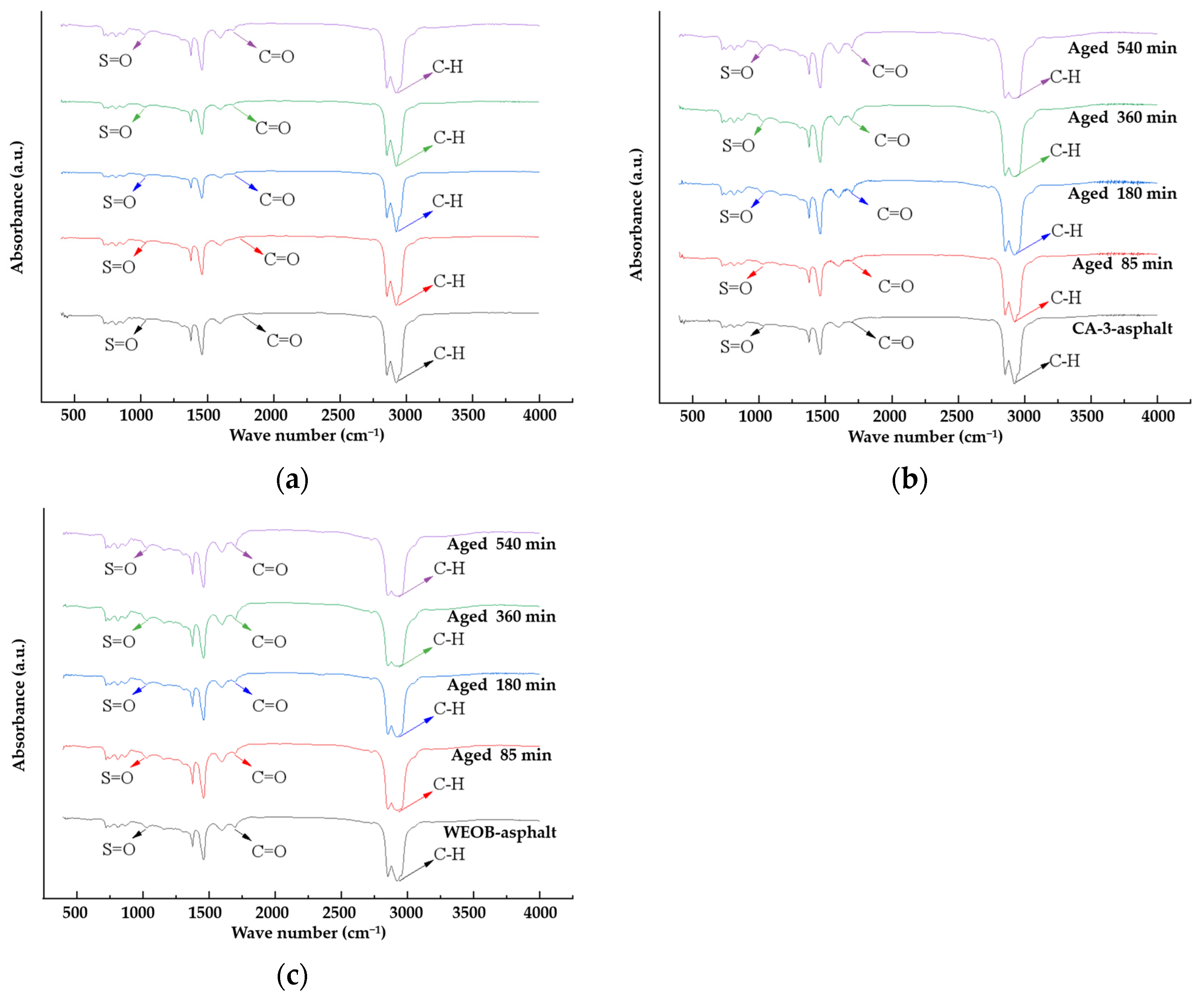
3.5. FTIR Test
3.6. Discussion
4. Conclusions
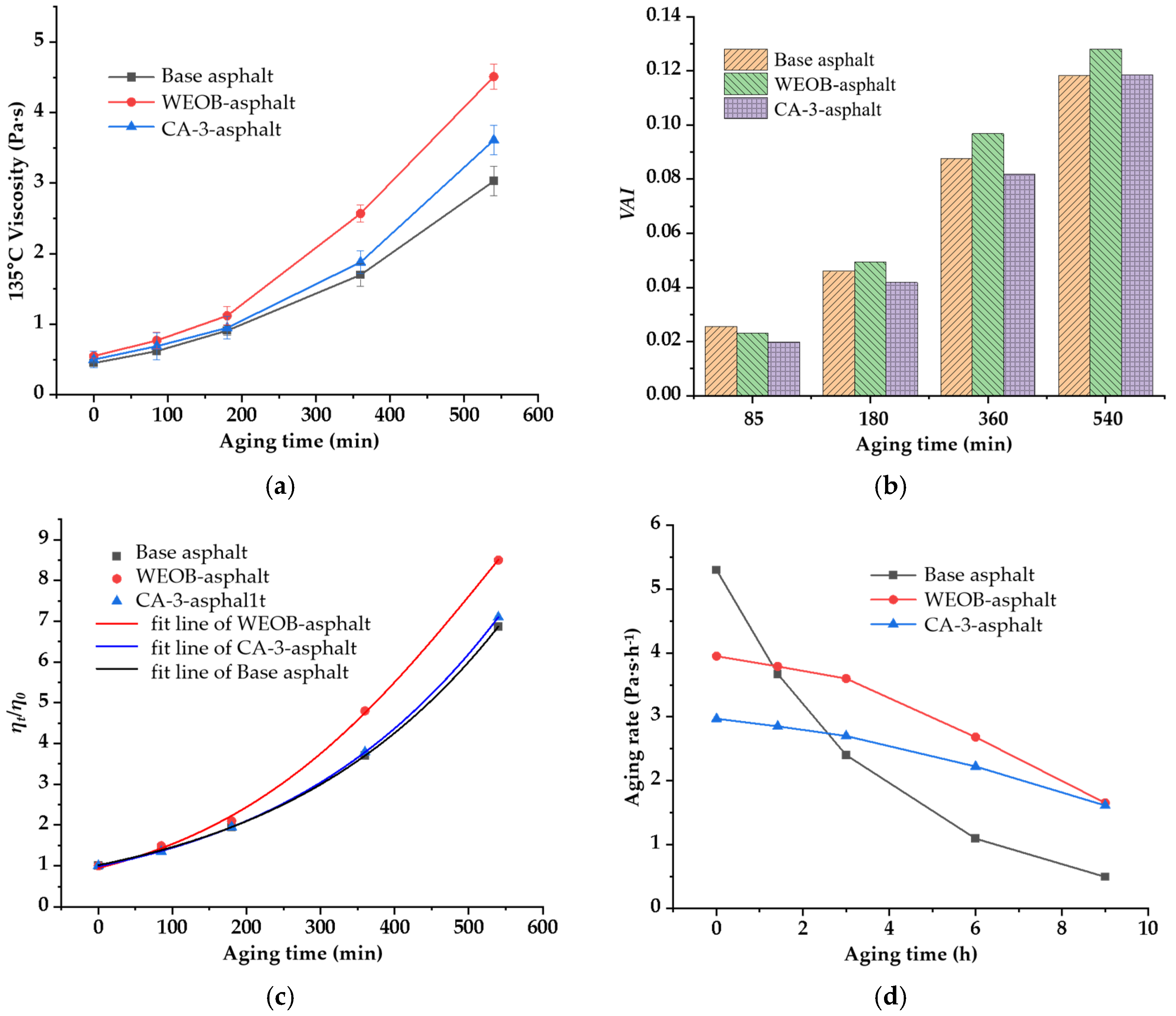
- A non-linear differential aging model based on Brookfield tests measuring asphalt viscosity was developed. It can be concluded that WEOB-asphalt shows acceptable thermal-oxidative aging performance within the first 85 min. However, from 85 min until the completion of the aging reaction, the aging rate of WEOB-rejuvenated asphalt remained higher than that of CA-3-asphalt and the original asphalt. This indicates that WEOB-asphalt exhibited the highest aging rate and the poorest thermal-oxidative aging resistance.
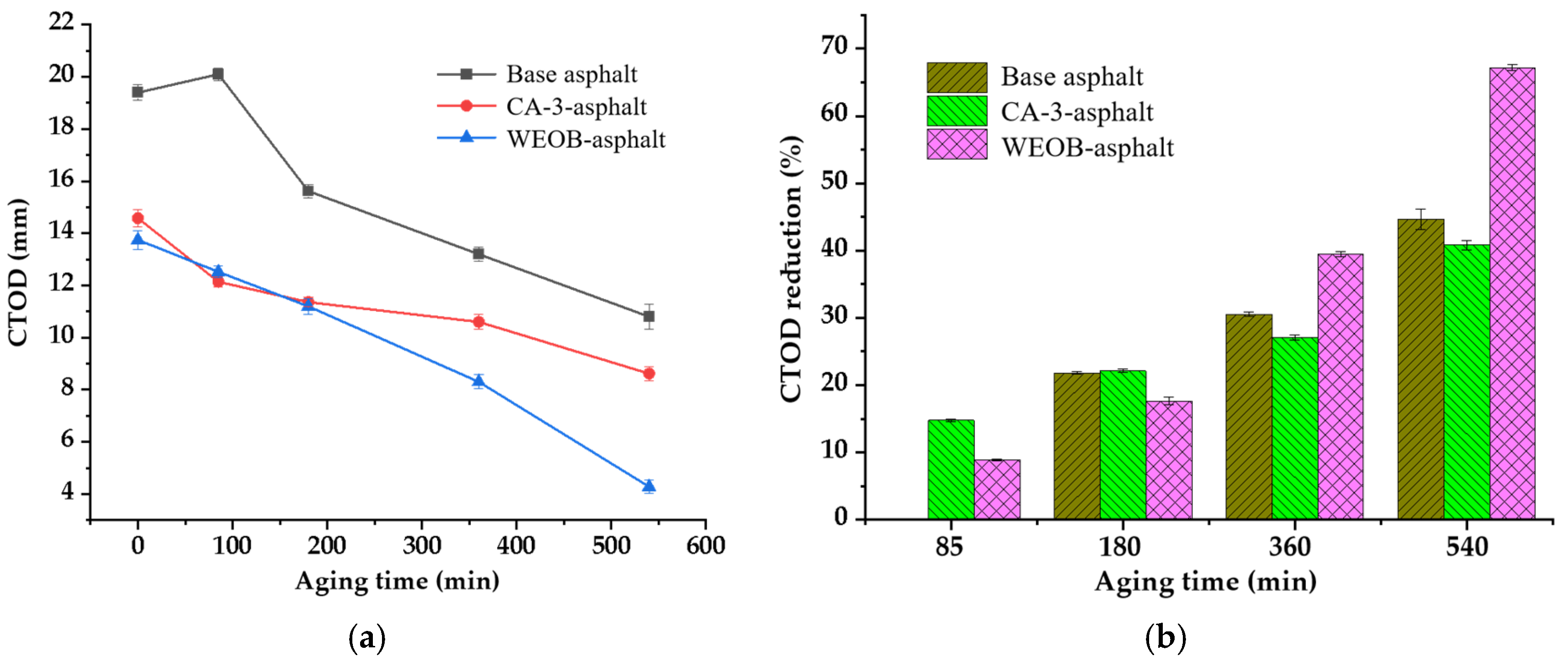
- Short-term aging has the least impact on the low-temperature cracking resistance of WEOB-asphalt. However, the long-term thermal-oxidative aging resistance of WEOB-asphalt is inferior to that of the original asphalt and CA-3-asphalt. Therefore, prolonged thermal-oxidative aging is essential for accurately characterizing the low-temperature performance of WEOB-asphalt.
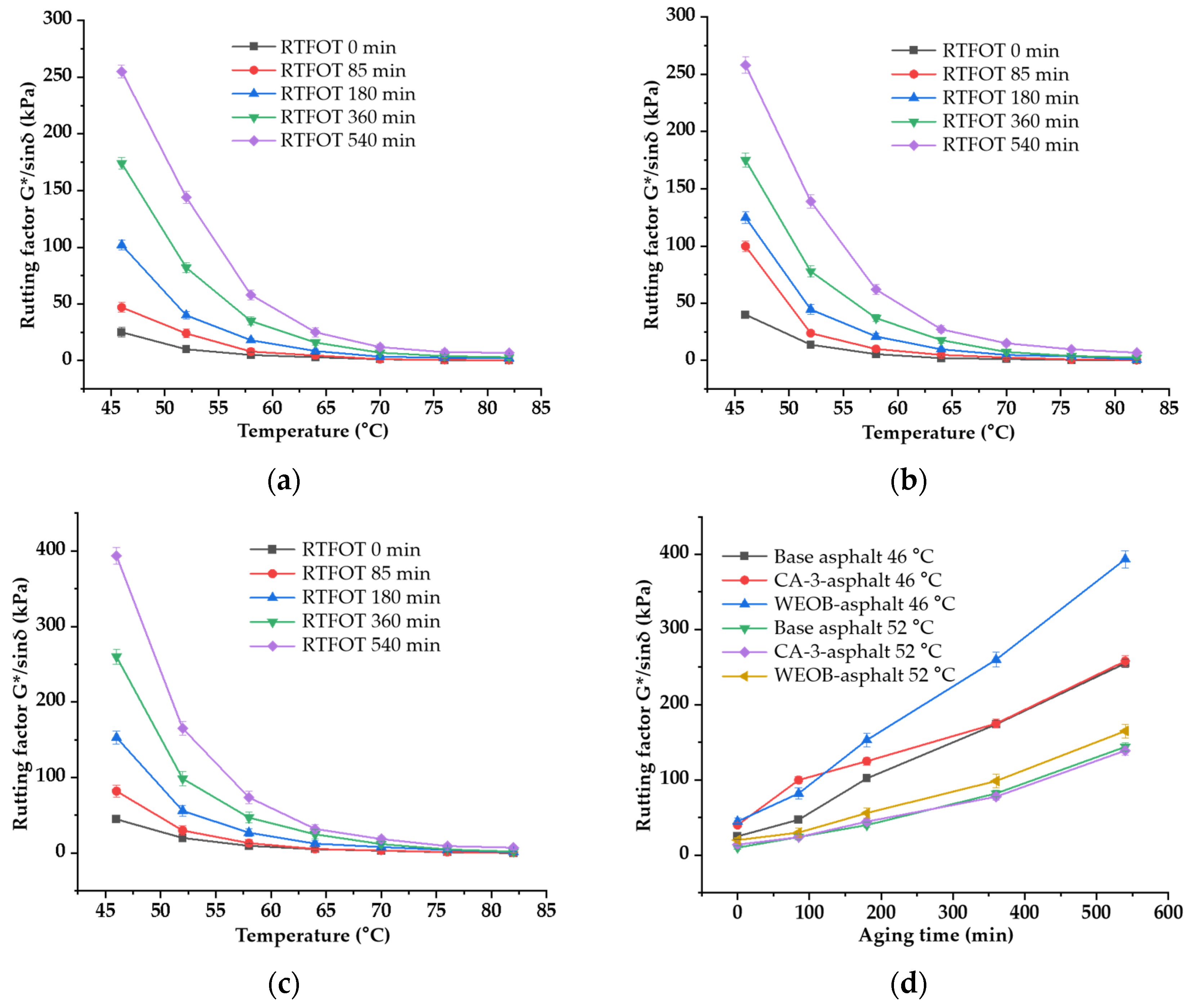
- The low-temperature sensitivity of WEOB-asphalt allows for significant differentiation in rutting factors at temperatures of 46 °C and 52 °C. This enables an effective assessment of the asphalt’s thermal-oxidative aging performance across various aging levels.
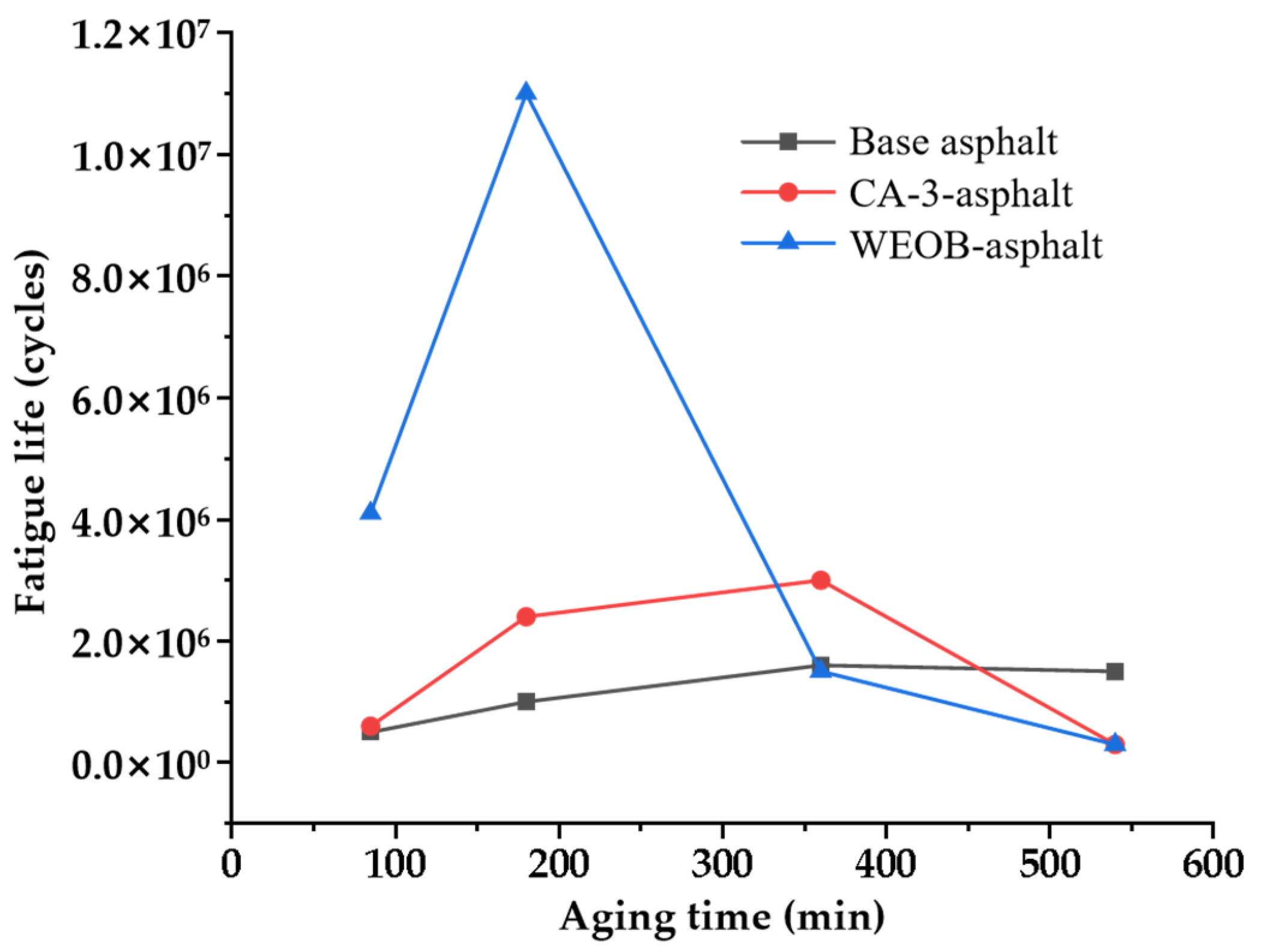
- Both the WEOB and CA-3 rejuvenators have the capability to enhance the fatigue resistance of asphalt. However, the fatigue life of WEOB-asphalt decreases with increasing aging time. Within an aging time of less than 180 min and a small strain range, its fatigue life is better than that of the original asphalt. However, once the cross-fatigue strain threshold is exceeded, the fatigue life becomes inferior to that of the original asphalt.
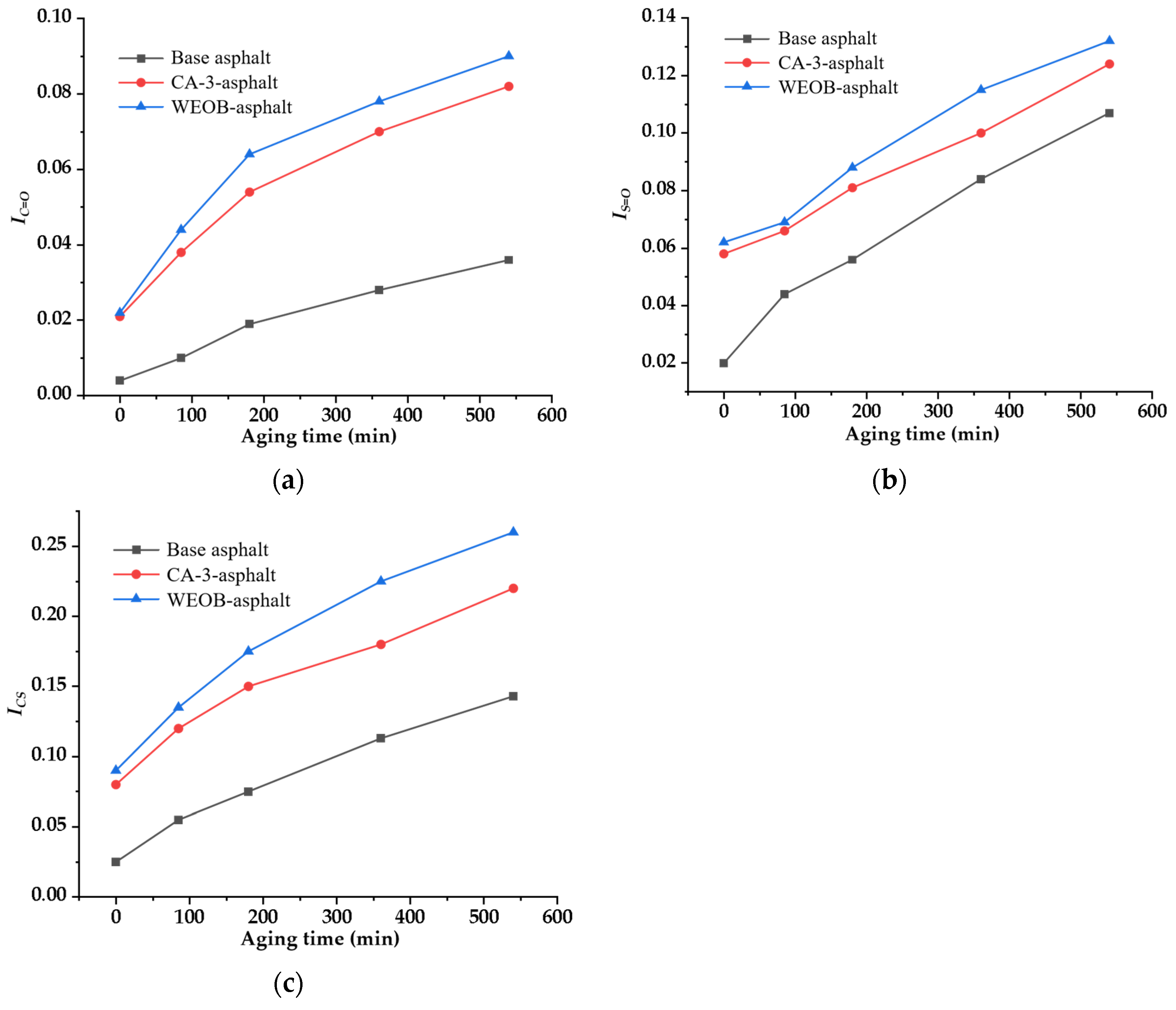
- As aging time increases, the rise in the sulfoxide index (IS=O) of the two types of rejuvenated asphalt is smaller compared to that of the original asphalt. However, the increase in the carbonyl index (IC=O) within the two types of rejuvenated asphalt due to aging is greater than that observed in the original asphalt. Therefore, compared to IC=O and IS=O, the sum of the sulfoxide and carbonyl indices provides a more comprehensive characterization of asphalt aging. Specifically, the rise in ICS is highest in WEOB-asphalt, followed by CA-3-asphalt, indicating that the original asphalt offers the greatest resistance to thermal-oxidative aging, followed by CA-3-asphalt, with WEOB-asphalt displaying the least resistance.
Author Contributions
Funding
Institutional Review Board Statement
Informed Consent Statement
Data Availability Statement
Conflicts of Interest
Abbreviations
| WEOB | Waste engine oil bottom |
| ME-RTFOT | Modified extended Rolling Thin Film Oven Test |
| DENT | Double-edge-notched tension |
| CTOD | Crack tip opening displacement |
| LAS | Linear amplitude sweep |
References
- Fu, C.; Liu, K.; Liu, Q.; Xu, P.; Dai, D.; Tong, J. Exploring directional energy conversion behavior of electromagnetic-based multifunctional asphalt pavement. Energy 2023, 268, 126573. [Google Scholar] [CrossRef]
- Shen, K.; Wang, H. Impact of dynamic loading on pavement deflection measurements from traffic speed deflectometer. Measurement 2023, 217, 113086. [Google Scholar] [CrossRef]
- Wang, T.; Riccardi, C.; Jiang, W. From waste to sustainable pavement: Rejuvenation of asphalt binder using waste engine oil residue and crumb rubber. Chem. Eng. J. 2025, 505, 159523. [Google Scholar] [CrossRef]
- Zhao, K.; Chen, J.; Chang, M.; Sheng, F.; Li, C.; Sun, G.; Yang, F.; Yao, B. Utilization of water/waste engine oil emulsion for the preparation of chemical additives-free coal slurry. Fuel 2025, 400, 135777. [Google Scholar] [CrossRef]
- Wang, W.; Jia, M.; Jiang, W.; Lou, B.; Jiao, W.; Yuan, D.; Li, X.; Liu, Z. High temperature property and modification mechanism of asphalt containing waste engine oil bottom. Constr. Build. Mater. 2020, 261, 119977. [Google Scholar] [CrossRef]
- Fernandes, S.R.M.; Silva, H.M.R.D.; Oliveira, J.R.M. Developing enhanced modified bitumens with waste engine oil products combined with polymers. Constr. Build. Mater. 2018, 160, 714–724. [Google Scholar] [CrossRef]
- Wang, R.; Chen, H.; Bahia, H.U. Effect of multiple aging-rejuvenating cycles (MARC) on critical rheological and fatigue properties of asphalt binder. Constr. Build. Mater. 2023, 399, 132392. [Google Scholar] [CrossRef]
- Yan, S.; Dong, Q.; Chen, X.; Zhou, C.; Dong, S.; Gu, X. Application of waste oil in asphalt rejuvenation and modification: A comprehensive review. Constr. Build. Mater. 2022, 340, 127784. [Google Scholar] [CrossRef]
- Al-Mutlaq, S.; Mahal, E.; Yahya, R.; Mahal, A. Effect of chlorination on the assessment of waste engine oil modified asphalt binders. Petrol. Sci. Technol. 2019, 37, 617–628. [Google Scholar] [CrossRef]
- AI-Saffar, Z.H.; Yaacob, H.; Satar, M.K.I.M.; Saleem, M.K.; Jaya, R.P.; Lai, C.J.; Shaffie, E. Evaluating the chemical and rheological attributes of aged asphalt: Synergistic effects of maltene and waste engine oil rejuvenators. Arab. J. Sci. Eng. 2020, 45, 8685–8697. [Google Scholar] [CrossRef]
- Wang, Y.; Liu, A.; Ding, W.; Rao, F.; Yuan, J.; Zhang, Z.; Xu, Z.; Dong, C. The effects of using waste engine oil bottom on physical, rheological properties and composite modification mechanism of SBS-modified asphalt. Arab. J. Sci. Eng. 2022, 2022, 2775950. [Google Scholar] [CrossRef]
- Aliakbari, A.; Khodaii, A.; Hajikarimi, P.; Khodadadi, M. Investigation of the effect of re-refined engine oil bottom on asphalt mixture performance and ecological implications. Int. J. Pavement Eng. 2024, 25, 2381656. [Google Scholar] [CrossRef]
- Zhou, G.; Tian, Y.; Gong, L.; Pang, Z.; Chen, T. Performance of rejuvenated asphalt and mixtures with waste engine oil bottom and liquid styrene-butadiene rubber. Adv. Mater. Sci. Eng. 2022, 2022, 4203851. [Google Scholar] [CrossRef]
- Li, J.; Yu, M.; Cui, X.; Wang, W. Properties and components of recycled engine oil bottom rejuvenated asphalt and its grey relationship analysis. Adv. Mater. Sci. Eng. 2019, 2019, 2462487. [Google Scholar] [CrossRef]
- Yu, M.; Li, J.; Cui, X.; Guo, D.; Li, X. Antiageing performance evaluation of recycled engine oil bottom used in asphalt rejuvenation. Adv. Mater. Sci. Eng. 2019, 2019, 2947170. [Google Scholar] [CrossRef]
- Wang, T.; Jiang, W.; Yuan, D.; Yu, H.; Wu, W. Sustainable pavements using waste engine oil residues and crumb rubber recycled asphalt: Properties and life cycle assessment. J. Clean. Prod. 2025, 534, 147045. [Google Scholar] [CrossRef]
- Porto, M.; Caputo, P.; Loise, V.; Abe, A.A.; Tarsi, G.; Sangiorgi, C.; Gallo, F.; Rossi, C.O. Preliminary study on new alternative binders through re-refined engine oil bottoms (REOBs) and industrial by-product additives. Molecules 2021, 26, 7269. [Google Scholar] [CrossRef]
- Qiu, Y.; Ding, H.; Rahman, A.; Wang, W. Damage characteristics of waste engine oil bottom rejuvenated asphalt binder in the non-linear range and its microstructure. Constr. Build. Mater. 2018, 174, 202–209. [Google Scholar] [CrossRef]
- Zaumanis, M.; Mallick, R.B.; Frank, R. Evaluation of rejuvenator’s effectiveness with conventional mix testing for 100% reclaimed asphalt pavement mixtures. Transport. Res. Rec. 2013, 2370, 17–25. [Google Scholar] [CrossRef]
- Liu, C.; Wang, Q. Enhancing effect of waste engine oil bottom incorporation on the performance of CR+SBS modified bitumen: A sustainable and environmentally-friendly solution for wastes. Sustainability 2021, 13, 12772. [Google Scholar] [CrossRef]
- Li, X.; Gibson, N.; Andriescu, A.; Arnold, T.S. Performance evaluation of REOB-modified asphalt binders and mixtures. Road Mater. Pavement Des. 2017, 18, 128–153. [Google Scholar] [CrossRef]
- Cui, Y.; Li, J.; Zhu, L.; Zuo, S.; Yu, M.; Liu, P.; Cui, X. Preparation and properties of SBS/REOB-modified rejuvenated asphalt. Appl. Sci. 2022, 12, 4063. [Google Scholar] [CrossRef]
- Li, J.; Zhu, L.; Yan, X.; Xin, C.; Yu, M.; Cheng, D. Preparation and Macro-Micro properties of SBS/REOB modified-rejuvenated asphalt. Polymers 2022, 14, 5071. [Google Scholar] [CrossRef]
- Bennert, T.; Ericson, C.; Pezeshki, D.; Haas, E.; Shamborovskyy, R.; Corun, R. Laboratory performance of re-refined engine oil bottoms (REOB) modified asphalt. J. Associat. Asphalt Pav. Technol. 2016, 85, 163–207. [Google Scholar]
- Joanna, S.B.; Grzegorz, Z.; Artur, W. Heavy metal content in used engine oils depending on engine type and oil change interval. Arch. Environ. Prot. 2021, 47, 81–94. [Google Scholar] [CrossRef]
- Li, C.; Wang, H.; Fu, C.; Shi, S.; Li, G.; Liu, Q.; Zhou, D.; Jiang, L.; Cheng, Y. Evaluation of modified bitumen properties using waste plastic pyrolysis wax as warm mix additives. J. Clean. Prod. 2023, 405, 136910. [Google Scholar] [CrossRef]
- Li, P.; Ding, Z.; Zhang, Z.; Zhang, D. Comparative evaluation of laboratory and field ageing of asphalt binder using a non-linear differential model. Road Mater. Pavement Des. 2016, 17, 434–445. [Google Scholar] [CrossRef]
- Li, J.; Yu, M.; Cui, X.; Li, Y.; Sheng, Y. Anti-aging performance of recycled engine oil bottom rejuvenated asphalt. J. Build. Mater. 2021, 24, 224–230. [Google Scholar] [CrossRef]
- AASHTO TP113-15; Standard Method of Test for Determining the Resistance of Asphalt Binder to Plastic Failure Using the Double-Edge-Notched Tension Test. American Association of State Highway and Transportation Officials: Washington, DC, USA, 2019.
- Hesp, S.A.M.; Soleimani, A.; Subramani, S.; Phillips, D.; Smith, D.; Marks, P.; Tam, K.K. Asphalt pavement cracking: Analysis of extraordinary life cycle variability in eastern and northeastern Ontario. Int. J. Pavement Eng. 2009, 10, 209–227. [Google Scholar] [CrossRef]
- Subhy, A.; Presti, D.L.; Airey, G. Evaluation of the fracture performance of different rubberised bitumens based on the essential work of fracture. Eng. Fract. Mech. 2017, 179, 203–212. [Google Scholar] [CrossRef]
- AASHTO TP101-14; Estimating Damage Tolerance of Asphalt Binders Using the Linear Amplitude Sweep. American Association of State Highway and Transportation Officials: Washington, DC, USA, 2014.
- Garrick, N.M. Nonlinear differ ential equation for modeling asphalt aging. J. Mater. Civil Eng. 1995, 7, 265–268. [Google Scholar] [CrossRef]
- Bhambhani, B.; Chandra, S.; Bharath, B. Use of waste engine oil residue for sustainability in road construction. Sustain. Mater. Technol. 2025, 45, e01557. [Google Scholar] [CrossRef]



| Type | Unit | WEOB | CA-3 |
|---|---|---|---|
| Color | / | Jet black | Light yellow |
| Density | g/cm3 | 0.9864 | 0.9752 |
| Flash point | °C | 237 | 235 |
| Asphaltenes | % | 7.58 | 1.7 |
| Resins | % | 16.0 | 8.8 |
| Aromatics | % | 49.8 | 63.2 |
| Saturates | % | 25.7 | 26.3 |
| Mechanical impurities content | % | 0.92 | 0 |
| Asphalt Binder | L | r | R2 |
|---|---|---|---|
| Original asphalt | 14.987 | 0.2681/h | 0.997 |
| WEOB-asphalt | 12.956 | 0.3391/h | 0.988 |
| CA-3-asphalt | 14.325 | 0.2766/h | 0.996 |
| Asphalt Binder | Cross-Fatigue Strain with Aged Original Asphalt (%) | |||
|---|---|---|---|---|
| 85 min | 180 min | 360 min | 540 min | |
| CA-3-asphalt | 3.2 | 5.6 | 6.8 | 0.06 |
| WEOB-asphalt | / | 22.7 | 2.09 | 0.04 |
| Asphalt Binder | Aging Time | Base Asphalt | WEOB-Asphalt | CA-3-Asphalt |
|---|---|---|---|---|
| 135 °C Viscosity (Pa·s) | 180 min | 0.91 | 1.12 | 0.95 |
| 540 min | 3.03 | 4.51 | 3.61 | |
| Aging rate (Pa·s·h−1) | 180 min | 2.40 | 3.60 | 2.70 |
| 540 min | 0.49 | 1.65 | 1.61 | |
| CTOD reduction (%) | 180 min | 21.8 | 17.6 | 22.1 |
| 540 min | 44.7 | 67.2 | 40.8 | |
| 46 °C Rutting factor (kPa) | 180 min | 103.2 | 147.9 | 124.6 |
| 540 min | 254.7 | 394.3 | 257.2 | |
| Fatigue life (Nf) | 180 min | 1.12 × 10⁶ | 1.11 × 10⁷ | 2.48 × 10⁶ |
| 540 min | 1.51 × 10⁶ | 3.01 × 10⁵ | 3.01 × 10⁵ | |
| ICS | 180 min | 0.075 | 0.175 | 0.151 |
| 540 min | 0.143 | 0.261 | 0.222 |
Disclaimer/Publisher’s Note: The statements, opinions and data contained in all publications are solely those of the individual author(s) and contributor(s) and not of MDPI and/or the editor(s). MDPI and/or the editor(s) disclaim responsibility for any injury to people or property resulting from any ideas, methods, instructions or products referred to in the content. |
© 2026 by the authors. Licensee MDPI, Basel, Switzerland. This article is an open access article distributed under the terms and conditions of the Creative Commons Attribution (CC BY) license.
Share and Cite
Li, R.; Shi, D.; Zhu, H.; Li, C. Thermal-Oxidative Aging Behavior of Waste Engine Oil Bottom-Rejuvenated Asphalt Binder. Appl. Sci. 2026, 16, 1234. https://doi.org/10.3390/app16031234
Li R, Shi D, Zhu H, Li C. Thermal-Oxidative Aging Behavior of Waste Engine Oil Bottom-Rejuvenated Asphalt Binder. Applied Sciences. 2026; 16(3):1234. https://doi.org/10.3390/app16031234
Chicago/Turabian StyleLi, Rukai, Dawei Shi, Hongmei Zhu, and Chuanqiang Li. 2026. "Thermal-Oxidative Aging Behavior of Waste Engine Oil Bottom-Rejuvenated Asphalt Binder" Applied Sciences 16, no. 3: 1234. https://doi.org/10.3390/app16031234
APA StyleLi, R., Shi, D., Zhu, H., & Li, C. (2026). Thermal-Oxidative Aging Behavior of Waste Engine Oil Bottom-Rejuvenated Asphalt Binder. Applied Sciences, 16(3), 1234. https://doi.org/10.3390/app16031234