1. Introduction
Sleep is a key determinant of recovery, health, and performance in elite athletes. In contrast to the general population, athletes are exposed to high physical, cognitive, and psychological loads, placing greater demands on recovery processes. Sleep, therefore, represents a primary window for physiological restoration and adaptation, supporting muscle repair, protein synthesis, endocrine regulation, and the replenishment of energy substrates following training and competition [
1]. In addition, deep non-rapid eye movement (NREM) sleep is associated with a hormonal milieu conducive to recovery, characterized by increased growth hormone secretion and reduced cortisol levels [
2]. Beyond its regenerative role, sleep also supports off-line consolidation of motor skills, with experimental evidence demonstrating overnight improvements in motor-sequence performance after sleep but not after equivalent periods of wakefulness [
3], highlighting its relevance for technical performance in elite sport.
Despite widespread awareness of the importance of sleep, suboptimal sleep quantity and quality remain highly prevalent among athletes. Observational studies and systematic reviews consistently report insufficient sleep duration, reduced sleep efficiency, and frequent sleep disturbances across training and competition phases, even in elite athletes with access to comprehensive performance support [
4,
5,
6]. Sport-specific factors, such as late-evening competitions, congested match schedules, travel demands, exposure to artificial light, and heightened physiological and psychological arousal, contribute to the high prevalence of sleep disturbance [
7,
8,
9]. Consequently, many elite athletes operate under real-world constraints in which further increases in sleep duration are difficult to achieve.
Sleep in athletes is increasingly conceptualized as a multidimensional construct, encompassing quantity, continuity, timing, regularity, and subjective sleep experience. Subjective sleep quality, in particular, has been shown to align closely with perceived recovery, fatigue, mood state, and readiness to train, often more strongly than isolated objective sleep metrics. Significantly subjective and objective sleep measures frequently diverge, indicating that improvements in perceived sleep quality may occur without measurable changes in sleep duration or architecture.
Beyond behavioral and circadian factors, the sleep environment represents a modifiable determinant of sleep quality. Environmental features such as ambient temperature [
10], light exposure [
11,
12], and noise [
13] have been consistently shown to influence sleep continuity, architecture, and circadian regulation, both in laboratory and applied settings [
1,
14]. In elite athletes, however, these factors are often constrained by training schedules, competition timing, travel, and shared accommodation, limiting their modifiability in real-world contexts [
15]. In contrast, the sleep surface represents a modifiable, athlete-controlled component of the sleep micro-environment that directly interacts with musculoskeletal load, pressure distribution, and comfort perception, making it a pragmatic target for applied intervention. Experimental and clinical studies indicate that mattress characteristics, such as firmness, pressure distribution, and spinal alignment, can influence perceived comfort and subjective sleep quality. In contrast, effects on objective sleep architecture appear more variable and individual-specific [
16,
17]. Despite promising findings, evidence in elite athletic populations under real-world conditions remains scarce. In contrast to prior mattress or sleep-surface studies conducted predominantly in laboratory or clinical populations, the present study focuses on elite athletes under free-living conditions. It uniquely evaluates whether a standardized, passively adaptive sleep system can improve perceived sleep quality without perturbing circadian timing or autonomic regulation.
However, real-world evidence in elite athletes is limited regarding whether sleep-surface interventions influence—or inadvertently disrupt—circadian timing and nocturnal autonomic regulation, both of which are critical for recovery and performance stability. Addressing this gap is essential to inform practical, low-risk interventions that can be implemented without disrupting physiological stability.
Accordingly, the primary outcome of the present study was subjective sleep quality, assessed using the Pittsburgh Sleep Quality Index. Secondary outcomes included objectively derived sleep parameters, circadian timing, and nocturnal autonomic markers, assessed to determine whether changes in perceived sleep quality occurred alongside or independent of physiological alteration. It was hypothesized that the intervention would primarily improve subjective sleep quality, while objective sleep architecture, circadian timing, and autonomic markers would remain stable, reflecting preserved physiological regulation.
2. Materials and Methods
2.1. Study Design
This exploratory study employed a pre–post design consisting of a baseline phase (T0) and an intervention phase (T1). The study was designed to evaluate within-participant changes in subjective and objective sleep-related outcomes under real-world conditions. Sleep was assessed using validated self-report questionnaires and wearable-derived physiological parameters. No control group was included, and participants maintained their habitual training and competition schedules throughout the study period.
The study protocol was approved by the local Ethics Committee of the Department of Sport and Exercise Science, University of Salzburg (reference number: EK-GZ 20/2021, Date of approval: 6 July 2021) and conducted in accordance with the Declaration of Helsinki [
18]. All participants provided written informed consent prior to participation.
2.2. Participants
Forty-three elite athletes were recruited for this study. The cohort included professional soccer players competing in the German Bundesliga as well as elite athletes from individual sports. Inclusion criteria were current elite-level competition status, self-reported good general health, and the absence of diagnosed sleep disorders. Exclusion criteria included known cardiovascular, metabolic, neurological, or psychiatric conditions that could affect sleep, circadian regulation, or autonomic function. Participants were studied in their habitual living environments and continued their regular training and competition routines during the observation period. Based on the inclusion and exclusion criteria, all players showed an adequate sleep quality.
2.3. Assessment Methods
Subjective sleep quality was assessed using the Pittsburgh Sleep Quality Index (PSQI), a widely used self-report questionnaire that evaluates sleep quality over a one-month period [
19]. The PSQI consists of 19 items that generate seven component scores, including subjective sleep quality, sleep latency, sleep duration, habitual sleep efficiency, sleep disturbances, use of sleep medication, and daytime dysfunction. Each component score ranges from 0 to 3, yielding a global score between 0 and 21, with higher scores indicating poorer sleep quality.
In accordance with established criteria, a global PSQI score of 5 or greater was considered indicative of impaired sleep quality. Participants completed the PSQI at baseline (T0) and again at the end of the intervention period (T1). The questionnaire was administered electronically or in paper-based format, depending on participant availability, and responses were reviewed for completeness prior to analysis.
The PSQI was selected to capture the subjective and perceptual dimensions of sleep that may not be fully reflected by objective physiological measures, particularly in athletic populations where perceived sleep quality and recovery are closely linked to training load, fatigue, and next-day functioning.
Objective sleep and physiological parameters were assessed using a commercially available wearable device (Oura Ring, 3rd generation; Oura Health Ltd., Oulu, Finland). The Oura Ring is a finger-worn health tracking device designed for continuous, non-invasive monitoring of physiological signals. All sensors are located on the inner surface of the ring, on the palmar side of the finger, to optimize signal quality during nocturnal measurements. Core body temperature minimum (CBT
min) and nocturnal minimum heart rate (HR
min) were derived using established circadian and autonomic analysis approaches [
20].
The device integrates multiple sensors, including infrared photoplethysmography (PPG), a negative temperature coefficient (NTC) thermistor for peripheral skin temperature measurement, and a tri-axial accelerometer. Heart rate–derived parameters were extracted from inter-beat intervals obtained from the PPG signal, while peripheral skin temperature and accelerometry data were used to estimate sleep timing and sleep–wake patterns.
Based on these multimodal signals, the Oura Ring generates estimates of sleep timing, total sleep time, sleep stage distribution, nocturnal heart rate, and circadian-related parameters. Data processing and sleep staging are performed using proprietary manufacturer algorithms, and raw PPG signals are not continuously stored or available for offline analysis. The device has been validated against polysomnography as the gold standard for selected sleep parameters, with acceptable sensitivity (94–95%), specificity (73–75%), PPV for sleep (96%) and wake (67%), reported for global sleep metrics, while greater variability has been noted for sleep stage classification [
21,
22,
23,
24]. Svensson et al. [
24] investigated 96 generally healthy Japanese men and women (age range: 20 to 70 years) and reported an overall accuracy of 92% and inter-device reliability of 95%. Accordingly, analyses focused on global sleep and physiological metrics, while sleep stage estimates were treated as secondary and exploratory outcomes. Given the known variability of wearable-derived sleep staging compared with polysomnography, inferential analyses were performed cautiously and interpreted in a descriptive–contextual manner, with emphasis on effect sizes, confidence intervals, and Bayesian evidence for the absence of change rather than hypothesis-driven conclusions.
Circadian timing and autonomic parameters were derived from wearable-based physiological signals recorded during nocturnal sleep periods. Circadian timing was assessed using the estimated core body temperature minimum (CBTmin), which represents the nadir of the circadian temperature rhythm and is a commonly used marker of the internal biological night. In this study, CBTmin was estimated indirectly from nocturnal peripheral skin temperature rhythms measured at the finger using an integrated negative temperature coefficient (NTC) thermistor, with temperature data processed using proprietary manufacturer algorithms to model circadian phase.
For clarity and reproducibility, key physiological endpoints were operationally defined as follows. Circadian timing was quantified using the estimated core body temperature minimum (CBTmin), defined as the nadir of the modelled nocturnal peripheral temperature rhythm generated by the device’s proprietary circadian algorithm. CBTmin was identified within the main nocturnal sleep episode and interpreted as a relative marker of internal biological night within individuals. Autonomic regulation was assessed using nocturnal minimum heart rate (HRmin), defined as the lowest heart rate value recorded during the primary sleep period of each night, derived directly from photoplethysmography-based heart rate estimates provided by the device. Both CBTmin and HRmin were extracted from device-generated outputs and averaged across three consecutive nights at baseline (T0) and post-intervention (T1).
CBTmin derived from wearable peripheral temperature measurements is a proxy for circadian timing rather than a direct assessment of core body temperature, as thermoregulatory and vasomotor processes influence peripheral temperature. Accordingly, CBTmin values were interpreted as relative indicators of circadian timing within individuals, rather than absolute physiological measurements.
Autonomic regulation during sleep was assessed using nocturnal minimum heart rate (HRmin), derived from photoplethysmographic heart rate measurements. HRmin was defined as the lowest heart rate value observed during the main sleep period for each night and reflects parasympathetic predominance during nocturnal recovery. Given the sensitivity of heart rate–derived metrics to measurement conditions and algorithmic processing, HRmin was interpreted descriptively as an index of nocturnal autonomic state.
To reduce night-to-night variability and enhance measurement stability, circadian and autonomic parameters were averaged per participant across three consecutive nights at baseline (T0) and across three consecutive nights following the intervention phase (T1), in accordance with previous wearable-based sleep research.
Participants wore an Oura Ring continuously throughout the study period, including both baseline and intervention phases. All participants used the same ring generation and wore the device on the ring finger, with the choice of hand left to the individual. Once selected, the wearing side was kept constant throughout the study. Participants were instructed to remove the device only for charging when necessary. No firmware or algorithm updates were performed during the study period.
Objective sleep and physiological data were collected continuously and synchronized via the manufacturer’s mobile application via Bluetooth connection. Data were subsequently accessed through the Oura Team Dashboard using an authorized study-specific login and exported to Microsoft Excel for further processing. Data access was performed directly by the study team via the Oura web platform; no third-party data processing services were involved.
Prior to analysis, all datasets were anonymized by a study investigator, with individual identifiers replaced by numeric codes. Anonymized data were stored on secure institutional servers and were accessible only to authorized study personnel, in accordance with applicable data protection regulations.
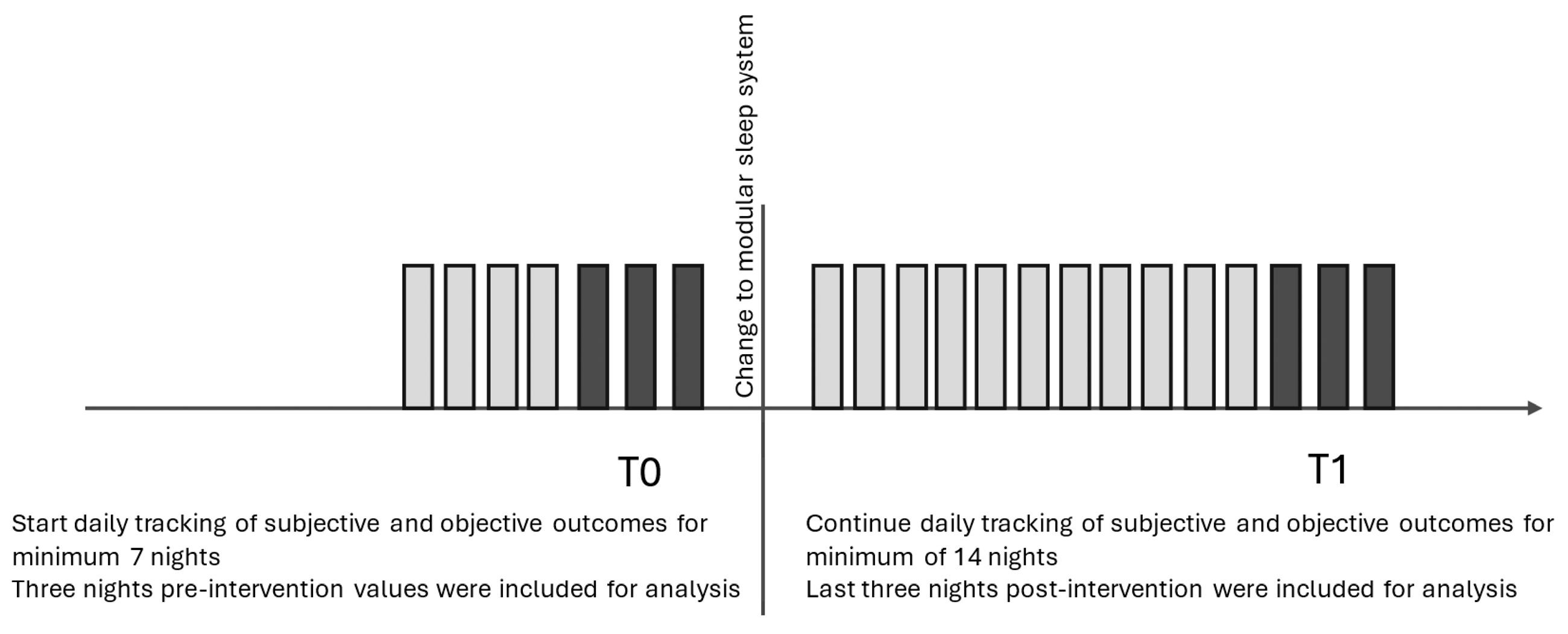
As part of the study timeline, participants completed daily tracking of subjective and objective sleep-related outcomes for a minimum of seven nights prior to the intervention, with the final three nights used to derive baseline values (T0). Following the intervention, daily tracking continued for a minimum of fourteen nights, with the final three nights used to derive post-intervention values (T1). While all participants completed a minimum of 14 nights with the modular sleep system prior to T1 assessment, the total intervention duration exceeded this minimum in a subset of athletes due to scheduling and logistical factors. Using the final three nights for analysis ensured standardized comparisons across participants, independent of total exposure duration. Averaging across three consecutive nights at each time point was chosen to reduce night-to-night variability and enhance the reliability of wearable-derived estimates in free-living conditions (
Figure 1).
Parameters of interest included total sleep time, sleep stage distribution, nocturnal minimum heart rate (HRmin), and circadian-related timing metrics derived from peripheral temperature rhythms. CBTmin and HRmin values were derived directly from device-generated outputs and subsequently averaged across the respective three-night windows. All data processing and statistical analyses were conducted using anonymized datasets.
Invalid data points were identified using a combination of automated quality-control checks (e.g., out-of-range values, abrupt non-physiological changes) and visual inspection where appropriate. Flagged data points were excluded prior to analysis. These procedures were applied uniformly across participants to reduce systematic bias and ensure consistency in data handling. Participants were reminded to complete the study measures daily. Because data were continuously tracked throughout the study period, missing data or low-quality data files were handled by excluding the affected day and including the nearest day with appropriate-quality data for analysis of the three-day block within the available recording period, in line with the predefined time periods.
2.4. Mattress and Experimental Environment
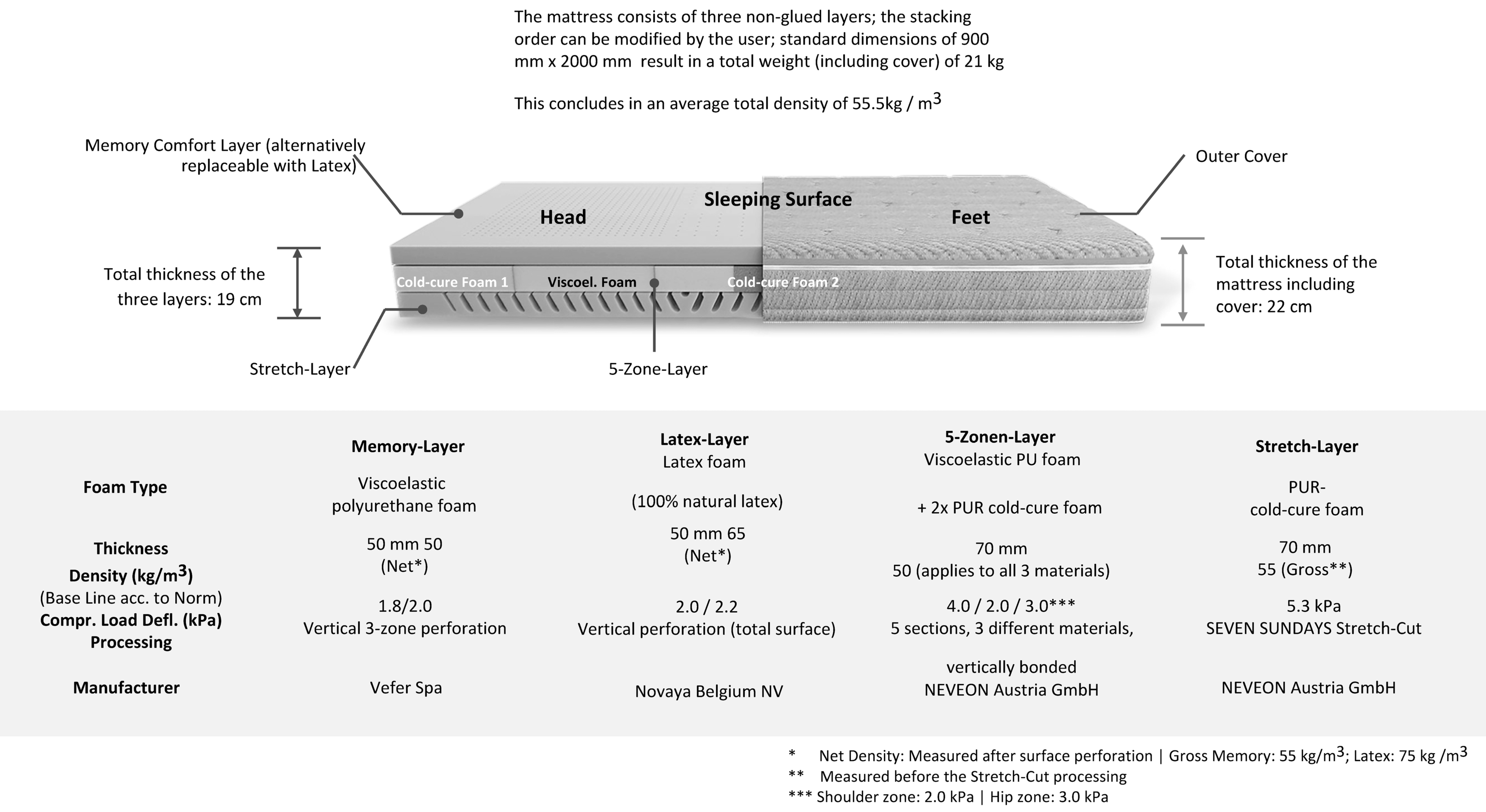
During the intervention phase, participants slept on a modular sleep system (SEVEN SUNDAYS, Seven Sundays GmbH, Munich, Germany) designed to provide passive, load-responsive adaptation rather than active individualized fitting. The system consists of a segmented support core combined with interchangeable comfort layers, enabling automatic mechanical accommodation to body mass distribution, body proportions, and habitual sleeping position through its material properties and segmented structure. The segmented support structure allows differential deformation under load, such that regions exposed to higher mechanical stress (e.g., shoulder and pelvic areas in lateral sleeping positions) undergo greater compression. In contrast, adjacent regions provide counter-support, thereby redistributing contact pressure and promoting neutral spinal alignment during supine and lateral sleep.
The mattress comprised a base support layer that provided structural stability and foundational support, and one or more configurable comfort layers. The layered design aimed to distribute mechanical load more evenly across the contact surface, reduce peak pressure points at the shoulder and pelvic regions, and maintain a neutral spinal posture during supine and lateral sleeping positions. All components were enclosed in a standardized mattress cover supplied by the manufacturer (
Figure 2).
The overall mattress dimensions were standardized across participants, and no additional mattress toppers were permitted during the study period. To minimize potential confounding effects, participants used their habitual pillows, and no changes to pillow type or bedding accessories were introduced during the intervention. Participants were instructed not to modify the mattress configuration after the individualized setup was completed. Sleep took place in the participants’ habitual sleeping environments to preserve ecological validity. No restrictions were imposed regarding room layout, lighting, or ambient temperature beyond the participants’ usual routines. This approach was chosen to reflect real-world sleep conditions in elite athletes and to ensure that observed changes in sleep outcomes were attributable primarily to the sleep system rather than to laboratory-induced environmental factors. Initial configuration of the modular sleep system was performed once at the start of the intervention period, in accordance with the manufacturer’s standardized guidelines. No therapist-led fitting, iterative optimization, or symptom-driven individual tuning was performed. No subsequent adjustments were made during the study period. This approach was intentionally chosen to maximize procedural standardization and comparability across participants and to avoid confounding effects arising from repeated adjustment, expectancy-driven optimization, or differential fitting strategies. In this context, the term “adjustable” refers to the modular design and material composition of the sleep system, rather than to active personalization during the study period. The modular sleep system is designed to provide adaptive support through its segmented, load-responsive structure, allowing passive accommodation of individual body characteristics without the need for active personalization. Accordingly, the present study evaluated the effects of introducing a standardized modular sleep surface under real-world conditions rather than through individualized clinical fitting. This design reflects typical implementation scenarios in high-performance settings, where scalability and reproducibility are critical considerations.
2.5. Statistics
All statistical analyses were conducted using Numiqo (
https://numiqo.com/), and analyses were performed on anonymized datasets. Descriptive statistics (mean, standard deviation, 95% confidence interval (95% CI)) were reported for all metric-scaled parameters.
Prior to inferential testing to evaluate within-participant changes between baseline (T0) and post-intervention (T1) conditions, data distributions were assessed for normality using visual inspection and the Shapiro–Wilk test, as appropriate. Depending on data distribution, paired-samples t tests were applied for normally distributed variables, while Wilcoxon signed-rank tests were used for non-normally distributed variables. Statistical significance was set at an alpha level of 0.05.
Effect sizes (d) were calculated to quantify the magnitude of observed changes, expressed as Cohen’s d for parametric analyses and as appropriate rank-based estimates for non-parametric comparisons. Ninety-five percent confidence intervals were calculated for primary outcomes.
In addition to frequentist analyses, Bayesian paired-samples analyses were conducted to quantify evidence for both the alternative hypothesis (i.e., a meaningful change between T0 and T1) and the null hypothesis (i.e., absence of a meaningful change). Bayesian analyses were performed using default Cauchy priors centered on zero (r = 0.707). Bayes Factors (BF10) were interpreted according to established conventions, with values greater than 3 indicating evidence for the alternative hypothesis and values below 1/3 indicating evidence in favor of the null hypothesis.
Bayesian analyses were included to complement traditional null-hypothesis significance testing and to allow for the explicit quantification of evidence supporting null effects, particularly for wearable-derived physiological parameters. Given the exploratory nature of the study and the limited number of predefined outcomes, no formal correction for multiple comparisons was applied, and results were interpreted with emphasis on effect sizes, confidence intervals, and Bayesian evidence rather than on p-values alone.
Finally, given the exploratory nature of the study, we did not perform a priori sample size calculation.
4. Discussion
The present study examined the effects of an individually adjustable modular sleep system on subjective sleep quality, objective sleep parameters, circadian timing, and nocturnal autonomic physiology in elite athletes. The principal finding was a statistically and clinically meaningful improvement in subjective sleep quality, reflected by reduced PSQI scores, occurring without concomitant changes in objectively derived sleep duration, sleep architecture, circadian phase, or nocturnal autonomic indices. Importantly, baseline objective sleep and physiological values were already consistent with ranges typically reported in high-level athletic populations, suggesting limited physiological scope for further improvement. This dissociation between subjective and objective outcomes extends previous observations in elite sport sleep research. It provides important insight into how environmental sleep interventions may influence athlete recovery without directly altering core sleep physiology [
7,
25,
26].
The improvement in subjective sleep quality suggests that the intervention primarily influenced perceptual and experiential dimensions of sleep, including comfort, perceived continuity, and satisfaction. While these improvements should not be overinterpreted as evidence of altered sleep physiology, subjective sleep quality is a meaningful outcome in elite athletes, where it has been shown to correlate with perceived recovery, mood state, readiness to train, and stress resilience, often more closely than objective sleep duration or stage distribution [
2,
7,
27,
28]. In this context, perceived sleep quality may act as an integrative signal reflecting interactions between training load, musculoskeletal discomfort, and psychological recovery, rather than isolated changes in sleep duration or architecture [
29,
30,
31]. From a practical perspective, perceived sleep quality may therefore represent a particularly relevant target for intervention in high-performance settings, where training load, psychological stress, and external constraints frequently limit the feasibility of extending sleep duration [
32]. Although performance and injury outcomes were not directly assessed, improvements in perceived sleep quality and recovery have been consistently associated with training readiness, reduced fatigue accumulation, and modulation of injury risk in elite athletes, suggesting potential downstream relevance for performance sustainability [
33,
34,
35].
While factors such as ambient temperature, light exposure, and noise primarily influence sleep onset, circadian entrainment, and arousal thresholds, the sleep surface predominantly affects biomechanical comfort, nocturnal movement behavior, and localized musculoskeletal loading. These mechanisms are particularly relevant in athletes, who frequently report residual soreness, stiffness, and asymmetrical load exposure that may impair sleep comfort without necessarily disrupting global sleep architecture [
36].
The absence of measurable changes in sleep architecture or circadian timing should not be interpreted as a limitation of the intervention, but rather as an important indicator of physiological stability. Circadian rhythms are robust and primarily entrained by potent zeitgebers such as light exposure, sleep–wake timing, and feeding schedules [
37]. Bedding interventions alone would not be expected to induce circadian phase shifts, and the observed stability of CBT
min timing suggests that the modular sleep system improved sleep comfort without perturbing internal circadian alignment. This finding is particularly relevant in elite athletes, for whom circadian misalignment has been linked to impaired recovery, increased injury risk, and decrements in physical and cognitive performance [
28,
38]. From an applied perspective, this finding is reassuring, as it suggests that improvements in sleep comfort were achieved without introducing circadian disruption, a factor known to affect health and performance in elite athletes adversely [
20].
Similarly, nocturnal autonomic markers remained unchanged across the intervention. Minimum nocturnal heart rate, assessed around the biological night, reflects parasympathetic predominance and cardiovascular recovery during sleep. In well-trained athletes, these parameters are often already optimized, leaving limited physiological reserve for further improvement through short-term interventions [
39]. Accordingly, the preservation of nocturnal autonomic stability alongside improved sleep perception may be interpreted as a favorable outcome, suggesting enhanced recovery experience without artificial modulation of autonomic control mechanisms that could conflict with underlying training demands [
40].
From a theoretical perspective, the present findings align with contemporary models of multidimensional sleep health, which emphasize that sleep cannot be reduced to duration or architecture alone but comprises interacting dimensions, including continuity, timing, regularity, and subjective experience [
41,
42,
43]. Within this framework, improvements in comfort or perceived sleep quality may occur independently of detectable changes in objective physiological parameters, particularly over short intervention periods [
44,
45], as observed in the present study.
The present study addresses these gaps by evaluating a modular sleep system in elite athletes under free-living conditions, with concurrent assessment of subjective sleep quality, objective sleep parameters, circadian timing, and nocturnal autonomic markers. Importantly, the absence of circadian or autonomic perturbation supports the suitability of such interventions as low-risk environmental modifications in populations where physiological systems are already highly optimized.
It should be noted that the present findings reflect the effects of a standardized, passively adaptive modular sleep system rather than individualized clinical fitting. This design choice was intentional and reflects real-world implementation scenarios in elite sport, where scalability and reproducibility are critical considerations. While further personalization may yield additional benefits in selected cases, the observed improvements in perceived sleep quality despite the absence of therapist-led adjustment highlight the potential of adaptive sleep environments as low-complexity interventions. Notably, this approach also minimizes confounding influences related to expectancy effects or differential fitting strategies.
The observed effects are also consistent with previous mattress and bedding studies in both athletic and non-athletic populations [
46]. Controlled trials have demonstrated that medium-firm or individually adaptable mattresses can reduce musculoskeletal discomfort and improve perceived sleep quality without necessarily altering polysomnographic sleep variables [
16,
27,
47,
48]. Athletes frequently experience localized pain, stiffness, and asymmetrical loading patterns that may not disrupt sleep architecture but impair sleep comfort; addressing these subclinical factors may be sufficient to improve sleep perception and recovery satisfaction. Taken together, these findings support a biomechanically plausible pathway by which changes in the sleep surface may improve sleep perception without altering global sleep physiology.
It is also likely that responsiveness to sleep environment interventions varies substantially between individuals. Factors such as habitual sleep quality, musculoskeletal load, pain sensitivity, training volume, and preferred sleeping position may influence the degree to which changes in the sleep surface translate into perceived benefits. The absence of group-level changes in objective sleep parameters does not preclude meaningful individual responses, which may be obscured in aggregate analyses but remain clinically relevant at the individual athlete level.
In addition to these plausible biomechanical mechanisms, psychological and contextual factors may also have contributed to the observed improvements. The use of a customized sleep system may enhance perceived control over the sleep environment, increase sleep-related self-efficacy, and heighten attention to recovery behaviors. In elite sport, such contextual factors are not trivial; expectancy effects and perceived recovery have been shown to influence training quality, motivation, and stress responses [
29,
30]. Although placebo effects cannot be excluded due to the absence of a control condition, such effects should not be interpreted as methodological weaknesses, as expectancy-related improvements in sleep perception may still confer functional benefits, including reduced fatigue, improved mood, and enhanced daytime functioning.
An additional behavioural mechanism that may be relevant in this context is sleep procrastination, defined as the voluntary delay of bedtime despite the absence of external constraints. Recent work has highlighted sleep procrastination as a common phenomenon in high-demand populations, driven by cognitive arousal, self-regulation fatigue, and the desire for psychological disengagement after stressful days [
49]. In elite athletes, who frequently experience prolonged cognitive and emotional load, such behaviours may contribute to reduced perceived sleep quality even when objective sleep duration remains adequate. Improvements in sleep comfort and perceived recovery, as observed in the present study, may indirectly reduce bedtime resistance and facilitate smoother transitions into sleep without necessarily altering sleep architecture or circadian timing. This perspective further supports the relevance of targeting environmental and experiential aspects of sleep in elite sport, where behavioural contributors to sleep quality are often subtle and context-dependent.
Methodologically, combining frequentist and Bayesian analyses strengthens confidence in the interpretation of null findings for objective outcomes. Bayesian inference provided explicit evidence supporting the absence of meaningful changes in sleep duration, circadian timing, and autonomic physiology, rather than merely failing to detect effects. This distinction is fundamental in wearable-based sleep research, where null findings may reflect proper physiological stability rather than insufficient sensitivity of the measurement approach [
21,
50,
51]. The use of multi-night averaging further enhanced reliability in this free-living study design.
Significantly, the use of wearable monitoring in habitual sleeping environments enhances ecological validity and relevance for applied sport settings, where laboratory-based assessments are rarely feasible [
14]. This design allows conclusions to be drawn under real-world conditions that closely reflect athletes’ everyday recovery environments. By preserving ecological validity, the present design allows conclusions that are directly applicable to applied performance and recovery settings.
From an applied perspective, the present findings suggest that sleep optimization strategies in elite athletes do not necessarily need to increase sleep duration or modify sleep architecture to be beneficial. In populations where sleep quantity is already near optimal, improving sleep comfort, satisfaction, and perceived recovery may represent a more realistic and sustainable intervention target. Personalized sleep environments may therefore serve as a low-risk, complementary component within broader sleep hygiene and recovery frameworks [
4,
7,
30]. By preserving circadian and autonomic stability, such interventions minimize risk while offering perceptual and recovery-related benefits in high-performance sport.
5. Limitations
Several limitations warrant consideration. The explorative character and lack of a randomized control group limit causal inference and preclude definitive separation of physiological and expectancy-driven effects. The intervention period was relatively short, and longer-term studies are needed to determine whether subjective improvements persist and whether cumulative effects emerge in objective sleep, autonomic regulation, or performance metrics. Although wearable devices enable ecologically valid sleep assessment, they cannot fully replace polysomnography for detailed sleep staging and neurophysiological analysis [
50].
A methodological limitation of the present study relates to the use of the PSQI, which assesses global sleep perception over a one-month recall period. Although participants were exposed to the modular sleep system for a minimum of 14 nights prior to post-intervention assessment, this duration does not fully match the temporal scope of the PSQI. Consequently, PSQI changes may reflect a combination of intervention effects and pre-existing sleep perceptions. This limitation should be considered when interpreting the magnitude of subjective improvements.
Due to the highly selective nature of the investigated sample (elite soccer players), the representativeness of the sample and the results is limited.
The measurements derived from wearables are based on proprietary algorithms. This results in measurement errors and limitations in interpretation, especially for staging and temperature proxy measurements.
Future research should employ randomized controlled designs, longer intervention durations, and include objective performance and recovery outcomes to determine whether improvements in perceived sleep quality translate into measurable athletic benefits. Investigating individual responsiveness to sleep environment modifications and sport-specific demands may further inform personalized sleep optimization strategies in elite sport.




 ,
,