Fetal Radiation Dose in Common Diagnostic Radiology Procedures for Pregnant Patients: Findings from In-Phantom Measurements

 , , , , , , , and
Abstract
1. Introduction
2. Materials and Methods
3. Results
4. Discussion
Author Contributions
Funding
Institutional Review Board Statement
Informed Consent Statement
Data Availability Statement
Conflicts of Interest
References
- Devis, P.; Knuttinen, M.G. Deep venous thrombosis in pregnancy: Incidence, pathogenesis and endovascular management. Cardiovasc. Diagn. Ther. 2017, 7 (Suppl. 3), S309–S319. [Google Scholar] [CrossRef]
- Say, L.; Chou, D.; Gemmill, A.; Tunçalp, Ö.; Moller, A.B.; Daniels, J.; Gülmezoglu, A.M.; Temmerman, M.; Alkema, L. Global causes of maternal death: A WHO systematic analysis. Lancet Glob. Health 2014, 2, e323–e333. [Google Scholar] [CrossRef] [PubMed]
- Van Der Pol, L.M.; Tromeur, C.; Bistervels, I.M.; Ni Ainle, F.; Van Bemmel, T.; Bertoletti, L.; Couturaud, F.; van Dooren, Y.P.; Elias, A.; Faber, L.M.; et al. Pregnancy-Adapted YEARS Algorithm for Diagnosis of Suspected Pulmonary Embolism. N. Engl. J. Med. 2019, 380, 1139–1149. [Google Scholar] [CrossRef]
- Foo, L.; Bewley, S.; Rudd, A. Maternal death from stroke: A thirty year national retrospective review. Eur. J. Obstet. Gynecol. Reprod. Biol. 2013, 171, 266–270. [Google Scholar] [CrossRef] [PubMed]
- Ijäs, P. Trends in the Incidence and Risk Factors of Pregnancy-Associated Stroke. Front. Neurol. 2022, 13, 833215. [Google Scholar] [CrossRef] [PubMed]
- Miller, E.C.; Gatollari, H.J.; Too, G.; Boehme, A.K.; Leffert, L.; Elkind, M.S.; Willey, J.Z. Risk of Pregnancy-Associated Stroke Across Age Groups in New York State. JAMA Neurol. 2016, 73, 1461–1467. [Google Scholar] [CrossRef]
- Mangal, R.; Stead, T.G.; Ganti, L.; Rosario, J. Diagnosing Appendicitis in Pregnancy Via Ultrasonography. Cureus 2019, 11, e5562. [Google Scholar] [CrossRef]
- Zachariah, S.K.; Fenn, M.; Jacob, K.; Arthungal, S.A.; Zachariah, S.A. Management of acute abdomen in pregnancy: Current perspectives. Int. J. Womens Health 2019, 11, 119–134. [Google Scholar] [CrossRef]
- Dietrich, C.S., III; Hill, C.C.; Hueman, M. Surgical diseases presenting in pregnancy. Surg. Clin. N. Am. 2008, 88, 403–419. [Google Scholar] [CrossRef]
- Lee, M.S.; Fenstermaker, M.A.; Naoum, E.E.; Chong, S.; Van de Ven, C.J.; Bauer, M.E.; Kountanis, J.A.; Ellis, J.H.; Shields, J.; Ambani, S.; et al. Management of Nephrolithiasis in Pregnancy: Multi-Disciplinary Guidelines From an Academic Medical Center. Front. Surg. 2021, 8, 796876. [Google Scholar] [CrossRef]
- Sakamoto, J.; Michels, C.; Eisfelder, B.; Joshi, N. Trauma in Pregnancy. Emerg. Med. Clin. N. Am. 2019, 37, 317–338. [Google Scholar] [CrossRef] [PubMed]
- The American College of Obstetricians and Gynecologists. Committee Opinion No. 723: Guidelines for Diagnostic Imaging During Pregnancy and Lactation. Obstet. Gynecol. 2017, 130, e210–e216. [Google Scholar] [CrossRef]
- Flanagan, E.; Bell, S. Abdominal Imaging in Pregnancy (Maternal and Foetal Risks). Best. Pract. Res. Clin. Gastroenterol. 2020, 44–45, 101664. [Google Scholar] [CrossRef]
- International Commission on Radiological Protection. Pregnancy and medical radiation. Ann. ICRP 2000, 30, 1–43. [Google Scholar] [PubMed]
- European Commission. Radiation Protection RP100: Guidance for Protection of Unborn Children and Infants Irradiated due to Parental Medical Exposures; Publications Office: Luxembourg, 1999. [Google Scholar]
- Valentin, J. Editorial. Ann. ICRP 2000, 30, iii–iv. [Google Scholar] [CrossRef]
- Tremblay, E.; Thérasse, E.; Thomassin-Naggara, I.; Trop, I. Quality Initiatives: Guidelines for Use of Medical Imaging during Pregnancy and Lactation. RadioGraphics 2012, 32, 897–911. [Google Scholar] [CrossRef]
- Matsunaga, Y.; Haba, T.; Kobayashi, M.; Suzuki, S.; Asada, Y.; Chida, K. Fetal Radiation Dose of Four Tube Voltages in Abdominal CT Examinations during Pregnancy: A Phantom Study. J. Appl. Clin. Med. Phys. 2021, 22, 178–184. [Google Scholar] [CrossRef]
- Hurwitz, L.M.; Yoshizumi, T.; Reiman, R.E.; Goodman, P.C.; Paulson, E.K.; Frush, D.P.; Toncheva, G.; Nguyen, G.; Barnes, L. Radiation Dose to the Fetus from Body MDCT During Early Gestation. Am. J. Roentgenol. 2006, 186, 871–876. [Google Scholar] [CrossRef]
- Faj, D.; Bassinet, C.; Brkić, H.; De Monte, F.; Dreuil, S.; Dupont, L.; Ferrari, P.; Gallagher, A.; Gallo, L.; Huet, C.; et al. Management of Pregnant or Potentially Pregnant Patients Undergoing Diagnostic and Interventional Radiology Procedures: Investigation of Clinical Routine Practice. Phys. Medica 2023, 115, 103159. [Google Scholar] [CrossRef] [PubMed]
- Gilet, A.G.; Dunkin, J.M.; Fernandez, T.J.; Button, T.M.; Budorick, N.E. Fetal Radiation Dose During Gestation Estimated on an Anthropomorphic Phantom for Three Generations of CT Scanners. Am. J. Roentgenol. 2011, 196, 1133–1137. [Google Scholar] [CrossRef]
- Osei, E.K.; Darko, J. Foetal radiation dose and risk from diagnostic radiology procedures: A multinational study. ISRN Radiol. 2012, 2013, 318425. [Google Scholar] [CrossRef] [PubMed] [PubMed Central]
- Kopacin, V.; Kasabasic, M.; Faj, D.; de Saint Hubert, M.; Galic, S.; Ivkovic, A.; Majer, M.; Brkic, H. Development of a Computational Pregnant Female Phantom and Calculation of Fetal Dose during a Photon Breast Radiotherapy. Radiol. Oncol. 2022, 56, 541–551. [Google Scholar] [CrossRef]
- Kopačin, V.; Brkić, H.; Ivković, A.; Kasabašić, M.; Knežević, Ž.; Majer, M.; Nodilo, M.; Turk, T.; Faj, D. Development and Validation of the Low-Cost Pregnant Female Physical Phantom for Fetal Dosimetry in MV Photon Radiotherapy. J. Appl. Clin. Med. Phys. 2024, 25, e14240. [Google Scholar] [CrossRef] [PubMed]
- Knežević, Ž.; Beck, N.; Milković, Đ.; Miljanić, S.; Ranogajec-Komor, M. Characterisation of RPL and TL Dosimetry Systems and Comparison in Medical Dosimetry Applications. Radiat. Meas. 2011, 46, 1582–1585. [Google Scholar] [CrossRef]
- ATGC. Explanation Material of RPL Glass Dosemeter: Small Element System; Asahi Techno Glass Corporation: Tokyo, Japan, 2007. [Google Scholar]
- Vekić, B.; Ban, R.; Miljanić, S. Secondary Standard Dosimetry Laboratory at the Ruđer Bošković Institute. Arh. Hig. Rada Toksikol. 2006, 57, 189–194. [Google Scholar] [PubMed]
- Knežević, Ž.; Stolarczyk, L.; Bessieres, I.; Bordy, J.M.; Miljanić, S.; Olko, P. Photon Dosimetry Methods Outside the Target Volume in Radiation Therapy: Optically Stimulated Luminescence (OSL), Thermoluminescence (TL) and Radiophotoluminescence (RPL) Dosimetry. Radiat. Meas. 2013, 57, 9–18. [Google Scholar] [CrossRef]
- ACR-SPR Practice Parameter for Imaging Pregnant or Potentially Pregnant Adolescents and Patients with Ionizing Radiation [Revised 2023 (Resolution 31)]. Available online: https://www.acr.org/-/media/ACR/Files/Practice-Parameters/Pregnant-Pts.pdf (accessed on 17 November 2024).
- Niemann, T.; Nicolas, G.; Roser, H.W.; Müller-Brand, J.; Bongartz, G. Imaging for Suspected Pulmonary Embolism in Pregnancy—What about the Fetal Dose? A Comprehensive Review of the Literature. Insights Imaging 2010, 1, 361–372. [Google Scholar] [CrossRef]
- Gillespie, C.D.; Yates, A.; Hughes, M.; Ewins, K.; McMahon, G.; Hynes, J.; Murphy, M.C.; Galligan, M.; Vencken, S.; Alih, E.; et al. Validating the Safety of Low-Dose CTPA in Pregnancy: Results from the OPTICA (Optimised CT Pulmonary Angiography in Pregnancy) Study. Eur. Radiol. 2024, 34, 4864–4873. [Google Scholar] [CrossRef]
- Tse, G.H.; Balian, V.; Charalampatou, P.; Maliakal, P.; Nayak, S.; Dyde, R.; Nagaraja, S. Foetal Radiation Exposure Caused by Mechanical Thrombectomy in Large-Vessel Ischaemic Stroke in Pregnancy. Neuroradiology 2019, 61, 443–449. [Google Scholar] [CrossRef] [PubMed]
- James, B.; Kelly, B. The Abdominal Radiograph. Ulster Med. J. 2013, 82, 179–187. [Google Scholar]
- Fachgesellschaften, Arbeitsgemeinschaft der Wissenschaftlichen Medizinischen. “S3-Leitlinie Polytrauma”. Available online: https://register.awmf.org/assets/guidelines/012_D_Ges_fuer_Unfallchirurgie/012-019m_S3_Polytrauma_Schwerverletzten-Behandlung_2016-09-abgelaufen.pdf (accessed on 15 November 2024).
- Kahn, J.; Kaul, D.; Böning, G.; Rotzinger, R.; Freyhardt, P.; Schwabe, P.; Maurer, M.; Renz, D.; Streitparth, F. Quality and Dose Optimized CT Trauma Protocol—Recommendation from a University Level-I Trauma Center. RöFo 2017, 189, 844–854. [Google Scholar] [CrossRef] [PubMed]
- Yaniv, G.; Portnoy, O.; Simon, D.; Bader, S.; Konen, E.; Guranda, L. Revised Protocol for Whole-Body CT for Multi-Trauma Patients Applying Triphasic Injection Followed by a Single-Pass Scan on a 64-MDCT. Clin. Radiol. 2013, 68, 668–675. [Google Scholar] [CrossRef] [PubMed]
- Naulet, P.; Wassel, J.; Gervaise, A.; Blum, A. Evaluation of the Value of Abdominopelvic Acquisition without Contrast Injection When Performing a Whole Body CT Scan in a Patient Who May Have Multiple Trauma. Diagn. Interv. Imaging 2013, 94, 410–417. [Google Scholar] [CrossRef] [PubMed][Green Version]
- The Royal College of Radiologists. Standards of Practice and Guidance for Trauma Radiology in Severely Injured Patients, 2nd ed.; The Royal College of Radiologists: London, UK, 2015. [Google Scholar]
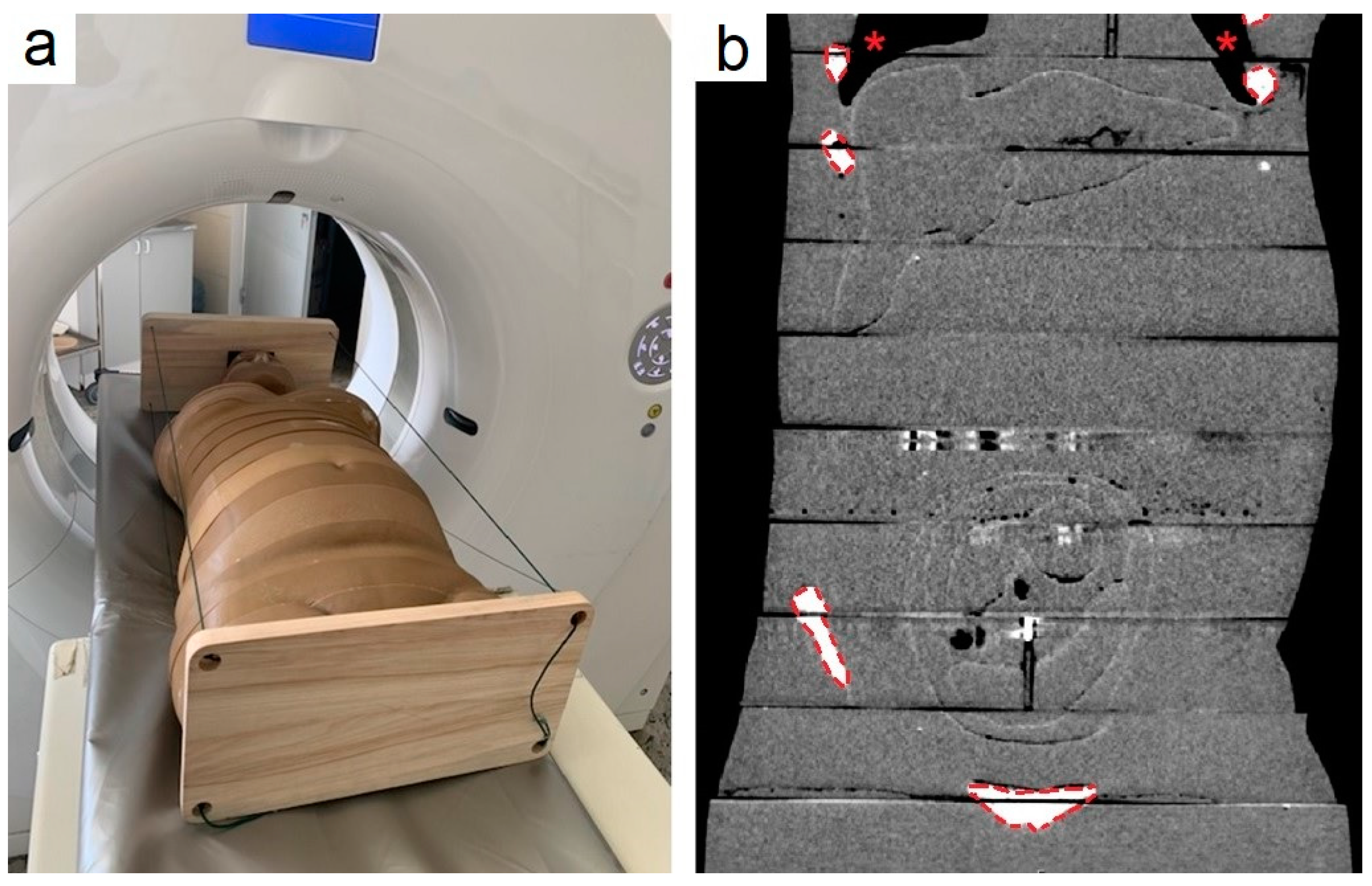


| Anatomical Region | Head, Neck, Thorax, Abdomen, Pelvis, Proximal Parts of the Thighs |
|---|---|
| Height (cm)/Mass (kg) | 88.9/49.7 |
| Substitutional Tissues | |
| STS | PU rubber, CaCO3 |
| Mass density (g/cm3) | 1.03 |
| CT number (HU) | 30 ± 5 |
| Zeff | 6.94 |
| BTS | Epoxy resin, CaCO3, SiO2 |
| Mass density (g/cm3) | 1.274 |
| CT number (HU) | 450 ± 45 |
| Zeff | 10.78 |
| LTS | STS, polystyrene (Styrofoam) balls |
| Mass density (g/cm3) | 0.29 |
| CT number (HU) | −750 ± 80 |
| Zeff | 6.9 |
| Clinical Scenario | Imaging Modality | Unit | Imaging Protocol | Imaging Parameters |
|---|---|---|---|---|
| Non-specific abdominal pain | Radiography | Siemens Luminos dRF Max | Abdomen and pelvis in two positions | 80.8 kV; 18.85 mAs |
| 72.9 kV; 40.7 mAs | ||||
| Nephrostomy tube placement Nephro/urolithiasis | Fluoroscopy | Siemens Uroskop Omnia Max | Pulsed fluoroscopy, collimated field | N/A |
| Nephrolithiasis, appendicitis, abdominal pain | CT | GE Revolution Frontier | NCCT abdomen and pelvis (lung bases—great trochanters) | 120 kV; auto mAs (range 50–750); noise index 13.3; section thickness 5 mm; pitch 1.375:1 |
| Polytrauma | CT | GE Revolution Frontier | NCCT head | 120 kV; auto mAs (range 100–335); noise index 3.23; section thickness 2.5 mm; pitch 0.531:1 |
| NCCT C spine | 120 kV; 335 mAs; section thickness 0.625 mm; pitch 0.516:1 | |||
| CECT (35 s) thorax and abdomen | 120 kV; auto mAs (range 100–600), noise index 18; section thickness 5 mm; pitch 1.375:1 | |||
| CECT (75 s) abdomen and pelvis | 120 kV; auto mAs (range 100–600), noise index 18; section thickness 5 mm; pitch 1.375:1 | |||
| Pulmonary embolism | CT | GE Revolution Frontier | CT angiography of PA with “bolus tracking” (5×) | 120 kV; auto mAs (range 150–800); noise index 28; section thickness 0.625 mm; pitch 1.375:1 |
| Ischemic stroke | CT | GE Revolution Frontier | NCCT head | 120/140 kV; 400/600 mAs; |
| CTA aortic arch–vertex | 120 kV; auto mAs (range 80–700), noise index 8.94; section thickness 1.25 mm; pitch 0.984:1 | |||
| Fluoroscopy and DSA | Philips Azurion | 2 pass MT: Pulsed fluoroscopy for selective catheterization and MT DSA run for pre- and post-procedure angiography (6 fps) | 75 kV; 7–22 mAs Rotation 0°, LAO 45°, LAO 89° Angulation: 0° and CRAN 15° SID: 100–111 cm |
| Clinical Scenario | Imaging Modality | Hospital | Unit | Imaging Protocol | Imaging Parameters |
|---|---|---|---|---|---|
| Non-specific abdominal pain | Radiography | 1 | Siemens Luminos (R1) | Abdomen and pelvis in two positions | 80.8 kV; 18.85 mAs |
| 72.9 kV; 40.7 mAs | |||||
| 1 | Siemens Ysio Max (R2) | Abdomen and pelvis in AP projection | 72.9 kV; 34.99 mAs | ||
| 2 | Siemens Luminos (R1) | Abdomen and pelvis in AP projection | 72.9 kV; 62.44 mAs | ||
| 3 | Siemens Aristos (R1) | Abdomen and pelvis in two positions | 81 kV; 22 mAs | ||
| 81 kV; 76 mAs | |||||
| Nephrolithiasis, appendicitis, abdominal pain | CT | 1 | GE Revolution Frontier (CT1) | NCCT abdomen and pelvis (lung bases—great trochanters) | 120 kV; CTDI 17.0 mGy; DLP 846 mGycm |
| 1 | Siemens Definition As (CT2) | NCCT abdomen and pelvis (lung bases—great trochanters | 120 kV; CTDI 7.1 mGy; DLP 334 mGycm | ||
| 1 | Philips Ingenuity (CT3) | NCCT abdomen and pelvis (lung bases—great trochanters | 140 kV; CTDI 14.3 mGy; DLP 744 mGycm | ||
| 1 | Siemens X.cite (CT4) | NCCT abdomen and pelvis (lung bases—great trochanters | 120 kV; CTDI 10.2 mGy; DLP 513 mGycm | ||
| 2 | Siemens X.cite (CT1) | NCCT abdomen and pelvis (lung bases—great trochanters | 120 kV; CTDI 10.8 mGy; DLP 585 mGycm | ||
| 2 | Siemens Definiton As (CT2) | NCCT abdomen and pelvis (lung bases—great trochanters | 80 kV; CTDI 1.7 mGy; DLP 100 mGycm | ||
| 3 | GE Revolution EVO (CT1) | NCCT abdomen and pelvis (lung bases—great trochanters | 120 kV; CTDI 14.5 mGy; DLP 810 mGycm | ||
| 3 | Siemens Definiton Edge (CT2) | NCCT abdomen and pelvis (lung bases—great trochanters | 120 kV; CTDI 10.1 mGy; DLP 566 mGycm | ||
| Polytrauma | CT | 1 | GE Revolution Frontier (CT1) | NCCT head | 120 kV; CTDI 62.9 mGy; DLP 1035 mGycm |
| NCCT C spine | 120 kV; CTDI 36.4; DLP 735 mGycm | ||||
| Art CECT thorax and abdomen | 120 kV; CTDI 8.0 mGy; DLP 435 mGycm | ||||
| Venous CECT abdomen and pelvis | 120 kV; CTDI 12.4 mGy; DLP 628 mGycm | ||||
| 1 | Philips Ingenuity (CT3) | NCCT head and neck | 120 kV; CTDI 49.0 mGy; DLP 1064 mGycm | ||
| Venous CECT thorax and abdomen and pelvis | 120 kV; CTDI 12.0 mGy; DLP 878 mGycm | ||||
| 1 | Siemens X.cite (CT4) | NCCT head | 120 kV; CTDI 73.0 mGy; DLP 1142 mGycm | ||
| NCCT C spine | 90 kV; CTDI 19.3 mGy; DLP 354 mGycm | ||||
| Venous CECT thorax and abdomen and pelvis | 120 kV; CTDI 10.8 mGy; DLP 747 mGycm | ||||
| 2 | Siemens X.cite (CT1) | NCCT head | 120 kV; CTDI 56.4 mGy; DLP 1335 mGycm | ||
| NCCT C spine | 120 kV; CTDI 16.8 mGy; DLP 359 mGycm | ||||
| NCCT thorax and abdomen and pelvis | 120 kV; CTDI 9.5 mGy; DLP 669 mGycm | ||||
| Venous CECT thorax and abdomen and pelvis | 100 kV; CTDI 7.8 mGy; DLP 535 mGycm | ||||
| 2 | Siemens Definiton As (CT2) | NCCT head | 120 kV; CTDI 68.5 mGy; DLP 1450 mGycm | ||
| NCCT C spine | 120 kV; CTDI 11.5 mGy; DLP 224 mGycm | ||||
| NCCT thorax and abdomen and pelvis | 120 kV; CTDI 8.4 mGy; DLP 571 mGycm | ||||
| Venous CECT thorax and abdomen and pelvis | 100 kV; CTDI 8.4 mGy; DLP 575 mGycm | ||||
| 3 | GE Revolution EVO (CT1) | NCCT head and neck | 120 kV; CTDI 55.0 mGy; DLP 980 mGycm | ||
| NCCT thorax and abdomen and pelvis | 100 kV; CTDI 10.5 mGy; DLP 880 mGycm | ||||
| Art CECT thorax and abdomen and pelvis | 100 kV; CTDI 10.5 mGy; DLP 880 mGycm | ||||
| Venous CECT thorax and abdomen and pelvis | 100 kV; CTDI 10.5 mGy; DLP 880 mGycm | ||||
| 3 | Siemens Definition Edge (CT2) | NCCT head and neck | 120 kV; CTDI 77.0 mGy; DLP 1960 mGycm | ||
| NCCT thorax and abdomen and pelvis | 120 kV; CTDI 10.0 mGy; DLP 730 mGycm | ||||
| Art CECT thorax and abdomen and pelvis | 120 kV; CTDI 10.0 mGy; DLP 560 mGycm | ||||
| Venous CECT thorax and abdomen and pelvis | 120 kV; CTDI 10.0 mGy; DLP 560 mGycm |
| Clinical Scenario | Imaging Modality | Unit | Fetal Dose—Head (mGy) | Fetal Dose—Body (mGy) |
|---|---|---|---|---|
| Non-specific abdominal pain | Radiography | Siemens Luminos dRF Max | 1.6 | 1.9 |
| Nephrostomy tube placement nephro/urolithiasis | Fluoroscopy | Siemens Uroskop Omnia Max | 0.5 | 0.1 |
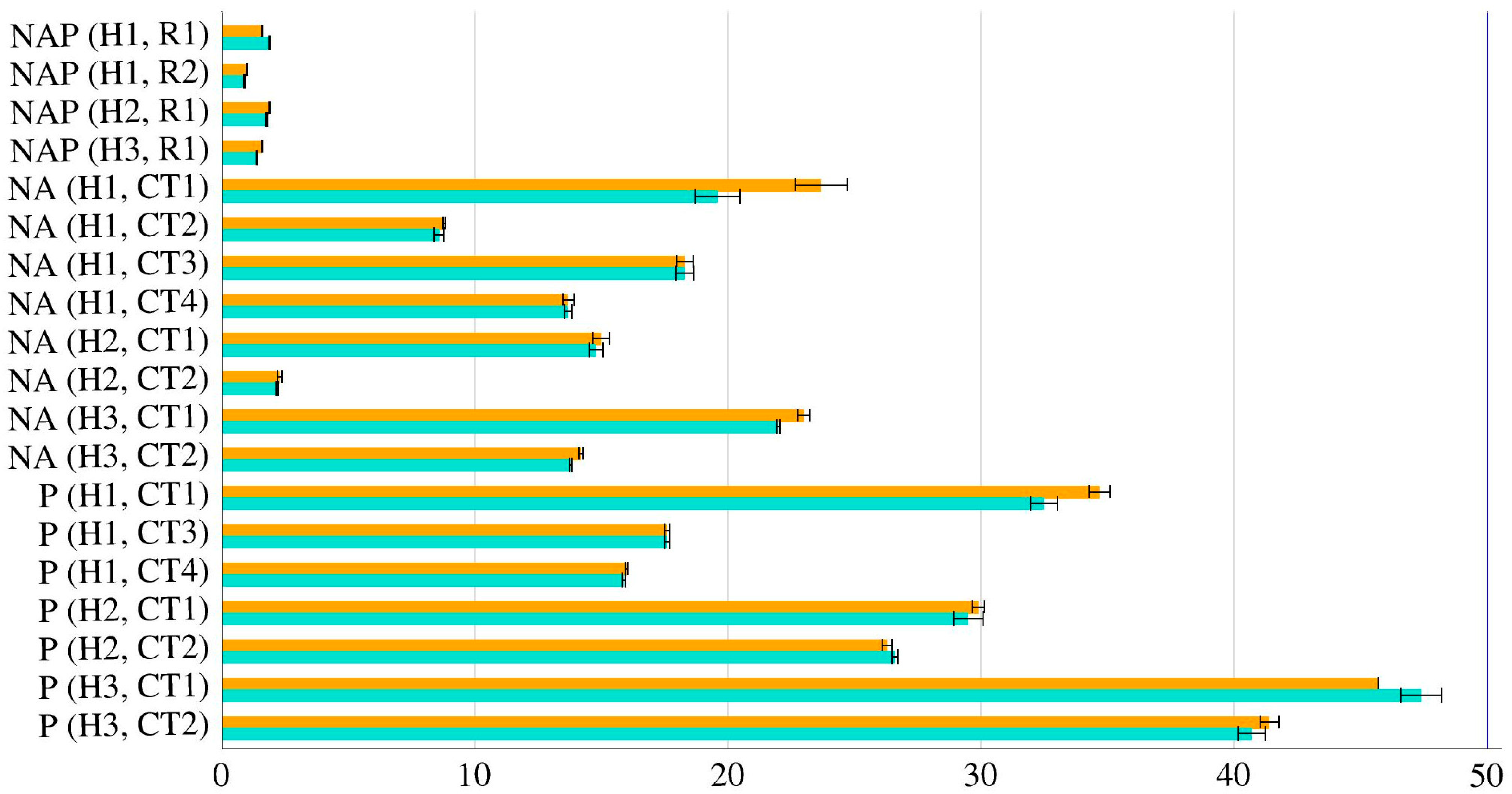
| Nephrolithiasis, appendicitis, abdominal pain | CT | GE Revolution Frontier | 23.7 | 19.6 |
| Polytrauma | CT | GE Revolution Frontier | 34.7 | 32.5 |
| Pulmonary embolism | CT | GE Revolution Frontier | 0.3 | 0.2 |
| Ischemic stroke | CT | GE Revolution Frontier | 0.05 | 0.03 |
| Fluoroscopy and DSA | Philips Azurion | 0.0 | 0.02 |
Disclaimer/Publisher’s Note: The statements, opinions and data contained in all publications are solely those of the individual author(s) and contributor(s) and not of MDPI and/or the editor(s). MDPI and/or the editor(s) disclaim responsibility for any injury to people or property resulting from any ideas, methods, instructions or products referred to in the content. |
© 2025 by the authors. Licensee MDPI, Basel, Switzerland. This article is an open access article distributed under the terms and conditions of the Creative Commons Attribution (CC BY) license (https://creativecommons.org/licenses/by/4.0/).
Share and Cite
Tomić, A.; Brkić, H.; Turk, T.; Kasabašić, M.; Bjelobrk, I.; Kralik, I.; De Monte, F.; Zancopè, N.; Lombardi, R.; Majer, M.; et al. Fetal Radiation Dose in Common Diagnostic Radiology Procedures for Pregnant Patients: Findings from In-Phantom Measurements. Appl. Sci. 2025, 15, 1143. https://doi.org/10.3390/app15031143
Tomić A, Brkić H, Turk T, Kasabašić M, Bjelobrk I, Kralik I, De Monte F, Zancopè N, Lombardi R, Majer M, et al. Fetal Radiation Dose in Common Diagnostic Radiology Procedures for Pregnant Patients: Findings from In-Phantom Measurements. Applied Sciences. 2025; 15(3):1143. https://doi.org/10.3390/app15031143
Chicago/Turabian StyleTomić, Anja, Hrvoje Brkić, Tajana Turk, Mladen Kasabašić, Ivana Bjelobrk, Ivana Kralik, Francesca De Monte, Nicola Zancopè, Riccardo Lombardi, Marija Majer, and et al. 2025. "Fetal Radiation Dose in Common Diagnostic Radiology Procedures for Pregnant Patients: Findings from In-Phantom Measurements" Applied Sciences 15, no. 3: 1143. https://doi.org/10.3390/app15031143
APA StyleTomić, A., Brkić, H., Turk, T., Kasabašić, M., Bjelobrk, I., Kralik, I., De Monte, F., Zancopè, N., Lombardi, R., Majer, M., Knežević, Ž., Horvat, M., Škarica, M., Marić, Z., Faj, D., & Kopačin, V. (2025). Fetal Radiation Dose in Common Diagnostic Radiology Procedures for Pregnant Patients: Findings from In-Phantom Measurements. Applied Sciences, 15(3), 1143. https://doi.org/10.3390/app15031143