Article

Study on Oscillation Characteristics and Flow Field Effects in Submerged Pulsed Water Jet

1
School of Resources and Environmental Engineering, Inner Mongolia University of Technology, Hohhot 010051, China
2
School of Engineering and Technology, China University of Geosciences, Beijing 100083, China
3
Resource Exploration Drilling Technology and Equipment Innovation Base of the Geological Society of China, Beijing 100083, China
*
Author to whom correspondence should be addressed.
Appl. Sci. 2025, 15(23), 12558; https://doi.org/10.3390/app152312558
Submission received: 31 October 2025 / Revised: 19 November 2025 / Accepted: 25 November 2025 / Published: 26 November 2025

Abstract

The self-excited oscillation pulsed waterjet (SOPW) offers simplicity and effective pressure source separation, making it widely utilized. This study investigates the oscillation characteristics and flow field effects of SOPW generated by a Helmholtz nozzle. A transfer function model for the nozzle is established, and the natural frequency is found to correlate with structural parameters such as the oscillation chamber’s cross-sectional area, length, and downstream nozzle diameter. Numerical simulations reveal optimal structural parameters that closely match experimental results, with errors under 15%. Notably, submerged pulsed jets exhibit faster velocity decay compared to non-submerged jets. Additionally, the study examines the effect of area discontinuity at the nozzle inlet on axial velocity, showing that the area enlargement or contraction enhances velocity at lower pressures but inhibits it at higher pressures. This work advances the understanding of nozzle design and the flow field behavior of SOPW.

1. Introduction

High-speed waterjet technology has seen significant progress, driven by its wide application in industries such as oil drilling, coal mining, and material processing [1,2,3]. While traditional continuous waterjets have proven effective in certain contexts [4], they often fall short in meeting the evolving demands of modern industrial applications. Pulsed waterjets, including self-excited oscillation pulsed waterjets (SOPWs), have gained attention for their enhanced performance due to their ability to generate high pressure and localized force [5]. Among various methods of generating pulsed jets, the SOPW stands out for its simplicity, low maintenance requirements, and efficiency, particularly when coupled with Helmholtz nozzles.
To enhance the performance of SOPW, researchers have turned their attention to the oscillation mechanism, structural parameter optimization, and flow field characteristics of pulsed jets [6]. The research focus of the oscillation mechanism is the oscillation characteristics of the Helmholtz nozzle. Researchers employ various methods, including the lumped parameter method based on fluid network theory, the analogy method based on mass-spring systems, and the transfer matrix method, to delve into these characteristics and the natural frequency of the Helmholtz nozzle. The lumped parameter method treats fluid flow similar to electrical current and pressure as voltage [7,8]. The natural frequency of the Helmholtz nozzle is solved by the circuit diagram. It is revealed that the interaction between the vortex and rigid boundaries plays a crucial role in pulsed jet formation [9,10,11]. The analogy method analogizes Helmholtz resonance to a second-order mass-spring system, where fluid in the orifice region represents effective mass and fluid compressibility corresponds to stiffness [12]. This method establishes an acoustic characteristic model for the double Helmholtz resonator, providing expressions for resonant frequency and transmission loss of the two-degree-of-freedom system [13]. Lastly, the transfer matrix method treats upstream and downstream nozzles of the Helmholtz nozzle as chamber units, with the oscillation chamber considered a point unit, allowing derivation of natural frequency and system frequency equations [14]. In summary, while the lumped parameter method sees the most widespread use, the analogy method finds application in the acoustic field, and the transfer matrix method overlooks the oscillating cavity’s impact on pulsed jet characteristics. Moreover, the application of the analogy method to oscillation characteristics remains relatively underexplored. Hence, this study delves into analyzing the oscillation characteristics of the Helmholtz nozzle using the analogy method as one of its primary research objectives.
On one hand, researchers are exploring avenues to enhance the oscillation performance of SOPW through nozzle structure optimization. With the advent of advanced research methodologies like particle imaging technology, particle image velocimetry, high-speed camera technology, and numerical simulation, studies on parameter optimization have significantly progressed [15]. Nozzle structure parameter optimization primarily investigates the impact of pulsed jets by modifying structural parameters and analyzing velocity and pressure characteristics [16]. The presence of the collapse wall affects shear layer characteristics, thereby altering pulsed jet features [17]. Notably, the upper collision wall’s shape exerts a more pronounced influence compared to the lower collision wall, with semi-circular collision walls being preferred in Helmholtz nozzle design [18]. However, the processing complexity of semi-circular collision wall nozzles has led researchers to optimize them into conical collision walls. Experimental comparisons of various collision wall angles reveal that a 120° impinging angle is optimal [19].
Moreover, ratios such as those of upstream nozzle diameter to downstream nozzle diameter, chamber length to upstream nozzle diameter, and chamber diameter to upstream nozzle diameter exert varying degrees of influence on nozzle performance. It is found that when the inlet pressure is 3 MPa, the factors affecting the jet performance are ranked as follows: chamber filet, outlet pipe diameter, chamber diameter, and chamber length [15]. And each dynamic pressure corresponds to an optimal chamber length [7]. Furthermore, oscillation frequency decreases with increasing inlet diameter, chamber diameter, chamber length, and impinging angle [20]. Optimal parameters include a chamber-diameter-to-downstream-nozzle-diameter ratio of 6–9, an upstream-nozzle-diameter-to-downstream-nozzle-diameter ratio of 1.5–2.3, a chamber length-to-diameter ratio of 0.4–0.7, and an impinging angle of 120° [21]. Additionally, the composite nozzle of the Venturi tube and the Helmholtz resonator enhance peak and average pressure at the outlet by 45% and 12.5%, respectively [15]. The peak and average pressure at the outlet of the composite nozzle of the Venturi tube and the Helmholtz resonator are increased by 45% and 12.5%, respectively [6]. Notably, area discontinuity enhances peak and amplitude but has no effect on oscillation frequency [10]. Thus, structural parameter optimization of the Helmholtz nozzle is a focal area of this study, laying a foundation for flow field characteristics investigation.
On the other hand, investigating the flow field characteristics of pulsed jets is pivotal for advancing the application of SOPW. The flow field, pressure oscillation, pulsed cavitation and acoustic shock characteristics of pulsed jets are experimentally studied. Moreover, flow properties are intricately linked to vortex formation and merging processes, which govern flow behavior in the development region of a plane jet [22]. Notably, the similarity between the fields of pulsed and non-pulsed flow is maintained [23]. Additionally, while pulsation significantly influences properties like spreading and heat exchange with the surrounding medium in the potential core region, these properties tend to resemble those of a steady jet after the potential core ends [24]. For instance, the entrainment rate of the pulsed jet at 2% was about 20% greater than that of the steady jet studied by Crow and Champagne [25].
Despite the advances in SOPW technology, several gaps remain in the understanding of its oscillation characteristics and flow field behavior. While various methods, including the lumped parameter method and analogy-based mass-spring systems, have been used to study the Helmholtz nozzle’s oscillation characteristics, there is limited exploration of the effect of area discontinuities at the nozzle inlet and their influence on flow field dynamics. Moreover, while nozzle structural optimization has been studied extensively, the specific impact of design parameters on pulsed jet performance under varying inlet pressures has not been fully addressed.
This study fills these gaps by employing the analogy method to investigate the oscillation characteristics of the Helmholtz nozzle and conducting numerical simulations to optimize nozzle structural parameters. Additionally, we explore the influence of area discontinuity at the nozzle inlet on axial velocity and the overall flow field. The innovative aspect of this study lies in its comprehensive examination of both simulation and experimental results to provide insights into the optimization of SOPW nozzle designs, particularly for applications requiring high performance under varying operational conditions.

2. Theoretical Background

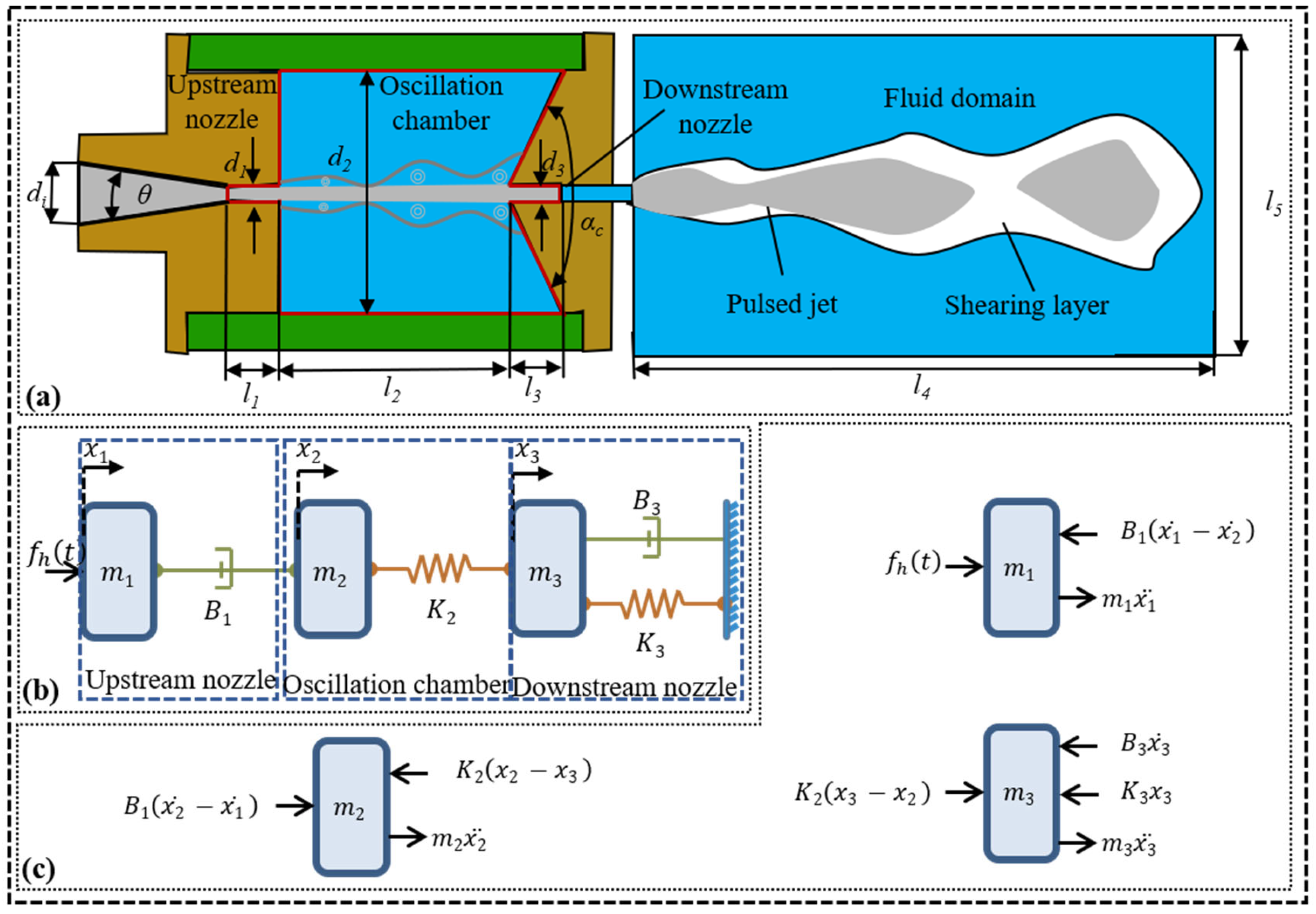
The Helmholtz oscillator is composed of a cylinder and two plates with central holes [26], as illustrated in Figure 1a. According to the flow direction of the fluid in the oscillator, the plate is called the upstream nozzle and the downstream nozzle, and the inner side of the downstream nozzle has a conical wall called the collision wall. The formation process of the pulsed jet unfolds in three stages: the free jet at the upstream nozzle outlet, the generation and dissipation of vortices within the oscillation chamber, and the resulting pulsed jet from the downstream nozzle. Initially, fluid enters the oscillation chamber from the upstream nozzle as a non-submerged jet. As the flow channel area abruptly widens at the upstream nozzle outlet, stress redistribution within the fluid leads to the generation. These disturbances interact with the fluid in the chamber, inducing vortexes formation in the free shear layer of the jet, propagating along its direction. Subsequently, as the vortex approaches the downstream nozzle, the jet’s entrainment causes a cross-sectional area increase, ultimately leading to vortex collision with the conical collision wall. This collision triggers self-excited acoustic waves and pressure waves within the oscillation chamber. Finally, the disturbance wave propagates to the upstream nozzle outlet, intensifying disturbances and fostering the generation of more robust vortices. The collision zone, also termed the feedback zone, plays a crucial role in this process by generating disturbance waves that amplify larger-scale vortices. This closed-loop phenomenon inside the oscillation chamber results in fluid flow fluctuation at a specific frequency at the downstream nozzle outlet. Moreover, if the Helmholtz nozzle’s natural frequency aligns with the disturbance frequency, resonance amplifies significantly [27].
According to the principle of fluid similarity network, the Helmholtz nozzle is equivalent to a mass-spring-damping system, as shown in Figure 1b. The pressure difference between the left and right ends of the nozzle is equivalent to the force f h t applied to the mechanical system. Considering the flow resistance, the upstream nozzle is equivalent to mass block m 1 and damping B 1 . The oscillation chamber is equivalent to a mass block m 2   and a spring K 2 . The downstream nozzle is equivalent to a mass block m 3 , a spring K 3   and a damping B 3 . The force analysis of each part of the mechanical system is carried out, and the force of each part is shown in Figure 1c. According to Newton’s second law, the motion equation of each part can be expressed as:
B 1 ( x ˙ 1 x ˙ 2 ) + m 1 x ¨ 1 = f h ( t ) B 1 ( x ˙ 2 x ˙ 1 ) K 2 ( x 2 x 3 ) m 2 x ¨ 2 = 0 K 2 ( x 3 x 2 ) K 3 x 3 B 3 x ˙ 3 m 3 x ¨ 3 = 0 ,
Under the zero initial condition, the Laplace transform of Equation (1) can be obtained:
B 1 s ( x 1 x 2 ) + m 1 s 2 x 1 = F h ( s ) B 1 s ( x 2 x 1 ) K 2 ( x 2 x 3 ) m 2 s 2 x 2 = 0 K 2 ( x 3 x 2 ) K 3 x 3 B 3 s x 3 m 3 s 2 x 3 = 0 ,
Equation (2) is written in the form of vector matrix. It can be obtained:
B 1 s + m 1 s 2 B 1 s 0 B 1 s B 1 s K 2 m 2 s 2 K 2 0 K 2 K 2 K 3 B 3 s m 3 s 2 x 1 x 2 x 3 = F h 0 0 ,
Thus, the transfer function of the mass-spring-damping system can be expressed as:
G ( s ) = x 3 F h = B 1 K 2 m 1 m 2 m 3 s 5 + + m 1 K 2 K 3 + K 2 B 1 B 3 s + B 1 K 2 K 3 ,
The natural frequency of the mass-spring-damper system is:
ω m n = B 1 K 2 K 3 m 1 m 2 m 3 ,
The transfer function and natural frequency of the fluid system can be expressed as:
G ( s ) = R 1 C 2 L 1 L 2 L 3 s 5 + + L 1 C 2 C 3 + C 2 R 1 R 3 s + R 1 C 2 C 3 ,
ω n = R 1 C 2 C 3 L 1 L 2 L 3 ,
Assuming that the fluid density at the upstream and downstream nozzles is equal, the structural parameters of the nozzle are brought into Equation (7). The natural frequency of the nozzle can be expressed as:
ω n = 128 μ l 1 π d 1 4 V 2 k V 3 k ρ 1 l 1 A 1 ρ 2 l 2 A 2 ρ 3 l 3 A 3 = 32 μ A 2 A 3 k 2 ρ 2 ρ 2 l 2 l 3 ,
In Equation (8), ρ , k , l 3 and A 3 are known, l 2 , A 2 and ρ 2 are equivalent parameters, necessitating experimental measurement. Moreover, the natural frequency of the nozzle correlated with the cross-sectional area of the oscillation chamber and downstream nozzle, inversely proportional to the lengths of the oscillation chamber and downstream nozzle. When the plunger pump power is low and the disturbance frequency is likewise low, adjustments can be made to match the nozzle frequency with the disturbance frequency. This entails appropriately increasing the cross-sectional area of the oscillation chamber and the diameter of the downstream nozzle while reducing the lengths of the oscillation chamber and the downstream nozzle.
The current model, while useful for initial simulations, has limitations due to its exclusion of local hydraulic losses. These losses can significantly affect the mass, spring, and damping coefficients and, consequently, the system’s behavior. Future research should incorporate more advanced models, such as CFD simulations, to better account for these losses and provide more accurate predictions of the pulsed jet’s oscillation characteristics.

3. Principle and Calculation Process of Numerical Simulation

In this study, the Realizable k-ε turbulence model and the Zwart–Gerber–Belamri cavitation model are employed to simulate the flow field of the self-excited oscillation pulsed waterjet. The Realizable k-ε model is chosen for its ability to accurately predict turbulent flows, especially in scenarios where strong swirl and shear layers are present. The model is particularly effective in capturing turbulence behavior in boundary layers and complex flow regions, such as those in the oscillation chamber and downstream nozzle. The Zwart–Gerber–Belamri model has been specifically developed to capture the dynamics of cavitation in high-pressure flows, where both vapor and liquid phases interact. Given the potential for strong cavitation and vapor bubble dynamics in the pulsed jet, this model provides a more accurate representation of the pressure drops and associated effects that influence jet behavior, such as velocity variations and flow instabilities.
Both models are selected to ensure that the simulation results accurately reflect the complex fluid behavior within the pulsed waterjet, including the turbulent flow with strong swirl and cavitation phenomena that are key to the jet’s performance. These models are widely recognized in computational fluid dynamics (CFD) applications and have been validated in similar high-pressure, high-speed flow scenarios.

3.1. Principle of Numerical Simulation

This study uses the Realizable k - ε model. In the boundary layer region of the jet, cavitation may occur, which affects the generation and dissipation of vortices. Thus, this study adopts the mixed multiphase flow model considering the influence of cavitation. The mass conservation equation and momentum conservation equation can be expressed as [28]:
u i x i = 0 ,
u i t + u j u i x j = f i 1 ρ p x i + μ ρ τ i j x j ,
The turbulent kinetic energy and turbulent dissipation transport equations can be expressed as [29]:
ρ k t + ρ k u i t = x μ + μ t σ k k x j + G k + G b ρ ε Y M ,
ρ ε t + ρ ε u i x i = x j μ + μ t σ ε ε x j + ρ c 1 E ε ρ c 2 ε 2 k + v ε + c 1 ε ε k c 3 ε G b + S ε ,
In this study, turbulence intensity and hydraulic diameter are used to define turbulence parameters. The expression is:
L t = D 4 ,
I = 0.16 × ρ v L t μ 0.125 ,
The cavitation problem is solved by introducing a transport-based gas volume fraction equation. In the solution process, ignoring the heat transfer between gas and liquid, the transport equation of liquid volume content can be expressed as:
m ˙ = ρ α 1 t + ρ α 1 μ j x j = m ˙ + + m ˙ ,

3.2. Geometric Model and Meshing

The geometric model of the self-excited oscillation nozzle established in this study is shown in Figure 1a. The model includes a nozzle and a fluid domain. The self-excited oscillation or Helmholtz nozzle is mainly composed of upstream nozzle, oscillation chamber and downstream nozzle. On the basis of previous studies, the structural parameters of the nozzle are d i = 13   m m , θ = 14 ° , d 1 = 2   m m , l 1 = 5   m m , d 2 = 24   m m , l 2 = 6   m m , d 3 = 2.2   m m , l 3 = 5   m m , and α c = 120 ° [30]. In addition, the study shows that when the length of the fluid domain is 80 mm and the width is 30 mm, the performance of the pulsed cavitation jet can be accurately reflected [15]. Therefore, the fluid domain parameters established in this study are l 4 = 80   m m and l 5 = 30   m m .
To investigate the impact of area discontinuity at the nozzle inlet on pulsed jet flow field characteristics, three nozzle structures employing distinct principles were designed. These structures, depicted in Figure 2, include enlargement, continuous, and contraction joints. Each joint connects to a pipeline with a 19 mm diameter at the upper end and varies in diameter at the lower end (6 mm, 13 mm, and 25 mm). As the upstream nozzle’s inlet diameter is fixed at 13 mm, the three structures generate different inlet discontinuities. The system comprising the enlargement joint and the Helmholtz nozzle forms a chamber due to the convergence angle between the joint and the upstream nozzle, resulting in double-chamber Helmholtz nozzles. Conversely, the continuous joint and Helmholtz nozzle form a conventional jet generation system. Lastly, the contraction joint and Helmholtz nozzle system can be likened to an organ pipe in series with the Helmholtz nozzle. Consequently, varying area discontinuities at the nozzle inlet are expected to yield distinct effects on oscillation characteristics.
Notably, the pressure variance between the 2D and 3D models amounts to only 1% [4]. Thus, to conserve computational resources, a two-dimensional axisymmetric model is established, as shown in Figure 3. This model comprises 14,506 nodes and 17,451 grids.

3.3. Boundary Conditions and Solution Settings

Many researchers believe that the flow pattern of slurry in the formation is laminar flow, and the laminar flow model is used to study the jet characteristics [31]. However, the jet process is accompanied by the generation and disappearance of vortices. Therefore, the model used in this paper is a mixed multiphase flow model. The cavitation model is Zwart–Gerber–Belamri. The pressure boundary condition is used, the turbulence intensity is 2%, and the hydraulic diameter is 0.002 m. The wall adopts a non-slip boundary condition.
This simulation was conducted using ANSYS Fluent 2021 R1. The pressure display solver [32] and SIMPLE [33] algorithm are used in the model. The discrete forms of kinetic energy and pressure are set to QUICK and PRESTO [34]. The second-order upwind algorithm is used for turbulent kinetic energy and dissipation rate. The calculation process first uses a steady-state simulation. After the residuals converge, representative simulation results are selected for analysis. Then the steady-state simulation results are used as the initial values of the transient simulation to continue the calculation. The total time of the transient simulation is 50 ms, the step size is 1 × 10⁻⁵ s, the time step is 5000, and the maximum number of iterations is 20.

3.4. Mesh Independency Validation

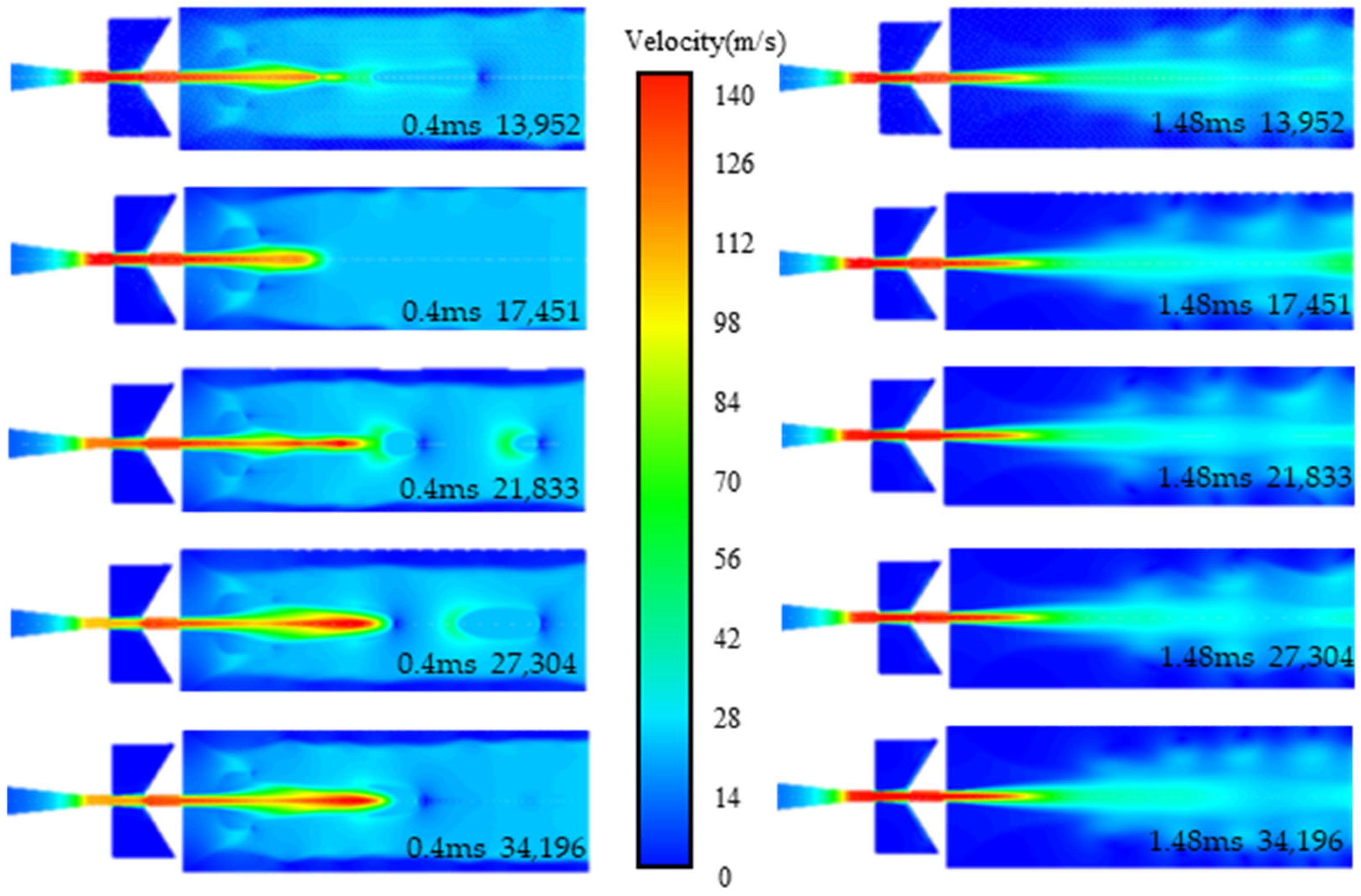
The accuracy of the calculation results is closely related to the mesh size [35]. If the mesh size is too large, fine details in the flow field may be obscured, leading to blurred jet boundaries and inaccurate measurements. Conversely, overly small grid sizes may facilitate data detection during simulation but can significantly prolong computation time and waste resources. Hence, it is imperative to ensure mesh independence to determine the most suitable mesh size and quantity. In this study, we initiated with a base grid count of 13,952, increasing by 25% with each subsequent iteration. The optimal mesh size was determined when the discrepancy error fell below 5%. Mesh sizes were set at 0.33678 mm, 0.3 mm, 0.2662 mm, 0.23655 mm, and 0.21 mm, corresponding to mesh counts of 13,952, 17,451, 21,833, 27,304, and 34,196, respectively.
The nozzle structure parameters are described in Section 3.2, and the inlet pressure is set to 10 MPa. The effect of different grid numbers on the flow field is shown in Figure 4. As shown in Figure 4, with increasing grid numbers, the velocity field exhibits distinct trends, while the boundary layer vortex and jet boundary become clearer. Notably, when the grid count is below 21,833, the jet boundary becomes unclear, leading to poor pulsation. Thus, a grid count of at least 21,833 is recommended.
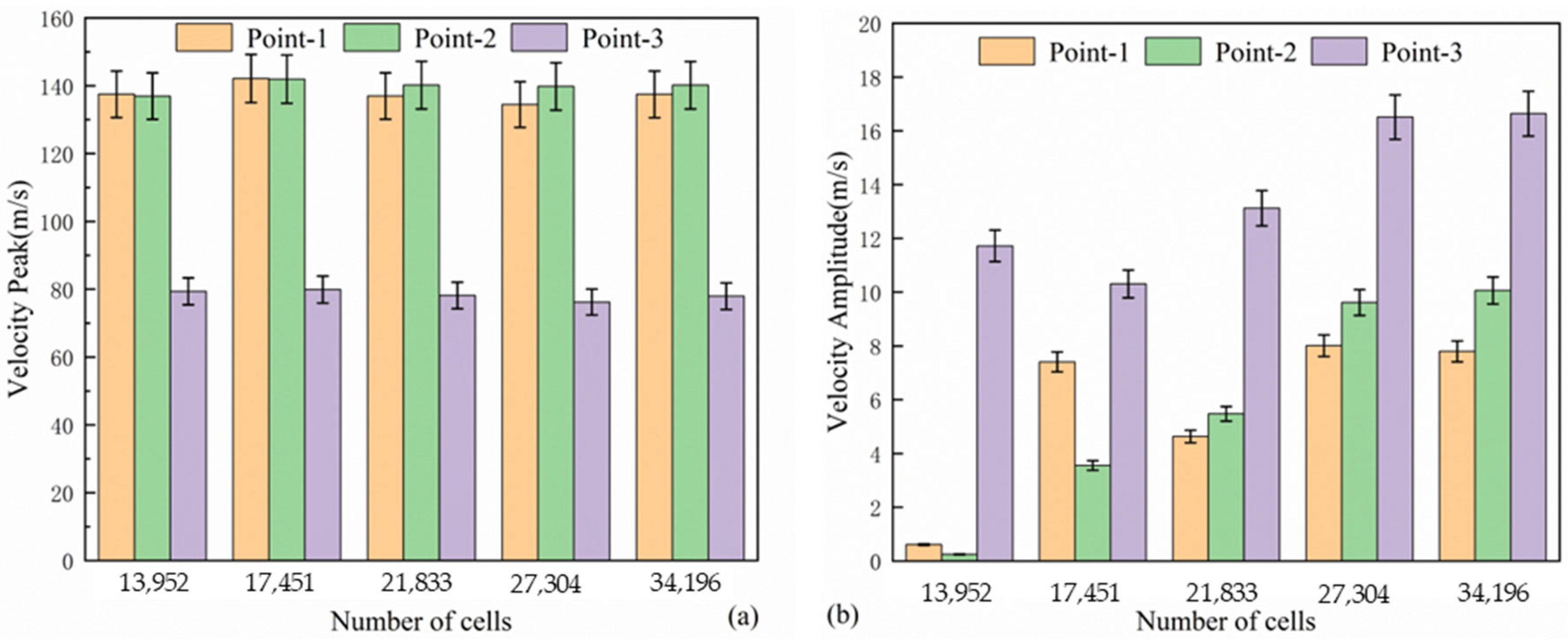
This study focuses on SOPW amplitude, pulsed jet peak value, and nozzle’s flow enhancement effect. Monitoring velocity at the upstream nozzle center, downstream nozzle center, and 20 mm from the downstream nozzle outlet, labeled as Point-1, Point-2, and Point-3, respectively, provides insights. In Table 1, the velocity differences between the monitoring points (Point-1, Point-2, and Point-3) represent the variations in the flow velocity observed at different positions within the pulsed waterjet flow field. The velocity differences between these points reflect the changes in flow velocity as the jet travels from the upstream nozzle through the oscillation chamber and out of the downstream nozzle. These differences are crucial for understanding the dynamics of the jet as it evolves under the influence of various nozzle structural parameters. A positive velocity difference indicates that the jet velocity at the downstream monitoring point is higher than at the upstream point, suggesting enhanced acceleration or entrainment in the flow. A negative velocity difference suggests that the jet velocity has decreased as it moves downstream, which could be due to factors such as energy dissipation, increased flow resistance, or cavitation effects. A zero or near-zero velocity difference would imply that the flow velocity remains relatively constant between the two monitoring points, indicating a stable jet with minimal loss of momentum over the measurement distance.
Figure 5 depicts the peak velocity and velocity amplitude of these points under various grid counts. It can be seen from Figure 5a that there is minimal variation in peak values across different grid counts, all within acceptable error margins. Conversely, Figure 5b shows significant velocity amplitude fluctuations occur, yet when the grid count reaches 34,196, the amplitude aligns within the error range of 27,304 grids. Thus, the optimal grid count should not be less than 27,304.
Table 1 shows the enhancement effect of the nozzle on the incoming flow. Notably, at grid counts of 21,833 and 34,196, the nozzle enhances incoming flow velocity. Considering the analysis of grid count impacts on peak velocity and velocity amplitude, 34,196 grids with a size of 0.21 mm emerge as optimal. This configuration ensures stable velocity variations and facilitates monitoring of the nozzle’s flow enhancement effect.

4. Results and Discussion

4.1. Optimization of Nozzle Structure Parameters

4.1.1. Optimization of Oscillation Chamber Length

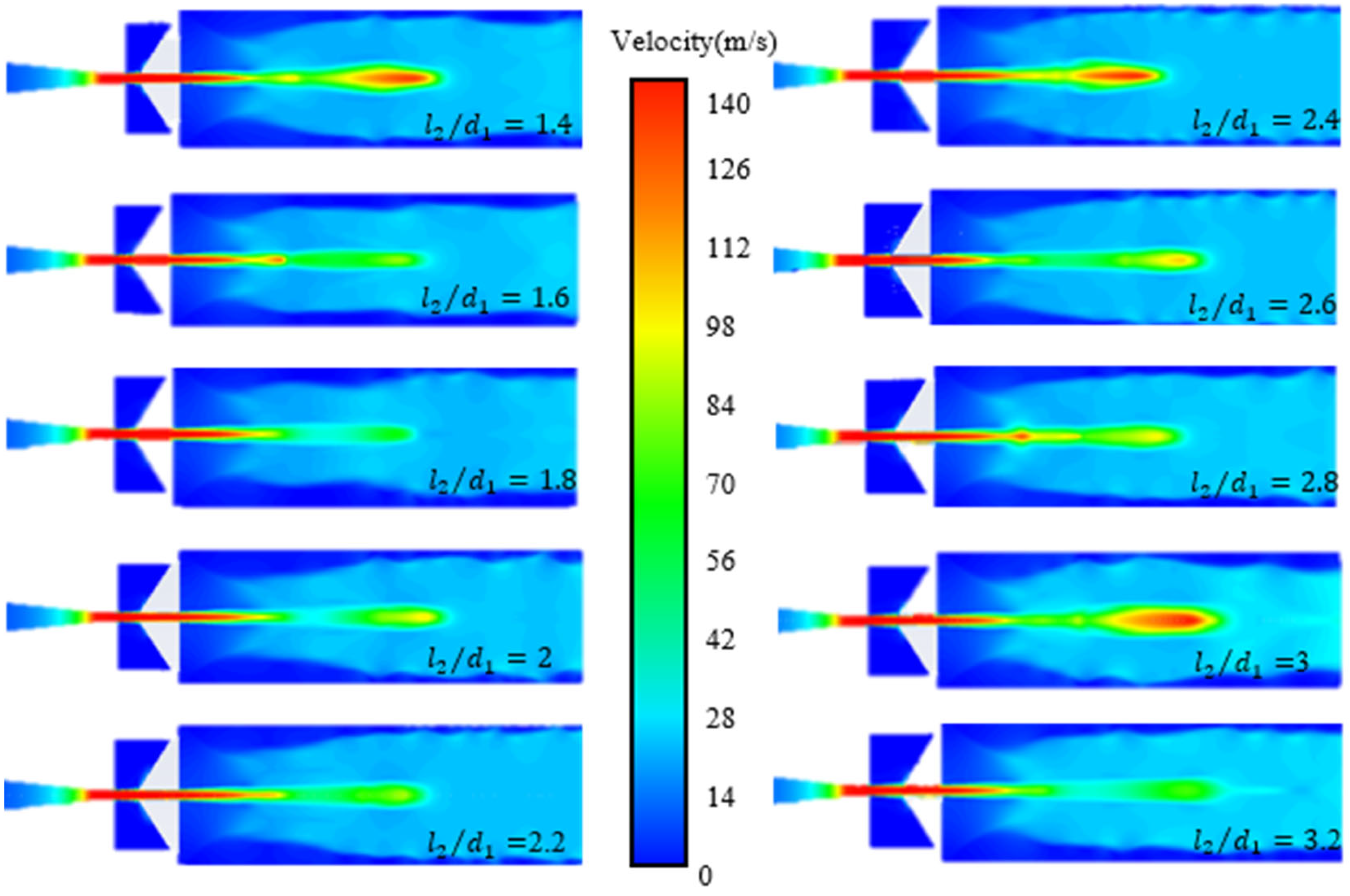
The study examines the impact of oscillating chamber length on pulsed jet characteristics under an inlet pressure of 10 MPa, with other structural parameters outlined in Section 3.2 and specific research conditions detailed in Table 2. The variation in the flow field with the length of the oscillating chamber is shown in Figure 6. As the chamber length increases, the number of water cannons initially rises and then declines. With a shorter oscillation chamber, rapid flow from the upstream to downstream nozzle limits vortex development, preventing effective feedback and continuous pulsed jet generation. In contrast, excessive chamber length results in energy dissipation before effective feedback can occur, indicating an optimal range for maximizing outlet velocity and achieving desired oscillation effects.
It can be seen from Figure 6 that noticeable velocity concentration areas emerge at ratios of chamber length to upstream nozzle diameter of 1.4, 1.6, and 1.8, possibly due to the presence of gas within the nozzle. Additionally, thinner shear layers suggest weaker disturbance, particularly evident when the ratio is 2, 2.2, and 2.4, where strong pulsed water cannons form, accompanied by significant disturbance in the shear layer. At ratios of 2.6, 2.8, and 3, a three-time pulse water cannon emerges, with optimal oscillation effects observed at a ratio of 2.6. Thus, qualitative analysis suggests an optimal ratio of oscillation chamber length to upstream nozzle diameter of 2.6.
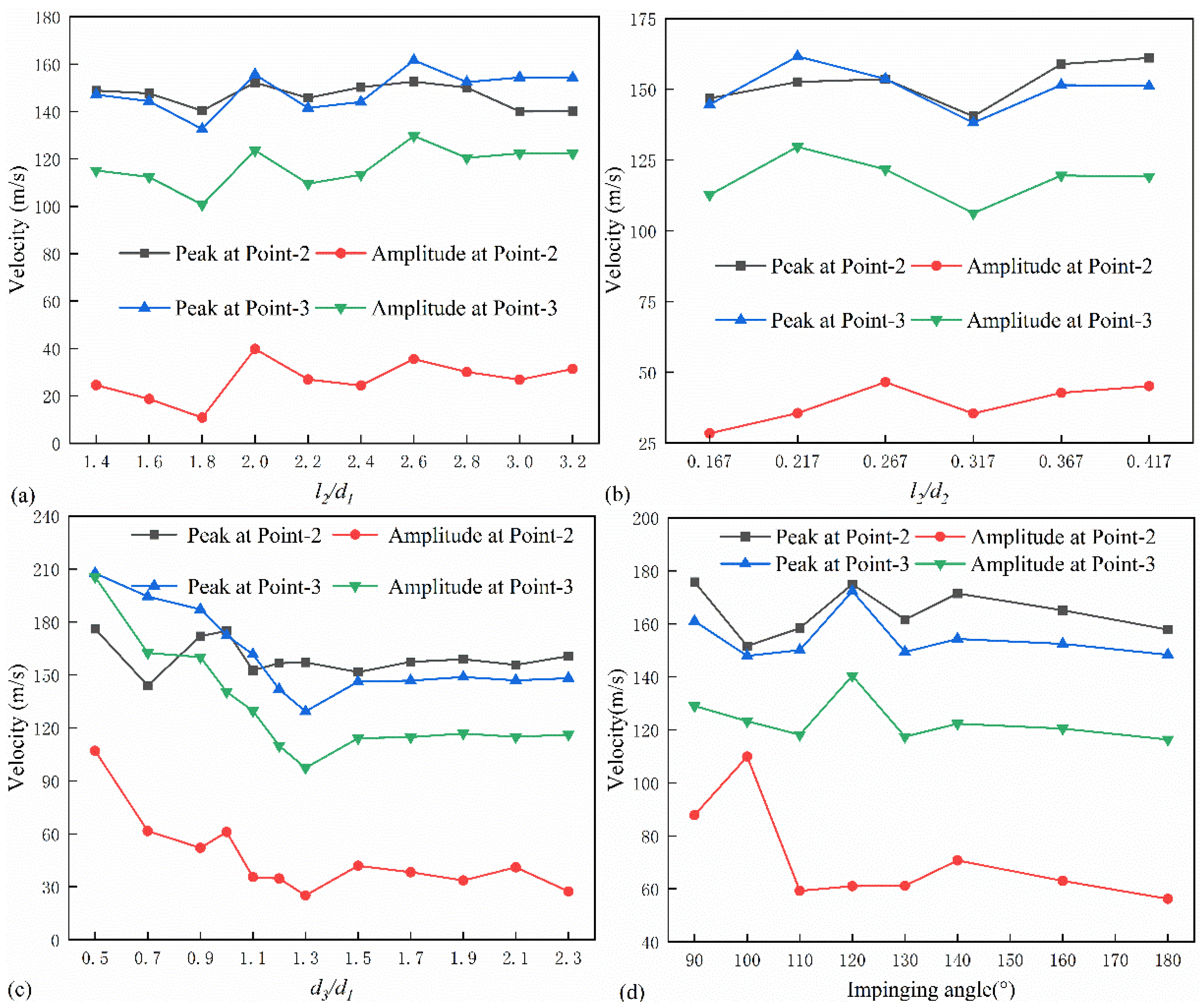
To quantitatively assess the optimal parameters of the oscillation chamber length, Figure 7a delineates the impact of various chamber lengths on both the nozzle outlet and flow field velocity. As depicted, the velocity at both the nozzle outlet and in the flow field fluctuates and gradually increases with increasing chamber length. Notably, when the ratio of chamber length to upstream nozzle diameter is 2 and 2.6, peak velocity and amplitude reach maximum values; at the same time, a ratio of 2.6 yields the highest velocity in the flow field. Considering the practical distance between the nozzle and the target, it is crucial to account for flow field pulsation at monitoring points. Based on simulation results from 10 groups, both qualitative and quantitative analyses converge, identifying the optimal oscillating chamber length as 5.2 mm.

4.1.2. Optimization of Oscillation Chamber Diameter

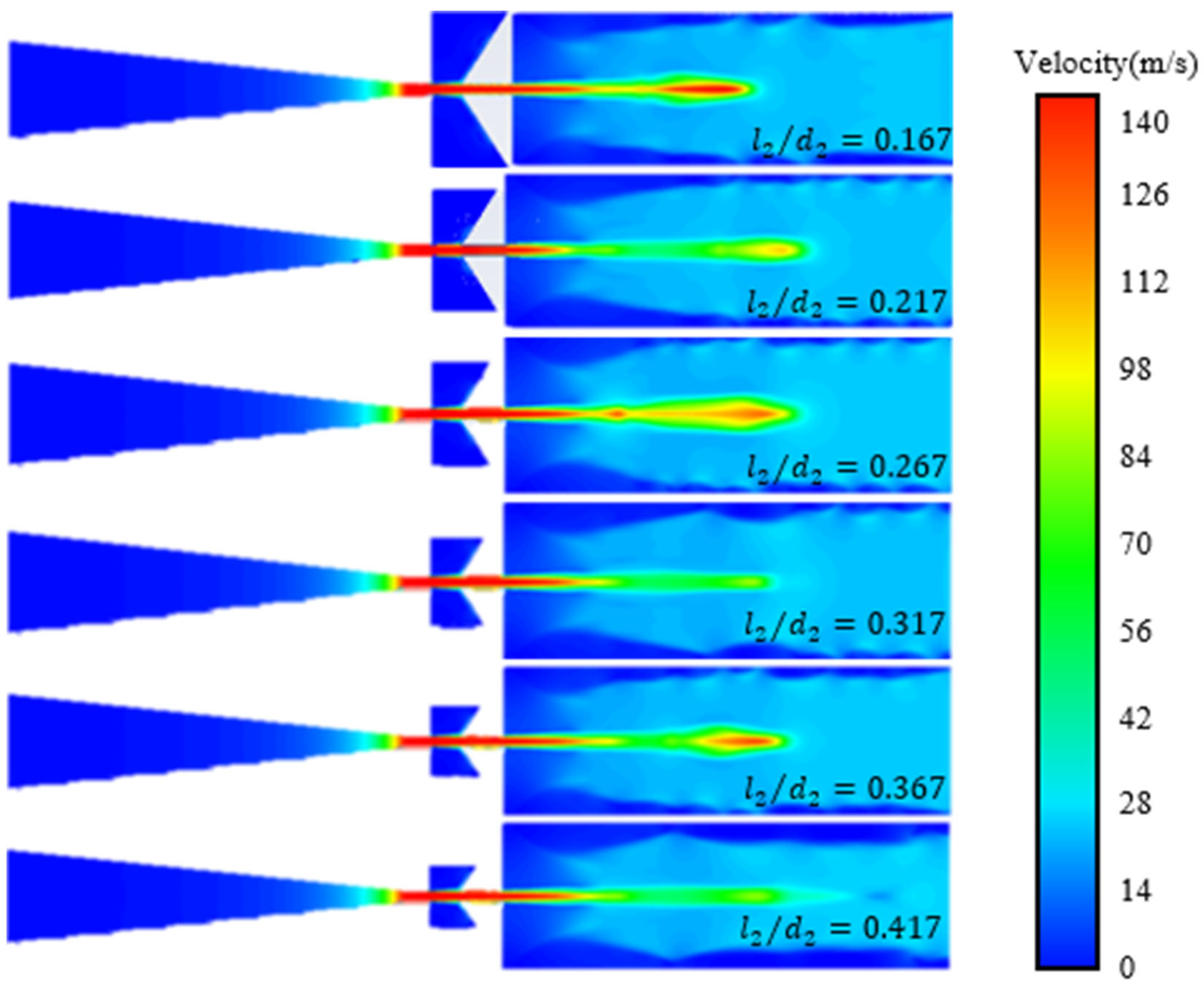
The research conditions are shown in Table 3. The variation in the velocity distribution in the flow field with the chamber diameter is shown in Figure 8. Altering the chamber diameter induces fluctuations in both the quantity and intensity of the resulting pulsed water jets. Extremes in chamber diameter will lead to ineffective feedback mechanisms: overly long diameters dissipate feedback energy prematurely, while excessively small diameters prevent the formation of fluid vortex rings. It can be seen from Figure 8 that ratios of 0.217 and 0.267 yield more consistent pulsed water jets, with the former ratio producing a more continuous pulse jet. Therefore, the optimal ratio of the oscillation chamber length to the chamber diameter is 0.217 by qualitative analysis.
It can be seen from Figure 7b that the nozzle outlet velocity and flow field monitoring point velocity exhibit a nonlinear trend with increasing ratio of oscillating chamber length to diameter. Initially, there is a rise, followed by a decline, and then another increase. When the ratio is 0.217, the peak velocity of the nozzle outlet, the peak, and the amplitude of the flow field reach maximum. Hence, the optimal oscillation chamber diameter is determined to be 24 mm.

4.1.3. Optimization of Downstream Nozzle Diameter

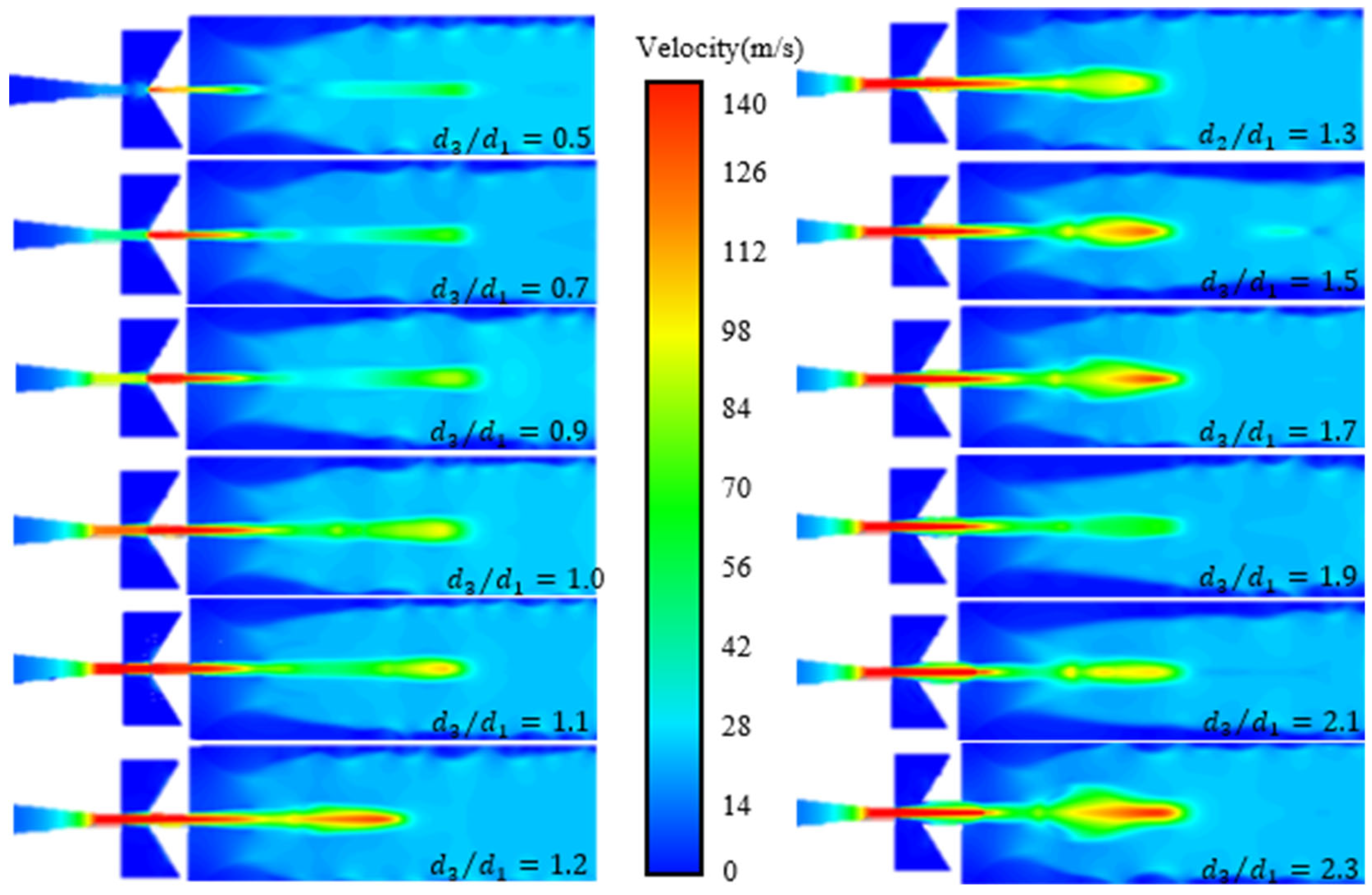
The research conditions are shown in Table 4. The variation in velocity distribution with the diameter of the downstream nozzle is shown in Figure 9. A smaller downstream nozzle diameter results in rapid chamber filling, leading to increased flow resistance and reduced outlet velocity. Conversely, a larger downstream nozzle diameter yields minimal flow reflection, failing to generate effective feedback. As shown in Figure 9, when the ratio of the diameter of the downstream nozzle to the diameter of the upstream nozzle is less than 1, both velocity and pressure of the pulsed jet are diminished, indicating lower jet energy. On the other hand, when the ratio exceeds 1.1, the pulsed velocity increases, expanding the action range of the water cannon but reducing its effective distance. Thus, qualitative analysis suggests that the optimal ratio of downstream to upstream nozzle diameter should be around 1 or 1.1, corresponding to downstream nozzle diameters of 2 mm or 2.2 mm, respectively.
Further quantitative analysis was conducted to investigate the effect of downstream nozzle diameter on flow velocity. As depicted in Figure 7c, increasing the downstream nozzle diameter initially leads to a decrease in monitoring point velocity, followed by a plateau, indicating diminishing influence of diameter enlargement on pulsed velocity. Notably, when the downstream nozzle diameter to upstream nozzle diameter ratio exceeds 1.1, velocity changes become progressively gentler. Thus, the optimal downstream nozzle diameter to upstream nozzle diameter ratio is 1, with a downstream nozzle diameter of 2 mm.

4.1.4. Optimization of Impinging Angle of Collision Wall

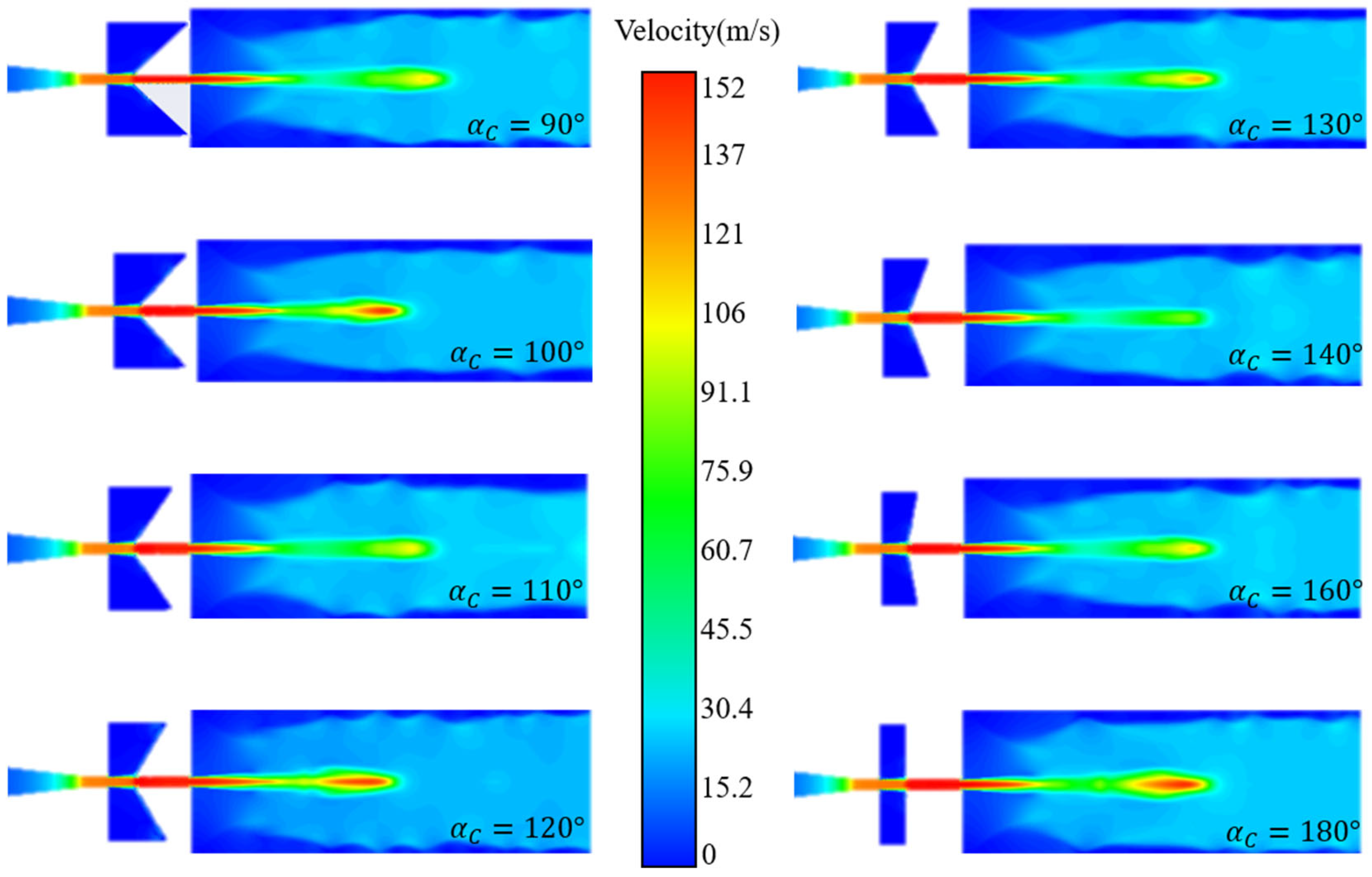
The research conditions are shown in Table 5. The variation in the velocity with the impinging angle is shown in Figure 10. A smaller impinging angle leads to higher energy consumption upon reaching the collision wall, hindering effective feedback formation. Conversely, with larger impinging angles, effective feedback formation occurs, albeit with varying effects. Notably, when the angle is below 120°, boundary layer disturbance is minimal, resulting in poor pulsation effects. As shown in Figure 7d, the velocity of the monitoring point trends upwards initially with increasing collision wall angle before declining. At an impinging angle of 120°, the peak velocity and pulsation effects in the flow field are maximized. Thus, considering qualitative analysis results, the optimal impinging angle is determined to be 120°.

4.1.5. Optimization of Nozzle Structure Parameters Under Different Pressures

Based on the parameter optimization results, at a nozzle inlet pressure of 10 MPa, the optimal structural parameters for the nozzle are as follows: upstream nozzle diameter of 2 mm, chamber length of 5.2 mm, chamber diameter of 24 mm, downstream nozzle diameter of 2 mm, and an impinging angle of 120°. When compared with relevant experimental findings [10], it is evident that optimizing Helmholtz nozzle parameters primarily requires attention to oscillation chamber length and downstream nozzle diameter. The research conditions are shown in Table 6.
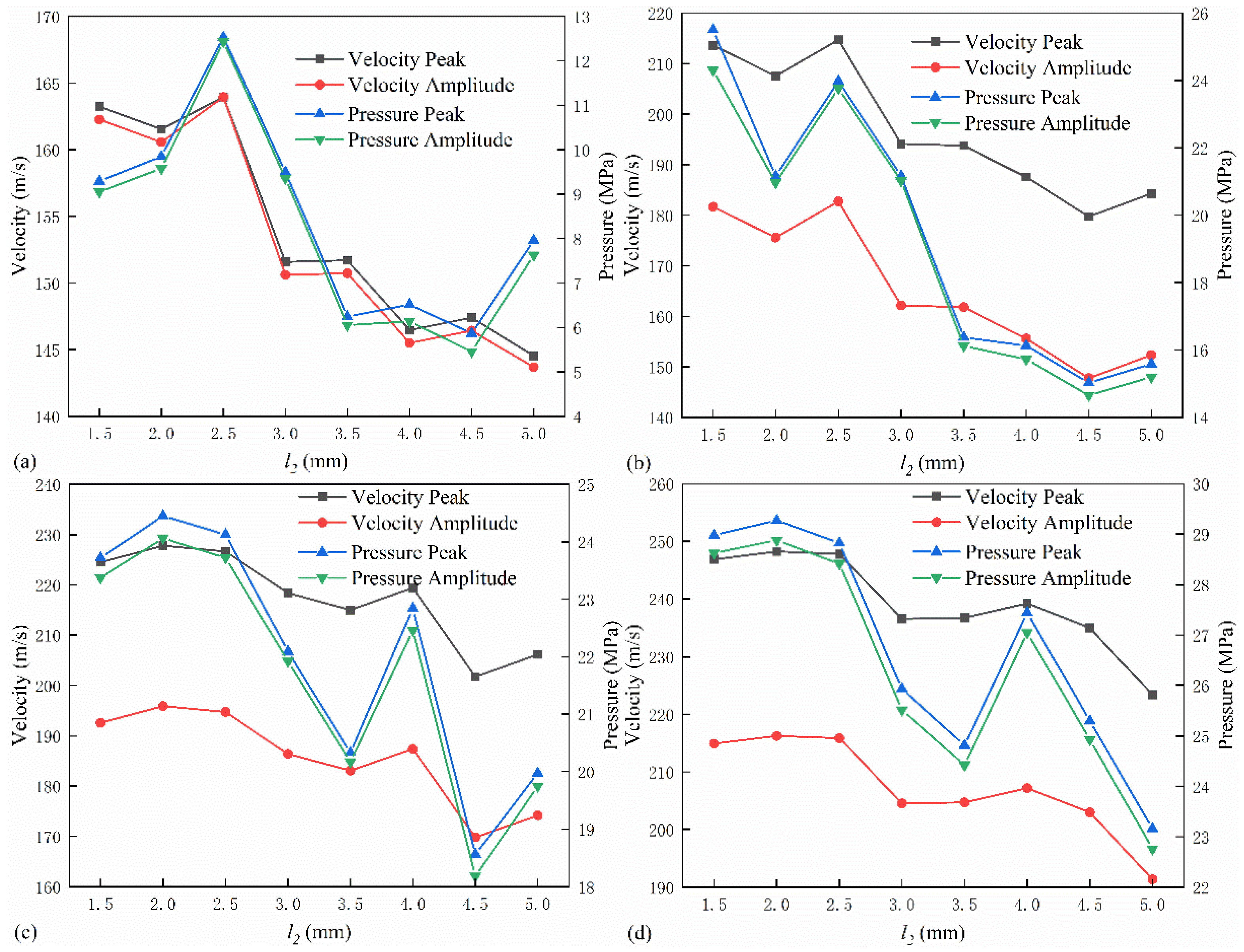
The velocity and pressure variation in the pulsed jet flow field with oscillating chamber length under different pressures is depicted in Figure 11. As the inlet pressure increases, the velocity and pressure at both the nozzle outlet and within the flow field also rise, leading to increased energy within the system. The oscillation chamber length plays a critical role in balancing the energy available for vortex formation and the dissipation of energy within the chamber. At lower pressures, a shorter chamber length (e.g., 2.5 mm for 15 MPa pressure) is sufficient to generate adequate vortex feedback, maximizing jet performance with minimal energy loss. However, as the pressure increases, the jet energy becomes higher, and a longer oscillation chamber (e.g., 5.2 mm at 10 MPa) is required to allow for the complete development of vortices and to sustain the required pulsation without excessive energy dissipation. As shown in Figure 11a, as the oscillating chamber length increases, peak velocity and amplitude fluctuation of monitoring points decrease, while flow field pressure initially increases and then decreases. At a 2.5 mm chamber length, the pressure in the flow field reaches the maximum. Thus, for optimal SOPW, a 2.5 mm oscillation chamber length is ideal at 15 MPa pressure. As shown in Figure 11b, longer oscillating chamber lengths lead to lower velocity and pressure in the flow field. However, at a 2.5 mm chamber length, both velocity and pressure in the flow field are higher. Similarly, as shown in Figure 11c, at 25 MPa inlet pressure and a 2.5 mm chamber length, monitoring points record higher pressure and velocity. As shown in Figure 11d, at 25 MPa inlet pressure and a 2.5 mm chamber length, monitoring points record higher pressure and velocity.
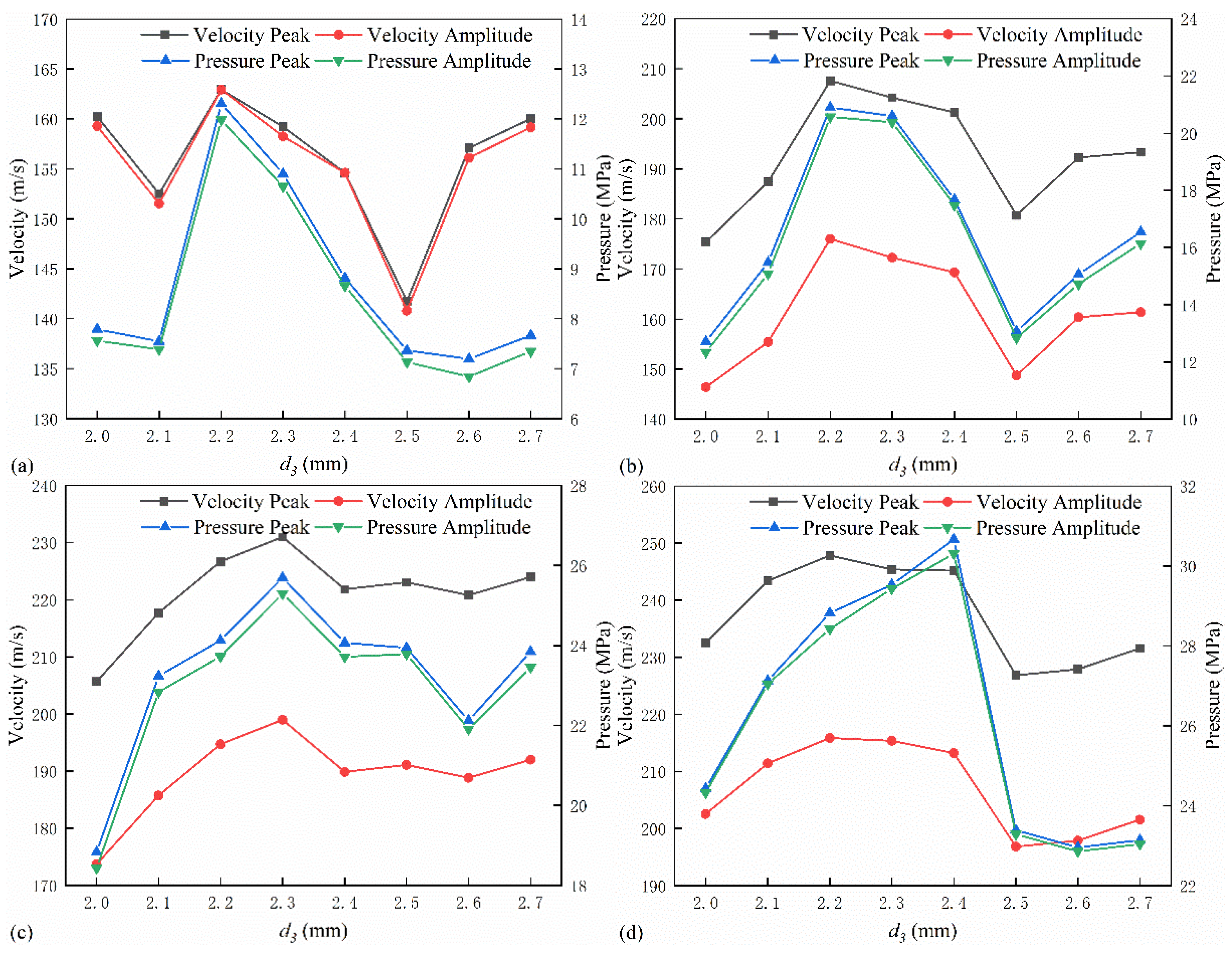
The velocity and pressure variation in the pulsed waterjet flow field with the downstream nozzle diameter under different pressures is depicted in Figure 12. Similarly, the downstream nozzle diameter also exhibits a dependency on inlet pressure. As the pressure increases, the downstream nozzle diameter needs to be optimized to control the expansion of the jet. A smaller nozzle diameter tends to restrict the jet’s exit velocity, while a larger diameter may cause the jet to expand too quickly, reducing the effectiveness of the pulsed jet. At lower pressures, a smaller downstream nozzle diameter (e.g., 2 mm at 10 MPa) is sufficient to maintain the necessary jet velocity and pressure. However, as the inlet pressure increases, the larger energy input requires a larger downstream nozzle diameter (e.g., 2.4 mm at 30 MPa) to accommodate the increased flow rate and reduce the potential for excessive jet expansion, ensuring that the jet maintains its focused, high-energy characteristics over a longer distance. It can be seen from Figure 12 that at 15 MPa inlet pressure, the optimal downstream nozzle diameter is 2.2 mm. Similarly, at 20 MPa inlet pressure, the optimal diameter remains 2.2 mm. At 25 MPa inlet pressure, the optimal diameter increases to 2.3 mm, and at 30 MPa, it further increases to 2.4 mm. The optimal structural parameters of the nozzle under different pressures obtained through numerical simulation are summarized in Table 7.

4.2. Experimental Validation

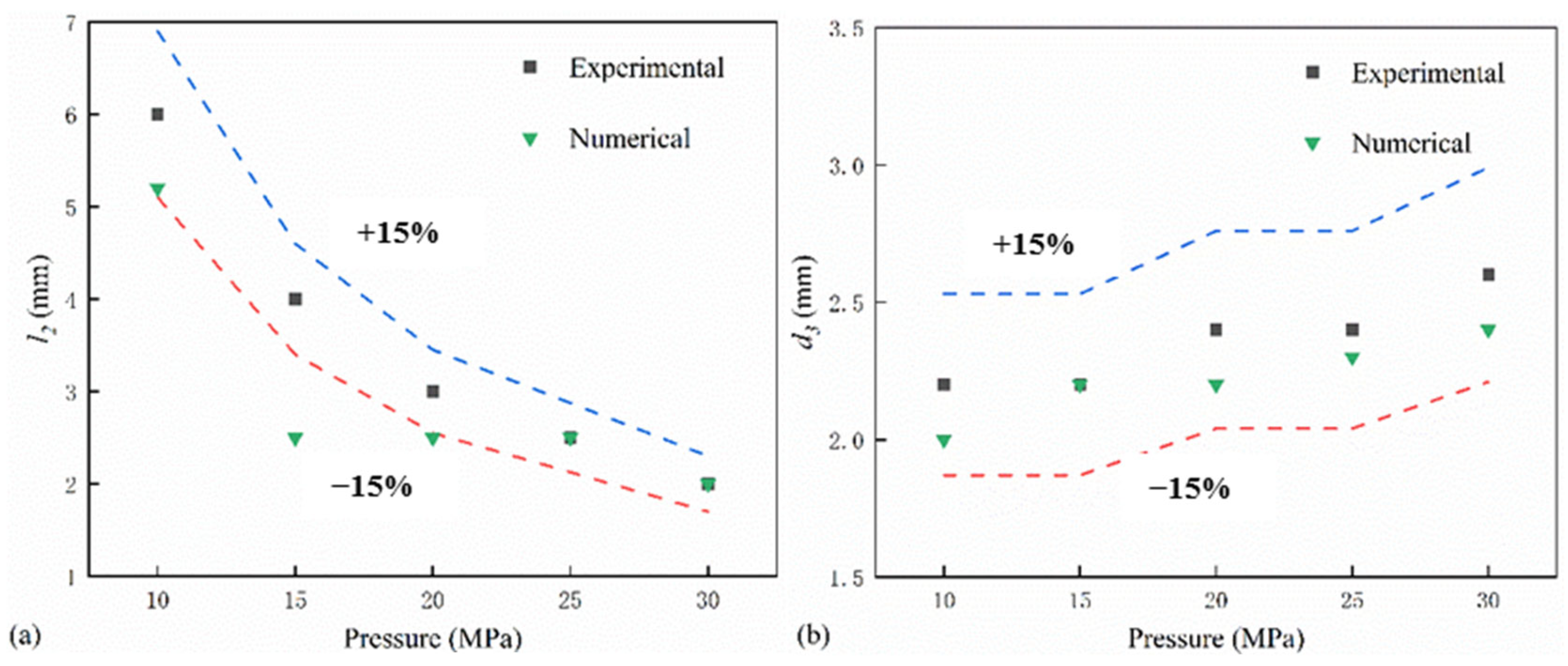
The accuracy of numerical results is verified, establishing a groundwork for exploring the effect of area discontinuity at the nozzle inlet on the flow field characteristics of the pulsed jet. Optimal nozzle structure parameters under varying pressures are cross-referenced with experimental data sourced from previous studies [10]. The comparison between the numerical and experimental results is shown in Figure 13. Notably, the numerical outcomes closely align with experimental findings, with errors typically not exceeding 15%. This consistency underscores the reliability of the numerical results.

4.3. Effect of Area Discontinuity at Nozzle Inlet on Flow Field Characteristics

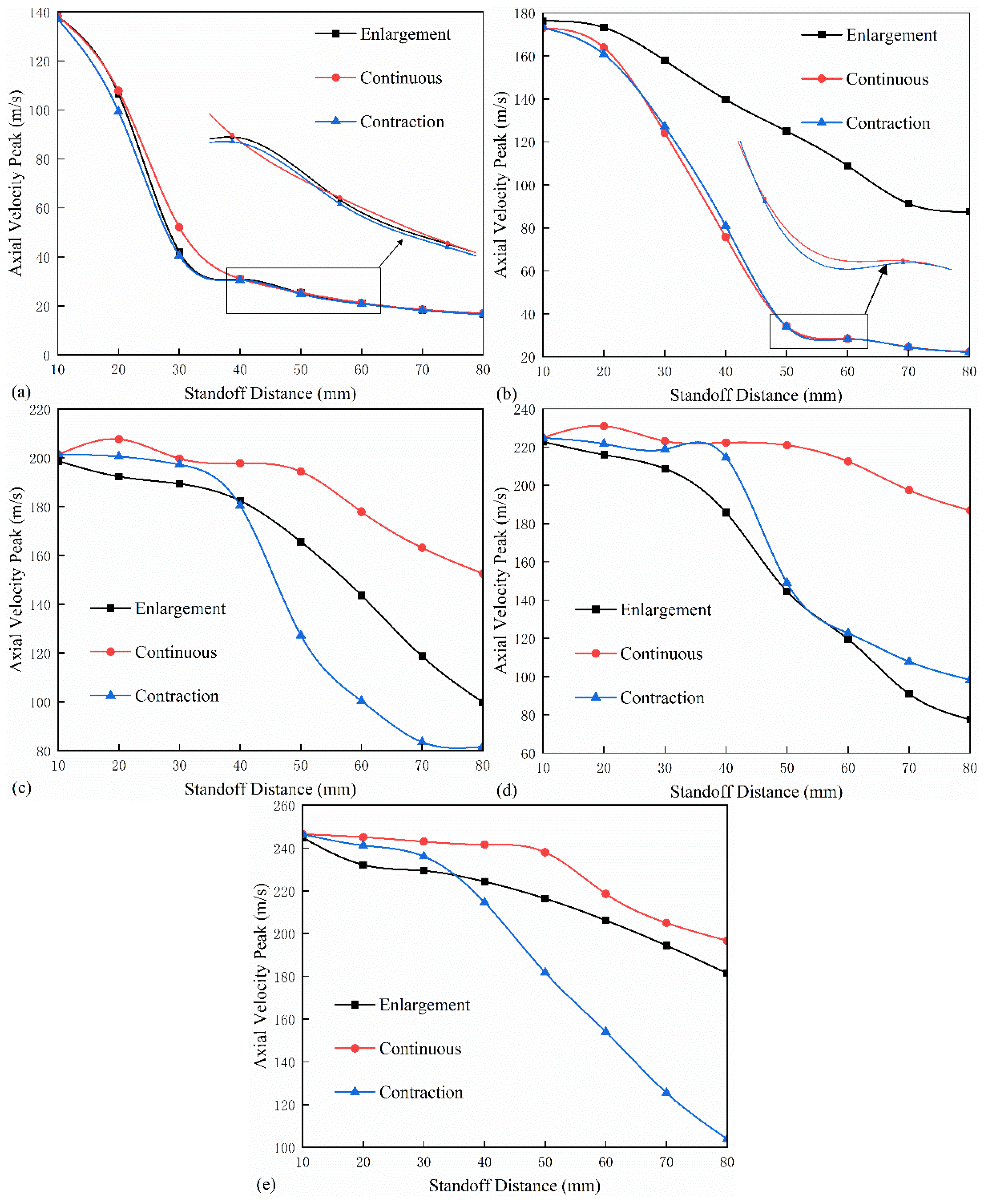
Figure 14 illustrates the impact of area discontinuity at varying distances on axial velocity peak under five inlet pressures. It is evident that as standoff distance increases, the axial velocity peak generally declines, albeit at different rates. It is evident that as standoff distance increases, the axial velocity peak generally declines, albeit at different rates [10]. This largely depends on the greater resistance of the water jet under submerged conditions, the faster the energy consumption, and the faster the water jet dissipates in the environmental medium. The observed variation in flow field characteristics between different media mirrors that of continuous jets, affirming the similarity in flow field structure between pulsed and continuous water jets [23].
The area discontinuity at the nozzle inlet significantly impacts the peak velocity, contingent upon the standoff distance and inlet pressure. At lower inlet pressures (10 MPa), the area enlargement and contraction at the nozzle inlet lead to an increase in the axial velocity peak under specific conditions, particularly at intermediate standoff distances (e.g., 40–50 mm). When the nozzle area is enlarged, the sudden expansion of the nozzle causes the flow to accelerate rapidly as it enters the nozzle, especially at lower pressures. This results in increased kinetic energy of the jet, leading to a higher velocity peak at these distances. The energy gain from the flow acceleration is more pronounced at lower pressures, where the fluid is less likely to experience significant energy dissipation due to turbulence and resistance. The enlargement or contraction of the nozzle also alters the flow structure, leading to more effective vortex formation in the nozzle. At lower pressures, this vortex formation enhances the feedback mechanism of the pulsed jet, amplifying the velocity and increasing the oscillation intensity. This contributes to the higher velocity peaks observed at standoff distances of 40–50 mm. At lower inlet pressures, the jet’s energy is not dissipated as rapidly due to reduced flow resistance. As a result, the jet can retain more of its kinetic energy, contributing to the enhanced velocity peaks observed with area discontinuity at standoff distances around 40–50 mm. Conversely, at other standoff distances, the continuous joint nozzle exhibits higher peak velocities than the discontinuous joint nozzle.
As shown in Figure 14b,c the inlet enlargement nozzle notably boosts axial velocity, particularly at a distance of 50 mm where the peak velocity sees the most substantial increase. However, for distances ranging from 30 mm to 50 mm, the inlet contraction nozzle yields a modest increase in axial velocity. As shown in Figure 14c–e, area enlargement and contraction play contrasting roles in enhancing oscillation intensity. Moreover, compared to inlet pressures of 10 MPa and 15 MPa, the decrease in velocity peak is significantly slower. At higher inlet pressures (30 MPa), the influence of area discontinuity on the velocity peak reverses, inhibiting the increase in velocity and leading to velocity suppression. As the inlet pressure increases, the fluid enters the nozzle at much higher speeds. When the nozzle area is enlarged or contracted, the rapid expansion or contraction of the flow leads to significant turbulence and higher energy dissipation. The high-speed flow interacting with the discontinuous region increases turbulent mixing, which results in momentum loss and reduces the axial velocity peak. At higher pressures, the jet’s momentum is stronger, but enlarging the nozzle diameter leads to unnecessary divergence of the jet, causing the energy of the flow to spread out. This spreading reduces the concentration of the jet’s energy at the nozzle exit, resulting in a lower velocity peak. Conversely, when the nozzle diameter is contracted, the flow experiences higher resistance, leading to energy losses and a reduction in the velocity peak. The increased turbulence at higher pressures disrupts the feedback mechanism that is essential for maintaining the pulsed jet’s velocity. This disruption, combined with the higher energy losses due to increased resistance and turbulence, results in the observed inhibition of the velocity peak at higher pressures.
That is to say, at relatively lower inlet pressures, area enlargement and contraction can potentially boost the axial velocity peak, contingent upon the standoff distance and inlet area type. Conversely, at higher inlet pressures, they impede peak increase. This is because under higher inlet pressure, fluid traverses the discontinuous region at high speeds, leading to intense turbulence and accelerated momentum exchange. Consequently, this heightened disturbance increases energy loss, resulting in a decrease in peak velocity.

5. Conclusions

Based on the theoretical analysis of the oscillation characteristics of the pulsed waterjet, this study optimized nozzle structures under various pressures and validated numerical results. The main results of this study are as follows:
(1)
The natural frequency of self-excited oscillation nozzles correlates with the cross-sectional area and inversely with the length of the oscillation chamber and downstream nozzle. Adjusting these parameters can enhance pulsed jet strength, particularly with lower power plunge pumps.
(2)
For an inlet pressure of 10 MPa, optimal structural parameters include a 2 mm upstream nozzle diameter, 5.2 mm oscillation chamber length, 24 mm oscillation chamber diameter, 2 mm downstream nozzle diameter, and 120° impinging angle.
(3)
Oscillation chamber length and downstream nozzle diameter significantly influence oscillation characteristics under different pressures. Numerically simulated optimal parameters closely align with experimental trends, with errors under 15%.
(4)
Compared to non-submerged pulsed jets, submerged pulsed jets exhibit faster velocity peak decline, attributed to increased water jet resistance, quicker energy consumption, and rapid dissipation in the surrounding medium.
(5)
The area discontinuity of the nozzle inlet significantly impacts axial velocity peak, largely influenced by standoff distance and inlet pressure. At lower pressures, area enlargement or contraction may enhance peak velocity, while at higher pressures, it tends to inhibit peak value increase.
This study is the first to systematically apply the analogy method to analyze the oscillation characteristics of the Helmholtz nozzle, and a transfer function model has been developed. This model provides a new theoretical tool for understanding and predicting the natural frequency of self-excited oscillation pulsed water jets. Additionally, the study reveals the dual regulation mechanism of nozzle inlet area discontinuity on the flow field. Contrary to conventional understanding, this research demonstrates that the effect of inlet area discontinuity is not fixed but strongly dependent on the inlet pressure. This finding provides key theoretical support for actively controlling jet performance through inlet design.
Despite the meaningful conclusions drawn from this study, there are still some limitations. First, to save computational resources, a two-dimensional axisymmetric model was used, which may overlook certain asymmetric vortex structures and their evolution in a real three-dimensional flow field. The stability of the system’s dynamic behavior is an important aspect that should be analyzed in detail. Although the Hurwitz criterion was not explicitly applied in this study, we recognize its value in assessing system stability. Future work should incorporate this method to rigorously analyze the conditions under which the system may exhibit stable or unstable oscillations, particularly in the presence of nonlinear dynamics and varying operating conditions.
Second, experimental validation primarily focused on the oscillation chamber length and downstream nozzle diameter, while comprehensive experimental verification of other parameter combinations remains a future task. Future research can also focus on fine simulation of three-dimensional transient flow fields and intelligent pulsed jet experimental techniques based on data-driven sensor networks [36,37]. Moreover, the linear equations used in this model do not fully capture the nonlinear dynamics of the system, such as turbulence, cavitation, and nonlinear damping. Future work could involve developing nonlinear models to better represent these complex interactions. The traditional approach does not account for the actual forces acting on the system’s elements, including fluid–structure interactions and turbulent forces. Future models could integrate CFD simulations and cavitation models to better capture the real forces at play.


Author Contributions

Conceptualization, C.F.; methodology, C.F.; software, C.F.; validation, K.L.; formal analysis, K.L.; investigation, K.L.; data curation, C.F.; writing—original draft preparation, C.F.; writing—review and editing, L.K.; visualization, C.F.; supervision, L.K.; project administration, L.K.; funding acquisition, C.F. All authors have read and agreed to the published version of the manuscript.

Funding

This research was funded by Inner Mongolia University of Technology scientific research start-up gold project, grant number DC2500003537.

Data Availability Statement

The data presented in this study are available on request from the corresponding author.

Acknowledgments

The authors sincerely acknowledge the researchers for their excellent work, which greatly assisted their academic study.

Conflicts of Interest

The authors declare no conflicts of interest.

Nomenclature

Latin Alphabet L t Hydraulic diameter
A Cross-section l Length
a Local sound speed l 4 Length of the fluid domain
B Damping l 5 Width of the fluid domain
C Hydraulic capacitance m Mass
D Pipe diameter m ˙ + Condensation rate of water
d i Upstream nozzle inlet diameter m ˙ Evaporation rate of water
d Diameter p Pressure
f Volume force R Hydraulic resistance
f h ( t ) Equivalent differential pressure S k Self-defined turbulent kinetic energy
G b Turbulent kinetic energy generated by buoyancy S ε Self-defined turbulent dissipation
G k Turbulent kinetic energy generated by velocity gradient u i Velocity vector
I Turbulent intensity V Volume
K Spring stiffness v Fluid velocity
L Hydraulic inductance Y M Effect of turbulent expansion on dissipation rate
Greek Letters
a c Collision wall cone angle ρ Fluid density
δ Frequency correction factor of 0.6 τ i j Stress tensor
θ Angle of upstream nozzle ω n Natural frequency
μ Dynamic viscosity
Subscripts
0 Helmholtz resonator inlet 2 Oscillation chamber
1 Upstream nozzle 3 Downstream nozzle

References

  1. Jakub, P.; Akash, N.; Tomáš, K.; Sergej, H. Effects of liquid droplet volume and impact frequency on the integrity of Al alloy AW2014 exposed to subsonic speeds of pulsating water jets. Wear 2022, 488–489, 204136. [Google Scholar]
  2. Monika, S.; Wojciech, K.; Kamil, B.; Przemysław, J.B.; Wiesław, S. Analysis of the pulsating properties of a high-pressure water jet generated in a self-excited head for erosion processing. Arch. Civ. Mech. Eng. 2023, 23, 1–16. [Google Scholar]
  3. Monika, S.; Wojciech, K.; Kamil, B.; Frank, P.; Andrzej, P.; Konrad, W.; Grzegorz, K. Assessment of the effectiveness of high-pressure water jet machining generated using self-excited pulsating heads. Int. J. Adv. Manuf. Technol. 2024, 133, 5029–5051. [Google Scholar]
  4. Li, D.; Kang, Y.; Wang, X.; Ding, X.; Fang, Z. Effects of nozzle inner surface roughness on the cavitation erosion characteristics of high speed submerged jets. Exp. Therm. Fluid Sci. 2016, 74, 444–452. [Google Scholar] [CrossRef]
  5. Zhou, Z.; Ge, Z.; Lu, Y.; Zhang, X. Experimental study on characteristics of self-excited oscillation pulsed. J. Vibroeng. 2017, 19, 1345–1357. [Google Scholar] [CrossRef]
  6. Yuan, M.; Li, D.; Kang, Y.; Shi, H.; Hu, Y. The Characteristics of Self-Resonating Jet Issuing from the Helmholtz Nozzle Combined with a Venturi Tube Structure. J. Appl. Fluid Mech. 2020, 13, 779–791. [Google Scholar] [CrossRef]
  7. Tang, C.; Hu, D.; Zhang, F. Study on the Frequency Characteristic of Self-Excited Oscillation Pulsed Water Jet. Adv. Mat. Res. 2011, 317–319, 1456–1461. [Google Scholar] [CrossRef]
  8. Li, H.; Liu, S.; Jia, J.; Wang, F.; Guo, C. Numerical simulation of rock-breaking under the impact load of self-excited oscillating pulsed waterjet. Tunneling Undergr. Space Technol. 2020, 96, 103179. [Google Scholar] [CrossRef]
  9. Wilson, T.A.; Beavers, G.S.; DeCoster, M.A.; Holger, D.K.; Regenfuss, M.D. Experiments on the Fluid Mechanics of Whistling. J. Acoust. Soc. Am. 1971, 50, 366–372. [Google Scholar] [CrossRef]
  10. Li, D.; Kang, Y.; Ding, X.; Wang, X.; Fang, Z. Effects of area discontinuity at nozzle inlet on the characteristics of high speed self-excited oscillation pulsed waterjets. Exp. Therm. Fluid Sci. 2016, 79, 254–265. [Google Scholar] [CrossRef]
  11. Cora, R.; Martins, C.A.; Lacava, P.T. Acoustic instabilities control using Helmholtz resonators. Appl. Acoust. 2014, 77, 1–10. [Google Scholar] [CrossRef]
  12. Ma, R.; Slaboch, P.E.; Morris, S.C. Fluid mechanics of the flow-excited Helmholtz resonator. J. Fluid Mech. 2009, 623, 1–26. [Google Scholar] [CrossRef]
  13. Xu, M.B.; Selamet, A.; Kim, H. Dual Helmholtz resonator. Appl. Acoust. 2010, 71, 822–829. [Google Scholar] [CrossRef]
  14. Fan, J.; Wang, Z.; Chen, S. Self-excited oscillation Frequency Characteristics of a Paralleled pulsed jet nozzle. Energy Procedia 2017, 141, 619–624. [Google Scholar] [CrossRef]
  15. Yuan, X.; Wang, N.; Wang, W.; Zhang, L.; Zhu, Y. Nozzle resonance mechanism and cooperative optimization of self-excited oscillating pulse cavitation jet. Trans. Can. Soc. Mech. Eng. 2023, 47, 74–88. [Google Scholar] [CrossRef]
  16. Zhang, X.; Li, X.; Nie, S.L.; Wang, L.; Dong, J. Study on velocity and pressure characteristics of self-excited oscillating nozzle. J. Braz. Soc. Mech. Sci Eng. 2021, 43, 5. [Google Scholar] [CrossRef]
  17. Geveci, M.; Oshkai, P.; Rockwell, D.; Lin, J.C.; Pollack, M. Imaging of the self-excited oscillation of flow past a cavity during generation of a flow tone. J. Fluid. Struct. 2003, 18, 665–694. [Google Scholar] [CrossRef]
  18. Fang, Z.; Kang, Y.; Yang, X.; Yuan, B.; Li, D. The influence of collapse wall on self-excited oscillation pulsed jet nozzle performance. In Proceedings of the 26th IAHR Symposium on Hydraulic Machinery and Systems, Beijing, China, 19–23 August 2012; IOP Publishing Ltd.: Bristol, UK, 2013; Volume 15, p. 052022. [Google Scholar]
  19. Wang, L.Q.; Wang, X.M.; Xu, R.L.; Li, J.Y. Experimental study on structural parameters optimized design of the self-excited oscillation pulsed jet nozzle. J. Eng. Thermophys. 2004, 25, 956–958. [Google Scholar]
  20. Zhang, S.; Fu, B.; Sun, L. Investigation of the Jet Characteristics and Pulse Mechanism of Self-Excited Oscillating Pulsed Jet Nozzle. Processes 2021, 9, 1423. [Google Scholar] [CrossRef]
  21. Wang, R.h.; Du, Y.k.; Ni, H.j.; Lin, M. Hydrodynamic analysis of suck-in pulsed jet in well drilling. J. Hydrodyn. 2011, 23, 34–41. [Google Scholar] [CrossRef]
  22. Hsiao, F.; Huang, J. On the Dynamics of Flow Structure Development in an Excited Plane Jet. J. Fluids Eng. 1994, 116, 714–720. [Google Scholar] [CrossRef]
  23. Thomas, F.O.; Goldschmidt, V.W. Interaction of an Acoustic Disturbance and a Two-Dimensional Turbulent Jet: Experimental Data. J. Fluids Eng. 1983, 105, 134–139. [Google Scholar] [CrossRef]
  24. Marzouk, S.; Ben, A.H.; Le, P.G. Numerical study of amplitude and frequency effects upon a pulsating jet. Comput. Fluids 2015, 123, 99–111. [Google Scholar] [CrossRef]
  25. Crow, S.C.; Champagne, F.H. Orderly structure in jet turbulence. J. Fluid Mech. 1971, 48, 547–591. [Google Scholar] [CrossRef]
  26. Morel, T. Experimental Study of a Jet-Driven Helmholtz Oscillator. J. Fluids Eng. 1979, 10, 383–390. [Google Scholar] [CrossRef]
  27. Hu, D.; Li, X.; Tang, C.; Kang, Y. Analytical and experimental investigations of the pulsed air-water jet. J. Fluid. Struct. 2015, 54, 88–102. [Google Scholar] [CrossRef]
  28. Flandoli, F. An introduction to 3D stochastic fluid dynamics. Lect. Notes Math. 2008, 1942, 51–150. [Google Scholar]
  29. Shur, M.L.; Spalart, P.R.; Strelets, M.K.; Travin, A.K. A hybrid RANS-LENS approach with delayed-DES and wall-modelled LES capabilities. Int. J. Heat Fluid Flow 2009, 29, 1638–1649. [Google Scholar] [CrossRef]
  30. Li, D.; Kang, Y.; Ding, X.; Liu, W. Effects of the geometry of impinging surface on the pressure oscillations of self-resonating pulsed waterjet. Adv. Mech. Eng. 2017, 9, 1. [Google Scholar] [CrossRef]
  31. Fu, Y.B.; Wang, X.L.; Zhang, S.Z.; Yang, Y. Modelling of Permeation Grouting considering Grout Self-Gravity Effect: Theoretical and Experimental Study. Adv. Mater. Sci. Eng. 2019, 2019, 7968240. [Google Scholar] [CrossRef]
  32. Zheng, F.; Ordon, R.L.; Scharton, T.D.; Kuznetsov, A.V.; Roberts, W.L. A New Acoustic Model for Valueless Pulsejets and Its Application to Optimization Thrust. J. Eng. Gas Turbines Power 2008, 130, 041501–041509. [Google Scholar]
  33. Kuwata, Y.; Suga, K.; Sakurai, Y. Development and application of a multi-scale k-epsilon model for turbulent porous medium flows. Int. J. Heat Fluid Flow 2014, 49, 135–150. [Google Scholar]
  34. Suluksna, K.; Juntasaro, E. Assessment of intermittency transport equations for modeling transition in boundary layers subjected to freestream turbulence. Int. J. Heat Fluid Flow 2008, 29, 48–61. [Google Scholar] [CrossRef]
  35. He, Y.; Wang, Y.; Zhang, D.; Xu, Y. Optimization design for turbodrill blades based on a twisting method. J. Petrol. Sci. Eng. 2021, 205, 108892. [Google Scholar]
  36. Sun, Z.; Yao, D.; Jin, H.; Xu, Y.; Huang, W.; Chen, H.; Li, K.; Shi, L.; Gu, J.; Zhang, Q.; et al. A novel in-situ sensor calibration method for building thermal systems based on virtual samples and autoencoder. Energy 2024, 297, 131314. [Google Scholar] [CrossRef]
  37. Sun, Z.; Yao, D.; Shi, L.; Jin, H.; Xu, Y.; Yang, P.; Xiao, H.; Chen, D.; Zhao, P.; Shen, X. Virtual sample diffusion generation method guided by large language model-generated knowledge for enhancing information completeness and zero-shot fault diagnosis in building thermal systems. J. Zhejiang Univ.-Sci. A 2025, 26, 895–916. [Google Scholar]
Figure 1. Principle diagram of self-excited oscillation pulsed waterjet. (a) Geometric model of the nozzle. (b) Equivalent mass-spring-damping system. (c) Force on each part.
Applsci 15 12558 g001
Figure 2. Three kinds of nozzle joints: (a) enlargement; (b) continuous; (c) contraction.
Applsci 15 12558 g002
Figure 3. Mesh of numerical simulation model.
Applsci 15 12558 g003
Figure 4. Effect of the grids number on the velocity.
Applsci 15 12558 g004
Figure 5. Effect of the grid numbers on the velocity of monitoring points: (a) velocity peak; (b) velocity amplitude.
Applsci 15 12558 g005
Figure 6. Effect of chamber length on velocity.
Applsci 15 12558 g006
Figure 7. Effect of structural parameters on the velocity. (a) The length of oscillating chamber; (b) diameter of oscillation chamber; (c) downstream nozzle diameter; (d) impinging angle.
Applsci 15 12558 g007
Figure 8. Variation in the velocity distribution with the chamber diameter.
Applsci 15 12558 g008
Figure 9. Variation in velocity distribution with the downstream nozzle diameter.
Applsci 15 12558 g009
Figure 10. Variation in the velocity with the impinging angle.
Applsci 15 12558 g010
Figure 11. Effect of the length of the oscillating chamber on the oscillation characteristics under different pressures. (a) 15 MPa inlet pressure; (b) 20 MPa inlet pressure; (c) 25 MPa inlet pressure; (d) 30 MPa inlet pressure.
Applsci 15 12558 g011
Figure 12. Effect of downstream nozzle diameter on oscillation characteristics under different pressures. (a) 15 MPa inlet pressure; (b) 20 MPa inlet pressure; (c) 25 MPa inlet pressure; (d) 30 MPa inlet pressure.
Applsci 15 12558 g012
Figure 13. Comparison and verification of experimental and numerical optimization results. (a) Oscillation chamber length; (b) downstream nozzle diameter.
Applsci 15 12558 g013
Figure 14. Effect of different joint types and pressures on the axial velocity peak. (a) 10 MPa inlet pressure; (b) 15 MPa inlet pressure; (c) 20 MPa inlet pressure; (d) 25 MPa inlet pressure; (e) 30 MPa inlet pressure.
Applsci 15 12558 g014
Table 1. Difference in the velocity at monitoring point speed.
Number of CellsDifference Between Point-1 and Point-2Difference Between Point-1 and Point-3
13,9520.208 m/s68.447 m/s
17,451−3.968 m/s63.274 m/s
21,833−3.756 m/s65.764 m/s
27,304−5.646 m/s63.024 m/s
34,196−3.189 m/s65.845 m/s
Table 2. Working parameter of oscillation chamber length optimization.
Number12345678910
l 2 / d 1 1.41.61.822.22.42.62.833.2
l 2 2.8 mm3.2 mm3.6 mm4 mm4.4 mm4.8 mm5.2 mm5.6 mm6 mm6.4 mm
Table 3. Working parameter of oscillation chamber diameter optimization.
Number123456
l 2 / d 2 0.1670.2170.2670.3170.3670.417
d 2 31.14 mm24 mm19.48 mm16.4 mm14.17 mm12.47 mm
Table 4. Working parameters of downstream nozzle diameter optimization.
Number123456789101112
d 3 / d 1 0.50.70.911.11.21.31.51.71.92.12.3
d 3 1 mm1.4 mm1.8 mm2 mm2.2 mm2.4 mm2.6 mm3 mm3.4 mm3.8 mm4.2 mm4.6 mm
Table 5. Working parameters for impinging angle optimization.
Number12345678
α c 90°100°110°120°130°140°160°180°
Table 6. Working parameters of parameter optimization under different pressures.
Number12345678
l 2 1.522.533.544.55
Number910111213141516
d 3 22.12.22.32.42.52.62.7
Table 7. Optimal parameters of the nozzle under different pressures.
Inlet Pressure/MPaOscillation Chamber Length/mmDownstream Nozzle Diameter/mm
105.22
152.52.2
202.52.2
252.52.3
3022.4
Disclaimer/Publisher’s Note: The statements, opinions and data contained in all publications are solely those of the individual author(s) and contributor(s) and not of MDPI and/or the editor(s). MDPI and/or the editor(s) disclaim responsibility for any injury to people or property resulting from any ideas, methods, instructions or products referred to in the content.