Review

Linear Approximations of Power Flow Equations in Electrical Power System Modelling—A Review of Methods and Their Applications


1
Department of Power Engineering, Lublin University of Technology, Nadbystrzycka 38A, 20-618 Lublin, Poland
2
Department of Electrical Power Engineering, FESB, University of Split, R. Boskovica 32, HR-21000 Split, Croatia
*
Author to whom correspondence should be addressed.
Appl. Sci. 2025, 15(23), 12399; https://doi.org/10.3390/app152312399
Submission received: 24 October 2025 / Revised: 19 November 2025 / Accepted: 20 November 2025 / Published: 21 November 2025

Abstract

The power system is constantly changing. New elements are being added. The network structure is being changed. Existing network infrastructure is being modernised. This results in the need to perform various types of computational analyses. These analyses are designed to assess the impact of new and existing power system components on its operation. These analyses can be complicated, complex and difficult. These analyses are influenced by the size of the actual grid, technical conditions, and the specific requirements of grid operators. Therefore, there is a constant search for methods that simplify them without significantly compromising the accuracy of the obtained results. In real networks, computation time is also a crucial parameter, which can be excessive when analysing multiple operating variants. Linearisation of the computational model significantly contributes to reducing computational time but also affects their accuracy. Particular attention should be paid to two frequently used and compared linearization methods: the DC method and the first-order Taylor expansion. The DC (Direct Current) method offers relatively simple formulas. These relationships are based on simplifying assumptions. They are well suited for error analysis, at the expense of neglecting reactive power and voltage changes. Taylor linearization preserves the full AC structure around a selected operating point. It takes reactive power and voltage changes into account. Its accuracy is local and depends on the base point. It may require re-linearization for large changes in the power system operating states. This article presents a detailed literature review. It concerns the linearization of the power flow problem in the context of solving various computational problems in the power system. Selected works are grouped and categorised by topic. Linearisation methods used in the literature are presented, and the most frequently used ones are also indicated. Research gaps that may be addressed in future work are highlighted.

1. Introduction

Modern power systems are complex. Their safe, reliable and economical operation requires constant monitoring. Appropriate decisions should be made based on precise technical analyses. One of the key tools supporting power system management is power flow calculations. They allow for the determination of electrical values such as active and reactive power, voltages, and currents in individual network elements. Thanks to them, it is possible, among other things, to forecast the system’s operating status, assess its security and plan repairs. They facilitate decision-making regarding the connection of new customers and energy sources. They support operational and investment activities.
Power flow calculations, also known as load flow or power flow calculations, form the basis for many other networking problems. They enable analysis of the current state of the system, making it easier to predict its behaviour in response to changes in load, network configuration, or failures. In practice, they are performed repeatedly, both in planning mode and in real time. This requires them to be performed quickly and efficiently.
Classical power-flow solvers such as Newton–Raphson achieve excellent accuracy. Nevertheless, their computational cost grows substantially with network scale. In large national or international power systems, encompassing thousands of nodes and transmission lines, performing accurate calculations can require significant computational resources and time. This problem becomes particularly important in applications where the speed of obtaining results is crucial, such as in online analyses, real-time system control, fault analysis or automatic response to network changes.
To reduce computational time, an approach that simplifies real power flow models through linearisation is increasingly being used. Linearisation involves replacing the nonlinear equations describing power flow with their linear approximations. One of the oldest and most well-known methods of this type is the so-called DC method, which assumes constant voltages and ignores reactive power and line resistance, significantly simplifies the equations and allows for very quick calculation of the approximate active power flow.
Although simplified methods, such as the DC model or small increment linearisation, are associated with a loss of accuracy, in many cases they offer a sufficiently good approximation of the actual grid state. This allows them to be used in applications where response time is crucial, such as in algorithms for grid optimisation, overload threat prediction, or operator decision support. With the development of smart grids and the integration of renewable energy sources, which introduce significant variability and uncertainty into system operation, the need for fast and efficient calculations will become increasingly important.
This article is organised in such a way that the Section 1 presents an introduction. The Section 2 contains a literature review covering a broad spectrum of power engineering issues, along with proposed solutions based on linear models. This approach is receiving special attention due to its growing importance in scientific research and proven effectiveness in solving complex problems in large energy systems. Section 3 summarises the methods collected, as well as possible areas for future application of linearisation. Section 4 provides a detailed summary of the research gaps identified by the authors based on an analysis of the available literature. For a clear presentation of the results, a table of research gaps was proposed, allowing for clear identification and reference to specific topic areas. This table serves as a synthetic summary of the most important conclusions drawn from the literature review and can serve as a starting point for future research in this field.
Section 5 provides a comprehensive summary of the conducted research, including both the main findings and conclusions drawn from the analysis of the collected material. The practical and theoretical implications of the identified research gaps are also highlighted, suggesting possible directions for further research.

2. Literature Review on Linear Approximation Methods Used in Power System Analysis

In the following chapter, the authors present research examples from the literature that focus on selected issues related to the application of linearisation-based power flow methods for solving various problems in power systems. This subject is widely explored in the literature, and general issues in power engineering can be categorised into areas such as optimal power flow, overload analysis, dynamic constraints of power sources for overload mitigation, power system planning and development, as well as other selected topics. In their study, the authors have attempted to present the latest publications to familiarise the reader with the current state of knowledge on linearisation methods used.
Section 2.1, Section 2.2, Section 2.3 and Section 2.4 present a literature review covering a wide range of power engineering issues, along with proposed solutions based on linear models. Particular attention is paid to this approach due to its growing importance in research and its proven effectiveness in solving complex problems in large power systems.

2.1. Linear Approximations for the Power Flow Modelling

A fundamental element of power system analysis is the calculation of power flows [1,2,3]. Classical AC power flow equations are nonlinear and, in large networks requiring numerous near-real-time calculations, they are relatively time-consuming to perform [4]. In some cases, they may even fail to converge [5]. For this reason, the use of classical power flow calculation methods can be somewhat limiting in practical analyses [6]. Therefore, linear models have been developed for years [7].
In ref. [7], the authors present a distributed, linearised equivalent active power flow model that achieves high computational efficiency with minimal loss of accuracy. Its practical utility is demonstrated through case studies on radial distribution systems. In ref. [8], Dhople et al. proposed a linear model that captures voltages and reactive power, which the classic DC model did not. The method proposed by the authors satisfies the active power balance, and the method allows for improved accuracy while maintaining computational simplicity, making it useful in planning and market analyses. Li et al. [9] present an approach combining power flow linearisation methods with machine learning methods. The authors focus on presenting a heuristic model that corrects the linear approximation error, which further improves accuracy while maintaining low computational time, which is crucial for real-time overload assessment. In ref. [10], the authors presented a modified version of one of the most widely used linear approximations of the optimal power flow model for power systems. Their approach preserves the original linear structure, ensuring that the model remains easy and fast to compute. Linear approximation is commonly used in power flow models to meet the requirements for power flow calculations. According to the authors of ref. [11], such a conventional approach can cause significant computational error. Therefore, they propose an approach based on neural networks combined with power flow linearisation to obtain the most accurate result possible. According to the results obtained, such an approach can improve the accuracy of linear power flow by approximately 39%. In ref. [12] Liu, Zhang and colleagues propose an approach to power flow linearisation based on partial least squares and Bayesian linear regression. The proposed approach was tested on a number of standard cases, including transmission networks. In ref. [13], the authors use a model based on adaptive linear power flow to address network constraints. Additionally, to reduce computational burden and increase computational speed, they employ a model downscaling method by identifying critical branches. The proposed methodology was tested on multiple closed-loop test systems of different scales, as well as on an actual provincial power grid in China. The results demonstrated that the method effectively decreases power flow linearisation errors.
In recent decades, progress has been made in the approximate linearisation of AC optimal power flow (AC OPF). However, little research has focused on the simultaneous accurate approximation of reactive power and transmission losses. Also in [14], the linearisation method is used for rapid power system analysis. The geometric approach proposed by the authors for deriving a linear approximation of a set of possible power flows in a network is rarely encountered in power flow analysis, but according to Bolognani and Dörfler’s research, it is extremely effective. Paper [15] presents a comparison of approximations for two nonlinear phenomena: power flow and transmission losses in linear problems of expanding the connection capacity of hybrid Renewable energy sources (RES) installations. Also in ref. [16], linearisation of the AC load flow equations was used to optimise the operation of generators subject to constraints due to overloaded power system lines. In ref. [17], the authors propose an optimal linearisation of the power flow equations to improve power system dispatch in order to mitigate the occurring losses. The tests conducted on the IEEE 39 test network showed the flexibility of the method used by achieving a compromise between computational accuracy and task execution speed.
The interval power flow (IPF) method is a commonly used method for calculating power flows and resolving uncertainties in renewable energy sources. Applications of this methodology can be found, among others, in [18,19,20,21,22,23]. However, these works did not utilise linearisation, so to improve calculation accuracy, the authors of [24] propose a linearised IPF model. Numerical results show that the linearised formula calculates IPF results 6.57 times faster than the nonlinear method, with negligible calculation errors (less than 0.06% for absolute values and 0.02° for angles). IPF linearisation methods can also be found in [25,26]. For example, the authors of [26] tested their methodology on closed IEEE 33-, 69-, and 118-node networks. The results obtained in these cases also confirm that the use of IPF linearisation contributes to increased computational efficiency.
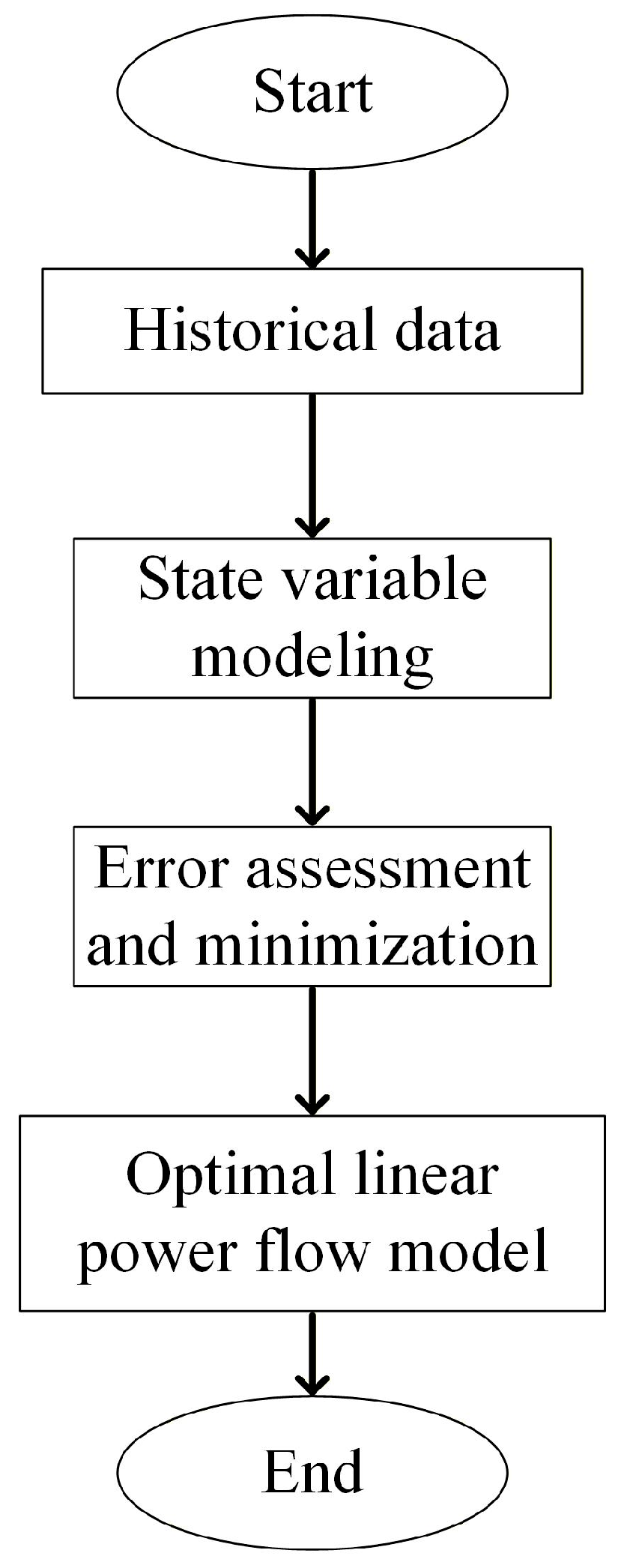
Although linear power flow models are becoming increasingly common, finding a model with minimal error remains a difficult task. In fact, the linear error of power flow is influenced by both the distribution of variables and the correct formulation of the distribution itself. Fan et al. [27] formulated a model for finding linear power flow with minimal linearity error using an optimal choice of variable space. The authors also propose a simplified power loss model and illustrate the difference between choosing variable space and popular hot start methods. The effectiveness of their method was tested on two IEEE test networks—30 and 118 nodes, as well as on the real Polish power system consisting of 2383 nodes. Also in ref. [28], a method using linear power flow to reduce the linearisation error is proposed. Thanks to the error control, the proposed linear optimal power flow (OPF) yields better final solutions. In ref. [29], a method for combining linear power flow models is proposed to reduce the linearisation error. Tests were conducted on an IEEE 30 network, and the obtained results, compared to three existing models in the test system, reduced the linearisation error of active and reactive power by over 60%. Sowa et al. [30] propose the use of linear optimisation of AC optimal power flow to improve the efficiency of power system operation. They used linear programming to significantly reduce the approximation error. The results obtained confirm that the proposed method significantly reduces computational errors and shows strong resilience to challenging real conditions. The authors of [31] propose finding the optimal copula function that best fits the actual distribution of historical data. Figure 1 presents the algorithm proposed by the authors, which allows for linearisation with minimised error.
The inclusion of Figure 1 is intended to clearly illustrate the logical structure and computational flow of the proposed algorithm. By presenting the sequence of operations leading to the optimal copula selection and subsequent linearisation, the figure facilitates a better understanding of the methodological framework adopted by the authors. Moreover, graphical representation enhances the transparency and reproducibility of the approach, enabling readers to trace how error minimisation is achieved within the linearisation process.
In the first step, a set of historical data is used to select a dome function describing the relationships between state variables. On this basis, the common distribution of variables (vi, vj), is determined, which is used to calculate the expected value of the linearisation error for five independent candidates of the linear form of the function g(v). The obtained error values are then minimised, which allows both the best linear form and the corresponding parameter to be determined. Finally, based on the candidate form and the estimated parameters, a target linear power flow model is constructed, whose structure is chosen to minimise the error relative to the distribution observed in the data [31].
The use of linearisation to solve the power flow problem in a system is also discussed in [32,33,34]. The results achieved by the researchers in [35] confirm that the proposed method considerably reduces computation time, making it a viable alternative to nonlinear power flow (NPF) approaches. It is also important to note that the non-convex nature of NPF creates substantial difficulties for optimisation and control algorithms in power systems. To address these issues, linear approximations are frequently employed, trading off some modelling accuracy in favour of computational simplicity. The precision of such linearised power flow models largely depends on the specific characteristics of the power system and the operational range within which the linearisation is applied. For this reason, in ref. [36], conservative linear approximations of the power flow equations are used, which aim to overestimate or underestimate the quantity of interest, to enable the use of easy-to-use algorithms that avoid constraint violations. In ref. [37], a new sequential linear programming (SLP) approach is proposed, which, by iteratively constructing hyperplanes, allows for achieving high-quality solutions for non-convex AC OPF using only SLP. Test results show that this method provides fast computation times, high accuracy and stable convergence regardless of the starting point compared to classical nonlinear power flow calculation methods. The authors of [38] applied a similar approach, and their findings also confirm the method’s effectiveness. To enhance the accuracy of the OPF solution, the authors of [39] employed a linear formulation based on the Karush-Kuhn-Tucker (KKT) conditions. By incorporating a deviation factor, they significantly improved the performance of linear OPF optimisation, which was both theoretically demonstrated and validated using various IEEE and Polish test systems. In ref. [40], a linear approximation method for AC-OPF is introduced, enabling a detailed representation of the relationships between active and reactive power flows and voltage profiles, with accuracy comparable to that of nonlinear models. The proposed approach allows for transforming the AC-OPF problem into a mixed integer linear programming (MILP) form, which ensures the possibility of using existing algorithms to achieve global optimality. Numerical results and simulations confirm the effectiveness and practical applicability of the proposed model. Paper [41] introduces an enhanced linearisation model for representing the aggregated flexibility of distribution networks. This approach enables operators to showcase the flexibility potential of their networks without revealing sensitive or confidential data. To achieve this, linear models of standard flexibility providers were created, and a linear optimisation-based aggregation algorithm was implemented. Compared to earlier nonlinear methods, this significantly decreased computation time while preserving a high level of accuracy. The method was validated using two real-world medium-voltage radial networks in Germany, confirming both its effectiveness and practical applicability. In [42], a Customised Sequential Quadratic Programming (CSQP) algorithm is presented, which exploits the physical specificity of the AC OPF problem and its appropriate formulation. Numerical tests show that CSQP outperforms available nonlinear solutions, providing solutions in an industrially acceptable time. The effectiveness of the method was confirmed on a wide set of test cases, covering systems with 500 to 30,000 buses. In ref. [43], a quadratic power flow model is initially trained using a regression-based approach, followed by the development of a linear power flow model derived through Taylor series expansion. Once the initial regression training is completed, the linear power flow (LPF) model does not require retraining, even when system updates occur. Instead, model parameters are updated online using real-time measurement data, enhancing their generalisation ability. Overall, the proposed LPF model offers high accuracy, strong generalisation, and significantly reduces both data usage and computational time. In ref. [44], the authors investigate the causes of errors arising from linearisation and introduce a modular linear power flow model. Simulation results on various IEEE and Polish test systems demonstrate that the proposed approach can reduce linearisation errors by as much as 52.98% compared to existing methods. In ref. [45], the authors propose three versions of an AC Optimal Power Flow approximation based on different Points of Linearisation (PoL), integrated into a fully linear model designed to facilitate the use of ancillary services provided by distributed energy resources (DERs). The models were tested on a modified 34-node distribution network and compared against the nonlinear AC OPF. The results indicate that linearising around the actual power flow solution considerably enhances accuracy, reduces errors in both active and reactive power objective functions, and allows for accurate determination of DER operating points. Paper [46] presents a linear optimal power flow (LOPF) based on modern methods for linearising flow constraints in quadratic branches. An analytical expression defining the number of linearisation segments required to achieve a given error is developed, which allows us to solve the LOPF without iterations using efficient linear methods. An analysis of field reduction methods in thermal boundary linearisation and a modified approach eliminating their shortcomings are also presented. In ref. [47], the authors conclude that the fundamental difference between various linear power flow models lies in the formulation of “independent variables”. Based on this, they propose and investigate general formulations of linear power flow models. Power flow linearisation is also addressed in ref. [48], where the authors use it to account for system constraints. In ref. [49], the authors use the Levenberg–Marquardt (LM) algorithm to linearise power flow problems. In ref. [50,51], network linearisation is used to account for uncertainty in a balanced system. In ref. [52], the authors focused on simultaneous studies of the linear approximation of reactive power and transmission losses. They used the logarithmic transform of voltage magnitudes as the modified voltage magnitude, and the results obtained were compared on 25 test systems. It is also extremely important to take line losses into account in the issue of optimal power flow. In ref. [53], the authors proposed an iterative procedure to solve this problem, in which linear cuts approximating quadratic losses in each transmission line are adjusted iteratively as the optimisation problem is solved.
The attentive reader should also refer to [54,55,56,57,58,59,60,61,62,63], which also use linearisation to solve power flow problems in a power system. These papers are particularly valuable due to their timeliness. Article [64] extends the formulation of branch flows by explicitly modelling line shunt admittances and transformer effects while maintaining strict linearity; the resulting model supports MILP-based voltage/reactive power control and provides accurate voltage estimates without iterative AC solutions. In ref. [65], the authors derive a linear steady-state method for radial networks through local linearisation based on the Jacobian matrix, which yields closed-form sensitivities between active/reactive injections and square-law voltages/flows, enabling fast non-iterative evaluation. In ref. [66], a data-driven robust linear OPF is developed, where power flow relationships are learned from data and embedded in linear optimisation with uncertainty sets to handle prediction/measurement errors. In ref. [67], an improved linear power flow is proposed by decomposing fundamental and incremental components, increasing accuracy over conventional LPF while maintaining linear computational complexity for planning and operations. For islanded microgrids, ref. [68] presents a tertiary control scheme based on a linearised AC-OPF with explicit loss compensation, mitigating the linearisation error and enabling efficient dispatch. Power flow linearisation for unbalanced three-phase distribution systems is discussed in [69], where a linear load flow with current injection is formulated, suitable as a fast linear layer within optimisation. Furthermore, in ref. [70], two three-phase linear formulations for autonomous voltage-drop-controlled microgrids were introduced, enabling linear OPF with approved voltage errors below one percent.
The reader should also consult the book by Bazara, Jarvis, and Sherali [71], which discusses various linear programming techniques and their application in network flow analysis. The authors pay particular attention to the modelling, design and analysis of linearisation algorithms in the context of power engineering problems. This work is a valuable resource for those wishing to explore linearisation methods in power engineering problems, serving as a significant reference in this field.

2.2. Linear Approximations for Assessing the Capacity of the Power System and Planning Network Development

Total transmission capacity (TTC) is essential for maintaining the reliability of power systems. As power grids integrate more variable renewable energy sources, operators face the challenge of solving complex, multidimensional optimisation problems within short time frames. To reduce the computational load, it is common practice to linearise AC power flow constraints.
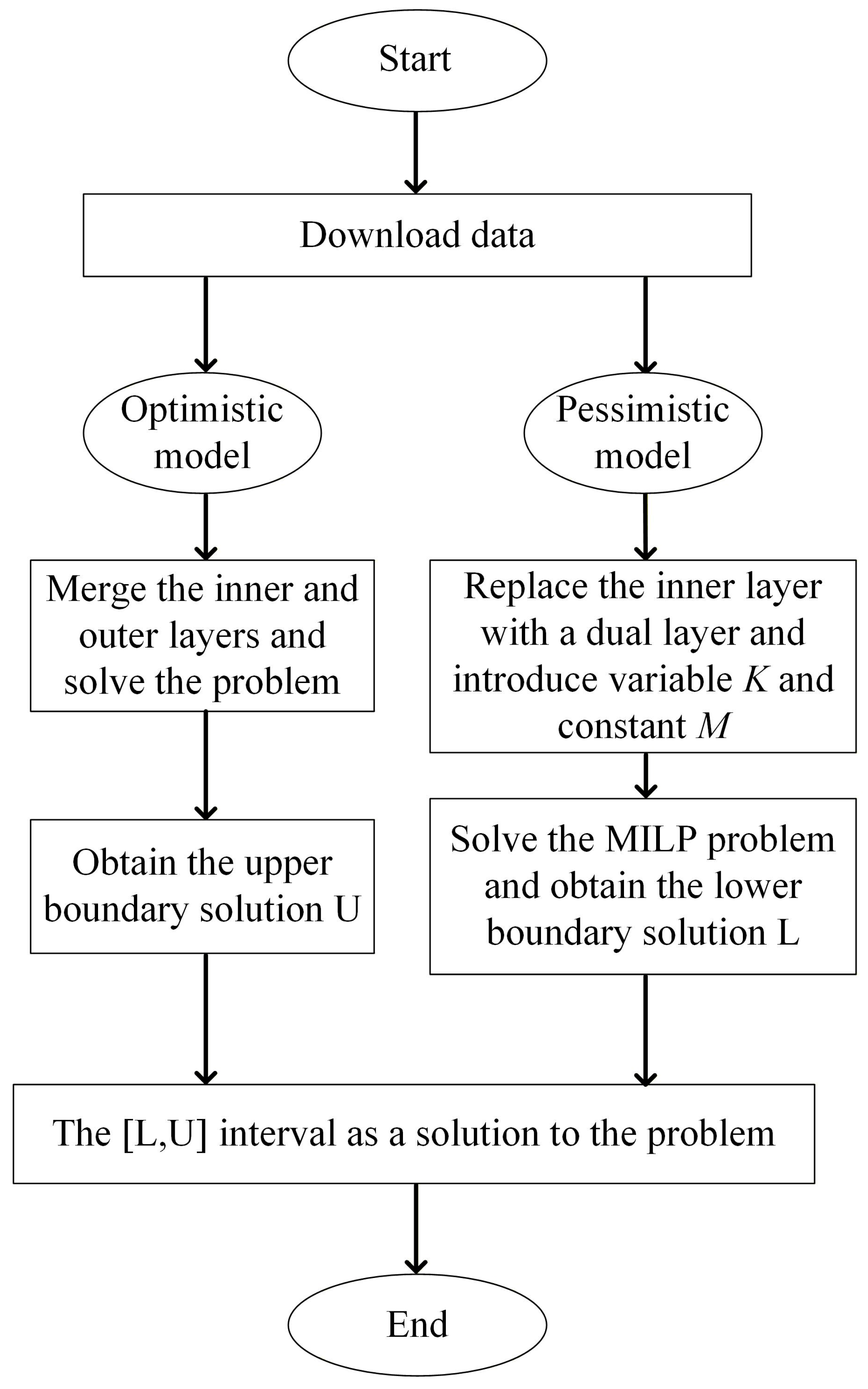
In ref. [72], the authors introduce a transmission capacity assessment method based on Linearised AC power flow (LACPF), which delivers information on TTC limits without requiring any prior distribution assumptions. Figure 2 illustrates the block diagram of the proposed approach. Figure 2 clarifies the overall workflow of the proposed methodology and highlights the sequential relationships between its analytical stages. By visualising the structure of the LACPF-based assessment process, the figure enhances the reader’s understanding of how linearisation is applied within the broader context of transmission capacity evaluation. This graphical representation also supports methodological transparency and facilitates replication of the approach in future studies, which is particularly relevant given the increasing reliance on linearised models in grid planning and operational analyses.
The algorithm begins with the input of data (generator power, loads, network parameters and other variables). On this basis, a TTC model is constructed, which is divided into two complementary sub-problems: an ‘optimistic’ and a ‘pessimistic’ variant, each with its own objective functions and constraints. The optimistic part is solved as a maximisation task using the simplex method, which gives the upper limit U. The pessimistic part is transformed into a dual form for the inner layer of the problem; binary variables and a large constant M, are introduced, which allows the problem to be written in MILP form and solved, leading to the lower limit L. After combining the results of both paths, we obtain the interval [L, U], interpreted as the solution to the original TTC model, which ensures both compliance with the constraints and a transparent interpretation of uncertainty [72].
The authors validated their proposed method on the IEEE 118 test network as well as on an actual power system in northwestern China. The results demonstrated the high computational efficiency of the approach.
Also in Ejebe et al. [73] focused on presenting a program for quickly calculating the available connection capacity of a power system based on linear incremental power flow. The presented test results on practical power system models confirm the effectiveness of the presented program. In ref. [74], linearisation is used to manage overloads in transmission lines while simultaneously reducing generation costs in the power system. The proposed model was applied to test systems following the IEEE 9-node and IEEE 118-node standards. Additionally, to evaluate system reliability both before and after switching operations, two approaches were employed: contingency analysis and calculation of the loss of load probability (LOLP) index. The obtained results show that the methodology proposed by the authors can be applied to real systems. In ref. [75], the authors used linearisation to determine the buffer capacity for transmission lines, thus ensuring safe system operation. They evaluated the performance of their method on several test networks of different sizes, and the obtained results are satisfactory. The algorithm presented in [76] linearises the optimal power flow formula and uses the Gram-Charlie expansion to find the maximum available transmission capacity. The key advantage of the proposed method is its short computational time, verified on an IEEE test system. In ref. [77], the authors proposed the use of a novel MILP for transmission expansion planning (TEP) frameworks, taking into account the role of compressed air energy storage (CAES) integration, to address the growing problem of decreasing connection capacity. The authors conducted studies on various test networks, and the numerical results demonstrate the positive impact of CAES units on the power system. Also in ref. [78], the authors proposed a methodology for increasing system flexibility based on MILP. Their proposed linearisation approach is based on a second-order Taylor series expansion of trigonometric expressions. It does not rely on the assumptions of flat voltage, near-voltage and small-angle voltage, and formulates linear approximations using the squared voltage and voltage angle difference variables. The second novelty is an advanced heuristic sequential linearisation algorithm (SLA), which iteratively considers and improves the accuracy of the MILP model. Test results show that the proposed methodology outperforms alternative methods in terms of solution accuracy and computational efficiency under normal and loaded operating conditions. In [79] the authors propose using linearisation in combination with dynamic line estimation (DLR), which enables better system expansion planning and provides greater flexibility. They tested their proposed methodology on two test networks. Also in [80] the authors use MILP in combination with DLR to provide improved system flexibility. Tests conducted on an IEEE test system confirm the positive impact of the methodology on the obtained results.
Liao, Wu and Lin [81] propose an active planning model for distributed networks that relies on linear constraints. They begin by outlining the fundamental principles and methods for linearising a distributed network model, approaching the problem from two angles: power flow linearisation and linearisation of distributed network connectivity. The results obtained prove the method has a small error of only 3.3%, reducing the calculation time to below 0.2 s.
In ref. [82] the authors propose a power flow analysis method based on the interval AC-linear power flow (AC-LPF) model and affine arithmetic. By linearising the power flow and introducing power injection intervals, it is possible to determine the ranges of network state variables while taking into account the uncertainties associated with Available Transfer Capacity (ATC). Deng et al. [83] focus on assessing the TTC between asynchronous areas and ensuring stability between systems. In their paper, a linear model is used to assess transmission capacity. In ref. [84] the authors present the AC power flow-constrained robust unit commitment (ACRUC), which linearise the quadratic constraints of AC power flow using a circular method. This allows for the transformation of nonlinear dependencies into a linear form, which can be effectively used in optimisation. Test results indicate that the model faithfully represents actual system operating conditions and enables a more accurate assessment of network capacity with high RES penetration.
Jakus et al. [85] developed an optimisation model based on mixed integrated linear programming for automatic planning of distribution network development and determining the optimal power supply solution for network users, taking into account network development costs as well as power quality and security criteria. In ref. [86] an optimal network planning model was developed to maximise the system operator’s profit. To ensure its accuracy, the model was linearised using the network loss coefficient method combined with circular constraints and the McCormick convex envelope method. A 15-node system in Jiangsu Province was considered as a test network. In ref. [87] the authors aimed to reduce CO2 emissions in the power generation process on Jurong Island in Singapore. For this purpose, they used the linear loss linearisation method with modified DC power flow to optimise network development with high saturation of distributed generation sources. In [88], in order to improve system flexibility and distribution network planning, a method for optimal allocation of electricity storage facilities based on interval linear programming is proposed. The conducted studies proved that this method ensures good network balance and efficiency. The reader can also refer to works [89,90,91,92,93,94,95,96], which also address the issue of power network planning using linear programming. Work [97] focuses on planning transmission network expansion, and linearisation is used to create an OPF model. Tests were conducted on closed IEEE 12 and IEEE 118 test networks. In ref. [98] the authors propose planning an orderly charging strategy for electric vehicles based on the reconstruction of the distribution network. Linearisation combined with proprietary soft normally open point (SNOP) software allowed for the development of an optimisation model for a reconfigurable distribution network. The proposed methodology was verified on a 94-node system. In ref. [99] a dynamic linear programming model is developed, as well as a simulation of optimal generation capacity development paths. Babonneau et al. [100] propose employing a linear programming model to capture the characteristics of the distribution network, alongside market balancing processes for flexible loads and distributed energy resources that provide reserve capacity and reactive power compensation.
In ref. [101] the focus is on a MILP-based approach for optimal planning and operation of the urban power grid. Similarly, in ref. [102], the authors focus on optimal management of the urban power grid. In ref. [103], linear programming methods are used to solve the problem of proper power system design. This problem becomes difficult to solve with the inclusion of a large number of variable power generators, such as wind farms or photovoltaic plants. Study [104] presents a novel approach to energy planning that takes into account the greater penetration of variable energy sources and the growing interaction between energy sectors. The presented method combines energy planning models with power flow models, enabling faster and more reliable solutions of optimisation problems. A linear continuous optimisation model for the power system, combined with a nonlinear model for power flow analysis, is employed. This approach is used to assess different energy planning scenarios for interconnected islands. The results show a 26.7% increase in system costs, a 3.3-fold decrease in battery capacity, and a 14.9 MW increase in renewable power compared to general spatial planning methods. Additionally, the power flow analysis revealed that the maximum voltage deviation reached 16% above the nominal level, underscoring the importance of evaluating the feasibility of the proposed scenarios before implementation.
Article [105] proposes the use of a mixed integer programming formulation for locating and sizing aggregated models of hybrid distributed energy sources in radial power distribution systems. The goal is to minimise errors in estimations based on available field measurements, which allow for improved system visibility. Aggregated models capture the collective impact of multiple unseen DERs, enabling the reconstruction of voltages at unobserved nodes and power flows in branches, which increases monitoring efficiency. The paper focuses on the linearisation method, which simplifies the calculations related to modelling nonlinear relationships between system variables, thus enabling the use of MILP methods. The use of linearisation makes the problem more computationally tractable, as verified in tests conducted using the OpenDSS (EPRI (Electric Power Research Institute), Palo Alto, California, USA) tool. Examples from the studies show average errors below 5% in estimating power flows in branches, despite limited voltage measurements. The results suggest high accuracy and efficiency of the proposed method, even under uneven system load conditions. In ref. [106] a new approach to solving the capacity development planning problem is proposed, which has three objectives: maximising total energy production, minimising system costs and reducing CO2 emissions. Instead of three objectives, the problem was transformed into two objectives: maximising the ratio of energy production to system costs and the ratio of energy production to CO2 emissions. This allows for obtaining better solutions without the need to specify preferences. A novel linearisation and parameterisation technique, based on Dinkelbach’s theorem and Güzel’s method, was employed to address this problem. This approach transformed the objective functions into a single linear programming problem. When applied to capacity development planning, the new method demonstrated improved handling of trade-offs between energy production, costs, and CO2 emissions compared to the traditional weighted sum method. Paper [107] discusses the optimal scheduling of prosumers who own energy storage in communities using renewable energy sources. It proposes an innovative strategy for optimising storage utilisation in a demand response model that depends on price and volume. The problem is formulated as a scalable, low-complexity linear mixed-integer program. Additionally, a heuristic procedure is proposed to fairly redistribute demand response rewards among participants based on their contribution to the demand response goals. The aim of this approach is to enhance the benefits for prosumers operating within a shared community compared to acting individually.
Readers seeking information on the use of linearisation in distribution or transmission network planning should also refer to [108,109,110,111,112,113].

2.3. Linear Approximations for Solving the Problem of Voltage Regulation in the Power System

Linearisation methods in power systems can also be applied to voltage regulation [114,115,116,117,118]. For example, in [116], the authors proposed a coordinated voltage regulation scheme for transmission systems that uses linearised power flow definitions to determine setpoints for voltage regulation devices. They tested the effectiveness of this method on two closed-loop test systems: IEEE 30 and IEEE 118.
In ref. [119], a mixed-integer linear programming method for optimising voltage profiles in active distribution networks is presented. The effectiveness of the proposed method was tested on a reference network. In ref. [120] the authors propose a linear power flow model for a distribution system with accurate voltage estimates. The model can be viewed as an extension of the LinDistFlow model. The proposed methodology was tested on a test network. Modifications of the linear DistFlow model for voltage regulation are also used in [117,121,122]. The increasing share of photovoltaic installations in distribution networks (DN) leads to voltage fluctuations that require effective mitigation. One of the basic devices used for this purpose is a step voltage regulator (SVR). In ref. [121], the authors focus on the problem of optimal selection of the regulation stage (OPTS) for SVRs operating in a star configuration, using a linear approximation of the power flow equations. In particular, the LinDist3Flow model was used, assuming a continuous nature of the effective SVR coefficient. This allows for the formulation of the LinDist3Flow-OPTS problem, which takes the form of a linear model. In ref. [123], a new centralised voltage regulation method is introduced, designed to enhance the security of active distribution networks. This approach relies on sensitivity analysis to optimally allocate control variables. The effectiveness of the proposed sensitivities and their use in voltage regulation was successfully validated on an 11 kV distribution network. In ref. [124], the authors propose a new control method based on Linear Active Disturbance Rejection Control (LADRC) integrated with the hybrid Salp Particle Swarm Algorithm (SPSA). This solution enables simultaneous tracking of Global Maximum Power (GMP), DC-Link voltage regulation and improved active and reactive power control. The test results show that LADRC provides faster response and lower THD (2.25%) compared to PI, PID and SMC controllers, and the effectiveness of the method was confirmed in Hardware-in-the-Loop (HIL) tests. In ref. [125] a DM-PI-DC controller tuned with a sine-cosine algorithm (SCA) is proposed, which limits the frequency (LFC loop) and voltage (AVR loop) fluctuations, taking into account communication delays and real system constraints. The model also incorporates an interline power flow controller (IPFC) to manage power flows and redox flow batteries for increased stability. Analyses show that the proposed controller achieves oscillation-free response in 3.3 s, and 33% better overshoot performance compared to other advanced methods, effectively improving power quality.
Matallana et al. [126] propose a linear sensitivity modelling algorithm that is useful for controlling voltage regulation in systems with a large number of distributed energy sources. The proposed algorithm was tested on an IEEE 33 network, and its application demonstrated enhanced performance in voltage monitoring and control scenarios. Its application allows for better estimation and compensation of voltage deviations with respect to operating voltage constraints.
In ref. [127] a new distribution LMP (DLMP) is proposed, which takes into account both reactive power and voltage constraints. For this purpose, three tools were developed: linearised power flow for distribution (LPF-D), loss factors for distribution (LF-D), and linear optimal power flow for distribution (LOPF-D). Integrating LPF-D and LF-D allows for reformulating the classical OPF into a linear form while maintaining high accuracy compared to the full AC model. Tests have shown that the proposed approach enables precise DLMP determination and provides valuable pricing information, and the tools themselves can also be applied to other distribution network analyses. In ref. [128] a new mixed integer linear programming formulation for AC-OPF in three-phase, unbalanced distribution networks is presented. The model aims to minimise energy production costs while maintaining voltage limits. New Euclidean norm linearisations in voltage and current calculations were introduced using a linear transformation of weighted norms and intersecting planes. Tests on two unbalanced systems showed that the proposed method is computationally more efficient, accurate and conservative than traditional approaches, with maximum errors below 0.1%. In ref. [129] an Under-Voltage Load Shedding (UVLS) model based on mixed integer programming (MIP) is proposed, aiming to maintain a given load margin with minimal power shedding. The complete nonlinear AC power flow equations are approximated through a piecewise linearisation approach and incorporated into the UVLS formulation. The model accounts for load characteristics and was evaluated under different operating and fault scenarios using the IEEE 14-node and 118-node test systems, showing superior performance compared to conventional nonlinear approaches. In [130], linearisation is used to optimise system voltages within an acceptable range by optimally utilising reactive power generated by distributed generation (DG). Also in ref. [131] the authors use linearisation methods for voltage regulation in power systems. In ref. [132], a type-2 interval fuzzy controller is introduced to enhance transient stability and voltage regulation in multi-machine power systems. The controller is developed using direct feedback linearisation (DFL), which converts the compensated DFL model into a type-1 Takagi–Sugeno (T–S) fuzzy representation. The stability assessment and design of stabilising controllers for type-2 fuzzy control systems (IT2 T–S FLCS) rely on linear matrix inequalities (LMIs) to ensure compliance with stability criteria. Based on local measurements, the controller provides transient stability, voltage regulation, and desirable dynamic performance. It was implemented in a two-generator system connected to an infinite bus, with simulation results demonstrating its effectiveness under various operating conditions. In [133], an adaptive control strategy for voltage and frequency regulation in a stand-alone hybrid power system combining a wind turbine and a diesel generator is proposed, employing constrained linear model predictive control (MPC). The system configuration includes a wind turbine with a self-excited induction generator (SEIG), connected through a DC link to a diesel engine-driven synchronous generator.
In refs. [134,135] the authors use the assumption of small angular differences between lines, which simplifies the calculations of bus voltage values. In ref. [136] it is assumed that voltages tend to approach 1.0 p.u., which facilitates the calculation of power flows in branches. In these works, linearisation is crucial. In refs. [137,138,139] the authors discuss the use of linear approximations to model unbalanced three-phase power flows, which enable voltage forecasting as a linear representation of load forecasts using Gaussian processes. In ref. [137] a privacy-preserving short-term voltage forecasting method is proposed, where federated learning is used to preserve the privacy of user data without revealing local information. In ref. [138] a Bayesian approach is used to solve the system state estimation (DSSE) problem with limited measurements, learning pseudo-measurement distributions to support DSSE. It should be emphasised, however, that these methods either do not fully exploit the available data from distribution systems or rely on assumed model accuracy, which limits the precision of voltage estimation. Moreover, they generally do not account for uncertainty in voltage estimation, particularly when measurement data are sparse. In ref. [139] proposes an approach using Gaussian processes to recover missing data and an approach based on Bayesian matrix completion for state estimation. However, the use of linear power flow constraints in this approach can lead to distorted results, especially with imprecise power flow models, and further limit the scalability of Gaussian processes.
Other works that provide readers with insight into the linearisation of voltage problems in power systems include [140,141,142,143,144,145,146,147,148,149,150,151,152,153,154].

2.4. Linear Approximations for Solving the Problem of Redistributing the Capacity of Renewable Energy Sources

Eliminating overloads in high-voltage lines and maintaining a power balance in the system under conditions of high renewable energy generation pose significant challenges for grid operators [155]. In 2024 alone, the use of nearly 1 TWh of energy was reduced in Poland in this way, while in Germany, this figure exceeded 20 TWh [156].
In ref. [157] the authors linearise the flow equation around the operating point and formulate the congestion management problem as a linear program with so-called “strict constraints,” determining sensitivity coefficients (also referred to as participation indices), that are used to select the optimal units for redispatch. In ref. [158] a local network flexibility market with single-line advance, taking into account network constraints, is presented using Successive Linear Programming. The authors demonstrated that the proposed algorithm is robust and capable of producing high-quality, feasible AC solutions with satisfactory computational efficiency. Its effectiveness was validated through applications to multiple distribution networks and a range of load scenarios. The authors of [159] also use Successive Linear Programming to determine the optimal power flow. Paper [160] proposes a new formulation based on mixed integer linear programming, in which various linearisation methods are used to describe the voltage stability index (VSI). Network reconfiguration in the MILP approach allows for increased accuracy and speed of calculations while maintaining the optimality of the solution. The main goal is to minimise active power losses and improve the VSI, while taking into account constraints on branch currents, node voltages, network radiality and distributed generation penetration. The effectiveness of the method was validated on 33- and 69-node radial test networks. In ref. [161] a new model for unit engagement with network constraints was presented, formulated as MILP with linear AC-OPF equations. The model allows limiting the unit dispatch schedule within the allowable line capacity and voltage deviations without the need for additional iterations. The effectiveness of the proposed approach was validated using benchmark test systems. In ref. [162] the authors present a novel Network Functions Virtualisation (NFV) algorithm that enables efficient implementation of planned network services while reducing load and limiting congestion.
Article [163] addresses the allocation planning problem for large-scale distributed renewable energy systems in distribution networks. It focuses on the integration of hybrid renewable sources such as photovoltaic, wind, and biomass energy, and examines the effects of PV and wind generation variability on long-term voltage dynamics and stability in distribution networks. Linearisation is used to account for variability in RES power generation, assess its impact on voltage stability, and maximise renewable energy penetration while minimising costs. The variability of RES power (especially PV and wind) is simplified to linear functions, allowing these variables to be effectively incorporated into the MILP model. Furthermore, the stochastic nature of the problem, related to forecasting variable RES energy production, is also addressed in the form of linear constraints, allowing for a scalable and optimised solution.
In refs. [164,165] the authors use piecewise linear approximations to calculate the squared active and reactive flows in the branches. In the context of optimisation applications, McCormick envelopes are used to linearise current calculations in a power flow model along a line. This method relaxes the nonlinear expression by introducing a set of appropriate linear constraints, facilitating the solution to the optimisation problem [166,167]. In ref. [168] Yang, Guo and co-authors propose applying a linearisation method to the optimal power flow problem to achieve optimal network reconfiguration. By introducing an error-control mechanism, the proposed linear OPF allowed for more accurate results. The method was verified on several standard test systems, and the results obtained confirmed its effectiveness. The paper constitutes an interesting addition to the literature on system reconfiguration, especially in the context of works that did not employ linearisation methods [169,170,171]. Linearisation in network reconfiguration was also applied in [172].
The problem of the need to use system reconfiguration to mitigate current overloads is a relatively new phenomenon that has emerged on a large scale in recent years. Readers wishing to delve deeper into this topic should also consult [173,174,175].
Linearisation is also used in wind farm analyses [176,177,178,179,180,181,182,183,184,185,186], e-mobility [187,188,189,190,191,192,193,194,195,196], energy management in multi-energy microgrids [197,198,199,200,201,202,203,204], and on-load tap changer modelling to reduce losses [205,206,207,208,209,210,211].
For instance, ref. [180] proposes a control strategy for wind energy conversion systems (WECS) connected to distribution networks, with a focus on providing both energy supply and ancillary services. A typical WECS includes variable-speed wind turbines coupled with a direct-driven permanent magnet (DDPM) generator, which offers significant operational flexibility as its output is delivered to the grid through a fully controlled frequency converter. The proposed control strategy aims to regulate the electrical and mechanical parameters of the generating unit, ensuring optimal power delivery to the grid while providing voltage support at the point of common coupling. The approach is based on feedback linearisation (FBL), which enables decomposition and linearisation of a nonlinear multiple-input, multiple-output (MIMO) system. FBL allows independent control of each system variable, simplifying controller design and system operation. Numerical simulations demonstrate that this method fully exploits the flexibility of the DDPM generator, supporting the integration of WECS into modern microgrids, where operational modes (grid-connected or islanded) and the charging or discharging states of energy storage systems can be represented as binary or integer variables. In ref. [202], an energy management system (EMS) for a power node was presented using MILP, which aims to reduce operating costs through optimal daily advance scheduling. The objective function that describes this problem is presented by the following formula:
min   t = 1 T C t C H P +   C t S T +   C t s h e d +   C t H e a t
where
  • C t C H P —represents the cost related to the operation of Combined Heat and Power units;
  • C t S T —refers to the cost or revenue resulting from electricity purchases from or sales to the grid;
  • C t s h e d —indicates the cost associated with load shedding;
  • C t H e a t —corresponds to the cost of meeting heat demand.
Additionally, the paper applies a linearisation technique to the AC network model’s line flow equations, as illustrated in Equations (2) and (3):
l ( i , k ) t P = g ( i , k ) L ( V i t V k t Ψ i k t + 1 ) b ( i , k ) L Φ i k t
l ( i , k ) t Q = b ( i , k ) L ( V i t V k t Ψ i k t + 1 ) g ( i , k ) L Φ i k t
where
  • P ( i , k ) t and Q ( i , k ) t —are line power flow equations from bus i to bus k;
  • g ( i , k ) L and b ( i , k ) L —are the conductance/susceptance of the lines;
  • V and Φ —are the voltage and angle difference between the buses.
Lima et al. [212] used MILP to perform a design analysis for the optimal deployment of Thyristor Controlled Phase Shifter Transformers (TCPSTs) in large power systems. They investigated how the number, location, and alignment of these transformers in the network affect the system’s load capacity maximisation using a DC load flow model. Constraints related to installation costs and the total number of TCPSTs were considered. The computational time of this method is considerably shorter compared to other similar approaches reported in the literature.
Research on IEEE test networks indicates that the linear model can very well replicate the results of the nonlinear model with shorter computation times. In the case of AC-OPF with Taylor (fractional-interval) linearisation for the IEEE-14 system, a maximum voltage module error of <2.2% (average 1.35%), an average phase angle error of ≈ 2.27° and a target gap of ≈ 0.87% were recorded. For IEEE-118 (three load levels), the cost error was ≈0.56–0.57%, the average generation error ≈ 0.57–0.75%, the voltage module error ≈ 3.5–3.8%, and the angle error was ≈0.28–0.45°; calculation times: 1.2 s (linearised model) vs. 1.76 s (nonlinear model) on the same platform, which confirms comparable or shorter calculation times while maintaining AC sensitivity [213].
In contrast, DC-OPF can significantly distort redistribution results in conditions with a high share of RES. A broad comparison (from 9 to 2383 nodes) shows that DC and AC models may indicate different sets of congested lines, different total redistribution costs and different cost allocations; for the 118-node system, both the total costs and the constraints that were binding changed. These results caution against relying solely on the DC approximation in the quantitative assessment of RES redistribution [214].

2.5. Summary of the Literature Review Conducted on the Subject in Consideration

The analysis of complex power systems (as nonlinear objects in which steady-state and transient processes occur) often requires the use of simplified methods or model approximations that enable effective analysis and design of control algorithms. In the context of power systems, and, in particular, the problem of power flow, nonlinear models describing the relationships between voltages and powers make direct calculations difficult and time-consuming. In practice, linear or partially linear approaches are often used, which preserve the essential properties of the system. Linearization significantly reduces calculation time and allows the use of standard optimisation tools, which would be computationally very costly in their full nonlinear form. However, the selection of an appropriate linearization method requires a critical assessment of a number of factors, including theoretical assumptions, trade-offs between accuracy and computational efficiency, and the characteristics of the system to which the method is to be applied
The most common approaches in the literature are linearization based on Taylor expansion (Newton-Raphson linearization) and DC linearization. The literature also mentions the following methods: Fast Decoupled Load Flow (FDLF) and Linearized AC Power Flow (Linearized AC PF). Each of the above methods has different assumptions and limitations that determine their suitability in specific application scenarios.
The DC linearization method is based on the assumption that the voltage angles at the nodes are small and that line losses can be ignored or assumed to be minimal. As a result, active power equations become linear, which allows for a quick solution to the power flow problem. The main advantage of this approach is a significant reduction in calculation time and the possibility of applying it in large systems where a full AC analysis would be too time-consuming. For this reason, the computational load of the method remains relatively low. This method also introduces limitations in terms of accuracy, especially in systems with large voltage deviations, significant losses, or in the event of critical situations such as overloads of power system components. As shown in the literature, under normal system operating conditions, this method can produce results with an error of up to several percent compared to the nonlinear AC model. However, in critical situations, this error can increase significantly.
The linearization method based on Taylor expansion allows for a more flexible consideration of the impact of voltage changes and power losses than the classic DC method. In this case, a specific operating state of the system is taken as a reference point, and linearization is performed relative to this point. This method allows for corrections to be made in the event of moderate changes in system parameters and provides better accuracy than the traditional DC method. On the other hand, it requires a preliminary estimate of the operating point and may be less stable in the event of sudden system changes. This method allows for a significant increase in calculation accuracy compared to the DC method. However, a significant increase in calculation costs should also be taken into account.
The Fast Decoupled Load Flow (FDLF) method is an intermediate method between full Newton-Raphson and simplified DC Power Flow. It assumes that active power depends mainly on voltage angles, and reactive power on voltage amplitudes, which allows the Jacobian matrix to be simplified into two separate matrices. This makes the method very fast and maintains decent accuracy under typical transmission conditions. Its limitation is lower precision in systems with strong nonlinearities or large voltage fluctuations. The Linearized AC Power Flow method, on the other hand, is a more modern approach that attempts to linearly approximate the full AC equations while maintaining greater accuracy than simplified DC PF methods. It usually involves expanding the power equations around the operating point while retaining first-order terms or using other approximations that take into account both angles and voltages. This makes the method suitable for both transmission and distribution systems, as well as for optimisation tasks. It should be noted that this method is much more computationally complex than the FDLF method.
Less common methods include: Modified voltage magnitude method, Quadratic form of line loss, and Proportional to power flow. Although less frequently used, these methods also find application in linearization.
The modified voltage magnitude method is characterised by very high accuracy in power flow mapping thanks to logarithmic voltage transformation, which takes into account both amplitude and phase angle changes. Compared to the classic DC model, it significantly reduces errors in active power calculations. However, the disadvantage of this method is the significantly longer calculation time and increased sensitivity, especially in large networks with strongly nonlinear voltage dependencies. Quadratic form of line loss is characterised by moderate accuracy at low computational cost, as it introduces only a simple quadratic term dependent on phase angle differences. It enables fast solutions with improved loss mapping, but its effectiveness decreases in high-resistance networks where voltage relationships dominate. The proportional to power flow method is a compromise between accuracy and computation time. Its iterative nature allows for gradual improvement of results while maintaining a short convergence time. This method is considered one of the most practical modifications of DC-OPF, but its effectiveness depends on the proper selection of the proportionality coefficient. It may also require several iterations, which limits its effectiveness in very large systems.
The literature also describes methods based on available measurements, e.g., power, current, voltage, and power flows. However, this type of approach requires data availability, good quality, and consistency of measurements. Although modern power grids are increasingly equipped with measuring devices that enable data acquisition, in practice, there are often gaps in the measurement data. It is therefore necessary to use further measures to fill these gaps. These include state estimates [215] and the use of machine learning [216,217]. These tools improve the quality of measurements but introduce further simplifications and certain errors in subsequent analyses. Nevertheless, they enable the creation of a linear model for calculations. This model is slightly more complicated, but the calculation time is relatively short. The accuracy, on the other hand, is better than in the case of the DC method and comparable to other simplified methods. Another advantage is that it is based on real measurements.
As part of an example case study, the authors presented a comparison of the accuracy of the results obtained and the calculation time, based on a specific example taken from the literature.
In order to critically compare different linearization methods, the authors analysed [58], in which Li and his colleagues analysed seven approaches to power flow linearization relative to the full AC–OPF model. The accuracy of the methods, the optimality of the solutions obtained, and the calculation time were evaluated. The results showed that the highest accuracy was achieved for the method based on logarithmic voltage transformation, which was characterised by minimal errors even in large test systems. In turn, the classic DC model was distinguished by the shortest calculation time and high computational robustness, but its accuracy remained relatively low. Iterative methods that take transmission losses into account achieved better quality parameters than simple linearizations, but their calculation time increased significantly with the size of the system—in the case of a 2000-node system, it was even about 70 times longer than for the classic DC model. The authors of the paper emphasised that the choice of linearization method should be a conscious compromise between the accuracy of the approximation and its feasibility and computational efficiency. In practice, the best balance between the quality of results and the speed of calculations is provided by iterative DC models that take line losses into account (Methods 6–7), which retain almost full feasibility with only a few times increase in calculation time compared to the classic DC model.
To more fully illustrate the issue under analysis, the authors have included a sample tabular summary (Table 1), enabling the reader to gain a comprehensive understanding of the methods being compared. Table 1 was prepared based on the results of the analyses presented in [57]. The tables are included for comparative purposes and the results are presented in a collective and summary form. They provide a valuable comparison of the effectiveness of individual methods in solving an example task of optimal power flow.
Despite their extensive use, all of the methods discussed have their limitations. Linearizations around the operating point are only accurate for small deviations from that point, which limits their use in systems with high generation saturation (e.g., with a high share of renewable sources). Fast Decoupled Load Flow, although fast, simplifies the relationships between active and reactive power, which can lead to errors in low-voltage distribution systems with high losses. The linearized AC PF function increases accuracy but is more difficult to analyse and is still based on the operating point. The DC method is the least accurate of those discussed. The measurement-based method is more accurate but more complicated in terms of obtaining good-quality data. The other methods are less commonly used but also worth considering.
Potential areas for improvement include:
  • Use of higher-order nonlinear approximations within Linearized AC PF, which can improve accuracy with moderate changes in voltage and angle.
  • Integration with probabilistic and stochastic methods, especially in systems with a high proportion of unstable energy sources, which would allow uncertainty in power flows to be taken into account.
  • Optimisation of the Jacobian matrix structure for computational efficiency, which could combine the accuracy of Newton-Raphson with the speed of FDLF.
Such improvements could significantly increase the scope of application of linearized power flow methods, allowing for faster and more accurate analysis of both transmission and distribution systems.
Although linearisation methods offer significant computational benefits, their effectiveness may be reduced in some situations and may decrease with distance from the operating point, especially near operating limits or after topology changes. The diversity of test networks and reporting conventions in the literature further complicates direct cross-sectional comparisons, prompting cautious interpretation of results and emphasis on conditions of applicability. Linearizations based on Taylor expansions provide useful sensitivities, but require frequent updates and lose accuracy with larger load deviations or transitions between node operating modes. Fast-coupled methods offer high speed for large transmission networks, but their accuracy decreases in the presence of strong transverse admittances and in radial systems. DistFlow variants provide very fast calculation in distribution networks, but with simplified treatment of losses, they may underestimate voltage drops and branch loads. In three-phase systems, there is also the issue of interphase couplings and unbalance, which requires careful parameterization. In practical applications, it is therefore recommended to combine linearisation with post-validation of AC power flow, to apply slight narrowing of voltage and current constraints, and to periodically recalibrate the model, which together allows the speed of calculations to be balanced with the predictability of the quality of results.

3. An Overview of the Approximation Methods and Their Potential Future Applications

Based on the literature review, it can be concluded that linear approximations for power flow are frequently used to solve complex problems arising in modern power systems worldwide. Research results indicate that both distribution and transmission system operators expect new, increasingly accurate tools to support grid management. The use of linearisation-based methods should be considered not only during the design and modernisation stages of infrastructure, but also during its ongoing operation.
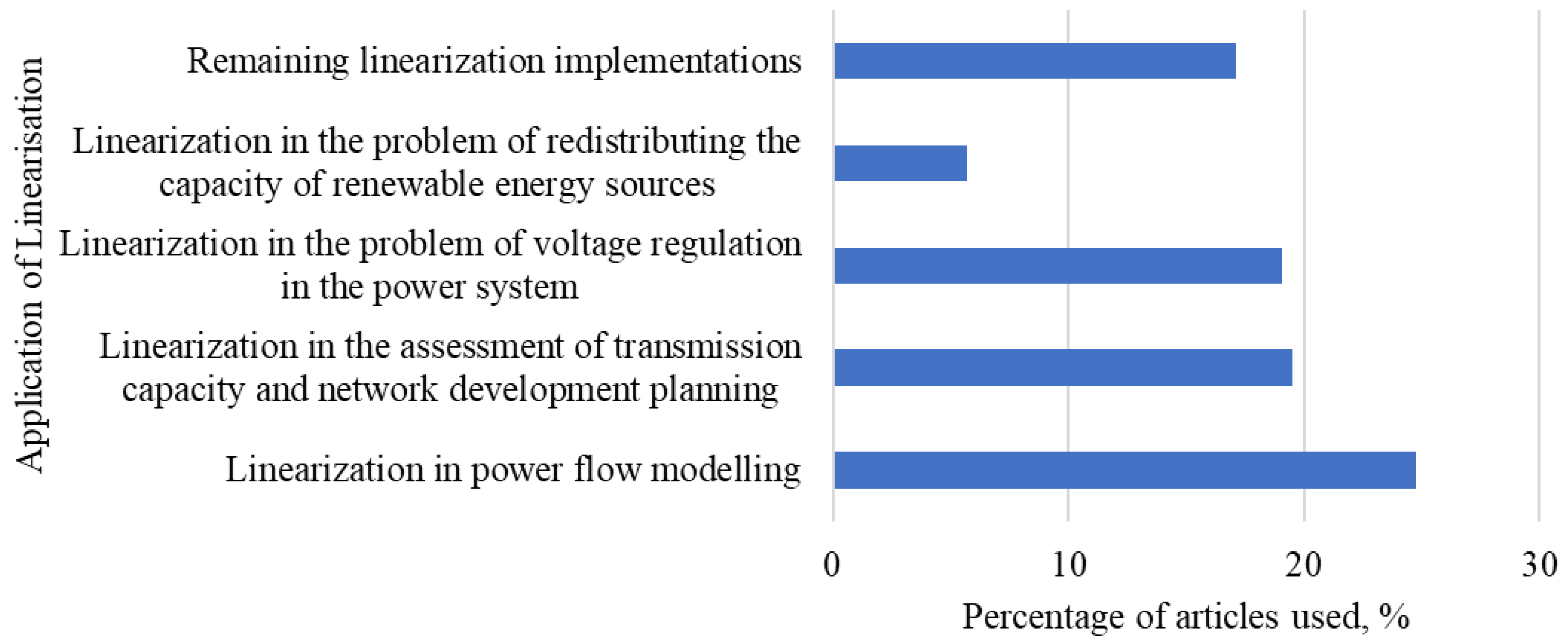
As evidenced by the extensive literature review discussed in Section 2, linearisation methods are used more frequently in some areas than others. This variation stems from, among other factors, their effectiveness, computational efficiency, degree of popularisation and computational time. Table 2 and Figure 3 summarise the main types of problems for which linearisation methods have been used, along with their frequency of use.
Figure 3 illustrates the overall trends in the problems tackled using linearisation methods. Analysis of this graph allows us to identify the areas where these techniques prove most effective. The data presented in Table 2, in turn, allows us to determine which issues are most frequently addressed in the literature. On this basis, it can be concluded that one of the most frequently addressed problems using linearisation methods is optimal power flow. Linearisation in the context of optimal power redispatching is still an area requiring further research, as reflected in the limited number of published works on this topic. This issue, a significant challenge for modern power systems, will gain in importance in the coming years, and the difficulties associated with solving it may intensify as the complexity and operating conditions of power grids increase. Optimising power redistribution in such systems requires consideration of numerous variables, both technical and economic, which makes traditional approaches not effective enough. In this context, linearisation is a key tool for simplifying calculations and accelerating the process of solving optimisation problems. However, due to the specific properties and complexity of energy systems, full implementation of this method requires further research.

4. Possible Research Gaps in the Literature

It should be emphasised that the articles included in this review do not exhaust the entire spectrum of research, but rather reveal certain trends, indicating which problems are frequently investigated and which remain insufficiently addressed in the literature.
This review also identifies significant research gaps that can inspire further scientific development. Key areas requiring in-depth analysis include:
  • Analyses conducted to assess the potential role of renewable energy sources and energy storage systems in restoring power plant generation capacity following a major system failure [218,219];
  • Optimal choice of a compensation device for a wind or solar farm connected to the power grid through a cable line [134];
  • Cable pooling—efficient utilisation of shared grid infrastructure by different types of renewable energy sources [220,221];
  • Insufficient number of studies examining computational errors resulting from the use of linear methods, particularly in the context of comparing their accuracy with nonlinear methods for various types of computational problems [222];
  • A limited number of studies comparing the effectiveness of various linear methods available in the literature in the context of specific computational problems. There are no comprehensive analyses presenting a comparison of the errors characteristic of available linear methods within a single problem [223,224];
  • An insufficient number of studies comparing the computational efficiency of linear and nonlinear methods, especially in terms of computational time and real-time applicability. Such analyses are important for implementing practical solutions in large power systems [225,226];
  • An insufficient number of studies analysing the computational error for power grids of various sizes, not only for test networks but also for real networks [227,228];
  • Limited consideration of reactive power flows in the analyses of computational methods, especially in the context of large and complex power grids. There is a need for more accurate models that allow for a reliable representation of this aspect [229];
  • Insufficient consideration of probabilistic models in power system analysis, particularly with respect to uncertainty related to measurements, load and generation. These models could significantly improve the reliability of forecasts and system analyses [230,231];
  • Insufficient number of studies incorporating actual measurement data to create linear models [232,233];
Table 3 summarises potential areas identified in the field of linearisation methods in the power industry, which could provide a basis for further, in-depth scientific analyses. The areas identified address both fundamental issues related to the accuracy and reliability of linear methods compared to nonlinear methods, as well as more specific issues such as computational efficiency, validation on actual data and extending models to include new aspects.
Research gaps are prioritised based on their significance for power system operation and the practical utility of linearisation methods. High priority was assigned to gaps related to error analysis, accuracy, and method validation, as these constitute the basis for their reliable implementation in real networks. Medium priority was assigned to issues such as validation on real data and computational efficiency analyses, which are essential for further development but naturally follow error analyses and benchmarking. Low priority, on the other hand, was assigned to new, innovative application areas, such as the contribution of renewable sources to power restoration, compensation, and the concept of cable pooling. Although these areas have significant development potential, they do not represent critical shortcomings in existing methods, and therefore their importance for system stability and security was rated lower.
Research path position refers to the stage of development at which a given research gap is situated in the process of improving linearisation methods. The gaps identified in the “Evaluation and Verification of Methods” section address fundamental issues related to their correctness, accuracy and practical implementation. The “Extension of Computational Models” section encompasses a further stage in which the basic methods are expanded to include additional aspects, such as reactive power flows and probabilistic modelling. The next level is “Validation on Real-World Data,” which emphasises empirically verifying the correctness of models in real-world power grid conditions. The most advanced stage is “New Applications in Power Engineering,” encompassing innovative approaches to linearisation methods, such as power restoration using renewable sources, compensation selection and cable pooling. This structure reflects the sequential nature of the research process, from analysis of the basic properties of the methods, through their extension and validation, to the development of new application areas.
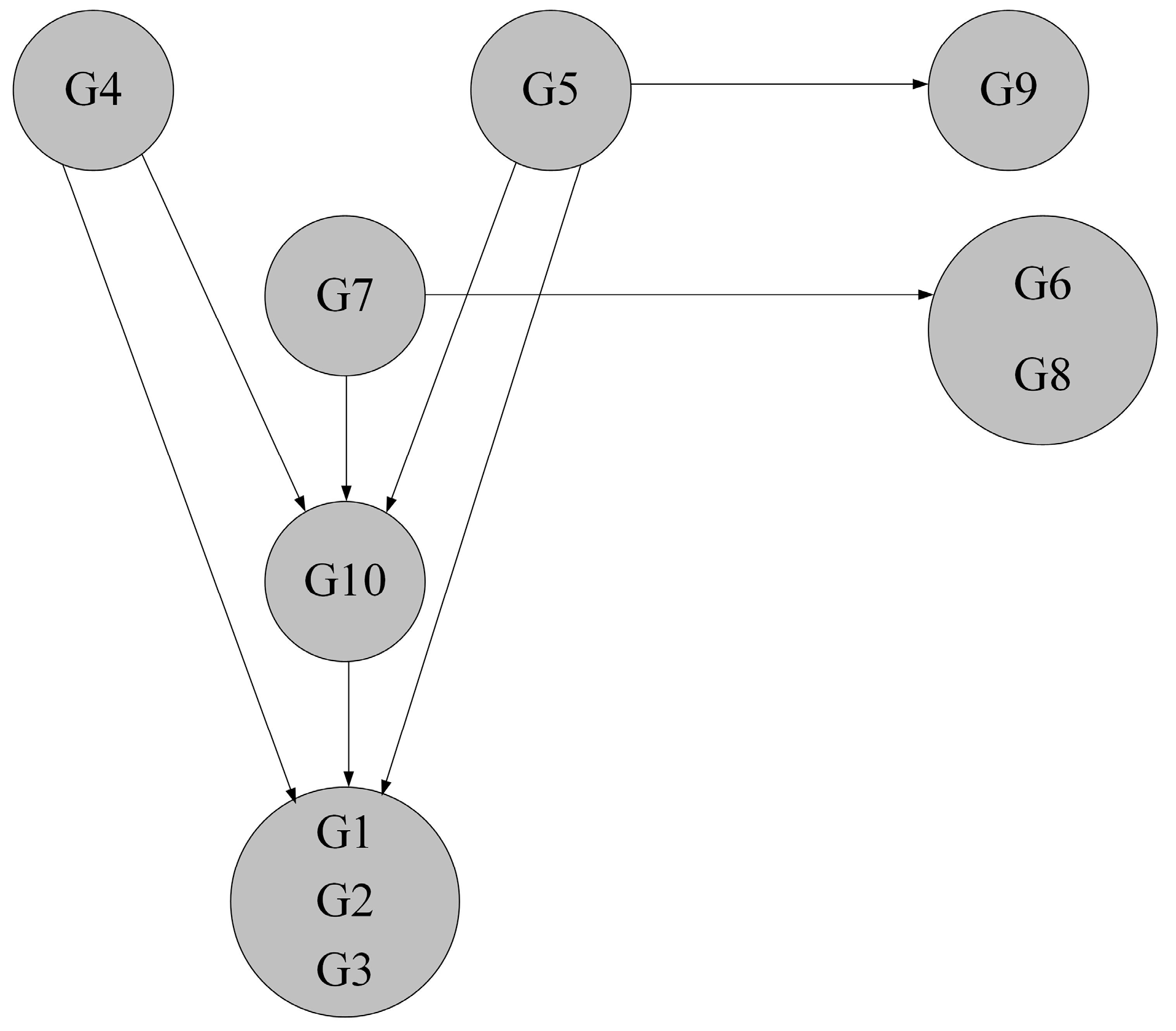
To more fully illustrate the identified research gaps, a diagram of their interrelationships was developed. This diagram presents not only the hierarchy of individual areas but also the logical connections between them. This makes it possible to capture the sequence of research activities, from error analysis and method validation, through the assessment of their effectiveness and scalability, to potential innovative applications in practical power systems.
The diagram in Figure 4 illustrates the hierarchy and interconnections between the identified research gaps. It shows that individual gaps do not exist independently but rather maintain logical cause-and-effect relationships, creating a coherent framework for research development.
In particular, the gap related to the lack of method validation (G10) is a consequence of deficiencies in error analyses and comparisons between linear and nonlinear methods (G4, G5). This means that until robust research on the accuracy and limitations of linearisation methods is conducted, full validation of their performance based on real-world data remains unattainable. Similarly, the gap related to the underestimation of error depending on network size (G7) directly impacts practical implementation issues (G6), as the lack of knowledge about the scalability of computational errors limits the applicability of models in operational settings.
Based on this, it can be seen that the identified research gaps (G4–G7, G10) provide a foundation for further, more innovative research directions, such as the contribution of renewable sources and storage to power restoration (G1), the optimal selection of compensation devices (G2) and the concept of cable pooling (G3). This indicates that new applications of linearisation models can only be fully credible and useful when grounded in solid foundations of error analysis, validation and method benchmarking.
Both the table and the diagram above constitute an original proposal developed as part of this article, the aim of which is not only to systematically organise the identified research gaps but also to inspire future authors to undertake in-depth research in this area. Their role is to identify priority research directions that may be crucial for the further development of linearisation methods in power engineering and their practical implementation in real-world energy systems. The table and diagram should be treated as a point of reference and an impulse to generate new ideas that, in the long run, can contribute to both improving the quality of analyses and developing modern, reliable solutions for the future energy sector.

5. Summary

The literature review demonstrates that linearisation methods play a significant role in power system research. Distribution and transmission system operators require modern computing tools that combine high accuracy, efficiency, and practical application. This is due to the ongoing energy transformation, the dynamic development of renewable energy sources and the greater complexity of the grid management process. Linearisation meets these requirements, enabling significant simplification of complex models while maintaining an acceptable level of accuracy. This allows these methods to be used in both planning analyses and system operations.
The reviewed literature demonstrates that linearisation has found particularly widespread application in optimal power flow problems, as well as in grid reconfiguration and renewable energy integration optimisation. However, its popularity and effectiveness vary depending on the specific problem, indicating the need for further research on adapting linearisation methods to new challenges. In some cases, simple simplifications and engineering logic prove to be fully sufficient to find a solution. For complex problems, the use of advanced algorithms becomes necessary.
The literature review also identified significant research gaps. Areas requiring further development include research on the role of RES and energy storage in system restoration after failures, the optimal selection of compensation devices for wind and photovoltaic farms connected via cables, and the development of the cable pooling concept, enabling the efficient use of shared infrastructure by various renewable sources. These issues can be largely addressed using linearisation methods, yet they have not been adequately explored in the literature so far.
An important direction of development is combining classical linearisation methods with modern artificial intelligence and advanced optimisation techniques. Hybrid approaches can enable better representation of complex phenomena while maintaining the required computational speed. Further improvement of programming tools and algorithms enabling real-time linearisation is also crucial.
It is also important to emphasise the need for an interdisciplinary approach. The development of linearisation methods requires the collaboration of experts in the fields of energy, mathematics, optimisation and artificial intelligence. Close collaboration with power system operators, who possess practical knowledge, data and experience in grid monitoring and management, is also crucial. This allows for the creation of methods that not only meet academic criteria but also have real-world applications.
In the context of combining linearisation with artificial intelligence methods, it is important to clarify the role of the ‘learning’ component. It should be seen as an addition that works alongside physical models, not instead of them. In practice, this means using predictors to: correct systematic linearisation deviations (e.g., compensation for typographical errors in voltages or losses), quickly ‘warm-start’ the solver (by predicting active constraints), and adaptively select the complexity of constraint approximations and inactive scenarios. Integration understood in this way reduces the risk of over-reliance on models and allows key decisions to remain interpretable.
At the same time, the relationship between time and accuracy should be considered. Training machine learning models is a process that is performed infrequently and offline, usually when there are significant changes in topology or workload profile. This cost is then amortised over time: inference in operational mode is very fast and accounts for a fraction of the total time spent solving a linear problem. In operational applications, decisions are made repeatedly over successive time horizons and for multiple scenarios. Under such conditions, the cost of training is quickly recouped, and adding a lightweight AI component to LP/MILP does not degrade the system’s response time. Moreover, the hybrid can speed up calculations by reducing the number of solver iterations or the size of the search space through better initialisation and filtering.
The issue of accuracy is addressed through a layer of security and validation embedded in the decision-making process. Firstly, conservative margins are applied in the constraints (e.g., slight ‘tightening’ of acceptable ranges), which reduces the risk of violations resulting from imperfect approximations. Secondly, predictions outside the training range are rejected and the system automatically reverts to a purely linear procedure if quality signals (e.g., uncertainty measures) indicate an increased risk of error. The importance of cooperation with power system operators should also be emphasised. Access to measurement data, operational experience and ‘digital twin’ platforms allows for the design of solutions that address real constraints from the outset: data quality and availability, hardware limitations, security and compliance requirements. Joint pilot projects, from the station level, through selected areas of the network, to larger-scale implementations, enable iterative refinement of methods and the definition of transparent procedures.
In summary, the integration of linearisation with AI is justified both computationally and qualitatively, as long as the learned component plays a supporting role rather than replacing physical models, and the whole is embedded in a clearly defined chain of security, validation and monitoring. This direction of development, supported by mature programming tools and interdisciplinary and operational cooperation, allows the benefits of computational speed to be combined with improved representation of phenomena, resulting in methods that are both scientifically sound and ready for practical application.
Linearization methods are an important tool supporting the development and operation of modern power systems. It should be noted that there is no universal method that can solve all the problems facing the energy sector. However, thanks to its flexibility and computational efficiency, linearization plays a significant role in various issues in the field of power engineering. The identified research gaps and potential development directions should inspire future studies focused on enhancing the reliability, security, and efficiency of power system operation.

Author Contributions

Conceptualisation, P.P., D.J. and A.B.; methodology, P.P., D.J., A.B., P.S. and D.P.; software, P.P., A.B. and D.P.; validation, P.P., D.J., A.B., P.S. and D.P.; formal analysis, P.P., A.B. and D.P.; investigation, P.P., D.J., A.B., P.S. and D.P.; resources, P.P., A.B. and D.P.; data curation, P.P., A.B. and D.P.; writing—original draft preparation, P.P., D.J., A.B., P.S. and D.P.; writing—review and editing, P.P., D.J., A.B., P.S. and D.P.; visualisation, P.P., A.B. and D.P.; supervision, P.P., D.J. and P.S.; project administration, P.P. and A.B.; funding acquisition, P.P. and A.B. All authors have read and agreed to the published version of the manuscript.

Funding

This research received no external funding.

Institutional Review Board Statement

Not applicable.

Informed Consent Statement

Not applicable.

Data Availability Statement

Not applicable.

Conflicts of Interest

The authors declare no conflicts of interest.

Abbreviations

The following abbreviations are used in this manuscript:
DCDirect Current
TTCTotal Transmission Capacity
IPFInterval Power Flow
OPFOptimal Power Flow
MILPMixed Integer Linear Programming
TEPTransmission Expansion Planning
CAESCompressed Air Energy Storage
SLASequential Linearization Algorithm
LACPFLinearized AC Power Flow
LPFLinearized Power Flow
NPFNonlinear Power Flow
GMPGlobal Maximum Power
SPSASalp Particle Swarm Algorithm
HILHardware-in-the-Loop
LADRCLinear Active Disturbance Rejection Control
LFCLoad Frequency Control
AVRAutomatic Voltage Regulation
SCASine Cosine Algorithm
IPFCInterline Power Flow Controller
KKTKarush-Kuhn-Tucker
LPF-DLinearized Power Flow for Distribution
LF-DLoss Factors for Distribution
LOPF-DLinear Optimal Power Flow for Distribution
CSQPCustomised Sequential Quadratic Programming
POLPoint of Linearization
UVLSUnder-Voltage Load Shedding
MIPMixed Integer Programming
NFVNetwork Functions Virtualization
SNOPSoft Normally Open Point
DGDistributed Generation
LMLevenberg–Marquardt
DFLDirect Feedback Linearization
FBLFeedback Linearization
DDPMDirect Driven Permanent Magnet
WECSWind Energy Conversion Systems
TCPSTThyristor Controlled Phase Shifter Transformers
SLPSequential Linear Programming
DERDistributed Energy Source
LOPFLinear Optimal Power Flow
DLRDynamic Line Rating
ACRUCAC Power Flow-Constrained Robust Unit Commitment
DNDistribution Network
SVRStep Voltage Regulators
OPTSOptimal Problem Tap Selection
DLMPDistribution LMP
T-STakagi–Sugeno
LMILinear Matrix Inequalities
MPCModel Predictive Control
SEIGSelf-Excited Induction Generator
DSSEDistribution Systems State Estimation
ESSEnergy Storage System
EMSEnergy Management System
AC OPFAC optimal power flow
ATCAvailable Transfer Capacity
RESRenewable energy sources
LOLPLoss of Load Probability

References

  1. Dong, X.; Wang, H.; Zhang, C.; Yu, W.; Yang, R.; Xiao, L.; Liao, W.; Luo, C. The power flow algorithm for AC/DC microgrids based on improved unified iteration method. Front. Energy Res. 2024, 12, 1376714. [Google Scholar] [CrossRef]
  2. Shao, Z.; Zhai, Q.; Mao, Y.; Guan, X. A method for evaluating and improving linear power flow models in system with large fluctuations. Int. J. Electr. Power Energy Syst. 2023, 145, 108635. [Google Scholar] [CrossRef]
  3. Buason, P.; Misra, S.; Watson, J.-P.; Molzahn, D.K. Adaptive Power Flow Approximations with Second-Order Sensitivity Insights. IEEE Trans. Power Syst. 2024, 40, 2648–2660. [Google Scholar] [CrossRef]
  4. van Horn, K.E.; Dominguez-Garcia, A.D.; Sauer, P.W. Measurement-Based Real-Time Security-Constrained Economic Dispatch. IEEE Trans. Power Syst. 2016, 31, 3548–3560. [Google Scholar] [CrossRef]
  5. Dorfler, F.; Bullo, F. Novel insights into lossless AC and DC power flow. In Proceedings of the 2013 IEEE Power & Energy Society General Meeting, Vancouver, BC, Canada, 21–25 July 2013; pp. 1–5, ISBN 978-1-4799-1303-9. [Google Scholar]
  6. Overbye, T.J.; Cheng, X.; Sun, Y. A comparison of the AC and DC power flow models for LMP calculations. In Proceedings of the 37th Annual Hawaii International Conference on System Sciences, Big Island, HI, USA, 8 January 2004; p. 9, ISBN 0-7695-2056-1. [Google Scholar]
  7. Yu, D.; Cao, J.; Li, X. Review of power system linearization methods and a decoupled linear equivalent power flow model. In Proceedings of the 2018 International Conference on Electronics Technology (ICET), Chengdu, China, 23–27 May 2018; IEEE: Piscataway, NJ, USA, 2018; pp. 232–239, ISBN 978-1-5386-5752-2. [Google Scholar]
  8. Dhople, S.V.; Guggilam, S.S.; Chen, Y.C. Linear approximations to AC power flow in rectangular coordinates. In Proceedings of the 2015 53rd Annual Allerton Conference on Communication, Control and Computing (Allerton), Monticello, IL, USA, 29 September–2 October 2015; pp. 211–217, ISBN 978-1-5090-1824-6. [Google Scholar]
  9. Li, X. Fast Heuristic AC Power Flow Analysis with Data-Driven Enhanced Linearized Model. Energies 2020, 13, 3308. [Google Scholar] [CrossRef]
  10. Rossi, M.; Viganò, G.; Rossini, M. Linear optimal power flow model for modern distribution systems: Management of normally closed loop grids and on-load tap changers. Electr. Power Syst. Res. 2024, 235, 110653. [Google Scholar] [CrossRef]
  11. Gao, C.; Kuang, F.; Wei, B.; Luo, S.; Huan, J. A topology-based neural network approach for linear power flow modeling within configurable error tolerance. Energy Rep. 2025, 13, 6161–6169. [Google Scholar] [CrossRef]
  12. Liu, Y.; Zhang, N.; Wang, Y.; Yang, J.; Kang, C. Data-Driven Power Flow Linearization: A Regression Approach. IEEE Trans. Smart Grid 2019, 10, 2569–2580. [Google Scholar] [CrossRef]
  13. Long, J.; Yang, Z.; Liu, Y.; Xiang, M.; Yu, J. AC Network-Constrained Unit Commitment Based on Adaptive Linear Power Flow Model. IEEE Trans. Power Syst. 2025, 40, 1360–1373. [Google Scholar] [CrossRef]
  14. Bolognani, S.; Dorfler, F. Fast power system analysis via implicit linearization of the power flow manifold. In Proceedings of the 2015 53rd Annual Allerton Conference on Communication, Control and Computing (Allerton), Monticello, IL, USA, 29 September–2 October 2015; pp. 402–409, ISBN 978-1-5090-1824-6. [Google Scholar]
  15. Neumann, F.; Hagenmeyer, V.; Brown, T. Assessments of linear power flow and transmission loss approximations in coordinated capacity expansion problems. Appl. Energy 2022, 314, 118859. [Google Scholar] [CrossRef]
  16. Hörsch, J.; Ronellenfitsch, H.; Witthaut, D.; Brown, T. Linear optimal power flow using cycle flows. Electr. Power Syst. Res. 2018, 158, 126–135. [Google Scholar] [CrossRef]
  17. Chen, Y.; Singh, M.K. Optimally Linearizing Power Flow Equations for Improved Power System Dispatch. arXiv 2025, arXiv:2504.03076. [Google Scholar] [CrossRef]
  18. Zhang, C.; Liu, Q.; Zhou, B.; Chung, C.Y.; Li, J.; Zhu, L.; Shuai, Z. A Central Limit Theorem-Based Method for DC and AC Power Flow Analysis Under Interval Uncertainty of Renewable Power Generation. IEEE Trans. Sustain. Energy 2023, 14, 563–575. [Google Scholar] [CrossRef]
  19. Guo, X.; Gong, R.; Bao, H.; Wang, Q. Hybrid Stochastic and Interval Power Flow Considering Uncertain Wind Power and Photovoltaic Power. IEEE Access 2019, 7, 85090–85097. [Google Scholar] [CrossRef]
  20. Li, Q.; Zhao, N. A probability box representation method for power flow analysis considering both interval and probabilistic uncertainties. Int. J. Electr. Power Energy Syst. 2022, 142, 108371. [Google Scholar] [CrossRef]
  21. Liao, X.; Liu, K.; Zhang, Y.; Wang, K.; Qin, L. Interval method for uncertain power flow analysis based on Taylor inclusion function. IET Gener. Transm. Distrib. 2017, 11, 1270–1278. [Google Scholar] [CrossRef]
  22. Liao, X.; Zhang, Y.; Li, Z.; Wei, H.; Ding, H. Probabilistic interval power flow calculation method for distribution networks considering the correlation of distributed wind power output. Int. J. Electr. Power Energy Syst. 2024, 157, 109827. [Google Scholar] [CrossRef]
  23. Rodrigues Junior, H.M.; Melo, I.D.; Nepomuceno, E.G. An interval power flow for unbalanced distribution systems based on the Three-Phase Current Injection Method. Int. J. Electr. Power Energy Syst. 2022, 139, 107921. [Google Scholar] [CrossRef]
  24. Zhang, X.; Deng, B.; Pan, Z.; Yu, T. A linear programming-based framework of interval power flow analysis for distribution systems. Int. J. Electr. Power Energy Syst. 2025, 167, 110638. [Google Scholar] [CrossRef]
  25. Wang, Y.; Wu, Z.; Dou, X.; Hu, M.; Xu, Y. Interval power flow analysis via multi-stage affine arithmetic for unbalanced distribution network. Electr. Power Syst. Res. 2017, 142, 1–8. [Google Scholar] [CrossRef]
  26. Cheng, S.; Zuo, X.; Yang, K.; Wei, Z.; Wang, R. Improved Affine Arithmetic-Based Power Flow Computation for Distribution Systems Considering Uncertainties. IEEE Syst. J. 2023, 17, 1918–1927. [Google Scholar] [CrossRef]
  27. Fan, Z.; Yang, Z.; Yu, J.; Xie, K.; Yang, G. Minimize Linearization Error of Power Flow Model Based on Optimal Selection of Variable Space. IEEE Trans. Power Syst. 2021, 36, 1130–1140. [Google Scholar] [CrossRef]
  28. Shao, Z.; Zhai, Q.; Xu, Y.; Guan, X. A Linear Probabilistic Optimal Power Flow Model with Linearization Error Checking. In Proceedings of the 2022 IEEE PES Innovative Smart Grid Technologies—Asia (ISGT Asia), Singapore, 1–5 November 2022; pp. 170–174, ISBN 979-8-3503-9966-0. [Google Scholar]
  29. Long, J.; Jiang, W.; Jin, L.; Zhang, T.; Jiang, H.; Xu, T. A Combination of Linear Power Flow Models to Reduce Linearization Error. In Proceedings of the 2020 IEEE 3rd International Conference of Safe Production and Informatization (IICSPI), Chongqing, China, 28–30 November2020; pp. 256–260, ISBN 978-1-7281-7738-0. [Google Scholar]
  30. Sowa, T.; Stroband, A.; Cramer, W.; Koopmann, S.; Schnettler, A. An AC power flow linearization for power system optimization using linear programming. In Proceedings of the 2016 IEEE Electrical Power and Energy Conference (EPEC), Ottawa, ON, Canada, 12–14 October 2016; pp. 1–5, ISBN 978-1-5090-1919-9. [Google Scholar]
  31. Feng, N.; Yang, Z.; Fan, Z.; Yu, J.; Yang, G. Linearization Error of Power Flow Model Considering the Distribution of State Variables. In Proceedings of the 2019 IEEE Innovative Smart Grid Technologies—Asia (ISGT Asia), Chengdu, China, 21–24 May 2019; pp. 859–864, ISBN 978-1-7281-3520-5. [Google Scholar]
  32. Uniyal, A.; Sarangi, S.; Rawat, M.S. Optimal linear power flow for droop controlled islanded microgrid. Int. J. Electr. Power Energy Syst. 2024, 160, 110091. [Google Scholar] [CrossRef]
  33. Byeon, G.; Ryu, M.; Kim, K. Linearized optimal power flow for multiphase radial networks with delta connections. Electr. Power Syst. Res. 2024, 235, 110689. [Google Scholar] [CrossRef]
  34. Wang, H.; Zhou, N.; Zhang, Y.; Liao, J.; Tan, S.; Liu, X.; Guo, C.; Wang, Q. Linearized power flow calculation of bipolar DC distribution network with multiple flexible equipment. Int. J. Electr. Power Energy Syst. 2024, 155, 109568. [Google Scholar] [CrossRef]
  35. Sereeter, B.; Markensteijn, A.S.; Kootte, M.E.; Vuik, C. A novel linearized power flow approach for transmission and distribution networks. J. Comput. Appl. Math. 2021, 394, 113572. [Google Scholar] [CrossRef]
  36. Buason, P.; Misra, S.; Molzahn, D.K. A sample-based approach for computing conservative linear power flow approximations. Electr. Power Syst. Res. 2022, 212, 108579. [Google Scholar] [CrossRef]
  37. Mhanna, S.; Mancarella, P. An Exact Sequential Linear Programming Algorithm for the Optimal Power Flow Problem. IEEE Trans. Power Syst. 2022, 37, 666–679. [Google Scholar] [CrossRef]
  38. Vaccari, M.; Mancuso, G.M.; Riccardi, J.; Cantù, M.; Pannocchia, G. A Sequential Linear Programming algorithm for economic optimization of Hybrid Renewable Energy Systems. J. Process Control 2019, 74, 189–201. [Google Scholar] [CrossRef]
  39. Fan, Z.; Lou, L.; Zhang, J.; Zhou, D.; Shi, Y. Improving Linear OPF Model via Incorporating Bias Factor of Optimality Condition. IEEE Trans. Power Syst. 2024, 39, 6753–6763. [Google Scholar] [CrossRef]
  40. Akbari, T.; Tavakoli Bina, M. Linear approximated formulation of AC optimal power flow using binary discretisation. IET Gener. Transm. Distrib. 2016, 10, 1117–1123. [Google Scholar] [CrossRef]
  41. Contreras, D.A.; Rudion, K. Improved Assessment of the Flexibility Range of Distribution Grids Using Linear Optimization. In Proceedings of the 2018 Power Systems Computation Conference (PSCC), Dublin, Ireland, 11–15 June 2018; pp. 1–7, ISBN 978-1-910963-10-4. [Google Scholar]
  42. Sadat, S.A.; Sahraei-Ardakani, M. Customized Sequential Quadratic Programming for Solving Large-Scale AC Optimal Power Flow. In Proceedings of the 2021 North American Power Symposium (NAPS), College Station, TX, USA, 14–16 November 2021; pp. 1–6, ISBN 978-1-6654-2081-5. [Google Scholar]
  43. An, M.; Lu, T.; Han, X. An online updated linear power flow model based on regression learning. IET Gener. Transm. Distrib. 2024, 18, 2006–2019. [Google Scholar] [CrossRef]
  44. Long, J.; Yang, Z.; Zhao, J.; Yu, J. Modular Linear Power Flow Model Against Large Fluctuations. IEEE Trans. Power Syst. 2024, 39, 402–415. [Google Scholar] [CrossRef]
  45. Usman, M.; Capitanescu, F. A New Second-Order Linear Approximation to AC OPF Managing Flexibility Provision in Smart Grids. In Proceedings of the 2021 International Conference on Smart Energy Systems and Technologies (SEST), Vaasa, Finland, 6–8 September 2021; pp. 1–6, ISBN 978-1-7281-7660-4. [Google Scholar]
  46. Pareek, P.; Verma, A. Linear OPF with linearization of quadratic branch flow limits. In Proceedings of the 2018 IEEMA Engineer Infinite Conference (eTechNxT), New Delhi, India, 13–14 March 2018; pp. 1–6, ISBN 978-1-5386-1138-8. [Google Scholar]
  47. Yang, Z.; Xie, K.; Yu, J.; Zhong, H.; Zhang, N.; Xia, Q.X. A General Formulation of Linear Power Flow Models: Basic Theory and Error Analysis. IEEE Trans. Power Syst. 2019, 34, 1315–1324. [Google Scholar] [CrossRef]
  48. Ahmadi, H.; Marti, J.R. Distribution System Optimization Based on a Linear Power-Flow Formulation. IEEE Trans. Power Deliv. 2015, 30, 25–33. [Google Scholar] [CrossRef]
  49. Arif, J.; Ray, S.; Chaudhuri, B. MIMO feedback linearization control for power systems. Int. J. Electr. Power Energy Syst. 2013, 45, 87–97. [Google Scholar] [CrossRef]
  50. Viehweider, A.; Schichl, H.; de Castro, D.B.; Henein, S.; Schwabeneder, D. Smart robust voltage control for distribution networks using interval arithmetic and state machine concepts. In Proceedings of the 2010 IEEE PES Innovative Smart Grid Technologies Conference Europe (ISGT Europe), Gothenburg, Sweden, 11–13 October 2010; Staff, I., Ed.; IEEE: New York, NY, USA, 2010; pp. 1–8, ISBN 978-1-4244-8508-6. [Google Scholar]
  51. Alizadeh Mousavi, O.; Bozorg, M.; Cherkaoui, R. Preventive reactive power management for improving voltage stability margin. Electr. Power Syst. Res. 2013, 96, 36–46. [Google Scholar] [CrossRef]
  52. Li, Z.; Yu, J.; Wu, Q.H. Approximate Linear Power Flow Using Logarithmic Transform of Voltage Magnitudes with Reactive Power and Transmission Loss Consideration. IEEE Trans. Power Syst. 2018, 33, 4593–4603. [Google Scholar] [CrossRef]
  53. dos Santos, T.N.; Diniz, A.L. A Dynamic Piecewise Linear Model for DC Transmission Losses in Optimal Scheduling Problems. IEEE Trans. Power Syst. 2011, 26, 508–519. [Google Scholar] [CrossRef]
  54. Resener, M.; Haffner, S.; Pereira, L.A.; Pardalos, P.M.; Ramos, M.J. A comprehensive MILP model for the expansion planning of power distribution systems—Part II: Numerical results. Electr. Power Syst. Res. 2019, 170, 317–325. [Google Scholar] [CrossRef]
  55. Bernstein, A.; Dall’Anese, E. Linear power-flow models in multiphase distribution networks. In Proceedings of the 2017 IEEE PES Innovative Smart Grid Technologies Conference Europe (ISGT-Europe), Torino, Italy, 26–29 September 2017; pp. 1–6, ISBN 978-1-5386-1953-7. [Google Scholar]
  56. Di Fazio, A.R.; Perna, S.; Russo, M.; de Santis, M. Linear Power Flow Method for Radial Distribution Systems Including Voltage Control Devices. IEEE Trans. Ind. Appl. 2024, 60, 4749–4761. [Google Scholar] [CrossRef]
  57. Li, B.; Wan, C.; Li, Y.; Jiang, Y.; Yu, P. Generalized linear-constrained optimal power flow for distribution networks. IET Gener. Transm. Distrib. 2023, 17, 1298–1309. [Google Scholar] [CrossRef]
  58. Li, M.; Du, Y.; Mohammadi, J.; Crozier, C.; Baker, K.; Kar, S. Numerical Comparisons of Linear Power Flow Approximations: Optimality, Feasibility, and Computation Time. In Proceedings of the 2022 IEEE Power & Energy Society General Meeting (PESGM), Denver, CO, USA, 17–21 July 2022; pp. 1–5, ISBN 978-1-6654-0823-3. [Google Scholar]
  59. Li, P.; Wu, W.; Wang, X.; Xu, B. A Data-Driven Linear Optimal Power Flow Model for Distribution Networks. IEEE Trans. Power Syst. 2023, 38, 956–959. [Google Scholar] [CrossRef]
  60. Jia, M.; Hug, G. Overview of Data-driven Power Flow Linearization. In Proceedings of the 2023 IEEE Belgrade PowerTech, Belgrade, Serbia, 25–29 June 2023; pp. 1–6, ISBN 978-1-6654-8778-8. [Google Scholar]
  61. Hu, R.; Li, Q.; Lei, S. Ensemble Learning based Linear Power Flow. In Proceedings of the 2020 IEEE Power & Energy Society General Meeting (PESGM), Montreal, QC, Canada, 2–6 August 2020; pp. 1–5, ISBN 978-1-7281-5508-1. [Google Scholar]
  62. Liu, Y.; Wang, Y.; Zhang, N.; Lu, D.; Kang, C. A Data-Driven Approach to Linearize Power Flow Equations Considering Measurement Noise. IEEE Trans. Smart Grid 2020, 11, 2576–2587. [Google Scholar] [CrossRef]
  63. Fernandes, A.C.; Júnior, M.F.M.; Oliveira, A.V.C.; Fonseca, J.R.L. A linear model for overload rerouting and testing switching measures for overload elimination by means of Relief Functions. In Proceedings of the IX Simpósio Brasileiro de Sistemas Elétricos, Santa Maria, Rio Grande do Sul, Brasil, 10–13 July 2022; Bernardon, D.P., Ed.; SBA Sociedade Brasileira de AutomáticaCampinas: São Paulo, Brasil, 2018. [Google Scholar]
  64. Lin, H.; UI Nazir, F.; Pal, B.C.; Guo, Y. A Linearized Branch Flow Model Considering Line Shunts for Radial Distribution Systems and Its Application in Volt/VAr Control. J. Mod. Power Syst. Clean Energy 2023, 11, 1191–1200. [Google Scholar] [CrossRef]
  65. Di Fazio, A.R.; Russo, M.; Valeri, S.; de Santis, M. Linear method for steady-state analysis of radial distribution systems. Int. J. Electr. Power Energy Syst. 2018, 99, 744–755. [Google Scholar] [CrossRef]
  66. Li, P.; Wu, W.; Wang, Y.; Hu, Y.; Wu, Z.; Li, Y.; Yuan, Y. A Data-Driven Linear Robust Optimal Power Flow Model. In Proceedings of the 2023 IEEE 7th Conference on Energy Internet and Energy System Integration (EI2), Hangzhou, China, 15–18 December 2023; pp. 650–654, ISBN 979-8-3503-4509-4. [Google Scholar]
  67. Rashidirad, N.; Dagdougui, H.; Sheshyekani, K. A Novel Approach for Improved Linear Power-Flow Formulation. IEEE Trans. Power Deliv. 2022, 37, 5224–5233. [Google Scholar] [CrossRef]
  68. Long, J.; Gong, C.; Lu, Y. Tertiary Control of Islanded Microgrids Based on a Linearized ACOPF with Losses Compensation. In Proceedings of the 2019 9th International Conference on Power and Energy Systems (ICPES), Perth, WA, Australia, 10–12 December 2019; pp. 1–8, ISBN 978-1-7281-2658-6. [Google Scholar]
  69. Costa, A.D.; Ferraz, B.P.; Resener, M.; Haffner, S. Linear Load Flow Formulation for Unbalanced Distribution Systems. In Proceedings of the 2019 IEEE PES Innovative Smart Grid Technologies Conference—Latin America (ISGT Latin America), Gramado, Brazil, 15–18 September 2019; pp. 1–6, ISBN 978-1-5386-9567-8. [Google Scholar]
  70. Bassey, O.; Chen, C.; Butler-Purry, K.L. Linear power flow formulations and optimal operation of three-phase autonomous droop-controlled Microgrids. Electr. Power Syst. Res. 2021, 196, 107231. [Google Scholar] [CrossRef]
  71. Bazaraa, M.S.; Jarvis, J.J.; Sherali, H.D. Linear Programming and Network Flows; Wiley: Hoboken, NJ, USA, 2009; ISBN 9780471485995. [Google Scholar]
  72. Huang, Y.; Ding, T.; Wang, P.; Jia, W.; Ju, C.; He, X.; Zhang, H.; Zhang, Z.; Sun, Y. Linearized AC power flow model based interval total transfer capability evaluation with uncertain renewable energy integration. Int. J. Electr. Power Energy Syst. 2023, 154, 109440. [Google Scholar] [CrossRef]
  73. Ejebe, G.C.; Waight, J.G.; Santos-Nieto, M.; Tinney, W.F. Fast calculation of linear available transfer capability. In Proceedings of the 21st International Conference on Power Industry Computer Applications. Connecting Utilities. PICA 99. To the Millennium and Beyond (Cat. No.99CH36351). PICA’99—Power Industry Computer Applications Conference, Santa Clara, CA, USA, 16–21 May 1999; pp. 255–260, ISBN 0-7803-5478-8. [Google Scholar]
  74. Habibi, M.; Zangeneh, A. Optimal Transmission Switching for Congestion Management and Cost Reduction Using Linearized AC Optimal Power Flow. Int. Trans. Electr. Energy Syst. 2025, 2025, 3620842. [Google Scholar] [CrossRef]
  75. Shokri Gazafroudi, A.; Neumann, F.; Brown, T. Topology-based approximations for N−1 contingency constraints in power transmission networks. Int. J. Electr. Power Energy Syst. 2022, 137, 107702. [Google Scholar] [CrossRef]
  76. Mohseni, M.; Nouri, A.; Salmanpor Bandaghiri, P.; Saeedavi, R.; Afkousi-Paqaleh, M. Probabilistic Assessment of Available Transfer Capacity via Market Linearization. IEEE Syst. J. 2015, 9, 1409–1418. [Google Scholar] [CrossRef]
  77. Mazaheri, H.; Moeini-Aghtaie, M.; Fotuhi-Firuzabad, M.; Dehghanian, P.; Khoshjahan, M. A linearized transmission expansion planning model under N − 1 criterion for enhancing grid-scale system flexibility via compressed air energy storage integration. IET Gener. Transm. Distrib. 2022, 16, 208–218. [Google Scholar] [CrossRef]
  78. Usman, M.; Capitanescu, F. A Novel Tractable Methodology to Stochastic Multi-Period AC OPF in Active Distribution Systems Using Sequential Linearization Algorithm. IEEE Trans. Power Syst. 2022, 38, 3869–3883. [Google Scholar] [CrossRef]
  79. Jabarnejad, M. Linearized Generation-Expansion Planning Considering Transmission Planning, Switching, and Dynamic-Line Rating. J. Energy Eng. 2021, 147, 04021021. [Google Scholar] [CrossRef]
  80. Bagheri, A.; Mobayen, S. Optimal integration of dynamic line rating and transmission expansion for sustainable grids: A mixed-integer linear programming approach with voltage stability constraints. Sustain. Energy Grids Netw. 2025, 44, 101932. [Google Scholar] [CrossRef]
  81. Liao, J.; Wu, G.; Lin, J. Linearized MILP Model with Improved Soft Actor-Critic Algorithm for Dynamic and Efficient Active Distribution Network Planning. IEEE Access 2025, 13, 121544–121555. [Google Scholar] [CrossRef]
  82. He, Y.; Xie, L.; Ding, T.; Huang, Y.; Sun, Y.; Shen, H.; Zhang, B.; Han, Z.; Sun, X. Interval Power Flow Analysis of Linearised AC Power Flow Model Based on Improved Affine Arithmetic Method. IET Gener. Transm. Distrib. 2025, 19, e70073. [Google Scholar] [CrossRef]
  83. Deng, B.; Wen, Y.; Jiang, X. Total transfer capability assessment of HVDC tie-lines in asynchronous grids. IET Gener. Transm. Distrib. 2021, 15, 2872–2882. [Google Scholar] [CrossRef]
  84. Li, Z.; Yin, H.; Wang, P.; Gu, C.; Wang, K.; Hu, Y. A fast linearized AC power flow-constrained robust unit commitment approach with customized redundant constraint identification method. Front. Energy Res. 2023, 11, 1218461. [Google Scholar] [CrossRef]
  85. Jakus, D.; Vasilj, J.; Matić, B.; Kalinić, M. Optimal distribution network planning based on mixed integrated linear programming. In Proceedings of the 15th Symposium on Power System Management, HRO CIGRE, Cavtat, Croatia, 6–9 November 2022; pp. 1–10. Available online: https://hro-cigre.hr/wp-content/uploads/2023/03/T1-10.pdf (accessed on 20 October 2025).
  86. Fan, Z.; Zhu, J.; Yuan, Y.; Wu, H. Distributed Generation Planning Model of Active Distribution Network and Linearization Method Based on Improved DC Power Flow Algorithm. Dianwang Jishu Power Syst. Technol. 2019, 43, 504–513. [Google Scholar] [CrossRef]
  87. Rigo-Mariani, R.; Ling, K.V.; Maciejowski, J. A clusterized energy management with linearized losses in the presence of multiple types of distributed generation. Int. J. Electr. Power Energy Syst. 2019, 113, 9–22. [Google Scholar] [CrossRef]
  88. Yu, D.; Tang, R.; Pan, L. Optimal allocation of photovoltaic energy storage in DC distribution network based on interval linear programming. J. Energy Storage 2024, 85, 110981. [Google Scholar] [CrossRef]
  89. Tabares, A.; Muñoz-Delgado, G.; Franco, J.F.; Arroyo, J.M.; Contreras, J. Multistage reliability-based expansion planning of ac distribution networks using a mixed-integer linear programming model. Int. J. Electr. Power Energy Syst. 2022, 138, 107916. [Google Scholar] [CrossRef]
  90. Munoz-Delgado, G.; Contreras, J.; Arroyo, J.M. Reliability Assessment for Distribution Optimization Models: A Non-Simulation-Based Linear Programming Approach. IEEE Trans. Smart Grid 2018, 9, 3048–3059. [Google Scholar] [CrossRef]
  91. Jooshaki, M.; Abbaspour, A.; Fotuhi-Firuzabad, M.; Munoz-Delgado, G.; Contreras, J.; Lehtonen, M.; Arroyo, J.M. Linear Formulations for Topology-Variable-Based Distribution System Reliability Assessment Considering Switching Interruptions. IEEE Trans. Smart Grid 2020, 11, 4032–4043. [Google Scholar] [CrossRef]
  92. Tabares, A.; Franco, J.F.; Lavorato, M.; Rider, M.J. Multistage Long-Term Expansion Planning of Electrical Distribution Systems Considering Multiple Alternatives. IEEE Trans. Power Syst. 2016, 31, 1900–1914. [Google Scholar] [CrossRef]
  93. Jooshaki, M.; Abbaspour, A.; Fotuhi-Firuzabad, M.; Farzin, H.; Moeini-Aghtaie, M.; Lehtonen, M. A MILP Model for Incorporating Reliability Indices in Distribution System Expansion Planning. IEEE Trans. Power Syst. 2019, 34, 2453–2456. [Google Scholar] [CrossRef]
  94. Jooshaki, M.; Abbaspour, A.; Fotuhi-Firuzabad, M.; Moeini-Aghtaie, M.; Lehtonen, M. MILP Model of Electricity Distribution System Expansion Planning Considering Incentive Reliability Regulations. IEEE Trans. Power Syst. 2019, 34, 4300–4316. [Google Scholar] [CrossRef]
  95. Rojer, J.; Janssen, F.; van der Klauw, T.; van Rooyen, J. Integral techno-economic design & operational optimization for district heating networks with a Mixed Integer Linear Programming strategy. Energy 2024, 308, 132710. [Google Scholar] [CrossRef]
  96. Cheng, R.; Wang, Z.; Guo, Y. An Online Feedback-Based Linearized Power Flow Model for Unbalanced Distribution Networks. IEEE Trans. Power Syst. 2022, 37, 3552–3565. [Google Scholar] [CrossRef]
  97. Babić, A.B.; Sarić, A.T.; Ranković, A. Transmission expansion planning based on Locational Marginal Prices and ellipsoidal approximation of uncertainties. Int. J. Electr. Power Energy Syst. 2013, 53, 175–183. [Google Scholar] [CrossRef]
  98. Lv, G.; Zhang, P.; Liu, Z.; Gao, X. Research on reconfiguration of distribution system base on snop integrated with orderly electric vehicle charging strategy. IET Conf. Proc. 2022, 2022, 755–759. [Google Scholar] [CrossRef]
  99. Chang, Y.; Li, Y. Power generation and cross-border grid planning for the integrated ASEAN electricity market: A dynamic linear programming model. Energy Strategy Rev. 2013, 2, 153–160. [Google Scholar] [CrossRef]
  100. Babonneau, F.; Caramanis, M.; Haurie, A. A linear programming model for power distribution with demand response and variable renewable energy. Appl. Energy 2016, 181, 83–95. [Google Scholar] [CrossRef]
  101. Maroufmashat, A.; Fowler, M.; Sattari Khavas, S.; Elkamel, A.; Roshandel, R.; Hajimiragha, A. Mixed integer linear programing based approach for optimal planning and operation of a smart urban energy network to support the hydrogen economy. Int. J. Hydrogen Energy 2016, 41, 7700–7716. [Google Scholar] [CrossRef]
  102. Jansen, J.; Jorissen, F.; Helsen, L. Mixed-integer non-linear model predictive control of district heating networks. Appl. Energy 2024, 361, 122874. [Google Scholar] [CrossRef]
  103. Clack, C.; Xie, Y.; MacDonald, A.E. Linear programming techniques for developing an optimal electrical system including high-voltage direct-current transmission and storage. Int. J. Electr. Power Energy Syst. 2015, 68, 103–114. [Google Scholar] [CrossRef]
  104. Mimica, M.; Dominković, D.F.; Kirinčić, V.; Krajačić, G. Soft-linking of improved spatiotemporal capacity expansion model with a power flow analysis for increased integration of renewable energy sources into interconnected archipelago. Appl. Energy 2022, 305, 117855. [Google Scholar] [CrossRef]
  105. Vasconcelos, P.N.; Trindade, F.C.L.; Venkatesh, B. Linearized Optimization for Enhanced Aggregate Modeling of Invisible Hybrid Distributed Energy Resources. IET Gener. Transm. Distrib. 2025, 19, e70088. [Google Scholar] [CrossRef]
  106. Chen, F.; Huang, G.; Fan, Y. A linearization and parameterization approach to tri-objective linear programming problems for power generation expansion planning. Energy 2015, 87, 240–250. [Google Scholar] [CrossRef]
  107. Bianchini, G.; Casini, M.; Gholami, M. Optimal Prosumer Storage Management in Renewable Energy Communities Under Demand Response. Energies 2025, 18, 4904. [Google Scholar] [CrossRef]
  108. Wang, D.Z.; Lo, H.K. Global optimum of the linearized network design problem with equilibrium flows. Transp. Res. Part B Methodol. 2010, 44, 482–492. [Google Scholar] [CrossRef]
  109. Akbari, T.; Tavakoli Bina, M. A linearized formulation of AC multi-year transmission expansion planning: A mixed-integer linear programming approach. Electr. Power Syst. Res. 2014, 114, 93–100. [Google Scholar] [CrossRef]
  110. Munoz-Delgado, G.; Contreras, J.; Arroyo, J.M. Joint Expansion Planning of Distributed Generation and Distribution Networks. IEEE Trans. Power Syst. 2015, 30, 2579–2590. [Google Scholar] [CrossRef]
  111. Wang, J.; Zhong, H.; Xia, Q.; Kang, C. Transmission network expansion planning with embedded constraints of short circuit currents and N-1 security. J. Mod. Power Syst. Clean Energy 2015, 3, 312–320. [Google Scholar] [CrossRef]
  112. Brissette, A.; Maksimovic, D.; Levron, Y. Distributed Series Static Compensator Deployment Using a Linearized Transmission System Model. IEEE Trans. Power Deliv. 2015, 30, 1269–1277. [Google Scholar] [CrossRef]
  113. Bent, R.; Toole, G.L.; Berscheid, A. Transmission Network Expansion Planning with Complex Power Flow Models. IEEE Trans. Power Syst. 2012, 27, 904–912. [Google Scholar] [CrossRef]
  114. Gong, Y.; Wang, Z.; Yuan, Y.; Wu, C. A Reinforcement Learning Compensated Feedback Linearization Controller for Voltage Regulation of Constant Power Loads. In Proceedings of the 7th International Conference on Power and Energy Applications (ICPEA), Taiyuan, China, 18–20 October 2024; pp. 148–152, ISBN 979-8-3503-5611-3. [Google Scholar]
  115. Jiang, Y.; Zhao, S. Voltage and Frequency Stability Constrained Unit Commitment for Power Systems with Heterogeneous Regulation Resources. IEEE Trans. Sustain. Energy 2025, 16, 2874–2887. [Google Scholar] [CrossRef]
  116. Mahmoudi, S.; Golshan, M.E.H.; Siano, P. A coordinated voltage control scheme based on linearized power flow functions for non-optimal and optimal problems. Electr. Power Syst. Res. 2024, 232, 110436. [Google Scholar] [CrossRef]
  117. Lin, H.; Shen, X.; Guo, Y.; Ding, T.; Sun, H. A linear Distflow model considering line shunts for fast calculation and voltage control of power distribution systems. Appl. Energy 2024, 357, 122467. [Google Scholar] [CrossRef]
  118. Di Fazio, A.R.; Perna, S.; Russo, M.; de Santis, M. Linear Method for Radial Distribution Systems including Voltage Control Devices. In Proceedings of the 2022 IEEE International Conference on Environment and Electrical Engineering and 2022 IEEE Industrial and Commercial Power Systems Europe (EEEIC/I&CPS Europe), Prague, Czech Republic, 28 June–1 July 2022; pp. 1–8, ISBN 978-1-6654-8537-1. [Google Scholar]
  119. Jakus, D.; Novakovic, J.; Vasilj, J.; Grbavac, N.; Jolevski, D. Active Distribution Network Voltage Profile Optimization Using Mixed Integer Linear Programming. In Proceedings of the 2022 International Conference on Smart Systems and Technologies (SST), Osijek, Croatia, 19–21 October 2022; pp. 73–79, ISBN 978-1-6654-8215-8. [Google Scholar]
  120. Huang, J.; Cui, B.; Zhou, X.; Bernstein, A. A Generalized LinDistFlow Model for Power Flow Analysis. In Proceedings of the 2021 60th IEEE Conference on Decision and Control (CDC), Austin, TX, USA, 14–17 December 2021; pp. 3493–3500, ISBN 978-1-6654-3659-5. [Google Scholar]
  121. Sandeep Ayyagari, K.; Ann Abraham, S.; Yao, Y.; Ghosh, S.; Flores-Espino, F.; Nagarajan, A.; Gatsis, N. Assessing the Optimality of LinDist3Flow for Optimal Tap Selection of Step Voltage Regulators in Unbalanced Distribution Networks. In Proceedings of the 2022 IEEE 61st Conference on Decision and Control (CDC), Cancun, Mexico, 6–9 December 2022; pp. 3116–3122, ISBN 978-1-6654-6761-2. [Google Scholar]
  122. Meng, L.; Yang, X.; Zhu, J.; Wang, X.; Meng, X. Network partition and distributed voltage coordination control strategy of active distribution network system considering photovoltaic uncertainty. Appl. Energy 2024, 362, 122846. [Google Scholar] [CrossRef]
  123. Alzaareer, K.; Saad, M.; Asber, D.; Lefebvre, S.; Lenoir, L. Impedance sensitivity-based corrective method for online voltage control in smart distribution grids. Electr. Power Syst. Res. 2020, 181, 106188. [Google Scholar] [CrossRef]
  124. AL-Wesabi, I.; Zhijian, F.; Jiuqing, C.; Hussein Farh, H.M.; Aboudrar, I.; Dagal, I.; Kandil, T.; Al-Shamma’a, A.A.; Saeed, F. Fast DC-link voltage control based on power flow management using linear ADRC combined with hybrid salp particle swarm algorithm for PV/wind energy conversion system. Int. J. Hydrogen Energy 2024, 61, 688–709. [Google Scholar] [CrossRef]
  125. Irfan, R.; Gulzar, M.M.; Shakoor, A.; Habib, S.; Ahmad, H.; Hasib, S.A.; Tehreem, H. Robust operating strategy for voltage and frequency control in a non-linear hybrid renewable energy-based power system using communication time delay. Comput. Electr. Eng. 2025, 123, 110119. [Google Scholar] [CrossRef]
  126. Lubo-Matallana, U.D.; Zorrozua, M.Á.; Miñambres, J.F. Linear Sensitivity Modelling Useful for Voltage Control Analysis Using Power Injections from DER. Energies 2021, 14, 4749. [Google Scholar] [CrossRef]
  127. Yuan, H.; Li, F.; Wei, Y.; Zhu, J. Novel Linearized Power Flow and Linearized OPF Models for Active Distribution Networks with Application in Distribution LMP. IEEE Trans. Smart Grid 2018, 9, 438–448. [Google Scholar] [CrossRef]
  128. Giraldo, J.S.; Vergara, P.P.; Lopez, J.C.; Nguyen, P.H.; Paterakis, N.G. A Linear AC-OPF Formulation for Unbalanced Distribution Networks. IEEE Trans. Ind. Appl. 2021, 57, 4462–4472. [Google Scholar] [CrossRef]
  129. Javadi, M.; Amraee, T. Mixed integer linear formulation for undervoltage load shedding to provide voltage stability. IET Gener. Transm. Distrib. 2018, 12, 2095–2104. [Google Scholar] [CrossRef]
  130. Bakhshideh Zad, B.; Hasanvand, H.; Lobry, J.; Vallée, F. Optimal reactive power control of DGs for voltage regulation of MV distribution systems using sensitivity analysis method and PSO algorithm. Int. J. Electr. Power Energy Syst. 2015, 68, 52–60. [Google Scholar] [CrossRef]
  131. Zhao, P.; Yao, W.; Wen, J.; Jiang, L.; Wang, S.; Cheng, S. Improved synergetic excitation control for transient stability enhancement and voltage regulation of power systems. Int. J. Electr. Power Energy Syst. 2015, 68, 44–51. [Google Scholar] [CrossRef]
  132. Abbadi, A.; Nezli, L.; Boukhetala, D. A nonlinear voltage controller based on interval type 2 fuzzy logic control system for multimachine power systems. Int. J. Electr. Power Energy Syst. 2013, 45, 456–467. [Google Scholar] [CrossRef]
  133. Kassem, A.M.; Yousef, A.M. Voltage and frequency control of an autonomous hybrid generation system based on linear model predictive control. Sustain. Energy Technol. Assess. 2013, 4, 52–61. [Google Scholar] [CrossRef]
  134. Ahmadi, H.; Marti, J.R.; von Meier, A. A Linear Power Flow Formulation for Three-Phase Distribution Systems. IEEE Trans. Power Syst. 2016, 31, 5012–5021. [Google Scholar] [CrossRef]
  135. Marković, M.; Hodge, B.-M. Parameterized Linear Power Flow for High Fidelity Voltage Solutions in Distribution Systems. IEEE Trans. Power Syst. 2023, 38, 4391–4403. [Google Scholar] [CrossRef]
  136. Liu, K.; Wang, C.; Wang, W.; Chen, Y.; Wu, H. Linear Power Flow Calculation of Distribution Networks with Distributed Generation. IEEE Access 2019, 7, 44686–44695. [Google Scholar] [CrossRef]
  137. Toubeau, J.-F.; Teng, F.; Morstyn, T.; von Krannichfeldt, L.; Wang, Y. Privacy-Preserving Probabilistic Voltage Forecasting in Local Energy Communities. IEEE Trans. Smart Grid 2023, 14, 798–809. [Google Scholar] [CrossRef]
  138. Mestav, K.R.; Luengo-Rozas, J.; Tong, L. Bayesian State Estimation for Unobservable Distribution Systems via Deep Learning. IEEE Trans. Power Syst. 2019, 34, 4910–4920. [Google Scholar] [CrossRef]
  139. Dahale, S.; Natarajan, B. Bayesian Framework for Multi-Timescale State Estimation in Low-Observable Distribution Systems. IEEE Trans. Power Syst. 2022, 37, 4340–4351. [Google Scholar] [CrossRef]
  140. Yang, Z.; Zhong, H.; Bose, A.; Zheng, T.; Xia, Q.; Kang, C. A Linearized OPF Model with Reactive Power and Voltage Magnitude: A Pathway to Improve the MW-Only DC OPF. IEEE Trans. Power Syst. 2018, 33, 1734–1745. [Google Scholar] [CrossRef]
  141. Marti, J.R.; Ahmadi, H.; Bashualdo, L. Linear Power-Flow Formulation Based on a Voltage-Dependent Load Model. IEEE Trans. Power Deliv. 2013, 28, 1682–1690. [Google Scholar] [CrossRef]
  142. Robbins, B.A.; Dominguez-Garcia, A.D. Optimal Reactive Power Dispatch for Voltage Regulation in Unbalanced Distribution Systems. IEEE Trans. Power Syst. 2016, 31, 2903–2913. [Google Scholar] [CrossRef]
  143. Garces, A. A Linear Three-Phase Load Flow for Power Distribution Systems. IEEE Trans. Power Syst. 2016, 31, 827–828. [Google Scholar] [CrossRef]
  144. Wang, Y.; Zhang, N.; Li, H.; Yang, J.; Kang, C. Linear three-phase power flow for unbalanced active distribution networks with PV nodes. CSEE J. Power Energy Syst. 2017, 3, 321–324. [Google Scholar] [CrossRef]
  145. Daratha, N.; Das, B.; Sharma, J. Robust voltage regulation in unbalanced radial distribution system under uncertainty of distributed generation and loads. Int. J. Electr. Power Energy Syst. 2015, 73, 516–527. [Google Scholar] [CrossRef]
  146. Sitbon, M.; Schacham, S.; Suntio, T.; Kuperman, A. Improved adaptive input voltage control of a solar array interfacing current mode controlled boost power stage. Energy Convers. Manag. 2015, 98, 369–375. [Google Scholar] [CrossRef]
  147. Kim, S.-K. Self-tuning adaptive feedback linearizing output voltage control for AC/DC converter. Control Eng. Pract. 2015, 45, 1–11. [Google Scholar] [CrossRef]
  148. Mezquita, J.; Mehrjerdi, H.; Lefebvre, S.; Saad, M.; Lagacé, P.J.; Asber, D. A secondary voltage regulation approach for Hydro-Québec in transmission level. Electr. Power Syst. Res. 2015, 121, 183–191. [Google Scholar] [CrossRef]
  149. Liu, X.; Cramer, A.M.; Liao, Y. Reactive power control methods for photovoltaic inverters to mitigate short-term voltage magnitude fluctuations. Electr. Power Syst. Res. 2015, 127, 213–220. [Google Scholar] [CrossRef]
  150. Vaccaro, A.; Zobaa, A.F. Voltage regulation in active networks by distributed and cooperative meta-heuristic optimizers. Electr. Power Syst. Res. 2013, 99, 9–17. [Google Scholar] [CrossRef]
  151. Yang, J.; Zhang, N.; Kang, C.; Xia, Q. A State-Independent Linear Power Flow Model with Accurate Estimation of Voltage Magnitude. IEEE Trans. Power Syst. 2017, 32, 3607–3617. [Google Scholar] [CrossRef]
  152. Lee, D.-C.; Jang, J.-I. Output voltage control of PWM inverters for stand-alone wind power generation systems using feedback linearization. In Proceedings of the Fourtieth IAS Annual Meeting. Conference Record of the 2005 Industry Applications Conference, 2005, Hong Kong, China, 2–6 October 2005; pp. 1626–1631, ISBN 0-7803-9208-6. [Google Scholar]
  153. Kenné, G.; Goma, R.; Nkwawo, H.; Lamnabhi-Lagarrigue, F.; Arzandé, A.; Vannier, J.C. An improved direct feedback linearization technique for transient stability enhancement and voltage regulation of power generators. Int. J. Electr. Power Energy Syst. 2010, 32, 809–816. [Google Scholar] [CrossRef]
  154. Zhang, B.; Lam, A.Y.; Dominguez-Garcia, A.D.; Tse, D. An Optimal and Distributed Method for Voltage Regulation in Power Distribution Systems. IEEE Trans. Power Syst. 2015, 30, 1714–1726. [Google Scholar] [CrossRef]
  155. Pijarski, P.; Belowski, A.; Bena, L. Operational Elimination of High-Voltage Line Overloads. In Proceedings of the 2025 25th International Scientific Conference on Electric Power Engineering (EPE), Prague, Czech Republic, 27–29 May 2025; pp. 1–6, ISBN 979-8-3315-8636-2. [Google Scholar]
  156. Pijarski, P.; Kacejko, P.; Belowski, A. Redysponowanie instalacji OZE w praktyce—Konieczność versus konsekwencje. Rynek Energii 2025, 177, 3–11. [Google Scholar]
  157. de Oliveira, E.J.; Nepomuceno, L.S.; Da Silva, G.S.; Da Costa, M.R.; de Paula, A.N.; de Oliveira, L.W. Congestion management based on linear programming with strict constraints. Arch. Elektrotechnik 2023, 105, 285–295. [Google Scholar] [CrossRef]
  158. Papazoglou, G.K.; Forouli, A.A.; Bakirtzis, E.A.; Biskas, P.N.; Bakirtzis, A.G. Day-ahead local flexibility market for active and reactive power with linearized network constraints. Electr. Power Syst. Res. 2022, 212, 108317. [Google Scholar] [CrossRef]
  159. Sadat, S.A.; Sahraei-Ardakani, M. Tuning Successive Linear Programming to Solve AC Optimal Power Flow Problem for Large Networks. Int. J. Electr. Power Energy Syst. 2021, 137, 107807. [Google Scholar] [CrossRef]
  160. Moghari, P.; Chabanloo, R.M.; Torkaman, H. Distribution system reconfiguration based on MILP considering voltage stability. Electr. Power Syst. Res. 2023, 222, 109523. [Google Scholar] [CrossRef]
  161. Nanou, S.I.; Psarros, G.N.; Papathanassiou, S.A. Network-constrained unit commitment with piecewise linear AC power flow constraints. Electr. Power Syst. Res. 2021, 195, 107125. [Google Scholar] [CrossRef]
  162. Raayatpanah, M.A.; Weise, T.; Elias, J.; Martignon, F.; Pimpinella, A. A Mixed-Integer Linear Programming Approach for Congestion-Aware Optimized NFV Deployment. In Proceedings of the 2025 23rd International Symposium on Modeling and Optimization in Mobile, Ad Hoc, and Wireless Networks (WiOpt), Linkoping, Sweden, 26–29 May 2025; pp. 1–8, ISBN 978-3-903176-73-7. [Google Scholar]
  163. Ajeigbe, O.A.; Munda, J.L.; Hamam, Y. Optimal Allocation of Renewable Energy Hybrid Distributed Generations for Small-Signal Stability Enhancement. Energies 2019, 12, 4777. [Google Scholar] [CrossRef]
  164. Yang, Z.; Zhong, H.; Xia, Q.; Bose, A.; Kang, C. Optimal power flow based on successive linear approximation of power flow equations. IET Gener. Transm. Distrib. 2016, 10, 3654–3662. [Google Scholar] [CrossRef]
  165. Golnazari, R.; Hasanzadeh, S.; Heydarian-Forushani, E.; Kamwa, I. Coordinated active and reactive power management for enhancing PV hosting capacity in distribution networks. IET Renew. Power Gener. 2025, 19, e12773. [Google Scholar] [CrossRef]
  166. Zhou, Y.; Wang, Q.; Huang, T.; Liao, J.; Chi, Y.; Zhou, N.; Xu, X.; Zhang, X. Convex optimal power flow based on power injection-based equations and its application in bipolar DC distribution network. Electr. Power Syst. Res. 2024, 230, 110271. [Google Scholar] [CrossRef]
  167. Javadi, M.S.; Gouveia, C.S.; Carvalho, L.M.; Silva, R. Optimal Power Flow Solution for Distribution Networks using Quadratically Constrained Programming and McCormick Relaxation Technique. In Proceedings of the 2021 IEEE International Conference on Environment and Electrical Engineering and 2021 IEEE Industrial and Commercial Power Systems Europe (EEEIC/I&CPS Europe), Bari, Italy, 7–10 September 2021; pp. 1–6, ISBN 978-1-6654-3613-7. [Google Scholar]
  168. Yang, T.; Guo, Y.; Deng, L.; Sun, H.; Wu, W. A Linear Branch Flow Model for Radial Distribution Networks and Its Application to Reactive Power Optimization and Network Reconfiguration. IEEE Trans. Smart Grid 2021, 12, 2027–2036. [Google Scholar] [CrossRef]
  169. Pijarski, P.; Saigustia, C.; Kacejko, P.; Belowski, A.; Miller, P. Optimal Network Reconfiguration and Power Curtailment of Renewable Energy Sources to Eliminate Overloads of Power Lines. Energies 2024, 17, 2965. [Google Scholar] [CrossRef]
  170. Pijarski, P.; Saigustia, C.; Kacejko, P.; Bena, L.; Belowski, A. The impact of renewable energy sources on the overload of high voltage lines—Power flow tracking versus direct current method. Arch. Electr. Eng. 2024, 73, 519–541. [Google Scholar] [CrossRef]
  171. Li, S.; Wang, L.; Gu, X.; Zhao, H.; Sun, Y. Optimization of loop-network reconfiguration strategies to eliminate transmission line overloads in power system restoration process with wind power integration. Int. J. Electr. Power Energy Syst. 2022, 134, 107351. [Google Scholar] [CrossRef]
  172. Gallego, L.A.; Lopez-Lezama, J.M.; Carmona, O.G. A Mixed-Integer Linear Programming Model for Simultaneous Optimal Reconfiguration and Optimal Placement of Capacitor Banks in Distribution Networks. IEEE Access 2022, 10, 52655–52673. [Google Scholar] [CrossRef]
  173. Gallego Pareja, L.A.; López-Lezama, J.M.; Gómez Carmona, O. A Mixed-Integer Linear Programming Model for the Simultaneous Optimal Distribution Network Reconfiguration and Optimal Placement of Distributed Generation. Energies 2022, 15, 3063. [Google Scholar] [CrossRef]
  174. Gao, H.; Ma, W.; Xiang, Y.; Tang, Z.; Xu, X.; Pan, H.; Zhang, F.; Liu, J. Multi-objective Dynamic Reconfiguration for Urban Distribution Network Considering Multi-level Switching Modes. J. Mod. Power Syst. Clean Energy 2022, 10, 1241–1255. [Google Scholar] [CrossRef]
  175. Ajaja, A.; Galiana, F.D. Distribution network reconfiguration for loss reduction using MILP. In Proceedings of the 2012 IEEE PES Innovative Smart Grid Technologies (ISGT), Washington, DC, USA, 16–20 January 2012; pp. 1–6, ISBN 978-1-4577-2158-8. [Google Scholar]
  176. Zhang, Q.; Xu, Y.; He, J. Facilitating wide-band oscillation analysis in wind farms with a novel linearization analysis framework based on the average-value model. iEnergy 2025, 4, 132–148. [Google Scholar] [CrossRef]
  177. Shukla, R.D.; Tripathi, R.K. Isolated Wind Power Supply System using Double-fed Induction Generator for remote areas. Energy Convers. Manag. 2015, 96, 473–489. [Google Scholar] [CrossRef]
  178. Johnston, L.; Díaz-González, F.; Gomis-Bellmunt, O.; Corchero-García, C.; Cruz-Zambrano, M. Methodology for the economic optimisation of energy storage systems for frequency support in wind power plants. Appl. Energy 2015, 137, 660–669. [Google Scholar] [CrossRef]
  179. Tang, Y.; Bai, Y.; Huang, C.; Du, B. Linear active disturbance rejection-based load frequency control concerning high penetration of wind energy. Energy Convers. Manag. 2015, 95, 259–271. [Google Scholar] [CrossRef]
  180. Delfino, F.; Pampararo, F.; Procopio, R.; Rossi, M. A Feedback Linearization Control Scheme for the Integration of Wind Energy Conversion Systems Into Distribution Grids. IEEE Syst. J. 2012, 6, 85–93. [Google Scholar] [CrossRef]
  181. Xing, X.; Jia, L.; Chen, Z. Hybrid prediction model for ultra-short-term wind speed based on empirical mode decomposition. J. North China Electr. Power Univ. 2023, 50, 1–11. [Google Scholar]
  182. Wang, J.; Wang, P.; Zhao, H.; Yang, F. Comprehensive Impedance Analysis of DFIG-Based Wind Farms Considering Dynamic Couplings. IEEE Trans. Power Electron. 2025, 40, 2259–2272. [Google Scholar] [CrossRef]
  183. Liu, R.; Wang, Z.; Wang, Y.; Shan, Y.; Wang, W.; Wu, J. Power Decoupling Control for Grid-Forming Battery Energy Storage System in Wind Farm. IEEE Trans. Power Deliv. 2025, 40, 2881–2893. [Google Scholar] [CrossRef]
  184. Feng, X.; Wen, T.; Liu, X.; Liu, Y.; Su, Y.; Wu, Q.H. Robust Adaptive Control of MMC-HVDC System Integrating Offshore Wind Farms Using Cascade High-Gain State and Perturbation Observer. IEEE Trans. Power Deliv. 2025, 40, 1863–1873. [Google Scholar] [CrossRef]
  185. Bai, G.; Huang, S.; Feng, Y.; Wu, Q.; Wang, P.; Mao, J. Distributed Optimal Power Control Scheme for Structural Loads Minimization in Wind Farms via a Consensus Approach. IEEE Trans. Sustain. Energy 2024, 15, 2143–2154. [Google Scholar] [CrossRef]
  186. Yan, C.; Huang, S.; Qu, Y.; Li, X.; Tang, W.; Yuan, Y.; Zhang, Y. A Decentralized Demanded Power Tracking and Voltage Control Method for Wind Farms Based on Data-Driven Sensitivities. IEEE Trans. Sustain. Energy 2025, 16, 1749–1761. [Google Scholar] [CrossRef]
  187. Jakus, D.; Vasilj, J.; Jolevski, D. Optimal Electric Vehicle Parking Lot Energy Supply Based on Mixed-Integer Linear Programming. Energies 2023, 16, 7793. [Google Scholar] [CrossRef]
  188. Šolić, A.J.; Jakus, D.; Vasilj, J.; Jolevski, D. Electric Vehicle Charging Station Power Supply Optimization with V2X Capabilities Based on Mixed-Integer Linear Programming. Sustainability 2023, 15, 16073. [Google Scholar] [CrossRef]
  189. He, J.; Yang, H.; Tang, T.-Q.; Huang, H.-J. Optimal deployment of wireless charging lanes considering their adverse effect on road capacity. Transp. Res. Part C Emerg. Technol. 2020, 111, 171–184. [Google Scholar] [CrossRef]
  190. Ameer, H.; Wang, Y.; Chen, Z. A density-based spatial clustering and linear programming method for electric vehicle charging station location and price optimization. Energy 2025, 317, 134581. [Google Scholar] [CrossRef]
  191. Zhang, J.; Cui, M.; Li, B.; Fang, H.; He, Y. Fast Solving Method Based on Linearized Equations of Branch Power Flow for Coordinated Charging of EVs (EVCC). IEEE Trans. Veh. Technol. 2019, 68, 4404–4418. [Google Scholar] [CrossRef]
  192. Franco, J.F.; Rider, M.J.; Romero, R. A Mixed-Integer Linear Programming Model for the Electric Vehicle Charging Coordination Problem in Unbalanced Electrical Distribution Systems. IEEE Trans. Smart Grid 2015, 6, 2200–2210. [Google Scholar] [CrossRef]
  193. Arias, N.B.; Lopez, J.C.; Rider, M.J.; Fredy Franco, J. Adaptive Robust Linear Programming Model for the Charging Scheduling and Reactive Power Control of EV Fleets. In Proceedings of the 2021 IEEE Madrid PowerTech, Madrid, Spain, 28 June–2 July 2021; pp. 1–6, ISBN 978-1-6654-3597-0. [Google Scholar]
  194. Tabar, V.S.; Tohidi, S.; Ghassemzadeh, S. Risk-constrained day-ahead planning of an energy hub integrated with the on-site hydrogen fueling station and active battery swapping infrastructure considering high level of renewable energies and load redistribution. J. Energy Storage 2023, 72, 108700. [Google Scholar] [CrossRef]
  195. Yoshida, Y.; Takano, Y. Linear control policies for online vehicle relocation in shared mobility systems. Expert Syst. Appl. 2022, 210, 118417. [Google Scholar] [CrossRef]
  196. Li, X.; Hedman, K. Data Driven Linearized AC Power Flow Model with Regression Analysis. 2018. Available online: http://arxiv.org/pdf/1811.09727v1 (accessed on 20 October 2025).
  197. Vasilj, J.; Jakus, D.; Sarajcev, P. Robust Nonlinear Economic MPC Based Management of a Multi Energy Microgrid. IEEE Trans. Energy Convers. 2021, 36, 1528–1536. [Google Scholar] [CrossRef]
  198. Hashemipour, N.; Niknam, T.; Aghaei, J.; Farahmand, H.; Korpås, M.; Shafie-Khah, M.; Osorio, G.J.; Catalão, J.P.S. A Linear Multi-Objective Operation Model for Smart Distribution Systems Coordinating Tap-Changers, Photovoltaics and Battery Energy Storage. In Proceedings of the 2018 Power Systems Computation Conference (PSCC), Dublin, Ireland, 11–15 June 2018; pp. 1–7, ISBN 978-1-910963-10-4. [Google Scholar]
  199. Faghiri, M.; Samizadeh, S.; Nikoofard, A.; Khosravy, M.; Senjyu, T. Mixed-Integer Linear Programming for Decentralized Multi-Carrier Optimal Energy Management of a Micro-Grid. Appl. Sci. 2022, 12, 3262. [Google Scholar] [CrossRef]
  200. Zou, Y.; Xu, Y.; Zhang, C. A Risk-Averse Adaptive Stochastic Optimization Method for Transactive Energy Management of a Multi-Energy Microgrid. IEEE Trans. Sustain. Energy 2023, 14, 1599–1611. [Google Scholar] [CrossRef]
  201. Rigo-Mariani, R.; Chea Wae, S.O.; Mazzoni, S.; Romagnoli, A. Comparison of optimization frameworks for the design of a multi-energy microgrid. Appl. Energy 2020, 257, 113982. [Google Scholar] [CrossRef]
  202. Ahmad, S.; Shafiullah, M.; Ahmed, C.B.; Alowaifeer, M. A Review of Microgrid Energy Management and Control Strategies. IEEE Access 2023, 11, 21729–21757. [Google Scholar] [CrossRef]
  203. Tan, H.; Ren, Z.; Yan, W.; Wang, Q.; Mohamed, M. A Wind Power Accommodation Capability Assessment Method for Multi-Energy Microgrids. IEEE Trans. Sustain. Energy 2021, 12, 2482–2492. [Google Scholar] [CrossRef]
  204. Cardoso, G.; Brouhard, T.; DeForest, N.; Wang, D.; Heleno, M.; Kotzur, L. Battery aging in multi-energy microgrid design using mixed integer linear programming. Appl. Energy 2018, 231, 1059–1069. [Google Scholar] [CrossRef]
  205. Chang, X.; Gao, C.; Gao, S. A VAR optimization model in distribution networks with precise linear modelling for OLTC of transformer. In Proceedings of the 2017 IEEE Conference on Energy Internet and Energy System Integration (EI2), Beijing, China, 26–28 November 2017; pp. 1–4, ISBN 978-1-5386-1427-3. [Google Scholar]
  206. Wu, W.; Tian, Z.; Zhang, B. An Exact Linearization Method for OLTC of Transformer in Branch Flow Model. IEEE Trans. Power Syst. 2017, 32, 2475–2476. [Google Scholar] [CrossRef]
  207. Saric, A.T.; Stankovic, A.M. A robust algorithm for Volt/Var control. In Proceedings of the 2009 IEEE/PES Power Systems Conference and Exposition (PSCE), Seattle, WA, USA, 15–18 March 2009; pp. 1–8, ISBN 978-1-4244-3810-5. [Google Scholar]
  208. Borghetti, A.; Napolitano, F.; Nucci, C.A. Volt/var optimization of unbalanced distribution feeders via mixed integer linear programming. Int. J. Electr. Power Energy Syst. 2015, 72, 40–47. [Google Scholar] [CrossRef]
  209. Iria, J.; Heleno, M.; Cardoso, G. Optimal sizing and placement of energy storage systems and on-load tap changer transformers in distribution networks. Appl. Energy 2019, 250, 1147–1157. [Google Scholar] [CrossRef]
  210. Savasci, A.; Inaolaji, A.; Paudyal, S. Optimal Coordination of On-Load Tap Changers with Local Control Rules. In Proceedings of the 2022 IEEE Industry Applications Society Annual Meeting (IAS), Detroit, MI, USA, 9–14 October 2022; pp. 1–9, ISBN 978-1-6654-7815-1. [Google Scholar]
  211. Hoseinzadeh, B.; Blaabjerg, F. A novel control technique for on-load tap changer to enlarge the reactive power capability of wind power plants. IET Gener. Transm. Distrib. 2022, 16, 2928–2938. [Google Scholar] [CrossRef]
  212. Lima, F.; Galiana, F.D.; Kockar, I.; Munoz, J. Phase shifter placement in large-scale systems via mixed integer linear programming. IEEE Trans. Power Syst. 2003, 18, 1029–1034. [Google Scholar] [CrossRef]
  213. Habibi, M.; Zanganeh, A. A linearized AC optimal power flow model based on a piecewise linear approximation along with a Taylor series. Res. Sq. 2024. preprint. [Google Scholar] [CrossRef]
  214. Bauer, R.; Dai, X.; Hagenmeyer, V. Industrial Application of the Shapley value-based Redispatch Cost Allocation to Large-Scale Power Grids requires AC Optimal Power Flow. In Proceedings of the 2024 IEEE Power & Energy Society General Meeting (PESGM), Seattle, WA, USA, 21–25 July 2024; Institute of Electrical and Electronics Engineers (IEEE): Piscataway, NJ, USA, 2024; pp. 1–5. [Google Scholar] [CrossRef]
  215. Nellikkath, R.; Chatzivasileiadis, S. Physics-Informed Neural Networks for AC Optimal Power Flow. Electr. Power Syst. Res. 2022, 212, 108412. [Google Scholar] [CrossRef]
  216. Jia, M.; Hug, G.; Zhang, N.; Wang, Z.; Wang, Y.; Kang, C. Data-driven Power Flow Linearization: Theory. arXiv. 2024. Available online: https://arxiv.org/abs/2407.02501 (accessed on 19 November 2025).
  217. Pham, T.; Li, X. Neural Network-based Power Flow Model. In Proceedings of the 2022 IEEE Green Technologies Conference (GreenTech), Houston, TX, USA, 30 March–3 April 2022; pp. 105–109, ISBN 978-1-6654-6768-1. [Google Scholar]
  218. Yang, H.; Tang, Z.; Wang, W.; Xue, Z. Two-stage power system restoration model. Glob. Energy Interconnect. 2024, 7, 773–785. [Google Scholar] [CrossRef]
  219. Liao, S.; Yao, W.; Han, X.; Fang, J.; Ai, X.; Wen, J.; He, H. An improved two-stage optimization for network and load recovery during power system restoration. Appl. Energy 2019, 249, 265–275. [Google Scholar] [CrossRef]
  220. van Druten, E.; van Wieringen, S. Cable pooling to add renewables amid grid congestion: Exploring optimal integration of solar and batteries with existing onshore wind under cost uncertainty. Sustain. Energy Grids Netw. 2025, 44, 101971. [Google Scholar] [CrossRef]
  221. Golroodbari, S.; Vaartjes, D.F.; Meit, J.; van Hoeken, A.P.; Eberveld, M.; Jonker, H.; van Sark, W. Pooling the cable: A techno-economic feasibility study of integrating offshore floating photovoltaic solar technology within an offshore wind park. Sol. Energy 2021, 219, 65–74. [Google Scholar] [CrossRef]
  222. Passos Filho, J.A.; Ferreira Avila, O.; La Oliveira Gatta, P. Comparison Between Linear and Nonlinear Governor Power Flow Formulations. Int. J. Emerg. Electr. Power Syst. 2020, 21, 20190194. [Google Scholar] [CrossRef]
  223. Montoya, O.D.; Molina-Cabrera, A.; Hernández, J.C. A Comparative Study on Power Flow Methods Applied to AC Distribution Networks with Single-Phase Representation. Electronics 2021, 10, 2573. [Google Scholar] [CrossRef]
  224. Buason, P.; Misra, S.; Molzahn, D.K. Sample-Based Conservative Bias Linear Power Flow Approximations. In Proceedings of the 2024 IEEE/IAS Industrial and Commercial Power System Asia (I&CPS Asia), Pattaya, Thailand, 9–12 July 2024; pp. 1–6, ISBN 979-8-3503-5229-0. [Google Scholar]
  225. Mhanna, S.; Verbic, G.; Chapman, A.C. Tight LP approximations for the optimal power flow problem. In Proceedings of the 2016 Power Systems Computation Conference (PSCC), Genoa, Italy, 20–24 June 2016; pp. 1–7, ISBN 978-88-941051-2-4. [Google Scholar]
  226. Coffrin, C.; van Hentenryck, P. A Linear-Programming Approximation of AC Power Flows. Inf. J. Comput. 2014, 26, 718–734. [Google Scholar] [CrossRef]
  227. Sereeter, B.; van Westering, W.; Vuik, C.; Witteveen, C. Linear Power Flow Method Improved with Numerical Analysis Techniques Applied to a Very Large Network. Energies 2019, 12, 4078. [Google Scholar] [CrossRef]
  228. Mao, W.; Li, H. Two three-phase linear power flow models for distribution power system under polar coordinates. COMPEL-Int. J. Comput. Math. Electr. Electron. Eng. 2022, 41, 1–21. [Google Scholar] [CrossRef]
  229. Wang, B.; Tang, N.; Bo, R.; Li, F. Three-phase DLMP model based on linearized power flow for distribution with application to DER benefit studies. Int. J. Electr. Power Energy Syst. 2021, 130, 106884. [Google Scholar] [CrossRef]
  230. Liu, Y.; Li, Z.; Zhao, J. Robust Data-Driven Linear Power Flow Model with Probability Constrained Worst-Case Errors. IEEE Trans. Power Syst. 2022, 37, 4113–4116. [Google Scholar] [CrossRef]
  231. Chamanbaz, M.; Dabbene, F.; Lagoa, C.M. Probabilistically Robust AC Optimal Power Flow. IEEE Trans. Control Netw. Syst. 2019, 6, 1135–1147. [Google Scholar] [CrossRef]
  232. Pinto, R.S.; Unsihuay-Vila, C.; Fernandes, T.S.P.; Baran Junior, A.R. Linear AC Three-Phase OPF Model for Active Distribution Networks with Unbalanced ZIP Loads. Braz. Arch. Biol. Technol. 2022, 65, e22220061. [Google Scholar] [CrossRef]
  233. Li, H.; Yan, X.; Yan, J.; Zhang, A.; Zhang, F. A Three-Phase Unbalanced Linear Power Flow Solution with PV Bus and ZIP Load. IEEE Access 2019, 7, 138879–138889. [Google Scholar] [CrossRef]
Figure 1. The algorithm structure of the optimal linear approximation model (Figure prepared based on the work [31]).
Applsci 15 12399 g001
Figure 2. Flowchart of the proposed method (Figure prepared based on the work [72]).
Applsci 15 12399 g002
Figure 3. Summary of various applications of linearisation for solving problems in the power system, together with the frequency of their use.
Applsci 15 12399 g003
Figure 4. Diagram of interdependence between research gaps.
Applsci 15 12399 g004
Table 1. Comparative summary of methods and their results based on the results of the analyses presented in [57].
MethodAverage Approximation ErrorAverage Optimality ErrorComputation Time (14–2000 Nodes) [s]General Remarks
DC power flow modelHigh (large errors for a 2000-node network)Low0.9–14Fastest but not very accurate
First-order Taylor seriesAverageHigh2.6–1009More accurate than DC, but unstable for large networks
Modified Phase AngleVaries depending on network sizeHigh2.6–1006Better than 2 for small networks, poor scalability
Square of Vol-tageAverageHigh2.5–1012Similar accuracy to 2, longer time for large networks
Voltage magnitude methodLowest error rateMedium2.8–1004Most accurate, but unstable and time-consuming
Quadratic form of line loss-Very low5.3–59Improves the accuracy of DC, maintains speed
Proportional to power flow-Very low5.2–59Similar results to 6; slightly faster
Table 2. Summary of linearisation applications in solving power system problems.
The Issue in the Power SystemReference in Literature
Linearisation in power flow modelling[7,8,9,10,11,12,13,14,15,16,17,18,26,27,28,29,30,31,32,33,34,35,36,37,38,39,40,41,42,43,44,45,46,47,48,49,50,51,52,53,54,55,56,57,58,59,60,61,62,63,64,65,66,67,68,69,70,71]
Linearisation in the assessment of transmission capacity and network development planning[72,73,74,75,76,77,78,79,80,81,82,83,84,85,86,87,88,89,90,91,92,93,94,95,96,97,98,99,100,101,102,103,104,105,106,107,108,109,110,111,112,113]
Linearisation in the problem of voltage regulation in the power system[114,115,116,117,118,119,120,121,122,123,124,125,126,127,128,129,130,131,132,133,134,135,136,137,138,139,140,141,142,143,144,145,146,147,148,149,150,151,152,153,154]
Linearisation in the problem of redistributing the capacity of renewable energy sources[157,158,159,160,161,162,163,164,165,166,167,168,172]
Remaining linearisation implementations[176,177,178,179,180,181,182,183,184,185,186,187,188,189,190,191,192,193,194,195,196,197,198,199,200,201,202,203,204,205,206,207,208,209,210,211,212,213,214]
Table 3. Key research gaps and proposed directions for further research on linearisation methods in the power industry.
ID GapDescription of the Research GapThe Proposed Research ApproachPriorityPosition in the Research Track
G4Lack of error analysis of linear vs. nonlinear methodsComparative simulations, error analysis (MAPE, RMSE) on a common modelHighAssessment and verification of methods
G5Lack of comprehensive comparisons of linear methodsBenchmarking multiple methods on the same problemHighAssessment and verification of methods
G6Lack of computational efficiency in analyses of methodsMeasurement of computation time, resource consumption, real-time usability analysisMediumAssessment and verification of methods
G7No studies on the relationship between error and network sizeTests on real and test networks of various sizesMediumAssessment and verification of methods
G8Neglecting reactive power flowsExtension of linearisation models with a passive component, accuracy analysisMediumExtension of calculation models
G9Lack of a probabilistic approachIntroduction of uncertainty (statistical distributions), sensitivity analysisLowExtension of calculation models
G10Insufficient use of actual dataValidation of linear models using SCADA and PMU dataMediumValidation on real data
G1The role of RES and storage facilities in power restorationDynamic modelling, optimal control using linearisationLowNew applications in electrical power engineering
G2Selection of compensation devicesCompensation optimisation (MILP, heuristics) based on linearised modelsLowNew applications in electrical power engineering
G3Cable poolingLinearisation of capacity models, optimisation of power allocationLowNew applications in electrical power engineering
Disclaimer/Publisher’s Note: The statements, opinions and data contained in all publications are solely those of the individual author(s) and contributor(s) and not of MDPI and/or the editor(s). MDPI and/or the editor(s) disclaim responsibility for any injury to people or property resulting from any ideas, methods, instructions or products referred to in the content.