Article

An FPGA-Based Networked Hybrid Valve Pneumatic System for a Multi-Layer Soft Sponge Robot

College of Electronics and Information Engineering, Shenzhen University, Shenzhen 518000, China
*
Author to whom correspondence should be addressed.
Appl. Sci. 2025, 15(23), 12373; https://doi.org/10.3390/app152312373
Submission received: 16 October 2025 / Revised: 11 November 2025 / Accepted: 13 November 2025 / Published: 21 November 2025

Abstract

This study develops a robust pneumatic control system for soft robots that require multi-cavity coordination. It proposes an FPGA-based hybrid valve pneumatic system (HVPS) with networked control and multi-mode pressure regulation to enhance performance in complex tasks. The system integrates a hybrid valve unit (a negative-pressure proportional valve + solenoid valves) to support four pressure regulation modes, implements an FPGA-based PWM/DAC control for scalability, and utilizes EtherCAT (Ethernet for Control Automation Technology) for real-time networked synchronization. The experimental results demonstrate that the HVPS can achieve variable-frequency PWM (VF-PPRM) and variable-duty-ratio PWM (VDR-PPRM), controlling a Multi-Layer Soft Sponge Robot (ML-SSR) to perform better crawling behaviors at frequencies ranging from 0.2 Hz to 0.33 Hz and duty ratios ranging from 30% to 50%. ML-SSRs could perform manipulation and synchronization following behavior using a closed-loop proportional regulation module (CPRM) and networked connection, with the mean square errors (MSEs) of 0.85 around the X-axis and 1.03 around the Y-axis. This work uniquely integrates FPGA-based hybrid valve control with EtherCAT networking, introduces multi-mode pressure regulation within a single pneumatic unit, and offers a scalable architecture for soft robotic systems, thereby enhancing the flexibility and performance of pneumatic control.

1. Introduction

In recent years, soft robots, characterized by their strong flexibility and ease of manufacture, have been applied in fields such as healthcare [1], exploration [2], and man–machine interaction [3]. Soft robots adopt cable-driven, pneumatic, and magnetic actuation methods to perform various tasks. Notably, the pneumatic-driven approach has emerged as a prominent choice from among various driving methods thanks to its low cost, high compliance, and rapid driving capabilities [4].
To implement pneumatic control in soft robots, researchers commonly utilize proportional valves [5] or solenoid valves [6]. Additionally, Huang et al. [7] compared the performance of proportional valves and solenoid valves in pneumatic control and reported that proportional valves can output precise pressure, while solenoid valves can quickly adjust pressure. However, solely relying on either proportional valves or solenoid valves in a single mode makes it challenging to achieve diverse behaviors for multi-function soft robots. Hybrid valve pneumatic control systems, consisting of multiple kinds of valves, are widely adopted for driving complex soft robots [8]. Xie et al. [9] controlled pneumatic output by serially connecting proportional valves and solenoid valves to drive an inchworm-like soft robot. Huang et al. [10] utilized positive and negative proportional valves along with 3/2 solenoid valves to regulate pressures for a soft gripper. To further take advantages of hybrid valves, Yang et al. [11] designed a multi-mode flow control valve (MMFCV) utilizing various valve combinations to drive a diverse range of soft robots. Shtarbanov [12] constructed FlowIO to regulate positive and negative pressures with different pressure control modes. Young et al. [13] employed multiple valves to construct a pneumatic system and achieved different modes of pneumatic regulation. Zhang et al. [14] adopted three solenoid valves connected in series and a micro air pump to assemble a pneumatic system to achieve multiple pressure output modes such as inflation, holding, and deflation, thereby driving various soft robots. Thus, the integration of multiple valves enables hybrid valve pneumatic control systems to achieve multi-mode pressure outputs, thereby satisfying the diverse actuation requirements of soft robots.
On the other hand, with operational complexity increasing, soft robots need multiple actuators to perform multiple tasks, which means that pneumatic systems are required to produce multiple channels of pressure [15,16]. Zhou et al. [17] devised a multiple-channel pneumatic system to control a 13-DOF soft hand robot. Dong et al. [18] constructed a pneumatic system with several pneumatic channels to drive the bellows of flexible joints for rigid and soft-legged robots. Tian et al. [19] constructed a prototype of a 10-channel pneumatic control system called OpenPneu, which supports further channel expansion and is suitable for controlling various types of soft robots. These multiple-channel pneumatic systems employ microcontrollers or DSPs to control a greater number of valves [20,21]. However, with fixed modules and serial processes, it is difficult to increase the number of channels in microcontrollers and DSPs for new application scenarios. FPGA can flexibly construct different modules with logic cells, and it is easy to replicate the same module according to actual systems [22]. Additionally, FPGA demonstrates superior performance in enhancing control systems [23]. Cabrera-Rufino et al. [24] utilized FPGA to generate control signals for a multiple-channel pneumatic system to manipulate a soft robotic arm. Baydere et al. [25] employed FPGA to output PWM signals for controlling solenoid valves in precise pressure regulation, and enabled the operation of a highly extensible soft robot through expanding multi-channel control modules. Buchler et al. [26] adopted FPGA to control a multi-channel pneumatic system for pneumatic muscle robotic arms. Therefore, FPGA is the preferable way of controlling multi-channel pneumatic systems.
In order to accomplish complex tasks, one or more individual soft robots are used to configure new combinations and to enable clusters to cooperate with each other [27]. McKenzie et al. [28] devised a modular soft robot combined with multiple units to perform object transportation tasks. Sayed et al. [29] designed an untethered soft robot, Limpet II, combined with multiple modules to realize operations and inspections. Therefore, a networked control system is needed to control each individual soft robot and unit simultaneously [30,31]. Bus communication is an important part of a networked control system [32]. Booth et al. [33] employed an IIC bus to expand multiple pressure regulators, which simplified wiring and achieved the precise control of soft robots. Deng et al. [34] utilized a CAN bus to implement master-slave distributed control systems for driving soft snake-like robots. Such communication methods have difficulty dealing with large volumes of data and synchronization issues. However, the EtherCAT bus offers stronger synchronization, making it a superior solution. Loeffl et al. [35] utilized the EtherCAT bus to connect each joint system to achieve the fast and accurate multi-joint driving of bipedal robots. Jamil et al. [36] designed a multi-DOF robotic arm and implemented synchronous control using EtherCAT. Therefore, implementing EtherCAT bus technology in pneumatic soft robot systems is a promising and effective approach.
In conclusion, we propose an FPGA-based networked hybrid valve pneumatic system (HVPS) that features multi-mode control, multi-channel scalability, and EtherCAT-based networking. Two multi-layer sponge soft robots (ML-SSRs) were developed to validate the system’s performance. The key contributions are as follows:
Multi-mode hybrid valve design: A hybrid valve unit (combining a negative-pressure proportional valve (NPPV) and two solenoid valves) enables four pressure regulation modes: VF-PPRM, VDR-PPRM, CPRM, and a low-pressure module (LPM).
(1)
Scalable FPGA-driven HVPS: The system’s multi-channel capability is achieved by replicating PWM and DAC controllers in FPGA.
(2)
EtherCAT-synchronized networked HVPS: Multiple HVPS units are coordinated via EtherCAT to realize synchronous control.
(3)
Multi-behavior ML-SSR validation: The ML-SSRs demonstrated crawling behavior, manipulation following behavior, and synchronization following behavior, which prove the HVPS’s ability to generate variable-frequency/duty-ratio pulses, continuous pressure, and scalable multi-channel control.

2. Methods for a Networked Hybrid Valve Pneumatic System

2.1. Overall Design of the Networked HVPS

Figure 1 presents the prototype and working principle of the FPGA-based networked HVPS, as well as the multiple behaviors of ML-SSRs enabled by this system. As shown in Figure 1a, the networked HVPS connects each HVPS via an EtherCAT bus, and each HVPS consists of hybrid valve units, a robot controller, a DAC control board, air pressure sensors, and a communication module (EtherCAT slave). Key characteristics of the EtherCAT bus include a transmission rate of 100 Mbps, a maximum support for 65,535 secondary nodes, and a data capacity of 1486 bytes per frame. When two secondaries are deployed, the communication latency between the primary station and secondaries is less than 1 μs. A schematic diagram of the networked HVPS is illustrated in Figure 1b. One hybrid valve unit comprises one two-way two-state negative-pressure proportional valve (NPPV), one three-way two-state solenoid valve (SV-1), and one two-way two-state solenoid valve (SV-2). A vacuum pump provides negative air pressure, which then flows through NPPV, SV-1, and SV-2, until reaching the actuator of ML-SSR. An NPPV is adopted to perform precise negative-pressure control by adjusting the analog voltage generated by the DAC control board. The control instructions in the DAC control board originate from a robot controller in the FPGA. Solenoid valves are controlled by an on-off signal. A continuously varying on–off signal is defined as a pulse-width modulation (PWM) signal. There are two types of PWM signal: one is variable-frequency PWM (VF-PWM), and the other is variable-duty-ratio PWM (VDR-PWM). SV-1 is used to switch the air flow between negative-pressure output from the NPPV and the atmosphere and is controlled by these two types of PWM signal generated by the robot controller. SV-2 is used to open and lock pressure from the output of SV-1 to the actuator and is controlled by a fixed-on or fixed-off signal in a single state. A hybrid valve unit is able to provide air pressure with four regulation modes, including VF-PPRM, VDR-PPRM, CPRM, and the LPM.
The hybrid valve group consists of several hybrid valve units based on the requirements of the application system. For each ML-SSR, one HVPS is configured with eight hybrid valve units corresponding to the eight pneumatic channels. The robot controller connects the EtherCAT secondary to the serial peripheral interface (SPI) bus and generates variable analog control instructions and on–off signals. The EtherCAT primary controller gathers control instructions from the joystick integrated with the inertial measurement unit (IMU) by using the universal asynchronous receiver/transmitter (UART) and operates the EtherCAT primary to control multiple EtherCAT secondaries in cascade mode. Furthermore, the air pressure sensors connected to the pneumatic tube of the ML-SSR are used to detect the air pressure value of pneumatic channels, which reflects the state of the ML-SSR. The sensing information is acquired using a data sampling card and sent to the primary controller. As shown in Figure 1c, the actuator of the ML-SSR is in a contracted state when the input is a negative pressure and in a natural state when the pressure is restored to the natural state. By controlling combined actuators, the ML-SSR can execute different behaviors. When the HVPS is running in VF-PPRM and VDR-PPRM, the ML-SSR can perform continuous extending and shrinking motion called crawling behavior. When the HVPS is running in CPRM and its manipulation instruction is derived from the joystick, the ML-SSR can perform multi-directional bending motion, which is called manipulation following behavior. When two ML-SSRs follow the manipulation synchronously, we call this synchronization following behavior.

2.2. Hybrid Valve Unit

2.2.1. The Principle of the Hybrid Unit

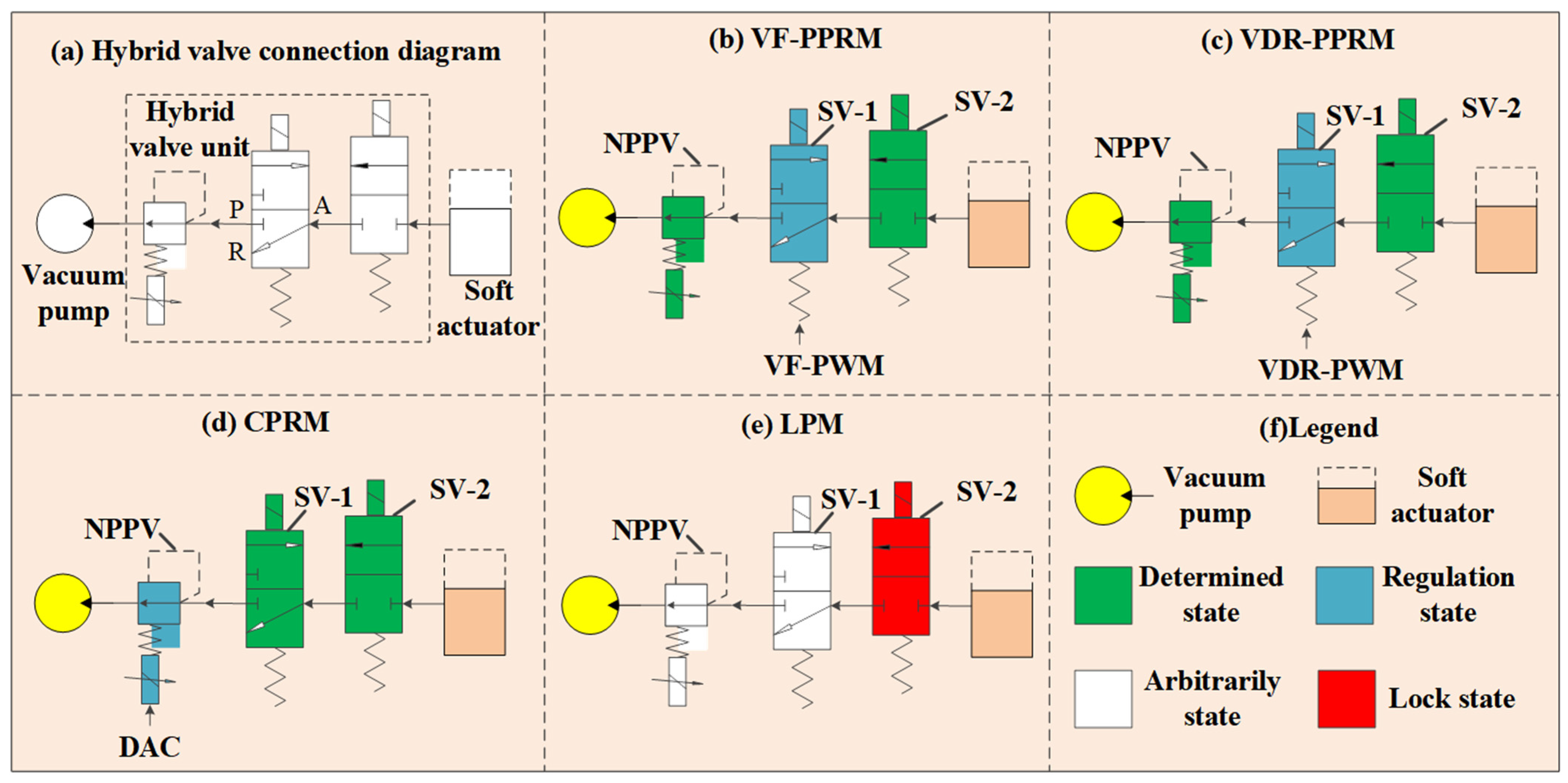
The connection principle and pressure regulation mode of the hybrid valve unit are illustrated in Figure 2. In Figure 2a, NPPV, SV-1, and SV-2 are connected in sequence to constitute the hybrid valve unit. The NPPV is connected to the vacuum pump, and SV-2 is connected to the soft actuator of the ML-SSR. The connection of the solenoid valve and proportional valve is referred to in ref. [7]. There are four kinds of pressure regulation mode. As shown in Figure 2b, for VF-PPRM, NPPV regulates a fixed-air-pressure value and SV-2 is in a normal open (on) state, while SV-1 is in a regulation state, controlled by the VF-PWM signal. As shown in Figure 2c, differing from VF-PWM, VDR-PPRM adopts a VDR-PWM signal to control SV-1. In Figure 2d, for CPRM, SV-1 and SV-2 are in the normal open (on) state and NPPV is in a regulation state, controlled by adjusting the variable analog voltage. In Figure 2e, when SV-2 is in a closed state (off), the LPM is achieved to retain the pressure in the actuator.

2.2.2. PPRM Principle

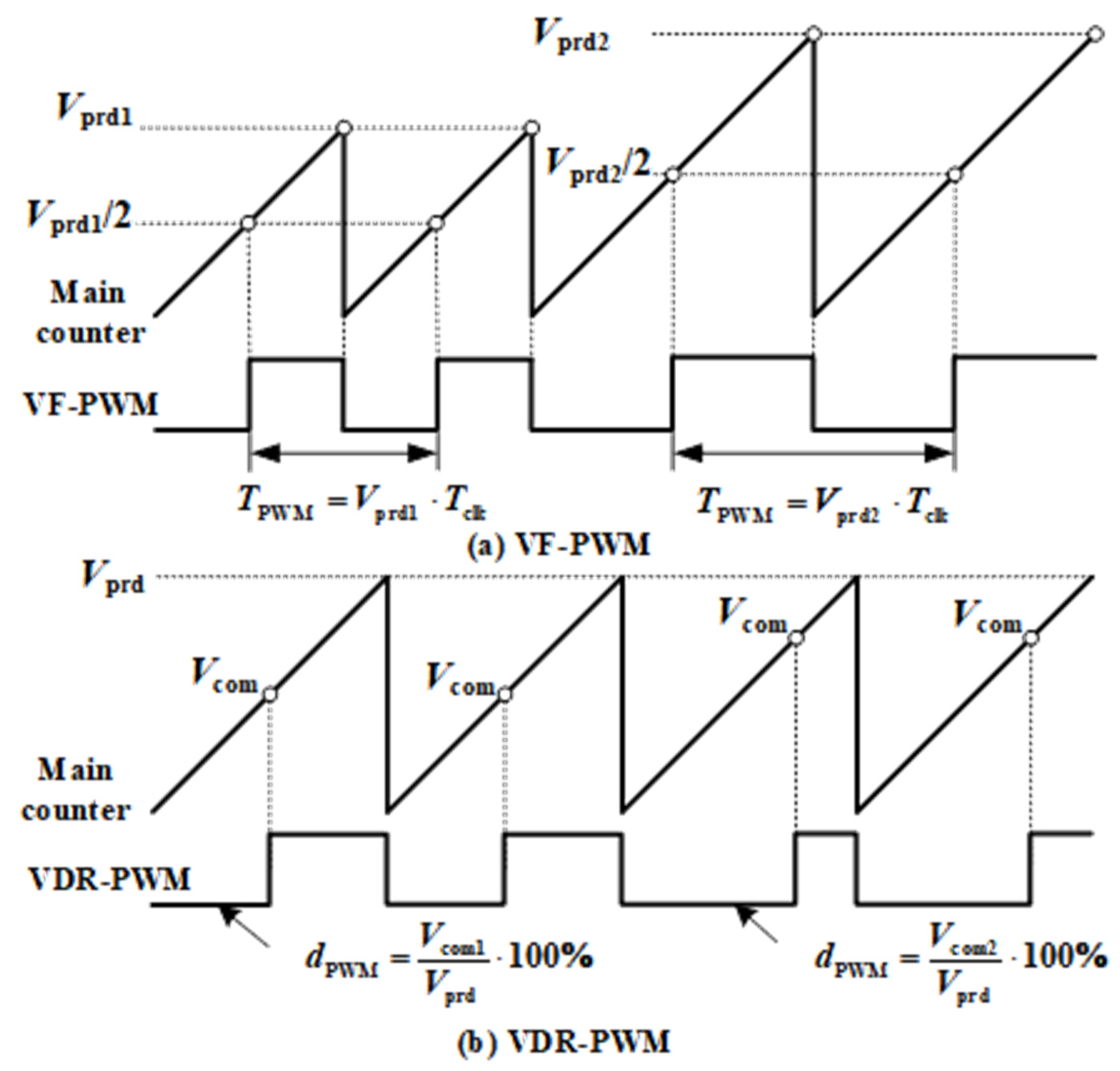
In PPRM, SV-1 serves as the core component that is controlled by a PWM signal generated by the robot controller. Figure 3 illustrates the generating principles of VF-PWM and VDR-PWM for the corresponding VF-PPRM and VDR-PPRM, respectively. In Figure 3a, the main counter accumulates from zero to the period value V p r d , and then drops to zero for the next period. When the count value is equal to half of the period value V p r d / 2 , the PWM signal jumps from a low level (0) to a high level (1), and when the count value is equal to V p r d , the PWM signal jumps from a high level (1) to a low level (0). VF-PWM is generated by adjusting the period value V p r d , for example by changing V p r d from V p r d 1 to V p r d 2 .
The frequency f P W M is calculated as follows:
f P W M = 1 V p r d · T c l k
where V p r d is the period value of the counter to determine the frequency of PWM signal and T c l k is the period of the system clock for the main counter.
In Figure 3b, for VDR-PWM, the period value V p r d is fixed, and the comparison value is variable. When the count value of main counter is less than the comparison value V c o m , the PWM signal is at a low level (0), otherwise it is at a high level (1). Through changing V c o m , the generating principle of VF-PWM, VDR-PWM is obtained.
The duty ratio d P W M is controlled as follows:
d PWM = V com V prd · 100 %
where V com is the compared value to determine the duty ratio and V prd is the period value to determine the frequency.
For PPRM, the NPPV is preset at a fixed pressure, SV-2 is in an open state, and SV-1 is controlled by the obtained VF-PWM and VDR-PWM. Then, the output pressure of the hybrid valve unit is calculated according to Equation (3) for VF-PPRM and Equation (4) for VDR-PPRM.
p = k · P pre · f PWM + b = k · P pre · 1 V prd · T clk + b
p = k · P pre · d PWM + b = k · P pre · V com V prd · 100 % + b
where k is linear coefficient, P pre is the preset pressure of the NPPV, f PWM is the frequency of PWM, d PWM is the duty ratio of PWM, and b is the constant coefficient.

2.2.3. CPRM Principle

In the CPRM mode, SV-1 is controlled to be linked to the NPPV, and SV-2 is in a normal open state. The NPPV is controlled by the continuous analog voltage, and the relationship between output pressure and the input analog voltage is linear, and thus output pressure is calculated as follows:
p = k · v + b
where p is the output pressure, k is the linear coefficient, v is the analog voltage, and b is the offset.
Through changing the input analog voltage, the output pressure is variable. In the practical system, analog voltage is controlled by the DAC chip, and the control schema is
v = v r e f l + v r e f h v r e f l 2 N · d a t a d a c
where v is the input voltage, v r e f l is the reference low voltage of the DAC chip, v r e f h is the reference high voltage of the DAC chip, N represents the bits of the DAC chip, and d a t a d a c is control data.
Then, by combining Equations (5) and (6), the output pressure is calculated as follows:
p = k · v r e f l + k · v r e f h v r e f l 2 N · d a t a d a c + b

2.2.4. LPM Principle

In the LPM, the SV-2 is in a closed state, the air pressure in the actuator of the ML-SSR is locked, and the actuator is in a stable condition. This situation is used in the holding state of the ML-SSR.

2.3. FPGA-Based Robot Controller

The FPGA-based (5CSEBA2U19I7N, Altera Inc., San Jose, CA, USA) robot controller serves as the EtherCAT secondary station to realize data communication with the EtherCAT primary station and generate PWM signals and DAC signals to control the hybrid valve units of HVPS.

2.3.1. The General Framework

The FPGA-based robot controller receives control data from the EtherCAT primary controller and produces corresponding signals to control hybrid valve units. The function diagram is presented in Figure 4.
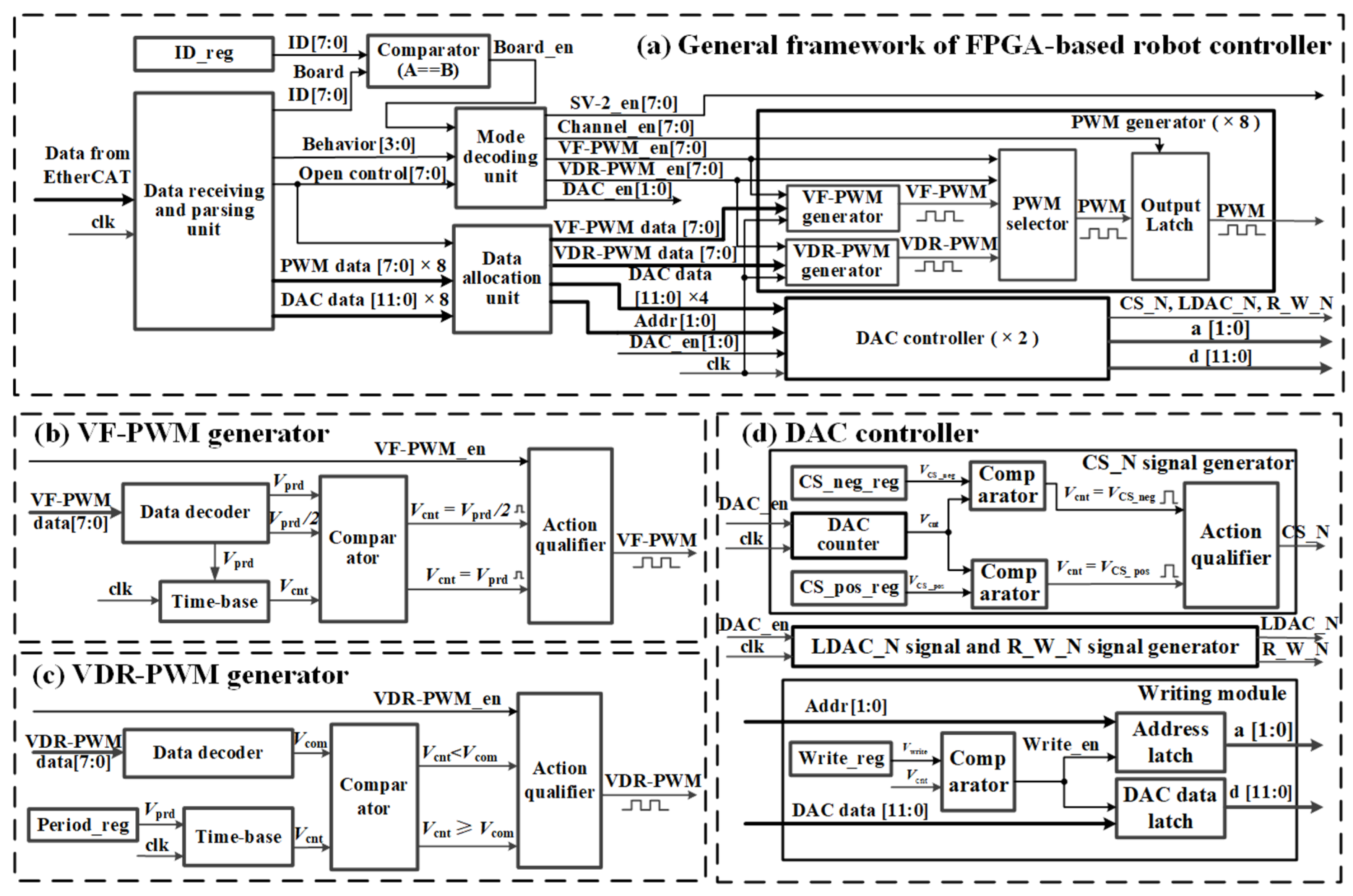
The general framework of the FPGA-based robot controller is shown in Figure 4a, which includes a data receiving and parsing unit, a mode-decoding unit, a data allocation unit, PWM generators, and DAC controllers.
The data receiving and parsing unit receives robot control data from the EtherCAT secondary (AX58100 ASIX Inc., Lund, Sweden) and parses out corresponding data ( B o a r d _ I D 7 : 0 , B e h a v i o r 3 : 0 , O p e n _ c o n t r o l 7 : 0 , P W M _ d a t a 7 : 0 , D A C _ d a t a 11 : 0 ) for different modules according to the protocol between the EtherCAT primary and secondary. In our system, there are eight pneumatic channels for one HVPS— P W M _ d a t a 7 : 0 and D A C _ d a t a 11 : 0 are for these eight channels, meaning that they are marked as × 8 . Through an equality comparator with I D 7 : 0 from register I D _ r e g and B o a r d _ I D 7 : 0 , the B o a r d _ e n is obtained for the mode-decoding unit.
The mode-decoding unit generates enabled signals for PWM generators, DAC controllers, and other enabled signals according to B e h a v i o r 3 : 0 and O p e n _ c o n t r o l 7 : 0 . S V 2 _ e n 7 : 0 is an enabled signal for solenoid valves (SV-2), with one bit for one channel. C h a n n e l _ e n 7 : 0 is an enabled signal controlling PWM output, also with one bit corresponding to one channel. V F P W M _ e n 7 : 0 and V D R P W M _ e n 7 : 0 are enabled signals for the VF-PWM generator and VDR-PWM generator, respectively, also with one bit for one channel. D A C _ e n 1 : 0 is allocated to the DAC controller, and each DAC controller drives one DAC chip, which is responsible for four pneumatic channels. Consequently, the proposed HVPS integrates two DAC chips to accommodate the eight pneumatic channels.
The data allocation unit produces and allocates corresponding data for PWM generators and DAC controllers.
For each PWM generator, the VF-PWM generator generates a VF-PWM signal according to V F - P W M _ d a t a 7 : 0 and the system clock c l k as the V F - P W M _ e n is enabled. Correspondingly, the VDR generator generates a VDR-PWM signal in accordance with V D R - P W M _ d a t a 7 : 0 and the system clock c l k   V D R - P W M _ e n when it is enabled. Subsequently, the PWM selector selects VF-PWM or VDR-PWM as the output PWM signal according to the states of V F - P W M _ e n and V D R - P W M _ e n . Then, an output latch is used to control the output PWM for the solenoid valve according to the C h a n n e l _ e n . Through replicating PWM generators, more pneumatic channels are achieved. In our HVPS, the number of channels is eight, meaning that it is marked as × 8 .
The DAC controller outputs the control signals ( C S _ N , L D A C _ N , R _ W _ N , a 1 : 0 , d 11 : 0 ) for the DAC chip according to the control data D A C _ d a t a 7 : 0 , address data A d d r 1 : 0 , and system clock c l k when D A C _ e n is enabled.

2.3.2. VF-PWM Generator

The functional block diagram of the VF-PWM generator is illustrated in Figure 4b. Initially, the data decoder extracts two key parameters: the period value V p r d and its half-value, V p r d / 2 . Serving as the core timing unit, the time-base module performs a periodic count from zero to V p r d . Subsequently, the comparator triggers two distinct event pulses based on the counter value: one when the count V c n t reaches V p r d / 2 , and the other when it attains the full period V p r d . Upon being enabled by the V F P W M _ e n signal, the action qualifier generates the VF-PWM waveform. Specifically, this waveform transitions to a high logic level (1) at the V c n t = V p r d / 2 pulse and returns to a low logic level (0) at the V c n t = V p r d pulse.

2.3.3. VDR-PWM Generator

In contrast to the VF-PWM generator, the VDR-PWM generator (Figure 4c) operates in a different way. Here, the data decoder is configured to output a comparison value V c o m , while the period value V p r d of the time-base module is predefined and derived from the Period_reg register. The comparator continuously compares the counter value V c n t with V c o m , generating two conditional event signals: V c n t < V c o m and V c n t V c o m . Once enabled by V D R P W M _ e n , the action qualifier sets the VDR-PWM output to a low value (0) whenever V c n t < V c o m holds true, and sets it to a high value (1) for the condition of V c n t V c o m .

2.3.4. DAC Controller

The functional block diagram of the DAC controller is illustrated in Figure 4d. Inside the C S _ N signal generator, a dedicated DAC counter performs periodic accumulation from zero to a fixed period value, T d a c , which is configured in accordance with the specifications of the DAC chip (DAC7724, TI Inc., Dallas, TX, USA).
A comparator is used to generate the event signal V c n t = V C S _ n e g when the counter value matches the preset value V C S _ n e g stored in the CS_neg_reg register. Similarly, when the counter reaches the value V C S _ p o s from the CS_pos_reg register, the second comparator triggers the event signal V c n t = V C S _ p o s .
The action qualifier then outputs the C S _ N signal; when the V c n t = V C S _ n e g event occurs, this signal jumps from a high level (1) to a low level (0), and when the V c n t = V C S _ p o s event occurs, the signal jumps back from a low level (0) to a high level (1).
The generation mechanism of the L D A C _ N and R _ W _ N signals follows the same principle as that of C S _ N , and their respective generator structures are analogous to the C S _ N signal generator.
In the writing module, a comparator generates the W r i t e _ e n signal once the counter value V c n t equals the preset V w r i t e . Subsequently, the address bits a[1:0] and DAC data bits d[11:0] are latched using an address latch and a DAC data latch, respectively.

2.4. EtherCAT Primary Controller

The EtherCAT bus is employed to link multiple HVPSs to construct the networked HVPS. TwinCAT software (version 3.1), running on the Windows operating system and functioning as an EtherCAT primary station, is designed to acquire interactive data from the joystick, enact the behavior control algorithm for controlling ML-SSRs, and realize data communication with the FPGA-based robot controller serving as the EtherCAT secondary station.
To quantitatively validate the superiority of EtherCAT in the control of soft robots, Table A2 in Appendix B compares its core performance metrics with those of widely adopted I2C/CAN protocols [33,34,35,36]. As shown in this table, EtherCAT achieves significantly lower synchronization error (≤1 μs vs. 10–100 μs for I2C and 1–10 ms for CAN) and higher bandwidth (100 Mbps vs. 400 kbps for I2C and 1 Mbps for CAN), while supporting over 1000 nodes to meet the scalability requirements of multi-actuator soft robots.

2.4.1. Interactive Data Acquisition

For the manipulation following behavior and synchronization following behavior, a joystick with an IMU is used to provide bend angles for ML-SSRs, whose data is acquired and collected by the EtherCAT primary controller with a UART communication scheme. The bend angles of Pitch and Roll are calculated as follows:
P i t c h = P i t c h H 8 + P i t c h L 2 N · D e g r
R o l l = R o l l h H 8 + R o l l h L 2 N · D e g r
where P i t c h H , P i t c h L , R o l l H , and R o l l L are the data acquired with an IMU embedded in the joystick, N represents the bits of IMU (ATK-IMU901, ALIENTEK Inc., Guangzhou, China), being 15 here, and D e g r is the degree range, which is 180 .

2.4.2. Data Communication

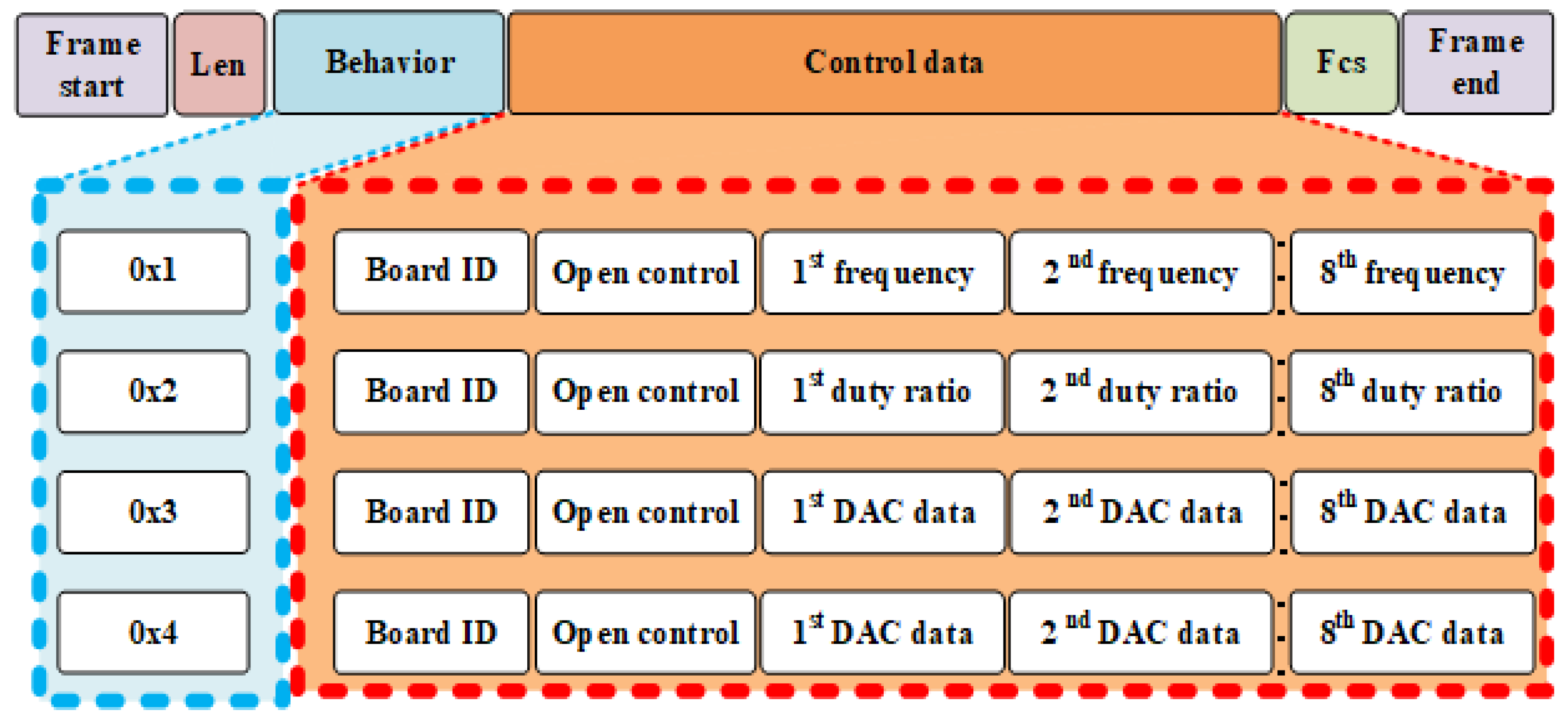
The data communication between the EtherCAT primary station and the EtherCAT secondary station is the main channel connecting the EtherCAT primary controller and the FPGA-based robot controller; this communication protocol is shown in Figure 5. Specifically, B e h a v i o r indicates the selected behavior of the ML-SSR. B o a r d I D is the ID number of the HVPS, used to determine which HVPS is able to receive the current protocol data. O p e n   c o n t r o l is 8-bit data, and each bit is used to control the opening or closing of one chamber of the ML-SSR. Frequency is the frequency parameter of VF-PWM. D u t y   R a t i o is the duty ratio parameter of VDR-PWM. D A C   d a t a is the control parameter of the DAC controller in the DAC chip, which determines the pressure in each pneumatic chamber of ML-SSRs.

2.4.3. Behavior Control Algorithm

Algorithm 1 describes the details of how the EtherCAT primary controller performs different behavior controls for the ML-SSR. The Set (S) is initialized with elements of four behaviors of the ML-SSR. An empty buffer (B) for air pressure and an open control (O) variable are defined. After selecting the behavior in Set (S) manually, the EtherCAT primary controller executes its specific control algorithms.
Algorithm 1 Behavior control algorithm.
Input: Behavior and its execution parameters
Output: EtherCAT secondary control data
1.    Initialize behavior set S and behavior B
2.    Select B S
3.    if B = crawling behavior with VF-PPRM then
4.     Set O and frequency
5.     Send D = (0x01, Board ID, O, frequency)
6.     else if B = crawling behavior with VDR-PPRM then
7.     Set O and duty ratio
8.     Send D = (0x02, Board ID, O, duty ratio)
9.     else if B = manipulation following behavior then
10.     (O, DAC) = Conversion ( R o l l L ,   R o l l H ,   P i t c h L ,   P i t c h H )
11.      Send D = (0x03, Board ID, O, DAC)
12.     else if B = synchronization following behavior then
13.     (O, DAC) = Conversion ( R o l l L ,   R o l l H ,   P i t c h L ,   P i t c h H )
14.    for i = 1:2 do
15.    Send D = (0x04, Board ID, O, DAC)
16.    end for
17.     end if
Crawling behavior with VF-PPRM:  0 x 01 represents the crawling behavior through VF-PPRM. B o a r d I D is selected to determine which ML-SSR performs the behavior. O stands for O p e n   c o n t r o l , which provides opening and closing instructions for each pneumatic channel. F r e q u e n c y is a series of frequency values of VF-PWM for each pneumatic channel. The EtherCAT primary controller concatenates this data and sends it to the EtherCAT secondary station.
Crawling behavior with VDR-PPRM:  0 x 02 represents the crawling behavior with VDR-PPRM. Differing from the above behavior, d u t y   r a t i o is a series of duty ratio values of VDR-PWM for each pneumatic channel.
Manipulation following behavior:  0 x 03 represents manipulation following behavior. The EtherCAT primary controller first reads the joystick’s attitude angle data and converts it into D A C   d a t a values to represent the air pressure of eight channels in the chambers and the O p e n   c o n t r o l value. After selecting Board ID, the EtherCAT primary controller concatenates these data and sends them to the EtherCAT secondary station. Before manually exiting this operation, the EtherCAT primary controller will perform the above operations in a loop.
Synchronization following behavior:  0 x 04 represents the synchronization following behavior, which is different from the manipulation following behavior. The EtherCAT primary controller sends the same D A C   d a t a and O p e n   c o n t r o l to different HVPSs.

3. Multi-Layer Sponge Soft Robot

3.1. Description of the ML-SSR

The high-performance control architecture based on FPGA and EtherCAT embodies a forward-looking design paradigm and a commitment to hard real-time capabilities and high-precision control. A sponge robot was selected as the inaugural verification platform to validate its efficacy, thereby establishing a robust technical foundation for the subsequent deployment of more complex applications in related fields.
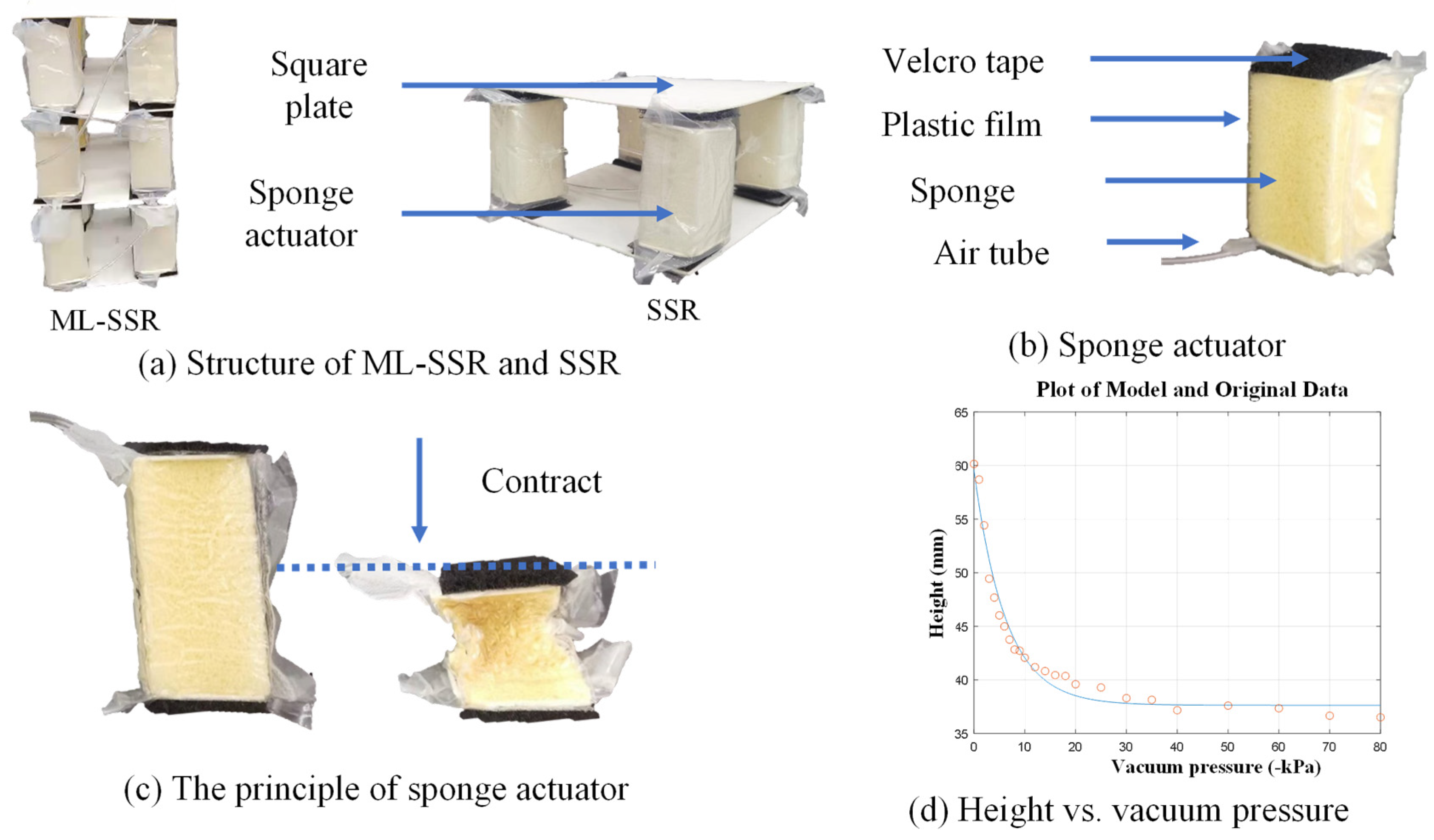
To validate the networked HVPS, an ML-SSR was developed, which consists of several soft sponge robots (SSRs). Each SSR includes four sponge actuators (30 × 30 × 60 mm, 40D) and two square plates. These actuators are composed of sponges sealed in plastic films, with air tubes attached to the bottom and connected to the corners of the plate-shaped structure through Velcro tape (Figure 6b). Experiments show that within a vacuum pressure range (0 to −20 kPa), the actuator height linearly contracts as pressure decreases, and tends to stabilize when the pressure exceeds −20 kPa (Figure 6d). A pressure–height relationship model was derived from experimental data fitting
H S S R = 37.9715 + 22.4242 · e 0.16 · p

3.2. Deformation Principle of ML-SSR

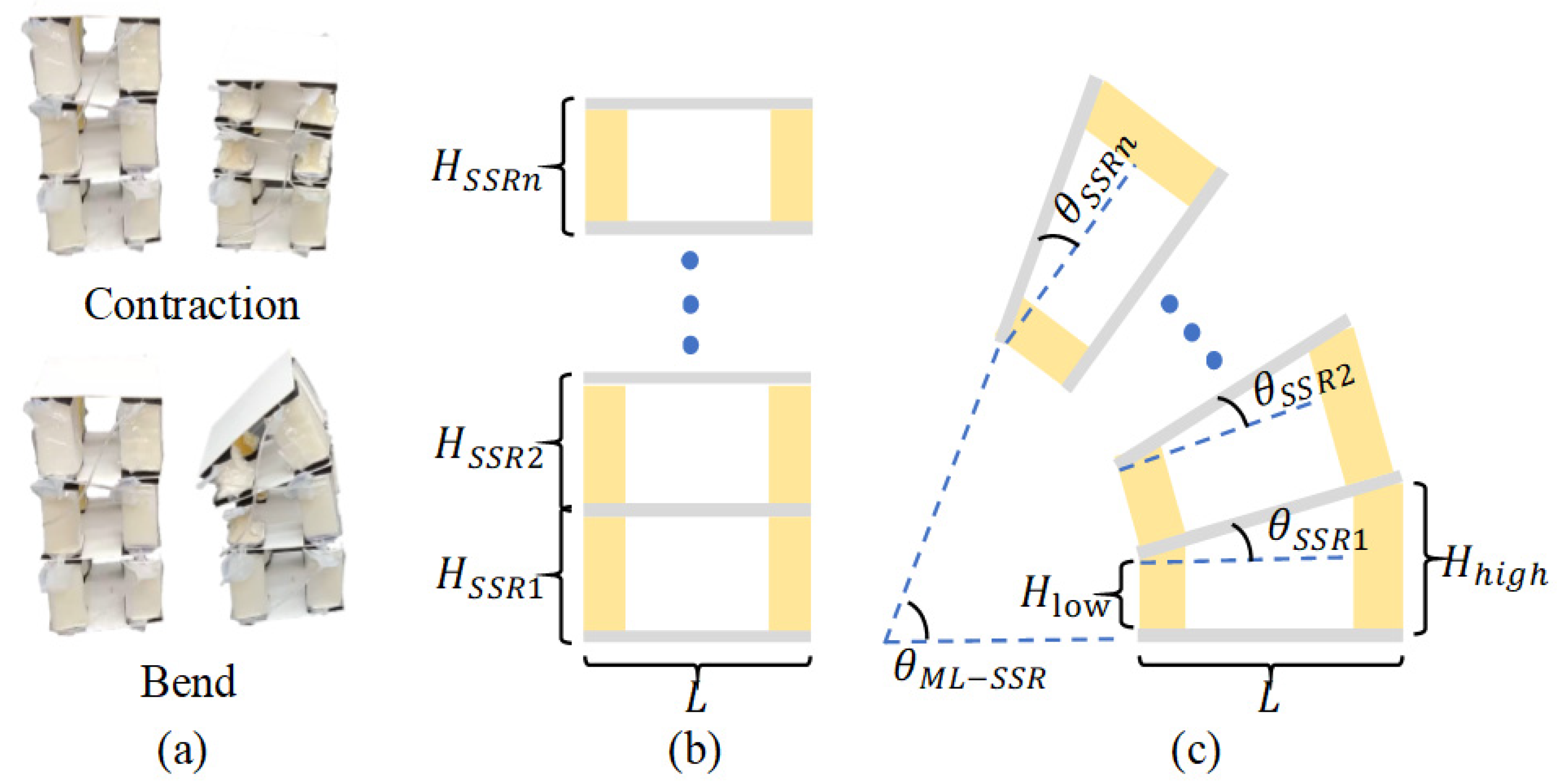
As shown in Figure 7a, by modulating the heights of sponge actuators in the ML-SSR, the entire ML-SSR exhibits two different types of deformation, namely contraction deformation and bending deformation. ML-SSR achieves crawling and following behaviors through contraction and bending. The contraction of ML-SSR is composed of the contractions of individual SSRs. For a single SSR, when the shrinkage of the four sponge actuators is the same, the SSR will contract. As shown in Figure 7b, since the height of the square plate is negligible, the height of the ML-SSR is equal to the sum of the heights of each SSR:
H M L S S R = H S S R 1 + H S S R 2 + + H S S R n
where SSRn is the n t h SSR.
Multiple SSRs’ bending in the same direction constitutes the bending of the ML-SSR. For a single SSR, its bend is obtained by changing the shrinkage of the four sponge actuators. As shown in Figure 7c, since the height of the square plate is negligible, the inclination angle of the ML-SSR is equal to the sum of the inclination angles of each SSR.
In the theoretical analysis of bending deformation, we adopt the diagonal of the ML-SSR square plane to represent the rotation axis. First, we retain the two non-adjacent diagonal sponges at an equal height. Then, we adjust the bending angle by regulating the air pressure of the other two controlled sponges. By changing the air pressure, the height of the upper controlled sponge is H h i g h , while the height of the lower controlled sponge is H l o w .
The distance between two sponge actuators is L. There is an inclination angle θ between two square plates, which can be determined by the geometric relations:
tan θ S S R = H h i g h H l o w L
Equation (13) can be obtained from Equation (12):
θ S S R = a r c t a n H h i g h H l o w L
Regarding the bending deformation of the ML-SSR, the inclination angle of the ML-SSR is equal to the sum of the inclination angles of all SSRs:
θ M L S S R = θ S S R 1 + θ S S R 2 + + θ S S R n

3.3. The Control of ML-SSR

ML-SSR achieves multiple motion modes by regulating the air pressure of each sponge actuator. In crawl mode, the pressure value in each chamber is set to a constant value p c o n , ranging from 0 kPa to –20 kPa. According to Equation (10), p c o n is calculated as
p c o n = 6.25 ln H S S R 37.9715 22.4242
Then, for the crawling behavior of VF-PPRM, we substitute the pressure p c o n into Equation (3) and inversely solve the frequency f P W M . For the crawling behavior of VDR-PPRM, we substitute the pressure p c o n into Equation (4) to solve the duty ratio d P W M backwards.
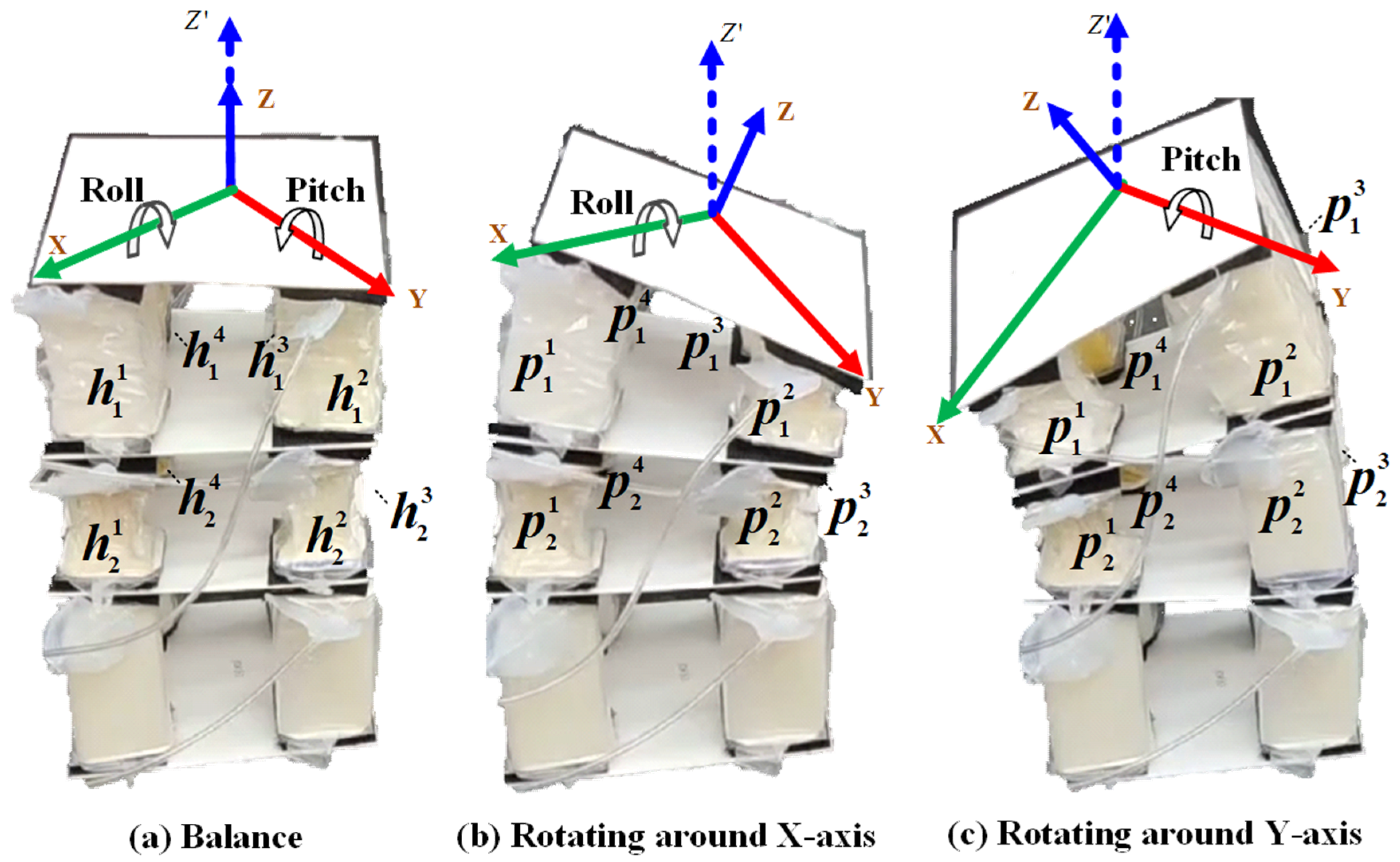
When performing subsequent actions (such as operational actions and synchronous actions), the bending angles (pitch and roll) need to be converted into air pressure values of the ML-SSR’s chambers. As shown in Figure 8a, the diagonals of the square plane of the ML-SSR are used as the rotation axes (X-axis, and Y-axis). The roll angle is the rotational bending angle around the X-axis, which is controlled by adjusting the heights of non-adjacent sponge groups ( h 1 2 , h 2 2 ) and ( h 1 4 , h 2 4 ). The pitch angle is the bending angle of rotation around the Y-axis and is controlled by adjusting the heights of non-adjacent sponge groups ( h 1 1 , h 2 1 ) and ( h 1 3 , h 2 3 ). As shown in Figure 8b, roll is obtained by adjusting the corresponding air pressure groups ( p 1 2 , p 2 2 , p 1 4 and p 2 4 ). As shown in Figure 8c, pitch is achieved by regulating the corresponding air pressure groups ( p 1 1 , p 2 1 , p 1 3 and p 2 3 ), respectively.
When the ML-SSR rolls and rotates around the X-axis, assuming that the second layer reaches the maximum bending angle, then the first layer continues to bend at this time. Meanwhile, the bending angle satisfies θ m a x θ θ m a x . By integrating Equations (10), (13) and (14), the air pressure in the corresponding sponge actuators ( p 1 2 , p 2 2 , p 1 4 and p 2 4 ) is expressed as Equation (16):
  p 1 2 = 6.25 ln 2 H h i g h L t a n θ 1 2 θ m a x 37.972 + 19.438 ,   if   1 2 θ m a x < θ θ m a x 0 ,   others   p 2 2 = 6.25 ln 2 H h i g h L t a n 1 2 θ m a x 37.972 + 19.438 ,   if   1 2 θ m a x < θ θ m a x   6.25 ln 2 H h i g h L t a n θ 37.972 + 19.438 ,   if   0 < θ 1 2 θ m a x 0 ,   others   p 1 4 = 6.25 ln 2 H h i g h + L t a n θ + 1 2 θ m a x 37.972 + 19.438 , if   θ m a x θ < 1 2 θ m a x 0 ,   others   p 2 4 = 6.25 ln 2 H h i g h + L t a n θ 37.972 + 19.438 ,   if   1 2 θ m a x θ 0   6.25 ln 2 H h i g h + L t a n 1 2 θ m a x 37.972 + 19.438 ,   if   θ m a x θ < 1 2 θ m a x 0 ,   others
The subscript i in p i j represents the i t h layer of the sponge actuator, while the superscript j represents the j t h sponge actuator in a certain layer. θ is the bending angle rotating around the X-axis, L is the distance between two adjacent sponge actuators, and H h i g h is fixed as the original length of the sponge.
Similarly, when the ML-SSR performs pitch rotation around the Y-axis, the relationship between the bending angle and another set of sponge pressures ( p 1 1 , p 2 1 , p 1 3 and p 2 3 ) can be derived. After calculating the air pressure values of each sponge actuator, we substitute them into Equation (7) for reverse solution, and the DAC control data d a t a d a c can be obtained.

4. Experiments and Results

4.1. Multi-Mode Verification for the Hybrid Valve Unit

The hybrid valve unit is the main component of the HVPS, which includes a three-way two-state solenoid valve (VQ110U-5M-M5, SMC Inc., Tokyo, Japan), a two-way two-state solenoid valve (VDW10AA, SMC Inc.), and a negative-pressure proportional valve (VEAB-L-26-D14-Q4-V1-1R1, Festo Inc., Esslingen am Neckar, Germany). The pressure sensor (−100 kPa–100 kPa, CFsensor Inc., Wuhu, China) is used to measure the air pressure output. The vacuum pump achieves a maximum vacuum degree of –92 kPa (gauge). The pipes are made of polyurethane, with an outer diameter of 5 millimeters and an inner diameter of 3 millimeters.
All experiments were conducted under room temperature (25 °C ± 2 °C) and standard atmospheric pressure conditions. The posture angles of the ML-SSR were measured by the IMU and transmitted to the upper computer via the UART communication protocol. Each experiment was repeated at least five times to ensure data reliability.

4.1.1. PPRM Verification

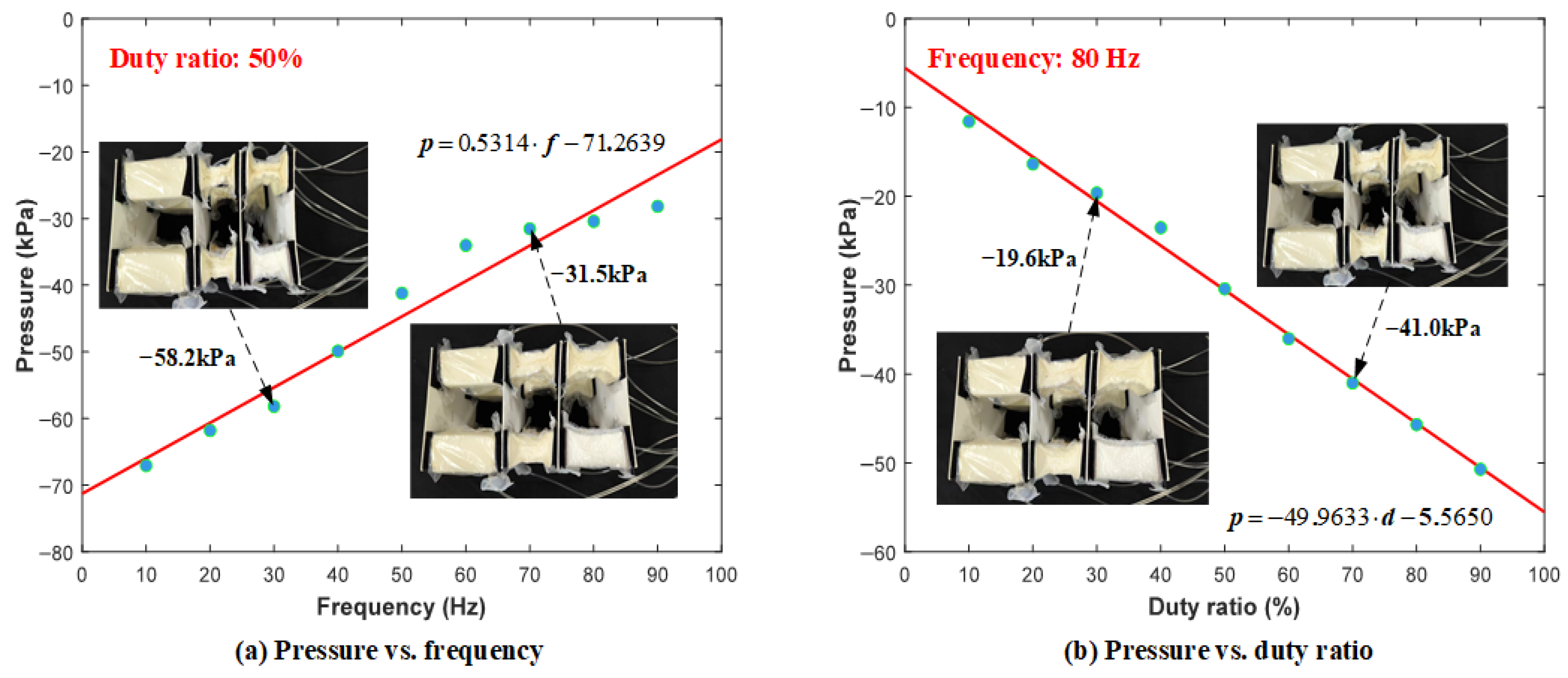
In the PPRM, the negative-pressure proportional valve is used to regulate a preset vacuum P p r e at 90 kPa, and the three-way two-state solenoid valve is regulated with VF-PWM and VDR-PWM, while the two-way two-state solenoid valve remains in an open state. After performing calibration, the relationship between output pressure and frequency is fitted as a straight line in VF-PPRM, which is in accordance with Equation (3). The fitted function is
p = 0.5314 · f P W M 71.2639
where p denotes the output pressure and f P W M is the frequency of PWM. When the frequency is 30 Hz, the output pressure is −58.2 kPa; correspondingly, when the frequency is 70 Hz, the output pressure is −31.5 kPa.
As shown in Figure 9b, as the frequency is fixed at 80 Hz, the calibration relationship between the output pressure p and the duty ratio d P W M in VDR-PPRM conforms to Equation (4), which is calculated as
p = ( 49.9633 · d P W M ) 5.5650
When the duty ratio is 30 percent, the output pressure is −19.6 kPa. Correspondingly, when the duty ratio is 70 percent, the output pressure is −41.0 kPa.

4.1.2. CPRM Verification

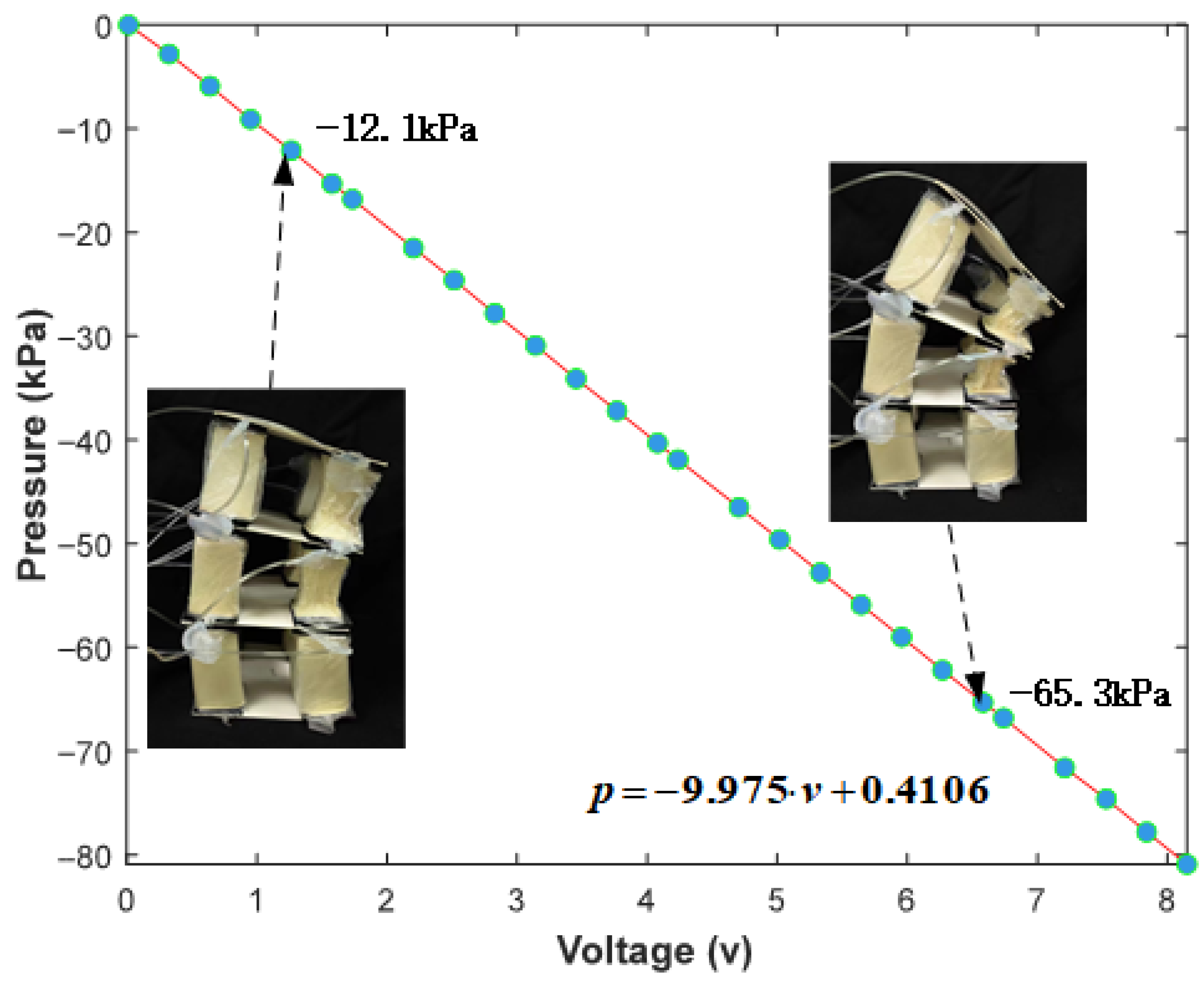
In CPRM, a DAC chip (DAC7724, TI Inc.) is used to generate an analog voltage to drive the negative-pressure proportional valve. The relationship between output pressure and input voltage is shown in Figure 10. We calibrated the input voltage and output pressure of negative proportional valve as
p = 9.975 · v + 0.4106
where p is the output pressure.
In Equation (6), in our HVPS, v r e f l is −15 V and v r e f h is +15 V. With the 12-bit DAC chip (N = 12), the output voltage is related to the DAC control code as follows:
v = 15 + 30 4096 · d a t a d a c
Next, inserting Equation (20) into Equation (19), the output pressure is
  p = 0.0730 · d a t a d a c + 150.0
Then, the control data is calculated as
  d a t a d a c = 13.70 · p + 2055
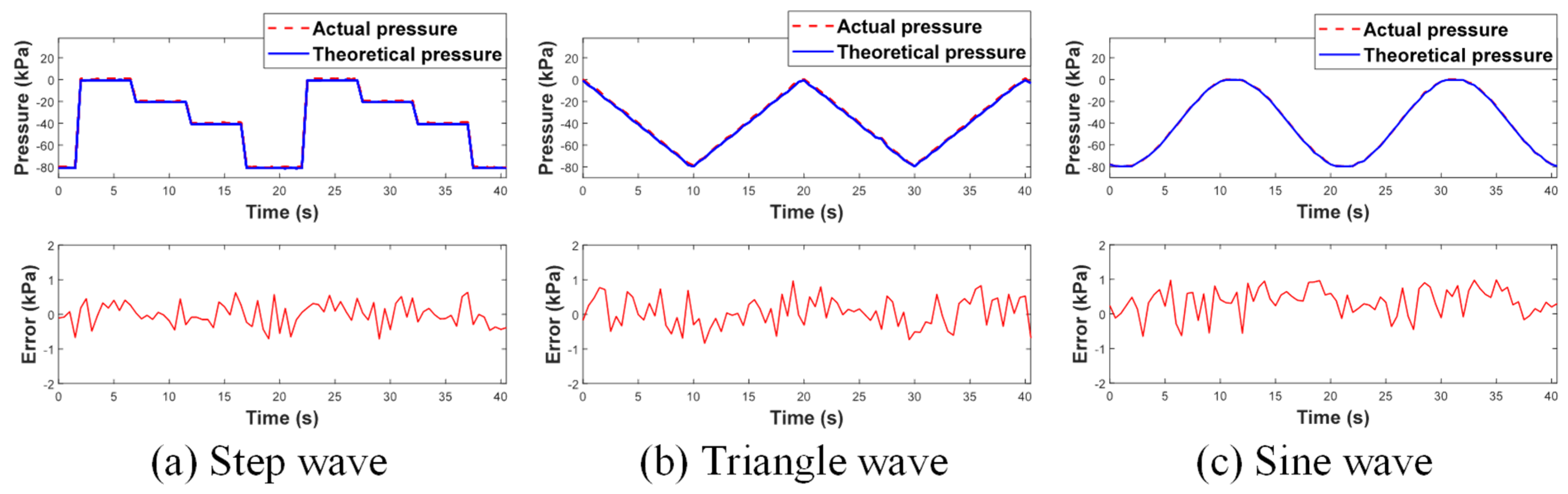
In order to verify the accuracy of CPRM, step waves, triangle waves, and sine waves are used to test the following performance of hybrid valves. As shown in Figure 11, the three subplots in the top row depict the curves of actual versus theoretical pressure for the step, triangular, and sinusoidal waveforms, respectively. The three corresponding subplots in the bottom row illustrate the error curves between the theoretical and actual pressure values, demonstrating that the hybrid valves are able to follow these three waves. The maximum errors are 0.71 kPa for the following step wave, 0.96 kPa for the following triangle wave, and 0.98 kPa for the following sine wave.

4.2. Verification of Network HVPS with ML-SSRs

To verify the feasibility and effectiveness of the proposed networked HVPS, ML-SSRs are used to implement crawling behavior, manipulation following behavior, and synchronization following behavior.

4.2.1. One-Channel Verification with Crawling Behavior

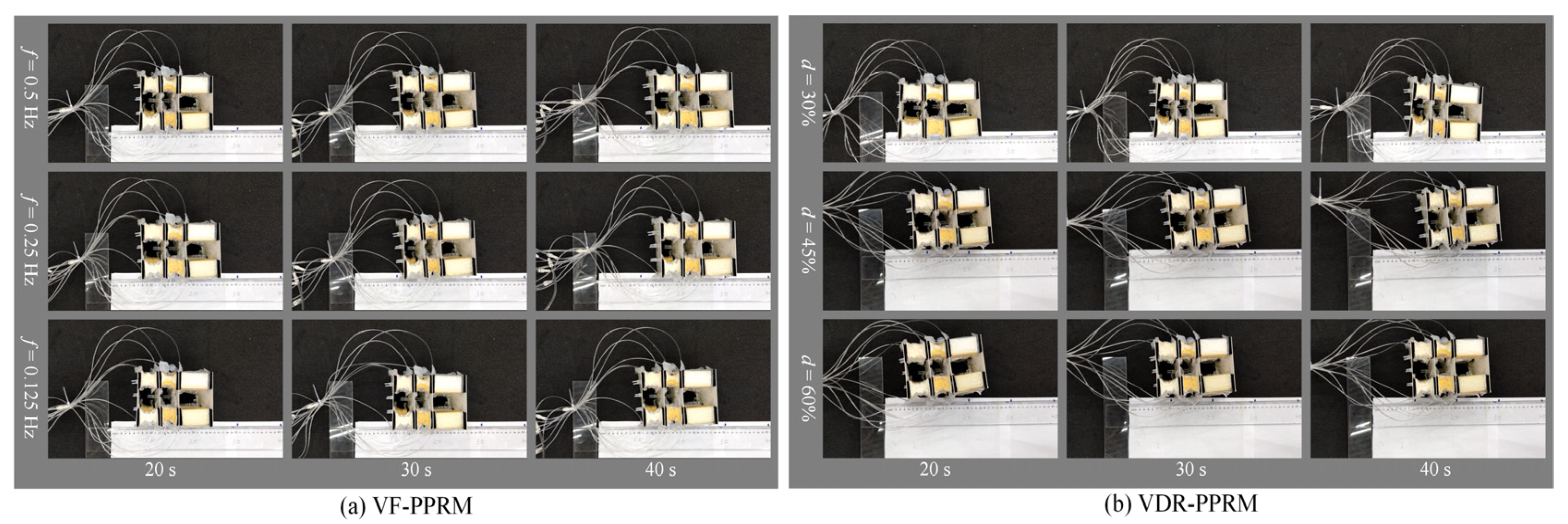
The ML-SSR crawls by contracting and relaxing it sponge actuators, controlled by continuous PWM signals (Figure 12). Nylon ties are added to its base to ensure forward movement. The rear eight actuators are synchronized using a single pneumatic channel powered by a high-voltage power supply (HVPS).
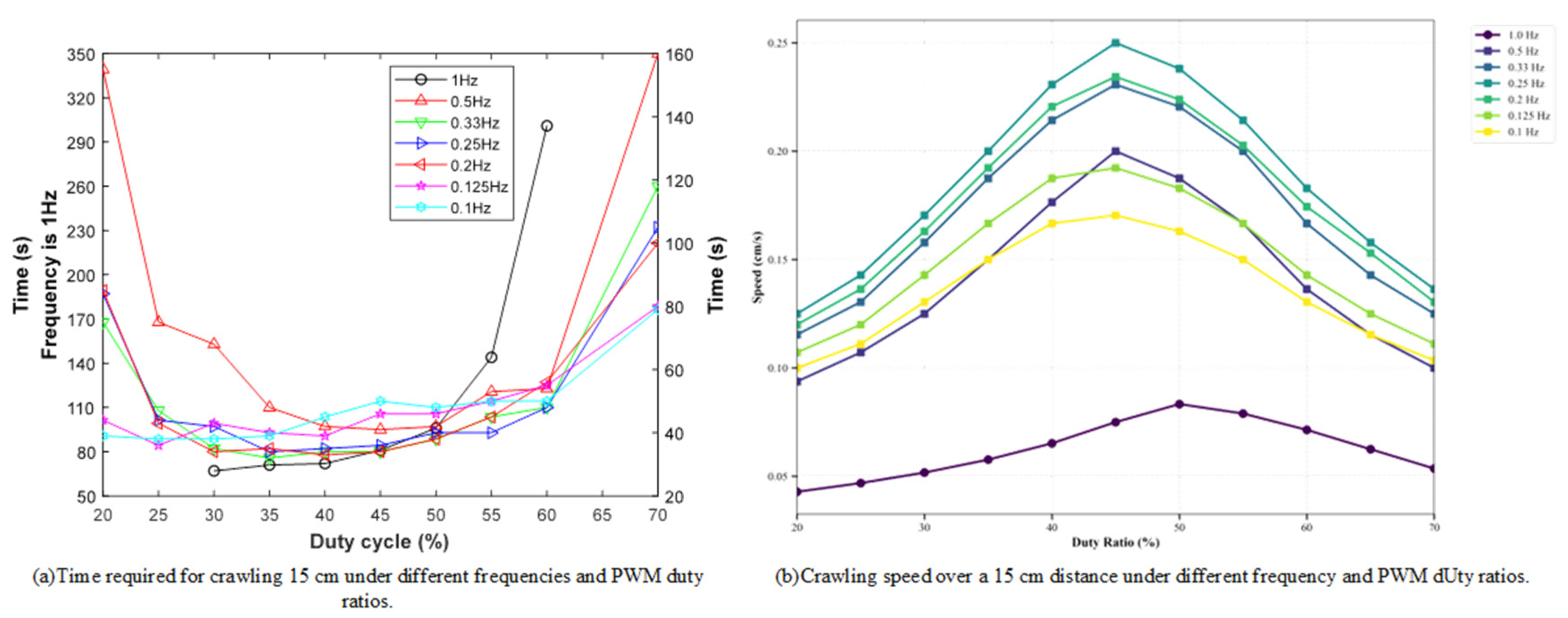
Experiments were conducted to test the time required to crawl 15 cm under varying PWM frequencies (0.1–1 Hz) and duty ratios (20–70%). The experimental results indicated that the shortest 15 cm crawling time occurred at a frequency of 0.25 Hz (Figure 12a) and a duty ratio of 45% (Figure 12b). Further tests confirmed that the ML-SSR moved faster within frequency ranges of 0.2–0.33 Hz and duty ratios of 30–45%, demonstrating the HVPS’s effective pressure control across multiple settings (Figure 13a). In Figure 13b, the monitoring index was replaced with the average speed required to crawl 15 cm to generate a line graph.

4.2.2. Multi-Channel Verification with Manipulation Following Behavior

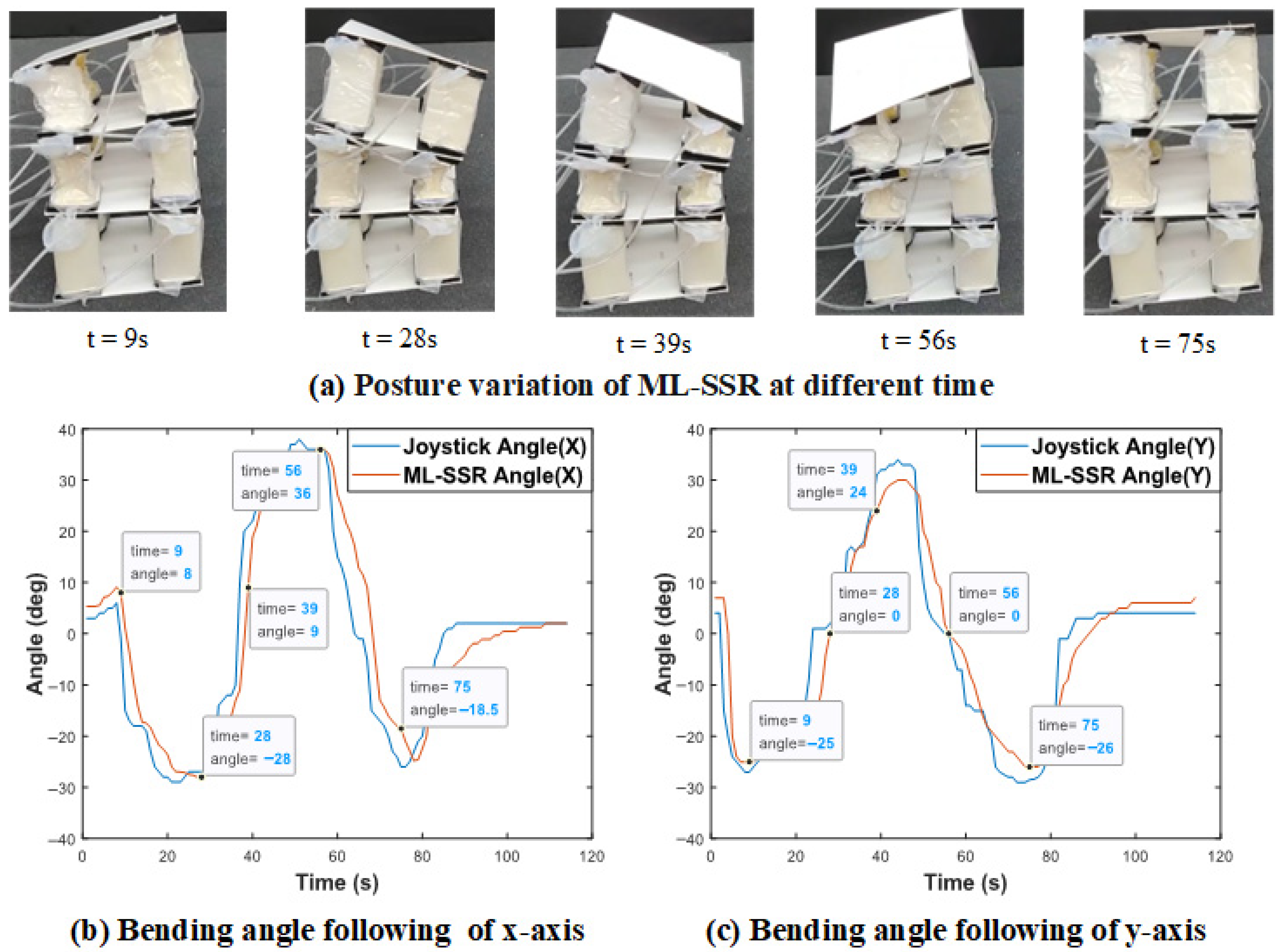
To verify the multi-channel control ability of HVPS, the ML-SSR was used to perform variable posture manipulation following behavior according to the joystick (rubber bellows, Hengguang Inc., Dongguan, China). Figure 14a shows the dynamic variation process of the ML-SSR following the posture of the joystick. Figure 14b,c present the angle following the X-axis and Y-axis, with both directions being limited from − 40 to 40 , and the sample interval was set at 0.5 s. As observed from the results, the ML-SSR achieves smooth joystick following, which can be attributed to the multi-channel continuous pressure output of the HVPS in CPRM mode. It is also proven that the data is transmitted via the EtherCAT bus from the joystick to the ML-SSR.

4.2.3. Network Connection Verification with Synchronization Following Behavior

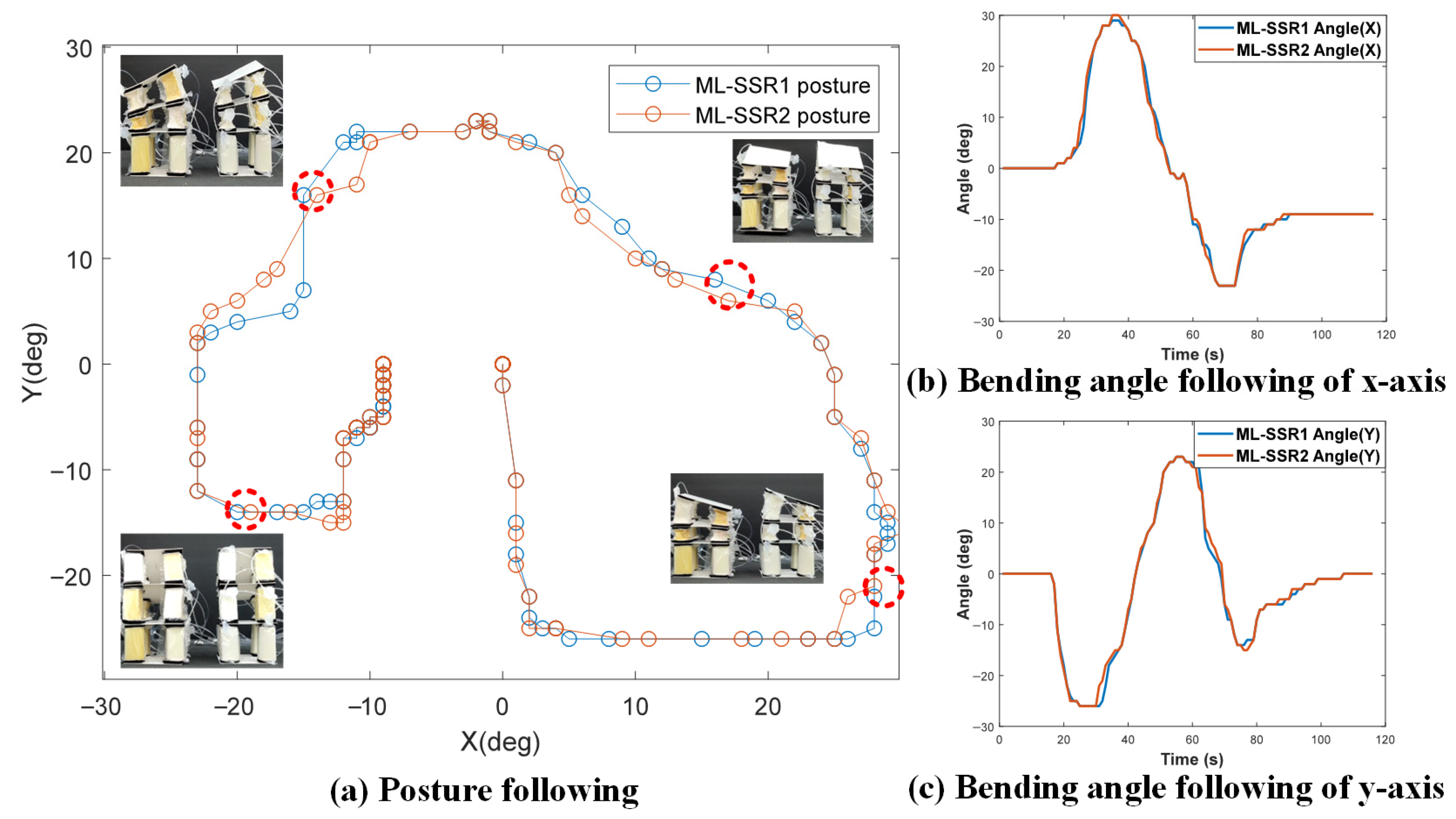
To verify the network connection ability of HVPS, two ML-SSRs were used to perform synchronization following behavior. During synchronization, the EtherCAT bus cascaded two HVPS units, and each HVPS unit independently controlled its own ML-SSR. Two IMUs were used to collect the real-time bending angles of these ML-SSRs. The ML-SSR angle was derived from a single on-board IMU (ATK-IMU901), whose built-in fusion algorithm directly provided ready-to-use Euler angles. The data were measured in real time at a sampling rate of 100 Hz, transmitted and stored in a PC buffer via an independent UART communication link, and processed offline subsequent to the experiment; they were not used for real-time control. Figure 15a shows the posture following process between these two ML-SSRs. The MSE of the Euclidean distance of corresponding point was 0.75, and the maximum error was 4.12 . Figure 15b,c show the bending angles sampled every 0.5 s with respect to the X-axis and the Y-axis. The MSE (mean square error) of the bending angle (X) is 0.85, with the error ranging from − 2 to 4 , and the MSE of the bending angle (Y) is 1.03, with the error ranging from − 4 to 4 .

5. Conclusions

In this paper, an FPGA-based networked HVPS is proposed to control ML-SSRs, enabling a range of behaviors including crawling, manipulation following, and synchronization following. The principal advantages of the proposed networked HVPS comprise multi-mode pressure regulation via hybrid valves, FPGA-enabled scalable multi-channel control, and networked synchronization using the EtherCAT bus. Compared to the programmable pressure system presented by Zhang et al. [14], the introduction of a negative-pressure proportional valve in our system not only enhances the negative pressure output capability to −90 kPa but also achieves high-precision tracking, with errors less than 1.0 kPa in continuous-pressure mode. In contrast to the mechanical multi-mode valve described by Yang et al. [11], the PWM/DAC control architecture in our approach, based on the FPGA, facilitates dynamic software switching between four pressure modes, overcoming the constraints of fixed mechanical structures and demonstrating superior channel scalability. Furthermore, relative to the microcontroller-based integrated system of Niu et al. [20], the combination of the FPGA and EtherCAT bus adopted in our system yields improved real-time performance and multi-unit synchronization control, achieving microsecond-level synchronization for the first time in soft robot synchronization control, with X/Y-axis angle errors (MSE of 0.85 and 1.03, respectively) among multiple units. The deployment of the EtherCAT bus to interconnect multiple HVPS units ensures user-friendly interactive control with both users and soft robots, facilitating effective ML-SSR synchronization. Collectively, these comparative analyses underscore that this study, through the unique combination of FPGA-based hybrid valve control and an industrial-grade EtherCAT network, delivers an innovative solution for sophisticated soft robotic systems demanding high performance, precise synchronization, and scalability. Future work will include the addition of a positive-pressure proportional valve to the hybrid valve unit to broaden the pressure regulation mode, thereby enabling high-precision, rapid-response air pressure adjustment from negative to positive values. Moreover, further HVPS units will be integrated via the EtherCAT bus to enable synchronization control for the multi-body reconfiguration and collective operation of soft robots. To rigorously validate the system’s exemplary performance, we will collect operational data and conduct statistical analyses of key parameters, such as communication rates and soft robot performance metrics. In subsequent research, we will also investigate the application potential of robots equipped with this control system in fields including search and rescue, exploration, and industrial automation, with the goal of advancing technological innovation.

Supplementary Materials

The following supporting information can be downloaded at: https://www.mdpi.com/article/10.3390/app152312373/s1.

Author Contributions

Conceptualization, H.H. and L.Z.; Methodology, H.H. and L.Z.; Software, Y.F. and Y.L.; Validation, X.L.; Data Curation, Y.F. and X.L.; Writing—Original draft, L.Z., X.L. and H.H.; Writing—Review and Editing, L.Z. and X.L.; Supervision, H.H.; Funding acquisition, H.H. All authors have read and agreed to the published version of the manuscript.

Funding

This research was funded by the National Natural Science Foundation of China (No. 62173233), the Shenzhen Science and Technology Innovation Commission project (JCYJ20220531102809022, JCYJ20210324094401005), the Scientific Instrument Developing Project of Shenzhen University (2023YQ021), the Shenzhen Institute of Artificial Intelligence and Robotics for Society, and the Shenzhen University-HAN’s Robot Intelligent Robot Join Innovation Center.

Institutional Review Board Statement

Not applicable.

Informed Consent Statement

Not applicable.

Data Availability Statement

The original contributions presented in the study are included in this article; further inquiries can be directed to the corresponding author.

Conflicts of Interest

The authors declare no conflicts of interest.

Abbreviations

HVPShybrid-valve pneumatic system
ML-SSRmulti-layer sponge soft robot
PWMpulse-width modulation
VF-PWMvariable-frequency PWM
VDR-PWMvariable-duty-ratio PWM
NPPVnegative-pressure proportional valve
CPRMclosed-loop proportional regulation module
LPMlow-pressure module
SVsolenoid valve
IMUinertial measurement unit
SPIserial peripheral interface
UARTuniversal asynchronous receiver/transmitter
PPRMpneumatic proportional regulation module
DACdigital-to-analog converter

Appendix A

Table A1. List of experimental equipment models.
EquipmentModelCompany
FPGA5CSEBA2U19I7NAltera Inc.
EtherCAT secondaryAX58100ASIX Inc.
IMUATK-IMU901ALIENTEK Inc.
Sponge actuators30 × 30 × 60 mm, 40D
3-way 2-state solenoid valveVQ110U-5M-M5SMC Inc.
2-way 2-state solenoid valveVDW10AASMC Inc.
Pressure sensor−100 kPa–100 kPaCFsensor Inc.
DAC chipDAC7724TI Inc.
JoystickRubber bellowsHengguang Inc.

Appendix B

Table A2. Comparison of communication protocol metrics.
Performance MetricEtherCATIICCAN
Sync Error≤1 μs10–100 μs1–10 ms
Bandwidth (Max)100 Mbps400 kbps1 Mbps
Maximum Channel Count1000+ nodes127 nodes32 nodes

References

  1. Guo, J.; Low, J.-H.; Liang, X.; Lee, J.S.; Wong, Y.-R.; Yeow, R.C.H. A hybrid soft robotic surgical gripper system for delicate nerve manipulation in digital nerve repair surgery. IEEE/ASME Trans. Trans. Trans. Mechatron. 2019, 24, 1440–1451. [Google Scholar] [CrossRef]
  2. Ai, X.; Yue, H.; Wang, W.D. Crawling Soft Robot Exploiting Wheel-Legs and Multimodal Locomotion for High Terrestrial Maneuverability. IEEE Trans. Robot. 2023, 39, 6. [Google Scholar] [CrossRef]
  3. Bardi, E.; Gandolla, M.; Braghin, F.; Resta, F.; Pedrocchi, A.L.; Ambrosini, E. Upper limb soft robotic wearable devices: A systematic review. J. Neuroeng. Rehabil. 2022, 19, 87. [Google Scholar] [CrossRef]
  4. Seleem, I.A.; El-Hussieny, H.; Ishii, H. Recent developments of actuation mechanisms for continuum robots: A review. Int. J. Control. Autom. Syst. 2023, 21, 1592–1609. [Google Scholar] [CrossRef]
  5. Caasenbrood, B.J.; van Beek, F.E.; Chu, H.K.; Kuling, I.A. A Desktop-sized Platform for Real-time Control Applications of Pneumatic Soft Robots. In Proceedings of the 2022 IEEE 5th International Conference on Soft Robotics (RoboSoft), Edinburgh, Scotland, 4–8 April 2022; pp. 217–223. [Google Scholar] [CrossRef]
  6. Xavier, M.S.; Fleming, A.J.; Yong, Y.K. Nonlinear Estimation and Control of Bending Soft Pneumatic Actuators Using Feedback Linearization and UKF. IEEE/ASME Trans. Mechatron. 2022, 27, 1919–1927. [Google Scholar] [CrossRef]
  7. Huang, H.; Lin, J.; Wu, L.; Fang, B.; Sun, F. Optimal control scheme for pneumatic soft actuator under comparison of proportional and PWM-solenoid valves. Photonic Netw. Commun. 2019, 37, 153–163. [Google Scholar] [CrossRef]
  8. Yu, Z.Y.; Gao, Z.; Li, Y.T.; Pan, J.F. Closed-loop control of a pneumatic soft gripper for fast and accurate response. In Proceedings of the 2020 8th International Conference on Power Electronics Systems and Applications (PESA), Hong Kong, China, 7–10 December 2020; pp. 1–5. [Google Scholar]
  9. Xie, R.; Su, M.; Zhang, Y.; Li, M.; Zhu, H.; Guan, Y. PISRob: A Pneumatic Soft Robot for Locomoting Like an Inchworm. In Proceedings of the 2018 IEEE International Conference on Robotics and Automation (ICRA), Brisbane, Australia, 21–25 May 2018; pp. 3448–3453. [Google Scholar] [CrossRef]
  10. Huang, H.; Tang, S.; Chai, W.; Sun, F.; Wu, D.E.; Miao, S. MCSG: A morphology configurable soft gripper with self-adaption modular composite finger. IEEE Trans. Ind. Electron. 2023, 71, 708–717. [Google Scholar] [CrossRef]
  11. Yang, Y.; Zhao, Y.; Zhong, S.; Peng, Y.; Yang, Y.; Liu, N.; Pu, H. A Multimode Flow Control Valve for Simplifying the Driving System of Pneumatic Soft Robots. IEEE Trans. Ind. Electron. 2021, 68, 12472–12481. [Google Scholar] [CrossRef]
  12. Shtarbanov, A. Flowio development platform—The pneumatic ‘raspberry pi’ for soft robotics. In Proceedings of the Extended Abstracts of the 2021 CHI Conference on Human Factors in Computing Systems, Yokohama, Japan, 8–13 May 2021; pp. 1–6. [Google Scholar]
  13. Young, T.R.; Xavier, M.S.; Yong, Y.K.; Fleming, A.J. A control and drive system for pneumatic soft robots: Pneusord. In Proceedings of the 2021 IEEE/RSJ International Conference on Intelligent Robots and Systems (IROS), Prague, Czech Republic, 27 September–1 October 2021; pp. 2822–2829. [Google Scholar]
  14. Zhang, B.; Chen, J.; Ma, X.; Wu, Y.; Zhang, X.; Liao, H. Pneumatic system capable of supplying programmable pressure states for soft robots. Soft Robot. 2022, 9, 1001–1013. [Google Scholar] [CrossRef]
  15. Liu, J.; Li, P.; Zuo, S. Actuation and design innovations in earthworm-inspired soft robots: A review. Front. Bioeng. Biotechnol. 2023, 11, 1088105. [Google Scholar] [CrossRef] [PubMed]
  16. Su, H.; Hou, X.; Zhang, X.; Qi, W.; Cai, S.; Xiong, X.; Guo, J. Pneumatic Soft Robots: Challenges and Benefits. Actuators 2022, 11, 92. [Google Scholar] [CrossRef]
  17. Zhou, J.; Yi, J.; Chen, X.; Liu, Z.; Wang, Z. BCL-13: A 13-DOF soft robotic hand for dexterous grasping and in-hand manipulation. IEEE Robot. Autom. Lett. 2018, 3, 3379–3386. [Google Scholar] [CrossRef]
  18. Dong, X.; Wang, Y.; Liu, X.-J.; Zhao, H. Development of modular multi-degree-of-freedom hybrid joints and robotic flexible legs via fluidic elastomer actuators. Smart Mater. Struct. 2022, 31, 035034. [Google Scholar] [CrossRef]
  19. Tian, Y.; Su, R.; Wang, X.; Altin, N.B.; Fang, G.; Wang, C.C. OpenPneu: Compact platform for pneumatic actuation with multi-channels. In Proceedings of the 2023 IEEE/ASME International Conference on Advanced Intelligent Mechatronics (AIM), Seattle, WA, USA, 27 June–1 July 2023; pp. 765–770. [Google Scholar]
  20. Niu, L.Z.; Ding, L.; Zhang, S.J.; Yang, H.G.; Gao, H.B.; Deng, Z.Q.; Liu, G.J.; Hossain, M. SoSpider: A bio-inspired multimodal untethered soft hexapod robot for planetary lava tube exploration. Sci. China Technol. Sci. 2023, 66, 3090–3106. [Google Scholar] [CrossRef]
  21. Manfredi, L. A compact control unit for a pneumatic soft colonoscope. In Proceedings of the ACTUATOR; International Conference and Exhibition on New Actuator Systems and Applications 2021, Virtual, 16–18 February 2021; pp. 1–4. [Google Scholar]
  22. Bianchi, V.; Bassoli, M.; De Munari, I. Comparison of FPGA and microcontroller implementations of an innovative method for error magnitude evaluation in Reed-Solomon codes. Electronics 2020, 9, 89. [Google Scholar] [CrossRef]
  23. dos Santos, M.P.S.; Ferreira, J.A.F. Novel intelligent real-time position tracking system using FPGA and fuzzy logic. ISA Trans. 2014, 53, 402–414. [Google Scholar] [CrossRef] [PubMed]
  24. Cabrera-Rufino, M.-A.; Ramos-Arreguín, J.-M.; Rodríguez-Reséndiz, J.; Gorrostieta-Hurtado, E.; Aceves-Fernandez, M.-A. Implementation of ANN-based auto-adjustable for a pneumatic servo system embedded on FPGA. Micromachines 2022, 13, 890. [Google Scholar] [CrossRef]
  25. Baydere, B.A.; Talas, S.K.; Samur, E. A novel highly-extensible 2-DOF pneumatic actuator for soft robotic applications. Sens. Actuators A Phys. 2018, 281, 84–94. [Google Scholar] [CrossRef]
  26. Büchler, D.; Ott, H.; Peters, J. A lightweight robotic arm with pneumatic muscles for robot learning. In Proceedings of the 2016 IEEE International Conference on Robotics and Automation (ICRA), Stockholm, Sweden, 16–21 May 2016; pp. 4086–4092. [Google Scholar] [CrossRef]
  27. Dorigo, M.; Theraulaz, G.; Trianni, V. Swarm robotics: Past, present, and future [point of view]. Proc. IEEE 2021, 109, 1152–1165. [Google Scholar] [CrossRef]
  28. McKenzie, R.M.; Sayed, M.E.; Nemitz, M.P.; Flynn, B.W.; Stokes, A.A. Linbots: Soft modular robots utilizing voice coils. Soft Robot. 2019, 6, 195–205. [Google Scholar] [CrossRef]
  29. Sayed, M.E.; Roberts, J.O.; McKenzie, R.M.; Aracri, S.; Buchoux, A.; Stokes, A.A. Limpet II: A modular, untethered soft robot. Soft Robot. 2021, 8, 319–339. [Google Scholar] [CrossRef] [PubMed]
  30. Zhang, Y.; Su, M.; Guan, Y.; Zhu, H.; Mao, S. An Integrated Framework for Modular Reconfigurable Soft Robots. In Proceedings of the 2018 IEEE International Conference on Robotics and Biomimetics (ROBIO), Kuala Lumpur, Malaysia, 12–15 December 2018; pp. 606–611. [Google Scholar]
  31. Wan, Z.; Sun, Y.; Qin, Y.; Skorina, E.H.; Gasoto, R.; Luo, M.; Fu, J.; Onal, C.D. Design, analysis, and real-time simulation of a 3D soft robotic snake. Soft Robot. 2023, 10, 258–268. [Google Scholar] [CrossRef] [PubMed]
  32. Gielis, J.; Shankar, A.; Prorok, A. A critical review of communications in multi-robot systems. Curr. Robot. Rep. 2022, 3, 213–225. [Google Scholar] [CrossRef]
  33. Booth, J.W.; Case, J.C.; White, E.L.; Shah, D.S.; Kramer-Bottiglio, R. An addressable pneumatic regulator for distributed control of soft robots. In Proceedings of the 2018 IEEE International Conference on Soft Robotics (RoboSoft), Livorno, Italy, 24–28 April 2018; pp. 25–30. [Google Scholar]
  34. Deng, R.; Wang, Y. Design and Preliminary Implementation of Distributed Control System for Pipeline Detection Serpentine Robot Based on CAN Bus. In Proceedings of the 2019 Chinese Automation Congress (CAC), Hangzhou, China, 22–24 November 2019; pp. 3124–3128. [Google Scholar] [CrossRef]
  35. Loeffl, F.; Werner, A.; Lakatos, D.; Reinecke, J.; Wolf, S.; Burger, R. The DLR C-runner: Concept, design and experiments. In Proceedings of the 2016 IEEE-RAS 16th International Conference on Humanoid Robots (Humanoids), Cancun, Mexico, 15–17 November 2016; pp. 758–765. [Google Scholar] [CrossRef]
  36. Jamil, B.; Yoo, G.; Choi, Y.; Rodrigue, H. Hybrid Robotic Manipulator Using Sensorized Articulated Segment Joints with Soft Inflatable Rubber Bellows. IEEE Trans. Ind. Electron. 2022, 69, 10259–10269. [Google Scholar] [CrossRef]
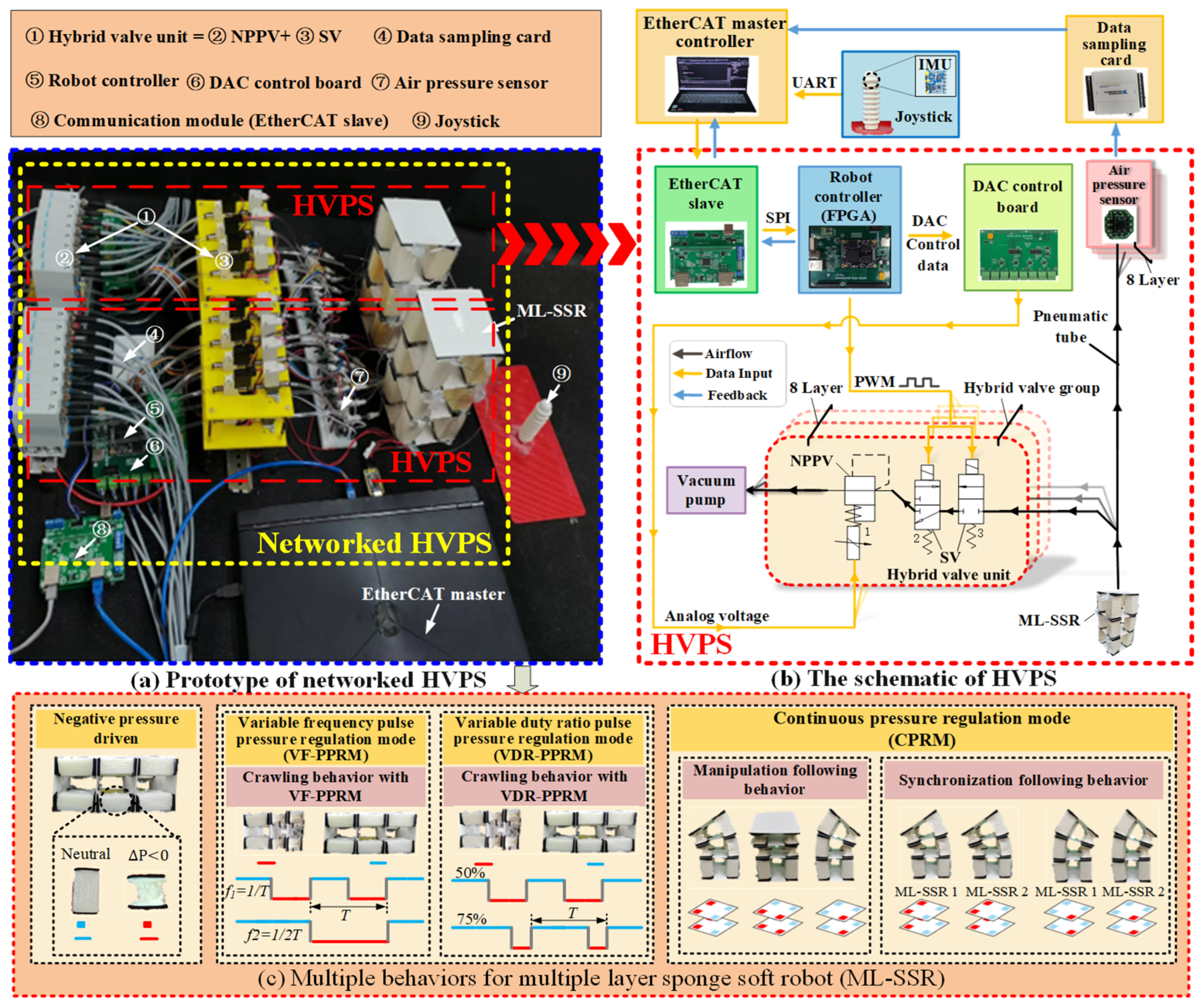
Figure 1. The networked HVPS and ML-SSR are developed herein. (a) Prototype of networked HVPS; (b) schematic of HVPS; (c) multiple behaviors of ML-SSRs implemented by networked HVPS.
Applsci 15 12373 g001
Figure 2. (a) Hybrid valve connection diagram; (b) pressure regulation mode of VF-PPRM; (c) pressure regulation mode of VDR-PPRM; (d) pressure regulation mode of CPRM; (e) Pressure regulation mode of LPM; (f) legend.
Applsci 15 12373 g002
Figure 3. (a) The generating principle of VF-PWM; (b) the generating principle of VDR-PWM.
Applsci 15 12373 g003
Figure 4. (a) General framework of the FPGA-based robot controller; (b) VF-PWM generator; (c) VDR-PWM generator; (d) DAC controller.
Applsci 15 12373 g004
Figure 5. The communication protocol between the EtherCAT primary controller and the FPGA-based robot controller.
Applsci 15 12373 g005
Figure 6. (a) Structure of SSR; (b) sponge actuator; (c) the principle of sponge actuator; (d) the relationship between the height of the sponge actuator and vacuum pressure.
Applsci 15 12373 g006
Figure 7. Schematic diagram of ML-SSR. (a) Deformation of ML-SSR; (b) the schematic diagram of contraction of the ML-SSR; (c) the bend of the ML-SSR.
Applsci 15 12373 g007
Figure 8. ML-SSR’s posture when rotating around different axes. (a) Balanced state of ML-SSR; (b) the posture rotating around the X-axis; (c) around the Y-axis.
Applsci 15 12373 g008
Figure 9. (a) The relationship between output pressure and different frequencies in VF-PPRM; (b) the relationship between output pressure and different duty ratios in VDR-PPRM.
Applsci 15 12373 g009
Figure 10. The relationship between output pressure and input voltage.
Applsci 15 12373 g010
Figure 11. Tracking curves of actual versus theoretical pressure and corresponding error curves for the three waveforms in the CPRM performance experiments: (a) step wave; (b) triangle wave; (c) sine wave.
Applsci 15 12373 g011
Figure 12. The movement process of ML-SSR’s crawling behaviors. (a) Controlled by VF-PPRM (Supplementary Video S1); (b) controlled by VDR-PPRM (Supplementary Video S2).
Applsci 15 12373 g012
Figure 13. (a) Time required for the ML-SSR to crawl 15 cm under varied PWM frequencies and duty ratios (left ordinate for 1 Hz curve; right ordinate for others); (b) crawling speed over a 15 cm distance under different frequencies and PWM duty ratios.
Applsci 15 12373 g013
Figure 14. Bending-angle tracking and posture of the ML-SSR in manipulation following behavior (Supplementary Video S3). (a) Posture of the ML-SSR at different times; (b) bending angle rotating around the X-axis; (c) bending angle around the Y-axis.
Applsci 15 12373 g014
Figure 15. The bending angle of two ML-SSRs (Supplementary Video S4). (a) Posture following; (b) bending angle following the X-axis; (c) bending angle following the Y-axis.
Applsci 15 12373 g015
Disclaimer/Publisher’s Note: The statements, opinions and data contained in all publications are solely those of the individual author(s) and contributor(s) and not of MDPI and/or the editor(s). MDPI and/or the editor(s) disclaim responsibility for any injury to people or property resulting from any ideas, methods, instructions or products referred to in the content.