Article

Advanced Parameter Optimization for Laser Engraving Machines via Genetic Algorithms

by
Chen-Yu Lee
1,*,
Chuin-Mu Wang
1 and
Jia-Xian Jian
2
1
Department of Computer Science and Information Engineering, National Chin-Yi University of Technology, Taichung 41170, Taiwan
2
Department of Electrical Engineering, National Cheng Kung University, Tainan 70101, Taiwan
*
Author to whom correspondence should be addressed.
Appl. Sci. 2025, 15(22), 11925; https://doi.org/10.3390/app152211925
Submission received: 19 September 2025 / Revised: 30 October 2025 / Accepted: 31 October 2025 / Published: 10 November 2025
(This article belongs to the Special Issue Innovative Applications of Big Data and Cloud Computing, 2nd Edition)

Abstract

Laser engraving may be used in a variety of industries, from medicine to defense, and it has many uses that require high-quality precision production. However, in practice, operators have to adjust the laser settings manually, which can result in wasted material and poor color quality and even decrease productivity. Current optimization approaches mostly concentrate on single objectives, making it impossible to co-optimize engraving quality and production efficiency simultaneously. In this paper, an approach based on a multi-objective genetic algorithm, a combination of NSGA-II, SPEA2, and MOEA/D, is proposed to automatically establish the relationship between CMYK color attributes, which are extracted from images of engravings, and laser parameters (power, speed, and frequency). Anodized aluminum 6061 was laser-processed using an SPI 30W fiber laser. While the proposed framework is general, the experimental validation in this study was specifically constrained to this material. The results also indicate that MOEA/D converges in a short time and becomes relatively stable after 20 generations. NSGA-II results in solutions that are more diverse, and SPEA2 offers a good trade-off between the speed of convergence and solution size. This approach resulted in optimization in terms of both a decrease in material used and color matching between manual operations, with the average CMYK improvement being up to 28%. Our results indicate that multi-objective evolutionary optimization is feasible for the optimization of efficiency and quality in laser cutting.

1. Introduction

Laser engraving, currently a leading technique in precision manufacturing, has been widely used in the electronics and semiconductor packaging industry, for medical device and instrument product marking, in consumer electronics-oriented customization, and in the production of high-end gifts. Over the past decade, laser-based processing of material has been concentrated not only on structural accuracy but also on subjective or cosmetic issues, such as color matching and surface finish. For example, Qin et al. [1] developed a genetic algorithm to investigate a laser-induced color gamut on stainless steel surfaces and proved that the color quality can be optimized quantitatively with Δ E metrics. Similarly, Wang et al. [2] employed machine learning and evolutionary algorithms for the optimization of femtosecond laser microstructuring for superhydrophobicity, showcasing the performance of data-driven hybrid models. Desai et al. [3] focused on multi-objective optimization to find the balance between machining efficiency and surface quality, especially for composite materials. These papers show that there is still a lot of interest in the industrial demand for multi-objective frameworks encompassing perceptual quality metrics, and this inspires our work. In addition, Abegunde et al. [4] directly compared and optimized laser engraving for stainless steel using multi-objective bounds, while Wang et al. [5] applied a response surface-based multi-objective design to optimize laser-based directed-energy deposition parameters and highlighted the wide industrial applicability of such approaches.
As quality demands increase, manufacturers must now produce not only highly accurate patterns but also consistent colors. Even slight deficiencies in the engraving process can have great impacts regarding the waste of materials and competitiveness in industries focusing on the quantity or speed of production. Industry surveys have shown that adjusting laser settings by hand can take up 20–30% of production time and leave scrap rates above 15%, particularly when vector cutting reflective or multi-layer materials. In those cases where designs need to be modified or orders are customized, these challenges are compounded.
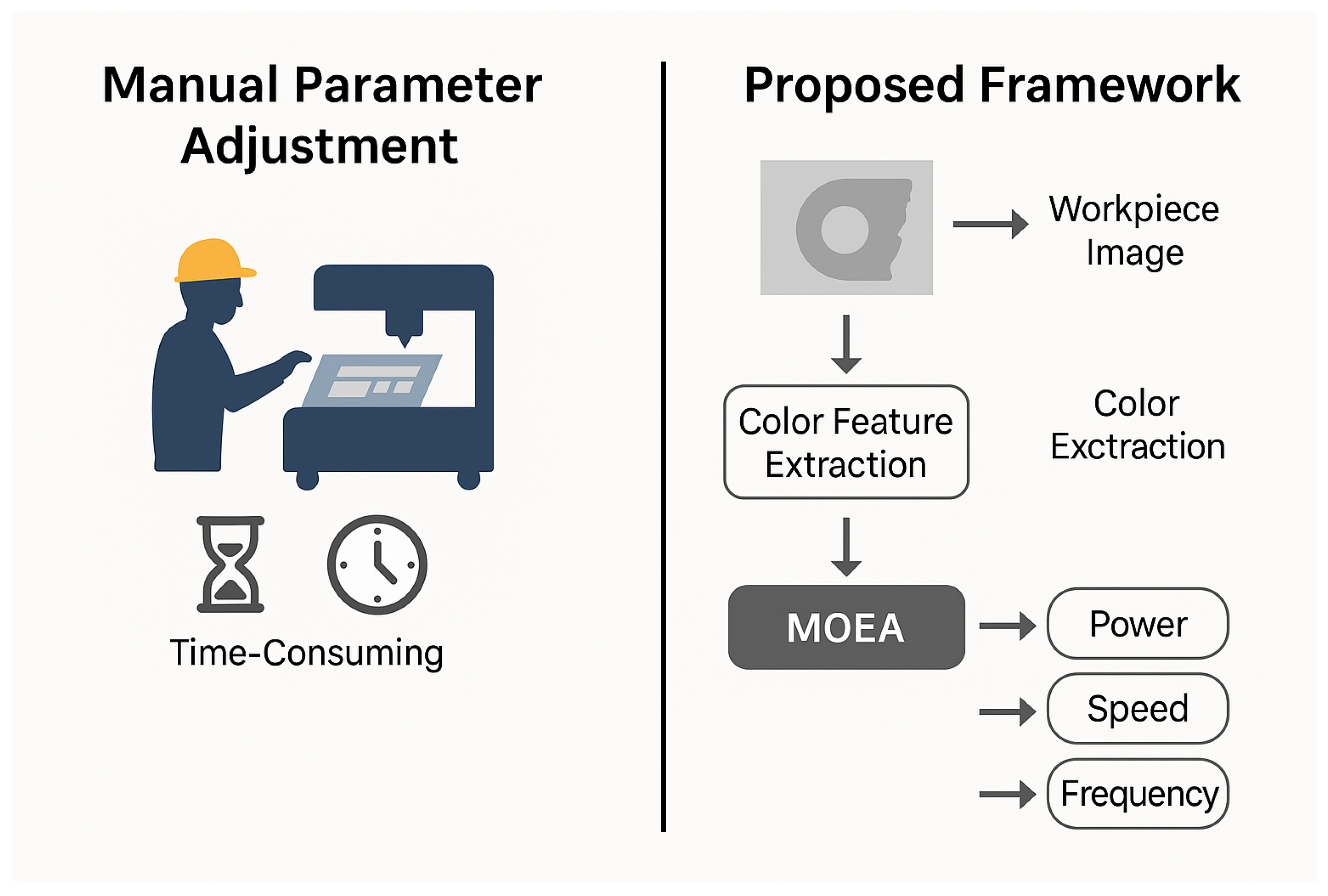
At present, the process parameters of laser engraving machines (power, scan speed, frequency, etc.) in most factories are empirically set up by skillful operators. An experienced technician can usually produce a satisfactory result, but it is a time-consuming and labor-intensive process with inherent operator variability. Moreover, when an engraving requires a plurality of tones or dimensions on the same material, it is not practical to manually adjust the device in accordance these different conditions. These constraints, therefore, underline the importance of an automatic optimization process, which can be tailored to different manufacturing objectives and that can control waste generation. A comparison between conventional manual tuning and the automatic optimization framework proposed in this study is shown in Figure 1.
Some optimization schemes for laser machining processes have emerged over the past decade. Statistical model-based and single-objective optimization methods, such as genetic algorithms or particle swarm optimization, are increasingly found in the literature. Although some successes using these methods have been reported, they encounter two major challenges. Firstly, most of existing methods aim at a single focal goal (e.g., the maximum cutting depth or minimum surface roughness) but do not cope well with the complicated multi-parameter requirements found in laser engraving. Secondly, color consistency is an important issue in engraving for applications such as logo embossing, electronic labeling, and the production of luxury goods, but relatively few studies have been conducted on this topic. Unfortunately, there is no efficient multi-objective framework for the practical use of existing optimization methods in industrial applications that effectively encompasses accuracy, speed, and color fidelity.
To solve this problem, we designed a multi-objective evolutionary algorithm (MOEA) model to coherently link the color features of imprinted images with the parameters of the laser engraving machine. In this paper, we employ three multi-objective genetic algorithms—NSGA-II, SPEA2, and MOEA/D—and evaluate them to explore how they can help handle multi-objective optimization in laser engraving. In our study, CMYK color features are extracted from the workpiece image, and engraving quality is determined by computing the average color difference between the original reference and the engraved result. In particular, we consider the average of the absolute difference between the CMYK channels to be a perception-based measure of color differences as follows:
D avg = 1 4 X { C , M , Y , K } X ref X engr .
This metric provides a simple way to assess color consistency without having to calculate Δ E 2000 and adjust laser settings—power, speed, and frequency—accordingly. By evaluating the performance of these three multi-objective evolutionary algorithms (MOEAs) on various workpieces, we aim to demonstrate the feasibility of applying genetic methods to laser engraving machines and provide a practical reference for selecting appropriate algorithms for different industrial applications.
The major contributions of this study are summarized as follows:
  • Novel framework: We present a novel multi-objective optimization framework that combines CMYK-based image features with evolutionary algorithms to automatically optimize the parameters of laser engraving.
  • Algorithmic comparison: We conduct a thorough comparison between three popular MOEAs (NSGA-II, SPEA2, and MOEA/D) in terms of their trade-offs between convergence speed, solution diversity, and robustness.
  • Experimental validation: We conduct experiments on anodized aluminum 6061 to validate the feasibility and effectiveness of the proposed framework under controlled laser engraving conditions.
  • Industrial relevance: We demonstrate quantitatively that the convenience of both material efficiency and color consistency is increased over manual tuning and single-objective optimization, thus showing the potential for integrating our approach into smart manufacturing systems.
The purpose of this study is to meet the urgent industrial requirement for high-quality, low-cost laser engraving by using the multi-objective evolutionary genetic algorithm method. The proposed framework reduces the dependence on manual skills, offers the capability to be upscaled, and is readily implementable in Industry 4.0 settings.

2. Related Works

In laser engraving, it is vital to employ the parameters that are suitable for each material [6,7,8]. However, many engraving plants have difficulty adjusting machine parameters rapidly enough to change colors for workpieces of the same material as they are engraved to different depths. It can be seen in Figure 2 that the change of engraving depth on such materials may bring about significant alteration of the workpiece’s perceived color. Therefore, this paper proposes an automatic method that adapts the parameters of the laser engraving machine so that it can meet the different color requirements of such workpieces.
The optimization of parameters in laser machining has received attention from many researchers. Flaviu et al. [9] used statistical methods to analyze the influence of laser parameters on workpieces and found that power greatly influences engraving roughness. Their research showed that increasing frequency and focal length, but decreasing speed and step size, enhanced the surface melting phenomenon. However, they did not propose a systematic approach to determining the optimal values for these parameters. Gadallah and Abdu [10] utilized a mathematical model that considers power, oxygen pressure, frequency, and speed to gain statistically optimized cutting parameters for a laser used on stainless steel. However, their approach was built on a single-objective optimization model, which works restrictively for laser engraving operations where multiple objectives must be considered simultaneously.
There are other studies investigating optimization strategies for improving machining efficiency. Genetic algorithms (GAs), differential evolution (DE), and particle swarm optimization (PSO) have been used in laser cutting and engraving [11,12,13,14]. These algorithms demonstrated superior performance to manual adjustments or statistics-only methods. However, where single-objective optimization was undertaken—e.g., to maximize the depth of a cut or to minimize surface roughness—many previous studies have failed to consider other important aims such as (i) processing time, (ii) energy efficiency, and (iii) color consistency. The emphasis on one goal often leads to conflicts between goals and a loss of diversity in terms of solutions and information.
On the other hand, multi-objective evolutionary algorithms (MOEAs) have come to be used seriously in recent years and can be seen as one of the successful ways to deal with conflicting objectives. Some common MOEAs include the Non-Dominated Sorting Genetic Algorithm II (NSGA-II) [11], the Strength Pareto Evolutionary Algorithm 2 (SPEA2) [12], and the Multi-Objective Evolutionary Algorithm based on Decomposition (MOEA/D) [13]. NSGA-II has biases regarding diversity preservation and the efficiency of non-dominated sorting; SPEA2 integrates archive-based elitism within which individuals suffer from low-density estimation regarding the determination of trade-offs between exploration and exploitation [13]; and MOEA/D decomposes multi-objective problems into simple ones, meaning it works well in high-dimensional tasks. These algorithms have also been used successfully for other applications like engineering design, scheduling, and energy optimization [15,16,17,18]. However, very few are used for laser engraving, especially when objectives such as color consistency and visual quality are in question—both now significant within the consumer and industrial sectors. Recent comparative studies have also highlighted that MOEA/D and NSGA-II have complementary properties in different optimization scenarios, which justifies our decision to investigate multiple algorithms in this paper [19]. Moreover, Zhang et al. [20] proved that advanced versions of NSGA-II can attain better fusion and distribution in the optimization of machining parameters, justifying the application of these approaches in manufacturing.
Furthermore, color difference metrics and perception modeling studies are necessary for maximal engraving improvement. The CIEDE2000 color difference metric [21,22,23], which has been accepted by the printing and imaging industry, is able to provide a quantitative description for perceptual color differences. It is, however, of essence how the color information is measured, and the more practice-oriented models require descriptions of object colors in terms of these models, but there is no color description system that includes perception-based models. Therefore, the use of MOEAs with perceptual grammar provides a novel pipeline to directly connect image-based features to engraving parameters. More recently, Demetoğlu et al. [24], showed that for laser etching of polymer-infiltrated ceramics, the practical applicability of CIEDE2000 appeared to be validated, emphasizing the necessity of applying perceptual color metrics in assessing engraving quality. In the current study, we applied the average color difference based on CMYK measurements as described in Equation (1) simply because we did not set up a Δ E 2000 -based measurement due to experimental restrictions.
Table 1 presents a summary of some of the important contributions in laser machining optimization and their approaches, objectives, and limitations. Complementing these findings, Sobri et al. [25] optimized the CO2 laser machining parameters for wood–plastic composites, and Wang et al. [5] tackled multi-objective optimization in laser remanufacturing, showing the effectiveness of parameter tuning across different materials and processes. Existing work predominantly focuses on single-objective models or ignores visual quality considerations. This paper fills this gap by integrating CMYK color features with multi-objective evolutionary algorithms (MOEAs) to the automatic optimization of engraving parameters, providing methodological advances as well as practical industrial recommendations.

3. Methods

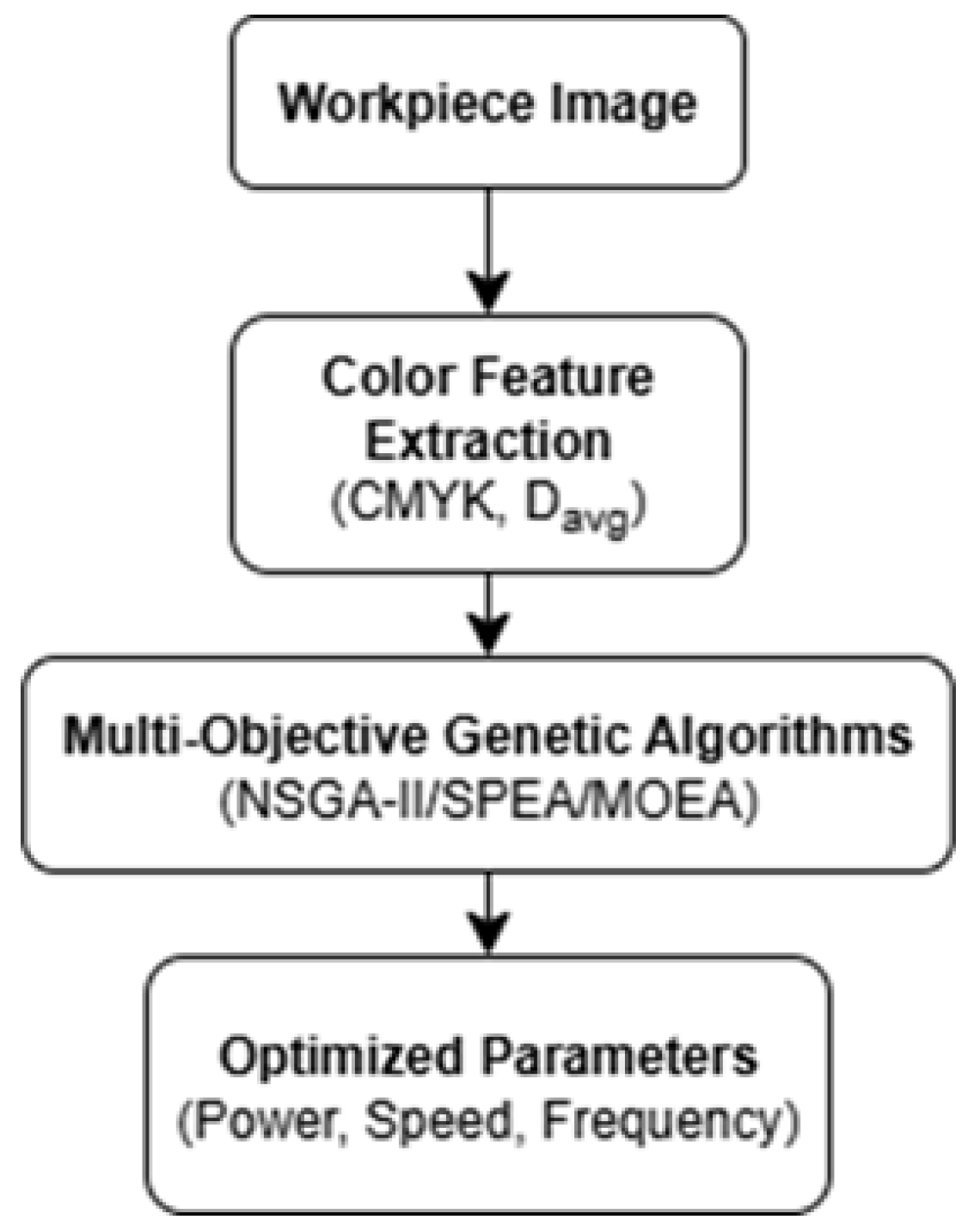
The suggested optimization framework has been designed to automatically fine-tune laser engraving settings to enhance color uniformity and operational efficiency. As shown in Figure 3, the system’s workflow includes three key steps: (i) extracting features from engraved images; (ii) performing multi-objective evolutionary optimization with algorithms such as NSGA-II, SPEA2, or MOEA/D; and (iii) predicting the optimized engraving parameters for testing on actual machines.

3.1. Dataset and Feature Extraction

Experiments were carried out on anodized aluminum 6061 to observe the range of engraving reactions and validate the framework. Each sample was engraved under controlled conditions using different settings for laser power, scanning speed, and frequency.
The extracted features (CMYK) form the input data for the optimization framework.
  • Image Acquisition: Engraved workpieces were imaged using a high-resolution industrial camera under consistent illumination. Images were cropped to the engraved region of interest.
  • Color Representation: RGB images were converted to CMYK values, which better describe perceived engraving appearance. Average CMYK values were extracted from each workpiece.
  • Color Difference Metric: To quantify perceptual differences, the average color difference was computed between targets and actual engraving outputs. This ensures that optimization reflects not only machine settings but also human-perceived quality.

3.2. Multi-Objective Optimization Formulation

The optimization problem is defined as minimizing three objectives simultaneously:
min x = { P , V s c a n , F q } F ( x ) = { f 1 ( x ) , f 2 ( x ) , f 3 ( x ) } .
where P = laser power, V s c a n = scanning speed, F q = frequency.
  • f 1 ( x ) : Color difference, CMYK-based average color difference (minimize).
  • f 2 ( x ) : Processing time, approximated by path length/scanning speed (minimize).
  • f 3 ( x ) : Energy consumption, proportional to P × time (minimize).
This formulation captures the trade-offs between visual quality, processing efficiency, and energy efficiency.

3.3. Algorithmic Implementations

Although the overall optimization framework (Algorithm 1) is general, the update and selection strategies differ among the three chosen MOEAs. Their main mechanisms are summarized below.
Algorithm 1 Proposed MOEA-based optimization framework for laser engraving
Require: Engraved workpiece images with CMYK features and A v g ( P , V s c a n , F q ) targets
Ensure: Pareto-optimal parameter set ( P , V s c a n , F q )
1:Initialize population of candidate solutions, each as ( P , V s c a n , F q )
2:for each individual ( P , V s c a n , F q ) do
3:   f 1 A v g ( P , V s c a n , F q ) ▹ Average Color difference (minimize)
4:   f 2 PathLength / V s c a n ▹ Processing time (minimize)
5:   f 3 P × f 2 ▹ Energy consumption (minimize)
6:end for
7:while termination criteria not met do
8:   Select parents based on MOEA type (NSGA-II / SPEA2 / MOEA/D)
9:   Apply crossover and mutation to generate offspring ( P , V s c a n , F q )
10:   Clip offspring values into valid ranges
   P [ 10 , 100 ] with step 10
   V s c a n [ 100 , 3000 ] with step 100
   F q [ 10 , 150 ] with step 10
11:   Evaluate offspring objectives f 1 , f 2 , f 3
12:   Update population and archive according to the selected MOEA
13:end while
14:return Pareto front of optimized ( P , V s c a n , F q )

3.3.1. NSGA-II

NSGA-II generates random initial populations, applies non-dominated sorting to identify Pareto fronts, and computes the crowding distance (Equation (3)) to preserve diversity.
I [ i ] = m = 1 M f m ( i + 1 ) f m ( i 1 ) f m max f m min .
Parents are selected based on Pareto rank and crowding distance. The offspring are generated through crossover and mutation, and the combined parent–offspring pool is sorted to form the next generation. Advantages: fast sorting, strong diversity maintenance, limited need for hyperparameter tuning.

3.3.2. SPEA2

SPEA2 maintains an external archive of non-dominated solutions. Fitness combines dominance strength and density information. Density is computed using the distance to the k-th nearest neighbor (Equation (4)) as follows:
D ( i ) = 1 d k ( i ) + 2
This prevents extreme values when distances are small. SPEA2 balances exploration and exploitation, ensuring both convergence and diversity.

3.3.3. MOEA/D

MOEA/D decomposes a multi-objective problem into sub-problems with weight vectors, solved collaboratively. Fitness can be aggregated by weighted sum (Equation (5)) or Tchebycheff (Equation (6)) as follows:
f a g g ( x λ ) = m = 1 M λ m f m ( x )
g T c h e b y c h e f f ( x λ , z * ) = max 1 m M λ m | f m ( x ) z m * |
where z * is the ideal point and λ is the weight vector. MOEA/D scales well to high dimensions and yields well-distributed solutions.

3.4. Algorithmic Comparison and Complexity

Although the overall optimization framework (Algorithm 1) is general, the update and selection strategies differ among the three chosen MOEAs. Their main mechanisms are summarized below.
  • NSGA-II: Complexity O( M N 2 ). Strong diversity but slower for large populations.
  • SPEA2: Complexity O( N 2 ). Balanced convergence and diversity but requires archive management.
  • MOEA/D: Complexity O(NM). Scalable and efficient in high dimensions but may lose diversity if weight vectors are poorly chosen.
The choice of algorithm depends on problem characteristics: NSGA-II and SPEA2 are suitable for problems requiring strong Pareto front diversity, while MOEA/D is more effective in high-dimensional parameter spaces.

4. Experiments

4.1. Hardware Setup

The experiments were conducted using both a laser engraving platform and a computational workstation.
Laser Engraving Machine:
  • SPI 30W fiber laser, 1064 nm wavelength.
  • SINO-GALVO galvanometer scanner.
  • 150 × 150 mm focusing lens.
  • Black anodized aluminum 6061 plates as workpieces.
Computational Workstation:
  • CPU: Intel Core i5-10300H @ 2.50 GHz.
  • RAM: 16 GB DDR4.
  • GPU: NVIDIA GeForce RTX 2060, 6 GB VRAM.
  • Operating System: Windows 10, 64-bit.
  • Programming Environment: Python 3.10 with DEAP 1.4, NumPy 1.24.4, and Matplotlib 3.7.5.

4.2. Parameter Ranges

The optimization problem was constrained within practical industrial ranges (Table 2). Parameters outside these ranges (e.g., speed 0–6000 mm/s or frequency up to 3000 kHz) were experimentally found to have little or no effect on engraving quality.

4.3. MOEA Configuration Parameters

All MOEAs shared the same configuration parameters to ensure fair comparison (Table 3).
Table 3 shows the main configurations of the genetic algorithm implemented in this paper, where the parameter abbreviations are as follows: PS represents the population size, OS represents the offspring size, GEN represents the total number of generations, CXPB represents the crossover probability, and MUTPB represents the mutation probability. Crossover (CX) was performed using simulated binary crossover (SBX) with a distribution exponent η = 20.0, while mutation (MUT) was performed using polynomial mutation with the same η .

4.4. Flows

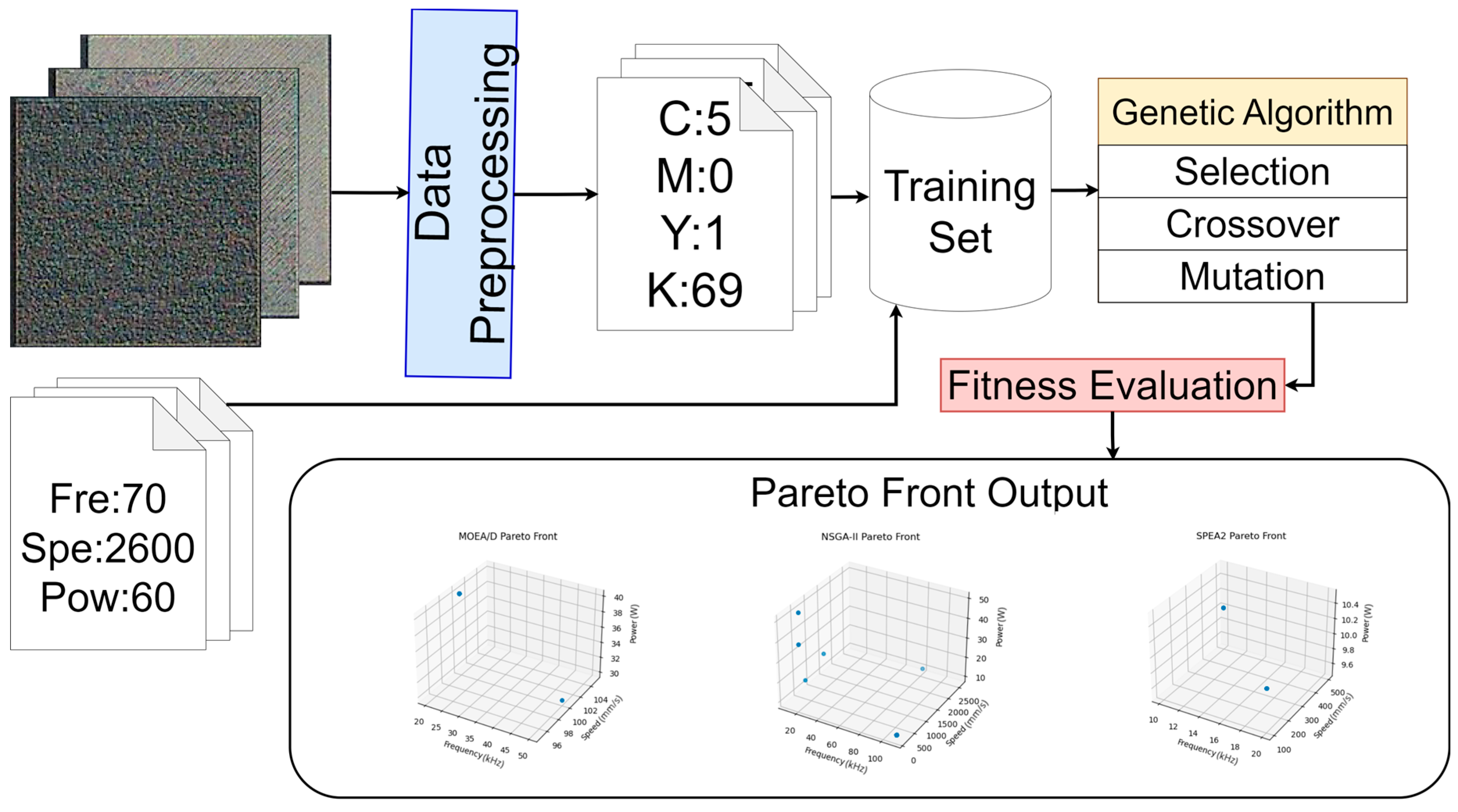
The overall experimental process is illustrated in Figure 4. First, the engraved image was converted into CMYK color values, which served as the optimized feature representation. The CMYK values were then standardized, and a multi-objective evolutionary algorithm (MOEA) was applied to optimize the corresponding processing parameters (frequency, speed, and power). Each individual in the evolutionary process represents a candidate solution, and its fitness is determined by evaluating the nearest sample in the dataset. Selection, crossover, mutation, and non-dominated sorting were performed iteratively to produce a Pareto-optimal set of solutions.

4.5. Data Preprocessing

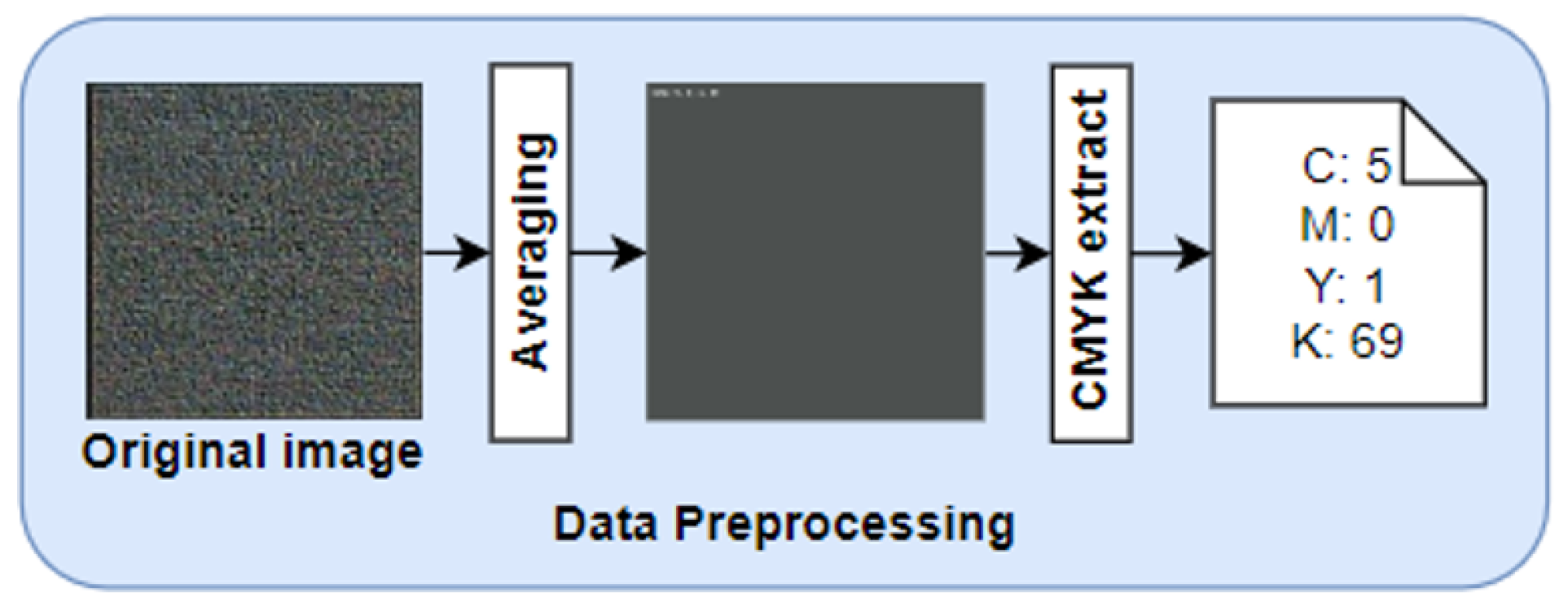
First, the workpiece image engraved by the laser engraving machine presents different color patterns due to the reflection of light. To obtain the color information of the workpiece image, the pixel values of the entire image were first averaged, and then the CMYK color information of the image was generated as the input data of the genetic algorithm, as shown in Figure 5.

4.6. Experimental Results

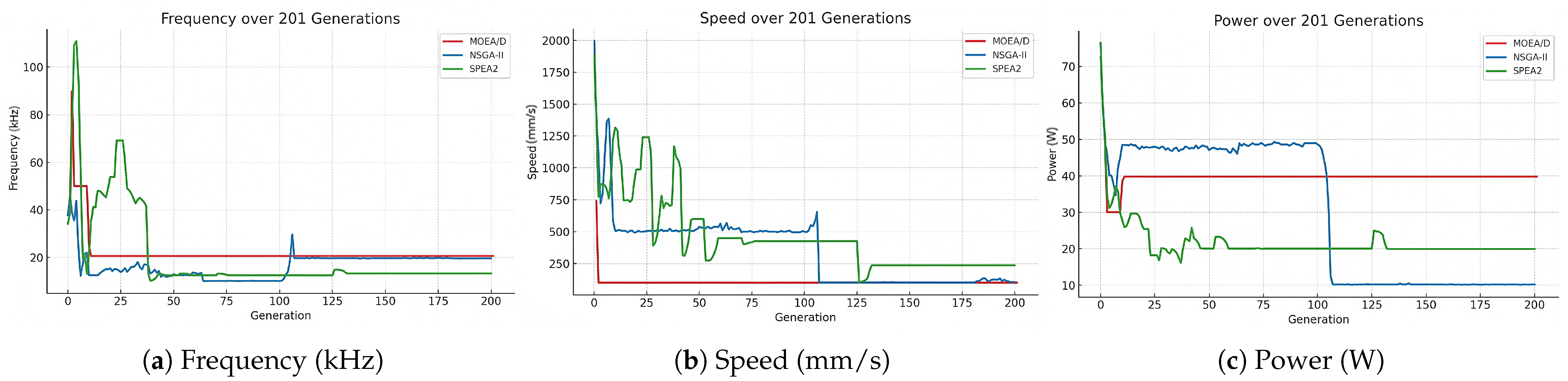
Regarding the convergence curves of MOEA/D, NSGA-II, and SPEA2 for the three optimization objectives of frequency, speed, and power, there are obvious differences in the convergence status and optimization effects among the methods. As shown in Figure 6a, MOEA/D converges fastest in the optimization of frequency parameters and almost converges around the 20th generation. The convergence trend of NSGA-II is relatively stable, but the convergence speed is slow. In contrast, SPEA2 has larger fluctuations in the early generations and requires longer evolutionary generations to reach convergent values. In terms of speed, as shown in Figure 6b, MOEA/D quickly reaches the lower limit (100), proving its better optimization performance. Although the overall curves of NSGA-II and SPEA2 also show a downward trend, they fail to converge to the minimum value during the entire iteration process. As shown in Figure 6c, in terms of power, SPEA2 maintains the lowest convergence value during most of the iterations. MOEA/D maintains a relatively stable convergence, while NSGA-II shows a sharp decline in the later period, but its convergence is relatively unstable overall.
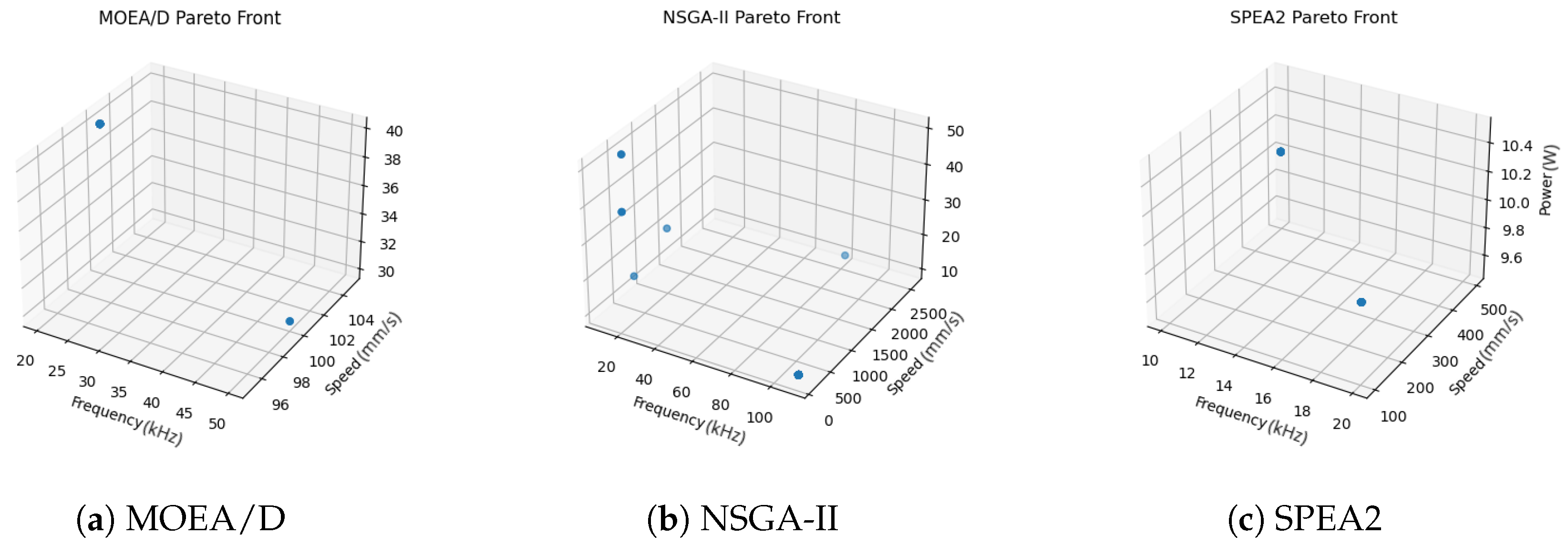
The Pareto front results generated by the three algorithms are shown in Figure 7. MOEA/D produces a more concentrated set of non-dominated solutions, reflecting better convergence but with more limited diversity of solutions. In comparison, NSGA-II and SPEA2 can show a wider distribution in the target space, indicating that the diversity of the solutions obtained is higher. It is noteworthy that NSGA-II contains solutions with very low values of power and frequency, while SPEA2 has solutions for a wider range of values for the speed parameter. These results highlight the differences among the three algorithms in terms of balancing convergence and diversity in multi-objective optimization.
The convergence processes and solution distributions of MOEA/D, NSGA-II, and SPEA2 are significantly different, and each algorithm has different advantages depending on the optimization objective. When fast and stable convergence is a priority, MOEA/D performs best, although its solution diversity is lower. NSGA-II converges more slowly and is less stable. SPEA2 has a balanced performance, providing diverse and consistent solutions. Overall, SPEA2 can be considered the most robust choice when both convergence efficiency and solution diversity are important.
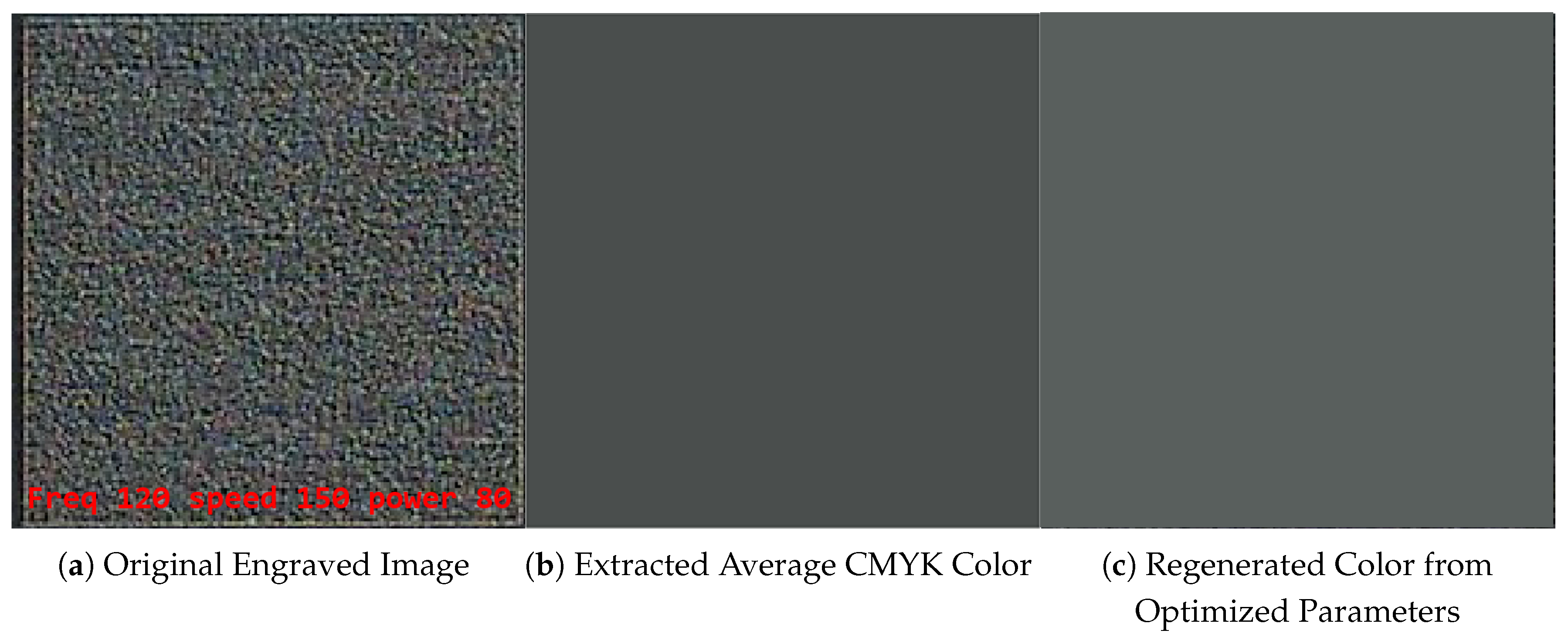
Figure 8 shows the experimental results of genetic algorithm processing for laser engraving machine parameter selection. First, the original image is processed by color averaging to reduce the complexity and noise of the original image. This processed image is then fed into a genetic algorithm, which predicts the three key parameters required for the laser engraving machine: frequency, speed, and power. When these predicted parameters are reverse mapped through the same algorithm, the output is very similar to the image after averaging the original input image, proving that genetic algorithms are feasible in optimizing parameter selection for laser engraving machines.
The observed 28% average CMYK improvement over manual operations demonstrates a strong practical benefit. While this initial study focuses on proving the framework’s feasibility on anodized aluminum, confirming the statistical significance of this improvement via rigorous hypothesis testing and reproducibility across different materials will be primary objectives for our future work.

5. Conclusions

This paper presents a multi-objective optimization approach to assist in the tuning of laser engraving parameters by means of evolutionary algorithms. It integrates CMYK-rooted color features with three popular MOEAs—NSGA-II [11], SPEA2 [12], and MOEA/D [13]—to optimize power, speed, and frequency together according to three objectives: consistent color quality (CMYK-based average color difference), processing time, and energy dissipation.
Measurements performed on anodized aluminum surfaces showed pronounced differences between the different algorithms. MOEA/D gave the quickest convergence, particularly in frequency optimization, but had a limited distribution of solutions. NSGA-II exhibited smoother convergence and solutions with very low parameter values, but its stability was sometimes lower as well. SPEA2 achieved a good trade-off between high-quality convergence and diversity, and its performance was more predictable for real-world applications overall.
The multi-objective approach provides a clear advantage over traditional single-objective optimization. A single-objective approach would require converting the conflicting goals ( f 1 , f 2 , f 3 ) into a single scalar function (e.g., a weighted sum), forcing the operator to choose fixed weights a priori without understanding the trade-offs. In contrast, our MOEA framework generates a Pareto-optimal front (Figure 7), which is a set of non-dominated solutions. This allows the production engineer to visualize and select the best compromise between fast processing (low f 2 ), low energy (low f 3 ), and high color fidelity (low f 1 ), thus offering superior flexibility and control in a real-world manufacturing setting.
From a commercial perspective, this method minimizes reliance on operator skill, reduces material costs, and improves the efficiency and consistency of engraved articles. These results highlight the applicability of MOEA-based parameter optimization for future use with smart manufacturing and Industry 4.0 systems.
However, some limitations remain. The present model has been proven only on anodized aluminum 6061 for a given laser configuration, and the color objective uses the CMYK-based D avg metric rather than the industry standard, Δ E 2000 . In future work, the framework will be extended to a wider variety of materials and incorporate the CIEDE2000 metric for improved perceptual accuracy. Crucially, we plan to incorporate real-time sensing for closed-loop control, integrating a camera-based feedback loop to dynamically adjust parameters during the engraving process. This will solidify the framework’s integration with smart manufacturing and Industry 4.0 systems, enhancing both flexibility and scalability in practical production applications.

Author Contributions

Conceptualization, C.-Y.L. and C.-M.W.; methodology, C.-Y.L.; software, C.-Y.L.; validation, C.-M.W. and J.-X.J.; formal analysis, J.-X.J.; investigation, C.-Y.L.; resources, C.-M.W.; data curation, C.-Y.L.; writing—original draft preparation, C.-Y.L.; writing—review and editing, C.-M.W. and J.-X.J.; visualization, C.-Y.L.; supervision, C.-M.W.; project administration, C.-M.W.; funding acquisition, Not applicable. All authors have read and agreed to the published version of the manuscript.

Funding

This research received no external funding.

Institutional Review Board Statement

Not applicable.

Informed Consent Statement

Not applicable.

Data Availability Statement

The raw data and image materials used to support the findings of this study are not publicly available as they contain proprietary information provided by a collaborating company. Data can be made available upon reasonable request to the corresponding author, subject to authorization from the original provider.

Acknowledgments

The authors are grateful to the National Chin-Yi University of Technology for providing the necessary facilities for this study.

Conflicts of Interest

The authors declare no conflict of interest.

Abbreviations

The following abbreviations are used in this manuscript:
MOEAMulti-Objective Evolutionary Algorithm
MOEA/DMulti-Objective Evolutionary Algorithm Based on Decomposition
NSGA-IINon-Dominated Sorting Genetic Algorithm II
SPEA2Strength Pareto Evolutionary Algorithm 2
CMYKCyan, Magenta, Yellow, Key (Black)
D a v g CMYK-based Average Color Difference
PLaser Power
V s c a n Scanning Speed
F q Laser Frequency
PSPopulation Size
OSOffspring Size
GENTotal Number of Generations

References

  1. Qin, X.; Xue, Z.; Wang, X.; Song, K.; Wan, X. A Color Reproduction Method for Exploring the Laser-Induced Color Gamut on Stainless Steel Surfaces Based on a Genetic Algorithm. Appl. Sci. 2025, 15, 28. [Google Scholar] [CrossRef]
  2. Wang, L.; Gu, Y.; Tian, X.; Wang, J.; Jia, Y.; Xu, J.; Zhang, Z.; Liu, S.; Liu, S. Machine Learning-Assisted Optimization of Femtosecond Laser-Induced Superhydrophobic Microstructure Processing. Photonics 2025, 12, 530. [Google Scholar] [CrossRef]
  3. Desai, A.A.; Khan, S.N.; Bagane, P.; Patil, S.D. Multi-objective optimization of laser machining parameters for carbon-glass reinforced hybrid composites: Integrating. MethodsX 2024, 13, 103066. [Google Scholar] [CrossRef] [PubMed]
  4. Abegunde, A.S.; Ojo, O.O.; Farayibi, P.K.; Adeyinka, A.M. Laser Engraving Processes on AISI 304 Stainless Steel: A Multi-Objective Optimization Approach. J. Eng. Res. Rep. 2024, 16, 313–331. [Google Scholar] [CrossRef]
  5. Wang, G.; Zhao, H.; Liang, H.; Deng, C.; Ma, W. Multi-objective optimisation of process parameters for laser-based directed energy deposition of a mixture of H13 and M2 steel powders on 4Cr5Mo2SiV1 steel. Virtual Phys. Prototyp. 2024, 19. [Google Scholar] [CrossRef]
  6. Hubeatir, K.A.; Al-Khafaji, M.M.H.; Imran, H.J. Optimization of Laser Parameters on Engraving Process for Different Materials; University of Technology: Baghdad, Iraq, 2019. [Google Scholar]
  7. Patel, D.K.; Patel, D.M. Parametric Optimization of Laser Engraving Process for different Material using Grey Relational Technique—A Review. Int. J. Eng. Sci. Res. Technol. 2014, 3, 1988–1992. [Google Scholar]
  8. Lim, M.; Kim, Y.H.; Sohn, H.; Shin, D.; Choi, J. Maximization of the ablation rate of metal, semiconductor and dielectric with a MHz repetition rate ultrafast laser. In Proceedings of the 2015 11th Conference on Lasers and Electro-Optics Pacific Rim (CLEO-PR), Busan, Republic of Korea, 24–28 August 2015; pp. 1–2. [Google Scholar]
  9. Corb, F.; Stanasel, I.; Buidos, T.; Veres, R.; Flonta, D. Study of Surface Quality Processed by Fiber Optic Laser Engraving of Steel According to Working Parameters. In Proceedings of the 2023 17th International Conference on Engineering of Modern Electric Systems (EMES), Oradea, Romania, 9–10 June 2023; pp. 1–4. [Google Scholar]
  10. Gadallah, M.H.; Abdu, H.M. Modeling and optimization of laser cutting operations. Manuf. Rev. 2015, 2, 20. [Google Scholar] [CrossRef]
  11. Deb, K.; Pratap, A.; Agarwal, S.; Meyarivan, T. A fast and elitist multiobjective genetic algorithm: NSGA-II. IEEE Trans. Evol. Comput. 2002, 6, 182–197. [Google Scholar] [CrossRef]
  12. Zaenudin, E.; Kistijantoro, A.I. pSPEA2: Optimization fitness and distance calculations for improving Strength Pareto Evolutionary Algorithm 2 (SPEA2). In Proceedings of the 2016 International Conference on Information Technology Systems and Innovation (ICITSI), Bandung, Indonesia, 24–27 October 2016; pp. 1–5. [Google Scholar]
  13. Zhang, Q.; Li, H. MOEA/D: A Multiobjective Evolutionary Algorithm Based on Decomposition. IEEE Trans. Evol. Comput. 2007, 11, 712–731. [Google Scholar] [CrossRef]
  14. Coello, C.A.C. Evolutionary multi-objective optimization: A historical view of the field. IEEE Comput. Intell. Mag. 2006, 1, 28–36. [Google Scholar] [CrossRef]
  15. Deb, K.; Jain, H. An Evolutionary Many-Objective Optimization Algorithm Using Reference-Point-Based Nondominated Sorting Approach, Part I: Solving Problems With Box Constraints. IEEE Trans. Evol. Comput. 2014, 18, 577–601. [Google Scholar] [CrossRef]
  16. Zitzler, E.; Deb, K.; Thiele, L. Comparison of Multiobjective Evolutionary Algorithms: Empirical Results. Evol. Comput. 2000, 8, 173–195. [Google Scholar] [CrossRef] [PubMed]
  17. Coello, C.A.C.; Lamont, G.B. Applications of Multi-Objective Evolutionary Algorithms; World Scientific: Singapore, 2004. [Google Scholar]
  18. Yuan, Z.; Ouyang, H.; Li, S.; Houssein, E.H.; Samee, N.A. Multi-objective differential evolution algorithm integrating a directional generation mechanism for multi-objective optimization problems. Appl. Soft Comput. 2025, 184, 113791. [Google Scholar] [CrossRef]
  19. Saǧlican, E.; Afacan, E. MOEA/D vs. NSGA-II: A Comprehensive Comparison for Multi/Many Objective Analog/RF Circuit Optimization through a Generic Benchmark. ACM Trans. Des. Autom. Electron. Syst. 2023, 29, 1–23. [Google Scholar] [CrossRef]
  20. Zhang, Z.; Wu, F.; Wu, A. Research on Multi-Objective Process Parameter Optimization Method in Hard Turning Based on an Improved NSGA-II Algorithm. Processes 2024, 12, 950. [Google Scholar] [CrossRef]
  21. Luo, M.R.; Cui, G.; Rigg, B. The development of the CIE 2000 colour-difference formula: CIEDE2000. Color Res. Appl. 2001, 26, 340–350. [Google Scholar] [CrossRef]
  22. Sharma, G.; Wu, W.; Dalal, E.N. The CIEDE2000 color-difference formula: Implementation notes, supplementary test data, and mathematical observations. Color Res. Appl. 2004, 30, 21–30. [Google Scholar] [CrossRef]
  23. Schanda, J. Colorimetry: Understanding the CIE System; Wiley: Hoboken, NJ, USA, 2007. [Google Scholar]
  24. Demetoğlu, G.A.; Çevlïk, E.T. Evaluation of the effect of etching with ytterbium fiber laser on the bond strength, color stability, and fracture analysis of lithium disilicate ceramics to bovine teeth: An in vitro study. BMC Oral Health 2025, 25, 607. [Google Scholar] [CrossRef] [PubMed]
  25. Ahmad Sobri, S.; Chow, T.P.; Tatt, T.K.; Nordin, M.H.; Hermawan, A.; Mohamad Amini, M.H.; Norizan, M.N.; Shuaib, N.A.; Wan Ismail, W.O.A.S. Optimization and Validation of CO2 Laser-Machining Parameters for Wood–Plastic Composites (WPCs). Polymers 2025, 17, 2216. [Google Scholar] [CrossRef] [PubMed]
Figure 1. Comparison between manual parameter adjustment (left) and the proposed multi-objective optimization framework (right). The manual process is highly dependent on worker skill and experience, resulting in inherent variability.
Applsci 15 11925 g001
Figure 2. Laser engraving workpiece colors (anodized aluminum 6061).
Applsci 15 11925 g002
Figure 3. Overall workflow of the proposed multi-objective optimization framework for laser engraving.
Applsci 15 11925 g003
Figure 4. Workflow of multi-objective optimization for laser engraving.
Applsci 15 11925 g004
Figure 5. CMYK-based color feature extraction from workpiece images.
Applsci 15 11925 g005
Figure 6. Convergence performance of MOEA/D, NSGA-II, and SPEA2.
Applsci 15 11925 g006
Figure 7. Pareto front results of MOEA/D, NSGA-II, and SPEA2.
Applsci 15 11925 g007
Figure 8. Color Matching Result for Anodized Aluminum 6061. Note: Images for other materials are not presented, as the current evaluation focuses exclusively on anodized aluminum, as acknowledged in the study’s limitations.
Applsci 15 11925 g008
Table 1. Summary of representative studies on laser machining optimization.
ReferenceMaterialMethodObjectivesLimitation
[6]VariousExperimental optimizationEngraving depthLimited scalability
[7]MixedGrey relational analysisMulti-parameter engravingEmpirical only, not automated
[9]SteelStatistical modelingRoughnessNo automated optimization
[10]Stainless steelSingle-objective optimizationCutting efficiencyIgnores multi-objective trade-offs
[11]GeneralMOEAMulti-objective frontsNot applied to laser engraving
[12]GeneralMOEAConvergence/diversity balanceNot validated for engraving
[13]GeneralMOEADecomposition-based optimizationRarely used in machining
Our WorkAnodized Aluminum 6061MOEA (NSGA-II, SPEA2, and MOEA/D)Color consistency, efficiency, and parameter tuningFirst systematic comparison in engraving
Table 2. Target parameter range table.
Speed (mm/s)Power (%)Frequency (kHz)
Minimum1001010
Maximum3000100150
Table 3. Genetic algorithm configuration parameters.
ParamPSOSGENCXPB/CXMUTPB/MUT
Value100200500.7/20.00.2/20.0
Disclaimer/Publisher’s Note: The statements, opinions and data contained in all publications are solely those of the individual author(s) and contributor(s) and not of MDPI and/or the editor(s). MDPI and/or the editor(s) disclaim responsibility for any injury to people or property resulting from any ideas, methods, instructions or products referred to in the content.