
Situation-Aware Causal Inference-Driven Vehicle Lane-Changing Decision-Making




Abstract
Featured Application
Abstract
1. Introduction
1.1. Decision-Making Models
1.2. Behavior Modeling and Prediction
1.3. Safety and Trajectory Planning
- Real-Time Decision-Making Capabilities: Current models struggle to meet the millisecond-level decision-making requirements of highly dynamic and strongly interactive scenarios. The rapid and complex nature of real-world driving conditions demands real-time decision-making capabilities that current models have not fully achieved.
- Multi-Dimensional Information Integration: There is a lack of effective mechanisms for efficiently integrating multi-dimensional information, particularly video streams from electronic rearview mirrors, to achieve in-depth environmental understanding and causal inference. The complexity of integrating diverse data sources and extracting meaningful insights remains a significant hurdle.
- Optimal Solution Under Multi-Objective Games: Finding the optimal solution rapidly under complex multi-objective games is still a formidable challenge. The interaction between multiple objectives and the dynamic nature of the driving environment makes it difficult to find the best course of action in a timely manner.
1.4. Electronic Rearview Mirror Technology
- A lane-changing safety and decision-making model is proposed, which integrates multimodal perception information along with context-related features. This research introduces electronic rearview mirror technology to acquire high-dimensional environmental data and employs an attention mechanism to enhance the extraction of critical scene features. Through dynamic perception and behavioral correlation analysis, this model can more accurately identify real-time risk factors in complex traffic environments, thereby improving decision-making accuracy while optimizing the selection of lane-changing strategies.
- The introduction of causal relationship modeling into the domain of lane-changing research represents a significant innovation. By constructing a structured causal graph and implementing a counterfactual analysis framework, this study elucidates the causal relationships present in multi-objective games across various driving scenarios. This approach not only facilitates a clearer understanding of the dynamic influence relationships among different factors during lane changes but also provides theoretical support and technical foundations for real-time safety assessments and optimal strategy optimization based on causal mechanisms.
2. Description of the Scenario
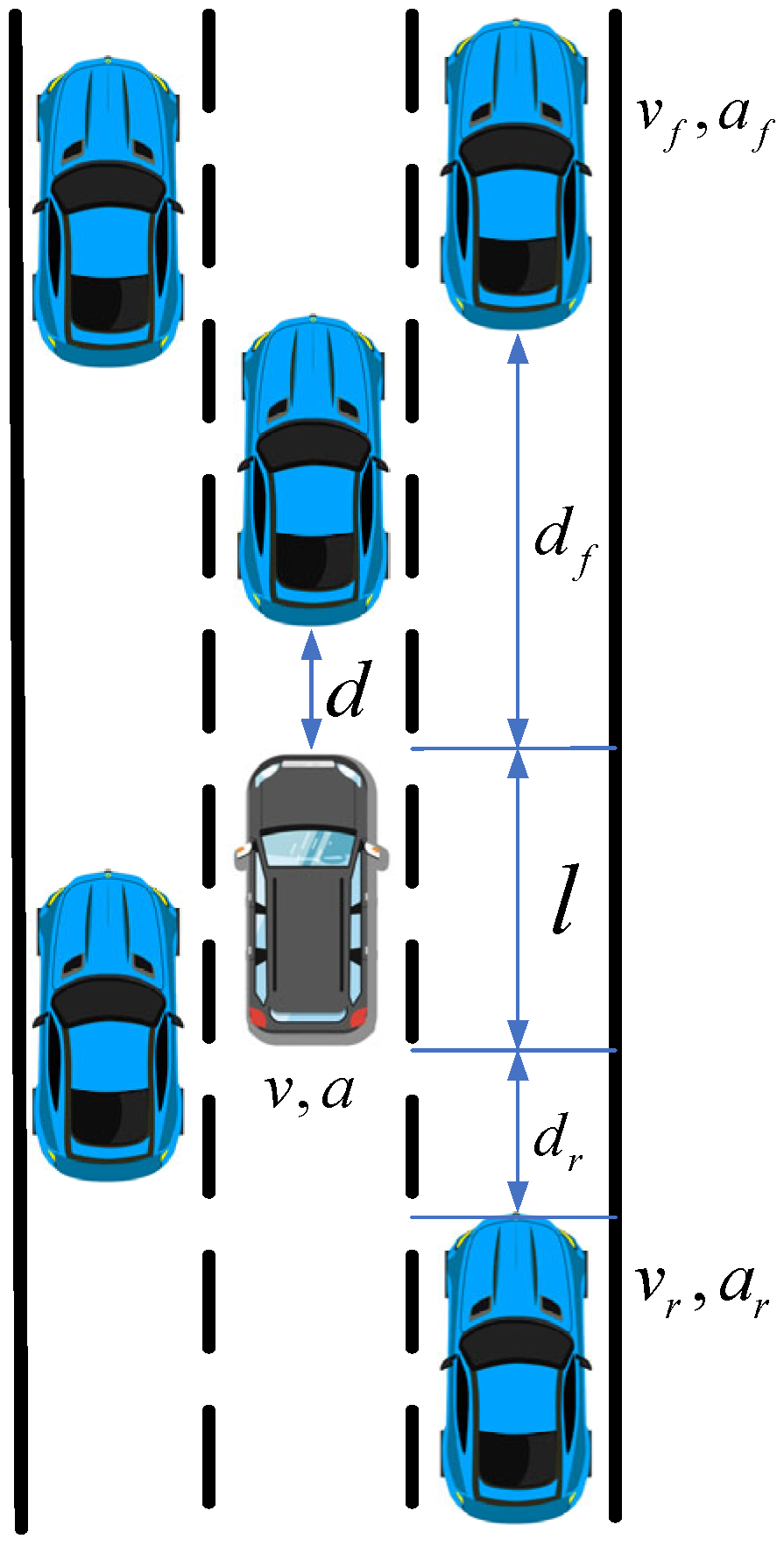
- (1)
- Define input parameters
- (2)
- Calculate the basic safe distance
- (3)
- Calculate the dynamic safe distance
3. Safe Lane-Changing Model Based on Context-Dependent Causal Inference
3.1. Emotion Perception Layer
3.2. Attention Mechanism Layer
- (1)
- Query vector, key vector, and value vector are obtained by linear transformation
- (2)
- Calculate the attention score matrix
- (3)
- Solve the context vector
3.3. Counterfactual Causal Inference Layer
- (1)
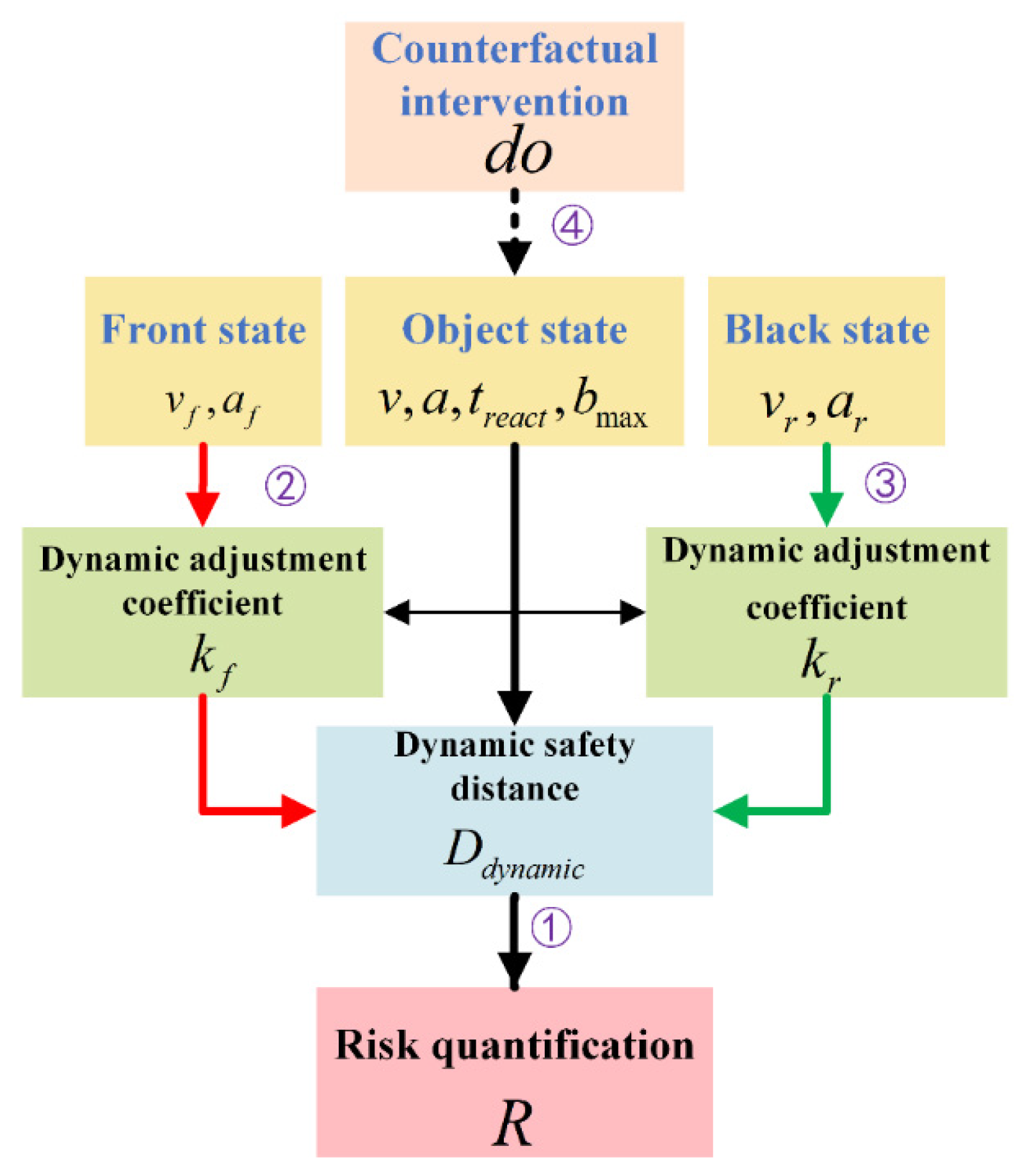
- Construct a structural causal model
- ①
- Main causal path of target vehicle:
- ②
- Leading vehicle influence path:
- ③
- The following vehicle affects the path:
- ④
- Counterfactual intervention path:where are the old and new dynamic safety distances, is the quantitative risk, and are the acceleration adjustment amount, the adjusted acceleration, and the adjusted speed of the target vehicle counterfactual intervention.
- (2)
- Counterfactual intervention construction
- ①
- Calculation of original safety distance:
- ②
- Counterfactual intervention operation:
- ③
- Quantitative assessment of lane change risk:
4. Optimization of Lane-Changing Strategy Based on Particle Swarm Optimization
4.1. Objective Function Construction
- ①
- Safety distance constraint
- ②
- Speed constraint
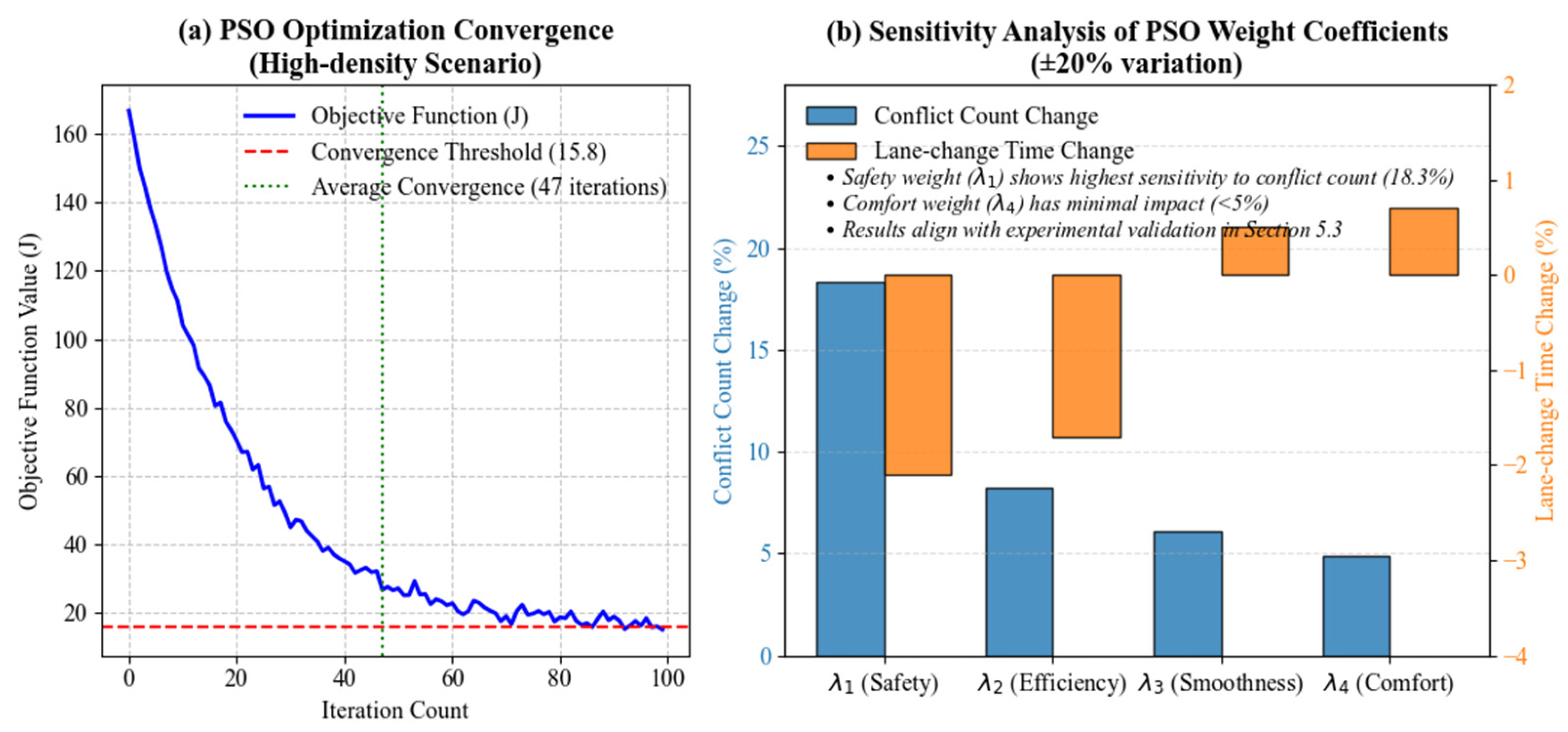
4.2. Particle Swarm Optimization Algorithm Optimization
- ①
- Particle encoding and initialization: Each particle is defined to represent a set of candidate solutions, the particle velocity is initialized to random values, and the feasible region is defined as .
- ②
- Fitness function design: The objective function is shown in Formula (15), and to achieve the optimization purpose , the penalty amount is introduced into it, and the penalty coefficient is
- ③
- Particle update rules: This part mainly includes two parts, which are the velocity update and position update.
5. Verify the Analysis Experimentally
5.1. Experimental Scene Construction
5.2. Simulation Experiment Setup
- ⮚
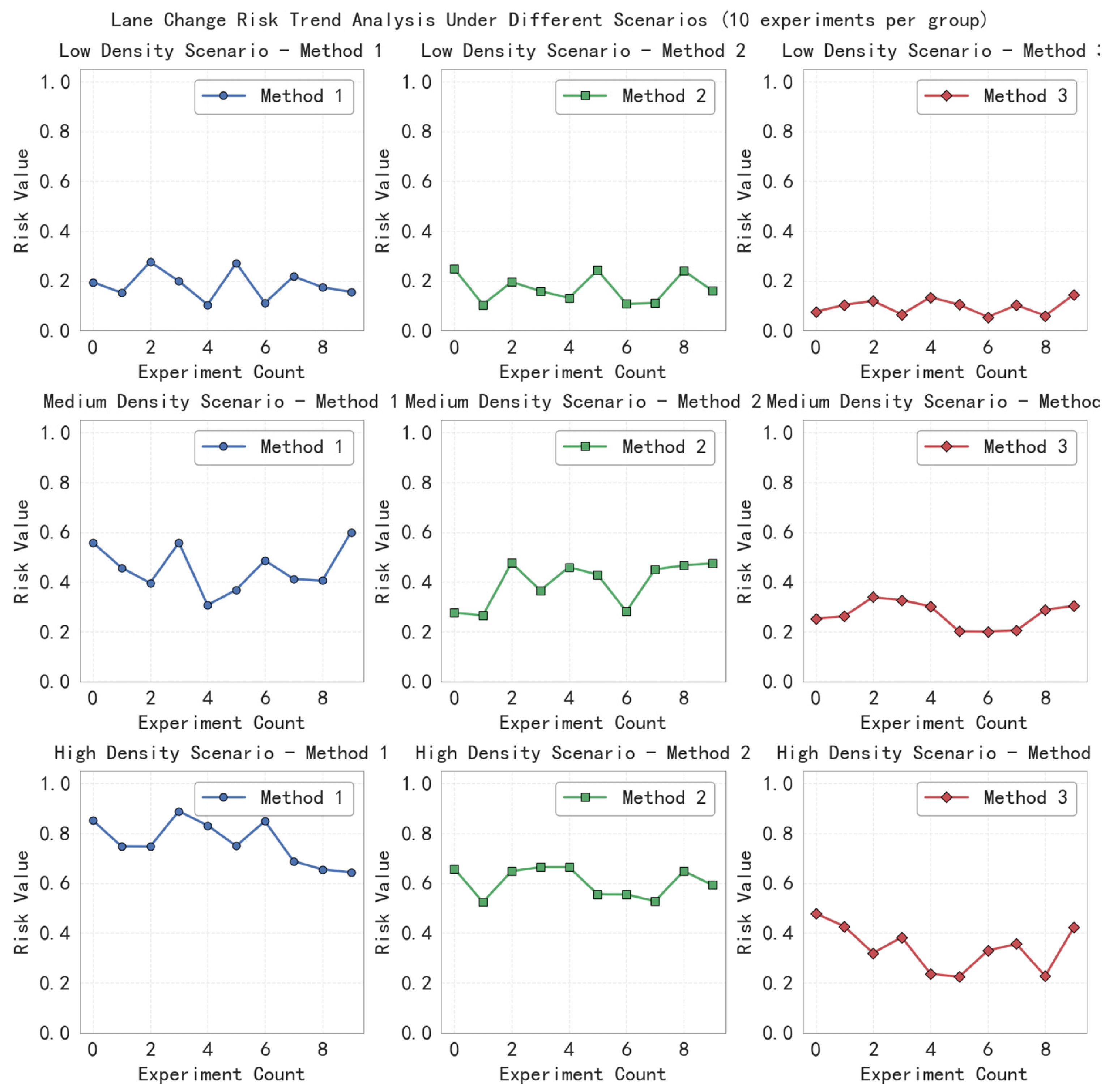
- Low-density scenarios: The distance between vehicles in adjacent lanes exceeds 50 m, with a speed difference of less than 10 km/h between leading and trailing vehicles.
- ⮚
- Medium-density scenario: The distance between vehicles in adjacent lanes ranges from 30 to 50 m, while the speed difference between front and rear vehicles is between 10 and 20 km/h.
- ⮚
- High-density scenario: The distance between vehicles in adjacent lanes is less than 30 m, accompanied by a speed differential exceeding 20 km/h.
5.3. Analysis of Experimental Results
6. Conclusions
- (1)
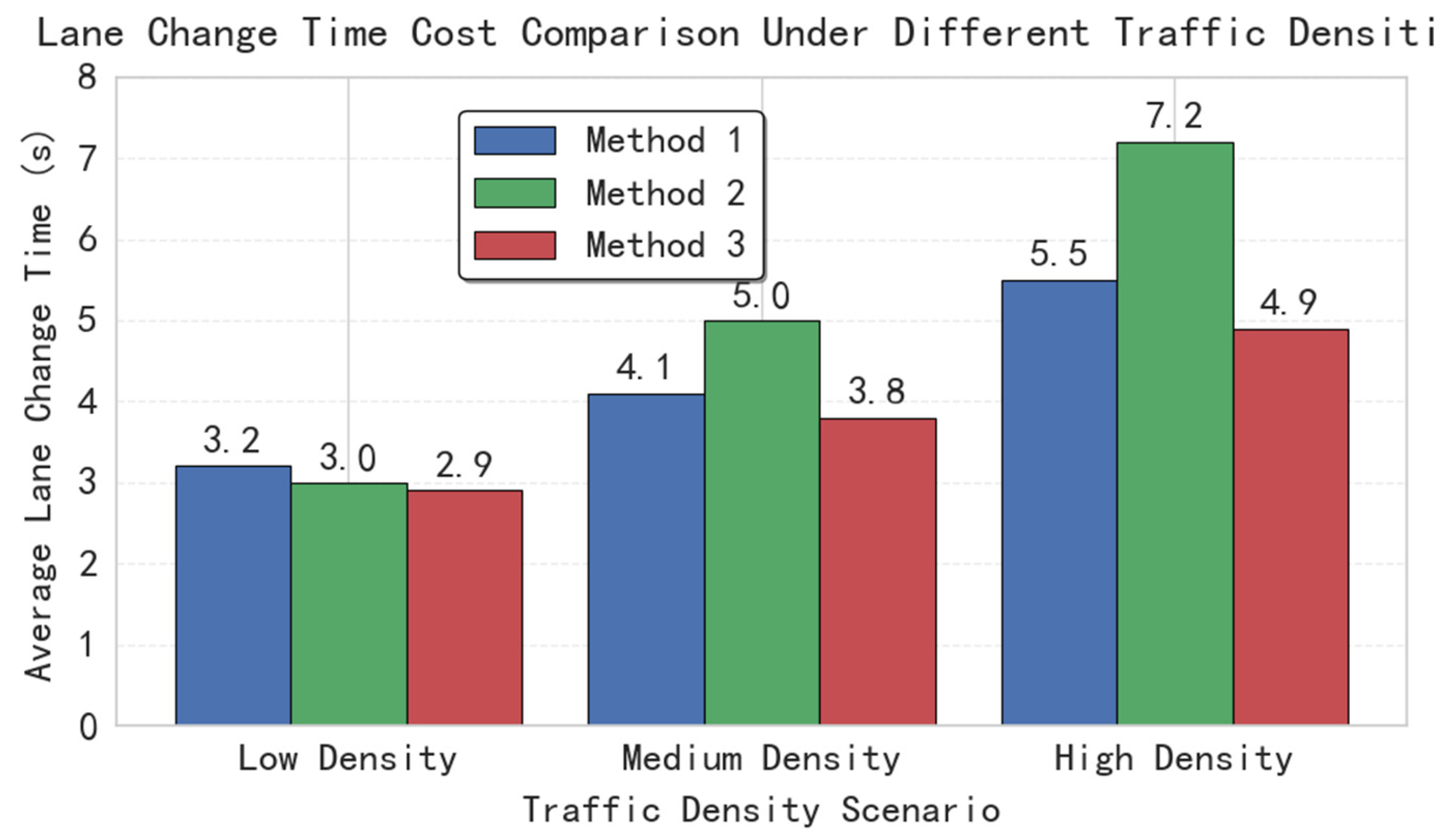
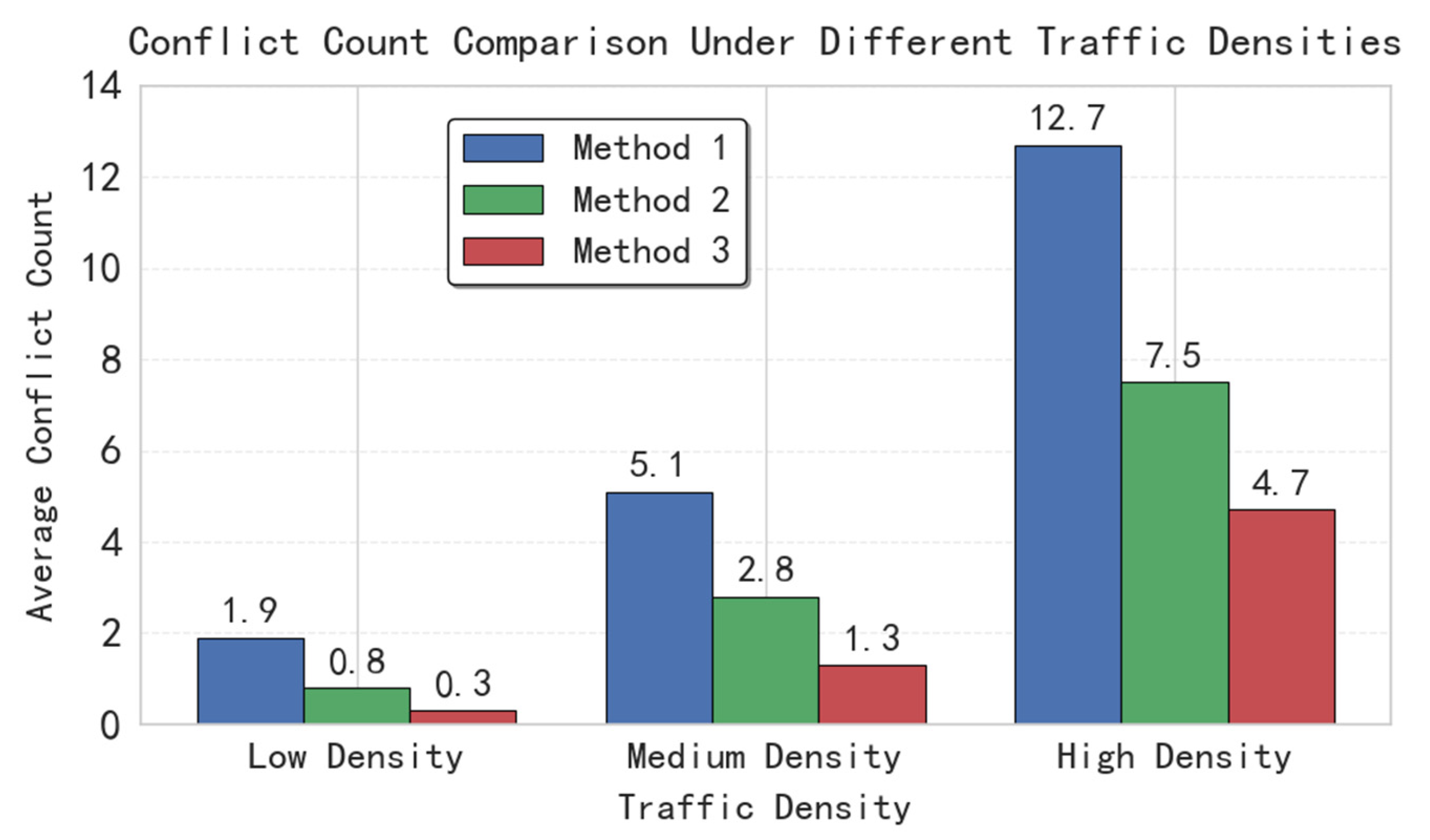
- Compared to the traditional safety distance model (Experiment 1), the proposed model (Experiment 3) achieved a remarkable 63.0% reduction in the average number of conflicts (from 12.7 to 4.7 instances) under high-density traffic conditions.
- (2)
- Compared to the built-in model of the simulation software (Experiment 2), a significant 37.3% reduction was observed (from 7.5 to 4.7 instances).
- (1)
- The proposed model (Exp3) reduced the average lane-changing duration by 10.9% compared to the traditional model (Exp1) (from 5.5 s to 4.9 s in high-density scenarios).
- (2)
- More strikingly, it achieved a 31.9% reduction compared to the simulation software’s model (Exp2) (from 7.2 s to 4.9 s), highlighting its superior ability to maintain efficiency even in congestion.
Author Contributions
Funding
Data Availability Statement
Conflicts of Interest
Abbreviations
References
- Beijing Municipal People’s Government, from Now on Four Types of Traffic Law Will Be Snapped. Available online: https://www.beijing.gov.cn/fuwu/bmfw/sy/jrts/202501/t20250117_3991435.html (accessed on 17 January 2025).
- Peng, T.; Su, L.; Zhang, R.; Guan, Z.; Zhao, H.; Qiu, Z.; Zong, C.; Xu, H. A new safe lane-change trajectory model and collision avoidance control method for automatic driving vehicles. Expert Syst. Appl. 2020, 141, 112953. [Google Scholar] [CrossRef]
- Yao, J.; Chen, G.; Gao, Z. Target vehicle selection algorithm for adaptive cruise control based on lane-changing intention of preceding vehicle. Chin. J. Mech. Eng. 2021, 34, 135. [Google Scholar] [CrossRef]
- Ma, C.; Li, D. A review of vehicle lane change research. Phys. A Stat. Mech. Its Appl. 2023, 626, 129060. [Google Scholar] [CrossRef]
- Zhang, X.; Sun, J.; Qi, X.; Sun, J. Simultaneous modeling of car-following and lane-changing behaviors using deep learning. Transp. Res. Part C Emerg. Technol. 2019, 104, 287–304. [Google Scholar] [CrossRef]
- Wu, J.; Wen, H.; Qi, W. A new method of temporal and spatial risk estimation for lane change considering conventional recognition defects. Accid. Anal. Prev. 2020, 148, 105796. [Google Scholar] [CrossRef]
- Li, M.; Li, Z.; Xu, C.; Liu, T. Short-term prediction of safety and operation impacts of lane changes in oscillations with empirical vehicle trajectories. Accid. Anal. Prev. 2020, 135, 105345. [Google Scholar] [CrossRef]
- Das, A.; Khan, M.N.; Ahmed, M.M. Detecting lane change maneuvers using SHRP2 naturalistic driving data: A comparative study machine learning techniques. Accid. Anal. Prev. 2020, 142, 105578. [Google Scholar] [CrossRef]
- Guo, J.; Harmati, I. Lane-changing decision modelling in congested traffic with a game theory-based decomposition algorithm. Eng. Appl. Artif. Intell. 2022, 107, 104530. [Google Scholar] [CrossRef]
- Guo, H.; Keyvan-Ekbatani, M.; Xie, K. Lane change detection and prediction using real-world connected vehicle data. Transp. Res. Part C Emerg. Technol. 2022, 142, 103785. [Google Scholar] [CrossRef]
- Gao, H.; Zhao, M.; Zheng, X.; Wang, C.; Zhou, L.; Wang, Y.; Ma, L.; Cheng, B.; Wu, Z.; Li, Y. An improved hierarchical deep reinforcement learning algorithm for multi-intelligent vehicle lane change. Neurocomputing 2024, 609, 128482. [Google Scholar] [CrossRef]
- Yang, D.; Zheng, S.; Wen, C.; Jin, P.J.; Ran, B. A dynamic lane-changing trajectory planning model for automated vehicles. Transp. Res. Part. C: Emerg. Technol. 2018, 95, 228–247. [Google Scholar] [CrossRef]
- Wang, C.; Sun, Q.; Li, Z.; Zhang, H. Human-like lane change decision model for autonomous vehicles that considers the risk perception of drivers in mixed traffic. Sensors 2020, 20, 2259. [Google Scholar] [CrossRef]
- Luo, Q.; Zang, X.; Cai, X.; Gong, H.; Yuan, J.; Yang, J. Vehicle lane-changing safety pre-warning model under the environment of the vehicle networking. Sustainability 2021, 13, 5146. [Google Scholar] [CrossRef]
- Li, L.; Gan, J.; Zhou, K.; Qu, X.; Ran, B. A novel lane-changing model of connected and automated vehicles: Using the safety potential field theory. Phys. A Stat. Mech. Its Appl. 2020, 559, 125039. [Google Scholar] [CrossRef]
- He, Y.; Feng, J.; Wei, K.; Cao, J.; Chen, S.; Wan, Y. Modeling and simulation of lane-changing and collision avoiding autonomous vehicles on superhighways. Phys. A Stat. Mech. Its Appl. 2023, 609, 128328. [Google Scholar] [CrossRef]
- Liu, Y.; Zhou, B.; Wang, X.; Li, L.; Cheng, S.; Chen, Z.; Li, G.; Zhang, L. Dynamic lane-changing trajectory planning for autonomous vehicles based on discrete global trajectory. IEEE Trans. Intell. Transp. Syst. 2021, 23, 8513–8527. [Google Scholar] [CrossRef]
- Wu, J.; Chen, X.; Bie, Y.; Zhou, W. A co-evolutionary lane-changing trajectory planning method for automated vehicles based on the instantaneous risk identification. Accid. Anal. Prev. 2023, 180, 106907. [Google Scholar] [CrossRef]
- Kim, W.; Yang, H.; Kim, J. Blind Spot Detection Radar System Design for Safe Driving of Smart Vehicles. Appl. Sci. 2023, 13, 6147. [Google Scholar] [CrossRef]
- Muzammel, M.; Yusoff, M.Z.; Saad, M.N.M.; Sheikh, F.; Awais, M.A. Blind-Spot Collision Detection System for Commercial Vehicles Using Multi Deep CNN Architecture. Sensors 2022, 22, 6088. [Google Scholar] [CrossRef]
- Yang, J.; Xu, Z.; Lai, H.; Chen, H.; Kong, S.; Wu, Y.; Yang, H. Intelligent EC Rearview Mirror: Enhancing Driver Safety with Dynamic Glare Mitigation via Cloud Edge Collaboration. arXiv 2024, arXiv:2405.05579. [Google Scholar]
- Qi, H. Research on Automatic Driving Safety Decision-Making Method Based on Counterfactual Reasoning. Master’s Thesis, Shandong Jiaotong University, Jinan, China, 2024. [Google Scholar]
- Wang, Y.; Ma, C.; Zhao, M. Multi-task allocation of heterogeneous Unmanned Aerial Vehicles based on hybrid strategy multi-objective particle swarm optimization. J. Zhejiang Univ. (Eng. Sci.) 2025, 59, 821–831. Available online: http://kns.cnki.net/kcms/detail/33.1245.t.20250328.1042.006.html (accessed on 28 March 2025).
- Liu, Y.-T.; Gu, J.-J.; Zhou, Q. City travel traffic prediction method based on structure of causal model. Comput. Sci. 2025, 1–14. Available online: http://kns.cnki.net/kcms/detail/50.1075.TP.20250310.1631.021.html (accessed on 28 March 2025).
- Cao, Y.; Shang, G.; Arnoud, V.; Chen, J.; Chai, L. Based on pattern matching attention mechanism of vehicle track prediction. China J. Highw. Transp. 2025, 1–15. Available online: http://kns.cnki.net/kcms/detail/61.1313.U.20250514.1522.002.html (accessed on 23 June 2025).
- Bono, G.; Dibangoye, J.S.; Simonin, O.; Matignon, L.; Pereyron, F. Solving multi-agent routing problems using deep attention mechanisms. IEEE Trans. Intell. Transp. Syst. 2020, 22, 7804–7813. [Google Scholar] [CrossRef]
- Antonio, G.P.; Maria-Dolores, C. Multi-agent deep reinforcement learning to manage connected autonomous vehicles at tomorrow’s intersections. IEEE Trans. Veh. Technol. 2022, 71, 7033–7043. [Google Scholar] [CrossRef]
- Li, X.; Lu, L.; Ni, W.; Jamalipour, A.; Zhang, D.; Du, H. Federated multi-agent deep reinforcement learning for resource allocation of vehicle-to-vehicle communications. IEEE Trans. Veh. Technol. 2022, 71, 8810–8824. [Google Scholar] [CrossRef]
- Press, W.H.; Teukolsky, S.A.; Vetterling, W.T.; Flannery, B.P. Numerical Recipes: The Art of Scientific Computing, 3rd ed.; Cambridge University Press: Cambridge, UK, 2007. [Google Scholar]
- Li, W.; Li, X.; Wang, X. A Potential Field-Based Approach for Safe Vehicle Following Control. IEEE Trans. Intell. Transp. Syst. 2020, 21, 5170–5181. [Google Scholar]



| Density Level | Vehicles per km | Inter-Vehicle Gap | Speed Difference |
|---|---|---|---|
| Low | <15 | >50 m | <10 km/h |
| Medium | 15–30 | 30–50 m | 10–20 km/h |
| High | >30 | <30 m | >20 km/h |
Disclaimer/Publisher’s Note: The statements, opinions and data contained in all publications are solely those of the individual author(s) and contributor(s) and not of MDPI and/or the editor(s). MDPI and/or the editor(s) disclaim responsibility for any injury to people or property resulting from any ideas, methods, instructions or products referred to in the content. |
© 2025 by the authors. Licensee MDPI, Basel, Switzerland. This article is an open access article distributed under the terms and conditions of the Creative Commons Attribution (CC BY) license (https://creativecommons.org/licenses/by/4.0/).
Share and Cite
Li, W.; Yang, C.; Zhou, X.; Liu, W.; Zheng, G. Situation-Aware Causal Inference-Driven Vehicle Lane-Changing Decision-Making. Appl. Sci. 2025, 15, 8864. https://doi.org/10.3390/app15168864
Li W, Yang C, Zhou X, Liu W, Zheng G. Situation-Aware Causal Inference-Driven Vehicle Lane-Changing Decision-Making. Applied Sciences. 2025; 15(16):8864. https://doi.org/10.3390/app15168864
Chicago/Turabian StyleLi, Wei, Changhao Yang, Xu Zhou, Weiyu Liu, and Guorong Zheng. 2025. "Situation-Aware Causal Inference-Driven Vehicle Lane-Changing Decision-Making" Applied Sciences 15, no. 16: 8864. https://doi.org/10.3390/app15168864
APA StyleLi, W., Yang, C., Zhou, X., Liu, W., & Zheng, G. (2025). Situation-Aware Causal Inference-Driven Vehicle Lane-Changing Decision-Making. Applied Sciences, 15(16), 8864. https://doi.org/10.3390/app15168864