

Seismic Resolution Enhancement Using a Cycle Generative Adversarial Neural Network with Pseudo-Well Data

Abstract
:1. Introduction
2. Theory
2.1. Network Architecture
2.2. Generation of the Training Set
- (1)
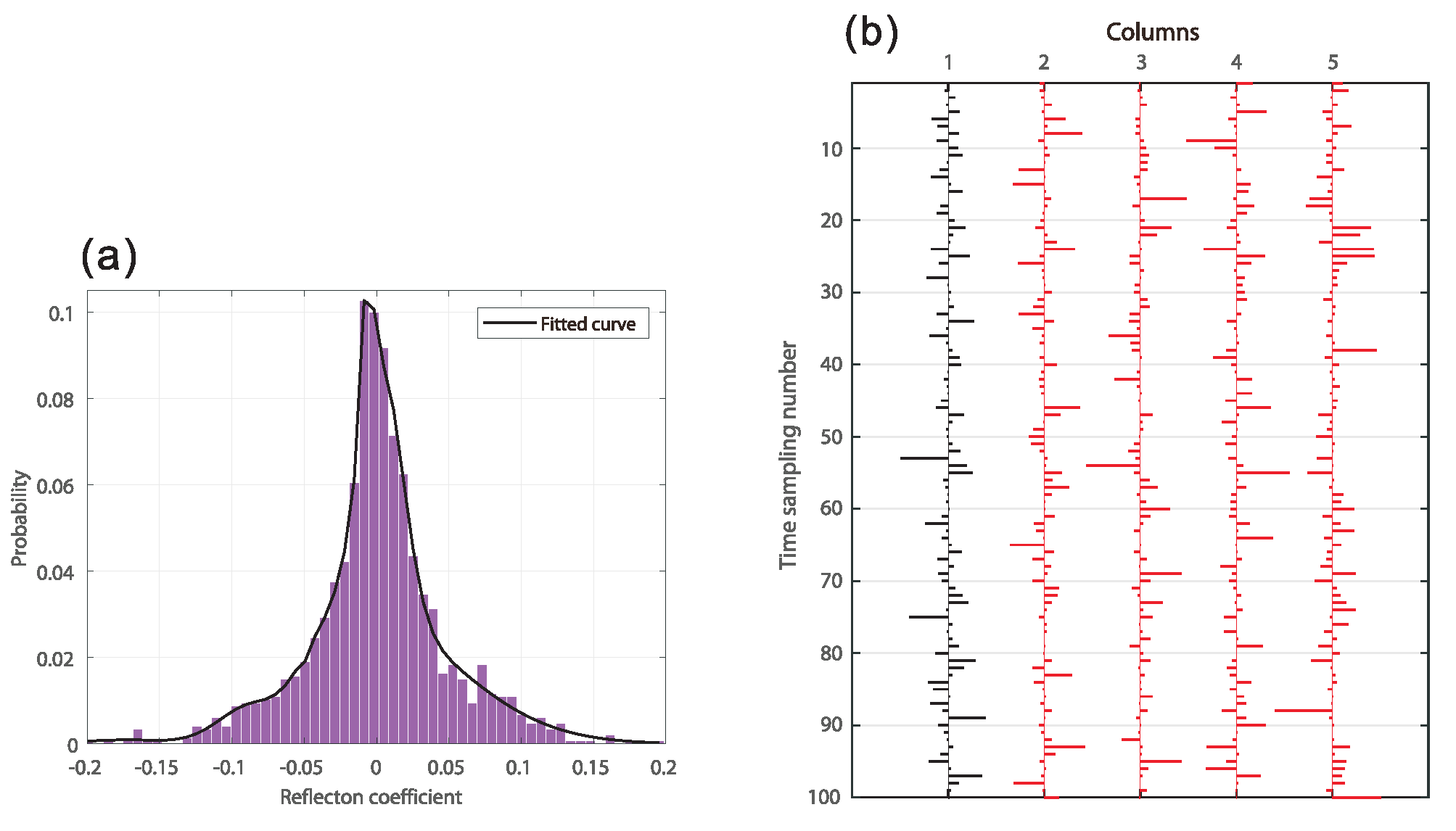
- Obtain the statistical distribution of the reflection coefficient based on logging data and generate multiple reflectivity models. First, we equally divide the reflection coefficient into several segments based on its valueswhere and are the maximum value and minimum value of the reflection coefficient, respectively. and are the lower and upper bounds of segment . L is the total number of segments. Then, according to the number of data points in each part, the probability is defined asin which is the number of data points in the segment , and is the total data points of the entire reflectivity. As shown in the histogram in Figure 2a, the probability is calculated with the reflection coefficient which is based on logging data (the first column in Figure 2b), where = −0.2, = 0.2, and L = 81. Finally, the Gaussian fit function is used to match the probability, and Acceptance–Rejection Sampling is used to generate a large number of reflection coefficient models that honor the extracted statistical distribution. The Gaussian fit function is expressed asin which denotes the amplitude of the Gaussian function, signifies the central position, represents the standard deviation, and n denotes the order of the Gaussian curve. Within the histogram depicted in Figure 2a, the parameters configuring the curve are established with n assigned a value of six as the Gaussian curve fits best, [, , , , , , , , , , , , , , , , , ] = [8.455, 0.00308, 0.02116, 4.751, −0.006751, 0.005758, −0.3839, −0.04897, 0.000609, 4.58, −0.01605, 0.09542, −1.403, −0.06501, 0.02489, −0.9482, −0.1161, 0.04361]. The second to fifth columns in Figure 2b show the generated reflectivity models, which are similar to the reflection coefficient (the first column) generated from actual logging data.
- (2)
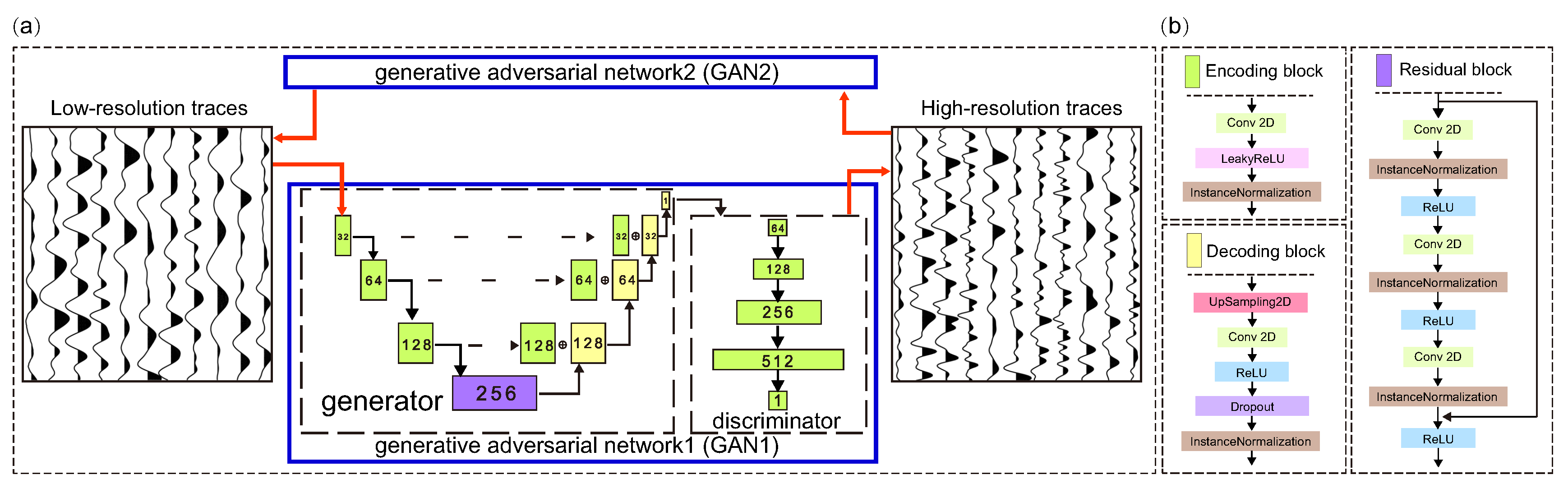
- Build a wavelet library with a variable frequency band and convolve it with generated reflection coefficient models. In order to alleviate the change in the frequency content of the non-stationary wavelet, the statistical wavelet is compressed and stretched through the stretch factor a by us to generate a series of wavelets with varying bandwidths. This process can be formulated as follows:in which w and are the original wavelet and the wavelet changed by a stretch factor a in the time domain, respectively, and W and are their Fourier transforms. The peak frequency range of the low-frequency wavelet is 0.7–1.4 times the main frequency of the original data, and the corresponding high-frequency wavelet is generated according to the bandwidth factor (a = 2.5). Finally, the generated low- and high-frequency wavelet pairs are convolved with the reflection coefficient model to generate corresponding low- and high-frequency traces, as shown in Figure 1a.
3. Examples
3.1. Synthetic Example
3.2. Field Data Example
4. Conclusions
Author Contributions
Funding
Institutional Review Board Statement
Informed Consent Statement
Data Availability Statement
Acknowledgments
Conflicts of Interest
References
- Berkhout, A. Least-squares inverse filtering and wavelet deconvolution. Geophysics 1977, 42, 1369–1383. [Google Scholar] [CrossRef]
- Walker, C.; Ulrych, T.J. Autoregressive recovery of the acoustic impedance. Geophysics 1983, 48, 1338–1350. [Google Scholar] [CrossRef]
- Ooe, M.; Ulrych, T. Minimum entropy deconvolution with an exponential transformation. Geophys. Prospect. 1979, 27, 458–473. [Google Scholar] [CrossRef]
- Sacchi, M.D. Reweighting strategies in seismic deconvolution. Geophys. J. Int. 1997, 129, 651–656. [Google Scholar] [CrossRef]
- Wang, Y.; Zhang, G.; Li, H.; Yang, W.; Wang, W. The high-resolution seismic deconvolution method based on joint sparse representation using logging–seismic data. Geophys. Prospect. 2022, 70, 1313–1326. [Google Scholar] [CrossRef]
- Charbonnier, P.; Blanc-Féraud, L.; Aubert, G.; Barlaud, M. Deterministic edge-preserving regularization in computed imaging. IEEE Trans. Image Process. 1997, 6, 298–311. [Google Scholar] [CrossRef]
- Kazemi, N.; Bongajum, E.; Sacchi, M.D. Surface-consistent sparse multichannel blind deconvolution of seismic signals. IEEE Trans. Geosci. Remote. Sens. 2016, 54, 3200–3207. [Google Scholar] [CrossRef]
- Wu, X.; Liang, L.; Shi, Y.; Fomel, S. FaultSeg3D: Using synthetic data sets to train an end-to-end convolutional neural network for 3D seismic fault segmentation. Geophysics 2019, 84, IM35–IM45. [Google Scholar] [CrossRef]
- Chen, W.; Yang, L.; Zha, B.; Zhang, M.; Chen, Y. Deep learning reservoir porosity prediction based on multilayer long short-term memory network. Geophysics 2020, 85, WA213–WA225. [Google Scholar] [CrossRef]
- Wang, Y.; Qiu, Q.; Lan, Z.; Chen, K.; Zhou, J.; Gao, P.; Zhang, W. Identifying microseismic events using a dual-channel CNN with wavelet packets decomposition coefficients. Comput. Geosci. 2022, 166, 105164. [Google Scholar] [CrossRef]
- Yang, L.; Wang, S.; Chen, X.; Chen, W.; Saad, O.M.; Zhou, X.; Pham, N.; Geng, Z.; Fomel, S.; Chen, Y. High-fidelity permeability and porosity prediction using deep learning with the self-attention mechanism. IEEE Trans. Neural Netw. Learn. Syst. 2022, 34, 3429–3443. [Google Scholar] [CrossRef] [PubMed]
- Sang, W.; Yuan, S.; Han, H.; Liu, H.; Yu, Y. Porosity prediction using semi-supervised learning with biased well log data for improving estimation accuracy and reducing prediction uncertainty. Geophys. J. Int. 2023, 232, 940–957. [Google Scholar] [CrossRef]
- Lewis, W.; Vigh, D. Deep learning prior models from seismic images for full-waveform inversion. In Proceedings of the SEG International Exposition and Annual Meeting, SEG, Houston, TX, USA, 24–29 September 2017; p. SEG-2017. [Google Scholar]
- Chen, X.; Wang, B. Self-supervised Multistep Seismic Data Deblending. Surv. Geophys. 2023, 1–25. [Google Scholar] [CrossRef]
- Wu, X.; Geng, Z.; Shi, Y.; Pham, N.; Fomel, S.; Caumon, G. Building realistic structure models to train convolutional neural networks for seismic structural interpretation. Geophysics 2020, 85, WA27–WA39. [Google Scholar] [CrossRef]
- Yang, L.; Wang, S.; Chen, X.; Saad, O.M.; Cheng, W.; Chen, Y. Deep Learning with Fully Convolutional and Dense Connection Framework for Ground Roll Attenuation. Surv. Geophys. 2023, 44, 1919–1952. [Google Scholar] [CrossRef]
- Das, V.; Pollack, A.; Wollner, U.; Mukerji, T. Convolutional neural network for seismic impedance inversion. In Proceedings of the 2018 SEG International Exposition and Annual Meeting, OnePetro, Anaheim, CA, USA, 14–19 October 2018. [Google Scholar]
- Zhang, J.; Li, J.; Chen, X.; Li, Y.; Huang, G.; Chen, Y. Robust deep learning seismic inversion with a priori initial model constraint. Geophys. J. Int. 2021, 225, 2001–2019. [Google Scholar] [CrossRef]
- Song, C.; Lu, W.; Wang, Y.; Jin, S.; Tang, J.; Chen, L. Reservoir Prediction Based on Closed-Loop CNN and Virtual Well-Logging Labels. IEEE Trans. Geosci. Remote. Sens. 2022, 60, 5919912. [Google Scholar] [CrossRef]
- Wang, Y.; Wang, Q.; Lu, W.; Li, H. Physics-Constrained Seismic Impedance Inversion Based on Deep Learning. IEEE Geosci. Remote. Sens. Lett. 2021, 19, 7503305. [Google Scholar] [CrossRef]
- Gao, Y.; Zhang, J.; Li, H.; Li, G. Incorporating Structural Constraint Into the Machine Learning High-Resolution Seismic Reconstruction. IEEE Trans. Geosci. Remote. Sens. 2022, 60, 5912712. [Google Scholar] [CrossRef]
- Isola, P.; Zhu, J.Y.; Zhou, T.; Efros, A.A. Image-to-image translation with conditional adversarial networks. In Proceedings of the IEEE Conference on Computer Vision and Pattern Recognition, Honolulu, HI, USA, 21–26 July 2017; pp. 1125–1134. [Google Scholar]




Disclaimer/Publisher’s Note: The statements, opinions and data contained in all publications are solely those of the individual author(s) and contributor(s) and not of MDPI and/or the editor(s). MDPI and/or the editor(s) disclaim responsibility for any injury to people or property resulting from any ideas, methods, instructions or products referred to in the content. |
© 2023 by the authors. Licensee MDPI, Basel, Switzerland. This article is an open access article distributed under the terms and conditions of the Creative Commons Attribution (CC BY) license (https://creativecommons.org/licenses/by/4.0/).
Share and Cite
Zhao, X.; Gao, Y.; Guo, S.; Gu, W.; Li, G. Seismic Resolution Enhancement Using a Cycle Generative Adversarial Neural Network with Pseudo-Well Data. Appl. Sci. 2023, 13, 12980. https://doi.org/10.3390/app132412980
Zhao X, Gao Y, Guo S, Gu W, Li G. Seismic Resolution Enhancement Using a Cycle Generative Adversarial Neural Network with Pseudo-Well Data. Applied Sciences. 2023; 13(24):12980. https://doi.org/10.3390/app132412980
Chicago/Turabian StyleZhao, Xianzheng, Yang Gao, Shuwen Guo, Weiwei Gu, and Guofa Li. 2023. "Seismic Resolution Enhancement Using a Cycle Generative Adversarial Neural Network with Pseudo-Well Data" Applied Sciences 13, no. 24: 12980. https://doi.org/10.3390/app132412980
APA StyleZhao, X., Gao, Y., Guo, S., Gu, W., & Li, G. (2023). Seismic Resolution Enhancement Using a Cycle Generative Adversarial Neural Network with Pseudo-Well Data. Applied Sciences, 13(24), 12980. https://doi.org/10.3390/app132412980