1. Introduction
In an ecosystem, cooperative hunting behavior among predators is an important biological phenomenon [
1] that is frequently observed in carnivores [
2] such as African wild dogs [
3], wolves [
4], lions [
5,
6,
7], chimpanzees [
8], and other organisms such as spiders [
9], birds [
10,
11], and ants [
12]. Cooperative hunting has many advantages for the evolution of predator populations. For example, cooperation increases hunting success, prey mass, and the probability of multiple kills. It also decreases the chase distance [
3], increases the probability of capturing large prey [
13], enables the population to find food more quickly [
14], and allows individuals in large packs to accrue foraging advantages by helping prevent the carcass from being stolen by other predators [
15].
In recent years, various predator–prey mathematical models with hunting cooperation have been proposed and studied. Cosner et al. [
16] proposed a predator–prey model with a functional response for predators that forage in a spatially linear formation and aggregate when they encounter a cluster of prey. Berec [
17] derived a predator–prey model with cooperative foraging, which is described by a Holling type II-like functional response, and investigated the impacts of foraging facilitation among predators. Due to this functional response, it was presented in [
17] that hunting cooperation has a destabilizing effect on predator–prey dynamics and the populations exhibit oscillatory behavior. Duarte et al. [
18] proposed a three-species food chain model with hunting cooperation for the predator and analyzed the dynamics of the species under several degrees of cooperative hunting. Pal et al. [
19] considered a modified Leslie–Gower predator–prey model, where predators cooperate during hunting and prey populations show anti-predator behavior due to fear of predation risk. It was observed that in the absence of the fear effect, hunting cooperation can induce both supercritical and subcritical Hopf bifurcations. Recently, Du et al. [
20] proposed a predator–prey model with a non-differentiable functional response, where the prey exhibits group defense and the predator exhibits cooperative hunting, and explored the effect of cooperative hunting in the predator and aggregation in the prey on the existence and stability of the coexistence state, as well as the dynamics of the system. We also refer the reader to [
21,
22,
23,
24,
25,
26,
27,
28,
29,
30,
31] for models of ordinary differential equations, reaction–diffusion equations, and difference equations with hunting cooperation.
Alves and Hilker [
32] studied the following predator–prey model with cooperative hunting in predators
where
N and
P represent the population density of the prey and predator, respectively;
r and
K are the intrinsic growth rate and carrying capacity of the prey population, respectively;
e is the conversion coefficient;
m is the mortality of the predator;
is the attack rate of each predator on the prey; and
a is a parameter describing predator cooperation in hunting. All these parameters are positive. By introducing the dimensionless variables
,
and
, and the dimensionless parameters
and
, and still using
t for
, Model (
1) is written as the following three-parameter system
The study of Alves and Hilker [
32] indicates that Model (
2) has more complex dynamics than the well-known Lotka–Volterra model (i.e., when
), and hunting cooperation can be beneficial to the predator population by increasing the attack rate brought about by the cooperation. In [
32], through numerical simulations, the stability of the equilibria and the various bifurcation behaviors of (
2), including the Hopf bifurcation, homoclinic bifurcation, and Bogdanov–Takens bifurcation, were investigated for one-parameter cases (bifurcation parameter is taken as
and
, respectively) and two-parameter cases (bifurcation parameter is taken as
and
, respectively). However, in [
32], the important parameter conditions that describe the dynamical behavior of (
2) were not provided mathematically. For example, the exact parameter regions such that Model (
2) has zero, one, and two interior equilibria, the parametric conditions for the stability of equilibria, and the critical parameter value for the Hopf bifurcation were not explicitly presented.
Motivated by the works of Alves and Hilker [
32], in this paper, we also study the dynamics of (
1) but apply changes to the variables
and
, and define the constants as
and
. After dropping the “tilde” on
, we rewrite Model (
1) in the following non-dimensional form
where the population density of the predator and prey are represented by
x and
y, respectively. In order to better understand the dynamics of (
3), such as the number of interior equilibria, stability of the equilibria, and Hopf bifurcation, we divide the two-parameter space
into several mutually exclusive regions. The idea and method of the division are motivated by [
33] and are described in this paper, along with an analysis of the dynamic behaviors of (
3). In each parameter region, by choosing
d as the bifurcation parameter, the dynamics of (
3) are explored in detail. Based on the dynamics of (
3), we investigate the following two questions: (i) What are the parameter regions in which both species coexist? (ii) How does hunting cooperation affect the coexistence of the two species and the pattern of coexistence?
The rest of the paper is organized as follows. First, we show the positivity and boundedness of the solutions to System (
3) in
Section 2. In
Section 3 and
Section 4, as
d varies, the existence and stability of equilibria are investigated in each parameter region. The Hopf bifurcation of (
3) and its directions, together with the stability of bifurcating periodic orbits, are discussed. It is presented that there is a critical surface
under which a supercritical and backward Hopf bifurcation occurs. In
Section 5, through theoretical analysis and numerical simulations, the global stability and the existence of periodic solutions are considered, and a complete description of the global dynamic behaviors of (
3) is presented for each parameter region. Finally, in
Section 6, we summarize our main results and compare the dynamics of (
3) to those of the well-known Lotka–Volterra model (i.e., when the predator has no cooperative hunting). It turns out that due to cooperative hunting, System (
3) has a richer and more complex dynamic behavior than the Lotka–Volterra model, such as various bifurcation phenomena and oscillation behavior. Cooperative hunting by predators is beneficial to the coexistence of the prey and predator. When the mortality of the predator is small (
), the hunting cooperation term
does not affect the coexistence of populations but it affects the pattern of coexistence.
3. Equilibria
In this section, we consider the number of equilibria in System (
3). Clearly, System (
3) always has two boundary equilibria
and
. Below, we discuss the existence of interior equilibria.
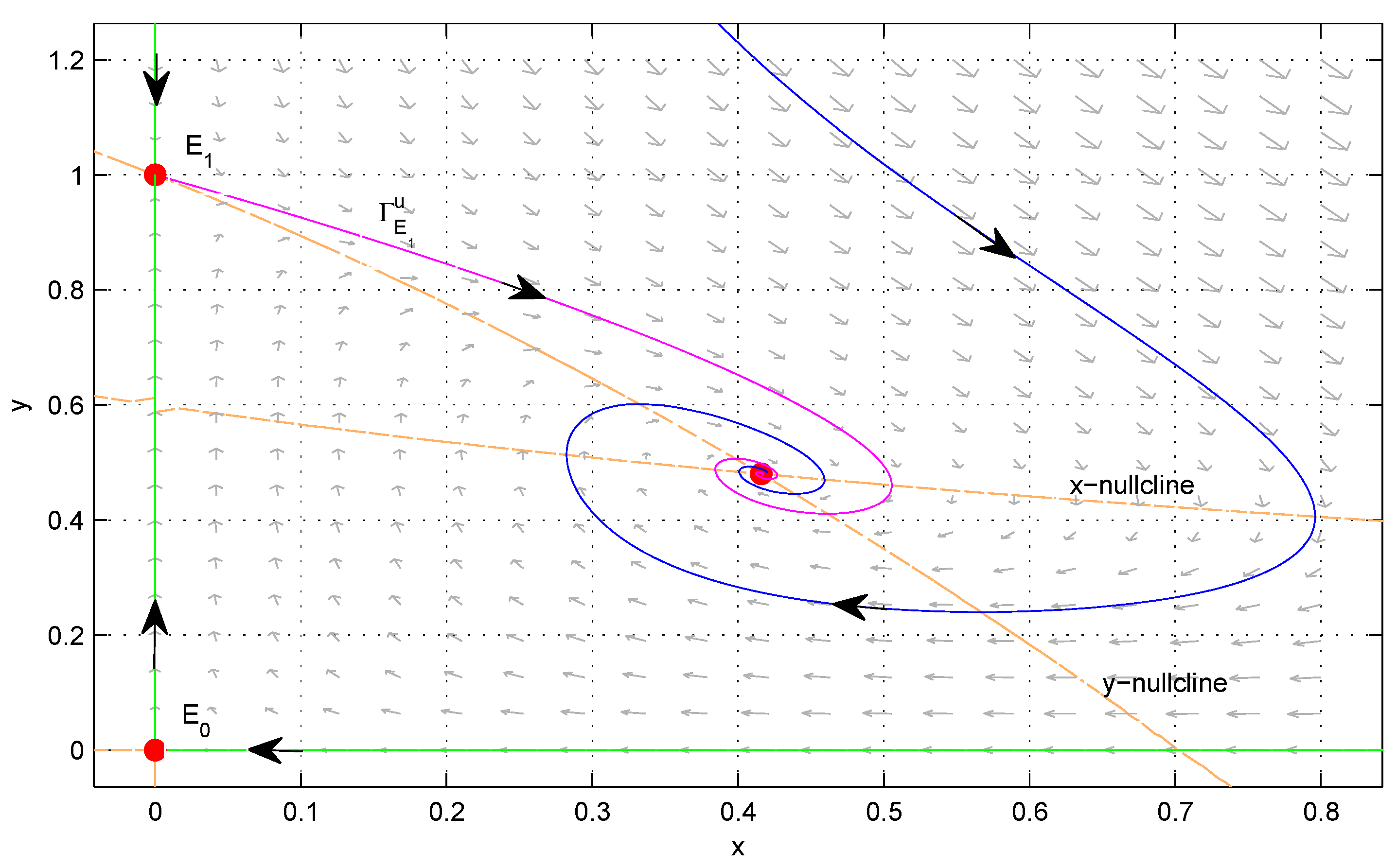
System (
3) has the
x-nullcline
and the
y-nullcline
It is easy to see that
decreases to zero as
x increases on
with
.
is a parabola with
and has a unique positive zero, denoted as
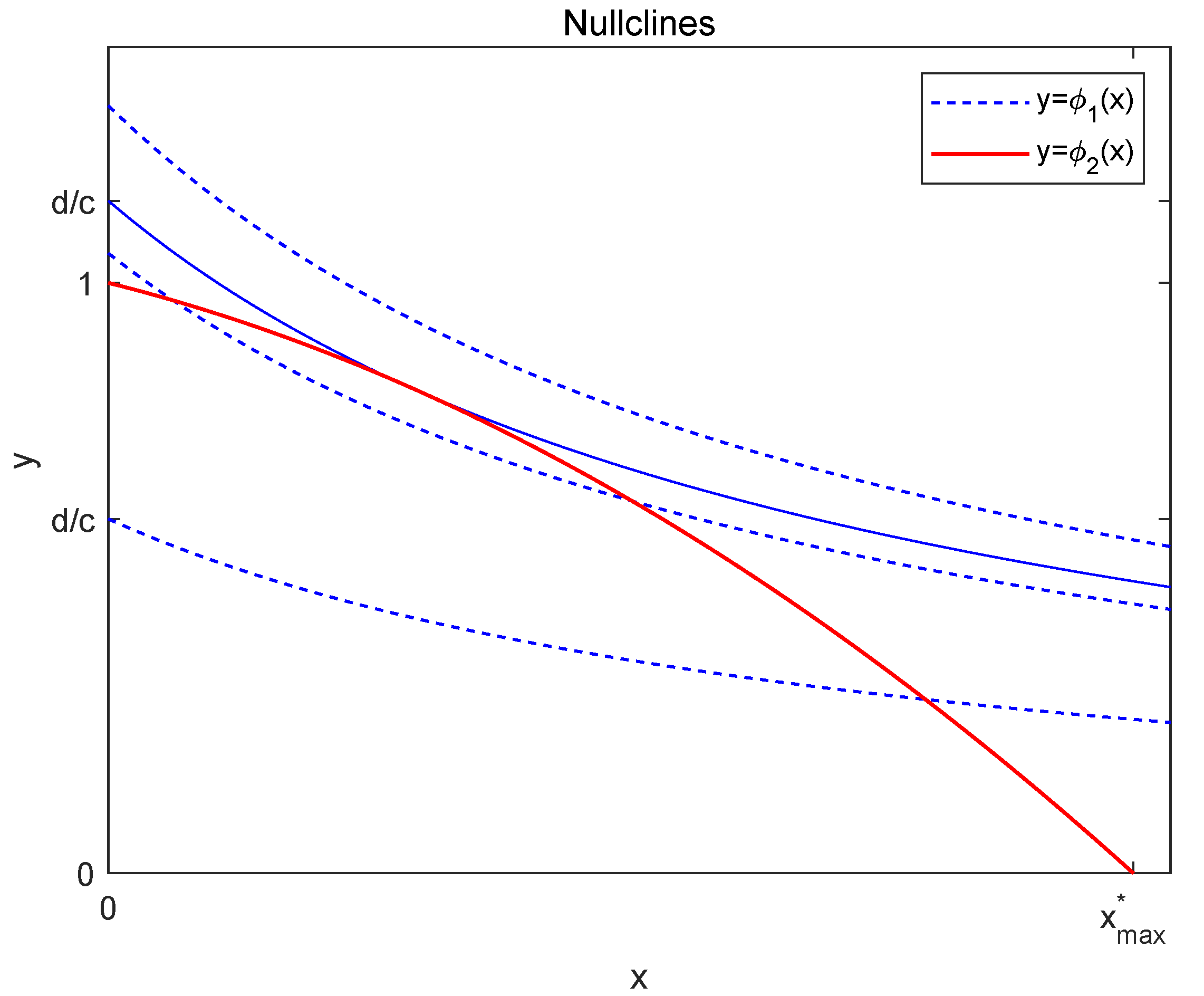
is an interior equilibrium point of (
3) if and only if it is the intersection point of
and
in the first quadrant of the
-plane (see
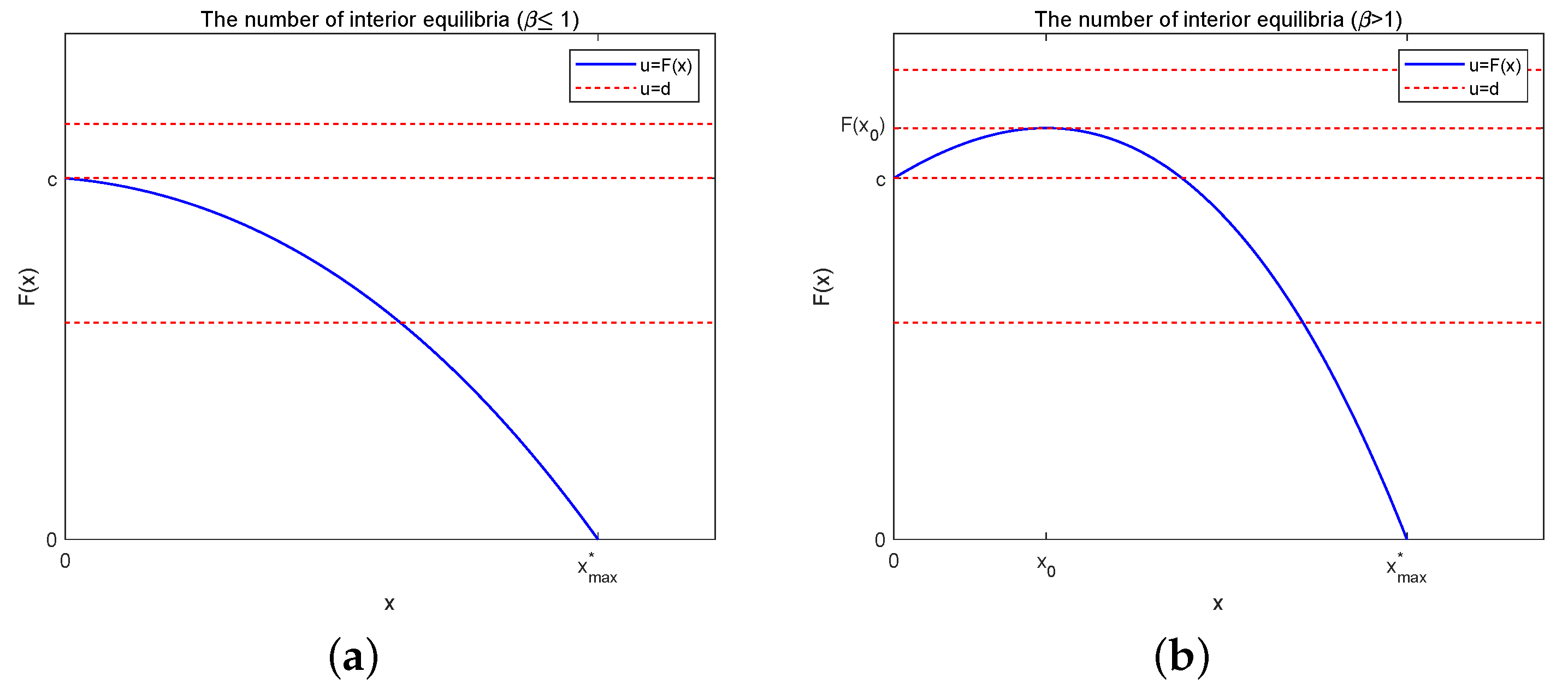
Figure 1). Therefore, System (
3) has at most two interior equilibria.
That is,
is an interior equilibrium point if and only if
is a positive root of
, i.e.,
satisfies
, and
. Here,
Clearly,
. Therefore, we only need to discuss the positive intersection point of the functions
and
. When there are two interior equilibria, the larger one of the predator is denoted as
, and the other one is denoted as
.
In (
6), the sign of the coefficient
is important for determining the graph of the function
and the range of the parameter
d such that System (
3) has zero, one, and two interior equilibria. So, we choose
d as the bifurcation parameter. Based on the sign of
, the coefficient of the first-order term of
, we divide the parameter space
given in (
4) into
If
, from
we know that
is decreasing on
, and for all
,
(see
Figure 2a). If
, then at the point
, where
has a positive local maximum value
When
,
increases and
; when
,
decreases and
(see
Figure 2b).
Thus, we can obtain the following result.
Theorem 2. System (3) may have zero, one, or two interior equilibria. More precisely: - 1
If , then System (3) has a unique interior equilibrium when , and no interior equilibrium when (see Figure 2a). - 2
If , then System (3) has two interior equilibria and , with when ; one interior equilibrium when ; and no interior equilibrium when . When , and coincide and System (3) has a unique interior equilibrium (see Figure 2b).
Remark 1. Based on the above arguments, we can make the following statements.
- 1
When the cooperative predation rate of the predator is small (), (3) has at most one coexistence equilibrium, whereas if β is large (), there may exist two coexistence equilibria. - 2
If , then for each , System (3) always has a unique interior equilibrium . - 3
If (or ) exists, then (or ).
- 4
It is easy to check that and are continuously differentiable functions with respect to the parameter d. As d increases, increases while decreases.
- 5
and . When , ; when , .
4. Stability of Equilibria
In this section, we consider the stability of the equilibria of (
3). The Jacobian matrix of (
3) is
4.1. Stability of Boundary Equilibria
In this subsection, we show the local qualitative behaviors of System (
3) near the boundary equilibria
and
.
Theorem 3. - 1
is always a saddle.
- 2
is a stable node if either or and , whereas it is a saddle if , with its stable manifold along the y-axis and its unstable manifold (denoted by ) entering the interior of . If and , is a saddle node:
- (i)
When , has a parabolic sector in the first quadrant and it is an attracting saddle node;
- (ii)
When , has two hyperbolic sectors in the first quadrant.
Proof. From the Jacobian matrix (
9) at
, it is easy to see that
is always a saddle.
At
, the eigenvalues of the Jacobian matrix (
9) are
and
. Therefore,
is a stable node if
and a saddle if
. Now, we discuss the critical case
, where
becomes a non-hyperbolic equilibrium. We use the center manifold theorem and the polar blow-up technique [
34] to determine the type of
.
By performing a transformation of
and then setting
, System (
3) becomes
It is easy to check that the flow on the center manifold is given by
Thus, we know from the center manifold theorem [
34] that
is a saddle node when
, whereas it is a stable node when
. In order to determine the qualitative behavior of the solutions near
in
when
, the blow-up technique [
34] is applied to System (
10) below. By applying the polar coordinate transformation
to (
10), we obtain the following system of polar coordinates
where
On the unit circle
, System (
11) clearly has four singular points
, corresponding to
. When
, we have
along the directions
and
. If
, then
along the direction
and
along the direction
. If
, then
along the direction
and
along the direction
. Therefore, when
,
is a saddle node that consists of two hyperbolic sectors and one parabolic sector, and its hyperbolic sectors are in the first quadrant; when
,
has its parabolic sector in the first quadrant, and it is an attracting saddle node. □
4.2. Stability of Interior Equilibria and Hopf Bifurcation
Now, we consider the local stability of the interior equilibria of (
3). At an interior equilibria
, the Jacobian matrix (
9) becomes
The characteristic equation is given by
where
. By using
and
, we have
and
Note that it is very important to observe that the determinant
is expressed by
, that is,
. If
exists, it is a saddle since
; if
exists, its stability is determined by the sign of
since
(see Remark 1). Thus, from (
15), we can directly obtain the following result.
Lemma 1. is a sink if and a source if .
Lemma 1 does not explicitly reveal whether is stable or unstable in explicit parameter regions. For this reason, we need to conduct an in-depth analysis of different parameter regions.
Obviously, for
,
and for
,
Based on (
17) and (
18), we divide the parameter region
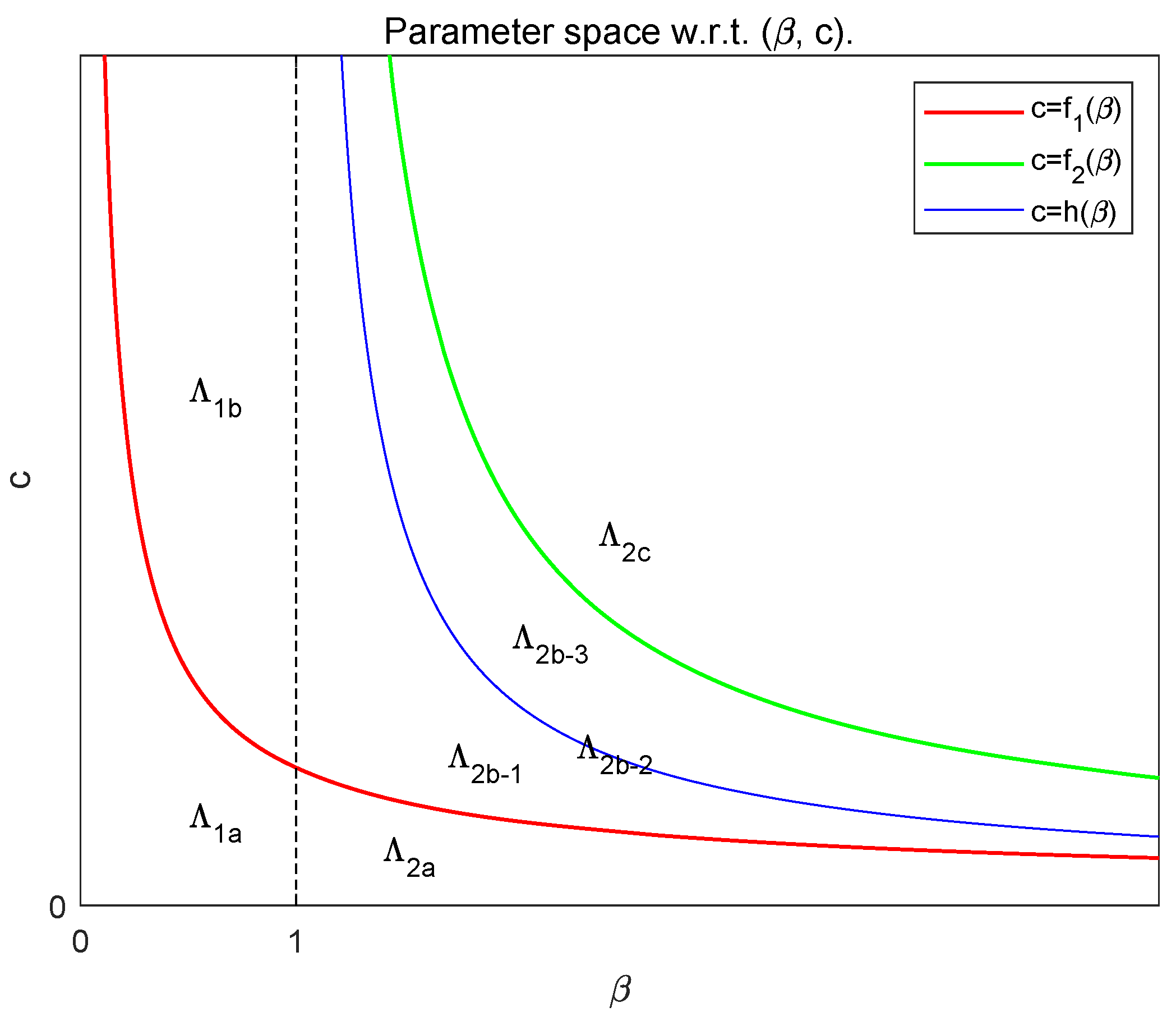
into the following two subregions (see
Figure 3):
Also, the parameter region
is divided into the following three subregions (see
Figure 3):
Now, we apply the monotonicity of
on
d (see Remark 1) to analyze the stable parameter region of the interior equilibrium
. Define
, that is,
Note that
is equivalent to
.
First, we consider the stability of
for the case of
. According to Theorem 2, System (
3) has the unique interior equilibrium
when
.
- (1)
Let
, then
, as indicated by (
17). According to Remark 1, if
exists, then
. Hence, for all
,
is a sink according to Lemma 1.
- (2)
Let
, then
. In addition, (
21) implies that when
,
. Then, from the monotonicity of
on
d (see Remark 1), we know that
for
and
for
. It follows from Lemma 1 that
is a source for
and a sink for
.
Now, we consider the stability of for the case of . According to Theorem 2, when , the interior equilibrium exists.
- (1)
Let , then, similar to the case of , , if it exists, is a sink.
- (2)
Let
, then
, as indicated by (
17) and (
18). From the monotonicity of
on
d, we know that
for
and
for
. It follows from Lemma 1 that
is a source for
and a sink for
.
- (3)
Let
, then
, as indicated by (
18), which implies from the monotonicity of
on
d that for all
, the corresponding interior equilibrium
satisfies
. So,
is a source for all
.
Then, we obtain the following conclusive result on the local stability of the interior equilibria.
Theorem 4. - 1
, if it exists, is always a saddle.
- 2
At , we have the following statements:
- (i)
If , then , if it exists, is a sink.
- (ii)
If , then is a source for and a sink for .
- (iii)
If , then is a source for and a sink for .
- (iv)
If , then is a source for all .
According to Theorem 4, if
or
, i.e.,
and
, or
and
, there exists a unique
(
or
) such that when
, System (
3) may undergo the Hopf bifurcation at
, where
is given by (
21), and
. Below, we discuss the Hopf bifurcation of (
3) and its directions, together with the stability of bifurcating periodic orbits.
We say that a Hopf bifurcation with respect to the parameter d at is backward (respectively, forward) if there is a small amplitude periodic orbit for each (respectively, ), where is a small constant. Additionally, we say that a Hopf bifurcation is supercritical (respectively, subcritical) if the bifurcating periodic solutions are orbitally asymptotically stable (respectively, unstable).
To compare d to c, we first determine the location of . If , i.e., and , we have since the interior equilibrium exists only for according to Theorem 4.
Let
, i.e.,
and
. According to Theorem 2, System (
3) has the unique interior equilibrium
for
and two interior equilibria
and
for
. From the equation
, one can deduce that the first component of the interior equilibrium
corresponding to
is given by
. It is easy to see that
Clearly, for
,
. Thus, from the monotonicity of
on
d,
if and only if
,
if and only if
, and
if and only if
.
It is easy to see that
if and only if
. Since
and
we know that for
,
. It follows that for
,
. So, conclusively, we have
Based on (
22), we divide the region
into the following three subregions (see
Figure 3):
Theorem 5. If , then a supercritical and backward Hopf bifurcation occurs at when . The Hopf bifurcation surface is given by (21). In addition, we have the following statements: - 1
If , then ;
- 2
If , then ;
- 3
If , then ;
- 4
If , then .
Proof. When
,
. Hence,
and the characteristic Equation (
14) at
has a pair of imaginary eigenvalues
. Let
be the root of (
14) when
d is near
. Then,
,
. Clearly,
Noticing that
and
(see Remark 1), we observe that for
,
From the Poincaré-Hopf Bifurcation Theorem [
35], it follows that System (
3) undergoes a Hopf Bifurcation when
.
Below, we calculate the first Lyapunov coefficient at
, which determines the direction of the Hopf bifurcation and the stability of the bifurcating periodic orbits. Let
,
. For simplicity, we still use the variables
x and
y instead of
X and
Y, respectively. Then, System (
3) becomes
where
By setting
, where
, we obtain
where
Let
where
denotes
etc. Through careful calculation, we have
At
, we obtain
Thus, the Hopf bifurcation is supercritical and backward (see Theorem 3.4.2 and Formula (3.4.11) of Guckenheimer and Holmes [
36]). The proof is complete. □
4.3. Saddle Node and Cusp
According to Theorem 2, when
and
, System (
3) has the unique interior equilibrium
, where
(see (
8)),
. Below, we discuss the dynamic behavior near
.
Theorem 6. Let and .
- (1)
If , then is a repelling saddle node of codimension one.
- (2)
If , then is an attracting saddle node of codimension one.
- (3)
If , then is a Bogdanov–Takens-type cusp of codimension two.
Proof. At
, it is easy to see that
and the characteristic Equation (
14) has two roots:
and
. Therefore,
is a non-hyperbolic equilibrium. We use the center manifold theorem and the blow-up technique [
34] to determine the type of
.
Let
, which implies that
. Perform a transformation of
,
to translate
to the origin. For simplicity, we still use the variables
x and
y instead of
X and
Y, respectively. Then, System (
3) becomes
Let
and
. Then, System (
24) becomes
Here,
It is clear that the flow on the center manifold is given by
. So, according to the center manifold theorem,
is a saddle node, i.e., half of
is a node and the other half is a saddle. In order to determine the stability of the half node of
, below, the blow-up technique [
34] is applied to System (
25). By applying the polar coordinate transformation
,
System (
25) is transformed into the following system
On the unit circle
, System (
26) clearly has four singular points
corresponding to
,
. If
, then
and
. Then, when
, we have
along the direction
and
along the directions
,
, and
, which implies that the half node of
is stable, i.e.,
is an attracting saddle node of codimension one. If
, then, when
, we have
along the direction
and
along the directions
,
, and
, which implies that the half node of
is unstable, i.e.,
is a repelling saddle node of codimension one.
Now, we assume that
, which implies that
. Then,
. In this case, we set
,
. Then, System (
24) becomes
Let
,
. Then, System (
27) is transformed into
where
So,
is a Bogdanov–Takens-type cusp of codimension two (see [
34,
37]). The proof is complete. □
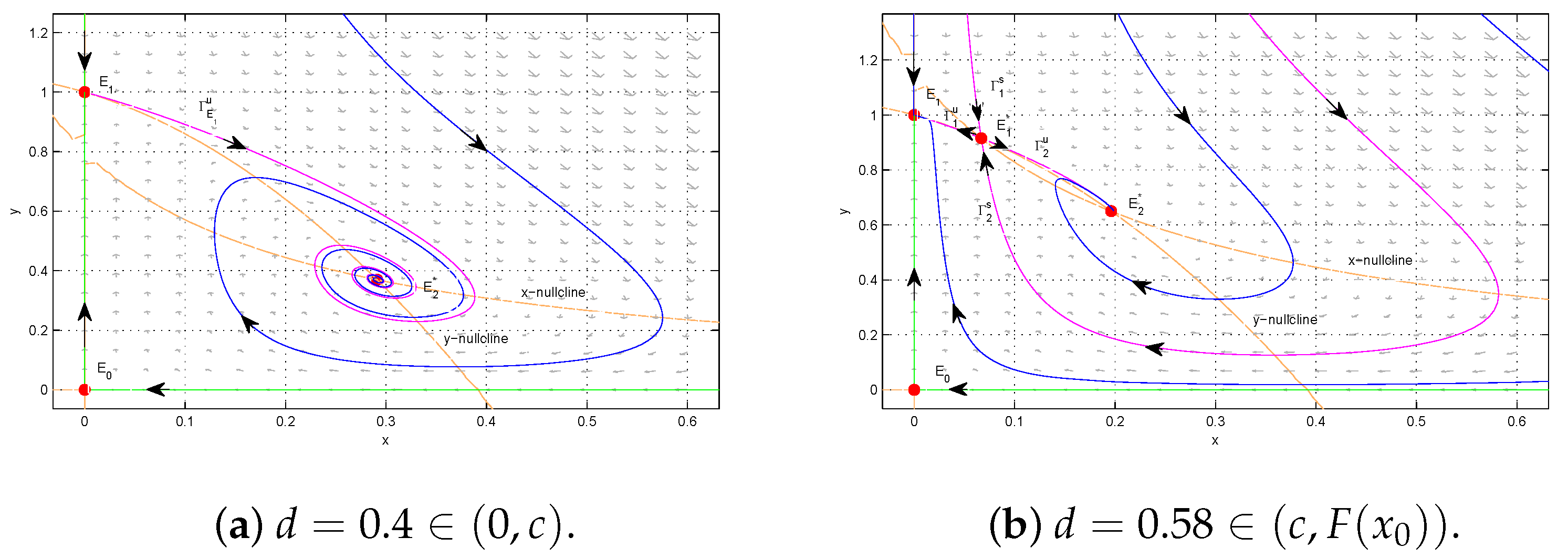
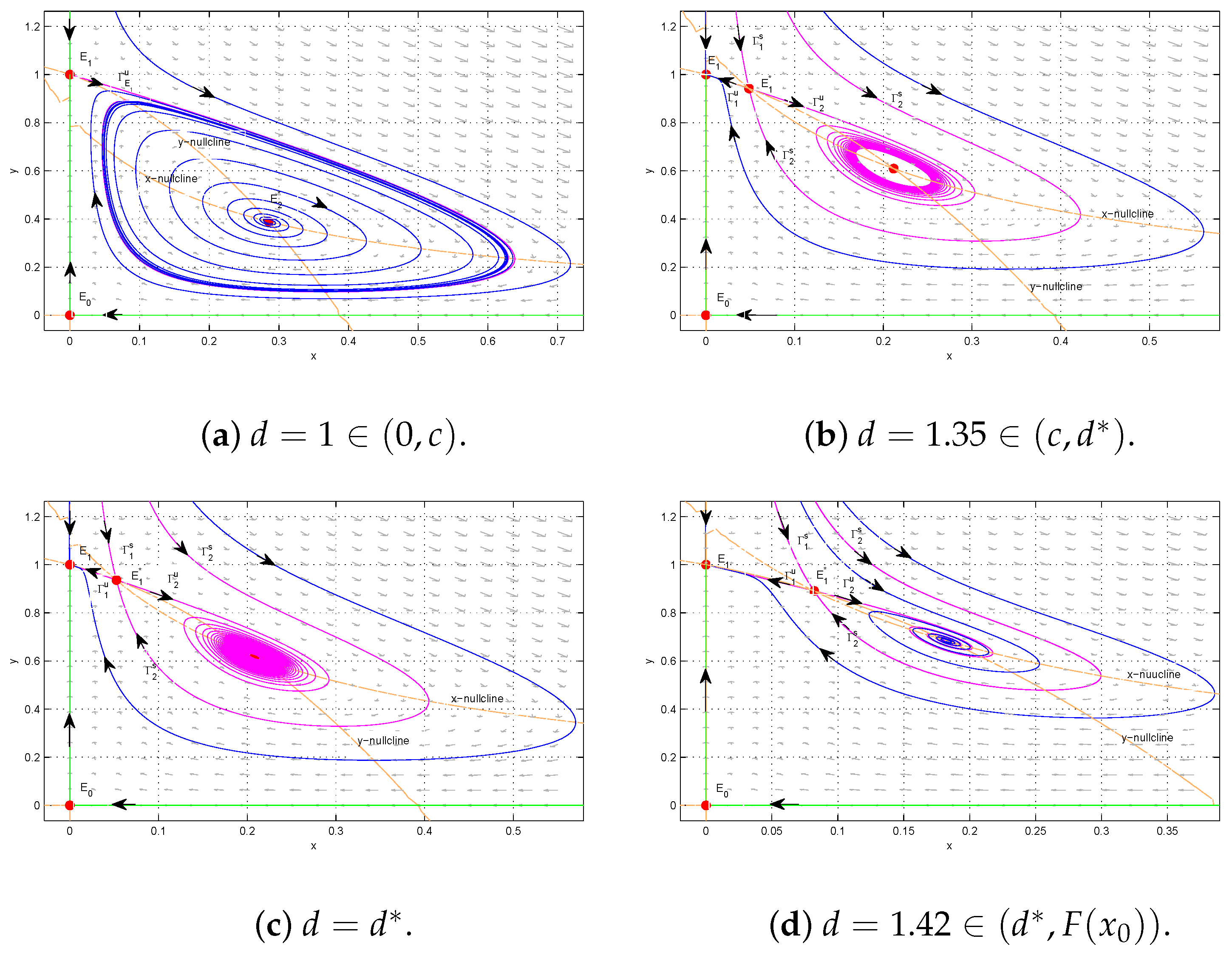
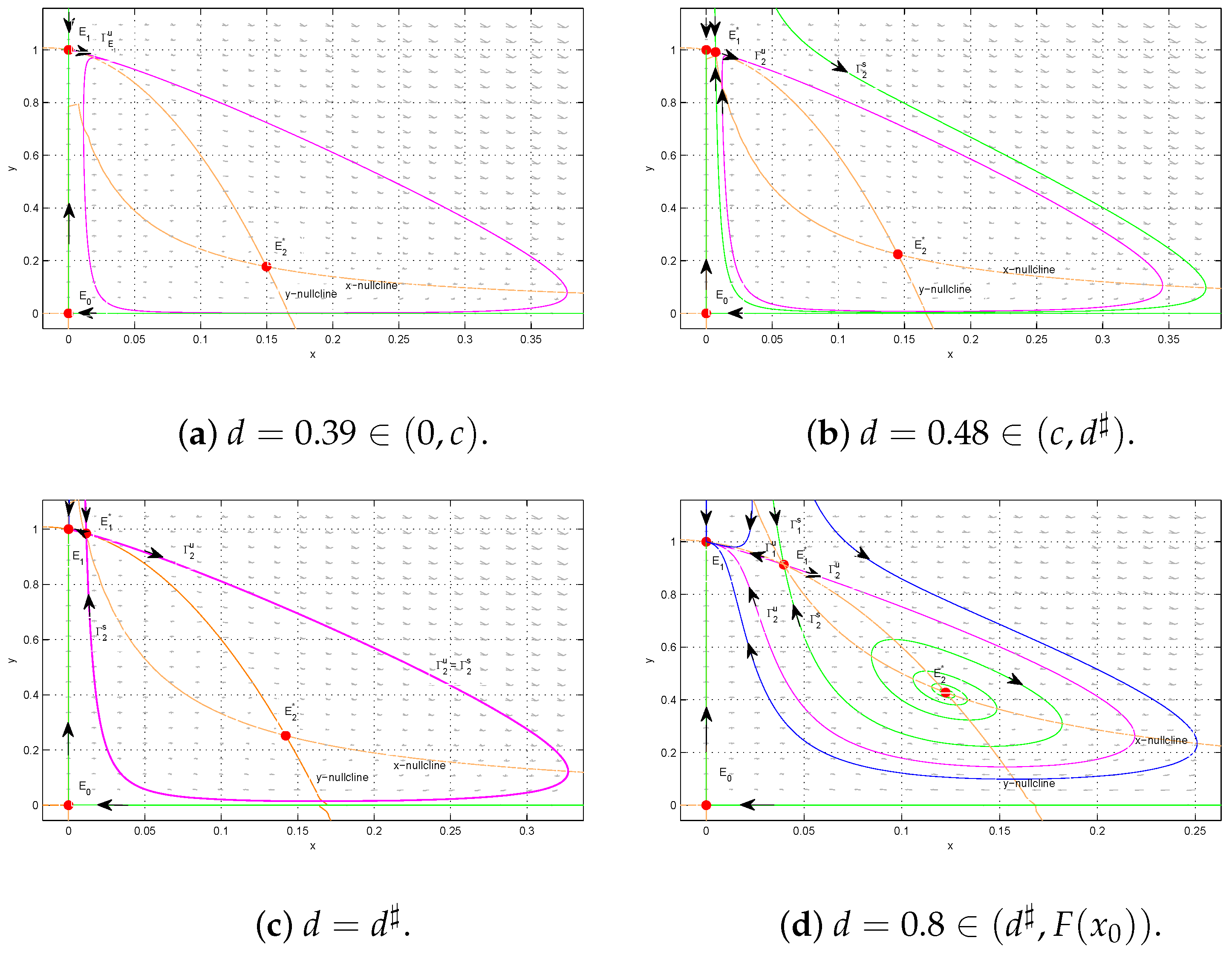
For example, we take
, then,
. We consider the dynamics of System (
3) when
and
.
- (1)
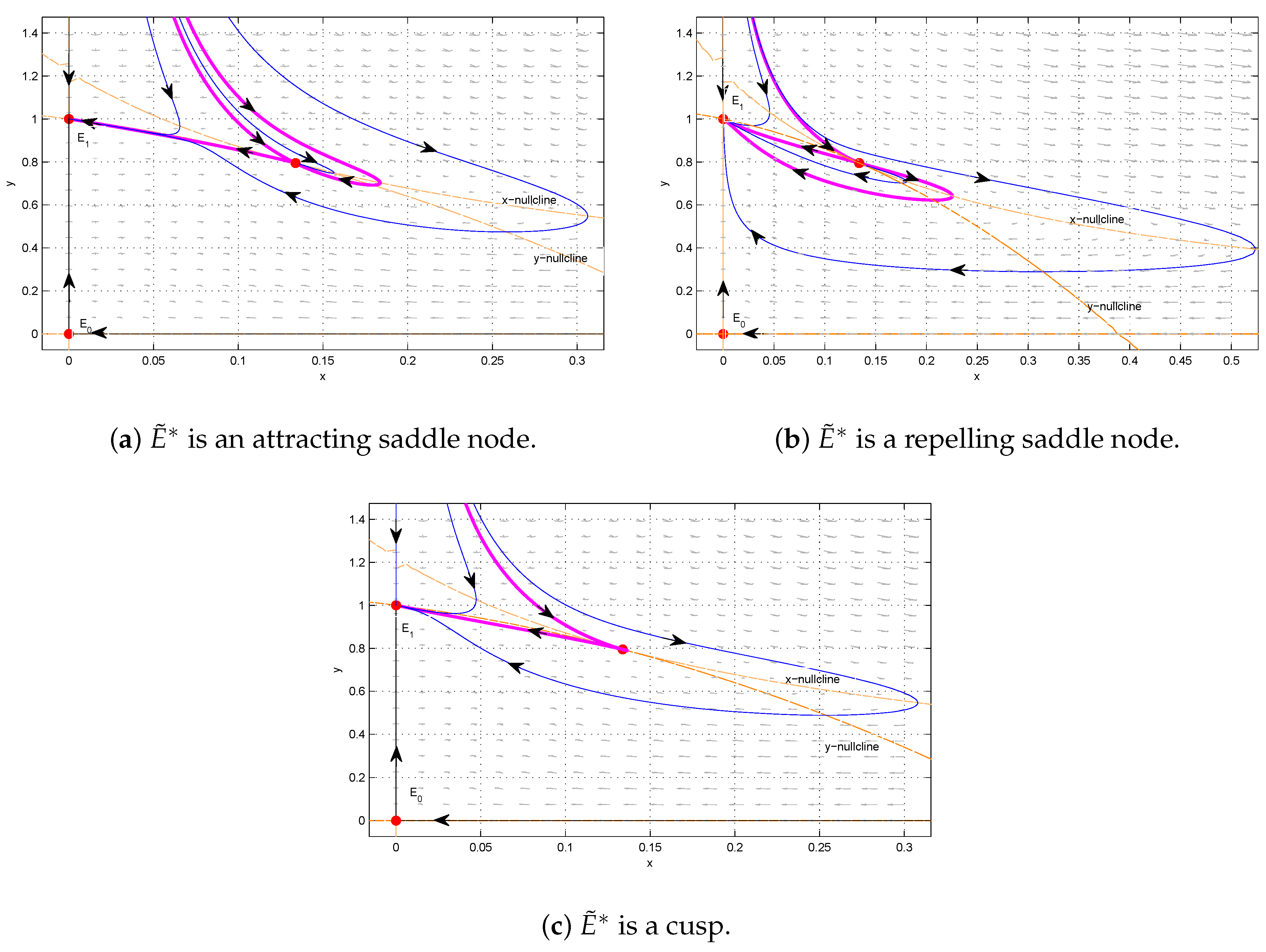
In
Figure 4a, we choose
. When
, System (
3) has the unique interior equilibrium
, which is an attracting saddle node. There are three separatrices, two approaching
and one connecting
and
and entering
. The three separatrices divide
into three parts, two of which are hyperbolic sectors and one of which is a parabolic sector. The solutions initiated in the hyperbolic sectors converge to
, whereas the solutions initiated in the parabolic sector tend to
.
- (2)
In
Figure 4b, we choose
. When
, the unique interior equilibrium
is a repelling saddle node.
consists of two hyperbolic sectors, one parabolic sector, and three separatrices. Only one of the separatrices approaches
and all the other solutions approach
.
- (3)
In
Figure 4c, we choose
. When
, the unique interior equilibrium
is a Bogdanov–Takens-type cusp. Cusp
consists of two hyperbolic sectors and two separatrices. Only one of the separatrices approaches
and all the other solutions approach
.
4.4. Summary
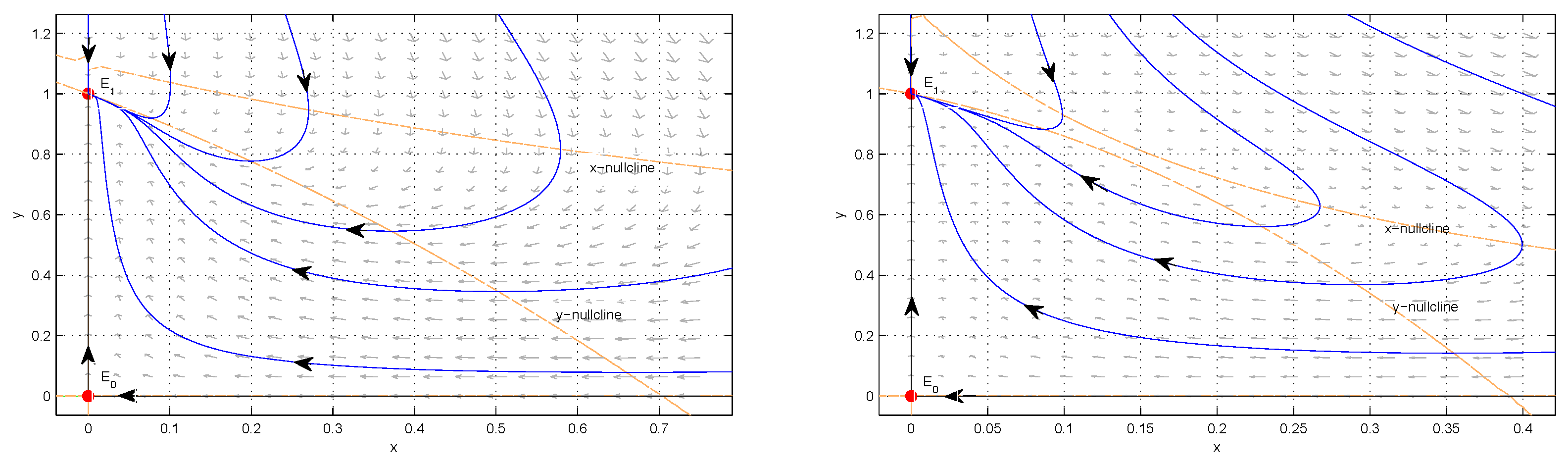
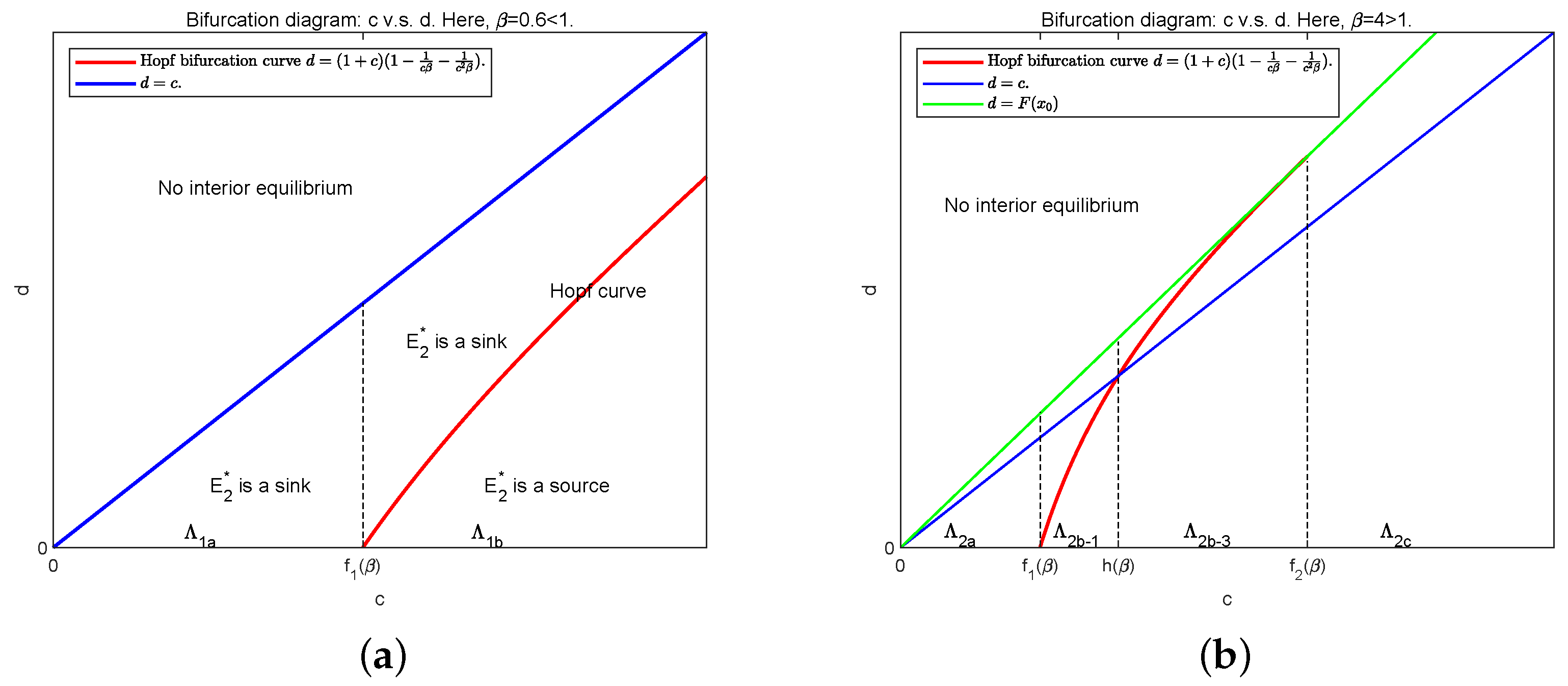
Our main results obtained in the previous arguments can be summarized in
Figure 5a,b, where the parameter
is chosen as
and
, respectively. The red curve denotes the Hopf bifurcation curve
, and the blue and green straight lines are
and
(
), respectively.
- 1.
As
d decreases,
Figure 5a (
) indicates the following implications:
- (1)
When , there is no interior equilibrium and is a sink; when , becomes a half-stable equilibrium (a saddle-node point; see Theorem 3); when d decreases from , the saddle-node bifurcation occurs, and becomes a saddle and a stable interior equilibrium appears (see Theorem 4).
- (2)
When d continues to decrease, according to Theorem 4, if , i.e., , is a sink for all ; if (i.e., ), as d decreases to the red curve, i.e., (), a supercritical Hopf bifurcation occurs. Below it, i.e., , becomes a source.
- 2.
As
d decreases,
Figure 5b (
) indicates the following implications:
- (1)
According to Theorem 2, when
, System (
3) has no interior equilibrium and
is stable node. According to Theorems 2 and 6, when
d decreases to the green line
, System (
3) has a unique interior equilibrium
, which is an attracting saddle node when
, a repelling saddle node when
, and a Bogdanov–Takens-type cusp when
(see
Figure 4). Note that when
, the line
is tangent to the Hopf bifurcation curve
.
- (2)
According to Theorems 2 and 4, as d continues to decrease from ( but near ), two interior equilibria and appear, where is a saddle and is a sink when (i.e., ), whereas it is a source when (i.e., ). When , is a stable node.
- (3)
When
, i.e.,
, and
d continues to decrease to
, the stability of
switches from a stable node to a half-stable equilibrium (a saddle node),
disappears, and System (
3) has the unique interior equilibrium
. When
,
becomes a saddle and
remains asymptotically stable.
- (4)
When
(here,
), i.e.,
, and
d continues to decrease to
, similar to the case
, the stability of
switches from a stable node to a saddle node,
disappears, and System (
3) has the unique interior equilibrium
. When
d decreases from
and passes the Hopf bifurcation curve
),
becomes a saddle and
goes from a sink to a source.
- (5)
When
, i.e.,
, and
d decreases to
,
becomes a saddle node,
disappears, and System (
3) has the unique interior equilibrium
. The Hopf bifurcation curve
intersects the line
when
. Therefore, when
and
, the Hopf bifurcation and saddle-node bifurcation occur simultaneously. After that, as
d continues to decrease from
,
becomes a saddle and
becomes a source.
- (6)
When , i.e., , and d decreases from and passes the Hopf bifurcation curve , goes from a sink to a source. As d continues to decrease and passes the line , goes from a stable node and a saddle node to a saddle, while remains a source.
- (7)
When , i.e., , and d decrease from , is always a source. If d continues to decrease and passes the line , goes from a stable node, a saddle node to a saddle.
6. Discussion
In this paper, the dynamics of the predator–prey model (
3) with cooperative hunting are considered. The parameter space
of
involved in (
3) is divided into different regions:
,
,
,
(see
Figure 3). The division is very important for the dynamic analysis of System (
3). In each region, as
d changes, the dynamic behaviors of (
3) are presented through theoretical analysis and numerical simulations, including the number of equilibria (see Theorem 2 and
Figure 2); the stability of equilibria (see Theorems 3 and 4); the bifurcation phenomena, including the Hopf bifurcation (see Theorem 5), saddle-node bifurcation and Bogdanov–Takens bifurcation (see Theorem 6 and
Figure 4), and homoclinic bifurcation (see
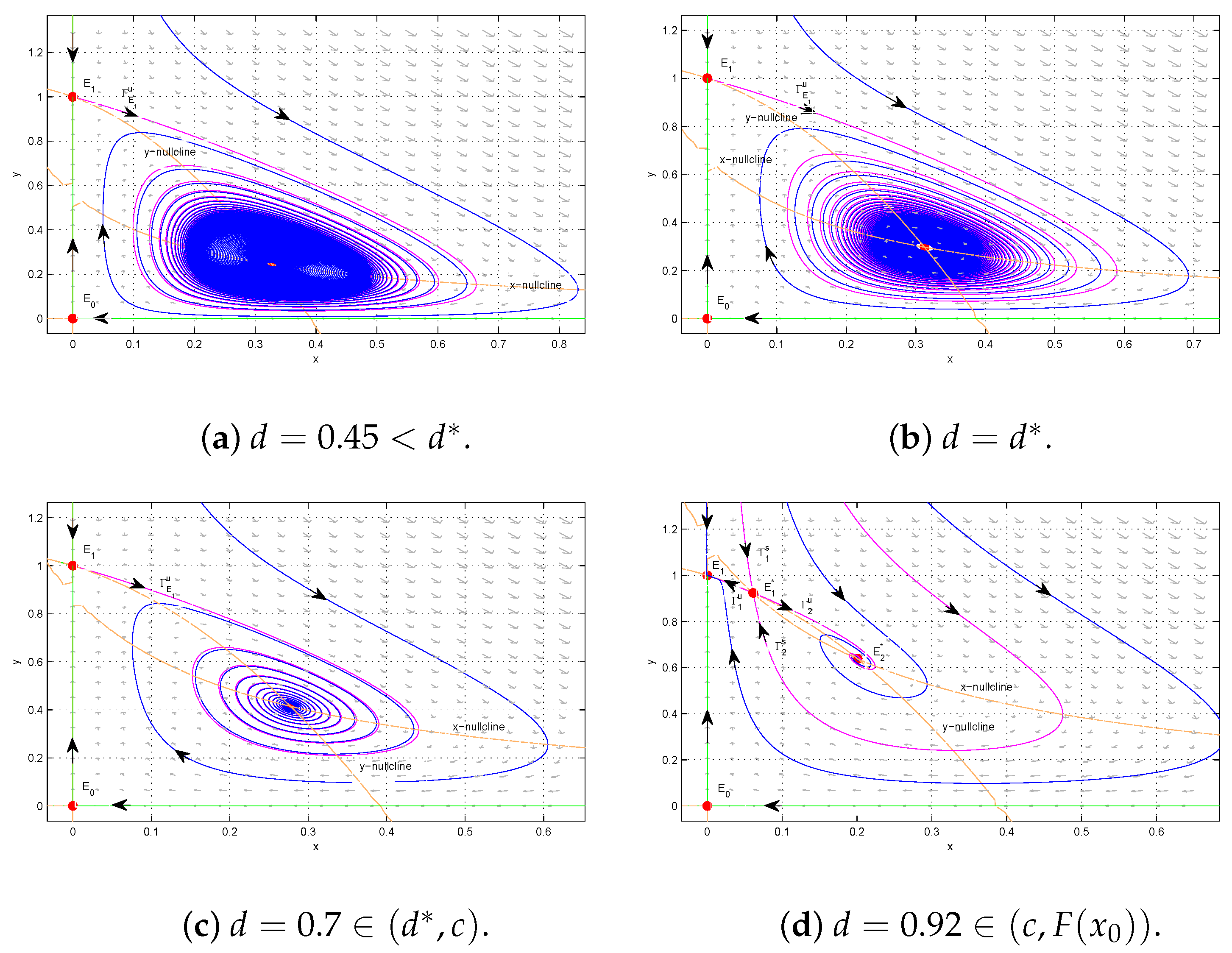
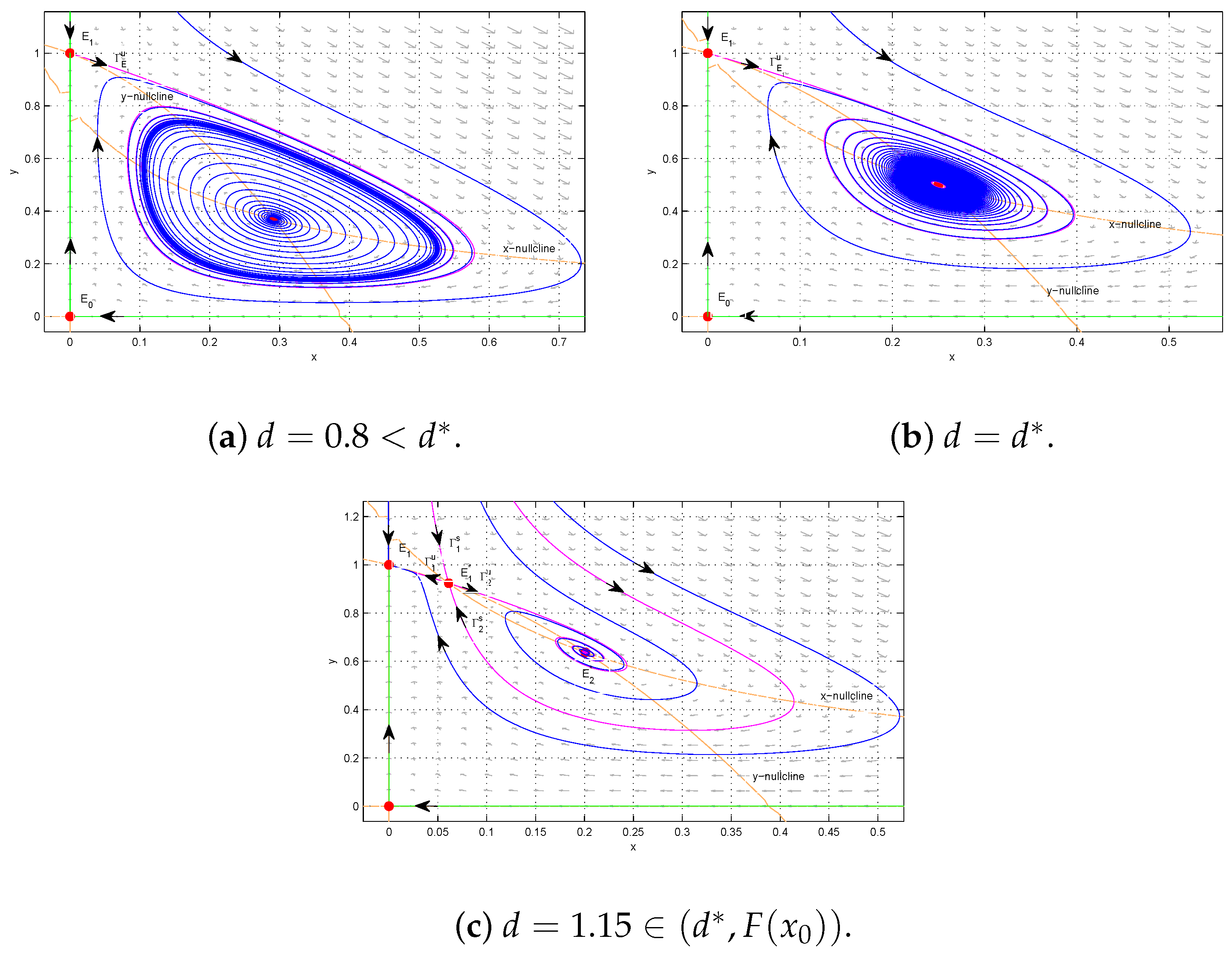
Figure 13); and the existence and non-existence of limit cycles (see Theorems 9–13 and
Figure 8 and
Figure 10,
Figure 11,
Figure 12 and
Figure 13). Based on the theoretical analysis and numerical simulations, a complete description of the dynamic behaviors of (
3) for
d, along with the corresponding biological explanations, is presented for each region.
If the predator is without cooperative hunting, then (
3) becomes the following well-known Lotka–Volterra model:
The dynamics of System (
31) are quite clear. System (
31) has two boundary equilibria:
, which is always a saddle, and
, which is locally asymptotically stable if
and a saddle if
. If
, there exists a unique interior equilibrium
, which is globally asymptotically stable. If
,
is globally asymptotically stable, which implies that the high death rate of the predator leads it to become extinct. Comparing Model (
3) to the Lotka–Volterra model (
31), we find that System (
3) has exactly the same dynamics as the Lotka–Volterra model (
31) only when
(see Theorem 8). When
, due to the nonlinearity of the cooperative hunting term
, Model (
3) exhibits more complex dynamic behavior than (
31), including rich bifurcation phenomena such as the Hopf bifurcation (see Theorem 5), saddle-node bifurcation and Bogdanov–Takens bifurcation (see Theorems 6), and homoclinic bifurcation (see
Figure 13). Moreover, we can make the following statements, which answer the questions posed in
Section 1.
- 1
If the mortality of the predator is small such that
, then both species coexist regardless of the intensity of hunting cooperation. The coexistence of the two species exhibits either a steady mode or an oscillatory mode. If the Hopf bifurcation occurs, it only changes the coexistence mode. Therefore, compared to the Lotka–Volterra model (
31), when
, the hunting cooperation term
does not affect the coexistence of populations but it affects the pattern of coexistence.
- 2
When
and
, or
and
, Model (
3) has two attractors (bistability): one is the boundary equilibrium
and the other is the interior equilibrium
or the stable limit cycle surrounding
. The separatrices of the attracting basins of these two attractors are the stable manifolds of the interior equilibrium
. This indicates that two species may coexist but this depends on the initial values. For the Lotka–Volterra model (
31), when
, the predator becomes extinct regardless of the initial value. Therefore, hunting cooperation is beneficial to the coexistence of the prey and predator.
Conclusively, in comparison to the Lotka–Volterra model (without cooperative hunting), hunting cooperation brings benefits to the predator population and plays an important role in ecosystem stability and persistence.
Generally, the extinction of a predator is induced by its high mortality or due to the extinction of its prey. Du et al. [
20] studied a predator–prey model with cooperative hunting in the predator and group defense in the prey. It was presented that too strong cooperation caused the extinction of the prey and, consequently, the extinction of the predator. In contrast, our results indicate that strong cooperation has a positive effect on the predator, and the extinction of the predator is induced by the high mortality of the species. However, if the cooperation of the predator is strong, the size of the predator in the coexistence state will be small. This also implies that hunting cooperation can enable a predator of a small size to survive.