
Arab–Israeli Leaders in Israeli Higher Education During the Iron Swords War

Abstract
1. Introduction
1.1. Research Question
1.2. Rationale
2. Method
2.1. Participants
2.2. Interview
2.3. Procedure and Ethical Considerations
2.4. Data Analysis Transparency and Trustworthiness
3. Results
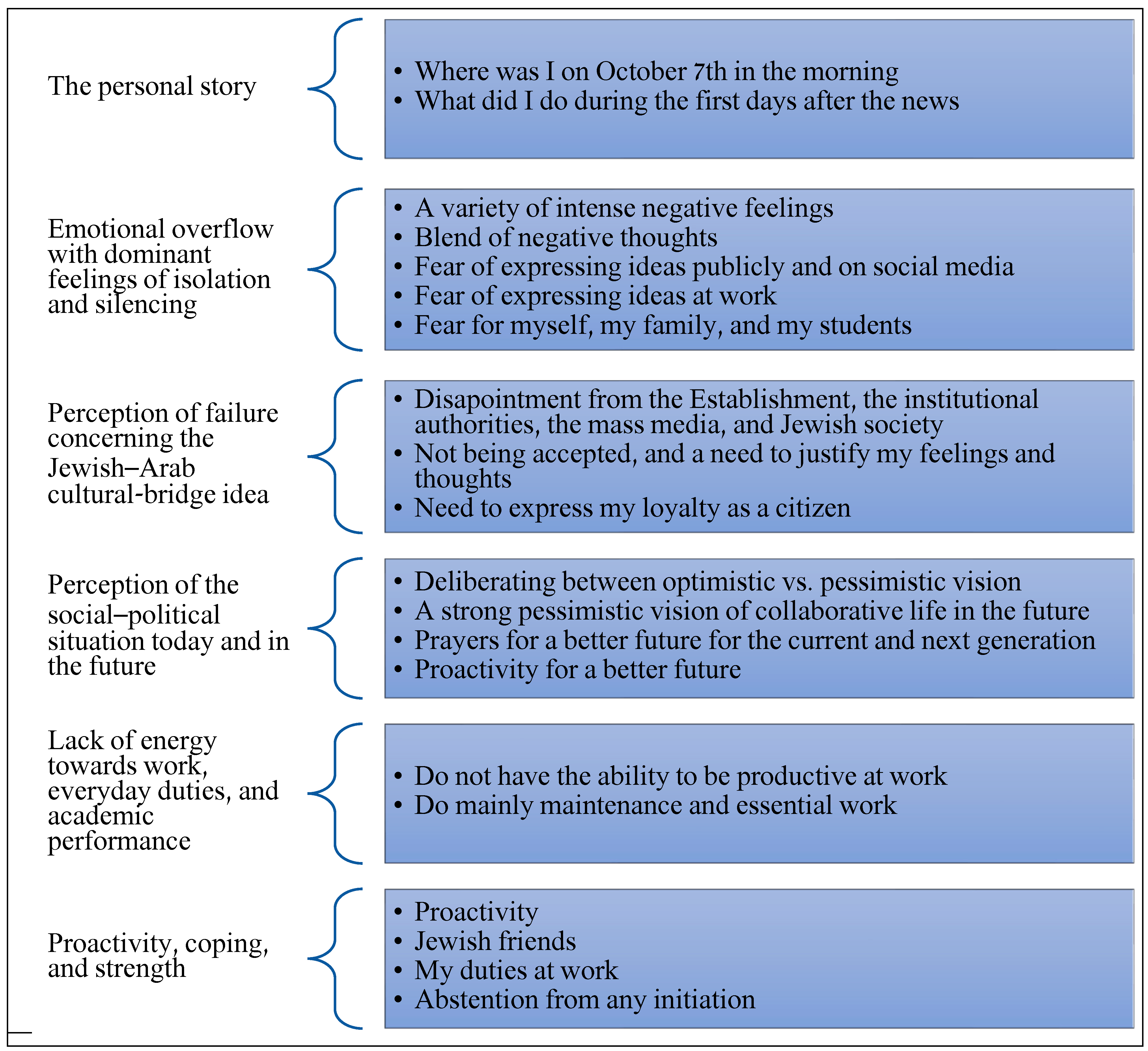
- The personal story—how the events of 7 October affected me personally. There are several natural disasters and manmade incidents or events that everyone who was living on Earth while they occurred will remember for the rest of their lives; specifically, they will remember not only what happened, but also where they were, and what they were doing (such as the President Kennedy assassination, the 9/11 Twin Towers collapse, Prime Minister Yitzchak Rabin’s assassination, the beginning of the 1973 Yom Kippur War in Israel, the UN declaration establishing Israel as a State for the Jewish Nation, etc.) (e.g., Monteil et al., 2020; Russo & Moses, 2013). This was evident in our interviews. All the participants, without exception, at the onset of the interview chose to describe where they were and what they were doing at 06:30 AM. 7 October was several days before the beginning of the new academic year. Hence, many people were still on vacation abroad. Half of the participants were abroad and described in detail what they did from the moment they heard the news to the moment of their return home. Here are several examples:
“I was not in the country. Immediately as I heard the news, I tried to purchase the tickets back home. It was chaos, almost all airlines canceled their flights to Israel due to the war that began. I had to travel through two airports in Europe, and it took 48 h to return.”(6)
“It was on Saturday early morning, while people were still at home. I was on the second floor at home. I rushed down and turned on the TV. The news spread out very quickly, all day long and ever since, but understanding the event took hours, days, and weeks”.(2)
- 2.
- Emotional overflow. At the beginning of the October 7th war, social media was a major news supplier. Films arrived through all existing channels—Telegram, Instagram, Facebook, TikTok, and the mobile channels of the TV and radio, both from the Hammams and from the Israeli soldiers and civilians that experienced the horrors.
“The enormity of the horror was beyond understanding. Most of all, we could not believe that the strong IDF was totally surprised and defeated. We really could not believe what we saw and heard. As a religious Muslim, I must say that I was ashamed, and even offended. Such inhuman brutality does not exist in our religion. I cannot imagine what those who planned the attack thought they were doing. I immediately knew the consequences, and I was devastated.”(7)
“I was totally shocked. I couldn’t believe what I heard and saw. I tried not to look at films at all! How people take other people’s lives. It is against all our beliefs. I was so scared of what was going to be next. I cared for myself and my family, especially the kids. I knew that revenge would be huge and thousands of people would pay.”(3)
“In the first several weeks after the war started, I was occupied with my students. I felt that I must be there for them. Some were very scared to go out, to take public transportation, even to come to the campus. Some of my students are young and have never experienced such a chaotic situation. I felt that I had to take care and instruct them, but I was not exactly sure how to do that.”(5)
“As an individual belonging to the Arab society minority, I felt isolated within the academic world. I felt silenced, so I deliberately avoided speaking or talking publicly and on social media, at least in the first several weeks. I felt that I had to justify myself, to declare again my loyalty to the Jewish society, as if I were not a citizen with equal rights. Actually, these feelings arose doubts regarding my or our place (the Arab society) in the general society.”(2)
“We are not only excluded, but we exclude ourselves and give up our right to express our opinion, because on that we may pay a heavy price.”(8)
“I wanted to discuss the situation with my students, but I did not dare. I was afraid to deal with the situation since the media was full of examples that Arab students and faculty were brought before discipline committees on the grounds of incitement and many were warned, expelled, suspended or even fired.”(10)
“Initially, I hesitated to express my opinions. Despite being known for my outspoken nature, I chose silence, opting instead to observe and absorb my surroundings. Reacting without a clear understanding of those around you is unwise. When I finally spoke, I declared, “You know nothing about me, yet I know everything about you.” This declaration was met with silence and restraint. With each passing moment of quiet reflection, my sense of self solidified, elevating my contemplation of self-identity to a higher level.”(3)
“It hurt me immediately and immensely; I never wished for us to find ourselves in the situation we faced on October 7th. I even feared it jeopardized the rights and prospects of the Palestinian people. In the aftermath of the attack, my mind was consumed with questions about the path ahead. Where would it lead us? What fate awaits my children? Will they depart our homeland, only to return later? Perhaps I’ll be compelled to start anew elsewhere. I cannot endure residing in a place where speech is stifled, where expressing oneself freely is restricted. I feel utterly powerless, overwhelmed by suffering.”(6)
“I found myself unable to freely express my thoughts in various forums. I grappled with questions about my identity: am I Israeli, Arab, Palestinian? Could a significant transformation occur? My mind swirled with these thoughts. I struggled with the dual anguish of the events of October 7th and the ongoing turmoil in Gaza, all while residing in Israel and striving to maintain my current lifestyle. What provided me strength were my Jewish friends. Their support was invaluable, even amidst our disagreements.”(9)
- 3.
- Critique/perception of failure regarding the Jewish–Arab cultural bridge idea. Although they were not surprised, interviewees, without exception, expressed their disappointment with “the Establishment”. They emphasized that their belief in coexistence between the Arab–Israeli society and the Jewish–Israeli society was badly and negatively affected. The memories from Operation Guardian of the Walls that occurred only three years earlier were still fresh. In that operation, according to the State Comptroller’s report, three civilians were killed, and hundreds were injured (including approximately 306 police officers) in approximately 520 documented incidents, at the peak of which, according to the assessment of authorized security officials, approximately 6000 Israeli–Arab residents participated. About 3200 people were arrested, including about 240 Jews (State Comptroller Report, 2022.07.27). Some said that they felt again the need to express their loyalty as a citizen, as follows:
“Every time that the Israeli society suffers an Arab attack of any kind and scale, we, as Arab–Israeli citizens, have to express our loyalty. It is expected of us to condemn initiation of hatred, violence, and terror. As if one can accept such behavior. It is against my belief to take other people’s lives. It is also against our religion. Still, it is expected that I will say it or write about it clearly.”(9)
“As an Arab, I could not feel part of the whole society; the divide between the two societies was immediately present. I had to justify my feelings and thoughts. I have family in Gaza, and I knew at the onset of that horrible morning that painful revenge would come. I felt devastated.”(10)
“I felt disappointment from the Establishment, the institutional authorities, the mass media and the Jewish society. Suddenly, the whole perception and hope for coexistence sound to me ironic and hypocritical.”(5)
“As the weeks passed, I became more confident, and I raised the voice of disappointment from the Jewish society.”(8)
- 4.
- Perception of the social–political situation today and in the future. The social–political situation in Israel since it became an independent country is fragile and has known constant difficulties (Sela, 2012). These difficulties are rooted in the history of both nations that live in the same country (Farsakh, 2011). Since the declaration of its independence, Israel has had to manage seven wars, dozens of operations, and thousands of terror attacks, which have been part of its population’s existence. Since wars and operations are a part of life, all Israeli citizens at the age of 18 are recruited to mandatory service in the army, while the Arab–Israeli citizens can choose to serve in the “civil service” (Amidror, 2018). Israeli Arabs exist as a minority within Israeli society, with the intricacies of their daily lives posing challenges to their connection to the State of Israel and their sense of inclusion within the broader societal fabric (Jonas & Fritsche, 2013). While officially recognized as citizens with voting rights and legal equality, they concurrently grapple with a complex dual identity (Levy et al., 2017; Pilecki & Hammack, 2014). They are actively engaged in the nation’s public institutions, yet their bonds often extend beyond Israel’s borders to include kin in areas such as Judea and Samaria, the Gaza Strip, and neighboring Arab nations. During periods of conflict, military campaigns, and acts of terrorism targeting Israel and its populace, this dual allegiance intensifies, as illustrated by the following excerpts:
“At the moment that I heard the horrible news, I knew that it would have a detrimental effect on the whole region for years. I see at least ten years of wars from now. All the fragile achievements that we have achieved will disappear. That was immediately very clear to me.”(1)
“On the one hand, I do not see hope for me or for my children; on the other hand, I am still optimistic, and I think that if we invest and are proactive toward our coexistence in this country, someday we will be able to live here together peacefully.”(4)
“I had a hope that a change would occur and that I would be part of the change, but the hope goes further away as years go by.”(10)
“I decided that unless I will to be proactive, I will never be able to come up with complaints to anyone. I think that we constantly and usually cry more about the situation than being proactive towards real and positive change.”(6)
- 5.
- Lack of energy towards work, everyday duties, and academic performance.
“I maintained office duties, working very hard 24/7 to give support and help with every problem that arose. There were endless problems”.(7)
“I felt sorry for my students who were eager to talk and get some relief from the high stress that they felt. Nevertheless, I could not afford it, because I understood that talking is forbidden. Hence, we continued with teaching routines.”(2)
“I completely left anything that is related to writing. Research is a luxury in such a chaotic time. Nothing. Nothing at all! In addition, I think that it would affect Arab researchers. They will receive less grants if they will receive any.”(3)
- 6.
- Coping and strength
Proactivity: “At the beginning, I helped to translate conversations that were spread on social media due to winds of violence that were expressed in both sides, Arabs and Jewish. Then, I decided to express my opinion, and I refused to be a translator. I thought that I had much more important duties as an educational leader. Talking was the first important step.”(5)
“Due to the war, I began to be politically involved. I started to search for organizations. I felt the need and I recognized my ability to lead to a better place. To give my part to coexistence.”(7)
“I felt a sense of duty, utilizing every opportunity to learn more about Arab society in Israel. I recognized the necessity of striking a balance; coexistence is imperative, not optional. It’s the reality we’re faced with, and I believe we can strive for a fulfilling life within it.”
Jewish friends: “What really comforted me is my Jewish friends from Israel and from the USA who called to support and ask how am I during this war and uncertain time. It is really comforting that I have a circle of people and friends that can understand the complexity of the situation that we encounter. It is meaningful to me and keeps me optimistic.”
Duties at work: “I am busy 24/7 with lots of duties. I volunteer to take more and more duties. Being highly active keeps me sane.”
Abstention: “In this war, the Arab–Israeli society chose an attitude of abstention. I think it sends a message which is kind of loyalty, but at the same time, we could not be more involved due to what we see happening in Gaza. You know, between the Palestinians and the Jewish Israelis, there is disconnection, and even blindness and impermeability to the pain of the other. The Israelis do not see the Palestinians and vice versa, and we, the 48’ Arabs who live here and see both sides and understand both sides, are stuck between the hammer and the anvil.”
4. Discussion
The Practical Implication
5. Conclusions
Author Contributions
Funding
Institutional Review Board Statement
Informed Consent Statement
Data Availability Statement
Acknowledgments
Conflicts of Interest
References
- Alfoqahaa, S., & Jones, E. (2020). Leading at the edge of chaos: Historical perspectives on the qualities of leadership for cultural diversity and conflict resolution. International Journal of Public Leadership, 16(2), 217–248. [Google Scholar] [CrossRef]
- Altheide, D. L., & Johnson, J. M. (2011). Reflections on interpretive adequacy in qualitative research. In The SAGE handbook of qualitative research (Vol. 4, pp. 581–594). SAGE. [Google Scholar]
- Amidror, Y. (2018). The Evolution and Development of the IDF. In Routledge handbook on Israeli security (pp. 36–48). Routledge. [Google Scholar]
- Arar, K. (2018). Arab women’s educational leadership and the implementation of social justice in schools. Journal of Educational Administration, 56(1), 18–32. [Google Scholar] [CrossRef]
- Barber, H. F. (1992). Developing strategic leadership: The US army war college experience. Journal of Management Development, 11, 4–12. [Google Scholar] [CrossRef]
- Bernbeck, R. (2003). War-time academic professionalism. Public Archaeology, 3(2), 112–116. [Google Scholar] [CrossRef]
- Boin, A. (2009). The new world of crises and crisis management: Implications for policymaking and research. Review of Policy Research, 26(4), 367–377. [Google Scholar] [CrossRef]
- Boin, A., & ’t Hart, P. (2022). From crisis to reform? Exploring three post-COVID pathways. Policy and Society, 41(1), 13–24. [Google Scholar] [CrossRef]
- Brink, H. I. (1993). Validity and reliability in qualitative research. Curationis, 16(2), 35–38. [Google Scholar] [CrossRef]
- Bulloch, J., & Morris, H. (1991). Saddam’s war: The origins of the Kuwait conflict and the international response. Faber and Faber. [Google Scholar]
- Burns, J. M. (1978). Leadership. Harper & Row. [Google Scholar]
- Dinh, N. B. K., Caliskan, A., & Zhu, C. (2021). Academic leadership: Perceptions of academic leaders and staff in diverse contexts. Educational Management Administration & Leadership, 49(6), 996–1016. [Google Scholar]
- Farsakh, L. (2011). The one-state solution and the Israeli-Palestinian conflict: Palestinian challenges and prospects. The Middle East Journal, 65(1), 55–71. [Google Scholar] [CrossRef]
- Fullan, M. (2007). The new meaning of educational change. Teachers College Press. [Google Scholar]
- Gallos, J. V., & Bolman, L. G. (2021). Reframing academic leadership. John Wiley & Sons. [Google Scholar]
- Gigliotti, R. A., & Ruben, B. D. (2017). Preparing higher education leaders: A conceptual, strategic, and operational approach. Journal of Leadership Education, 16(1), 96–114. [Google Scholar] [CrossRef]
- Gunter, H. M. (2016). An intellectual history of school leadership practice and research. Bloomsbury Academic. [Google Scholar]
- Gutman, M. (Ed.). (2024). Challenges facing education leadership in the shadow of war: International and multicultural perspectives from zones of conflict. Taylor & Francis. [Google Scholar]
- Hennink, M., & Kaiser, B. N. (2022). Sample sizes for saturation in qualitative research: A systematic review of empirical tests. Social Science & Medicine, 292, 114523. [Google Scholar] [CrossRef]
- Jonas, E., & Fritsche, I. (2013). Destined to die but not to wage war: How existential threat can contribute to escalation or de-escalation of violent intergroup conflict. American Psychologist, 68(7), 543. [Google Scholar] [CrossRef] [PubMed]
- Kezar, A. J. (Ed.). (2023). Rethinking leadership in a complex, multicultural, and global environment: New concepts and models for higher education. Taylor & Francis. [Google Scholar]
- Levy, A., van Zomeren, M., Saguy, T., & Halperin, E. (2017). Intergroup emotions and gateway groups: Introducing multiple social identities into the study of emotions in conflict. Social and Personality Psychology Compass, 11(6), e12320. [Google Scholar] [CrossRef]
- Lieblich, A., & Josselson, R. (1997). The narrative study of lives (Vol. 5). Sage. [Google Scholar]
- Lord, R. G., & Maher, K. J. (2002). Leadership and information processing: Linking perceptions and performance. Routledge. [Google Scholar]
- Lumby, J., & Foskett, N. (2016). International perspectives on school leadership: Management, challenges, and innovations. Routledge. [Google Scholar]
- MacMillan, M. (2020). War: How conflicts shaped us. Random House Publishers. [Google Scholar]
- Monteil, C., Barclay, J., & Hicks, A. (2020). Remembering, forgetting, and absencing disasters in the post-disaster recovery process. International Journal of Disaster Risk Science, 11, 287–299. [Google Scholar] [CrossRef]
- Pearson, C. M., & Clair, J. A. (1998). Reframing crisis management. Academy of Management Review, 23(1), 59–76. [Google Scholar] [CrossRef]
- Pilecki, A., & Hammack, P. L. (2014). Negotiating the past, imagining the future: Israeli and Palestinian narratives in intergroup dialog. International Journal of Intercultural Relations, 43, 100–113. [Google Scholar] [CrossRef]
- Riessman, C. K. (2012). Analysis of personal narratives. In J. F. Gubrium, J. A. Holstein, A. B. Marvasti, & K. D. McKinney (Eds.), The sage handbook of interview research: The complexity of the craft (2nd ed., pp. 367–379). Sage Publications. [Google Scholar]
- Riggio, R. E., & Newstead, T. (2023). Crisis leadership. Annual Review of Organizational Psychology and Organizational Behavior, 10(1), 201–224. [Google Scholar] [CrossRef]
- Russo, G., & Moses, H. (2013). Where were you?: America remembers the JFK assassination. Rowman & Littlefield. [Google Scholar]
- Schlaerth, A., Ensari, N., & Christian, J. (2013). A meta-analytical review of the relationship between emotional intelligence and leaders’ constructive conflict management. Group Processes & Intergroup Relations, 16(1), 126–136. [Google Scholar] [CrossRef]
- Sela, A. (2012). The decline of the Arab-Israeli conflict: Middle East politics and the quest for regional order. State University of New York Press. [Google Scholar]
- Shepherd, G., & Shepherd, G. (1996). War attitudes and ideological orientations of honors directors in American higher education. The Journal of Higher Education, 67(3), 298–321. [Google Scholar] [CrossRef]
- Shields, C. M. (2010). Transformative leadership: Working for equity in diverse contexts. Educational Administration Quarterly, 46(4), 558–589. [Google Scholar] [CrossRef]
- Shoshaim, S. (2024). Crisis as a starting point to human education. Studies in Education: Journal for Study and Research in Education, 24, 149–159. (In Hebrew). [Google Scholar]
- Spector-Mersel, G. (2008). Sabras don’t age: Life stories of senior officers from 1948’s generation. Magnes. (In Hebrew) [Google Scholar]
- Spector-Mersel, G. (2010). Narrative research: Time for a paradigm. Narrative Inquiry, 20(1), 204–224. [Google Scholar] [CrossRef]
- Strong, M. (2011). The high quality teacher: What is teacher quality and how do we measure it? (156p) Teachers College Press. [Google Scholar]
- Thorne, S. (2016). Interpretive description: Qualitative research for applied practice. Routledge. [Google Scholar]
- Titchen, A., & McIntyre, T. (1993). A phenomenological approach to qualitative data analysis in nursing research. In A. Titchen (Ed.), Changing nursing practice through action research (pp. 29–48). Report No. 6. National Institute for Nursing. [Google Scholar]
- Tufano, P. (2020). Training leaders to win wars and forge peace: Lessons from history. Business History Review, 94(4), 807–833. [Google Scholar] [CrossRef]
- Van Manen, M. (2016). Researching lived experience: Human science for an action sensitive pedagogy. Routledge. [Google Scholar]
- Walker, A., & Dimmock, C. (2002). School leadership and administration: Adopting a cultural perspective. Routledge Falmer. [Google Scholar]
- Wells, T. (1994). The war within: America’s battle over Vietnam. University of California Press. [Google Scholar]
- Zaroulis, N., & Sullivan, G. (1984). Who spoke up? American protest against the war in Vietnam. Doubleday. [Google Scholar]


Disclaimer/Publisher’s Note: The statements, opinions and data contained in all publications are solely those of the individual author(s) and contributor(s) and not of MDPI and/or the editor(s). MDPI and/or the editor(s) disclaim responsibility for any injury to people or property resulting from any ideas, methods, instructions or products referred to in the content. |
© 2025 by the authors. Licensee MDPI, Basel, Switzerland. This article is an open access article distributed under the terms and conditions of the Creative Commons Attribution (CC BY) license (https://creativecommons.org/licenses/by/4.0/).
Share and Cite
Zach, S.; Sindiani, M. Arab–Israeli Leaders in Israeli Higher Education During the Iron Swords War. Behav. Sci. 2025, 15, 1710. https://doi.org/10.3390/bs15121710
Zach S, Sindiani M. Arab–Israeli Leaders in Israeli Higher Education During the Iron Swords War. Behavioral Sciences. 2025; 15(12):1710. https://doi.org/10.3390/bs15121710
Chicago/Turabian StyleZach, Sima, and Mahmood Sindiani. 2025. "Arab–Israeli Leaders in Israeli Higher Education During the Iron Swords War" Behavioral Sciences 15, no. 12: 1710. https://doi.org/10.3390/bs15121710
APA StyleZach, S., & Sindiani, M. (2025). Arab–Israeli Leaders in Israeli Higher Education During the Iron Swords War. Behavioral Sciences, 15(12), 1710. https://doi.org/10.3390/bs15121710