1. Introduction
The contemporary workplace is experiencing significant changes as Artificial Intelligence (AI) becomes increasingly embedded in organizational activities. AI systems now autonomously perform a wide range of cognitive and analytical tasks (
Tang et al., 2023). These technologies improve the quality of decision-making, simplify operational routines, and generate actionable insights across various sectors (
Brynjolfsson & McAfee, 2015;
Brynjolfsson & Mitchell, 2017). As intelligent tools are incorporated into job design, employees have begun to depend more on AI in areas such as task execution, decision support, and performance monitoring (
Omoteso, 2012;
Topol, 2019).
Existing studies have primarily focused on the outcomes of AI usage, including its effects on performance, autonomy, innovation, and job security (
Ackerman & Kanfer, 2020;
Tang et al., 2022;
Parker & Grote, 2022;
Van Hootegem et al., 2019;
Malik et al., 2023). AI usage typically refers to the frequency and intensity with which employees interact with AI systems in their daily work (
Tang et al., 2022). However, as AI becomes more deeply embedded within organizational processes, employees may develop a deeper psychological dependence on these technologies. In practice, this is evidenced by a growing tendency among employees to delegate core work components—such as composing emails and reports, analyzing data, generating strategic ideas, and even drafting performance reviews—to generative AI tools, indicating a phenomenon called “AI dependence syndrome” (
Einhorn, 2025). Moreover, in workplaces, AI has exhibited the capability to take on leadership roles (
Höddinghaus et al., 2021). For example, an AI system named “Mika” was appointed interim CEO at Dictador in 2022 (
Mann, 2023). More recently, this trend reached a new milestone when Albania appointed an AI named “Diella” as the Minister of Public Procurement in 2025, formally vesting it with governmental power to evaluate bids and combat corruption (
Henley, 2025). Despite such emblematic developments, limited attention has been given to how dependence on AI influences interpersonal relationships between employees and their human supervisors.
Following
Tang et al. (
2023), AI dependence is defined as employees’ perception that effectively accomplishing their work requires reliance on the advanced capabilities of AI systems. Unlike AI usage, which emphasizes how often AI is used, dependence emphasizes how essential and irreplaceable AI is perceived to be in enabling decision-making and task success. This conceptualization treats AI dependence as a state-like and situational construct that may vary across work contexts and over time, consistent with prior views that regard dependence as episodic and context-specific (
Shi et al., 2013;
Shu et al., 2011). Accordingly, AI dependence captures a deeper level of human–technology interaction, offering new insight into how employees’ psychological perceptions and social relationships may shift as dependence on intelligent systems increases. Despite its growing importance, research on AI dependence remains limited, particularly concerning its implications for relationships between leaders and employees. This study aims to fill this gap by examining how employees’ dependence on AI reshapes the power structure and interaction patterns within leader–subordinate relationships. Understanding these changes can assist organizations in adjusting leadership practices to accommodate AI’s expanding presence in daily work.
Grounded in Power Dependence Theory (
Emerson, 1962), this study explores how the integration of AI influences power relations between employees and leaders. The theory suggests that one party’s (X) influence over another (Y) depends on Y’s reliance on resources controlled by X and the availability of alternatives. Traditionally, employees depend on leaders for task-related resources (
Hunter et al., 2017). As AI now provides these forms of support, including information processing, decision assistance, and performance verification (
Tang et al., 2023), it enhances employees’ access to resources and feedback, partly substituting leadership functions (
Kerr & Jermier, 1978). This shift may reduce employees’ dependence on leaders, thereby altering perceptions of leader power and enhancing employees’ sense of personal power in their interactions with supervisors (
Emerson, 1962). Such changes in perceived power may subsequently shape employee behavior in the workplace (
Molm et al., 2000).
According to Power-Dependence Theory (
Emerson, 1962), power arises from the dependency in social exchange relationships. When employees gain more resources through AI—such as decision support, feedback, and skill enhancement—and reduce their dependence on leaders, their sense of power in interactions with leaders increases. Changes in power-dependence relationships often first appear in interaction patterns (
Molm, 1997), which may then influence individuals’ social behaviors and willingness to exert influence (
Anderson & Galinsky, 2006). Voice behavior refers to employees’ voluntary efforts to offer ideas or suggestions to improve organizational operations (
Morrison, 2023;
Ng & Feldman, 2012;
Van Dyne & LePine, 1998). This behavior is both constructive and socially risky, as it reflects employees’ organizational commitment and motivation for improvement, but it can also be seen as a challenge to existing authority and decision-making (
Morrison, 2011). In contrast, task-oriented behaviors, such as creativity or performance, reflect an individual’s use of resources and ability performance, rather than the redistribution of power within social relationships (
Jia et al., 2024;
Boussioux et al., 2024). Therefore, voice behavior is more capable of revealing the relational changes triggered by AI dependence, which reflects employees’ repositioning and proactive influence tendencies in leader-employee relationships as their sense of power increases (
Tost et al., 2012). As employees feel more empowered, they are more willing to take social risks and proactively voice their opinions, thus promoting organizational improvement (
Ng & Feldman, 2012;
Chamberlin et al., 2017;
Morrison, 2023;
Luo et al., 2024). By providing reliable information and feedback, AI partially substitutes for leadership functions, alter the patterns of employees’ dependence on leaders, and increase employees’ autonomy and informational control in leader interactions, thereby enhancing their perceptions of power and encouraging more frequent voice behavior.
The substitutability of resource channels is crucial in understanding how power shifts occur (
Emerson, 1962). Power-Dependence Theory suggests that the power imbalance between two parties is determined by their control over and access to valued resources. As AI tools increasingly perform tasks that were traditionally carried out by leaders, such as providing feedback, supporting decision processes, and facilitating employee development, employees may become less reliant on their leaders, contributing to changes in power relations (
Müller & Bostrom, 2016;
Walsh, 2018) Coaching leadership is especially relevant in this context because it focuses on helping employees improve skills, receive guidance, and develop competence (
Ali et al., 2020;
Ladyshewsky & Taplin, 2017;
Kellogg et al., 2020;
Yuan et al., 2019). These functions overlap considerably with the developmental support that AI systems can provide (
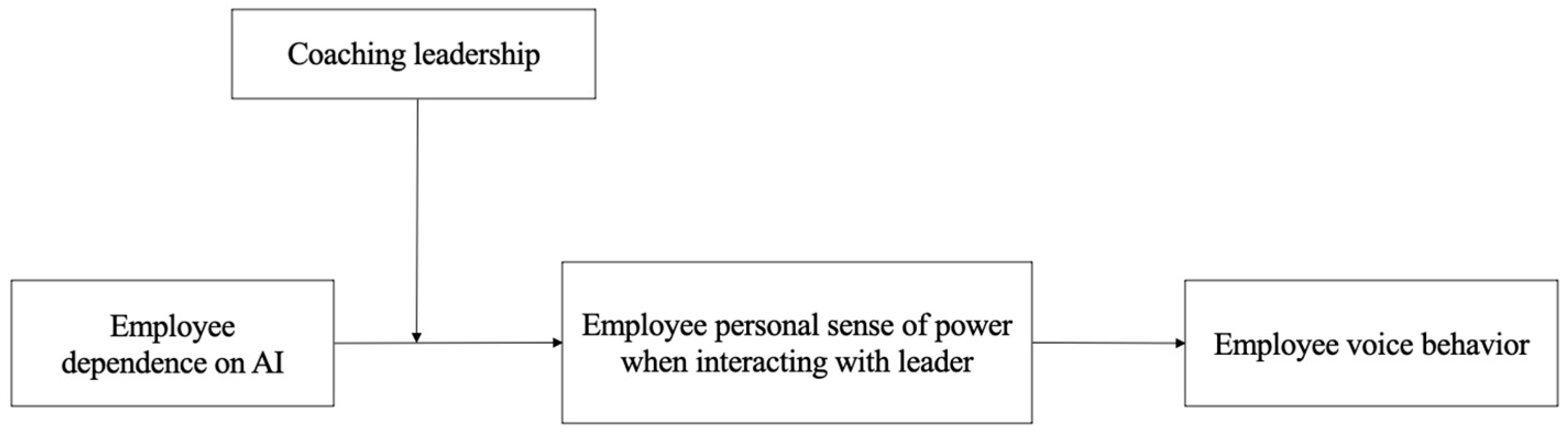
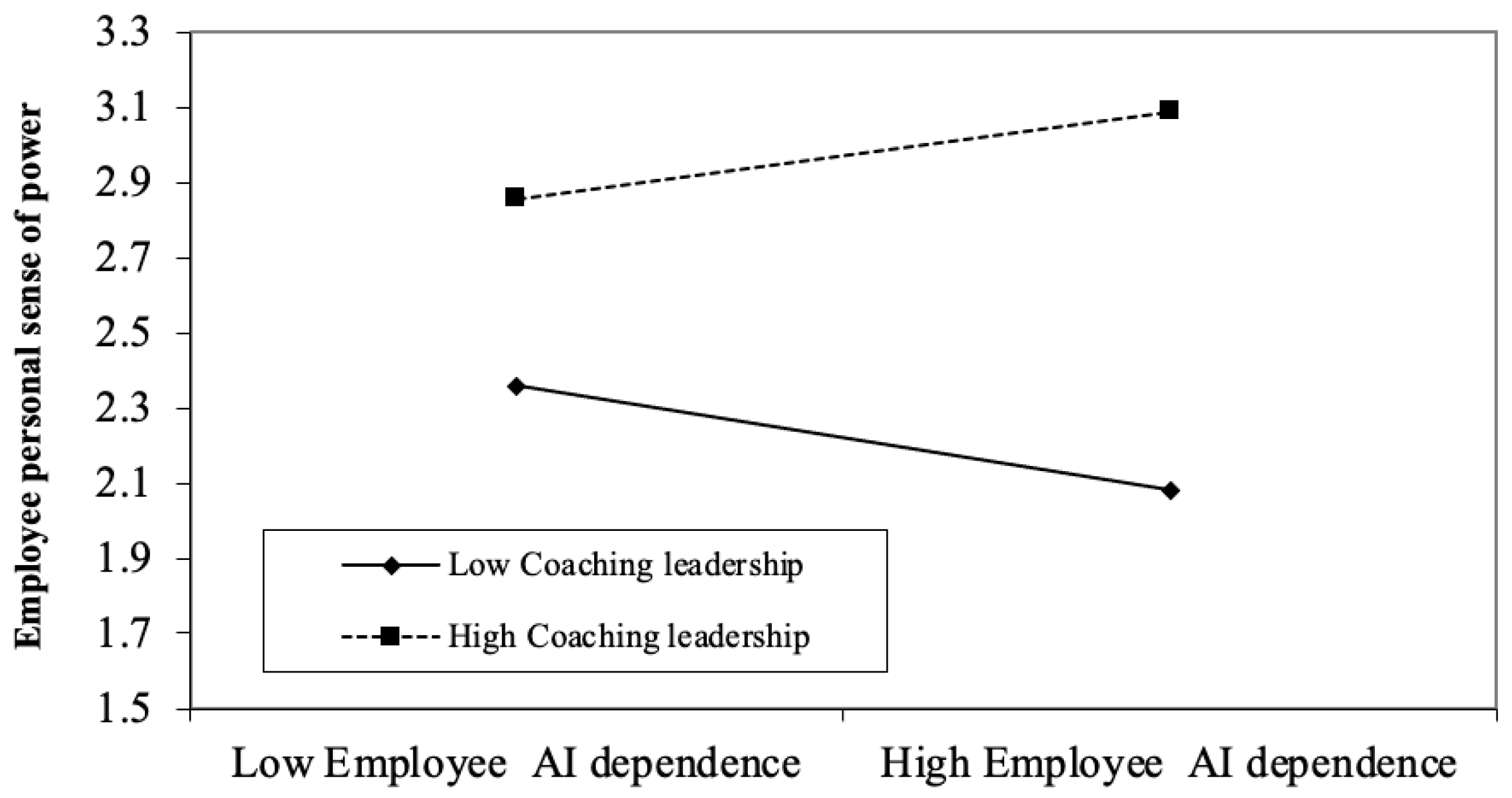
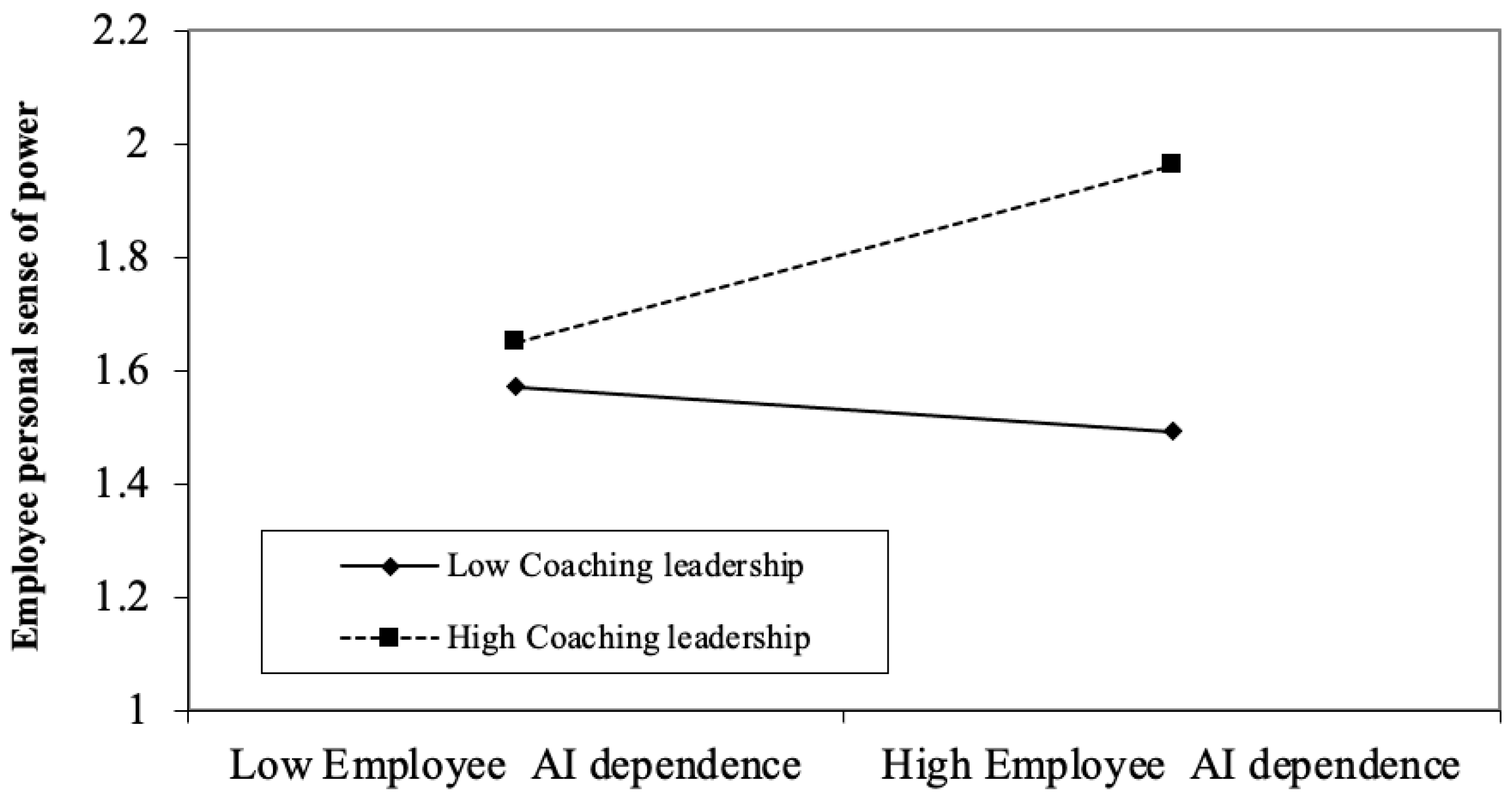
Schildt, 2017). When coaching leadership is high, the functional overlap between leadership and AI is more pronounced, thereby amplifying the impact of AI dependence on employees’ perceived power. In contrast, when coaching leadership is low, AI is less able to substitute for leadership functions, and the effect of AI dependence on perceived power is likely to be diminished. Thus, we propose that the degree of coaching leadership moderates the relationship between AI dependence and employees’ perceived power, with the relationship is stronger under high levels of coaching leadership than under low levels.
This study makes a significant theoretical contribution by examining how employees’ increasing dependence on AI reshapes power dynamics within leader-employee relationships, drawing on power dependence theory. By introducing AI as a third-party actor, it highlights how power can be redistributed among leaders, employees, and AI systems. The findings indicate that employees’ growing dependence on AI enhances their sense of personal power in interactions with leaders, thereby altering traditional power dynamics and interaction patterns. Furthermore, the study reveals that coaching leadership moderates this relationship, intensifying the impact of AI dependence on employees’ perceived power. This finding extends existing leadership theories by suggesting that AI can substitute certain interpersonal leadership functions. The study also offers practical insights for organizations to adapt leadership practices in the AI era while maintaining effective leader-employee relationships.
12. Discussion and Conclusions
Drawing on Power Dependence Theory, this study examines how employees’ dependence on AI shapes their workplace voice behavior. Using two experimental studies and two surveys, the findings show that AI dependence enhances employees’ personal sense of power, which in turn moderates voice behavior. Furthermore, coaching leadership strengthens these relationships: the effects of AI dependence on both perceived power and voice behavior are more pronounced under high rather than low levels of coaching leadership. These results provide important theoretical and practical implications.
12.1. Theoretical Implications
This research makes several important theoretical contributions. First, this study uncovers a novel power dynamics mechanism through which AI dependence influences employee voice behavior. Traditionally, research has focused on static, hierarchical power dynamics within leader–subordinate dyads (
Chiu et al., 2017;
Abdel-Halim, 1979;
Farmer & Aguinis, 2005). In contrast, our research broadens the scope by examining the dynamic, triadic relationship among leaders, employees, and AI. As AI becomes more embedded in organizational processes (
Höddinghaus et al., 2021), it reshapes power perceptions, enhancing employees’ sense of power and fostering voice behavior. By emphasizing power perceptions as a central mechanism, we offer a new theoretical explanation for how AI dependence drives employee voice, expanding on previous research that highlights employees’ reluctance to voice opinions due to power imbalances (
Morrison & Milliken, 2000;
Morrison & Rothman, 2009). This contribution shifts the focus from individual outcomes—such as autonomy, job insecurity, and performance (
Ackerman & Kanfer, 2020;
Malik et al., 2023)—to the interpersonal dynamics within organizations, thus providing a more nuanced understanding of how AI not only influences individual work outcomes but also reshapes power dynamics and interpersonal interactions.
Second, this study explores the potential for AI to substitute certain leadership functions, particularly in the context of coaching leadership. By identifying coaching leadership as a key moderator in the relationship between AI dependence and perceived power, we address the question of whether AI can replace or complement specific leadership roles (
Wesche & Sonderegger, 2019). Our findings suggest that AI can either substitute or enhance leadership functions, particularly those involving guidance and feedback. In this context, AI complements leadership behaviors, strengthening employees’ sense of power and altering traditional power dynamics. These insights contribute to ongoing debates regarding AI’s capacity to assume leadership responsibilities, adding depth to the literature on AI’s evolving role in leadership theory.
Finally, this study provides initial evidence that the impact of AI dependence transcends cultural boundaries. Despite the cultural differences between China and the United States, our results show consistent patterns: AI dependence positively influenced employees’ perceived power, which in turn promoted voice behavior. This suggests that AI’s impact on power dynamics and voice behavior reflects a broader, global shift in organizational structures, rather than being culturally specific. These findings challenge assumptions that voice behavior would differ significantly across cultures—particularly the expectation that collectivist cultures, such as China, would exhibit more restrained voice behavior (
Hui et al., 2004;
Morrison, 2011). Thus, this study underscores the universal implications of AI in reshaping power perceptions and interpersonal relationships across diverse cultural contexts.
12.2. Practical Implications
Our study demonstrates that AI dependence enhances employees’ sense of power, thereby encouraging greater voice behavior in the workplace. However, this empowerment dynamic also presents challenges for leadership, as AI may strengthen employees’ confidence and initiative while potentially diminishing leaders’ perceived authority if not managed effectively. The following implications provide guidance on how organizations and leaders can respond to the changing landscape of AI-augmented work environments.
First, leadership remains crucial even as AI technologies evolve (
Agrawal et al., 2017;
Davenport & Kirby, 2016;
Kolbjørnsrud et al., 2017). As AI takes on more decision-support and feedback functions, leaders must develop complementary capabilities rather than compete with AI. Our findings suggest that coaching leadership—focused on guidance and feedback—aligns well with AI’s capabilities. Leaders should redefine their roles by emphasizing human connection, interpretation, and ethical judgment (
Hossain et al., 2025). By improving AI literacy and ethical awareness, leaders can ensure fairness and transparency in decision-making while maintaining human oversight.
Second, organizations must adopt a balanced approach to AI integration, acknowledging both its empowering potential and relational risks (
Newman et al., 2020). AI should support, not replace, human leadership. Clear ethical boundaries are necessary, especially in performance evaluation and recruitment. Over-dependence on AI can reduce autonomy, creativity, and intrinsic motivation (
Davenport & Kirby, 2016). Ethical frameworks should ensure AI empowers employees, rather than silences them. Furthermore, organizations should promote collaborative relationships and shared responsibility, positioning AI as a tool for collective development (
Wilson & Daugherty, 2018). Through thoughtful policy design and ongoing ethical review, AI and human leadership can work synergistically to foster employee voice and organizational vitality.
12.3. Limitations and Future Directions
Despite the valuable insights generated, several limitations in this research warrant attention and suggest directions for future studies.
First, our theoretical framework primarily draws on Power-Dependence Theory (
Emerson, 1962) to examine how AI reshapes leader–employee power dynamics. While this theory provides a strong foundation for understanding structural power shifts, it may not fully account for the motivational or relational processes involved in AI dependence. Future studies could integrate complementary perspectives, such as Self-Determination Theory (SDT), Social Exchange Theory (SET), or Algorithmic Management frameworks to offer a more holistic view of how AI affects intrinsic motivation, autonomy, and inter-personal trust. For instance, Self-Determination Theory may clarify whether AI’s impact on employees’ autonomy enhances or undermines intrinsic motivation and job satisfaction.
Second, although this study identifies employees’ sense of power as a key psycho-logical mechanism linking AI dependence to voice behavior, other pathways may also contribute to this relationship. AI dependence may alter affective or motivational states such as confidence, anxiety, or fatigue, which in turn influence employees’ willingness to speak up. Future research could examine interaction-related indicators, such as communication frequency or reliance on leader feedback, to determine whether increased AI dependence alters upward voice by reducing interpersonal reliance on supervisors. Beyond voice behavior, AI dependence may also shape a broader range of work behaviors, including creativity, risk-taking, or opportunism (
Boussioux et al., 2024;
Jia et al., 2024). Greater autonomy and information access may foster innovation, whereas excessive reliance on AI could potentially lead to isolation, diminished social connection, or self-serving tendencies (
Hai et al., 2025). Exploring these dual consequences would enrich understanding of how AI dependence reshapes both social and task-oriented behaviors in organizations.
Third, although our experimental studies successfully isolated the core theoretical mechanisms of AI dependence, the simplified task scenarios may not fully capture the complexity of real-world power relations. The consulting-task setting captured AI guidance but lacked elements such as multi-stakeholder interactions, hierarchical tensions, or organizational politics, all of which are common in actual workplaces. Future research could adopt more realistic and context-rich designs to better reflect the multifaceted nature of power, decision-making, and influence in AI-enhanced environments. Combining experimental methods with field studies would also strengthen validity by balancing internal control with external realism.
Fourth, our reliance on self-report data in Studies 3 and 4 may have introduced common method variance (CMV), despite the use of time-lagged designs and controls for social desirability. Future research should employ multi-source data, such as supervisor ratings, peer assessments, or objective performance indicators and consider analytical approaches of unmeasured latent method factor (ULMF) techniques to mitigate CMV risk and strengthen causal inference.
Finally, cultural context likely plays a crucial role in shaping how employees perceive AI’s influence on power and voice. In high power-distance or collectivist cultures like China, employees may be less inclined to express voice or challenge authority due to hierarchical norms emphasizing respect and harmony (
Hofstede, 2001;
Farh et al., 2007;
Hui et al., 2004). Future research should systematically compare cultural contexts to explore how national values, institutional systems, and leadership traditions moderate the effects of AI dependence. Such cross-cultural investigations would deepen our under-standing of how AI is embedded within different sociocultural systems and clarify its implications for leadership and employee agency across global workplaces.