Intrinsic Learning Rather than External Difficulty Dominates Decision Performance: Integrated Evidence from the Drift-Diffusion Model and Random Forest Analysis


Abstract
1. Introduction
2. Methods
2.1. Participants
2.2. Experimental Design
2.3. Experimental Task
2.3.1. Learning Stage
- (1)
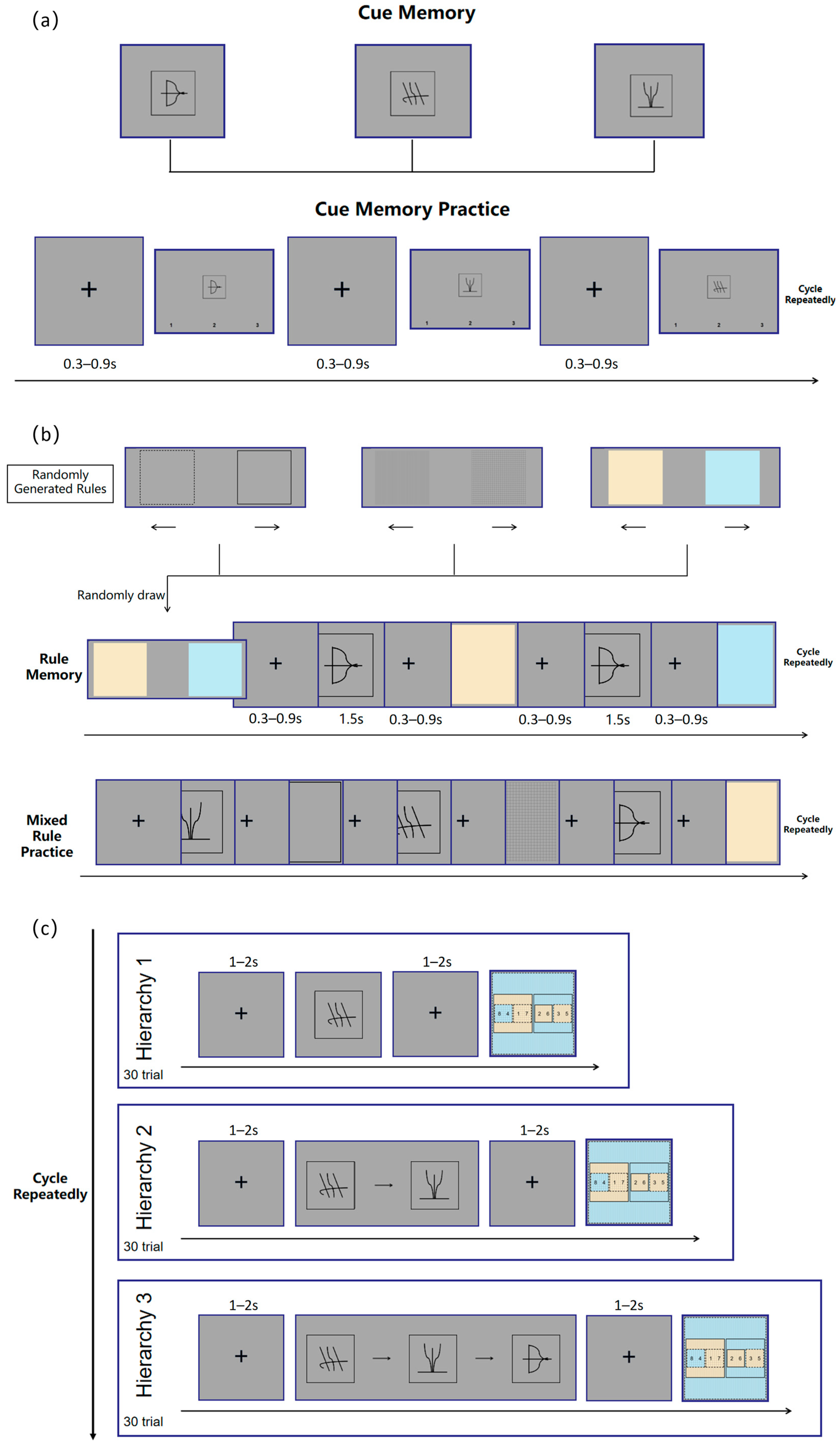
- Cue Memory. Participants first learned three cue symbols and their corresponding judgment rules, with the symbol–rule pairings assigned randomly. They then entered the practice phase for cue–rule associations. During this phase, the cue symbols learned previously were presented one by one at the center of the screen. Keys 1, 2, and 3 represented the three rules, respectively. Participants were required to quickly and accurately identify the meaning associated with each cue symbol and make the correct keypress response. If a participant responded incorrectly, the corresponding cue would reappear on the screen along with the instructional message from the cue memory phase, prompting the participant to memorize it again. A fixation cross was presented for 0.3–0.9 s between trials, as illustrated in Figure 1a.
- (2)
- Rule Memory. A cue image was first presented on the screen, and the accompanying instructions informed participants of the rule corresponding to that cue. Participants were required to memorize the attentional directions associated with the two features under that rule. They then entered the practice phase for the corresponding rule. In each trial, the cue symbol for the rule appeared first on the screen, prompting the participant to recall the rule it represented. Next, one of the features under that rule was randomly presented, and participants were asked to judge its attentional direction (left or right) according to the rule and press the corresponding key (left or right arrow key). The stimulus disappeared immediately after the response. If the response was incorrect, the system provided corrective feedback. Specifically, for the color rule, the two features were blue and orange; for the texture rule, the features were vertical lines and crosshatch textures; and for the border rule, the features were solid and dashed borders. The attentional direction assigned to each feature was randomized, with one feature corresponding to the left direction and the other to the right. For example, when the selected rule was the color rule and its cue image corresponded to the “bow and arrow” symbol (as shown in the top-left corner of the third image in the first row of Figure 1a), orange might correspond to the left and blue to the right. A fixation cross lasting 0.3–0.9 s was presented between trials, as illustrated in Figure 2. This procedure was repeated three times (once for each rule), with 20 trials per rule (10 trials per feature). Each session involved one rule and one cue image. The order of rules was randomized, and all rules and features were sampled without replacement to ensure the independence and randomness of each trial.
- (3)
- Mixed Rule Practice. This phase tested participants’ memory of all three rules. Each feature was presented in five trials, resulting in 10 trials per rule. The three rules were randomly intermixed, producing a total of 30 trials. The trial procedure was identical to that used in the rule memory phase, and the overall process is shown in Figure 1b.
- (4)
- Experimental Practice. Participants were first informed of the content and procedures of the formal experiment through on-screen instructions. They then proceeded to a practice session, which followed the same procedure as the formal experiment (see the following section for details), except that the number of trials was smaller and feedback was provided, allowing participants to know whether their responses were correct.


2.3.2. Experimental Stage
2.4. Experimental Questionnaires
2.5. Experimental Procedure
2.6. Data Analysis
2.6.1. Data Preprocessing
2.6.2. Analysis of Variance (ANOVA)
2.6.3. Drift-Diffusion Model (DDM)
- (1)
- Model Construction
- (2)
- Parameter Estimation
- (3)
- Model Comparison
2.6.4. Random Forest
- (1)
- Variable Definition
- (2)
- Model Construction
- (3)
- Model Performance Evaluation
- (4)
- Model Importance Analysis
3. Results
3.1. Data Collation
3.2. The Results of Analysis of Variance (ANOVA)
3.3. The Results of Drift-Diffusion Model (DDM)
3.3.1. Model Fitting Results
3.3.2. Decision Parameters of the Optimal Model
- (1)
- Drift Rate (v)
- (2)
- Boundary Parameter (a)
- (3)
- Non-Decision Time (t0)
- (4)
- Starting Point Proportion (z)
3.4. The Results of Random Forest
3.4.1. Accuracy Classification Model
- (1)
- Model Performance
- (2)
- Key Classification Factors
3.4.2. Reaction Time Regression Model
- (1)
- Model Performance
- (2)
- Key Predictive Factors
4. Discussion
4.1. Regulation of Task Progress on the Rule Hierarchy Effect in Decision Tasks
4.2. Dissociable Mechanisms of Decision Accuracy and Decision Speed
4.3. Expansion of Decision-Making Theories
4.4. Limitations and Future Directions
5. Conclusions
Author Contributions
Funding
Institutional Review Board Statement
Informed Consent Statement
Data Availability Statement
Acknowledgments
Conflicts of Interest
References
- Han, Z., Sanchez, D., Levitan, C. A., & Sherman, A. (2024). Stimulus-locked auditory information facilitates real-time visuo-motor sequence learning. Psychonomic Bulletin & Review, 31(2), 828–838. [Google Scholar]
- Harada, T., Iwabuchi, T., Senju, A., Nakayasu, C., Nakahara, R., Tsuchiya, K. J., & Hoshi, Y. (2022). Neural mechanisms underlying rule selection based on response evaluation: A near-infrared spectroscopy study. Scientific Reports, 12(1), 20696. [Google Scholar] [CrossRef] [PubMed]
- Harris, J. A. (2022). The learning curve, revisited. Journal of Experimental Psychology: Animal Learning and Cognition, 48(4), 265. [Google Scholar] [CrossRef] [PubMed]
- Jacobs, P. A., & Gaver, D. P. (1998). Human factors influencing decision making (No. NPSOR98003). Naval Postgraduate School. [Google Scholar]
- Karayanidis, F., Hawkins, G. E., Wong, A. S., Aziz, F., Hunter, M., & Steyvers, M. (2023). Jointly modeling behavioral and EEG measures of proactive control in task switching. Psychophysiology, 60(7), e14241. [Google Scholar] [CrossRef] [PubMed]
- Koechlin, E., & Summerfield, C. (2007). An information theoretical approach to prefrontal executive function. Trends in Cognitive Sciences, 11(6), 229–235. [Google Scholar] [CrossRef] [PubMed]
- Li, J., Hua, L., & Deng, S. W. (2024). Modality-specific impacts of distractors on visual and auditory categorical decision-making: An evidence accumulation perspective. Frontiers in Psychology, 15, 1380196. [Google Scholar] [CrossRef] [PubMed]
- Markant, D. B., Ruggeri, A., Gureckis, T. M., & Xu, F. (2016). Enhanced memory as a common effect of active learning. Mind, Brain, and Education, 10(3), 142–152. [Google Scholar] [CrossRef]
- Mazur, J. E., & Hastie, R. (1978). Learning as accumulation: A reexamination of the learning curve. Psychological Bulletin, 85(6), 1256. [Google Scholar] [CrossRef] [PubMed]
- Moisello, C., Crupi, D., Tunik, E., Quartarone, A., Bove, M., Tononi, G., & Ghilardi, M. F. (2009). The serial reaction time task revisited: A study on motor sequence learning with an arm-reaching task. Experimental Brain Research, 194(1), 143–155. [Google Scholar] [CrossRef] [PubMed]
- Nee, D. E., & Brown, J. W. (2012). Rostral–caudal gradients of abstraction revealed by multi-variate pattern analysis of working memory. Neuroimage, 63(3), 1285–1294. [Google Scholar] [CrossRef] [PubMed]
- Newell, B. R., & Shanks, D. R. (2014). Unconscious influences on decision making: A critical review. Behavioral and Brain Sciences, 37(1), 1–19. [Google Scholar] [CrossRef] [PubMed]
- Paas, F., & Van Merrienboer, J. J. (2020). Cognitive-load theory: Methods to manage working memory load in the learning of complex tasks. Current Directions in Psychological Science, 29(4), 394–398. [Google Scholar] [CrossRef]
- Suzuki, Y., Yokosawa, S., & Aline, D. (2022). The role of working memory in blocked and interleaved grammar practice: Proceduralization of L2 syntax. Language Teaching Research, 26(4), 671–695. [Google Scholar] [CrossRef]
- Sweller, J. (2011). Cognitive load theory. In Psychology of learning and motivation (Vol. 55, pp. 37–76). Academic Press. [Google Scholar]
- Sweller, J. (2023). The development of cognitive load theory: Replication crises and incorporation of other theories can lead to theory expansion. Educational Psychology Review, 35(4), 95. [Google Scholar] [CrossRef]
- van der Kleij, S. W., Groen, M. A., Segers, E., & Verhoeven, L. (2019). Sequential implicit learning ability predicts growth in reading skills in typical readers and children with dyslexia. Scientific Studies of Reading, 23(1), 77–88. [Google Scholar] [CrossRef]
- Van Maanen, L., Portoles, O., & Borst, J. P. (2021). The discovery and interpretation of evidence accumulation stages. Computational Brain & Behavior, 4(4), 395–415. [Google Scholar] [CrossRef]
- Verbruggen, F., McLaren, R., Pereg, M., & Meiran, N. (2018). Structure and implementation of novel task rules: A cross-sectional developmental study. Psychological Science, 29(7), 1113–1125. [Google Scholar] [CrossRef] [PubMed]
- Yu, Z., Cao, Y., & Cao, K. (1996). Atlas of color blindness inspection (5th ed.). People’s Medical Publishing House. [Google Scholar]
- Zhu, C., & Han, J. (2022). The higher, more complicated: The neural mechanism of hierarchical task switching on prefrontal cortex. Brain Sciences, 12(5), 645. [Google Scholar] [CrossRef] [PubMed]



| Dimension | Feature Content |
|---|---|
| Experimental Design | Block Information (Block_ID), Rule Hierarchy (Rule_Hierarchy), Interaction between Block and Rule Hierarchy (Block_ID*Rule_Hierarchy) |
| Computational Modeling Parameters | Drift Rate (v), Boundary Separation (a), Non-Decision Time (t0), Starting Point bias (Z0), Model Convergence Index (Rhat) |
| Dynamic Learning Process | Dynamic Learning Process of Accuracy (Acc_CMA_AllPast), Dynamic Learning Process of Reaction Time (RT_CMA_AllPast), Rule Switch Flag (Rule_alt) |
| Model No. | Model Name | Degrees of Freedom | AIC | BIC | R-Hat | ELPD |
|---|---|---|---|---|---|---|
| 1 | DDM with Rule Hierarchy | 12 | 262.60 | 283.48 | 0.99579 | −420.35 |
| 2 | DDM with Block | 20 | 285.30 | 305.78 | 0.99666 | −475.68 |
| 3 | DDM with Rule Hierarchy + Block | 60 | 258.10 | 381.56 | 0.99940 | −362.15 |
| 4 | DDM with Rule Hierarchy + Block + Interaction Effect | 60 | 255.80 | 358.42 | 0.99997 | −359.87 |
| Parameter | Effect Type | Parameter Estimate | 95% Confidence Interval | Comparison with Other Models |
|---|---|---|---|---|
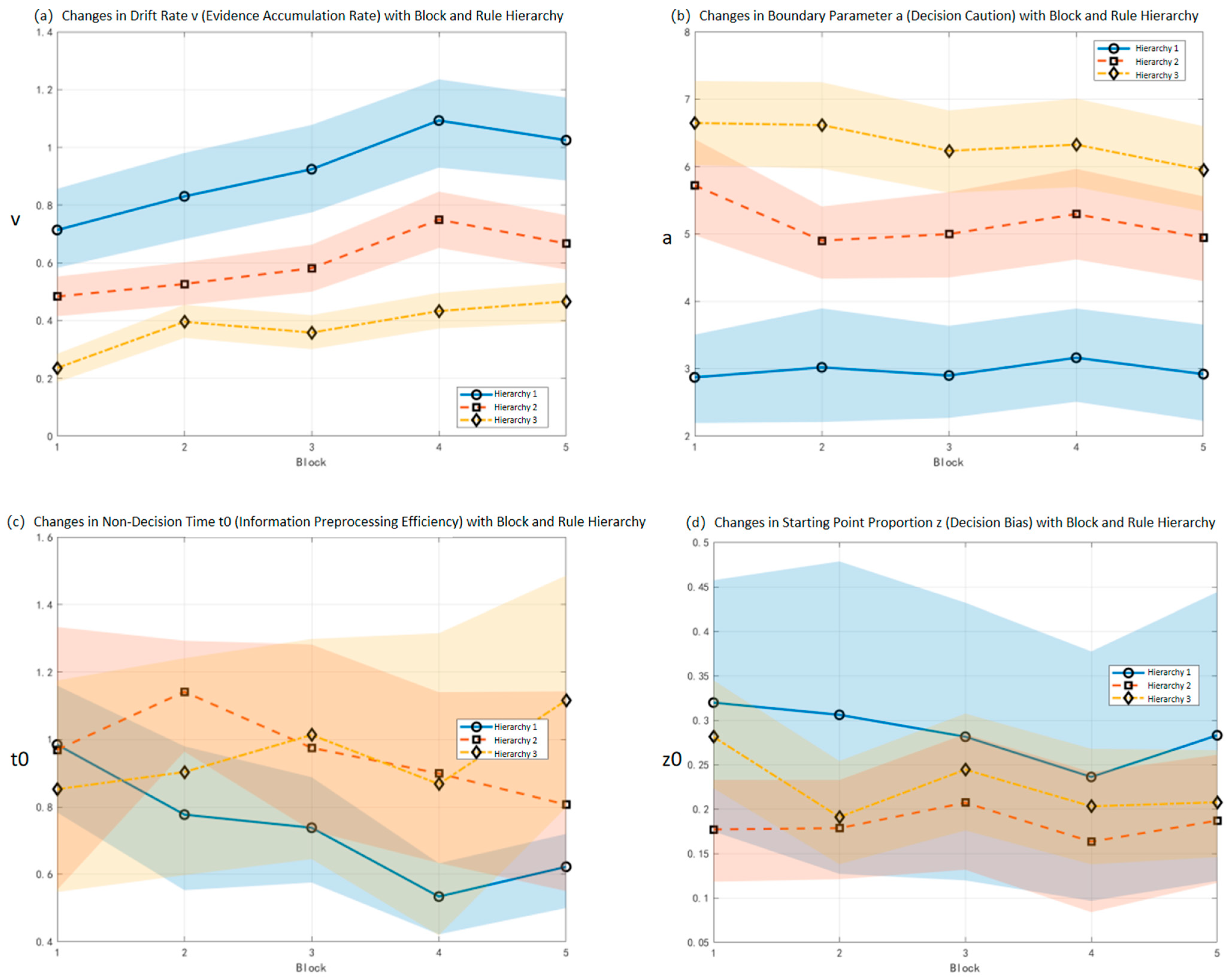
| Drift Rate (v) | Rule Hierarchy | Hierarchy 1: 0.92 | Hierarchy 1: [0.85, 0.99] | All show the consistent trend of “the lower the Rule Hierarchy, the significantly higher the drift rate” with Models 1 and 3, indicating that the regulatory effect of Rule Hierarchy on information accumulation rate is robust. |
| Hierarchy 2: 0.60 | Hierarchy 2: [0.52, 0.68] | |||
| Hierarchy 3: 0.38 | Hierarchy 3: [0.30, 0.46] | |||
| Block | Block 1: 0.48 | Block 1: [0.40, 0.56] | Both show the consistent law of “the drift rate generally increases with the increase in Block” with Model 1, with only a slight fluctuation in Block 5 due to fatigue, indicating that the promoting effect of practice on information processing efficiency is robust. | |
| Block 2: 0.58 | Block 2: [0.50, 0.66] | |||
| Block 3: 0.62 | Block 3: [0.54, 0.70] | |||
| Block 4: 0.76 | Block 4: [0.68, 0.84] | |||
| Block 5: 0.72 | Block 5: [0.64, 0.80] | |||
| Interaction Effect | M = 0.14 | M: [0.05, 0.23] | Only capturable in Model 4. | |
| Boundary Parameter (a) | Rule Hierarchy | Hierarchy 1: 2.98 | Hierarchy 1: [2.81, 3.15] | All show the consistent trend of “the higher the Rule Hierarchy, the significantly larger the Boundary Parameter” with Models 1 and 3, indicating that the regulatory effect of Rule Hierarchy on decision caution is robust. |
| Hierarchy 2: 5.17 | Hierarchy 2: [5.02, 5.32] | |||
| Hierarchy 3: 6.36 | Hierarchy 3: [6.20, 6.52] | |||
| Block | Block 1: 5.08 | Block 1: [4.92, 5.24] | Both show the consistent law of “the Boundary Parameter generally shows a decreasing trend with the increase in Block” with Model 3, with only a slight rebound in Block 4, indicating that the promoting effect of practice on decision flexibility is robust. | |
| Block 2: 4.85 | Block 2: [4.69, 5.01] | |||
| Block 3: 4.71 | Block 3: [4.55, 4.87] | |||
| Block 4: 4.93 | Block 4: [4.77, 5.09] | |||
| Block 5: 4.61 | Block 5: [4.45, 4.77] | |||
| Interaction Effect | M = −0.01 | M: [−0.04, 0.03] | Only capturable in Model 4. | |
| Non-Decision Time (t0) | Rule Hierarchy | Hierarchy 1: 731.20 | Hierarchy 1: [710.50, 751.90] | All show the consistent trend of “the non-decision time of Rule Hierarchy 1 is significantly shorter than that of Hierarchy 2 and 3” with Models 1 and 3, indicating that the regulatory effect of Rule Hierarchy on information preprocessing efficiency is robust. |
| Hierarchy 2: 958.40 | Hierarchy 2: [936.80, 979.90] | |||
| Hierarchy 3: 950.60 | Hierarchy 3: [928.30, 972.90] | |||
| Block | Block 1: 935.50 | Block 1: [912.30, 958.70] | Both show the consistent law of “the non-decision time generally shows a decreasing trend with the increase in Block” with Models 2 and 3, indicating that the promoting effect of practice on the efficiency of the information preprocessing stage is robust. | |
| Block 2: 940.70 | Block 2: [917.50, 963.90] | |||
| Block 3: 908.90 | Block 3: [885.70, 932.10] | |||
| Block 4: 766.80 | Block 4: [743.60, 789.00] | |||
| Block 5: 848.30 | Block 5: [825.10, 871.50] | |||
| Interaction Effect | M = 16.50 | M: [−12.40, 36.18] | Only capturable in Model 4. | |
| Starting Point Proportion (z) | Rule Hierarchy | Hierarchy 1: 0.29 | Hierarchy 1: [0.26, 0.32] | All show the trend that the starting point proportion z of Hierarchy 2 is the smallest with Models 1 and 3. |
| Hierarchy 2: 0.18 | Hierarchy 2: [0.15, 0.21] | |||
| Hierarchy 3: 0.23 | Hierarchy 3: [0.20, 0.26] | |||
| Block | Block 1: 0.26 | Block 1: [0.23, 0.29] | Both show the consistent law of “the decision starting point proportion generally decreases with the increase in Block” with Model 3, indicating that the weakening effect of practice on initial decision bias is robust. | |
| Block 2: 0.23 | Block 2: [0.20, 0.26] | |||
| Block 3: 0.24 | Block 3: [0.21, 0.27] | |||
| Block 4: 0.20 | Block 4: [0.17, 0.23] | |||
| Block 5: 0.23 | Block 5: [0.20, 0.26] | |||
| Interaction Effect | M = 0.01 | M: [−0.02, 0.04] | Only capturable in Model 4. |
Disclaimer/Publisher’s Note: The statements, opinions and data contained in all publications are solely those of the individual author(s) and contributor(s) and not of MDPI and/or the editor(s). MDPI and/or the editor(s) disclaim responsibility for any injury to people or property resulting from any ideas, methods, instructions or products referred to in the content. |
© 2026 by the authors. Licensee MDPI, Basel, Switzerland. This article is an open access article distributed under the terms and conditions of the Creative Commons Attribution (CC BY) license.
Share and Cite
Liu, Y.; Zhang, Q. Intrinsic Learning Rather than External Difficulty Dominates Decision Performance: Integrated Evidence from the Drift-Diffusion Model and Random Forest Analysis. Behav. Sci. 2026, 16, 300. https://doi.org/10.3390/bs16020300
Liu Y, Zhang Q. Intrinsic Learning Rather than External Difficulty Dominates Decision Performance: Integrated Evidence from the Drift-Diffusion Model and Random Forest Analysis. Behavioral Sciences. 2026; 16(2):300. https://doi.org/10.3390/bs16020300
Chicago/Turabian StyleLiu, Yanzhe, and Qihan Zhang. 2026. "Intrinsic Learning Rather than External Difficulty Dominates Decision Performance: Integrated Evidence from the Drift-Diffusion Model and Random Forest Analysis" Behavioral Sciences 16, no. 2: 300. https://doi.org/10.3390/bs16020300
APA StyleLiu, Y., & Zhang, Q. (2026). Intrinsic Learning Rather than External Difficulty Dominates Decision Performance: Integrated Evidence from the Drift-Diffusion Model and Random Forest Analysis. Behavioral Sciences, 16(2), 300. https://doi.org/10.3390/bs16020300