
The Green Shield: How Pro-Environmental Advocacy Protects Employees from Supervisor Ostracism

Abstract
1. Introduction
2. Theoretical Framework and Hypothesis Development
2.1. Signaling High Moral Character Through Work Group Green Advocacy
2.2. Moral Credits as a Buffer Against Supervisor Ostracism
2.3. The Moderating Role of Supervisory Support for the Environment
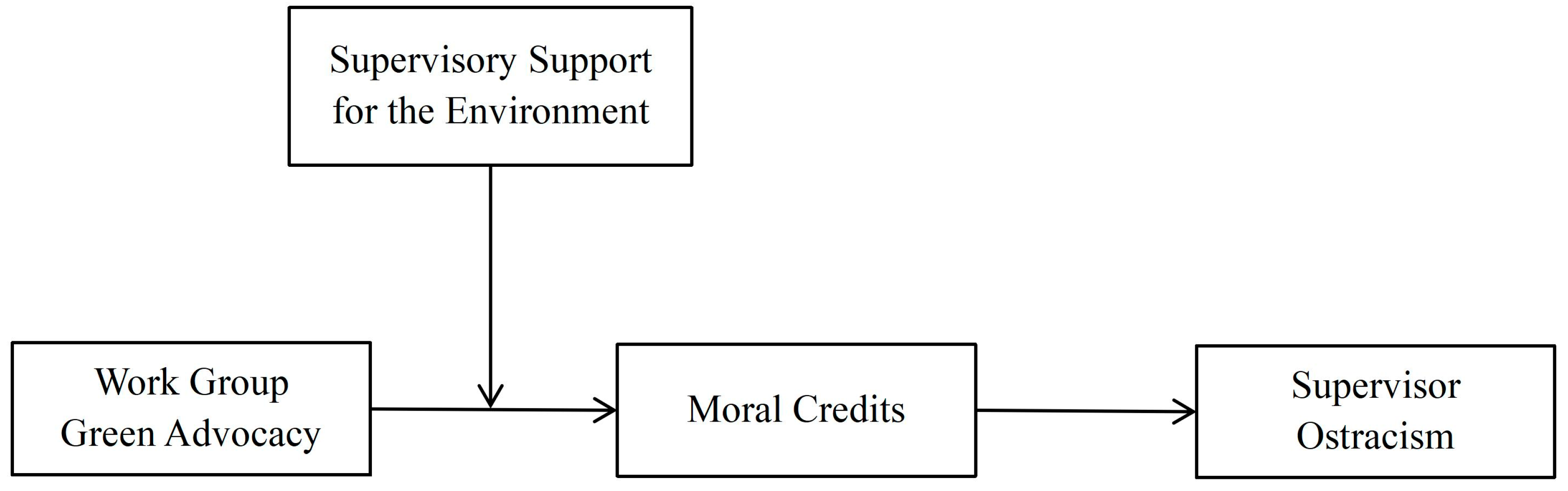
2.4. Overview of Studies
3. Study 1 Method
3.1. Participants
3.2. Procedure and Experimental Design
3.3. Measure
4. Study 1 Results
4.1. Manipulation Check
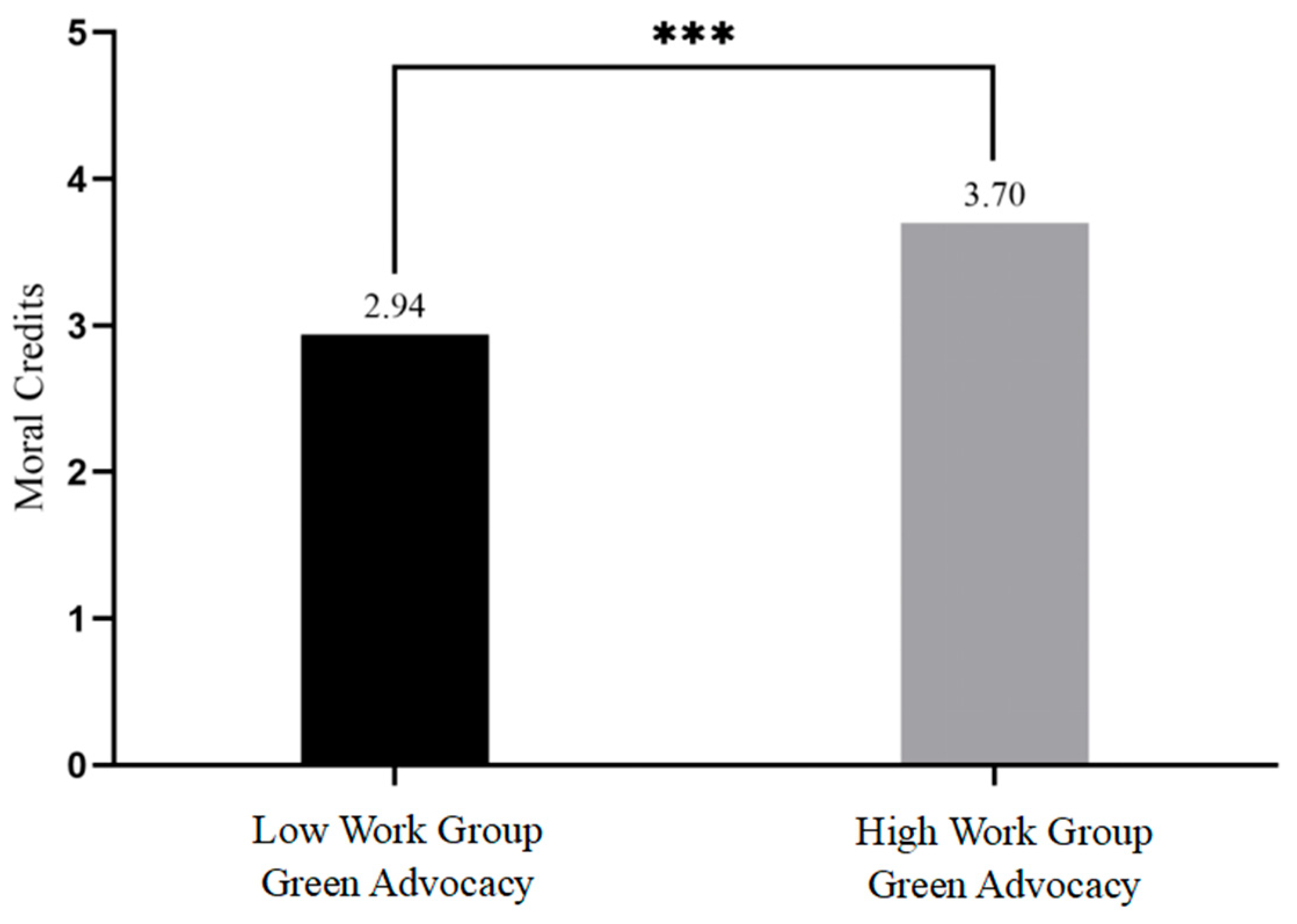
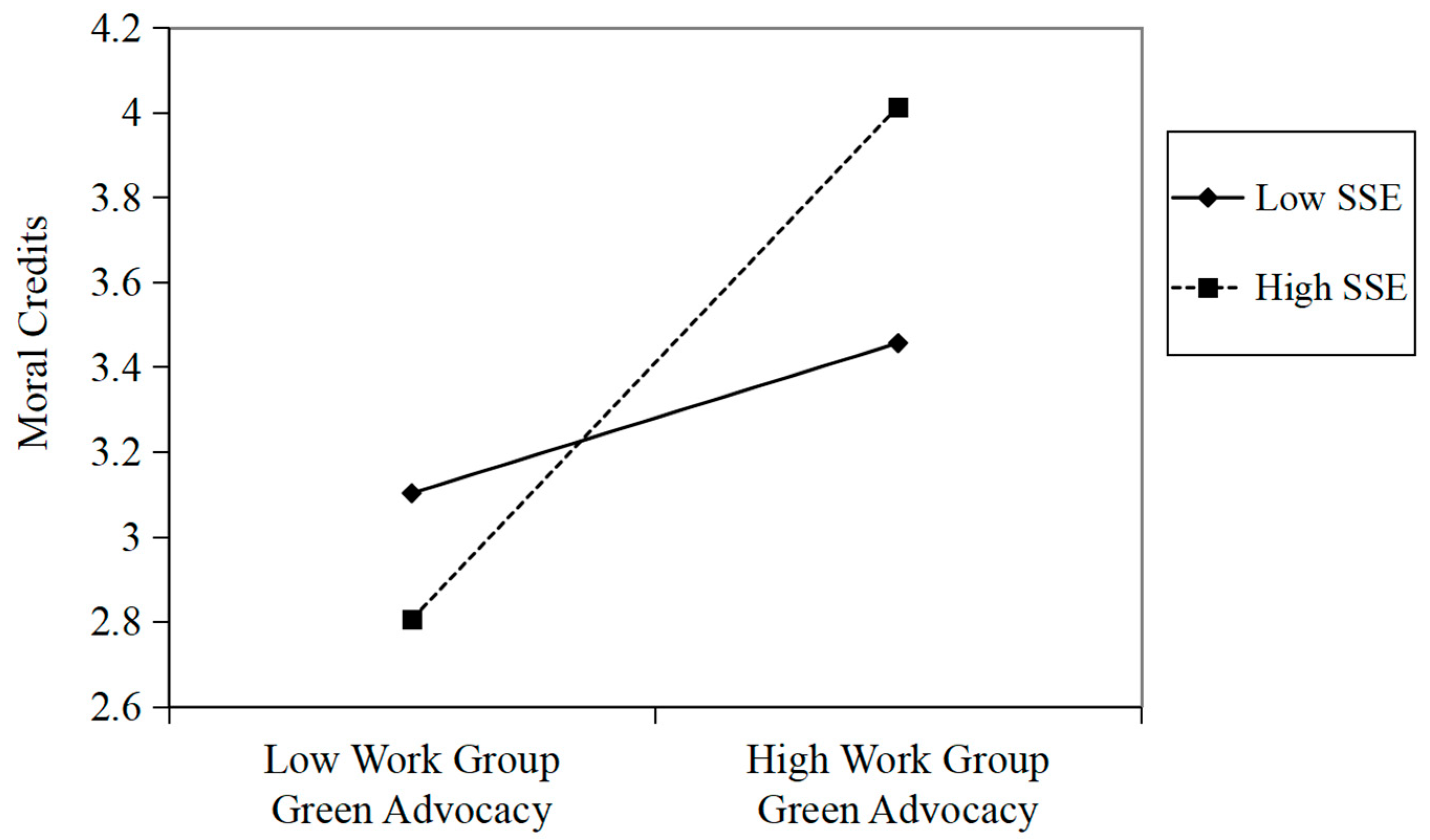
4.2. Hypotheses Examination
5. Study 2 Method
5.1. Procedure and Participants
5.2. Measurement
6. Study 2 Results
6.1. Measurement Model Validation
6.2. Descriptive Statistics and Simple Correlations
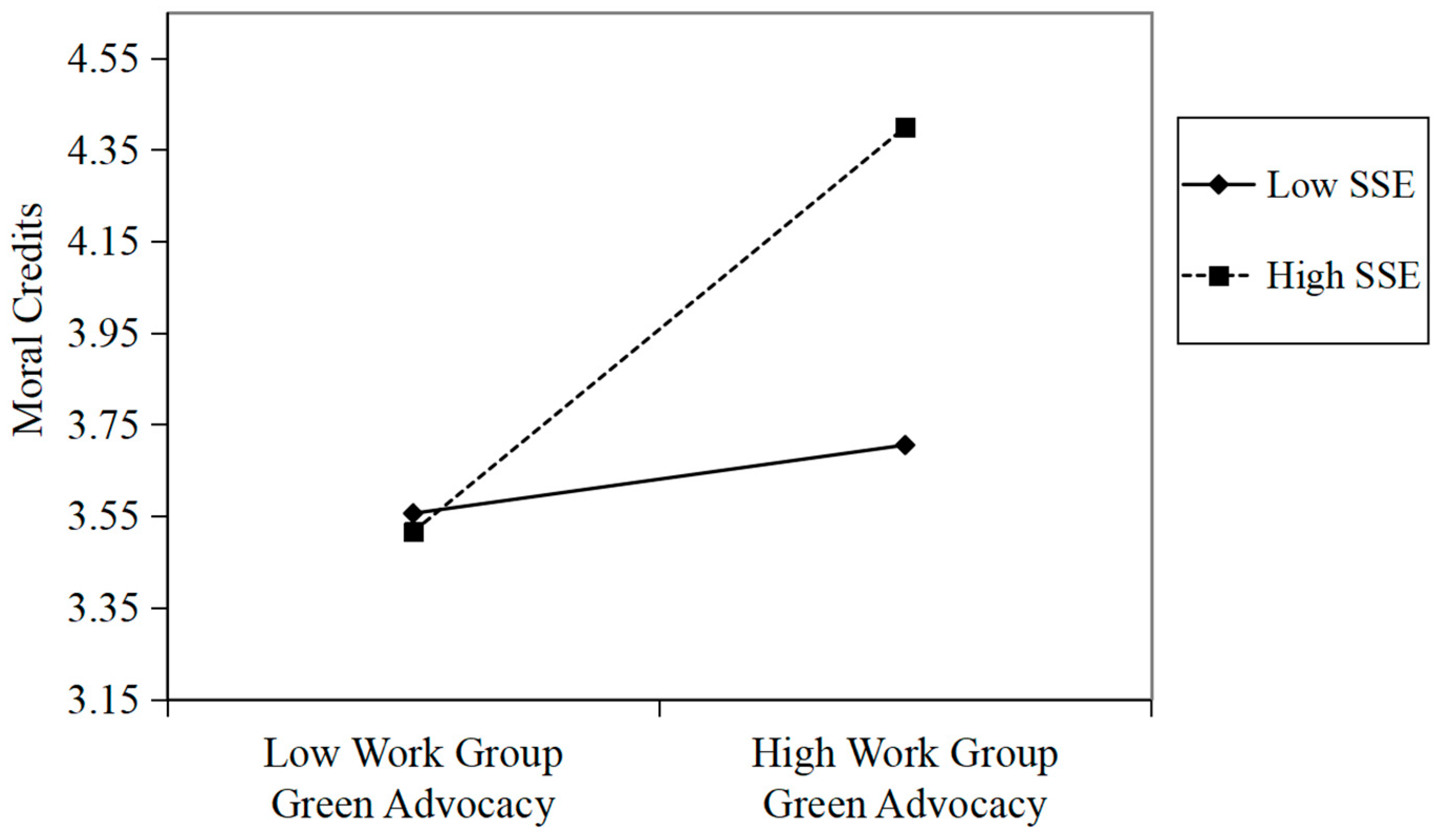
6.3. Hypotheses Examination
7. Discussion
7.1. Theoretical Contributions
7.2. Practical Implications
7.3. Limitations and Future Directions
8. Conclusions
Author Contributions
Funding
Institutional Review Board Statement
Informed Consent Statement
Data Availability Statement
Conflicts of Interest
Appendix A. Manipulations of Employee Green Advocacy in Study 1
- Green Advocacy Condition
- Control Condition
Appendix B. Scale Items Used in Studies 1 and 2
- Work Group Green Advocacy (Study 1)
- Supervisory Support for the Environment (Study 1)
- Moral Credits (Study 1)
- Supervisor Ostracism Intention (Study 1)
- Work Group Green Advocacy (Study 2)
- Supervisory Support for the Environment (Study 2)
- Moral Credits (Study 2)
- Supervisor Ostracism (Study 2)
References
- Aiken, L. S., & West, S. G. (1991). Multiple regression: Testing and interpreting interactions. Sage Publications, Inc. [Google Scholar]
- Blau, P. M. (1964). Exchange and power in social life. Wiley. [Google Scholar]
- Bolino, M. C. (1999). Citizenship and impression management: Good soldiers or good actors? The Academy of Management Review, 24(1), 82–98. [Google Scholar] [CrossRef]
- Bolino, M. C., Klotz, A. C., Turnley, W. H., & Harvey, J. (2013). Exploring the dark side of organizational citizenship behavior. Journal of Organizational Behavior, 34(4), 542–559. [Google Scholar] [CrossRef]
- Branzei, O., Ursacki-Bryant, T. J., Vertinsky, I., & Zhang, W. (2004). The formation of green strategies in Chinese firms: Matching corporate environmental responses and individual principles. Strategic Management Journal, 25, 1075–1095. [Google Scholar] [CrossRef]
- Campbell, E. L., & Hahl, O. (2022). He’s overqualified, she’s highly committed: Qualification signals and gendered assumptions about job candidate commitment. Organization Science, 33(6), 2451–2476. [Google Scholar] [CrossRef]
- Carnes, N. C., Allmon, B., Alva, J., Cousar, K. A., & Varnam, Z. D. (2022). How morality signals, benefits, binds, and teaches. Journal of Experimental Social Psychology, 101, 104313. [Google Scholar] [CrossRef]
- Carton, A. M., & Lucas, B. J. (2018). How can leaders overcome the blurry vision bias? Identifying an antidote to the paradox of vision communication. Academy of Management Journal, 61(6), 2106–2129. [Google Scholar] [CrossRef]
- Cheng, C. (2024). How supervisor ostracism affects employee turnover intention: The roles of employee cynicism and job embeddedness. Journal of Managerial Psychology, 39(1), 39–51. [Google Scholar] [CrossRef]
- Cho, Y., & Jiang, W. Y. (2022). How work orientation impacts objective career outcomes via managerial (mis)perceptions. Academy of Management Journal, 65(4), 1353–1382. [Google Scholar] [CrossRef]
- Connelly, B. L., Certo, S. T., Ireland, R. D., & Reutzel, C. R. (2011). Signaling theory: A review and assessment. Journal of Management, 37(1), 39–67. [Google Scholar] [CrossRef]
- Connelly, B. L., Certo, S. T., Reutzel, C. R., DesJardine, M. R., & Zhou, Y. S. (2025). Signaling theory: State of the theory and its future. Journal of Management, 51(1), 24–61. [Google Scholar] [CrossRef]
- Cropanzano, R., & Mitchell, M. S. (2005). Social exchange theory: An interdisciplinary review. Journal of Management, 31(6), 874–900. [Google Scholar] [CrossRef]
- Desai, S. D., & Kouchaki, M. (2017). Moral symbols: A necklace of garlic against unethical requests. Academy of Management Journal, 60(1), 7–28. [Google Scholar] [CrossRef]
- Drover, W., Wood, M. S., & Corbett, A. C. (2018). Toward a cognitive view of signalling theory: Individual attention and signal set interpretation. Journal of Management Studies, 55(2), 209–232. [Google Scholar] [CrossRef]
- Faul, F., Erdfelder, E., Lang, A. G., & Buchner, A. (2007). G*Power 3: A flexible statistical power analysis program for the social, behavioral, and biomedical sciences. Behavior Research Methods, 39(2), 175–191. [Google Scholar] [CrossRef]
- Ferris, D. L., Brown, D. J., Berry, J. W., & Lian, H. (2008). The development and validation of the Workplace Ostracism Scale. Journal of Applied Psychology, 93(6), 1348–1366. [Google Scholar] [CrossRef]
- Godfrey, P. C. (2005). The relationship between corporate philanthropy and shareholder wealth: A risk management perspective. Academy of Management Review, 30(4), 777–798. [Google Scholar] [CrossRef]
- Gomulya, D., & Mishina, Y. (2017). Signaler credibility, signal susceptibility, and relative reliance on signals: How stakeholders change their evaluative processes after violation of expectations and rehabilitative efforts. Academy of Management Journal, 60(2), 554–583. [Google Scholar] [CrossRef]
- Grant, A. M., & Mayer, D. M. (2009). Good soldiers and good actors: Prosocial and impression management motives as interactive predictors of affiliative citizenship behaviors. Journal of Applied Psychology, 94(4), 900–912. [Google Scholar] [CrossRef]
- Grant, A. M., & Patil, S. V. (2012). Challenging the norm of self-interest: Minority influence and transitions to helping norms in work units. The Academy of Management Review, 37(4), 547–568. [Google Scholar] [CrossRef]
- Grimpe, C., Kaiser, U., & Sofka, W. (2019). Signaling valuable human capital: Advocacy group work experience and its effect on employee pay in innovative firms. Strategic Management Journal, 40(4), 685–710. [Google Scholar] [CrossRef]
- Griskevicius, V., Tybur, J. M., & Van den Bergh, B. (2010). Going green to be seen: Status, reputation, and conspicuous conservation. Journal of Personality and Social Psychology, 98(3), 392–404. [Google Scholar] [CrossRef]
- Hales, A. H., Kassner, M. P., Williams, K. D., & Graziano, W. G. (2016). Disagreeableness as a cause and consequence of ostracism. Personality & Social Psychology Bulletin, 42(6), 782–797. [Google Scholar] [CrossRef]
- Hayes, A. F. (2015). An index and test of linear moderated mediation. Multivariate Behavioral Research, 50(1), 1–22. [Google Scholar] [CrossRef]
- Hayes, A. F. (2017). Introduction to mediation, moderation, and conditional process analysis: A regression-based approach. Guilford Publications. [Google Scholar]
- Howard, M. C., Cogswell, J. E., & Smith, M. B. (2020). The antecedents and outcomes of workplace ostracism: A meta-analysis. Journal of Applied Psychology, 105(6), 577–596. [Google Scholar] [CrossRef]
- Huang, W., & Yuan, C. (2024). Workplace ostracism and helping behavior: A cross-level investigation: JBE. Journal of Business Ethics, 190(4), 787–800. [Google Scholar] [CrossRef]
- Inesi, M. E., & Cable, D. M. (2015). When accomplishments come back to haunt you: The negative effect of competence signals on women’s performance evaluations. Personnel Psychology, 68(3), 615–657. [Google Scholar] [CrossRef]
- Jahanzeb, S., Fatima, T., & Malik, M. A. R. (2018). Supervisor ostracism and defensive silence: A differential needs approach. European Journal of Work and Organizational Psychology, 27(4), 430–440. [Google Scholar] [CrossRef]
- Jiang, Z., Hu, X., & Wang, Z. (2018). Career adaptability and plateaus: The moderating effects of tenure and job self-efficacy. Journal of Vocational Behavior, 104, 59–71. [Google Scholar] [CrossRef]
- Kim, A., Kim, Y., Han, K., Jackson, S. E., & Ployhart, R. E. (2017). Multilevel influences on voluntary workplace green behavior: Individual differences, leader behavior, and coworker advocacy. Journal of Management, 43(5), 1335–1358. [Google Scholar] [CrossRef]
- Lin, S. J., Ma, J., & Johnson, R. E. (2016). When ethical leader behavior breaks bad: How ethical leader behavior can turn abusive via ego depletion and moral licensing. Journal of Applied Psychology, 101(6), 815–830. [Google Scholar] [CrossRef]
- Lindsey, A. P., Dawson, J. F., Avery, D. R., & King, E. B. (2017). Investigating why and for whom management ethnic representativeness influences interpersonal mistreatment in the workplace. Journal of Applied Psychology, 102(11), 1545–1563. [Google Scholar] [CrossRef]
- Liu, C., Li, H., & Li, L. (2022). Examining the curvilinear relationship of job performance, supervisor ostracism, and turnover intentions. Journal of Vocational Behavior, 138, 103787. [Google Scholar] [CrossRef]
- Meade, A. W., & Craig, S. B. (2012). Identifying careless responses in survey data. Psychological Methods, 17(3), 437–455. [Google Scholar] [CrossRef]
- Merritt, A. C., Effron, D. A., & Monin, B. (2010). Moral self-licensing: When being good frees us to be bad. Social and Personality Psychology Compass, 4(5), 344–357. [Google Scholar] [CrossRef]
- Minson, J. A., & Monin, B. (2012). Do-gooder derogation: Disparaging morally motivated minorities to defuse anticipated reproach. Social Psychological and Personality Science, 3(2), 200–207. [Google Scholar] [CrossRef]
- Monin, B., & Miller, D. T. (2001). Moral credentials and the expression of prejudice. Journal of Personality and Social Psychology, 81(1), 33–43. [Google Scholar] [CrossRef]
- Muthén, L. K., & Muthén, B. O. (1998–2017). Mplus user’s guide (8th ed.). Muthén & Muthén. [Google Scholar]
- Ng, T. W. H., Wang, M., Hsu, D. Y., & Su, C. (2022). Voice quality and ostracism. Journal of Management, 48(2), 281–318. [Google Scholar] [CrossRef]
- Ni, D., Yang, M., & Chen, W. (2024). A dual-path model of observers’ responses to peer voice endorsement: The role of instrumental attribution. Journal of Organizational Behavior, 45(1), 39–56. [Google Scholar] [CrossRef]
- Paillé, P., Mejía Morelos, J. H., Raineri, N., & Stinglhamber, F. (2019). The influence of the immediate manager on the avoidance of non-green behaviors in the workplace: A three-wave moderated-mediation model. Journal of Business Ethics, 155(3), 723–740. [Google Scholar] [CrossRef]
- Palan, S., & Schitter, C. (2018). Prolific.ac—A subject pool for online experiments. Journal of Behavioral and Experimental Finance, 17, 22–27. [Google Scholar] [CrossRef]
- Peer, E., Brandimarte, L., Samat, S., & Acquisti, A. (2017). Beyond the Turk: Alternative platforms for crowdsourcing behavioral research. Journal of Experimental Social Psychology, 70, 153–163. [Google Scholar] [CrossRef]
- Pharo, H., Gross, J., Richardson, R., & Hayne, H. (2011). Age-related changes in the effect of ostracism. Social Influence, 6(1), 22–38. [Google Scholar] [CrossRef]
- Podsakoff, P. M., MacKenzie, S. B., Lee, J.-Y., & Podsakoff, N. P. (2003). Common method biases in behavioral research: A critical review of the literature and recommended remedies. Journal of Applied Psychology, 88(5), 879–903. [Google Scholar] [CrossRef]
- Preacher, K. J., & Hayes, A. F. (2008). Asymptotic and resampling strategies for assessing and comparing indirect effects in multiple mediator models. Behavior Research Methods, 40, 879–891. [Google Scholar] [CrossRef]
- Robertson, J. L., & Barling, J. (2013). Greening organizations through leaders’ influence on employees’ pro-environmental behaviors. Journal of Organizational Behavior, 34(2), 176–194. [Google Scholar] [CrossRef]
- Robinson, S. L., O’Reilly, J., & Wang, W. (2013). Invisible at work: An integrated model of workplace ostracism. Journal of Management, 39(1), 203–231. [Google Scholar] [CrossRef]
- Rodell, J. B., & Lynch, J. W. (2016). Perceptions of employee volunteering: Is it “credited” or “stigmatized” by colleagues? Academy of Management Journal, 59(2), 611–635. [Google Scholar] [CrossRef]
- Rupp, D. E., & Mallory, D. B. (2015). Corporate social responsibility: Psychological, person-centric, and progressing. Annual Review of Organizational Psychology and Organizational Behavior, 2, 211–236. [Google Scholar] [CrossRef]
- Sarwar, B., Mahasbi, M. H., Zulfiqar, S., Sarwar, M. A., & Huo, C. (2025). Silent suffering: Exploring the far-reaching impact of supervisor ostracism via sociometer theory. Journal of Applied Research in Higher Education, 17(2), 791–806. [Google Scholar] [CrossRef]
- Sauer, S. J., Thomas-Hunt, M. C., & Morris, P. A. (2010). Too good to be true? The unintended signaling effects of educational prestige on external expectations of team performance. Organization Science, 21(5), 1108–1120. [Google Scholar] [CrossRef]
- Spence, M. (1973). Job market signaling. The Quarterly Journal of Economics, 87(3), 355–374. [Google Scholar] [CrossRef]
- Spence, M. (2002). Signaling in retrospect and the informational structure of markets. American Economic Review, 92(3), 434–459. [Google Scholar] [CrossRef]
- Taj, S. A. (2016). Application of signaling theory in management research: Addressing major gaps in theory. European Management Journal, 34(3), 338–348. [Google Scholar] [CrossRef]
- Taufik, D., Bolderdijk, J. W., & Steg, L. (2015). Acting green elicits a literal warm glow. Nature Climate Change, 5(1), 37–40. [Google Scholar] [CrossRef]
- Uhl-Bien, M., Riggio, R. E., Lowe, K. B., & Carsten, M. K. (2014). Followership theory: A review and research agenda. The Leadership Quarterly, 25(1), 83–104. [Google Scholar] [CrossRef]
- Venkataramani, V., Derfler-Rozin, R., Liu, X., & Mao, J. Y. (2024). Keep off my turf! Low-status managers’ territoriality as a response to employees’ novel ideas. Organization Science, 35(4), 1224–1250. [Google Scholar] [CrossRef]
- Vesely, S., Klöckner, C. A., & Brick, C. (2020). Pro-environmental behavior as a signal of cooperativeness: Evidence from a social dilemma experiment. Journal of Environmental Psychology, 67, 101362. [Google Scholar] [CrossRef]
- World Medical Association. (2013). World medical association declaration of Helsinki: Ethical principles for medical research involving human subjects. JAMA, 310(20), 2191–2194. Available online: https://jamanetwork.com/journals/jama/fullarticle/1760318 (accessed on 1 November 2025). [CrossRef]
- Wowak, A. J., Mannor, M. J., Arrfelt, M., & McNamara, G. (2016). Earthquake or glacier? How CEO charisma manifests in firm strategy over time. Strategic Management Journal, 37(3), 586–603. [Google Scholar] [CrossRef]
- Wu, L. Z., Ferris, D. L., Kwan, H. K., Chiang, F., Snape, E., & Liang, L. H. (2015). Breaking (or making) the silence: How goal interdependence and social skill predict being ostracized. Organizational Behavior and Human Decision Processes, 131, 51–66. [Google Scholar] [CrossRef]
- Xu, E., Huang, X., & Robinson, S. L. (2017). When self-view is at stake: Responses to ostracism through the lens of self-verification theory. Journal of Management, 43(7), 2281–2302. [Google Scholar] [CrossRef]
- Xu, X., Kwan, H. K., Wei, F., & Wang, Y. (2025). Who is likely to be ostracized? The easy target is the dark triad. Asia Pacific Journal of Management, 42(3), 1805–1832. [Google Scholar] [CrossRef]
- Zhang, S., Ren, S., & Tang, G. (2024). From passive to active: The positive spillover of required employee green behavior on green advocacy. Journal of Business Ethics, 192, 57–76. [Google Scholar] [CrossRef]



| M | SD | 1 | 2 | 3 | |
|---|---|---|---|---|---|
| 1. Employee green advocacy manipulation | 0.50 | 0.50 | |||
| 2. SSE | 3.74 | 0.81 | −0.11 | ||
| 3. Moral credits | 3.32 | 0.94 | 0.41 *** | 0.08 | |
| 4. Supervisor ostracism | 1.53 | 0.75 | 0.04 | −0.14 | −0.34 *** |
| Variable | Moral Credits | Supervisor Ostracism | |||||||
|---|---|---|---|---|---|---|---|---|---|
| Model 1 | Model 2 | Model 3 | |||||||
| b | S.E. | t | b | S.E. | t | b | S.E. | t | |
| SSE | 0.14 | 0.09 | 1.63 | −0.18 | 0.14 | −1.31 | −0.08 | 0.07 | −1.05 |
| Employee green advocacy manipulation | 0.79 | 0.14 | 5.55 *** | 0.78 | 0.14 | 5.62 *** | 0.30 | 0.13 | 2.36 * |
| Employee green advocacy manipulation × SSE | 0.53 | 0.18 | 2.97 ** | ||||||
| Moral credits | −0.33 | 0.07 | −4.92 *** | ||||||
| Constant | 2.38 | 0.36 | 6.71 *** | 2.95 | 0.10 | 29.98 *** | 2.76 | 0.33 | 8.41 *** |
| R2 | 0.18 | 0.23 | 0.16 | ||||||
| ΔR2 | 0.05 ** | ||||||||
| F | 15.93 *** | 14.15 *** | 9.16 *** | ||||||
| Model | χ2 | df | Δχ2/Δdf | CFI | TLI | RMSEA | SRMR |
|---|---|---|---|---|---|---|---|
| Hypothesized 4-factor | 605.67 | 246 | — | 0.96 | 0.96 | 0.06 | 0.04 |
| 3-factor (WGGA + SSE, MC, SO) | 980.7 | 249 | 375.03/3 *** | 0.93 | 0.92 | 0.08 | 0.05 |
| 2-factor (WGGA + SO + MC, SSE) | 3354.82 | 251 | 2749.15/5 *** | 0.69 | 0.66 | 0.17 | 0.22 |
| 1-factor | 6107.22 | 252 | 5501.55/6 *** | 0.41 | 0.35 | 0.23 | 0.27 |
| M | SD | 1 | 2 | 3 | 4 | 5 | 6 | 7 | |
|---|---|---|---|---|---|---|---|---|---|
| 1. Gender | 0.50 | 0.50 | |||||||
| 2. Age | 36.57 | 11.95 | −0.01 | ||||||
| 3. Education | 3.22 | 1.00 | 0.12 * | 0.01 | |||||
| 4. Organizational tenure | 7.27 | 6.11 | −0.03 | 0.62 *** | 0.00 | ||||
| 5. Work group green advocacy | 3.68 | 1.03 | 0.15 ** | −0.11* | 0.18 *** | −0.09 | |||
| 6. SSE | 3.64 | 1.07 | 0.19 *** | −0.18 *** | 0.19 *** | −0.10 * | 0.70 *** | ||
| 7. Moral credits | 3.86 | 0.85 | 0.04 | −0.06 | 0.06 | −0.06 | 0.32 *** | 0.31 *** | |
| 8. Supervisor ostracism | 1.56 | 0.72 | −0.01 | −0.06 | −0.12 * | −0.04 | −0.04 | −0.19 *** | −0.19 *** |
| Variable | Moral Credits | Leader’s Ostracism | |||||||
|---|---|---|---|---|---|---|---|---|---|
| Model 1 | Model 2 | Model 3 | |||||||
| b | S.E. | t | b | S.E. | t | b | S.E. | t | |
| Gender | −0.02 | 0.08 | −0.30 | −0.03 | 0.08 | −0.43 | 0.01 | 0.07 | 0.20 |
| Age | −0.00 | 0.00 | −0.26 | 0.00 | 0.00 | 0.23 | −0.00 | 0.00 | −1.10 |
| Education | 0.01 | 0.04 | 0.17 | −0.01 | 0.04 | −0.37 | −0.08 | 0.03 | −2.36 * |
| Organizational tenure | −0.00 | 0.01 | −0.36 | −0.00 | 0.01 | −0.58 | −0.00 | 0.01 | −0.13 |
| Work group green advocacy | 0.26 | 0.04 | 6.80 *** | 0.25 | 0.05 | 4.71 *** | 0.02 | 0.04 | 0.65 |
| Moral credits | −0.17 | 0.04 | −4.07 *** | ||||||
| SSE | 0.15 | 0.05 | 3.04 ** | ||||||
| Work group green advocacy × SSE | 0.17 | 0.03 | 5.41 *** | ||||||
| R2 | 0.11 | 0.18 | 0.06 | ||||||
Disclaimer/Publisher’s Note: The statements, opinions and data contained in all publications are solely those of the individual author(s) and contributor(s) and not of MDPI and/or the editor(s). MDPI and/or the editor(s) disclaim responsibility for any injury to people or property resulting from any ideas, methods, instructions or products referred to in the content. |
© 2026 by the authors. Licensee MDPI, Basel, Switzerland. This article is an open access article distributed under the terms and conditions of the Creative Commons Attribution (CC BY) license.
Share and Cite
Ju, D.; Tang, Y.; Geng, S.; Lu, R.; Wang, W. The Green Shield: How Pro-Environmental Advocacy Protects Employees from Supervisor Ostracism. Behav. Sci. 2026, 16, 196. https://doi.org/10.3390/bs16020196
Ju D, Tang Y, Geng S, Lu R, Wang W. The Green Shield: How Pro-Environmental Advocacy Protects Employees from Supervisor Ostracism. Behavioral Sciences. 2026; 16(2):196. https://doi.org/10.3390/bs16020196
Chicago/Turabian StyleJu, Dong, Yan Tang, Shu Geng, Ruobing Lu, and Weifeng Wang. 2026. "The Green Shield: How Pro-Environmental Advocacy Protects Employees from Supervisor Ostracism" Behavioral Sciences 16, no. 2: 196. https://doi.org/10.3390/bs16020196
APA StyleJu, D., Tang, Y., Geng, S., Lu, R., & Wang, W. (2026). The Green Shield: How Pro-Environmental Advocacy Protects Employees from Supervisor Ostracism. Behavioral Sciences, 16(2), 196. https://doi.org/10.3390/bs16020196