
Factors Predicting Ambulatory Status at Discharge After Fragility Hip Fracture Surgery: A Retrospective Cohort Study

 and
and
Abstract
1. Introduction
2. Materials and Methods
2.1. Design and Setting
2.2. Ethical Considerations
2.3. Sample Size Calculation
2.4. Study Endpoint
2.5. Data Collection
2.6. Data Analysis
3. Results
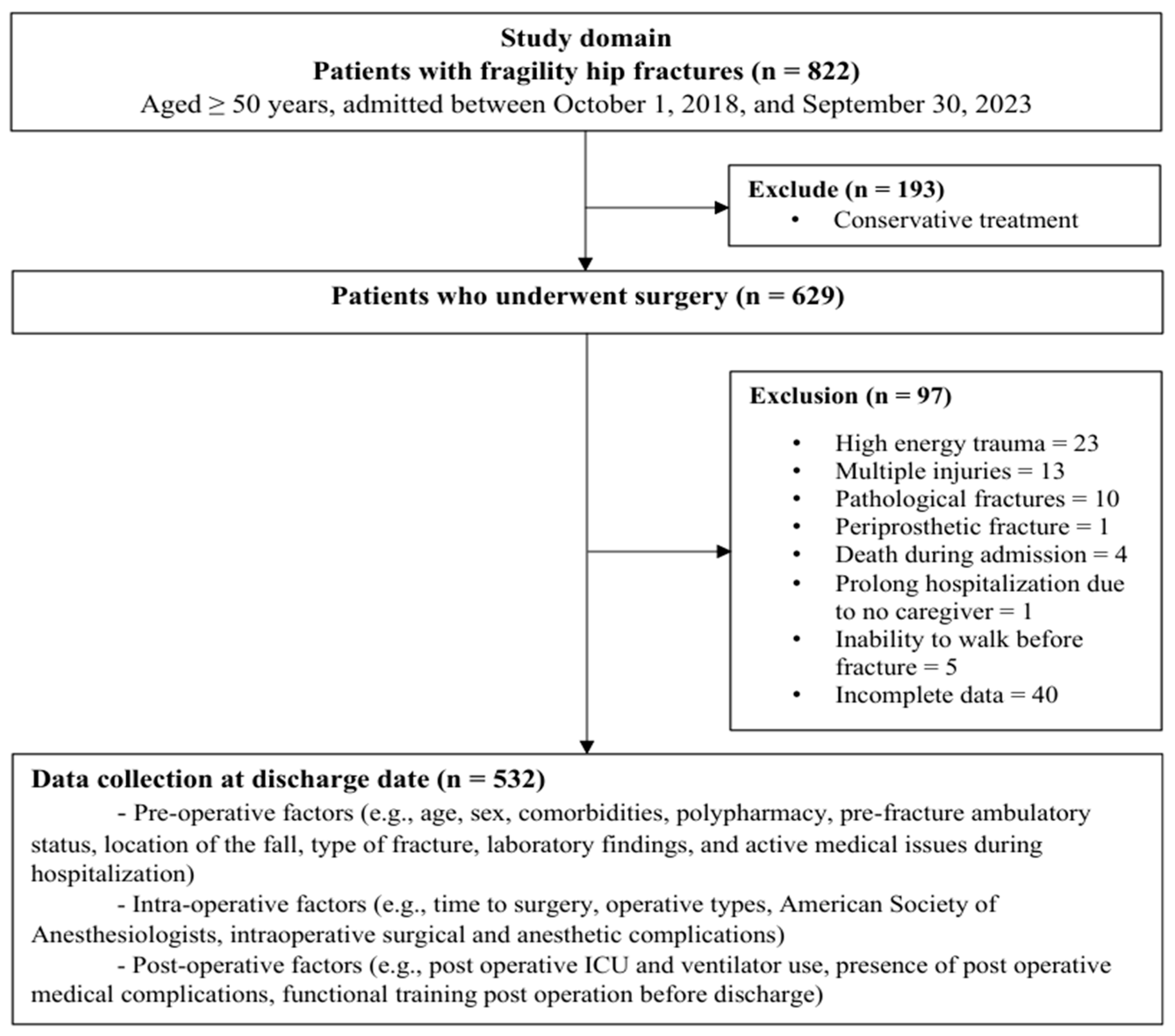
3.1. Study Population and Exclusions
3.2. Patient Characteristics
3.3. Comparison of Predictors Between Ambulatory and Non-Ambulatory Patients
3.4. Predictive Factors for Ambulation
4. Discussion
4.1. Strengths
4.2. Limitations
5. Conclusions
Author Contributions
Funding
Institutional Review Board Statement
Informed Consent Statement
Data Availability Statement
Acknowledgments
Conflicts of Interest
Abbreviations
| AAOS | American Academy of Orthopedic Surgeons |
| ADLs | activities of daily living |
| AF | atrial fibrillation |
| AKI | acute kidney injury |
| ASA | American Society of Anesthesiologists |
| BI | Barthel Index |
| CHF | congestive heart failure |
| CI | confidence interval |
| COVID-19 | coronavirus disease 2019 (COVID-19) infection |
| eGFR | estimated glomerular filtration rate |
| EMR | electronic medical records |
| FUO | fever of unknown origin |
| Hct | hematocrit |
| IHD | ischemic heart disease |
| IQR | interquartile range |
| ICU | intensive care unit |
| ICD | the International Classification of Diseases |
| LOS | the length of hospital stay |
| mRR | multivariable risk ratio |
| NICE | the National Institute for Health and Care Excellence |
| OR | Odds ratio |
| QOL | quality of life |
| SD | standard deviation |
| uRR | univariable risk ratio |
| UTIs | urinary tract infections |
| VHD | valvular heart disease |
| VIF | variant inflation factor |
References
- Nazeri, H.; Pearce, G. Future-Proofing the Longevity Economy: Innovations and Key Trends; World Economic Forum: Geneva, Switzerland, 2025. [Google Scholar]
- GBD 2019 Fracture Collaborators. Global, Regional, and National Burden of Bone Fractures in 204 Countries and Territories, 1990–2019: A Systematic Analysis from the Global Burden of Disease Study 2019. Lancet Healthy Longev. 2021, 2, e580–e592. [Google Scholar] [CrossRef] [PubMed]
- Veronese, N.; Maggi, S. Epidemiology and Social Costs of Hip Fracture. Injury 2018, 49, 1458–1460. [Google Scholar] [CrossRef] [PubMed]
- Sing, C.W.; Lin, T.C.; Bartholomew, S.; Bell, J.S.; Bennett, C.; Beyene, K.; Bosco-Levy, P.; Bradbury, B.D.; Chan, A.H.Y.; Chandran, M.; et al. Global Epidemiology of Hip Fractures: Secular Trends in Incidence Rate, Post-Fracture Treatment, and All-Cause Mortality. J. Bone Miner. Res. 2023, 38, 1064–1075. [Google Scholar] [CrossRef]
- Cheung, C.L.; Ang, S.B.; Chadha, M.; Chow, E.S.; Chung, Y.S.; Hew, F.L.; Jaisamrarn, U.; Ng, H.; Takeuchi, Y.; Wu, C.H.; et al. An updated hip fracture projection in Asia: The Asian Federation of Osteoporosis Societies study. Osteoporos. Sarcopenia 2018, 4, 16–21. [Google Scholar] [CrossRef]
- Charatcharoenwitthaya, N.; Nimitphong, H.; Wattanachanya, L.; Songpatanasilp, T.; Ongphiphadhanakul, B.; Deerochanawong, C.; Karaketklang, K. Epidemiology of hip fractures in Thailand. Osteoporos. Int. 2024, 35, 1661–1668. [Google Scholar] [CrossRef]
- Morri, M.; Ambrosi, E.; Chiari, P.; Orlandi Magli, A.; Gazineo, D.; D’Alessandro, F.; Forni, C. One-year mortality after hip fracture surgery and prognostic factors: A prospective cohort study. Sci. Rep. 2019, 9, 18718. [Google Scholar] [CrossRef]
- Amphansap, T.; Sujarekul, P. Quality of life and factors that affect osteoporotic hip fracture patients in Thailand. Osteoporos Sarcopenia 2018, 4, 140–144. [Google Scholar] [CrossRef] [PubMed]
- O’Connor, M.I.; Switzer, J.A. AAOS Clinical Practice Guideline Summary: Management of Hip Fractures in Older Adults. J. Am. Acad. Orthop. Surg. 2022, 30, e1291–e1296. [Google Scholar] [CrossRef]
- Xu, B.Y.; Yan, S.; Low, L.L.; Vasanwala, F.F.; Low, S.G. Predictors of poor functional outcomes and mortality in patients with hip fracture: A systematic review. BMC Musculoskelet. Disord. 2019, 20, 568. [Google Scholar] [CrossRef]
- Gonzalez de Villaumbrosia, C.; Barba, R.; Ojeda-Thies, C.; Grifol-Clar, E.; Alvarez-Diaz, N.; Alvarez-Espejo, T.; Cancio-Trujillo, J.M.; Mora-Fernandez, J.; Pareja-Sierra, T.; Barrera-Crispin, R.; et al. Predictive factors of gait recovery after hip fracture: A scoping review. Age Ageing 2025, 54, afaf057. [Google Scholar] [CrossRef]
- Sheehan, K.J.; Williamson, L.; Alexander, J.; Filliter, C.; Sobolev, B.; Guy, P.; Bearne, L.M.; Sackley, C. Prognostic factors of functional outcome after hip fracture surgery: A systematic review. Age Ageing 2018, 47, 661–670. [Google Scholar] [CrossRef] [PubMed]
- Adulkasem, N.; Phinyo, P.; Khorana, J.; Pruksakorn, D.; Apivatthakakul, T. Prognostic Factors of 1-Year Postoperative Functional Outcomes of Older Patients with Intertrochanteric Fractures in Thailand: A Retrospective Cohort Study. Int. J. Environ. Res. Public Health 2021, 18, 6896. [Google Scholar] [CrossRef]
- Bano, G.; Dianin, M.; Biz, C.; Bedogni, M.; Alessi, A.; Bordignon, A.; Bizzotto, M.; Berizzi, A.; Ruggieri, P.; Manzato, E.; et al. Efficacy of an interdisciplinary pathway in a first level trauma center orthopaedic unit: A prospective study of a cohort of elderly patients with hip fractures. Arch. Gerontol. Geriatr. 2020, 86, 103957. [Google Scholar] [CrossRef]
- Pioli, G.; Lauretani, F.; Pellicciotti, F.; Pignedoli, P.; Bendini, C.; Davoli, M.L.; Martini, E.; Zagatti, A.; Giordano, A.; Nardelli, A.; et al. Modifiable and non-modifiable risk factors affecting walking recovery after hip fracture. Osteoporos. Int. 2016, 27, 2009–2016. [Google Scholar] [CrossRef] [PubMed]
- Tangchitphisut, P.; Khorana, J.; Phinyo, P.; Patumanond, J.; Rojanasthien, S.; Apivatthakakul, T. Prognostic Factors of the Inability to Bear Self-Weight at Discharge in Patients with Fragility Femoral Neck Fracture: A 5-Year Retrospective Cohort Study in Thailand. Int. J. Environ. Res. Public Health 2022, 19, 3992. [Google Scholar] [CrossRef]
- Fukui, N.; Watanabe, Y.; Nakano, T.; Sawaguchi, T.; Matsushita, T. Predictors for ambulatory ability and the change in ADL after hip fracture in patients with different levels of mobility before injury: A 1-year prospective cohort study. J. Orthop. Trauma 2012, 26, 163–171. [Google Scholar] [CrossRef] [PubMed]
- Ariza-Vega, P.; Lozano-Lozano, M.; Olmedo-Requena, R.; Martin-Martin, L.; Jimenez-Moleon, J.J. Influence of Cognitive Impairment on Mobility Recovery of Patients with Hip Fracture. Am. J. Phys. Med. Rehabil. 2017, 96, 109–115. [Google Scholar] [CrossRef]
- Chanthanapodi, P.; Tammata, N.; Laoruengthana, A.; Jarusriwanna, A. Independent Walking Disability After Fragility Hip Fractures: A Prognostic Factors Analysis. Geriatr. Orthop. Surg. Rehabil. 2024, 15, 21514593241278963. [Google Scholar] [CrossRef]
- Carpintero, P.; Caeiro, J.R.; Carpintero, R.; Morales, A.; Silva, S.; Mesa, M. Complications of hip fractures: A review. World J. Orthop. 2014, 5, 402–411. [Google Scholar] [CrossRef]
- Kim, J.L.; Jung, J.S.; Kim, S.J. Prediction of Ambulatory Status After Hip Fracture Surgery in Patients Over 60 Years Old. Ann. Rehabil. Med. 2016, 40, 666–674. [Google Scholar] [CrossRef]
- Bujang, M.A.; Sa’at, N.; Sidik, T.; Joo, L.C. Sample Size Guidelines for Logistic Regression from Observational Studies with Large Population: Emphasis on the Accuracy Between Statistics and Parameters Based on Real Life Clinical Data. Malays. J. Med. Sci. 2018, 25, 122–130. [Google Scholar] [CrossRef] [PubMed]
- Takegami, Y.; Osawa, Y.; Funahashi, H.; Asamoto, T.; Ido, H.; Otaka, K.; Tanaka, S.; Asai, H.; Yokoi, H.; Imagama, S. One-Year Survival and Postoperative Complications in Older Patients with Intertrochanteric Fractures: Association with Polypharmacy-A Multicenter Retrospective Cohort Study. Drugs Aging 2025, 42, 435–444. [Google Scholar] [CrossRef]
- Kang, M.J.; Kim, B.R.; Lee, S.Y.; Beom, J.; Choi, J.H.; Lim, J.Y. Factors predictive of functional outcomes and quality of life in patients with fragility hip fracture: A retrospective cohort study. Medicine 2023, 102, e32909. [Google Scholar] [CrossRef]
- Adulkasem, N.; Chotiyarnwong, P.; Vanitcharoenkul, E.; Unnanuntana, A. Ambulation recovery prediction after hip fracture surgery using the Hip Fracture Short-Term Ambulation Prediction tool. J. Rehabil. Med. 2024, 56, jrm40780. [Google Scholar] [CrossRef] [PubMed]
- Chammout, G.K.; Mukka, S.S.; Carlsson, T.; Neander, G.F.; Stark, A.W.; Skoldenberg, O.G. Total hip replacement versus open reduction and internal fixation of displaced femoral neck fractures: A randomized long-term follow-up study. J. Bone Jt. Surg. Am. 2012, 94, 1921–1928. [Google Scholar] [CrossRef]
- Ackermann, L.; Schwenk, E.S.; Lev, Y.; Weitz, H. Update on medical management of acute hip fracture. Clevel. Clin. J. Med. 2021, 88, 237–247. [Google Scholar] [CrossRef]
- Shen, J.W.; Zhang, P.X.; An, Y.Z.; Jiang, B.G. Prognostic Implications of Preoperative Pneumonia for Geriatric Patients Undergoing Hip Fracture Surgery or Arthroplasty. Orthop. Surg. 2020, 12, 1890–1899. [Google Scholar] [CrossRef]
- Cohn, M.R.; Cong, G.T.; Nwachukwu, B.U.; Patt, M.L.; Desai, P.; Zambrana, L.; Lane, J.M. Factors Associated With Early Functional Outcome After Hip Fracture Surgery. Geriatr. Orthop. Surg. Rehabil. 2016, 7, 3–8. [Google Scholar] [CrossRef]
- Zuo, D.; Jin, C.; Shan, M.; Zhou, L.; Li, Y. A comparison of general versus regional anesthesia for hip fracture surgery: A meta-analysis. Int. J. Clin. Exp. Med. 2015, 8, 20295–20301. [Google Scholar]
- Karaca, S.; Ayhan, E.; Kesmezacar, H.; Uysal, O. Hip fracture mortality: Is it affected by anesthesia techniques? Anesthesiol. Res. Pract. 2012, 2012, 708754. [Google Scholar] [CrossRef] [PubMed]
- Eschbach, D.; Bliemel, C.; Oberkircher, L.; Aigner, R.; Hack, J.; Bockmann, B.; Ruchholtz, S.; Buecking, B. One-Year Outcome of Geriatric Hip-Fracture Patients following Prolonged ICU Treatment. BioMed Res. Int. 2016, 2016, 8431213. [Google Scholar] [CrossRef]
- Cecchi, F.; Pancani, S.; Antonioli, D.; Avila, L.; Barilli, M.; Gambini, M.; Landucci Pellegrini, L.; Romano, E.; Sarti, C.; Zingoni, M.; et al. Predictors of recovering ambulation after hip fracture inpatient rehabilitation. BMC Geriatr. 2018, 18, 201. [Google Scholar] [CrossRef] [PubMed]
- Foss, N.B.; Kristensen, M.T.; Kehlet, H. Anaemia impedes functional mobility after hip fracture surgery. Age Ageing 2008, 37, 173–178. [Google Scholar] [CrossRef]
- Malik, A.T.; Quatman-Yates, C.; Phieffer, L.S.; Ly, T.V.; Khan, S.N.; Quatman, C.E. Factors Associated with Inability to Bear Weight Following Hip Fracture Surgery: An Analysis of the ACS-NSQIP Hip Fracture Procedure Targeted Database. Geriatr. Orthop. Surg. Rehabil. 2019, 10, 2151459319837481. [Google Scholar] [CrossRef] [PubMed]
- Xiang, Z.; Chen, Z.; Wang, P.; Zhang, K.; Liu, F.; Zhang, C.; Wong, T.M.; Li, W.; Leung, F. The effect of early mobilization on functional outcomes after hip surgery in the Chinese population—A multicenter prospective cohort study. J. Orthop. Surg. 2021, 29, 23094990211058902. [Google Scholar] [CrossRef] [PubMed]
- Goubar, A.; Martin, F.C.; Potter, C.; Jones, G.D.; Sackley, C.; Ayis, S.; Sheehan, K.J. The 30-day survival and recovery after hip fracture by timing of mobilization and dementia: A UK database study. Bone Jt. J. 2021, 103, 1317–1324. [Google Scholar] [CrossRef]
- Nakamura, K.; Kurobe, Y.; Sue, K.; Sakurai, S.; Sasaki, T.; Yamamoto, S.; Ushiyama, N.; Taga, M.; Momose, K. Impact of early postoperative ambulation on gait recovery after hip fracture surgery: A multicenter cohort study. Sci. Rep. 2025, 15, 12893. [Google Scholar] [CrossRef]
- Unnanuntana, A.; Kuptniratsaikul, V.; Srinonprasert, V.; Charatcharoenwitthaya, N.; Kulachote, N.; Papinwitchakul, L.; Wattanachanya, L.; Chotanaphuti, T. A multidisciplinary approach to post-operative fragility hip fracture care in Thailand—A narrative review. Injury 2023, 54, 111039. [Google Scholar] [CrossRef]
- HAIP Organization. Clinical Practice Guideline for the Management of Hip Fracture Surgery in Older Adults; Healthcare Accreditation Institute: Bangkok, Thailand, 2020. [Google Scholar]
- Ko, Y. Pre- and Perioperative Risk Factors of Post Hip Fracture Surgery Walking Failure in the Elderly. Geriatr. Orthop. Surg. Rehabil. 2019, 10, 2151459319853463. [Google Scholar] [CrossRef]
- Bursac, Z.; Gauss, C.H.; Williams, D.K.; Hosmer, D.W. Purposeful selection of variables in logistic regression. Source Code Biol. Med. 2008, 3, 17. [Google Scholar] [CrossRef]
- Kim, J.H. Multicollinearity and misleading statistical results. Korean J. Anesthesiol. 2019, 72, 558–569. [Google Scholar] [CrossRef] [PubMed]
- Mansournia, M.A.; Nazemipour, M.; Naimi, A.I.; Collins, G.S.; Campbell, M.J. Reflection on modern methods: Demystifying robust standard errors for epidemiologists. Int. J. Epidemiol. 2021, 50, 346–351. [Google Scholar] [CrossRef] [PubMed]
- Collin, C.; Wade, D.T.; Davies, S.; Horne, V. The Barthel ADL Index: A reliability study. Int. Disabil. Stud. 1988, 10, 61–63. [Google Scholar] [CrossRef]
- Amarilla-Donoso, F.J.; Lopez-Espuela, F.; Roncero-Martin, R.; Leal-Hernandez, O.; Puerto-Parejo, L.M.; Aliaga-Vera, I.; Toribio-Felipe, R.; Lavado-Garcia, J.M. Quality of life in elderly people after a hip fracture: A prospective study. Health Qual. Life Outcomes 2020, 18, 71. [Google Scholar] [CrossRef]
- Elli, S.; Contro, D.; Castaldi, S.; Fornili, M.; Ardoino, I.; Caserta, A.V.; Panella, L. Caregivers’ misperception of the severity of hip fractures. Patient Prefer. Adherence 2018, 12, 1889–1895. [Google Scholar] [CrossRef]
- Iosifidis, M.; Iliopoulos, E.; Panagiotou, A.; Apostolidis, K.; Traios, S.; Giantsis, G. Walking ability before and after a hip fracture in elderly predict greater long-term survivorship. J. Orthop. Sci. 2016, 21, 48–52. [Google Scholar] [CrossRef]
- Alito, A.; Fenga, D.; Portaro, S.; Leonardi, G.; Borzelli, D.; Sanzarello, I.; Calabrò, R.S.; Milone, D.; Tisano, A.; Leonetti, D. Early hip fracture surgery and rehabilitation. How to improve functional quality outcomes. A retrospective study. Folia Medica 2023, 65, 879–884. [Google Scholar] [CrossRef]
- Takahashi, A.; Naruse, H.; Hasegawa, D.; Nakajima, H.; Matsumine, A. Functional recovery predictors in Hip Fractures: Insights from a community clinical pathway. J. Clin. Med. 2025, 14, 3430. [Google Scholar] [CrossRef] [PubMed]
- Pfeufer, D.; Grabmann, C.; Mehaffey, S.; Keppler, A.; Bocker, W.; Kammerlander, C.; Neuerburg, C. Weight bearing in patients with femoral neck fractures compared to pertrochanteric fractures: A postoperative gait analysis. Injury 2019, 50, 1324–1328. [Google Scholar] [CrossRef]
- Kitcharanant, N.; Atthakomol, P.; Khorana, J.; Phinyo, P.; Unnanuntana, A. Predictive model of recovery to prefracture activities-of-daily-living status one year after fragility hip fracture. Medicina 2024, 60, 615. [Google Scholar] [CrossRef]
- Krakers, S.M.; Woudsma, S.; van Dartel, D.; Vermeer, M.; Vollenbroek-Hutten, M.M.R.; Hegeman, J.H. Rehabilitation of frail older adults after hip fracture surgery: Predictors for the length of geriatric rehabilitation stay at a skilled nursing home. J. Clin. Med. 2024, 13, 4547. [Google Scholar] [CrossRef] [PubMed]
- Kim, J.W.; Byun, S.E.; Chang, J.S. The clinical outcomes of early internal fixation for undisplaced femoral neck fractures and early full weight-bearing in elderly patients. Arch. Orthop. Trauma Surg. 2014, 134, 941–946. [Google Scholar] [CrossRef]
- Kuru, T.; Olcar, H.A. Effects of early mobilization and weight bearing on postoperative walking ability and pain in geriatric patients operated due to hip fracture: A retrospective analysis. Turk. J. Med. Sci. 2020, 50, 117–125. [Google Scholar]
- Patel, N.; Chaudhari, M. Weight-Bearing Approaches After Neck of Femur Fractures: A Narrative Review of Evidence and Outcomes. Cureus 2025, 17, e84932. [Google Scholar] [CrossRef]
- American Academy of Orthopaedic Surgeons. Postoperative Rehabilitation of Low Energy Hip Fractures in Older Adults: Appropriate Use Criteria. Re-Issued by the American Academy of Orthopaedic Surgeons Board of Directors; American Academy of Orthopaedic Surgeons: Rosemont, IL, USA, 2023. [Google Scholar]
- National Institute for Health and Care Excellence (NICE). Hip Fracture: Management (Update): Economic Model Report for Total Hip Replacement Versus Hemiarthroplasty; NICE Guideline CG124; National Institute for Health and Care Excellence (NICE): London, UK, 2023. [Google Scholar]
- Handoll, H.H.; Cameron, I.D.; Mak, J.C.; Panagoda, C.E.; Finnegan, T.P. Multidisciplinary rehabilitation for older people with hip fractures. Cochrane Database Syst. Rev. 2021, 11, CD007125. [Google Scholar] [CrossRef]
- Kristensen, M.T.; Foss, N.B.; Ekdahl, C.; Kehlet, H. Prefracture functional level evaluated by the New Mobility Score predicts in-hospital outcome after hip fracture surgery. Acta Orthop. 2010, 81, 296–302. [Google Scholar] [CrossRef] [PubMed]
- Aprisunadi Nursalam, N.; Mustikasari, M.; Ifadah, E.; Hapsari, E.D. Effect of Early Mobilization on Hip and Lower Extremity Postoperative: A Literature Review. SAGE Open Nurs. 2023, 9, 23779608231167825. [Google Scholar] [CrossRef] [PubMed]


| Variables | Number | Percent |
|---|---|---|
| Age (years, mean ± SD) | 76.8 ± 9.7 | |
| Female | 387 | 72.7 |
| Comorbidities | ||
| -Hypertension | 368 | 69.2 |
| -Chronic kidney disease | 184 | 34.6 |
| -Cerebrovascular disease | 96 | 18.0 |
| -Musculoskeletal problems | 67 | 12.6 |
| -Anemia | 63 | 11.8 |
| -Heart disease (AF/VHD/IHD) | 51 | 9.6 |
| -Pulmonary disease | 60 | 11.3 |
| -Alzheimer/Dementia | 29 | 5.5 |
| Polypharmacy (Use of ≥5 medications) | 154 | 28.9 |
| Indoor (falling area) | 434 | 81.6 |
| Fall from slipping (cause of fracture) | 459 | 86.3 |
| Ambulatory status before fracture | ||
| -Home walk, with gait aids | 105 | 19.7 |
| -Home walk, no gait aids | 60 | 11.3 |
| -Community walk, with gait aids | 41 | 7.7 |
| -Community walk, no gait aids | 326 | 61.3 |
| Close fracture neck of femur | 263 | 49.4 |
| Type of operation | ||
| -Fixation (multiple screw/plate and screw/intramedullary nail) | 302 | 56.8 |
| -Arthroplasty | 230 | 43.2 |
| Time from admission to internal medicine consultation (days, median (IQR)) | 1 (1) | |
| Surgery within 72 h from admission | 205 | 38.5 |
| Length of stay (days, median (IQR)) | 10 (4) | |
| Barthel Index at discharge (scores, median (IQR)) | 9 (3) | |
| Characteristics | Ambulatory | Non-Ambulatory | p-Value |
|---|---|---|---|
| (n = 314) | (n = 218) | ||
| Preoperative factors | |||
| Female | 230 (73.2) | 157 (72.0) | 0.754 |
| Age ≥ 80 years | 111 (35.4) | 203 (93.1) | <0.001 |
| Body mass index (kg/m2, mean ± SD) | 22.5 ± 4.1 | 22.3 ± 3.9 | 0.480 |
| Smoking | 31 (9.9) | 22 (10.1) | 0.934 |
| Comorbidities | |||
| -Hypertension | 210 (66.9) | 158 (72.5) | 0.169 |
| -Chronic kidney disease | 98 (31.2) | 86 (39.4) | 0.049 |
| -Musculoskeletal problems (Osteoporosis/Lumbar spondylosis) | 35 (11.1) | 32 (14.7) | 0.227 |
| -Cerebrovascular disease | 17 (5.4) | 21 (9.6) | 0.063 |
| -Anemia | 32 (10.2) | 31 (14.2) | 0.157 |
| -Pulmonary disease | 30 (9.6) | 30 (13.8) | 0.131 |
| -Heart diseases (IHD/VHD/AF) | 20 (6.4) | 31 (14.2) | 0.002 |
| -Alzheimer/Dementia | 13 (4.1) | 16 (7.3) | 0.110 |
| -Osteoporosis | 13 (4.1) | 7 (3.2) | 0.580 |
| Polypharmacy (Use of ≥5 medications) | 85 (27.1) | 68 (31.2) | 0.302 |
| Anti-platelet use | 58 (18.5) | 64 (29.4) | 0.003 |
| Ambulatory status before fracture | <0.001 | ||
| -Home walk, with gait aids | 35 (11.1) | 70 (32.1) | |
| -Home walk, no gait aids | 20 (6.4) | 40 (18.3) | |
| -Community walk, with gait aids | 16 (5.1) | 25 (11.5) | |
| -Community walk, no gait aids | 243 (77.4) | 83 (38.1) | |
| Indoor, falling area | 249 (79.3) | 184 (84.4) | 0.227 |
| Type of fracture | <0.001 | ||
| -Subtrochanteric | 3 (1.0) | 5 (2.3) | |
| -Intertrochanteric | 186 (59.2) | 75 (34.4) | |
| -Neck of femur | 125 (39.8) | 138 (63.3) | |
| Recurrent fracture | 13 (4.1) | 15 (6.9) | 0.164 |
| Laboratory investigations | |||
| -Hematocrit (%, mean ± SD) | 33.8 ± 5.3 | 31.6 ± 5.4 | <0.001 |
| -Glomerular filtration rate (mL/min, mean ± SD) | 82.0 ± 49.4 | 71.9 ± 27.4 | 0.006 |
| Preoperative medical in hospital factors | |||
| -Acute kidney injury | 110 (35.0) | 101 (46.3) | 0.009 |
| -New diagnosis anemia | 96 (30.6) | 103 (47.3) | <0.001 |
| -Electrolyte disturbances | |||
| -Hyponatremia | 39 (12.4) | 37 (17.0) | 0.140 |
| -Hypokalemia | 46 (14.6) | 50 (22.9) | 0.015 |
| -Hyperkalemia | 5 (1.6) | 10 (4.6) | 0.040 |
| -Urinary tract infection | 52 (16.6) | 61 (28.0) | 0.002 |
| -Preoperative active heart disease (CHF/AF) | 11 (3.5) | 12 (5.5) | 0.264 |
| -Delirium | 11 (3.5) | 18 (8.3) | 0.018 |
| -Pneumonia | 1 (0.3) | 12 (5.5) | <0.001 |
| -Coagulopathy | 2 (0.6) | 3 (1.4) | 0.048 |
| -COVID-19 infection | 2 (0.6) | 6 (2.8) | 0.049 |
| Intraoperative factors | |||
| Time from admission to surgery (hours, median (IQR)) | 84 (85) | 97.5 (95) | <0.001 |
| Surgery within 72 h from admission | 142 (45.2) | 63 (2.9) | <0.001 |
| Type of operation | <0.001 | ||
| -Fixation (multiple screw/plate and screw/intramedullary nail) | 149 (47.5) | 153 (70.2) | |
| -Arthroplasty | 165 (52.5) | 65 (29.8) | |
| Total surgical time (minutes, mean ± SD) | 79.8 ± 37.9 | 77.3 ± 39.7 | 0.469 |
| Presence of intraoperative surgical complications | 5 (1.6) | 13 (6.0) | 0.006 |
| Anemia during operation | 69 (22.0) | 65 (29.8) | 0.040 |
| Estimate Blood loss (mL, median (IQR)) | 150 (200) | 150 (100) | 0.342 |
| Class III-IV ASA classification | 222 (70.7) | 199 (91.3) | <0.001 |
| Regional anesthesia | 265 (84.4) | 166 (76.1) | 0.017 |
| Total anesthetic time (minutes, mean ± SD) | 114.5 ± 33.8 | 123.1 ± 34.5 | 0.004 |
| Presence of intraoperative anesthesia complications | 109 (34.7) | 103 (47.2) | 0.004 |
| Postoperative factors | |||
| Postoperative ICU and ventilator use | 6 (1.9) | 19 (8.7) | <0.001 |
| Postoperative oxygen support | 126 (40.1) | 120 (55.0) | <0.001 |
| Urinary Cath use in the 2nd day postoperative | 154 (49.0) | 139 (63.8) | 0.001 |
| Presence of postoperative surgical complication | 0 (0.0) | 23 (10.6) | <0.001 |
| Pain scores on rehabilitation day (scores, median (IQR)) | 2 (0) | 2 (1) | 0.064 |
| Anemia due to postoperative blood loss | 93 (29.6) | 93 (42.7) | 0.002 |
| Presence of postoperative medical complications | |||
| -Pressure sore | 5 (1.6) | 18 (8.3) | <0.001 |
| -Delirium | 10 (3.2) | 24 (11.0) | <0.001 |
| -Pneumonia | 1 (0.3) | 8 (3.7) | 0.004 |
| -Urinary tract infection | 8 (2.5) | 22 (10.1) | <0.001 |
| Postoperative electrolyte disturbances | |||
| -Hyponatremia | 12 (3.8) | 11 (5.0) | 0.495 |
| -Hypokalemia | 20 (6.4) | 27 (12.4) | 0.016 |
| -Hyperkalemia | 0 (0.0) | 5 (2.3) | 0.011 |
| Postoperative deep vein thrombosis | 2 (0.6) | 1 (0.5) | 1.000 |
| Postoperative pulmonary embolism | 1 (0.3) | 0 (0.0) | 1.000 |
| Postoperative Atrial fibrillation | 0 (0.0) | 4 (1.8) | 0.028 |
| Functional training postoperatively | |||
| Time to start functional training | <0.001 | ||
| -Less than 48 h postoperatively | 167 (53.2) | 84 (38.5) | |
| -48 h to less than 72 h postoperatively | 89 (28.3) | 63 (28.9) | |
| -More than 72 h postoperatively | 58 (18.5) | 71 (32.6) | |
| Ambulation training | 310 (98.7) | 68 (31.2) | <0.001 |
| Total training days (days, median (IQR)) | 2 (1) | 3 (1) | 0.001 |
| Length of stay ≥ 14 days | 41 (13.1) | 66 (30.3) | <0.001 |
| Univariable RR | 95% CI | p-Value | Multivariable RR | 95% CI | p-Value | |
|---|---|---|---|---|---|---|
| Preoperative factors | ||||||
| Age ≥ 80 years | 0.69 | 0.59–0.80 | <0.001 | 0.97 | 0.86–1.08 | 0.558 |
| Comorbidities | ||||||
| -Hypertension | 0.89 | 0.78–1.04 | 0.157 | 1.06 | 0.96–1.18 | 0.259 |
| -Chronic kidney disease | 0.85 | 0.73–1.01 | 0.058 | 1.01 | 0.90–1.13 | 0.892 |
| -Musculoskeletal problems | 0.87 | 0.68–1.11 | 0.259 | 0.97 | 0.82–1.14 | 0.680 |
| -Cerebrovascular disease | 0.55 | 0.42–0.73 | <0.001 | 0.70 | 0.53–0.91 | 0.007 |
| -Anemia | 0.84 | 0.66–1.09 | 0.193 | 1.11 | 0.96–1.28 | 0.165 |
| -Pulmonary disease | 0.83 | 0.64–1.08 | 0.168 | 0.92 | 0.78–1.08 | 0.331 |
| -Heart disease (AF/VHD/IHD) | 0.64 | 0.42–0.91 | 0.013 | 0.85 | 0.68–1.06 | 0.145 |
| -Alzheimer/Dementia | 0.75 | 0.50–1.13 | 0.167 | 1.05 | 0.79–1.39 | 0.722 |
| Anti-platelet use | 0.76 | 0.62–0.93 | 0.008 | 1.08 | 0.91–1.29 | 0.356 |
| Ambulatory status before fracture | ||||||
| -Home walk, with gait aids | reference | |||||
| -Home walk, no gait aids | 1.00 | 0.64–1.57 | 1.000 | 0.86 | 0.63–1.18 | 0.359 |
| -Community walk, with gait aids | 1.17 | 0.73–1.87 | 0.510 | 0.78 | 0.54–1.14 | 0.208 |
| -Community walk, no gait aids | 2.24 | 1.69–2.95 | <0.001 | 1.12 | 0.92–1.36 | 0.266 |
| Recurrent fracture | 0.78 | 0.52–1.16 | 0.222 | 1.06 | 0.87–1.27 | 0.563 |
| Pre-operative medical in hospital factors | ||||||
| -Acute kidney injury | 0.82 | 0.70–0.96 | 0.011 | 0.96 | 0.88–1.05 | 0.422 |
| -New diagnosis anemia | 0.74 | 0.63–0.87 | <0.001 | 0.92 | 0.84–1.01 | 0.098 |
| -Electrolyte disturbances | ||||||
| -Hypokalemia | 0.76 | 0.61–0.95 | 0.016 | 0.96 | 0.81–1.10 | 0.577 |
| -Hyperkalemia | 0.56 | 0.27–1.14 | 0.112 | 0.95 | 0.62–1.44 | 0.808 |
| -Urinary tract infection | 0.74 | 0.59–0.91 | 0.005 | 0.96 | 0.84–1.11 | 0.616 |
| -Delirium | 0.63 | 0.39–1.01 | 0.054 | 1.06 | 0.77–1.45 | 0.722 |
| -Pneumonia | 0.13 | 0.02–0.84 | 0.032 | 0.34 | 0.06–1.76 | 0.197 |
| -Coagulopathy | 0.84 | 0.73–0.97 | 0.015 | 1.02 | 0.93–1.11 | 0.725 |
| -COVID-19 infection | 0.42 | 0.13–1.40 | 0.157 | 0.68 | 0.28–1.67 | 0.402 |
| -Fever of unknown origin | 0.46 | 0.22–0.98 | 0.043 | 0.75 | 0.47–1.18 | 0.215 |
| Intraoperative factors | ||||||
| Surgery within 72 h from admission | 1.32 | 1.15–1.51 | <0.001 | 1.06 | 0.97–1.15 | 0.168 |
| Arthroplasty operation | 1.45 | 1.26–1.67 | <0.001 | 1.17 | 1.07–1.29 | <0.001 |
| Presence of intraoperative surgical complications | 0.46 | 0.22–0.98 | 0.043 | 0.66 | 0.43–1.02 | 0.064 |
| Presence of intraoperative anesthesia complications | 0.80 | 0.39–0.94 | 0.005 | 0.95 | 0.87–1.04 | 0.243 |
| Postoperative factors | ||||||
| Postoperative ICU or ventilator use | 0.39 | 0.20–0.80 | 0.009 | 0.96 | 0.60–1.53 | 0.865 |
| Postoperative need for oxygen support | 0.78 | 0.67–0.90 | 0.001 | 1.08 | 0.97–1.19 | 0.149 |
| Urinary Cath use in the 2nd day postoperative | 0.79 | 0.68–0.90 | 0.001 | 0.95 | 0.86–1.04 | 0.255 |
| Anemia due to postoperative blood loss | 0.78 | 0.66–0.92 | 0.003 | 1.05 | 0.95–1.16 | 0.349 |
| Presence of postoperative medical complications | ||||||
| -Pressure sore | 0.36 | 0.16–0.78 | 0.010 | 0.95 | 0.51–1.07 | 0.870 |
| -Delirium | 0.49 | 0.28–0.81 | 0.006 | 0.74 | 0.51–1.07 | 0.107 |
| -Pneumonia | 0.18 | 0.03–1.17 | 0.074 | 0.41 | 0.08–2.11 | 0.287 |
| -Urinary tract infection | 0.44 | 0.24–0.79 | 0.007 | 0.80 | 0.54–1.20 | 0.287 |
| -Postoperative electrolyte disturbances | ||||||
| -Hypokalemia | 0.70 | 0.50–0.99 | 0.041 | 1.06 | 0.47–0.91 | 0.730 |
| Time to start functional training | ||||||
| -Less than 48 h postoperatively | reference | |||||
| -48 h to less than 72 h post operatively | 0.88 | 0.75–1.03 | 0.117 | 0.92 | 0.84–1.02 | 0.120 |
| -More than 72 h postoperatively | 0.67 | 0.55–0.83 | <0.001 | 0.84 | 0.73–0.97 | 0.014 |
| Ambulation training | 31.6 | 12.0–83.2 | <0.001 | 24.10 | 9.14–63.60 | <0.001 |
Disclaimer/Publisher’s Note: The statements, opinions and data contained in all publications are solely those of the individual author(s) and contributor(s) and not of MDPI and/or the editor(s). MDPI and/or the editor(s) disclaim responsibility for any injury to people or property resulting from any ideas, methods, instructions or products referred to in the content. |
© 2025 by the authors. Licensee MDPI, Basel, Switzerland. This article is an open access article distributed under the terms and conditions of the Creative Commons Attribution (CC BY) license.
Share and Cite
Jongutchariya, T.; Loomcharoen, P.; Saengsuwan, J.; Settheekul, S. Factors Predicting Ambulatory Status at Discharge After Fragility Hip Fracture Surgery: A Retrospective Cohort Study. Med. Sci. 2026, 14, 17. https://doi.org/10.3390/medsci14010017
Jongutchariya T, Loomcharoen P, Saengsuwan J, Settheekul S. Factors Predicting Ambulatory Status at Discharge After Fragility Hip Fracture Surgery: A Retrospective Cohort Study. Medical Sciences. 2026; 14(1):17. https://doi.org/10.3390/medsci14010017
Chicago/Turabian StyleJongutchariya, Thitirut, Palanthorn Loomcharoen, Jittima Saengsuwan, and Saowaluck Settheekul. 2026. "Factors Predicting Ambulatory Status at Discharge After Fragility Hip Fracture Surgery: A Retrospective Cohort Study" Medical Sciences 14, no. 1: 17. https://doi.org/10.3390/medsci14010017
APA StyleJongutchariya, T., Loomcharoen, P., Saengsuwan, J., & Settheekul, S. (2026). Factors Predicting Ambulatory Status at Discharge After Fragility Hip Fracture Surgery: A Retrospective Cohort Study. Medical Sciences, 14(1), 17. https://doi.org/10.3390/medsci14010017