
Article

Determinants of Entero-Invasive and Non-Entero-Invasive Diarrheagenic Bacteria Among HIV-Positive and HIV-Negative Adults in Ghana

by
Hagen Frickmann
1,2,
Fred Stephen Sarfo
3,4,
Betty Roberta Norman
3,4,
Albert Dompreh
5,
Shadrack Osei Asibey
3,
Richard Boateng
5,
Veronica Di Cristanziano
6,
Tafese Beyene Tufa
7,8,9,
Ulrike Loderstädt
10,
Ramona Binder
11,
Andreas Erich Zautner
12,13,
Tom Luedde
9,
Torsten Feldt
8,9 and
Kirsten Alexandra Eberhardt
9,14,15,*
1
Department of Microbiology and Hospital Hygiene, Bundeswehr Hospital Hamburg, 22049 Hamburg, Germany
2
Institute for Medical Microbiology, Virology and Hygiene, University Medicine Rostock, 18057 Rostock, Germany
3
Department of Medicine, Komfo Anokye Teaching Hospital, Kumasi 00233, Ghana
4
Department of Internal Medicine, School of Medical Sciences, Kwame Nkrumah University of Science and Technology, Kumasi 00233, Ghana
5
Department of Clinical Microbiology, Komfo Anokye Teaching Hospital, Kumasi 00233, Ghana
6
Institute of Virology, Faculty of Medicine and University Hospital Cologne, University of Cologne, 50937 Cologne, Germany
7
Asella Referral and Teaching Hospital, College of Health Sciences, Arsi University, Asella P.O. Box 04, Ethiopia
8
Hirsch Institute of Tropical Medicine (HITM), Heinrich Heine University, Asella P.O. Box 04, Ethiopia
9
Department of Gastroenterology, Hepatology and Infectious Diseases, University Hospital and Medical Faculty of the Heinrich Heine University, 40225 Düsseldorf, Germany
10
Institute of Infection Control and Infectious Diseases, University Medical Center Göttingen, 37075 Göttingen, Germany
11
Laboratory Medicine and Transfusion Medicine Department, IMD Laboratory Greifswald, 17493 Greifswald, Germany
12
Institute of Laboratory Medicine and Microbiology & Vaccination Center, Klinikum Würzburg Mitte, Campus Juliusspital, 97070 Würzburg, Germany
13
Institute of Medical Microbiology and Hospital Hygiene, Medical Faculty, Otto-von-Guericke University Magdeburg, 39120 Magdeburg, Germany
14
Department of Tropical Medicine, Bernhard Nocht Institute for Tropical Medicine, 20359 Hamburg, Germany
15
I. Department of Medicine, University Medical Center Hamburg-Eppendorf, 20246 Hamburg, Germany
*
Author to whom correspondence should be addressed.
Med. Sci. 2025, 13(4), 316; https://doi.org/10.3390/medsci13040316
Submission received: 11 November 2025 / Revised: 1 December 2025 / Accepted: 9 December 2025 / Published: 12 December 2025

Abstract

Objectives: This observational and cross-sectional study investigated differential associations between entero-invasive and non-entero-invasive enteric pathogens and HIV infection, considering socioeconomic, clinical and immunological aspects. In a Ghanaian population with a high prevalence of enteric pathogens, stool samples from people living with HIV (PLWH) were screened for Salmonella spp., Shigella spp./EIEC (enteroinvasive Escherichia coli), and Campylobacter jejuni as entero-invasive bacteria, for enteropathogenic E. coli (EPEC), enterotoxigenic E. coli (ETEC), and enteroaggregative E. coli (EAEC) as non-entero-invasive bacteria. Arcobacter butzleri, with uncertain enteropathogenicity, was also included. Methods: Stool samples from PLWH (with and without antiretroviral therapy) and HIV-negative controls were analyzed by real-time PCR for the presence and quantity of the selected enteropathogens. Results were correlated with socioeconomic, clinical, and immunological parameters. Results: The presence of Shigella spp. /EIEC in stool was both qualitatively and quantitatively associated with reduced CD4+ T lymphocyte counts and was qualitatively associated with clinically apparent diarrhea. EAEC showed a weak positive association with HIV infection, supported by a negative correlation between EAEC DNA quantity and CD4+ T lymphocyte counts. EPEC colonization was associated with HIV negativity, higher CD4+ T lymphocyte counts, and lower socioeconomic status. Abundance of Salmonella enterica was associated with clinically apparent diarrhea. Conclusions: This explorative, hypothesis-forming study suggests species- or pathovar-specific associations between enteric bacterial pathogens and HIV-related immunosuppression. Observed relationships with clinically apparent diarrhea largely align with findings from sub-Saharan African children, except for a more pronounced association between diarrhea and Salmonella in this cohort.

1. Introduction

Infections with several enteric pathogens have been reported as more frequent in patients with acquired immunodeficiency syndrome (AIDS), which results from infection with the human immunodeficiency virus (HIV). Among bacterial microorganisms causing entero-invasive disease in susceptible individuals, the strongest associations have been documented for Salmonella spp. (including non-typhoidal serovars), Shigella spp., and Campylobacter jejuni [1,2,3,4,5]. Increasing antimicrobial resistance rates in these pathogens, particularly in tropical regions with high endemicity, complicate therapeutic management [6]. Even independent of acquired resistance, salmonellosis, shigellosis, and campylobacteriosis in patients with HIV often show therapeutic failure or recurrence [7].
Besides common fecal–oral transmission, sexual transmission via the anal–oral route has been well documented for Shigella spp. [8] and thermophilic Campylobacter spp. [9]. Concomitant HIV infection has been identified as a risk factor for shigellosis [8,10]. While dysentery is the typical manifestation of shigellosis, Shigella spp. bacteremia is strongly associated with immunosuppression due to HIV infection [11], and persistent or chronic Shigella-associated enteritis has been observed in immunocompromised patients [12].
AIDS increases Salmonella spp. infection risk approximately 20-fold. Bacteremia occurs in about 40% of co-infected patients [7]. The link between non-typhoidal Salmonella (NTS) bacteremia and HIV infection is particularly strong [4,13,14]. In addition to malnutrition, malaria, anemia, sickle cell disease, and young age, HIV infection is an established risk factor for systemic NTS infection [15,16,17,18]. Reported focal manifestations of disseminated NTS in patients with HIV include difficult-to-treat infections such as endocarditis [19], liver abscess [20], and meningitis [21]. Impaired macrophage function drives NTS invasiveness in HIV patients [22]. Strain-specific traits, such as enhanced intracellular survival and modulation of immune cell migration, likely contribute to long-term intestinal persistence and prolonged bacterial shedding [23,24].
The association between invasive campylobacteriosis and HIV infection is also well established [25,26,27]. In individuals with HIV, Campylobacter jejuni bacteremia can cause severe febrile illness with poor response to antibiotic therapy, recurrent or prolonged courses, extra-intestinal involvement (e.g., pulmonary or dermatological), and elevated mortality [26]. In contrast, infections in immunocompetent individuals are typically self-limiting and respond well to antibiotics [26]. Similarly to shigellosis, sexual transmission of Campylobacter spp. via the anal–oral route has also been confirmed [7,28,29].
Likely sexual transmissibility has been proposed for diarrheagenic Escherichia coli [30] and other enteric bacteria [31] as well. However, consistent associations between HIV infection and non-invasive E. coli pathovars such as enteropathogenic (EPEC), enterotoxigenic (ETEC), or enteroaggregative (EAEC) E. coli have not been demonstrated convincingly. These pathovars commonly occur in both HIV-positive and HIV-negative individuals, with or without diarrheal disease, especially in high-endemicity regions [32,33,34,35,36]. For example, a recent Iranian study found thalassemia more strongly associated with diarrheagenic E. coli than HIV positivity [32]. Nevertheless, HIV infection may facilitate colonization or infection with diarrheagenic E. coli in sub-Saharan Africa [34], whereas such associations have not been confirmed in industrialized settings [36].
Arcobacter butzleri (homotypic synonym Aliarcobacter butzleri) is a bacterial species frequently detected in human stool samples and associated with gastroenteritis, abdominal pain, and acute or persistent watery diarrhea [37]. Adhesive, cytotoxic, and invasive properties of A. butzleri contribute to its pathogenic potential [37,38,39,40,41,42], with epithelial barrier dysfunction likely leading to leak-flux-type diarrhea [43]. In immunocompromised individuals, including those with HIV infection, A. butzleri and other Arcobacter spp. have also been reported to cause invasive disease and bacteremia [44,45]. Similarly, patients with other severe conditions predisposing them to bacterial translocation, such as liver cirrhosis, may develop A. butzleri bacteremia [46]. Despite these reports [44,45], a recent epidemiological study in sub-Saharan Africa did not confirm a significant association between HIV infection and A. butzleri prevalence in stool samples [47]. An Indian study also found detection rates too low for meaningful conclusions [48].
In this study, Salmonella spp., Shigella spp./EIEC, and C. jejuni were selected as representative entero-invasive bacterial pathogens with known associations to HIV infection. EPEC, ETEC and EAEC were included as non-invasive enteropathogens with unclear HIV correlation, and A. butzleri was investigated as a potentially invasive bacterium under conditions of immunosuppression. Ghana was chosen as a study site owing to its considerable HIV prevalence of approximately 1.6% [49]. As a resource-limited tropical country, where maintaining high standards of food hygiene is challenging, it is also significantly burdened by gastroenteric infections. At the time of sampling for our study, the prevalence of gastroenteric pathogens in Ghana was primarily derived from cross-sectional epidemiological studies conducted in children. One study reported prevalence values exceeding 50% for ETEC, over 30% for Shigella spp. and Campylobacter spp., and greater than 10% for Salmonella spp. in Ghanaian children, regardless of symptomatic presentation [50].
The study aimed to assess the differential associations of these invasive and non-invasive enteropathogens with socio-economic, clinical, and immunological characteristics of Ghanaian HIV patients, thereby contributing to understanding their etiological relevance in immunocompromised individuals.

2. Materials and Methods

2.1. Study Design and Setting

People living with HIV (PLWH) attending the outpatient HIV clinic at Komfo Anokye Teaching Hospital in Kumasi, Ghana, were invited to participate in this cross-sectional, observational, hypothesis-generating study. Even beyond the present study, the research focused on exploring associations between gastrointestinal and other pathogens and various socio-demographic, clinical, and immunological factors [51,52]. As a control group, HIV-negative adults from the same region were also enrolled. Equal numbers of PLWH receiving and not receiving antiretroviral therapy ensured the assessment of possible therapy effects. Notably, the samples were collected between November 2011 and November 2012, thus before the publication of the START study group findings, which ultimately led to the recommendation to initiate antiretroviral combination therapy as soon as possible [53]. The entire cohort, comprising both HIV-positive and HIV-negative participants, was recruited over a 12-month period. Demographic, socio-economic, immunological, and clinical data were collected via standardized questionnaires administered by trained study personnel. Given that the study included only native Ghanaians living under regional conditions throughout their lives, and since the assessment was conducted outside of an outbreak situation, more specific questions regarding consumption of food from restaurants or vendors were deemed unlikely to yield conclusive results.

2.2. Laboratory Diagnostics

Venous blood samples were collected to determine CD4+ T lymphocyte counts using a FACSCalibur flow cytometer (Becton Dickinson, Mountain View, CA, USA) in Ghana. HIV-1 viral loads were quantified with a Real-Time HIV-1 PCR system (Abbott Diagnostics, Wiesbaden, Germany). Peripheral blood mononuclear cells (PBMCs) were isolated from heparinized venous blood by Ficoll/Hypaque (Biocoll Separating Solution, Biochrom AG, Berlin, Germany) density gradient centrifugation, washed with phosphate-buffered saline, and resuspended in RPMI 1640 medium (Gibco Invitrogen, Carlsbad, CA, USA) with heat-inactivated fetal calf serum (Biochrom AG, Berlin, Germany). Cells were cryopreserved in liquid nitrogen, shipped to Germany, stained for immune activation markers, and analyzed by LSRII flow cytometry (BD Biosciences, Heidelberg, Germany) using FlowJo (v9.6.2, Tree Star, San Carlos, CA, USA).
Native stool aliquots were stored at −80 °C until DNA extraction, which was performed according to the manufacturer’s instructions using the QIAamp stool DNA mini Kit (Qiagen, Hilden, Germany). In-house established laboratory-developed real-time PCR assays as reported in the literature [54,55,56,57] were used to assess the samples for Salmonella spp., Shigella spp./enteroinvasive E. coli (EIEC) (not further discriminable due to the use of a shared target sequence), C. jejuni, enteropathogenic E. coli (EPEC), enterotoxigenic E. coli (ETEC), enteroaggregative E. coli (EAEC) and A. butzleri. In more detail, the assays targeted a 180-base pair sequence of the ttrC gene of Salmonella spp., a 170-base pair sequence of the ipaH gene of Shigella spp./EIEC, a 249-base pair sequence of the gyrA gene of C. jejuni, a 102-base pair sequence of the eae gene of EPEC, a 76-base pair sequence of the EAF plasmid of EPEC, a 68-base pair sequence of the eltA gene of ETEC, a 251-base pair sequence of the estB gene of ETEC, a 105-base pair sequence of the aatA gene of EAEC, and a 170-base pair sequence of the rpoB/C gene of A. butzleri, respectively. Of note and as shown in Appendix A Table A1, the eltB and estB genes of ETEC were jointly assessed in the same fluorescence channel, resulting in a common cycle threshold (Ct) value. In contrast, the eae gene and the EAF plasmid of EPEC were assessed in different fluorescence channels. Positivity of a sample for EPEC was accepted if at least one out of the two parameters provided a positive real-time PCR signal. As described in detail elsewhere [54,57,58], the assays’ diagnostic accuracy was estimated with sensitivities in the 61–100% range, specificities in the 97–100% range, and limits of detection in the 1.2 × 101–3.7 × 10² copies per µL eluate range. Appropriate amplification conditions in each real-time PCR run were monitored with a PCR grade water-based negative control and a positive control consisting of a plasmid containing the respective target sequence inserted in a pEX-A128 vector backbone. Appendix A Table A1 provides details on both the applied oligonucleotides and the limits of detection of the used real-time PCR assays.
Corbett Q cyclers (Qiagen, Hilden, Germany) were used to run the above-described real-time PCR assays. The master mix compositions and run conditions of each real-time PCR assay are shown in detail in Appendix A Table A2. Of note, a Phocid herpesvirus (PhHV) DNA-specific real-time PCR described elsewhere [59] was used to control sample inhibition.

2.3. Statistics

A socioeconomic status (SES) index was derived using principal component analysis (PCA) based on three binary household indicators: access to tap water, availability of a refrigerator, and electricity. The first principal component was used as the SES index, and the median value of this index was used to classify participants as having low or high SES. Descriptive analyses used Fisher’s exact test for categorical variables. The Spearman rank correlation coefficient (ρ), chosen because it does not require normality assumptions and is appropriate for typically skewed Ct values, quantified the strength of the relationship between continuous variables. Due to the high prevalence of coinfections with multiple bacterial enteropathogens in both HIV-positive and HIV-negative individuals, traditional univariate analyses examining individual pathogens separately may overlook the combined and potentially interacting effects of coinfections on clinical, immunological, and socioeconomic outcomes. To address this complexity, we applied a machine learning approach—random forest analysis (500 trees, 2 variables tried per split)—conducted separately in HIV-positive and HIV-negative groups. This methodology accommodates multiple correlated predictors, identifies key enteropathogens most strongly associated with CD4+ T cell counts, diarrheal disease, and SES, and captures nonlinear relationships. Missing data were handled by complete-case analysis (no imputation). Variable importance was quantified by the random forest algorithm using either the Increase in Node Purity (for continuous outcomes) or the Mean Decrease in Gini (for binary outcomes), reflecting each predictor’s relative contribution to model performance. Higher values indicate stronger influence on prediction accuracy. Following random forest prioritization, multivariable regression models were fitted comprehensively on the entire cohort: linear regression for continuous outcomes and logistic regression for binary outcomes. No sensitivity analyses were performed, and due to the exploratory, hypothesis-forming nature of the present study, correction for multiple testing (e.g., Bonferroni) was not applied [60]. Statistical analyses were conducted using the software R (version 4.4.3, R Foundation for Statistical Computing, Vienna, Austria). All statistical tests were two-sided with a significance threshold of p < 0.05.

2.4. Ethics

The study was conducted in accordance with the Declaration of Helsinki and its amendments. Sample collection and analysis followed protocols approved by the Committee on Human Research at Kwame Nkrumah University of Science and Technology, Kumasi, Ghana (approval no. CHRPE/AP/82/11, dated 8 September 2011), and the Ethics Committee of the Medical Council in Hamburg, Germany (approval no. PV3771, dated 13 May 2011). Written informed consent was obtained from all participants prior to enrollment.

3. Results

3.1. Study Population

Stool samples were available from 651 HIV-positive and 84 HIV-negative individuals (Table 1). The median age was 40 years (IQR 33–47) among HIV-positive participants and 29 years (IQR 24–37) among HIV-negatives, with females comprising 73.6% and 64.6%, respectively. Over half of participants had access to tap water, and most had electricity and refrigerators in their households. The socioeconomic status index indicated that approximately three-quarters of HIV-positive participants had a high SES, comparable to the HIV-negative group. Clinically, one-third of HIV-positive participants were on cotrimoxazole prophylaxis, and 41.3% received combination antiretroviral therapy. The median body mass index was slightly lower in HIV-positive individuals (22; IQR 20–26) than in HIV-negative individuals (24; IQR 21–27). Immunologically, HIV-positive individuals showed a median viral load of 4.2 log10 copies/mL (IQR 1.6–5.4), lower median CD4+ T lymphocyte counts (347 cells/µL; IQR 145–571) versus HIV-negative individuals (949 cells/µL; IQR 767–1168), higher CD8+ T lymphocyte counts (970 cells/µL; IQR 648–1379 vs. 470 cells/µL; IQR 354–710), and reduced CD4+/CD8+ ratios (0.4; IQR 0.2–0.7 vs. 2.0; IQR 1.6–2.5).

3.2. Detection of Bacterial Enteropathogens in Stool Samples According to HIV Infection

Prevalence of enteric bacterial pathogens was assessed separately in HIV-positive (n = 651) and HIV-negative (n = 84) individuals (Figure 1a). Among HIV-negative participants, enteroaggregative E. coli (EAEC) was most prevalent at 64.3% (n = 54), followed by enterotoxigenic E. coli (ETEC) at 39.3% (n = 33) and enteropathogenic E. coli (EPEC) at 31.0% (n = 26). Salmonella spp. and Shigella spp./enteroinvasive E. coli (EIEC) were detected in 13.1% (n = 11) and 17.9% (n = 15), respectively, while A. butzleri and C. jejuni were rare (2.4% [n = 2] and 3.6% [n = 3]). In HIV-positive individuals, E. coli (EAEC) prevalence was higher at 75.0% (n = 488), followed by Shigella spp. (22.9%, n = 149), which was more prevalent among those not receiving ART (p = 0.053), EPEC (14.0%, n = 91), Salmonella spp. (11.5%, n = 75), A. butzleri (5.4%, n = 35), and C. jejuni (2.0%, n = 13). EAEC was significantly more prevalent in HIV-positives (p = 0.047), while EPEC was more common in HIV-negatives (p < 0.001); within PLWH, EAEC was more frequent in those not receiving ART (p = 0.002). No significant differences were observed for other pathogens.
Coinfection analysis stratified by HIV status (Figure 1b) showed that 82.1% (n = 69) of HIV-negative individuals and 84.3% (n = 549) of HIV-positive individuals harbored detectable enteric pathogen DNA. Among HIV-negative individuals, most had one (28.6%, n = 24), two (22.6%, n = 19), or three (26.2%, n = 22) simultaneous infections. A smaller fraction (4.8%, n = 4) had four coinfections, with no cases exceeding that count. In contrast, among HIV-positives, 31.8% (n = 207), 29.2% (n = 190), and 17.2% (n = 112) had one, two, or three coinfections, respectively. A total of 5.4% (n = 35) had four concurrent infections, with rare cases of five (0.6%, n = 4) and six (0.2%, n = 1) infections in parallel.

3.3. Enteric Pathogens Associated with CD4+ T-Lymphocyte Counts

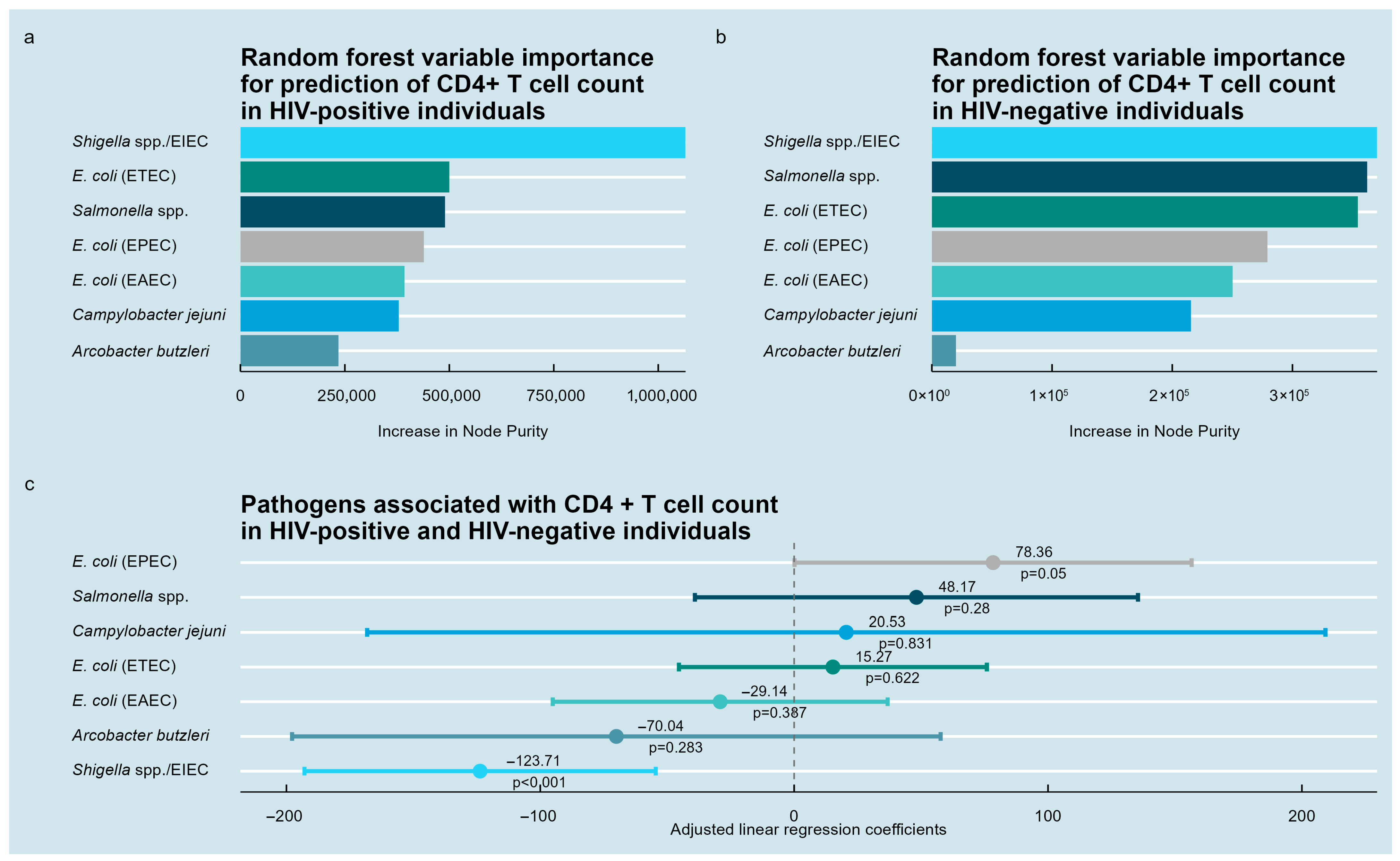
Random forest analysis, conducted separately for HIV-positive and HIV-negative individuals, identified the relative importance of bacterial pathogens in predicting CD4+ T-lymphocyte counts (Figure 2a,b). In HIV-positive participants, Shigella spp./EIEC exhibited the highest importance, followed by Salmonella spp., ETEC, EPEC, EAEC, C. jejuni, and A. butzleri. Among HIV-negative participants, Shigella spp., Salmonella spp., and ETEC ranked highest.
Multivariable linear regression on the entire cohort revealed few statistically significant associations with CD4+ T-lymphocyte counts. Shigella spp. was independently associated with a lower CD4+ T-lymphocyte count (β = −124, 95% CI: −193 to −54.5, p < 0.001). EPEC showed a robust trend toward positive association (β = 78.4, 95% CI: 0.1 to 157, p = 0.05). Associations with Salmonella spp., C. jejuni, A. butzleri, ETEC, and EAEC were not significant (Figure 2c).
Additional analyses of other immune parameters in the HIV positive subgroup revealed patterns broadly consistent with these findings: Shigella spp. presence was linked to lower CD4 counts (β = −96.3, p = 0.002) and lower CD4/CD8 ratio (β = −0.116, p = 0.032), consistent with immunosuppression. Shigella spp. were also associated with higher HLA-DR+CD38+CD8+ cells (β = 6.17, p = 0.042), indicating CD8 activation.

3.4. Pathogens Associated with Diarrheal Disease

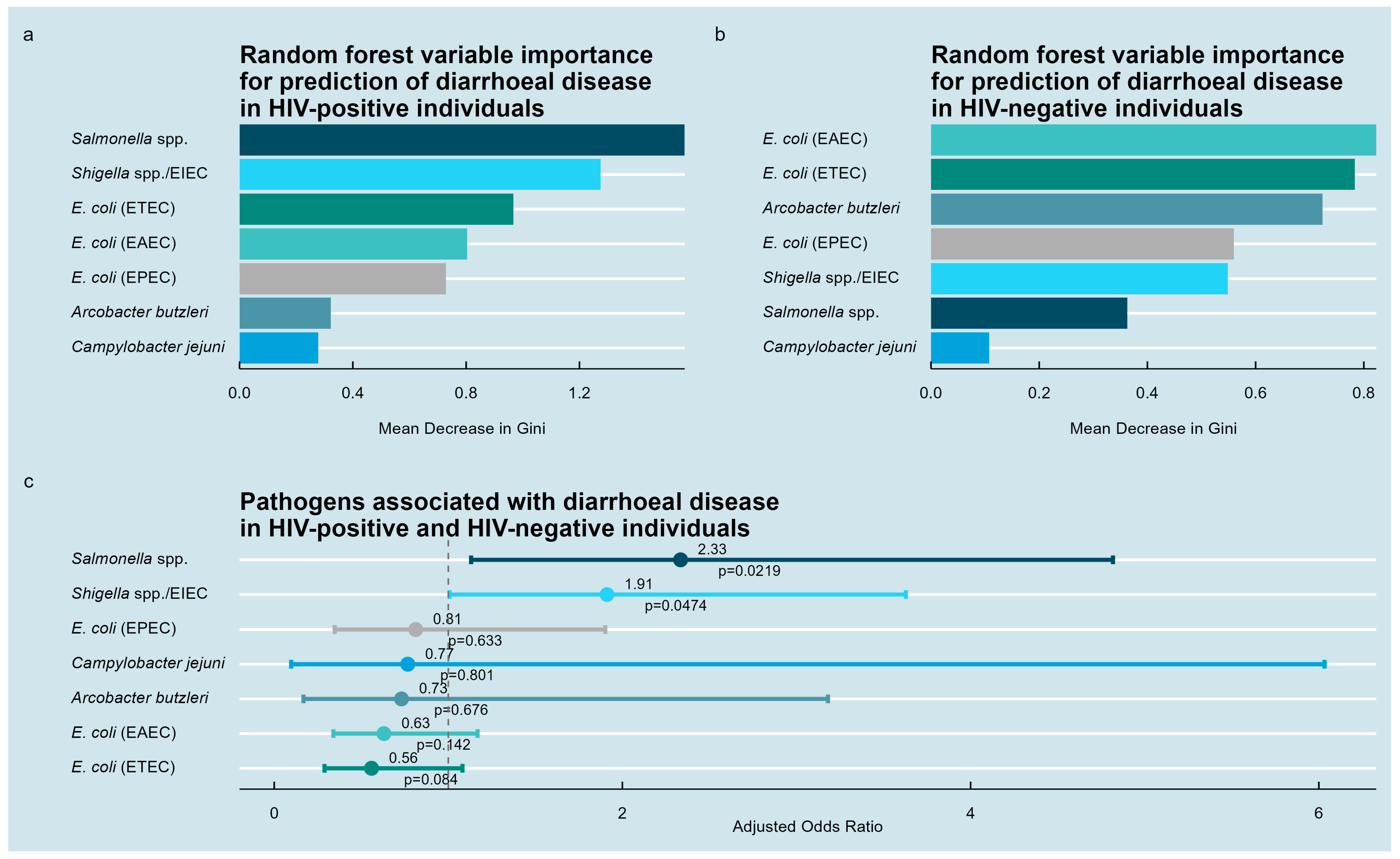
To identify bacterial pathogens associated with diarrheal disease, random forest analyses were performed separately for the HIV-positive and HIV-negative subgroups (Figure 3a,b). Among HIV-positive participants, Salmonella spp. exhibited the highest importance, followed by Shigella spp., ETEC, EAEC, EPEC, A. butzleri, and C. jejuni. In the HIV-negative group, EAEC, ETEC, A. butzleri, EPEC, Shigella spp./EIEC, Salmonella spp., and C. jejuni ranked in decreasing order.
Multivariable logistic regression combining all participants revealed statistically significant positive associations between diarrheal disease and Salmonella spp. (OR = 2.33, 95% CI: 1.13–4.82, p = 0.022) and Shigella spp. (OR = 1.91, 95% CI: 1.01–3.63, p = 0.047). No significant associations were observed for A. butzleri, C. jejuni, ETEC, EAEC, or EPEC (Figure 3c).
Notably, cotrimoxazole prophylaxis showed no relevant associations with enteric pathogen detection.

3.5. Pathogens Associated with the Socioeconomic Status Index

As described in the Methods section, a binary SES index was derived using principal component analysis (PCA) based on household access to tap water, availability of a refrigerator, and electricity.
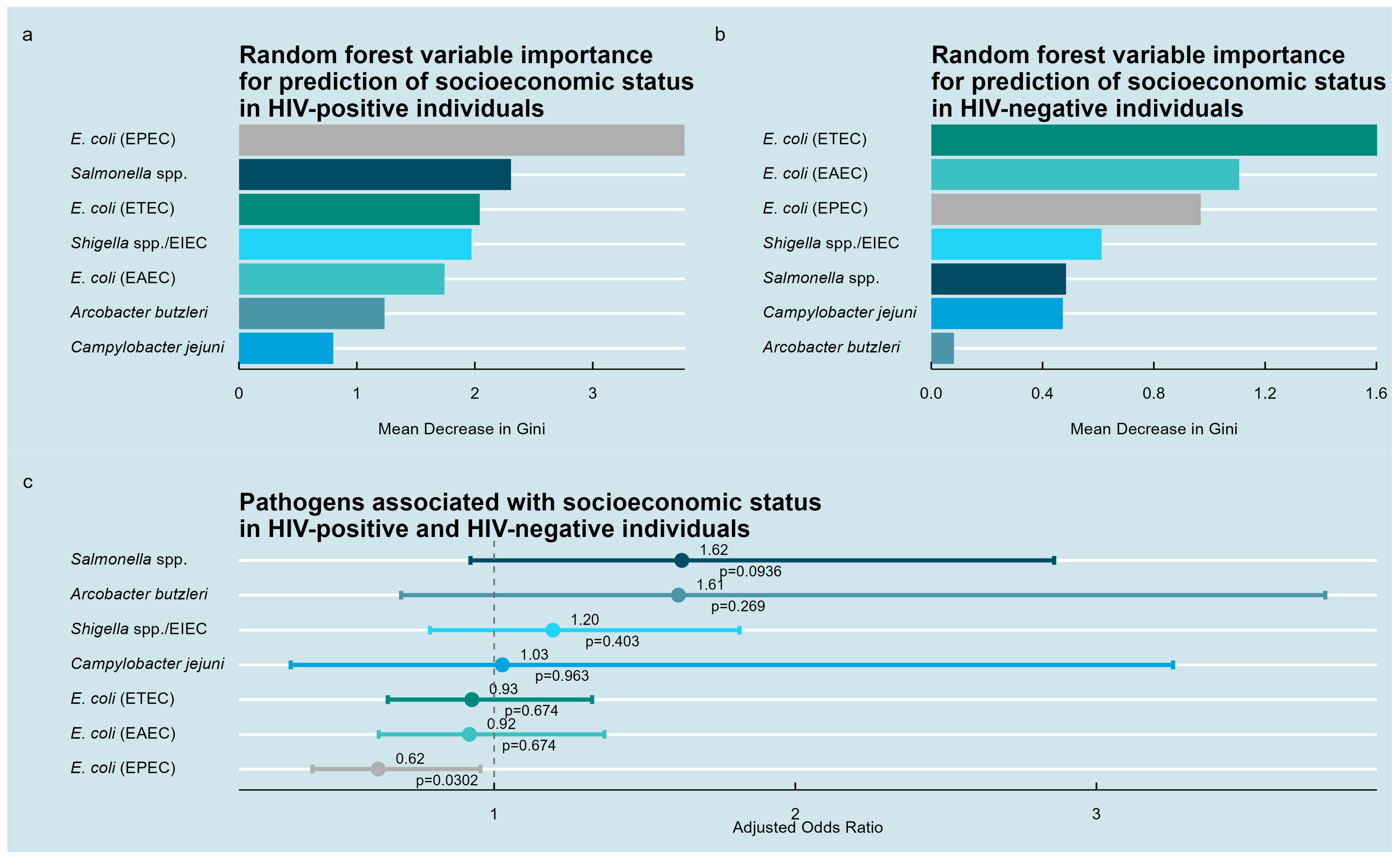
Random forest analyses conducted separately in HIV-positive and HIV-negative individuals identified enteropathogenic bacteria predictive of the SES (Figure 4a,b). Among HIV-positive participants, EPEC demonstrated the highest importance, followed by Salmonella spp., ETEC, Shigella spp., EAEC, A. butzleri, and C. jejuni. In HIV-negative participants, ETEC, EAEC, EPEC, Shigella spp., Salmonella spp., C. jejuni, and A. butzleri ranked in decreasing order of importance.
Multivariable logistic regression on the entire cohort showed that only EPEC was significantly inversely associated with a high SES index (odds ratio = 0.62; 95% CI: 0.40–0.96, p = 0.03). No other pathogens showed statistically significant associations (Figure 4c).

3.6. Correlations of Cycle Threshold (Ct) Values with CD4+ T-Lymphocyte Count

Spearman rank correlations were analyzed between Ct values from real-time PCR assays targeting bacterial pathogens and CD4+ T lymphocyte counts (Table 2). Ct values for Shigella spp. (rho = 0.18, p = 0.025) and EAEC (rho = 0.10, p = 0.018) showed weak but statistically significant positive correlations with CD4+ T-lymphocyte counts, indicating that higher Ct values (i.e., lower pathogen loads) tend to be associated with higher CD4+ T-lymphocyte counts. Other assessed pathogens did not exhibit statistically significant correlations with CD4+ T lymphocyte counts.

4. Discussion

The study aimed to assess the associations between selected invasive and non-invasive enteropathogenic bacteria, as well as A. butzleri, and key socioeconomic, clinical, and immunological characteristics of Ghanaian individuals with and without HIV infection. The HIV-negative control group was moderately younger and had a slightly higher body mass index than HIV-positive participants, who showed the expected signs of immunosuppression. Otherwise, the two subpopulations were broadly comparable.
Concerning the overall association between enteric bacterial pathogens and HIV status, no significant links were observed for the classical enteroinvasive pathogens despite well-established evidence from earlier studies [1,2,3,4,5]. One plausible explanation is antiretroviral therapy use by approximately 41% of the HIV-positive patients, which improves immune competence by increasing CD4+ T lymphocyte counts. This likely attenuated the aforementioned associations [1,2,3,4,5], which were mostly described for HIV patients without effective antiretroviral therapy. When reduced immunocompetence, as indicated by low CD4+ T-lymphocyte counts, was considered, impaired immunity showed the expected correlation with Shigella spp./EIEC [1,2,3,4,5]. Multivariable analyses confirmed Shigella spp./EIEC presence was associated with immunosuppression markers, including lower CD4/CD8 ratios and elevated CD8 T cell activation (HLA-DR+CD38+), consistent with pathogen-driven immune responses during impaired immunity. However, no comparable pattern was observed for Salmonella spp. or C. jejuni. Importantly, the association for Shigella spp./EIEC was reflected not only in qualitative presence but also quantitatively, as higher enteric bacterial loads corresponded to lower CD4+ T-lymphocyte counts.
In contrast, EAEC was more frequently detected among PLWH, whereas EPEC was more common in stool samples from individuals without HIV infection. This finding differs from earlier studies reporting no such associations [32,33,34,35,36]. Prior research has linked EAEC infections to growth impairment in children and has suggested that EAEC may act as a copathogen with pathogenic importance in enteric illnesses [61,62,63,64]. Although statistical significance for EAEC approached the conventional 5% threshold, an additional correlation between higher EAEC load and lower CD4+ T-lymphocyte counts suggests the pattern may not be incidental.
The predominance of EPEC among HIV-negative individuals remains unexplained. This inverse association—EPEC presence alongside higher CD4+ T-lymphocyte counts—supports the observed trend but should be interpreted cautiously, as HIV status and CD4+ T-lymphocyte levels are not mutually independent. In line with expectations for fecal–oral transmitted organisms, EPEC detection was also associated with lower socioeconomic status across the study cohort, while no comparable associations were observed for other pathogens. These findings point to preferential EPEC colonization in socioeconomically disadvantaged individuals despite lacking evidence for additional pathology. Stable immunological control might facilitate such colonization, whereas immunosuppression may diminish it, particularly under high exposure conditions. However, the present study was not specifically designed or powered to confirm this hypothesis.
Multiple pathogen detections within individual stool samples were common in both groups, consistent with reports from other resource-limited, high-endemicity settings [50,65]. No apparent predominance of coinfections was observed in either HIV-positive or HIV-negative participants.
Regarding clinical symptoms, diarrheal disease was associated with Salmonella spp. and Shigella spp./EIEC in this high HIV-prevalence cohort, whereas no such links emerged for the remaining pathogens. As reported previously and illustrated in Table 3, the weak association between detected gastrointestinal pathogens and overt diarrheal symptoms has frequently been observed in sub-Saharan African populations, where repeated exposures are thought to induce immunological tolerance to otherwise pathogenic microorganisms [66,67]. This phenomenon is particularly well described for Campylobacter spp. infections [68,69], although detailed mechanisms, including potential immunological and microbiome-related contributions, remain to be elucidated [70]. Notably, the compared studies [66,67] on Ghanaian and Tanzanian children comprised higher numbers of cases and controls (approximately 2000 children each) and more than 30,000 assessed stool samples in the Tanzanian assessment. Although these historic studies focused on young children rather than adults with HIV, the similarity of the results is nevertheless striking.
In detail, comparing associations between diarrheal disease and detected microorganisms in this Ghanaian population with high HIV prevalence to previous studies among Ghanaian and Tanzanian children reveals marked similarity in the observed association patterns, with the exception of Salmonella spp. [66,67]. The increased virulence of Salmonella spp. in PLWH is consistent with earlier findings [4,7,13,14]. In contrast, the association of Shigella spp./EIEC with diarrhea is well documented among Ghanaian children [66], and at least bacterial load–dependent associations have been reported in Tanzanian children [67]. Similarly to C. jejuni, A. butzleri was not associated with clinically apparent diarrhea in the present sub-Saharan African study population. This finding aligns with previous observations indicating no significant association between HIV infection and A. butzleri occurrence in the same setting [47]. Collectively, the results suggest that recorded associations between HIV infection and bacterial causes of diarrheal disease are likely species specific, although confirmatory assessments are required to confirm or exclude causal effects.
This study has several limitations. First, its retrospective design prevents causal inference. Second, the sample size was determined by the availability of stored specimens rather than formal power calculations based on expected effect sizes. Accordingly, the analysis should be regarded as exploratory and hypothesis-generating. Third, reliance on molecular diagnostic methods precludes conclusions about viability of detected bacterial organisms. Fourth, low prevalence of some pathogens limits interpretability of non-significant associations. Fifth, suboptimal sample storage and transport conditions precluded culture-based diagnostic approaches in addition to molecular diagnosis. Notably, DNA might have been partly degraded despite −80 °C storage, though this should have affected both subpopulations comparably. Sixth, assessment was restricted to a single center in one country, so regional confounders cannot be excluded. Seventh, machine-learning approaches carry risks of bias from black-box methodology and overfitting. Eight, lack of multiple testing correction (e.g., Bonferroni approach [60]), consistent with the exploratory, hypothesis-generating nature of the assessment, bears the risk of overinterpretation.

5. Conclusions

Despite the limitations outlined above, this study identified associations between Shigella/EIEC and EAEC with HIV-related immunosuppression, whereas the opposite pattern was observed for EPEC. Regarding clinically apparent diarrhea, the detected association patterns largely mirrored those described previously in Ghanaian and Tanzanian children, except for Salmonella spp., which showed a specific link with diarrhea in the present study population. The basis of the negative association between enteric EPEC abundance and HIV infection remains unclear. Future investigations are warranted to further assess interactions between immune status, pathogen abundance, and clinical manifestations of gastrointestinal infections.

Author Contributions

Conceptualization, H.F., K.A.E.; methodology, H.F., R.B. (Ramona Binder), V.D.C.; software, H.F., R.B. (Ramona Binder), K.A.E.; validation, H.F., R.B. (Ramona Binder), K.A.E.; formal analysis, R.B. (Ramona Binder), K.A.E.; investigation, H.F., F.S.S., B.R.N., A.D., S.O.A., R.B. (Ramona Binder), R.B. (Richard Boateng), U.L., V.D.C., T.F., K.A.E.; resources, H.F., K.A.E.; data curation, K.A.E.; writing—original draft preparation, K.A.E., H.F.; writing—review and editing, H.F., F.S.S., B.R.N., A.D., S.O.A., R.B. (Ramona Binder), R.B. (Richard Boateng), U.L., V.D.C., T.F., A.E.Z., T.L., T.B.T., K.A.E.; visualization, K.A.E.; supervision, H.F., K.A.E.; project administration, H.F., K.A.E.; funding acquisition, T.F., H.F., K.A.E. All authors have read and agreed to the published version of the manuscript.

Funding

The here-provided study was financially supported by the ESTHER Alliance for Global Health Partnerships, the German Federal Ministry of Education and Research (Project No. 01KA1102) as well as by the German Ministry of Defense (grant 36K2-S-45 1922). In addition, we acknowledge the generous support by the Heinz Ansmann Foundation for AIDS Research.

Institutional Review Board Statement

The study was conducted in accordance with the Declaration of Helsinki and its subsequent amendments. Both the sample collection and analysis followed protocols approved by the Committee on Human Research at Kwame Nkrumah University of Science and Technology in Kumasi, Ghana (approval number CHRPE/AP/12/11, dated 8 September 2011), and the ethics committee of the Medical Council in Hamburg, Germany (approval number PV3771, dated 13 May 2011).

Informed Consent Statement

Written informed consent was obtained from all subjects involved in the study.

Data Availability Statement

The original contributions presented in this study are included in the article. Further inquiries can be directed to the corresponding author.

Acknowledgments

Simone Priesnitz is gratefully acknowledged for their excellent technical assistance.

Conflicts of Interest

The authors declare that the research was conducted in the absence of any commercial or financial relationships that could be construed as a potential conflict of interest. The funders had no role in the design of the study; in the collection, analyses, or interpretation of data; in the writing of the manuscript, or in the decision to publish the results.

Abbreviations

The following abbreviations are used in this manuscript:
95% CI95% confidence interval
AIDSacquired immunodeficiency syndrome
cARTcombination antiretroviral therapy
Ctcycle threshold
DNAdesoxyribonucleic acid
EAECenteroaggregative Escherichia coli
EIECenteroinvasive Escherichia coli
EPECenteropathogenic Escherichia coli
ETECenterotoxigenic Escherichia coli
HIVhuman immunodeficiency virus
IQRinter-quartile range
min.minute
µLmicroliter
Nnumber
NAnot applicable
PCAprincipal component analysis
PCRpolymerase chain reaction
PLWHpeople-living-with-HIV
SDstandard deviation
sec.second
SESsocio-economic status
spp.species (plural)

Appendix A

Table A1. Target genes, calculated detection limits and oligonucleotides used for the applied real-time PCR screening assays for the assessed entero-invasive and non-entero-invasive diarrheagenic bacteria. Hyphens in the oligonucleotide sequences have been inserted to increase the readability, not to delineate codon triplets.
PCR targetSalmonella spp.
Target genettrC
Detection limit3.6 × 102 copies/µL
Forward primer5′-ATT-GTT-GAT-TCA-GGT-ACA-AAC-3′
Reverse primer5′-AAT-TAG-CCA-TGT-TGT-AAT-CTC-3′
Probe and modifications5′-JOE-CAA-GTT-CAA-CGC-GCA-ATT-TA-BHQ1-3′
Positive control plasmid insert5′-CTG-GAC-ATT-GTT-GAT-TCA-GGT-ACA-AAC-CGT-CCC-CAA-GTT-CAA-CGC-GCA-ATT-TAA-CCC-TTA-CTC-GTT-ACC-AGG-CGG-AAC-GGA-TGG-CTG-GCT-GGC-TAT-TCT-CGG-CAC-CTT-CGG-CCT-GTG-GAT-AGC-GCT-ACT-GAT-TAT-TAT-TCG-TGA-AAC-GCT-GAA-CGG-ACT-CAC-CAG-GAG-ATT-ACA-ACA-TGG-CTA-ATT-TAA-CCC-3′
GenBank accession number used for the insertCP007365.2
Reference[55]
PCR targetShigella spp./entero-invasive Escherichia coli (EIEC)
Target geneipaH
Detection limit3.6 × 102 copies/µL
Forward primer5′-CAG-AAG-AGC-AGA-AGT-ATG-AG-3′
Reverse primer5′-CAG-TAC-CTC-GTC-AGT-CAG-3′
Probe and modifications5′-ROX-ACA-GGT-GAT-GCG-TGA-GAC-TG-BHQ2-3′
Positive control plasmid insert5′-CGC-AGG-CAG-AAG-AGC-AGA-AGT-ATG-AGA-TGC-TGG-AGA-ATG-AGT-ACT-CTC-AGA-GGG-TGG-CTG-ACC-GGC-TGA-AAG-CAT-CAG-GTC-TGA-GCG-GTG-ATG-CGG-ATG-CGC-AGA-GGG-AAG-CCG-GTG-CAC-AGG-TGA-TGC-GTG-AGA-CTG-AAC-AGC-AGA-TTT-ACC-GTC-AGC-TGA-CTG-ACG-AGG-TAC-TGG-CCC-TG-3′
GenBank accession number used for the insertM32063.1
Reference[55]
PCR targetCampylobacter jejuni
Target genegyrA
Detection limit3.6 × 102 copies/µL
Forward primer5′-CTA-TAA-CAA-CTG-CAC-CTA-CTA-AT-3′
Reverse primer5′-ATG-AAA-TTT-TTG-CCA-GTG-GTG-3′
Probe and modifications5′-FAM-CTT-AAT-AGC-CGT-CAC-CCC-AC-BHQ1-3′
Positive control plasmid insert5′-CAT-TTT-CTA-TAA-CAA-CTG-CAC-CTA-CTA-ATT-CGT-CAT-TTT-TCT-CTT-TAA-ACT-TAA-TAG-CCG-TCA-CCC-CAC-GAC-TTA-CAC-GAC-CGA-TTT-CAC-GTA-CTT-TAG-CAA-GTG-GGA-ATT-TGA-TAC-ACA-TAC-CTT-TTT-TGG-TTA-CTG-CAA-AGA-GCA-TTT-TAC-CTT-GTG-TGC-TTA-CAC-TTT-CTT-CAT-TTT-CAA-GAT-TTT-CAT-CAT-CTA-AAT-TTT-CAA-TTT-CTT-GAT-TTT-CTA-AAT-TTT-CTT-CAC-CAC-CAC-TGG-CAA-AAA-TTT-CAT-CTT-CAT-3′
GenBank accession number used for the insertCP012244.1
Reference[55]
PCR targetEnteropathogenic Escherichia coli (EPEC) PCR 1
Target geneeae gene
Detection limit2.5 × 101 copies/µL
Forward primer5′-CAT-TGA-TCA-GGA-TTT-TTC-TGG-TGA-TA-3′
Reverse primer5′-CTC-ATG-CGG-AAA-TAG-CCG-TTA-3′
Probe and modifications5′-ROX-ATA-GTC-TCG-CCA-GTA-TTC-GCC-ACC-AAT-ACC-BHQ2-3′
Positive control plasmid insert5′-CGT-CTT-CAT-TGA-TCA-GGA-TTT-TTC-TGG-TGA-TAA-TAC-CCG-TTT-AGG-TAT-TGG-TGG-CGA-ATA-CTG-GCG-AGA-CTA-TTT-CAA-AAG-TAG-TGT-TAA-CGG-CTA-TTT-CCG-CAT-GAG-CGG-CTG-3′
GenBank accession number used for the insertZ11541.1
Reference[54]
PCR targetEnteropathogenic Escherichia coli (EPEC) PCR 2
Target geneEAF plasmid sequence
Detection limit3.1 × 101 copies/µL
Forward primer5′-CAG-GGT-AAA-AGA-AAG-ATG-ATA-A-3′
Reverse primer5′-GCA-TGG-AAC-ATC-GAT-CAG-TGA-3′
Probe and modifications5′-6-FAM-TGG-AGT-GAT-CGA-ACG-GGA-TCC-A-BHQ1-3′
Positive control plasmid insert5′-AAA-AAA-CAG-GGT-AAA-AGA-AAG-ATG-ATA-AGT-TAA-CGC-TTG-GAG-TGA-TCG-AAC-GGG-ATC-CAA-ATC-ACT-GAT-CGA-TGT-TCC-ATG-CGA-ATA-AGT-GAT-CGA-TCA-TGT-CGG-AAT-ATC-CAA-AAA-CCC-GAA-ATC-ACC-AGT-TGC-CAC-ATT-GAA-CGG-CGC-TGG-TGA-TTT-CGG-GTT-CGT-CAC-TTT-ATG-GAT-ACC-ATC-AAC-CCA-TTC-CCC-GGA-GAA-AGT-ATG-GGC-TGG-CTA-AAG-TGT-AGC-GNC-ATT-AAG-AGC-AGT-TAT-TTA-GTA-TTT-TAA-TGA-GTA-TCG-AAT-CTT-TAT-ATT-TGC-ATC-ATT-CCG-TTG-TTG-GTC-CGC-CTT-CTG-ACA-AGC-TGT-GTT-GGC-AGA-AGA-AAC-GTC-GTT-AGC-GGT-TCC-TAT-TTT-GTT-ACT-ACC-TAG-ATA-TAT-ATC-AGG-TTT-TTG-ATA-ATA-CAT-GGT-CCC-CAT-ATT-CAT-A-3′
GenBank accession number used for the insertX76137.1
Reference[54]
PCR targetEnterotoxigenic Escherichia coli (ETEC)
Target geneeltB gene (component 1) and estB gene (component 2)
Detection limit2.7 × 101 copies/µL
Component1
Forward primer5′-GCG-TTA-CTA-TCC-TCT-CTA-TG-3′
Reverse primer5′-TGA-TAT-TCC-GAA-CAT-AGT-TCT-GTA-3′
Probe and modifications5′-JOE-TAG-ACT-GGG-GAG-CTC-CGT-GTG-C-BHQ1-3′
Positive control plasmid insert5′-TAT-TTA-CGG-CGT-TAC-TAT-CCT-CTC-TAT-GTG-CAC-ACG-GAG-CTC-CCC-AGT-CTA-TTA-CAG-AAC-TAT-GTT-CGG-AAT-ATC-ACA-ACA-CAC-AAA-TAT-ATA-CGA-TAA-ATG-ACA-AGA-TAC-TAT-CAT-ATA-CGG-AAT-CGA-TGG-CAG-GCA-AAA-GAG-AAA-TGG-TTA-TCA-TTA-CAT-TTA-AGA-GCG-GCG-CAA-CAT-TTC-AGG-TCG-AAG-TCC-CGG-GCA-GTC-AAC-ATA-TAG-ACT-CCC-AAA-AAA-AAG-CCA-TTG-AAA-GGA-TGA-AGG-ACA-CAT-TAA-GAA-TCA-CAT-ATC-TGA-CCG-AGA-CCA-AAA-TTG-ATA-AAT-TAT-GTG-TAT-GGA-ATA-ATA-AAA-CCC-CCA-ATT-CAA-TT-3′
GenBank accession number used for the insertKJ716874.1
Component2
Forward primer5′-TCC-CTC-AGG-ATG-CTA-AAC-3′
Reverse primer5′-CAA-CAA-AGC-AAC-AGG-TAC-ATA-CGT-3′
Probe and modifications5′-JOE-ATA-GCA-CCC-GGT-ACA-AGC-AGG-BHQ1-3′
Positive control plasmid insert5′-CAC-CTT-TCC-CTC-AGG-ATG-CTA-AAC-CAG-TAG-AGT-CTT-CAA-AAG-AAA-AAA-TCA-CAC-TAG-AAT-CAA-AAA-AAT-GTA-ACA-TTG-CAA-AAA-AAA-GTA-ATA-AAA-GTG-GTC-CTG-AAA-GCA-TGA-ATA-GTA-GCA-ATT-ACT-GCT-GTG-AAT-TGT-GTT-GTA-ATC-CTG-CTT-GTA-CCG-GGT-GCT-ATT-AAT-AAT-ATA-AAG-GGA-ACT-AAA-CAG-TTC-CCT-TTA-TAT-TTG-TTC-TGA-TTC-TGA-TGA-TGT-CTG-TAA-CGT-ATG-TAC-CTG-TTG-CTT-TGT-TGA-ATA-AA-3′
GenBank accession number used for the insertM34916.1
Reference[54]
PCR targetEnteroaggregative Escherichia coli (EAEC)
Target geneaatA gene
Detection limit1.2 × 101 copies/µL
Forward primer5′-CAA-TGT-ATA-GAA-ATC-CGC-TGT-T-3′
Reverse primer5′-CTG-TCA-GAT-AAA-ATC-TCG-AGA-GAA-3′
Probe and modifications5′-Cy5-CATGTTCCTGAGAGTGCAATCCCAG-BHQ2-3′
Positive control plasmid insert5′-AGC-TAA-TAA-TGT-ATA-GAA-ATC-CGC-TGT-TTT-ACA-CTC-TTT-TAA-CTT-ATG-ATA-TGT-AAT-GTC-TGG-GAT-TGC-ACT-CTC-AGG-AAC-ATG-ATA-TTC-TCT-CGA-GAT-TTT-ATC-TGA-CAG-TAA-ACT-TTC-CTC-CTC-CTC-AAG-GAC-A-3′
GenBank accession number used for the insertX81423.1
Reference[54]
PCR targetArcobacter butzleri
Target generpoB/C
Detection limit3.7 × 102 copies/µL
Forward primer5′-GCC-ACA-CCA-GTG-ACA-ATA-TC-3′ & 5′-AAA-AAA-TAC-TTT-CTT-GGT-CTT-GTG-GTG-TA-3′
Reverse primer5′-AAC-AAC-ACC-TTT-GTA-TCT-CAT-TTT-TTT-G-3′
Probe and modifications5′-HEX-TTG-GAC-CAG-TAA-AAG-ATT-ATG-AGT-GTC-TTT-GTG-GTA-AA-BHQ1-3′
Positive control plasmid insert5′-GCA-AGT-CCA-GAA-AAA-ATA-CTT-TCT-TGG-TCT-TGT-GGT-GAA-GTT-AAA-AAA-CCT-GAA-ACA-ATT-AAT-TAT-AGA-ACA-TTA-AAA-CCA-GAA-AGA-GAT-GGA-TTA-TTT-TGT-GCT-AAA-ATT-TTT-GGA-CCA-GTA-AAA-GAT-TAT-GAG-TGT-CTT-TGT-GGT-AAA-TAC-AAA-AAA-ATG-AGA-TAC-AAA-GGT-GTT-GTT-TGC-GAA-A-3′
GenBank accession number used for the insertAB104468.1
Reference[56,57]
spp. = species. Underlined bases = intended A-G-mismatches and C-T-mismatches to affect binding affinity and annealing temperature. EIEC = entero-invasive Escherichia coli, EAEC = enteroaggregative E. coli, ETEC = enterotoxigenic E. coli, EPEC = enteropathogenic E. coli.
Table A2. Reaction mixes and run conditions for the assessed entero-invasive and non-entero-invasive diarrheagenic bacteria.
Salmonella spp., Shigella spp./EIEC, Campylobacter jejuni PCREPEC, ETEC, EAEC PCRArcobacter butzleri PCR
Reaction chemistry
Master MixHotStar master mix (Qiagen, Hilden, Germany)HotStar master mix (Qiagen, Hilden, Germany)HotStar master mix (Qiagen, Hilden, Germany)
Reaction volume (µL)20.020.020.0
Forward primer concentration (nM)750.0 (Salmonella spp.), 375.0 (Shigella spp./EIEC), 125.0 (C. jejuni)125.0300.0
Reverse primer concentration (nM)750.0 (Salmonella spp.), 375.0 (Shigella spp./EIEC), 125.0 (C. jejuni)125.0300.0
Probe concentration (nM)42.0 (Salmonella spp.), 21.0 (Shigella spp./EIEC), 35.0 (C. jejuni)18.0 (eae gene of EPEC), 35.0 (EAF plasmid of EPEC and aatA gene of EAEC), 70.0 (estB and eltA genes of ETEC)100.0
Final Mg2+ concentration (mM)3.06.04.5
Bovine serum albumin (ng/µL)-2.05.0
Eluate volume (µL)2.02.02.0
Run conditions
Initial denaturation15 min. at 95 °C15 min. at 95 °C15 min. at 95 °C
Cycle numbers454540
Denaturation15 sec. at 95 °C15 sec. at 95 °C15 sec. at 95 °C
Annealing20 sec. at 56 °C with a touchdown 13 × 0.5/cycle30 sec. at 60 °C60 sec. at 60 °C
Amplification30 sec. at 72 °C30 sec. at 72 °Ctogether with annealing
Hold30 sec. at 40 °C20 sec. at 40 °C20 sec. at 40 °C
min. = minute, sec. = second, spp. = species, EIEC = entero-invasive Escherichia coli, EAEC = enteroaggregative E. coli, ETEC = enterotoxigenic E. coli, EPEC = enteropathogenic E. coli.

References

  1. Chui, D.W.; Owen, R.L. AIDS and the gut. J. Gastroenterol. Hepatol. 1994, 9, 291–303. [Google Scholar] [CrossRef]
  2. Bhaijee, F.; Subramony, C.; Tang, S.J.; Pepper, D.J. Human immunodeficiency virus-associated gastrointestinal disease: Common endoscopic biopsy diagnoses. Patholog. Res. Int. 2011, 2011, 247923. [Google Scholar] [CrossRef]
  3. Grant, A.D.; Djomand, G.; De Cock, K.M. Natural history and spectrum of disease in adults with HIV/AIDS in Africa. AIDS 1997, 11 (Suppl. B), S43–S54. [Google Scholar]
  4. Pithie, A.D.; Malin, A.S.; Robertson, V.J. Salmonella and shigella bacteraemia in Zimbabwe. Cent. Afr. J. Med. 1993, 39, 110–112. [Google Scholar]
  5. Oktedalen, O.; Selbekk, B.; Helle, I.; Heger, B.; Serck-Hanssen, A.; Melby, K. Diagnostikk og behandling av infeksjoner i fordøyelseskanalen ved HIV [Diagnosis and treatment of infections of the digestive system in HIV-infected patients]. Tidsskr Nor Laegeforen 1994, 114, 1416–1420. [Google Scholar]
  6. Rowe, J.S.; Shah, S.S.; Motlhagodi, S.; Bafana, M.; Tawanana, E.; Truong, H.T.; Wood, S.M.; Zetola, N.M.; Steenhoff, A.P. An epidemiologic review of enteropathogens in Gaborone, Botswana: Shifting patterns of resistance in an HIV endemic region. PLoS ONE 2010, 5, e10924. [Google Scholar] [CrossRef] [PubMed]
  7. Chaisson, R.E. Infections due to encapsulated bacteria, Salmonella, Shigella, and Campylobacter. Infect. Dis. Clin. N. Am. 1988, 2, 475–484. [Google Scholar] [CrossRef]
  8. Siddiq, M.; O’Flanagan, H.; Richardson, D.; Llewellyn, C.D. Factors associated with sexually transmitted shigella in men who have sex with men: A systematic review. Sex. Transm. Infect. 2023, 99, 58–63. [Google Scholar] [CrossRef]
  9. McNeil, C.J.; Kirkcaldy, R.D.; Workowski, K. Enteric Infections in Men Who Have Sex with Men. Clin. Infect. Dis. 2022, 74 (Suppl. 2), S169–S178. [Google Scholar] [CrossRef] [PubMed]
  10. Cooper, F.; Barber, T. ‘Gay bowel syndrome’: Relic or real (and returning) phenomenon? Curr. Opin. Infect. Dis. 2014, 27, 84–89. [Google Scholar] [CrossRef]
  11. Huebner, J.; Czerwenka, W.; Gruner, E.; von Graevenitz, A. Shigellemia in AIDS patients: Case report and review of the literature. Infection 1993, 21, 122–124. [Google Scholar] [CrossRef]
  12. Kist, M. Chronische Diarrhoe: Stellenwert der Mikrobiologie in der Diagnostik [Chronic diarrhea: Value of microbiology in diagnosis]. Praxis 2000, 89, 1559–1565. [Google Scholar] [PubMed]
  13. Hajra, D.; Nair, A.V.; Chakravortty, D. Decoding the invasive nature of a tropical pathogen of concern: The invasive non-Typhoidal Salmonella strains causing host-restricted extraintestinal infections worldwide. Microbiol. Res. 2023, 277, 127488. [Google Scholar] [CrossRef]
  14. Taramasso, L.; Tatarelli, P.; Di Biagio, A. Bloodstream infections in HIV-infected patients. Virulence 2016, 7, 320–328. [Google Scholar] [CrossRef]
  15. GBD 2017 Non-Typhoidal Salmonella Invasive Disease Collaborators. The global burden of non-typhoidal salmonella invasive disease: A systematic analysis for the Global Burden of Disease Study 2017. Lancet Infect. Dis. 2019, 19, 1312–1324.
  16. Uche, I.V.; MacLennan, C.A.; Saul, A. A Systematic Review of the Incidence, Risk Factors and Case Fatality Rates of Invasive Nontyphoidal Salmonella (iNTS) Disease in Africa (1966 to 2014). PLoS Negl. Trop. Dis. 2017, 11, e0005118. [Google Scholar] [CrossRef]
  17. Mastroeni, P.; Rossi, O. Immunology, epidemiology and mathematical modelling towards a better understanding of invasive non-typhoidal Salmonella disease and rational vaccination approaches. Expert Rev. Vaccines 2016, 15, 1545–1555. [Google Scholar] [CrossRef]
  18. Feasey, N.A.; Dougan, G.; Kingsley, R.A.; Heyderman, R.S.; Gordon, M.A. Invasive non-typhoidal salmonella disease: An emerging and neglected tropical disease in Africa. Lancet 2012, 379, 2489–2499. [Google Scholar] [CrossRef]
  19. Murray, L.; Venter, M.; Le Grange, M.; Meel, R. Non-typhoid Salmonella endocarditis complicated by cardiac failure and acute limb ischaemia in a person living with HIV and hepatitis C: A case report and literature review. ID Cases 2023, 32, e01747. [Google Scholar] [CrossRef]
  20. Talibi Alaoui, Z.; Arabi, F.; Ihbibane, F.; Soraa, N.; Tassi, N. The first description of liver abscesses due to Salmonella enterica subsp. enterica in an African HIV-infected young woman: Case report and review of the literature. Rev. Inst. Med. Trop. Sao Paulo 2021, 63, e72. [Google Scholar] [CrossRef] [PubMed]
  21. Gilchrist, J.J.; MacLennan, C.A. Invasive Nontyphoidal Salmonella Disease in Africa. EcoSal. Plus 2019, 8, 10. [Google Scholar] [CrossRef]
  22. Lê-Bury, G.; Niedergang, F. Defective Phagocytic Properties of HIV-Infected Macrophages: How Might They Be Implicated in the Development of Invasive Salmonella typhimurium? Front. Immunol. 2018, 9, 531. [Google Scholar] [CrossRef]
  23. Ruby, T.; McLaughlin, L.; Gopinath, S.; Monack, D. Salmonella’s long-term relationship with its host. FEMS Microbiol. Rev. 2012, 36, 600–615. [Google Scholar] [CrossRef]
  24. Monack, D.M. Salmonella persistence and transmission strategies. Curr. Opin. Microbiol. 2012, 15, 100–107. [Google Scholar] [CrossRef] [PubMed]
  25. Bravo, F.; Céspedes, A.; Morales, P.; Chanqueo, L. Bacteriemia por Campylobacter jejuni en un paciente con infección por VIH en etapa SIDA [Campylobacter jejuni bacteremia in a patient with HIV infection in AIDS stage]. Rev. Chil. Infectol. 2019, 36, 663–666. [Google Scholar] [CrossRef] [PubMed]
  26. Tee, W.; Mijch, A. Campylobacter jejuni bacteremia in human immunodeficiency virus (HIV)-infected and non-HIV-infected patients: Comparison of clinical features and review. Clin. Infect. Dis. 1998, 26, 91–96. [Google Scholar] [CrossRef]
  27. Knobel, H.; López-Colomes, J.; Saballs, P.; Drobnic, L. Formas inusuales de bacteriemia por Campylobacter jejuni en pacientes con infección por el VIH [Unusual forms of bacteremia due to Campylobacter jejuni in patients with HIV infection]. Med. Clin. 1994, 103, 239. [Google Scholar]
  28. Wahab, N.; Dubey, V.; Sivachandran, V.; Llewellyn, C.; Richardson, D. Campylobacter spp. in men who have sex with men: A systematic review. Int. J. STD AIDS 2024, 35, 1094–1102. [Google Scholar] [CrossRef] [PubMed]
  29. Wilmer, A.; Romney, M.G.; Gustafson, R.; Sandhu, J.; Chu, T.; Ng, C.; Hoang, L.; Champagne, S.; Hull, M.W. Shigella flexneri serotype 1 infections in men who have sex with men in Vancouver, Canada. HIV Med. 2015, 16, 168–175. [Google Scholar] [CrossRef]
  30. Frem, J.A.; Russell, A.; Fitzpatrick, C.; Williams, D.; Richardson, D. Gastrointestinal Escherichia coli in men who have sex with men: A systematic review. Int. J. STD AIDS 2025, 36, 176–184. [Google Scholar] [CrossRef]
  31. Richardson, D.; Savary-Trathen, A.; Fitzpatrick, C.; Williams, D. Estimated prevalence and associations of sexually transmissible bacterial enteric pathogens in asymptomatic men who have sex with men: A systematic review and meta-analysis. Sex. Transm. Infect. 2024, 100, 532–537. [Google Scholar] [CrossRef]
  32. Alizade, H.; Sharifi, H.; Naderi, Z.; Ghanbarpour, R.; Bamorovat, M.; Aflatoonian, M.R. High Frequency of Diarrheagenic Escherichia coli in HIV-Infected Patients and Patients with Thalassemia in Kerman, Iran. J. Int. Assoc. Provid. AIDS Care 2017, 16, 353–358. [Google Scholar] [CrossRef]
  33. Medina, A.M.; Rivera, F.P.; Romero, L.M.; Kolevic, L.A.; Castillo, M.E.; Verne, E.; Hernandez, R.; Mayor, Y.E.; Barletta, F.; Mercado, E.; et al. Diarrheagenic Escherichia coli in human immunodeficiency virus (HIV) pediatric patients in Lima, Peru. Am. J. Trop. Med. Hyg. 2010, 83, 158–163. [Google Scholar] [CrossRef] [PubMed]
  34. Okeke, I.N. Diarrheagenic Escherichia coli in sub-Saharan Africa: Status, uncertainties and necessities. J. Infect. Dev. Ctries. 2009, 3, 817–842. [Google Scholar] [CrossRef] [PubMed]
  35. Garcia, C.; Chincha, O.; Leon, M.; Iglesias, D.; Barletta, F.; Mercado, E.; Ochoa, T. High frequency of diarrheagenic Escherichia coli in human immunodeficiency virus (HIV) patients with and without diarrhea in Lima, Peru. Am. J. Trop. Med. Hyg. 2010, 82, 1118–1120. [Google Scholar] [CrossRef]
  36. Newman, K.L.; Newman, G.S.; Cybulski, R.J.; Fang, F.C. Gastroenteritis in Men Who Have Sex with Men in Seattle, Washington, 2017–2018. Clin. Infect. Dis. 2020, 71, 109–115. [Google Scholar] [CrossRef]
  37. Heimesaat, M.M.; Karadas, G.; Alutis, M.; Fischer, A.; Kühl, A.A.; Breithaupt, A.; Göbel, U.B.; Alter, T.; Bereswill, S.; Gölz, G. Survey of small intestinal and systemic immune responses following murine Arcobacter butzleri infection. Gut Pathog. 2015, 7, 28. [Google Scholar] [CrossRef]
  38. Baztarrika, I.; Salazar-Sánchez, A.; Hernaez Crespo, S.; López Mirones, J.I.; Canut, A.; Alonso, R.; Martínez-Ballesteros, I.; Martinez-Malaxetxebarria, I. Virulence genotype and phenotype of two clinical isolates of Arcobacter butzleri obtained from patients with different pathologies. Arch. Microbiol. 2023, 205, 369. [Google Scholar] [CrossRef]
  39. Ferreira, S.; Queiroz, J.A.; Oleastro, M.; Domingues, F.C. Genotypic and phenotypic features of Arcobacter butzleri pathogenicity. Microb. Pathog. 2014, 76, 19–25. [Google Scholar] [CrossRef] [PubMed]
  40. Levican, A.; Alkeskas, A.; Günter, C.; Forsythe, S.J.; Figueras, M.J. Adherence to and invasion of human intestinal cells by Arcobacter species and their virulence genotypes. Appl. Environ. Microbiol. 2013, 79, 4951–4957. [Google Scholar] [CrossRef]
  41. Karadas, G.; Sharbati, S.; Hänel, I.; Messelhäußer, U.; Glocker, E.; Alter, T.; Gölz, G. Presence of virulence genes, adhesion and invasion of Arcobacter butzleri. J. Appl. Microbiol. 2013, 115, 583–590. [Google Scholar] [CrossRef]
  42. Baztarrika, I.; Wösten, M.M.S.M.; Alonso, R.; Martínez-Ballesteros, I.; Martinez-Malaxetxebarria, I. Genes involved in the adhesion and invasion of Arcobacter butzleri. Microb. Pathog. 2024, 193, 106752. [Google Scholar] [CrossRef]
  43. Karadas, G.; Bücker, R.; Sharbati, S.; Schulzke, J.D.; Alter, T.; Gölz, G. Arcobacter butzleri isolates exhibit pathogenic potential in intestinal epithelial cell models. J. Appl. Microbiol. 2016, 120, 218–225. [Google Scholar] [CrossRef]
  44. Arguello, E.; Otto, C.C.; Mead, P.; Babady, N.E. Bacteremia caused by Arcobacter butzleri in an immunocompromised host. J. Clin. Microbiol. 2015, 53, 1448–1451. [Google Scholar] [CrossRef] [PubMed]
  45. Rathore, A.; Patel, F.; Gupta, N.; Asiimwe, D.D.; Rollini, F.; Ravi, M. First case of Arcobacter species isolated in pericardial fluid in an HIV and COVID-19 patient with worsening cardiac tamponade. ID Cases 2023, 32, e01771. [Google Scholar] [CrossRef] [PubMed]
  46. Yan, J.J.; Ko, W.C.; Huang, A.H.; Chen, H.M.; Jin, Y.T.; Wu, J.J. Arcobacter butzleri bacteremia in a patient with liver cirrhosis. J. Formos. Med. Assoc. 2000, 99, 166–169. [Google Scholar] [PubMed]
  47. Samie, A.; Obi, C.L.; Barrett, L.J.; Powell, S.M.; Guerrant, R.L. Prevalence of Campylobacter species, Helicobacter pylori and Arcobacter species in stool samples from the Venda region, Limpopo, South Africa: Studies using molecular diagnostic methods. J. Infect. 2007, 54, 558–566. [Google Scholar] [CrossRef]
  48. Kownhar, H.; Shankar, E.M.; Rajan, R.; Vengatesan, A.; Rao, U.A. Prevalence of Campylobacter jejuni and enteric bacterial pathogens among hospitalized HIV infected versus non-HIV infected patients with diarrhoea in southern India. Scand. J. Infect. Dis. 2007, 39, 862–866. [Google Scholar] [CrossRef]
  49. Ali, H.; Amoyaw, F.; Baden, D.; Durand, L.; Bronson, M.; Kim, A.; Grant-Greene, Y.; Imtiaz, R.; Swaminathan, M. Ghana’s HIV epidemic and PEPFAR’s contribution towards epidemic control. Ghana Med. J. 2019, 53, 59–62. [Google Scholar] [CrossRef]
  50. Eibach, D.; Krumkamp, R.; Hahn, A.; Sarpong, N.; Adu-Sarkodie, Y.; Leva, A.; Käsmaier, J.; Panning, M.; May, J.; Tannich, E. Application of a multiplex PCR assay for the detection of gastrointestinal pathogens in a rural African setting. BMC Infect. Dis. 2016, 16, 150. [Google Scholar] [CrossRef]
  51. Sarfo, F.S.; Eberhardt, K.A.; Dompreh, A.; Kuffour, E.O.; Soltau, M.; Schachscheider, M.; Drexler, J.F.; Eis-Hübinger, A.M.; Häussinger, D.; Oteng-Seifah, E.E.; et al. Helicobacter pylori Infection Is Associated with Higher CD4 T Cell Counts and Lower HIV-1 Viral Loads in ART-Naïve HIV-Positive Patients in Ghana. PLoS ONE 2015, 10, e0143388. [Google Scholar] [CrossRef] [PubMed]
  52. Eberhardt, K.A.; Sarfo, F.S.; Dompreh, A.; Kuffour, E.O.; Geldmacher, C.; Soltau, M.; Schachscheider, M.; Drexler, J.F.; Eis-Hübinger, A.M.; Häussinger, D.; et al. Helicobacter pylori Coinfection Is Associated with Decreased Markers of Immune Activation in ART-Naive HIV-Positive and in HIV-Negative Individuals in Ghana. Clin. Infect. Dis. 2015, 61, 1615–1623. [Google Scholar] [CrossRef] [PubMed]
  53. INSIGHT START Study Group; Lundgren, J.D.; Babiker, A.G.; Gordin, F.; Emery, S.; Grund, B.; Sharma, S.; Avihingsanon, A.; Cooper, D.A.; Fätkenheuer, G.; et al. Initiation of Antiretroviral Therapy in Early Asymptomatic HIV Infection. N. Engl. J. Med. 2015, 373, 795–807. [Google Scholar]
  54. Hahn, A.; Luetgehetmann, M.; Landt, O.; Schwarz, N.G.; Frickmann, H. Comparison of one commercial and two in-house TaqMan multiplex real-time PCR assays for detection of enteropathogenic, enterotoxigenic and enteroaggregative Escherichia coli. Trop. Med. Int. Health 2017, 22, 1371–1376. [Google Scholar] [CrossRef]
  55. Wiemer, D.; Loderstaedt, U.; von Wulffen, H.; Priesnitz, S.; Fischer, M.; Tannich, E.; Hagen, R.M. Real-time multiplex PCR for simultaneous detection of Campylobacter jejuni, Salmonella, Shigella and Yersinia species in fecal samples. Int. J. Med. Microbiol. 2011, 301, 577–584. [Google Scholar] [CrossRef]
  56. Brightwell, G.; Mowat, E.; Clemens, R.; Boerema, J.; Pulford, D.J.; On, S.L. Development of a multiplex and real time PCR assay for the specific detection of Arcobacter butzleri and Arcobacter cryaerophilus. J. Microbiol. Methods 2007, 68, 318–325. [Google Scholar] [CrossRef]
  57. Binder, R.; Hahn, A.; Eberhardt, K.A.; Hagen, R.M.; Rohde, H.; Loderstädt, U.; Feldt, T.; Sarfo, F.S.; Di Cristanziano, V.; Kahlfuss, S.; et al. Comparison of the Diagnostic Accuracy of Three Real-Time PCR Assays for the Detection of Arcobacter butzleri in Human Stool Samples Targeting Different Genes in a Test Comparison without a Reference Standard. Microorganisms 2023, 11, 1313. [Google Scholar] [CrossRef]
  58. Tanida, K.; Hahn, A.; Frickmann, H. Comparison of two commercial and one in-house real-time PCR assays for the diagnosis of bacterial gastroenteritis. Eur. J. Microbiol. Immunol. 2020, 10, 210–216. [Google Scholar] [CrossRef]
  59. Niesters, H.G. Quantitation of viral load using real-time amplification techniques. Methods 2001, 25, 419–429. [Google Scholar] [CrossRef]
  60. VanderWeele, T.J.; Mathur, M.B. Some desirable properties of the Bonferroni correction: Is the Bonferroni correction really so bad? Am. J. Epidemiol. 2019, 188, 617–618. [Google Scholar] [CrossRef] [PubMed]
  61. Das, R.; Palit, P.; Haque, M.A.; Mahfuz, M.; Faruque, A.S.G.; Ahmed, T. Site specific incidence rate of virulence related genes of enteroaggregative Escherichia coli and association with enteric inflammation and growth in children. Sci. Rep. 2021, 11, 23178. [Google Scholar] [CrossRef]
  62. Lima, A.A.M.; Medeiros, P.H.Q.S.; Havt, A. Enteroaggregative Escherichia coli subclinical and clinical infections. Curr. Opin. Infect. Dis. 2018, 31, 433–439. [Google Scholar] [CrossRef]
  63. Lima, A.A.M.; Soares, A.M.; Filho, J.Q.S.; Havt, A.; Lima, I.F.N.; Lima, N.L.; Abreu, C.B.; Junior, F.S.; Mota, R.M.S.; Pan, W.K.; et al. Enteroaggregative Escherichia coli Subclinical Infection and Coinfections and Impaired Child Growth in the MAL-ED Cohort Study. J. Pediatr. Gastroenterol. Nutr. 2018, 66, 325–333. [Google Scholar] [CrossRef] [PubMed]
  64. Rogawski, E.T.; Guerrant, R.L.; Havt, A.; Lima, I.F.N.; Medeiros, P.H.Q.S.; Seidman, J.C.; McCormick, B.J.J.; Babji, S.; Hariraju, D.; Bodhidatta, L.; et al. Epidemiology of enteroaggregative Escherichia coli infections and associated outcomes in the MAL-ED birth cohort. PLoS Negl. Trop. Dis. 2017, 11, e0005798. [Google Scholar] [CrossRef]
  65. Platts-Mills, J.A.; Babji, S.; Bodhidatta, L.; Gratz, J.; Haque, R.; Havt, A.; McCormick, B.J.; McGrath, M.; Olortegui, M.P.; Samie, A.; et al. Pathogen-specific burdens of community diarrhoea in developing countries: A multisite birth cohort study (MAL-ED). Lancet Glob. Health 2015, 3, e564–e575. [Google Scholar] [CrossRef]
  66. Krumkamp, R.; Sarpong, N.; Schwarz, N.G.; Adlkofer, J.; Loag, W.; Eibach, D.; Hagen, R.M.; Adu-Sarkodie, Y.; Tannich, E.; May, J. Gastrointestinal infections and diarrheal disease in Ghanaian infants and children: An outpatient case-control study. PLoS Negl. Trop. Dis. 2015, 9, e0003568, Correction in PLoS Negl. Trop. Dis. 2015, 9, e0003728. [Google Scholar]
  67. Platts-Mills, J.A.; Gratz, J.; Mduma, E.; Svensen, E.; Amour, C.; Liu, J.; Maro, A.; Saidi, Q.; Swai, N.; Kumburu, H.; et al. Association between stool enteropathogen quantity and disease in Tanzanian children using TaqMan array cards: A nested case-control study. Am. J. Trop. Med. Hyg. 2014, 90, 133–138. [Google Scholar] [CrossRef] [PubMed]
  68. Georges-Courbot, M.C.; Beraud-Cassel, A.M.; Gouandjika, I.; Georges, A.J. Prospective study of enteric Campylobacter infections in children from birth to 6 months in the Central African Republic. J. Clin. Microbiol. 1987, 25, 836–839. [Google Scholar] [CrossRef]
  69. Andersson, M.E.; Elfving, K.; Shakely, D.; Nilsson, S.; Msellem, M.; Trollfors, B.; Mårtensson, A.; Björkman, A.; Lindh, M. Rapid Clearance and Frequent Reinfection with Enteric Pathogens Among Children With Acute Diarrhea in Zanzibar. Clin. Infect. Dis. 2017, 65, 1371–1377. [Google Scholar] [CrossRef]
  70. Paintsil, E.K.; Masanta, W.O.; Dreyer, A.; Ushanov, L.; Smith, S.I.; Frickmann, H.; Zautner, A.E. Campylobacter in Africa—A specific viewpoint. Eur. J. Microbiol. Immunol. 2023, 13, 107–124. [Google Scholar] [CrossRef]
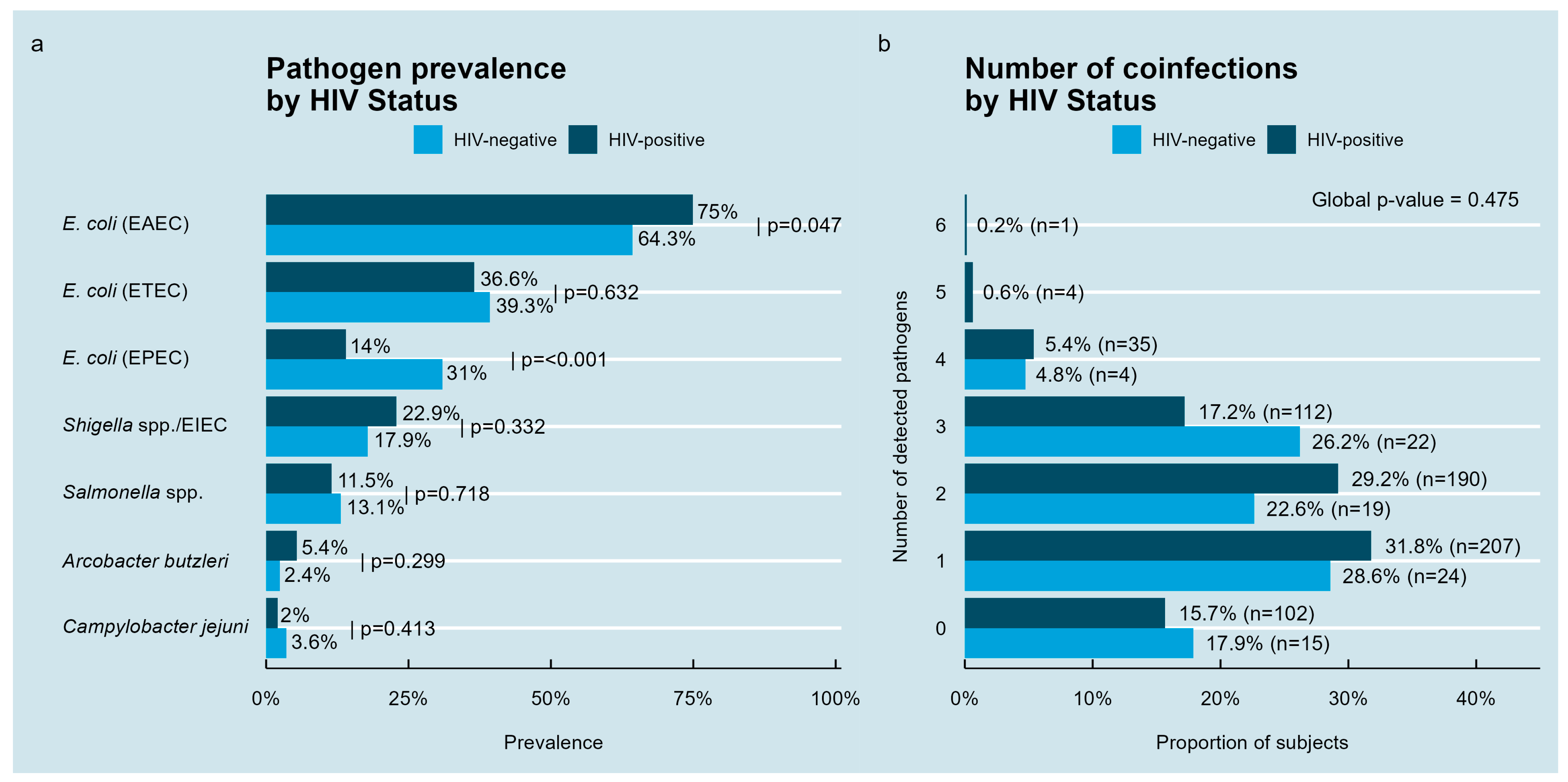
Figure 1. DNA-detection-based prevalence and absolute numbers of coinfections with enteropathogenic bacteria by HIV status in the study population. (a) Prevalence of detected enteric pathogens in stool samples, stratified by HIV-negative and HIV-positive groups. (b) Distribution of the number of concurrent detected enteric bacterial infections according to HIV status.
Medsci 13 00316 g001
Figure 2. Pathogens associated with CD4+ T-lymphocyte counts in the study population. (a) Random forest variable importance analysis for HIV-positive individuals identifying bacterial enteropathogens ranked by their predictive contribution to CD4+ T-lymphocyte counts. (b) Corresponding random forest analysis for HIV-negative individuals. (c) Multivariable linear regression results for the combined cohort showing estimated associations between pathogens and CD4+ T-lymphocyte counts.
Medsci 13 00316 g002
Figure 3. Pathogens associated with diarrheal disease in the study population. (a) Random forest variable importance analysis for HIV-positive individuals identifying enteropathogenic bacteria ranked by their predictive contribution to the clinical symptom of diarrhea. (b) Corresponding random forest analysis for HIV-negative individuals. (c) Multivariable logistic regression results for the entire study population showing estimated associations between pathogens and diarrheal disease.
Medsci 13 00316 g003
Figure 4. Pathogens associated with socioeconomic status index in the study population. (a) Random forest variable importance analysis for HIV-positive individuals identifying bacterial enteropathogens ranked by their predictive contribution to the binary socioeconomic status. (b) Corresponding random forest analysis for HIV-negative individuals. (c) Multivariable logistic regression results for the entire study population showing estimated associations between detected enteropathogens and socioeconomic status index.
Medsci 13 00316 g004
Table 1. Demographics, socioeconomic parameters, medical parameters, and immunological parameters in the study population according to HIV status.
VariableHIV-Positive
Individuals,
n = 651
HIV-Negative
Individuals,
n = 84
DemographicsAge in years, median (IQR)40 (33/47)29 (24/37)
Female, n (%)469 (73.63)53 (64.63)
Socioeconomic
parameters
Access to tap water, n (%)337 (52.9)53 (63.86)
Electricity in household, n (%)595 (93.41)80 (96.39)
Refrigerator in household, n (%)463 (72.68)68 (81.93)
SES index high, n (%)459 (72.06)68 (81.93)
Medical parametersCotrimoxazole prophylaxis, n (%)206 (33.01)NA
Intake of cART, n (%)263 (41.29)NA
Body mass index, median (IQR)22 (20/26)24 (21/27)
Virological andimmunological parametersViral load, log10 copies/mL, median (IQR)4.2 (1.6/5.4)NA
CD4+ T cell count/µL, median (IQR)347 (145/571)949 (767/1168)
CD8+ T cell count/µL, median (IQR)970 (648/1379)470 (354/710)
CD4+/CD8+ T cell ratio, median (IQR)0.4 (0.2/0.7)2.0 (1.6/2.5)
cART—antiretroviral combination therapy; IQR—Interquartile range; NA—not applicable; SES index—socioeconomical index.
Table 2. Correlation of cycle threshold (Ct) values of the real-time PCR assays targeting the assessed enteropathogens with CD4+ T-lymphocyte count.
Ct Values of the Real-Time PCR Assays
Spearman’s ρp-Value
Arcobacter butzleri0.030.858
Campylobacter jejuni−0.110.692
EAEC0.100.018
EPEC (assay 1 targeting the eae gene)0.050.249
EPEC (assay 2 targeting an EAF plasmid sequence)−0.180.058
ETEC−0.100.102
Salmonella spp.0.190.078
Shigella spp.0.180.025
Table 3. Comparison of diarrhea-associations of detected enteric microorganisms from the present study as well as from historic studies on children from Ghana and Tanzania [66,67].
MicroorganismPresent Study on a Ghanaian Population with HIV Ghanaian Children [66]Tanzanian Children [67]
Salmonella spp.Associated with diarrheaNo association with diarrhea detectedNo association with diarrhea detected
Shigella spp./enteroinvasive Escherichia coliAssociated with diarrheaAssociated with diarrheaNo association with diarrhea detected *
Campylobacter jejuniNo association with diarrhea detectedNo association with diarrhea detectedNo association with diarrhea detected
enteropathogenic Escherichia coliNo association with diarrhea detectedNot assessedNo association with diarrhea detected
enterotoxigenic Escherichia coliNo association with diarrhea detectedNot assessedNo association with diarrhea detected
enteroaggregative Escherchia coliNo association with diarrhea detectedNot assessedNo association with diarrhea detected
Arcobacter butzleriNo association with diarrhea detectedNot assessedNot assessed
* association with high bacterial load.
Disclaimer/Publisher’s Note: The statements, opinions and data contained in all publications are solely those of the individual author(s) and contributor(s) and not of MDPI and/or the editor(s). MDPI and/or the editor(s) disclaim responsibility for any injury to people or property resulting from any ideas, methods, instructions or products referred to in the content.