
Article

Pyrolysis Kinetics of Lacustrine Shales from the Yanchang Formation: Revealing the Role of Kerogen Type in Shaping Hydrocarbon Generation and Expulsion Pattern

1
College of Environment and Resources, Guangxi Normal University, Guilin 541004, China
2
Guangxi Key Laboratory of Environmental Processes and Remediation in Ecologically Fragile Regions, Guangxi Normal University, Guilin 541006, China
3
State Key Laboratory of Organic Geochemistry, Guangzhou Institute of Geochemistry, Chinese Academy of Sciences, Guangzhou 510640, China
4
College of Resources and Environment, Zhongkai University of Agriculture and Engineering, Guangzhou 510225, China
*
Author to whom correspondence should be addressed.
Geosciences 2026, 16(3), 96; https://doi.org/10.3390/geosciences16030096
Submission received: 20 January 2026 / Revised: 8 February 2026 / Accepted: 14 February 2026 / Published: 26 February 2026

Abstract

The Yanchang Formation in the Ordos Basin is a key target for continental shale oil exploration in China. Due to its complex geological background and diversified organic inputs, the hydrocarbon generation and accumulation in the lacustrine basin remain to be fully understood. Unlike marine shales rich in Type I kerogen, this lacustrine system is dominated by Type II and III kerogens. In this study, Rock-Eval pyrolysis was performed on lacustrine shales with Type IIa, IIb, and III kerogens to investigate the effect of kerogen type on their hydrocarbon generation and expulsion characteristics. The results reveal that the hydrocarbon generation potential of the Yangchang Formation shale generally follows the order of Type IIa > Type IIb > Type III. Pyrolysis kinetic calculations of the kerogens demonstrate a clear hierarchy of hydrocarbon generation and expulsion among the kerogen types, of which Type II kerogen has better hydrocarbon generation potential, earlier generation timing, and narrower generation window than Type III kerogen. The discrepancy in hydrocarbon generation potential and pyrolysis kinetic behavior is largely attributed to the kerogen components and types, which manifests as a kerogen-type constraint on the hydrocarbon generation and expulsion of shale. Based on the geological mapping of the lacustrine shales in the study area, we propose a “kerogen type-specific” exploration strategy that prioritizes Type IIa-rich intervals in moderate-maturity areas for shale oil exploration, Type IIb as secondary prospects, and Type III in high-maturity areas for shale gas exploration. This study provides a systematic investigation of pyrolysis simulation and hydrocarbon generation and expulsion kinetics on the Yanchang Formation shale, as well as a practical framework for optimizing exploration in analogous lacustrine basins.

1. Introduction

Given the escalating global demand for energy and the finite nature of traditional fossil fuels, unconventional hydrocarbon resources like shale oil and gas have emerged as critical alternatives to conventional petroleum [1,2,3]. Among these, lacustrine shale oil and gas are particularly pivotal in China, with recent successes in the Ordos Basin, the Bohai Bay Basin, and the Sichuan Basin [4,5]. For instance, the Upper Triassic Yanchang Formation in the Ordos Basin becomes a prime target for lacustrine shale oil exploration and development, with cumulative proven reserves exceeding one billion tons and commercial production achieved in the Chang 7 Member [6,7,8]. The Yanchang Formation’s unique geological setting, characterized by a semi-arid to humid lacustrine facies, has led to the dominance of three kerogen types: Type IIa, Type IIb, and Type III. However, Type I kerogen is geologically rare in the Yanchang Formation, due to limited aquatic algal blooms in the lacustrine lake system [9,10,11,12,13]. This feature distinguishes the Yanchang Formation from marine shale systems (e.g., Marcellus Shale and Eagle Ford Shale) in terms of organic matter inputs, with large discrepancies in hydrocarbon resource potentials [14,15]. Generally, marine shale system is abundant in Type I/IIS kerogens, which usually exhibit better oil mobility due to the superior oil-prone nature [16,17,18,19,20]. Consequently, successful marine evaluation criteria and exploration strategies may not be directly applicable to lacustrine shales, thereby necessitating a systematic assessment of hydrocarbon generation potential for lacustrine shales [17,21].
Thermal evolution of organic matter in the Yanchang Formation’s shale layers is the primary driver of hydrocarbon generation, and kerogen type serves as a fundamental control on the quantity, quality, and mobility of the resulting oil and gas [22,23]. Using Rock-Eval pyrolysis, Du et al. [24] quantified the hydrocarbon generation potential of Type II and III kerogens in the Chang 7 Member and found that Type II kerogen contributes over 70% of the total oil yield. Sun et al. [25] demonstrated that high organic matter abundance (TOC > 5%) can enhance hydrocarbon retention in Type IIa-rich shales. However, these studies focus primarily on hydrocarbon generation and expulsion amounts but rarely link kerogen type with hydrocarbon generation and expulsion kinetics. To date, Hui et al. [26] quantitatively investigated lacustrine source rocks with different kerogen types in the Liaohe Western Depression, elucidating the role of kerogen type in hydrocarbon generation potential. This has implications for a systematic, kinetics-focused investigation of the dominant kerogen types (IIa, IIb, III) in the Yanchang Formation to address the commercial production challenges in the Ordos Basin [27,28], as well as develop tailored exploration strategies for economically significant lacustrine systems. A key issue is that a benchmark of oil saturation index (OSI) > 100 mg/g TOC underperforms in lacustrine shale resource appraisal [29]. Such differences in the hydrocarbon generation-expulsion-retention of source rock may be rooted in the kerogen components and types [20,30]. Therefore, comparing hydrocarbon generation and expulsion among kerogen types is essential to clarify the differences between lacustrine and marine shale systems, or among different intervals of a single deposit.
Rock-Eval pyrolysis is widely used for the rapid evaluation of source rock quality and pyrolysis kinetic analysis [31,32,33,34]. Our previous work on the Yanchang Formation employed Rock-Eval pyrolysis and kinetic analysis to demonstrate the effects of shale grain size and TOC content on the hydrocarbon generation and expulsion [25,35]. On this basis, this study aims to (1) compare the hydrocarbon generation and expulsion kinetics of lacustrine shales with Type IIa, IIb, and III kerogens; (2) elucidate how kerogen type influences the hydrocarbon generation and expulsion behaviors; and (3) propose an organic type-specific exploration strategy for shale oil and gas in the Yanchang Formation. This study is expected to enhance our understanding of shale oil/gas accumulation mechanisms and to provide guidance for optimizing resource allocation in the Ordos Basin.

2. Geological Setting

The Ordos Basin, located in northwest China, is the second largest sedimentary basin and a crucial energy province in China. It is a stable cratonic basin characterized by a simple structural framework, generally showing a large W-dipping monocline. The Upper Triassic Yanchang Formation developed under a lacustrine environment, comprises the most important oil-bearing unit in the basin [14,36,37,38,39,40,41]. For instance, the Chang 7 Member of the Yanchang Formation was formed during the most extensive lacustrine transgression under semi-deep to deep lake conditions, which results in a co-deposition of organic-rich shales and siltstones [42,43,44,45]. It is reported that organic matter in source rocks of the Chang 7 Member is predominantly Type II and III originating from aquatic algae and terrestrial higher plants [45,46,47].
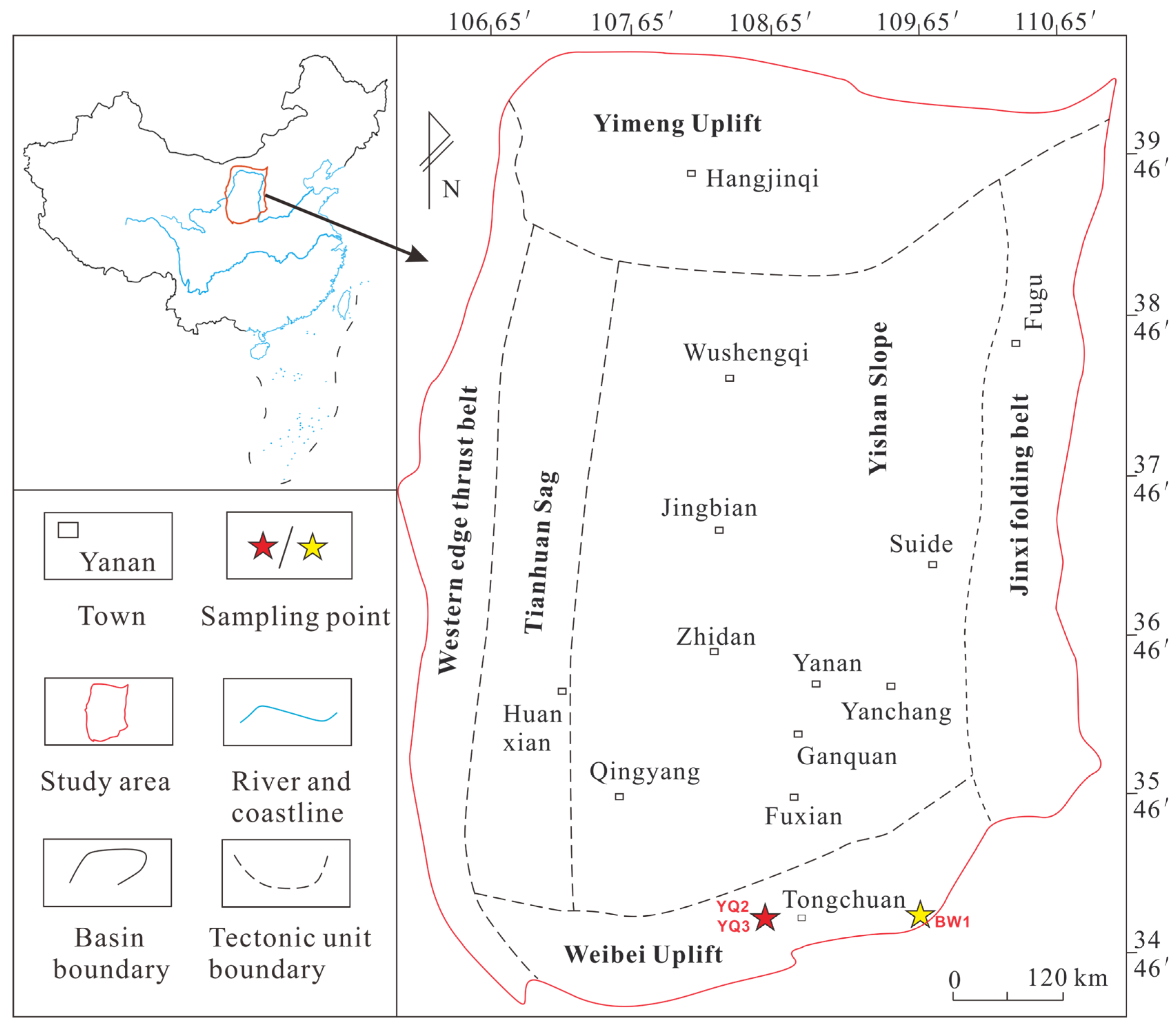
The shale samples used in this study were collected from a shallow borehole in the Tongchuan area, situated on the southeastern margin of the Ordos Basin (Figure 1). Due to the Weibei uplift, the Chang 7 Member is widely exposed at the surface and is thought to be representative of subsurface materials in this region. The thermal maturity of the Chang 7 Member increases northwestward across the basin, with a natural gradient extending from oil-prone (southeastern and central regions, Ro = 0.8–1.3%) to gas-prone (northwestern region, Ro = 1.5–2.0%) windows [48,49,50,51,52].

3. Samples and Experimental Methods

3.1. Samples

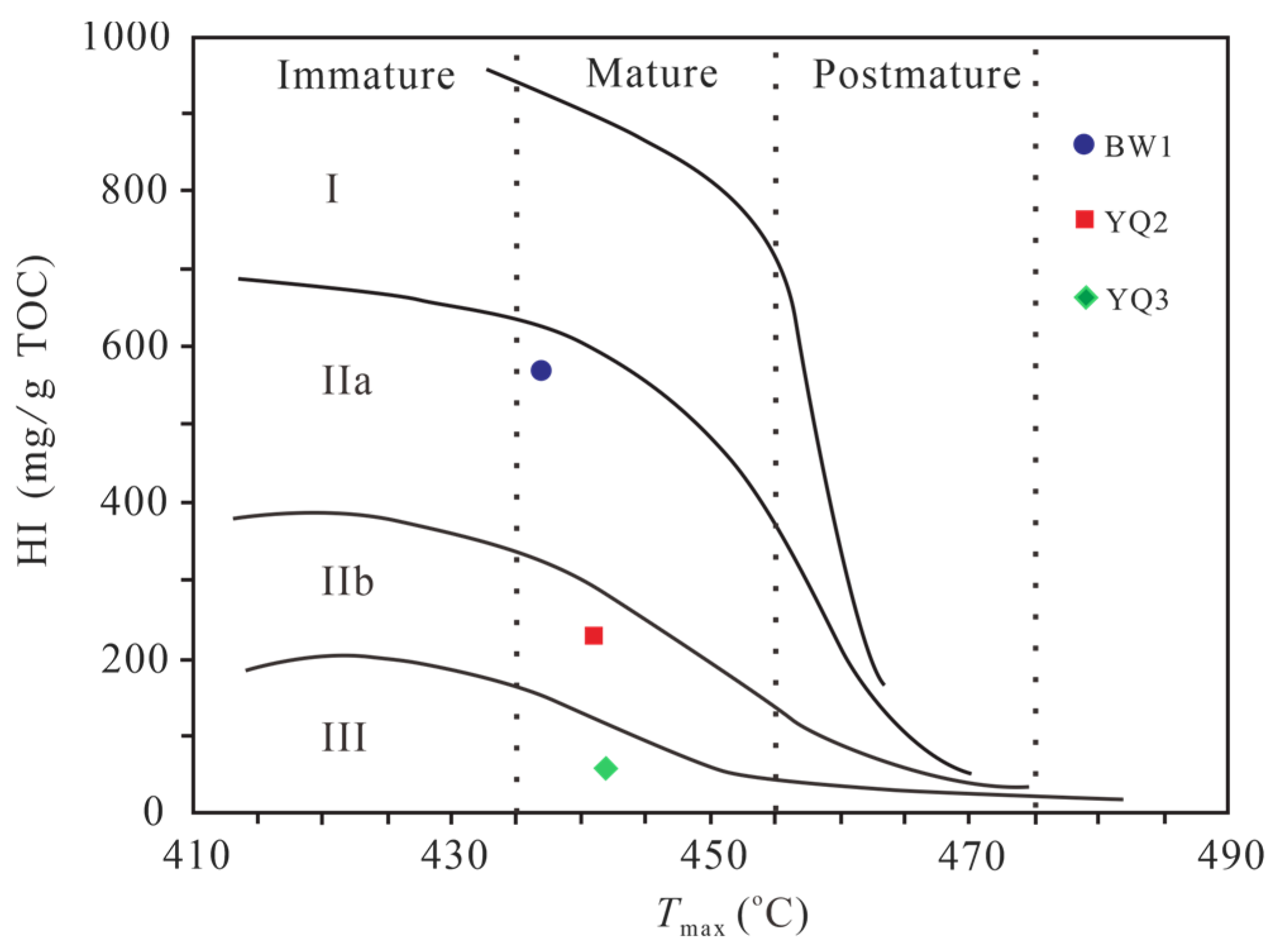
Three shale samples were obtained from the Chang 7 Member of the Upper Triassic Yanchang Formation in the Ordos Basin of China. One is from Bawangzhuang and two are from Yaoqu, all located in Tongchuan City, Shaanxi Province. The mineralogical composition of the shales, determined by X-ray diffraction (XRD) analysis, is clays (30.0–41.5 wt%), halite (22.7–24.6 wt%), feldspar (11.7–14.8 wt%), quartz (10.2–13.4 wt%), and minor (<5 wt%) calcite and pyrite. To minimize the heterogeneity in lithology and organic content, the shales were crushed to grains with a diameter of 4 mm preparing for Rock-Eval temperature-programmed pyrolysis. Full details of the sample preparation can be found in a previous study [53]. Table 1 lists the Rock-Eval pyrolysis parameters of the shale samples. The present-day hydrogen index (HI) varies largely for different shale samples, with values being 567, 226, and 58 mg/g TOC for shales BW1, YQ2, and YQ3, respectively. Shale BW1 from Bawangzhuang has a higher total organic carbon (TOC) content of 7.25%, compared to YQ2 and YQ3 from Yaoqu. Kerogen type as expressed in an HI-Tmax plot (Figure 2) shows that the samples in this region are assigned to three kerogen types: IIa, IIb, and III. Tmax is usually indicative of thermal maturity [54], and that of the shale samples generally indicates an early mature stage. The similarity in mineral constituents of the shales provides us with a broad range of geological samples to examine the organic type-specific effect on hydrocarbon generation and expulsion of shale.

3.2. Rock-Eval Pyrolysis

The thermal simulation experiments were performed using a Rock-Eval 6 pyrolyzer (Vinci Technologies, Nanterre, France) with the Optikin programmed temperature method [55]. Liao et al. [56] provided a detailed description of the instrumental analysis conditions for Rock-Eval pyrolysis. In brief, shale samples were heated from 300 °C (held for 3 min to quantify free hydrocarbons, S1) to 700 °C at rates of 5, 15, and 25 °C/min. This process provided fundamental geochemical parameters including S1, S2, S3, and TOC, which were subsequently used to calculate the Hydrogen Index (S2/TOC × 100) and Oil Saturation Index (S1/TOC × 100). To ensure data reliability, duplicate analyses were conducted for each sample. The powdered sample was weighed with an error range of ±0.05 mg to minimize weight-induced variations. Prior to each analysis, the instrument was calibrated with a standard sample to verify proper operation. Based on replicate measurements, the analytical precision was determined to be within ±5% for S2, ±2 °C for Tmax, and ±0.14% for TOC.

3.3. Kinetic Modeling

Kinetic modeling serves as a mathematical bridge between rapid laboratory reactions and long-term geological processes. This approach is usually governed by first-order kinetics, in which the conversion of kerogen is quantified using the Arrhenius equation as shown in Equation (1) [54,57,58].
d x i / d t = A x i e x p E i R T , i = 1 N
where xi is the residual potential of hydrocarbon generation associated with reaction i, t is time, T is the temperature, R is the molar gas constant, A is the frequency factor, and Ei is the assumed activation energy [57,59].
In this study, the kinetic parameters A and Ea were calculated based on the distributed activation energy model, which is a widely adopted approach for kerogen pyrolysis [60,61]. The kinetic calculations and modeling for hydrocarbon generation and expulsion were performed using the Kinetics 2000 software. The validity of extrapolating laboratory-derived kinetic parameters to geological conditions is supported by previous studies [56,60]. Although such extrapolation would embrace inherent uncertainties in basin simulator due to the assumption of constant frequency factor and the simplification of complex geological processes, it provides a robust framework for comparative kinetic analysis among source rocks containing different kerogen types.

4. Results

4.1. Rock-Eval Pyrolysis Characteristics

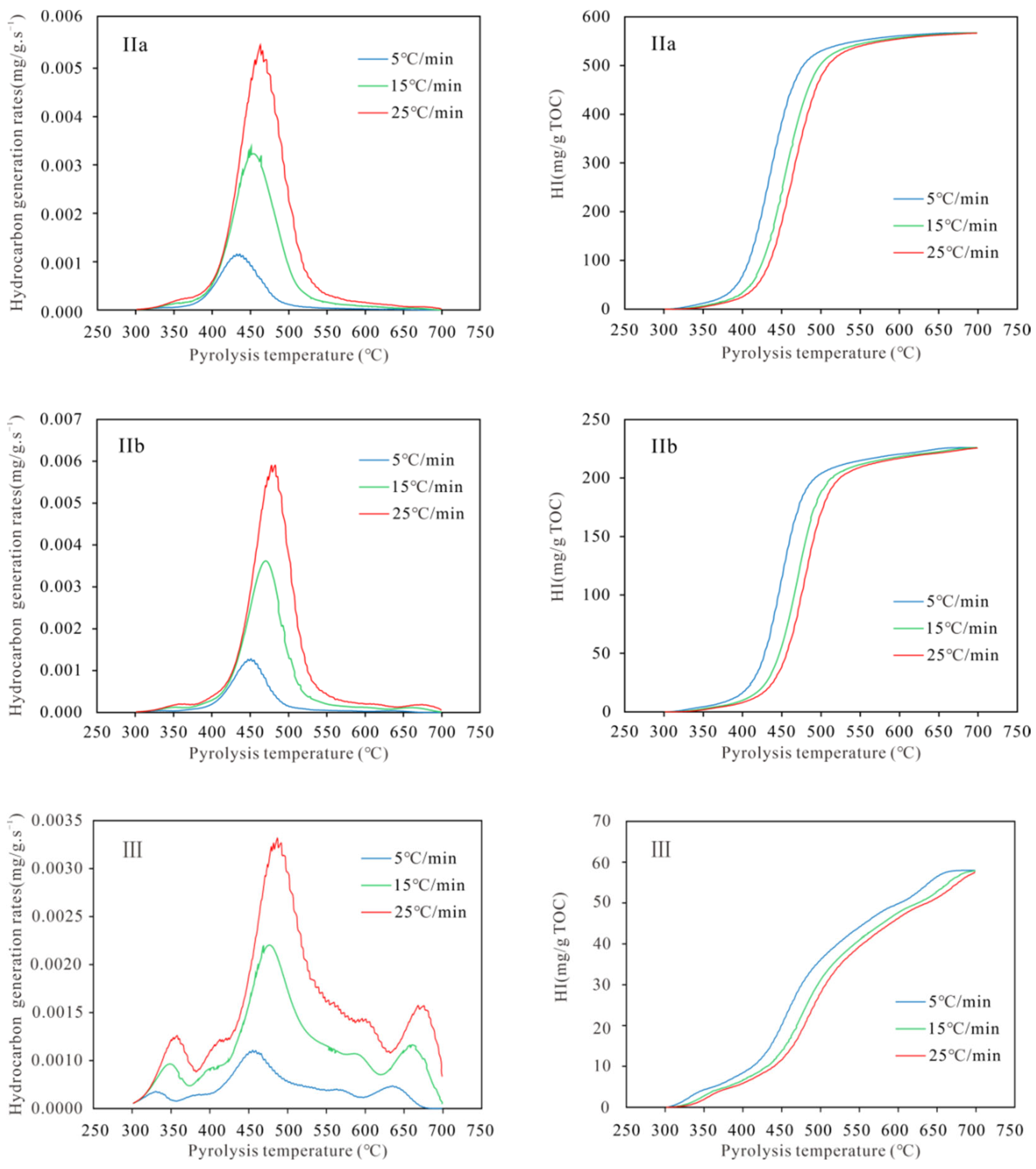
Figure 3 shows the hydrocarbon generation rates (HGRs) and yields of the shale samples with different kerogen types as a function of pyrolysis temperature at varying heating rates. Comparison of Type IIa, IIb, and III kerogens at various heating rates reveals the similarity to each other in that the HGR increases with heating rate. Where the maximum HGR was reached, the corresponding pyrolysis temperature generally follows the sequence 5 °C/min < 15 °C/min < 25 °C/min. This distribution pattern is consistently observed for the pyrolysis of Type I kerogen reported in the literature (e.g., [26,28,56,62,63]). Moreover, the pyrolysis characteristic of Type IIa kerogen is similar to that of Type IIb kerogen but vastly different from Type III kerogen.
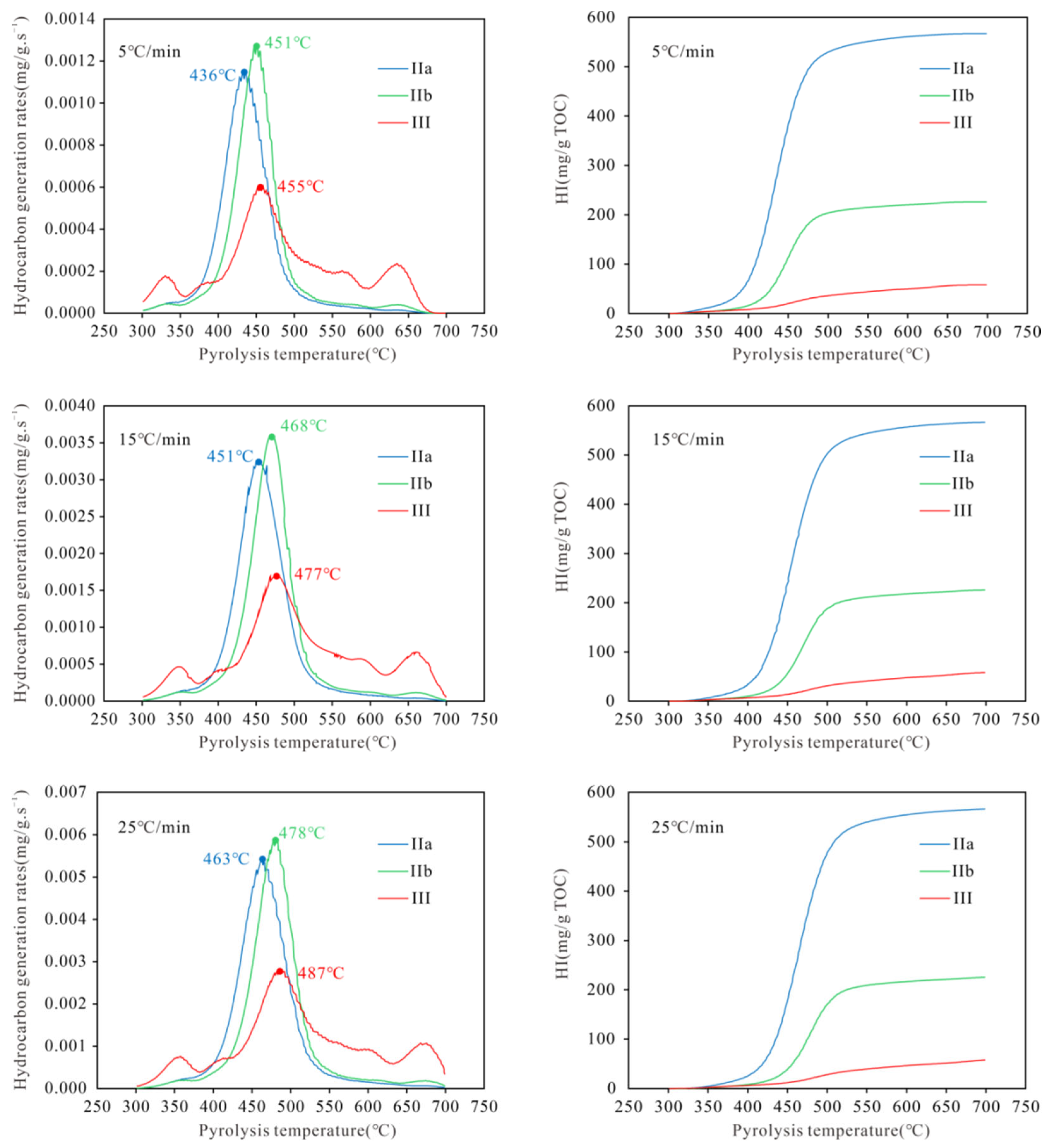
For a better interpretation of the differences in pyrolysis characteristics among different kerogen types, the HGRs and accumulative yields of the shales with Type IIa, IIb, and III kerogens for each heating rate were compared (Table 2 and Figure 4). The results show that not only is the HGR of shale with Type III kerogen significantly lower but that it reaches the maximum later than Type IIa and IIb kerogens at each heating rate. That is, the shale with Type III kerogen requires a relatively higher temperature to reach its maximum HGR, as compared to Type IIa and IIb kerogens. For example, at the heating rate of 5 °C/min, the respective pyrolysis temperature is 455 °C for Type III kerogen, higher than that of Type IIa kerogen (436 °C) and Type IIb kerogen (451 °C) (Table 2).
Significant differences in the total hydrocarbon yields are also observed among the kerogen types. For a given source rock, the total amount of hydrocarbon generation is the same irrespective of pyrolysis heating rate [64]. As shown in Figure 4, the accumulative yield of hydrocarbon generation that is expressed as HI is, respectively, 567, 226, and 58 mg/g TOC for the shales with Type IIa, IIb, and III kerogens, indicating that Type III kerogen has a lower hydrocarbon generation potential than Type II kerogen. Note that Type IIa kerogen has a lower HGR than Type IIb kerogen, although the accumulative yield for the former is more than twice that of the latter.

4.2. Kinetic Parameters

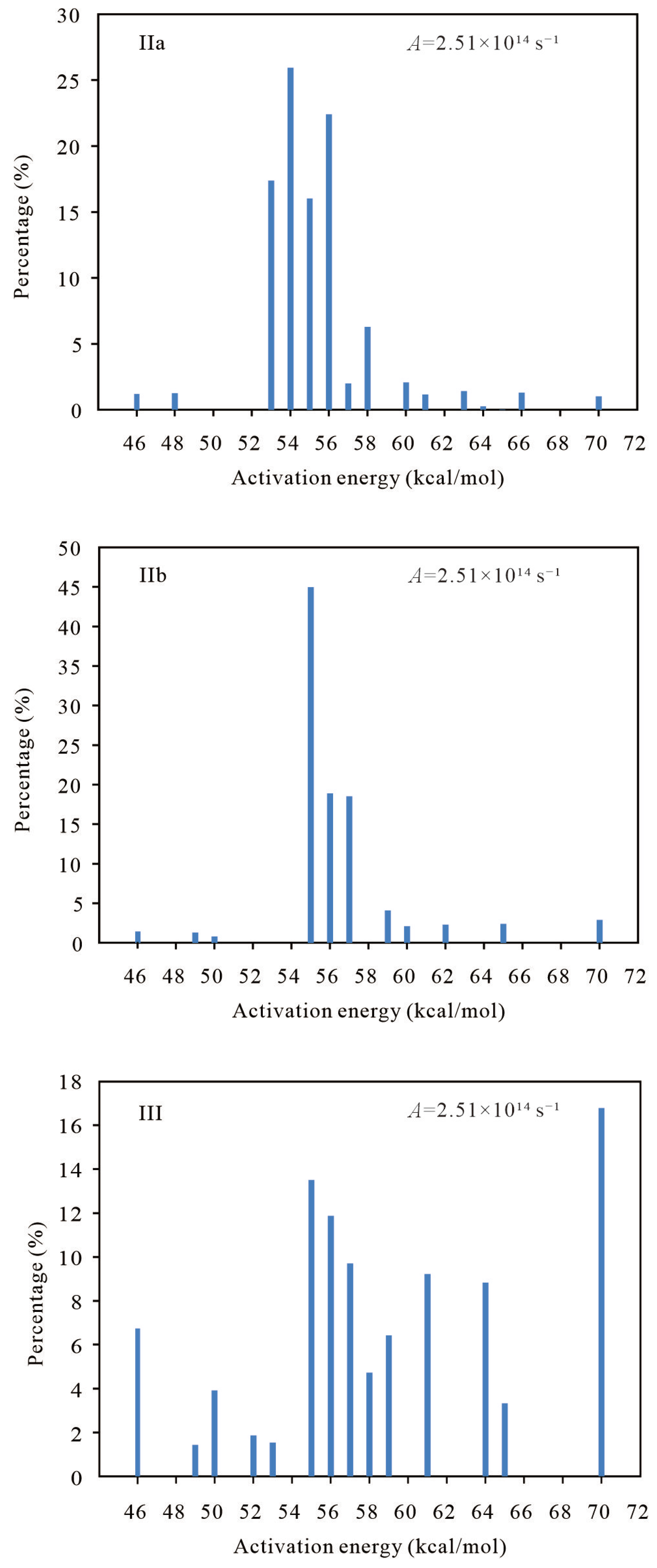
Activation energy (Ea) for the conversion of kerogen to hydrocarbons was assessed for the shales with Type IIa, IIb, and III kerogens, with the assumption that the kerogen decomposition reaction follows first-order kinetics [65,66,67,68,69]. Ea for the decomposition of kerogen with various types ranged from 46 to 70 kcal/mol, and the frequency factor (A) was approximately 2.51 × 10¹⁴ s−1 (Figure 5). Both Type IIa and IIb kerogens show comparatively narrow distributions with principal discrete activation energies of 53–56 and 55–57 kcal/mol, respectively; whereas a dispersed distribution in the Ea range of 55–70 kcal/mol for Type III kerogen. This indicates that the susceptibility of kerogen decomposition to thermal stress generally follows the sequence of Type IIa > IIb > III, as the larger activation energy gives rise to a stronger temperature dependence for the kerogen decomposition.

4.3. Modeling of Hydrocarbon Generation and Expulsion History

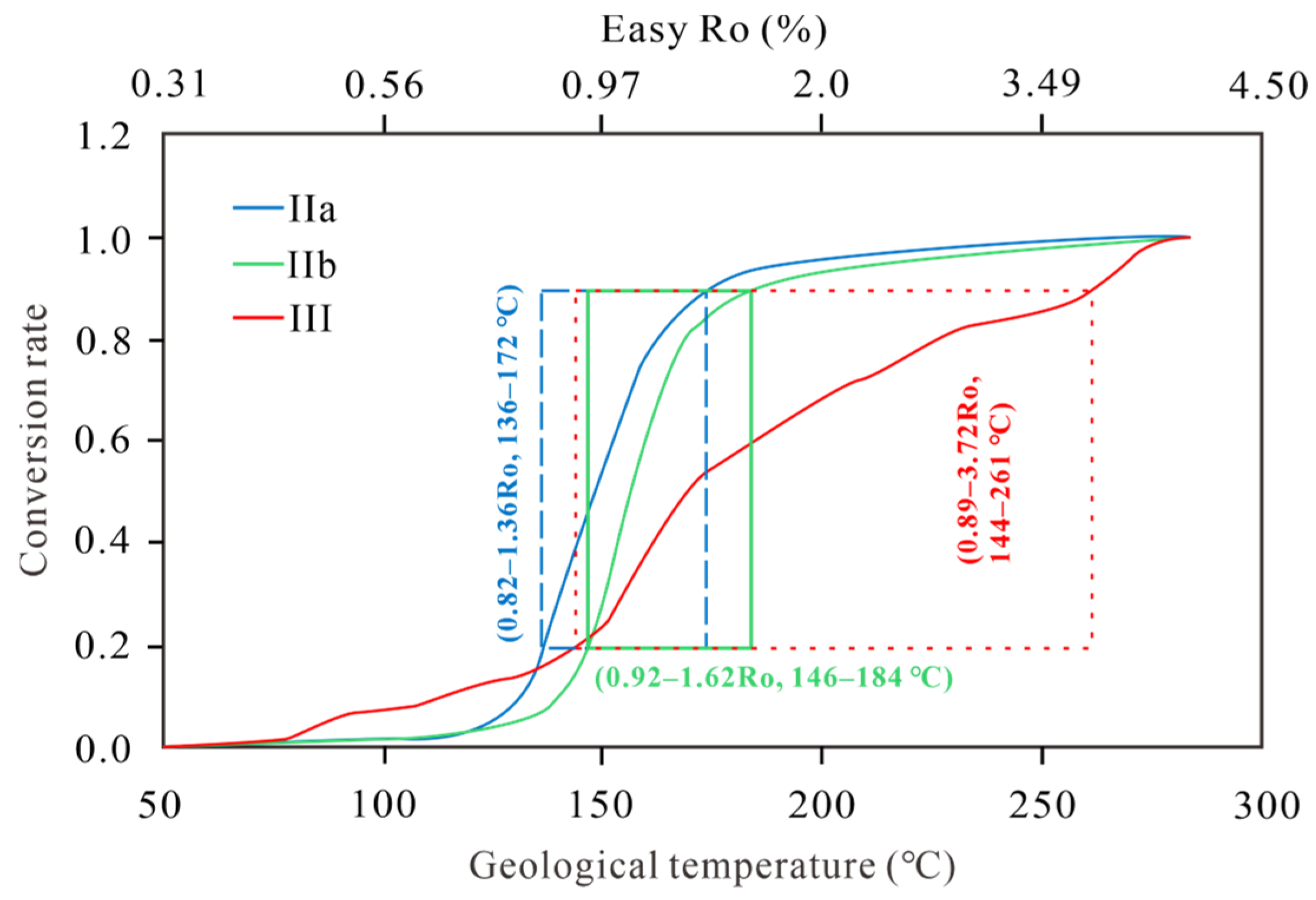
The kinetics of kerogen decomposition based on Rock-Eval pyrolysis was extrapolated to a geological heating rate of 3 °C/Ma for modeling of hydrocarbon generation history of the Chang 7 Member (Figure 6). Hydrocarbon conversion rate is commonly used to assess the thermal evolution stage of source rock, during which the main hydrocarbon generation period corresponds to a conversion rate range of 0.2–0.9 [70,71]. At this period, the corresponding maturity (geological temperature) is in the EasyRo range of 0.82–1.36% (136–172 °C), 0.92–1.62% (146–184 °C), and 0.89–3.72% (144–261 °C) for the shales with Type IIa, IIb, and III kerogens, respectively. Type II kerogen exhibits lower maturity at the onset of its main hydrocarbon generation period, suggesting an earlier start of hydrocarbon generation compared to Type III kerogen. Furthermore, a relatively broad range of maturity for Type III kerogen may suggest a prolonged hydrocarbon generation duration.
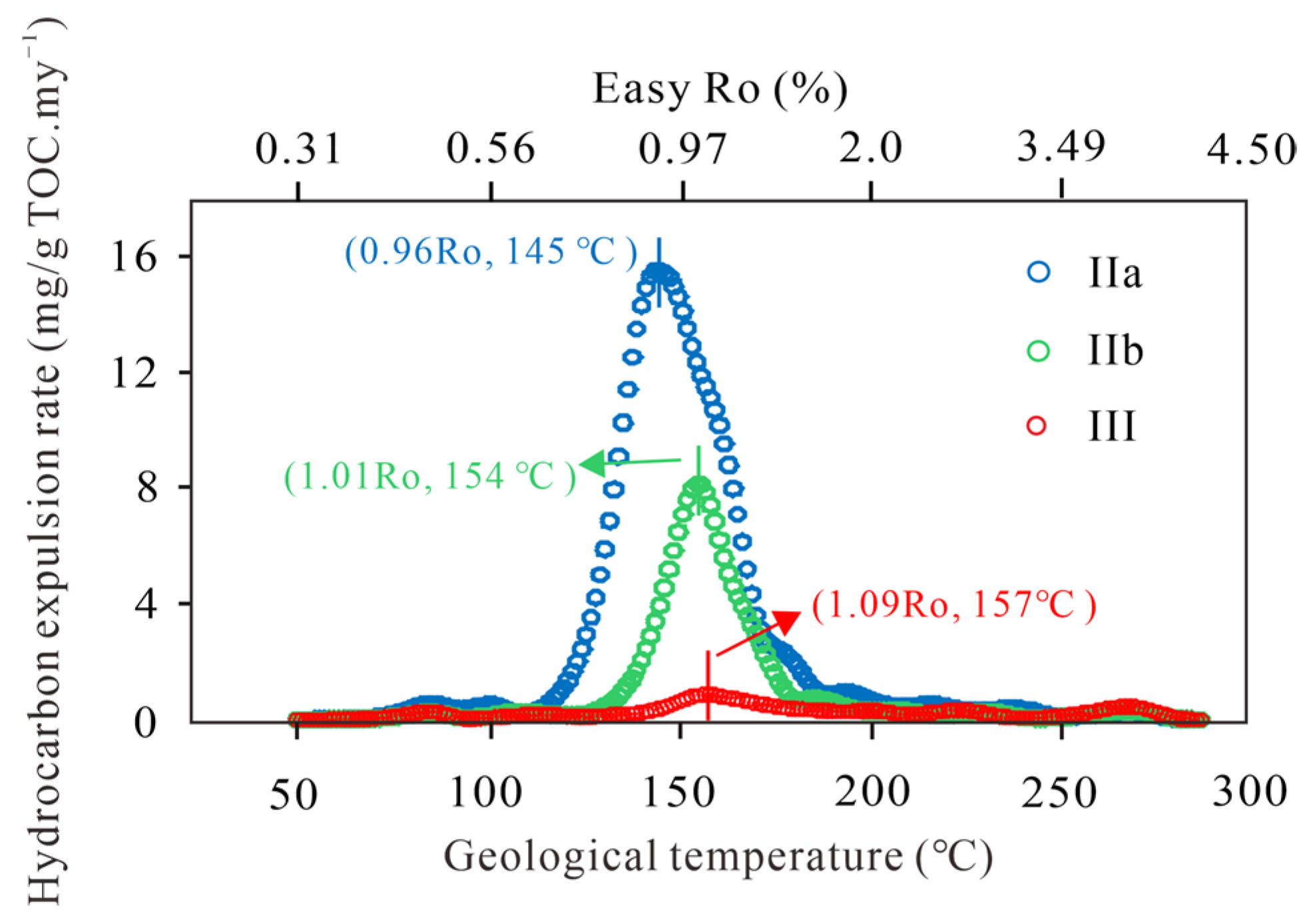
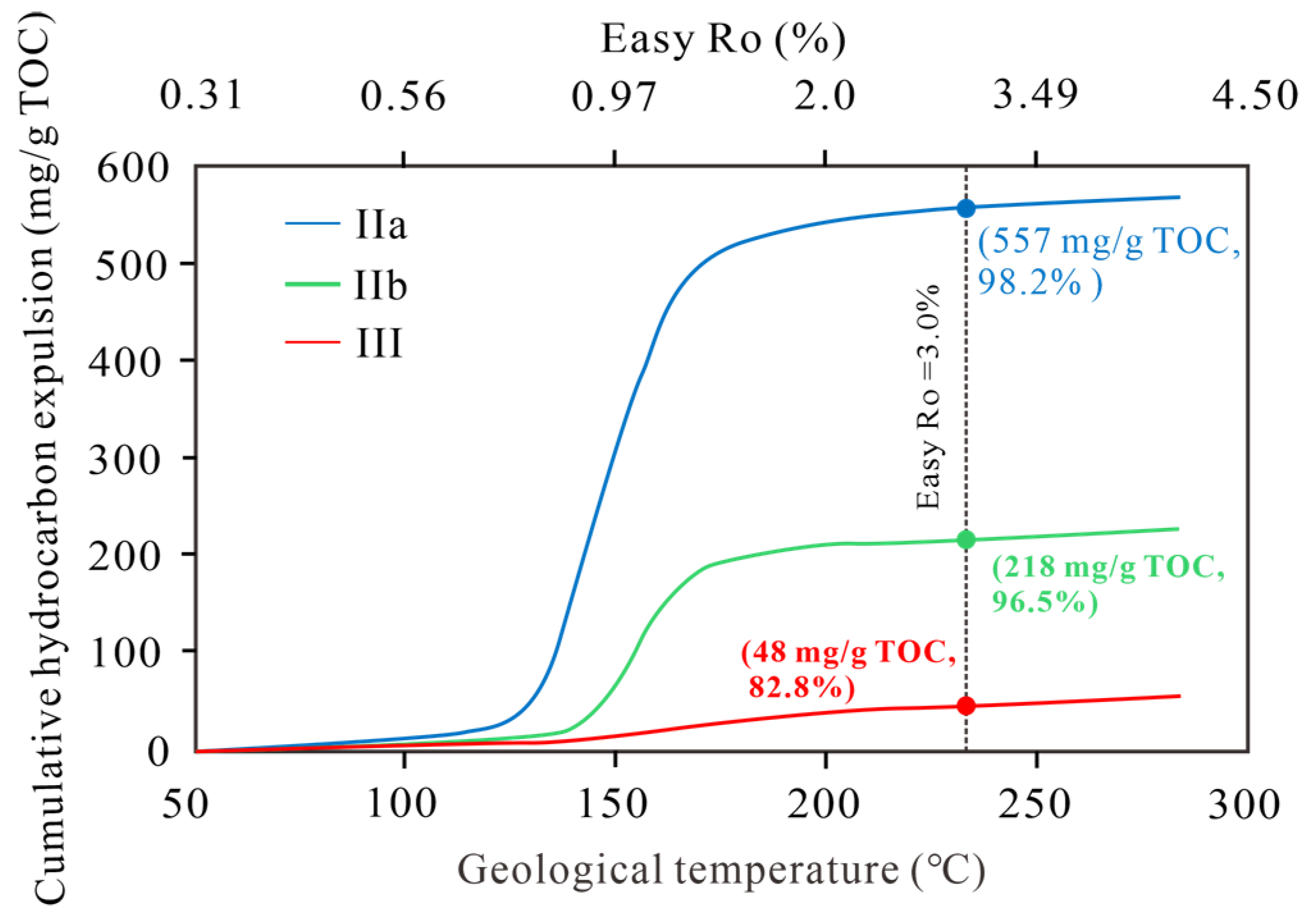
Comparison of hydrocarbon expulsion rate (HER) based on kinetic calculations reveals distinct expulsion behaviors for the shales with Type IIa, IIb, and III kerogens (Figure 7). Type IIa kerogen exhibits the highest HER (15.52 mg/g TOC·my−1), followed by Type IIb kerogen (8.14 mg/g TOC·my−1) and Type III kerogen (only 0.86 mg/g TOC·my−1). The maturity (temperature) corresponding to the maximum HER is 0.96% (145 °C), 1.01% (154 °C), and 1.09% (157 °C) for Type IIa, IIb, and III kerogens, respectively. Figure 8 also displays that at an over-mature stage of Ro = 3%, the cumulative hydrocarbon expulsion amount for Type IIa, IIb, and III kerogens is 557 mg/g TOC, 218 mg/g TOC, and 48 mg/g TOC. At this stage, the hydrocarbon expulsion efficiencies for the shales with Type IIa, IIb, and III kerogens are 98.2%, 96.5%, and 82.8%, respectively. These results indicate that hydrocarbon generation and expulsion capacity/efficiency vary distinctly among the lacustrine shales with various kerogen types.

5. Discussion

The hydrocarbon generation-expulsion-retention of organic-rich shales is limited to geochemical conditions mainly including two aspects: organic matter characteristics (e.g., the abundance, type, and maturity of organic matter) and physicochemical properties of source rock (e.g., porosity, permeability, lithology, and mineralogy) [48,72,73,74]. On the basis of understanding that both TOC and shale grain size did affect hydrocarbon generation and expulsion of lacustrine shales [25,35], we selected three representative lacustrine shales with similar mineralogical composition and grain size but various kerogen types (i.e., IIa, IIb, and III) and investigated their pyrolysis characteristics and kinetics, to demonstrate the influence of kerogen types on the hydrocarbon generation and expulsion of lacustrine shales in this study.

5.1. Kerogen Type Dictates Hydrocarbon Generation Potential of Lacustrine Shale

As kerogen is the major organic-parent-material in shale, the shale pyrolysis can be considered as kerogen transformation to oil/gas [29], which depends largely upon the temperature increase [75]. For either of the shale samples, the increased heating rate accelerates the HGR (Figure 3), which suggests that the hydrocarbon generation in the Rock-Eval pyrolysis system is essentially a temperature dependent process. In other words, the slower heating rate for the kerogen pyrolysis requires a relatively lower temperature and longer time to reach its maximum HGR, which indicates the time-temperature compensation effects in hydrocarbon generation under real geological conditions [76]. As noted above, the Rock-Eval pyrolysis results revealed the differences visible in pyrolysis characteristic and kinetic parameters among the three kerogen types. Overall, the hydrocarbon generation potential of lacustrine shales with various kerogen types as indicated by Pg and HI (Table 1, Figure 4), generally follows the order of Type IIa > IIb > III. This distribution is consistent with those reported in previous studies [26,77]. Hui et al. [26] also suggested that Type I kerogen is characterized by better hydrocarbon generation potential, earlier generation timing, and narrower generation window than other types of kerogen. In this study, the pyrolysis of Type II kerogen reached its maximum HGR earlier than Type III kerogen, suggesting a lower temperature threshold for the decomposition of Type II kerogen. Additionally, the apparent Ea of Type II kerogen is mostly distributed within a narrower range than Type III kerogen (Figure 5), indicating a narrower generation window. While ruling out the heterogeneity-induced effect of inorganic mineral matrix, these differences highlight the vital role of kerogen type in determining the hydrocarbon generation potential and pyrolysis kinetic behavior [78,79,80,81].
Type IIa, IIb, and III kerogens are fundamentally distinguished by their origin and the molecular composition and structure that is determined by sources of contributing biological precursors and sedimentary environments [54,75,82]. On this basis, the plot of HI versus Tmax (Figure 2) can better differentiate the kerogen types [83,84]. Type II kerogen is typical of lipid-rich aquatic organisms comprising mostly of relatively weak, aliphatic C−C and C−S bonds, which facilitates efficient oil generation at lower thermal stress [85]. While Type III kerogen originates from a terrestrial input of higher plants comprising of aromatic ligneous debris (aromatic C=C and C−O bonds), favoring gas generation at higher thermal stress [75,85,86,87]. This is explicitly demonstrated by the Ea distribution for which Type IIa kerogen falls within a lower range of 53–56 kcal/mol than Type IIb kerogen (55–57 kcal/mol) and Type III kerogen (55–70 kcal/mol) (Figure 5). This indicates that the chemical bonding forms within kerogen macromolecules are primarily responsible for the divergent kinetic behaviors.
Owing to variable respective amounts of the major constituents of kerogen composition, kerogen type plays a critical role in determining the chemical composition of its resulting products during maturation [75]. Moreover, the diversified kerogen composition gives rise to a variable oil/gas potential upon maturation. For Type II kerogen, high HI and high Pg with a unimodal hydrocarbon generation peak yielded a considerable amount of light, paraffinic oils with greater fluidity (Table 1, Figure 4). In contrast, low HI and low Pg with multimodal generation profile for Type III kerogen indicate a propensity to generate heavy, aromatic compounds and gases [26,64]. As shown in Figure 4, the HGRs for both Type IIa and Type IIb kerogens show a unimodal curve spanning a relatively narrow range of temperature from 370 °C to 550 °C, and a multimodal pattern comprising of two minor peaks alongside the main peak for Type III kerogen. Regarding Type III kerogen, an apparent peak at the pyrolysis temperature range of 650–700 °C may suggest a considerable gas generation potential. Although the subdivided Type IIa and IIb kerogens share similar distributions in HGR and Ea, there exists more than twice the difference in the total hydrocarbon yield. According to the chemical kinetic model of hydrocarbon generation [88], source rocks with high TOC and high HI would promote the conversion of organic matter to hydrocarbons. Because shale BW1 (Type IIa) has a higher TOC content than shale YQ2 (Type IIb) (Table 1), it is plausible that the organic matter abundance of shale also contributes to its hydrocarbon generation potential.

5.2. Hydrocarbon Generation and Expulsion Differences Among Kerogen Types

The pyrolysis kinetics of source rock link laboratory measurements with geological applications, offering a predictive framework for regional exploration [89,90]. Our results showed that Type IIa kerogen in the deep-lake area (Bawangzhuang) is kinetically favorable for the main hydrocarbon generation window at a relatively low geological temperature (136–172 °C, Ro = 0.82–1.36%) (Figure 6). This temperature range corresponds to burial depths of 1500–2500 m for the Chang 7 Member in the Ordos Basin, which represents an optimal window for shale oil development by effective fracturing [91,92,93,94]. While Type IIb kerogen from the Yaoqu transitional zone possesses a slightly higher Ea, with the main hydrocarbon generation window being at 146–184 °C (Ro = 0.92–1.62%). This temperature range corresponds to greater burial depths (2000–3000 m) where the late oil stage has led to condensate wet gas formation by oil secondary cracking. Type III kerogen from the basin margin exhibits the broadest Ea range (55–70 kcal/mol) and requires significantly higher maturity (144–261 °C, Ro = 0.89–3.72%) to generate hydrocarbons. At the corresponding burial depths (>3000 m) in the Ordos Basin, the primary product is generally natural gas. However, due to low TOC content (0.31%) for the lacustrine shales in this region, the hydrocarbon generation potential is very low.
The compositional distribution of the generated hydrocarbons from lacustrine shale, in turn, affects hydrocarbon expulsion efficiency as well as shale oil mobility within the oil window. Micro-migration phenomenon in shaly strata has been considered to be one of the most important issues affecting shale oil accumulation and efficient development [18]. Expulsion efficiency is governed by a combination of generated hydrocarbon volume and product composition [28]. Construction of the hydrocarbon expulsion history of the shales with various kerogen types shows that Type III kerogen requires a higher maturity to reach its maximum HER (Figure 7) and has a lower amount of hydrocarbon expulsion (Figure 8), as compared to Type IIa and IIb kerogens. The lagging behind in hydrocarbon expulsion and the difference in hydrocarbon expulsion amount suggest that the hydrocarbon expulsion behavior of shale is at least controlled by the kerogen type. The higher expulsion efficiency (98.2%) for Type IIa kerogen is not only a function of greater oil volume but also a result of its lighter, less viscous product suite. This gives them a lower surface tension and they can migrate through nano-pores more easily, coalescing into a continuous mobile phase [95]. In contrast, the lower expulsion efficiency (82.8%) of Type III kerogen could be attributed to its inherently lower hydrocarbon generation potential and a broader generation window. This would result in the generation of heavier hydrocarbons with a greater tendency for retention within the organic network, as well as potentially insufficient pore pressure buildup to drive effective expulsion [63]. As a consequence of its poor generative potential, the hydrocarbon expulsion and retention of Type III kerogen is inefficient.

5.3. Evaluation of Movable Shale Oil Resource and Exploration Implications

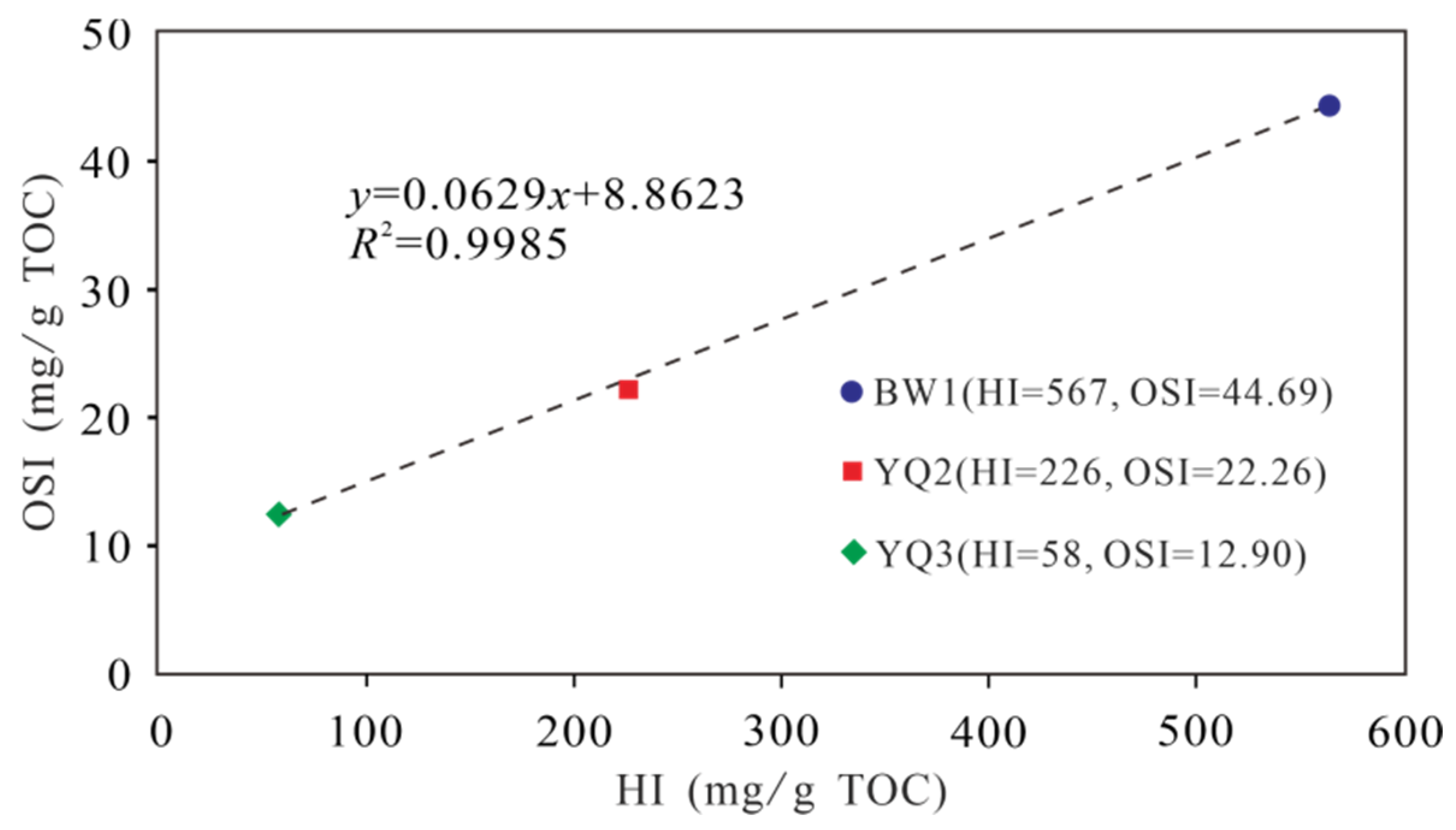
Oil saturation index (OSI) is a key parameter to evaluate the mobility of retained oil in shale. For the original shale samples, the OSI values calculated in terms of Rock-Eval pyrolysis data reveal significant differences among the kerogen types, following the order of Type IIa >IIb > III (Table 1). A strong positive correlation (R2 > 0.99) is observed between HI and OSI for the shale samples (Figure 9). This may suggest that kerogen type as indicated by HI is a principal factor controlling the retention of movable hydrocarbons in shales at a low-maturity stage. For instance, Type IIa kerogen with an HI of 567 mg HC/g TOC generally corresponds to a high OSI, indicating the strongest retention of movable oil. According to the “like-dissolves-like” principle, the hydrocarbon products are readily associated with their parent material (e.g., kerogen and bitumen) at a low-maturity stage [96]. Hou et al. [97] reported that high TOC resulted in a relative increase in light components in retained shale oils. These studies generally imply that kerogen type and organic matter abundance not only control the hydrocarbon generation potential, but can also influence the retention of movable shale oils.
In this study, Type IIa kerogen exhibits the highest hydrocarbon potential and oil mobility, with HI and OSI values being 567 mg HC/g TOC and 44.69 mg/g TOC, respectively (Table 1). It primarily generates light, saturated hydrocarbons within a narrow generation window (136–172 °C) (Figure 6). The high TOC content for the shale with Type IIa kerogen also facilitates organic pore development, reduces mineral surface adsorption, and enhances oil mobility [98,99,100]. These characteristics are favorable to the accumulation of shale oil with relatively better mobility. In contrast, Type IIb kerogen shows moderate generative potential and oil mobility, with HI and OSI values being 226 mg HC/g TOC and 22.26 mg/g TOC, respectively. This kerogen type is widely distributed in transition zones between deep lake and shallow lake or delta front facies, where TOC content ranges between 2% and 5%. However, Type III kerogen displays limited oil generation potential as indicated by low HI (58 mg/g TOC) and OSI (12.90 mg/g TOC). However, its broad generation window (144–261 °C) makes it conducive to gas generation at higher maturities (Ro > 2.0%). The systematic decline in OSI values from Type IIa to IIb to III, even after accounting for expulsion effects, highlights the critical role of kerogen composition in controlling the hydrocarbon retention. The superior OSI performance of Type IIa kerogen underscores its exceptional generative potential and relative superiority within the lacustrine shale system of the Yanchang Formation. The pyrolysis parameters and kinetic behaviors for the Yanchang Formation reveal fundamental differences from those well-documented marine shale plays. In marine systems like the Eagle Ford Shale, high OSI values (>100 mg/g TOC) are commonly achieved on Type I/IIS kerogen and efficient expulsion by high pressure and well-interconnected pore networks [16,23,101]. In this study, even though the Yanchang Formation shales with Type IIa kerogen yields low OSI values (<45 mg/g TOC), successful shale oil production has been made in the Chang 7 Member of the southern Ordos Basin (e.g., the Xin’anbian oilfield) [93,102]. This discrepancy suggests that low OSI does not necessarily preclude commercial viability but rather reflect the result of good potential generative capacity and efficient expulsion in a petroleum system.
Based on the integration of our pyrolysis kinetics, hydrocarbon expulsion modeling, and geological context, we thus propose a “kerogen type-specific” exploration strategy for the lacustrine shales of the Yanchang Formation. For shale oil, the primary targets could be intervals enriched in Type IIa kerogen within moderate-maturity areas (Ro = 0.8–1.3%, corresponding to burial depths of 1500–2500 m), due to the highest hydrocarbon potential, the earliest generation timing, and the best oil mobility. This is corroborated by the commercial successes in some areas like Qingyang [24,103]. In the transitional zones, intervals dominated by Type IIb kerogen represent secondary prospects, given their moderate generative potential and oil mobility. These areas may yield condensate wet gas at greater depths within the late oil window. Regarding shale gas, intervals containing prevalent Type III kerogen in high-maturity areas (Ro > 1.5–2.0%, burial depths >3000 m) are suitable targets, with good gas potential due to the broad generation window. This is evidenced by discoveries in the northern and western parts of the basin [48,51]. Therefore, strategies for shale oil and gas exploration should be based not solely on geography, but on integrated mapping of kerogen type with thermal maturity across lacustrine basins. Success may hinge on identifying intervals where the synergy among Type IIa kerogen, moderate-to-high maturity (Ro = 0.8%–1.3%), and a favorable mineralogy (low clay, high brittleness) maximizes the retention of movable oil fraction [103]. The OSI can serve as an efficient predictive metric to guide such targeted exploration efforts. Our results therefore confirm that the kerogen type-specific exploration strategy can provide a tailored framework for optimizing exploration in the Yanchang Formation and analogous lacustrine basins.

6. Conclusions

This study systematically selected three representative kerogens, namely Type IIa, IIb, and III obtained from the Chang 7 Member of the Ordos Basin, and investigated their hydrocarbon generation and expulsion characteristics using Rock-Eval pyrolysis method. A comparison has been made among these kerogens to demonstrate the organic type-specific effects on hydrocarbon generation potential and pyrolysis kinetic behavior. The following conclusions are drawn:
(1)
The hydrocarbon generation potential of lacustrine shales with various kerogen types generally shows a trend of Type IIa > Type IIb > Type III, as revealed by both potential generating capacity (Pg) and hydrogen index (HI). Pyrolysis kinetic results indicate that Type II kerogen has better hydrocarbon generation potential, earlier generation timing, and narrower generation window than Type III kerogen, which highlights the important role of kerogen type in determining hydrocarbon generation potential and pyrolysis kinetic behavior. Kinetic modeling of hydrocarbon generation and expulsion from lacustrine shales with Type IIa, IIb, and III kerogens shows significant differences in hydrocarbon generation and expulsion capacity/efficiency. When extrapolated to a geological condition (3 °C/Ma), Type IIa kerogen requires a relatively low temperature range favorable to the main hydrocarbon generation window, implying a higher prevalence of shale oil formation for Type IIa kerogen than Type IIb and Type III kerogens in the Yangchang Formation.
(2)
The distinct behaviors of the kerogen types, in association with the basin’s thermal maturity gradient, dictate a spatially variable resource quality in the study area. Based on the insights from kinetic calculation and modeling, this study proposes a kerogen type-specific exploration strategy for the Yangchang Formation shale in the Ordos Basin that (i) Type IIa-rich intervals in moderate-maturity areas are the primary shale oil targets; (ii) Type IIb-rich transitional zones serve as secondary prospects; and (iii) Type III-rich intervals in high-maturity areas are suitable for shale gas exploration. This study exemplifies a practical framework for shale oil and gas exploration in lacustrine basins.

Author Contributions

Conceptualization, L.L. and Y.P.; methodology, L.L.; software, Y.Z.; validation, L.L.; formal analysis, Y.Z.; investigation, L.L.; resources, Y.L.; writing—original draft, L.L.; writing—review and editing, Y.L. and Y.P.; visualization, L.L. and Y.Z.; supervision, Y.P.; funding acquisition, Y.L. and Y.P. All authors have read and agreed to the published version of the manuscript.

Funding

This work was supported by the Science and Technology Planning Project of Guangxi, China (Grants No. GK-AD23026055, 2024GXNSFAA010205, and GK-AD21220084); the State Key Laboratory of Organic Geochemistry, GIGCAS (Grants No. SKLOG202220 and SKLOG202210); and the National Natural Science Foundation of China (Grant No. 42203002).

Data Availability Statement

We confirm that all data underlying the findings are presented in the article.

Conflicts of Interest

The authors declare no conflicts of interest.

References

  1. Ma, Y.; Zhou, S.X.; Li, J.; Li, Y.J.; Chen, K.F.; Zhang, Y.H.; Fu, D.L. Pyrolysis characteristics analysis of Chang-7 oil shale using thermal analysis and pyrolysis-gas chromatograph-mass spectrometry. Energy Explor. Exploit. 2018, 36, 1006–1021. [Google Scholar] [CrossRef]
  2. Lu, H.; Li, Q.; Yue, D.Y.; Wu, Y.; Gao, J.; Wu, S.H.; Wang, W.R.; Li, M.Q.; An, K.Q. Quantitative characterization and formation mechanism of the pore system heterogeneity: Examples from organic-rich laminated and organic-poor layered shales of the upper triassic chang 7 member in the southern Ordos Basin, China. Mar. Pet. Geol. 2023, 147, 105999. [Google Scholar] [CrossRef]
  3. Muther, T.; Qureshi, H.A.; Syed, F.I.; Aziz, H.; Siyal, A.; Dahaghi, A.K.; Negahban, S. Unconventional hydrocarbon resources: Geological statistics, petrophysical characterization, and field development strategies. J. Pet. Explor. Prod. Technol. 2022, 12, 1463–1488. [Google Scholar] [CrossRef]
  4. Hu, T.; Pang, X.Q.; Jiang, S.; Wang, Q.F.; Zheng, X.W.; Ding, X.G.; Zhao, Y.; Zhu, C.X.; Li, H. Oil content evaluation of lacustrine organic-rich shale with strong heterogeneity: A case study of the Middle Permian Lucaogou Formation in Jimusaer Sag, Junggar Basin, NW China. Fuel 2018, 221, 196–205. [Google Scholar] [CrossRef]
  5. Zou, C.N.; Zhu, R.K.; Chen, Z.Q.; Ogg, J.G.; Wu, S.T.; Dong, D.Z.; Qiu, Z.; Wang, Y.M.; Wang, L.; Lin, S.H.; et al. Organic-matter-rich shales of China. Earth-Sci. Rev. 2019, 189, 51–78. [Google Scholar] [CrossRef]
  6. Han, S.B.; Horsfield, B.; Zhang, J.C.; Chen, Q.; Mahlstedt, N.; di Primio, R.; Xiao, G.L. Hydrocarbon generation kinetics of lacustrine Yanchang shale in southeast Ordos Basin, north China. Energy Fuels 2014, 28, 5632–5639. [Google Scholar] [CrossRef]
  7. Chen, Z.H.; Guo, Q.L.; Jiang, C.Q.; Liu, X.J.; Reyes, J.; Mort, A.; Jia, Z.K. Source rock characteristics and Rock-Eval-based hydrocarbon generation kinetic models of the lacustrine Chang-7 Shale of Triassic Yanchang Formation, Ordos Basin, China. Int. J. Coal Geol. 2017, 182, 52–65. [Google Scholar] [CrossRef]
  8. Jin, Z.; Liang, X. Exploration and development of shale oil in China: State, challenges, and prospects. Russ. Geol. Geophys. 2024, 65, 20–34. [Google Scholar] [CrossRef]
  9. Er, C.; Li, Y.Y.; Zhao, J.Z.; Wang, R.; Wei, Z.K. Characteristics of lacustrine organic-rich shale: A case study of the Chang 7 member, Triassic Yanchang Formation, Ordos Basin, China. J. Nat. Gas Geosci. 2016, 1, 173–185. [Google Scholar] [CrossRef]
  10. Guo, R.L.; Zhao, Y.D.; Wang, W.B.; Hu, X.Y.; Zhao, X.P.; Hao, L.W.; Ma, X.F.; Ma, D.X.; Li, S.T. Application of Rare-Earth Elements and Comparison to Molecular Markers in Oil−Source Correlation of Tight Oil: A Case Study of Chang 7 of the Upper Triassic Yanchang Formation in Longdong Area, Ordos Basin, China. ACS Omega 2020, 5, 22140–22156. [Google Scholar] [CrossRef]
  11. Zhao, W.Z.; Zhu, R.K.; Hu, S.Y.; Hou, L.H.; Wu, S.T. Accumulation contribution differences between lacustrine organic-rich shales and mudstones and their significance in shale oil evaluation. Pet. Explor. Dev. 2020, 47, 1160–1171. [Google Scholar] [CrossRef]
  12. Bai, B.; Hao, J.Y.; Fu, L.; Liu, Y.X.; Wang, J.P.; Wang, L.; Taylor, K.G.; Ma, L. Microfacies and diagenetic alteration in a semi-deep to deep lacustrine shale: The Yanchang Formation in the Ordos Basin, China. Pet. Sci. 2024, 21, 1524–1538. [Google Scholar] [CrossRef]
  13. Zhao, Y.G.; Zhang, C.Y.; Lu, J.G.; Zhu, X.C.; Li, L.; Si, S.H. Sedimentary environment and model for organic matter enrichment: Chang 7 Shale of Late Triassic Yanchang Formation, Southern Margin of Ordos Basin, China. Energies 2022, 15, 2948. [Google Scholar] [CrossRef]
  14. Wang, Y.; Zhu, Y.M.; Wang, H.Y.; Feng, G.J. Nanoscale pore morphology and distribution of lacustrine shale reservoirs: Examples from the Upper Triassic Yanchang Formation, Ordos Basin. J. Energy Chem. 2015, 24, 512–519. [Google Scholar] [CrossRef]
  15. Li, L.H.; Huang, B.X.; Tan, Y.F.; Deng, X.L.; Li, Y.Y.; Zheng, H. Geometric heterogeneity of continental shale in the Yanchang Formation, Southern Ordos Basin, China. Sci. Rep. 2017, 7, 6006. [Google Scholar] [CrossRef]
  16. Jarvie, D.M. Shale resource systems for oil and gas: Part 2—Shale-oil resource systems. In Shale Reservoirs—Giant Resources for the 21st Century; Breyer, J.A., Ed.; American Association of Petroleum Geologists: Tulsa, OK, USA, 2012; Volume 97, pp. 89–119. [Google Scholar] [CrossRef]
  17. Wu, S.T.; Li, S.X.; Yuan, X.J.; Yang, Z.; Li, A.F.; Cui, J.W.; Pan, S.Q.; Mao, Z.G.; Su, L.; Zhou, Y. Fluid mobility evaluation of tight sandstones in Chang 7 Member of Yanchang Formation, Ordos Basin. J. Earth Sci. 2021, 32, 850–862. [Google Scholar] [CrossRef]
  18. Hu, T.; Pang, X.Q.; Jiang, F.J.; Wang, Q.F.; Liu, X.H.; Wang, Z.; Jiang, S.; Wu, G.Y.; Li, C.J.; Xu, T.W.; et al. Movable oil content evaluation of lacustrine organic-rich shales: Methods and a novel quantitative evaluation model. Earth-Sci. Rev. 2021, 214, 103545. [Google Scholar] [CrossRef]
  19. Li, Q.Q.; Chen, F.L.; Wu, S.Q.; Zhang, L.; Wang, Y.X.; Xu, S. A simple and effective evaluation method for lacustrine shale oil based on mass balance calculation of Rock-Eval data. Appl. Geochem. 2022, 140, 105287. [Google Scholar] [CrossRef]
  20. Wang, E.Z.; Li, C.R.; Feng, Y.; Wang, B.R.; Liu, G.Y. Mass balance-based method for quantifying the oil moveable threshold and oil content evaluation of lacustrine shale in the Paleogene Shahejie Formation, Nanpu Sag, Bohai Bay Basin. ACS Omega 2022, 7, 33560–33571. [Google Scholar] [CrossRef]
  21. Wang, M.; Li, M.; Li, J.B.; Xu, L.; Zhang, J.X. The key parameter of shale oil resource evaluation: Oil content. Pet. Sci. 2022, 19, 1443–1459. [Google Scholar] [CrossRef]
  22. Wu, J.; Ji, F.J.; Wang, Y.; Krooss, B.M.; He, K.; Jin, X.; Luo, Q.Y.; Yang, Y.N.; Zhong, N.N. Influence of hydrogen fugacity on thermal transformation of sedimentary organic matter: Implications for hydrocarbon generation in the ultra-depth. Sci. China Earth Sci. 2022, 65, 2188–2201. [Google Scholar] [CrossRef]
  23. Zheng, R.H.; Wang, Y.F.; Li, Z.P.; Zhang, Z.H.; Wang, G.L.; Zhang, H. Differences and origins of hydrocarbon generation characteristics between mudstone and shale in the Seventh Member of the Yanchang Formation, Ordos Basin, China. Int. J. Coal Geol. 2022, 257, 104012. [Google Scholar] [CrossRef]
  24. Du, X.Y.; Jin, Z.J.; Zeng, L.B.; Liu, G.P.; Li, S.X.; Ostadhassan, M.; Liang, X.P.; Wang, G.P.; Lu, G.Q. Characteristics, controlling factors and mechanisms of natural fractures formation in lacustrine shale oil reservoirs: The Chang 7 member in Ordos Basin, China. Pet. Sci. 2025, 22, 1391–1406. [Google Scholar] [CrossRef]
  25. Sun, Y.; Wang, Y.P.; Liao, L.L.; Shi, S.Y.; Liu, J.Z. How grain size influences hydrocarbon generation and expulsion of shale based on Rock-Eval pyrolysis and kinetics? Mar. Pet. Geol. 2023, 155, 106369. [Google Scholar] [CrossRef]
  26. Hui, S.S.; Pang, X.Q.; Jiang, F.J.; Wang, C.X.; Mei, S.X.; Hu, T.; Pang, H.; Li, M.; Zhou, X.L.; Shi, K.Y. Quantitative effect of kerogen type on the hydrocarbon generation potential of Paleogene lacustrine source rocks, Liaohe Western Depression. Pet. Sci. 2024, 21, 14–30. [Google Scholar] [CrossRef]
  27. Pang, X.Q.; Li, M.; Li, B.Y.; Wang, T.; Hui, S.S.; Liu, Y.; Liu, G.Y.; Hu, T.; Xu, T.W.; Jiang, F.J.; et al. Main controlling factors and movability evaluation of continental shale oil. Earth-Sci. Rev. 2023, 243, 104472. [Google Scholar] [CrossRef]
  28. Hou, L.H.; Ma, W.J.; Luo, X.; Liu, J.Z.; Liu, S.H.; Zhao, Z.Y. Hydrocarbon generation-retention-expulsion mechanism and shale oil producibility of the Permian Lucaogou shale in the Junggar Basin as simulated by semi-open pyrolysis experiments. Mar. Pet. Geol. 2021, 125, 104880. [Google Scholar] [CrossRef]
  29. Pang, B.; Chen, J.Q.; Pang, X.Q.; Hu, T.; Sheng, Y. Driving forces and their relative contributions to hydrocarbon expulsion from deep source rocks: A case of the Cambrian source rocks in the Tarim Basin. Pet. Sci. 2023, 20, 20–33. [Google Scholar] [CrossRef]
  30. Zhou, Q.S.; Liu, J.Y.; Zhang, D.W.; Li, C.; Xiao, Y.Y.; Chen, G.J.; Lyu, C.F. Microscopic enrichment and porosity-permeability reduction mechanism of residual oil in tight sandstone reservoirs: An insight from Chang 8 Member, Yanchang Formation, Ordos Basin, China. J. Pet. Explor. Prod. Technol. 2024, 14, 1365–1393. [Google Scholar] [CrossRef]
  31. Espitalié, J.; Laporte, J.L.; Madec, M.; Marquis, F.; Leplat, P.; Paulet, J.; Boutefeu, A. Méthode rapide de caractérisation des roches mères de leur potentiel pétrolier et de leur degré d’évolution. Oil Gas Sci. Technol. 1977, 32, 23–42. [Google Scholar] [CrossRef]
  32. Peters, K.E. Guidelines for evaluating petroleum source rock using programmed pyrolysis. AAPG Bull. 1986, 70, 318–329. [Google Scholar] [CrossRef]
  33. Ordoñez, L.; Vogel, H.; Sebag, D.; Ariztegui, D.; Adatte, T.; Russell, J.M.; Kallmeyer, J.; Vuillemin, A.; Frieß, A.; Crowe, S.A.; et al. Empowering conventional Rock-Eval pyrolysis for organic matter characterization of the siderite-rich sediments of Lake Towuti (Indonesia) using End-Member Analysis. Org. Geochem. 2019, 134, 32–44. [Google Scholar] [CrossRef]
  34. Baudin, F.; Disnar, J.R.; Aboussou, A.; Savignac, F. Guidelines for Rock–Eval analysis of recent marine sediments. Org. Geochem. 2015, 86, 71–80. [Google Scholar] [CrossRef]
  35. Sun, Y.; Liao, L.L.; Shi, S.Y.; Liu, J.Z.; Wang, Y.P. How TOC affects Rock-Eval pyrolysis and hydrocarbon generation kinetics: An example of Yanchang Shale (T3y) from Ordos Basin, China. IOP Conf. Ser. Earth Environ. Sci. 2020, 600, 012026. [Google Scholar] [CrossRef]
  36. Ju, W.; Niu, X.B.; Feng, S.B.; You, Y.; Xu, K.; Wang, G.; Xu, H.R. Present-day in-situ stress field within the Yanchang Formation tight oil reservoir of Ordos Basin, central China. J. Pet. Sci. Eng. 2020, 187, 106809. [Google Scholar] [CrossRef]
  37. Wang, Y.; Liu, L.F.; Li, S.T.; Ji, H.T.; Xu, Z.J.; Luo, Z.H.; Xu, T.; Li, L.Z. The forming mechanism and process of tight oil sand reservoirs: A case study of Chang 8 oil layers of the Upper Triassic Yanchang Formation in the western Jiyuan area of the Ordos Basin, China. J. Pet. Sci. Eng. 2017, 158, 29–46. [Google Scholar] [CrossRef]
  38. Ding, X.Q.; Yang, P.; Han, M.M.; Chen, Y.; Zhang, S.Y.; Zhang, S.N.; Liu, X.; Gong, Y.M.; Nechval, A.M. Characteristics of gas accumulation in a less efficient tight-gas reservoir, He 8 interval, Sulige gas field, Ordos Basin, China. Russ. Geol. Geophys. 2016, 57, 1064–1077. [Google Scholar] [CrossRef]
  39. Ju, W.; Niu, X.B.; Feng, S.B.; You, Y.; Xu, K.; Wang, G.; Xu, H.R. Predicting the present day in situ stress distribution within the Yanchang Formation Chang 7 shale oil reservoir of Ordos Basin, central China. Pet. Sci. 2020, 17, 912–924. [Google Scholar] [CrossRef]
  40. Lu, H.; Xia, D.D.; Li, Q.; Yue, D.L.; Wu, S.H.; Wang, W.R.; Zhang, X.M. Quantitative characterization and differences of the pore structure in lacustrine siliceous shale and argillaceous shale: A case study of the Upper Triassic Yanchang Formation Shales in the Southern Ordos Basin, China. Energy Fuels 2021, 35, 15525–15544. [Google Scholar] [CrossRef]
  41. Yang, Z.; Wu, S.H.; Zhang, J.J.; Zhang, K.; Xu, Z.H. Diagenetic controls on the reservoir quality of tight reservoirs in digitate shallow-water lacustrine delta deposits: An example from the Triassic Yanchang Formation, southwestern Ordos Basin, China. Mar. Pet. Geol. 2022, 144, 105839. [Google Scholar] [CrossRef]
  42. Ge, Z.L.; Sun, Q.; Li, D.L.; Shi, Q.M.; Wei, S.N.; Yang, T. Pyrolysis characteristics of organic-rich shale from the Chang 7 member of Triassic Yanhe Profile in Ordos Basin. Arab. J. Geosci. 2021, 14, 1024. [Google Scholar] [CrossRef]
  43. Tang, X.; Zhang, J.C.; Wang, X.Z.; Yu, B.S.; Ding, W.L.; Xiong, J.Y.; Yang, Y.T.; Wang, L.; Yang, C. Shale characteristics in the southeastern Ordos Basin, China: Implications for hydrocarbon accumulation conditions and the potential of continental shales. Int. J. Coal Geol. 2014, 128–129, 32–46. [Google Scholar] [CrossRef]
  44. Cao, Y.C.; Xi, K.L.; Niu, X.B.; Lin, M.R.; Ma, W.J.; Zhang, Z.H.; Hellevang, H. Lamina-scale diagenetic mass transfer in lacustrine organic-rich shales and impacts on shale oil reservoir formation. AAPG Bull. 2024, 108, 1327–1356. [Google Scholar] [CrossRef]
  45. Fu, J.H.; Li, S.X.; Niu, X.B.; Deng, X.Q.; Zhou, X.P. Geological characteristics and exploration of shale oil in Chang 7 Member of Triassic Yanchang Formation, Ordos Basin, NW China. Pet. Explor. Dev. 2020, 47, 931–945. [Google Scholar] [CrossRef]
  46. Zheng, R.H.; Zeng, W.R.; Li, Z.P.; Chen, X.; Man, K.X.; Zhang, Z.H.; Wang, G.L.; Shi, S.B. Differential enrichment mechanisms of organic matter in the Chang 7 Member mudstone and shale in Ordos Basin, China: Constraints from organic geochemistry and element geochemistry. Palaeogeogr. Palaeoclimatol. Palaeoecol. 2022, 601, 111126. [Google Scholar] [CrossRef]
  47. Wang, R.Y.; Wang, G.P.; Zhao, G.; Qian, M.H.; Liu, Y.J.; He, W.L.; Li, Z.H. Geological characteristics and resources potential of shale oil in Chang 7 Member of Upper Triassic Yanchang Formation in Fuxian area, southern Ordos Basin, western China. Unconv. Resour. 2023, 3, 237–247. [Google Scholar] [CrossRef]
  48. Zou, C.N.; Zhu, R.K.; Bai, B.; Yang, Z.; Hou, L.H.; Cha, M.; Fu, J.H.; Shao, Y.; Liu, K.Y.; Cao, H.; et al. Significance, geologic characteristics, resource potential and future challenges of tight oil and shale oil. Bull. Mineral. Petrol. Geochem. 2015, 34, 3–17+1–2, (In Chinese with English abstract). [Google Scholar] [CrossRef]
  49. Liu, B.; Teng, J.; Li, C.; Li, B.Q.; Bie, S.Z.; Wang, Y.L. The control of shale composition on the pore structure characteristics of lacustrine shales: A case study of the Chang 7 Member of the Triassic Yanchang Formation, Ordos Basin, North China. Energies 2022, 15, 8353. [Google Scholar] [CrossRef]
  50. Niu, X.B.; Feng, S.B.; You, Y.; Xin, H.G.; Liang, X.W.; Hao, B.Y.; Dan, W.D. Analyzing major controlling factors of shale oil ‘sweet spots’ in the Chang-7 member of the Triassic Yanchang Formation, Ordos Basin. Unconv. Resour. 2022, 2, 51–59. [Google Scholar] [CrossRef]
  51. Guo, Q.H.; Liu, C.L.; He, Y.A.; Zhang, J.; Shi, S.T.; Huang, T.J.; Li, S.X.; Li, Z.; Ma, S.H. The control of multi-stage slope break zone and hydrocarbon generation coupling on the differential enrichment of interlayer shale oil: A case study of the seventh member of Yanchang Formation in Qingcheng oilfield. Nat. Gas Geosci. 2025, 36, 1537–1553, (In Chinese with English abstract). [Google Scholar] [CrossRef]
  52. Sun, K.Z.; Chen, G.; Zhou, X.L.; Yong, J.M.; Xu, Y.H.; Wang, N.; Dong, J. Paleoenvironment reconstruction and differential OM enrichment mechanism of the Upper Triassic Chang 7 member source rocks in the Ordos Basin. Sci. Rep. 2025, 15, 16903. [Google Scholar] [CrossRef]
  53. Liao, L.L.; Wang, Y.P.; Lu, J.L. Experimental study on fractional compositions of residual oil from shale and coal of China using grain-based MSSV pyrolysis. Energy Fuels 2016, 30, 256–263. [Google Scholar] [CrossRef]
  54. Tissot, B.P.; Welte, D.H. Petroleum Formation and Occurrence, 2nd ed.; Springer: Berlin, Germany, 1984. [Google Scholar]
  55. Zhang, Z.Y.; Hou, L.H.; Luo, X.; He, K.; Zhang, Y. Hydrocarbon generation kinetics and in-situ conversion temperature conditions of Chang 7 Member shale in the Ordos Basin, China. J. Nat. Gas Geosci. 2022, 7, 111–119. [Google Scholar] [CrossRef]
  56. Liao, L.L.; Wang, Y.P.; Chen, C.S.; Shi, S.Y.; Deng, R. Kinetic study of marine and lacustrine shale grains using Rock-Eval pyrolysis: Implications to hydrocarbon generation, retention and expulsion. Mar. Pet. Geol. 2018, 89, 164–173. [Google Scholar] [CrossRef]
  57. Ungerer, P.; Pelet, R. Extrapolation of the kinetics of oil and gas-formation from laboratory experiments to sedimentary basins. Nature 1987, 327, 52–54. [Google Scholar] [CrossRef]
  58. Inan, S.; Schenk, H.J. Evaluation of petroleum generation and expulsion from a source rock by open and restricted system pyrolysis experiments. Part I. Extrapolation of experimentally-derived kinetic parameters to natural systems. J. Anal. Appl. Pyrolysis 2001, 58–59, 213–228. [Google Scholar] [CrossRef]
  59. Burnham, A.K.; Braun, R.L. Global kinetic analysis of complex materials. Energy Fuel 1999, 13, 1–22. [Google Scholar] [CrossRef]
  60. Peters, K.E.; Burnham, A.K.; Walters, C.C. Petroleum generation kinetics: Single versus multiple heating-ramp open-system pyrolysis. AAPG Bull. 2015, 99, 591–616. [Google Scholar] [CrossRef]
  61. Hou, L.H.; He, K.; Zhai, J.; Mi, J.K.; Weng, N. Compositional kinetics for hydrocarbon evolution in the pyrolysis of the Chang 7 organic matter: Implications for in-situ conversion of oil shale. J. Anal. Appl. Pyrolysis 2022, 162, 105434. [Google Scholar] [CrossRef]
  62. Liao, L.L.; Wang, Y.P.; Chen, C.S.; Pan, Y.H. Application of the grain-based Rock-Eval pyrolysis method to evaluate hydrocarbon generation, expulsion, and retention of lacustrine shale. Front. Earth Sci. 2022, 10, 921806. [Google Scholar] [CrossRef]
  63. Wang, H.B.; Niu, D.M.; Luan, Z.S.; Dang, H.L.; Pan, X.Y.; Sun, P.C. Kinetic characteristics of secondary hydrocarbon generation from oil shale and coal at different maturation stages: Insights from open-system pyrolysis. Int. J. Coal Geol. 2025, 308, 104845. [Google Scholar] [CrossRef]
  64. Behar, F.; Kressmann, S.; Rudkiewicz, J.L.; Vandenbroucke, M. Experimental simulation in a confined system and kinetic modelling of kerogen and oil cracking. Org. Geochem. 1992, 19, 173–189. [Google Scholar] [CrossRef]
  65. Campbell, J.H.; Koskinas, G.H.; Stout, N.D. Kinetics of oil generation from Colorado oil shale. Fuel 1978, 57, 372–376. [Google Scholar] [CrossRef]
  66. Rajeshwar, K. The kinetics of the thermal decomposition of Green River oil shale kerogen by non-isothermal thermogravimetry. Thermochim. Acta 1981, 45, 253–263. [Google Scholar] [CrossRef]
  67. Tissot, B.P.; Pelet, R.; Ungerer, P.H. Thermal history of sedimentary basins, maturation indices, and kinetics of oil and gas generation. AAPG Bull. 1987, 71, 1445–1466. [Google Scholar] [CrossRef]
  68. Lewan, M.D.; Ruble, T.E. Comparison of petroleum generation kinetics by isothermal hydrous and nonisothermal open-system pyrolysis. Org. Geochem. 2002, 33, 1457–1475. [Google Scholar] [CrossRef]
  69. Pan, Y.H.; Zheng, Y.; Huang, Q.L.; Wu, L.L.; Liao, Y.H.; Liao, L.L.; Li, M.W.; Sun, Y.G. Quantitative flash pyrolysis of an artificially matured shale kerogen sequence: Deciphering evolution of liquid linear hydrocarbon generation throughout the oil window. J. Anal. Appl. Pyrolysis 2025, 192, 107333. [Google Scholar] [CrossRef]
  70. Wei, Z.F.; Zou, Y.R.; Cai, Y.L.; Wang, L.; Luo, X.R.; Peng, P.A. Kinetics of oil group-type generation and expulsion: An integrated application to Dongying Depression, Bohai Bay Basin, China. Org. Geochem. 2012, 52, 1–12. [Google Scholar] [CrossRef]
  71. Yang, M.H.; Zuo, Y.H.; Yan, K.N.; Zhou, Y.S.; Zhang, Y.X.; Zhang, C.F. Hydrocarbon generation history constrained by thermal history and hydrocarbon generation kinetics: A case study of the Dongpu Depression, Bohai Bay Basin, China. Pet. Sci. 2022, 19, 472–485. [Google Scholar] [CrossRef]
  72. Stainforth, J.G. Practical kinetic modeling of petroleum generation and expulsion. Mar. Pet. Geol. 2009, 26, 552–572. [Google Scholar] [CrossRef]
  73. Guo, H.J.; Jia, W.L.; Peng, P.A.; Zeng, J.; He, R.L. Evolution of organic matter and nanometer-scale pores in an artificially matured shale undergoing two distinct types of pyrolysis: A study of the Yanchang Shale with Type II kerogen. Org. Geochem. 2017, 105, 56–66. [Google Scholar] [CrossRef]
  74. Cheng, P.; Xiao, X.M.; Wang, X.; Sun, J.; Wei, Q. Evolution of water content in organic-rich shales with increasing maturity and its controlling factors: Implications from a pyrolysis experiment on a water-saturated shale core sample. Mar. Pet. Geol. 2019, 109, 291–303. [Google Scholar] [CrossRef]
  75. Vandenbroucke, M.; Largeau, C. Kerogen origin, evolution and structure. Org. Geochem. 2007, 38, 719–833. [Google Scholar] [CrossRef]
  76. Ma, W.J.; Hou, L.H.; Luo, X.; Liu, J.Z.; Tao, S.Z.; Guan, P.; Cai, Y.W. Generation and expulsion process of the Chang 7 oil shale in the Ordos Basin based on temperature-based semi-open pyrolysis: Implications for in-situ conversion process. J. Pet. Sci. Eng. 2020, 190, 107035. [Google Scholar] [CrossRef]
  77. Zhu, C.Z.; Gang, W.Z.; Li, X.F.; Wang, N.; Guo, Y.; Zhao, X.Z.; Wang, Y.F.; Pu, X.G. The sorting effect of hydrodynamics on the geochemical compositions of sedimentary organic matter in a lacustrine rift basin: Significance for hydrocarbon exploration on the Qibei Slope, Bohai Bay Basin, China. Mar. Pet. Geol. 2022, 141, 105705. [Google Scholar] [CrossRef]
  78. Wang, M.; Lu, S.F.; Xue, H.T. Kinetic simulation of hydrocarbon generation from lacustrine type I kerogen from the Songliao Basin: Model comparison and geological application. Mar. Pet. Geol. 2011, 28, 1714–1726. [Google Scholar] [CrossRef]
  79. Chen, Z.H.; Liu, X.J.; Osadetz, K.G. Petroleum generation kinetic models for Late Ordovician Kukersite Yeoman Formation source rocks, Williston Basin (Southern Saskatchewan), Canada. Fuel 2019, 241, 234–246. [Google Scholar] [CrossRef]
  80. Atwah, I.; Sweet, S. Petroleum generation kinetics of unconventional Mississippian mudrocks in central Oklahoma, United states. Front. Earth Sci. 2023, 11, 1146251. [Google Scholar] [CrossRef]
  81. Han, Q.Y.; Li, M.J.; Liu, X.Q.; Xiao, H.; Ren, J.H.; Guo, C.B. A maturation scale for molecular simulation of kerogen thermal degradation. Org. Geochem. 2023, 175, 104507. [Google Scholar] [CrossRef]
  82. Cooles, G.P.; Mackenzie, A.S.; Quigley, T.M. Calculation of petroleum masses generated and expelled from source rocks. Org. Geochem. 1986, 10, 235–245. [Google Scholar] [CrossRef]
  83. Espitalié, J.; Marquis, F.; Barsony, I. Geochemical logging. In Analytical Pyrolysis; Voorhees, K.J., Ed.; Butterworths: Boston, MA, USA, 1984; pp. 276–304. [Google Scholar] [CrossRef]
  84. Shalaby, M.R.; Hakimi, M.H.; Abdullah, W.H. Geochemical characteristics and hydrocarbon generation modeling of the Jurassic source rocks in the Shoushan Basin, North Western Desert, Egypt. Mar. Pet. Geol. 2011, 28, 1611–1624. [Google Scholar] [CrossRef]
  85. Behar, F.; Vandenbroucke, M.; Tang, Y.; Marquis, F.; Espitalié, J. Thermal cracking of kerogen in open and closed systems: Determination of kinetic parameters and stoichiometric coefficients for oil and gas generation. Org. Geochem. 1997, 26, 321–339. [Google Scholar] [CrossRef]
  86. Powell, T.G.; Boreham, C.J.; Smyth, M.; Russel, N.; Cook, A.C. Petroleum source rock assessment in non-marine sequences: Pyrolysis and petrographic analysis of Australian coals and carbonaceous shales. Org. Geochem. 1991, 17, 375–394. [Google Scholar] [CrossRef]
  87. Killops, S.D.; Funnell, R.H.; Suggate, R.P.; Sykes, R.; Peters, K.E.; Walters, C.; Woolhouse, A.D.; Weston, R.J.; Boudou, J.-P. Predicting generation and expulsion of paraffinic oil from vitrinite rich coal. Org. Geochem. 1998, 29, 1–21. [Google Scholar] [CrossRef]
  88. Li, C.R.; Pang, X.Q.; Ma, X.H.; Wang, E.Z.; Hu, T.; Wu, Z.Y. Hydrocarbon generation and expulsion characteristics of the Lower Cambrian Qiongzhusi shale in the Sichuan Basin, Central China: Implications for conventional and unconventional natural gas resource potential. J. Pet. Sci. Eng. 2021, 204, 108610. [Google Scholar] [CrossRef]
  89. Peters, K.E.; Cassa, M.R. Applied source rock geochemistry. In The Petroleum System—From Source to Trap; Magoon, L.B., Dow, W.G., Eds.; American Association of Petroleum Geologists: Tulsa, OK, USA, 1994; Volume 60, pp. 93–120. [Google Scholar] [CrossRef]
  90. Horsfield, B.; Zou, C.N.; Li, J.; Yang, S.Y.; Mahlstedt, N.; Misch, D.; Gross, D.; Wei, M.; Wang, Y.F.; Tan, J.Q. Prediction of the gas-generating characteristics of the Qiongzhusi and Longmaxi Formations, Yangtze Platform, southern China, using analogues. AAPG Bull. 2021, 105, 945–985. [Google Scholar] [CrossRef]
  91. Zhu, H.H.; Liu, G.C.; Zhong, D.K.; Zhang, T.S.; Lang, J.; Yao, J.L. Diagenetic controls on reservoir quality of tight sandstone: A case study of the Upper Triassic Yanchang formation Chang 7 sandstones, Ordos Basin, China. Earth Sci. Res. J. 2018, 22, 129–138. [Google Scholar] [CrossRef]
  92. Cui, J.W.; Zhu, R.K.; Luo, Z.; Li, S. Sedimentary and geochemical characteristics of the Triassic Chang 7 Member shale in the Southeastern Ordos Basin, Central China. Pet. Sci. 2019, 16, 285–297. [Google Scholar] [CrossRef]
  93. Zhao, W.B.; Hu, S.Y.; Deng, X.Q.; Bai, B.; Tao, S.Z.; Sun, B.; Wang, Q.R.; Cheng, D.X. Physical property and hydrocarbon enrichment characteristics of tight oil reservoir in Chang 7 division of Yanchang Formation, Xin’anbian oil field, Ordos Basin, China. Pet. Sci. 2021, 18, 1294–1304. [Google Scholar] [CrossRef]
  94. Qiao, J.; Baniasad, A.; Zieger, L.; Zhang, C.; Luo, Q.; Littke, R. Paleo-depositional environment, origin and characteristics of organic matter of the Triassic Chang 7 Member of the Yanchang Formation throughout the mid-western part of the Ordos Basin, China. Int. J. Coal Geol. 2021, 237, 103636. [Google Scholar] [CrossRef]
  95. Pepper, A.S.; Corvi, P.J. Simple kinetic models of petroleum formation. Part III: Modelling an open system. Mar. Pet. Geol. 1995, 12, 417–452. [Google Scholar] [CrossRef]
  96. Pan, Y.H.; Li, M.W.; Sun, Y.G.; Li, Z.M.; Liao, L.L.; Liao, Y.H. Characterization of free and bound bitumen fractions in a thermal maturation shale sequence. Part 2: Structural evolution of kerogen and bitumen during shale oil generation, expulsion and retention. Org. Geochem. 2023, 182, 104640. [Google Scholar] [CrossRef]
  97. Hou, L.H.; Ma, W.J.; Luo, X.; Liu, J.Z. Characteristics and quantitative models for hydrocarbon generation-retention-production of shale under ICP conditions: Example from the Chang 7 member in the Ordos Basin. Fuel 2020, 279, 118497. [Google Scholar] [CrossRef]
  98. Ross, D.J.K.; Bustin, R.M. The importance of shale composition and pore structure upon gas storage potential of shale gas reservoirs. Mar. Pet. Geol. 2009, 26, 916–927. [Google Scholar] [CrossRef]
  99. Loucks, R.G.; Reed, R.M.; Ruppel, S.C.; Hammes, U. Spectrum of pore types and networks in mudrocks and a descriptive classification for matrix-related mudrock pores. AAPG Bull. 2012, 96, 1071–1098. [Google Scholar] [CrossRef]
  100. Lei, Y.H.; Zhang, L.K.; Wang, X.Z.; Liu, N.G.; Cheng, M.; Cai, Z.J.; Yin, J.T. Heterogeneity of the Triassic Lacustrine Yanchang Shale in the Ordos Basin, China, and Its Implications for Hydrocarbon Primary Migration. Appl. Sci. 2025, 15, 7392. [Google Scholar] [CrossRef]
  101. Amin, S.; Wehner, M.; Heidari, Z.; Tice, M.M. Rock classification in the Eagle Ford Formation through integration of petrophysical, geological, geochemical, and geomechanical characterization. AAPG Bull. 2021, 105, 1357–1381. [Google Scholar] [CrossRef]
  102. Li, J.B.; Wang, M.; Chen, Z.H.; Lu, S.F.; Jiang, C.Q.; Chen, G.H.; Tian, S.S. Evaluating the total oil yield using a single routine Rock-Eval experiment on as-received shales. J. Anal. Appl. Pyrolysis 2019, 144, 104707. [Google Scholar] [CrossRef]
  103. Pan, S.Q.; Guo, Q.L.; Zou, C.N.; Jing, Z.H.; Yuan, M.; He, Y.; Zheng, H.; Mu, Y.; Yang, Z.; Li, S.X.; et al. Identification of sweet spots in shale-type and siltstone-type “shale oil systems”: A case study of the Chang 7 Member in Ordos Basin. Sci. China Earth Sci. 2023, 66, 1647–1663. [Google Scholar] [CrossRef]
Figure 1. Location map of the Ordos Basin and sampling site (modified from reference [43]).
Geosciences 16 00096 g001
Figure 2. Hydrogen index (HI) versus Tmax plot illustrating organic matter type and maturity.
Geosciences 16 00096 g002
Figure 3. Hydrocarbon generation rates (shown on left) and total hydrocarbon yields (shown on right) of lacustrine shales with Type IIa, IIb, and III kerogens versus pyrolysis temperatures at varying heating rates.
Geosciences 16 00096 g003
Figure 4. Comparison of hydrocarbon generation rate and total hydrocarbon yield among the shales with Type IIa, IIb, and III kerogens at heating rates of 5 °C/min, 15 °C/min, and 25 °C/min.
Geosciences 16 00096 g004
Figure 5. Distribution of activation energies alongside universal frequency factor for the lacustrine shales with Type IIa, IIb, and III kerogens.
Geosciences 16 00096 g005
Figure 6. The conversion rate in relation to geological temperature (maturity) for the shales with Type IIa, IIb, and III kerogens at a geological heating rate of 3 °C/Ma.
Geosciences 16 00096 g006
Figure 7. Hydrocarbon expulsion rates for lacustrine shales with Type IIa, IIb, and III kerogens at a geological heating rate of 3 °C/Ma.
Geosciences 16 00096 g007
Figure 8. Cumulative hydrocarbon expulsion amount for lacustrine shales with Type IIa, IIb, and III kerogens at a geological heating rate of 3 °C/Ma. The hydrocarbon expulsion efficiency was calculated as follows: (cumulative hydrocarbon expulsion amount/total hydrocarbon generation amount) × 100%, where the total hydrocarbon generation amount is represented by HI derived from Rock-Eval pyrolysis.
Geosciences 16 00096 g008
Figure 9. Correlation between HI and OSI for the lacustrine shales with different kerogen types. A strong positive correlation indicates a predominance of dissolved state hydrocarbons by shale kerogen.
Geosciences 16 00096 g009
Table 1. Organic geochemical information of the shale samples.
Sample IDKerogen TypeLocationS1S2TmaxTOCHIPgOSI
BW1IIaBawangzhuang3.2441.094377.2556744.3344.69
YQ2IIbYaoqu0.616.194412.742266.8022.26
YQ3IIIYaoqu0.040.184420.31580.2212.90
Abbreviations: S1, free hydrocarbons (mg/g); S2, pyrolyzable hydrocarbons (mg/g); Tmax, pyrolysis temperature at the maximum of S2 peak (°C); TOC, total organic carbon (%); HI, hydrogen index (mg/g TOC), HI = (S2 × 100)/TOC; Pg, potential generating capacity (mg/g); OSI, oil saturation index (mg/g TOC), OSI = (S1 × 100)/TOC.
Table 2. Hydrocarbon generation characteristics of the shales with Type IIa, IIb, and III kerogens at heating rates of 5 °C/min, 15 °C/min, and 25 °C/min.
Kerogen Type5 °C/min15 °C/min25 °C/min
Pyrolysis Temperature
(°C)
Maximum HGR (mg/g TOC·s−1)Pyrolysis Temperature
(°C)
Maximum HGR (mg/g TOC·s−1)Pyrolysis Temperature
(°C)
Maximum HGR (mg/g TOC·s−1)
IIa4360.001154510.003374630.00548
IIb4510.001284680.003604780.00591
III4550.000614770.001704870.00282
Disclaimer/Publisher’s Note: The statements, opinions and data contained in all publications are solely those of the individual author(s) and contributor(s) and not of MDPI and/or the editor(s). MDPI and/or the editor(s) disclaim responsibility for any injury to people or property resulting from any ideas, methods, instructions or products referred to in the content.