
Article

Metamorphic Fluids with Magmatic Overprint in the Huayagou Gold Deposit, West Qinling Orogen, Central China: Evidence from Apatite and Tourmaline In Situ Geochemistry

1
Xi’an Mineral Resources Survey, China Geological Survey, Xi’an 710100, China
2
Technology Innovation Center for Gold Ore Exploration, China Geological Survey, Xi’an 710100, China
3
Key Laboratory for the Study of Focused Magmatism and Giant Ore Deposits of Ministry of Natural Resources, Xi’an Center of China Geological Survey (Northwest China Center of Geoscience Innovation), Xi’an 710119, China
4
Xinjiang Geological Survey Institute, Urumqi 833000, China
*
Authors to whom correspondence should be addressed.
Geosciences 2026, 16(2), 80; https://doi.org/10.3390/geosciences16020080
Submission received: 18 December 2025 / Revised: 11 February 2026 / Accepted: 11 February 2026 / Published: 13 February 2026

Abstract

Recent exploration has demonstrated significant prospecting potential at the Huayagou Au deposit in Longnan mineral Field, Gansu Province, West Qinling Orogen, Central China. However, the nature and evolution of the auriferous fluids responsible for gold enrichment remain poorly constrained, hindering effective exploration targeting of high-grade ores. In this study, apatite and tourmaline closely associated with gold mineralization are investigated as mineralogical recorders of fluid composition and evolution. Integrated petrographic observations, TIMA phase mapping, cathodoluminescence imaging, electron probe microanalysis, and in situ trace element analyses were used to distinguish magmatic, metamorphic, and syn-ore hydrothermal generations of apatite and tourmaline, together with in situ Nd isotopic analyses of apatite and B isotopic analyses of tourmaline. Syn-ore hydrothermal apatite is characterized by homogeneous blue cathodoluminescence, fluorapatite compositions, strong LREE depletion, and εNd(t) values overlapping those of Triassic magmatic apatite, whereas Early-Devonian magmatic and metamorphic apatites display more distinct signatures. Tourmaline records a systematic evolution from early dravite to late schorl, accompanied by trace element enrichment and a shift toward heavier δ11B values. These mineralogical and isotopic features, together with published sulfur isotope constraints, indicate that gold mineralization at Huayagou was dominantly controlled by structurally focused metamorphic fluids, with localized Triassic magmatic–hydrothermal overprinting enhancing gold enrichment in high-grade ores. The Huayagou Au deposit is, therefore, best interpreted as an atypical orogenic gold system, highlighting enhanced exploration potential in structurally favorable zones at depth, particularly in the western part of the district where Triassic magmatism is inferred.

1. Introduction

The West Qinling Orogen (WQO) in central China has been recognized lately as the second-largest gold province in the country, as documented by numerous studies [1,2,3,4,5,6]. The majority of gold deposits within this orogenic belt are classified as either orogenic gold deposits [7,8] or Carlin-type gold deposits [9]. The Longnan mineral field (LMF) is one of the most significant gold-producing regions in the WQO, exhibiting considerable exploration potential [10,11]. Recent exploration initiatives have led to significant breakthroughs [12], particularly in the Huayagou district, where preliminary exploration has estimated over 20 t of gold, highlighting its economic significance.
However, despite the progress, the origin and evolution of the ore-forming fluids in the Huayagou district and the broader Longnan mineral field remain controversial. Geological, geophysical, and geochemical evidence suggests that both orogenic processes and magmatic activity may have contributed to gold mineralization in this region [9,13,14,15]. Huayagou is located adjacent to the coeval Taibai pluton [16] and is characterized by a pronounced negative magnetic anomaly in its western part (Supplementary Figure S2; Project Nos. DD20242984 and DD20240019), together with a circular gravity anomaly documented by regional geophysical surveys, both of which are commonly interpreted as indicators of magmatic overprinting. Although it has been proposed that high-grade ores resulted from superimposed magmatic-derived fluids [15], the uniformly heavy sulfur isotopic compositions (12.15‰ to 15.28‰ for various types) challenge this interpretation [13,17,18]. Determining whether the mineralizing fluids were of metamorphic or magmatic–hydrothermal origin is crucial for deposit classification, understanding the key controls on mineralization, and guiding further exploration efforts. Therefore, it is important to employ advanced analytical methods to resolve this controversy.
Determining the nature of ore-forming fluids in gold deposits worldwide is challenging because of complex fluid evolution and the inherent limitations of traditional isotopic methods, particularly H–O isotope and fluid inclusion studies based on single quartz grains, which may record only late-stage or mixed fluid signatures [19,20,21,22]. In recent years, in situ mineral geochemistry has emerged as a powerful alternative for tracing fluid sources and evolution. Minerals such as apatite and tourmaline can directly incorporate key elemental and isotopic signatures from ore-forming fluids and preserve these records even in systems affected by multistage overprinting. In particular, in situ Sr–Nd isotopic analyses of apatite and boron isotopic analyses of tourmaline have proven effective in distinguishing magmatic versus metamorphic fluid contributions and in addressing long-standing debates on the genesis of major gold deposits [23,24,25,26]. At Huayagou, apatite and tourmaline are closely associated with Au-related arsenopyrite under microscopic examination (discussed later), making them valuable proxies for constraining the nature of ore-forming fluids.
In this study, samples of relatively rich ores, barren slate, and diorite dikes were systematically collected and analyzed using a combination of electron probe microanalysis (EPMA) and laser ablation inductively coupled plasma mass spectrometry (LA-ICP-MS) to characterize their major and trace element geochemistry. Various apatites and tourmalines were classified into distinct compositional types based on chemical characteristics and cathodoluminescence (CL) features. In addition, in situ Nd isotopic analyses of apatite and boron isotopic analyses of tourmaline were conducted to further constrain fluid sources. By integrating these mineralogical and isotopic data with previously published pyrite geochemical results as well as geological observations and regional geophysical constraints, this study aims to evaluate the relative contributions of metamorphic and magmatic processes to gold mineralization at Huayagou and provide new insights into the mechanisms of gold enrichment in the Longnan mineral field.

2. Geological Background

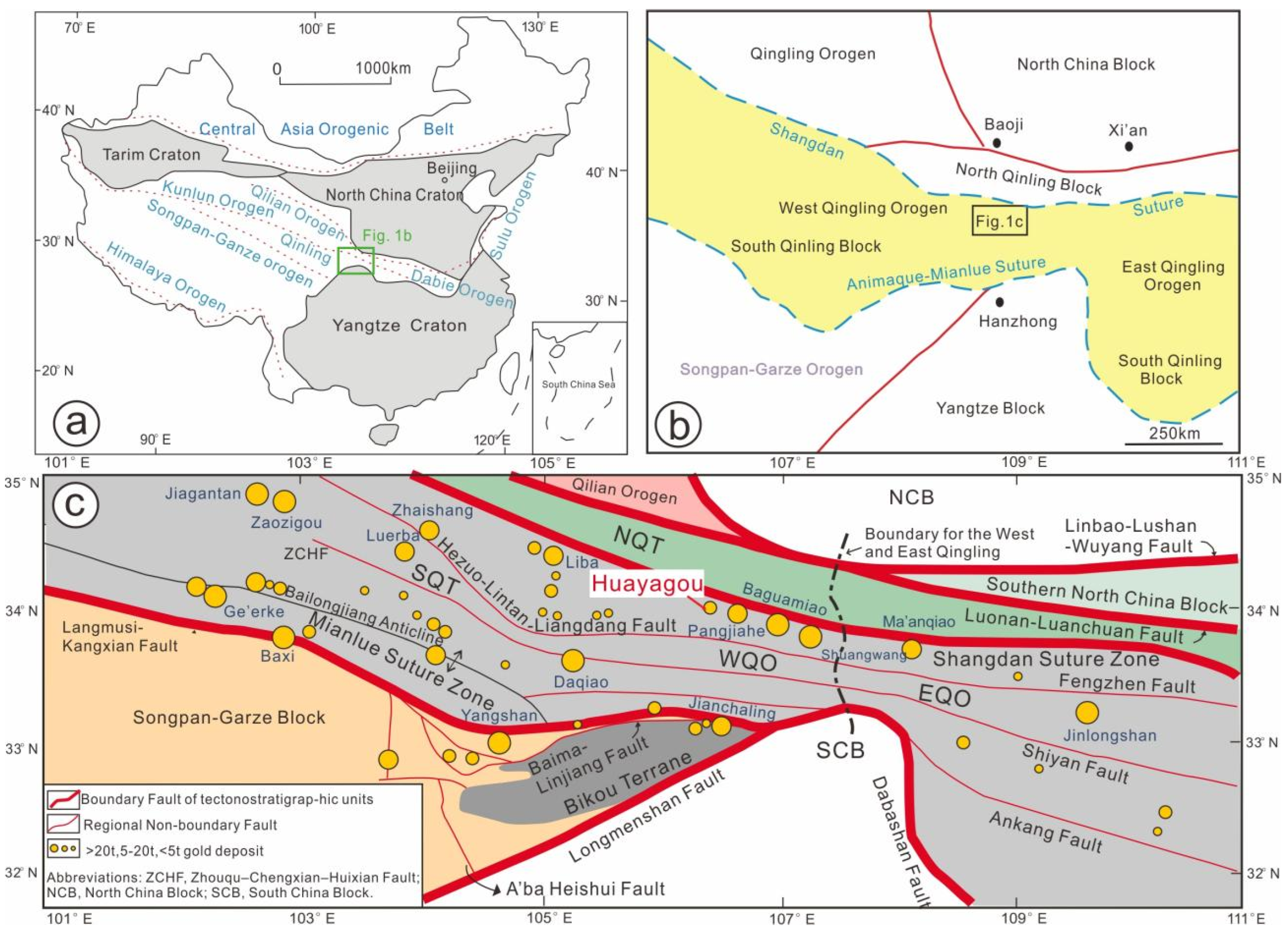
The Qinling Orogen is situated between the North China and South China blocks at the core of the Central China Orogenic Belt. It links westward with the Kunlun and Qilian orogens and eastward with the Dabie–Sulu orogen (Figure 1a). The Orogen can be structurally subdivided into northern and southern domains, separated by the Shangdan Suture Zone (Figure 1b), which represents a major tectonic boundary within the orogen [27,28]. Geographically (rather than tectonically), the Qinling Orogen is commonly divided into the East Qinling Orogen (WQO) and West Qinling Orogen (WQO), with the Baoji–Chengdu Railway (not a formally standardized boundary) used as the conventional boundary (Figure 1c). At the scale of the Qinling Orogenic Belt, two principal suture zones are recognized: the Shangdan Suture and the Mianlue Suture [29]. The Shangdan Suture marks the former oceanic boundary between the North China Block (NCB) and the South Qinling Belt (SQB) and records closure of the Shangdan Ocean during the Early Silurian (ca. 444–427 Ma). This suture is generally interpreted as the product of an Early Silurian collisional event between these two tectonic units [30,31]. In contrast, the Mianlue Suture documents Late Triassic convergence associated with the collision between the North China and Yangtze blocks, which occurred at approximately 242–219 Ma [32].
The northern sector of the WQO is dominated by extensive Devonian flysch sequences that experienced regional metamorphism under greenschist-facies conditions [27,32]. This area also includes a prominent eastward-verging belt of Triassic turbiditic strata that are weakly metamorphosed or unmetamorphosed and preserve primary sedimentary features, such as Bouma sequences, indicative of deep marine depositional environments [33]. In contrast, the southern domain of the WQO is bounded to the southwest by the Triassic Songpan–Ganzi Block and is internally dissected by the Zhouqu–Chengxian–Huixian fault zone (Figure 1c). Structurally, this domain is characterized by a set of E-W-trending fold systems, including the prominent Bailongjiang Anticline, which affects stratigraphic units from the Cambrian to the Middle Triassic [34]. Subsequent intracontinental deformation following orogeny resulted in the formation of widespread southward-verging, arcuate, thin-skinned thrust nappes across the region [35].
Magmatic activity during the Mesozoic represents a key component of the WQO evolution and is characterized by widespread emplacement of granitic plutons, together with subordinate intrusions of dolerite, gabbro, diorite, and mafic microgranular enclaves [36]. Zircon U–Pb geochronology indicates that magmatism in the Eastern WQO occurred mainly between 220 and 200 Ma, whereas intrusive activity in the western segment is slightly older, with crystallization ages clustering around 250–240 Ma [37,38]. This spatial variation in magmatic ages has been attributed to diachronous, westward propagation of the Mianlue Ocean closure in a scissor-like manner, ultimately leading to continental collision [39].
The magmatic evolution of the WQO reflects a multistage tectonic evolution, beginning with northward underthrusting of the Paleo-Tethys oceanic lithosphere at approximately 250–237 Ma, followed by syn-collisional magmatism between about 238 and 208 Ma, and transitioning into post-collisional magmatic activity from roughly 210 to 185 Ma [38,40,41]. Together, these successive magmatic episodes record the progressive tectono-magmatic processes that played a fundamental role in shaping the geological architecture of the West Qinling Orogen (maps and reports from the project of Dynamic Evaluation of Gold Resource Potential in China (No. DD20230059)) (Supplementary Figure S3).
Figure 1. Tectonic framework and location of major gold deposits within the West Qinling Orogen (revised from [8,35,40]): (a) Geographic location of the West Qinling in central China, (b) Tectonic framework of the Qinling Orogen, (c) Distribution of major Au deposits within the Qinling orogen.
Geosciences 16 00080 g001

3. Deposit Geology

The Huayagou gold deposit (Figure 1c) lies in the Taiyangsi–Liziyuan district of Liangdang County, Longnan City, Gansu Province, in proximity to the Pangjiahe Au deposit of Fengxian County. From a tectonic perspective, the deposit is situated in the northern segment of the South Qinling Orogen and occurs immediately south of the Shangdan Suture zone (Figure 1b).
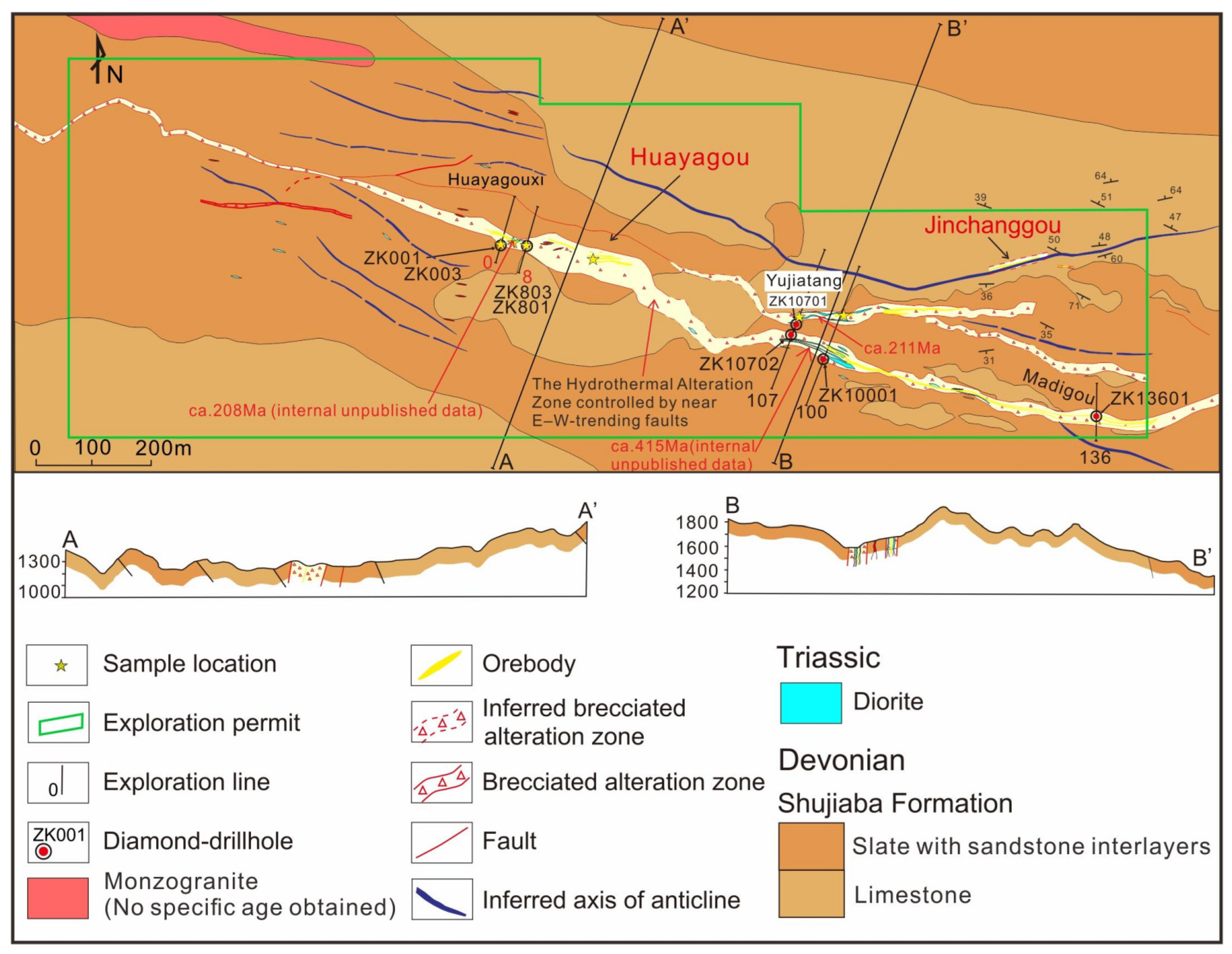
Exposed strata in the Huayagou area are assigned to the Devonian Shujia’ba Group (Figure 2), which is a suite of slightly metamorphosed clastic sedimentary rocks including deep to semi-deep marine turbidite-facies. It trends NNW and primarily consists of gray sandy slate, gray to off-white medium- to thick-bedded fine-grained meta-sandstone, siltstone, and gray medium- to thick-bedded sandy limestone. Based on lithological characteristics, it is subdivided to two major lithological units: a slate member interlayered with sandstone and an overlying limestone member. Rocks within the shear zones have experienced strong deformation, locally appearing highly deformed.
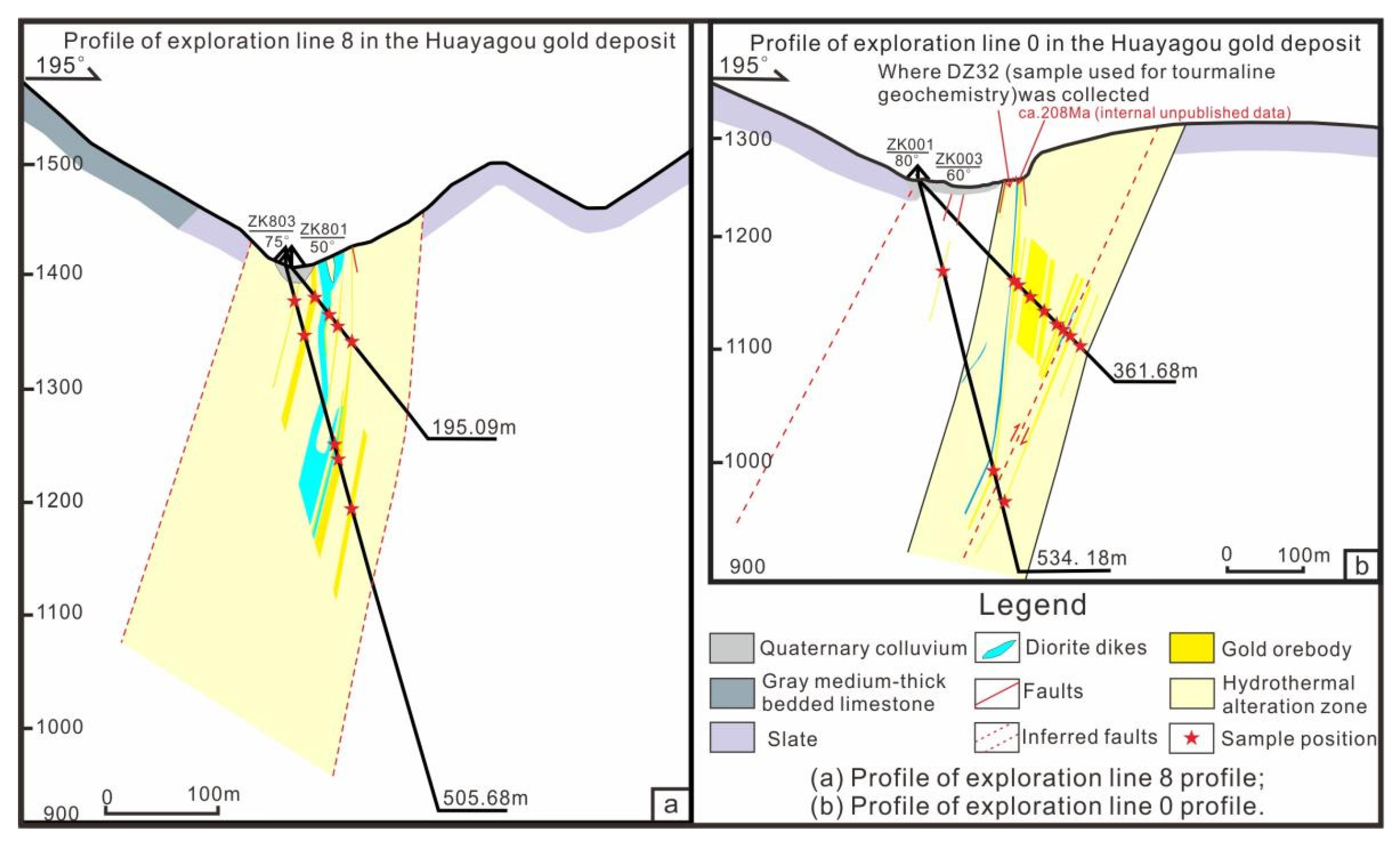
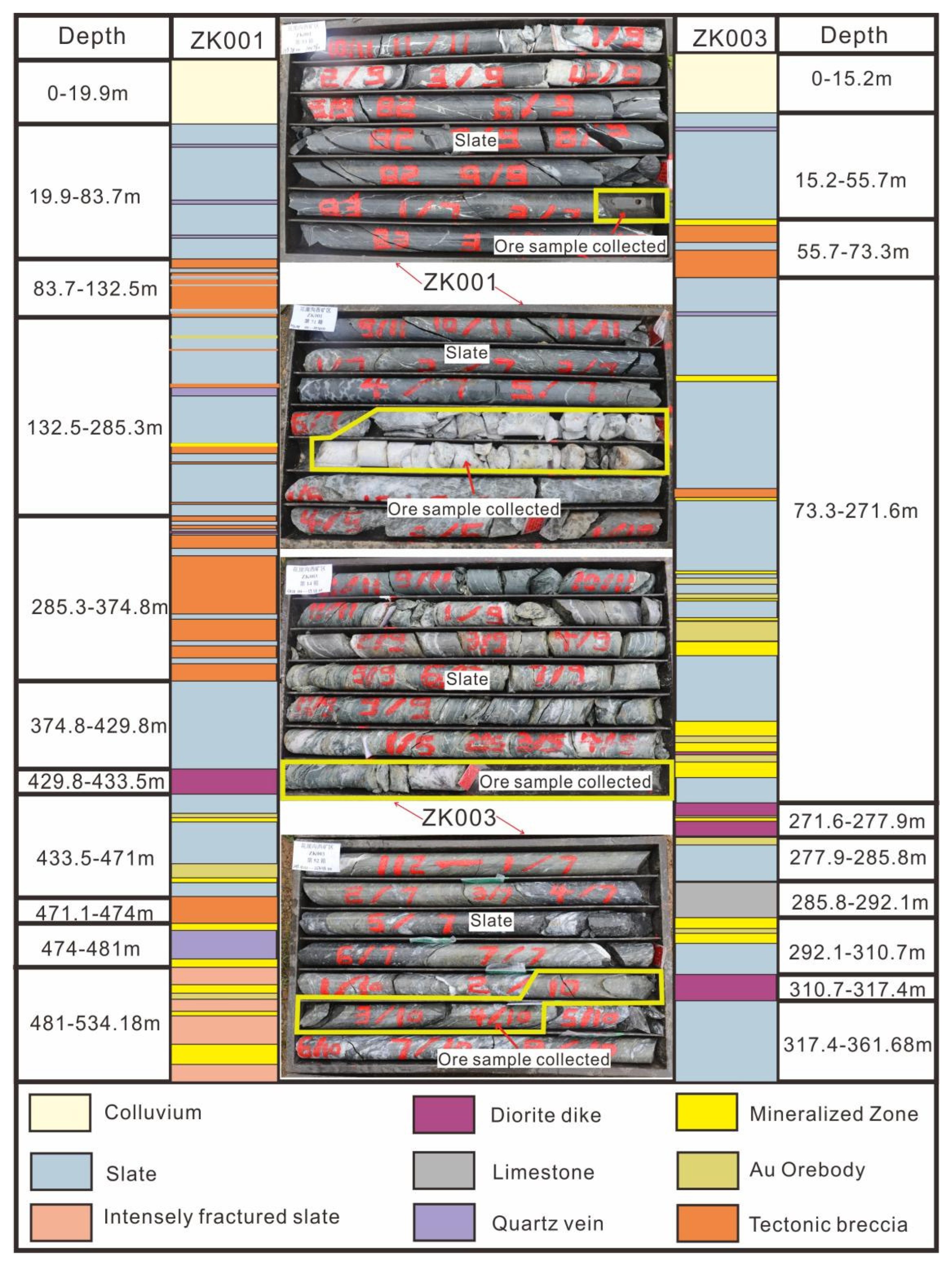
The regional structural architecture is dominated by large-scale anticlines and synclines, overprinted by pervasive interlayer folding generated during multiple deformation episodes. Superposition of these folding events has produced complex fold geometries at various structural levels, which acted as effective fluid pathways and traps for ore-bearing fluids and, thus, exerting a primary control on gold mineralization (Figure 2). This is supported by our previous work on Jinchanggou, where super-rich orebodies (locally 250 g/t) are preferentially localized in gently dipping segments (unusual in the region) of anticline-related structures. The dominant structural features of the Huayagou area are interlayer shear zones (with an average trend of ~290°) formed by ductile deformation under approximately N-S compression, which extends regionally beyond the mining area. The shear zones are typically 200–300 m wide and constitute the principal ore-hosting structures, striking 190–210° and dipping 66–72°. Fault systems exert a primary control on the distribution and geometry of orebodies (Figure 3). Orebody morphology is strongly influenced by deformation and associated fracturing within these zones, where minor structures have strikes of 150–180° and dips of 60–80°. Shear-zone breccias consist of intensely fragmented slates (Figure 4) supported by siliceous, calcareous, argillaceous, and iron-rich cement and form gently undulating, wave-shaped bodies along the dip direction. Besides the interlayer shear zones, a major NW-trending thrust fault that dips steeply to the south is extensively altered and brecciated and represents another important control on mineralization. This fault zone, with a width of approximately 50–200 m, intersects a S-trending fault, and their intersection forms structurally favorable sites for Au enrichment. These intersections are marked by intense fracturing and alteration, providing efficient pathways for ore-forming fluids and sites for localized Au deposition.
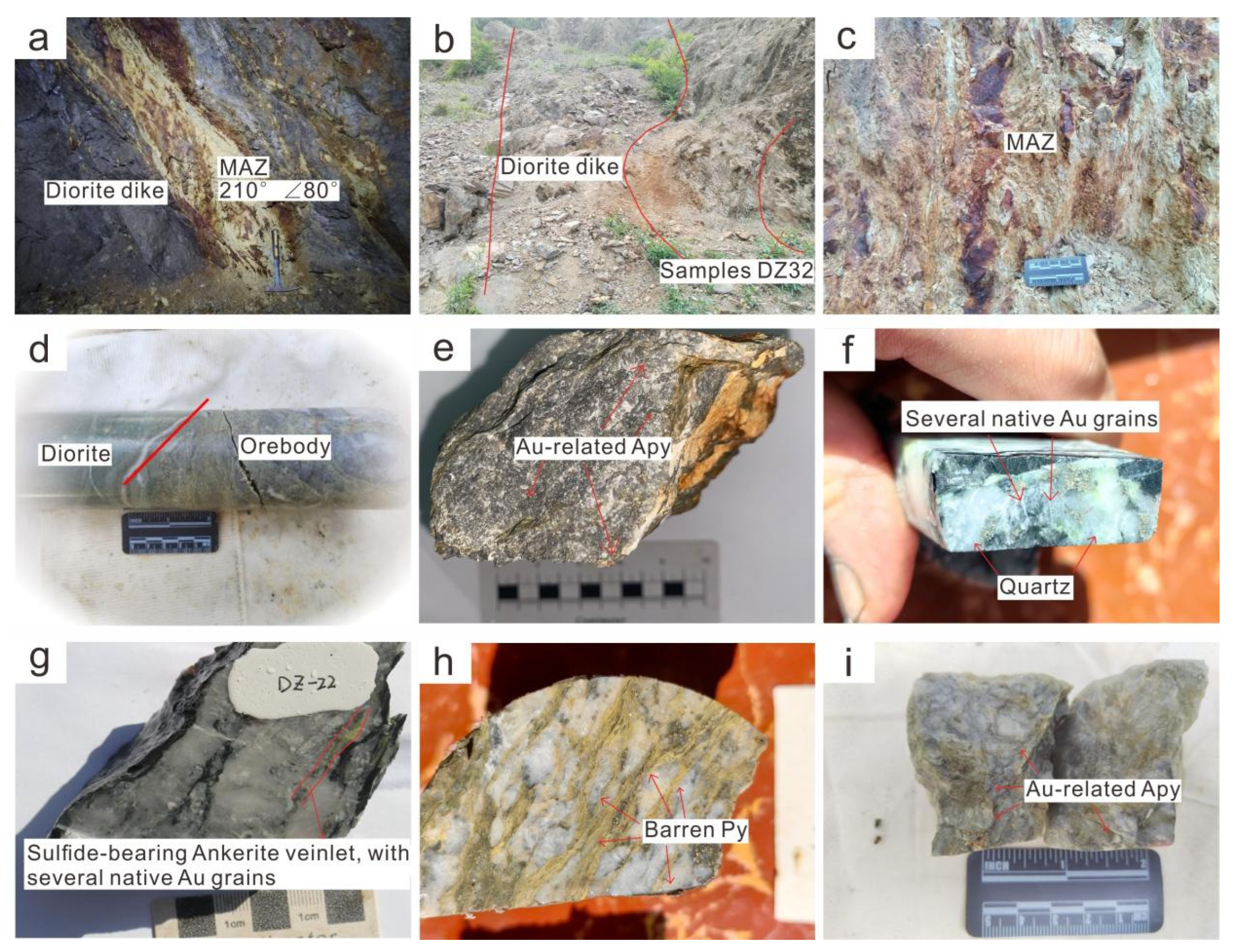
Structurally controlled igneous activity is also prominent in the Huayagou area. Late-magmatic diorite dikes with variable petrographic characteristics are widely developed and typically range from 0.5 to 2 m in width (Figure 5a,b). The dikes are mainly emplaced within the alteration zones and display a discontinuous NW-trending or locally NE-trending distribution. Intense alteration occurs along both margins of the dikes, with elevated gold grades. Field observations reveal a close spatial association between diorite dikes and Au mineralization, particularly at the 1270 horizontal tunnel (Figure 3 and Figure 5a). Geological observations combined with internal unpublished geochronological data (ca. 440–420 Ma) suggest that other dikes exposed within the district predate the diorite intrusions and are not genetically related to gold mineralization.
A large, mineralized alteration zone has recently been delineated, controlled by two E-W-trending faults (Figure 2). The zone extends for approximately 15–20 km along strike and is 50–200 m wide, defining the Huayagou gold deposit as a medium-sized gold system (standard seen in Supplementary Figure S3). Four mineralized segments have been identified within this zone; the segments typically range from 5 to 30 m in width and can be traced discontinuously for several hundred meters to several kilometers along strike, with average grades ranging from 1.13 to 3.40 g/t Au.
The ore is characterized by disseminated and vein-hosted pyrite and arsenopyrite within a gangue assemblage dominated by ankerite, albite, and quartz. Pyrite occurs as both euhedral crystals, interpreted as early generations, and subhedral-to-anhedral grains formed during later hydrothermal stages. Arsenopyrite commonly coexists with hydrothermal pyrite and locally infills fractures within earlier-stage coarse pyrite grains. Our previous mineralogical examinations suggest that gold is frequently observed as inclusions in arsenopyrite or within fractured early-stage pyrite. In high-grade ores, native Au also locally occurs within ankerite veins of orebodies.

4. Sampling and Analytical Method

4.1. Sampling, Scanning Electron Microscopy, TIMA Examination and CL Imaging

In this study, seven samples were systematically collected for comparative analysis, representing rich ores (generally 2–4 g/t, with native Au grains readily visible under microscopic examination), medium-grade ores, barren rocks, and diorite dikes. Detail characterization of samples can be seen in Supplementary Table S7. Sample classification is primarily based on field relationships and petrographic observations and is further supported by chronological and geochemical constraints. Accordingly, apatite was divided into four genetic groups. Samples DZ44 and H115, collected from Triassic and Early-Devonian diorite dykes, respectively, represent magmatic apatite. Syn-ore hydrothermal apatite from samples DZ41, DZ22, and DZ36 has been characterized and validated in our earlier studies and is supplemented here by new EPMA and in situ Nd isotopic analyses of apatite. Sample H248, collected from barren slate, represents metamorphic apatite formed during regional metamorphism and provides a reference for non-mineralized conditions. Tourmaline samples are from rich ore DZ32 (Figure 3, Figure 5b and Figure 6g–i).
A total of forty-four polished thin sections were prepared from the collected samples and examined using transmitted and reflected light microscopy as well as scanning electron microscopy with backscattered electron imaging (SEM–BSE; JSM-6510A, JEOL Ltd., Japan). Based on these observations, fourteen polished thin sections were selected for further detailed analyses.
The TIMA3 X GHM system (TESCAN, the Czech Republic), at the Xi’an Kuangpu Geological Exploration Technology Co., Ltd., was used for polished thin section analyses. The attached scanning electron microscopy was performed using a system equipped with nine detectors, including four high-flux energy-dispersive X-ray spectrometers (EDAX Element 30) positioned at 90°intervals around the chamber. Analyses were conducted in dot-mapping mode, with an X-ray acquisition resolution of 1200 pixels, a BSE pixel size of 3 μm, and an EDS dot spacing of 9 μm. Measurements were carried out under high-vacuum conditions at an accelerating voltage of 25 KV, a beam current of 9 nA, and a working distance of 15 mm. Beam current and BSE signals were calibrated using a platinum Faraday cup, whereas EDS calibration was performed using a Mn standard. The TIMA system automatically matches the measured BSE and EDS signals of individual phases against an internal mineral database to identify mineral species and calculate their modal abundances. All the minerals were identified first by TIMA and selected for in situ geochemical analysis. In sample DZ32, where tourmaline is particularly well-developed, TIMA analysis was conducted to characterize tourmaline mineralogy, identifying both dravite and schorl; these classifications were further confirmed by EPMA analyses. Both dravite and schorl were subsequently analyzed by LA-ICP-MS for trace elements and by in situ methods for B isotopic composition. Samples DZ44, H115, DZ41, DZ22, DZ36, and H248, in which apatite was first identified by TIMA, were analyzed by EPMA, in situ trace element analysis, and in situ B-isotope determination.
Cathodoluminescence (CL) imaging of apatite was conducted at the Key Laboratory for the Study of Focused Magmatism and Giant Ore Deposits, Xi’an Center of Geological Survey (Northwest China Center of Geoscience Innovation), China Geological Survey. The analysis was performed using a Chromal CL 2 cathodoluminescence probe mounted on a JSM-6510A (JEOL Ltd., Japan) scanning electron microscope under the following conditions: accelerating voltage of 10 kV, beam current SS65, and working distance of 14 mm.

4.2. Major Element Analyses of Apatite and Tourmaline

The major element compositions of apatite and tourmaline were determined using a JEOL JXA-8230 (Japan) electron probe microanalyzer housed at the Key Laboratory for Focused Magmatism and Giant Ore Deposits, Xi’an Center of the China Geological Survey (Northwest China Center of Geoscience Innovation). Analyses were conducted at an accelerating voltage of 15 kV for phosphate and silicate phases, using a beam current of 10 nA and a focused beam diameter of 1–5 μm. Instrument calibration was carried out using Chinese GSB (Reference Material P.R. China) and American SPI reference materials (USA), including diopside for Si, jadeite for Al and Na, rutile for Ti, periclase for Mg, apatite for F, Ca, and P, hematite for Fe, rhodonite for Mn, KTiOPO4 for K, tugtuoite for Cl, LaP5O14 for La, CeP5O14 for Ce, NdP5O14 for Nd, pyrite for Fe and S, metallic Bi for Bi, and Au-Ag alloy for Ag. Data reduction and corrections were performed using the ZAF (Atomic number(Z)–Absorption(A)–Fluorescence(F)) correction method.

4.3. Trace Element Analysis of Apatite and Tourmaline

In situ trace element determinations of apatite and tourmaline were carried out at Xi’an Zhaonian Mineral Testing Technology Co., Ltd., using a ThermoFisher iCAP RQ inductively coupled plasma mass spectrometer coupled to a New Wave NWR 213 laser ablation system (USA). Ablation was performed with a 40 μm spot size, a repetition frequency of 10 Hz, and a fluence of approximately 6 J/cm2 using high-purity He as the carrier gas. Prior to analysis, the instrument was tuned with the NIST SRM 610 glass to achieve optimal sensitivity and stability.
Analyses were conducted in single-spot mode following a three-step acquisition protocol consisting of 20 s of background collection with the laser off, 45 s of continuous ablation, and 20 s of washout, resulting in a total integration time of 85 s for each spot. External calibration and quality control were ensured by analyzing NIST 610, NIST 612, BCR-2G, and BIR-1G reference materials after every ten unknowns. Raw signals were processed offline using the ICPMSDataCal software (developed by Ji Mao, University of China University of Geosciences (Wuhan)), including background subtraction, drift correction, and calculation of elemental concentrations. More details regarding the internal standards, statistical parameters, element detection limits, and so on can be viewed in Supplementary File S1.

4.4. In Situ Analysis of Nd Isotopes of Apatite and B Isotopes of Tourmaline

Nd isotope ratios of the minerals were measured by a Neptune Plus MC-ICP-MS (ThermoFisher Scientific, Germany) in combination with a Geolas Pro excimer ArFlaser ablation system (Coherent, Germany) at the Isotropic lab in the Key Laboratory for the Study of Focused Magmatism and Giant Ore Deposits, Xi’an Center of Geological Survey (Northwest China Center of Geoscience Innovation), China Geological Survey. The Faraday collector configuration of the mass system was composed of an array from L3 to H3 to monitor 142Nd, 143Nd, 144Sm, 144Nd, 145Nd, 146Nd, 147Sm, and 149Sm. Helium (400 mL/min) was used as the carrier gas of sample aerosol. For a single laser spot ablation, the spot diameter was 60 μm, the pulse frequency was 8 Hz, and the laser fluence was ~10 J/cm2. Each analysis for each spot contains 200 circles. A signal smoothing device was used downstream from the sample cell to eliminate the short-term variation in the signal. A bit of N2 (4 mL/min) was inlet into the sample gas line via a T connector to enhance the signal sensitivity. To obtain accurate 147Sm/144Nd and 143Nd/144Nd isotopic ratios using LA-MC-ICP-MS, the contribution of the isobaric interference of 144Sm on the 144Nd signal must be carefully corrected [42,43,44]. The measured 147Sm/149Sm was used to calculate a Sm fractionation factor using the exponential law. The measured 147Sm intensity was used to estimate the interference on mass 144Sm by employing the natural 147Sm/144Sm ratio of 4.866559 [45]. Then, the interference-corrected 146Nd/144Nd ratio was used to calculate the Nd fractionation factor. Finally, the 143Nd/144Nd and 145Nd/144Nd ratios were normalized using the exponential law. The accurate 147Sm/144Nd ratio can also be calculated using the exponential law after correcting for the isobaric interference of 144Sm on 144Nd. The Sm and Nd isotopic abundances of 147Sm/149Sm = 1.08680, 144Sm/149Sm = 0.22332, and 146Nd/144Nd = 0.7219 [45,46,47] were adopted in this study. Data reduction for the LA-MC-ICP-MS analyses was performed using an in-house software package (Nada 1.0, patent number ZL 2021 1 1453175.4). One natural monazite reference material Diamantina (0.511427+/−0.000003, LA-MC-ICP-MS) [48], two natural titanite reference materials T3 and T4 (0.512611+/−0.000012, 0.511846+/−0.000008, ID-MC-ICP-MS) [49], and three natural apatite reference materials Durango (0.70634+/−0.00014, LA-MC-ICP-MS), Otter Lake (0.70421+/−0.00012, LA-MC-ICP-MS), and Mud Tank (0.70302+/−0.00008, LA-MC-ICP-MS) [50] were used as the unknown samples to monitor the analysis procedure and to verify the accuracy of the calibration method for in situ Nd isotope analysis, following the method from a previous study [51]. The determined mean 143Nd/144Nd ratios of the standard sample (Dur and Mud) were 0.51249 ± 0.00002 (n = 3, 2SD) and 0.51236 ± 0.00004 (n = 3, 2SD) respectively, which is in agreement within errors with reference values.
The in situ boron isotope analysis of tourmaline was conducted at the Kehui Testing Technology Co., Ltd. (Tianjin). The instruments used for analysis were the Neptune Plus Multi-Collector Inductively Coupled Plasma Mass Spectrometer (MC-ICP-MS) (Thermo Fisher Scientific, USA) and the RESOlution SE 193 nm solid-state laser (Australia). Ablation was performed using a spot ablation technique to obtain stable signals, with an ablation diameter of 38 µm, a frequency of 8 Hz, and a laser energy density of 5 J/cm2. Both 10B and 11B were simultaneously collected using Faraday cups (L3 and H3) in static mode, with an integration time of 0.131 s, collecting 200 data points, resulting in a total acquisition time of approximately 27s. Helium (approximately 420 mL/min) was used as the carrier gas to transport the aerosol generated by the ablation, which was then mixed with argon and introduced into the MC-ICP-MS for mass spectrometry analysis. Prior to testing, the instrument was calibrated using a tourmaline boron isotope standard. The analysis was carried out using the IAEA B4 standard, with two standard points tested before and after the sample point. The standard–sample–standard (SSS) method was employed to correct for mass discrimination and isotope fractionation. The tourmaline standard IMR RB1 was used as a monitoring standard, and the δ11B value obtained for IMR RB1 in this experiment was (−13.17 ± 0.14)‰ (2σ), which is consistent within error with the value (−12.96‰ ± 0.97‰) (2σ) reported by a previous study [52].

5. Results

5.1. TIMA Examination, BSE and CL Imaging

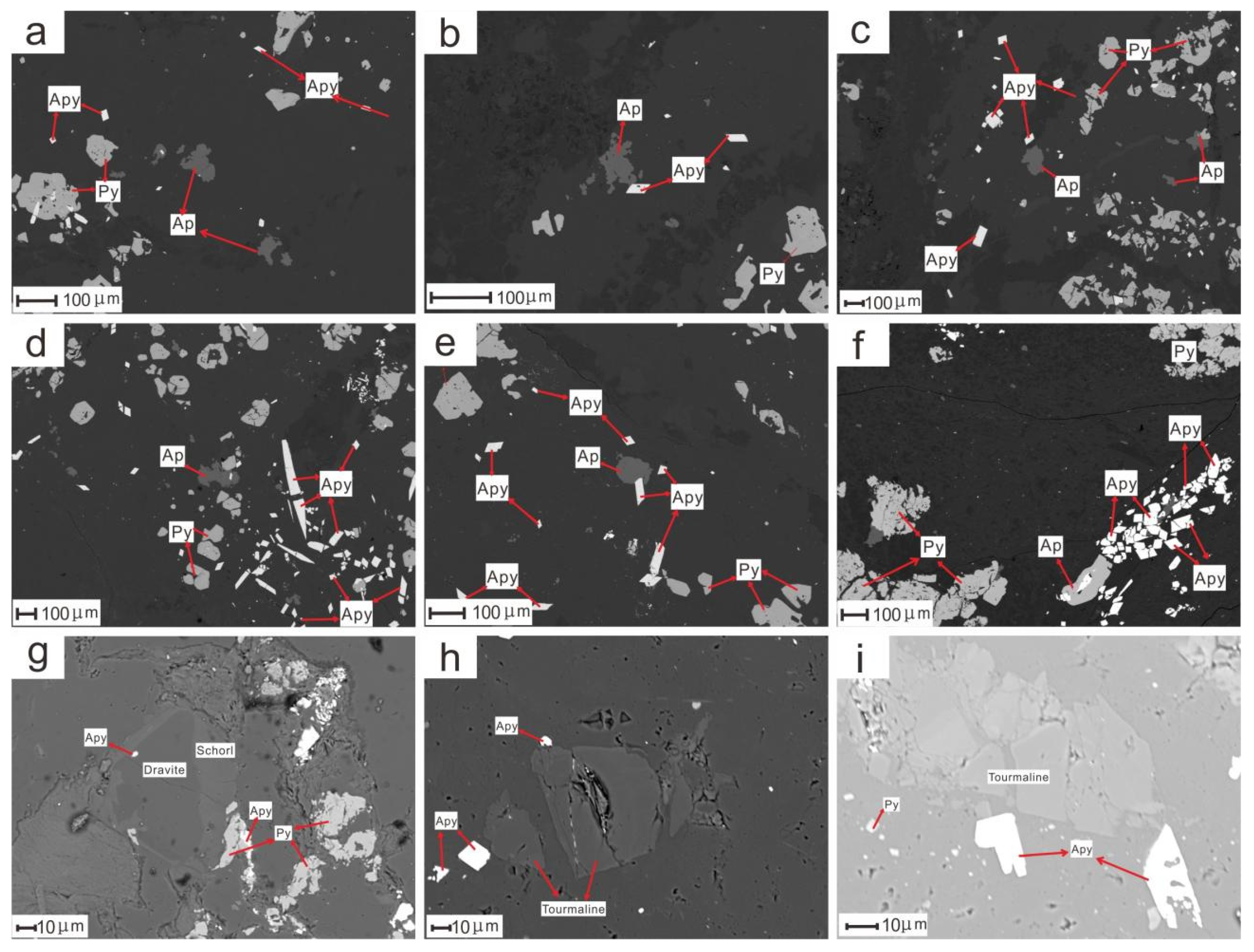
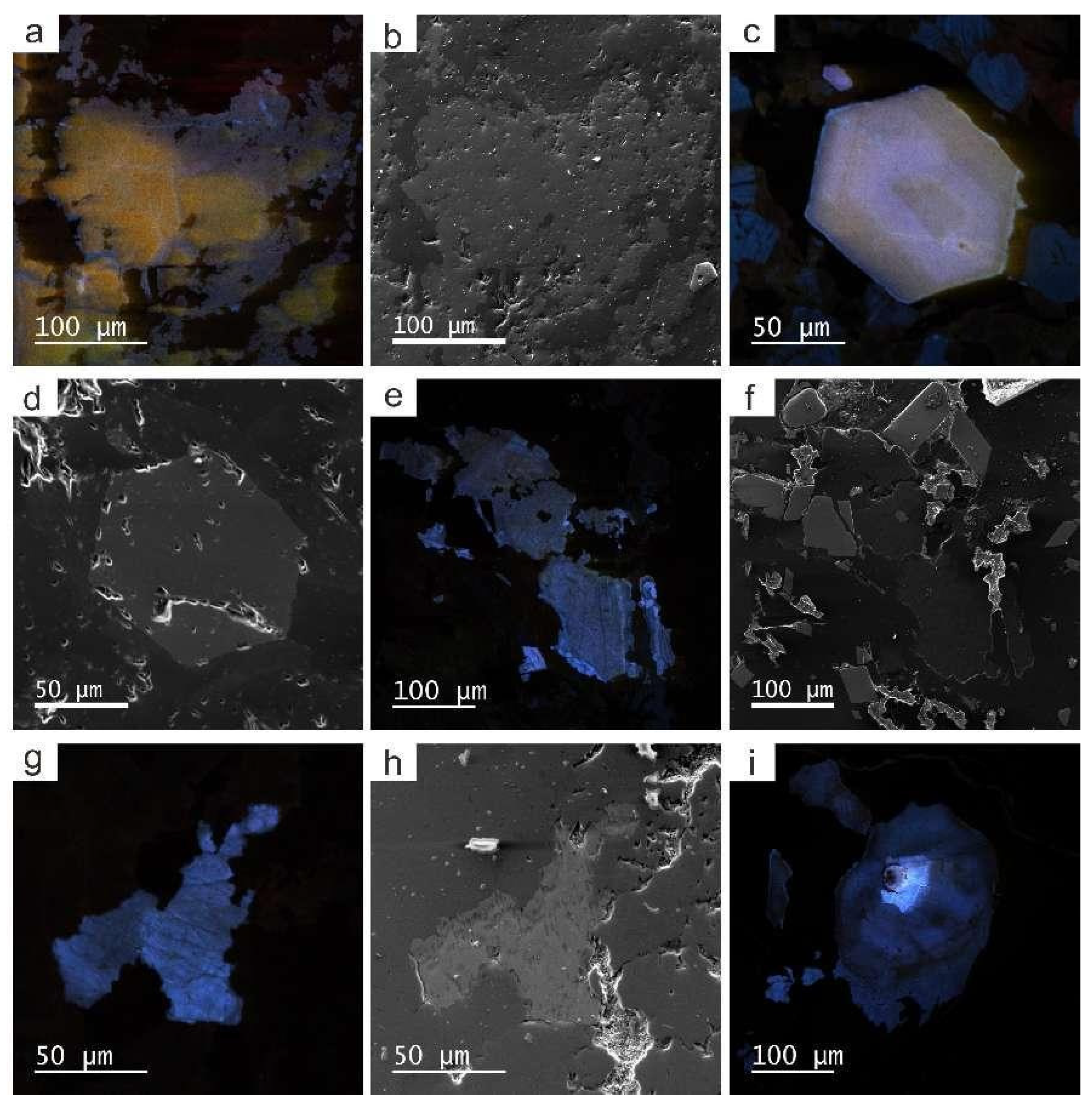
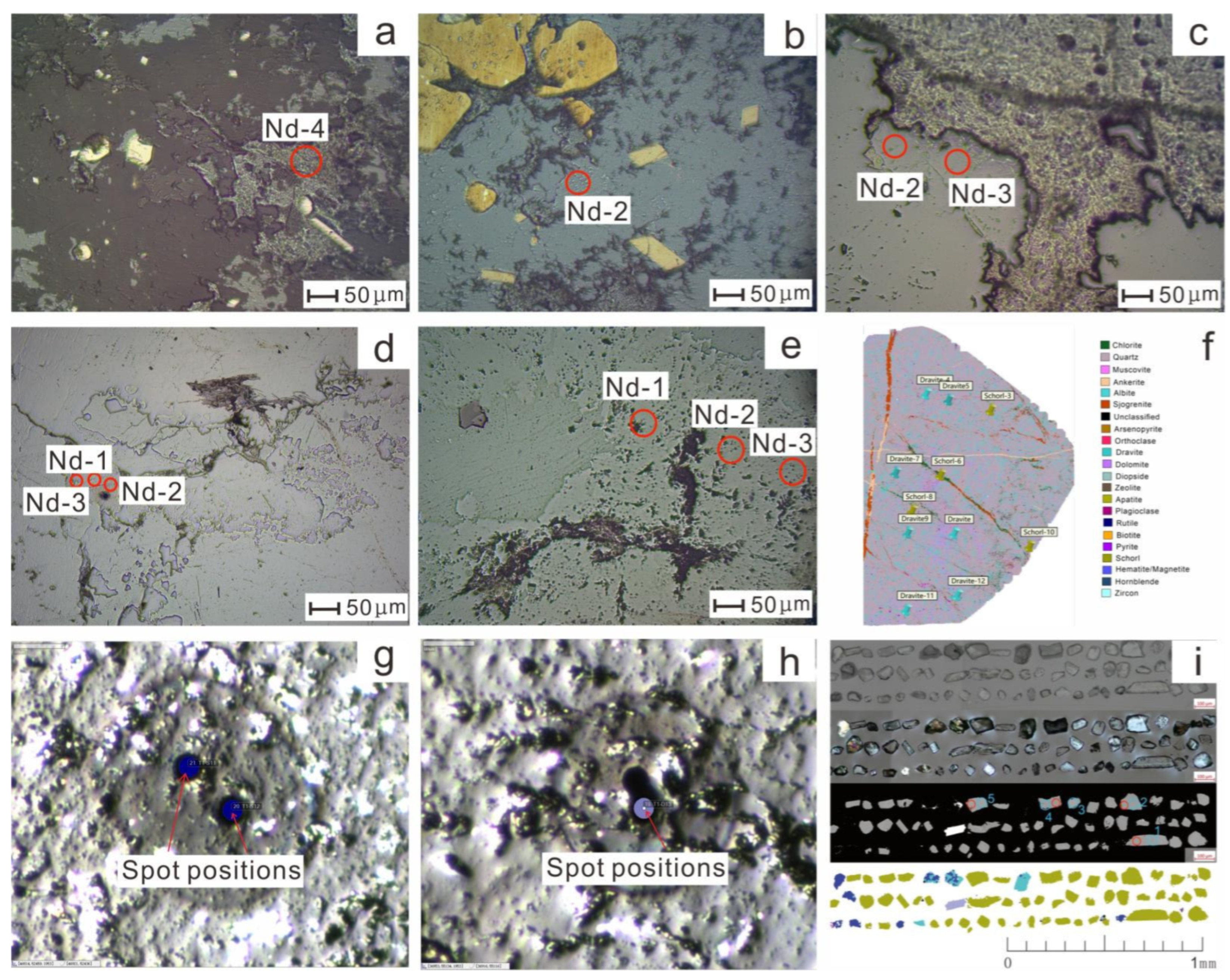
TIMA phase mapping of representative thin sections provides mineral assemblages, textural relationships, and modal information that guide subsequent in situ analyses. High-resolution BSE images show that syn-ore apatite (Figure 6a–f) and tourmaline (Figure 6g–i) are closely associated with Au-related arsenopyrite, commonly occurring as fine-grained aggregates intergrown with arsenopyrite or distributed along grain boundaries and microfractures. Cathodoluminescence imaging reveals distinct textural and compositional features among different apatite generations (Figure 7): syn-ore hydrothermal apatite displays a uniform blue CL response (Figure 7e,g,i), metamorphic apatite exhibits heterogeneous luminescence with transitional yellow–blue zoning (Figure 7a), and magmatic apatite is characterized by complex oscillatory zoning (Figure 7c). These combined TIMA, BSE, and CL observations document clear contrasts among apatite generations and their close spatial relationship with Au-bearing arsenopyrite.

5.2. Major Element Composition of Apatite and Tourmaline

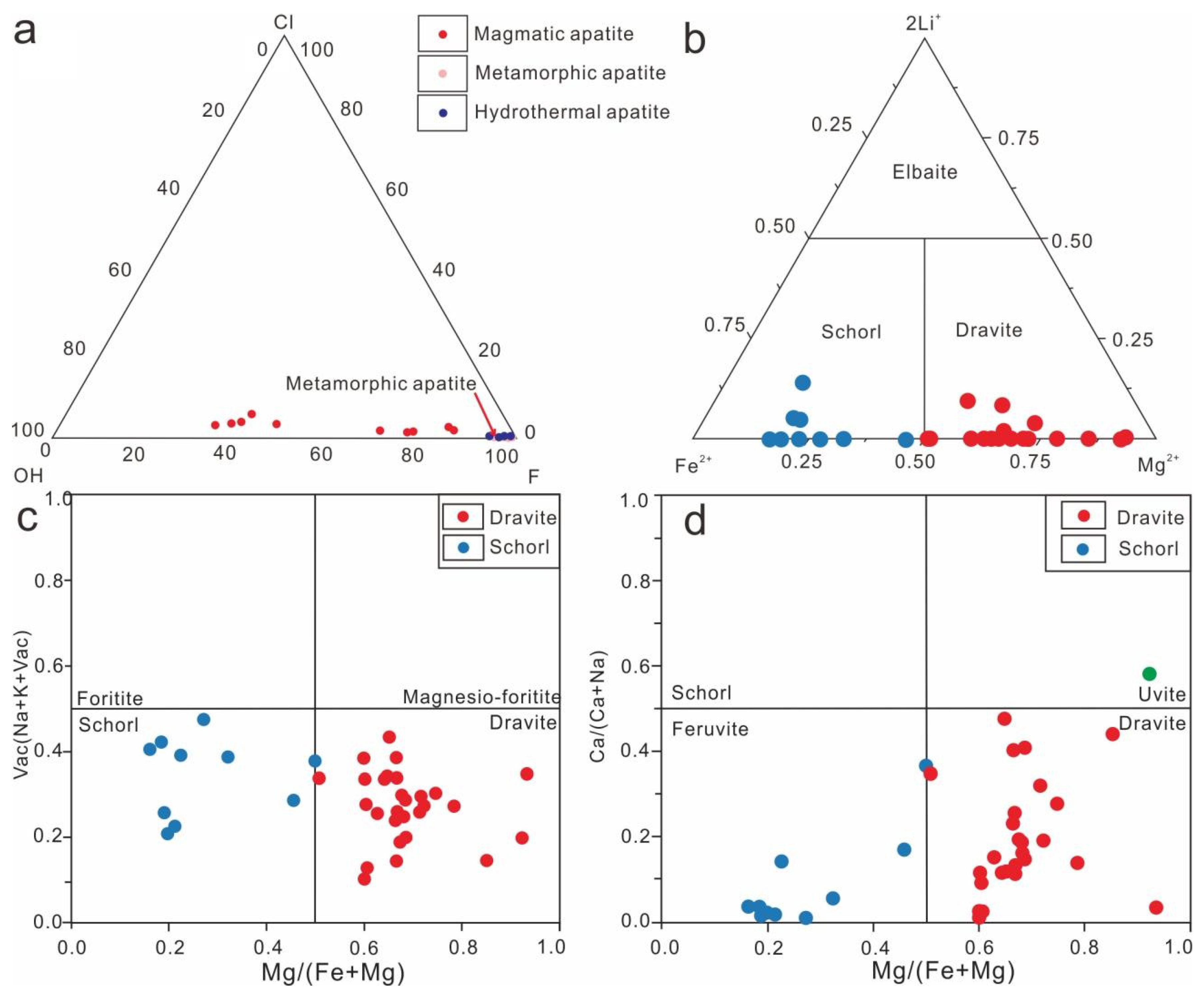
Apatite EPMA analyses reveal compositions dominated by CaO (54–56 wt%) and P2O5 (39–41 wt%), consistent with stoichiometric apatite. The apatite exhibit elevated F contents (2.5–4.2 wt%) and very low Cl concentrations (<0.23 wt%), indicating a strong F-rich composition. Rare earth elements (La2O3, Ce2O3, Nd2O3) are uniformly low (<0.1 wt% for most cases), and other minor components such as FeO, MgO, SiO2, and Al2O3 occur in trace amounts. The EPMA data and classification diagram are shown in Supplementary Table S1 and Figure 8a, respectively. The corresponding calculation and plotting followed the methods described by previous studies [53,54], including total corrections for F, Cl, and estimated OH, with apatite formulae calculated on the basis of 25 anions. Most analyses plot within the expected compositional fields, supporting the validity of the classification and the robustness of the dataset.
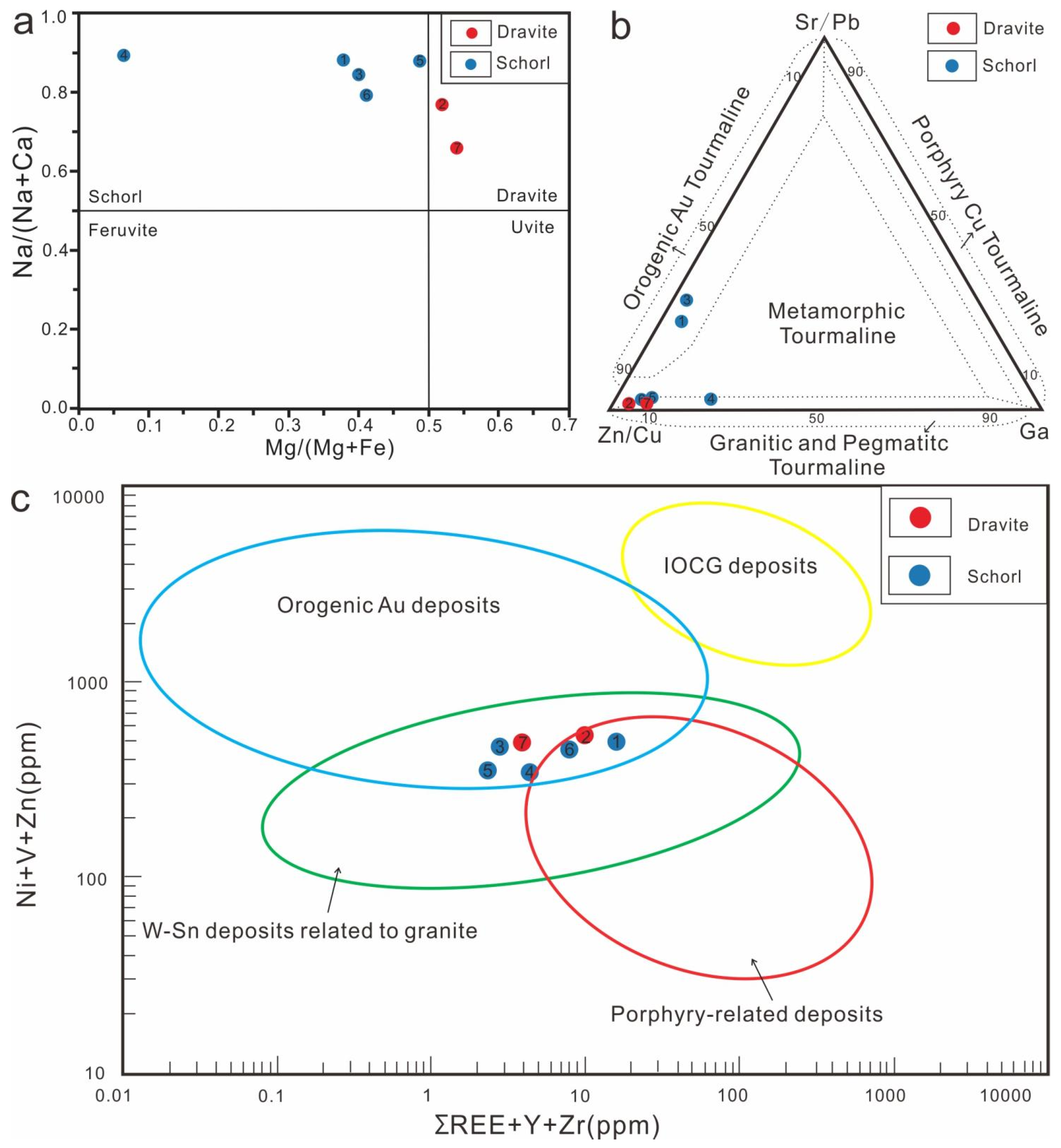
Electron microprobe analyses of tourmaline show relatively high Al2O3 contents, ranging from 26.7 to 34.2 wt% (mean ≈ 31.2 wt%). Variation in MgO of 0.81–9.01 wt% (mean ≈ 6.30 wt%) and FeO of 4.47–13.17 wt% (mean ≈ 7.68 wt%) among different grains can be observed. SiO2 contents are comparatively uniform, between 34.2 and 36.3 wt% (mean ≈ 35.6 wt%). Na2O varies from 1.23 to 2.88 wt% (mean ≈ 2.08 wt%), whereas TiO2 ranges from 0.16 to 2.46 wt% (mean ≈ 0.78 wt%). CaO is between 0.3 and 2.73 wt% for most grains and MnO, P2O5, and K2O are negligible. After correction for B2O3, all analytical totals are higher than 83 wt% (analytical threshold), indicating reliability of the measurement. EPMA data are presented in Supplementary Table S2 and the corresponding tourmaline classification diagrams are shown in Figure 8b–d, following the established methods [55,56]. In these calculations, analytical totals are corrected for fluorine, and structural formulae are calculated on the basis of 15 cations, excluding B, Na, Ca, and K. These EPMA-based plots were used to verify the tourmaline species identified by TIMA phase mapping. Most analyses display consistent classifications across the different diagrams, confirming the TIMA-derived distinction between dravite and schorl. Only a single dravite analysis plots slightly above the dravite–uvite boundary, reflecting minor Ca enrichment; this isolated outlier does not affect the overall mineralogical interpretation.
Figure 8. Classification diagram for: (a) apatite (calculation and plotting from [53,54]) and (bd) tourmaline (calculation and plotting from [55,56]).
Geosciences 16 00080 g008

5.3. Trace Element Composition of Apatite and Tourmaline

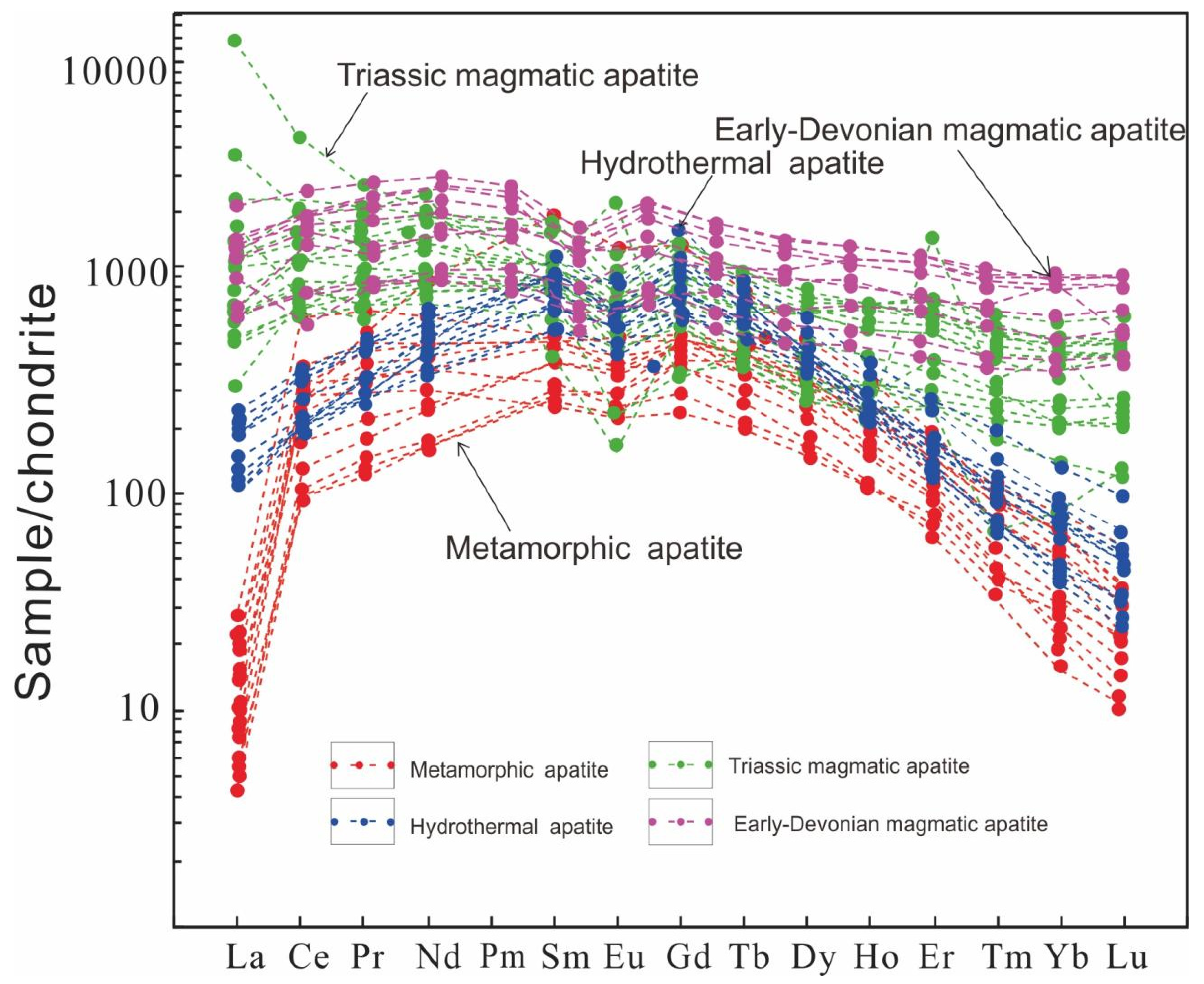
In situ LA-ICP-MS analyses indicate that apatites from different genetic groups exhibit distinct REE characteristics (Figure 9). Metamorphic apatite is characterized by low total REE abundances and pronounced LREE depletion with consistently low Eu concentrations. Syn-ore hydrothermal apatite displays smooth and coherent REE patterns with moderate LREE depletion relative to magmatic apatite but higher REE contents than metamorphic apatite; Eu anomalies are generally weak and near-neutral. By contrast, Triassic magmatic apatite shows the highest overall REE abundances and more pronounced LREE enrichment, together with variable Eu anomalies ranging from weakly positive to negative. Early-Devonian magmatic apatite exhibits similar pattern shapes but lower total REE contents and less variable Eu anomalies. Overall, systematic differences in REE abundance, pattern smoothness, and Eu behavior among metamorphic, syn-ore hydrothermal, and two types of magmatic apatites provide a robust basis for genetic classification. The detailed data of various apatites can be seen in Supplementary Table S3.
Figure 9. Chrondrite-normalized REE diagram of apatite normalization values from [57]; hydrothermal apatite data from [58]).
Geosciences 16 00080 g009
In situ LA-ICP-MS analyses indicate that tourmaline from rich ore samples contains appreciable Li and Be, with Li concentrations ranging from ~5 to 118 ppm and Be concentrations ranging from ~0.86 to 7.16 ppm. Boron contents are extremely high, varying from ~1.49 × 10⁴ to 1.97 × 10⁴ ppm, consistent with tourmaline acting as the principal boron-hosting phase. Fe contents are even higher, varying from ~31,433 to 78,314 ppm and showing moderate inter-grain variability, whereas magnesium occurs at elevated levels, ranging from ~5360 to 39,543 ppm. Mn concentrations range from 23 to 1302 ppm, and Ca varies between 1804 and 10,573 ppm. Titanium ranges from ~1732 to 6520 ppm. Sodium contents span from ~13,036 to 20,256 ppm, while K concentrations range from 162 to 1503 ppm. When plotted on established trace element discrimination diagrams (Figure 10), these compositions define coherent distributions that fall within overlapping fields of orogenic and intrusion-related gold systems, providing a geochemical framework for evaluating the nature of mineralizing fluids. All analyses fall within the expected classification boundaries and re-confirmed the compositional variation. The detailed data are listed in Supplementary Table S4.
Figure 10. Classification diagrams from tourmaline trace element (a) after [56]; (b) after [59]; (c) after [60].
Geosciences 16 00080 g010

5.4. In Situ Nd Isotopic Analysis of Apatite and B Isotopic Analysis of Tourmaline Results

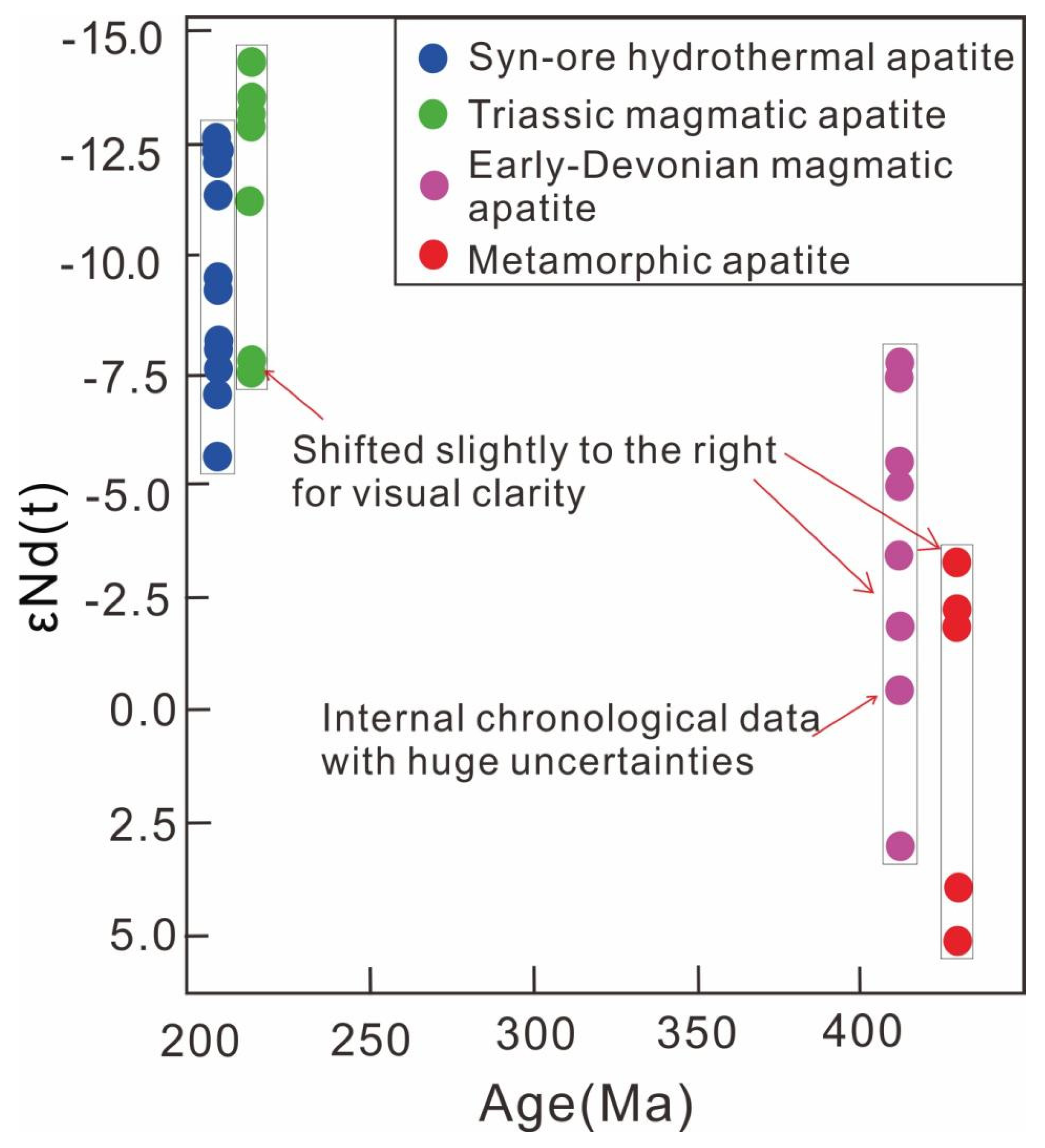
In situ Nd isotope analyses of apatite yield (143Nd/144Nd) ratios between 0.510867 and 0.512631 (2SE = 0.000028–0.009222, n = 36). The data were age-corrected to several different reference ages, including 205 Ma for syn-ore hydrothermal apatite [53], 211 Ma for Triassic Period diorite dike [54], 415 Ma for Early-Devonian era diorite dike (apatite and zircon dating result from internal unpublished data), 432 Ma for regional metamorphism [55], and 812 Ma for Neoproterozoic basement (apatite and zircon dating result from internal unpublished data). For apatite corrected to 205 Ma (n = 13), (143Nd/144Nd) ratios range from 0.511878 to 0.512242, with corresponding εNd(t) values of −12.82 to −5.56. At 211 Ma (n = 8), (143Nd/144Nd) varies from 0.511800 to 0.512145, and εNd(t) spans −14.27 to −7.51. For analyses corrected to 415 Ma (n = 8), (143Nd/144Nd) values range from 0.512036 to 0.512582, with εNd(t) between –7.60 and +3.00. At 432 Ma (n = 5), (143Nd/144Nd) ratios lie between 0.512252 and 0.512631, and εNd(t) values range from −3.21 to +5.13. The oldest age group, corrected to 812 Ma (n = 2), shows (143Nd/144Nd) ratios of 0.510867–0.510922 and εNd(t) values of −26.46 to −24.95. Across all age groups, the data display consistent analytical behavior with no anomalous or irregular measurements. The data is listed in Supplementary Table S5.
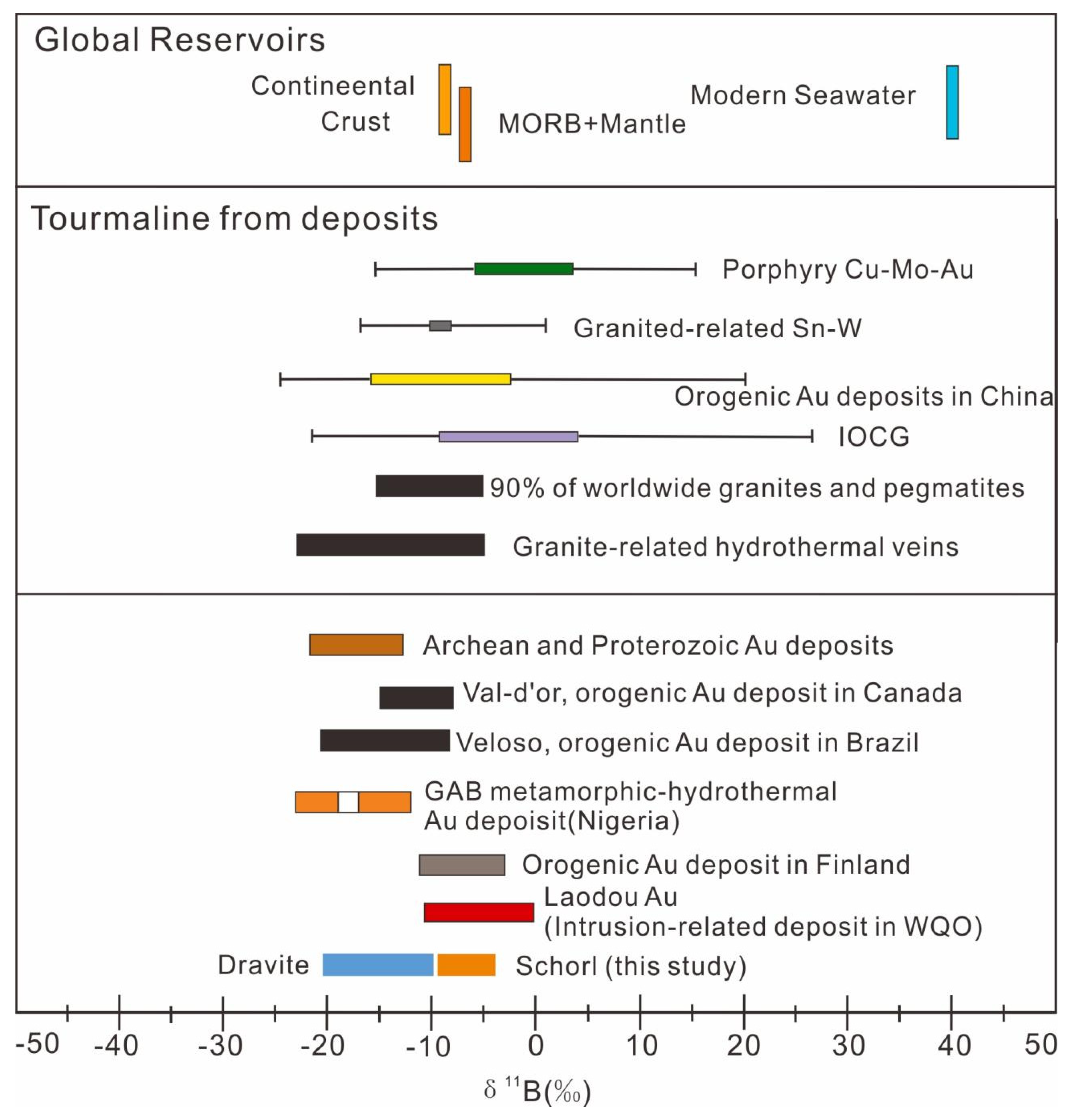
In situ B-isotope analyses of tourmaline show that dravite has δ11B values ranging from −19.44‰ to −10.93‰ (NIST 951, n = 6), whereas schorl displays higher δ11B values between −9.98‰ and −4.88‰ (NIST 951, n = 4). Together, these data define two partially overlapping but distinguishable δ11B ranges for dravite and schorl within the studied samples, and no anomalous measurements are observed in either group. The data is listed in Supplementary Table S6.

6. Discussions

6.1. Classification of the Samples and Origin of the Apatite and Tourmaline

Variations in major and trace element compositions, together with isotopic characteristics of apatite and tourmaline, provide effective constraints on the origin of these minerals and the nature of associated fluids [61,62,63]. Apatite and tourmaline geochemistry has been widely applied in assessing metallogenic processes and exploration potential in various deposits [59,64,65,66,67,68,69].
In the Huayagou Au deposit, a close spatial and temporal relationship between orebodies and diorite dikes has been well documented in our previous studies. Zircon U–Pb ages from Triassic diorite dikes and the U-Pb ages of syn-ore apatite occurring in close association with arsenopyrite indicate that dike emplacement and gold mineralization broadly overlap at ca. 210 Ma, consistent with the regional Triassic metallogenic event in the West Qinling Orogen [3,58,70,71,72]. Field observations from the 1270 m horizontal tunnel (Figure 5a), trench BT10 (Figure 5b,c), and drill cores (Figure 5d) show that the highest-grade ores are preferentially developed adjacent to the Triassic diorite dykes (Figure 3 and Figure 5a–d). All ore samples investigated in this study were collected within this well-defined geological context. Mineralogical observations further demonstrate that apatite and tourmaline are closely associated with arsenopyrite (Figure 6), a key indicator of gold mineralization throughout the West Qinling Orogen. This spatial and mineralogical relationship provides a robust basis for constraining the nature of the ore-forming fluids using apatite (Figure 6a–f) and tourmaline (Figure 6g–i) geochemistry, as has been widely applied in a wide range of hydrothermal gold systems [73].
On the basis of host lithologies, CL imaging, textural relationships, and geochemical characteristics, apatite can be divided into four genetic groups, namely Triassic magmatic, Early-Devonian magmatic, syn-ore hydrothermal, and metamorphic, as summarized in the Methods section and Supplementary Table S7. Magmatic apatite occurs within diorite dykes and preserves primary magmatic textures and compositions, whereas syn-ore hydrothermal apatite is closely associated with arsenopyrite in ore samples. Metamorphic apatite, developed in barren slate, represents a background component formed during regional metamorphism and provides an important reference for non-mineralized conditions. Together, the in situ geochemistry of these apatite populations capture compositional contrasts between magmatic, metamorphic, and mineralizing fluid. In contrast to apatite, tourmaline is not subdivided into discrete genetic groups but, instead, displays continuous compositional variability. Phase mapping and compositional data indicate the presence of both dravite and schorl, reflecting variations in fluid chemistry during mineralization. These tourmaline types occur within mineralized domains and display systematic chemical differences that are consistent with evolving fluid conditions. Their trace element and B-isotopic compositions, therefore, provide complementary constraints to apatite on fluid source and evolution.
Taken together, the geological context, mineral associations, and classification of apatite and tourmaline demonstrate that these samples provide an appropriate framework for constraining the characteristics of auriferous fluids.

6.2. Nature of the Auriferous Fluid Constrained by Mineral Geochemistry

Systematic variations among different types of apatites are evident from CL imaging, EPMA, and REE patterns (Figure 7, Figure 8a and Figure 9), which, together, provide meaningful constraints on their genetic origins. Syn-ore hydrothermal apatite typically displays homogeneous, patchy blue luminescence with relatively simple internal textures (Figure 7e,g,i), consistent with formation during a single, internally coherent hydrothermal stage associated with Au mineralization. In contrast, metamorphic apatite shows mixed blue–yellow luminescence (Figure 7a), variability during metamorphism, whereas magmatic apatite is distinguished by oscillatory zoning (Figure 7c), indicative of primary magmatic growth. These textural differences are mirrored by systematic geochemical contrasts. Magmatic apatite plots within both the hydroxyapatite and fluorapatite fields, whereas syn-ore hydrothermal and metamorphic apatite consistently fall within the fluorapatite field (Figure 8a). These textural differences are accompanied by systematic variations in rare earth element (REE) patterns (Figure 9). Magmatic apatite does not show pronounced LREE depletion and exhibits both positive and negative Eu anomalies, with variations between Triassic and Early-Devonian grains. By comparison, both hydrothermal and metamorphic apatite display strong LREE depletion, which is more pronounced in the latter, and are generally associated with weakly negative Eu anomalies. These differences provide additional basis for distinguishing apatite formed in magmatic, metamorphic, and syn-ore hydrothermal environments.
Representative apatite grains from each genetic group were selected for in situ Nd isotopic analysis (Figure 11a–e,i). To ensure accuracy, Nd isotopic data were age-corrected using reference ages of 205 Ma for syn-ore hydrothermal apatite [58], 211 Ma [70] and 415 Ma (internal unpublished data) for Triassic and Early-Devonian magmatic apatite, respectively, and 432 Ma for regional metamorphic apatite [71]. To reflect inheritance from a regionally developed Neoproterozoic basement component (c.a.812Ma), two analyses obtained from apatite grains with core–rim textures are, therefore, excluded from further comparison. Variations in trace element concentrations exert only a minor influence on the calculated εNd(t) values, and average trace element compositions were, therefore, used for isotopic calculations. After exclusion of the two inherited data points, the remaining analyses were plotted for comparison (Figure 12). The syn-ore hydrothermal apatite and Triassic magmatic apatite show overlapping and relatively enriched εNd(t) values compared with Early-Devonian magmatic and metamorphic apatite. Although most apatite grains are extremely fine-grained (<60 μm), which limits the acquisition of trace element, geochronological, and isotopic data from the same grain, the observed comparative isotopic relationships are considered robust within the geological and analytical framework of this study. Further improvements in analytical precision could be achieved through the application of higher-resolution techniques such as SHRIMP or NanoSIMS. In addition, detailed fluid inclusion studies of apatite are required to better constrain the physicochemical characteristics of ore-forming fluids, which should be the aim of future studies.
Additional constraints are provided by tourmaline geochemistry (Figure 8b–d, Figure 10 and Figure 13). Tourmaline from ore samples collected from the same drill core samples but with progressively increasing Au grades (from ~0.8 g/t to 2 g/t and 4 g/t) shows a compositional transition from early-phase dravite to late-phase schorl, as revealed by TIMA mineral content analysis and supported by core–rim textures observed in BSE images (Figure 6g). The tourmaline classification inferred from TIMA phase mapping is further supported by EPMA major element classification diagrams (Figure 8b–d), which show overall consistent discrimination between dravite and schorl. A single dravite analysis plots marginally above the dravite field toward the Ca-rich boundary, reflecting localized Ca enrichment rather than true uvite. Such minor deviations are plausibly related to fluid–rock interaction with carbonate-bearing wall rocks and do not affect the overall classification or interpretation of tourmaline compositions. Owing to the very fine grain size of most tourmaline crystals (generally <40 μm), only a limited number of grains were suitable for LA-ICP-MS trace element analysis. These data are plotted with ID labels in classification diagrams to ensure consistency (Figure 10a) and are further used to evaluate deposit-type affinity (Figure 10b,c). The results show considerable overlap between dravite and schorl compositions and field characteristics of orogenic Au, intrusion-related, and granitic–pegmatitic systems, suggesting mixed or evolving fluid signatures rather than a single end-member source. This conclusion is consistent with the geological observation that the ore sample DZ32 was collected from the structurally controlled alteration zone and adjacent the ca.210Ma diorite dikes, assuming contributions from both the orogenic process and magmatic–hydrothermal overprinting, although more systematic analysis is needed to further support this hypothesis.
Based on tourmaline classification, in situ B-isotope analyses were conducted on both dravite and schorl (Figure 11g,h) and compared with data from orogenic Au deposits both within the orogen and globally (Figure 13). The overall δ11B range of the Huayagou tourmaline overlaps that of orogenic Au systems but displays a systematic trend of heavier values. Late-ore-phase schorl exhibits heavier δ11B values than dravite, comparable to that of the intrusion-related Laodou Au deposit in the WQO or other intrusion-related deposits. Additionally, the observed dravite-to-schorl evolution is opposite to the trend expected from simple fluid–rock interaction [74,75,76].
Collectively, apatite and tourmaline geochemical characteristics indicate a hybrid auriferous fluid system at Huayagou, in which apatite Nd isotopes suggest a magmatic affinity of the hydrothermal component, while tourmaline trace element and B-isotope data record mixed fluid signatures with a localized magmatic–hydrothermal overprint that likely enhanced gold transport and enrichment in higher-grade ores.
Figure 12. Comparison of in situ Nd analysis data of various types of apatites (after [77]).
Geosciences 16 00080 g012
Figure 13. Comparison of in situ B isotopes of tourmaline with various deposits (data from [24,78,79,80,81,82]).
Geosciences 16 00080 g013

6.3. Mineralization Mechanism of the Huayagou Au Deposit

Most Au deposits in the Longnan mineral field (LMF) are large but generally characterized by relatively low-grade mineralization [83]. Orebodies in this region are typically strictly controlled by structures, and direct evidence for magmatic involvement is limited. Accordingly, these deposits are commonly classified as orogenic Au systems [9,10,13,84,85,86]. However, the mechanisms responsible for local gold enrichment remain poorly constrained, and high-grade orebodies are difficult to predict during exploration. In this context, the Huayagou Au deposit is notable for its considerable metallogenic potential, with locally developed ores reaching grades of up to 24.3 g/t [15]. Although Huayagou shares key features with typical orogenic Au deposits, such as strong structural control, it also displays several distinctive characteristics.
At the regional scale (1:500,000), the Huayagou deposit is situated within an area affected by well-developed NE-trending tectono-magmatic events (Supplementary Figure S1). Although these events are largely Jurassic–Cretaceous in age across the West Qinling Orogen [87,88,89,90], they indicate prolonged magmatic activity in the region, which likely influenced the thermal and fluid regime during gold mineralization. In contrast, the weakly metamorphosed clastic and carbonate host rocks alone are unlikely to have generated voluminous metamorphic fluids, suggesting that magmatic–hydrothermal systems played an important role in supplying ore-forming fluids. Furthermore, the deposit is situated east of the ca. 221 Ma Taibai pluton (Supplementary Figure S3; after the map from project of Dynamic Evaluation of Gold Resource Potential in China (No. DD20230059)) [16,83], and magmatism is particularly intense in the western part of the Huayagou district (Results Report on the 1:50,000 Mineral Prospectivity Survey of the Gaoqiao–Taibai Area, Longnan City, Gansu Province (Sheets I48E012016, Gaoqiao Town, and I48E012017, Taibai), 2022), as indicated by strong negative magnetic anomaly (Supplementary Figure S2). More evidence for magmatic overprinting has been documented in the nearby Tianziping Au deposit [73], which is considered part of the same metallogenic belt as Huayagou. In addition, geophysical data further reveal a circular gravity anomaly in the region (the Summary Report of the 1:50,000 Geophysical and Remote Sensing Survey in the Qinling–Dabie Metallogenic Belt), indicating the presence of deep-seated pluton. Importantly, the richest orebodies show close spatial and temporal associations with Triassic diorite dikes. Collectively, these geological and geophysical observations point to the presence of a magmatic–hydrothermal overprint superimposed on a structurally controlled orogenic system.
Mineral geochemical data provide further constraints on this interpretation. Multiple lines of evidence suggest that metamorphic fluids played a dominant role in ore formation, whereas Triassic magmatism contributed to localized gold enrichment. On one hand, tourmaline compositions plot within or near the overlapping fields of orogenic and intrusion-related Au deposits, and the overall range of tourmaline δ11B values overlaps that of typical orogenic Au systems. Additionally, according to a previous study [15], the sulfur isotopic compositions of pyrite of different types at the Huayagou deposit remained consistently heavy (12–16‰), suggesting a significant contribution from metamorphic fluids derived from meta-sedimentary host rocks [15]. Conversely, several geochemical features point to a magmatic contribution during the enrichment stage, including the similarity in Nd isotopic compositions between syn-ore hydrothermal apatite and Triassic magmatic apatite, the systematic shift toward heavier δ11B values from early-stage dravite to late-stage schorl, and the enrichment of Au together with Te, Bi, and Co in higher-grade ores, as revealed by LA-ICP-MS elemental mapping of pyrite [15]. Preliminary geochemical results show that non-mineralized slate from the mining area contains low Au concentrations, typically below 0.1 g/t. Whole-rock geochemical analyses further indicate an average Au content of ~4.43 ppb, comparable to or slightly higher than the regional background level of the West Qinling Orogen (2–3 ppb). These observations are best explained by localized magmatic–hydrothermal input superimposed on an orogenic fluid system, rather than by a purely magmatic or a solely metamorphic (or orogenic) origin [91,92,93,94].
In summary, the Huayagou Au deposit is best interpreted as an atypical orogenic gold deposit (shear-zone hosted but intrusion-related) [95], in which structurally controlled metamorphic fluids were the primary ore-forming component, and Triassic magmatic activity acted as an overprinting process that enhanced gold enrichment in favorable structural sites. Geophysical data suggest that magmatic bodies are present at depth beneath the Huayagou deposit, although their exact geometry and depth remain to be constrained, and current drilling only reaches depths of approximately 300 m. Given that the orebodies plunge at ~30° westward (Supplementary Figure S4), the western deeper parts of the district—particularly areas where Triassic magmatism is inferred—represent promising exploration targets for future work.

7. Conclusions

This study integrates detailed petrographic observations, TIMA phase mapping, cathodoluminescence imaging, EPMA, in situ trace element analyses, and multiple in situ isotopic systems (apatite Nd, tourmaline B, and previously published pyrite S geochemistry) to constrain the origin and evolution of auriferous fluids in the Huayagou Au deposit, West Qinling Orogen. By combining mineral-scale geochemical fingerprints with geophysical and geological context, this work provides new insights into fluid sources, mineralization processes, and exploration implications for atypical orogenic gold systems.
  • Magmatic, syn-ore hydrothermal, and metamorphic apatites from the Huayagou Au deposit exhibit distinct textural, compositional, and isotopic characteristics. Syn-ore hydrothermal apatite is characterized by homogeneous cathodoluminescence, fluorapatite compositions, strong LREE depletion, and εNd(t) values overlapping those of Triassic magmatic apatite, whereas Early-Devonian magmatic and metamorphic apatites display more distinct geochemical signatures.
  • Tourmaline geochemistry records a systematic evolution from early-phase dravite to late-phase schorl, characterized by compositional overlap with both orogenic and intrusion-related Au deposit fields and a shift toward heavier δ11B values. When combined with previous in situ pyrite geochemical data, these features indicate a magmatic–hydrothermal overprint superimposed on an overall orogenic system during the formation of the richer ores.
  • Integrated mineralogical, isotopic, structural, and geophysical evidence indicates that gold mineralization at Huayagou was dominantly controlled by structurally focused metamorphic fluids, with Triassic magmatic activity acting as a superimposed process that enhanced gold enrichment in favorable structural sites. Accordingly, the Huayagou Au deposit is best interpreted as an atypical orogenic gold system. Based on orebody geometry and geophysical constraints, the deeper western part of the district—where Triassic magmatism is inferred at depth—is considered to have significant exploration potential.

Supplementary Materials

The following supporting information can be downloaded at https://www.mdpi.com/article/10.3390/geosciences16020080/s1. Supplementary Figure S1 1:500,000 Geological Map of the Qinling metallogenic belt (showing the Huaygou district is in regions where NE-trending tectono-magmatic events are well-developed); Supplementary Figure S2 1:20,000 UAV Aeromagnetic Anomaly Map within Huayagou–Jinchanggou Au deposit, suggesting the likelihood of a deep-seated intrusive body beneath the Western Huayagou region; Supplementary Figure S3 Simplified Distribution Map of Magmatic Rocks and Gold Deposits (Occurrences) in the Qinling Metallogenic Belt (Scale 1:4,000,000) (after the map from project of Dynamic Evaluation of Gold Resource Potential in China (No. DD20230059) and [86]; Supplementary Figure S4 Field photograph illustrating the westward plunge (~30°) of the Huayagou orebody; Supplementary Table S1 EMPA data of apatite; Supplementary Table S2 EMPA data of tourmaline; Supplementary Table S3 In situ trace element analysis data of apatite; Supplementary Table S4 In situ trace element analysis data of tourmaline; Supplementary Table S5 In situ Nd isotopes of apatite; Supplementary Table S6 In situ B isotopes of tourmaline; Supplementary Table S7 Characterization of sampling; Supplementary File S1 Analytical descriptions for in situ trace element.

Author Contributions

Conceptualization, F.T. and J.Z.; methodology, F.T.; software, Y.T.; validation, Y.W. and N.Z.; formal analysis, F.T. and W.G.; investigation, F.T. and K.Y.; resources, K.Y.; data curation, W.G.; writing—original draft preparation, F.T. and W.G.; writing—review and editing, L.B., Y.G. and L.W.; visualization, Y.T.; supervision, J.Z. and L.B.; project administration, J.Z. and K.Y.; funding acquisition, J.Z. and K.Y. All authors have read and agreed to the published version of the manuscript.

Funding

This research is jointly supported by grants from Science and Technology Innovation Foundation of Survey Center of Comprehensive Natural Resources (Program No. KC20250010), the projects (DD20242984, DD20240019, DD20242950, DD20230206404) from China Geological Survey, the Science and Technology Support Program of the Ministry of Natural Resources of the People’s Republic of China (ZKKJ202414) and Shaanxi Provincial Natural Science Basic Research Program-Youth Project (Category C), No.2024JC-YBQN-0259.

Data Availability Statement

Data will be available upon request.

Acknowledgments

San Liu and Shuangshuang Wang from Xi’an Center of China Geological Survey (Northwest China Center of Geoscience Innovation) are gratefully acknowledged for the help during the CL imaging and in situ geochemistry process. We thank Wei Yao and Huanhuan Wu for their help with data interpretation and for providing valuable suggestions during manuscript revision. We sincerely thank the three anonymous reviewers for their constructive comments, which substantially improved the quality of this manuscript. We acknowledge the technical team from Xi’an Kuangpu Geological Exploration Technology Co., Ltd. for providing timely and high-quality technical support. The authors used AI to improve the clarity, grammar, and readability of the manuscript during the revision process. The AI tool was used solely for language polishing and editorial refinement. All scientific interpretations, data analyses, and conclusions were developed, verified, and approved by the authors, who take full responsibility for the content of the manuscript.

Conflicts of Interest

The authors declare no conflicts of interest.

References

  1. Liu, J.; Liu, C.; Carranza, E.J.M.; Li, Y.; Mao, Z.; Wang, J.; Wang, Y.; Zhang, J.; Zhai, D.; Zhang, H.; et al. Geological characteristics and ore-forming process of the gold deposits in the western Qinling region, China. J. Asian Earth Sci. 2015, 103, 40–69. [Google Scholar] [CrossRef]
  2. Li, N.; Yang, L.Q.; Groves, D.I.; Li, H.X.; Liu, X.W.; Liu, J.; Ye, Y.; Li, H.R.; Liu, C.X.; Yin, C. Tectonic and district- to deposit-scale structural controls on the Ge’erke orogenic gold deposit within the Dashui–Zhongqu district, West Qinling Belt, China. Ore Geol. Rev. 2020, 120, 103436. [Google Scholar] [CrossRef]
  3. He, C.G.; Li, J.W.; Zu, B.; Liu, W.J.; Qiu, H.N.; Bai, X.J. Sericite 40Ar/39Ar and zircon U–Pb dating of the Liziyuan gold deposit, West Qinling orogen, central China: Implications for ore genesis and tectonic setting. Ore Geol. Rev. 2021, 139, 104531. [Google Scholar] [CrossRef]
  4. Cao, Y.; Du, Y.; Wang, Y.; Li, W.; Liu, K.; Zhang, Z.; Lou, Y. Magmatic–hydrothermal fingerprints in lode gold deposits: A case study of the Liushaogou deposit in the West Qinling Orogen, China. Ore Geol. Rev. 2025, 186, 106888. [Google Scholar] [CrossRef]
  5. Du, S.G.; Tian, X.S.; Ren, Z.; Jin, X.Y.; Tao, H.; Luo, T.; Zhu, R.; Li, J.W.; Deng, X.D. Laser ablation ICP-MS scheelite U–Pb dating constraints on two discrete gold mineralization events of the Zaozigou Au–Sb deposit, West Qinling orogen, China. Ore Geol. Rev. 2025, 176, 106437. [Google Scholar] [CrossRef]
  6. Fan, C.; Yu, H.C.; Tamer, M.T.; Zhang, L.; Wang, J.; Liu, P.X.; Xue, X.F.; Li, C.; Wang, Y.X. Ore genesis of the Nanban gold deposit, West Qinling Orogen: Insights from monazite geochronology and geochemistry of sulfides. Ore Geol. Rev. 2025, 179, 106531. [Google Scholar] [CrossRef]
  7. Mao, J.; Qiu, Y.; Goldfarb, R.J.; Zhang, Z.; Garwin, S.; Feng, R. Geology, distribution, and classification of gold deposits in the western Qinling belt, central China. Miner. Depos. 2002, 37, 352–377. [Google Scholar] [CrossRef]
  8. Deng, J.; Wang, Q.F. Gold mineralization in China: Metallogenic provinces, deposit types and tectonic framework. Gondwana Res. 2016, 36, 219–274. [Google Scholar] [CrossRef]
  9. Ma, J.; Lü, X.; Li, S.; Fu, J.; Mao, C.; Lu, F.; Yin, X.; Zhi, Q.; Zou, B. Pyrite zonation and source of gold in the Pangjiahe orogenic gold deposit, West Qinling Orogen, central China. Ore Geol. Rev. 2021, 139, 104578. [Google Scholar] [CrossRef]
  10. Ma, J.; Lü, X.; Li, S.; Chen, J.; Lu, F.; Yin, X.; Wu, M. The ca. 230 Ma gold mineralization in the Fengtai Basin, Western Qinling orogen, and its implications for ore genesis and geodynamic setting: A case study of the Matigou gold deposit. Ore Geol. Rev. 2021, 138, 104398. [Google Scholar] [CrossRef]
  11. Du, W.G.; Yan, K.; Gao, Y.B.; Wei, L.Y.; Li, G.Y.; Yang, K.; Guo, W.D.; Du, W.G.; Shi, L.; Zhang, R. A new discovery of large prospective gold deposit in the Huayagou area, eastern section of Western Qinling. Geol. China 2024, 51, 1791–1792. (In Chinese) [Google Scholar]
  12. Tang, Y.H.; Gao, Y.B.; Yan, K.; Wei, L.Y.; Li, G.Y.; Yang, K.; Guo, W.D.; Du, W.G.; Shi, L.; Zhang, R. Discovery of large prospective gold deposit (10.88t) in the Huayagou area, eastern section of Western Qinling. Geol. China 2024. (In Chinese) [Google Scholar]
  13. Ma, J.; Lü, X.; Escolme, A.; Li, S.; Zhao, N.; Cao, X.; Zhang, L.; Lu, F. In-situ sulfur isotope analysis of pyrite from the Pangjiahe gold deposit: Implications for variable sulfur sources in the north and south gold belt of the South Qinling orogen. Ore Geol. Rev. 2018, 98, 38–61. [Google Scholar] [CrossRef]
  14. Wang, S.; Liu, Z.; Liu, Y.; Deng, N.; Yang, B.; Tân, L. Contribution of Triassic tectonomagmatic activity to the mineralization of the Liziyuan orogenic gold deposits, West Qinling Orogenic Belt, China. Minerals 2023, 13, 130. [Google Scholar] [CrossRef]
  15. Du, W.; Song, Y.; Yang, K.; Yan, K.; Gao, Y.; Wei, L. Gold mineralization processes of the Huayagou gold deposit, West Qinling Orogen: Constraints from textures, in-situ sulfur isotopes and trace element compositions of pyrite. Ore Geol. Rev. 2026, 188, 107039. [Google Scholar] [CrossRef]
  16. Ren, H.Z.; Pei, X.Z.; Liu, C.J.; Li, Z.C.; Li, R.B.; Wei, B.; Chen, W.N.; Wang, Y.Y.; Xu, X.C.; Liu, T.J.; et al. LA-ICP-MS zircon U–Pb dating and geochemistry of the Taibai intrusion in the Tianshui area of the western Qinling Mountains and their geological significance. Geol. Bull. China 2014, 33, 1041–1054, (In Chinese with English abstract). [Google Scholar]
  17. Ohmoto, H. Stable isotope geochemistry of ore deposits. Rev. Mineral. Geochem. 1986, 16, 491–559. [Google Scholar]
  18. Groves, D.I.; Goldfarb, R.J.; Robert, F.; Hart, C.J.R. Gold deposits in metamorphic belts: Overview of current understanding, outstanding problems, future research, and exploration significance. Econ. Geol. 2003, 98, 1–29. [Google Scholar]
  19. Groves, D.I.; Santosh, M.; Deng, J.; Wang, Q.; Yang, L.; Zhang, L. A holistic model for the origin of orogenic gold deposits and its implications for exploration. Miner. Depos. 2020, 55, 275–292. [Google Scholar] [CrossRef]
  20. Goldfarb, R.J.; Pitcairn, I. Orogenic gold: Is a genetic association with magmatism realistic? Miner. Depos. 2022, 58, 5–35. [Google Scholar] [CrossRef]
  21. Legros, H.; Marignac, C.; Tabary, T.; Mercadier, J.; Richard, A.; Cuney, M.; Wang, R.C.; Charles, N.; Lespinasse, M.Y. The ore-forming magmatic–hydrothermal system of the Piaotang W–Sn deposit (Jiangxi, China) as seen from Li-mica geochemistry. Am. Mineral. 2018, 103, 39–54. [Google Scholar] [CrossRef]
  22. Andersson, S.S.; Wagner, T.; Jonsson, E.; Fusswinkel, T.; Whitehouse, M.J. Apatite as a tracer of the source, chemistry and evolution of ore-forming fluids: The case of the Olserum–Djupedal REE-phosphate mineralisation, SE Sweden. Geochim. Cosmochim. Acta 2019, 255, 163–187. [Google Scholar] [CrossRef]
  23. Vasilopoulos, M.; Molnár, F.; Ranta, J.P.; Kurhila, M.; O’Brien, H.; Lahaye, Y.; Lukkari, S.; Moilanen, M. U-Pb geochronology, tourmaline geochemistry, and stable (B, S) isotope constraints from the Hirvilavanmaa Au-only and the polymetallic Naakenavaara orogenic gold deposits, Central Lapland belt, northern Finland. J. Geochem. Explor. 2024, 258, 107419. [Google Scholar] [CrossRef]
  24. Sciuba, M.; Beaudoin, G.; Makvandi, S. Chemical composition of tourmaline in orogenic gold deposits. Miner. Depos. 2021, 56, 537–560. [Google Scholar] [CrossRef]
  25. Trumbull, R.B.; Codeço, M.S.; Jiang, S.-Y.; Palmer, M.R.; Slack, J.F. Boron isotope variations in tourmaline from hydrothermal ore deposits: A review of controlling factors and insights for mineralizing systems. Ore Geol. Rev. 2020, 125, 103682. [Google Scholar] [CrossRef]
  26. Roberts, S.; Palmer, M.R.; Waller, L. Sm–Nd and REE characteristics of tourmaline and scheelite from the Björkdal gold deposit, northern Sweden: Evidence of an intrusion-related gold deposit? Econ. Geol. 2006, 101, 1415–1425. [Google Scholar] [CrossRef]
  27. Shi, Y.; Yu, J.H.; Santosh, M. Tectonic evolution of the Qinling orogenic belt, central China: New evidence from geochemical, zircon U–Pb geochronology and Hf isotopes. Precambrian Res. 2013, 231, 19–60. [Google Scholar] [CrossRef]
  28. Dong, Y.; Zhang, G.; Neubauer, F.; Liu, X.; Genser, J.; Hauzenberger, C. Tectonic evolution of the Qinling orogen, China: Review and synthesis. J. Asian Earth Sci. 2011, 41, 213–237. [Google Scholar] [CrossRef]
  29. Meng, Q.R.; Zhang, G.W. Geologic framework and tectonic evolution of the Qinling orogen, central China. Tectonophysics 2000, 323, 183–196. [Google Scholar] [CrossRef]
  30. Li, Y.; Yang, J.; Dilek, Y.; Zhang, J.; Pei, X.; Chen, S.; Xu, X.; Li, J. Crustal architecture of the Shangdan suture zone in the early Paleozoic Qinling orogenic belt, China: Record of subduction initiation and backarc basin development. Gondwana Res. 2015, 27, 733–744. [Google Scholar] [CrossRef]
  31. Li, S.; Kusky, T.M.; Wang, L.; Zhang, G.; Lai, S.; Liu, X.; Dong, S.; Zhao, G. Collision leading to multiple-stage large-scale extrusion in the Qinling orogen: Insights from the Mianlue suture. Gondwana Res. 2007, 12, 121–143. [Google Scholar] [CrossRef]
  32. Mattauer, M.; Matte, P.; Malavieille, J. Tectonics of the Qinling Belt: Build-up and evolution of the eastern Tibetan Plateau. Nature 1985, 317, 511–516. [Google Scholar] [CrossRef]
  33. Meng, Q.R.; Hu, J.M.; Jin, J.Q.; Zhang, Y.; Xu, D.F. Tectonics of the Qinling Belt; Science Press: Beijing, China, 2007. (In Chinese) [Google Scholar]
  34. Zeng, Q.; Evans, N.J.; McInnes, B.I.A.; Batt, G.E.; McCuaig, C.T.; Bagas, L.; Tohver, E. Geological and thermochronological studies of the Dashui gold deposit, West Qinling Orogen, Central China. Miner. Depos. 2013, 48, 397–412. [Google Scholar] [CrossRef]
  35. Zhang, G.W.; Zhang, B.R.; Yuan, X.C.; Xiao, Q.H. Qinling Orogenic Belt and Continental Dynamics; Science Press: Beijing, China, 2001. (In Chinese) [Google Scholar]
  36. Hu, F.; Liu, S.; Ducea, M.N.; Chapman, J.B.; Wu, F.; Kusky, T. Early Mesozoic magmatism and tectonic evolution of the Qinling Orogen: Implications for oblique continental collision. Gondwana Res. 2020, 88, 296–332. [Google Scholar] [CrossRef]
  37. Dong, Y.P.; Santosh, M. Tectonic architecture and multiple orogeny of the Qinling Orogenic Belt, Central China. Gondwana Res. 2016, 29, 1–40. [Google Scholar] [CrossRef]
  38. Dong, Y.; Yang, Z.; Liu, X.; Sun, S.; Li, W.; Cheng, B.; Zhang, F.; Zhang, X.; He, D.; Zhang, G. Mesozoic intracontinental orogeny in the Qinling Mountains, central China. Gondwana Res. 2016, 30, 144–158. [Google Scholar] [CrossRef]
  39. Wu, Y.F.; Li, J.W.; Evans, K.; Koenig, A.E.; Li, Z.K.; O’Brien, H.; Lahaye, Y.; Rempel, K.; Hu, S.Y.; Zhang, Z.P.; et al. Ore-forming processes of the Daqiao epizonal orogenic gold deposit, West Qinling Orogen, China: Constraints from textures, trace elements, and sulfur isotopes of pyrite and marcasite, and Raman spectroscopy of carbonaceous material. Econ. Geol. 2018, 113, 1093–1132. [Google Scholar] [CrossRef]
  40. Qiu, K.F.; Yu, H.C.; Gou, Z.Y.; Liang, Z.L.; Zhang, J.L.; Zhu, R. Nature and origin of Triassic igneous activity in the Western Qinling Orogen: The Wenquan composite pluton example. Int. Geol. Rev. 2017, 60, 242–266. [Google Scholar] [CrossRef]
  41. Dong, Y.; Sun, S.; Santosh, M.; Zhao, J.; Sun, J.; He, D.; Shi, X.; Hui, B.; Cheng, C.; Zhang, G. Central China Orogenic Belt and amalgamation of East Asian continents. Gondwana Res. 2021, 100, 131–194. [Google Scholar] [CrossRef]
  42. Foster, G.; Vance, D. In situ Nd isotopic analysis of geological materials by MC-ICP-MS. J. Anal. At. Spectrom. 2006, 21, 288–296. [Google Scholar] [CrossRef]
  43. McFarlane, C.R.M.; McCulloch, M.T. Coupling of in-situ Sm–Nd systematics and U–Pb dating of monazite and allanite with applications to crustal evolution studies. Chem. Geol. 2007, 245, 45–60. [Google Scholar] [CrossRef]
  44. Fisher, C.M.; McFarlane, C.R.M.; Hanchar, J.M.; Schmitz, M.D.; Sylvester, P.J.; Lam, R.; Longerich, H.P. Sm–Nd isotope systematics by laser ablation–multicollector–inductively coupled plasma mass spectrometry: Methods and potential natural and synthetic reference materials. Chem. Geol. 2011, 284, 1–20. [Google Scholar] [CrossRef]
  45. O’Nions, R.K.; Hamilton, P.J.; Evensen, N.M. Variations in 143Nd/144Nd and 87Sr/86Sr ratios in oceanic basalts. Earth Planet. Sci. Lett. 1977, 34, 13–22. [Google Scholar] [CrossRef]
  46. Isnard, H.; Brennetot, R.; Caussignac, C.; Caussignac, N.; Chartier, F. Investigations for determination of Gd and Sm isotopic compositions in spent nuclear fuels samples by MC-ICP-MS. Int. J. Mass Spectrom. 2005, 246, 66–73. [Google Scholar] [CrossRef]
  47. Dubois, J.C.; Retali, G.; Cesario, J. Isotopic analysis of rare earth elements by total vaporization of samples in thermal ionization mass spectrometry. Int. J. Mass Spectrom. Ion Process. 1992, 120, 163–177. [Google Scholar] [CrossRef]
  48. Gonçalves, G.O.; Lana, C.; Scholz, R.; Buick, I.S.; Gerdes, A.; Kamo, S.L.; Corfu, F.; Rubatto, D.; Wiedenbeck, M.; Nalini, H.A.; et al. The Diamantina monazite: A new low-Th reference material for microanalysis. Geostand. Geoanalytical Res. 2017, 42, 25–47. [Google Scholar] [CrossRef]
  49. Ma, Q.; Evans, N.J.; Ling, X.X.; Yang, J.H.; Wu, F.Y.; Zhao, Z.D.; Yang, Y.H. Natural titanite reference materials for in situ U–Pb and Sm–Nd isotopic measurements by LA-(MC)-ICP-MS. Geostand. Geoanalytical Res. 2019, 43, 355–384. [Google Scholar] [CrossRef]
  50. Yang, Y.H.; Wu, F.Y.; Yang, J.H.; Chew, D.M.; Xie, L.W.; Chu, Z.Y.; Zhang, Y.B.; Huang, C. Sr and Nd isotopic compositions of apatite reference materials used in U–Th–Pb geochronology. Chem. Geol. 2014, 385, 35–55. [Google Scholar] [CrossRef]
  51. Wang, D.; Fu, Y. Petrogenesis of the Mesozoic Tongshanling granodiorite in southern Hunan Province, South China: Clues from in-situ Nd isotopes and trace elements of titanite. Rock Miner. Anal. 2023, 42, 282–297, (In Chinese with English abstract). [Google Scholar] [CrossRef]
  52. Hou, K.J.; Li, Y.H.; Xiao, Y.K.; Liu, F.; Tian, Y.R. In situ boron isotope measurements of natural geological materials by LA–MC–ICP–MS. Chin. Sci. Bull. 2010, 55, 3305–3311. [Google Scholar] [CrossRef]
  53. Ketcham, R.A. Technical Note: Calculation of stoichiometry from EMP data for apatite and other phases with mixing on monovalent anion sites. Am. Mineral. 2015, 100, 1620–1623. [Google Scholar] [CrossRef]
  54. Li, W.; Costa, F. A thermodynamic model for F–Cl–OH partitioning between silicate melts and apatite including non-ideal mixing with application to constraining melt volatile budgets. Geochim. Cosmochim. Acta 2020, 269, 203–222. [Google Scholar] [CrossRef]
  55. Hawthorne, F.C.; Henry, D.J. Classification of the minerals of the tourmaline group. Eur. J. Mineral. 1999, 11, 201–216. [Google Scholar] [CrossRef]
  56. Henry, D.J.; Novák, M.; Hawthorne, F.C.; Ertl, A.; Dutrow, B.L.; Uher, P.; Pezzotta, F. Nomenclature of the tourmaline-supergroup minerals. Am. Mineral. 2011, 96, 895–913. [Google Scholar] [CrossRef]
  57. Sun, S.S.; McDonough, W.F. Chemical and isotopic systematics of oceanic basalts: Implications for mantle composition and processes. In Magmatism in the Ocean Basins, 42; Saunders, A.D., Norry, M.J., Eds.; Geological Society of London, Special Publications: London, UK, 1989; pp. 313–345. [Google Scholar] [CrossRef]
  58. Teng, F.; Yan, K.; Yang, K.; Bagas, L.; Gao, Y.; Wei, L.; Teng, Y.; Guo, H.; Tang, Y.; Li, G. Geological characteristics and geochronology of the Huayagou Au deposit, Western Qinling: Implication for regional ore genesis. Ore Geol. Rev. 2025, 178, 106456. [Google Scholar] [CrossRef]
  59. Zheng, Y.; Chen, X.; Palmer, M.R.; Zhao, K.; Hernández-Uribe, D.; Gao, S.; Wu, S. Magma mixing and magmatic-to-hydrothermal fluid evolution revealed by chemical and boron isotopic signatures in tourmaline from the Zhunuo–Beimulang porphyry Cu–Mo deposits. Miner. Depos. 2024, 59, 1133–1153. [Google Scholar] [CrossRef]
  60. Li, W.; Qiao, X.; Zhang, F.; Zhang, L. Tourmaline as a potential mineral for exploring porphyry deposits: A case study of the Bilihe gold deposit in Inner Mongolia, China. Miner. Depos. 2022, 57, 61–82. [Google Scholar] [CrossRef]
  61. Ma, Y.; Jiang, S.Y.; Frimmel, H.E. Apatite records metamorphic and hydrothermal fluid evolution at the large Shuangqishan orogenic gold deposit, SE China. Geol. Soc. Am. Bull. 2023, 135, 3005–3023. [Google Scholar] [CrossRef]
  62. Hong, W.; Testa, F.; Cooke, D.R.; Fox, N.; Zhang, L.; Baker, M.J.; Orovan, E.; Ahmed, A.; Hollings, P.; Belousov, I.; et al. Tourmaline mineral chemistry: A fertility assessment and vectoring tool for mineral exploration in magmatic-hydrothermal ore systems. Econ. Geol. 2025, 120, 87–118. [Google Scholar] [CrossRef]
  63. Khan, A.; Ullah, Z.; Li, H.; Faisal, S.; Rahim, Y. Apatite texture, trace elements and Sr–Nd isotope geochemistry of the Koga carbonatite–alkaline complex, NW Pakistan: Implications for petrogenesis and mantle source. Chem. Geol. 2025, 676, 122611. [Google Scholar] [CrossRef]
  64. Zhang, L.; Chen, Z.; Wang, F.; Zhou, T. Apatite geochemistry as an indicator of petrogenesis and uranium fertility of granites: A case study from the Zhuguangshan batholith, South China. Ore Geol. Rev. 2021, 128, 103886. [Google Scholar] [CrossRef]
  65. Tan, H.M.R.; Huang, X.W.; Qi, L.; Gao, J.F.; Meng, Y.M.; Xie, H. Research progress on chemical composition of apatite: Application in petrogenesis, ore genesis and mineral exploration. Acta Petrol. Sin. 2022, 38, 3067–3084, (In Chinese with English abstract). [Google Scholar]
  66. Xie, D.; Yang, L.Q.; Gao, X.; O’Sullivan, G.; Santosh, M.; Yang, W.; Li, Z.; Feng, T.; Deng, J. Apatite as a proxy for imaging the link between multistage hydrothermal alteration and anomalous gold enrichment in orogenic gold deposits: Evidence from the Jiaodong Peninsula, Eastern China. J. Geochem. Explor. 2025, 272, 107716. [Google Scholar] [CrossRef]
  67. Wang, X.; Wu, W.; Lang, X.; Xiang, Z.; Deng, Y.; Ye, Z.; Dong, W.; Luo, C.; Lohmeier, S.; Frimmel, H.E. Apatite and zircon compositions as petrogenetic and metallogenic indicators for Late Ordovician porphyries in the Songshunangou gold district, North Qilian orogenic belt (China). Ore Geol. Rev. 2025, 179, 106502. [Google Scholar] [CrossRef]
  68. Liu, J.W.; Li, L.; Li, S.R.; Santosh, M.; Yuan, M.W. Apatite as a fingerprint of granite fertility and gold mineralization: Evidence from the Xiaoqinling Goldfield, North China Craton. Ore Geol. Rev. 2022, 142, 104720. [Google Scholar] [CrossRef]
  69. Qiu, K.F.; Yu, H.C.; Hetherington, C.; Huang, Y.Q.; Yang, T.; Deng, J. Tourmaline composition and boron isotope signature as a tracer of magmatic-hydrothermal processes. Am. Mineral. 2021, 106, 1033–1044. [Google Scholar] [CrossRef]
  70. Teng, F.; Yan, K.; Yang, K.; Teng, Y.; Bagas, L.; Xue, Z.; Guo, W.; Li, W.; Gao, Y.; Wei, L. Geological characteristics and enrichment mechanisms of the Huayagou–Jinchanggou Au deposit: Implications for ore genesis in the Baguamiao–Jiutiaogou anomaly belt. Ore Geol. Rev. 2025, 186, 106878. [Google Scholar] [CrossRef]
  71. Yu, P.Y.; Li, C.; Fu, J.N.; Wang, J.Y.; Zhang, J.H.; Zhang, H.; Ren, H.Y.; Yu, H.C.; Luo, J.X.; He, Z.J.; et al. Laser ablation inductively coupled plasma tandem mass spectrometry (LA-ICP-MS/MS) Rb–Sr sericite geochronology in orogenic gold deposits: Strategies and significance. Ore Geol. Rev. 2025, 180, 106543. [Google Scholar] [CrossRef]
  72. Huang, Y.; Qi, X.; Wu, Q.; Li, J.; Ren, M.; Duan, L.; Xiong, T.; Yang, Z.; Zhao, Y.; Ciren, L.; et al. In situ Rb–Sr dates of muscovite and sulfur isotope of pyrite from the Yangshan gold deposit in western Qinling, China. Acta Geol. Sin. (Engl. Ed.) 2023, 97, 1475–1489. [Google Scholar] [CrossRef]
  73. Liu, Y.G.; Yang, Y.P.; Li, J.J.; Liu, W.L.; Xue, J.N.; Su, Q.H.; Wu, J.F.; Hu, X.L. Metallogenic epoch and genetic study of the Tianziping gold deposit, West Qinling orogenic belt. Geol. Bull. China 2020, 39, 1212–1220, (In Chinese with English abstract). [Google Scholar]
  74. Chen, S.C.; Yu, J.J.; Bi, M.F.; Lehmann, B. Fluid-rock interaction and fluid mixing in the large Furong tin deposit, South China: New insights from tourmaline and apatite chemistry and in situ B–Nd–Sr isotope composition. Am. Mineral. 2023, 108, 338–353. [Google Scholar] [CrossRef]
  75. Madayipu, N.; Li, H.; Algeo, T.J.; Elatikpo, S.M.; Zheng, H.; Wu, Q.H.; Chen, Y.L.; Sun, W.B. Chemical and boron isotopic compositions of tourmalines from the Lianyunshan Nb–Ta pegmatite in northeastern Hunan, China: Insights into fluid and metallogenic sources. Ore Geol. Rev. 2023, 152, 105263. [Google Scholar] [CrossRef]
  76. Yao, J.M.; Li, F.L.; Ma, G.Z.; Zhang, X.B.; Hou, K.J.; Yang, H.Y.; Li, N. Tourmaline chemical composition and boron isotopic composition at the Longmenshan pegmatite in the Dahongliutan area, West Kunlun: Implications for rare-metal Li–Be mineralization. Ore Geol. Rev. 2024, 167, 105987. [Google Scholar] [CrossRef]
  77. Li, W.T.; Jiang, S.Y.; Liu, D.L.; Yang, M.Z.; Niu, P.P. Formation of large to giant porphyry Mo deposits: Constraints from whole-rock and in situ mineral geochemistry of causative magmatic rocks in the Tongbai–Hong’an–Dabie orogens, central China. Econ. Geol. 2024, 119, 1005–1033. [Google Scholar] [CrossRef]
  78. Safiyanu, M.E.; Li, H.; Algeo, T.J.; Madayipu, N.; Tamehe, L.S.; Lemdjou, Y.B. Formation of tourmaline in the Bakoshi–Gadanya Goldfield, Nigeria: Insights from elemental compositions and boron isotopes. Geochemistry 2023, 83, 126020. [Google Scholar] [CrossRef]
  79. Daver, L.; Jébrak, M.; Beaudoin, G.; Trumbull, R.B. Three-stage formation of greenstone-hosted orogenic gold deposits in the Val-d’Or mining district, Abitibi, Canada: Evidence from pyrite and tourmaline. Ore Geol. Rev. 2020, 120, 103449. [Google Scholar] [CrossRef]
  80. Pimenta, J.S.; Cabral, A.R.; Queiroga, G.; Lana, C.; Tupinambá, M.; Zeh, A.; Kwitko-Ribeiro, R. The auriferous quartz lode of the Veloso deposit, Quadrilátero Ferrífero of Minas Gerais, Brazil: Geological characterisation and constraints from tourmaline boron isotopes. Mineral. Petrol. 2024, 118, 89–103. [Google Scholar] [CrossRef]
  81. Beckett-Brown, C.E.; McDonald, A.M.; McClenaghan, M.B. Trace element characteristics of tourmaline in porphyry Cu systems: Development and application to discrimination. Can. J. Mineral. Petrol. 2023, 61, 31–60. [Google Scholar] [CrossRef]
  82. Guo, M.; Liu, J.; Zhai, D.; de Fourestier, J.; Liu, M.; Zhu, R. Tourmaline as an indicator of ore-forming processes: Evidence from the Laodou gold deposit, Northwest China. Ore Geol. Rev. 2023, 154, 105304. [Google Scholar] [CrossRef]
  83. Gao, Y.; Li, H.; Yang, K.; Xue, Z.; Ma, C.; Song, Y.; Ge, Z.; Liu, C. Gold metallogenic regularity and resource potential in the Qinling metallogenic belt. Northwestern Geol. 2026, 59, 1–21, (In Chinese with English abstract). [Google Scholar] [CrossRef]
  84. Chen, M.; Lü, X.; Jiang, S.; Sun, B.; Ruan, B.; Chen, C. The genesis of the Baguamiao orogenic gold deposit linked to multistage ore-forming processes in Triassic tectonic transition of South Qinling, China. Ore Geol. Rev. 2025, 166, 105964. [Google Scholar] [CrossRef]
  85. Yang, H.; Du, B.; Santosh, M.; Wang, Z.; Yan, G.; Qi, X.; Xu, K.; Li, L.; Deng, J. Role of As in the formation of giant Au deposits: Insights from sulfur isotope and geochemistry of pyrite from the Shuangwang Au deposit, West Qinling, central China. Ore Geol. Rev. 2024, 175, 106363. [Google Scholar] [CrossRef]
  86. Wang, J.; Liu, J.; Carranza, E.J.M.; Liu, Z.; Liu, C.; Liu, B.; Wang, K.; Zeng, X.; Wang, H. A possible genetic model of the Shuangwang hydrothermal breccia gold deposit, Shaanxi Province, central China: Evidence from fluid inclusion and stable isotope. J. Asian Earth Sci. 2015, 111, 840–852. [Google Scholar] [CrossRef]
  87. Wang, P.; Mao, J.W.; Ye, H.S.; Wang, Y.T.; Jian, W.; Song, S.W.; Yan, J.M.; Wan, L.M.; Lu, Y.L.; Ren, B.Z. The sources and physical–chemical conditions of gold mineralization in the Qi189 porphyry deposit, Qiyugou gold orefield, Eastern Qinling. Ore Geol. Rev. 2024, 169, 106102. [Google Scholar] [CrossRef]
  88. He, C.; Li, J.; Kontak, D.J.; Jin, X.; Wu, Y.; Hu, H.; Zu, B.; Yu, X.; Zhao, S.; Du, S.; et al. An Early Cretaceous gold mineralization event in the Triassic West Qinling orogen revealed from U-Pb titanite dating of the Ma’anqiao gold deposit. Sci. China Earth Sci. 2023, 66, 316–333. [Google Scholar] [CrossRef]
  89. Li, N.; Chen, Y.J.; Fletcher, I.R.; Zeng, Q.T. Triassic mineralization with Cretaceous overprint in the Dahu Au–Mo deposit, Xiaoqinling gold province: Constraints from SHRIMP monazite U–Th–Pb geochronology. Gondwana Res. 2011, 20, 543–552. [Google Scholar] [CrossRef]
  90. Liu, J.C.; Wang, Y.T.; Mao, J.W.; Jian, W.; Hu, Q.Q.; Wei, R.; Zhang, X.W.; Hao, J.L.; Wang, J.M. Episodic Au–Mo mineralization events in the Xiaoqinling district, southern margin of the North China Craton. Ore Geol. Rev. 2022, 149, 105096. [Google Scholar] [CrossRef]
  91. Goldfarb, R.J.; Groves, D.I. Orogenic gold: Common or evolving fluid and metal sources through time. Lithos 2015, 233, 2–26. [Google Scholar] [CrossRef]
  92. Zhao, H.; Wang, Q.; Kendrick, M.A.; Groves, D.I.; Fan, T.; Deng, J. Metasomatized mantle lithosphere and altered ocean crust as a fluid source for orogenic gold deposits. Geochim. Cosmochim. Acta 2022, 334, 316–337. [Google Scholar] [CrossRef]
  93. Hector, S.; Patten, C.G.C.; Kolb, J.; de Araujo Silva, A.; Walter, B.F.; Molnár, F. Orogenic Au deposits with atypical metal association (Cu, Co, Ni): Insights from the Pohjanmaa Belt, western Finland. Ore Geol. Rev. 2023, 154, 105326. [Google Scholar] [CrossRef]
  94. Lusty, P.A.; Naden, J.; Bouch, J.J.; McKervey, J.A.; McFarlane, J.A. Atypical gold mineralization in an orogenic setting—The Bohaun deposit, Western Irish Caledonides. Econ. Geol. 2011, 106, 359–380. [Google Scholar] [CrossRef]
  95. Yang, M.L.; Zhou, H.W.; Zhang, R.F. Metallogenic model and prospecting direction of Huayagou gold deposit in Liangdang county, Gansu province. Gansu Geol. 2014, 23, 51–55, (In Chinese with English abstract). [Google Scholar]
Figure 2. Simplified geological map (1:10,000) of the Huayagou Au deposit.
Geosciences 16 00080 g002
Figure 3. Exploration line profiles across the Huayagou Au deposit (modified from project (No. DD20242984) progress report, Xi’an Mineral Resources Survey, China Geological Survey).
Geosciences 16 00080 g003
Figure 4. Stratigraphic column of the diamond drillhole core from exploration line 0.
Geosciences 16 00080 g004
Figure 5. Field photos and hand specimen of ore samples from Huayagou: (a) the occurrence of mineralized alteration zone (MAZ) from the horizontal tunnel of 1270 section; (b,c) the relationship between the diorite dyke and MAZ, where sample DZ32 with tourmaline was collected; (d) diamond drillhole core showing the spatial relationship between the diorite dyke and ores; (e) altered wall-rock type ore; (f,g) strongly silicified, rich ore samples, with sulfide-bearing ankerite micro-veins; (h) barren slate sample; (i) rich ore samples from diamond-drillholediamond drillhole core ZK01 (owned by private company). Abbreviation: Apy: arsenopyrite.
Geosciences 16 00080 g005
Figure 6. BSE photos from ore samples in Huayagou: (af) syn-ore stage apatite (Ap), evidenced by the co-existing relationship with arsenopyrite (Apy); (g) transition of tourmaline (Tur) from dravite to schorl, with core–rim texture; and (h,i) co-existing relationship of tourmaline and arsenopyrite.
Geosciences 16 00080 g006
Figure 7. CL images (a,c,e,g,i) and the corresponding SE images (b,d,f,h) of apatite: (a,b) typical metamorphic apatite; (c,d) typical magmatic apatite, with oscillatory zoning; (eh) typical syn-ore stage hydrothermal apatite; (i) syn-ore hydrothermal apatite with laser spot.
Geosciences 16 00080 g007
Figure 11. TIMA phase photo and microscopic photos showing the spotting positions of Nd isotopes and B isotopes (circles not to the scale): (a,b) syn-ore stage apatite, with co-existing relationship of arsenopyrite; (ce) metamorphic apatite from slate samples; (f) TIMA phase photo of samples for in situ B isotopes of tourmaline; (g,h) photographs illustrating in situ B isotope analysis spot positions; and (i) magmatic apatite samples from diorite dykes, with photos under transmission, reflection light, CL imaging and TIMA photos (red circle for chronology, blue circle for in situ Nd isotopes).
Geosciences 16 00080 g011
Disclaimer/Publisher’s Note: The statements, opinions and data contained in all publications are solely those of the individual author(s) and contributor(s) and not of MDPI and/or the editor(s). MDPI and/or the editor(s) disclaim responsibility for any injury to people or property resulting from any ideas, methods, instructions or products referred to in the content.