Article

Magnetic ‘Fingerprinting’ of Sediments in Taizhou Bay: Implications for Provenance

1
College of Geography and Environmental Sciences, Zhejiang Normal University, Jinhua 321004, China
2
Zhejiang Institute of Marine Geology Survey, Zhoushan 316021, China
3
Zhejiang Institute of Geosciences, Hangzhou 310000, China
4
Observation and Research Station of Zhejiang Coastal Urban Geological Security, Ministry of Natural Resources, Hangzhou 310000, China
5
Zhejiang Key Laboratory of Digital Intelligence Monitoring and Restoration of Watershed Environment, Zhejiang Normal University, Jinhua 321004, China
6
College of Earth and Environmental Sciences, Lanzhou University, Lanzhou 730000, China
*
Authors to whom correspondence should be addressed.
Geosciences 2026, 16(1), 20; https://doi.org/10.3390/geosciences16010020
Submission received: 26 November 2025 / Revised: 29 December 2025 / Accepted: 30 December 2025 / Published: 31 December 2025
(This article belongs to the Section Sedimentology, Stratigraphy and Palaeontology)

Abstract

The reduction in Yangtze River-derived suspended particulate matter significantly impacts adjacent marine sedimentation. Although traditionally considered the primary sediment source for the Zhejiang-Fujian Mud Belt, environmental magnetic evidence contradicts this, indicating local rivers predominantly supply the muddy tidal flats south of central Zhejiang. This study focuses on analyzing sediment provenance in the central Zhejiang offshore area. Magnetic analysis shows the sediments are characterized by low magnetic mineral concentration and fine grain size, highly similar to the adjacent Jiaojiang River’s riverbed sediment and suspended particulate matter, distinct from the Yangtze. Consistent magnetic characteristics in high-energy flood layers further confirm the Jiaojiang River as the stable main source. The robust chronology, established by 210Pb and 137Cs dating, revealed significantly accelerated sedimentation after 1980. End-Member Modeling Analysis shows nearshore sediments are dominated by fine-grained components, with their proportion rising in the long term; meanwhile, coarse-grained components plummeted after 1990, indicating a shift toward stable, low-energy deposition. The contradiction between accelerated sedimentation and weakened hydrodynamics likely stems from Jiaojiang River basin human activities, enhancing local fine-grained sediment supply and trapping efficiency.

1. Introduction

Environmental magnetism is a discipline that reconstructs paleoclimates [1,2,3,4], assesses heavy metal pollution [5,6], and traces sediment sources [7,8,9] by analyzing properties such as the types of magnetic minerals, crystal grain size, and mineral concentrations in sediments or organisms. Owing to its advantages of cost-effectiveness, rapidity, and non-destructiveness, it has gained considerable favor by researchers in studies involving large sample sizes [10,11,12,13]. Environmental magnetic investigations of topsoil in arid regions of China reveal that desert sediments in arid basins exhibit close material linkages with adjacent deserts [7]. Overall, desert sediments near the Central Asian Orogenic Belt are characterized by relatively high magnetite concentrations, whereas those near the Tibetan Plateau show lower magnetite concentrations [10]. Based on this, previous studies have quantified the contribution of these desert materials to the Chinese Loess Plateau [10]. In southern China, the diverse rock types result in topsoil magnetic properties that are strongly influenced by the magnetic mineral composition of the parent rocks [14,15,16,17]. Regional variations are manifested not only in magnetic mineral concentrations but also in the types of magnetic minerals and crystal grain sizes [17,18]. This complicates the method of identifying sediment provenance through environmental magnetism, yet makes the results more reliable. Compared with single magnetic indices, integrating these multi-dimensional parameters enables cross-validation of provenance signals, effectively reducing misjudgment risks caused by similar single parameters and significantly enhancing the credibility of identification results [19,20].
Zhejiang is a province in the coastal region of southeastern China. In recent years, rapid economic development and limited land resources have led to intensified human-land conflicts in the area. Muddy tidal flats have long been regarded as an important land reserve resource in this region. In decades of research, studies based on multiple methods such as sediment accumulation rate [21], clay mineralogy [22,23], heavy mineral and geochemical analysis [24], and grain size analysis [25] have confirmed that the Yangtze River is a crucial material source for the mudflats along the Zhejiang coast. Transported by coastal currents, the suspended matter brought by the Yangtze River is deposited in the coastal zone, serving as a key provenance for the muddy tidal flats in the Zhejiang-Fujian region [26]. With the intensification of human activities and the shortening of recurrence intervals for global extreme climate events, the total area of coastal tidal flats worldwide has been rapidly declining [27]. As a major economic zone in China, the Yangtze River Basin has experienced significant changes in its hydrological properties, particularly a sharp decrease in the amount of suspended sediments discharged into the sea [28]. Over the past 30 years, the sediment load of the Yangtze River has decreased drastically: in 2019, the sediment discharge of the Yangtze River into the sea was only 1.05 × 10⁸ t/a, which accounts for merely 31.2% of that in the 1990s [29]. Only 30% of this sediment (i.e., 3.15 × 10⁷ t) is transported to the Zhejiang-Fujian sea area [30]; moreover, this portion of sediment needs to simultaneously maintain the budget balance of the Zhejiang-Fujian mud belt, so the actual amount available for tidal flat deposition is even more limited.
In contrast, the material contribution of small and medium-sized rivers along the Zhejiang-Fujian coast has become irreplaceable: their total sediment discharge into the sea reaches 8.46 × 10⁶ t/a [31]. Against the backdrop of the significant decline in the Yangtze River’s supply capacity, these local rivers—originally a secondary supplement—have now emerged as a critical material source for tidal flat deposition along the Zhejiang-Fujian coast. In contrast, the contribution of sediment from small and medium-sized rivers along the Zhejiang-Fujian coast to the deposition of coastal tidal flats in this region has gradually become prominent. Recent magnetic investigations reveal that the contribution of local rivers in Zhejiang to the muddy tidal flats along the coast cannot be overlooked, with areas south of Yueqing Bay primarily supplied by these local rivers [9]. Subsequent studies, through further magnetic analysis using mineral inclusions resistant to seawater dissolution, proposed that the surface sediments of the newly developed muddy tidal flats along the Zhejiang coast are mainly derived from suspended particulate matter of local rivers [32]. However, most of the aforementioned studies focus on the provenance identification of surface sediments in tidal flats, lacking systematic analysis of continuous sedimentary sequences in offshore areas, and their conclusions still need further verification by vertical records of coastal sediments.
Under the context of global change, research on whether there have been changes in sediment provenance in the coastal areas of Zhejiang and the timing of such changes remains scarce. This study retrieves a sediment core, collected by the Zhejiang Institute of Marine Geology Survey, from the coastal region of Zhejiang and employs environmental magnetism methods to reconstruct the history of provenance changes. The aim is to provide new data for a deeper understanding of the formation and evolution mechanisms of muddy tidal flats in Zhejiang, as well as for land resource management.

2. Study Area and Sampling

2.1. Study Area
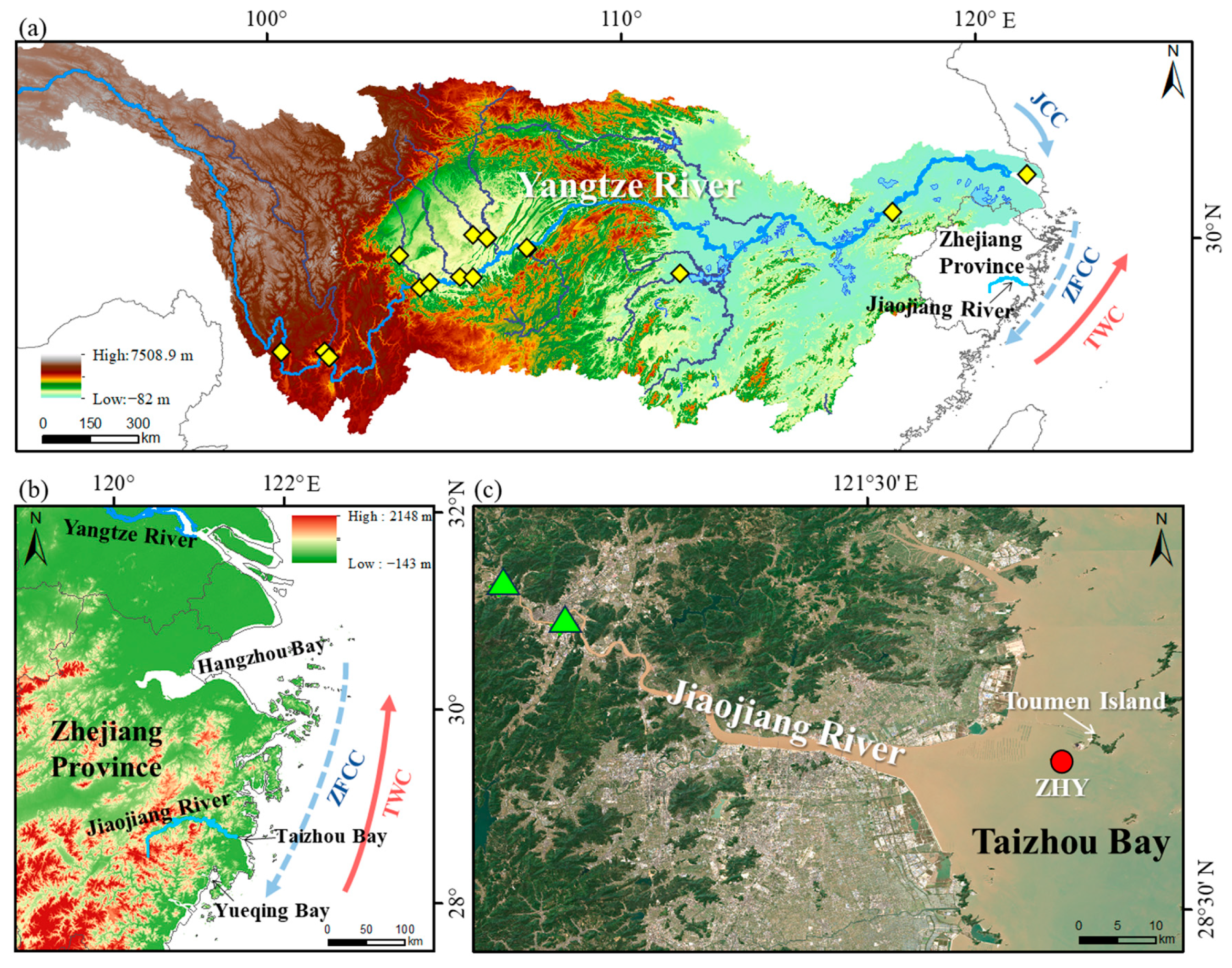
Taizhou Bay is situated on the coast of Taizhou, in the middle-eastern part of Zhejiang Province, China. It serves as the estuary of the Jiaojiang River and constitutes a typical embayment (Figure 1b). The Jiaojiang River system supplies two crucial elements dictating the bay’s characteristics: freshwater and sediment. The Jiaojiang River basin experiences abundant rainfall and is characterized by a subtropical monsoon climate, which results in significant seasonal variations in river discharge. The wet season occurs during spring and summer. Influenced by the plum rain season (Meiyu, a prolonged rainy period in early summer over East China) and the typhoon season, rainfall is concentrated, leading to large river runoff. A substantial influx of freshwater into Taizhou Bay significantly reduces the salinity within the bay and near the estuary. Concurrently, this input carries a substantial sediment load, causing the seawater to become highly turbid and appear yellowish-brown. Conversely, the dry season spans autumn and winter, when rainfall decreases, and the river runoff reduces significantly, leading to a substantial decrease in sediment transport. During this period, the seawater is relatively clearer, with higher salinity, and the marine characteristics are more pronounced.
The marine dynamics of Taizhou Bay are primarily controlled by the Zhejiang-Fujian Coastal Current (ZFCC) and the Taiwan Warm Current (TWC) [33]. As a branch of the Kuroshio Current, the TWC regulates the bay’s salinity structure and guides the transport of fine-grained sediment from the East China Sea shelf, synergizing with the ZFCC to shape the regional sedimentary dynamic balance. The ZFCC is a current flowing along the coasts of Zhejiang and Fujian Provinces, China. Its flow direction and properties exhibit strong seasonality, making it the most dominant oceanic current system influencing Taizhou Bay. In summer, prevailing southerly winds drive the formation of this coastal current. It flows northeastward, transporting the freshwater and sediment from the Yangtze River, Qiantang River, and the Jiaojiang River itself northward into the ocean. The warm, low-salinity coastal water results in higher sea surface temperatures and lower salinity in the bay during summer. In winter, strong prevailing northerly winds drive the southward-flowing ZFCC. Originating from the Yellow Sea and the northern East China Sea (ECS), the current is characterized by low temperature and low salinity due to the input of terrestrial runoff from rivers like the Yangtze River. It flows closely along the coast and passes through Taizhou Bay [34].
Figure 1. (a) Schematic diagram showing the location of the Yangtze River Basin, the Jiaojiang River and Zhejiang Province. The yellow diamonds represent the river sediment sampling sites of the Yangtze River [35]. (b) Schematic map of the Yangtze River Estuary, coastal bays of Zhejiang Province, and ocean currents. (c) Schematic diagram of the Taizhou Bay coast and oceanic currents. The red circle indicates the ZHY core sampling site, and the green triangles represent the riverbed sediment and suspended particulate matter sampling sites of the Jiaojiang River [9]. TWC: Taiwan Warm Current. ZFCC: Zhejiang-Fujian Coastal Current. JCC: Jiangsu Coastal Current. Note: The ZFCC flows northward in summer and southward in winter.
Geosciences 16 00020 g001

2.2. Sample Collection

The ZHY core (121°43′40.56″ E, 28°40′31.98″ N) in Taizhou Bay is located near Toumen Island at the river mouth (Figure 1b). The coring site is situated 6.7 km from the nearest mainland, 2.5 km from the nearest island, Toumen Island, and 14.5 km from the tidal-defined estuary mouth. A gravity corer was used to retrieve the ZHY core with an overall length of over 10 m. The core was subsampled at 1 cm intervals, and the subsequent analyses were restricted to its uppermost 1.5 m segment.

3. Material and Methods

3.1. Dating Methods

Dating studies of sub-recent sediments commonly utilize the naturally occurring radionuclide 210Pb and the artificial radionuclide 137Cs to establish chronological control points [36,37,38]. For the ZHY core, control points were obtained by combining the 210Pb accumulation rate with 137Cs abundance variations.
210Pb in sediments has two sources: supported 210Pb, produced in situ by 226Ra decay and in secular equilibrium; and excess 210Pb. Excess 210Pb is derived from atmospheric deposition after the decay of 222Rn (intermediate product of 226Ra decay) and is not in equilibrium with 226Ra. The excess 210Pb value is derived by subtracting the supported 210Pb (based on 226Ra measurement) from the total 210Pb [39]. Due to the instability of the annual input flux, the Constant Rate of Supply (CRS) model is typically employed for calculation, which accounts for variable sedimentation rates.
137Cs dating uses this artificial radioactive nuclide as a chronological marker horizon. Since 137Cs does not occur naturally, its presence in the environment is a byproduct of nuclear weapons testing and major nuclear accidents (e.g., Chernobyl and Fukushima). Large-scale global nuclear testing was mainly concentrated between the 1950s and the early 1960s, peaking in 1963 (corresponding to the signing of the Partial Test Ban Treaty). This activity released substantial amounts of 137Cs into the atmosphere, leading to a clear, globally synchronous peak layer recorded in sediment archives worldwide. Furthermore, the 1986 Chernobyl nuclear accident provided another distinct 137Cs marker in regional sediments, such as those across Europe. The combination of 210Pb and 137Cs dating methods leverages their respective advantages for mutual verification, yielding more reliable results [40]. Both 210Pb and 137Cs measurements were performed using a High-Purity Germanium Gamma Spectrometer at Isotope Technology Co., Ltd. (Qingdao, China).

3.2. Subsection Grain Size and End-Member Modeling

The grain size of all samples was measured using a Malvern Mastersizer 3000 laser diffraction particle size analyzer. Samples were pretreated following the method of Lu and An [41], utilizing 10% hydrogen peroxide (H2O2) and 10% hydrochloric acid (HCl) to remove organic matter and carbonates, respectively. After mixing with an appropriate volume of 10% sodium hexametaphosphate (NaPO3)6, the mixture was subjected to ultrasonic treatment to ensure the complete dispersion of fine particles.
End-Member Modeling Analysis (EMMA) was employed to decompose the grain size components of the samples and extract potential environmental information. The fundamental principle of EMMA assumes that the observed grain size distribution X is the result of mixing p end members (EMs) that possess specific frequency distribution characteristics [42]. Its mathematical model can be expressed as: X = M × B + E, where X is the matrix of the original grain size distributions; B is the characteristic distribution matrix of the p end members; M is the matrix of end-member abundance (or contribution proportion) in each sample; and E is the matrix of model residuals.
In this study, the open-source grain size analysis software QGrain (v0.5.4) was used for grain size end-member analysis. QGrain utilizes the Neural Network End-Member Modeling Analysis (NNEMMA) algorithm [43]. During the analysis, the grain-size distribution of end-members was assumed to follow a Weibull distribution; model fitting performance was evaluated using the Mean Squared Error (MSE), where a smaller MSE value indicates a better agreement between the fitted results and the actual data. The number of end-members was selected following the principle of achieving satisfactory fitting performance with the minimum number of end-members: For the Adam optimizer integrated with the NNEMMA algorithm, this study set its learning rate to 0.01, minimum iterations to 500, and maximum iterations to 2000, so as to balance the convergence efficiency and solution accuracy of the algorithm. We tested 2 to 5 end-members and found that the residual was the smallest when using 3 end-members, with no significant reduction in residual after exceeding 3 end-members. Ultimately, by analyzing the variation characteristics of the fitting error curve and combining the geological context of the actual sedimentary processes in the study area, the optimal number of end-members in this study was determined to be 3. This algorithm automatically iterates using the Adam optimizer to find the global optimum solution, thereby minimizing the model error. The end members (B) obtained through NNEMMA represent different material sources, transport, or depositional processes, while their abundance variation sequence (M) serves as a proxy indicator for studying paleoclimate and paleoenvironmental evolution.

3.3. Magnetic Property Measurements

The sediments were dried at a temperature below 40 °C. The air-dried samples were then packed into 2 cm cubic plastic boxes for subsequent magnetic property measurements. Magnetic susceptibility is a metric that reflects the ease with which a material can be magnetized. Low-frequency magnetic susceptibility (χlf, 976 Hz) and high-frequency magnetic susceptibility (χhf, 15,616 Hz) were measured using a Kappabridge magnetic susceptibility meter, with three replicate measurements performed for each sample (relative standard deviation < 2%) to ensure data reliability. Unless otherwise specified, magnetic susceptibility (χ) refers to the χlf. The percentage of frequency-dependent magnetic susceptibility (χfd%) was calculated as: χfd% = (χlf − χhf)/χlf × 100%.
Anhysteretic Remanent Magnetization (ARM) is defined as the remanence acquired when a sample is exposed to an alternating current (AC) field superimposed on a weak constant direct current (DC) bias field, with the AC field gradually decaying to zero. ARM was imparted using a Dtech D2000 AC demagnetizer, with a DC bias field of 100 μT and a peak AC demagnetizing field of 100 mT. The remanence intensity was measured using a JR6 spinner magnetometer. The Anhysteretic Remanent Magnetization susceptibility (χARM) was calculated as: χARM = ARM/H (where H = 100 μT).
Isothermal Remanent Magnetization (IRM) is the residual magnetization obtained by applying a DC magnetic field to a sample at room temperature. IRM of the samples was acquired using an MMPM10 Impulse magnetizer. The IRM acquired in a 1 T pulse magnetic field was defined as the Saturation Isothermal Remanent Magnetization (SIRM). The remanence intensity was also measured using the JR6 spinner magnetometer. When the external magnetic field is removed, certain types of magnetic minerals retain a certain degree of remanent magnetization, and this phenomenon where the change in magnetization lags behind the change in the magnetic field is referred to as hysteresis [44]. Hysteresis loops of the samples can be obtained by measuring the forward and reverse magnetic fields up to 1 T. Nine representative samples were selected and measured using a Vibrating Sample Magnetometer (VSM 3107), with a maximum applied magnetic field of 2 T and a measurement step size of 5 mT during the test. Magnetic and grain size experiments described above were completed at the Magnetism Analysis Laboratory and the Sedimentary Laboratory of Zhejiang Normal University.

4. Results

4.1. Chronological Analysis

The core chronology was analyzed in this study using the Constant Initial Concentration (CIC) model [45], the Constant Rate of Supply (CRS) model [46], and the Plum model (R package, version 4.3.2) [47]. The CRS model yielded the best results (Figure 2).
In 210Pb geochronological analysis, the core difference among different models lies in their assumptions about physical processes. The CRS model assumes that the input flux of unsupported 210Pb from the atmosphere to the sedimentary interface is constant [46], and fluctuations in sedimentation rate are corrected by the ratio of cumulative activity below a specific depth to the total cumulative activity of the entire core, thus being widely applied in marine areas with turbulent environments and uneven sedimentation. The CIC model presupposes a constant initial specific activity of sediments, essentially requiring sedimentation rate and provenance supply to be in a steady state, with age determined by the exponential decay curve of measured activity with depth [45]. In contrast, the Plum model breaks away from the single assumption of physical constancy, integrating it into a Bayesian statistical framework [47]. It uses Gamma prior distribution to constrain parameters such as sedimentation rate and supported lead, and outputs a chronology-depth sequence with quantified uncertainty through MCMC (Markov Chain Monte Carlo) simulation.
The excess 210Pb in the 110–130 cm depth interval exhibited exponential decay and reached equilibrium. Based on this, the background value was determined. Subsequent CRS fitting estimated that the layer corresponding to the onset of global nuclear testing in 1963CE is located at approximately 73 cm. This result is reasonably consistent with the measured 137Cs peak position, indicating broad agreement between the two methods.
This sedimentary sequence is unsuitable for the CIC model because the sedimentation rates or fluxes calculated using CIC exhibit significant variations, thereby violating the core assumption of constant initial concentration, reflecting the high instability of provenance supply or the sedimentary dynamic environment in the study area. Furthermore, the 210Pb data did not satisfy the Plum model’s requirements for flux stability and background estimation, which prevented the model from converging, and the reconstructed results consequently lacked reliability, which implies that the profile may be affected by disturbance from unsteady-state sedimentary processes, causing the vertical distribution of radionuclides to deviate from the ideal decay sequence. Therefore, the CRS model was employed in this study to construct the chronostratigraphic sequence of the sediments (Figure 2C).

4.2. Grain Size Analysis

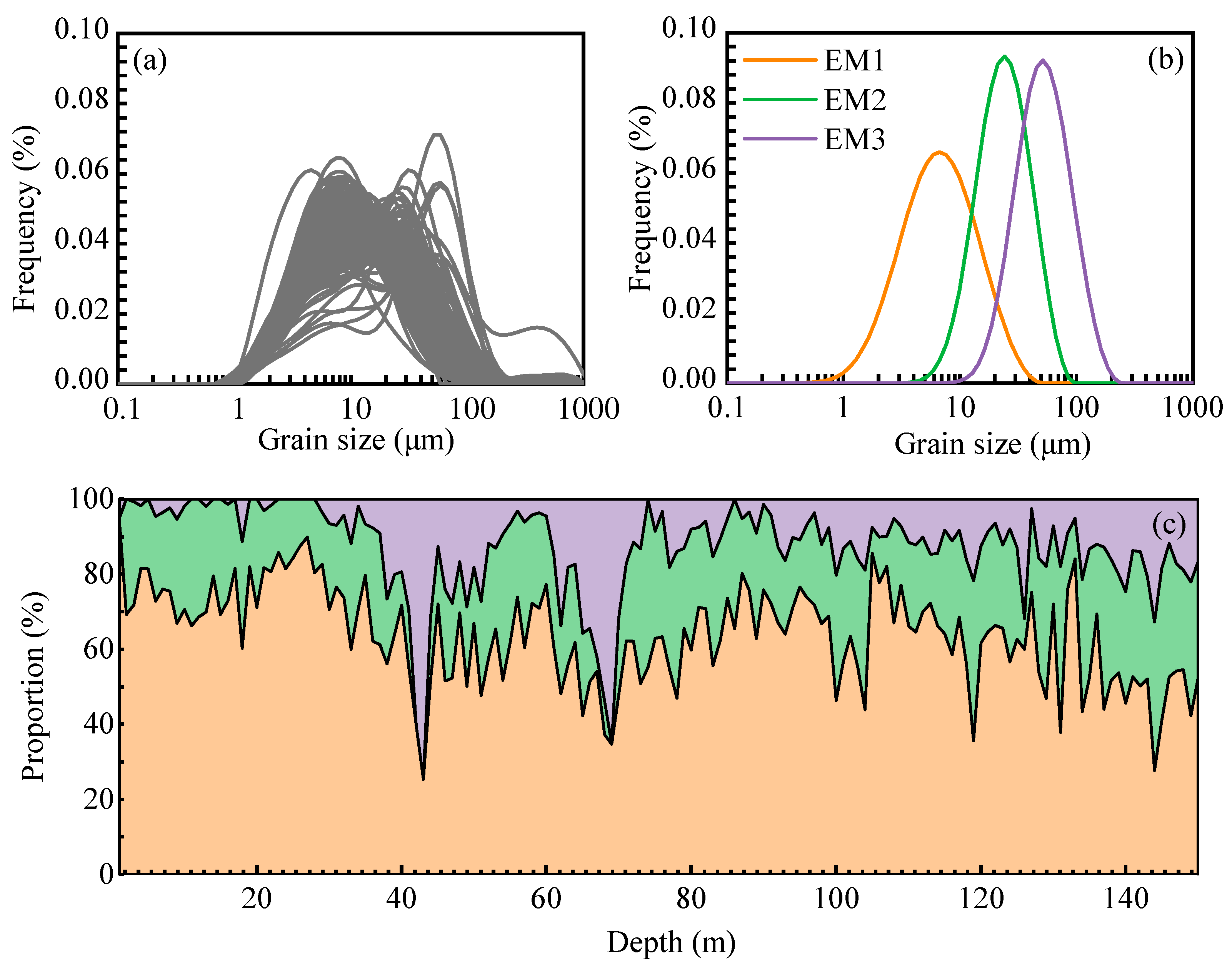
The grain size of the ZHY core sediments is primarily concentrated in the 5–25 μm range. Frequency analysis of 150 samples indicates the mean grain size is clustered within the 8–14 μm fine silt fraction. The fine-grained dominance reflects a continuous low-energy background sedimentation prevailing in the Taizhou Bay nearshore, suggesting a relatively stable hydrodynamic environment.
End-Member Modeling Analysis (EMMA) was performed on the ZHY core grain size data, identifying three end members (EMs) with distinct physical significance. Figure 3b shows the grain size frequency distribution curves of the three decomposed end members. EM1 is the finest end member, with a mode grain size of 7.72 μm, primarily composed of fine silt. Its kurtosis is 3.57, the highest among the three EMs, indicating the poorest sorting. EM2 has an intermediate grain size, with a mode at 24.09 μm, mainly medium silt. Its kurtosis is 1.15, indicating its most peaked shape, narrowest grain size distribution, and highest peak.EM3 is the coarsest end member, with a mode at 51.82 μm, primarily composed of coarse silt to very fine sand. Its kurtosis is 1.97, and its grain size distribution is slightly broader than that of EM2.
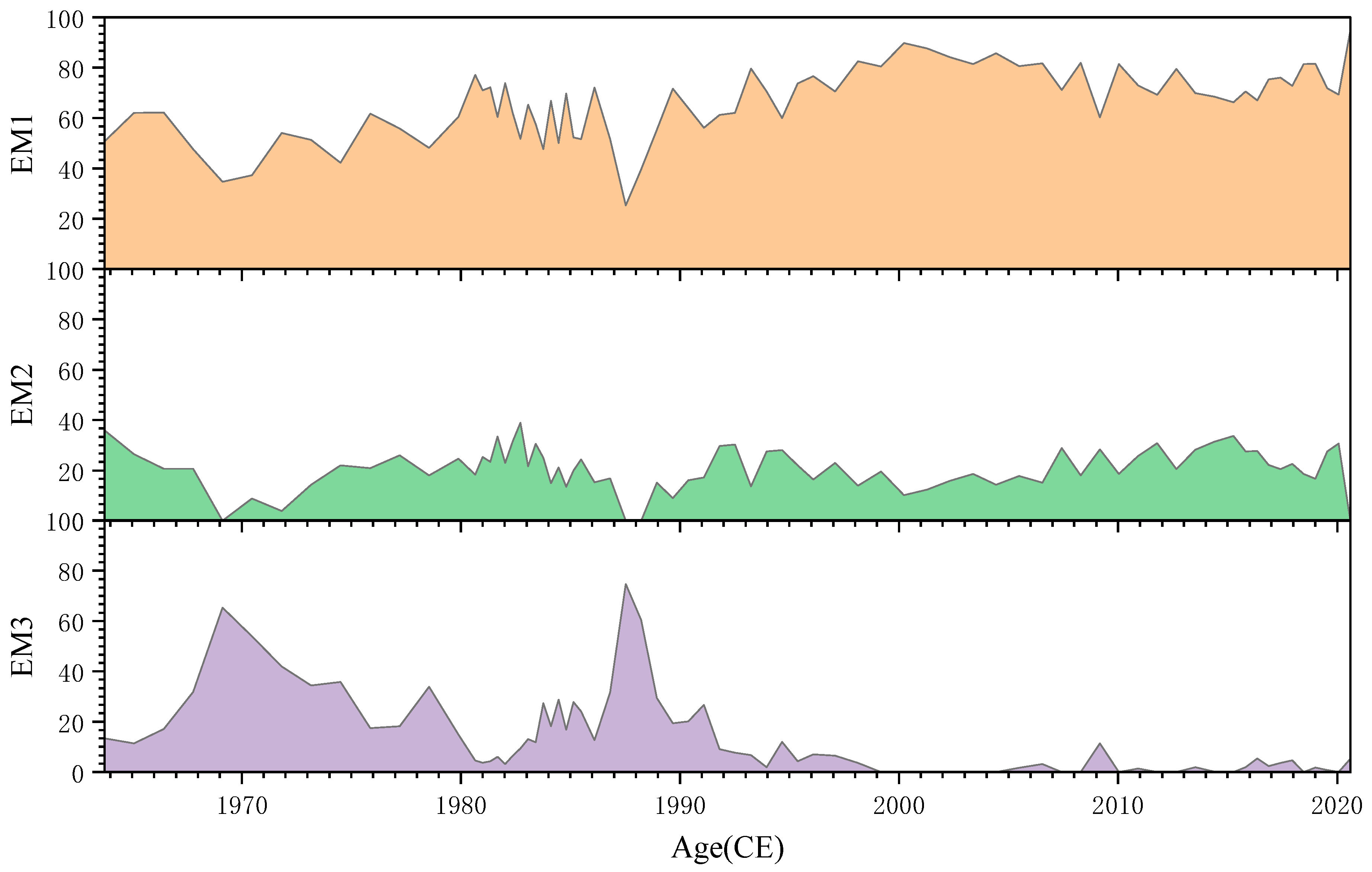
The average contribution rate of EM1 component is extremely high at 63.7%, demonstrating its dominant role in the Taizhou Bay sediments. Its contribution ranges from 25.3% to 94.7% (Figure 3c). The average contribution rate of EM2 component is 23.5%, with a proportion ranging from 0% to 44%. The average for EM3 component is 12.7%, with a contribution range of 0% to 74.7%. Despite having the lowest average contribution, EM3 component’s largest fluctuation range implies a strong relationship with localized, high-energy depositional processes.
In terms of down-core variation, EM1 component generally exhibits an increasing-decreasing-increasing-stable trend. Its proportion fluctuates upwards from 150–105 cm depth, shows a decreasing trend from 105–70 cm depth, increases in the depth range around 70–30 cm, and finally remains relatively stable in the 30–0 cm depth section. The vertical variation curve of EM2 component is similar in shape to EM1, except for a few specific layers where it reaches near-zero low values influenced by the extreme values of EM3. The down-core trend of EM3 component differs from the others; its highest fluctuation range and lowest average contribution suggest a strong correlation with localized, high-energy depositional processes, displaying an episodic nature.

4.3. Magnetic Analysis

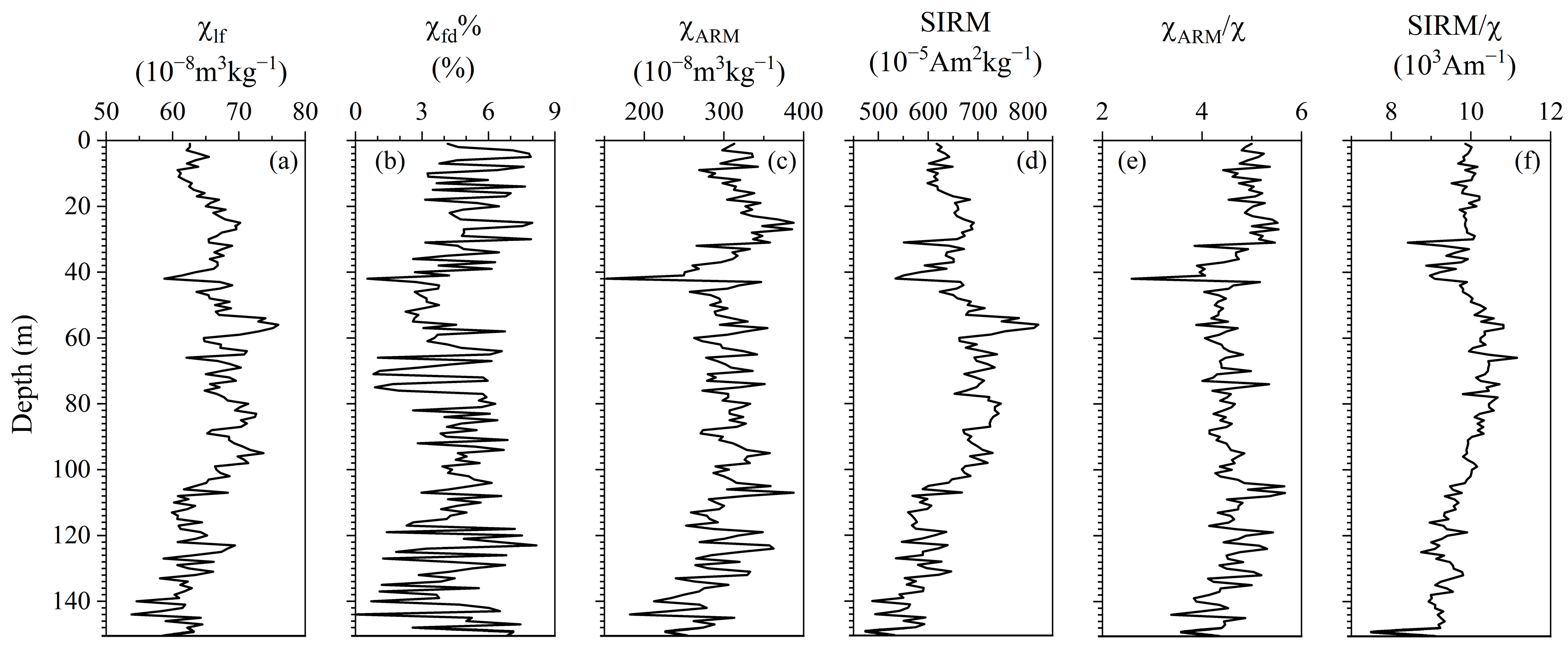
χ is a commonly used magnetic parameter reflecting the concentration of magnetic minerals [48]. The χ values of the Taizhou Bay marine sediment samples are highly concentrated, ranging from 53.8 to 75.9 × 10⁻⁸ m3kg−1, with an average value of 65.6 × 10⁻⁸ m3kg−1 and a variance of 4.0 × 10⁻⁸ m3kg−1 (Figure 4a; the detailed data are provided in Table S1). This indicates that the magnetic mineral content in the sediments is relatively low and stable. Based on the χ values, the ZHY core can be divided into three sections: a low-value interval from 150–100 cm, a high-value interval from 100–40 cm, and another low-value interval from 40–0 cm. The concentration of magnetic minerals throughout the core shows a trend of increasing first and then decreasing from the bottom upward. The maximum value of 75.9 × 10⁻⁸ m3kg−1 occurs at 56 cm depth, and the minimum value of 53.8 × 10⁻⁸ m3kg−1 appears at 42 cm depth. SIRM is another parameter that reflects the concentration of magnetic minerals in sediments. Compared to χ, SIRM amplifies the signal from antiferromagnetic minerals [49]. The SIRM values of the ZHY core range between 473.4 and 821.2 × 10⁻⁵ Am2kg−1, with an average value of 644.3 × 10⁻⁵ Am2kg−1 and a variance of 73.1 × 10⁻⁵ Am2kg−1. This similarly suggests a low and stable concentration of magnetic minerals in the sediments. SIRM and χ exhibit similar variation patterns (Figure 4a,d), further suggesting that the primary magnetic carrier mineral type in the sediments is uniform. The SIRM/χ value generally fluctuates around 10 × 103 Am−1 (Figure 4f), indicating that magnetite is the dominant magnetic carrier mineral [50].
χfd% is highly sensitive to magnetite grains in the 20–25 nm size range and can be used to indicate the content of nanometer-scale ultrafine magnetite in sediments. Due to its fine size, it is commonly considered a product of biochemical weathering processes [51]. The χfd% for all samples of the Taizhou Bay nearshore sediments ranges between 0.53% and 8.17%, with an average value of 4.5%, suggesting that the marine sediments of Taizhou Bay are relatively rich in fine-grained magnetite (Figure 4b). Furthermore, a sustained relatively low value and smaller fluctuation of χfd are observed in the 50–40 cm depth interval, which contrasts with the frequent and larger fluctuations seen at other depths.
χARM is sensitive to the presence of single-domain (SD, 30–100 nm) magnetite and can be used to indicate the content of nanometer-scale fine-grained magnetite in sediments [51]. The χARM of the ZHY core ranges from 152.0 to 387.4 × 10⁻⁸ m3kg−1, with an average value of 301.9 × 10⁻⁸ m3kg−1 and a variance of 36.2 × 10⁻⁸ m3kg−1. The numerical variation is relatively stable, showing a gradually increasing trend only in the 150–120 cm and 40–30 cm depth intervals (Figure 4c). Notably, the lowest χARM value for the Taizhou Bay core samples, 152.0 × 10⁻⁸ m3kg−1, appears near 40 cm depth.
The χARM/χ ratio is often used to indicate the equivalent crystal size of the magnetic minerals. A larger value suggests a finer equivalent crystal size of magnetite in the sediments, while a smaller value reflects a coarser equivalent crystal size [48]. Figure 4e shows that the χARM/χ ratio mostly fluctuates between 4 and 5, reflecting a coarser equivalent crystal size of magnetite at the 40 cm layer. The χARM/χ ratio reaches a relatively high average value of 5.09 in the 31–0 cm section, whereas the average value in the underlying depth layers is only 4.48.
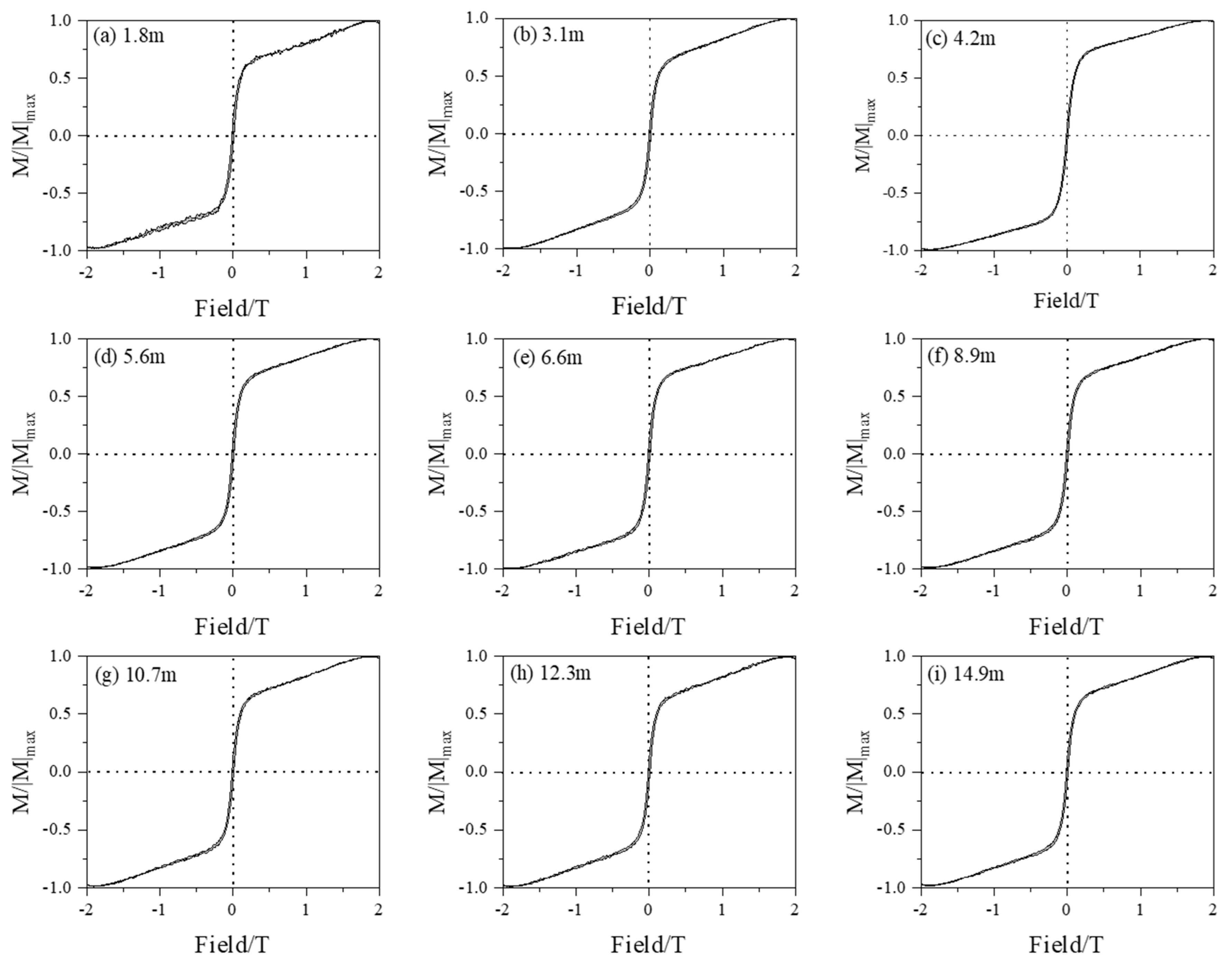
The type of magnetic minerals in the samples can be roughly inferred from the shape of hysteresis loops: hematite typically exhibits a wide and flat hysteresis loop, whereas magnetite and maghemite show narrow and tall ones [52]. After performing paramagnetic correction on the hysteresis loops of typical samples and normalizing the magnetization to the maximum saturation magnetization (M/Ms), the resulting M/Ms ratios range from 0.079 to 0.112 with an average of 0.1. This outcome rules out significant contributions from high-coercivity minerals. All typical samples display highly similar hysteresis loop morphologies (Figure 5) with only minor differences, presenting a distinct waist-like shape rather than a wasp-waisted shape. This morphological feature indicates that the samples are dominated by low-coercivity ferrimagnetic minerals, further confirming the magnetic characteristic that magnetite serves as the primary magnetic carrier.

5. Discussion

5.1. Magnetic Evidence for Sediment Provenance in Taizhou Bay

Comprehensive analysis of magnetic characteristics indicates that the magnetism of sediments in the study area is mainly dominated by magnetite, which is consistent with the results of sediments and their inclusions in Zhejiang tidal flats [31,32]. In terms of vertical distribution of the entire ZHY core, although SIRM and χARM exhibit slight fluctuations, they have relatively small overall variances. Minor adjustments in the size of magnetic particles are only observed in some intervals, indicating that no substantial change in sediment provenance occurred during the deposition process. The hysteresis loops have nearly consistent morphologies at different depths, which also confirms this from the perspective of magnetic mineral types.
The suspended particulate matter (SPM) from the Yangtze River has long been considered the main source of material for the nearshore waters and coastal tidal flats of Zhejiang [26]. However, recent climatic changes [53,54] and the construction of large-scale hydraulic engineering projects [55,56] have significantly altered the hydrological characteristics of the East China Sea region. Survey results using multiple parameters [9] indicate that the material contribution of the SPM transported by the Yangtze River to the muddy tidal flats formed along the Zhejiang coast gradually decreases from north to south, shifting from a dominant contribution in the Hangzhou Bay area to almost no contribution in Yueqing Bay (Figure 1b). Compared to the muddy tidal flat deposits within the bays, the nearshore deposits have a significantly higher possibility of receiving Yangtze SPM.
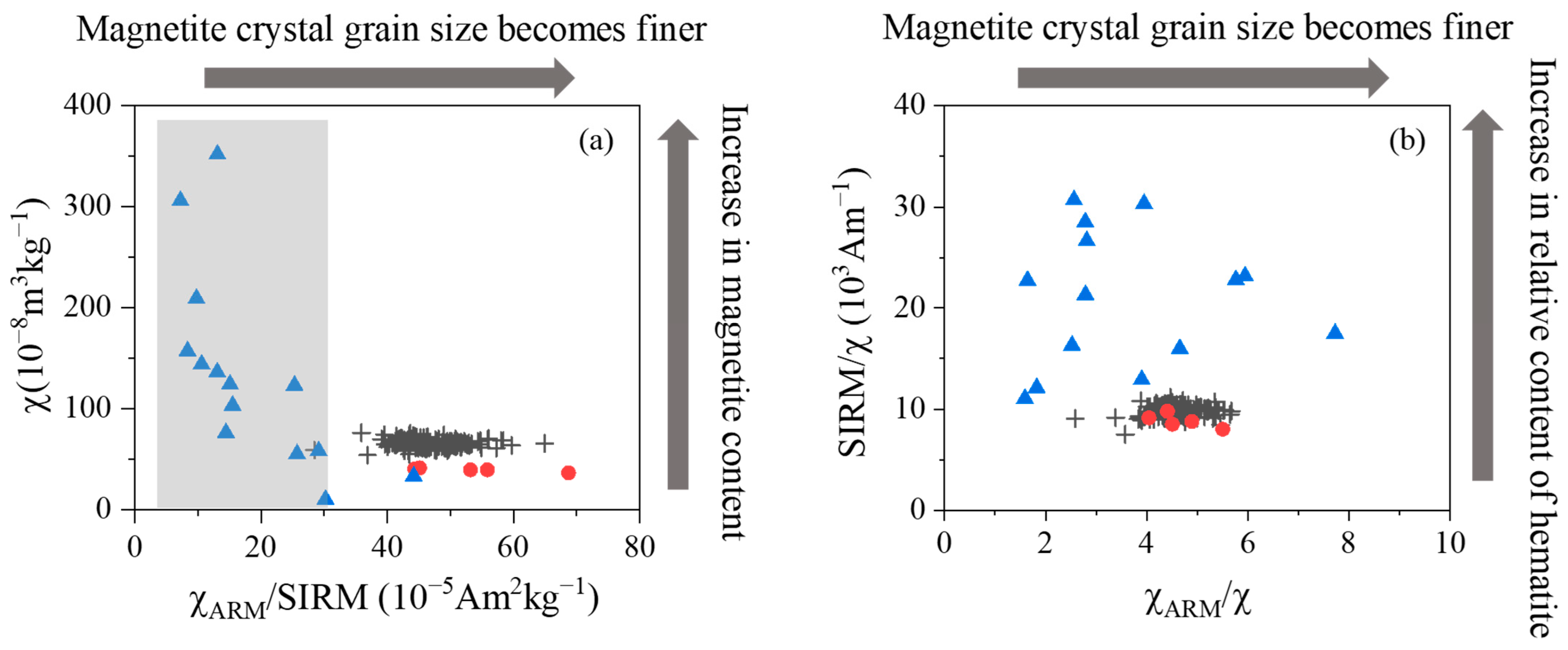
As shown in Figure 6, the χ versus χARM/SIRM scatter plot clearly separates the Yangtze River deposits [35] from the Taizhou Bay ZHY core samples. The latter samples plot closely to the Jiaojiang River riverbed sediment and SPM [9] positions. The main magnetic features of the Yangtze River sediments are high magnetite content, a wide range of variation, and coarser magnetic crystal grains. Compared with muddy intertidal sediments within the bays, nearshore deposits are more strongly influenced by coastal currents and offshore tides, and are more prone to capturing the southward transport flux of Yangtze-derived SPM from the East China Sea shelf, resulting in a significantly higher probability of accumulating Yangtze-derived materials.
The χARM/χ versus SIRM/χ scatter plot (Figure 6) shows that the Yangtze River sediments have a wide distribution range, while the Taizhou Bay sediments and Jiaojiang River sediments are concentrated and overlap. Compared to the Yangtze River sediments, which exhibit higher hematite content, the Taizhou Bay sediments show low hematite content. The significant magnetic difference from the Yangtze River deposits and the magnetic similarity to the Jiaojiang River deposits jointly demonstrate a material connection between the Taizhou Bay marine sediments and the adjacent Jiaojiang River SPM.
In the high-energy event layers (41–42 cm and 66–67 cm), although the sediment grain size exhibited abnormal coarsening, a comparison along the core depth of their magnetic characteristics with other layers (Figure 6) shows no significant differences, aside from an obvious fining of the magnetic minerals. This consistency indicates a uniformity of sediment provenance throughout the stratigraphic column. This further corroborates the close source-to-sink relationship between the Taizhou Bay sediments and the Jiaojiang River.

5.2. End-Member Analysis Reveals a Decrease in Depositional Energy

In the Taizhou Bay sediments, EM1 is the finest end member, EM2 represents the primary component under moderate hydrodynamic conditions, and EM3 is the coarsest end member. These coarse particles require strong hydrodynamic conditions for transport and deposition, serving as typical indicators of high-energy hydrodynamic events. In coastal sedimentary records, the presence and increased abundance of EM3 component are typically associated with instantaneous high-energy events such as catastrophic floods, strong typhoon waves, or high-intensity tidal resuspension and erosion [57]. Therefore, EM3 component is regarded as a proxy indicator for recording regional historical extreme climate or hydrological events.
Since 1963 CE, the contribution rate of the fine-grained component EM1 has continuously increased, rising from 50.82% in 1963 to 89.85% in 2000, and subsequently stabilized at an average of 76.27%. Correspondingly, the coarse-grained component EM3 rapidly declined to extremely low levels after 1990, with its proportion remaining near 0% for many years. The increase in EM1 component and the marked decline of EM3 component jointly reveal a strong signal of decreasing depositional energy in the Taizhou Bay sedimentary record. As EM1 component is the finest and poorest-sorted end member, its long-term increase indicates that the hydrodynamic environment of the Taizhou Bay nearshore is overall trending towards stability and low energy, insufficient to support the effective resuspension or transport of coarse particles. This implies that, excluding occasional high-energy events, a low-energy depositional background has become dominant in the nearshore marine area.
Furthermore, the high-value interval of the χARM/χ ratio in the ZHY core at 31–0 cm depth indicates a fining trend in the equivalent crystal size of magnetite. The synchronous fining trend observed in both grain size and magnetic grain size data jointly confirms the continuous weakening of sediment transport energy.
Conversely, the ZHY core clearly records an event characterized by abnormal grain size coarsening at a depth of 41–42 cm. Dating results place this event in 1988 CE (Figure 7). Hydrological records show a catastrophic flood occurred in the Jiaojiang River in 1989 due to a typhoon, which is broadly consistent with the stratigraphic record. A similar coarsening event is recorded at 66–67 cm in the ZHY core (dated to 1969 CE).

5.3. Accelerated Sedimentation Rate Driven by Human Activities

Taizhou Bay is synergistically regulated by the runoff of the Jiaojiang River and tidal currents [30]. Among them, the intensity of the Jiaojiang River runoff dominates the migration of the depositional center by altering the spatial location of the maximum turbidity zone [58], and is simultaneously superimposed with the tidal current-driven reciprocal sediment transport process [59], collectively forming the core sedimentary dynamic mechanism of the bay. The sampling site of the ZHY core is located in the stable fine-grained depositional center in the west-central part of Taizhou Bay [58]. The sediments are dominated by fine silt with a mean grain size concentrated between 5–25 μm. Its grain size composition is highly consistent with that of the fine-grained sediments on the seafloor surface of the Jiaojiang Estuary and Taizhou Bay (4–22.6 μm), reflecting the common characteristics of fine-grained deposition in the bay. In addition, this sampling site is situated in the transition zone between the influence zone of the Jiaojiang River runoff and the action zone of the Zhejiang-Fujian Coastal Current (ZFCC), thereby ensuring its representativeness for the fine-grained depositional areas of Taizhou Bay.
Based on the CRS model results, the sedimentation rate of the nearshore deposits in the Taizhou Bay area accelerated rapidly after 1980, increasing from 0.765 cm/a during 1963–1980 to 1.5 cm/a. We hypothesize that the increase in sedimentation rate in the estuarine area is driven by fluvial hydrodynamic intensification. However, enhanced hydrodynamics typically results in coarser sediment (as stronger hydrodynamics transports fine-grained materials to more distal regions for deposition), which contradicts the findings from the EMMA analysis. The EM1 component separated by the grain size frequency curve, which represents a low-energy environment, shows a continuously increasing contribution rate, implying that the overall hydrodynamic background tends towards low energy and stability. Thus, we infer that the elevated sedimentation is caused either by hydrodynamic weakening or by an increase in fine-grained sediment input. From 1960 to 2021, there were no significant changes in the annual precipitation and annual runoff of Yonganxi and Shifengxi—the two main rivers of the Jiaojiang River system. Their relative change ratios are all far below 1% per year, meaning the interannual variation amplitude is extremely small [60]. Given that the Jiaojiang River runoff under climatic influences and ocean circulation patterns have not undergone significant changes, it is reasonable to hypothesize that this phenomenon is closely associated with the increasing intensity of human activities.
Since the 21st century, large-scale clustered tidal flat reclamation has been the core feature of human activities in the Taizhou Bay estuary: approximately 100 km2 of reclamation was completed between 2004 and 2014, and over 126.7 km2 of reclamation has been planned or proposed for 2015–2025 [61]. Such projects not only drove a 10.8 km extension of the natural shoreline and a ~177 km2 expansion of land area during 2009–2014 [62]. Concurrently, the construction of nearshore engineering projects [63] may have altered the estuarine flow field [64], resulting in reduced flow velocities in some offshore areas outside the Jiaojiang Estuary [65]. These projects have also altered tidal current velocities and enhanced the flocculation and settling efficiency of fine-grained sediment [66], ultimately leading to increased sedimentation. This pattern is analogous to cases such as the Ribble Estuary (UK) [67], Seine Estuary (France) [68], and Modaomen Estuary of the Pearl River (China) [69], where human activities have reduced the tidal prism, leading to weakened hydrodynamics and exacerbated siltation. Furthermore, 3D numerical modeling of the Rotterdam Waterway [70] has demonstrated that tidal flat reclamation weakens tidal currents by reducing the tidal prism, thereby enhancing sediment trapping.

6. Conclusions

Based on the Pb and 137Cs dating, grain size end-member decomposition, and magnetic analysis of the Taizhou Bay ZHY core, this study systematically revealed the characteristics of the contemporary sedimentary environment and hydrodynamic evolution of Taizhou Bay.
The chronosequence established using the CRS model indicates a significant acceleration of the contemporary sedimentation rate in the Taizhou Bay region around 1980. Grain size end-member analysis reveals an overall weakening of depositional energy. The long-term evolution of the grain size end members shows an increase and dominance of the fine-grained component in the nearshore sediments of Taizhou Bay, suggesting that the hydrodynamic process is gradually shifting toward a stable, low-energy depositional background. Two events of significant grain size coarsening in the sedimentary sequence (1969 and 1988) are consistent with regional catastrophic flood records, demonstrating the ZHY core’s ability to effectively capture short-term high-energy events.
The magnetic parameters of the ZHY core samples show high similarity to the Jiaojiang River riverbed and suspended particulate matter, yet are clearly distinct from Yangtze River sediments. This suggests that the sediments in the study area are characterized by low magnetic mineral content and fine grain size, with the provenance primarily derived from the input of the nearest river, the Jiaojiang River. In the high-energy hydrodynamic event layers, the magnetic characteristics showed no significant anomaly despite the grain size coarsening, which further supports the provenance uniformity.
Although the sedimentation rate significantly increased after 1980, the grain size end members indicate that the hydrodynamic force did not strengthen; instead, it tended to weaken. Considering the background of regional land use change, river channel regulation, and nearshore engineering construction, it is hypothesized that the accelerated sedimentation mainly stems from the increased input of fine-grained material and improved nearshore depositional efficiency, rather than being a result of natural hydrodynamic changes. The contemporary sedimentary record of Taizhou Bay presents a characteristic combination of fining grain size, stable provenance, and accelerating sedimentation rate. This combination reflects the reshaping of the depositional pattern driven by the synergistic effects of regional natural processes and human activities, providing evidence for understanding the geomorphological evolution and the response of the estuary-nearshore depositional system of the Zhejiang coast.

Supplementary Materials

The following supporting information can be downloaded at: https://www.mdpi.com/article/10.3390/geosciences16010020/s1, Table S1: Magnetic parameters of sediment samples from the ZHY drill core.

Author Contributions

Conceptualization, L.Y. and J.J.; Methodology, L.Y., P.C. and Y.X.; Software, L.Y.; Validation, L.Y., Y.X. and Y.T.; Formal analysis, L.Y.; Investigation, L.Y., Y.T. and X.Z.; Resources, L.Y.; Data curation, L.Y., P.C., Y.X., N.C., X.Z. and J.S.; Writing—original draft, P.C., N.C. and J.S.; Writing—review & editing, J.J.; Visualization, S.L. and X.Z.; Supervision, N.C.; Project administration, J.S.; Funding acquisition, J.J. All authors have read and agreed to the published version of the manuscript.

Funding

This research was funded by Zhejiang Provincial Geological Special Fund Project, grant number 2023013.

Data Availability Statement

Data will be made available on request.

Conflicts of Interest

The authors declare no conflicts of interest.

References

  1. Jia, J.; Chen, J.; Wang, Z.; Chen, S.; Wang, Q.; Wang, L.; Yang, L.; Xia, D.; Chen, F. No evidence for an anti-phased Holocene moisture regime in mountains and basins in Central Asian: Records from Ili loess, Xinjiang. Palaeogeogr. Palaeoclimatol. Palaeoecol. 2021, 572, 110407. [Google Scholar] [CrossRef]
  2. Zan, J.; Fang, X.; Yang, S.; Nie, J.; Li, X. A rock magnetic study of loess from the West Kunlun Mountains. J. Geophys. Res. Solid Earth 2010, 115, B10101. [Google Scholar] [CrossRef]
  3. Gao, X.; Hao, Q.; Oldfield, F.; Bloemendal, J.; Deng, C.; Wang, L.; Song, Y.; Ge, J.; Wu, H.; Xu, B.; et al. New High-Temperature Dependence of Magnetic Susceptibility-Based Climofunction for Quantifying Paleoprecipitation From Chinese Loess. Geochem. Geophys. Geosyst. 2019, 20, 4273–4291. [Google Scholar] [CrossRef]
  4. Maher, B.A. Palaeoclimatic records of the loess/palaeosol sequences of the Chinese Loess Plateau. Quat. Sci. Rev. 2016, 154, 23–84. [Google Scholar] [CrossRef]
  5. Maher, B.A. Airborne Magnetite- and Iron-Rich Pollution Nanoparticles: Potential Neurotoxicants and Environmental Risk Factors for Neurodegenerative Disease, Including Alzheimer’s Disease. J. Alzheimer’s Dis. JAD 2019, 71, 361–375. [Google Scholar] [CrossRef]
  6. Chen, H.; Xia, D.-s.; Wang, B.; Liu, H.; Ma, X. Pollution monitoring using the leaf-deposited particulates and magnetism of the leaves of 23 plant species in a semi-arid city, Northwest China. Environ. Sci. Pollut. Res. 2022, 29, 34898–34911. [Google Scholar] [CrossRef]
  7. Xia, D.; Wang, Y.; Jia, J.; Wei, H.; Fan, Y.; Jin, M.; Chen, F. Mountain loess or desert loess? New insight of the sources of Asian atmospheric dust based on mineral magnetic characterization of surface sediments in NW China. Atmos. Environ. 2020, 232, 117564. [Google Scholar] [CrossRef]
  8. Maher, B.A.; Mutch, T.J.; Cunningham, D. Magnetic and geochemical characteristics of Gobi Desert surface sediments: Implications for provenance of the Chinese Loess Plateau. Geology 2009, 37, 279–282. [Google Scholar] [CrossRef]
  9. Jia, J.; Zhang, X.; Zhou, R.; Meadows, M.; Sengupta, D.; Zhu, L. Sources of sediment in tidal flats off Zhejiang coast, southeast China. J. Oceanol. Limnol. 2021, 39, 1245–1255. [Google Scholar] [CrossRef]
  10. Jia, J.; Wang, Y.; Xia, D.; Lu, H.; Gao, F. Dust Sources of Last Glacial Chinese Loess Based on the Iron Mineralogy of Fractionated Source Samples. Geophys. Res. Lett. 2019, 46, 2103–2110. [Google Scholar] [CrossRef]
  11. Watkins, S.J.; Maher, B.A.; Bigg, G.R. Ocean circulation at the Last Glacial Maximum: A combined modeling and magnetic proxy-based study. Paleoceanography 2007, 22, PA2204. [Google Scholar] [CrossRef]
  12. Zan, J.; Fang, X.; Kang, J.; Li, X.; Yan, M. Spatial and altitudinal variations in the magnetic properties of eolian deposits in the northern Tibetan Plateau and its adjacent regions: Implications for delineating the climatic boundary. Earth-Sci. Rev. 2020, 208, 103271. [Google Scholar] [CrossRef]
  13. Liu, Q.; Sun, Y.; Qiang, X.; Tada, R.; Hu, P.; Duan, Z.; Jiang, Z.; Liu, J.; Su, K. Characterizing magnetic mineral assemblages of surface sediments from major Asian dust sources and implications for the Chinese loess magnetism. Earth Planets Space 2015, 67, 61. [Google Scholar] [CrossRef]
  14. Tang, J.; Lü, B.; Liu, X.; Du, J.; Chen, T.; Li, J. Chromaticity characteristics of soil profiles in the coastal areas of Fujian and Guangdong, southern China and their climatic significance. Quat. Int. 2023, 649, 38–45. [Google Scholar] [CrossRef]
  15. Long, X.; Ji, J.; Barrón, V.; Torrent, J. Climatic thresholds for pedogenic iron oxides under aerobic conditions: Processes and their significance in paleoclimate reconstruction. Quat. Sci. Rev. 2016, 150, 264–277. [Google Scholar] [CrossRef]
  16. Long, X.; Ji, J.; Balsam, W. Rainfall-dependent transformations of iron oxides in a tropical saprolite transect of Hainan Island, South China: Spectral and magnetic measurements. J. Geophys. Res. Earth Surf. 2011, 116, F03015. [Google Scholar] [CrossRef]
  17. Su, Y.; Lü, B.; Liu, X.; Chen, Z.; Zheng, X. Magnetic characteristics of purple soils in Wuyishan and their significance for pedogenesis. Quat. Sci. 2023, 43, 154–162. [Google Scholar] [CrossRef]
  18. Liu, X.; Lü, B.; Liu, X.; Zheng, X.; Chen, Z.; Du, J. Different types of maghemite and their gensis in humid subtropical red soil derived from granite weathering crust. Quat. Sci. 2021, 41, 63–77. [Google Scholar] [CrossRef]
  19. Nguyen, T.T.H.; Zhang, W.; Li, Z.; Li, J.; Ge, C.; Liu, J.; Bai, X.; Feng, H.; Yu, L. Magnetic properties of sediments of the Red River: Effect of sorting on the source-to-sink pathway and its implications for environmental reconstruction. Geochem. Geophys. Geosyst. 2016, 17, 270–281. [Google Scholar] [CrossRef]
  20. Ge, C.; Zhang, W.; Dong, C.; Wang, F.; Feng, H.; Qu, J.; Yu, L. Tracing sediment erosion in the yangtze river subaqueous delta using magnetic methods. J. Geophys. Res. Earth Surf. 2017, 122, 2064–2078. [Google Scholar] [CrossRef]
  21. Lim, D.I.; Choi, J.Y.; Jung, H.S.; Rho, K.C.; Ahn, K.S. Recent sediment accumulation and origin of shelf mud deposits in the Yellow and East China Seas. Prog. Oceanogr. 2007, 73, 145–159. [Google Scholar] [CrossRef]
  22. Xu, K.; Li, A.; Liu, J.P.; Milliman, J.D.; Yang, Z.; Liu, C.-S.; Kao, S.-J.; Wan, S.; Xu, F. Provenance, structure, and formation of the mud wedge along inner continental shelf of the East China Sea: A synthesis of the Yangtze dispersal system. Mar. Geol. 2012, 291–294, 176–191. [Google Scholar] [CrossRef]
  23. Liu, X.; Li, A.; Dong, J.; Lu, J.; Huang, J.; Wan, S. Provenance discrimination of sediments in the Zhejiang-Fujian mud belt, East China Sea: Implications for the development of the mud depocenter. J. Asian Earth Sci. 2018, 151, 1–15. [Google Scholar] [CrossRef]
  24. Zhang, X.; Dalrymple, R.W.; Yang, S.-Y.; Lin, C.-M.; Wang, P. Provenance of Holocene sediments in the outer part of the Paleo-Qiantang River estuary, China. Mar. Geol. 2015, 366, 1–15. [Google Scholar] [CrossRef]
  25. Xu, G.; Liu, J.; Liu, S.; Wang, Z.; Hu, G.; Kong, X. Modern muddy deposit along the Zhejiang coast in the East China Sea: Response to large-scale human projects. Cont. Shelf Res. 2016, 130, 68–78. [Google Scholar] [CrossRef]
  26. Li, W.; Hu, Z.X.; Zhang, W.G.; Ji, R.; Nguyen, T.T.H. Influence of provenance and hydrodynamic sorting on the magnetic properties and geochemistry of sediments of the Oujiang River, China. Mar. Geol. 2017, 387, 1–11. [Google Scholar] [CrossRef]
  27. Murray, N.J.; Phinn, S.R.; DeWitt, M.; Ferrari, R.; Johnston, R.; Lyons, M.B.; Clinton, N.; Thau, D.; Fuller, R.A. The global distribution and trajectory of tidal flats. Nature 2019, 565, 222–225. [Google Scholar] [CrossRef]
  28. Guo, L.; Su, N.; Zhu, C.; He, Q. How have the river discharges and sediment loads changed in the Changjiang River basin downstream of the Three Gorges Dam? J. Hydrol. 2018, 560, 259–274. [Google Scholar] [CrossRef]
  29. Ministry of Water Resources of the People’s Republic of China. China River Sediment Bulletin 2019; China Water & Power Press: Beijing, China, 2020; p. 74. [Google Scholar]
  30. Gu, G.; Hu, F.; Zhang, Z. The sediment source and development mechanics of the muddy coast in the East Zhejiang. Donghai Mar. Sci. 1997, 15, 2–13. [Google Scholar]
  31. Zhang, X.; Zhu, L.; Hu, K.; Zhang, X.; Xiong, W.; Wang, N.; Zhou, W.; Li, F. Sedimentary Magnetic Characteristics and Provenance Identification of Muddy Tidal Flats Along the Coast of Zhejiang and Fujian. Acta Sedimentol. Sin. 2022, 40, 774–786. [Google Scholar] [CrossRef]
  32. Jiang, B.; Jia, J.; Zhou, R.; Wang, B. Source tracing of tidal flats in Zhejiang coastal zone: Evidence from magnetic mineral inclusions. J. Earth Environ. 2024, 15, 317–325. [Google Scholar] [CrossRef]
  33. Lian, E.; Yang, S.; Wu, H.; Yang, C.; Li, C.; Liu, J.T. Kuroshio subsurface water feeds the wintertime Taiwan Warm Current on the inner East China Sea shelf. J. Geophys. Res. Ocean. 2016, 121, 4790–4803. [Google Scholar] [CrossRef]
  34. Liu, J.P.; Xu, K.H.; Li, A.C.; Milliman, J.D.; Velozzi, D.M.; Xiao, S.B.; Yang, Z.S. Flux and fate of yangtze river sediment delivered to the east China sea. Geomorphology 2007, 85, 208–224. [Google Scholar] [CrossRef]
  35. Li, C.; Yang, S.; Zhang, W. Magnetic properties of sediments from major rivers, aeolian dust, loess soil and desert in China. J. Asian Earth Sci. 2012, 45, 190–200. [Google Scholar] [CrossRef]
  36. Appleby, P.G.; Oldfield, F. The calculation of lead-210 dates assuming a constant rate of supply of unsupported 210Pb to the sediment. Catena 1978, 5, 1–8. [Google Scholar] [CrossRef]
  37. Kuzyk, Z.Z.A.; Gobeil, C.; Macdonald, R.W. 210Pb and 137Cs in margin sediments of the Arctic Ocean: Controls on boundary scavenging. Glob. Biogeochem. Cycles 2013, 27, 422–439. [Google Scholar] [CrossRef]
  38. Ghaderi Dehkordi, N.; Khaledi Darvishan, A.; Porto, P.; Zare, M.R. Erosional history by combining 210Pbex and 137Cs methods with sediment fingerprinting and measurements. Sci. Rep. 2025, 15, 18165. [Google Scholar] [CrossRef]
  39. Sanchez-Cabeza, J.A.; Ruiz-Fernández, A.C. 210Pb sediment radiochronology: An integrated formulation and classification of dating models. Geochim. Cosmochim. Acta 2012, 82, 183–200. [Google Scholar] [CrossRef]
  40. Tsumune, D.; Tsubono, T.; Aoyama, M.; Hirose, K. Distribution of oceanic 137Cs from the Fukushima Dai-ichi Nuclear Power Plant simulated numerically by a regional ocean model. J Environ. Radioact. 2012, 111, 100–108. [Google Scholar] [CrossRef]
  41. Lu, H.; An, Z. Pretreated methods on loess-palaeosol samples granulometry. Chin. Sci. Bull. 1998, 43, 237–240. [Google Scholar] [CrossRef]
  42. Weltje, G.J. End-member modeling of compositional data: Numerical-statistical algorithms for solving the explicit mixing problem. Math. Geol. 1997, 29, 503–549. [Google Scholar] [CrossRef]
  43. Liu, Y.; Liu, X.; Sun, Y. QGrain: An open-source and easy-to-use software for the comprehensive analysis of grain size distributions. Sediment. Geol. 2021, 423, 105980. [Google Scholar] [CrossRef]
  44. Torrent, J.; Barrón, V.; Liu, Q. Magnetic enhancement is linked to and precedes hematite formation in aerobic soil. Geophys. Res. Lett. 2006, 33, 2005GL024818. [Google Scholar] [CrossRef]
  45. Binford, M.W. Calculation and uncertainty analysis of 210Pb dates for PIRLA project lake sediment cores. J. Paleolimnol. 1990, 3, 253–267. [Google Scholar] [CrossRef]
  46. Córdoba, F.E.; Piovano, E.L.; Guerra, L.; Mulsow, S.; Sylvestre, F.; Zárate, M. Independent time markers validate 210Pb chronologies for two shallow argentine lakes in southern pampas. Quat. Int. 2017, 438, 175–186. [Google Scholar] [CrossRef]
  47. Aquino-López, M.A.; Blaauw, M.; Christen, J.A.; Sanderson, N.K. Bayesian analysis of 210pb dating. J. Agric. Biol. Environ. Stat. 2018, 23, 317–333. [Google Scholar] [CrossRef]
  48. Liu, Q.; Deng, C.; Torrent, J.; Zhu, R. Review of recent developments in mineral magnetism of the Chinese loess. Quat. Sci. Rev. 2007, 26, 368–385. [Google Scholar] [CrossRef]
  49. Oldfield, F.; Crowther, J. Establishing fire incidence in temperate soils using magnetic measurements. Palaeogeogr. Palaeoclimatol. Palaeoecol. 2007, 249, 362–369. [Google Scholar] [CrossRef]
  50. Liu, Q.; Jin, C.; Hu, P.; Jiang, Z.; Ge, K.; Roberts, A.P. Magnetostratigraphy of Chinese loess–paleosol sequences. Earth-Sci. Rev. 2015, 150, 139–167. [Google Scholar] [CrossRef]
  51. Liu, Q.; Roberts, A.P.; Larrasoaña, J.C.; Banerjee, S.K.; Guyodo, Y.; Tauxe, L.; Oldfield, F. Environmental magnetism: Principles and applications. Rev. Geophys. 2012, 50, 2012RG000393. [Google Scholar] [CrossRef]
  52. Ge, K.; Williams, W.; Liu, Q.; Yu, Y. Effects of the core-shell structure on the magnetic properties of partially oxidized magnetite grains: Experimental and micromagnetic investigations. Geochem. Geophys. Geosyst. 2014, 15, 2021–2038. [Google Scholar] [CrossRef]
  53. Ashfaq, M.F.; Zhao, B.; Chen, L.; Ding, Y.; Wang, N.; Ye, X.; Gao, C.; Duan, X.; Yao, P. Impacts of sea level rise and climate change on the sources, preservation and thermal stability of sedimentary organic carbon in the East China Sea inner shelf since the last deglaciation. Quat. Sci. Rev. 2025, 362, 109416. [Google Scholar] [CrossRef]
  54. Wang, F.; Li, X.; Tang, X.; Sun, X.; Zhang, J.; Yang, D.; Xu, L.; Zhang, H.; Yuan, H.; Wang, Y.; et al. The seas around China in a warming climate. Nat. Rev. Earth Environ. 2023, 4, 535–551. [Google Scholar] [CrossRef]
  55. Yang, Y.; Zheng, J.; Zhu, L.; Zhang, H.; Wang, J. Influence of the Three Gorges Dam on the transport and sorting of coarse and fine sediments downstream of the dam. J. Hydrol. 2022, 615, 128654. [Google Scholar] [CrossRef]
  56. Yang, S.L.; Milliman, J.D.; Xu, K.H.; Deng, B.; Zhang, X.Y.; Luo, X.X. Downstream sedimentary and geomorphic impacts of the three gorges dam on the yangtze river. Earth-Sci. Rev. 2014, 138, 469–486. [Google Scholar] [CrossRef]
  57. Pang, H.; Jia, Y. Sedimentary Records of Paleoflood Events in the Desert Section of the Upper Yellow River Since the Late Quaternary. Atmosphere 2025, 16, 1019. [Google Scholar] [CrossRef]
  58. Jiang, C. Numerical Simulation Research on the Sediment Settling Characteristics in the Strong Tidal Current Estuarine Environment—A Case Study of the Jiaojiang Estuary in Zhejiang Coastal Area. Master’s Thesis, Zhejiang University, Hangzhou, China, 2017. [Google Scholar]
  59. Xia, W.; Zhao, X.; Zhang, X. Influences of variations in runoff and tide on spatial and temporal distribution of sediment concentration in Jiaojiang River estuary. Hydro-Sci. Eng. 2016, 3, 35–45. [Google Scholar] [CrossRef]
  60. Han, M.; Yin, P.; Chu, Z.; Tian, Y.; Cao, K.; Li, M.; Guang, X.; Gao, B.; Zhang, X.; Tian, Y.; et al. Characteristics and influencing factors of water and sediment changes in Jiaojiang River Basin. Mar. Geol. Front. 2022, 38, 26–39. [Google Scholar] [CrossRef]
  61. Guo, C.; Sen, Z.; Zheng, H.; Pan, G. Response of estuarine erosion and deposition to reclamation in estuary. J. Zhejiang Univ. (Eng. Sci.) 2016, 50, 1791–1797. [Google Scholar] [CrossRef]
  62. Huang, C.; Pan, G.; Chen, P. Coastline Change of the Taizhou Bay and Its Driving Force Over the Last 30 Years. Coast. Eng. 2015, 34, 1–10. [Google Scholar] [CrossRef]
  63. Zhou, L.; Huang, J.; Zhu, Y. Analysis on Changes in Coastline and Reclamation and its Causes Based on 40-year Satellite Data in Jiaojiang-Taizhou Bay. Geol. Rev. 2017, 63, 337–338. [Google Scholar] [CrossRef]
  64. Ni, M.; Jiang, G. Influence of renovation project in Jiaojiang on estuary dynamic and evolution of river bed. J. Water Resour. Water Eng. 2011, 22, 161–166. [Google Scholar]
  65. Guo, C. Responses of the Jiaojiang Estuary to Reclamation Projects. Doctoral Thesis, Zhejiang University, Hangzhou, China, 2016. [Google Scholar]
  66. Zhang, Q.; Tao, J.; Zhang, C.; Dai, W.; Xu, F. Effect of the large-scale reclamation of tidal flats on the hydrodynamic characteristics in the Taizhou Bay. Mar. Sci. Bull. 2015, 34, 392–398. [Google Scholar] [CrossRef]
  67. van der Wal, D.; Pye, K.; Neal, A. Long-term morphological change in the Ribble Estuary, northwest England. Mar. Geol. 2002, 189, 249–266. [Google Scholar] [CrossRef]
  68. Grasso, F.; Bismuth, E.; Verney, R. Unraveling the impacts of meteorological and anthropogenic changes on sediment fluxes along an estuary-sea continuum. Sci. Rep. 2021, 11, 20230. [Google Scholar] [CrossRef]
  69. Qiu, L.; Wei, X.; Mo, W.; Wu, C.; Bao, Y. A long-term numerical model of mophodynamic evolution and its applicationto Modaomen Estuary. Acta Oceanol. Sin. 2012, 34, 135–146. [Google Scholar]
  70. Siemes, R.W.A.; Duong, T.M.; Borsje, B.W.; Hulscher, S.J.M.H. Fine Sediment Dynamics Affected by Large-Scale Interventions; A 3D Modelling Study of An Engineered Estuary. Estuaries Coasts 2025, 49, 11. [Google Scholar] [CrossRef]
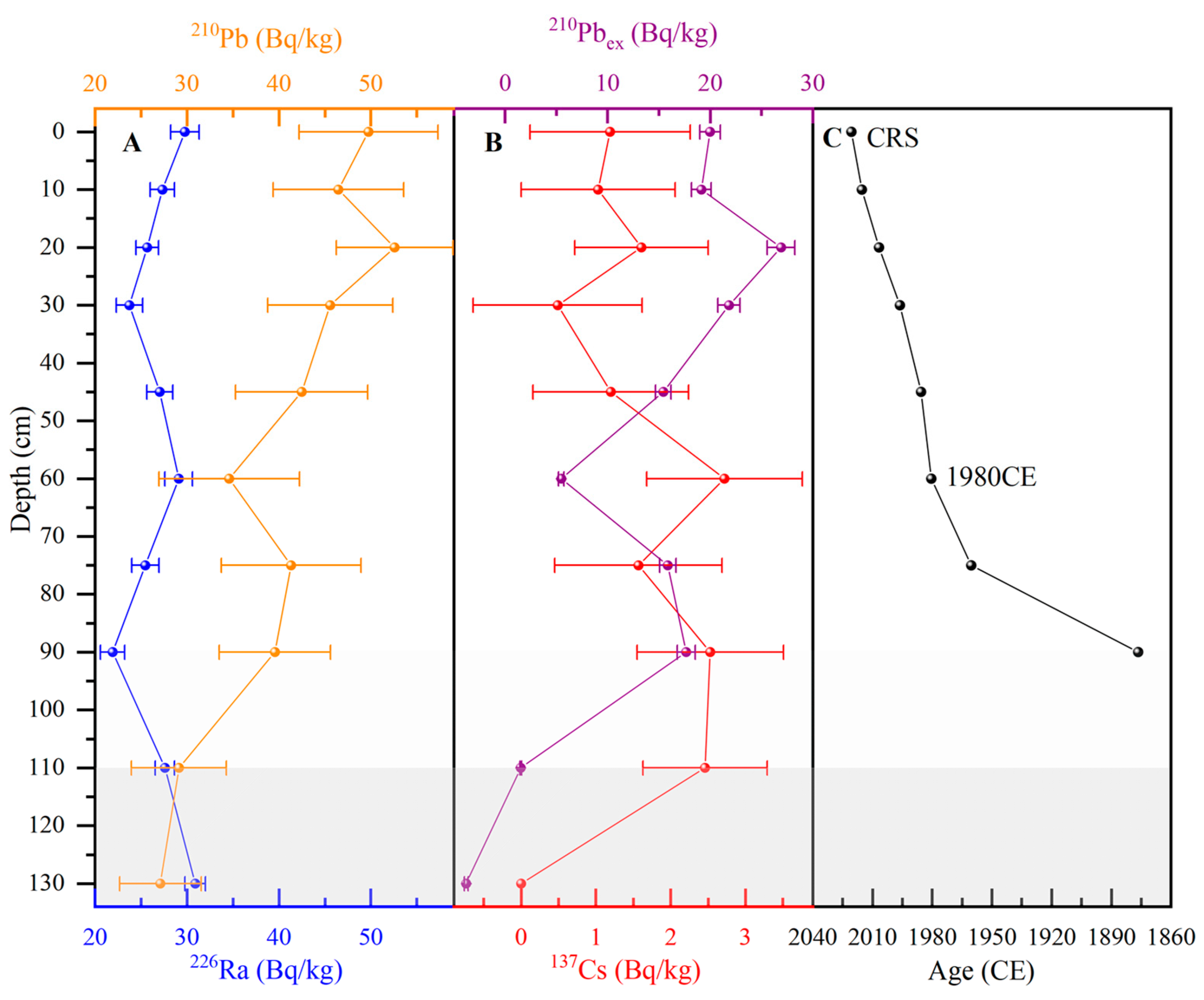
Figure 2. 210Pb and 137Cs activity and core chronology for the ZHY Core. (A) Depth profile of 210Pb and 226Ra activity; (B) Depth profile of 210Pbex and 137Cs activity; (C) CRS model-derived age (CE) depth profile.
Geosciences 16 00020 g002
Figure 3. End-member analysis results of grain size data from the ZHY core. (a) is the grain size frequency distribution plot; (b) is the end-member plot; and (c) is the end-member contribution plot (yellow for EM1, green for EM2, purple for EM3).
Geosciences 16 00020 g003
Figure 4. Magnetic parameter plots for the ZHY core. (a) χlf (10−8 m3kg−1); (b) χfd% (%); (c) χARM (10−8 m3kg−1); (d) SIRM (10−5 Am2kg−1); (e) χARM/χ; (f) SIRM/χ (103 Am−1).
Geosciences 16 00020 g004
Figure 5. Hysteresis loops for representative samples after corrected for paramagnetic contribution.
Geosciences 16 00020 g005
Figure 6. χ versus χARM/SIRM and SIRM/χ versus χARM/χ scatter plots. (a) χ (×10−8 m3kg−1) versus χARM/SIRM (×10−5 Am2kg−1) scatter plot; the arrows denote that magnetite crystal grain size becomes finer (top) and magnetic content increases (right). (b) SIRM/χ (×103 Am−1) versus χARM/χ scatter plot; the arrows denote that magnetite crystal grain size becomes finer (top) and relative content of hematite increases (right). The black crosses indicate the ZHY core samples, the red circles indicate the riverbed sediment and suspended particulate matter of the Jiaojiang River [9], and the blue triangles represent the river sediments of the Yangtze River [35].
Geosciences 16 00020 g006
Figure 7. Temporal variation in end-member (EM1–EM3) contributions in the ZHY core sediments.
Geosciences 16 00020 g007
Disclaimer/Publisher’s Note: The statements, opinions and data contained in all publications are solely those of the individual author(s) and contributor(s) and not of MDPI and/or the editor(s). MDPI and/or the editor(s) disclaim responsibility for any injury to people or property resulting from any ideas, methods, instructions or products referred to in the content.