
Comparative Evaluation of Empirical and Numerical Approaches for Ground Support Design: A Case Study from the Gilar Underground Mine



Abstract
1. Introduction
2. Design and Evaluation of Support Efficiency
2.1. Empirical Approach
2.2. Computer-Aided Simulations
3. Description of the Trial Site
4. Materials and Methods
4.1. Empirically Based Rock Support Design
4.2. Numerical Modeling
4.2.1. In Situ Stresses
4.2.2. Rock Mass Strength (Generalized Hoek–Brown)
4.2.3. Development of the Model
4.2.4. Evaluation Criteria
5. Results
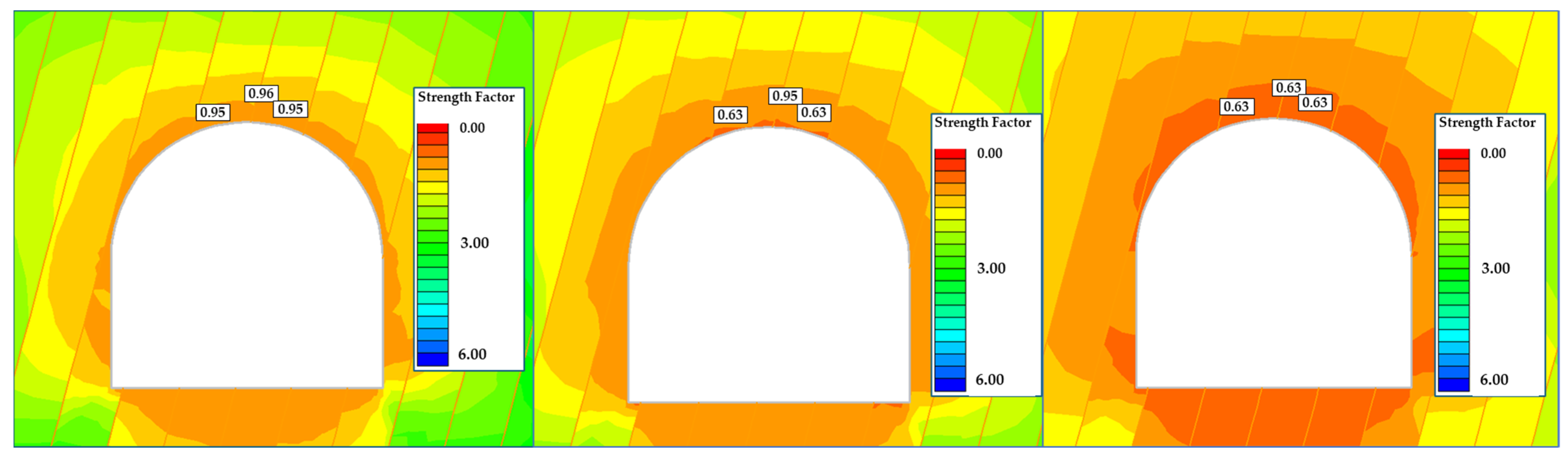
- In section 540 (Figure 17, left), SF = 0.95 at 0.10 m above the crown. This section is near the stability limit but does not indicate immediate failure. Early shotcrete and systematic bolting are still required to maintain the margin as advance proceeds.
- In section 810 (Figure 17-centre), SF falls to 0.63 near the upper sidewalls, indicating a high risk of local instability. At 0.10 m above the crown, SF = 0.95, showing better conditions directly over the opening. Immediate application of shotcrete after each round and prompt bolt installation is recommended to control slabbing and ensure safe support installation.
- Section 1040 (Figure 17, right) shows the lowest margins, with zones of SF < 1 concentrated around the crown and sidewalls. Heavy, closely spaced support and short advance lengths are advised, followed by verification of stability after each stage.

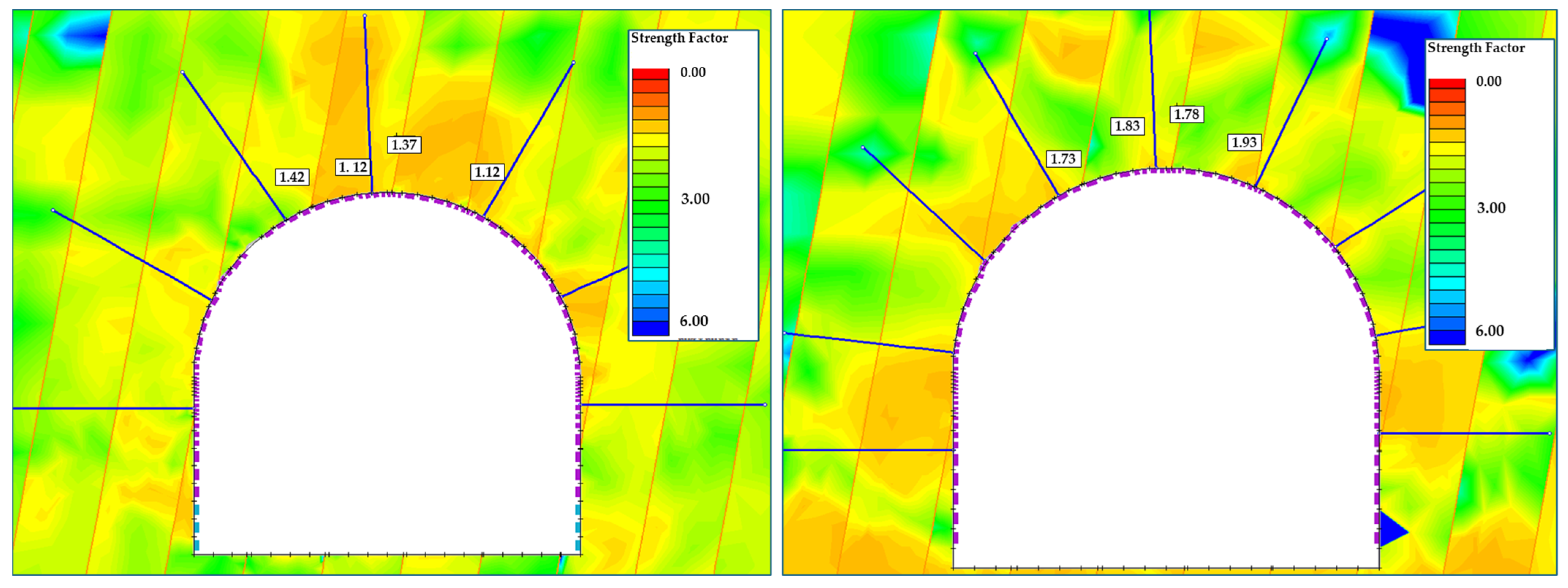
Comparison of Empirical and FEM Solutions
6. Conclusions
Author Contributions
Funding
Data Availability Statement
Acknowledgments
Conflicts of Interest
References
- Hoek, E.; Brown, E.T. Chapter 14: Rock Bolts and Cables. In Rock Mechanics for Underground Mining; Springer: Dordrecht, The Netherlands, 2006. [Google Scholar]
- Kaiser, P.K.; Cai, M. Design of Rock Support System under Rockburst Condition. J. Rock Mech. Geotech. Eng. 2012, 4, 215–227. [Google Scholar] [CrossRef]
- Lubryka, D.; Madziarz, M. Underground Testing of Load Bearing Capacity of Rock Bolting as Part of the Verification of Its Proper Selection. Min. Sci. 2023, 30, 63–81. [Google Scholar] [CrossRef]
- Madziarz, M. Monitoring system of rockbolting interaction in rock mass conduct under seismic activity in undeground mines. In Proceedings of the 17th International Multidisciplinary Scientific GeoConference SGEM 2017, Albena, Bulgaria, 29 June–5 July 2017. [Google Scholar]
- Varelija, M.; Hartlieb, P. Designing Intelligent Rock Support Systems to Detect Gravity-Driven Wedges. Rock. Mech. Rock. Eng. 2025, 58, 4527–4541. [Google Scholar] [CrossRef]
- Fuławka, K.; Stolecki, L.; Szumny, M.; Pytel, W.; Jaśkiewicz-Proć, I.; Jakić, M.; Nöger, M.; Hartlieb, P. Roof Fall Hazard Monitoring and Evaluation—State-of-the-Art Review. Energies 2022, 15, 8312. [Google Scholar] [CrossRef]
- Pytel, W.; Mertuszka, P.; Fuławka, K.; Lurka, A.; Pałac-Walko, B. Resultant Axial Stresses in Instrumented Rockbolts Induced by Dynamic Effects Occurred Due to Multi-Face Blasting in the Working Areas. Tunn. Undergr. Space Technol. 2021, 116, 104088. [Google Scholar] [CrossRef]
- Fuławka, K.; Pytel, W.; Szumny, M.; Mertuszka, P.; Pałac-Walko, B.; Hartlieb, P.; Jakić, M.; Nöger, M. Prototype of Instrumented Rock Bolt for Continuous Monitoring of Roof Fall Hazard in Deep Underground Mines. Sensors 2022, 23, 154. [Google Scholar] [CrossRef] [PubMed]
- Brady, B.H.G.; Brown, E.T. Rock Mechanics for Underground Mining, 3rd ed.; Springer: Dordrecht, The Netherlands, 2006; ISBN 9781402021169, 9781402020643. [Google Scholar]
- Adach-Pawelus, K.; Pawelus, D. Influence of Driving Direction on the Stability of a Group of Headings Located in a Field of High Horizontal Stresses in the Polish Underground Copper Mines. Energies 2021, 14, 5955. [Google Scholar] [CrossRef]
- Pawelus, D.; Adach-Pawelus, K.; Butra, J. Issue of Selecting Stress Field Parameters for the Analysis of Mining Excavation Stability Using Numerical Methods in the Conditions of the LGCB Mines. Appl. Sci. 2025, 15, 12365. [Google Scholar] [CrossRef]
- Adach-Pawelus, K.; Szyry, N. Influence of a Type of Rock Mass on the Stability of Headings in Polish Underground Copper Mines Based on Boundary Element Method. Energies 2022, 15, 5837. [Google Scholar] [CrossRef]
- Elrawy, W.R.; Abdelhaffez, G.S.; Saleem, H.A. Stability assessment of underground openings using different rock support systems. MGPB 2020, 35, 49–63. [Google Scholar] [CrossRef]
- Skrzypkowski, K.; Korzeniowski, W.; Zagórski, K.; Zagórska, A. Modified Rock Bolt Support for Mining Method with Controlled Roof Bending. Energies 2020, 13, 1868. [Google Scholar] [CrossRef]
- Barton, N.; Grimstad, E. Q-System—An Illustrated Guide Following Forty Years in Tunnelling; Technical Report. 2014. Available online: http://www.nickbarton.com (accessed on 14 January 2024).
- Bieniawski, Z.T. Rock Mass Classification in Rock Engineering. In Exploration for Rock Engineering; Bieniawski, Z.T., Ed.; A.A. Balkema: Cape Town, South Africa, 1976; Volume 1, pp. 97–106. [Google Scholar]
- Potvin, Y.; Hadjigeorgiou, J. Empirical Ground Support Design of Mine Drives. In Proceedings of the International Seminar on Design Methods in Underground Mining; Australian Centre for Geomechanics, Perth, Australia, 17–19 November 2015; pp. 419–430. [Google Scholar]
- Norwegian Geotechnical Institute (NGI). Using the Q-System: Rock Mass Classification and Support Design; NGI Report; NGI: Oslo, Norway, 2015. [Google Scholar]
- Palmstrom, A.; Broch, E. Use and Misuse of Rock Mass Classification Systems with Particular Reference to the Q-System. Tunn. Undergr. Space Technol. 2006, 21, 575–593. [Google Scholar] [CrossRef]
- Sebbeh-Newton, S.; Abdulazeez Shehu, S.; Ayawah, P.; Kaba, A.A.; Zabidi, H. Analytical and Numerical Assessment of a Preliminary Support Design—A Case Study. Cogent Eng. 2021, 8, 1869367. [Google Scholar] [CrossRef]
- Kanik, M.; Gurocak, Z. Importance of Numerical Analyses for Determining Support Systems in Tunneling: A Comparative Study from the Trabzon-Gumushane Tunnel, Turkey. J. Afr. Earth Sci. 2018, 143, 253–265. [Google Scholar] [CrossRef]
- Marinos, P.; Hoek, E. Estimating the Geotechnical Properties of Heterogeneous Rock Masses Such as Flysch. Bull. Eng. Geol. Environ. 2001, 60, 85–92. [Google Scholar] [CrossRef]
- Zienkiewicz, O.C.; Taylor, R.L. The Finite Element Method. 2: Solid Mechanics; Butterworth-Heinemann: Oxford, UK, 2003; ISBN 9780750650557. [Google Scholar]
- Cundall, P.A.; Hart, R.D. Numerical modelling of discontinua. Eng. Comput. 1992, 9, 101–113. [Google Scholar] [CrossRef]
- Shen, B.; Stephansson, O.; Rinne, M. Modelling Rock Fracturing Processes: A Fracture Mechanics Approach Using FRACOD; Springer: Dordrecht, The Netherlands, 2014; ISBN 9789400769038, 9789400769045. [Google Scholar]
- Shapka-Fels, T.; Elmo, D. Numerical Modelling Challenges in Rock Engineering with Special Consideration of Open Pit to Underground Mine Interaction. Geosciences 2022, 12, 199. [Google Scholar] [CrossRef]
- Kulatilake, P.H.S.W.; Chen, J.; Teng, J.; Pan, G.; Shufang, X. Discontinuity network modeling of the rock mass around a tunnel close to the proposed permanent shiplock area of the Three Gorges Dam site in China. In Proceedings of the 35th U.S. Symposium on Rock Mechanics (USRMS), Lake Tahoe, NV, USA, 5–7 June 1995; pp. 807–812. [Google Scholar]
- Ghasemi, E.; Ataei, M.; Shahriar, K.; Sereshki, F.; Jalali, S.E.; Ramazanzadeh, A. Assessment of Roof Fall Risk during Retreat Mining in Room and Pillar Coal Mines. Int. J. Rock Mech. Min. Sci. 2012, 54, 80–89. [Google Scholar] [CrossRef]
- Gurocak, Z.; Solanki, P.; Zaman, M.M. Empirical and Numerical Analyses of Support Requirements for a Diversion Tunnel at the Boztepe Dam Site, Eastern Turkey. Eng. Geol. 2007, 91, 194–208. [Google Scholar] [CrossRef]
- Vlachopoulos, N.; Carrapatoso, C.; Holt, S.W.; Cruz, D.; Forbes, B. An Investigation into Support Interaction of Ground Support Through Numerical Modelling and Laboratory Testing. Geotech. Geol. Eng. 2020, 38, 5719–5736. [Google Scholar] [CrossRef]
- Ismayilov, S. Design and Numerical Modelling of Ground Support Systems in Underground Mine Gilar Using Rock Mechanics Principles. Master’s Thesis, Montanuniversität Leoben, Leoben, Austria, 2025. [Google Scholar]
- Deere, D.U.; Deere, D.W. Rock Quality Designation (RQD) After Twenty Years; Contract Report GL-89-1; U.S. Army Engineer Waterways Experiment Station: Vicksburg, MS, USA, 1989. [Google Scholar]
- Grimstad, E.; Barton, N. Updating the Q-system for NMT. In Proceedings of the International Symposium on Sprayed Concrete, Fagernes, Norway, 17–21 October 1993. [Google Scholar]
- Barton, N. Some new Q-value correlations to assist in site characterization and tunnel design. Int. J. Rock Mech. Min. Sci. 2002, 39, 185–216. [Google Scholar] [CrossRef]
- Høien, A.H.; Nilsen, B.; Olsson, R. Main Aspects of Deformation and Rock Support in Norwegian Road Tunnels. Tunn. Undergr. Space Technol. 2019, 86, 262–278. [Google Scholar] [CrossRef]
- Pawelus, D. Stability Assessment of Headings Situated in a Field of High Horizontal Stress in Polish Copper Mines by Means of Numerical Methods. IOP Conf. Ser. Earth Environ. Sci. 2019, 221, 012097. [Google Scholar] [CrossRef]
- Pawelus, D.; Butra, J. Numerical Methods as an Aid in the Selection of Roof Bolting Systems for Access Excavations Located at Different Depths in the LGCB Mines. Appl. Sci. 2024, 14, 7052. [Google Scholar] [CrossRef]
- Ciantia, M.O.; Arroyo, M.; Kaiser, P. Application of a Bonded Critical State Model to Design Tunnel Support for Rockmass Bulking. IOP Conf. Ser. Earth Environ. Sci. 2021, 833, 012162. [Google Scholar] [CrossRef]
- Hoek, E. Practical Rock Engineering; 2023 Edition; Rocscience: Toronto, ON, Canada, 2023; Available online: https://www.rocscience.com/learning/hoeks-corner (accessed on 4 November 2025).
- Fuławka, K.; Stolecki, L.; Jaśkiewicz-Proć, I.; Kołodziej, R. The Use of Large-Scale 3D Numerical Modeling to Identify Areas of Increased Seismic Risk in Polish Underground Copper Mines. In Proceedings of the 7th International Conference on Geotechnical and Geophysical Site Characterization, Barcelona, Spain, 18–21 June 2024; CIMNE: Barcelona, Spain, 2024. [Google Scholar]
- Zhang, H.; Adoko, A.C.; Meng, Z.; Wang, H.; Jiao, Y. Mechanism of the Mudstone Tunnel Failures Induced by Expansive Clay Minerals. Geotech. Geol. Eng. 2017, 35, 263–275. [Google Scholar] [CrossRef]
- Krawiec, K.; Czarny, R. Comparison of an Empirical S-Wave Velocity Model and a Calculated Stress-Strain Model for a Rock Mass Disturbed by Mining. E3S Web Conf. 2017, 24, 03001. [Google Scholar] [CrossRef]
- Wojtecki, L.; Krawiec, K.; Ćwiękała, M.; Dzik, G. An Attempt to Determine the Cause of the Strong Tremor Responsible for a Rockburst in a Hard Coal Mine Based on Numerical Modeling and Spectral Parameter. Geol. Geophys. Environ. 2024, 50, 323–340. [Google Scholar] [CrossRef]
- Saadat, M.; Khishvand, M.; Seccombe, A. FLAC3D Simulation of Caving Mechanism and Strata Fracture Response in Underground Mining. Mining 2024, 4, 818–840. [Google Scholar] [CrossRef]
- Deb, D.; Das, K.C. Modelling of Fully Grouted Rock Bolt Based on Enriched Finite Element Method. Int. J. Rock Mech. Min. Sci. 2011, 48, 283–293. [Google Scholar] [CrossRef]
- Jalalifar, H.; Aziz, N. Numerical Simulation of Fully Grouted Rock Bolts. In Numerical Simulation—From Theory to Industry; Andriychuk, M., Ed.; InTech: Nappanee, IN, USA, 2012; ISBN 9789535107491. [Google Scholar]
- Aziz, N.; Marston, K.; Mirzaghorbanali, A. (Eds.) Proceedings of the 2023 Resource Operators Conference: 9–10 February 2023; University of Wollongong: Wollongong, Australia, 2023; ISBN 9781741283686. [Google Scholar]
- Ghadimi Chermahini, A.; Tahghighi, H. Numerical Finite Element Analysis of Underground Tunnel Crossing an Active Reverse Fault: A Case Study on the Sabzkouh Segmental Tunnel. Geomech. Geoengin. 2019, 14, 155–166. [Google Scholar] [CrossRef]
- Su, Y.; Vlachopoulos, N. Numerical Modelling of Fully Grouted Rock Bolts Using a 2D Finite Element Method. In Proceedings of the GeoVirtual 2020, Online, 14–16 September 2020. [Google Scholar]
- Wang, T.; Fan, B.; Khadka, S.S. Flowchart of DEM Modeling Stability Analysis of Large Underground Powerhouse Caverns. Adv. Civ. Eng. 2020, 2020, 8874120. [Google Scholar] [CrossRef]
- Zhou, P.; Bazargan, M.; Lanaro, F.; Shirzadegan, S.; Nikadat, N.; Warema, S.; Yi, C.; Nordlund, E. Dynamic Modelling of Rock Bolts at Kiirunavaara Mine; BeFo Report 244; BeFo—Rock Engineering Research Foundation: Stockholm, Sweden, 2024; ISBN BEFO-R-244-SE. ISSN 1104-1773. [Google Scholar]
- Munjiza, A. The Combined Finite-Discrete Element Method, 1st ed.; Wiley: Hoboken, NJ, USA, 2004; ISBN 9780470841990. [Google Scholar]



| Method | Principles | Applications | Strengths | Limitations |
|---|---|---|---|---|
| LEM | Force equilibrium on failure surfaces | Wedge and planar failure analysis | Simple, fast, and user-friendly | Limited to predefined failure planes |
| FEM | Stress–strain analysis with elements | Deformation, stress, and support analysis | Handles complex geometries | Computationally intensive |
| DEM | Discrete block or particle interaction | Fractured/jointed rock behavior | Models block movement and fractures | High input data requirement |
| FDM | Governing equations solved on a grid using fi-nite differences | Large-strain plasticity, staged excavation, and time-dependent behavior | Efficient for non-linear response and step-by-step excavation/support modeling | Grid dependence; discontinuities require special treatment (e.g., interfaces); sensitive to calibration |
| FDEM | Continuum–discontinuum transition | Fracture propagation and dynamic failure | Detailed failure and fracture modeling | High computational cost |
| Tunnel Section | RQD | SRF | Jn | Jr | Ja | Jw | Q | Rock Classification |
|---|---|---|---|---|---|---|---|---|
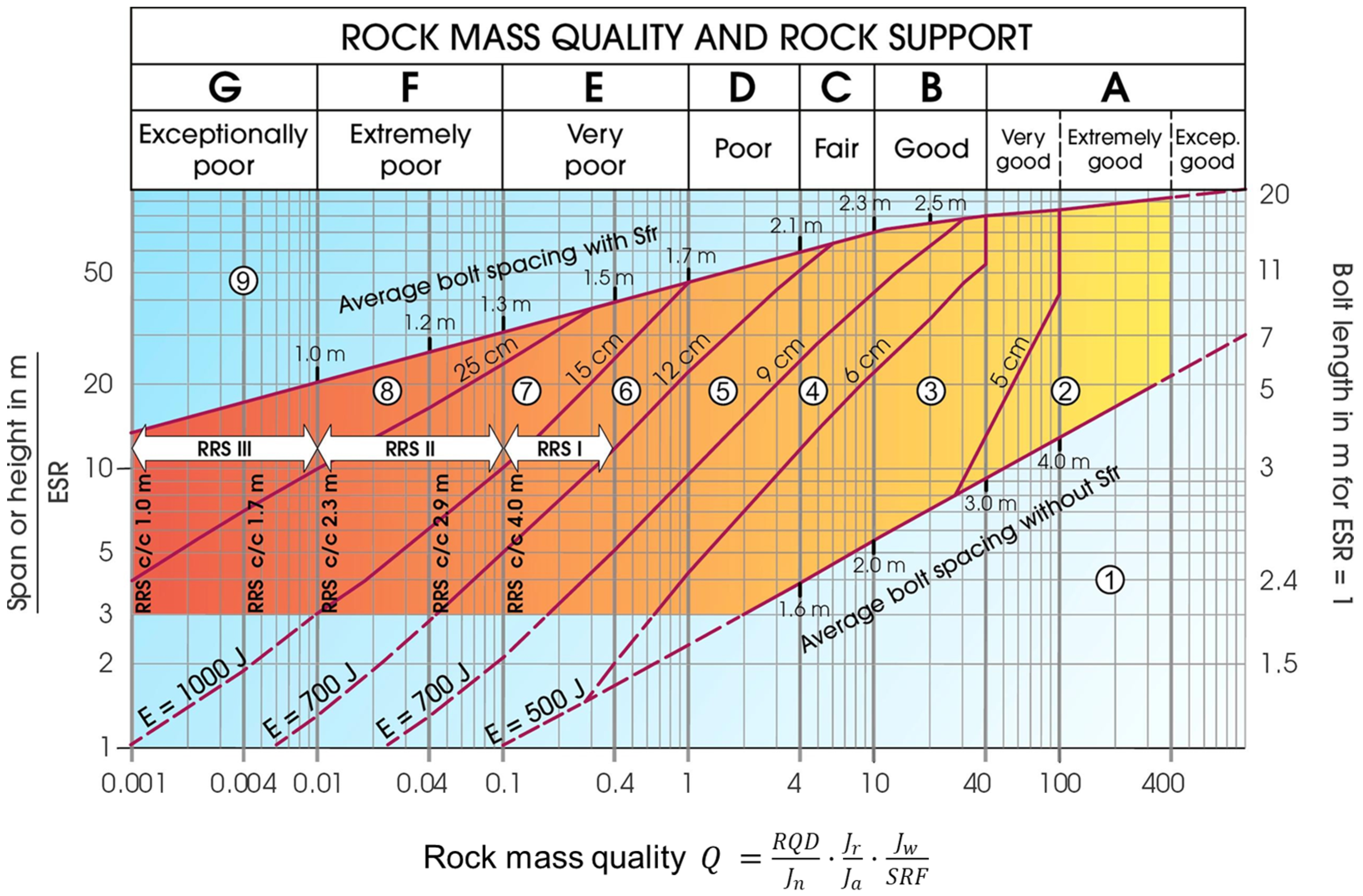
| 540–660 | 30 | 10 | 9 | 1 | 4 | 0.66 | 0.055 | Extremely poor rock |
| 660–975 | 15 | 10 | 9 | 1 | 4 | 0.66 | 0.028 | Extremely poor rock |
| 975–1020 | 50 | 10 | 9 | 1 | 4 | 0.66 | 0.092 | Extremely poor rock |
| 1020–1080 | 10 | 10 | 9 | 1 | 4 | 0.66 | 0.018 | Extremely poor rock |
| 1080–1180 | 80 | 10 | 9 | 1 | 4 | 0.66 | 0.147 | Very poor rock |
| 1180–1210 | 50 | 10 | 9 | 1 | 4 | 0.66 | 0.092 | Extremely poor rock |
| 1210–1440 | 30 | 10 | 9 | 1 | 4 | 0.66 | 0.055 | Extremely poor rock |
| Tunnel Section | 540 | 810 | 1040 |
|---|---|---|---|
| Type | Isotropic | Isotropic | Isotropic |
| Strength of rock mass (MPa) | 25 | 35 | 20 |
| GSI | 26 | 22 | 19 |
| mi | 22 | 25 | 25 |
| mb | 0.504 | 0.467 | 0.401 |
| s | 0.0000344 | 0.0000197 | 0.0000130 |
| a | 0.5292 | 0.5382 | 0.5467 |
| Deformation modulus of rock mass (MPa) | 675.3 | 592.5 | 547.1 |
| Poisson’s ratio of rock mass | 0.25 | 0.25 | 0.25 |
| Vertical stress (MPa) | 3.8 | 5.7 | 6.8 |
| Horizontal stress (MPa) | 3.1 | 3.7 | 4.1 |
| Properties | Rockbolt | Shotcrete | Wire Mesh |
|---|---|---|---|
| Young’s Modulus (GPa) | 200 | 30 | 200 |
| Poisson’s ratio | - | 0.2 | 0.35 |
| Uniaxial compressive strength (MPa) | - | 35 | 500 |
| Residual uniaxial compressive strength (MPa) | - | 3.5 | - |
| Peak Tensile Strength (MPa) | - | 3.1 | 500 |
| Residual Tensile Strength (MPa) | - | 0 | - |
| Peak load (MN) | 0.25 | - | - |
| Residual load (MN) | 0.025 | - | - |
| Type | Φ 25 mm Fully Bonded | Fiber Reinforced | Φ 6.5 mm 150 × 150 mm |
| Support Category | Description |
|---|---|
| 5 | Fiber-reinforced shotcrete of thickness 9 to 12 cm and 2.4 m long bolts with 2.3 m spacing |
| 6 | Fiber-reinforced shotcrete with thickness 12 to 15 cm, one layer of rebar, and 2.4 m long bolts with 1.8 m spacing |
| 7 | Fiber-reinforced shotcrete with thickness >15 cm, two layers of rebars, and 2.4 m long bolts with 1.5 m spacing |
| Tunnel Section | Q-System | FEM | Reduction in Bolt Spacing |
|---|---|---|---|
| 540 | 2.3 × 2.4 m | 1.8 × 2.4 m | 22% |
| 810 | 1.8 × 2.4 m | 1.5 × 2.4 m | 17% |
| 1040 | 1.5 × 2.4 m | 1.2 × 2.4 m | 20% |
Disclaimer/Publisher’s Note: The statements, opinions and data contained in all publications are solely those of the individual author(s) and contributor(s) and not of MDPI and/or the editor(s). MDPI and/or the editor(s) disclaim responsibility for any injury to people or property resulting from any ideas, methods, instructions or products referred to in the content. |
© 2025 by the authors. Licensee MDPI, Basel, Switzerland. This article is an open access article distributed under the terms and conditions of the Creative Commons Attribution (CC BY) license.
Share and Cite
Ismayilov, S.; Fuławka, K.; Adach-Pawelus, K.; Valiyev, A. Comparative Evaluation of Empirical and Numerical Approaches for Ground Support Design: A Case Study from the Gilar Underground Mine. Geosciences 2026, 16, 19. https://doi.org/10.3390/geosciences16010019
Ismayilov S, Fuławka K, Adach-Pawelus K, Valiyev A. Comparative Evaluation of Empirical and Numerical Approaches for Ground Support Design: A Case Study from the Gilar Underground Mine. Geosciences. 2026; 16(1):19. https://doi.org/10.3390/geosciences16010019
Chicago/Turabian StyleIsmayilov, Suleyman, Krzysztof Fuławka, Karolina Adach-Pawelus, and Anar Valiyev. 2026. "Comparative Evaluation of Empirical and Numerical Approaches for Ground Support Design: A Case Study from the Gilar Underground Mine" Geosciences 16, no. 1: 19. https://doi.org/10.3390/geosciences16010019
APA StyleIsmayilov, S., Fuławka, K., Adach-Pawelus, K., & Valiyev, A. (2026). Comparative Evaluation of Empirical and Numerical Approaches for Ground Support Design: A Case Study from the Gilar Underground Mine. Geosciences, 16(1), 19. https://doi.org/10.3390/geosciences16010019