1. Introduction
Ground instability, including landslides, debris flows, and collapses, poses persistent threats to infrastructure, land-use safety, and socio-economic development in regions with fragile loess terrain. The Loess Hilly region of Northwest China is particularly prone to such hazards due to its steep slopes, unconsolidated loess deposits, and intensive human disturbance. In recent years, repeated instability events have led to severe losses of life and property, highlighting the urgent need for accurate and spatially explicit hazard–risk assessments to support disaster mitigation and territorial planning [
1,
2,
3,
4,
5].
Early investigations into mass movement susceptibility primarily employed qualitative or semi-quantitative approaches, relying heavily on expert judgment, such as overlay analysis, index weighting, and hierarchical scoring methods [
6,
7,
8,
9]. With advancements in geographic information systems (GIS) and computational modeling, these traditional approaches have progressively evolved toward fully quantitative techniques. Widely adopted models include Frequency Ratio (FR), Logistic Regression (LR), and Weight-of-Evidence (WoE), as well as data-driven and machine-learning algorithms such as Random Forest (RF), Support Vector Machine (SVM), and Artificial Neural Networks (ANN) [
10,
11]. These methods have substantially enhanced predictive accuracy by capturing nonlinear relationships between conditioning factors and hazard occurrence.
At the regional scale, numerous studies have demonstrated that the Loess Plateau of Northwest China—particularly the Ningxia Hui Autonomous Region—exhibits a unique combination of geomorphic, climatic, and lithologic conditions that promote frequent mass movements [
12,
13,
14,
15,
16,
17,
18]. The area’s thick unsaturated loess, high relief energy, and seasonal rainfall create favorable conditions for landslides and debris flows, often exacerbated by agricultural reclamation and infrastructure development. Consequently, Ningxia and its surrounding areas have become typical regions for studying the evolution and risk mechanisms of loess-related ground instabilities.
Internationally, a growing number of large-scale studies have advanced quantitative hazard assessment methods. These include multi-factor probabilistic analyses and physically based models that incorporate hydrological and seismic triggers, as demonstrated in Italy, the United States, and other regions [
19,
20,
21,
22]. In particular, national- and regional-scale quantitative risk assessment (QRA) has recently evolved substantially. For example, ref. [
23] developed a nationwide QRA framework for Italy, integrating hazard frequency, exposure distribution, and expected losses into a unified model, while [
24] proposed a regional methodology for slow-moving landslide risk that emphasized proper definition and separation of hazard, exposure, and vulnerability components. In the United States, ref. [
25] introduced a cost-effective, regional-scale landslide risk assessment strategy for Eastern Kentucky, demonstrating how exposure density can be evaluated under limited-data conditions. Machine-learning-assisted QRA has also emerged, such as the InSAR–ML hybrid model by [
26], which improves both spatial and temporal representation of hazard evolution.
Global and regional guidelines have further emphasized the integration of susceptibility, hazard, and risk mapping as essential tools for land-use management [
27]. At the same time, conventional GIS-based frameworks and inventory-driven models remain foundational to hazard mapping and validation [
28], while recent progress has expanded their scope to incorporate rainfall and ground-shaking triggers through satellite and near-real-time data [
29,
30]. More recently, ensemble and hybrid frameworks that combine statistical, heuristic, and data-driven methods have shown improved accuracy, interpretability, and transferability across diverse geological environments [
31,
32,
33,
34]. However, purely statistical or data-driven models often face limitations in interpretability, regional adaptability, and the calibration between susceptibility, hazard, and exposure—issues that constrain their effectiveness in comprehensive risk evaluation.
To address these challenges, this study proposes an integrated, information-theoretic framework that couples the Information Value (IV) model with Analytic Hierarchy Process (AHP) weighting for the evaluation of ground-instability susceptibility and risk in the Loess Hilly region of Northwest China. The framework quantitatively integrates multiple conditioning and triggering factors—including geomorphology, lithology, slope, vegetation, rainfall, and seismic activity—while calibrating their interactions through expert weighting and statistical validation. The main objectives are to: (1) establish a hybrid IV-AHP model to enhance interpretability and reduce subjectivity; (2) delineate susceptibility, hazard, exposure, and risk zones through multi-source data fusion; and (3) verify model performance using receiver operating characteristic (ROC) analysis. This research provides a transferable approach for ground-instability risk assessment in loess terrains and offers a scientific basis for regional disaster prevention and sustainable land-use planning.
2. Geographical and Geological Background
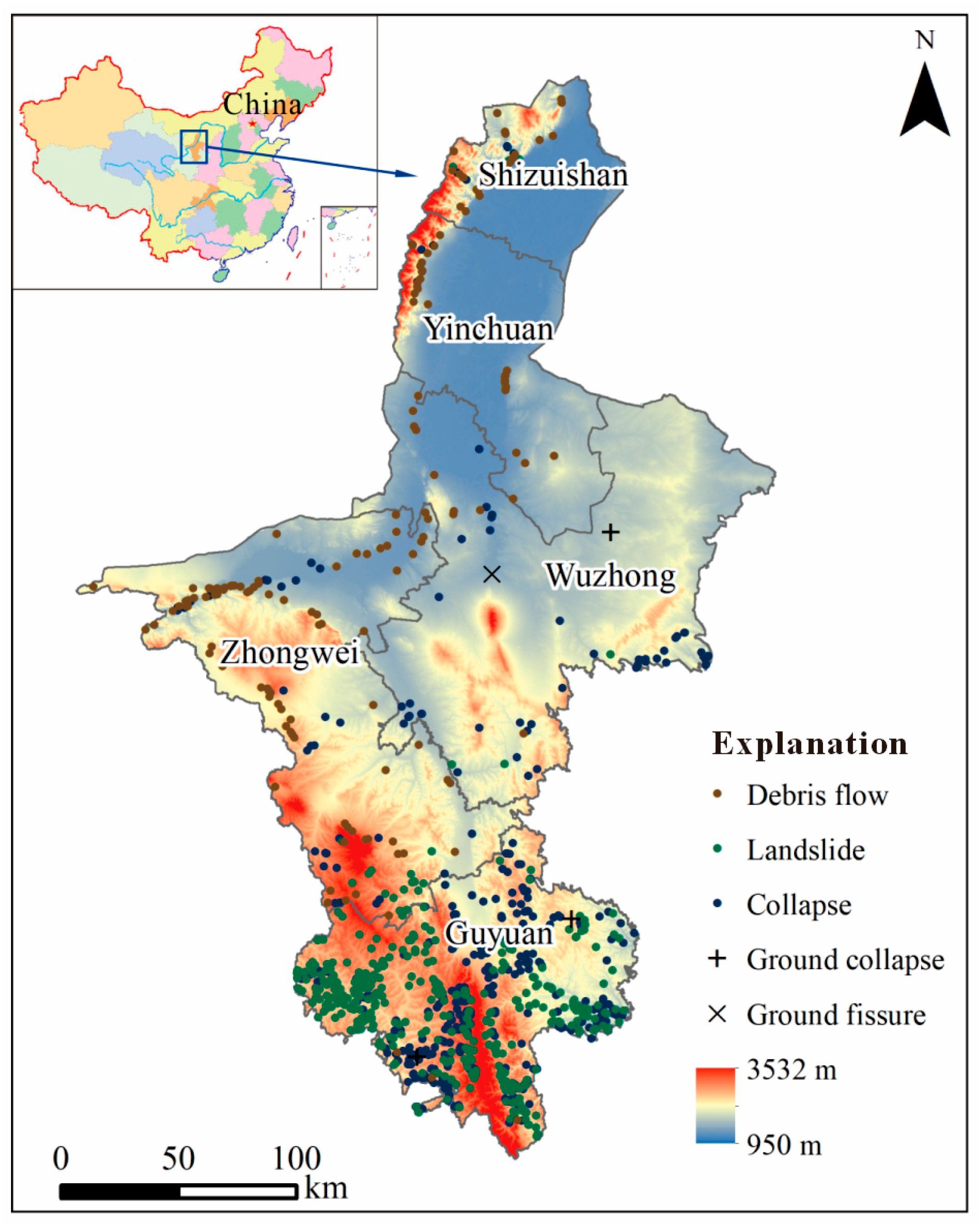
The study area is located in the Ningxia Hui Autonomous Region, situated in the transitional zone between the eastern margin of the Qinghai–Tibet Plateau and the western edge of the Loess Plateau (coordinates: E 104°17′–107°39′, N 35°14′–39°23′). It encompasses the middle to upper reaches of the Yellow River and extends approximately 465 km from north to south, with an east–west width ranging from 45 km to 250 km. The total area covers around 66,400 km
2, featuring diverse geomorphological units and a vertically differentiated topographic profile (
Figure 1).
The terrain of the region is characterized by significant elevation variation, with altitudes ranging from about 1100 m in the northern plains to over 2000 m in the southern hilly and mountainous zones. From north to south, the region transitions from fluvial plains to intermontane basins and finally to deeply dissected loess hills. These loess-dominated uplands exhibit steep slopes, deep gullies, and widespread signs of surface erosion, forming a geomorphic environment highly prone to mass movement processes.
The climate is semi-arid, dominated by monsoonal influence. Annual precipitation ranges from 200 to 600 mm, with strong spatial gradients—rainfall increases significantly from north to south. Most precipitation is concentrated in the summer months, often in the form of short-duration, high-intensity convective storms. Coupled with high evaporation rates and poor vegetation cover in many parts, this climatic regime contributes to recurrent slope instability.
From a geological perspective, the region is structurally complex and seismically active. It lies near the Alxa–Ordos tectonic junction, where neotectonic uplift and fault activity have created a fragmented bedrock foundation. Loess deposits, with thicknesses up to 100 m in places, blanket much of the terrain. The loose, unconsolidated nature of these deposits, combined with slope steepness and rainfall infiltration, makes the area particularly vulnerable to landslides, collapses, and debris flows.
According to regional geological disaster monitoring data, as of June 2024, a total of 1038 potential hazard sites have been identified, including 437 landslides, 443 collapses, 154 debris flows, three ground collapses, and one ground fissure. These hazards threaten the safety of approximately 18,600 residents. The most concentrated and severe hazards are found in the southern mountainous areas, particularly within the five counties of Guyuan City. These zones correspond closely with steep terrain, sparse vegetation, and active fault development.
3. Methodology
3.1. Evaluation Framework
The comprehensive mass movement risk assessment in this study is established on a multi-source data fusion and model-coupling framework that integrates the Information Value (IV) model, the Analytic Hierarchy Process (AHP), and the Weighted Information Value (WIV) method. This combination is designed to harness the strengths of both statistical and expert-based approaches—balancing objectivity with geological reasoning—to better capture the spatial heterogeneity and multi-factorial nature of ground instability formation in loess terrains.
The workflow comprises four main stages: (1) data acquisition and preprocessing, including the collection of conditioning and triggering factors such as topography, lithology, vegetation, and seismic data; (2) susceptibility evaluation using the IV model to quantify the relative contribution of each factor to hazard occurrence; (3) weighting of these factors through AHP to incorporate expert judgment and to mitigate redundancy among correlated variables; and (4) model integration using the WIV approach to synthesize the results into a spatial susceptibility index, followed by overlay analysis with exposure indicators to generate risk maps.
This multi-level framework provides a transparent and reproducible pathway to assess ground-instability hazards in complex terrain settings, similar to integrated approaches adopted in other large-scale assessments [
19,
21,
31]. The use of both bivariate statistics and expert-derived weights ensures that the model is both data-driven and interpretable, thereby improving its regional adaptability and practical applicability in land-use planning and disaster mitigation.
3.1.1. Information Value (IV) Model
In this study, the Information Quantity (IQ) method was employed to evaluate the susceptibility and hazard of mass movements. As a bivariate statistical model grounded in information theory, the IQ model quantifies the informational contribution of different classes within each conditioning factor to the occurrence of mass movements, thereby elucidating their role in the development and propagation of such events [
35,
36].
This method is considered objective, computationally efficient, and widely used in susceptibility assessment practices. In the context of mass movement risk analysis, the IQ model evaluates each factor’s relative contribution based on its class-specific influence compared to a baseline or average level across the entire study area [
37]. An IQ value less than 0 indicates that the specific class of an influencing factor reduces the likelihood of hazard occurrence, while a value greater than 0 suggests an increased susceptibility associated with that class. An IQ value of 0 implies that the factor class offers no additional information regarding hazard potential within the designated interval.
In this study, the IQ model is applied to quantitatively divide the study area into zones of varying susceptibility. Given that geological disasters are typically the result of complex interactions among multiple conditioning variables, the IQ method enables a disaggregated interpretation of these influences, highlighting the most sensitive factor intervals in specific geological settings [
38]. The total information conveyed by the combination of multiple factors within each classified interval can be calculated using Formula (1).
where
I(
xi, D) denotes the information quantity (IQ) that the evaluation factor
xi contributes to the mass movement occurrence
D. Specifically,
Ni represents either the number or spatial area of mass movement events corresponding to the
ith interval of factor
x, while
Si is the total area occupied by that factor interval across the study region.
N denotes the total number or area of all mass movement occurrences in the study area, and
S represents the entire area of the study region.
To ensure adequate spatial resolution for analysis, the entire study area was discretized into grid units measuring 25 m × 25 m. This resolution balances computational efficiency with spatial precision and facilitates the integration of rasterized factor layers during subsequent GIS-based processing.
3.1.2. Analytic Hierarchy Process (AHP)
The Analytic Hierarchy Process (AHP) is a structured and systematic approach widely used in multi-criteria decision-making, particularly effective in situations involving both qualitative and quantitative factors [
39,
40]. In this study, AHP is employed to determine the relative weights of mass movement evaluation indicators, offering a transparent and logic-based framework for incorporating expert knowledge into the risk modeling process.
The AHP procedure begins with the construction of a hierarchical structure, which organizes the evaluation factors into multiple levels based on their causal relationships or thematic relevance. Pairwise comparisons are then conducted to assess the relative importance of each factor with respect to others at the same hierarchical level. These comparisons form a judgment matrix, which reflects the decision-maker’s preferences.
The priority weights of each factor are calculated using either the eigenvalue method (root method) or the normalized sum-product method. The derived feature vector and maximum eigenvalue are used to evaluate consistency through a consistency ratio (CR). A CR value less than 0.1 is generally accepted as indicative of a logically coherent matrix, ensuring that the derived weights are both mathematically and logically reliable [
41].
3.1.3. Weighted Information Value (WIV) Method
This study employs the weighted Information Quantity (IQ) method to evaluate mass movement risk, combining the strengths of both statistical inference and expert-based judgment. The approach integrates the Analytic Hierarchy Process (AHP) for factor weighting with the IQ model for factor classification analysis.
Specifically, the process begins with determining the relative importance (weights) of each conditioning factor via AHP, thereby reflecting the subjective knowledge and experience of domain experts. These weights capture the perceived influence of each factor on hazard occurrence. Following this, the IQ model is applied to calculate the information quantity of each class interval under all factors, based on the statistical relationship between factor levels and historical hazard distributions.
Finally, the weight of each factor is multiplied by the corresponding IQ value of its class to obtain a composite weighted information quantity. This cumulative value synthesizes the spatial contribution and relative significance of all conditioning factors, resulting in a more refined and interpretable risk index map [
42]. The formula for computing the weighted IQ is expressed as follows.
where
Wi denotes the weight of the
ith evaluation indicator, as derived from the Analytic Hierarchy Process.
IQi represents the information quantity value of the corresponding class interval for factor
i, obtained via the bivariate statistical IQ model. The weighted information value is computed by multiplying the factor’s weight by its IQ value, reflecting both the statistical correlation and expert-judged importance of the factor. This calculation integrates multiple evaluation layers to generate a composite risk indicator used in spatial mapping and classification.
3.2. The Selection of Influence Factors and Data Sources
The development of ground-instability hazards in the Loess Hilly Region is controlled by multiple natural and anthropogenic factors. These factors can be broadly grouped into (1) intrinsic conditioning elements such as topography, geomorphic type, lithology, geological structure, and vegetation cover; and (2) extrinsic triggering agents including rainfall, seismic shaking, and human engineering activity [
2,
43]. To comprehensively represent these influences, this study constructs a factor-system framework comprising geomorphic, geological, environmental, external, and socio-economic components.
The geomorphic component includes geomorphic type, slope, and aspect. Elevation was excluded to prevent multicollinearity with slope, as previous studies have demonstrated a strong positive correlation between them [
44]. The geological component considers rock-and-soil mass types and distance to fault zones, which jointly reflect the mechanical integrity and deformation susceptibility of the substrate. The environmental component incorporates vegetation cover, represented by the Normalized Difference Vegetation Index (NDVI), and the hydrological setting derived from the drainage network and river-system hierarchy.
The external component captures short-term dynamic processes including precipitation intensity and seismic activity, both of which directly trigger slope failures. Rainfall data were obtained from the China Meteorological Administration, representing a 30-year average (1993–2022) with a spatial resolution of 1 km. Peak Ground Acceleration (PGA) values were taken from the China Seismic Intensity Zonation Map (1:1,000,000) published by the China Earthquake Administration. The geological map used in this study is at a scale of 1:250,000, compiled from the Geological Survey of Ningxia and verified through field mapping.
The socio-economic component accounts for exposure and exposure conditions, using population density and the spatial distribution of buildings and major transportation corridors extracted from the National Bureau of Statistics (2020 census) and the OpenStreetMap (OSM) dataset. Land-use information was cross-referenced with Sentinel-2 Level-1C imagery (10 m resolution, 2023) to refine built-up areas. To avoid conceptual overlap, geomorphic type describes the physical landform morphology (e.g., hill, mountain, basin, plain), whereas land-use refers to human utilization patterns (e.g., urban, agricultural, forest) and was used only within the exposure evaluation.
All spatial layers were converted into 25 m × 25 m grid cells for uniform spatial analysis. Data preprocessing, projection unification (WGS-84 UTM Zone 48N), and raster normalization were performed using ArcGIS 10.8 and ENVI 5.6. The complete list of factor datasets and their sources is provided in
Table 1.
3.3. Data Preprocessing and Model Implementation
To ensure data integrity, consistency, and comparability among multi-source spatial datasets, all thematic layers were standardized before model construction. Continuous variables such as slope, NDVI, and rainfall were normalized to a common scale using min–max rescaling, while categorical variables (e.g., lithology, geomorphic type, and fault proximity) were reclassified into discrete intervals based on thresholds defined by regional geological standards and prior empirical studies [
45,
46,
47]. Each class was numerically encoded for model compatibility and cross-checked to avoid redundancy and overfitting.
To achieve uniform spatial granularity, all datasets were resampled to a grid resolution of 25 m × 25 m, using bilinear interpolation for continuous data and nearest-neighbor interpolation for categorical data. This resolution provided a balance between terrain precision and computational efficiency in loess and mountainous settings. Each grid cell was assigned a set of attribute values corresponding to the selected conditioning and triggering factors, forming the base dataset for subsequent calculations.
Model implementation was conducted in a GIS–Python hybrid environment. ArcGIS 10.8 was used for spatial operations, raster algebra, and projection unification, while Python 3.9 scripts were applied for automated information value computation and weight assignment. For each influencing factor, the information value (IV) was calculated according to the spatial association between historical instability events and factor categories. These values were then adjusted using AHP-derived weights to produce the weighted information value (WIV) for each grid unit, ensuring that both statistical and expert-based information were integrated into the susceptibility model.
Subsequently, the calibrated susceptibility, hazard, and exposure layers were integrated through a normalized multiplicative process to generate a comprehensive risk index. To maintain consistency across all evaluation components (susceptibility, hazard, and exposure) and to avoid sparsely populated classes in the regional-scale dataset, the resulting continuous risk map was reclassified into four categories—low, moderate, high, and extreme—using the Jenks natural breaks method.
To ensure consistency across all components of the assessment framework, all continuous datasets were uniformly reclassified into four levels (low, moderate, high, and extreme) using the Jenks natural breaks method. This choice avoids sparsely populated “very low” classes and ensures that susceptibility, hazard, and exposure adopt a coherent classification structure across the study. This systematic preprocessing and implementation workflow establishes a transparent, reproducible, and calibrated pathway for translating heterogeneous spatial datasets into a unified risk model. It effectively addresses previous limitations associated with uncalibrated overlays and inconsistent data scaling, providing a scientifically grounded foundation for subsequent spatial analysis and decision support.
3.4. Definitions of Risk, Hazard, and Exposure
Following internationally accepted guidelines for landslide and ground-instability assessment [
27,
48], risk (R) is defined as the combined effect of the probability of hazardous processes and the level of exposure of elements at risk. Accordingly, the overall risk index in this study is expressed as:
where H (Hazard) represents the spatial probability of occurrence of a mass movement event of a given magnitude. V (Exposure) represents the degree of loss of an exposed element (0–1), conditional on a mass movement of given intensity. E (Exposure) represents the value, density, or presence of elements at risk (population, infrastructure, assets).
In this study, specific exposure information (V) for individual buildings or infrastructure is not available; thus, following [
23,
25], we assume V = 1 (worst-case scenario), and the combined term V × E is treated as “effective exposure”.
This formulation is consistent with many regional-scale risk assessments where detailed structural exposure data are unavailable [
23,
25].
3.5. Model Validation and Rationale for Weighting Strategy
To ensure the reliability and scientific rigor of the susceptibility and risk assessments, the model was validated using both statistical performance metrics and expert-based weighting evaluation.
(1) Verification of susceptibility model using ROC analysis
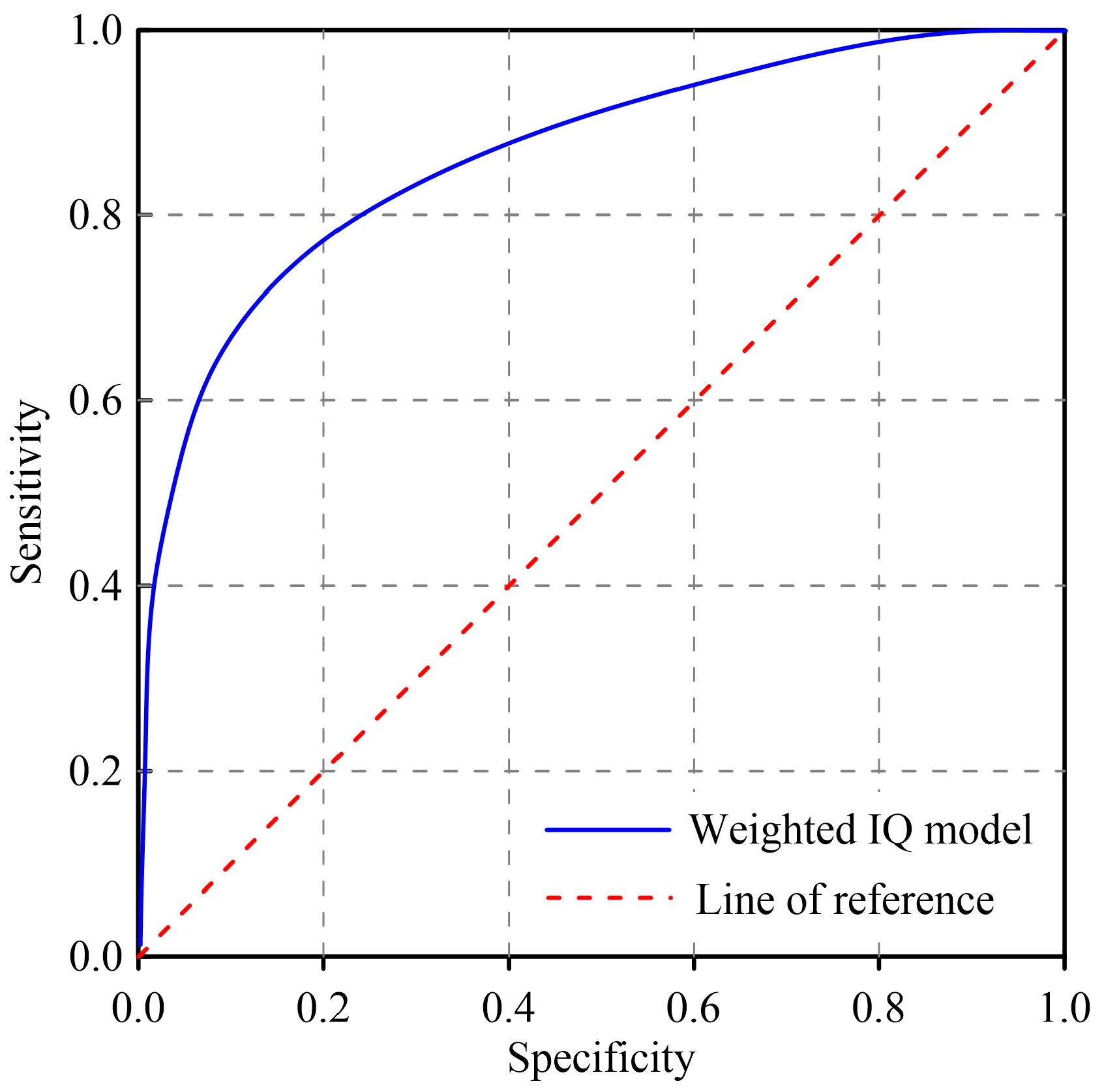
The Receiver Operating Characteristic (ROC) curve was applied to evaluate the predictive performance of the susceptibility model. Due to the limited number of mapped mass movement events in the study area, the entire historical disaster inventory was used for validation following the widely adopted “success-rate” evaluation approach. This avoids sample-size reduction and ensures statistical representativeness. The AUC value of 0.833 indicates that the model achieves a high prediction accuracy.
(2) Expert elicitation for weight determination
The AHP weighting process incorporated the judgments of seven experts specializing in geomorphology, engineering geology, hydrogeology, and remote sensing interpretation. Each expert independently completed a pairwise comparison matrix. The final judgment matrix was obtained through geometric averaging, and all matrices satisfied the consistency requirement with CR < 0.1, demonstrating satisfactory logical coherence [
8,
13].
(3) Multi-stage hierarchical weighting
The weighting was performed across three hierarchical levels (criterion → sub-criteria → factor) rather than a single aggregated comparison, because the indicators belong to conceptually distinct groups (topography, geology, hydrology, land cover, anthropogenic influences). Forcing all indicators into one flat comparison would require evaluating logically unrelated factors directly against each other, potentially inflating or suppressing weights inappropriately [
49,
50].
The hierarchical weighting design ensures that: comparisons occur only within conceptually coherent groups, intermediate weights reflect factor relationships within each subsystem, and final global weights fully align with multi-criteria spatial analysis principles commonly adopted in AHP-based hazard modeling.
This multi-layered weighting strategy, combined with ROC-based validation, establishes a transparent and reproducible workflow for deriving susceptibility and risk maps and ensures a methodologically sound foundation for subsequent analysis.
4. Results
4.1. Susceptibility Evaluation
4.1.1. The IQ of Evaluation Indicators
The conditioning indicators governing ground-instability susceptibility in the Ningxia Loess Hilly Region were grouped into four primary domains: topography, geology, hydrology, and anthropogenic activity. Seven representative variables—geomorphic type, slope, aspect, lithology, distance to fault zones, surface-water distribution, and the normalized difference vegetation index (NDVI)—were selected for quantitative assessment. These parameters jointly characterize the intrinsic mechanical setting and the external surface processes that favor instability development.
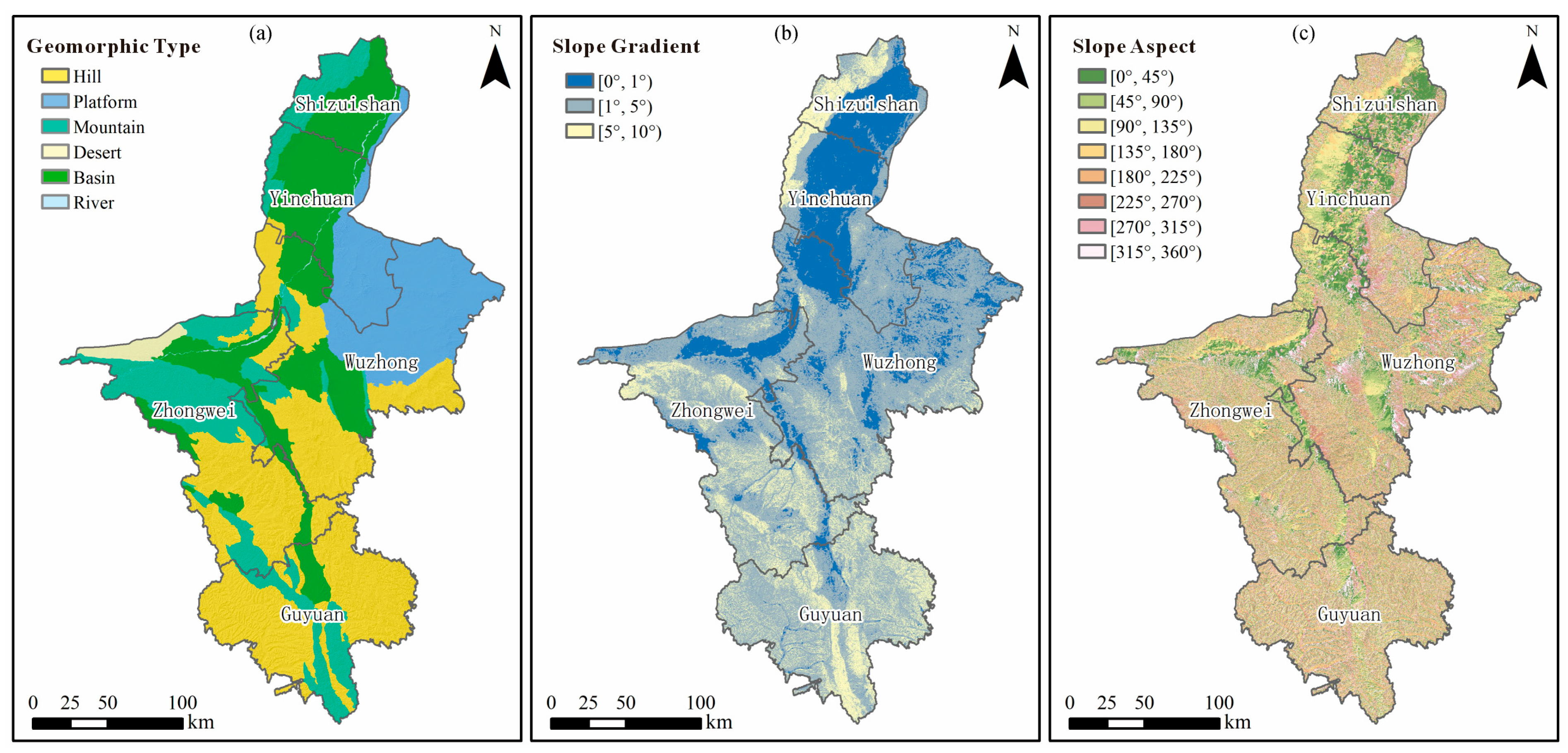
According to the regional geomorphic framework and the spatial distribution of historical instability events, five landform categories were identified: mountains, hills, plateaus, deserts, and basins (
Figure 2a). Hilly terrain proved most prone to ground failure, accounting for 74.6% of all recorded events (
Table 2). This predominance reflects the combination of steep, irregular slopes, thick loess cover, and intense runoff concentration that together enhance shear stress within surface materials.
The regional slope gradient varies between 0° and 75°. Following standard geomorphological thresholds, five slope intervals were delineated: 0–1°, 1–5°, 5–10°, 10–20°, and 20–75° (
Figure 2b). More than 83% of all instability occurrences lie within slopes steeper than 5°, while the 10–20° interval exhibits the highest concentration of events. These moderate slopes are steep enough to generate gravitational shear but gentle enough to accumulate thick, moisture-sensitive loess, explaining their dominant contribution to slope failures.
Aspect exerts a strong control on local hydrothermal regimes and soil-moisture dynamics. Eight directional intervals—0–45°, 45–90°, 90–135°, 135–180°, 180–225°, 225–270°, 270–315°, and 315–360°—were defined (
Figure 2c). The greatest density of instability events occurs on south- and southwest-facing slopes (180–225°), followed by southeast-facing slopes (135–180°). Enhanced solar radiation on these aspects increases evapotranspiration, accelerates desiccation cracking, and reduces effective cohesion, thereby pre-conditioning slopes for failure once rainfall infiltration resumes.
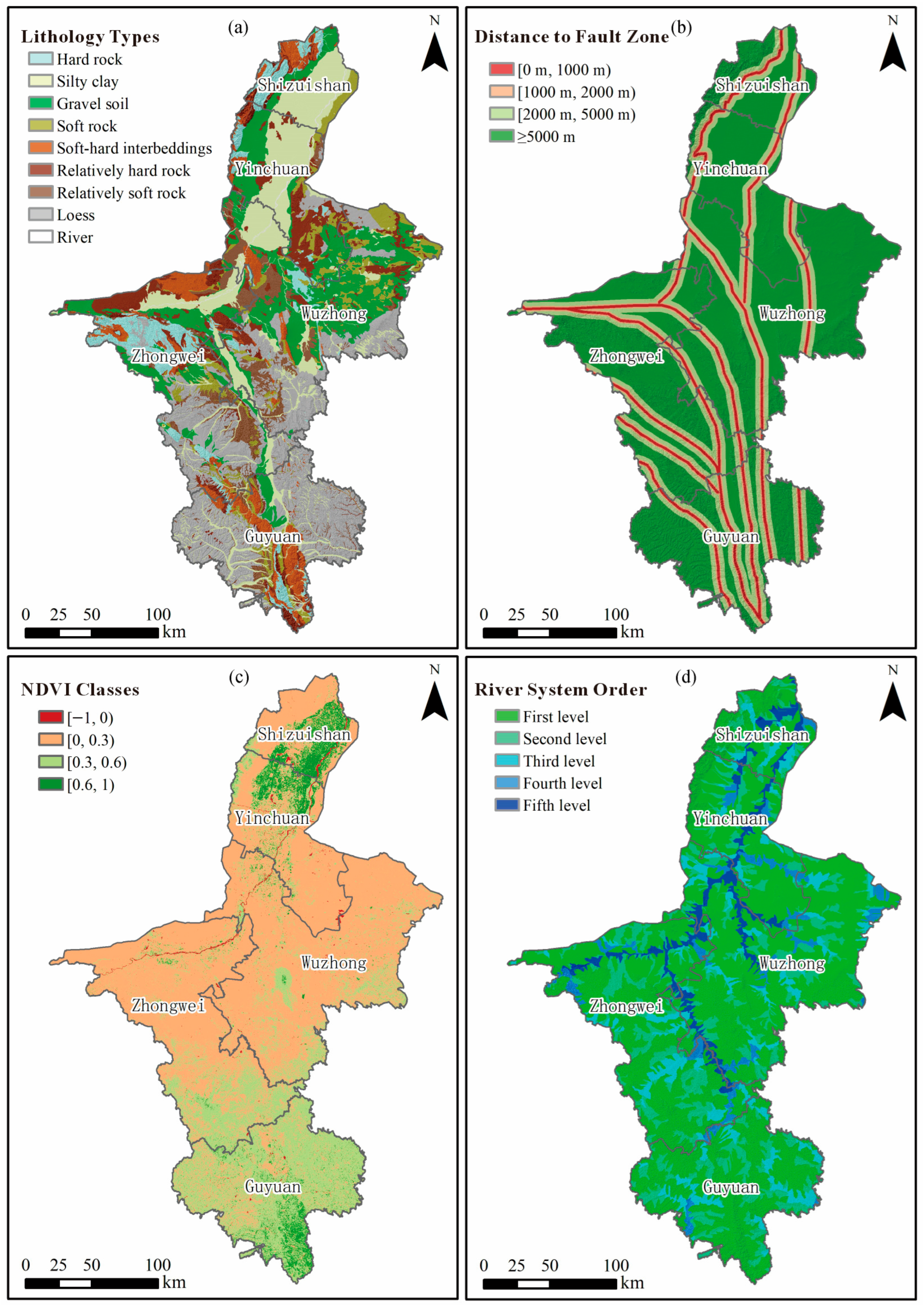
Lithological and structural factors further amplify susceptibility. Nine representative rock-and-soil units were distinguished: hard rock, relatively hard rock, soft–hard interbedding, soft rock, relatively soft rock, gravel soil, silty clay, loess, and river deposits (
Figure 3a). Loess alone covers 25.8% of the study area yet hosts 47.3% of instability events, highlighting its weak cementation, collapsibility, and strong water sensitivity. Fault proximity also plays a major role: zones within 0–1000 m of mapped faults display the highest event density (
Figure 3b), indicating that fractured rock masses and preferential groundwater pathways near faults markedly lower slope stability.
Vegetation exerts both stabilizing and destabilizing effects depending on coverage density. NDVI values were partitioned into four ecological ranges—0–0.3 (sparse), 0.3–0.6 (moderate), 0.6–1 (dense), and bare ground (no vegetation) (
Figure 3c). The moderate-vegetation interval (0.3–0.6) shows the strongest correlation with instability occurrence, suggesting that slopes with partial coverage and weak loess substrates are most vulnerable because vegetation roots increase pore-pressure pathways while offering insufficient mechanical reinforcement.
Hydrological and geomorphic coupling is equally evident. Flow-accumulation analysis from the digital elevation model delineated five watershed hierarchy levels (
Figure 3d). Third-order basins exhibit the highest instability density, reflecting runoff convergence, erosion intensification, and sediment re-mobilization processes that frequently initiate debris flows and shallow landslides.
Overall, the spatial pattern of susceptibility indicates that hilly loess terrain, moderate slopes (10–20°), and south-facing aspects represent the critical conditions for ground instability in Ningxia, with secondary modulation by lithology, fault structure, vegetation density, and drainage concentration.
4.1.2. Estimation of Indices Weights
To quantify the relative contribution of each conditioning factor to ground-instability susceptibility, a hierarchical decision-making structure was constructed to reflect the logical relationships among the indicators (
Table 3). Within this framework, factors belonging to four domains—topography, geology, hydrology, and human activity—were organized into criterion and sub-criterion levels according to their functional relationships and potential influence magnitudes.
The Analytic Hierarchy Process (AHP) was adopted to perform pairwise comparisons among indicators using Saaty’s 1–9 scale [
41]. This approach transforms qualitative expert judgments into quantitative weights while maintaining the interpretability of decision logic. Each comparison matrix was completed by a group of domain specialists familiar with the loess-hill environment. The resulting judgment matrices express the dominance of one factor over another with respect to susceptibility contribution.
To ensure methodological rigor, a consistency ratio (CR) test was carried out for each matrix. When CR < 0.1, the comparison was deemed logically consistent; otherwise, the matrix was revised until the criterion was satisfied. The verified weights of individual indicators were then propagated upward through the hierarchy by multiplying local (sub-layer) weights with their corresponding parent (criterion-layer) weights to obtain final comprehensive weights. These results are summarized in
Table 4,
Table 5,
Table 6,
Table 7 and
Table 8.
The use of AHP provides a transparent and traceable means of integrating expert knowledge into quantitative modeling while avoiding the over-fitting risk typical of purely data-driven methods. Although alternative approaches such as entropy weighting or machine-learning-based feature importance could also be applied, AHP was preferred here because of its strong interpretability, its proven reliability in ground-instability mapping, and its ability to maintain consistency across multi-source datasets [
19,
21,
31].
The final set of weights derived through this process was subsequently incorporated into the weighted information-value (WIV) model to refine susceptibility mapping. This combination of objective statistical evaluation and expert-guided weighting enhances both the precision and the physical interpretability of the ground-instability susceptibility assessment.
4.1.3. Results of Susceptibility Evaluation
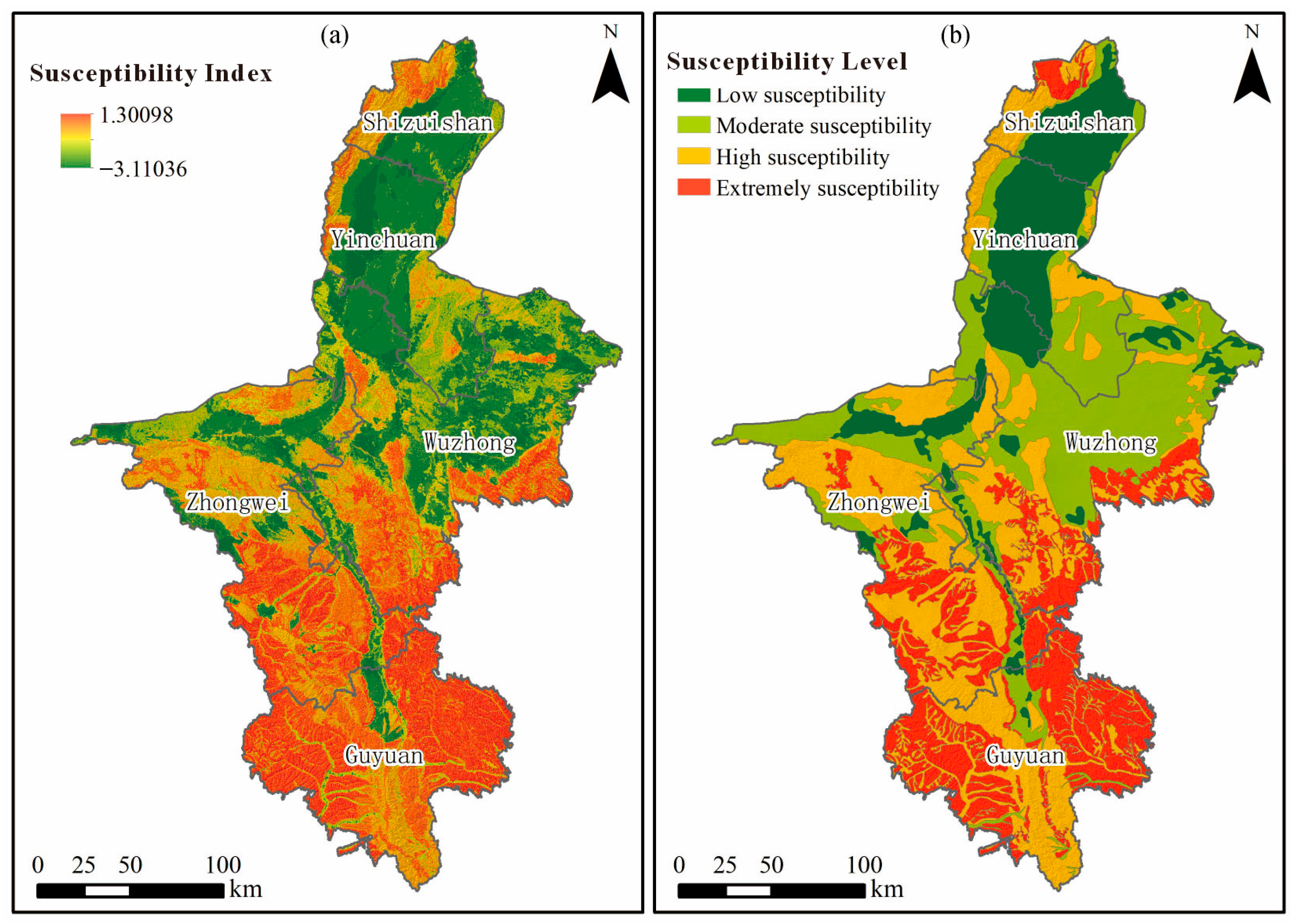
Weighted overlay analysis of the seven conditioning factors produced a continuous susceptibility surface with total information-value scores ranging from −3.11 to 1.30 (
Figure 4a). The spatially normalized results were classified into four levels—extreme, high, moderate, and low—using the Jenks natural-breaks optimization (
Figure 4b). A four-class scheme was adopted to ensure consistency across all evaluation components (susceptibility, hazard, and exposure) and because the distribution of values in this regional dataset did not support a meaningful separation into five classes without producing sparsely populated categories [
33,
34].
Extreme-susceptibility zones are primarily concentrated in northern Shizuishan, the loess-hill terrain south of Zhongwei, the eastern and southern sectors of Wuzhong, and both the eastern and western margins of Guyuan. These zones collectively cover about 11,464 km2 (22.1% of the study area). Their elevated instability potential arises from the convergence of steep slopes, thick loess deposits with low cohesion, active fault zones, and intensive river-valley incision. These conditions promote deep-seated deformation, gully erosion, and loess-collapse failures, explaining the clustering of historical events.
High-susceptibility areas, totaling 17,371 km2 (33.4%), are mainly located in the western Shizuishan belt, the eastern and western flanks of Yinchuan, the southwestern margin of Wuzhong, and the central-Zhongwei and mid-Guyuan regions. Here, alternating loess–soft-rock strata, neotectonic uplift, and dense gully networks enhance differential weathering and shear concentration, thereby intensifying slope deformation processes.
Moderate-susceptibility regions (14,581 km2; 28.1%) are distributed mainly in southern Yinchuan, northern Wuzhong, and northern Zhongwei, where plains transition into loess hills. Although these zones lack extreme slopes or active faulting, the combined influence of variable lithology, moderate slopes, and intermittent rainfall still generates localized failures, particularly along road cuts and terrace margins. These transitional areas thus require focused monitoring during construction and land-use planning.
Low-susceptibility areas (8548 km2; 16.5%) are confined to central Shizuishan, central Yinchuan, and northwestern Wuzhong, with additional minor patches along broad river valleys. These stable terrains are characterized by gentle gradients, well-consolidated strata, and limited tectonic disturbance. Their geomorphological stability provides favorable conditions for urban expansion and infrastructure projects, subject to standard site-specific geotechnical verification.
Overall, the susceptibility pattern reveals a north–south gradient of increasing instability, with loess-covered hills and structurally complex areas exhibiting the greatest hazard potential, whereas plains and basin environments remain largely stable.
4.2. Hazard Evaluation
Building upon the results of the susceptibility assessment, the hazard evaluation further integrates external triggering factors—rainfall, seismic acceleration, and human engineering disturbance—to capture the dynamic conditions responsible for ground-instability initiation. These factors were standardized to a consistent spatial framework and incorporated through information-value weighting to refine the predictive accuracy of the hazard model.
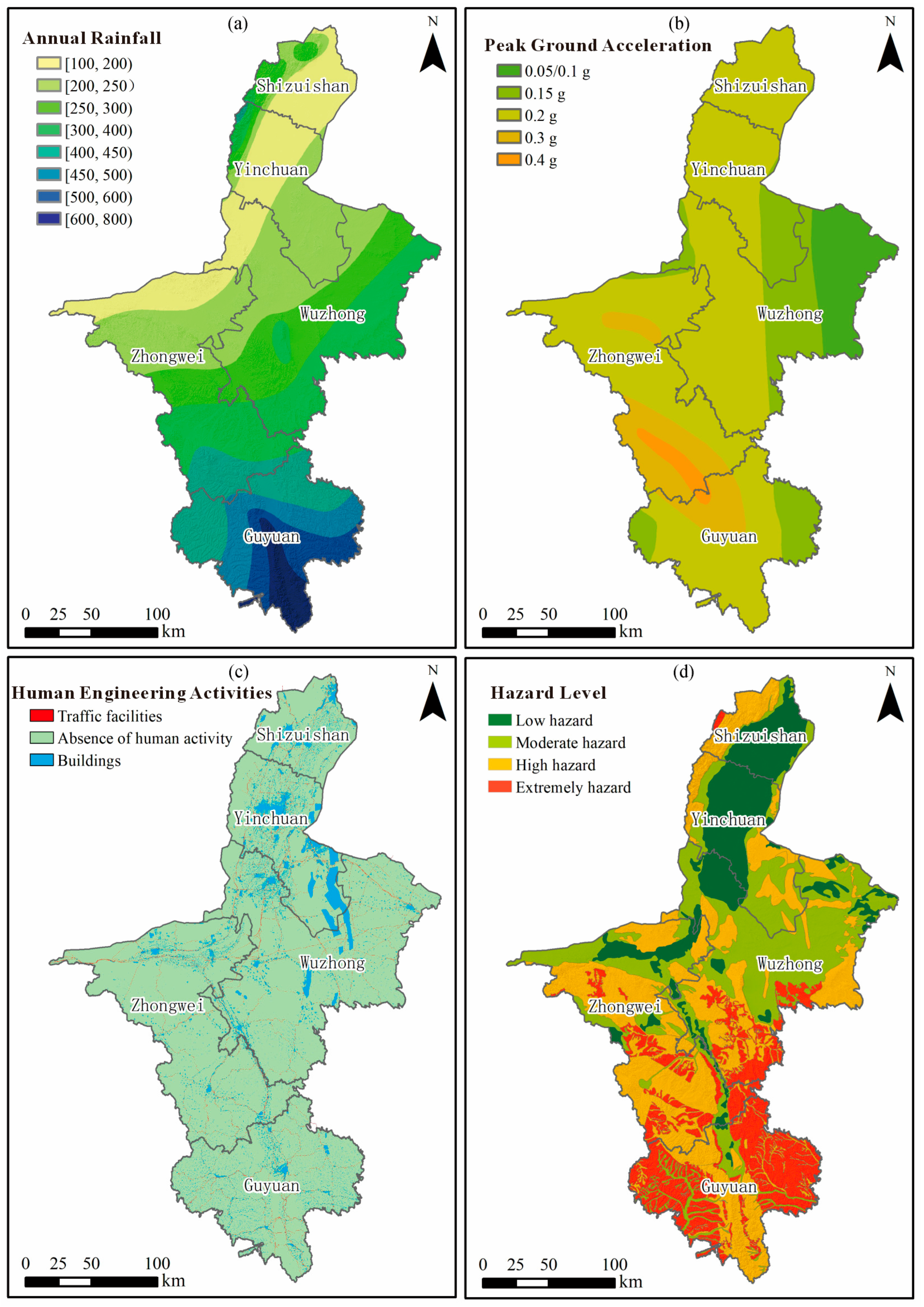
(1) Rainfall: The multi-year (1990–2023) mean annual precipitation data were obtained from the China Meteorological Administration (CMA) station network and resampled to 25 m resolution using spatial interpolation. Precipitation exhibits a clear north–south gradient, increasing from approximately 150 mm yr
−1 in Shizuishan to more than 700 mm yr
−1 in southern Guyuan. Based on the Jenks natural-breaks classification, rainfall was divided into eight intervals—(100, 200], (200, 250], (250, 300], (300, 400], (400, 450], (450, 500], (500, 600], and (600, 800] mm yr
−1 (
Figure 5a). These categories effectively distinguish areas with high potential for rainfall-induced landslides and loess collapses.
(2) Seismic factor: Seismic shaking intensity was represented by Peak Ground Acceleration (PGA), extracted from the 2022 national seismic zoning map issued by the China Earthquake Administration. The study region is subdivided into five PGA zones—0.05/0.1 g, 0.15 g, 0.20 g, 0.30 g, and 0.40 g (
Figure 5b)—revealing a distinct east–west gradient. The highest PGA values coincide with active fault systems in the Liupan–Xihaigu structural belt, where repeated historical earthquakes have contributed to slope destabilization and secondary failures.
(3) Human activity: Anthropogenic modification of the terrain, including road construction, urban expansion, and mining operations, alters both local hydrological routing and the mechanical stability of slopes. Based on land-use datasets and high-resolution remote-sensing imagery (2020 Landsat-8 OLI), engineering activities were classified into transportation corridors and built-up areas (
Figure 5c). Their spatial intensity was quantified using buffer-zone density statistics to compute corresponding information values.
By overlaying the susceptibility map with these three triggering-factor layers, a composite hazard index was derived and subsequently reclassified into four hazard levels—extreme, high, moderate, and low—using the Jenks method (
Figure 5d). Extreme-hazard zones, characterized by strong neotectonic activity, high rainfall, and intensive human interference, cover approximately 9849 km
2 (18.9%) of the study area. High-hazard zones extend across 18,793 km
2 (36.2%), mainly along the southern margin of the Ningxia Basin and central Wuzhong. Moderate-hazard areas (14,721 km
2; 28.3%) are distributed within transitional hilly terrain, whereas low-hazard zones (8597 km
2; 16.5%) correspond to flat plains with limited triggering potential.
The spatial coherence between high-hazard regions and recorded disaster events demonstrates that the integration of dynamic triggers into the susceptibility framework significantly improves the reliability and realism of the hazard assessment.
4.3. Exposure Evaluation
The exposure assessment aims to quantify the degree of potential damage and loss of exposure elements under mass movement scenarios. Based on field investigations, remote-sensing interpretation, and socio-economic statistics, three key indicators were selected to represent human and infrastructural exposure: population density, building structures, and transportation networks.
(1) Population density: Population data for 2020 were obtained from the National Bureau of Statistics of China and spatially disaggregated to a 25 m grid using areal-weighted interpolation. High population densities are mainly concentrated in urbanized centers such as Yinchuan, Wuzhong, and Guyuan, where the potential human impact of ground instabilities is greatest.
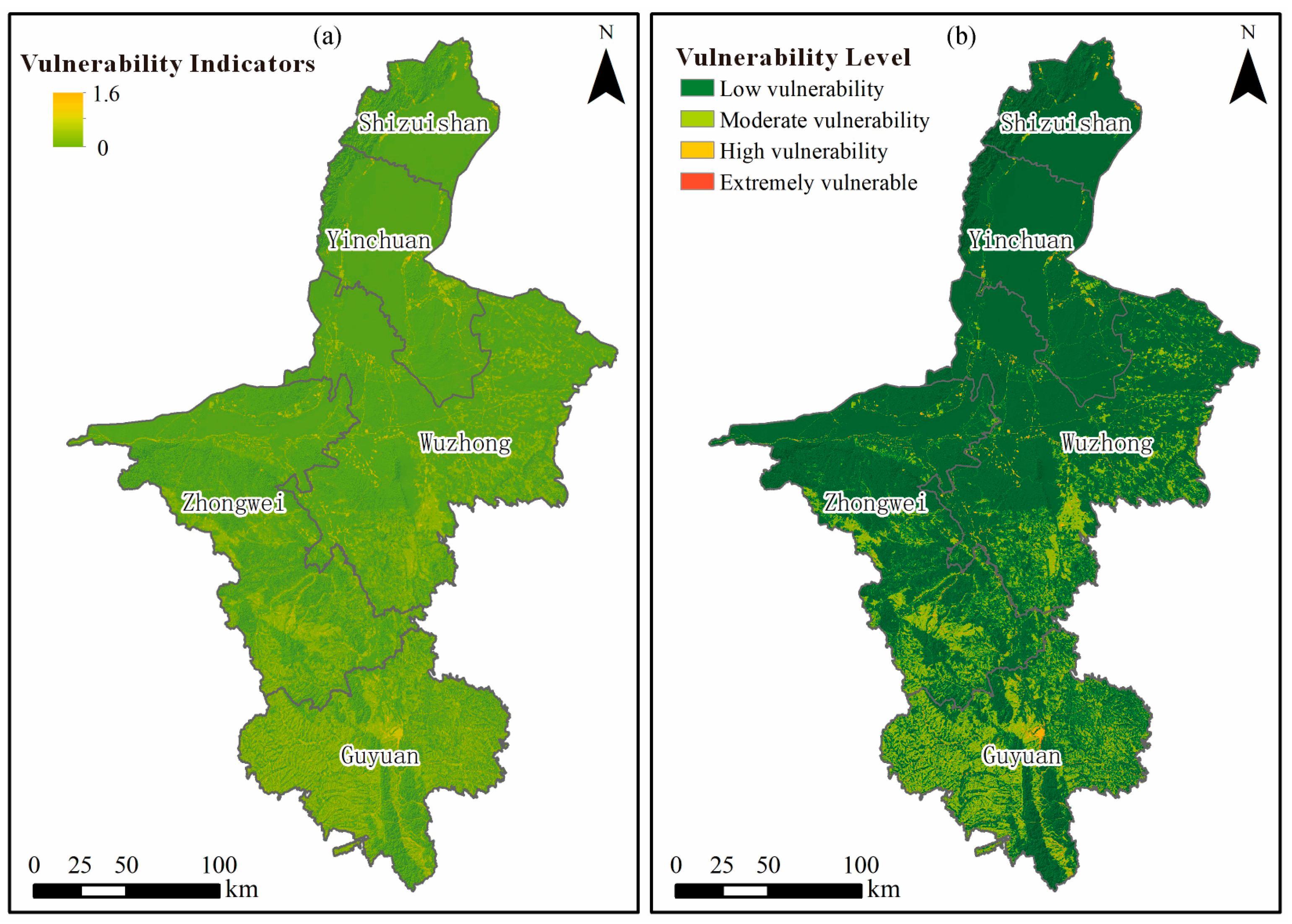
(2) Building and land-use intensity: Residential and industrial construction areas were extracted from Landsat-8 OLI imagery (30 m resolution) and refined using Sentinel-2A data for validation. The total building footprint and land-use intensity were quantified by calculating built-up ratios within each grid cell. Areas with a high proportion of permanent or multi-story buildings were assigned higher exposure scores due to greater potential property losses (
Figure 6a).
(3) Transportation infrastructure: Major highways, secondary roads, and railway lines were mapped using vector data from OpenStreetMap and regional planning maps (2023). Linear density analysis in ArcGIS was applied to estimate the cumulative length of transport corridors within a 1 km buffer zone (
Figure 6b). Transport networks in hilly terrains exhibit higher exposure due to the combined effects of slope cutting and runoff concentration along road embankments.
The above indicators were standardized through min–max normalization and aggregated using an empirical scoring approach (
Table 9). The cumulative exposure index (CVI) was derived by raster-based overlay analysis and subsequently categorized into four levels—extreme, high, moderate, and low exposure—according to the Jenks natural-breaks method (
Figure 6b).
The spatial pattern reveals that extreme and high-exposure zones are concentrated in Yinchuan, Wuzhong, and the central-eastern part of Guyuan, covering approximately 8900 km2 (17.1% of the total area). These regions feature dense population clusters and extensive infrastructure networks. Moderate-exposure areas account for 42.6%, corresponding to transitional suburban belts, while low-exposure zones (40.3%) dominate sparsely populated mountainous and desert regions. The resulting exposure map effectively characterizes the spatial differentiation of exposure intensity and provides a quantitative foundation for subsequent risk synthesis.
4.4. Risk Evaluation
In accordance with the Technical Requirements for Geological Disaster Risk Investigation and Evaluation (1:50,000), a risk classification matrix (
Table 10) was applied to synthesize the results of the hazard and exposure assessments. Within this framework, mass movement risk (R) is defined as the joint probability and expected consequence of a hazardous event, expressed conceptually as R = H × E, where H and V denote normalized hazard intensity and exposure index, respectively.
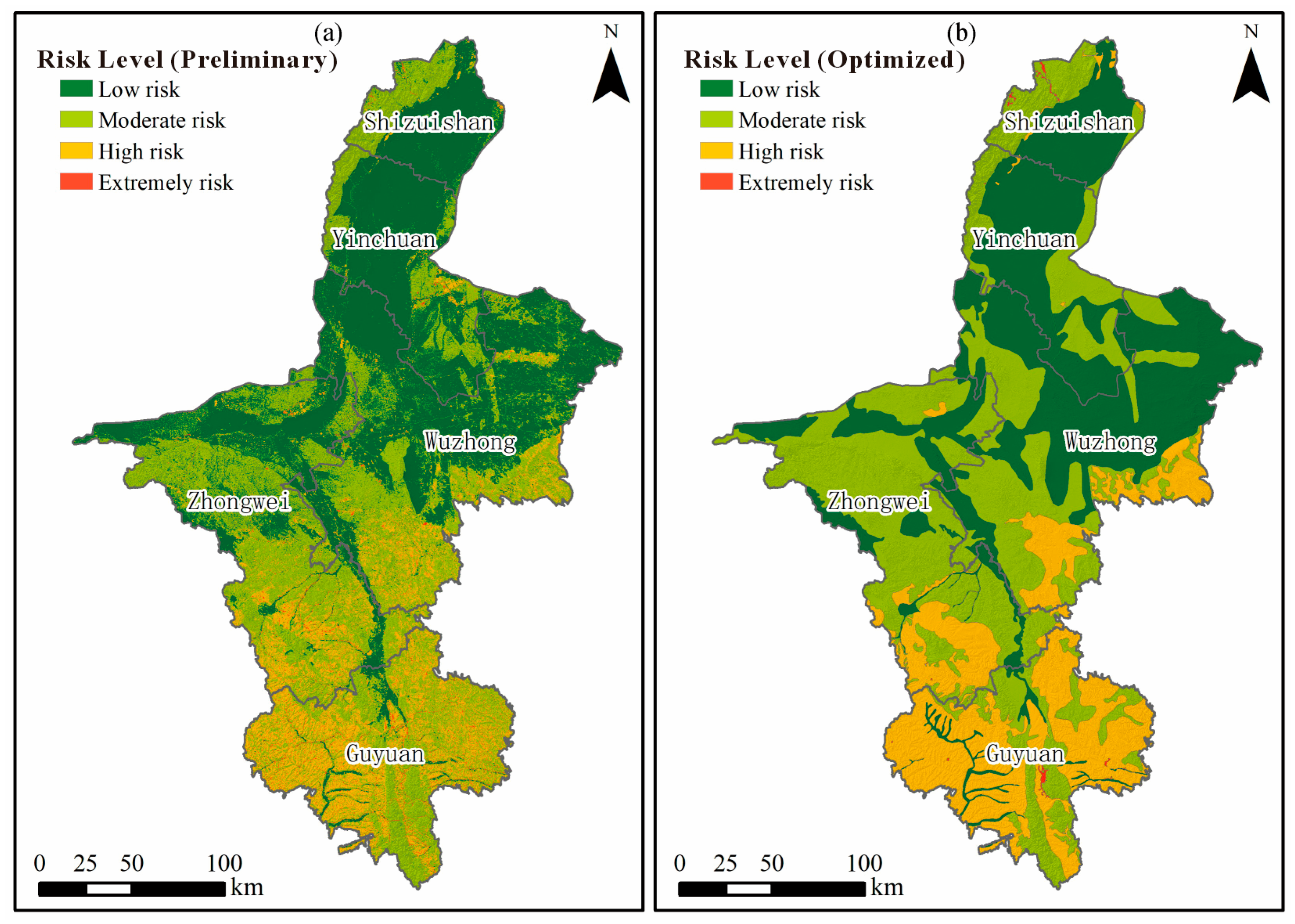
Raster-based overlay analysis was performed in ArcGIS to integrate the two layers. The initial composite map revealed fragmented and discontinuous zoning due to the pixel-level variation inherent in raster calculations (
Figure 7a). To enhance cartographic readability and ensure spatial coherence, a spatial optimization and neighborhood aggregation procedure was employed. Adjacent grid cells sharing similar hazard and exposure combinations were merged through region-group and dissolve operations, generating a continuous and interpretable final risk zoning map (
Figure 7b).
The final results indicate that extreme-risk zones encompass approximately 83.6 km2 (0.16% of the study area) and are primarily located in central Guyuan and northwestern Shizuishan. These regions coincide with steep loess slopes, active faults, and dense transportation corridors, where high hazard intensity converges with concentrated exposure. High-risk zones cover about 11,366 km2 (21.9%), distributed across most of Guyuan and southern Wuzhong, reflecting the combined influence of strong seismic shaking, high rainfall, and urban expansion.
Moderate-risk areas dominate the central portion of the Ningxia Basin and northern Zhongwei, accounting for 41.7% of the study area, where moderate hazard levels overlap with medium population density and infrastructure exposure. Low-risk zones (36.3%) are primarily found in central Yinchuan and the surrounding plains, corresponding to flat terrain and limited triggering or exposure factors.
Comparative spatial validation using historical disaster inventories confirms a positive correlation between observed event density and modeled risk grades, thereby verifying the internal consistency and predictive capability of the risk evaluation model. The resulting risk zoning provides a decision-support tool for disaster prevention, urban land-use control, and regional resilience planning in the Loess Hilly region of Northwest China.