


Simple Summary
Maternal milk represents a crucial source of nutrients provided to suckling lambs. We analyzed the properties of maternal milk relative to the live weight of suckling lambs, and confirmed positive impact of milk production, milk protein, and milk lactose on lambs growth intensity in general. Further analyses identified specific fatty acids contained in milk fat with positive effect to lambs live weight. Results highlighted important components of mother’s milk for optimizing lambs’ growth potential till their weaning.
Abstract
This study determined effects of milk production, milk components, or fatty acids (FA) profile on live weight of suckling lambs till their weaning. Live weight (LW, kg) of 42 purebred Wallachian lambs (from 33 ewes) was recorded during four control days with approximately 30-day intervals during rearing. At the same time, their mothers were examined for milk production (kg), milk fat (g), proteins (g), lactose (g), and fatty acids (%) contents. Results investigated using linear regression analysis showed 5.93 kg (p < 0.05) increase of lambs LW corresponded with 1 kg of ewe’s daily milk production increase during the observed period. Similarly, significant 0.13 kg or 0.11 kg increases of lambs live weight corresponded with 1 g increase of milk protein or milk lactose at this time. Milk with higher prevalence of trans-palmitoleic acid, trans-vaccenic acid, cis-vaccenic acid, linolelaidic acid, linoleic acid, or conjugated linolenic acid (CLA) significantly improved lambs LW. Moreover, significantly positive Pearson partial correlation between LW and trans-vaccenic acid (r = 0.305) or CLA (r = 0.347) indicated on genetic correlation between these traits. Therefore, milk (natural or artificially supplied) with higher distribution of these specified FAs could improve lambs’ LW.
1. Introduction
Lambs growth intensity from birth until weaning is strongly influenced by a complex of characteristics related to the mother, called maternal abilities. Age, parity, ewes’ nutritional status, birth weight of lamb, lambing ease, or ewes’ behavior after parturition and during lambs rearing are some of the characteristics that influence a lamb’s growth, as [1,2,3,4,5,6] have demonstrated. Additionally, breeding values predicted for maternal effect help to increase lambs live weight by selection on maternal traits [7,8]. Another important factor reflected in maternal abilities is milk production and its quality, as it represents a crucial source of nutrients provided to suckling lambs. That is the reason for monitoring ewes milking ability [9] in non-dairy flocks, especially concerning low-input flocks or flocks under extensive management. Wallachian sheep are used in the maternal position while out-crossing as they have been historically adapted on breeding in very extensive conditions of Beskydy Mountains [10,11]. Their potential for milk production has been previously suggested by [12], demonstrating health beneficial fatty acid (FA) distribution in raw milk. However, in terms of mutton production the volume of milk produced, and its composition, as related to lambs live weight is of particular interest as well. Some previous studies confirmed positive effect of milk production [13,14] or milk lactose and protein distribution [15] on lambs growth intensity; however, this effect was not so obvious for milk fat [16]. Additionally, effect of particular FAs on lambs live weight should be informative. This was usually studied in the context of improving suckling lamb meat quality by polyunsaturated fatty acids (PUFA) enriched milk or milk replacers [17,18], or, recently, by direct diet fortification for specific oil supplements with high PUFA prevalence [19], demonstrating lambs’ growth and meat quality improvements.
The aim of this study was to determine the effects of milk production, namely, its milk components or FA profile on the live weight of suckling lambs until their weaning. Furthermore, to define those FAs in milk fat with significantly positive or significantly negative effects on lambs live weight.
2. Materials and Methods
The study was performed from April to August 2015 on non-milked purebred Wallachian sheep, with their lambs managed under a traditional Carpathian farming system in the Beskydy Mountains (Moravian-Silesian region; 450–890 m above sea level altitude; local annual rainfall was 833 mm and the average annual temperature was 7.0 °C in the evaluated year). 42 lambs were randomly selected from the basic flock and their live weight until their rearing (LW; kg ± 100 g) was monitored on four control days: 27th April (the average 43rd day of age), 25th May (the average 71st day of age), 23rd June (the average 99th day of age), and 4th August (the average 142nd day of age). At the same time, their mothers (n = 33) were examined for milk production, and milk samples for solids and FAs estimation were collected. Milk production was measured in weight (MILK; kg). Milk fat, milk protein, and milk lactose were expressed as weight amount (g) contained in the milk. FA groups or particular FAs were expressed as percentage proportion (%) from FAs contained in the milk fat. This study was a part of the complex study bringing information about Wallachian sheep and showed their potential in current farming systems. Flock management, information about milk samples collection, and their analysis for solid components or for fatty acid profile analysis, as well as information about weighing lambs have been methodically described in [12,20].
Ethical approval was not required specifically for purpose of this study, as the investigations were carried out using data routinely collected throughout normal practice, in order to record performance. Additionally, procedures performed with the animals—for the whole project—were in accordance with Ethics Committee of Central Commission for Animal Welfare at the Ministry of Agriculture of the Czech Republic (Prague, Czech Republic), and carried out in accordance with Directive 2010/63/EU for animal experiments and Local Ethics Commission (No. 3/2015). Lambs’ live weight throughout the evaluation period was visualized by using a growth curve (interposed with polynomial function) from the base dataset MS Excel® (MS Office, Microsoft Corporation, Redmond, Washington, USA).
All statistical analyses were performed using SAS 9.3. (Available online: https://support.sas.com/documentation/cdl/en/statug/63962/HTML/default/viewer.htm#titlepage.htm, accessed on 23 September 2019). [21]. Pearson partial correlation coefficients were used to express relations between residuals for LW on the one side and MILK, milk components, FA groups, and selected FAs on the other side. These relations were estimated after adjusting data for effects of control day, ewe age category, lambs litter size, lambs age, and for sex of lambs.
The second used approach were linear regressions of individual milk traits included into model equation for LW analysis of variance, which were estimated using generalized linear model (GLM) procedure of SAS software with significance level of p < 0.05, p < 0.01, or p < 0.001. Milk (kg), and milk components (g) obtained from twins were divided by 2 for this analysis. This data correction was performed based on assumption that the twins fed equally from their mother.
where Yijklmn = lambs live weight, µ = mean value, DAYi = fixed effect of the control day (four classes; i = first control day, i = second control day; i = third control day; i = fourh control day), LSj = fixed effect of lambs litter size (j = singles; j = twins,), AGEk = fixed effect of ewe age category (k = 1 and 2 years old ewes; k = 3 years old ewes; k = 4 years and older ewes), SEXl = fixed effect of sex of lambs (l = males; l = females), agem (DAY) = nested effect of age of lambs nested in control days of weighing, b *(MILK) = linear regression on milk production (144.72–2600 g), b *(PROT) = linear regression on milk protein content (9.49–114.14 g), b *(LAKT) = linear regression on milk lactose content (6.44–134.68 g), b *(FAT) = linear regression on milk fat content (15.51–148.98 g), b *(SFA) = linear regression on saturated fatty acid group content (45.18–75.53%), b *(MUFA) = linear regression on monounsaturated fatty acid group (18.90–46.23%), b *(PUFA) = linear regression on polyunsaturated fatty acid group (5.57–10.56%), b *(FAs: C4:0–CLA) = linear regression on fatty acid distribution (C4:0 = 0.94–2.50%; C6:0 = 0.83–2.41%; C8:0 = 0.64–2.51%; C10:0 = 1.49–9.06%; C12:0 = 1.15–7.94%; C14:0 = 3.75–16.74%; C14:1 = 0.02–0.56%; C16:0 = 16.68–27.87%; C16:1T = 0.42–0.88%; C16:1 = 0.39–1.72%; C17:0 = 0.55–1.20%; C17:1 = 0.19–0.46%; C18:0 = 4.92–22.39%; ∑ C18:1T = 0.52–15.23%; C18:1n9c = 12.42–34.05%; ∑ C18:1C = 1.16–2.54%; ∑ C18:2T = 1.15–2.47%; C18:2n6c = 1.03–3.67%; C18:3n3 = 0.69–2.92%; CLA = 0.13–4.41%), and eijklmn = residual error.
Yijklmn = µ + DAYi + LSj + AGEk + SEXl + agem (DAY) + b *(MILK) or b *(PROT) or b *(LAKT) or b *(FAT) or b *(SFA) or b *(MUFA) or b *(PUFA) or b *(FAs: C4:0–CLA) + eijklmn
3. Results and Discussion
Information about milk production, milk composition, and FAs profile of Wallachian milk during lactation is presented in [12]. Figure 1 shows the dynamics of LW of Wallachian lambs throughout the observed period.
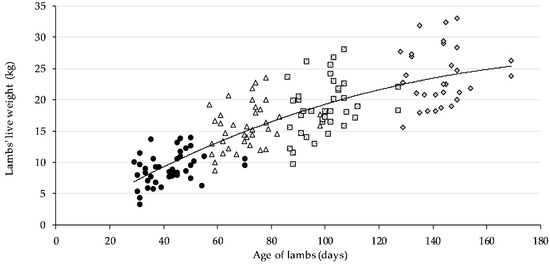
Figure 1.
Growth curve (third order polynomial function) estimated for Wallachian lambs.  1st day of lambs live weight monitoring;
  2nd day of lambs live weight monitoring;
  3rd day of lambs live weight monitoring;
  4th day of lambs live weight monitoring.
1st day of lambs live weight monitoring; 2nd day of lambs live weight monitoring; 3rd day of lambs live weight monitoring; 4th day of lambs live weight monitoring.
Lambs LW was during this observation positively correlated with milk production (r = 0.257; p < 0.01), and all the evaluated milk solids (r = 0.248–0.305; p < 0.01) as documented in Table 1. This corresponded with previously published studies [9,22,23] that demonstrated a crucial effect of maternal milk on lamb growth rate. Additionally, Pearson partial correlation coefficients were used trying to suggest a genetic correlation between LW and milk production, or on LW and milk composition in case of a relatively small number of animals, as we had available. This supported positive genetic correlation between milk yield and average weight of the lambs weaned in the litter (r = 0.44) published by [24]; however, results for percentage milk components showed neutral (protein, r = 0.00; lactose, r = 0.01) or negative (fat, r = −0.31) correlation with average weight of the lambs weaned in the litter in their study. Table 1 shows more detailed view on milk fat illustrated by correlations analysis between LW and FA groups. FAs in saturated fatty acid (SFA) or monounsaturated fatty acid (MUFA) group indicated a neutral relation to lambs LW in general, while PUFA showed a significantly positive correlation (r = 0.194, p < 0.05). All these relations were further investigated using linear regression analysis showing a 5.93 kg (p < 0.05) increase of lambs’ live weight, corresponding with 1 kg of daily milk production increase during the observed period. Similarly, significantly positive linear regression was demonstrated for solids non-fat, when 0.13 kg or 0.11 kg increase of LW corresponded with 1 g increase of milk protein or milk lactose at this time. Importantly, both these linear regression were significantly positive; however, an error margin on the scales has to be considered when particular LW values are predicted using these regression coefficients. Contrary, a non-significant increase of LW was demonstrated by linear relation against milk fat content. Positive linear regression of milk production on lambs live weight was confirmed by a range of authors [13,14,15,16], when several of them also documented a significantly positive regression of milk protein or lactose. Milk fat was in a positive or in a negative linear relation with daily gains of twin lambs, as [16] have demonstrated; however, its r2 values were relatively low (ranging about 0.02–0.04) in experiments performed in their study. This supports only a minor linear effect of milk fat percentage that was observed in our results as well. However, a more detailed analysis of milk fat shows an evident significant increase of LW connected with increasing MUFA or PUFA. On the contrary, significantly negative linear regression was demonstrated for SFA. This indicates that generally respected FAs with beneficial health effect had positive impact on lambs’ growth abilities, while “health risk” FAs (lauric acid, C12:0; myristic acid, C14:0; palmitic acid, C16:0) contained in the SFA group showed a negative relation [25,26]. The effect of milk fat—as a whole—was eliminated as particular groups of FAs showed an opposed tendency. Therefore, more specific monitoring was aimed at identifying the effect of major FAs in milk fat on lambs live weight.

Table 1.
Regression-correlation analysis between Wallachian lambs’ live weight and milk production, milk compounds, or fatty acid groups during their rearing.
Table 2 shows correlations of the major representatives of FA groups from mother’s milk to LW of lambs; three FAs showed a significant relation to LW. Stearic acid (C18:0), FA from SFA group, was negatively correlated to LW (r = −0.195, p < 0.05). Contrary, significantly positive correlation concerned trans-vaccenic acid (∑ C18:1T) (r = 0.305, p < 0.001), and conjugated linolenic acid (CLA) (r = 0.347, p < 0.001), representing FAs from MUFA and PUFA group, respectively. Prediction of lambs’ LW by changing course of FAs in milk fat was performed using linear regression analysis. FAs in SFA group showed neutral (butyric acid, C4:0; margaric acid, C17:0; stearic acid, C18:0) or significantly negative linear regression (caproic acid, C6:0; caprylic acid, C8:0; capric acid, C10:0; lauric acid, C12:0; myristic acid, C14:0; palmitic acid, C16:0). Significantly positive linear-relationship concerned trans-palmitoleic acid (C16:1T), palmitoleic acid (C16:1), ∑ C18:1T, and cis-vaccenic acid (∑ C18:1C) (all MUFA groups) when 1% of C16:1T, C16:1, ∑ C18:1T and ∑ C18:1C corresponded with significant increases of LW 19.33 kg, 5.60 kg, 0.55 kg and 5.25 kg throughout the monitored time interval. Similarly, 1% of linolelaidic acid (∑ C18:2T) and CLA (all PUFA group) was reflected by a significantly increase of lambs live weight by 5.59 kg (∑ C18:2T) and 1.39 kg (CLA), respectively. In general only two FAs with significantly positive effect (both correlation and linear regression analyses) were representative of MUFA (C18:1T) and PUFA (CLA) group. Monitoring of FAs in milk fat is important for its health beneficial aspect in nutrition [27,28]. A strongly negative effect on health is particularly noted for lauric (C12:0), myristic (C14:0), and palmitic (C16:0) FAs [25,26]. Some positive occurrence of specific FAs from SFA group (such as C6:0 to C10:0) could be tolerated as they are of medical interest in humans: malabsorption syndromes, infant malnutrition, cardiovascular diseases, and nonallergenic properties [29]. However, none of these FAs showed some kind of positive relation to LW in our study. All named FAs were in significantly negative regression with LW. Contrary, FAs in PUFA and MUFA group are reported for their positive effect on cholesterol levels [29]. Additionally, CLA is frequently discussed in terms of anticarcinogenic effects [26] as well. Interestingly, generally respected positive effect of these FAs in metabolism should be indicated as an explanatory element of improved lambs growth demonstrated in the presented study.
Table 2.
Regression–correlation analysis s between lambs live weight and selected fatty acids in fat of Wallachian sheep milk.
4. Conclusions
This study described effect of maternal milk production and composition on lambs live weight. Milk production as well as milk protein and lactose contents showed a significantly positive linear relationship with lambs live weight. No such positive effect was obvious for milk fat percentage in general. However, the SFA group showed significantly negative linear regression, while a significantly positive relation was demonstrated for PUFA or MUFA. This positive effect of major FAs from PUFA or MUFA groups, especially concerning trans-palmitoleic acid, trans-vaccenic acid, cis-vaccenic acid (MUFA group), and linolelaidic acid, linoleic acid, or CLA (PUFA group). Moreover, significantly positive Pearson partial correlation between LW and trans-vaccenic acid or conjugated linolenic acid suggest a genetic correlation between these traits. Therefore, milk (natural or artificially supplied) with higher prevalence of these specified FAs could improve lambs’ live weight.
Author Contributions
Conceptualization and methodology, M.M., V.T., M.P., and L.S.; investigation, M.P., M.M., J.D., V.T., J.S., and M.U.; data curation, J.D.; writing-original draft preparation, M.P.; writing-review and editing, M.M., L.S., and J.D.; milk analysis, T.M.; project administration, L.S. and L.N.
Funding
This study was supported by an S grant of MEYS, by projects of the Ministry of Agriculture of the Czech Republic (QJ1310107, and MZERO0717), and by the Ministry of Education, Science, Research and Sports of the Slovak Republic/the Slovak Research and Development Agency (Project No. APVV-15-0072).
Conflicts of Interest
The authors declare no conflict of interest.
References
- O’Connor, C.E.; Jay, N.P.; Nicol, A.M.; Beatson, P.R. Ewe maternal behaviour score and lamb survival. Proc. N. Z. Soc. Anim. Prod. 1985, 45, 159–162. [Google Scholar]
- Kenyon, P.R.; Maloney, S.K.; Blache, D. Review of sheep body condition score in relation to production characteristics. N. Z. J. Agr. Res. 2014, 57, 38–64. [Google Scholar] [CrossRef]
- Ptáček, M.; Ducháček, J.; Stádník, L.; Fantová, M. Effects of age and nutritional status at mating on the reproductive and productive traits in Suffolk sheep kept under permanent outdoor management system. Czech J. Anim. Sci. 2017, 62, 211–218. [Google Scholar] [CrossRef]
- Ptáček, M.; Ducháček, J.; Stádník, L.; Hakl, J.; Fantová, M. Analysis of multivariate relations among birth weight, survivability traits, growth performance, and some important factors in Suffolk lambs. Arch. Anim. Breed. 2017, 60, 43–50. [Google Scholar] [CrossRef]
- Pesántez-Pacheco, J.L.; Heras-Molina, A.; Torres-Rovira, L.; Sanz-Fernández, M.V.; García-Contreras, C.; Vázquez-Gómez, M.; Feyjoo, P.; Cáceres, E.; Frías-Mateo, M.; Hernández, F.; et al. Influence of maternal factors (Weight, Body Condition, Parity, and Pregnancy Rank) on plasma metabolites of dairy ewes and their lambs. Animals 2019, 9, 122. [Google Scholar] [CrossRef] [PubMed]
- Pesántez-Pacheco, J.L.; Heras-Molina, A.; Torres-Rovira, L.; Sanz-Fernández, M.V.; García-Contreras, C.; Vázquez-Gómez, M.; Feyjoo, P.; Cáceres, E.; Frías-Mateo, M.; Hernández, F.; et al. Maternal Metabolic Demands Caused by Pregnancy and Lactation: Association with Productivity and Offspring Phenotype in High-Yielding Dairy Ewes. Animals 2019, 9, 295. [Google Scholar] [CrossRef]
- Milerski, M. Methodology of Breeding Values Estimation in Sheep; Institute of Animal Science: Prague, Czech Republic, 2005; pp. 1–19. [Google Scholar]
- Ptáček, M.; Ducháček, J.; Schmidová, J.; Stádník, L. Response to selection of a breeding program for Suffolk sheep in the Czech Republic. Czech J. Anim. Sci. 2018, 63, 305–312. [Google Scholar]
- Snowder, G.D.; Knight, A.D.; Van Vleck, L.D.; Bromley, C.M.; Kellom, T.R. Usefulness of subjective ovine milk scores: I. Associations with range ewe characteristics and lamb production. J. Anim. Sci. 2001, 79, 811–818. [Google Scholar] [CrossRef]
- Jandurová, O.M.; Kott, T.; Kottová, B.; Czerneková, V.; Milerski, M. Genetic relationships among Šumava, Valachian and Improved Valachian sheep. Small Ruminant Res. 2005, 57, 157–165. [Google Scholar] [CrossRef]
- Milerski, M. Methodology of Wallachian Sheep Breeding; Ministry of Agriculture of the Czech Republic: Prague, Czech Republic, 2013; pp. 1–7.
- Ptáček, M.; Milerski, M.; Ducháček, J.; Schmidová, J.; Tančin, V.; Uhrinčať, M.; Stádník, L.; Michlová, T. Analysis of fatty acid profile in milk fat of Wallachian sheep during lactation. J. Dairy Res. 2019, 86, 233–237. [Google Scholar] [CrossRef]
- Geenty, K.G.; Clarke, J.N.; Wright, D.E. Lactation performance, growth, and carcass composition of sheep: 2. Relationships between ewe milk production, lamb water turnover, and lamb growth in Romney, Dorset, and crossbred sheep. N. Z. J. Agr. Res. 1985, 28, 249–255. [Google Scholar] [CrossRef]
- Dove, H.; Freer, M.; Foot, J.Z. The nutrition of grazing ewes during pregnancy and lactation: Relationships between herbage, supplement and milk intakes, and ewe and lamb liveweight and body composition. Anim. Prod. Sci. 2018, 58, 1253–1270. [Google Scholar] [CrossRef]
- Torres-Hernandez, G.; Hohenboken, W. Relationships between ewe milk production and composition and preweaning lamb weight gain. J. Anim. Sci. 1980, 50, 597–603. [Google Scholar] [CrossRef]
- Danso, A.S.; Morel, P.C.H.; Kenyon, P.R.; Blair, H.T. Relationships between prenatal ewe traits, milk production, and preweaning performance of twin lambs. J. Anim. Sci. 2016, 94, 3527–3539. [Google Scholar] [CrossRef] [PubMed]
- Toteda, F.; Facciolongo, F.; Ragni, F. Effect of suckling type and PUFA use on productive performances, quanti-qualitative characteristics of meat and fatty acid profile in lamb. Progr. Nutr. 2011, 13, 125–134. [Google Scholar]
- Vieira, C.; Rubio, B.; Martínez, B.; Mantecón, A.R.; Manso, T. Suckling lamb meat quality from ewes fed with different sources of fat, during storage under display conditions. Small Ruminant Res. 2019, 176, 47–54. [Google Scholar] [CrossRef]
- Le, H.; Nguyen, Q.; Nguyen, D.; Malau-Aduli, B.; Nichols, P.; Malau-Aduli, A. Nutritional Supplements Fortified with Oils from Canola, Flaxseed, Safflower and Rice Bran Improve Feedlot Performance and Carcass Characteristics of Australian Prime Lambs. Animals 2018, 8, 231. [Google Scholar] [CrossRef] [PubMed]
- Ptáček, M.; Milerski, M.; Schmidová, J.; Ducháček, J.; Tančin, V.; Uhrinčať, M.; Hakl, J.; Stádník, L. Relationship between body mass index, body energy reserves, milk, and meat production of original Wallachian sheep. Small Ruminant Res. 2018, 165, 131–133. [Google Scholar] [CrossRef]
- SAS. Statistical Analysis System. SAS/STAT User’s Guide: Statistics. Version 9.2. Edition; SAS Inc.: Cary, NC, USA, 2009. [Google Scholar]
- Morgan, J.E.; Fogarty, N.M.; Nielsen, S.; Gilmour, A.R. The relationship of lamb growth from birth to weaning and the milk production of their primiparous crossbred dams. Aust. J. Exp. Agr. 2007, 47, 899–904. [Google Scholar] [CrossRef]
- Burgos-González, C.; Huerta-Aparicio, M.; Aguirre, V.; Vázquez, R.; Orihuela, A.; Pedernera, M. Milk production and lamb development in Saint Croix and Katahdin hair sheep breeds (Ovis aries). Trop. Anim. Health Prod. 2018, 50, 683–687. [Google Scholar] [CrossRef] [PubMed]
- Afolayan, R.A.; Fogarty, N.M.; Morgan, J.E.; Gaunt, G.M.; Cummins, L.J.; Gilmour, A.R. Preliminary genetic correlations of milk production and milk composition with reproduction, growth, wool traits and worm resistance in crossbred ewes. Small Ruminant Res. 2009, 82, 27–33. [Google Scholar] [CrossRef]
- Mensink, R.P.; Zock, P.L.; Kester, A.D.; Katan, M.B. Effects of dietary fatty acids and carbohydrates on the ratio of serum total to HDL cholesterol and on serum lipids and apolipoproteins: A meta-analysis of 60 controlled trials. Am. J. Clin. Nutr. 2003, 77, 1146–1155. [Google Scholar] [CrossRef] [PubMed]
- Haug, A.; Høstmark, A.T.; Harstad, O.M. Bovine milk in human nutrition—A review. Lipids Health Dis. 2007, 6, 25. [Google Scholar] [CrossRef] [PubMed]
- Pfeuffer, M.; Schrezenmeir, J. Bioactive substances in milk with properties decreasing risk of cardiovascular diseases. Br. J. Nutr. 2000, 84, 155–159. [Google Scholar] [CrossRef] [PubMed]
- Ducháček, J.; Stádník, L.; Ptáček, M.; Beran, J.; Okrouhlá, M.; Čítek, J.; Stupka, R. Effect of cow energy status on the hypercholesterolaemic fatty acid proportion in raw milk. Czech J. Food Sci. 2014, 32, 273–279. [Google Scholar] [CrossRef]
- Haenlein, G.F.W. Goat milk in human nutrition. Small Ruminant Res. 2004, 51, 155–163. [Google Scholar] [CrossRef]
© 2019 by the authors. Licensee MDPI, Basel, Switzerland. This article is an open access article distributed under the terms and conditions of the Creative Commons Attribution (CC BY) license (http://creativecommons.org/licenses/by/4.0/).