

Personality, Stereotypy, and Responses to Crate Entry in Captive Giant Pandas
Simple Summary
Abstract
1. Introduction
2. Materials and Methods
2.1. Animals and Housing
2.2. Ratings (Keeper-Based Assessment)
2.3. Crate-Entry Training (Transport Simulation)
2.4. Measurement of Urinary Cortisol
2.5. Data Analysis
2.5.1. Inter-Rater Reliability
2.5.2. Principal Component Analysis (PCA)
2.5.3. Group Comparisons and Correlations
2.5.4. Time-to-Entry (Crate-Entry Latency; Censoring-Aware Analysis)
3. Results
3.1. Inter-Rater Reliabilities
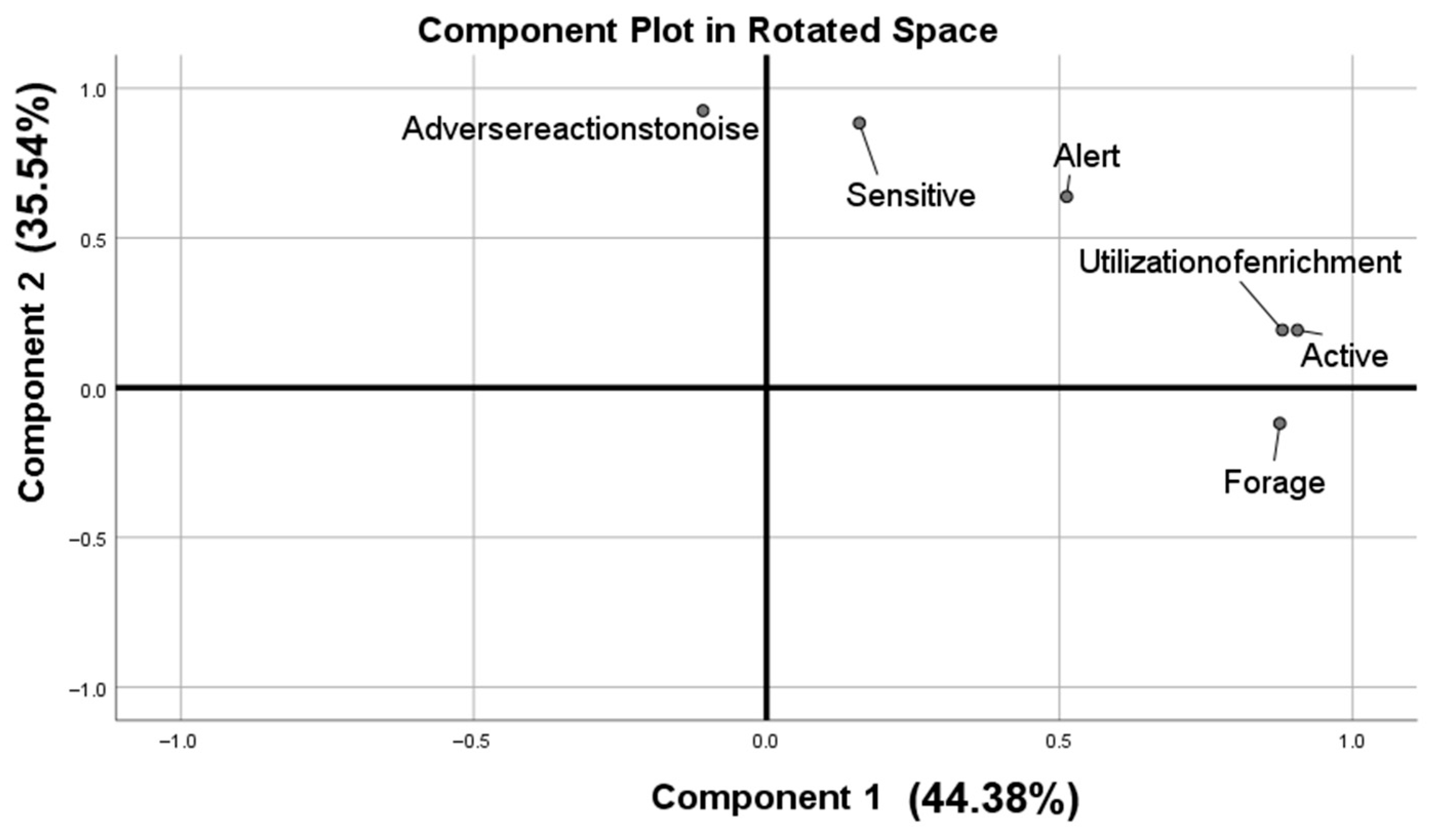
3.2. Principal Components Analyses
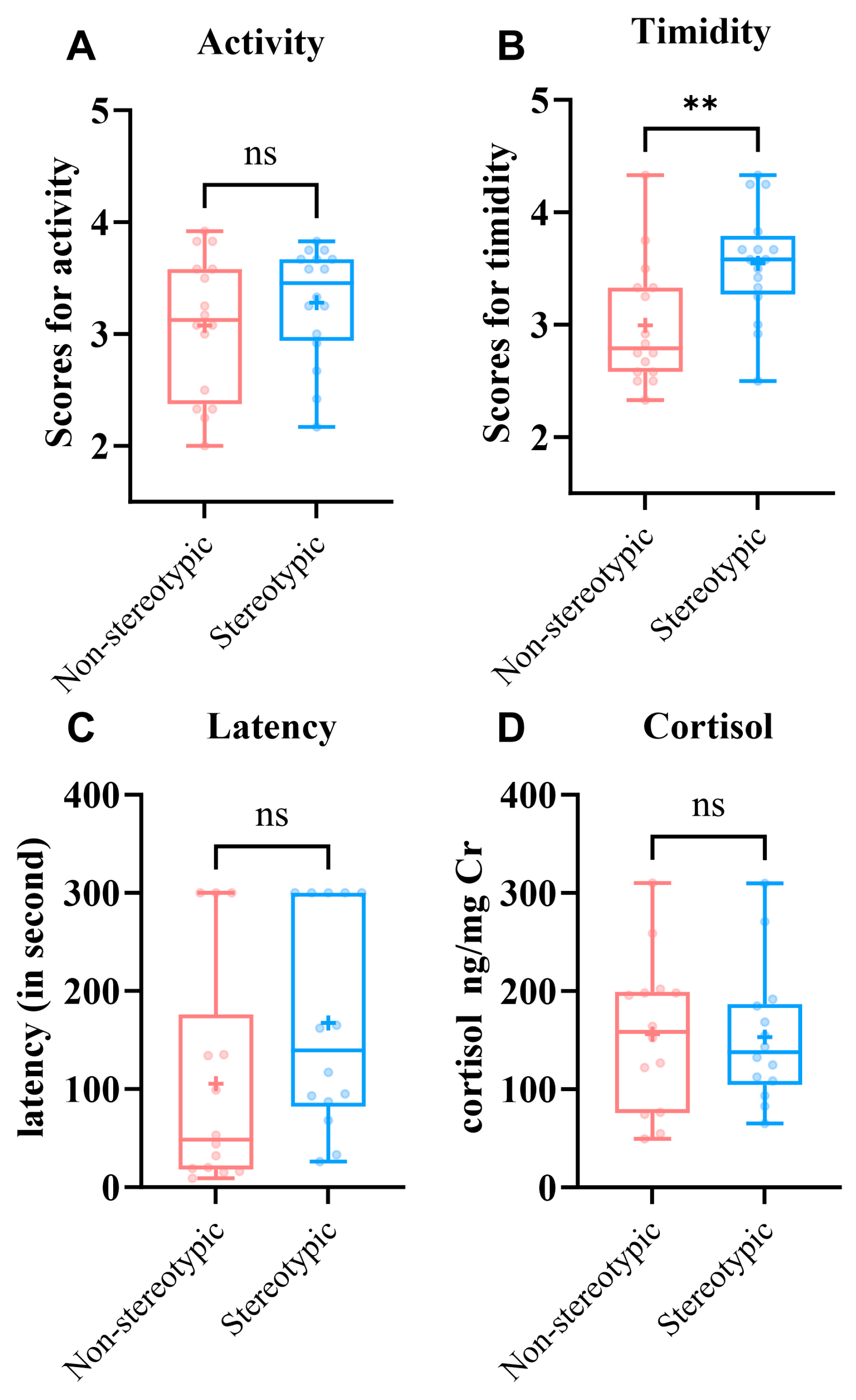
3.3. Group Differences (Non-Stereotypic vs. Stereotypic)
- Activity (Figure 2A), there was no significant difference between groups—non-stereotypic: 3.125 (2.46–3.58) vs. stereotypic: 3.458 (2.855–3.688); Z = −0.926, p = 0.355.
- Timidity (Figure 2B), the non-stereotypic group scored lower—2.99 ± 0.55 vs. 3.55 ± 0.49—and the difference was statistically significant (t = −3.003, p = 0.005).
- Crate entry training (Figure 2C), the non-stereotypic group entered the transport crate faster, with a latency of 48.5 s (18.25–176.25) vs. 139.5 s (82.25–300.00) in the stereotypic group; the difference was not statistically significant (Z = −1.790, p = 0.074), although non-stereotypic pandas tended to enter faster on average.

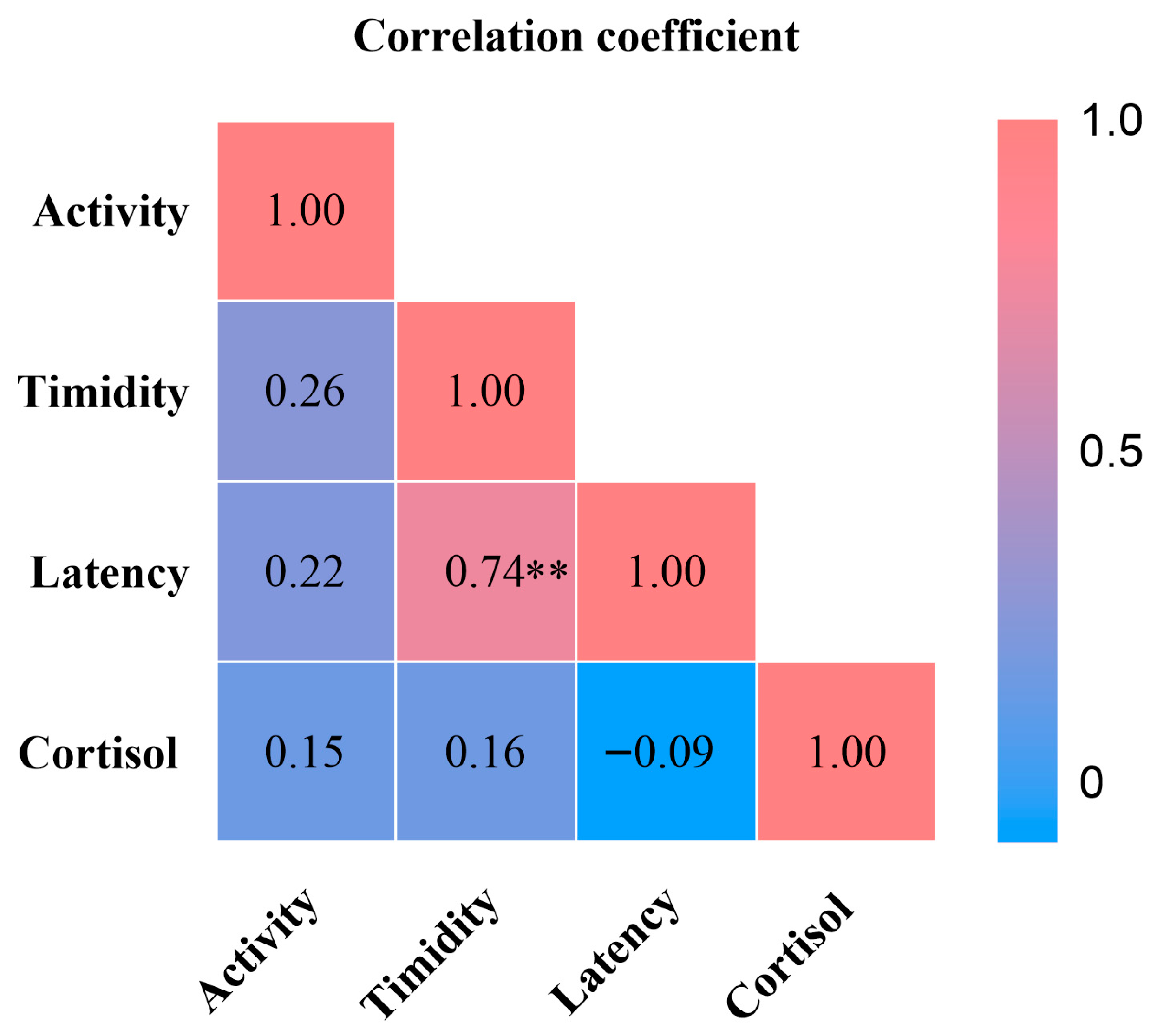
3.4. Spearman’s Rank Correlations
3.5. Regression Analyses
4. Discussion
5. Conclusions
Author Contributions
Funding
Institutional Review Board Statement
Informed Consent Statement
Data Availability Statement
Acknowledgments
Conflicts of Interest
Abbreviations
| AFT | Accelerated Failure Time model |
| CI | Confidence Interval |
| Cr | Creatinine |
| CRBGPB | Chengdu Research Base of Giant Panda Breeding |
| ELISA | Enzyme-Linked Immunosorbent Assay |
| HPA axis | Hypothalamic–Pituitary–Adrenal axis |
| HR | Hazard Ratio |
| HRP | Horseradish Peroxidase |
| ICC | Intraclass Correlation Coefficient |
| IgG | Immunoglobulin G |
| KMO | Kaiser–Meyer–Olkin statistic |
| KM | Kaplan–Meier |
| PCA | Principal Component Analysis |
| PC | Principal Component |
| TR | Time Ratio |
References
- Réale, D.; Reader, S.M.; Sol, D.; McDougall, P.T.; Dingemanse, N.J. Integrating animal temperament within ecology and evolution. Biol. Rev. 2007, 82, 291–318. [Google Scholar] [CrossRef]
- Watters, J.V.; Powell, D.M. Measuring animal personality for use in population management in zoos: Suggested methods and rationale. Zoo. Biol. 2012, 31, 1–12. [Google Scholar] [CrossRef]
- Sánchez-Tójar, A.; Moiron, M.; Niemelä, P.T. Terminology use in animal personality research: A self-report questionnaire and a systematic review. Proc. Biol. Sci. 2022, 289, 20212259. [Google Scholar] [CrossRef]
- Merrick, M.J.; Koprowski, J.L. Should we consider individual behavior differences in applied wildlife conservation studies? Biol. Conserv. 2017, 209, 34–44. [Google Scholar] [CrossRef]
- Corsetti, S.; Borruso, S.; Di Traglia, M.; Lai, O.; Alfieri, L.; Villavecchia, A.; Cariola, G.; Spaziani, A.; Natoli, E. Bold personality makes domestic dogs entering a shelter less vulnerable to diseases. PLoS ONE 2018, 13, e0193794. [Google Scholar] [CrossRef] [PubMed]
- Ijichi, C.; Collins, L.M.; Elwood, R.W. Pain expression is linked to personality in horses. Appl. Anim. Behav. Sci. 2014, 152, 38–43. [Google Scholar] [CrossRef]
- Benhajali, H.; Ezzaouia, M.; Lunel, C.; Charfi, F.; Hausberger, M. Stereotypic behaviours and mating success in domestic mares. Appl. Anim. Behav. Sci. 2014, 153, 36–42. [Google Scholar] [CrossRef]
- Lutz, C.; Well, A.; Novak, M. Stereotypic and self-injurious behavior in rhesus macaques: A survey and retrospective analysis of environment and early experience. Am. J. Primatol. 2003, 60, 1–15. [Google Scholar] [CrossRef] [PubMed]
- Muñoz, L.; Donaire, C.; Salazar, T.; Ortiz, R.; Cruces, J.; Briones, M. Heritability of Locomotor Stereotypies in Chilean Horses. J. Equine Vet. Sci. 2021, 105, 103702. [Google Scholar] [CrossRef]
- Greco, B.J.; Meehan, C.L.; Hogan, J.N.; Leighty, K.A.; Mellen, J.; Mason, G.J.; Mench, J.A. The Days and Nights of Zoo Elephants: Using Epidemiology to Better Understand Stereotypic Behavior of African Elephants (Loxodonta africana) and Asian Elephants (Elephas maximus) in North American Zoos. PLoS ONE 2016, 11, e0144276. [Google Scholar] [CrossRef]
- Bernardino, T.; Tatemoto, P.; Morrone, B.; Mazza Rodrigues, P.H.; Zanella, A.J. Piglets Born from Sows Fed High Fibre Diets during Pregnancy Are Less Aggressive Prior to Weaning. PLoS ONE 2016, 11, e0167363. [Google Scholar] [CrossRef]
- Vaz, J.; Narayan, E.J.; Dileep Kumar, R.; Thenmozhi, K.; Thiyagesan, K.; Baskaran, N. Prevalence and determinants of stereotypic behaviours and physiological stress among tigers and leopards in Indian zoos. PLoS ONE 2017, 12, e0174711. [Google Scholar] [CrossRef]
- Ahola, M.K.; Vapalahti, K.; Lohi, H. Early weaning increases aggression and stereotypic behaviour in cats. Sci. Rep. 2017, 7, 10412. [Google Scholar] [CrossRef] [PubMed]
- Díez-León, M.; Bowman, J.; Bursian, S.; Filion, H.; Galicia, D.; Kanefsky, J.; Napolitano, A.; Palme, R.; Schulte-Hostedde, A.; Scribner, K.; et al. Environmentally enriched male mink gain more copulations than stereotypic, barren-reared competitors. PLoS ONE 2013, 8, e80494. [Google Scholar] [CrossRef] [PubMed]
- Baker, K.C.; Bloomsmith, M.A.; Oettinger, B.; Neu, K.; Griffis, C.; Schoof, V.; Maloney, M. Benefits of pair housing are consistent across a diverse population of rhesus macaques. Appl. Anim. Behav. Sci. 2012, 137, 148–156. [Google Scholar] [CrossRef]
- Spiezio, C.; Vaglio, S.; Scala, C.; Regaiolli, B. Does positive reinforcement training affect the behaviour and welfare of zoo animals? The case of the ring-tailed lemur (Lemur catta). Appl. Anim. Behav. Sci. 2017, 196, 91–99. [Google Scholar] [CrossRef]
- Ghavamian, Y.; Minier, D.E.; Jaffe, K.E. Effects of Complex Feeding Enrichment on the Behavior of Captive Malayan Sun Bears (Helarctos malayanus). J. Appl. Anim. Welf. Sci. 2023, 26, 670–684. [Google Scholar] [CrossRef]
- Donald, K.; Benedetti, A.; Goulart, V.; Deming, A.; Nollens, H.; Stafford, G.; Brando, S. Environmental Enrichment Devices Are Safe and Effective at Reducing Undesirable Behaviors in California Sea Lions and Northern Elephant Seals during Rehabilitation. Animals 2023, 13, 1222. [Google Scholar] [CrossRef]
- Jackson, M.N.; Truelove, M.A.; Williams, K.; Chen, J.; Moore, R.H.; Wood, J.S.; Cohen, J.K.; Mollie, B. Effects of pair housing on behavior, cortisol, and clinical outcomes during quarantine-like procedures for rhesus macaques (Macaca mulatta). J. Med. Primatol. 2023, 52, 108–120. [Google Scholar] [CrossRef]
- Alejandro, J.; Yamanashi, Y.; Nemoto, K.; Bercovitch, F.B.; Huffman, M.A. Behavioral Changes of Solitary Housed Female Pygmy Slow Lorises (Nycticebus pygmeaus) after Introduction into Group Enclosures. Animals 2021, 11, 2751. [Google Scholar] [CrossRef]
- Scott, N.L.; LaDue, C.A. The behavioral effects of exhibit size versus complexity in African elephants: A potential solution for smaller spaces. Zoo. Biol. 2019, 38, 448–457. [Google Scholar] [CrossRef] [PubMed]
- Lesimple, C.; Gautier, E.; Benhajali, H.; Rochais, C.; Lunel, C.; Bensaïd, S.; Khalloufi, A.; Henry, S.; Hausberger, M. Stall architecture influences horses’ behaviour and the prevalence and type of stereotypies. Appl. Anim. Behav. Sci. 2019, 219, 104833. [Google Scholar] [CrossRef]
- Schork, I.G.; de Azevedo, C.S.; Young, R.J. Personality, abnormal behaviour, and health: An evaluation of the welfare of police horses. PLoS ONE 2018, 13, e0202750. [Google Scholar] [CrossRef]
- Święcicka, N.; Bogucki, M.; Kołodziejska-Sawerska, A. The impact of temperament type on the occurrence of stereotypic behaviour in chinchillas. Acta Sci. Pol. Zootech. 2022, 21, 19–26. [Google Scholar] [CrossRef]
- Goswami, S.; Tyagi, P.C.; Malik, P.K.; Pandit, S.J.; Kadivar, R.F.; Fitzpatrick, M.; Mondol, S. Effects of personality and rearing-history on the welfare of captive Asiatic lions (Panthera leo persica). PeerJ 2020, 8, e8425. [Google Scholar] [CrossRef]
- Vaz, J.; Bartley, A.; Hunt, J.; Schork, I.G.; de Azevedo, C.S.; Young, R.J. Personality matters: Exploring the relationship between personality and stress physiology in captive African lions. BMC Zool. 2022, 7, 30. [Google Scholar] [CrossRef] [PubMed]
- Grand, A.P.; Kuhar, C.W.; Leighty, K.A.; Bettinger, T.L.; Laudenslager, M.L. Using personality ratings and cortisol to characterize individual differences in African Elephants (Loxodonta africana). Appl. Anim. Behav. Sci. 2012, 142, 69–75. [Google Scholar] [CrossRef]
- Huang, W.; Wang, X.; Zhou, X.; Wu, J.; Lu, X.; Shakun, V.; Solovej, I.; Li, Y.; Zhou, M.; Meng, X. Relationships between boldness and fecal steroid hormone levels in captive alpine musk deer (Moschus chrysogaster) in China. Appl. Anim. Behav. Sci. 2024, 278, 106367. [Google Scholar] [CrossRef]
- Zhou, X.; Lv, Q.; Qin, Y.; Yuan, N.; Li, Y.; Zhou, M.; Meng, X. Effects of social stress on the welfare of captive male alpine musk deer: Stereotypic behavior, fecal cortisol, and musk secretion. Appl. Anim. Behav. Sci. 2023, 258, 105828. [Google Scholar] [CrossRef]
- Koyama, H.; Tachibana, Y.; Takaura, K.; Takemoto, S.; Morii, K.; Wada, S.; Kaneko, H.; Kimura, M.; Toyoda, A. Effects of housing conditions on behaviors and biochemical parameters in juvenile cynomolgus monkeys (Macaca fascicularis). Exp. Anim. 2019, 68, 195–211. [Google Scholar] [CrossRef]
- Karaer, M.C.; Čebulj-Kadunc, N.; Snoj, T.; Sánchez-Tójar, A.; Moiron, M.; Niemelä, P.T. Stress in wildlife: Comparison of the stress response among domestic, captive, and free-ranging animals. Front. Vet. Sci. 2023, 10, 1167016. [Google Scholar] [CrossRef]
- Dougherty, L.R.; Guillette, L.M. Linking personality and cognition: A meta-analysis. Philos. Trans. R. Soc. B Biol. Sci. 2018, 373, 20170282. [Google Scholar] [CrossRef]
- Šlipogor, V.; Graf, C.; Massen, J.J.; Bugnyar, T. Personality and social environment predict cognitive performance in common marmosets (Callithrix jacchus). Sci. Rep. 2022, 12, 6702. [Google Scholar] [CrossRef]
- Swaisgood, R.R.; Wang, D.; Wei, F. Panda Downlisted but not Out of the Woods. Conserv. Lett. 2018, 11, e12355. [Google Scholar] [CrossRef]
- Wei, F.; Swaisgood, R.; Hu, Y.; Nie, Y.; Yan, L.; Zhang, Z.; Qi, D.; Zhu, L. Progress in the ecology and conservation of giant pandas. Conserv. Biol. 2015, 29, 1497–1507. [Google Scholar] [CrossRef] [PubMed]
- Nie, Y.; Speakman, J.R.; Wu, Q.; Zhang, C.; Hu, Y.; Xia, M.; Yan, L.; Hambly, C.; Wang, L.; Wei, W. Exceptionally low daily energy expenditure in the bamboo-eating giant panda. Science 2015, 349, 171–174. [Google Scholar] [CrossRef] [PubMed]
- Xue, Z.; Zhang, W.; Wang, L.; Hou, R.; Zhang, M.; Fei, L.; Zhang, X.; Huang, H.; Bridgewater, L.C.; Jiang, Y.; et al. The bamboo-eating giant panda harbors a carnivore-like gut microbiota, with excessive seasonal variations. mBio 2015, 6, e00022-00015. [Google Scholar] [CrossRef]
- Martin-Wintle, M.S.; Kersey, D.C.; Wintle, N.J.; Aitken-Palmer, C.; Owen, M.A.; Swaisgood, R.R. Comprehensive breeding techniques for the giant panda. In Reproductive Sciences in Animal Conservation; Springer: Cham, Switzerland, 2019; pp. 275–308. [Google Scholar] [CrossRef]
- Gandia, K.M.; Herrelko, E.S.; Kessler, S.E.; Buchanan-Smith, H.M. Understanding circadian and circannual behavioral cycles of captive Giant pandas (Ailuropoda melanoleuca) can help to promote good welfare. Animals 2023, 13, 2401. [Google Scholar] [CrossRef]
- Zhang, M.-Y.; Zhang, X.-H.; Ayala, J.; Hou, R. Effects of different nursing methods on the behavioral response of adult captive giant pandas (Ailuropoda melanoleuca). Animals 2021, 11, 626. [Google Scholar] [CrossRef] [PubMed]
- Zhang, X.; Wang, X.; Ayala, J.; Liu, Y.; An, J.; Wang, D.; Cai, Z.; Hou, R.; Zhang, M. Possible effects of early maternal separation on the gut microbiota of captive adult giant pandas. Animals 2022, 12, 2587. [Google Scholar] [CrossRef]
- Zhang, M.-Y.; Yuan, B.; Zhang, X.-H.; Hou, J.A.R. Effects of Pinus koraiensis Bark Substrate on the Behavioural Responses of Captive Giant Pandas. Pak. J. Zool. 2021, 53, 801–1200. [Google Scholar] [CrossRef]
- Martin, M.S.; Owen, M.; Wintle, N.J.; Zhang, G.; Zhang, H.; Swaisgood, R.R. Stereotypic behaviour predicts reproductive performance and litter sex ratio in giant pandas. Sci. Rep. 2020, 10, 7263. [Google Scholar] [CrossRef]
- Liu, J.; Chen, Y.; Guo, L.; Gu, B.; Liu, H.; Hou, A.; Liu, X.; Sun, L.; Liu, D. Stereotypic behavior and fecal cortisol level in captive giant pandas in relation to environmental enrichment. Zoo. Biol. Publ. Affil. Am. Zoo. Aquar. Assoc. 2006, 25, 445–459. [Google Scholar] [CrossRef]
- Liu, G.; Guan, T.; Dai, Q.; Li, H.; Gong, M. Impacts of temperature on giant panda habitat in the north Minshan Mountains. Ecol. Evol. 2016, 6, 987–996. [Google Scholar] [CrossRef]
- Tetley, C.L.; O’Hara, S.J. Ratings of animal personality as a tool for improving the breeding, management and welfare of zoo mammals. Anim. Welf. 2012, 21, 463–476. [Google Scholar] [CrossRef]
- Martin-Wintle, M.S.; Shepherdson, D.; Zhang, G.; Huang, Y.; Luo, B.; Swaisgood, R.R. Do opposites attract? Effects of personality matching in breeding pairs of captive giant pandas on reproductive success. Biol. Conserv. 2017, 207, 27–37. [Google Scholar] [CrossRef]
- Powell, D.M.; Svoke, J.T. Novel environmental enrichment may provide a tool for rapid assessment of animal personality: A case study with giant pandas (Ailuropoda melanoleuca). J. Appl. Anim. Welf. Sci. 2008, 11, 301–318. [Google Scholar] [CrossRef] [PubMed]
- Dai, F.; Toson, M.; Bertotto, D.; Dalla Costa, A.; Heinzl, E.U.L.; Lega, F.; Minero, M.; Padalino, B.; Stefani, A.L.; Trestini, S.; et al. Transportation to the Slaughterhouse: Can Training Reduce the Stress Response in Horses? Vet. Sci. 2025, 12, 547. [Google Scholar] [CrossRef] [PubMed]
- Dai, F.; Mazzola, S.; Cannas, S.; Heinzl, E.U.L.; Padalino, B.; Minero, M.; Dalla Costa, E. Habituation to Transport Helps Reducing Stress-Related Behavior in Donkeys During Loading. Front. Vet. Sci. 2020, 7, 593138. [Google Scholar] [CrossRef]
- Gruen, M.E.; Thomson, A.E.; Clary, G.P.; Hamilton, A.K.; Hudson, L.C.; Meeker, R.B.; Sherman, B.L. Conditioning laboratory cats to handling and transport. Lab Anim. 2013, 42, 385–389. [Google Scholar] [CrossRef]
- Verspeek, J.; Behringer, V.; Laméris, D.W.; Murtagh, R.; Salas, M.; Staes, N.; Deschner, T.; Stevens, J.M. Time-lag of urinary and salivary cortisol response after a psychological stressor in bonobos (Pan paniscus). Sci. Rep. 2021, 11, 7905. [Google Scholar] [CrossRef]
- Wang, X.; Yuan, B.; Huang, H.; Zhang, X.; Liu, Y.; Hou, R.; Zhang, M. Abnormal expression of natural mating behaviour of captive adult giant pandas is related to physiological stress. Conserv. Physiol. 2024, 12, coae061. [Google Scholar] [CrossRef]
- Yuan, B.; Fu, Q.; Wang, X.Y.; Zhang, X.H.; Liu, Y.L.; Hou, R.; Zhang, M.Y. Effects of Social Group Housing on the Behavioral and Physiological Responses of Captive Sub-Adult Giant Pandas. Animals 2024, 14, 2545. [Google Scholar] [CrossRef] [PubMed]
- Shrout, P.E.; Fleiss, J.L. Intraclass correlations: Uses in assessing rater reliability. Psychol. Bull. 1979, 86, 420–428. [Google Scholar] [CrossRef]
- Koo, T.K.; Li, M.Y. A Guideline of Selecting and Reporting Intraclass Correlation Coefficients for Reliability Research. J. Chiropr. Med. 2016, 15, 155–163. [Google Scholar] [CrossRef] [PubMed]
- Williams, E.; Carter, A.; Hall, C.; Bremner-Harrison, S. Exploring the relationship between personality and social interactions in zoo-housed elephants: Incorporation of keeper expertise. Appl. Anim. Behav. Sci. 2019, 221, 104876. [Google Scholar] [CrossRef]
- Koolhaas, J.M.; Korte, S.M.; De Boer, S.F.; Van Der Vegt, B.J.; Van Reenen, C.G.; Hopster, H.; De Jong, I.C.; Ruis, M.A.; Blokhuis, H.J. Coping styles in animals: Current status in behavior and stress-physiology. Neurosci. Biobehav. Rev. 1999, 23, 925–935. [Google Scholar] [CrossRef]
- van Zeeland, Y.R.A.; van der Aa, M.M.J.A.; Vinke, C.M.; Lumeij, J.T.; Schoemaker, N.J. Behavioural testing to determine differences between coping styles in Grey parrots (Psittacus erithacus erithacus) with and without feather damaging behaviour. Appl. Anim. Behav. Sci. 2013, 148, 218–231. [Google Scholar] [CrossRef]
- Cools, A.R.; Brachten, R.; Heeren, D.; Willemen, A.; Ellenbroek, B. Search after neurobiological profile of individual-specific features of Wistar rats. Brain Res. Bull. 1990, 24, 49–69. [Google Scholar] [CrossRef]
- Koolhaas, J.M.; de Boer, S.F.; Coppens, C.M.; Buwalda, B. Neuroendocrinology of coping styles: Towards understanding the biology of individual variation. Front. Neuroendocrinol. 2010, 31, 307–321. [Google Scholar] [CrossRef]
- Cussen, V.A.; Mench, J.A. The Relationship between Personality Dimensions and Resiliency to Environmental Stress in Orange-Winged Amazon Parrots (Amazona amazonica), as Indicated by the Development of Abnormal Behaviors. PLoS ONE 2015, 10, e0126170. [Google Scholar] [CrossRef]
- Herrelko, E.S.; Vick, S.J.; Buchanan-Smith, H.M. Cognitive research in zoo-housed chimpanzees: Influence of personality and impact on welfare. Am. J. Primatol. 2012, 74, 828–840. [Google Scholar] [CrossRef]
- Bondy, E.; Baranger, D.A.A.; Balbona, J.; Sputo, K.; Paul, S.E.; Oltmanns, T.F.; Bogdan, R. Neuroticism and reward-related ventral striatum activity: Probing vulnerability to stress-related depression. J. Abnorm. Psychol. 2021, 130, 223–235. [Google Scholar] [CrossRef]
- Klein, R.J.; Robinson, M.D. Neuroticism as mental noise: Evidence from a continuous tracking task. J. Personal. 2019, 87, 1221–1233. [Google Scholar] [CrossRef] [PubMed]
- Blaszczyk, M.B. Boldness towards novel objects predicts predator inspection in wild vervet monkeys. Anim. Behav. 2017, 123, 91–100. [Google Scholar] [CrossRef]
- Goursot, C.; Düpjan, S.; Kanitz, E.; Tuchscherer, A.; Puppe, B.; Leliveld, L.M.C. Assessing animal individuality: Links between personality and laterality in pigs. Curr. Zool. 2019, 65, 541–551. [Google Scholar] [CrossRef]
- Stiegler, J.; Lins, A.; Dammhahn, M.; Kramer-Schadt, S.; Ortmann, S.; Blaum, N. Personality drives activity and space use in a mammalian herbivore. Mov. Ecol. 2022, 10, 33. [Google Scholar] [CrossRef]
- Clary, D.; Skyner, L.J.; Ryan, C.P.; Gardiner, L.E.; Anderson, W.G.; Hare, J.F. Shyness–Boldness, but not Exploration, Predicts Glucocorticoid Stress Response in Richardson’s Ground Squirrels (Urocitellus richardsonii). Ethology 2014, 120, 1101–1109. [Google Scholar] [CrossRef]
- Thomson, J.S.; Watts, P.C.; Pottinger, T.G.; Sneddon, L.U. Physiological and genetic correlates of boldness: Characterising the mechanisms of behavioural variation in rainbow trout, Oncorhynchus mykiss. Horm. Behav. 2011, 59, 67–74. [Google Scholar] [CrossRef]
- Owen, M.A.; Czekala, N.M.; Swaisgood, R.R.; Steinman, K.; Lindburg, D.G. Seasonal and diurnal dynamics of glucocorticoids and behavior in giant pandas. Ursus 2005, 16, 208–221. [Google Scholar] [CrossRef]
- Anestis, S.F.; Bribiescas, R.G.; Hasselschwert, D.L. Age, rank, and personality effects on the cortisol sedation stress response in young chimpanzees. Physiol. Behav. 2006, 89, 287–294. [Google Scholar] [CrossRef] [PubMed]
- Cockrem, J.F. Individual variation in glucocorticoid stress responses in animals. Gen. Comp. Endocrinol. 2013, 181, 45–58. [Google Scholar] [CrossRef] [PubMed]



| Stereotypic Behaviors | Definition |
|---|---|
| Stereotypic Pace | Back and forth or perimeter travels in a repetitive, sustained, stereotyped pattern. |
| Pirouette | Stands on hind legs and spins at least 90 degrees. |
| Head Toss | Abruptly lifts head upward and/or to the side in a swinging movement. Often occurs during pacing (especially when turning). |
| Rock | Shifts weight from side to side, but remains stationary. Often occurs in anticipation of feeding. |
| Roll | Frequently rolls its body while walking (especially when turning). |
| Walk Backward | Repetitive backward walking along a fixed route in calm conditions. |
| Suck | Sucks on parts of its own body (e.g., paws, chest), or the body of other individuals. This behavior is mainly seen in cubs. |
| Area | Animal ID | Sex | Age | Stereotypic Behaviors |
|---|---|---|---|---|
| 1 | 1 | M | 18 | / |
| 2 | F | 18 | / | |
| 3 | M | 8 | Rock | |
| 4 | F | 13 | / | |
| 5 | M | 7 | / | |
| 6 | F | 9 | Pirouette | |
| 7 | M | 17 | Stereotypic Pace, Roll | |
| 8 | M | 7 | Stereotypic Pace | |
| 2 | 9 | F | 10 | Stereotypic Pace, Head Toss |
| 10 | F | 10 | Stereotypic Pace, Head Toss | |
| 11 | M | 7 | Walk Backward | |
| 12 | M | 23 | / | |
| 13 | F | 8 | / | |
| 14 | M | 19 | Stereotypic Pace, Head Toss | |
| 15 | M | 23 | / | |
| 16 | F | 17 | Stereotypic Pace, Head Toss | |
| 17 | M | 8 | / | |
| 18 | F | 20 | / | |
| 19 | M | 24 | / | |
| 20 | F | 25 | / | |
| 3 | 21 | M | 9 | / |
| 22 | F | 8 | / | |
| 23 | F | 21 | Stereotypic Pace, Head Toss | |
| 24 | F | 21 | Stereotypic Pace, Head Toss | |
| 25 | M | 6 | / | |
| 4 | 26 | M | 5 | Pirouette |
| 27 | M | 7 | Stereotypic Pace, Head Toss | |
| 28 | F | 12 | Stereotypic Pace, Head Toss | |
| 29 | F | 25 | Rock | |
| 30 | M | 9 | Rock | |
| 5 | 31 | F | 11 | / |
| 32 | M | 16 | / |
| Trait | Definition |
|---|---|
| Curious/Explorative | Readily approaches and explores changes in the environment |
| Adaptable | Adaptability to new environments. |
| Innovative | Solves problems and creates new behaviors (e.g., using new enrichments or tools). |
| Smart | Learns quickly to associate certain events and seems to remember for a long time. |
| Aggressive to people | Reacts in a hostile way or attempts to attack/threaten people. |
| Aggressive to panda | Reacts in a hostile way or attempts to attack/threaten other pandas. |
| Friendly to people | Initiates proximity reacts socially to people. |
| Friendly to panda | Initiates proximity reacts socially to other pandas. |
| Cooperative | Actively participates in behavioral training and cooperates to complete training tasks. |
| Olfactory Investigation | Sniffs for a long time at scent-marked locations. |
| Active | Activity amount (e.g., walking, running, climbing, defecating, scent marking). |
| Utilization of enrichment | Duration of animal–enrichment interactions. |
| Playful | Playing duration (e.g., gamboling, rolling or using objects for entertainment). |
| Forage | Duration of foraging, including processing or consuming food. |
| Alert | Pays attention to surroundings and changes in surroundings. |
| Sensitive | Overreacts to minor disturbances in objects or situations. |
| Anxious | Easily disturbed or frightened, often in a state of restlessness. |
| Fearful | Retreats readily from people or pandas. |
| Adverse reactions to noise | Exhibits adverse reactions to anthropogenic noise (e.g., escaping, pacing, reducing foraging). |
| Personality Traits | PC 1 | PC 2 |
|---|---|---|
| Active | 0.906 | 0.192 |
| Utilization of enrichment | 0.880 | 0.192 |
| Forage | 0.876 | −0.119 |
| Adverse reactions to noise | −0.109 | 0.925 |
| Sensitive | 0.158 | 0.884 |
| Alert | 0.512 | 0.638 |
| Eigenvalue | 3.058 | 1.737 |
| Percent of variance | 44.380% | 35.538% |
| Cronbach’s alpha | 0.865 | 0.792 |
Disclaimer/Publisher’s Note: The statements, opinions and data contained in all publications are solely those of the individual author(s) and contributor(s) and not of MDPI and/or the editor(s). MDPI and/or the editor(s) disclaim responsibility for any injury to people or property resulting from any ideas, methods, instructions or products referred to in the content. |
© 2025 by the authors. Licensee MDPI, Basel, Switzerland. This article is an open access article distributed under the terms and conditions of the Creative Commons Attribution (CC BY) license (https://creativecommons.org/licenses/by/4.0/).
Share and Cite
Li, M.; Fan, X.; Huang, H.; Zhang, H.; Li, H.; Zhao, X.; Peng, W.; Yin, H.; Deng, T.; Wu, K.; et al. Personality, Stereotypy, and Responses to Crate Entry in Captive Giant Pandas. Animals 2025, 15, 3535. https://doi.org/10.3390/ani15243535
Li M, Fan X, Huang H, Zhang H, Li H, Zhao X, Peng W, Yin H, Deng T, Wu K, et al. Personality, Stereotypy, and Responses to Crate Entry in Captive Giant Pandas. Animals. 2025; 15(24):3535. https://doi.org/10.3390/ani15243535
Chicago/Turabian StyleLi, Ming, Xueyang Fan, He Huang, Hao Zhang, Han Li, Xingna Zhao, Wenpei Peng, Hong Yin, Tao Deng, Kongju Wu, and et al. 2025. "Personality, Stereotypy, and Responses to Crate Entry in Captive Giant Pandas" Animals 15, no. 24: 3535. https://doi.org/10.3390/ani15243535
APA StyleLi, M., Fan, X., Huang, H., Zhang, H., Li, H., Zhao, X., Peng, W., Yin, H., Deng, T., Wu, K., Li, M., & Yang, K. (2025). Personality, Stereotypy, and Responses to Crate Entry in Captive Giant Pandas. Animals, 15(24), 3535. https://doi.org/10.3390/ani15243535