Brief Report

Cryptic Divergence of Rochia nilotica (Gastropoda: Tegulidae) from Chuuk Lagoon, Federated States of Micronesia, Revealed by Morphological and Mitochondrial Genome Analyses

1
Tropical & Subtropical Research Center, Korea Institute of Ocean Science & Technology (KIOST), Jeju 63349, Republic of Korea
2
KIOST School, University of Science and Technology (UST), Daejeon 34113, Republic of Korea
3
Korea South Pacific Ocean Research Center, Korea Institute of Ocean Science & Technology (KIOST), Busan 49111, Republic of Korea
4
Jeju Research Institute, Korea Institute of Ocean Science & Technology (KIOST), Jeju 63349, Republic of Korea
5
Department of Life Science, Chung-Ang University, Seoul 06974, Republic of Korea
6
Aquafeed Research Center, National Institute of Fisheries Science, Pohang 37517, Republic of Korea
7
Research Cooperation Division, National Institute of Fisheries Science, Busan 46083, Republic of Korea
*
Author to whom correspondence should be addressed.
Animals 2025, 15(23), 3471; https://doi.org/10.3390/ani15233471 (registering DOI)
Submission received: 29 October 2025 / Revised: 29 November 2025 / Accepted: 30 November 2025 / Published: 2 December 2025

Simple Summary

Rochia nilotica is a tropical marine gastropod inhabiting Indo-Pacific coral reefs and is an important resource for many Pacific Island nations, where it is used both as food and as a source of shell material for traditional crafts. To better understand the genetic identity of this species in remote regions, we collected individuals from Weno Island in Chuuk Atoll, Federation of Micronesia, and analyzed their complete mitochondrial genome. We also compared two commonly used DNA markers (COX1 and 16S rRNA) together with 13 protein-coding genes from the mitochondrial genome to reconstruct their evolutionary relationships. The genetic results showed that the Chuuk population forms congruent topology with R. nilotica from other regions, but it also occupies a distinct position within the Rochia group. This pattern suggests that long-term geographic isolation of Chuuk Atoll may have shaped unique genetic characteristics in this population. These findings highlight the importance of combining DNA data with traditional shell-based identification to correctly recognize species. Such integrative approaches are essential for conserving marine biodiversity and supporting sustainable aquaculture and fisheries management in isolated reef ecosystems.

Abstract

Rochia nilotica is a tropical Pacific gastropod inhabiting shallow coral reef habitats and supporting important marine resources in Pacific island nations. In this study, we analyzed specimens collected from Weno Island, Chuuk Atoll, Federation States of Micronesia (FSM), using an integrative approach that combined morphological characteristics, molecular phylogenetics (COX1 and 16S rRNA), and complete mitochondrial genome analysis. While the Chuuk population exhibited morphological features consistent with R. nilotica, molecular data revealed substantial genetic divergence. Phylogenetic analyses based on the complete mitochondrial genome (17,664 bp) clustered the Chuuk specimen with Rochia virgata. Phylogenies inferred from concatenated COX1 and 16S rRNA gene sequences yielded congruent topologies, placing the Chuuk lineage within the Rochia clade but clearly separated from other R. nilotica populations in New Caledonia and Mo’orea Island, French Polynesia. This genetic divergence is likely driven by the long-term geographic isolation of Chuuk Atoll. The lagoon’s fringing reefs descend rapidly into waters exceeding 4000 m, which may act as a barrier to restricting larval dispersal. Combined with the extremely short planktonic larval duration of R. nilotica (approximately four days), such environmental isolation may promote the formation of a distinct gene pool. Despite morphological uniformity, the observed genetic divergence suggests that the Chuuk population may represent a cryptic species. Our study provides a complete mitochondrial genome and offers robust phylogenetic framework that provides an understanding of species boundaries within Rochia. These findings underscore the importance of integrating genomic and morphological data for accurate species identification and have implications for conservation and sustainable aquaculture practices in geographically isolated reef ecosystems.

1. Introduction

Rochia nilotica (Linnaeus, 1767), formerly known as Trochus niloticus Linnaeus, 1767, commonly known as the top shell, is a large marine gastropod belonging to the family Tegulidae, typically inhabiting shallow coral reef environments. This species has a broad distribution across the Indo-Pacific region, with its type locality in the Indian Ocean, and occurs from East Africa to northern Australia, Southeast Asia, and numerous South Pacific islands [1,2,3]. Adult individuals can attain shell heights up to 120 mm, and are primarily harvested for their thick, nacreous shells, which are used in the manufacture of buttons, ornaments, and other decorative products [4]. Intensive harvesting throughout its range has resulted in a significant decline in population densities and production yields [5]. In Pacific Island countries, annual production was estimated at approximately 1400 tons in the late 2010s, representing a 39% decrease from the 2300 tons estimate reported in 1996 [4]. This trend aligns with global declines exceeding 50% over the past two decades, primarily attributed to overexploitation [6].
Chuuk Atoll, located in the western region of the Federated States of Micronesia (FSM), is one of the largest and most ecologically significant atoll systems in the western Pacific. It comprises approximately 190 islands formed by volcanic activity during the Oligocene to Miocene epochs, arranged in an elliptical barrier reef that encloses a central lagoon [7]. The lagoon supports a diverse array of coral reefs, seagrass beds, and intertidal flats, which sustain a wide range of marine organisms and constitute a unique and highly biodiverse ecosystem [8,9]. In Chuuk, studies on reproductive cycle studies of R. nilotica have previously been conducted [10], and local efforts to develop production techniques and restore natural populations are currently underway. Despite the ecological and economic importance of the species, fundamental data on its morphological and genetic characteristics in Chuuk remain limited. This knowledge gap presents challenges for accurate species identification, understanding of population structure, and designing of effective conservation and resource management strategies. Therefore, a more comprehensive understanding of the Chuuk population is essential to support science-based restoration and sustainable utilization of R. nilotica in the region.
The use of mitochondrial genome data in taxonomic and phylogenetic studies has significantly enhanced resolution compared to analyses based on partial gene approaches, providing more comprehensive insights into molecular evolution, phylogenetics, and population genetics [11]. This approach is now widely employed in species identification and phylogenetic analysis of mollusks [12,13,14]. Although the mitochondrial genome of R. nilotica has been previously reported in Quanfu Island, South China Sea [15], the available record in NCBI remains unverified. In this study, we newly sequenced and annotated the complete mitochondrial genome of Rochia specimens from Chuuk Atoll. Based on the annotated mitogenome, we conducted molecular species identification and phylogenetic analyses to clarify the taxonomic status of the Chuuk population. The resulting data are expected to serve as a valuable reference for future research on resource conservation, physiological traits, and ecological dynamics of Rochia species.

2. Materials and Methods

2.1. Study Area and Sampling

Specimens of Rochia nilotica were collected by SCUBA diving from the northwestern fringing reef of Weno Island, Chuuk Atoll, FSM (7.458° N, 151.902° E), at 5–7 m depth (Figure 1A). Both adult individuals and juveniles (approximately one year old; with shell height of approximately 2 cm [16]) were sampled for morphological and molecular analyses (Figure 1B,C). Muscle tissue samples were dissected and stored at −20 °C until further processing for molecular analysis. All sampling and research activities were conducted under official authorization from of the Department of Marine Resources, Chuuk State Government, including permits for biological specimen collection, scientific research, and export.

2.2. Morphological Analysis

A total of 10 adult specimens were used for morphological classification. Shell biometric parameters, including shell height and width, were measured with digital calipers. For radula extraction, the buccal mass was dissected and digested in 2 M KOH at 60 °C for 2 h to remove soft tissue. The residual tissue was further cleaned with hydrogen peroxide. The cleaned radulae were air-dried and sputter-coated with platinum using Q150TS Sputter Coater (Quorum Technologies, Laughton, UK) for 60 s at a current of 20 mA. Scanning electron microscopy (SEM) imaging was performed using a MIRA3 Field Emission-SEM (Tescan, Brno, Czech Republic). Voucher specimens have been deposited at the Honam National Institute of Biological Resource (accession numbers: HNIBRIV 18781-18790).

2.3. Molecular Analysis

2.3.1. DNA Extraction and Sequencing

Total genomic DNA was extracted from the foot muscle tissue of a single specimen using a Qiagen DNeasy Blood & Tissue Kit (Qiagen, Hilden, Germany), following the manufacturer’s protocol. The complete mitochondrial genome was sequenced on Illumina NovaSeq 6000 platform with 2 × 151 bp paired-end reads (Illumina, San Diego, CA, USA) at JS Link Inc. (Seoul, Republic of Korea).
Raw reads were processed using Trim Galore! (v0.6.7) [17] to remove adapter sequences and low-quality bases (phred score ≥ 30), with reads of at least 120 bp retained for downstream analysis. The read quality was assessed using FastQC (v0.11.9) [18].
In addition, partial COX1 and 16S rRNA sequences were newly generated from five additional R. nilotica individuals collected in Chuuk Lagoon, and these sequences were incorporated into the genetic analyses; detailed methods are provided in the Supplementary Methods.

2.3.2. De Novo Assembly and Annotation

De novo assembly of mitochondrial genomes was performed using MitoZ (v3.3) [19] in conjunction with MEGAHIT (v1.2.9) [20]. The initially assembled linear mitochondrial genome was used as a seed in NOVOplasty (v4.3.5) [21] to obtain the complete circular mitogenome. COX1 gene fragments were extracted from the assembled mitogenomes and compared against the NCBI nucleotide database using BLAST (v2.16.0) for species identification. Genome annotation was performed using MITOS2 (v2.1.6) [22] to annotate protein-coding genes and RNAs. Circos (v0.69-8) [23] was employed to visualize genome features.

2.4. Phylogenetic Analysis

Phylogenetic analyses in this study were conducted using two independent datasets. The first analysis employed a concatenated alignment of partial mitochondrial COX1 and 16S rRNA gene sequences to determine the genetic divergence among Rochia species. The second analysis was based on a concatenated alignment of all 13 protein-coding genes (PCGs) from the complete mitochondrial genome, providing deeper phylogenetic resolution within the superfamily Trochoidea. Multiple sequence alignments were performed using MAFFT (ver. 7.520) [24]. Partitioning schemes and evolutionary models were selected using PartitionFinder2 (v2.1.1) [25] under the Akaike’s Information Criterion (AICc) and the ‘--raxml’ option. The best-fit models for PCGs included GTR + I + G (for ATP6, COX1, COX2, COX3, CYTB, ND1, ND2, ND3, ND4, ND4L, ND5, ND6, and 16S rRNA) and GTR + G (for ATP8). Maximum likelihood (ML) analyses were conducted with RAxML-ng (v1.2.0) [26] using 1000 bootstrap replicates. Bayesian inference (BI) was performed using MrBayes (v3.2.7) [27] using two independent MCMC runs of 1 × 10⁶ generations, sampling every 1000 generations, with 25% burn-in. The resulting phylogenetic trees were visualized in FigTree (v1.4.4). For both phylogenetic analyses, Rapana venosa (NC_011193.1), a member of Muricidae, was used as the outgroup to root the trees.

3. Results and Discussion

3.1. Morphological Characteristics of Rochia nilotica from Chuuk Atoll

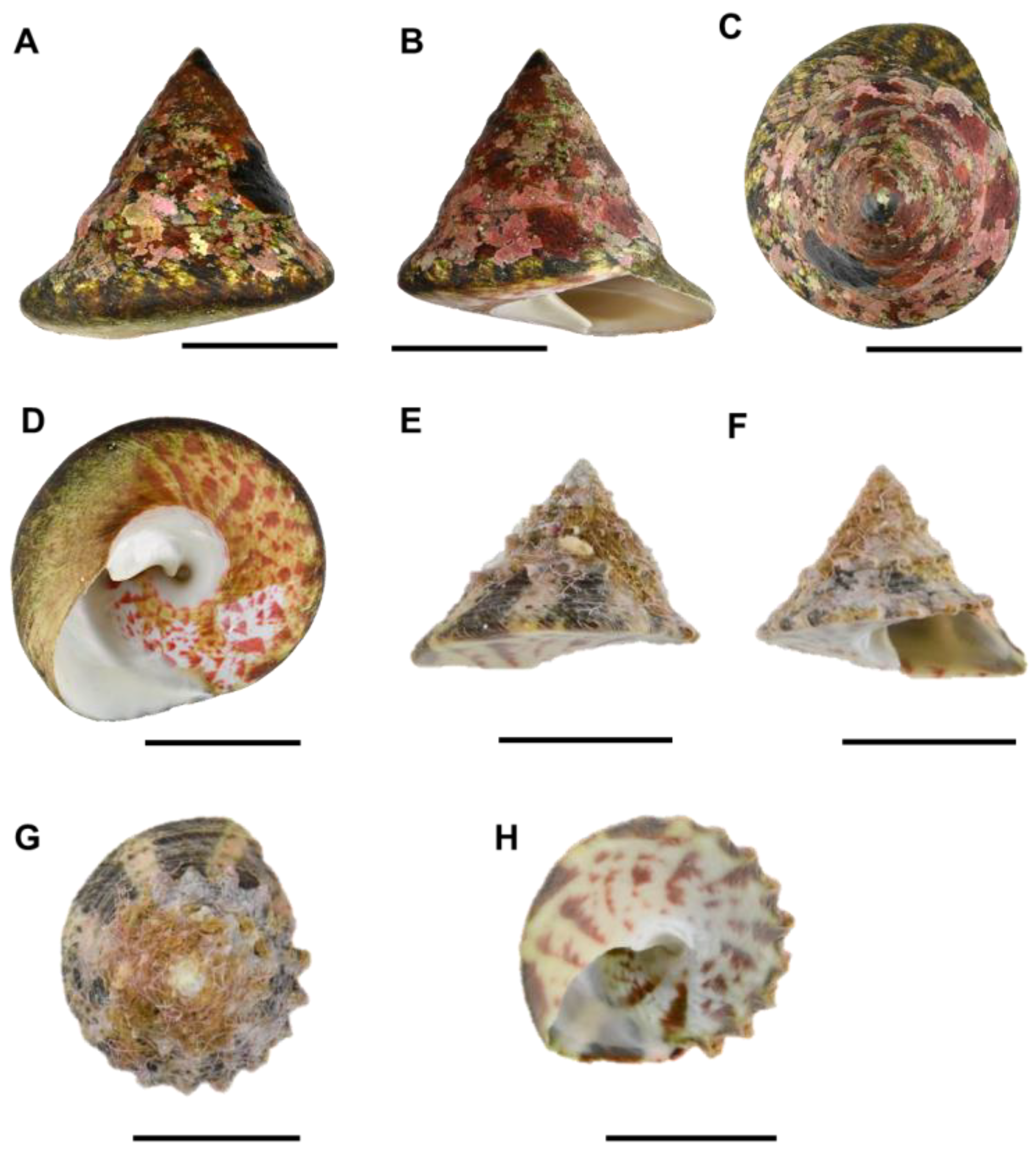
Specimens of R. nilotica collected from Weno Island exhibited morphological traits fully consistent with previous descriptions of R. nilotica. The shell is characteristically thick, smooth, and conical, lacking prominent external ridges (Figure 2A,B). The basal region near the aperture is slightly expanded, resulting in a rounded, outwardly curved appearance at the aperture margin (Figure 2A–C). Shell coloration comprises distinctive purplish-red radial streaks set against a predominantly white background, overlaid by a thin brown periostracum. This color pattern extends laterally and ventrally, while internally, the shells possess a highly lustrous nacreous layer. Additionally, a deep and open umbilicus, a prominent diagnostic feature distinguishing Rochia from closely related genera, such as Tectus within the family Tegulidae, was clearly observed (Figure 2D,H). Although the uppermost whorls in adult specimens were often eroded or obscured by encrusting algae, juvenile individuals clearly displayed sharply defined peripheral structures (Figure 2G,H). In particular, gear-like processes along the periphery and fine spiral riblets on the upper surface, as described by Okutani (2000) [28], were prominently observed in juveniles but became obsolete with growth, resulting in a smoother shell surface in adults. Shell proportion, expressed as the ratio of shell height to shell width (SH/SW), represent another key taxonomic characteristics within the genus Rochia.
Measurements from 10 adult individuals yielded SH/SW ratio of 0.95–10.4, closely aligning with previously reported values for R. nilotica populations in Indonesia [3,29] (Table 1).
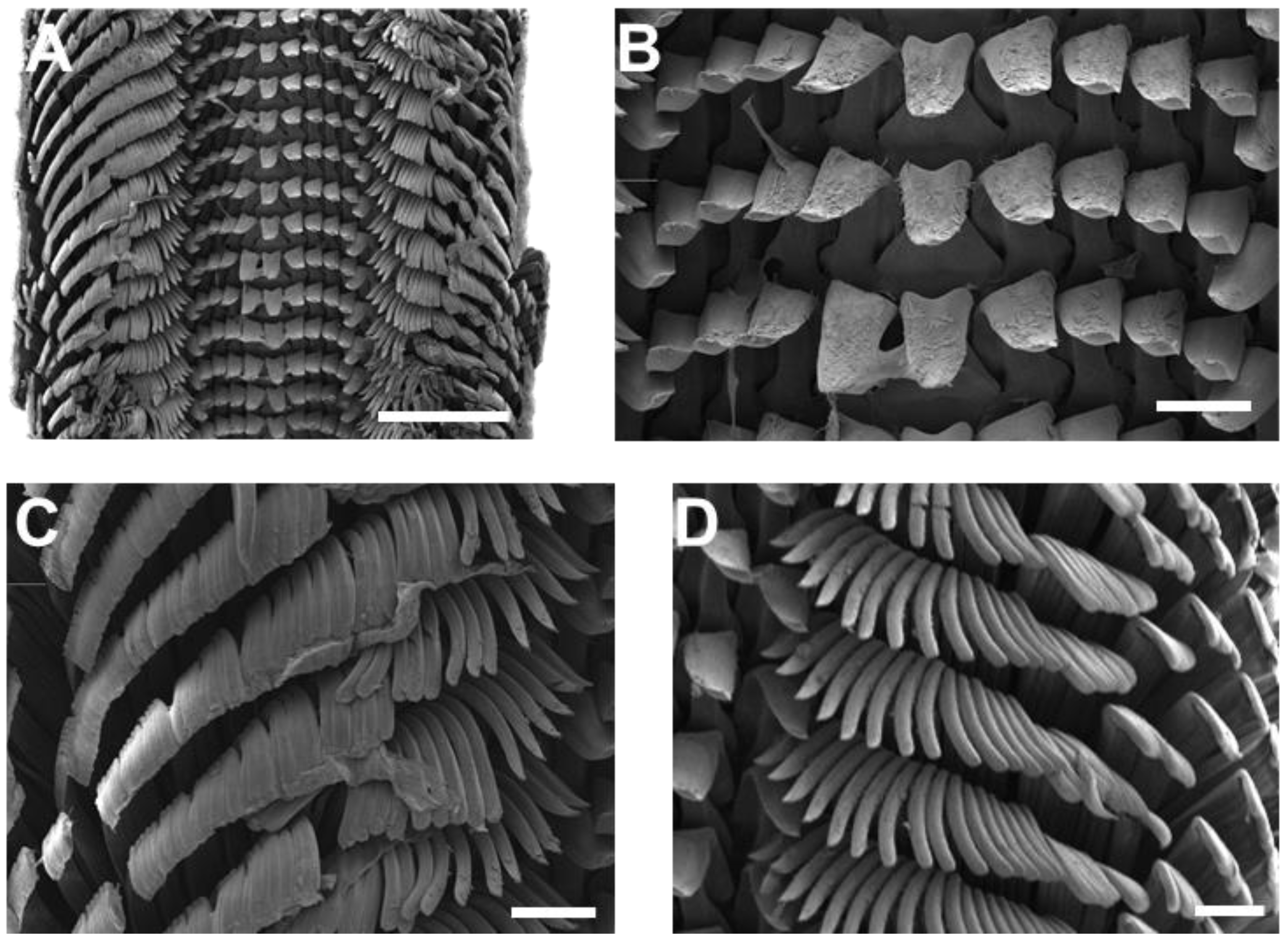
This comparatively moderate slope clearly distinguishes R. nilotica from congeners with steeper profiles, including R. conus (Gmelin, 1791) and R. maxima (F. C. L. Koch, 1844), as well as from other species not included in our phylogenetic analyses, such as R. elata (Lamarck, 1822), R. hirasei (Pilsbry, 1904), and R. magnifica (Poppe, 2004) [30,31]. Radular morphology observed in Chuuk specimens was rhipidoglossan, typical of vetigastropods (Figure 3A). Each radular row consists of a small central tooth, five lateral teeth on each side arranged symmetrically (Figure 3B), and approximately 30–40 slender marginal teeth (Figure 3C,D). Due to the current lack of comparative radular data across other Rochia species, the detailed radular description provided here serves as an essential morphological baseline. Although the Chuuk population of Rochia exhibited no apparent morphological differences from previously described R. nilotica [3,29], molecular analyses revealed significant genetic divergence. This incongruence between morphological uniformity and genetic divergence suggests the possibility of cryptic speciation. To resolve species-level taxonomy and evaluate regional patterns, comprehensive morphological and molecular comparisons across Rochia populations throughout the Indo-Pacific region will be necessary.

3.2. Mitochondrial Genome Characterization and Phylogeny

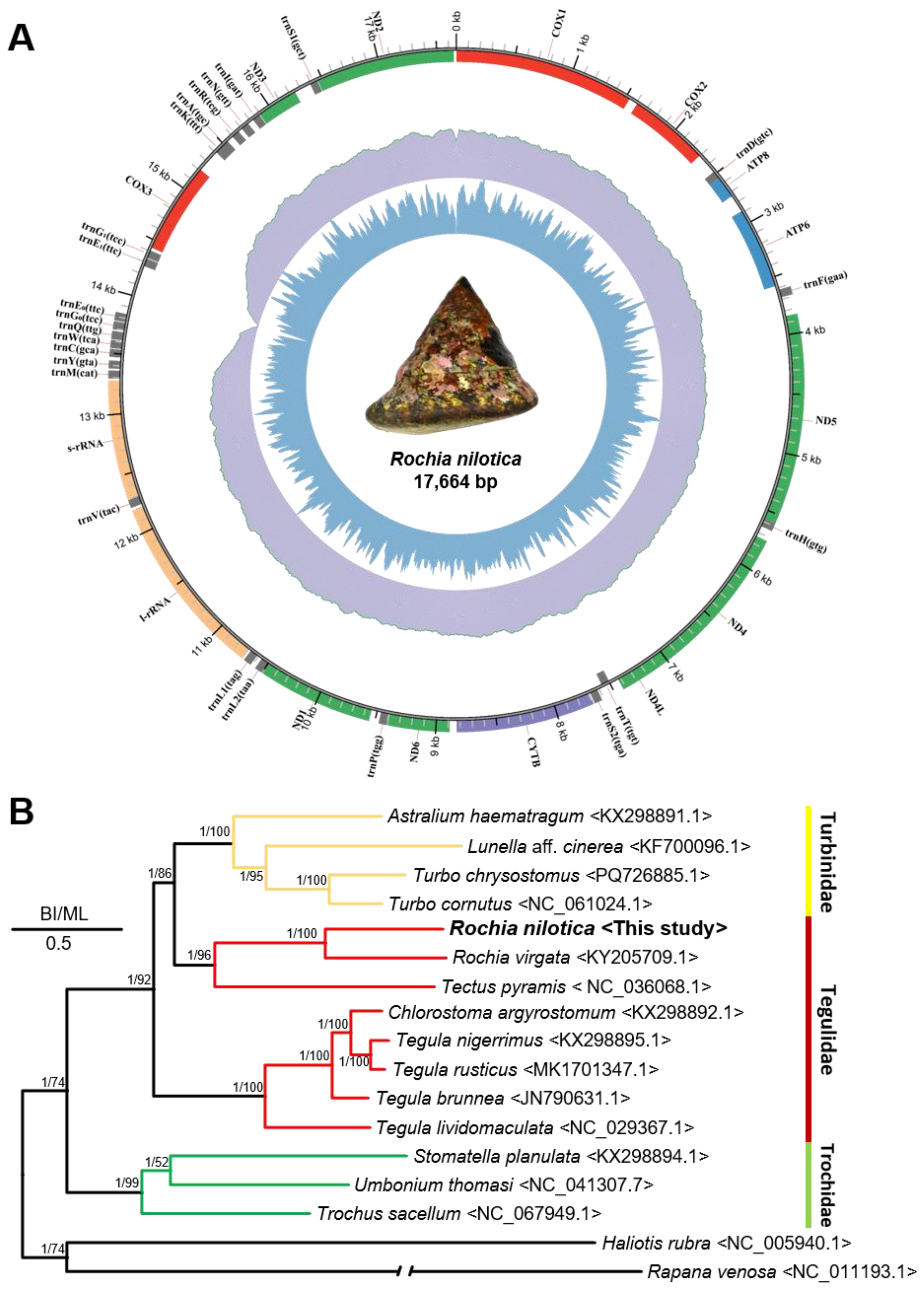
The complete mitochondrial genome of R. nilotica collected from Weno Island, Chuuk Atoll, was assembled using a de novo approach and annotated as a circular molecule (Figure 4A). The final genome is 17,664 bp in length with a GC content of 34.15%. A total of 37 genes were identified, including 13 PCGs, 2 rRNAs, and 24 tRNAs, with gene duplications observed in trnE and trnG. A summary of gene content and genome features is provided in Table 2. The mitochondrial genome of R. nilotica has been deposited in the NCBI’s GenBank database (under accession number: PV929813).
A phylogenetic tree was inferred using 13 mitochondrial PCGs from 15 taxa within the superfamily Trochoidea, along with two outgroup gastropod species (Table S1; Figure 4B). The R. nilotica specimen from Chuuk clustered most closely with Rochia virgata (KY205709.1) with strong statistical support [posterior probability (PP) = 1; bootstrap value (BV) = 100]. Additionally, the gene order (synteny) of the mitochondrial genome between the two species was conserved. These two Rochia species formed a monophyletic clade with Tectus pyramis, all belonging to the family Tegulidae. However, within Tegulidae, the phylogenetic topology revealed two distinct clades, indicating paraphyly of the family. One clade included the genera Tegula, whereas the other grouped Rochia and Tectus together. Notably, the RochiaTectus clade was recovered as a sister to members of the family Turbinidae (PP = 1; BV = 92), suggesting a closer evolutionary relationship between these two groups than with other Tegulidae genera. The topology of the mitochondrial genome-based phylogenetic tree constructed in this study was congruent with that of the concatenated COX1 and 16S rRNA gene-based tree, both supporting the paraphyly of the family Tegulidae. This finding is consistent with previous studies challenging the monophyly of this family and advocating for its taxonomic reevaluation based on mitochondrial genomic evidence [32,33,34]. These findings suggest that the current phylogenetic framework of the superfamily Trochoidea, which includes the families Tegulidae and Turbinidae, may not accurately reflect their evolutionary relationships. Although mitochondrial genome analyses provide higher phylogenetic resolution compared to single-gene approaches, their application can be limited by the lack of available comparative genomic data across taxa. By characterizing the complete mitochondrial genome of R. nilotica from Chuuk, this study contributes to filling that gap and provides a valuable reference for future phylogenetic, taxonomic, and evolutionary studies within Trochoidea.

3.3. Species Identification Based on Partial COX1 and 16S rRNA Gene Sequences

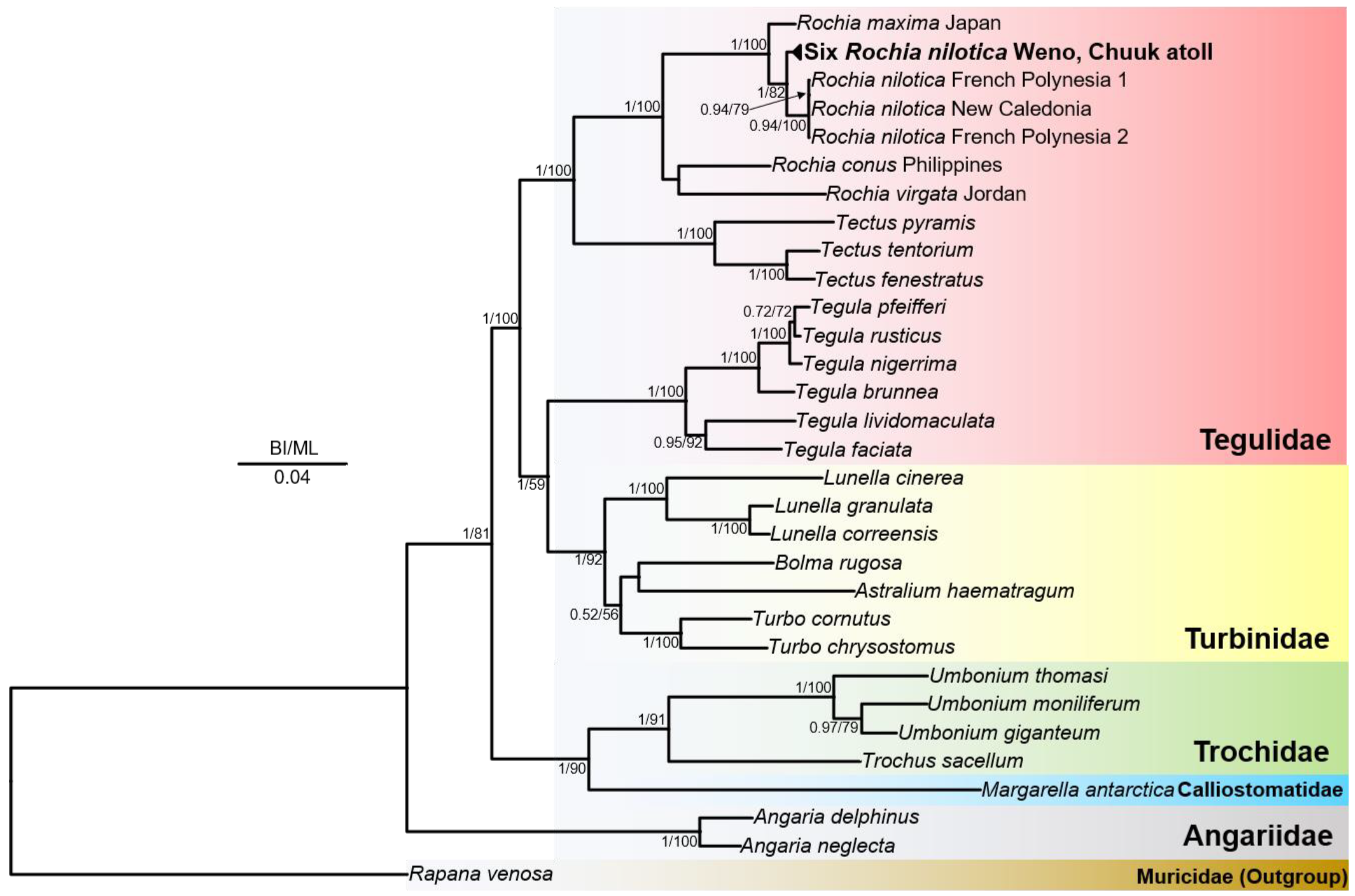
Mitochondrial COX1 and 16S rRNA gene sequences were extracted from the complete mitochondrial genome of the Rochia specimen collected from Weno Island, Chuuk Atoll, and additional partial COX1 and 16S rRNA sequences obtained from five newly sequenced Chuuk individuals were also included to refine the genetic comparison. To determine its phylogenetic placement, a concatenated gene tree was constructed using representative sequences from 30 taxa within the superfamily Trochoidea, with R. venosa from Muricidae designated as outgroups. The resulting phylogenetic tree, reconstructed under both BI and ML frameworks, placed the Chuuk specimen within the family Tegulidae, clustering closely with species of the genus Tectus (Figure 5). Among the seven currently recognized species in the genus Rochia (WoRMS; https://www.marinespecies.org/, accessed on 1 May 2025), four had available sequences and were included in the analysis, forming a strongly supported monophyletic clade (PP = 1; BV = 100). Although the Chuuk specimen showed no apparent morphological differences from previously described R. nilotica, its genetic profile was clearly distinct. In the phylogenetic tree, the Chuuk lineage formed a separate branch from R. nilotica specimens from Mo’orea Island (French Polynesia) and New Caledonia, which were closely grouped. Pairwise genetic distances further support this divergence. For the COX1 gene, the p-distance between the Chuuk and New Caledonia populations was 6.92%, and between Chuuk and Mo’orea (French Polynesia), it was 7.10–8.21% (Table S2). In contrast, the distance between the Mo’orea and New Caledonia populations was only 0.16–0.33% (Table S2), indicating high genetic similarity. For the 16S rRNA gene, sequence data were unavailable for the Mo’orea population; however, the p-distance between Chuuk and New Caledonia was 3.15%, further supporting the genetic distinctiveness of the Chuuk population (Table S3).
The observed genetic divergence is likely driven by the long-term geographic isolation of Chuuk Atoll. Island populations inhabiting geographically isolated atolls can exhibit distinct genetic variation due to restricted gene flow [35], which plays a pivotal role in both evolutionary processes and conservation strategies. Chuuk consists of a central lagoon surrounded by more than 60 fringing islands, and while the internal reef slopes reach depths of up to 70 m, the outer slopes drop steeply into oceanic waters exceeding 4000 m in depth [36]. This abrupt bathymetric gradient may act as a significant barrier to larval dispersal and gene flow. Furthermore, the planktonic larval duration of R. nilotica is extremely short, approximately 4 days [37,38], which could exacerbate the effects of isolation by limiting the potential for long-distance dispersal [2]. These geographic and biological constraints likely contributed to the establishment of a genetically distinct population in Chuuk, despite morphological similarities to R. nilotica populations elsewhere. The observed divergence highlights the potential for cryptic speciation and underscores the importance of localized genetic assessments in informing conservation and resource management strategies in isolated reef systems such as Chuuk.
Our integrated morphological and genomic analyses revealed that the Rochia population from Chuuk shares morphological characteristics with R. nilotica, but exhibits notable genetic divergence, suggesting the presence of a cryptic species. The complete mitochondrial genome generated in this study provides a valuable genetic resource that can facilitate more precise species identification and further clarify potential species boundaries within the genus Rochia.

4. Conclusions

Our integrative approach combining mitochondrial genome sequencing, partial COX1 and 16S rRNA analyses, and detailed morphological observations revealed that the Rochia population from Chuuk Atoll exhibits clear genetic divergence despite morphological congruence with R. nilotica. The complete mitochondrial genome and phylogenetic analyses consistently placed the Chuuk lineage within the genus Rochia but separate from R. nilotica populations elsewhere in the Pacific, suggesting the presence of a distinct genetic lineage shaped by long-term geographic and dispersal isolation. These results not only highlight the potential for cryptic speciation within the genus but also emphasize the importance of using genomic data alongside traditional taxonomy for accurate species identification in geographically isolated reef ecosystems. The data generated in this study provide a valuable reference for future taxonomic, ecological, and resource management studies and support the need for expanded genomic comparisons across the Indo-Pacific, particularly including populations from the Indian Ocean, the species’ type locality.

Supplementary Materials

The following supporting information can be downloaded at https://www.mdpi.com/article/10.3390/ani15233471/s1, Table S1: List of sequences used in the phylogenetic tree; Table S2: Pairwise genetic distances among species of the superfamily Trochoidea based on partial mitochondrial COX1 gene sequences; Table S3: Pairwise genetic distances among species of the superfamily Trochoidea based on partial mitochondrial 16S rRNA gene sequences.

Author Contributions

Conceptualization, H.-S.Y. and H.-S.P.; formal analysis, data curation, and methodology, J.-S.S., C.-u.S., C.L., Y.-J.P., K.K. and S.-W.H.; writing—original draft preparation, J.-S.S.; writing—review and editing, J.-S.S., B.-H.M. and J.K.; project administration, D.K. All authors have read and agreed to the published version of the manuscript.

Funding

This research was funded by Korea Institute of Marine Science & Technology Promotion (KIMST), Ministry of Oceans and Fisheries, Korea (grant number RS-2024-00406249). This study was also supported by the Korea Institute of Ocean Science & Technology (grant number PEA0311) and National Institute of Fisheries Science (R2025038), Korea.

Institutional Review Board Statement

Not applicable.

Informed Consent Statement

All sampling and research activities were conducted under the permission of the Department of Marine Resources, Chuuk State Government, including authorization for biological collection, research, and export.

Data Availability Statement

The mitochondrial sequence of Rochia nilotica is available from NCBI under accession no. PV929813.

Acknowledgments

We gratefully acknowledge Chuuk State Government for granting permission to collect, study, and export biological specimens, which made this research possible. We also extend our sincere appreciation to the staff of the Korea South Pacific Ocean Research Center (KSORC) for their logistical assistance, field support, and technical help during sampling and laboratory work. Their cooperation and commitment greatly contributed to the successful completion of this study.

Conflicts of Interest

The authors declare that they have no competing interest.

References

  1. Ulm, S.; McNiven, I.J.; Aird, S.J.; Lambrides, A.B. Sustainable Harvesting of Conomurex luhuanus and Rochia nilotica by Indigenous Australians on the Great Barrier Reef over the Past 2000 Years. J. Archaeol. Sci. Rep. 2019, 28, 102017. [Google Scholar] [CrossRef]
  2. Berry, O.; Richards, Z.; Moore, G.; Hernawan, U.; Travers, M.; Gruber, B. Oceanic and Coastal Populations of a Harvested Macroinvertebrate Rochia nilotica in North-Western Australia Are Isolated and May Be Locally Adapted. Mar. Freshw. Res. 2019, 71, 782–793. [Google Scholar] [CrossRef]
  3. Wahyudi, N.D.; Hidayati, D.; Arbi, U.Y.; Ismail, A. Morphometric Study of Lola Rochia nilotica (Linnaeus 1767) Shells from Natural Harvest Found in Indonesian. Biodiversitas J. Biol. Divers. 2023, 24, 4711–4722. [Google Scholar] [CrossRef]
  4. Gillett, R.; McCoy, M.; Bertram, I.; Kinch, J.; Desurmont, A. Trochus in the Pacific Islands: A Review of the Fisheries, Management and Trade; Fisheries, Aquaculture and Marine Ecosystems Division, Secretariat of the Pacific Community (SPC): Noumea, New Caledonia, 2020. [Google Scholar]
  5. Balisco, R.A.; Gonzales, B.; Dolorosa, R. Species Composition, Abundance and Conservation Status of Some Economically Important Macrobenthic Invertebrates in Pag-Asa Island, Kalayaan, Palawan, Philippines. Asian Fish. Sci. 2020, 33, 357. [Google Scholar] [CrossRef]
  6. Lasi, F. Trochus Production in Solomon Islands from 1953 to 2006. SPC Trochus Inf. Bull. 2010, 15, 24–27. [Google Scholar]
  7. Lincoln, J.M.; Schlanger, S.O. Atoll Stratigraphy as a Record of Sea Level Change: Problems and Prospects. J. Geophys. Res. Solid Earth 1991, 96, 6727–6752. [Google Scholar] [CrossRef]
  8. George, A.; Luckymis, M.; Palik, S.; Adams, K.; Joseph, E.; Mathias, D.; Malakai, S.; Nakayama, M.R.; Graham, C.; Rikim, K. The State of Coral Reef Ecosystems of the Federated States of Micronesia; National Oceanographic and Atmospheric Administration: Washington, DC, USA, 2008. [Google Scholar]
  9. Kim, T.; Lee, D.-W.; Kim, H.-J.; Jung, Y.-H.; Choi, Y.-U.; Oh, J.-H.; Kim, T.-H.; Kang, D.-H.; Park, H.-S. Estimation of the Benthic Habitat Zonation by Photo-Quadrat Image Analysis along the Fringing Reef of Weno Island, Chuuk, Micronesia. J. Mar. Sci. Eng. 2022, 10, 1643. [Google Scholar] [CrossRef]
  10. Jin, Y.-S.; Park, Y.-J.; Kim, H.-J.; Na, O.-S.; Song, Y.-B.; Lee, C.-H.; Choi, M.-S.; Rho, S.; Lee, Y.-D. Reproductive Cycle of Top Shell, Trochus niloticus in Chuuk Island, Micronesia. Korean J. Malacol. 2004, 20, 65–73. [Google Scholar]
  11. Cameron, S.L. Insect Mitochondrial Genomics: Implications for Evolution and Phylogeny. Annu. Rev. Entomol. 2014, 59, 95–117. [Google Scholar] [CrossRef] [PubMed]
  12. Han, J.; Kim, J.G.; Kwon, O.-N.; Park, J.J.C.; Lee, K.-W.; Choi, Y.-U. On the Species Identification of Korean Geoduck Clam (Panopea sp. 1) Based on the Morphological and Molecular Evidence. J. Mar. Sci. Eng. 2023, 11, 2115. [Google Scholar] [CrossRef]
  13. Kim, M.; Choi, H.; Kim, H.; Kang, J.; Jeong, H.G.; Eyun, S.; Kang, J.-H. Characterization of the Mitochondrial Genome, Ecological Distribution, and Morphological Features of the Marine Gastropod Mollusc Lophocochlias parvissimus (Gastropoda, Tornidae). J. Mar. Sci. Eng. 2023, 11, 2307. [Google Scholar] [CrossRef]
  14. Shin, J.-S.; Song, C.; Choi, H.; Yang, S.H.; Kwon, K.K.; Eyun, S.; Choi, K.-S. The Complete Mitochondrial Genome of the Chemosymbiotic Lucinid Bivalve Pillucina pisidium (Dunker, 1860) Occurring in Seagrass Zostera marina Bed in a Lagoon in Jeju Island, Korea. J. Mar. Sci. Eng. 2024, 12, 847. [Google Scholar] [CrossRef]
  15. Jiang, D.; Liu, Z.; Zeng, X.; Tang, X.; Yang, S.; Zheng, X. The Complete Mitochondrial Genome of Rochia nilotica (Gastropoda: Tegulidae). Mitochondrial DNA Part B 2019, 4, 1121–1122. [Google Scholar] [CrossRef]
  16. Smith, B.D. Growth Rate, Distribution and Abundance of the Introduced Topshell Trochus niloticus Linnaeus on Guam, Mariana Islands. Bull. Mar. Sci. 1987, 41, 466–474. [Google Scholar]
  17. Krueger, F. Trim Galore!: A Wrapper around Cutadapt and FastQC to Consistently Apply Adapter and Quality Trimming to FastQ Files, with Extra Functionality for RRBS Data; Babraham Institute: Cambridge, UK, 2015. [Google Scholar]
  18. Brown, J.; Pirrung, M.; McCue, L.A. FQC Dashboard: Integrates FastQC Results into a Web-Based, Interactive, and Extensible FASTQ Quality Control Tool. Bioinformatics 2017, 33, 3137–3139. [Google Scholar] [CrossRef]
  19. Meng, G.; Li, Y.; Yang, C.; Liu, S. MitoZ: A Toolkit for Animal Mitochondrial Genome Assembly, Annotation and Visualization. Nucleic Acids Res. 2019, 47, e63. [Google Scholar] [CrossRef]
  20. Li, D.; Luo, R.; Liu, C.-M.; Leung, C.-M.; Ting, H.-F.; Sadakane, K.; Yamashita, H.; Lam, T.-W. MEGAHIT v1.0: A Fast and Scalable Metagenome Assembler Driven by Advanced Methodologies and Community Practices. Methods 2016, 102, 3–11. [Google Scholar] [CrossRef]
  21. Dierckxsens, N.; Mardulyn, P.; Smits, G. NOVOPlasty: De Novo Assembly of Organelle Genomes from Whole Genome Data. Nucleic Acids Res. 2017, 45, e18. [Google Scholar]
  22. Bernt, M.; Donath, A.; Jühling, F.; Externbrink, F.; Florentz, C.; Fritzsch, G.; Pütz, J.; Middendorf, M.; Stadler, P.F. MITOS: Improved de Novo Metazoan Mitochondrial Genome Annotation. Mol. Phylogenetics Evol. 2013, 69, 313–319. [Google Scholar] [CrossRef]
  23. Krzywinski, M.; Schein, J.; Birol, I.; Connors, J.; Gascoyne, R.; Horsman, D.; Jones, S.J.; Marra, M.A. Circos: An Information Aesthetic for Comparative Genomics. Genome Res. 2009, 19, 1639–1645. [Google Scholar] [CrossRef]
  24. Katoh, K.; Standley, D.M. MAFFT Multiple Sequence Alignment Software Version 7: Improvements in Performance and Usability. Mol. Biol. Evol. 2013, 30, 772–780. [Google Scholar] [CrossRef]
  25. Lanfear, R.; Frandsen, P.B.; Wright, A.M.; Senfeld, T.; Calcott, B. PartitionFinder 2: New Methods for Selecting Partitioned Models of Evolution for Molecular and Morphological Phylogenetic Analyses. Mol. Biol. Evol. 2017, 34, 772–773. [Google Scholar] [CrossRef]
  26. Kozlov, A.M.; Darriba, D.; Flouri, T.; Morel, B.; Stamatakis, A. RAxML-NG: A Fast, Scalable and User-Friendly Tool for Maximum Likelihood Phylogenetic Inference. Bioinformatics 2019, 35, 4453–4455. [Google Scholar] [CrossRef]
  27. Ronquist, F.; Teslenko, M.; Van Der Mark, P.; Ayres, D.L.; Darling, A.; Höhna, S.; Larget, B.; Liu, L.; Suchard, M.A.; Huelsenbeck, J.P. MrBayes 3.2: Efficient Bayesian Phylogenetic Inference and Model Choice across a Large Model Space. Syst. Biol. 2012, 61, 539–542. [Google Scholar] [CrossRef] [PubMed]
  28. Okutani, T. Marine Mollusks in Japan; Tokai University Press: Hiratsuka, Japan, 2000. [Google Scholar]
  29. Dharma, B.; Pringgenies, D. Differences in Shell Morphology of the Species Rochia nilotica (Linnaeus, 1767) and Rochia maxima (F. C. L. Koch, 1844) (Gastropoda: Tegulidae). J. Moluska Indones. 2023, 7, 36–42. [Google Scholar] [CrossRef]
  30. Pilsbry, H.A. New Japanese Marine Mollusca: Gastropoda. Proc. Acad. Nat. Sci. USA 1904, 56, 3–37. [Google Scholar]
  31. Poppe, G.T. Descriptions of Spectacular New Species from the Philippines. Visaya 2004, 1, 4–19. [Google Scholar]
  32. Williams, S.T. Advances in Molecular Systematics of the Vetigastropod Superfamily Trochoidea. Zool. Scr. 2012, 41, 571–595. [Google Scholar] [CrossRef]
  33. Guo, E.; Yang, Y.; Kong, L.; Yu, H.; Liu, S.; Liu, Z.; Li, Q. Mitogenomic Phylogeny of Trochoidea (Gastropoda: Vetigastropoda): New Insights from Increased Complete Genomes. Zool. Scr. 2021, 50, 43–57. [Google Scholar] [CrossRef]
  34. Cunha, T.J.; Reimer, J.D.; Giribet, G. Investigating Sources of Conflict in Deep Phylogenomics of Vetigastropod Snails. Syst. Biol. 2022, 71, 1009–1022. [Google Scholar] [CrossRef]
  35. James, J.E.; Lanfear, R.; Eyre-Walker, A. Molecular Evolutionary Consequences of Island Colonization. Genome Biol. Evol. 2016, 8, 1876–1888. [Google Scholar] [CrossRef] [PubMed]
  36. Mayer, L.; Jakobsson, M.; Allen, G.; Dorschel, B.; Falconer, R.; Ferrini, V.; Lamarche, G.; Snaith, H.; Weatherall, P. The Nippon Foundation—GEBCO Seabed 2030 Project: The Quest to See the World’s Oceans Completely Mapped by 2030. Geosciences 2018, 8, 63. [Google Scholar] [CrossRef]
  37. Foale, S.; Day, R. Stock Assessment of Trochus (Trochus niloticus) (Gastropoda: Trochidae) Fisheries at West Nggela, Solomon Islands. Fish. Res. 1997, 33, 1–16. [Google Scholar] [CrossRef]
  38. Heslinga, G.A.; Hillmann, A. Hatchery Culture of the Commercial Top Snail Trochus niloticus in Palau, Caroline Islands. Aquaculture 1981, 22, 35–43. [Google Scholar] [CrossRef]
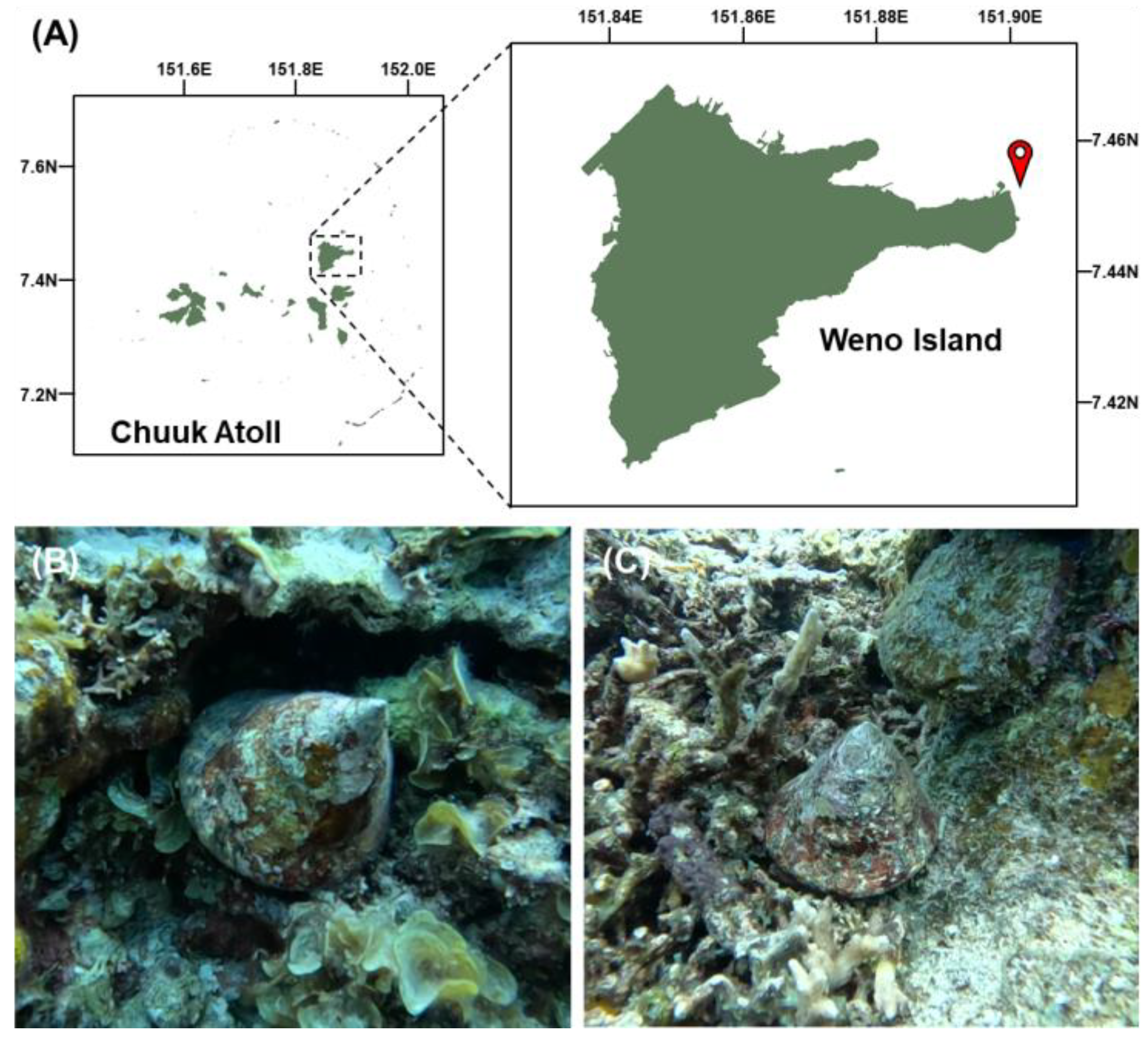
Figure 1. (A) Map of the study area showing Weno Island within Chuuk Atoll. The red marker indicates the sampling site. (B,C) Specimen of Rochia nilotica inhabiting coral reefs near Weno Island.
Animals 15 03471 g001
Figure 2. Images of Rochia nilotica shells. Adult: (A) dorsal view with aperture visible; (B) ventral view without aperture. (C) apical view; (D) abapical view. Juvenile (1-year-old): (E) dorsal view; (F) ventral view; (G) apical view without aperture; (H) abapical view with aperture visible. Scale bar: (A,D) 5 cm; (EH) 2 cm.
Animals 15 03471 g002
Figure 3. Radula morphology of Rochia nilotica from Chuuk Atoll. (A) Entire radula showing the rhipidoglossan arrangement. (B) Central region of the radula, including the central and lateral teeth. (C) Left marginal teeth in high magnification. (D) Right marginal teeth in high magnification. Scale bar: 200 μm.
Animals 15 03471 g003
Figure 4. (A) Mitochondrial genome map of Rochia nilotica inhabiting Chuuk Atoll. The innermost blue bar plot represents GC content. The middle purple circle shows sequencing read depth. The outermost circle depicts gene order: red for COX genes, blue for ATP synthase, purple for cytochrome b (CYTB), and green for ND genes. The two rRNAs are in apricot, and the 22 tRNAs are in gray. (B) Phylogenetic tree constructed using 13 protein-coding genes (PCGs) from the mitochondrial genome. Vertical lines next to the species names indicate their family affiliations. The synteny of the 13 mitochondrial PCGs is aligned in a row to the right of the phylogenetic tree. Posterior probabilities (left) of Bayesian inference (BI) and bootstrap supports (right) for the maximum likelihood (ML) are indicated on the branches. The scale bar indicates 0.50 substitutions per site. Bootstrap supports <50% and posterior probabilities <80% are not shown.
Animals 15 03471 g004
Figure 5. Phylogenetic trees of the superfamily Trochoidea based on concatenated COX1 and 16S rRNA sequences. Bayesian inference (BI) and maximum likelihood (ML) analyses were performed using the concatenated alignment of partial COX1 and 16S rRNA gene sequences. Specimens of Rochia nilotica from this study are indicated in bold. The best-fit substitution model (GTR + I + G) was applied, and node support values are shown as Bayesian posterior probabilities (0–1) and ML bootstrap values (0–100) based on 1000 replicates. GenBank accession numbers for all sequences used in the tree are listed in Table S1.
Animals 15 03471 g005
Table 1. Biometric information of Rochia nilonica.
Voucher NumberSH (mm)SW (mm)H/W
HNIBRIV 18781101.39104.830.97
HNIBRIV 18782101.34104.370.97
HNIBRIV 1878391.73100.850.91
HNIBRIV 1878486.9496.340.90
HNIBRIV 1878592.5896.270.96
HNIBRIV 18786102.7098.571.04
HNIBRIV 1878790.7091.990.99
HNIBRIV 1878886.01920.93
HNIBRIV 1878988.4994.530.94
HNIBRIV 1879089.0795.940.93
Average93.1097.570.95
SH, shell height; SW, shell width; H/W, shell height to width.
Table 2. Summary of the mitochondrial genome of Rochia nilotica.
Gene NameLocationSizeStart CodonStop CodonIntergenic Region
Cytochrome c oxidase subunit 1 1–15361536ATGTAA74
Cytochrome c oxidase subunit 2 1611–2297687ATGTAA179
tRNA-Asp2477–254569--0
ATP synthase F0 subunit 82546–2734189ATGTAA149
ATP synthase F0 subunit 62884–3579696ATGTAG36
tRNA-Phe 3616–368368--159
NADH dehydrogenase subunit 5 3843–55761734ATGTAA0
tRNA-His 5577–564367--90
NADH dehydrogenase subunit 4 5734–71311398ATGTAG−7
NADH dehydrogenase subunit 4L 7125–7424300ATGTAA73
tRNA-Thr7498–756871--48
tRNA-Ser 7617–768367--8
Cytochrome b 7692–88311140ATGTAA55
NADH dehydrogenase subunit 6 8887–9393507ATGTAA4
tRNA-Pro9398–946770--79
NADH dehydrogenase subunit 19547–10,494948ATATAA4
tRNA-Leu 10,499–10,56668--45
tRNA-Leu10,612–10,67968--15
16S ribosomal RNA 10,695–12,2021508--22
tRNA-Val 12,225–12,29470--3
12S ribosomal RNA12,298–13,280983--12
tRNA-Met13,293–13,36068--15
tRNA-Tyr 13,376–13,44166--28
tRNA-Cys 13,470–13,53566--6
tRNA-Trp 13,542–13,60867--5
tRNA-Gln 13,614–13,68269--11
tRNA-Gly13,694–13,76168--6
tRNA-Glu 13,768–13,83770--426
tRNA-Glu 14,264–14,33370--6
tRNA-Gly 14,340–14,40768--24
cytochrome c oxidase subunit 3 14,432–15,211780ATGTAG195
tRNA-Lys15,407–15,47872--−5
tRNA-Ala15,474–15,54168--55
tRNA-Arg 15,597–15,66569--34
tRNA-Asn 15,700–15,77071--50
tRNA-Ile15,821–15,88969--4
NADH dehydrogenase subunit 3 15,894–16,247354ATGTAG142
tRNA-Ser16,390–16,45768--3
NADH dehydrogenase subunit 2 16,461–17,6451185ATGTAG18
Disclaimer/Publisher’s Note: The statements, opinions and data contained in all publications are solely those of the individual author(s) and contributor(s) and not of MDPI and/or the editor(s). MDPI and/or the editor(s) disclaim responsibility for any injury to people or property resulting from any ideas, methods, instructions or products referred to in the content.