1. Introduction
Post-weaning diarrhea remains one of the most significant challenges in modern swine production. Its etiology is multifactorial, and a major contributing factor to this is the sudden dietary transition from the highly digestible milk consumed during lactation to a solid feed-based diet after weaning. Soybean meal, the primary plant-based protein source in swine diets, can cause hypersensitivity in weaning piglets, resulting in lower intestinal villus height and depressed growth performance when compared with dried skim milk [
1]. Specifically, increasing the proportion of soybean meal in the diet, which raises dietary protein levels, has been linked to greater incidence of diarrhea and poorer growth performance [
2,
3,
4].
The negative effects of soybean meal on weaned piglets are mainly caused by its high glycinin and β-conglycinin contents—two major antigenic proteins that, as shown by in vivo [
5,
6,
7] and in vitro [
8,
9,
10] studies, can damage the intestinal barrier (e.g., increased permeability), induce inflammation, and impair cellular function. To counteract the negative effects of soybean antigens on feed utilization and piglet growth performance, previous reviews have highlighted specific processing technologies, including extrusion, fermentation, and enzymatic treatment, that could reduce soybean protein immunoreactivity [
11,
12]. Notably, enzymatic treatment has drawn attention as an effective approach for simultaneously reducing anti-nutritional factors and improving gut health in piglets, possibly via enzyme-released small peptides [
13,
14,
15].
Some studies have already analyzed the relationship between enzymatic hydrolysis parameters (e.g., enzyme type, reaction conditions) and the degradation efficiency of antigenic proteins [
16,
17]. However, in the enzymatic hydrolysis of soybean meal, the following challenges still occur: The soluble carbohydrates (e.g., raffinose and stachyose) in soybean meal may sterically hinder protease activity, potentially impairing the enzymatic hydrolysis of soybean proteins [
18]. Water-soluble sugars such as raffinose and stachyose in soybean meal may participate in the Maillard reaction with amino acids during the drying process, reducing amino acid (AA) digestibility [
19]. The crude protein (CP) content of enzymatically treated soybean meal is approximately 50% [
20], while top-grade fishmeal typically contains more than 65% crude protein, creating a nutritional gap in fishmeal substitution. Further research is needed to develop deep-processing techniques for soybean meal to enhance its nutritional value.
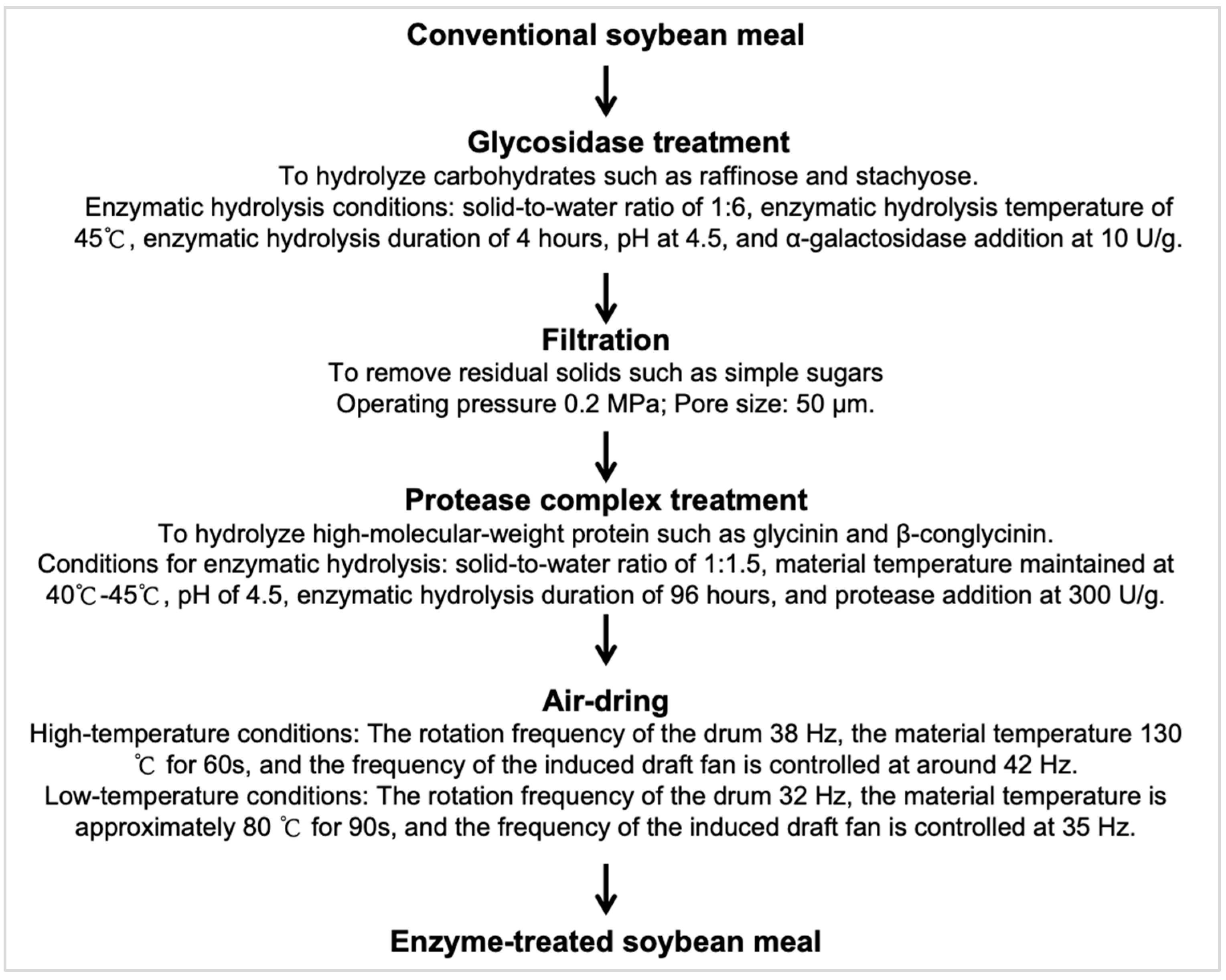
To address these issues, a novel soybean meal processing method has been devised, which incorporates a “washing” step to remove water-soluble carbohydrates prior to enzymatic (protease) hydrolysis. It was hypothesized that this approach will result in a higher level of amino acids and lower content of reducing sugars. Moreover, when the enzymatically (protease) hydrolyzed soybean meal is subjected to air drying, this may have no negative effects on ileal AA digestibility.
4. Discussion
In practical swine production, advanced processing of soybean meal primarily serves two critical objectives: to mitigate antinutritional factors, particularly glycinin and β-conglycinin, to minimize their detrimental effects on piglet intestinal health and prevent post-weaning stress syndrome [
16,
25]; and to increase nutritional value through targeted enzymatic hydrolysis, thereby enabling the partial substitution of costly protein sources such as fishmeal [
26]. This approach can reduce feed production costs and contribute to sustainable swine production.
The efficacy of enzymatic hydrolysis is conventionally assessed through two primary indicators: (1) the reduction in soybean antigen content and (2) the improvement of AA digestibility. While extensive research has examined enzymatically hydrolyzed soybean meal [
27,
28,
29,
30,
31], this study introduces a novel pre-hydrolysis carbohydrate removal step designed to specifically reduce soluble reducing sugars (e.g., raffinose and stachyose). This approach may minimize Maillard reaction products during the drying process by decreasing reducing sugar content, thereby preserving AA quality, and increase the AA concentration in enzyme-treated soybean meal, thereby enhancing its potential to replace fishmeal in swine diets. Chemical composition analyses confirmed the effectiveness of this processing method, which reduced soybean antigen content and increased CP content (approaching 60%). These findings confirm that the processing method successfully achieved its dual objectives of increasing CP content and minimizing undesirable soybean antigen levels. To determine nutritional value and ingredient substitution potential, the standardized ileal AA digestibility of enzyme-treated soybean meal and fishmeal was analyzed. Given that a lower level of dietary sugars may decrease Maillard reactions and enhance AA digestibility [
19], the impact of this processing procedure on post-enzymatic hydrolysis AA digestibility was evaluated.
Since ESM has the potential to replace fishmeal in swine diets [
15], the ileal amino acid digestibility between fishmeal and ESM was initially investigated. In Trial 1, the apparent ileal digestibility of CP and AA in ESM was lower than that in fishmeal. Regarding fishmeal, it was determined to be of a top grade based on the Chinese national standard for feed material and fishmeal (GB/T 19164-2021) [
32]. Digestibility assays revealed that fishmeal exhibited exceptionally high CP standardized ileal digestibility (86.6%), and the measured standardized ileal digestibility of essential amino acids in this study was an average 91.28%. This value is in close agreement with the results obtained in growing pigs (87.78%) [
33] and weaning pigs (90.08%) [
28]. Notably, the SID of lysine is 93.7% for fishmeal in this study, which is consistent with the results of a more recent study [
34]. This study examined 10 different sources of fishmeal and found an overall SID for lysine of 91.2%. Among them, four top-grade fishmeals (with a crude protein > 66%) exhibited an SID for lysine ranging from 90.2% to 95.9% [
34]. Such consistency indicates that the analytical and calculation methods are reliable and that the current results are comparable to those from well-established international studies.
In contrast, the enzyme-treated soybean meal showed substantially lower standardized ileal digestibility values for essential amino acids, with the following coefficients: arginine (56.89%), histidine (56.26%), isoleucine (71.94%), leucine (73.97%), lysine (69.66%), methionine (77.42%), phenylalanine (76.43%), threonine (58.29%), and valine (66.74%). The standardized ileal digestibility observed in this enzyme-treated soybean meal was lower than that reported in other laboratory studies [
20,
22,
28,
35], as well as for conventional soybean meal evaluated in growing pigs [
21,
22,
36,
37]. These results clearly demonstrated the inferior nutritional quality of this enzyme-treated soybean meal compared to fishmeal, particularly in terms of essential AA bioavailability.
It should be noted that the CP content and AA composition of the diets used for amino acid digestibility evaluation in Trial 1 varied. The fishmeal diet (13.2% CP, 0.97% lysine) and the enzyme-treated soybean meal diet (14.03% CP, 0.76% lysine) differed in CP (by 0.83 percentage points) and lysine (by 0.21 percentage points) contents in the present study. It was speculated that the differences in dietary CP content and AA composition observed in Trial 1 are unlikely to affect the ileal amino acid digestibility of the test ingredients. This can be supported by a recent study which showed that increasing dietary CP from 7.06% to 11.01% and varying amino acid levels (e.g., lysine from 0.23% to 0.77%) did not affect the standardized ileal digestibility (SID) of amino acids in corn [
38]. Similarly, in studies with soybean meal, differences in dietary CP (19.68% vs. 22.47%) and lysine (1.13% vs. 1.57%) did not influence the SID of amino acids in soybean meal when evaluated in growing pigs [
38]. On the other hand, it was demonstrated that when cornstarch-based diets were formulated using soybean meal as the sole amino acid source and tested across six graded dietary CP levels, the apparent ileal digestibility of amino acids increased sharply from 4% to 16% CP and then plateaued between 16% and 24% CP [
39]. Thus, this study cannot entirely rule out the potential impact of dietary CP level variations on amino acid digestibility.
The entire process in Trial 1 was carefully examined, and it was hypothesized that the drying temperature (130 °C) might be the underlying cause, as supported by the existing literature. Specifically, prolonged heating (e.g., 125 °C autoclaving for 30 min) linearly reduces AA digestibility, likely due to Maillard reaction products [
40]. Notably, limited research has systematically examined the impact of drying temperature on the standardized ileal digestibility of amino acids in ESM. To address this knowledge gap, trial 2 was specifically designed to compare the ileal AA digestibility of enzyme-treated soybean meal processed at two distinct drying temperatures: 80 °C (LtESM) and 130 °C (HtESM). Analyses revealed that LtESM exhibited a higher lysine-to-CP ratio than HtESM, indicating a possible reduction in Maillard reaction products compared to HtESM [
40]. The glycinin content in HtESM and LtESM was 17.4 mg/g and 16.5 mg/g, respectively, while the β-conglycinin content was 7.79 mg/g and 14.3 mg/g, respectively. In contrast, conventional soybean meal contained greater levels of glycinin (69.7 mg/g) and β-conglycinin (128 mg/g), indicating that the enzymatic treatment process effectively reduced the allergenic protein content in soybean meal. Animal trials confirmed that LtESM had greater standardized ileal digestibility values for both CP and amino acids than HtESM. However, trial 2 had a two-period crossover design, which has some limitations when applied in animal nutrition or physiology studies. In particular, when the number of experimental units (i.e., animals) is limited, such designs may exhibit lower statistical robustness compared to fully balanced designs (e.g., randomized complete block design or Latin Square design). This is especially relevant in cases where there is considerable individual variability among animals, which is common among pigs fitted with T-cannulas and can increase the risk of reaching incorrect conclusions or failing to properly test the study hypotheses.
The average standardized ileal digestibility of essential amino acids in LtESM was 89.56%, and the SID of crude protein was 86.37%. These values are comparable to or exceed those reported in previous studies, including the value presented by NRC (2012) (average SID of essential AA = 88.3%) [
22] and other reports (average SID of essential AA = 90.08%) [
28], as well as findings on fermented soybean meal, where the SID of essential AAs ranged between 84.3% and 88.8% [
28,
41,
42].
Notably, when HtESM from trial 2 was compared with that from trial 1, the standardized ileal digestibility of CP was 56.82%, which was higher than the data of 48.86% recorded in trial 1. For essential amino acids, except for histidine (with SID values of 56.26% in trial 1 and 71.19% in trial 2), the standardized ileal digestibility values were highly consistent between the two trials. Of particular significance, the LtESM exhibited a high CP standardized ileal digestibility of 86.37%, which was close to the value of 86.60% recorded for fishmeal in trial 1. These results indicated that the LtESM had high ileal AA digestibility.
Although it was hypothesized that differences in Maillard reaction intensity contributed to the observed variations in ileal amino acid digestibility between drying temperatures in this study, the Maillard reaction severity (e.g., via reactive lysine content) could not be directly assessed due to analytical limitations. Notwithstanding this constraint, this study’s findings unequivocally reaffirm that drying temperature plays a pivotal role in determining the amino acid digestibility of enzyme-treated soybean meal. These research results offer valuable guidance for the advanced processing technologies for feed ingredients rich in amino acids.
The enzyme-treated soybean meal used in this study was priced at RMB 3000/ton more than conventional soybean meal. Nevertheless, even with this difference, enzyme-treated soybean meal remains more economical than fishmeal within the Chinese market. The low antigenic protein content and increased levels of CP and AA in enzyme-treated soybean meal highlight its suitability as a partial substitute for fishmeal, while its cost-effectiveness further enhances its practical applicability. Further research is needed to evaluate the effects of replacing fishmeal with low-temperature-dried, enzyme-treated soybean meal on the growth performance of piglets.