Article

Site-Specific Nested Integration of Tn1806 into ICESa2603-Family Integrative and Conjugative Elements in Streptococcus agalactiae


1
Department of Molecular Biology, Shanghai Center for Clinical Laboratory, Shanghai 200126, China
2
Department of Quality Control Material R&D, Shanghai Center for Clinical Laboratory, Shanghai 200126, China
*
Authors to whom correspondence should be addressed.
Microorganisms 2026, 14(2), 375; https://doi.org/10.3390/microorganisms14020375
Submission received: 5 December 2025 / Revised: 21 January 2026 / Accepted: 22 January 2026 / Published: 5 February 2026
(This article belongs to the Section Antimicrobial Agents and Resistance)

Abstract

Composite integrative and conjugative elements (ICEs) frequently mediate the co-transfer of multiple antibiotic resistance genes during horizontal gene transfer, but their formation mechanisms remain unclear. This study investigated the site-specific integration of Tn1806 into ICESa2603-family ICEs in Streptococcus agalactiae by conjugation experiments. PCR screening of 161 S. agalactiae clinical isolates identified potential Tn1806-like ICE carriers; whole-genome sequencing was performed to further characterize the macrolide-resistance isolates from this group. PCR detection resulted in 24 carrying Tn1806-like ICEs being found, five of which were macrolide-resistant. Genomic analysis for these five revealed distinct Tn1806-like ICEs (ICESag16, ICESag57, ICESag139, ICESag167, and ICESag220), three of which were found nested within another ICE (ICESpy009, an ICESa2603-family ICE). Conjugation experiments confirmed ICESag167 could integrate into the snf2 (methyltransferase containing a SNF2 helicase domain) of ICESpy009 in recipient cells, generating a composite ICE. Re-conjugation verified the transferability of composite ICE at low frequencies (8.63 × 10⁻⁸), during which some nested ICESag167 were excised and transferred independently. This work provides first experimental evidence supporting Tn1806 nesting within another ICE as a mechanism for resistance accumulation and mobile element evolution in S. agalactiae. The spread of such composite ICEs may confer multiple forms of resistance to new hosts, challenging infection treatment and raising public health concerns.

1. Introduction

Integrative and conjugative elements (ICEs), a class of self-transmissible mobile genetic elements (MGEs), reside in bacterial chromosomes and mediate functional gene unit dissemination between different hosts [1,2]. Under specific conditions, ICEs are excised from chromosomes by encoded site-specific integrases and transferred to the recipient bacteria through the conjugation machinery, conferring novel phenotypes, such as pathogenicity and antibiotic resistance, to the new hosts [3,4]. Whole-genome sequencing has identified numerous ICEs carrying antibiotic resistance genes and facilitating their horizontal dissemination [5,6,7,8,9]. Consequently, ICEs play a critical role in driving the evolution of bacterial antimicrobial resistance.
Streptococcus agalactiae (group B Streptococcus), a leading cause of neonatal sepsis and meningitis, is a significant pathogen among pregnant women, the elderly, and immunocompromised individuals [10]. In this clinically important pathogen, ICEs have been identified as primary vectors for the dissemination of multidrug resistance [11]. These elements are not only widely prevalent but also frequently harbor clusters of resistance genes, conferring resistance to aminoglycosides, macrolides, lincosamides, tetracyclines, and even oxazolidinones [12,13,14]. In 2019, the U.S. Centers for Disease Control and Prevention (CDC) classified clindamycin-resistant S. agalactiae as a “concerning threat” among 21 antibiotic resistance threats [15].
Horizontal gene transfer mediated by ICEs represents a major driver of microbial evolution, enabling microorganisms to rapidly acquire new genes and phenotypes. An analysis of over 1000 genomes identified 335 putative ICEs and 180 conjugative plasmids, indicating that ICEs are present in most bacterial clades and are likely more common than conjugative plasmids [16]. However, ICEs are not static genetic entities. They can exhibit considerable genetic diversity through chimeric recombination events, which may alter their core characteristics. This dynamic, mosaic nature complicates efforts to monitor and control the antibiotic resistance associated with ICEs [1,17]. In some cases, ICEs act as vectors by incorporating exogenous ICEs/mobile elements or integrate into other ICEs/mobile elements: ICESagTR7 forms a “Matryoshka doll”-like structure, created when a Tn1806-like ICE carrying the erm(TR) gene into an ICESa2603-family ICE backbone (ICESde3396) [18]. ICESag236 resulted from a recombination between ICESpn529IQ and ICESpy009, with deletions in both components, and its transfer mediates the spread of macrolide, lincosamide, and streptogramin B (MLSB) and chloramphenicol resistance [19]. Although composite ICEs like ICESagTR7 have been documented, the mechanism enabling Tn1806—an element carrying erm(TR) first identified in Streptococcus pneumoniae [20]—to integrate into a resident ICE and confer additional resistance, remains unconfirmed experimentally. This gap in understanding may stem from the unconfirmed independent transferability of Tn1806, leading to its characterization primarily as a component of composite ICE, rather than as a distinct mobile entity.
Recently, a novel Tn1806-like ICE, designated ICESan95_hsdM, was identified in S. anginosus [21]. This element carries an erm(B)-carrying fragment shares a high degree of identity with Tn6002, providing the first experimental confirmation of the transferability for this ICE type. Comparative analysis revealed that ICESan95_hsdM possesses a putative integration target within snf2 (encoding the sucrose non-fermenting 2 protein), that is highly conserved in the backbone of ICESa2603-family ICEs [13]. Therefore, we hypothesized that large composite ICEs (e.g., ICESagTR7) arise from the site-specific integration of Tn1806-like ICEs into the snf2 gene within ICESa2603, acquiring resistance determinants to form composite structures.
This study experimentally demonstrates that composite ICE derived from ICESa2603-family ICEs are formed when a Tn1806-like ICE integrates site-specifically into the conserved snf2 gene of the ICESa2603 backbone. This integration physical nests one ICE within another. Consequently, multiple resistance genes accumulate within a single mobile element. The resulting composite ICE exhibits greater flexibility and adaptability, which may enhance the versatility of horizontal gene transfer in bacterial populations.

2. Materials and Methods

2.1. Bacterial Strains and Susceptibility Tests

The 161 clinical S. agalactiae isolates and ATCC13813 used in this study were preserved at Shanghai Center for Clinical Laboratory. All strains were collected from routine laboratory procedures and utilized for scientific research purposes. For enrichment, S. agalactiae strain was cultured in Todd–Hewitt Broth (THB; Qingdao Hope Bio-Technology Co., Ltd., Qingdao, China) supplemented with 5% calf serum (Tianhang Biological Products Co., Ltd., Huzhou, China) at 37 °C with shaking at 150 rpm under 10% CO2 for 12–24 h. Antimicrobial susceptibility testing was performed on Mueller–Hinton (MH) agar (Qingdao Hope Bio-Technology Co., Ltd.) supplemented with 5% horse serum (YINUO Co., Ltd., Hohhot, China), with incubation at 37 °C under 10% CO2 for 48 h. This study involved no personal information or clinical trials. In accordance with our institutional guidelines and relevant regulations, ethical approval was therefore not required for the use of these bacterial strains.
Broth microdilution method was used to perform routine antimicrobial susceptibility testing on S. agalactiae isolates against clinical common antibiotics, including erythromycin, clindamycin, levofloxacin, chloramphenicol, penicillin, amoxicillin, and linezolid. These antibiotics were purchased from Sigma Chemical Co., St. Louis, MO, USA. The S. agalactiae ATCC 13813 was used as the quality control strain. The minimum inhibitory concentration (MIC) breakpoints complied with the standards of Clinical and Laboratory Standards Institute (CLSI M100-ed34, 2024) [22].

2.2. PCR Amplifications

PCR primers targeting conserved genes (encoding integrases, relaxases, and T4SS components) were designed based on three homologous ICEs: Tn1806 from S. pneumoniae and ICESan95 from S. anginosus (Table S1). Detection of all three conserved genes in a clinical strain suggested at least one putative Tn1806-like ICE.
Putative transconjugants colonies were confirmed by PCR. A colony was confirmed as a genuine transconjugant—a recipient that had acquired Tn1806—only if PCR detected both the donor-specific erm(TR) gene from Tn1806 and the recipient-specific tyrosine integrase gene from the resident ICESpy009.
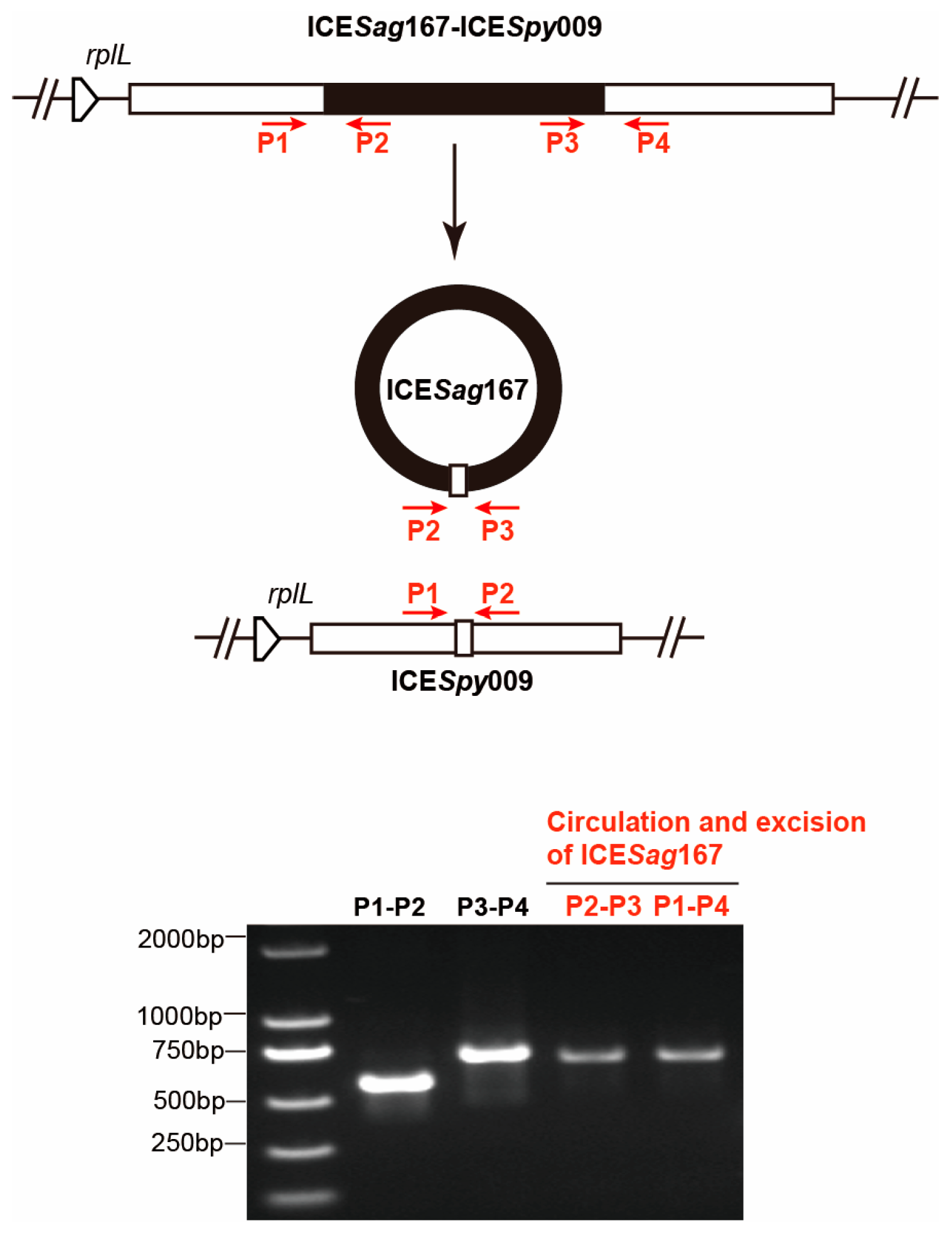
PCR primers targeting distinct ICE integration sites were designed to detect different ICE states through the pairwise combinations P1-P2, P3-P4, P1-P4, and P2-P3, as described previously [23]. Primer pairs P1-P2 and P3-P4 detect ICESag167 integration at the snf2, where P2 and P3 are outward-facing primers within end of ICESag167, while P1 and P4 are inward-facing primers within snf2 gene. P1hsdM-P2 and P3-P4hsdM were used to detect the integration of ICESag167 at SE864_01385 (hsdM, encoding methyltransferase with a YeeA domain) site; P1MTase-P2 and P3-P4MTase were used to detect the integration of ICESag167 at an Eco57I restriction-modification methylase protein, SE864_06140 (MTase). To conclusively verify the results, the PCR products indicative of ICE integration and circularization was confirmed by Sanger sequencing.

2.3. Determination of ICE Integration Sites

To screen the integration site of ICESag167 after conjugation, PCR primers were designed based on the known target sites of Tn1806-like ICEs (Tn1806, ICESag167, ICESag16, ICESan95_hsdM, ICESag139). First, the complete open reading frames (ORFs) of ICE target genes were retrieved from the NCBI database: Tn1806 (AP018937, hsdM), ICESag167 (CP029749, DLM82_06795), ICESag16 (CP051004, GRB95_01380), ICESan95 (CP053789, GE023_005635), and ICESag139 (CP053789, GE023_005635). Primers were then designed to flank the predicted attB within each target ORF. All primer sequences are listed in Table S1.

2.4. Conjugation Transfer Experiments

The selection of recipient strains was based on two criteria: (1) displaying the complementary resistance phenotype to the donor, and (2) containing at least one integration target site for ICEs. Prior to this study, a clinical S. agalactiae strain, SagR31 (Accession No. CP138369) had been whole-genome sequenced. This strain was found to carry an ICESa2603 family ICE, highly similar to ICESpy009 at 3′ rplL gene. It was resistant to tetracycline but susceptible to clindamycin, a profile opposite to that of the donor strain S. agalactiae Sag167, which was resistant to erythromycin and clindamycin but susceptible to tetracycline. Both SagR31 and Sag167 were susceptible to levofloxacin. Therefore, SagR31 was selected as the recipient for the first round of conjugation. In the re-transfer experiment, the recipient was selected from 161 clinical S. agalactiae isolates. These were screened by PCR to confirm an unoccupied rplL site. Strain SagRR40, which had an unoccupied rplL detected by other elements, was susceptible to erythromycin and clindamycin but resistant to levofloxacin, and was chosen as the recipient for the second round of conjugation.
The conjugation transfer experiment was performed as described previously [12,21]. Donors and recipients were cultured to the logarithmic phase and adjusted to OD600 = 0.5. Take 100 μL of donor culture to serially dilute and plate on medium for colony counting. Then donors and recipients were mixed at a 1:10 ratio, spread on nitrocellulose membrane-overlaid agar, and incubated for 4 h. An amount of 10 mg/mL of DNase I was added to eliminate the potential effects of DNA transformation [24]. The DNase I was purchased from YEASEN Biotechnology (Shanghai) Co., Ltd. After the incubation, the mixed bacteria were scraped from membranes and cultured in the medium containing 50 μg/mL erythromycin, 50 μg/mL clindamycin, and 40 μg/mL tetracycline and/or 20 μg/mL levofloxacin. Selected transconjugants were further verified by PCR and sequencing.
The conjugation frequency (F) was calculated as F = Nt/Nd, where Nt and Nd represent the number of transconjugants and donor cells, respectively. To determine the donor count, a 100 μL aliquot from a 50 mL donor culture was serially diluted 10-fold in PBS six to ten times. After mixing, 100 μL of the appropriate dilution was spread onto counting plates and incubated for one to two days, with colony counts between 30 and 300 considered valid. For transconjugant enumeration, cells were harvested from the nitrocellulose membrane after mating using a sterile swab and resuspended. This suspension was then plated onto transconjugant selective medium either undiluted or following a 10-fold or 100-fold dilution.

2.5. DNA Sequencing and Comparison Analysis

Based on previous reports, Tn1806-like ICEs frequently carry macrolide resistance genes such as erm(B), erm(TR), or mef(E) [20,21,25]. Therefore, we selected macrolide-resistant isolates from the 24 S. agalactiae harboring Tn1806-like ICEs for further sequencing (Table 1). This selection targeted strains more likely to carry these relevant resistance genes within their ICEs.
Conjugation transfer of ICEs was verified through next-generation sequencing (NGS) of recipient strains and corresponding transconjugants. Genomic DNA extraction employed the QIAGEN Midi Kit (Qiagen, Hilden, Germany), and whole-genome sequencing services were provided by BGI Genomics using the Illumina HiSeq X platform (San Diego, CA, USA). Sequencing data were quality trimmed, and Illumina Nextera indexes were removed using Trimmomatic v0.39.82 [26]. The high-quality reads were de novo assembled using Spades v3.9.034 [27]. Genome annotation was performed using online tool rast (https://rast.nmpdr.org) (accessed on 15 May 2025) [28]. Genomes sequences produced in our study were deposited in NCBI, following accession numbers: recipient SagR31 (CP138369), transconjugant SagR31_TC1 (CP138371), SagR31_TC2 (JAYLLK000000000), SagR31_TC3 (CP138364), SagR31_TC4 (CP138367), re-recipient SagRR40 (CP138370), re-transconjugants SagRR40_TC1 (CP138368), and SagRR40_TC2 (CP139638) (all of which are listed in Table 2).

3. Results

3.1. Early Characteristics of Tn1806-Positive Isolates

Among 161 S. agalactiae strains, 24 were preliminarily identified as potential Tn1806-like ICE carriers. Five strains (Sag16, Sag57, Sag139, Sag167, and Sag220), which exhibited high levels of erythromycin resistance (minimum inhibitory concentration > 128 mg/L), were selected for whole-genome sequencing (Appendix A Table A1).
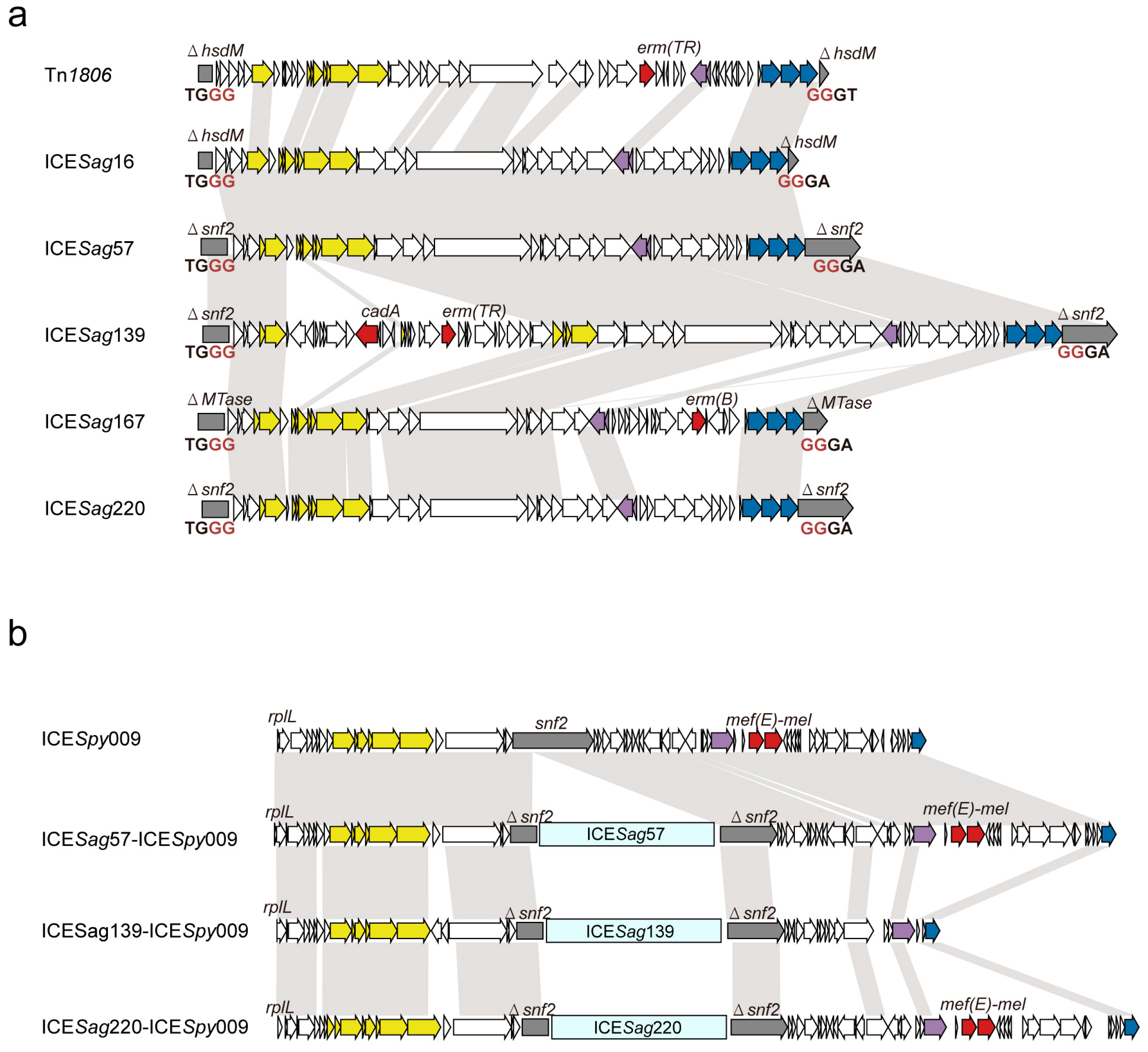
Whole-genome sequencing confirmed the presence of complete Tn1806-like ICEs in all five strains. Table 1 summarizes their genetic features, antimicrobial resistance profiles, and the genomic location of each Tn1806-like ICE. Among these, Sag167 carried erm(B), Sag139 carried erm(TR), and Sag16, Sag57, and Sag220 harbored the mel-mef(E) macrolide resistance gene cluster. However, macrolide resistance genes were located within the Tn1806-like ICEs only in the strains Sag167 [erm(B)] and Sag139 [erm(TR)] (Figure 1a).

3.2. Characteristics and Genetic Context of Tn1806-like ICEs

Whole-genome sequencing identified the five complete Tn1806-like ICEs of 49.005–71.946 kb size (designated ICESag16, ICESag57, ICESag139, ICESag167, and ICESag220, respectively, based on the strain abbreviation [Sag] and the number of hosts) in five clinical isolates (Figure 1, Table 1). These ICEs encode highly conserved triple serine integrases (>70% amino acid identity) with a known ICE Tn1806 [20], but each exhibits a distinct chromosomal attachment site (attB). ICESag16 targeted attB within the hsdM genes, which encodes a methyltransferase with a YeeA domain. ICESag57, ICESag139, and ICESag220 integrated into the snf2 gene, encoding a methyltransferase protein containing an SNF2 helicase domain, while ICESag167 is integrated within a gene encoding a protein with an Eco57I restriction modification methylase domain (WP_224219255.1), a methyltransferase abbreviated herein as MTase (Figure 1a). A shared feature was the presence of conserved 4 bp direct repeat sequences (5′-TGGG-GGGA-3′ or 5′-TGGG-GGGT-3′) flanking the five ICE boundaries. Integration into these attB sites resulted in the splitting of the target genes into two truncated open reading frames flanking the ICE boundaries.
Analysis of the resistance determinants showed that ICESag167 carried erm(B) conferring macrolide–lincosamide–streptogramin B (MLSB) resistance, while ICESag139 harbored erm(TR) (another MLSB determinant) along with cadA, a heavy metal resistance gene typically associated with the ICESa2603 family [29]. Further examination of genomic contexts revealed that ICESag57, ICESag139, and ICESag220 were nested within another ICE exhibiting high similarity to ICESpy009, an ICESa2603 family member from S. pyogenes (Figure 1b) [30]. Given that the snf2 gene serves as a conserved integration site in ICESa2603-family ICEs, we hypothesized that Tn1806-like ICEs may have undergone specific integration into ICESpy009 backbone to generate composite ICEs.

3.3. ICESag167 Integration into ICESpy009 via Conjugation Transfer Experiments

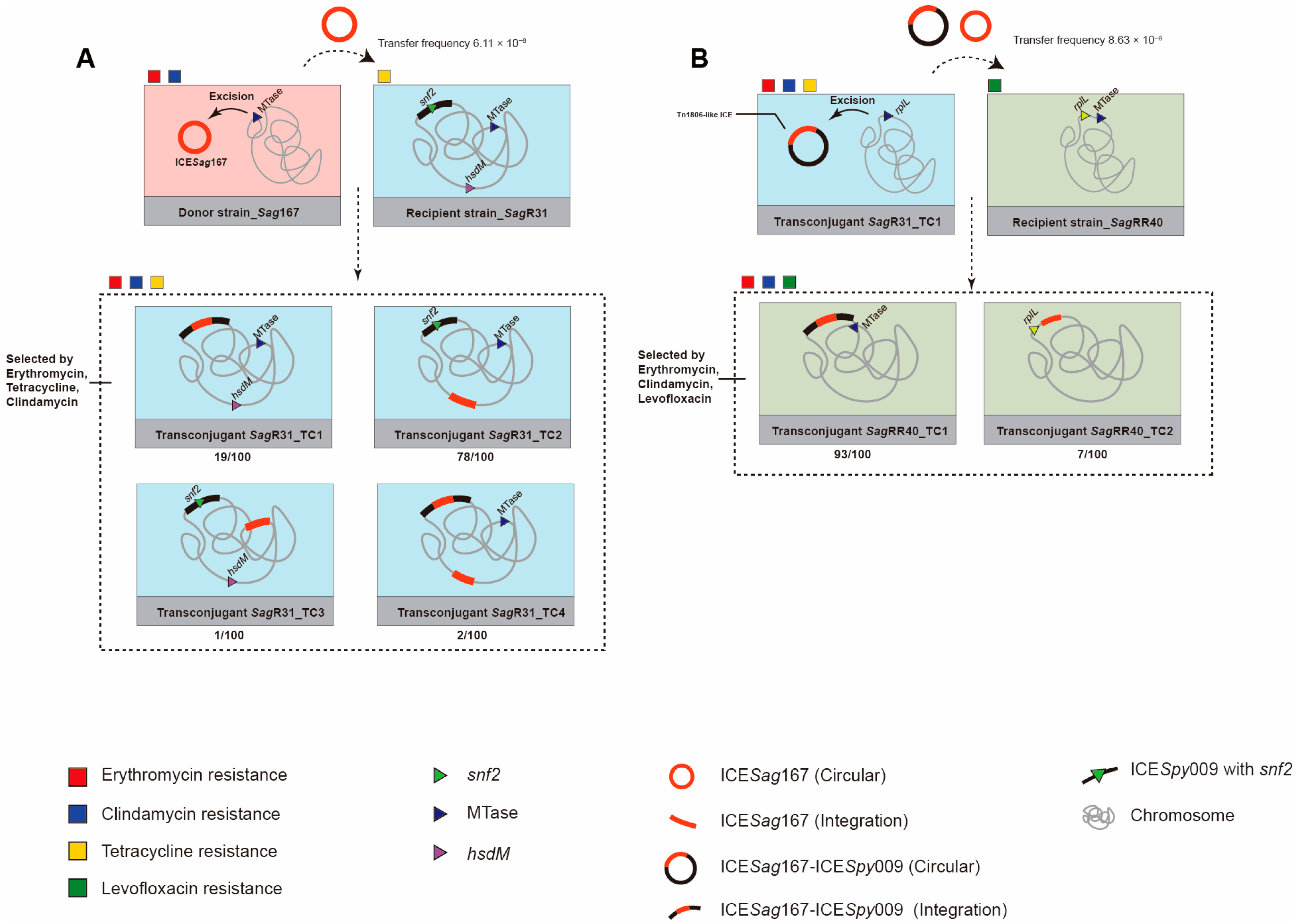
To test the hypothesis, experiments were performed using Sag167 (ERYR, CLIR, TETS, and LEVS) as the donor strain, which carries ICESag167 harboring the MLSB resistance gene erm(B). SagR31 (ERYS, CLIS, TETR, and LEVS) was selected as the recipient strain, as its genome had been fully sequenced prior to this study (Figure 2A, Table 2). Genomic analysis of the recipient SagR31 (accession no. CP138369) revealed three putative integration sites for ICESag167: SE864_06335 (snf2), SE864_01385 (hsdM), and SE864_06140 (MTase). Importantly, an ICESpy009-like ICE (located at genomic coordinates 1,220,484–1,277,017) containing the snf2 gene was identified at 3′ rplL. Conjugation experiments successfully generated transconjugants at a frequency of 6.11 × 10⁻⁶. Subsequent antimicrobial susceptibility testing confirmed that the putative transconjugants exhibited high-level MLSB and tetracycline resistance, consistent with the phenotype of both donor and recipient strains.
To determine the integration sites of ICESag167 in the recipient, 100 transconjugant colonies were randomly selected from the selective medium and analyzed by PCR. This analysis revealed that 19 of the 100 transconjugants, designated SagR31_TC1, carried a single copy of ICESag167 integrated at the SE864_06335 (snf2) locus, which aligns with the primary objective of this study. Whole-genome sequencing further confirmed the presence of a 106.508 kb composite ICE, formed by ICESag167 and the resident ICESpy009 and designated ICESag167–ICESpy009, located downstream of the rplL gene, thereby verifying the nested integration (Table 2). Among the remaining transconjugants, 78 (SagR31_TC2) carried ICEs integrated into SE864_01385 (hsdM), 1 (SagR31_TC3) showed integration into SE864_06140 (MTase), and 2 (SagR31_TC4) carried ICEs integrated simultaneously into both SE864_01385 (hsdM) and SE864_06335 (snf2).

3.4. Diverse Transferability of the ICESag167–ICESpy009 Composite

To further evaluate the transferability of the composite ICE ICESag167-ICESpy009, re-conjugation experiments were performed using the transconjugant SagR31_TC (ERYᴿ, CLIᴿ, TETᴿ, and LEVS) as the donor. SagRR40 (ERYS, CLIS, TETR, and LEVR), possessing an unoccupied rplL integration site, was selected as a recipient (Figure 2B). Whole-genome sequencing analysis of the recipient strain SagRR40 (CP138370) revealed the presence of an unoccupied rplL integration site, which can accept the composite ICE, and a SE933_06840 (MTase), which is a potential target for ICESag167 (Table 2). Re-conjugation yielded transconjugants at a frequency of 8.63 × 10⁻⁸ per donor. Antimicrobial susceptibility testing showed that transconjugants were resistant to erythromycin, clindamycin and levofloxacin. Of the 100 randomly screened transconjugant colonies, 93/100 transconjugants (SagRR40_TC1) showed integration of the composite ICE at 3′ rplL, as expected. Whole-genome sequencing for transconjugant SagRR40_TC1 confirmed that the complete ICESag167-ICESpy009 integrated the 3′ rplL gene into the SagRR40 recipient.
The remaining seven transconjugants (SagRR40_TC2) were found integrated into a ICESag167 at SE861_06150 (MTase). To validate the dynamic transfer of ICESag167 within the composite ICE, an inward-facing primer pair P2-P3 was used to detect circular intermediates via PCR (Figure 3). Faint positive bands were observed with both the P2-P3 and P1-P4 primer sets, indicating that ICESag167 retained its autonomous circularization capacity within the composite ICE.

4. Discussion

ICE mobility and transformation are modulated by multiple factors, including ICE-specific regulators (e.g., integrases and conjugation-associated genes) and host determinants (e.g., genomic context or resident mobile elements) [1,2,31,32]. These variables complicate ICE interactions and evolution. For example, SXT/R391-family ICEs form tandem arrays with genomic islands at shared integration sites, enabling ICE mobilization via island-encoded machinery to enhance inter-host dissemination and genome plasticity [17]. In streptococci, competition between ICESsu32457 and ICESa2603 for the rplL integration site drives recombination, generating novel composite ICEs [33]. Such interactions complicate the prediction of ICE-mediated antibiotic resistance gene dissemination, thereby delaying the epidemiological responses, with novel variants often being retrospectively identified [34,35]. Therefore, investigation of these diverse evolutionary pathways is a critical research priority.
To our knowledge, this study provides the first experimental evidence that Tn1806-family ICEs specifically integrate into common ICESa2603-family ICEs, thereby forming a large composite structure containing the genetic cargo of both. Molecular characterization revealed that Tn1806-like ICEs integrated into four-bp repeats within the snf2 gene of the ICESa2603-family ICEs. This special nested architecture differs from the previously reported tandem arrays, which usually compete for the same genomic position and occur between homologous ICEs [33,36]. Tandem arrays are inherently unstable due to frequent recombination events between homologous sequences, leading to structural transformation. In contrast, significant divergence between the Tn1806- and ICESa2603-family ICEs promoted stable composite formation in this study. Conjugation transfer experiments revealed that Tn1806 targeted the conserved sequences of the ICESa2603-family ICEs, suggesting that these evolutionarily distinct elements form fixed modular pairs. However, composite ICEs were transferred as dynamic loosely organized structures, not as conventional monolithic units. Embedded ICESag167 detached from the composite during transfer and mobilized independently. This flexible mechanism enhanced its dissemination versatility. When the recipient host lacked appropriate integration sites, such as rplL, for the composite, ICESag167 compensatorily mediated the resistance gene transfer. Therefore, selective removal of internal ICEs may optimize fitness costs by reducing the genomic burden.
Many known ICESa2603-family ICEs, such as ICESa2603 [18] from S. agalactiae and ICESde3396 [37] from S. dysgalactiae subsp. equisimilis, lack antibiotic resistance genes but harbor heavy metal resistance determinants. The embedding mechanism of Tn1806 consolidates the dispersed resistance genes into one ICE, creating novel elements with multidrug resistance. For example, ICESagTR7 acquired an additional MLSB resistance gene, erm(TR), from the Tn1806-like ICE. Recently identified resistance-associated ICEs, including ICESag139 (OP508059), ICESag048 (OP715839), and ICESag100414 (OP715842), possibly also originated through this mechanism [7]. Similarly, composite ICEs assembled the macrolide resistance genes (mel-mef) from ICESpy009 with erm(B) from embedded ICEs in this study. This process can create powerful resistance gene combinations, accelerating the evolutionary adaptation of bacteria during horizontal transfer. While our experimental investigation was conducted specifically in S. agalactiae, the composite ICE characterized here may be more broadly distribution across streptococci. This possibility is supported by existing reports, as ICESa2603-family elements have been identified in various species, including S. pneumoniae [19], S. pyogenes [25], S. agalactiae [14], and S. suis [24]. Furthermore, Tn1806-like ICEs have demonstrated transfer capability not only among streptococci but also to enterococci. Although the transferability of these composite ICEs requires direct experimental confirmation, related elements have been reported in other streptococcal species such as S. anginosus [38]. Collectively, these findings suggest that the mechanism of resistance gene accumulation and dissemination via composite a Tn1806-like ICE is likely not confined to S. agalactiae but may represent a more widespread strategy within streptococci.
The integration of both composite ICEs and Tn1806-like ICEs may impose fitness costs on the host. The former, with a sequence length exceeding 100 kb, likely place a significant metabolic burden on the cell during replication, a phenomenon commonly observed following conjugative plasmid transfer [39,40]. The latter often integrate into methyltransferase genes (e.g., snf2 or hsdM), potentially disrupting their function and thereby impacting transconjugant growth. Since methyltransferases play a key role in protecting bacterial DNA from restriction endonucleases, their impairment could be detrimental. The observed success of conjugation, however, suggests the methyltransferase function may not be fully lost or could be compensated by genes carried on the ICE itself. The precise mechanism responsible for this outcome requires further investigation.
Composite ICEs formed by Tn1806-like and ICESa2603-family ICEs are not invariant. Integration sites (att) for Tn1806-like ICEs were primarily localized within the snf2 and methyltransferase genes; however, snf2 also exists in enterococcal pheromone-responsive plasmids [41,42], and methyltransferase gene functions as a core component of the restriction-modification system widespread among MGEs [43]. Therefore, in addition to ICESa2603-family ICEs, Tn1806-like ICEs potentially embed within other mobile elements (e.g., plasmids or integrative and mobilizable elements) to form novel ICE–plasmid or ICE–integrative and mobilizable element composites, also warranting further investigation.

5. Conclusions

Streptococcus species, particularly Streptococcus agalactiae, are established reservoirs of diverse antibiotic and heavy metal resistance genes and harbor abundant MGEs disseminating these determinants to other bacteria [9]. The presence of Tn1806 may enable the accumulation of multiple resistance genes within a single element, thereby contributing to the evolution of ICESa2603 and the formation of large resistance genomic islands. Our experimental results confirm the feasibility of this mechanism and provide a foundation for further investigation into the interactions between Tn1806 and extensive MGEs.

Supplementary Materials

The following supporting information can be downloaded at: https://www.mdpi.com/article/10.3390/microorganisms14020375/s1, Table S1: Primers used in this study.

Author Contributions

Conceptualization, S.Y. and X.W.; methodology, S.Y.; software, X.X. and L.Y.; validation, S.Y.; formal analysis, S.Y.; investigation, S.Y.; resources, X.X. and S.Y.; data curation, S.Y.; writing—original draft preparation, S.Y.; writing—review and editing, X.W. and Z.H.; visualization, S.Y.; supervision, X.W. and Z.H.; project administration, X.W. and Z.H.; funding acquisition, S.Y. and X.W. All authors have read and agreed to the published version of the manuscript.

Funding

This research was funded by the Clinical Research Special Program of Shanghai Municipal Health Commission [Grant Number 2025Y0054].

Institutional Review Board Statement

Not applicable.

Informed Consent Statement

Not applicable.

Data Availability Statement

The genomes sequences presented in this study are openly available in NCBI, following accession numbers: recipient SagR31 (CP138369), transconjugant SagR31_TC (CP138371), re-recipient SagRR40 (CP138370), re-transconjugants SagRR40_TCrplL (CP138368), SagRR40_TC (CP139638).

Conflicts of Interest

The authors declare no conflicts of interest.

Abbreviations

The following abbreviations are used in this manuscript:
CLSIClinical and Laboratory Standards Institute
ICEsIntegrative and conjugative elements
MLSBMacrolides, Lincosamides, and Streptogramin B
MICMinimum inhibitory concentration
NGSNext-generation sequencing
ERMErythromycin
CLIClindamycin
TETTetracycline
LEVLevofloxacin
MGESMobile genetic elements

Appendix A

Table A1. Phenotypic, genotypic, and other characteristics of the 24 Tn1806-like ICEs positive S. agalactiae.
StrainsYearMIC (mg/L)Strains Resistance GenotypeTn1806-like ICE Resistance Genotype
ERYCLITETLEVCHLVANPEN
Sag16202325612818≤0.5≤0.5≤0.5mef(E)-mel-
Sag572023>256256≤0.5≤0.5≤0.5≤0.5≤0.5mef(E)-mel-
Sag1392023>256>256>2568≤0.5≤0.5≤0.5erm(TR), tetMerm(TR)
Sag1672023>256>256≤0.5≤0.5≤0.5≤0.5≤0.5erm(B)erm(B)
Sag22020231282>256≤0.5≤0.5≤0.5≤0.5mef(E)-mel, tetM-
Sag082023≤0.5641288≤0.5≤0.5≤0.5
Sag1022023≤0.5≤0.5≤0.5≤0.5≤0.5≤0.5≤0.5
Sag1112023≤0.5≤0.564321≤0.5≤0.5
Sag1382023≤0.5≤0.5≤0.5≤0.5≤0.5≤0.5≤0.5
Sag138.22023≤0.5≤0.5≤0.5≤0.5≤0.5≤0.5≤0.5
Sag1572023≤0.5≤0.5≤0.5≤0.5≤0.5≤0.5≤0.5
Sag1592023≤0.52>256≤0.5≤0.5≤0.5≤0.5
Sag18820231≤0.5≤0.5≤0.516≤0.5≤0.5
Sag2012023≤0.5≤0.5≤0.5≤0.5≤0.5≤0.5≤0.5
Sag201.22023≤0.5≤0.5≤0.58≤0.5≤0.5≤0.5
Sag201.32023≤0.5≤0.5≤0.5≤0.5≤0.5≤0.5≤0.5
Sag2132023≤0.5≤0.5≤0.516≤0.5≤0.5≤0.5
Sag2402023161≤0.52≤0.5≤0.5≤0.5
Sag2722023≤0.58>256≤0.5≤0.5≤0.5≤0.5
Sag3002023≤0.5≤0.5≤0.5≤0.5≤0.5≤0.5≤0.5
Sag33020231≤0.5128≤0.51≤0.5≤0.5
Sag3422023≤0.5≤0.5≤0.5≤0.5≤0.5≤0.5≤0.5
Sag342.22023≤0.5≤0.5≤0.5≤0.5≤0.5≤0.5≤0.5
Sag5162025123211≤0.5≤0.5
Abbreviations: MIC, minimum inhibitory concentration; ERY, erythromycin; CLI, clindamycin; TET, tetracycline; LEV, levofloxacin; CHL, chloramphenicol; PEN, penicillin; VAN, vancomycin.

References

  1. Wozniak, R.A.; Waldor, M.K. Integrative and conjugative elements: Mosaic mobile genetic elements enabling dynamic lateral gene flow. Nat. Rev. Microbiol. 2010, 8, 552–563. [Google Scholar] [CrossRef] [PubMed]
  2. Johnson, C.M.; Grossman, A.D. Integrative and Conjugative Elements (ICEs): What They Do and How They Work. Annu. Rev. Genet. 2015, 49, 577–601. [Google Scholar] [CrossRef]
  3. Rodriguez-Blanco, A.; Lemos, M.L.; Osorio, C.R. Integrating conjugative elements as vectors of antibiotic, mercury, and quaternary ammonium compound resistance in marine aquaculture environments. Antimicrob. Agents Chemother. 2012, 56, 2619–2626. [Google Scholar] [CrossRef]
  4. Whittle, G.; Shoemaker, N.B.; Salyers, A.A. The role of Bacteroides conjugative transposons in the dissemination of antibiotic resistance genes. Cell Mol. Life Sci. 2002, 59, 2044–2054. [Google Scholar] [CrossRef]
  5. Bi, D.; Xu, Z.; Harrison, E.M.; Tai, C.; Wei, Y.; He, X.; Jia, S.; Deng, Z.; Rajakumar, K.; Ou, H.Y. ICEberg: A web-based resource for integrative and conjugative elements found in Bacteria. Nucleic Acids Res. 2012, 40, D621–D626. [Google Scholar] [CrossRef]
  6. Ambroset, C.; Coluzzi, C.; Guedon, G.; Devignes, M.D.; Loux, V.; Lacroix, T.; Payot, S.; Leblond-Bourget, N. New Insights into the Classification and Integration Specificity of Streptococcus Integrative Conjugative Elements through Extensive Genome Exploration. Front. Microbiol. 2015, 6, 1483. [Google Scholar] [CrossRef] [PubMed]
  7. Khan, U.B.; Portal, E.A.R.; Sands, K.; Lo, S.; Chalker, V.J.; Jauneikaite, E.; Spiller, O.B. Genomic Analysis Reveals New Integrative Conjugal Elements and Transposons in GBS Conferring Antimicrobial Resistance. Antibiotics 2023, 12, 544. [Google Scholar] [CrossRef] [PubMed]
  8. Huang, J.; Ma, J.; Shang, K.; Hu, X.; Liang, Y.; Li, D.; Wu, Z.; Dai, L.; Chen, L.; Wang, L. Evolution and Diversity of the Antimicrobial Resistance Associated Mobilome in Streptococcus suis: A Probable Mobile Genetic Elements Reservoir for Other Streptococci. Front. Cell Infect. Microbiol. 2016, 6, 118. [Google Scholar] [CrossRef]
  9. Brochet, M.; Couve, E.; Glaser, P.; Guedon, G.; Payot, S. Integrative conjugative elements and related elements are major contributors to the genome diversity of Streptococcus agalactiae. J. Bacteriol. 2008, 190, 6913–6917. [Google Scholar] [CrossRef]
  10. Le Doare, K.; Heath, P.T. An overview of global GBS epidemiology. Vaccine 2013, 31, D7–D12. [Google Scholar] [CrossRef]
  11. Lorenzo-Diaz, F.; Fernandez-Lopez, C.; Douarre, P.E.; Baez-Ortega, A.; Flores, C.; Glaser, P.; Espinosa, M. Streptococcal group B integrative and mobilizable element IMESag-rpsI encodes a functional relaxase involved in its transfer. Open Biol. 2016, 6, 160084. [Google Scholar] [CrossRef]
  12. Yang, Q.; Zhu, Y.; Schwarz, S.; Zhang, W.; Wang, X. Characterization of an optrA-harbouring unconventional circularizable structure located on a novel ICESa2603 family-like integrative and conjugative element ICESsuHN38 in Streptococcus suis. J. Antimicrob. Chemother. 2023, 78, 2066–2069. [Google Scholar] [CrossRef]
  13. Huang, J.; Liang, Y.; Guo, D.; Shang, K.; Ge, L.; Kashif, J.; Wang, L. Comparative Genomic Analysis of the ICESa2603 Family ICEs and Spread of erm(B)- and tet(O)-Carrying Transferable 89K-Subtype ICEs in Swine and Bovine Isolates in China. Front. Microbiol. 2016, 7, 55. [Google Scholar] [CrossRef]
  14. Zhou, K.; Xie, L.; Han, L.; Guo, X.; Wang, Y.; Sun, J. ICESag37, a Novel Integrative and Conjugative Element Carrying Antimicrobial Resistance Genes and Potential Virulence Factors in Streptococcus agalactiae. Front. Microbiol. 2017, 8, 1921. [Google Scholar] [CrossRef] [PubMed]
  15. Centers for Disease Control and Prevention. Bacteria and Fungi Listed in the 2019 AR Threats Report. Available online: https://www.cdc.gov/antimicrobial-resistance/data-research/threats/index.html (accessed on 1 December 2025).
  16. Guglielmini, J.; Quintais, L.; Garcillán-Barcia, M.P.; de la Cruz, F.; Rocha, E.P.C. The Repertoire of ICE in Prokaryotes Underscores the Unity, Diversity, and Ubiquity of Conjugation. PLoS Genet. 2011, 7, e1002222. [Google Scholar] [CrossRef] [PubMed]
  17. Wang, P.; Zeng, Z.; Wang, W.; Wen, Z.; Li, J.; Wang, X. Dissemination and loss of a biofilm-related genomic island in marine Pseudoalteromonas mediated by integrative and conjugative elements. Environ. Microbiol. 2017, 19, 4620–4637. [Google Scholar] [CrossRef]
  18. Mingoia, M.; Morici, E.; Marini, E.; Brenciani, A.; Giovanetti, E.; Varaldo, P.E. Macrolide resistance gene erm(TR) and erm(TR)-carrying genetic elements in Streptococcus agalactiae: Characterization of ICESagTR7, a new composite element containing IMESp2907. J. Antimicrob. Chemother. 2016, 71, 593–600. [Google Scholar] [CrossRef] [PubMed]
  19. Morici, E.; Simoni, S.; Brenciani, A.; Giovanetti, E.; Varaldo, P.E.; Mingoia, M. A new mosaic integrative and conjugative element from Streptococcus agalactiae carrying resistance genes for chloramphenicol (catQ) and macrolides [mef(I) and erm(TR)]. J. Antimicrob. Chemother. 2017, 72, 64–67. [Google Scholar] [CrossRef]
  20. Camilli, R.; Del Grosso, M.; Iannelli, F.; Pantosti, A. New genetic element carrying the erythromycin resistance determinant erm(TR) in Streptococcus pneumoniae. Antimicrob. Agents Chemother. 2008, 52, 619–625. [Google Scholar] [CrossRef]
  21. Yi, S.; Zhou, K.; Xu, X. Characterization of erm(B)-Carrying Integrative and Conjugative Elements Transferred from Streptococcus anginosus to Other Streptococci and Enterococci. Microb. Drug Resist. 2024, 30, 243–253. [Google Scholar] [CrossRef]
  22. M100ed34; Performance Standards for Antimicrobial Susceptibility Testing 34th Informational Supplement. Clinical and Laboratory Standards Institute (CLSI): Wayne, PA, USA, 2024.
  23. Yi, S.; Huang, J.; Hu, X.; Chen, L.; Dai, X.; Sun, J.; Liu, P.; Wang, X.; Wen, J.; Wang, L. Nonconservative integration and diversity of a new family of integrative and conjugative elements associated with antibiotic resistance in zoonotic pathogen Streptococcus suis. Vet. Microbiol. 2021, 254, 109009. [Google Scholar] [CrossRef]
  24. Palmieri, C.; Magi, G.; Mingoia, M.; Bagnarelli, P.; Ripa, S.; Varaldo, P.E.; Facinelli, B. Characterization of a Streptococcus suis tet(O/W/32/O)-carrying element transferable to major streptococcal pathogens. Antimicrob. Agents Chemother. 2012, 56, 4697–4702. [Google Scholar] [CrossRef]
  25. Beres, S.B.; Musser, J.M. Contribution of exogenous genetic elements to the group A Streptococcus metagenome. PLoS ONE 2007, 2, e800. [Google Scholar] [CrossRef] [PubMed]
  26. Bolger, A.M.; Lohse, M.; Usadel, B. Trimmomatic: A flexible trimmer for Illumina sequence data. Bioinformatics 2014, 30, 2114–2120. [Google Scholar] [CrossRef] [PubMed]
  27. Prjibelski, A.; Antipov, D.; Meleshko, D.; Lapidus, A.; Korobeynikov, A. Using SPAdes De Novo Assembler. Curr. Protoc. Bioinform. 2020, 70, e102. [Google Scholar] [CrossRef]
  28. Aziz, R.K.; Bartels, D.; Best, A.A.; DeJongh, M.; Disz, T.; Edwards, R.A.; Formsma, K.; Gerdes, S.; Glass, E.M.; Kubal, M.; et al. The RAST Server: Rapid annotations using subsystems technology. BMC Genom. 2008, 9, 75. [Google Scholar] [CrossRef] [PubMed]
  29. Zhong, C.; Zhou, Y.; Fu, J.; Qi, X.; Wang, Z.; Li, J.; Zhang, P.; Zong, G.; Cao, G. Cadmium stress efficiently enhanced meropenem degradation by the meropenem- and cadmium-resistant strain Pseudomonas putida R51. J. Hazard. Mater. 2022, 429, 128354. [Google Scholar] [CrossRef]
  30. Del Grosso, M.; Camilli, R.; Rizzi, E.; Pietrelli, A.; De Bellis, G.; Pantosti, A. ICESpy009, a Conjugative Genetic Element Carrying mef(E) in Streptococcus pyogenes. Antimicrob. Agents Chemother. 2016, 60, 3906–3912. [Google Scholar] [CrossRef]
  31. Lyra de Holanda Fonseca, D.; Scheunemann, G.S.; Fortes, B.N.; Ishida, K.; Galhardo, R.S. Interaction of the SXT/R391 element ICEPmiJpn1 with its natural host Proteus mirabilis. Microbiol. Spectr. 2025, 13, e0033925. [Google Scholar] [CrossRef]
  32. Wang, Y.; Liu, T.; Yi, S.; Zhu, Y. A New Composite Integrative and Conjugative Element Mediates Multiple Drug Resistance from Streptococcus anginosus to Streptococcus agalactiae. Infect. Drug Resist. 2025, 18, 1941–1949. [Google Scholar] [CrossRef]
  33. Marini, E.; Palmieri, C.; Magi, G.; Facinelli, B. Recombination between Streptococcus suis ICESsu32457 and Streptococcus agalactiae ICESa2603 yields a hybrid ICE transferable to Streptococcus pyogenes. Vet. Microbiol. 2015, 178, 99–104. [Google Scholar] [CrossRef] [PubMed]
  34. Botelho, J.; Schulenburg, H. The Role of Integrative and Conjugative Elements in Antibiotic Resistance Evolution. Trends Microbiol. 2021, 29, 8–18. [Google Scholar] [CrossRef]
  35. Han, Y.; Gao, Y.F.; Xu, H.t.; Li, J.P.; Li, C.; Song, C.L.; Lei, C.W.; Chen, X.; Wang, Q.; Ma, B.H.; et al. Characterization and risk assessment of novel SXT/R391 integrative and conjugative elements with multidrug resistance in Proteus mirabilis isolated from China, 2018–2020. Microbiol. Spectr. 2024, 12, e0120923. [Google Scholar] [CrossRef]
  36. Pavlovic, G.; Burrus, V.; Gintz, B.; Decaris, B.; Guedon, G. Evolution of genomic islands by deletion and tandem accretion by site-specific recombination: ICESt1-related elements from Streptococcus thermophilus. Microbiology 2004, 150, 759–774. [Google Scholar] [CrossRef]
  37. Davies, M.R.; Shera, J.; Van Domselaar, G.H.; Sriprakash, K.S.; McMillan, D.J. A novel integrative conjugative element mediates genetic transfer from group G Streptococcus to other beta-hemolytic Streptococci. J. Bacteriol. 2009, 191, 2257–2265. [Google Scholar] [CrossRef]
  38. Wang, Y.; Liu, T.; Sida, Y.; Zhu, Y. Diversity and Evolution of the Mobilome Associated with Antibiotic Resistance Genes in Streptococcus anginosus. Microb. Drug Resist. 2025, 31, 52–63. [Google Scholar] [CrossRef] [PubMed]
  39. Sher, A.A.; VanAllen, M.E.; Ahmed, H.; Whitehead-Tillery, C.; Rafique, S.; Bell, J.A.; Zhang, L.; Mansfield, L.S. Conjugative RP4 Plasmid-Mediated Transfer of Antibiotic Resistance Genes to Commensal and Multidrug-Resistant Enteric Bacteria In Vitro. Microorganisms 2023, 11, 193. [Google Scholar] [CrossRef]
  40. Liu, Z.; Wang, Z.; Lu, X.; Peng, K.; Chen, S.; He, S.; Li, R. Structural Diversity, Fitness Cost, and Stability of a Bla(NDM-1)-Bearing Cointegrate Plasmid in Klebsiella pneumoniae and Escherichia coli. Microorganisms 2021, 9, 193. [Google Scholar] [CrossRef]
  41. Tomita, H.; Lu, J.J.; Ike, Y. High Incidence of Multiple-Drug-Resistant Pheromone-Responsive Plasmids and Transmissions of VanA-Type Vancomycin-Resistant Enterococcus faecalis between Livestock and Humans in Taiwan. Antibiotics 2023, 12, 1668. [Google Scholar] [CrossRef] [PubMed]
  42. Price, V.J.; Huo, W.; Sharifi, A.; Palmer, K.L. CRISPR-Cas and Restriction-Modification Act Additively against Conjugative Antibiotic Resistance Plasmid Transfer in Enterococcus faecalis. mSphere 2016, 1, 3. [Google Scholar] [CrossRef]
  43. Zheng, H.; Dietrich, C.; Hongoh, Y.; Brune, A. Restriction-Modification Systems as Mobile Genetic Elements in the Evolution of an Intracellular Symbiont. Mol. Biol. Evol. 2016, 33, 721–725. [Google Scholar] [CrossRef] [PubMed]
Figure 1. Schematic, but to scale, representation comparing putative ICEs identified in this study with known ICEs. (a) Comparison against five newly identified Tn1806-like ICEs (designated ICESag16, ICESag57, ICESag139, ICESag167, and ICESag220) with Tn1806 (EF469826). Triangular symbol (Δ) represents truncated ORFs that were inserted by ICEs; areas shaded gray represent regions of identity between 70 and 100%. Integrase genes are shown as blue arrows, relaxase genes as purple arrows, T4SSs and T4CPs components as yellow arrows, antibiotics and heavy metal resistance genes as red arrows, ICE insertion associated genes as light gray arrows, and variable genes as white arrows. The characteristic flanking direct repeats (GG-GG) are highlighted by red. (b) Comparison of three composite ICEs (designated ICESag57-ICESpy009, ICESag139-ICESpy009, and ICESag220-ICESpy009) with the known ICE ICESpy009 (KU056701). The light blue rectangle represents Tn1806-like ICEs (ICESag57, ICESag139, and ICESag220) that are embedded within snf2 of the ICE framework.
Microorganisms 14 00375 g001
Figure 2. Diagram of the conjugation transfer and re-conjugation transfer experiments. (A) experimental workflow for conjugative transfer of ICESag167 from donor S. agalactiae Sag167 to recipient SagR31 and generated four types of transconjugants. Transconjugant were selected by antibiotics erythromycin, tetracycline and clindamycin. Four types of transconjugants: 19/100 SagR31_TC1, 78/100 SagR31_TC2, 1/100 SagR31_TC3, and 2/100 SagR31_TC4. (B) re-conjugative transfer of ICESag167–ICSpy009 or ICESag167 from SagR31_TC1 to recipient SagRR40 and generated two types of transconjugants. Transconjugant were selected by antibiotics erythromycin, clindamycin, and levofloxacin. Two types of transconjugants: 93/100 SagRR40_TC1 and 7/100 SagR40_TC2.
Microorganisms 14 00375 g002
Figure 3. Diagram of PCR analysis of the integration and excision/circularization of ICESag167 (black fragment) from composite ICESag167-ICESpy009. The integration form of internal ICESag167 was detected by primers P1/P2 and P3/P4, the excised or empty form was detected by P1/P4, and the circular form was detected by P2/P3. The PCR bands corresponding to the excised and circularized ICESag167 are highlighted in red. The DL2000 DNA Marker (Vazyme) was used.
Microorganisms 14 00375 g003
Table 1. Characteristics of the 5 S. agalactiae isolates harboring Tn1806-like ICE.
StrainYearsMIC (mg/L)SerotypeMLSTAccession NumberICEs Information
ERYCLINamedCarried ARGsLengthEmbedded ICELocation
Sag162023256128IbST10JBAPEH000000000ICESag16None49,616NONODE_1,
57,929–107,544
Sag572022>256256IbST19JBAPEL000000000ICESag57None49,616YESSequence 3,
64,336–113,951
Sag1392022>256>256IaST19JBAPEP000000000ICESag139erm(TR), cadA71,946YESSequence 4,
21,884–93,829
Sag1672022>256>256IbST10JBAPEQ000000000ICESag167erm(B)49,975NOSequence 2,
12,144–62,118
Sag22020221282IbST19JBAPER000000000ICESag220None49,005YESSequence 2,
136,618–185,622
ARGs: antibiotic resistance genes.
Table 2. Characteristics of S. agalactiae isolates used in the conjugation transfer experiments.
StrainDescriptionsMIC (mg/L)Integration Site (s)Transferred ICELocation of ICEAccession Numbers
ERYCLITETLEV
Sag167Donor256128≤0.5≤0.5--Sequence 2,
12,144–62,118
JBAPEH000000000
SagR31Recipient2132≤0.5---CP138369
SagR31_TCTransconjugant
/Donor
25612832≤0.5snf2ICESag1671,255,041–1,305,015CP138371
SagR31_TC2Transconjugant12812832≤0.5hsdMICESag167NODE_18 III
8715–45,199
JAYLLK000000000
SagR31_TC3Transconjugant25612816≤0.5MTaseICESag1671,026,742–1,076,705CP138364
SagR31_TC4Transconjugant25612832≤0.5snf2 and hsdMICESag167 × 21,305,259–1,355,233;
240,002–289,976
CP138367
SagRR40Recipient>2561281128---CP138370
SagRR40_TC1Transconjugant256641128rplLICESag167–ICESpy0091,848,521–1,955,094CP138368
SagRR40_TC2Transconjugant>2561281128hsdMICESag167418,895–468,868CP139638
Notes: The bold values were obtained by antibiotic resistance screening via a conjugation transfer experiment. Abbreviations: MIC, minimum inhibitory concentration; ERY, erythromycin; CLI, clindamycin; TET, tetracycline; LEV, levofloxacin; MTase, SE864_06140 (annotated as a methyltransferase gene; Sag: Streptococcus agalactiae; TC, transconjugant.
Disclaimer/Publisher’s Note: The statements, opinions and data contained in all publications are solely those of the individual author(s) and contributor(s) and not of MDPI and/or the editor(s). MDPI and/or the editor(s) disclaim responsibility for any injury to people or property resulting from any ideas, methods, instructions or products referred to in the content.