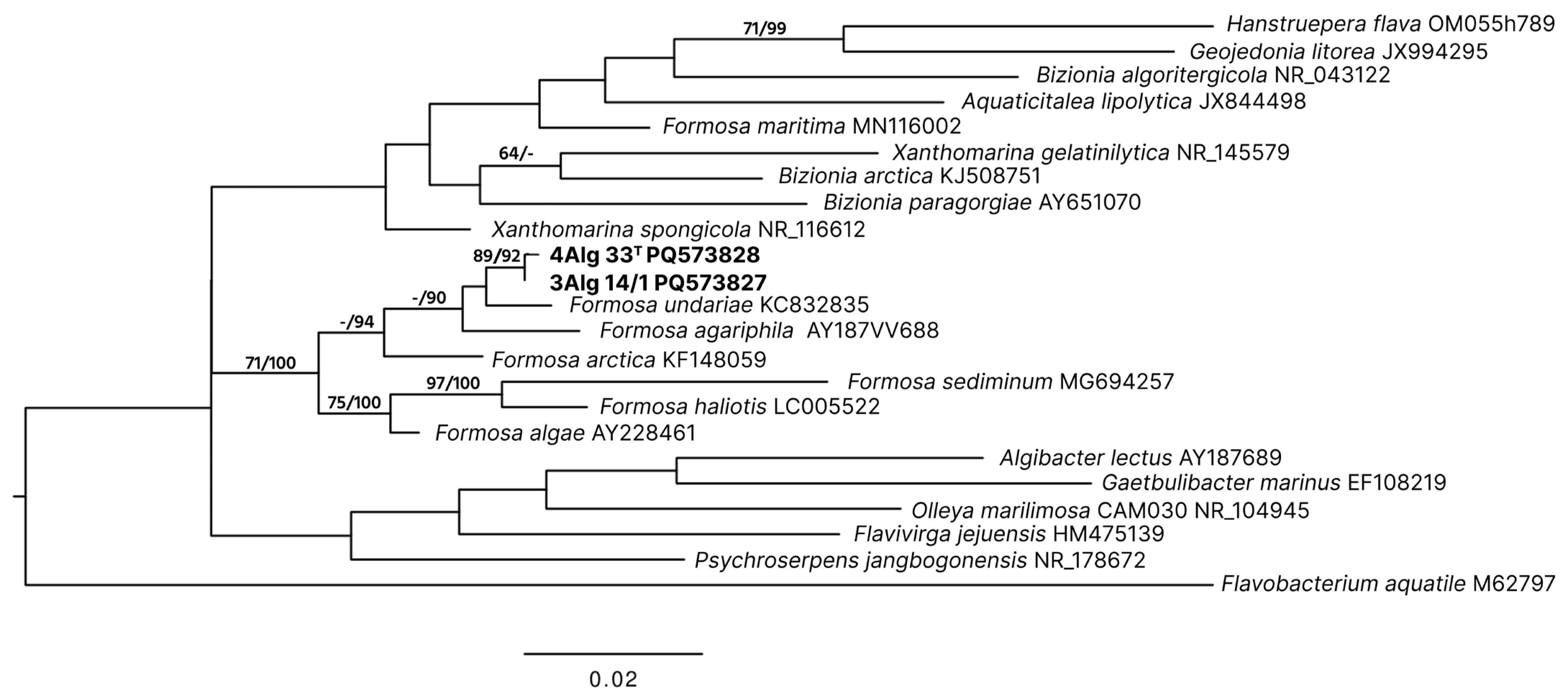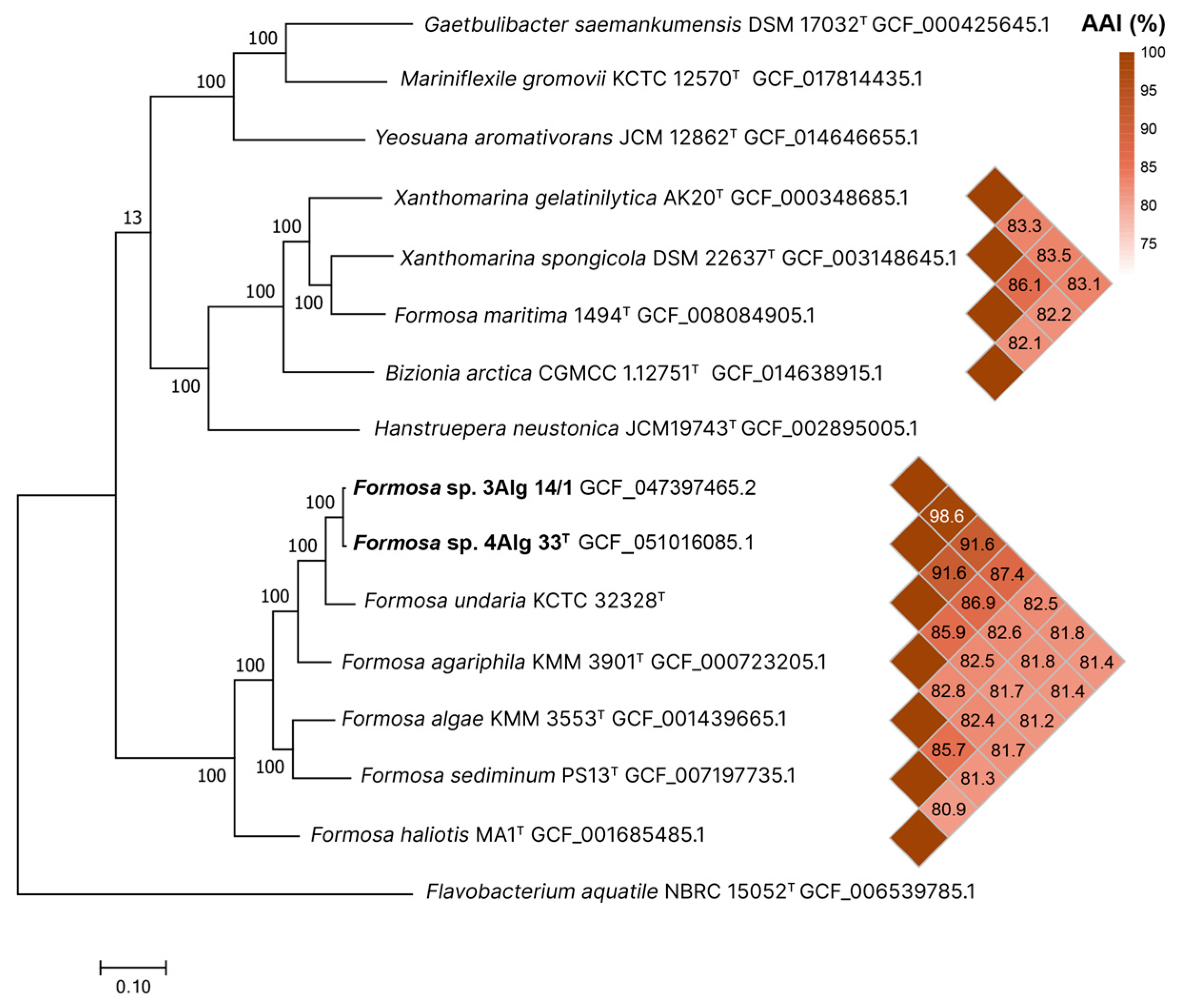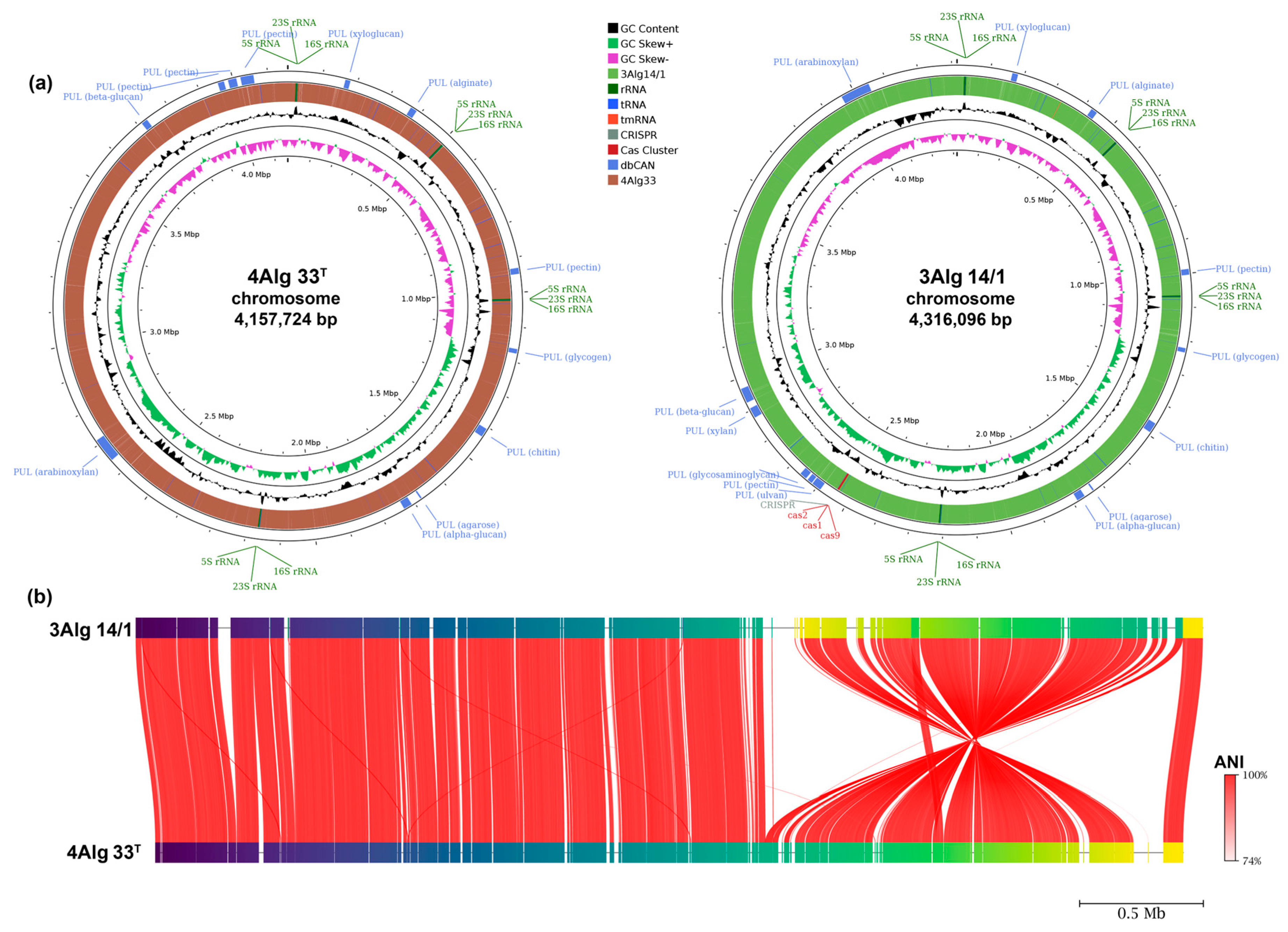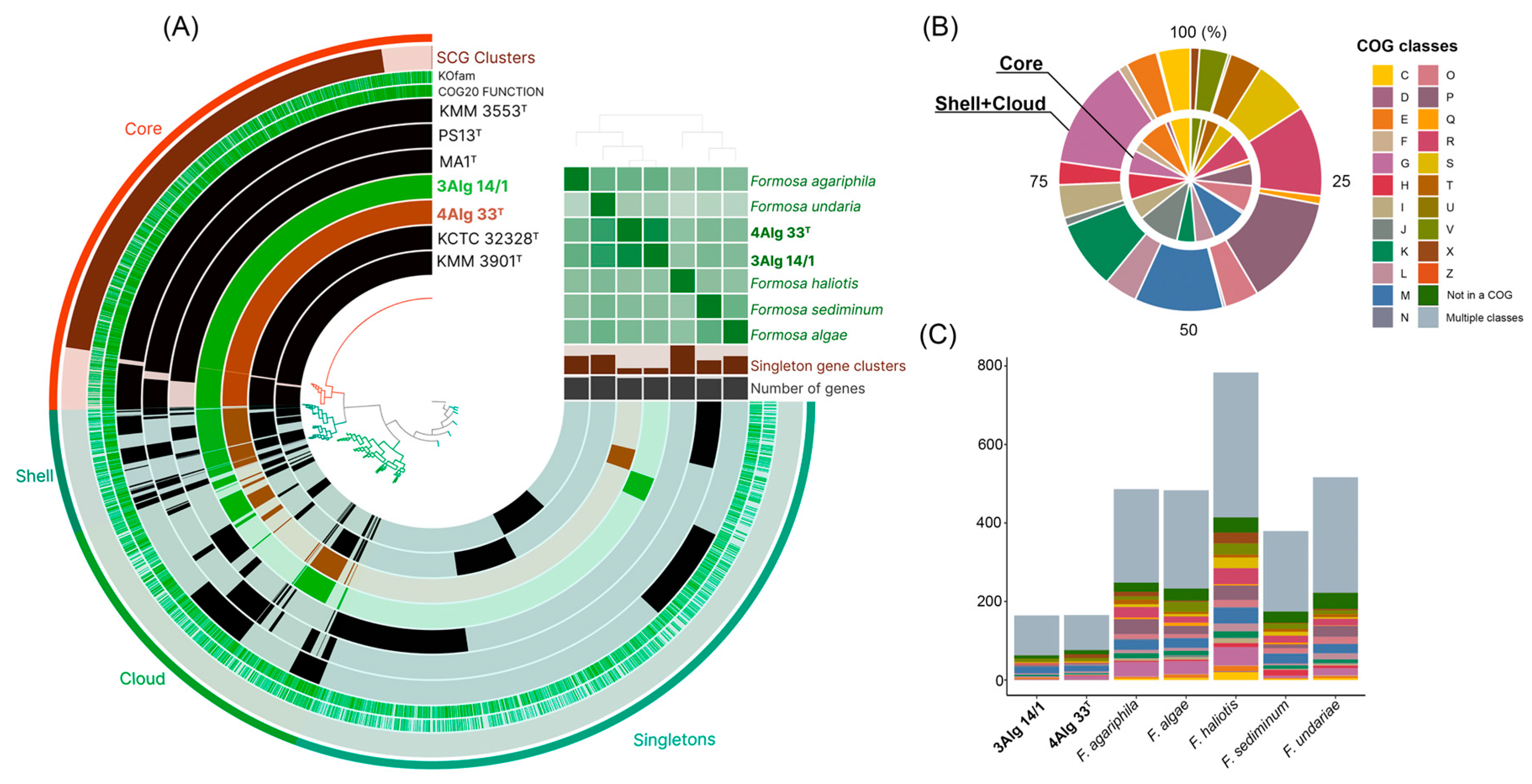

Genome Analysis and Characterization of Formosa bonchosmolovskayae sp. nov. Isolated from Brown and Green Algae, and a Proposal to Reclassify Formosa maritima Cao et al. 2020 and Bizionia arctica Li et al. 2015 as Xanthomarina New Members

 , , ,
, , ,  , and
, and
Abstract
1. Introduction
2. Materials and Methods
2.1. Isolation and Maintenance of Bacterial Strains
2.2. Phenotypic Characterization
2.3. Chemotaxonomic Characterization
2.4. 16S rRNA Gene Sequence and Phylogenetic Analysis
2.5. Whole-Genome Sequencing and Genome-Based Phylogenetic Analysis
2.6. Functional Genomic Analysis
3. Results and Discussion
3.1. Phylogenetic Analyses
3.2. Genomic Characteristics and Pan-Genome Analysis
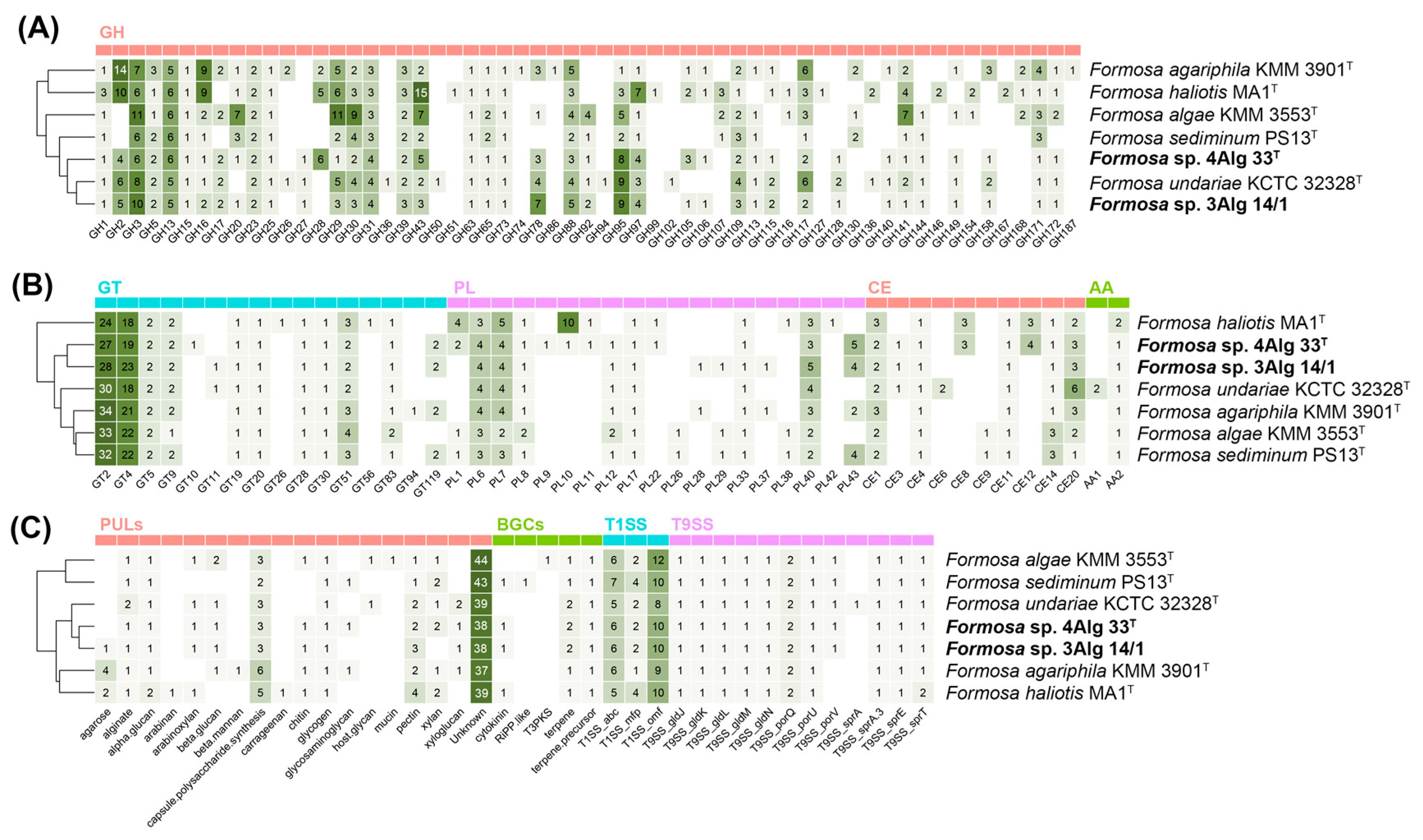
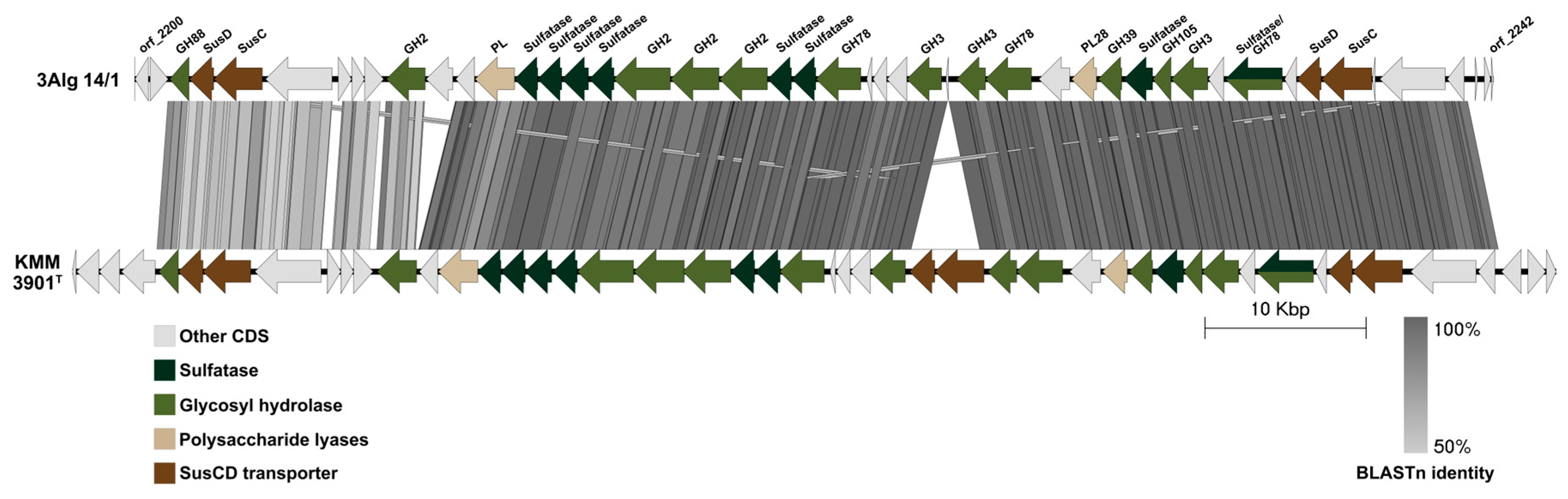
3.3. In Silico Analysis of Hydrolytic and Biosynthetic Potentials
3.4. Phenotypic Characterization of New Strains
3.5. Reclassification of Formosa maritima and Bizionia arctica as New Xanthomarina Species
4. Conclusions
- Description of Formosa bonchosmolovskayae sp. nov.
- Description of Xanthomarina maritima comb. nov.
- Description of Xanthomarina arctica comb. nov.
Supplementary Materials
Author Contributions
Funding
Institutional Review Board Statement
Informed Consent Statement
Data Availability Statement
Conflicts of Interest
References
- Ivanova, E.P.; Alexeeva, Y.V.; Flavier, S.; Wright, J.P.; Zhukova, N.V.; Gorshkova, N.M.; Mikhailov, V.V.; Nicolau, D.V.; Christen, R. Formosa algae gen. nov., sp. nov., a novel member of the family Flavobacteriaceae. Int. J. Syst. Evol. Microbiol. 2004, 54, 705–711. [Google Scholar] [CrossRef]
- Nedashkovskaya, O.I.; Kim, S.B.; Vancanneyt, M.; Snauwaert, C.; Lysenko, A.M.; Rohde, M.; Frolova, G.M.; Zhukova, N.V.; Mikhailov, V.V.; Bae, K.S.; et al. Formosa agariphila sp. nov., a budding bacterium of the family Flavobacteriaceae isolated from marine environments, and emended description of the genus Formosa. Int. J. Syst. Evol. Microbiol. 2006, 56, 161–167. [Google Scholar] [CrossRef] [PubMed]
- Shakeela, Q.; Shehzad, A.; Zhang, Y.; Tang, K.; Zhang, X.H. Flavirhabdus iliipiscaria gen. nov., sp. nov., isolated from intestine of flounder (Paralichthys olivaceus) and emended descriptions of the genera Flavivirga, Algibacter, Bizionia and Formosa. Int. J. Syst. Evol. Microbiol. 2015, 65, 1347–1353. [Google Scholar] [CrossRef] [PubMed]
- Garcia-Lopez, M.; Meier-Kolthoff, J.P.; Tindall, B.J.; Gronow, S.; Woyke, T.; Kyrpides, N.C.; Hahnke, R.L.; Goker, M. Analysis of 1000 Type-Strain Genomes Improves Taxonomic Classification of Bacteroidetes. Front. Microbiol. 2019, 10, 2083. [Google Scholar] [CrossRef] [PubMed]
- Park, S.; Lee, J.-S.; Lee, K.-C.; Yoon, J.-H. Formosa undariae sp. nov., isolated from a reservoir containing the brown algae Undaria pinnatifida. Int. J. Syst. Evol. Microbiol. 2013, 63, 4130–4135. [Google Scholar] [CrossRef]
- Cao, W.R.; Lu, D.C.; Li, Y.J.; Sun, X.K.; Sun, Y.Y.; Saren, G.; Du, Z.J. Formosa maritima sp. nov., isolated from coastal sediment. Int. J. Syst. Evol. Microbiol. 2020, 70, 982–988. [Google Scholar] [CrossRef]
- Han, B.; Kim, M.; Lee, K.E.; Lee, B.H.; Lee, E.Y.; Park, S.J. Formosa sediminum sp. nov., a starch-degrading bacterium isolated from marine sediment. Int. J. Syst. Evol. Microbiol. 2020, 70, 2008–2015. [Google Scholar] [CrossRef]
- Kwon, T.; Baek, K.; Lee, K.; Kang, I.; Cho, J.C. Formosa arctica sp. nov., isolated from Arctic seawater. Int. J. Syst. Evol. Microbiol. 2014, 64, 78–82. [Google Scholar] [CrossRef]
- Tanaka, R.; Cleenwerck, I.; Mizutani, Y.; Iehata, S.; Shibata, T.; Miyake, H.; Mori, T.; Tamaru, Y.; Ueda, M.; Bossier, P.; et al. Formosa haliotis sp. nov., a brown-alga-degrading bacterium isolated from the gut of the abalone Haliotis gigantea. Int. J. Syst. Evol. Microbiol. 2015, 65, 4388–4393. [Google Scholar] [CrossRef]
- Mann, A.J.; Hahnke, R.L.; Huang, S.; Werner, J.; Xing, P.; Barbeyron, T.; Huettel, B.; Stüber, K.; Reinhardt, R.; Harder, J.; et al. The genome of the alga-associated marine flavobacterium Formosa agariphila KMM 3901T reveals a broad potential for degradation of algal polysaccharides. Appl. Environ. Microbiol. 2013, 79, 6813–6822. [Google Scholar] [CrossRef]
- Gerhardt, P.; Murray, R.G.E.; Wood, W.A.; Krieg, N.R. (Eds.) Methods for General and Molecular Bacteriology; American Society for Microbiology: Washington, DC, USA, 1994. [Google Scholar]
- Bowman, J.P. Description of Cellulophaga algicola sp. nov., isolated from the surfaces of Antarctic algae, and reclassification of Cytophaga uliginosa (ZoBell and Upham 1944) Reichenbach 1989 as Cellulophaga uliginosa comb. nov. Int. J. Syst. Evol. Microbiol. 2000, 50, 1861–1868. [Google Scholar] [CrossRef]
- Lemos, M.L.; Toranzo, A.E.; Barja, J.L. Modifed medium for oxidation-fermentation test in the identifcation of marine bacteria. Appl. Environ. Microbiol. 1985, 40, 1541–1543. [Google Scholar] [CrossRef]
- Smibert, R.M.; Krieg, N.R. Phenotypic characterization. In Methods for General and Molecular Bacteriology; Gerhardt, P., Murray, R.G.E., Eds.; American Society for Microbiology: Washington, DC, USA, 1994; pp. 607–655. [Google Scholar]
- Reichenbach, H. The order Cytophagales. In The Prokaryotes. A Handbook on the Biology of Bacteria: Ecophysiology, Isolation, Identification, Applications, 2nd ed.; Balows, A., Trüper, H.G., Dworkin, M., Harder, W., Schleifer, K.H., Eds.; Springer: New York, NY, USA, 1992; pp. 3631–3675. [Google Scholar]
- Komagata, K.; Suzuki, K.I. Lipid and cell wall analysis in bacterial systematics. Methods Microbiol. 1987, 19, 161–207. [Google Scholar] [CrossRef]
- Romanenko, L.; Bystritskaya, E.; Savicheva, Y.; Eremeev, V.; Otstavnykh, N.; Kurilenko, V.; Velansky, P.; Isaeva, M. Description and Whole-Genome Sequencing of Mariniflexile litorale sp. nov., Isolated from the Shallow Sediments of the Sea of Japan. Microorganisms 2024, 12, 1413. [Google Scholar] [CrossRef] [PubMed]
- Yoon, S.H.; Ha, S.M.; Kwon, S.; Lim, J.; Kim, Y.; Seo, H.; Chun, J. Introducing EzBioCloud: A taxonomically united database of 16S rRNA gene sequences and whole-genome assemblies. Int. J. Syst. Evol. Microbiol. 2017, 67, 1613. [Google Scholar] [CrossRef] [PubMed]
- Meier-Kolthoff, J.P.; Carbasse, J.S.; Peinado-Olarte, R.L.; Göker, M. TYGS and LPSN: A database tandem for fast and reliable genome-based classification and nomenclature of prokaryotes. Nucleic Acids Res. 2021, 7, D801–D807. [Google Scholar] [CrossRef] [PubMed]
- Meier-Kolthoff, J.P.; Hahnke, R.L.; Petersen, J.; Scheuner, C.; Michael, V.; Fiebig, A.; Rohde, C.; Rohde, M.; Fartmann, B.; Goodwin, L.A.; et al. Complete genome sequence of DSM 30083T, the type strain (U5/41T) of Escherichia coli, and a proposal for delineating subspecies in microbial taxonomy. Stand. Genomic. Sci. 2014, 8, 10. [Google Scholar] [CrossRef]
- Stamatakis, A. RAxML version 8: A tool for phylogenetic analysis and post-analysis of large phylogenies. Bioinformatics 2014, 30, 1312–1313. [Google Scholar] [CrossRef]
- Goloboff, P.A.; Farris, J.S.; Nixon, K.C. TNT, a free program for phylogenetic analysis. Cladistics 2008, 24, 774–786. [Google Scholar] [CrossRef]
- Bolger, A.M.; Lohse, M.; Usadel, B. Trimmomatic: A flexible trimmer for Illumina sequence data. Bioinformatics 2014, 30, 2114–2120. [Google Scholar] [CrossRef]
- De Coster, W.; D’Hert, S.; Schultz, D.; Cruts, M.; Van Broeckhoven, C. NanoPack: Visualizing and processing long-read sequencing data. Bioinformatics 2018, 34, 2666–2669. [Google Scholar] [CrossRef] [PubMed] [PubMed Central]
- De Coster, W.; Rademakers, R. NanoPack2: Population-scale evaluation of long-read sequencing data. Bioinformatics 2023, 39, btad311. [Google Scholar] [CrossRef] [PubMed]
- Wick, R.R.; Judd, L.M.; Gorrie, C.L.; Holt, K.E. Unicycler: Resolving bacterial genome assemblies from short and long sequencing reads. PLoS Comput. Biol. 2017, 13, e1005595. [Google Scholar] [CrossRef] [PubMed]
- Parks, D.H.; Imelfort, M.; Skennerton, C.T.; Hugenholtz, P.; Tyson, G.W. CheckM: Assessing the quality of microbial genomes recovered from isolates, single cells, and metagenomes. Genome Res. 2015, 25, 1043–1055. [Google Scholar] [CrossRef]
- Danecek, P.; Bonfield, J.K.; Liddle, J.; Marshall, J.; Ohan, V.; Pollard, M.O.; Whitwham, A.; Keane, T.; McCarthy, S.A.; Davies, R.M.; et al. Twelve years of SAMtools and BCFtools. GigaScience 2021, 10, giab008. [Google Scholar] [CrossRef]
- Aziz, R.K.; Bartels, D.; Best, A.A.; DeJongh, M.; Disz, T.; Edwards, R.A.; Formsma, K.; Gerdes, S.; Glass, E.M.; Kubal, M.; et al. The RAST Server: Rapid annotations using subsystems technology. BMC Genom. 2008, 9, 75. [Google Scholar] [CrossRef]
- Tatusova, T.; DiCuccio, M.; Badretdin, A.; Chetvernin, V.; Nawrocki, E.P.; Zaslavsky, L.; Lomsadze, A.; Pruitt, K.D.; Borodovsky, M.; Ostell, J. NCBI prokaryotic genome annotation pipeline. Nucleic Acids Res. 2016, 44, 6614–6624. [Google Scholar] [CrossRef]
- Seemann, T. Prokka: Rapid prokaryotic genome annotation. Bioinformatics 2014, 30, 2068–2069. [Google Scholar] [CrossRef]
- Asnicar, F.; Thomas, A.M.; Beghini, F.; Mengoni, C.; Manara, S.; Manghi, P.; Zhu, Q.; Bolzan, M.; Cumbo, F.; May, U.; et al. Precise phylogenetic analysis of microbial isolates and genomes from metagenomes using PhyloPhlAn 3.0. Nat. Commun. 2020, 11, 2500. [Google Scholar] [CrossRef]
- Jain, C.; Rodriguez-R, L.M.; Phillippy, A.M.; Konstantinidis, K.T.; Aluru, S. High throughput ANI analysis of 90K prokaryotic genomes reveals clear species boundaries. Nat. Commun. 2018, 9, 5114. [Google Scholar] [CrossRef]
- Kim, D.; Park, S.; Chun, J. Introducing EzAAI: A pipeline for high throughput calculations of prokaryotic average amino acid identity. J. Microbiol. 2021, 59, 476–480, Erratum in J. Microbiol. 2023, 61, 879. [Google Scholar] [CrossRef]
- Meier-Kolthoff, J.P.; Göker, M. TYGS is an automated high-throughput platform for state-of-the-art genome-based taxonomy. Nat. Commun. 2019, 10, 2182. [Google Scholar] [CrossRef]
- Eren, A.M.; Esen, O.C.; Quince, C.; Vineis, J.H.; Morrison, H.G.; Sogin, M.L.; Delmont, T.O. Anvi’o: An advanced analysis and visualization platform for ‘omics data. PeerJ 2015, 3, e1319. [Google Scholar] [CrossRef] [PubMed]
- Zheng, J.; Ge, Q.; Yan, Y.; Zhang, X.; Huang, L.; Yin, Y. dbCAN3: Automated carbohydrate-active enzyme and substrate annotation. Nucleic Acids Res. 2023, 51, W115–W121. [Google Scholar] [CrossRef] [PubMed]
- Ausland, C.; Zheng, J.; Yi, H.; Yang, B.; Li, T.; Feng, X.; Zheng, B.; Yin, Y. dbCAN-PUL: A database of experimentally characterized CAZyme gene clusters and their substrates. Nucleic Acids Res. 2021, 49, D523–D528. [Google Scholar] [PubMed]
- Blin, K.; Shaw, S.; Lisa, V.; Szenei, J.; Reitz, Z.L.; Augustijn, H.E.; Cediel-Becerra, J.D.D.; de Crécy-Lagard, V.; Koetsier, R.A.; Williams, S.E.; et al. antiSMASH 8.0: Extended gene cluster detection capabilities and analyses of chemistry, enzymology, and regulation. Nucleic Acids Res. 2025, 53, W32–W38. [Google Scholar] [CrossRef]
- Neron, B.; Denise, R.; Coluzzi, C.; Touchon, M.; Rocha, E.P.; Abby, S.S. MacSyFinder v2: Improved modelling and search engine to identify molecular systems in genomes. Peer Community J. 2023, 3, e28. [Google Scholar] [CrossRef]
- Hitch, T.C.A.; Riedel, T.; Oren, A.; Overmann, J.; Lawley, T.D.; Clavel, T. Automated Analysis of Genomic Sequences Facilitates High-Throughput and Comprehensive Description of Bacteria. ISME Commun. 2021, 1, 16. [Google Scholar] [CrossRef]
- Riesco, R.; Trujillo, M.E. Update on the proposed minimal standards for the use of genome data for the taxonomy of prokaryotes. Int. J. Syst. Evol. Microbiol. 2024, 74, 006300. [Google Scholar] [CrossRef]
- Grant, J.R.; Enns, E.; Marinier, E.; Mandal, A.; Herman, E.K.; Chen, C.; Graham, M.; Van Domselaar, G.; Stothard, P. Proksee: In-Depth Characterization and Visualization of Bacterial Genomes. Nucleic Acids Res. 2023, 51, W484–W492. [Google Scholar] [CrossRef]
- Lozada, M.; Diéguez, M.C.; García, P.E.; Dionisi, H.M. Microbial communities associated with kelp detritus in temperate and subantarctic intertidal sediments. Sci. Total Environ. 2023, 857, 159392. [Google Scholar] [CrossRef] [PubMed]
- Imran, M.; Poduval, P.B.; Ghadi, S.C. Bacterial degradation of algal polysaccharides in marine ecosystem. In Marine Pollution and Microbial Remediation; Naik, M.M., Dubey, S.K., Eds.; Springer: Singapore, 2017; pp. 189–203. [Google Scholar]
- Chen, J.; Yang, J.; Du, H.; Aslam, M.; Wang, W.; Chen, W.; Li, T.; Liu, Z.; Liu, X. Laminarin, a major polysaccharide in stramenopiles. Mar. Drugs 2021, 19, 576. [Google Scholar] [CrossRef] [PubMed]
- Becker, S.; Scheffel, A.; Polz, M.F.; Hehemann, J.-H. Accurate quantification of laminarin in marine organic matter with enzymes from marine microbes. Appl. Environ. Microbiol. 2017, 83, e03389-16. [Google Scholar] [CrossRef] [PubMed]
- Xu, F.; Chen, X.-L.; Zhang, Y.-Z. Alginate catabolic systems in marine bacteria. Curr. Opin. Microbiol. 2025, 83, 102564. [Google Scholar] [CrossRef]
- Sun, X.-K.; Gong, Y.; Shang, D.-D.; Liu, B.-T.; Du, Z.-J.; Chen, G.-J. Degradation of alginate by a newly isolated marine Bacterium Agarivorans sp. B2Z047. Mar. Drugs 2022, 20, 254. [Google Scholar] [CrossRef]
- Chernysheva, N.; Bystritskaya, E.; Likhatskaya, G.; Nedashkovskaya, O.; Isaeva, M. Genome-Wide Analysis of PL7 Alginate Lyases in the Genus Zobellia. Molecules 2021, 26, 2387. [Google Scholar] [CrossRef]
- Reisky, L.; Préchoux, A.; Zühlke, M.-K.; Bäumgen, M.; Robb, C.S.; Gerlach, N.; Roret, T.; Stanetty, C.; Larocque, R.; Michel, G.; et al. A marine bacterial enzymatic cascade degrades the algal polysaccharide ulvan. Nat. Chem. Biol. 2019, 15, 803–812. [Google Scholar] [CrossRef]
- Li, H.; Zhang, X.Y.; Liu, C.; Liu, A.; Qin, Q.L.; Su, H.N.; Shi, M.; Zhou, B.C.; Chen, X.L.; Zhang, Y.Z.; et al. Bizionia arctica sp. nov., isolated from Arctic fjord seawater, and emended description of the genus Bizionia. Int. J. Syst. Evol. Microbiol. 2015, 65, 2925–2930. [Google Scholar] [CrossRef]
- Vaidya, B.; Kumar, R.; Sharma, G.; Srinivas, T.N.R.; Anil Kumar, P. Xanthomarina gelatinilytica gen. nov., sp. nov., isolated from seawater. Int. J. Syst. Evol. Microbiol. 2015, 65, 3926–3932. [Google Scholar] [CrossRef]
- Yoon, B.J.; Oh, D.C. Formosa spongicola sp. nov., isolated from the marine sponge Hymeniacidon flavia. Int. J. Syst. Evol. Microbiol. 2011, 61, 330–333. [Google Scholar] [CrossRef]
- Kurilenko, V.; Bystritskaya, E.; Otstavnykh, N.; Velansky, P.; Baldaev, S.; Eremeev, V.; Ageenko, N.; Kiselev, K.; Nedashkovskaya, O.; Isaeva, M. Genome-Based Reclassification of [Bizionia] algoritergicola Bowman and Nichols 2005 as Algorimicrobium algoritergicola gen. nov., comb. nov. and description of Algorimicrobium bowmanii sp. nov. Microorganisms 2026, 14, 24. [Google Scholar] [CrossRef]



| Feature | 1 | 2 | 3 | 4 | 5 | 6 | 7 | 8 |
|---|---|---|---|---|---|---|---|---|
| Assembly level | Chromosome | Chromosome | Contig | Chromosome | Contig | Chromosome | Contig | Scaffold |
| Genome size (Mb) | 4.2 | 4.3 | 4.4 | 4.2 | 4.3 | 3.9 | 4.3 | 3 |
| Number of contigs | 1 | 1 | 4 | 9 | 82 | 1 | 1 | 76 |
| G+C Content (mol%) | 34.5 | 34.5 | 34.1 | 33.5 | 33.5 | 32 | 34.5 | 31 |
| N50 (Mb) | 4157.7 | 4316.1 | 4407.2 | 2500 | 108.4 | 3900 | 4300 | 141.1 |
| L50 | 1 | 1 | 1 | 1 | 13 | 1 | 1 | 8 |
| Coverage (x) | 180 | 196 | 150 | 53 | 22 | 101 | 25 | 644 |
| Total genes | 3545 | 3663 | 3962 | 3623 | 3693 | 3445 | 3711 | 2838 |
| Protein-coding genes | 3459 | 3579 | 3897 | 3541 | 3613 | 3367 | 3542 | 2775 |
| rRNAs (5S/16S/23S) | 4/4/4 | 4/4/4 | 5/5/5 | 4/3/3 | 1/1/1 | 4/4/4 | 4/4/4 | 1/1/3 |
| tRNA | 47 | 47 | 50 | 45 | 41 | 46 | 46 | 36 |
| checkM completeness (%) | 100.0 | 99.35 | 99.01 | 99.35 | 99.68 | 99.84 | 95.07 | 99.35 |
| checkM contamination (%) | 0.11 | 1.29 | 1.83 | 0 | 1.08 | 0.82 | 0.49 | 0.16 |
| WGS project | - | JBJJID02 | - | - | LMAK01 | - | BDEL01 | VSFC01 |
| Genome assembly name | ASM5101608v1 | ASM4739746v2 | PRJNA1402693 | FAGA1 | ASM143966v1 | ASM719773v1 | ASM168548v1 | ASM808490v1 |
| Feature | 1 | 2 | 3 | 4 |
|---|---|---|---|---|
| Source of isolation | Brown and green algae | Brown alga | Brown alga | Green alga |
| Type of metabolism | A | A | F | F |
| Gliding motility | + | − | + | + |
| Temperature range for growth (°C): | 4–34 | 4–30 | 4–34 | 4–33 |
| Salinity range for growth (% NaCl): | 0–8 | 0–9 | 0–8 | 1–8 |
| Degradation of: | ||||
| Agar | + | − | − | + |
| Gelatin | + | − | + | + |
| Acid formation from: | ||||
| D-Cellobiose, D-lactose | − | + | − | − |
| D-Galactose | + | + | − | + |
| L-Rhamnose | + | + | − | − |
| Glycerol | − | ND | + | − |
| Utilization of: | ||||
| L-Arabinose, D-lactose | − | + | − | + |
| Enzyme activities (API ZYM): | ||||
| α-Glucosidase | + | + | + | − |
| Cysteine arylamidase, | + | + | − | + |
| Esterase (C4), N-acetyl-β-glucosaminidase | + | − | + | + |
| Trypsin, α-chymotrypsin, α-fucosidase | + | − | − | + |
| Susceptibility to: | ||||
| Ampicillin, carbenicillin | + | − | + | + |
| Benzylpenicillin | + | − | − | + |
| Oleandomycin | + | + | − | − |
| Cefazolin | + | − | + | + |
| DNA G+C content (mol%) | 34.5 | 37.3 | 33.5 | 33.5 |
| Oxidase | + | + | + | + |
| Catalase | + | + | + | − |
| Fatty Acid | 1 | 2 | 3 | 4 | 5 |
|---|---|---|---|---|---|
| Saturated straight-chain: | |||||
| C15:0 | 5.9 | 7.6 | 6.3 | 18.5 | 13.0 |
| C16:0 | 8.0 | 7.5 | 8.0 | 2.6 | 4.3 |
| C18:0 | 3.9 | 2.5 | 4.3 | Tr | 1.2 |
| Unsaturated straight-chain: | |||||
| C15:1 ω6c | 4.9 | 5.5 | 6.3 | 13.5 | 7.6 |
| C16:1 ω7c | 7.8 | 11.5 | 8.5 | 5.8 | 6.1 |
| Branched-chain: | |||||
| iso-C14:0 | Tr | 1.1 | 1.6 | 2.0 | 1.7 |
| iso-C15:0 | 18.3 | 14.0 | 15.5 | 12.6 | 15.7 |
| anteiso-C15:0 | 2.7 | 4.3 | 3.4 | 4.1 | 6.7 |
| iso-C15:1 | 10.6 | 7.8 | 9.7 | 8.6 | 6.6 |
| iso-C16:0 | 4.0 | 4.3 | 2.3 | 2.3 | 3.0 |
| iso-C16:1 | 3.6 | 2.3 | 1.9 | 2.1 | 2.0 |
| iso-C17:1 ω8c | 1.4 | 1.2 | Tr | 1.3 | 1.5 |
| Hydroxy-substituted: | |||||
| iso-C15:0 3-OH | 2.2 | 2.7 | 2.8 | 9.2 | 10.3 |
| iso-C16:0 3-OH | 8.6 | 10.8 | 5.4 | 9.0 | 10.6 |
| iso-C17:0 3-OH | 15.4 | 14.5 | 21.4 | 6.4 | 8.3 |
| Feature | 1 | 2 | 3 | 4 |
|---|---|---|---|---|
| Source of isolation | Marine sediment | Seawater | Marine sponge | Seawater |
| Temperature range for growth (°C): | 4–37 * | 4–30 | 15–35 ** | 10–40 |
| Salinity range for growth (% NaCl): | 0–8 * | 1–6 | 1–5 ** | 0.5–7.5 |
| Gliding motility | + | − | + | + |
| Oxidase | + | − | + | + |
| Arginine dihydrolase | − | + | − | + |
| Nitrate reduction | + | − | + | − |
| Flexirubin-type pigment production | + | − | + | + |
| Hydrolysis of: | ||||
| Casein | − | + | + | − |
| Starch | − | − | + | − |
| Tween 80 | + | − | − | + |
| Tyrosine | − | ND | + | ND |
| Urea | − | − | − | + |
| Acid formation from D-glucose | + | + | + | − |
| Utilization of: | ||||
| L-Arabinose | − * | − | + ** | ND |
| D-Glucose | + * | − | + ** | − |
| Maltose, D-mannose | − * | − | + ** | − |
| N-acetyl-glucosamine, gluconate | − * | − | + ** | ND |
| Enzyme activities (API ZYM): | ||||
| Acid phosphatase | + * | + | − ** | ND |
| α-Galactosidase | − * | − | + ** | − |
| Susceptibility to: | ||||
| Ampicillin | − | + | + | + |
| Carbenicillin, cefalexin | − | + | + | ND |
| Neomycin | − | − | + | − |
| Tetracycline, vancomycin | − | + | + | − |
| Streptomycin | + | − | − | ND |
| DNA G+C content (mol%) * | 35.5 | 31 | 31 | 33 |
| Fatty Acid | 1 | 2 | 3 | 4 |
|---|---|---|---|---|
| Saturated straight-chain: | ||||
| C15:0 | 4.6 | 5.3 | 1.7 | |
| C16:0 | 5.6 | Tr | 6.1 | |
| C18:0 | 2.2 | 3.1 | ||
| Unsaturated straight-chain: | ||||
| C15:1 ω6c | 1.2 | Tr | Tr | |
| C16:1 ω7c | 3.5 | 7.9 | 2.6 | |
| Branched-chain: | ||||
| iso-C14:0 | 2.7 | 3.4 | 1.3 | |
| iso-C15:0 | 25.0 | 25.5 | 39.3 | 25.6 |
| anteiso-C15:0 | 4.7 | 14.2 | 3.8 | |
| iso-C15:1 | 15.3 | 20.3 | 29.5 | 8.6 |
| anteiso-C15:1 | - | 3.4 | - | - |
| iso-C16:0 | 4.6 | Tr | 1.7 | |
| iso-C16:1 | 2.9 | 1.2 | Tr | |
| iso-C17:1 ω8c | 2.3 | 1.8 | ||
| iso-C17:1 ω9c | Tr | 3.8 | ||
| Hydroxy-substituted: | ||||
| C15:0 2-OH | - | 1.7 | - | - |
| iso-C15:0 3-OH | 2.4 | 2.7 | 6.1 | 2.5 |
| iso-C16:0 3-OH | 5.0 | 3.9 | 2.5 | |
| C17:0 2-OH | - | 1.2 | - | - |
| iso-C17:0 3-OH | 16.2 | 4.8 | 13.4 | 35.4 |
Disclaimer/Publisher’s Note: The statements, opinions and data contained in all publications are solely those of the individual author(s) and contributor(s) and not of MDPI and/or the editor(s). MDPI and/or the editor(s) disclaim responsibility for any injury to people or property resulting from any ideas, methods, instructions or products referred to in the content. |
© 2026 by the authors. Licensee MDPI, Basel, Switzerland. This article is an open access article distributed under the terms and conditions of the Creative Commons Attribution (CC BY) license.
Share and Cite
Nedashkovskaya, O.; Bystritskaya, E.; Savicheva, Y.; Bronnikova, Y.; Otstavnykh, N.; Eremeev, V.; Kim, S.-G.; Zhukova, N.; Isaeva, M. Genome Analysis and Characterization of Formosa bonchosmolovskayae sp. nov. Isolated from Brown and Green Algae, and a Proposal to Reclassify Formosa maritima Cao et al. 2020 and Bizionia arctica Li et al. 2015 as Xanthomarina New Members. Microorganisms 2026, 14, 328. https://doi.org/10.3390/microorganisms14020328
Nedashkovskaya O, Bystritskaya E, Savicheva Y, Bronnikova Y, Otstavnykh N, Eremeev V, Kim S-G, Zhukova N, Isaeva M. Genome Analysis and Characterization of Formosa bonchosmolovskayae sp. nov. Isolated from Brown and Green Algae, and a Proposal to Reclassify Formosa maritima Cao et al. 2020 and Bizionia arctica Li et al. 2015 as Xanthomarina New Members. Microorganisms. 2026; 14(2):328. https://doi.org/10.3390/microorganisms14020328
Chicago/Turabian StyleNedashkovskaya, Olga, Evgeniya Bystritskaya, Yulia Savicheva, Yulia Bronnikova, Nadezhda Otstavnykh, Viacheslav Eremeev, Song-Gun Kim, Natalia Zhukova, and Marina Isaeva. 2026. "Genome Analysis and Characterization of Formosa bonchosmolovskayae sp. nov. Isolated from Brown and Green Algae, and a Proposal to Reclassify Formosa maritima Cao et al. 2020 and Bizionia arctica Li et al. 2015 as Xanthomarina New Members" Microorganisms 14, no. 2: 328. https://doi.org/10.3390/microorganisms14020328
APA StyleNedashkovskaya, O., Bystritskaya, E., Savicheva, Y., Bronnikova, Y., Otstavnykh, N., Eremeev, V., Kim, S.-G., Zhukova, N., & Isaeva, M. (2026). Genome Analysis and Characterization of Formosa bonchosmolovskayae sp. nov. Isolated from Brown and Green Algae, and a Proposal to Reclassify Formosa maritima Cao et al. 2020 and Bizionia arctica Li et al. 2015 as Xanthomarina New Members. Microorganisms, 14(2), 328. https://doi.org/10.3390/microorganisms14020328