Article

Viral Spectrum of Herpetic Keratitis: A 15-Year Retrospective Analysis from Switzerland

1
Department of Ophthalmology, University Hospital Zurich, University of Zurich, 8091 Zurich, Switzerland
2
Augenklinik Wettingen, 5430 Wettingen, Switzerland
3
Talacker Augenzentrum Zürich (TAZZ), 8001 Zurich, Switzerland
4
Institute of Medical Virology, University of Zurich, 8057 Zurich, Switzerland
*
Author to whom correspondence should be addressed.
Microorganisms 2026, 14(2), 268; https://doi.org/10.3390/microorganisms14020268 (registering DOI)
Submission received: 1 December 2025 / Revised: 13 January 2026 / Accepted: 19 January 2026 / Published: 23 January 2026
(This article belongs to the Special Issue Ocular Microorganisms)

Abstract

To evaluate the epidemiology of herpetic keratitis over a 15-year period at a tertiary care center in Switzerland, focusing on the relative incidence of herpes simplex virus (HSV)-1, HSV-2, and varicella zoster virus (VZV), gender distribution, and co-infections, we conducted a retrospective single-center analysis of polymerase chain reaction (PCR) assays from corneal and conjunctival scrapings of suspected herpetic keratitis at a tertiary referral hospital. Patient demographics, viral spectra, and microbiological co-infections were assessed. Between 2010 and 2025, we identified 9954 PCR assays from 2892 patients, with 482 samples testing positive for herpesvirus. HSV-1 was the most frequent pathogen (328 of 3358, 9.8%), followed by VZV (143 of 3112, 4.6%), HSV-2 (9 of 3290, 0.27%), and CMV (2 of 194, 1.0%). Triplet testing (simultaneous HSV-1, HSV-2, and VZV-PCR) enabled direct comparisons of relative incidence rates. We found 2913 triplet testing results, with a relative distribution in positive results of 65.4% for HSV-1, 32.5% for VZV, and 2.1% for HSV-2. HSV-1 keratitis had a statistically significant higher incidence in men (58.9%, p = 0.0044), while no sex difference was detected for VZV (47.9%, p = 0.6683), HSV-2 (33.3%, p = 0.5078), or CMV (100%, p = 0.500). Bilateral infections were present in two patients, and co-infections were detected as follows: 8 cases of HSV-1/VZV co-detection, 3 cases of Acanthamoeba, and 15 of fungi. HSV-1 was the overwhelmingly dominant cause of herpetic keratitis at our institution, occurring more than twice as frequently as VZV and vastly outnumbering HSV-2. The statistically significant higher incidence in men in HSV-1 keratitis suggests possible biological or sociodemographic influences, whereas co-infections highlight the complexity of corneal pathology in a referral setting. These findings underscore the importance of multiplex PCR testing for accurate pathogen detection and provide insights into the epidemiologic landscape of herpetic keratitis.

1. Introduction

Herpetic corneal infections constitute a leading cause of infectious keratitis and corneal blindness worldwide [1,2]. The primary causative viruses include herpes simplex virus types 1 and 2 (HSV-1 and HSV-2), varicella zoster virus (VZV), and cytomegalovirus (CMV). Among these, HSV keratitis, predominantly due to HSV-1, is the most prevalent, and is recognized as the most common cause of infectious corneal blindness in developed countries [3]. Approximately one in five individuals with ocular HSV infection develops stromal herpes simplex keratitis, carrying a high risk of visual impairment [4]. Globally, the incidence of herpes keratitis is estimated at approximately 24 per 100,000 people per year, resulting in roughly 1.7 million new infections annually and causing substantial ocular morbidity, including vision loss due to recurrent disease and corneal scarring [5,6,7].
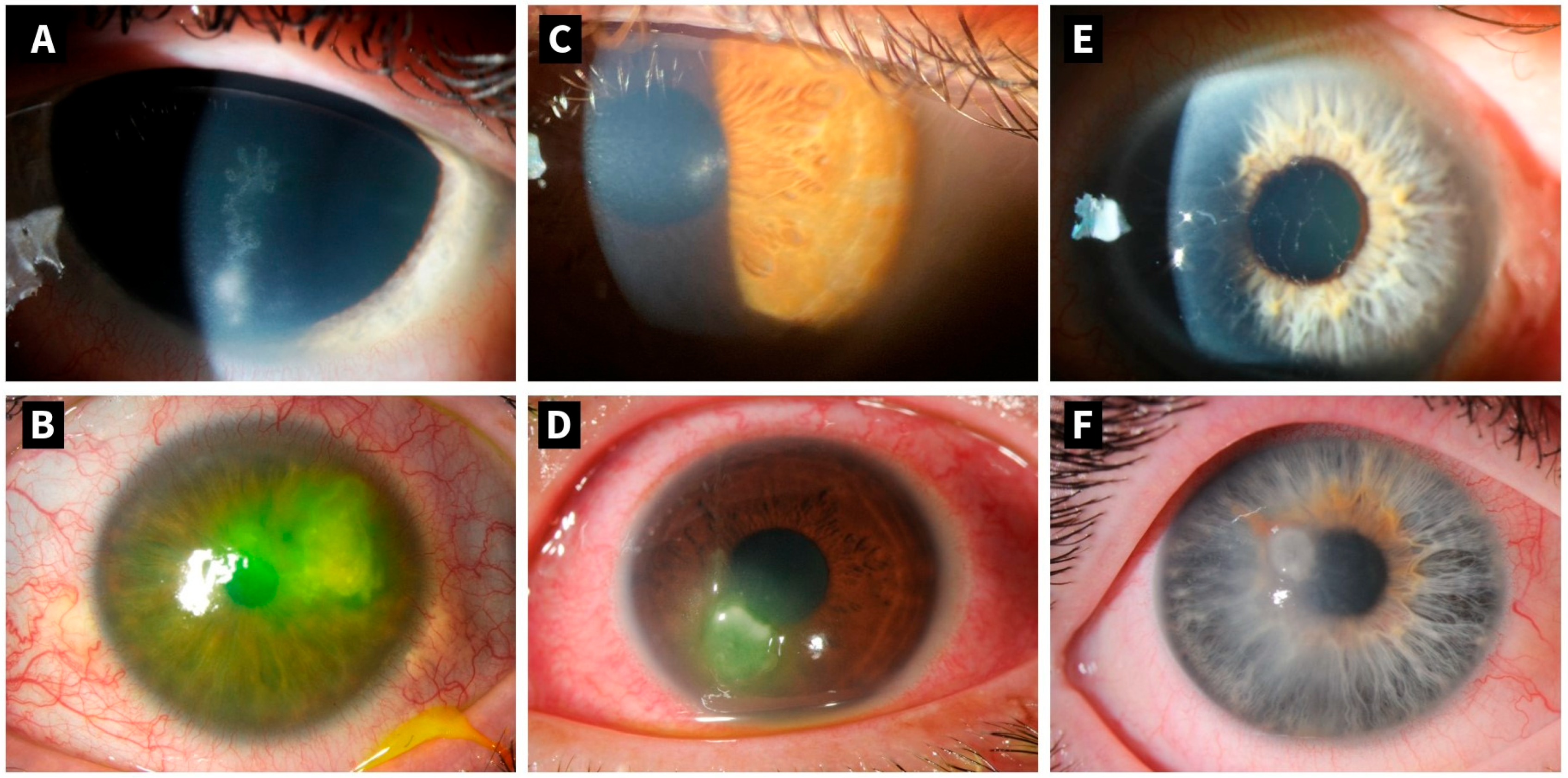
Diagnostic methods for herpes keratitis include clinical examination using slit-lamp biomicroscopy, polymerase chain reaction (PCR) assays, viral culture, immunofluorescence staining, and confocal microscopy [8]. PCR testing is the gold standard of invasive procedures due to its high sensitivity and specificity, enabling rapid and precise identification of the causative virus [9]. Moreover, it is critical to distinguish herpes keratitis from other infectious causes, such as bacteria, fungi, or parasites, especially acanthamoeba. Herpes keratitis may be grouped clinically into epithelial, stromal, endothelial, or neurotrophic keratitis. The epithelial affection typically manifests with dendritic lesions visible through slit-lamp biomicroscopy. In contrast, stromal keratitis is characterized by corneal stromal inflammation, stromal opacities, edema or ulceration, and potential subsequent stromal scarring [9,10]. Figure 1 shows clinical manifestations of herpetic keratitis caused by HSV-1, HSV-2, and VZV. Endothelial herpetic keratitis presents with disciform stromal edema, keratic precipitates (usually localized in the area of the edema), anterior chamber reaction, and usually absent epithelial defect (in contrast to epithelial keratitis). As a varicella-zoster of all herpetic corneal infections, neurotrophic keratitis may occur, resulting in impaired corneal sensation and persistent epithelial defects [11,12].
The overlapping clinical features of herpes virus keratitis make it challenging to distinguish among the different entities solely on clinical examination. HSV epithelial keratitis typically presents true dendrites demonstrating central fluorescein uptake, whereas VZV pseudo-dendrites lack central ulceration and therefore do not stain centrally [13]. CMV keratitis is most often seen in immunocompromised patients or following organ transplantation [14]. Definitive diagnosis, however, relies on pathogen detection through corneal scrapings or anterior chamber paracentesis [14].
Despite advances in diagnostics and therapy, herpes keratitis remains a significant challenge owing to its recurrent nature, diverse clinical manifestations, and risk of severe visual morbidity. Our tertiary care center in Switzerland functions as a national referral center for atypical or severe keratitis, including herpes-related cases. This retrospective study assesses the incidence and patient characteristics of PCR-confirmed herpes keratitis at our institution and reviews the current literature.

2. Materials and Methods

This is an investigator-initiated, retrospective, single-center study conducted at the University Hospital Zurich in Switzerland. We identified patients diagnosed with PCR-positive herpes keratitis between January 2010 and March 2025. The leading ethics committee in Zurich waived our study protocol as it does not fall within the scope of the Human Research Act (BASEC number 2023-01146). Nevertheless, we handled all data according to Good Clinical Practice guidelines.

2.1. Data Collection

We reviewed our laboratory information system of patients regarding PCR-positive corneal or conjunctival scraping results for HSV-1, HSV-2, VZV, and CMV. We extracted the patients’ birth dates, gender, and date of positive results, inferring the patients’ age at the time of test positivity. To explore co-testing patterns and interrelationships, we identified all “triplet” tests in which a single specimen was assayed simultaneously for HSV-1, HSV-2 and VZV. Within this triplet cohort, we compared detection rates across the three viruses. Further, we investigated for Acanthamoeba and fungal co-infections, considering PCR and culture results. Bacterial co-infections were not assessed in this study, as they are presumably common, culture positivity in corneal scrapings is often due to probe contamination, and all infectious keratitis patients at our clinic receive empirical topical antibiotics before a definitive diagnosis. However, we routinely include bacterial investigations in all corneal scrapings in unclear, presumed-infectious keratitis.

2.2. Detection of CMV, HSV-1, HSV-2, and VZV

Sample preparation and DNA extraction: For microbiological diagnostics, corneal scrapings were used as the primary sampling method; conjunctival swabs were obtained only in exceptional cases, such as in pediatric patients or when patient cooperation was insufficient to safely perform corneal scraping. Corneal and conjunctival swabs were placed in 2 mL viral transport medium (VTM) immediately after collection. Before sample processing, specimens were vortexed, swabs removed, and the remaining VTM centrifuged at 2000 relative centrifugal force (rcf) for 10 min. DNA was extracted using easyMAG and EMAG® nucleic acid extraction systems (bioMérieux, Marcy l’Etoile, France) according to the manufacturer’s protocol from 200 microliter (μL) supernatant and concentrated in 110 elution buffer (extraction buffer 3). From 28 August 2024, nucleic acid was extracted from 600, 400, or 300 μL supernatant, depending on the number of additional analyses requested, and concentrated in 60, 40, or 30 μL elution buffer (extraction buffer 3), respectively. In addition, all specimens were spiked with a standardized amount of Phocid herpes virus type 1 (PhHV) as PCR process control before extraction (European virus archive EVAG, Marseille, France, https://www.european-virus-archive.com) [15].
DNA amplification: DNA PCR amplifications were conducted following in-house real-time PCR protocols. All primers and Taqman probes were synthesized by Microsynth (Microsynth AG, Balgach, Switzerland). The PCR tests used in this study are validated diagnostic tests with high sensitivity and specificity. The assays are specific for the individual Herpesvirus species within the Simplexvirus genus or the Orthoherpesviridae family [15,16,17,18,19]. Sequences of all primers and probes are listed in Table 1.
Until 28 August 2024, a single-plex PCR process control using GAPDH (Homo sapiens glyceraldehyde-3-phosphate dehydrogenase) was run separately for HSV-1, HSV-2, and VZV PCR tests. For CMV, the GAPDH process control was run as a duplex assay with GAPDH primers and probe incorporated in the CMV-Mastermix. Each viral target assay was performed in duplicate to increase detection sensitivity. Mastermixes for HSV-1, HSV-2, VZV, and GAPDH PCR process controls were composed of 900 nM of each respective target primer and 200 nM of each respective target probe in 25 μL of TaqMan Universal MMIX II (Applied Biosystems by Thermo Fisher Scientific, Waltham, MA, USA) and 19 μL nuclease-free water (AppliChem GmbH, Darmstadt, Germany). CMV Mastermixes contained 900 nM of CMV primers, 100 nM of GAPDH primers, and 200 nM of CMV and GAPDH probe in 25 μL of TaqMan Universal MMIX II (Applied Biosystems) and 18.8 μL nuclease-free water (AppliChem GmbH) or, from 5 May 2023, 17.9 μL nuclease-free water. All RT-PCR amplifications were conducted in a total volume of 50 μL, containing 45 μL of Mastermix and 5 μL of eluted DNA.
From 28 August 2024, GAPDH process controls were replaced by the amplification of phocid herpes virus (PhHV) glycoprotein B in combination with spiking all clinical specimens with a standardized amount of PhHV. Each PCR assay was run in a duplex protocol, also containing primers and TaqMan probe for PhHV detection. Mastermixes from 28 August 2024 thus contained 780 nM of each respective diagnostic target primer, 50 nM of PhHV forward primer, 200 nM of PhHV reverse primer, 200 nM of respective diagnostic target probe and 100 nM of PhHV probe in 21.7 μL of TaqMan Universal MMIX (Applied Biosystems) and 17.3 μL nuclease-free water for HSV-1, HSV-2, and VZV or 16.5 μL nuclease-free water for CMV (AppliChem GmbH). All RT-PCR amplifications were conducted in a total volume of 50 μL, containing 40 μL of Mastermix and 10 μL of eluted DNA modifications of the new protocol (i.e., DNA extraction protocol leading to a 10-fold concentration of eluted DNA and doubling the volume of eluted DNA added to the PCR reaction mix) resulted in a 10-fold increase in sensitivity with potentially higher target detection rates. Thus, assay duplicates were eliminated. DNA amplifications were conducted in a QuantStudio™ 3 Real-Time PCR System (Applied Biosystems) under the following conditions: 2 min at 50 °C, 10 min at 95 °C and 50 cycles of 15 s at 95 °C, and 1 min at 60 °C. In each run, negative and positive controls were included. Elution buffer (NUCLISENS® easyMAG® Extraction Buffer 3, bioMérieux) was used as negative control and target-specific positive controls were all obtained from ATCC [ATCC, Manassas, VA, USA] as follows: CMV: purified viral DNA, ATCC VR-538, strain AD-169; HSV-1: purified viral DNA, ATCC VR-539, strain MacIntyre; HSV-2: purified viral DNA, ATCC VR-734, strain G; VZV: purified viral DNA, ATCC VR-586, strain Ellen. Signals reaching cycle thresholds of <38 were interpreted as positive; tests raising signals after ≥38 cycles were repeated and reported as positive if a signal was also detected in the repeated test. If assays were run in duplicates, tests were interpreted as positive, if at least one test result was positive. Signals of GAPDH or PhHV process controls were required before 33 cycles, i.e., the reaction showed no inhibition or reduction of DNA during extraction and PCR [16,17,18,19,20].

2.3. Statistical Analyses

In descriptive statistics, we present means with standard deviation and medians with interquartile ranges (IQR), or minimum to maximum values for continuous data and numbers and percentages for categorical data. To assess potential gender predominance, we tested whether the observed proportion of male positive results for each virus differed significantly from a neutral distribution of 50%. For each pathogen (HSV-1, HSV-2, VZV, and CMV), we performed a two-sided exact binomial test under the null hypothesis that the probability of a positive result being male was 0.5. To account for multiple comparisons across the four pathogens, we applied a Bonferroni correction, adjusting the significance threshold from α = 0.05 to α = 0.0125 (0.05 divided by 4). We considered a p-value statistically significant only if it was below the corrected threshold and the corresponding 95% confidence interval (CI) for the male proportion did not include 0.5. All statistical analyses were conducted using R version 4.2.1 (R Foundation for Statistical Computing, Vienna, Austria).

3. Results

From January 2010 to March 2025, we identified a total of 9954 herpesvirus PCR test results performed on corneal and conjunctival scrapings. Demographic information was available for 8693 individual test entries, corresponding to 2892 patients. Hence, all the following demographics were only conducted on the latter dataset. The median (IQR; range) patient age was 48.0 (31.7–66.3; 0–97) years, with a quasi-balanced gender distribution (49.7% female). In total, 3358 PCR tests were targeted for HSV-1, 3290 for HSV-2, 3112 for VZV, and 194 for CMV. Among these, 328 (9.8%) were positive for HSV-1, 9 (0.3%) for HSV-2, 143 (4.6%) for VZV, and 2 (1.0%) for CMV. Table 2 summarizes the patient demographics stratified by virus type.
We identified 2913 corneal-scraping specimens tested in triplets (i.e., simultaneous testing for HSV-1, HSV-2, and VZV), enabling direct comparisons of detection rates across these three viruses. Among the 419 positive results obtained within the triplet cohort, 274 (65.4%) were positive for HSV-1, 136 (32.5%) for VZV, and 9 (2.1%) for HSV-2. Table 3 displays detailed results of the triplet analyses. For each pathogen, we tested whether the proportion of male patients among positive cases differed from an equal distribution between males and females. Applying a two-sided exact binomial test, we found that 161 of 274 HSV-1 positive cases were male, corresponding to a male proportion of 58.9% (95% CI: 52.7–64.7%), with a p-value of 0.0044, indicating a statistically significantly higher incidence in men. For HSV-2, 3 of 9 positive cases were male (33.3%, 95% CI: 7.5–70.1%; p = 0.5078), for VZV, 65 of 136 were male (47.9%, 95% CI: 39.2–56.5%; p = 0.6683), and for CMV, 2 of 2 were male (100%, 95% CI: 15.8–100%; p = 0.5000), none of which differed significantly from equal distribution.
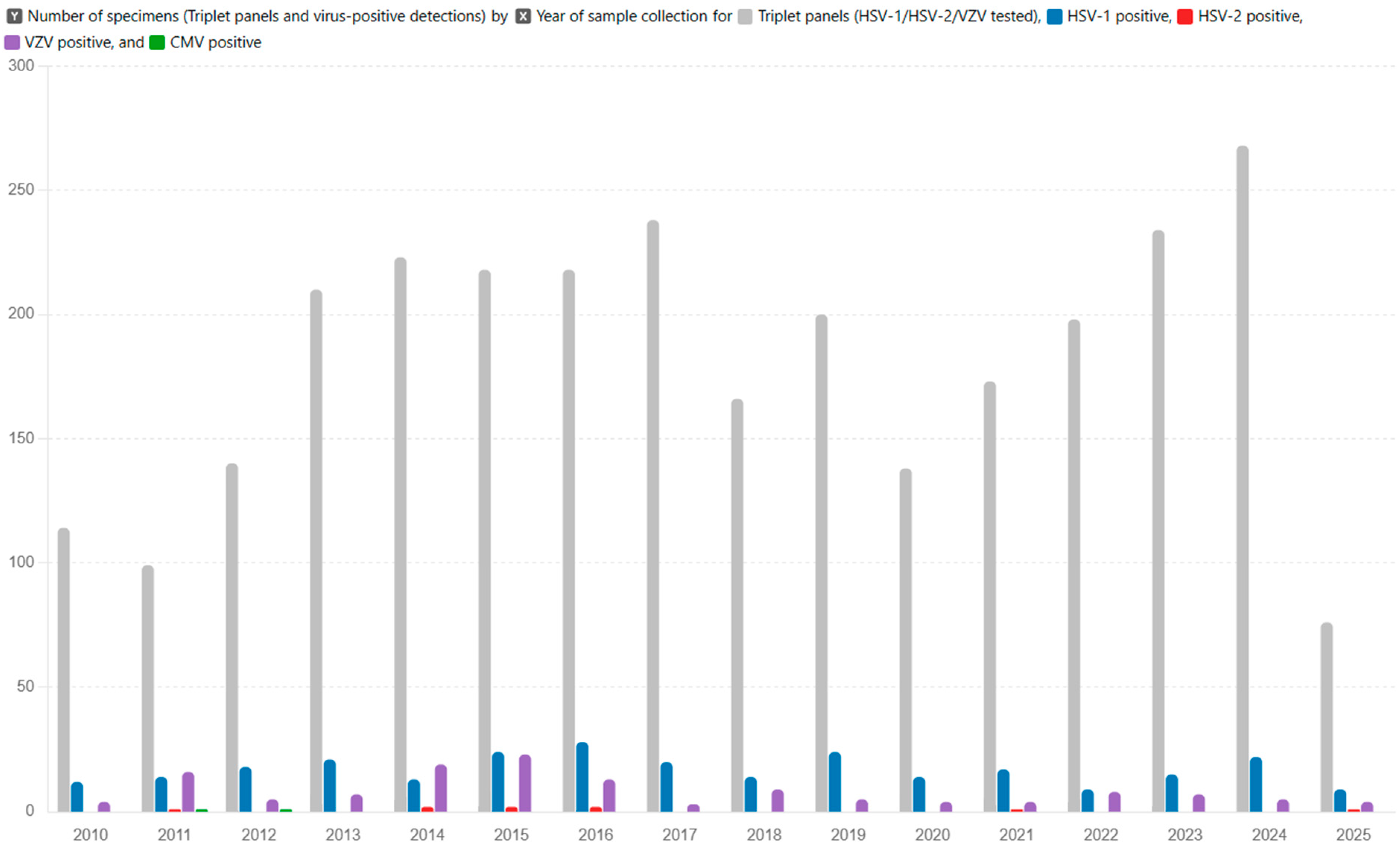
The use of multiplex PCR testing increased across the study period, reflecting the broader implementation of standardized triplet panels. In 2010, we performed 114 triplet assays, with the number of assays increasing yearly to a peak of 268 in 2024. Notably, there were two transient declines: from 238 assays in 2017 to 166 in 2018, and from 200 in 2019 to 138 in 2020. Despite the overall growth in testing volume, annual positivity rates remained relatively stable (HSV-1: 8–11%; VZV: 3–6%), whereas HSV-2 detections remained rare, with only nine positive triplet assays identified in six separate years (2011, 2014–2016, 2021, and 2025). Table 4 and Figure 2 provide a detailed analysis of the temporal triplet testing patterns.
Demographically, the triplet cohort closely mirrored the overall tested population, with no significant differences in age or gender proportions compared to the full assay set. HSV-2 detections remained rare, with nine unique patients tested positive for HSV-2 keratitis; one patient had two positive results within 10 days, yielding a total of 10 positive assays. The median (IQR) age of HSV-2 positive patients was 57.2 (46.7–66.4) years, and 66.7% were female. Furthermore, we identified eight cases of simultaneous HSV-1 and VZV co-infections, of whom two (25.0%) were female, ranging in age from 16 to 70 years. Clinical documentation reported six epithelial presentations and two corneal ulcers. In addition, two patients presented with simultaneous bilateral viral detections: a 29-year-old male with bilateral HSV-1 infection and a 74-year-old male with bilateral VZV infection.
Regarding other microbiological co-infections, two (0.6%) patients with HSV-1 and one (0.7%) with VZV-positivity had concurrent Acanthamoeba infection. Neither of the HSV-1-positive cases wore contact lenses, whereas the VZV-positive case wore soft daily contact lenses. Furthermore, 15 (3.2%) patients showed positive fungal detections. Of these, 11 (73.3%) were positive for HSV-1, none were positive for HSV-2, and 4 (26.7%) were positive for VZV. Regarding contact lens use, 8 of 11 (72.7%) HSV-1-positive and 3 of 4 (75.0%) VZV-positive patients used contact lenses.

4. Discussion

This retrospective study investigated PCR test results regarding possible herpetic keratitis at our tertiary care center in Switzerland. Between January 2010 and March 2025, we identified 9954 PCR tests, obtained from 2892 patients. Over the 15-year interval, the laboratory’s adoption of multiplex triplet panels (HSV-1, HSV-2, VZV) increased markedly—from 114 triplet panels in 2010 to a peak of 268 in 2024—reflecting broader clinical uptake of PCR diagnostics for suspected viral keratitis. These trends underscore the increasing reliance on comprehensive PCR diagnostics in cases of suspected viral keratitis. We found 9.8% and 4.6% positivity for HSV-1 and VZV, respectively, whereby HSV-2 and CMV occurred much less frequently. Despite this expansion in testing throughput, the annual proportion of positive triplet results for HSV-1 and VZV remained relatively constant (HSV-1 around 8–11%; VZV around 3–6%), which supports a stable clinical threshold for testing and the epidemiological dominance of these viruses in corneal disease.
HSV-1 was the overwhelmingly predominant pathogen in our dataset, which aligns with global epidemiology. Worldwide, HSV-1 is the leading cause of herpetic keratitis, with pooled incidence estimates of 24 per 100,000 people per year, most cases affecting the corneal epithelium [3,20,21]. Its predominance is attributable to the high prevalence of latent HSV-1 infection within the trigeminal ganglion and the lifelong risk of recurrent corneal reactivation. VZV was the second-most frequent pathogen in our cohort, which is also consistent with international data: although VZV accounts for only a minority of herpetic keratitis cases (3–12%), it remains an important cause of ocular morbidity due to its association with herpes zoster ophthalmicus [14]. By contrast, HSV-2 was rarely detected (<1%), aligning with previous European and global studies [22,23,24,25]. HSV-2 keratitis most often occurs through neonatal transmission or in immunocompromised patients, and is therefore uncommon in otherwise healthy adults [20,22,25]. Although cases of CMV epitheliitis and CMV stromal keratitis have been reported, CMV endotheliitis is the most common manifestation of corneal infection [26].
In our tertiary care center, we routinely perform multiplex PCR triplet testing, as the clinical presentation of herpetic keratitis does not allow reliable differentiation of the causative virus. In addition, initial therapy differs: current consensus recommends valaciclovir 500 mg three times daily for HSV-1 stromal keratitis, whereas VZV stromal keratitis requires 1 g three times daily [11,12].
Triplet testing in our cohort enabled a direct comparison of the relative incidence rates, with HSV-1 identified in 65.4% of positive assays, VZV in 32.5%, and HSV-2 in 2.2%. Previous studies limited to corneal specimens reported substantially higher proportions of HSV-1 (89%) compared to VZV (11%) [27]. By contrast, investigations including a broader range of ocular samples—such as conjunctival swabs, corneal scrapings, aqueous humour, and vitreous samples—demonstrated a more balanced distribution, with VZV slightly exceeding HSV-1 (12.3% versus 11.7%) [22]. These differences suggest potential tissue tropism: HSV-1 appears to have a predilection for the corneal epithelium and stroma, whereas VZV may more frequently involve multiple ocular structures beyond the cornea. The distribution in our study likely reflects the inclusion of both corneal and conjunctival scrapings, which may have increased the relative detection of VZV while proportionally reducing the apparent dominance of HSV-1 compared to studies analyzing only corneal tissue.
In this study, we observed two transient reductions in triplet testing throughout the observation period. The first decline occurred between 2017 and 2018 (from 238 to 166 triplets) and the second between 2019 and 2020 (from 200 to 138 triplets). The latter coincides with the onset of the COVID-19 pandemic and is plausibly explained by reduced outpatient activity and fewer elective procedures, resulting in fewer samplings. In contrast, the 2018 decline is less clearly attributable to a single external factor and may reflect local workflow adjustments or changes in referral patterns. These year-to-year perturbations highlight the importance of interpreting temporal trends in the context of operational and public health influences, rather than attributing them solely to epidemiologic fluctuations.
Identifying co-infections in patients with herpes keratitis is of crucial clinical importance as they may influence management and final visual outcomes. In our study, we identified cases of Acanthamoeba or fungal co-infection in patients with PCR-confirmed herpes keratitis, consistent with prior reports describing the coexistence or clinicopathologic overlap among Acanthamoeba, fungal, and herpetic keratitis [28,29]. The coexistence of amoeba and herpes may be due to a chance of dual infection or to a symbiosis in which one pathogen masks the other. Overall, contact lens use and ocular trauma remain the primary risk factors for infectious keratitis, which may explain the potential for co-infections [30]. These results emphasize the importance of comprehensive microbiological evaluations in atypical keratitis cases.
We found a statistically significant higher incidence in men in HSV-1-associated keratitis, a gender-associated observation that is difficult to explain and highlights an existing research gap regarding the underlying pathophysiology. The possible reasons for sex-related differences in the incidence of herpetic keratitis are multifactorial and remain incompletely understood. While male predominance has been reported in several studies, the extent and statistical significance of this finding vary across populations and study designs [31,32]. Conversely, not all studies show this pattern, and some pediatric cohorts have even reported a predominance of female HSV-1 infections [33]. Biological factors, such as sex hormone differences and differences in immune response, may contribute. Animal models have shown that male mice can have higher mortality and more severe disease following HSV-1 ocular infection, potentially due to androgen effects and gender-specific modulation of interferon pathways [34,35]. However, such findings have not been consistently replicated in human populations. Sociodemographic and behavioral factors may also play a role. For example, differences in occupational exposure, healthcare-seeking behavior, and risk of corneal trauma could influence gender distribution in certain cohorts [36,37]. Geographic and cultural factors, as well as comorbidities such as diabetes and immunosuppression, may further modulate risk but do not reveal a clear gender predilection [33,36,38]. Taken together, these findings underscore that the true mechanisms driving gender differences in HSV-1 keratitis remain poorly defined and warrant further investigation.
This study’s key strengths include a 15-year observation period and a large data sample of nearly 10,000 PCR assays. Furthermore, the standardized triplet testing of HSV-1, HSV-2, and VZV on the same specimen, along with transparent laboratory methods and internal controls, enables robust within-sample comparisons and temporal descriptions. However, this study has several limitations. First, the retrospective design is inherently prone to selection bias and missing data. The single-center design may introduce referral and sampling biases, potentially leading our study cohort to not accurately reflect other populations and testing practices. Further, incomplete demographic data may affect the accuracy of incidence estimates. Moreover, the mid-study laboratory changes complicate longitudinal comparisons of positivity rates. Last, the rarity of HSV-2 and CMV limits the precision of incidence for those subgroups.

5. Conclusions

To conclude, over a 15-year period at our Swiss tertiary care center, HSV-1 emerged as the most common cause of PCR-confirmed herpetic keratitis. This was followed by VZV, whereas HSV-2 and CMV were rarely detected. We advocate for triplet testing panels not only for a more complete and efficient laboratory assessment, but also for epidemiologic monitoring reasons that allow for investigating relative prevalence data. The statistically significant higher incidence of HSV-1 in men underscores a research gap in understanding the sex-specific pathophysiology of herpetic keratitis, emphasizing the need for future biological and sociodemographic studies to investigate the underlying mechanisms.

Author Contributions

Conceptualization, M.A.K., S.S., A.B., I.V., M.H., S.A.Z., D.B. and F.B.; methodology, M.A.K., S.S., A.B., I.V., M.H., S.A.Z., D.B. and F.B. formal analysis, M.A.K., S.S. and F.B.; investigation, M.A.K., S.S., A.B., I.V., M.H., S.A.Z., D.B. and F.B.; resources, F.B., S.A.Z. and D.B.; data curation, M.A.K., S.S. and F.B.; writing—original draft preparation, M.A.K., S.S. and F.B.; writing—review and editing, M.A.K., S.S., A.B., I.V., M.H., S.A.Z., D.B. and F.B.; visualization, M.A.K., S.S. and F.B.; supervision, M.A.K., S.S., A.B., I.V., M.H., S.A.Z., D.B. and F.B.; project administration, M.A.K., S.S., A.B., I.V., M.H., S.A.Z., D.B. and F.B. All authors have read and agreed to the published version of the manuscript.

Funding

This research received no external funding.

Institutional Review Board Statement

The study was conducted according to the guidelines of the Declaration of Helsinki and waived by the Institutional Ethics Committee of the Canton of Zurich (BASEC-No. 2023-01146; approved on the 22 June 2024).

Informed Consent Statement

Informed consent was obtained from all subjects involved in the study.

Data Availability Statement

The original contributions presented in this study are included in the article. Further inquiries can be directed to the corresponding author. Since this is a non-public project data will be made available upon request to the correspondence author.

Acknowledgments

The authors are very thankful to all study participants for the retrospective use of their data.

Conflicts of Interest

The authors declare no conflicts of interest.

Abbreviations

The following abbreviations are used in this manuscript:
HSV-1Herpes simplex virus type 1
HSV-2Herpes simplex virus type 2
VZVVaricella zoster virus
CMVCytomegalovirus
PCRPolymerase chain reaction
GAPDHHomo sapiens glyceraldehyde-3-phosphate dehydrogenase
PhHVPhocid herpes virus

References

  1. Watson, S.; Cabrera-Aguas, M.; Khoo, P. Common Eye Infections. Aust. Prescr. 2018, 41, 67–72. [Google Scholar] [CrossRef]
  2. Guess, S.; Stone, D.U.; Chodosh, J. Evidence-Based Treatment of Herpes Simplex Virus Keratitis: A Systematic Review. Ocul. Surf. 2007, 5, 240–250. [Google Scholar] [CrossRef]
  3. Farooq, A.V.; Shukla, D. Herpes Simplex Epithelial and Stromal Keratitis: An Epidemiologic Update. Surv. Ophthalmol. 2012, 57, 448–462. [Google Scholar] [CrossRef]
  4. Cabrera-Aguas, M.; Robaei, D.; McCluskey, P.; Watson, S. Clinical Translation of Recommendations from Randomized Trials for Management of Herpes Simplex Virus Keratitis. Clin. Exp. Ophthalmol. 2018, 46, 1008–1016. [Google Scholar] [CrossRef] [PubMed]
  5. Farooq, A.V.; Shah, A.; Shukla, D. The Role of Herpesviruses in Ocular Infections. Virus Adapt. Treat. 2010, 2, 115–123. [Google Scholar] [CrossRef]
  6. Ung, L.; Rajaiya, J.; Chodosh, J. Viral Conjunctivitis. In Infections of the Cornea and Conjunctiva; Springer: Singapore, 2021; pp. 17–50. [Google Scholar] [CrossRef]
  7. Young, R.C.; Hodge, D.O.; Liesegang, T.J.; Baratz, K.H. Incidence, Recurrence, and Outcomes of Herpes Simplex Virus Eye Disease in Olmsted County, Minnesota, 1976–2007: The Effect of Oral Antiviral Prophylaxis. Arch. Ophthalmol. 2010, 128, 1178–1183. [Google Scholar] [CrossRef] [PubMed]
  8. Cabrera-Aguas, M.; Watson, S.L. Updates in Diagnostic Imaging for Infectious Keratitis: A Review. Diagnostics 2023, 13, 3358. [Google Scholar] [CrossRef]
  9. Kaye, S.; Choudhary, A. Herpes Simplex Keratitis. Prog. Retin. Eye Res. 2006, 25, 355–380. [Google Scholar] [CrossRef]
  10. Azher, T.N.; Yin, X.T.; Tajfirouz, D.; Huang, A.J.; Stuart, P.M. Herpes Simplex Keratitis: Challenges in Diagnosis and Clinical Management. Clin. Ophthalmol. 2017, 11, 185–191. [Google Scholar] [CrossRef]
  11. Seitz, B.; Heiligenhaus, A. “Herpeskeratitis”: Unterschiedliche Ausprägungsformen Erfordern Unterschiedliche Therapieansätze. Ophthalmologe 2011, 108, 385–398. [Google Scholar] [CrossRef]
  12. Seitz, B.; Heiligenhaus, A. Das Chamäleon Der Keratitis Herpetischer Genese—Diagnose Und Therapie. Klin. Monbl. Augenheilkd. 2015, 232, 745–753. [Google Scholar] [CrossRef]
  13. Chern, K.C.; Conrad, D.; Holland, G.N.; Holsclaw, D.S.; Schwartz, L.K.; Margolis, T.P. Chronic Varicella-Zoster Virus Epithelial Keratitis in Patients with Acquired Immunodeficiency Syndrome. Arch. Ophthalmol. 1998, 116, 1011–1017. [Google Scholar] [CrossRef]
  14. Kedar, S.; Jayagopal, L.N.; Berger, J.R. Neurological and Ophthalmological Manifestations of Varicella Zoster Virus. J. Neuro-Ophthalmol. 2019, 39, 220–231. [Google Scholar] [CrossRef]
  15. Van Doornum, G.J.J.; Guldemeester, J.; Osterhaus, A.D.M.E.; Niesters, H.G.M. Diagnosing Herpesvirus Infections by Real-Time Amplification and Rapid Culture. J. Clin. Microbiol. 2003, 41, 576–580. [Google Scholar] [CrossRef]
  16. Yun, Z.; Lewensohn-Fuchs, I.; Ljungman, P.; Vahlne, A. Real-Time Monitoring of Cytomegalovirus Infections after Stem Cell Transplantation Using the TaqMan Polymerase Chain Reaction Assays. Transplantation 2000, 69, 1733–1736. [Google Scholar] [CrossRef]
  17. Pevenstein, S.R.; Williams, R.K.; McChesney, D.; Mont, E.K.; Smialek, J.E.; Straus, S.E. Quantitation of Latent Varicella-Zoster Virus and Herpes Simplex Virus Genomes in Human Trigeminal Ganglia. J. Virol. 1999, 73, 10514–10518. [Google Scholar] [CrossRef] [PubMed]
  18. Kronenberg, A.; Schupbach, R.; Schuknecht, B.; Bossart, W.; Weber, R.; Gilden, D.H.; Speck, R.F. Multifocal Vasculopathy Due to Varicella-Zoster Virus (VZV): Serial Analysis of VZV DNA and Intrathecal Synthesis of VZV Antibody in Cerebrospinal Fluid. Clin. Infect. Dis. 2002, 35, 330–333. [Google Scholar] [CrossRef]
  19. Cohrs, R.J.; Randall, J.; Smith, J.; Gilden, D.H.; Dabrowski, C.; van der Keyl, H.; Tal-Singer, R. Analysis of Individual Human Trigeminal Ganglia for Latent Herpes Simplex Virus Type 1 and Varicella-Zoster Virus Nucleic Acids Using Real-Time PCR. J. Virol. 2000, 74, 11464–11471. [Google Scholar] [CrossRef]
  20. James, C.; Harfouche, M.; Welton, N.J.; Turner, K.M.E.; Abu-Raddad, L.J.; Gottlieb, S.L.; Looker, K.J. Herpes Simplex Virus: Global Infection Prevalence and Incidence Estimates, 2016. Bull. World Health Organ. 2020, 98, 315–329. [Google Scholar] [CrossRef] [PubMed]
  21. McCormick, I.; James, C.; Welton, N.J.; Mayaud, P.; Turner, K.M.E.; Gottlieb, S.L.; Foster, A.; Looker, K.J. Incidence of Herpes Simplex Virus Keratitis and Other Ocular Disease: Global Review And Estimates. Ophthalmic Epidemiol. 2022, 29, 353–362. [Google Scholar] [CrossRef] [PubMed]
  22. Letafati, A.; Jazayeri, S.M.; Atwan, H.; Mahmoudi, M.K.; Sarrafzadeh, S.; Ardekani, O.S.; Norouzi, M.; Ghaziasadi, A. Utilization of Multiplex Polymerase Chain Reaction for Simultaneous and Rapid Detection of Viral Infections from Different Ocular Structures. Sci. Rep. 2024, 14, 17997. [Google Scholar] [CrossRef] [PubMed]
  23. Guda, S.; Sontam, B.; Bagga, B.; Ranjith, K.; Sharma, S.; Joseph, J. Evaluation of Multiplex Real-Time Polymerase Chain Reaction for the Detection of Herpes Simplex Virus-1 and 2 and Varicella-Zoster Virus in Corneal Cells from Normal Subjects and Patients with Keratitis in India. Indian. J. Ophthalmol. 2019, 67, 1040–1046. [Google Scholar] [CrossRef]
  24. Miserocchi, E.; Fogliato, G.; Bianchi, I.; Bandello, F.; Modorati, G. Clinical Features of Ocular Herpetic Infection in an Italian Referral Center. Cornea 2014, 33, 565–570. [Google Scholar] [CrossRef]
  25. Adhin, M.R.; Grunberg, M.G.; Labadie-Bracho, M.; Pawiroredjo, J. Incidence of Alpha-Herpes Virus Induced Ocular Disease in Suriname. J. Med. Virol. 2012, 84, 1937–1942. [Google Scholar] [CrossRef] [PubMed]
  26. Faith, S.C.; Durrani, A.F.; Jhanji, V. Cytomegalovirus Keratitis. Curr. Opin. Ophthalmol. 2018, 29, 373–377. [Google Scholar] [CrossRef]
  27. McDonald, E.M.; Patel, D.V.; McGhee, C.N.J. A Prospective Study of the Clinical Characteristics of Patients with Herpes Simplex and Varicella Zoster Keratitis, Presenting to a New Zealand Emergency Eye Clinic. Cornea 2015, 34, 279–284. [Google Scholar] [CrossRef]
  28. Keratitis, C.A.; Mathers, H.K.W.D.; Goldberg, M.A.; Sutphin, J.E.; Dithqff, J.W.; Folberg, R. Coexistent Acanthamoeba Keratitis and Herpetic Keratitis. Arch. Ophthalmol. 1997, 115, 714–718. [Google Scholar] [CrossRef]
  29. Blaser, F.; Bajka, A.; Grimm, F.; Metzler, S.; Herrmann, D.; Barthelmes, D.; Zweifel, S.A.; Said, S. Assessing PCR-Positive Acanthamoeba Keratitis—A Retrospective Chart Review. Microorganisms 2024, 12, 1214. [Google Scholar] [CrossRef]
  30. Ibrahim, Y.W.; Boase, D.L.; Cree, I.A. How Could Contact Lens Wearers Be at Risk of Acanthamoeba Infection? A Review. J. Optom. 2010, 2, 60. [Google Scholar] [CrossRef]
  31. Rousseau, A.; Pharm, S.B.; Gueudry, J.; Deback, C.; Haigh, O.; Schweitzer, C.; Boutolleau, D.; Labetoulle, M. Acyclovir-Resistant Herpes Simplex Virus 1 Keratitis: A Concerning and Emerging Clinical Challenge. Am. J. Ophthalmol. 2022, 238, 110–119. [Google Scholar] [CrossRef]
  32. Cabrera-Aguas, M.; Khoo, P.; George, C.R.R.; Lahra, M.M.; Watson, S.L. Predisposing Factors, Microbiological Features and Outcomes of Patients with Clinical Presumed Concomitant Microbial and Herpes Simplex Keratitis. Eye 2022, 36, 86–94. [Google Scholar] [CrossRef] [PubMed]
  33. Ulman, E.A.; Selver, O.B.; Biler, E.D.; Palamar, M. Clinical Features of Pediatric Age Herpes Simplex Virus Keratitis. Cornea 2023, 42, 1099–1103. [Google Scholar] [CrossRef] [PubMed]
  34. Han, X.; Lundberg, P.; Tanamachi, B.; Openshaw, H.; Longmate, J.; Cantin, E. Gender Influences Herpes Simplex Virus Type 1 Infection in Normal and Gamma Interferon-Mutant Mice. J. Virol. 2001, 75, 3048–3052. [Google Scholar] [CrossRef]
  35. Kolb, A.W.; Ferguson, S.A.; Larsen, I.V.; Brandt, C.R. Disease Parameters Following Ocular Herpes Simplex Virus Type 1 Infection Are Similar in Male and Female BALB/C Mice. PLoS ONE 2023, 18, e0287194. [Google Scholar] [CrossRef] [PubMed]
  36. Jan, R.L.; Ho, C.H.; Wang, J.J.; Jan, H.Y.; Chen, J.Y.; Chang, Y.S. Sociodemographic Factors and Comorbidities Are Associated with an Elevated Risk of Herpes Simplex Keratitis: A Population-Based Study in Taiwan. Front. Microbiol. 2024, 15, 1506659. [Google Scholar] [CrossRef]
  37. Zhang, S.; Mi, J.; Ge, S.; Wang, G.; Zhou, Z.; Zhao, Y.; Zhao, Y. Analysis of Clinical Characteristics and Factors Influencing Herpes Simplex Virus Keratitis. Front. Med. 2023, 10, 1267783. [Google Scholar] [CrossRef]
  38. Forbes, H.; Warne, B.; Doelken, L.; Brenner, N.; Waterboer, T.; Luben, R.; Wareham, N.J.; Warren-Gash, C.; Gkrania-Klotsas, E. Risk Factors for Herpes Simplex Virus Type-1 Infection and Reactivation: Cross-Sectional Studies among EPIC-Norfolk Participants. PLoS ONE 2019, 14, e0215553. [Google Scholar] [CrossRef]
Figure 1. Slit lamp photography of different clinical presentation of herpetic keratitis of patients from the department of ophthalmology of the University Hospital Zurich, Switzerland: (A) epithelial keratitis of HSV-1 with typical dendritic lesion with terminal bulbs; (B) geographic keratitis of HSV-1 with stromal ulceration with fluorescein dye; (C) epithelial keratitis of HSV-2; (D) ulclerative keratitis of HSV-2 with fluorescein dye; (E) epithelial keratitis of VZV with pseudodendrites with no central ulceration and no terminal bulbs; (F) ulcerative keratitis of VZV with pseudodendrites at the margin of the lesion.
Microorganisms 14 00268 g001
Figure 2. Annual number of triplet test panels and virus detections conducted from January 2010 until March 2025 at the University Hospital Zurich, Switzerland from Table 4 displayed in a diagram.
Microorganisms 14 00268 g002
Table 1. Target primers and probes used during the testing period.
Primer/ProbeIn Use FromSequenceAmplicon
Region, Length
CMV forwardBefore 20105′-GCC CAA GAC ATC ACC CAT G-3′Glycoprotein B, UL55, 62 bp [17]
CMV forward modified 1A6GFrom 5 May 20235′-ACC CAG GAC ATC ACC CAT G-3′
(allowing detection of additional strains)
CMV reverse Before 20105′-CCA TTC TCT CGG CCA TTT ACA-3′
CMV reverse modified 17CFrom 5 May 20235′-CCA TTC TCT CGG CCA TCT ACA-3′
(allowing detection of additional strains)
CMV probe Before 20105′-FAM-CAA ACC GAT TGC CGC GCG TTT-TAMRA-3′
HSV-1 forward Before 20105′-CTG TTC TCG TTC CTC ACT GCC T-3′Glycoprotein G, ORF 4 US fragment, 81 bp modified from [18]
HSV-1 reverse Before 20105′-CAA-AAA-CGA-TAA-GGT-GTG-GAT-GAC-3′
HSV-1 probe Before 20105′-FAM-CCG CCC TGG ACA CC-MGB.NFQ-3′ 
HSV-2 forward Before 20105′-CAA GCT CCC GCT AAG GAC AT-3′Glycoprotein G, ORF 4 US fragment, 108 bp [19]
HSV-2 reverse Before 20105′-GGT GCT GAT GAT AAA GAG GAT ATC TAG A-3′
HSV-2 probeBefore 20105′-FAM-ACA CAT CCC CCT GTT CTG GTT CCT AAC G-TAMRA-3′
VZV forward Before 20105′-ACA GCT TGT CTT TAT TGG AGA GCA A-3′Glycoprotein I, ORF 67 US fragment, 84 bp [16]
VZV reverse Before 20105′-GCC ACC GTA TCC GCG TAT A-3′
VZV probeBefore 20105′-FAM-ACC TAC CGG GAC AAA CTA TAG CGG AAC ACT G-TAMRA-3′
From 13 January 20255′-FAM-ACC TAC CGG GAC AAA CTA TAG CGG AAC ACT G-BHQ1-3′
(improving signal quality)
GAPDH forward Before 20105′-CAA GGT CAT CCA TGA CAA CTT TG-3′Homo sapiens glyceraldehyde-3-phosphate dehydrogenase, 89 bp [16]
GAPDH reverse Before 20105′-GGC CAT CCA CAG TCT TCT GG-3′
GAPDH probeBefore 20105′-VIC-ACC ACA GTC CAT GCC ATC ACT GCC A-TAMRA-3′
PhHV forward From 28 August 20245′-GGG CGA ATC ACA GAT TGA ATC-3′Phocid herpes virus (PhHV) glycoprotein B, 89 bp [15]
PhHV reverse From 28 August 20245′-GCG GTT CCA AAC GTA CCA A-3′
PhHV probeFrom 28 August 20245′-VIC-TTT TTA TGT GTC CGC CAC CAT CTG GAT C-BHQ1-3′
HSV-1: Herpes simplex virus type 1; HSV-2: Herpes simplex virus type 2; VZV: Varicella zoster-virus; CMV: cytomegalovirus; GAPDH: Homo sapiens glyceraldehyde-3-phosphate dehydrogenase; PhHV: phocid herpes virus.
Table 2. Total amount of PCR assays from corneal and conjunctival scrapings conducted between January 2010 and March 2025.
VirusAssays
Performed
Positives (n)Positivity (%)Median Age (Years)IQR (25th to 75th
Percentile)
Male (%)Female (%)
HSV-1 33583289.852.234.3–71.959.440.6
HSV-2329090.2757.246.7–66.422.277.8
VZV31121434.655.038.1–73.148.052.0
CMV19421.037.535.8–39.21000
Table 3. Total amount of PCR assays from simultaneous HSV-1, HSV-2 and VZV “triplets”. The percentages in gender distribution refer to positive tested patients only.
VirusTriplet PanelsPositive
Patients (n)
Positivity (%)Median Age (Years)IQR (25th to 75th Percentile)Male (%)Female (%)
HSV-1 29132749.455.338.2–73.358.941.1
HSV-2291390.457.246.7–66.433.366.7
VZV29131366.253.737.0–72.147.952.1
Table 4. Annual number of triplet test panels and virus detections conducted from January 2010 until March 2025 at the university hospital of Zurich in Switzerland.
YearTriplet PanelsHSV-1 PosHSV-2 PosVZV PosCMV Pos
201011412040
201199141161
201214018051
201321021070
2014223133190
2015218241230
2016218282130
201723820030
201816614090
201920024050
202013814040
202117317140
20221989080
202323415070
202426822050
2025769140
Total 291327491362
Number of corneal- and conjunctival-scraping specimens for which HSV-1, HSV-2, and VZV PCRs were run simultaneously (“triplet panels”), together with the annual counts of PCR-positive specimens for HSV-1, HSV-2, VZV, and CMV.
Disclaimer/Publisher’s Note: The statements, opinions and data contained in all publications are solely those of the individual author(s) and contributor(s) and not of MDPI and/or the editor(s). MDPI and/or the editor(s) disclaim responsibility for any injury to people or property resulting from any ideas, methods, instructions or products referred to in the content.