Abstract
Exposure to aerosols containing Legionella from artificially made water systems has been established as a primary cause of Legionnaires’ disease. In this study, we investigated an outbreak of L. pneumophila serogroup 1 sequence type 138 which occurred at a bath facility in 2022. The whole-genome sequencing of isolates revealed that the colonization of L. pneumophila at the bath facility had occurred before 2013, and the patients had been exposed to multiple genetic lineages of the strain. Our study demonstrates the importance of performing a careful comparative genetic analysis of clinical and environmental isolates from LD outbreaks in order to effectively investigate and prevent future LD outbreaks.
Legionnaires’ disease (LD) outbreaks occur when people are exposed to water contaminated with Legionella [1]. Legionella pneumophila serogroup 1 (SG1) accounts for most cases of Legionella infections in humans [2]. In Japan, hot springs and public bath facilities are major sources of Legionella infection [3]. In this study, we report the first case identified as an outbreak of LD caused by L. pneumophila SG1 sequence type (ST) 138 based on whole-genome sequencing, which occurred at a bath facility in Japan.
In March 2022, two cases of LD were reported among users of a bath facility in Kobe City, Hyogo Prefecture. The facility consisted of two bath facilities each (one of which was a bubble bath facility) for men and women. Both the bubble bath facilities were connected to a common circulation system which included filtration and heating components.
Sputum samples from two patients (who tested positive for urinary antigens detecting L. pneumophila), one on day 4 and the other on day 8 of illness onset, and environmental samples from the bath water, hair-catcher and the filtration components in the bath facility were collected for epidemiological investigations and tested for the presence of Legionella at our laboratory. Legionella could not be detected in the sputum sample of one patient in PCR and culture tests because the sputum was obtained after 8 days of illness onset and the administration of antibiotics; however, 14 L. pneumophila strains were isolated from the sputum sample of the other patient, which was cultured in a selective medium (MWY medium; Kanto Chemical Co., Inc., Tokyo, Japan). The serogrouping of Legionella isolates was performed using slide agglutination tests with monovalent antisera (Denka Seiken, Tokyo, Japan). Sequence-based typing (SBT) was performed according to the protocol of the European Working Group for Legionella infections (EWGLI) [4,5]. All the strains isolated from this patient sample belonged to SG1 ST138. The samples collected from the bubble bath water, hair catcher and filtration components also contained L. pneumophila SG1 ST138.
Legionella pneumophila SG1 ST138, detected only in Japan, belongs to the B3 group (bathwater group) and leads to sporadic cases and small outbreaks of LD [6]. To investigate the genetic similarities between different strains identified in this outbreak, we performed whole-genome sequencing to compare the 14 strains of L. pneumophila isolated from the patient sputum sample and those isolated from the environmental samples collected from the bath facility (5 strains each isolated from the bath water and hair-catcher samples and 8 strains isolated from the sample collected from the filtration components). All the isolates were found to harbor lag-1, a virulence-associated marker [7]. Whole-genome sequencing data were obtained using the MiSeq instrument (Illumina). Single-nucleotide variant (SNV) analysis was performed using BactSNP [8], and the removal of the recombinant region was achieved using Gubbins [9]. The median mapping depth of the analyzed samples to the reference genome (L. pneumophila str. Paris, Accession no.; CR628336.1) was 167.
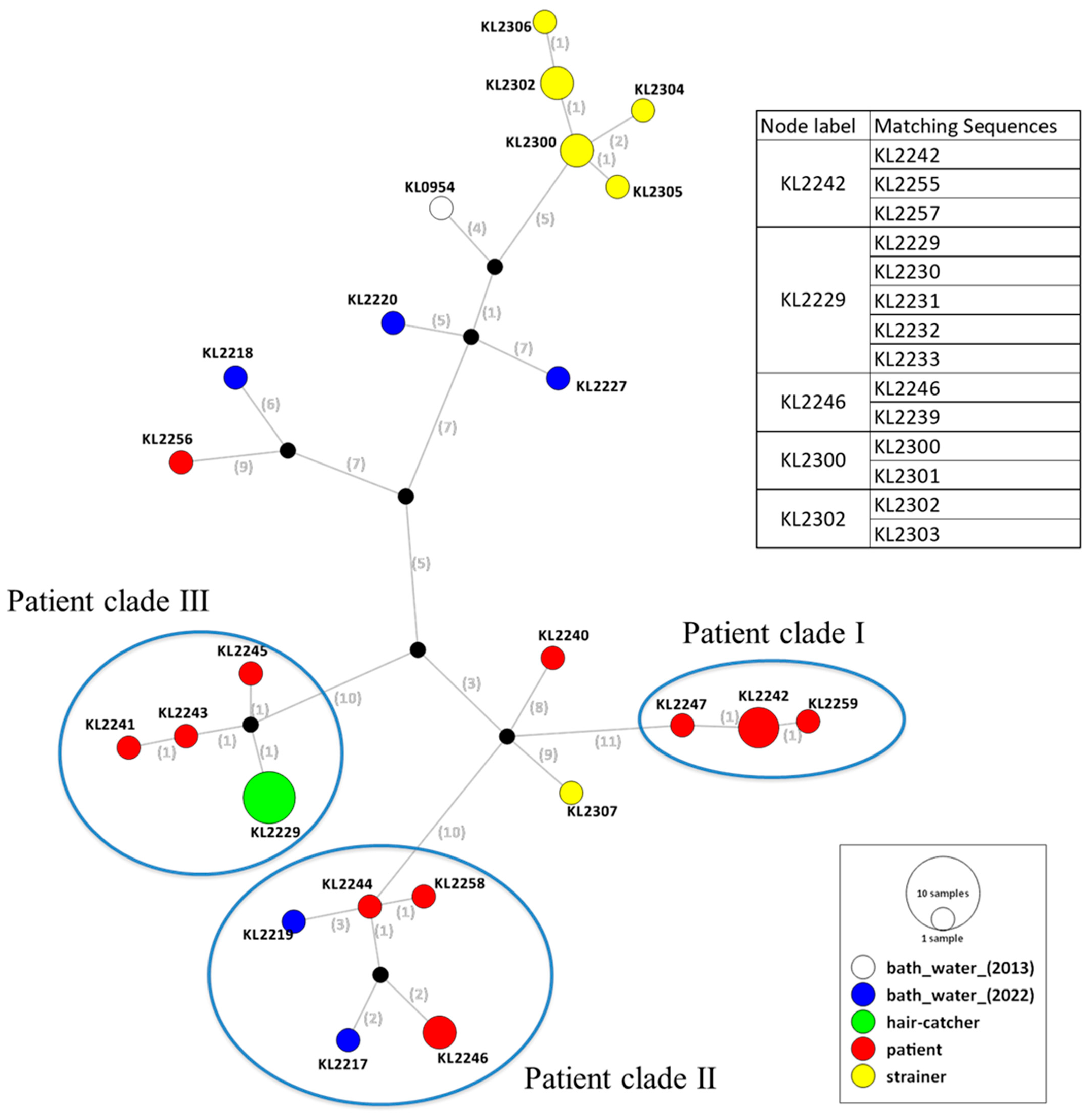
The strains isolated from the patient sputum sample and environmental samples from the outbreak facility differed by 0–42 SNVs. Haplotype network analysis based on SNVs showed that 12 of the 14 strains isolated from the patient sputum sample could be divided into clades I, II and III, each differing from the other by 10 or fewer SNVs (Figure 1). Clade I consisted of only five patient strains with 0–1 SNVs. Clades II and III contained both strains from the patient sample and environmental samples with 3-4 and 2 SNVs, respectively (clade II (four strains from the patient sample and two strains from the bath water sample); clade III (three strains from the patient sample and five strains from swabs of the hair catcher)). Isolates from other LD outbreaks have been shown to differ from each other by as few as five core SNVs [10]. Therefore, the results of this study confirmed that the bath facility was indeed the source of the Legionella infection in this outbreak. Environmental strains that were nearly identical to the two patient strains, KL2256 and KL2240, could not be isolated through our environmental survey. However, these genetic subtypes were supposed to be potentially present in the bath facility. Thus, it can be concluded that the patient was exposed to multiple genetic subtypes of Legionella belonging to ST138, as reported earlier [11,12].
Figure 1.
Haplotype network analysis based on single-nucleotide variants (SNVs) using whole-genome sequencing of 33 Legionella pneumophila serogroup 1 (SG1) sequence type (ST) 138 strains. The numbers between each node represent the number of SNVs. The strains isolated from the patient and environmental samples, bath water, hair catcher and filtration are shown as red, blue, green and yellow circles, respectively. KL0954 isolated from bath water in 2013 is indicated as white circle. The raw sequence data used in this study were deposited in DDBJ/EMBL/GenBank under DRA accession number DRR410368-DRR410400.
Whole-genome sequencing of L. pneumophila SG1 ST138 strain KL0954 isolated from the sample collected from the bubble bath facility of the same bath house in 2013 was also conducted. The difference between the strains collected from the patient sample and KL0954 was approximately 30 SNVs. Furthermore, KL0954 differed from the KL2300 and KL2301 strains isolated from the filtration components’ sample by only nine SNVs and differed from the KL2220 strain isolated from the bath water sample by ten SNVs. Epidemiological and laboratory investigations revealed that the inadequate maintenance of the filtration components, bubble generators (which had not been replaced and cleaned for more than 10 years) and circulation systems resulted in Legionella colonization in the bath facilities. Taken together, it is possible that L. pneumophila SG1 ST138 strains had colonized prior to 2013 and had diversified into multiple genetic lineages within the bath facility.
Our investigation into this outbreak showed that the bath facility was colonized by different genetic subtypes of L. pneumophila SG1 ST138. Therefore, genetic comparisons between multiple clinical isolates (from one patient) and environmental isolates (from the site of an outbreak) should be carried out to effectively investigate and prevent future LD outbreaks and determine whether patients have been exposed to multiple genetic strains of Legionella.
Author Contributions
N.N. and R.N. designed the study methods and wrote the first draft of the manuscript; N.N., S.K. and S.T. carried out bacterial isolation and identification; S.K. and N.N. carried out the typing and PCR work; N.N. and R.N. analyzed the data; K.M. contributed to the writing of the manuscript. All authors have read and agreed to the published version of the manuscript.
Funding
This work was supported by MHLW Health and Labor Sciences Research (grant number: JPMH22LA1008), Japan Society for the Promotion of Science KAKENHI (grant number: 19K12376) and Japan Agency for Medical Research and Development (AMED) Research Program on Emerging and Reemerging Infectious Diseases (grant numbers: JP21fk0108103 and JP22fk0108636).
Institutional Review Board Statement
This study was approved by the Kobe City Review Board; Ref. SenR3-1.
Informed Consent Statement
Not applicable.
Data Availability Statement
All new WGS data of L. pneumophila strains obtained as part of this study are deposited in the DDBJ/EMBL/GenBank under BioProject accession number PRJDB14217. The DRA accession numbers are DRR410368-DRR410400.
Acknowledgments
We thank the officers at Public Health Center of Kobe city who provided us with information to conduct the epidemiological studies with.
Conflicts of Interest
The authors declare no conflict of interest.
References
- Yu, V.L.; Stout, J.E. Community-Acquired Legionnaires Disease: Implications for Underdiagnosis and Laboratory Testing. Clin. Infect. Dis. 2008, 46, 1365–1367. [Google Scholar] [CrossRef] [PubMed]
- Yu, V.L.; Plouffe, J.F.; Pastoris, M.C.; Stout, J.E.; Schousboe, M.; Widmer, A.; Summersgill, J.; File, T.; Heath, C.M.; Paterson, D.L.; et al. Distribution of Legionella species and Serogroups Isolated by Culture in Patients with Sporadic Community-Acquired Legionellosis: An International Collaborative Survey. J. Infect. Dis. 2002, 186, 127–128. [Google Scholar] [CrossRef] [PubMed]
- Gaia, V.; Fry, N.K.; Afshar, B.; Lück, P.C.; Meugnier, H.; Etienne, J.; Peduzzi, R.; Harrison, T.G. Consensus sequence-based scheme for epidemiological typing of clinical and environmental isolates of Legionella pneumophila. J. Clin. Microbiol. 2005, 43, 2047–2052. [Google Scholar] [CrossRef] [PubMed]
- Ratzow, S.; Gaia, V.; Helbig, J.H.; Fry, N.K.; Lück, P.C. Addition of neuA, the gene encoding N-acylneuraminate cytidylyl transferase, increases the discriminatory ability of the consensus sequence-based scheme for typing Legionella pneumophila serogroup 1 strains. J. Clin. Microbiol. 2007, 45, 1965–1968. [Google Scholar] [CrossRef] [PubMed]
- National Institute of Infectious Diseases; Tuberculosis and Infectious Diseases Control Division; Ministry of Health, Labour and Welfare. Legionellosis, April 1999. Infect. Agents Surveill. Rep. 2000, 21, 186–187. Available online: http://idsc.nih.go.jp/iasr/21/247/tpc247.htmlExternalLink (accessed on 9 May 2016).
- Amemura-Maekawa, J.; Kura, F.; Chida, K.; Ohya, H.; Kanatani, J.I.; Isobe, J.; Tanaka, S.; Nakajima, H.; Hiratsuka, T.; Yoshino, S.; et al. Legionella pneumophila and Other Legionella species Isolated From Legionellosis Patients in Japan between 2008 and 2016. Appl. Environ. Microbiol. 2018, 84, e00721-18. [Google Scholar] [CrossRef] [PubMed]
- Kozak, N.A.; Benson, R.F.; Brown, E.; Alexander, N.T.; Taylor, T.H., Jr.; Shelton, B.G.; Fields, B.S. Distribution of Lag-1 Alleles and Sequence-Based Types Among Legionella pneumophila Serogroup 1 Clinical and Environmental Isolates in the United States. J. Clin. Microbiol. 2009, 47, 2525–2535. [Google Scholar] [CrossRef] [PubMed][Green Version]
- Yoshimura, D.; Kajitani, R.; Gotoh, Y.; Katahira, K.; Okuno, M.; Ogura, Y.; Hayashi, T.; Itoh, T. Evaluation of SNP Calling Methods for Closely Related Bacterial Isolates and a Novel High-Accuracy Pipeline: BactSNP. Microb. Genom. 2019, 5, e000261. [Google Scholar] [CrossRef] [PubMed]
- Croucher, N.J.; Page, A.J.; Connor, T.R.; Delaney, A.J.; Keane, J.A.; Bentley, S.D.; Parkhill, J.; Harris, S.R. Rapid Phylogenetic Analysis of Large Samples of Recombinant Bacterial Whole Genome Sequences Using Gubbins. Nucleic Acids Res. 2015, 43, e15. [Google Scholar] [CrossRef] [PubMed]
- Raphael, B.H.; Baker, D.J.; Nazarian, E.; Lapierre, P.; Bopp, D.; Kozak-Muiznieks, N.A.; Morrison, S.S.; Lucas, C.E.; Mercante, J.W.; Musser, K.A.; et al. Genomic Resolution of Outbreak-Associated Legionella pneumophila Serogroup 1 Isolates From New York State. Appl. Environ. Microbiol. 2016, 82, 3582–3590. [Google Scholar] [CrossRef] [PubMed][Green Version]
- Kuroki, T.; Amemura-Maekawa, J.; Ohya, H.; Furukawa, I.; Suzuki, M.; Masaoka, T.; Aikawa, K.; Hibi, K.; Morita, M.; Lee, K.I.; et al. Outbreak of Legionnaire’s Disease Caused by Legionella pneumophila Serogroups 1 and 13. Emerg. Infect. Dis. 2017, 23, 349–351. [Google Scholar] [CrossRef] [PubMed]
- Qin, T.; Yan, G.; Ren, H.; Zhou, H.; Wang, H.; Xu, Y.; Zhao, M.; Guan, H.; Li, M.; Shao, Z. High Prevalence, Genetic Diversity and Intracellular Growth Ability of Legionella in Hot Spring Environments. PLoS ONE 2013, 8, e59018. [Google Scholar] [CrossRef] [PubMed]
Disclaimer/Publisher’s Note: The statements, opinions and data contained in all publications are solely those of the individual author(s) and contributor(s) and not of MDPI and/or the editor(s). MDPI and/or the editor(s) disclaim responsibility for any injury to people or property resulting from any ideas, methods, instructions or products referred to in the content. |
© 2022 by the authors. Licensee MDPI, Basel, Switzerland. This article is an open access article distributed under the terms and conditions of the Creative Commons Attribution (CC BY) license (https://creativecommons.org/licenses/by/4.0/).