Article

A Novel Multi-Dimensional Synergistic Optimization Control Strategy for Enhanced Performance of Mining Dump Truck Hydro-Pneumatic Suspensions


School of Automotive and Traffic Engineering, Jiangsu University of Technology, Changzhou 213001, China
*
Author to whom correspondence should be addressed.
Actuators 2026, 15(3), 159; https://doi.org/10.3390/act15030159
Submission received: 4 February 2026 / Revised: 7 March 2026 / Accepted: 8 March 2026 / Published: 10 March 2026
(This article belongs to the Section Actuators for Surface Vehicles)

Abstract

Aiming at the challenge of simultaneously controlling ride comfort and wheel grounding performance for mining dump trucks, this paper proposes a multi-dimensional synergistic optimization control (MDSOC) strategy based on model predictive control (MPC) for active hydro-pneumatic suspension. First, an accurate hydro-pneumatic suspension and hinged mining truck full-vehicle-dynamics model is established, and the model accuracy is validated through actual vehicle testing. Subsequently, an MDSOC-MPC for active hydro-pneumatic suspension is constructed to minimize the mean square root of the three-axis acceleration of the body, pitch angle, roll angle, and wheel dynamic tire load. Comparative analysis is performed with traditional single-MPC longitudinal, lateral, and vertical control, and the simulation results showed: under emergency braking conditions, the root mean square (RMS) value of the pitch angle is reduced by 18.2%; under single and double-shift conditions, the RMS values of the roll angle are reduced by 40.4% and 30%, respectively; under D-class random road, the RMS values of the longitudinal, lateral, and vertical body acceleration are significantly reduced by 22%, 21.5%, and 21.2%, respectively, while the RMS values of pitch angle and roll angle are reduced by 22.5%, and 20.2%, respectively, systematically improving riding comfort, vehicle wheel contact, and driving safety. This study provides a theoretical basis and feasible engineering methods for the active control of hydro-pneumatic suspension systems in heavy engineering vehicles.

1. Introduction

As an important component and main transportation tool of mining machinery, mining dump trucks experience a lot of pitch, roll, and bounce movements during operation. Designing a suitable suspension system is of great significance for improving road adaptability, vehicle stability, and safety in mining areas [1,2,3]. Hydro-pneumatic suspension has the advantages of high integration, strong load-bearing capacity, adjustable body height, and nonlinear stiffness, which can effectively suppress body vibration caused by harsh working conditions, and has been widely used in mining dump trucks. The most widely used hydro-pneumatic suspension system currently is passive hydro-pneumatic suspension [4,5]. Research on passive hydro-pneumatic suspension mainly focuses on precise modeling, structural sealing, structural parameter optimization, and characteristic testing [6,7]. Because of the fixed structural parameters of the passive hydro-pneumatic suspension system, its suppression effect on vehicle vibration is limited. Therefore, parameter-adjustable semi-active/active hydro-pneumatic suspensions have begun to be studied to further improve the dynamic performance of mining dump trucks.
In recent years, scholars worldwide have conducted extensive research on semi-active/active hydro-pneumatic suspensions [8,9,10,11,12]. Duan et al. [13] proposed a vehicle height control method based on active hydro-pneumatic suspension, which includes model compensation and robust control strategies, and can achieve precise control of vehicle height for heavy vehicles. Chen et al. [14] proposed a multi-mode hydro-pneumatic suspension control strategy based on underground mine pavement grade recognition. This strategy dynamically adjusts the parameters of the controller in real-time based on the identified parameters to enhance the adaptability of the vehicle in complex environments.
Considering the interference of nonlinear and parameter uncertainty factors in the vertical dynamics comprehensive control process of the whole vehicle’s active hydro-pneumatic suspension system, it is necessary to establish a vehicle dynamics model that can accurately reflect the vehicle’s motion characteristics [15,16,17]. Construct observers can accurately estimate the vehicle’s motion state and design a reasonable control strategy for the vehicle suspension system based on this, thereby achieving optimal vehicle dynamic performance [18,19]. Xu et al. [20] designed an interconnected active hydro-pneumatic suspension that can autonomously adapt to changes in wheelbases to address the issue of vehicle attitude stability control during complex road turning processes for six-wheel independent-drive unmanned ground vehicles. They also proposed a pitch stability control strategy that considers the lowest energy consumption of the chassis. Xie et al. [21] focused on a novel integrated semi-active control algorithm for the mining dump truck hydro-pneumatic suspension, namely, back propagation-active disturbance rejection control. The analysis results illustrate that the semi-active BP-ADRC hydro-pneumatic suspension can significantly improve mining dump truck ride comfort.
Although active control provides an effective framework for solving such problems, different suspension control strategies also have different control effects on achieving comprehensive coordinated control of the vehicle body [22]. Existing research on control strategy design often ignores the impact of driving condition variability on dynamic control effects and still faces challenges such as designing control strategies that can only achieve optimal dynamic performance under a single operating condition [23].
To overcome the aforementioned limitations, this study aims to improve the comprehensive dynamic performance of mining dump trucks and conduct multi-dimensional synergistic optimization control (MDSOC) research on the parameters of hydro-pneumatic suspension. First, an accurate hydro-pneumatic suspension and the entire mining dump truck dynamics model are established, and their accuracy is validated through real-vehicle experiments. Second, the patterns of influence of key structural parameters on the entire-vehicle dynamics performance are systematically analyzed based on the entire mining dump truck model. On this basis, a multi-objective optimization problem for the active hydro-pneumatic suspension control is formulated, aiming to minimize the RMS values of the vehicle’s three-axis acceleration, pitch angle, roll angle, and dynamic tire load. This paper proposes a multi-dimensional synergistic optimization control strategy of MPC-based (MDSOC-MPC) for active hydro-pneumatic suspension, to address the problem of optimal performance of traditional MPC algorithms exhibiting only under single operating conditions but with difficulties in adapting to composite operating conditions, thereby achieving a global optimal balance of vehicles among multi-dimensional dynamic objectives and verifying the engineering feasibility of this multi-objective synergistic optimization control strategy. Finally, comparing emergency braking conditions (longitudinal), single-shift and double-shift conditions (lateral), and D-class random road simulation (vertical), the effectiveness of MDSOC in improving vehicle ride comfort, wheel grounding, and driving safety is comprehensively verified. The main contributions of this study include:
(1)
An accurate nonlinear dynamics model of the hydro-pneumatic suspension and the full articulated mining dump truck is established and validated by real-vehicle experiments, providing a reliable digital twin platform for controller design.
(2)
An improved multi-dimensional synergistic optimization control strategy of MPC-based (MDSOC-MPC) for active hydro-pneumatic suspension is proposed.
Unlike studies focusing on a single scenario, the system’s effectiveness is comprehensively validated under composite operating conditions, demonstrating its ability to achieve a global optimal balance across multiple performance metrics.
The structure of this article is arranged as follows: the dynamic model of the hydro-pneumatic suspension and mining dump truck is established and experimental verification is conducted in Section 2; the construction of multi-dimensional synergistic optimization control (MDSOC) for active oil-gas suspension is elaborated and the model predictive controller is designed in Section 3; Section 4 analyzes the simulation results and verifies them under multiple operating conditions; Section 5 summarizes the research conclusions of the entire text.

2. Modeling of the Mining Dump Truck

Establishing an accurate vehicle dynamics model is the primary foundation prerequisite for achieving high-performance control of the active hydro-pneumatic suspension for mining dump trucks. This section focuses on a vehicle dynamics model that includes nonlinear oil-gas suspension characteristics. Subsequently, the accuracy of the model is validated against real-vehicle road test data, providing a reliable digital twin platform for subsequent controller design and simulation. The structure of this section is as follows: first, the nonlinear modeling of the hydro-pneumatic suspension is introduced; second, the full-vehicle model of the articulated mining dump truck is established; finally, the model accuracy is verified through experimental comparison.

2.1. Modeling of Hydro-Pneumatic Suspension

The research object of this paper is the hydro-pneumatic suspension used in mining dump trucks, and its simplified structure is shown in Figure 1. The working principle of this suspension is as follows: When the piston rod moves, hydraulic oil flows through the damping orifice and the check valve, generating a damping force. Simultaneously, the movement of the hydraulic oil causes a volume change in the top gas chamber, thereby adjusting the system stiffness. Consequently, the hydro-pneumatic suspension can provide both stiffness and damping effects, and its total output force F can be expressed as follows:
F = ρ A 1 A 2 3 x ˙ 2 sign x ˙ 2 n 2 C s A s + C d A d 1 2 + 1 2 sign x ˙ 2 + M g 1 A 2 x A 1 h 0 r
where M is the sprung mass; ρ represents the density of the hydraulic oil; A1 denotes the cross-sectional area of the piston; and A2 represents the effective cross-sectional area of the piston rod. n represents the number of damping orifices and check valves, where n = 1 in this paper; Cs and Cd are the flow coefficients of the damping orifice and check valve, respectively; As and Ad are the effective flow areas of the damping orifice and check valve, respectively; h0 represents the initial gas-charging height of the hydro-pneumatic suspension; x represents the relative space between the piston rod and the cylinder of the hydro-pneumatic suspension; and sign(·) denotes the sign function. The specific formula can be derived from the reference literature [24].

2.2. Modeling of Mining Dump Truck

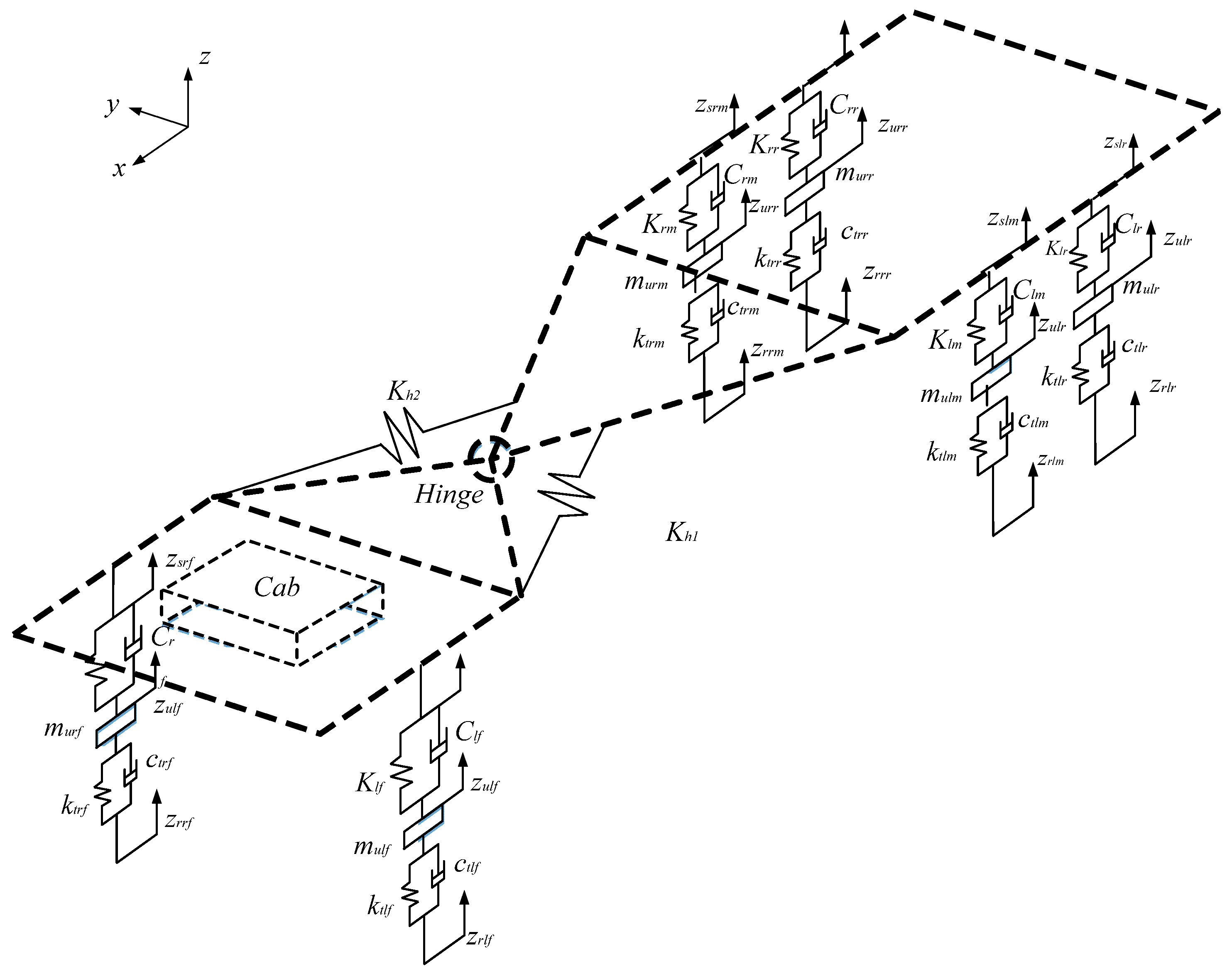
This paper selects a certain type of 40-ton articulated mining dump truck (Specific parameters are shown in Table 1). Due to the articulated connection of the mining dump truck, its front and rear bodies are asymmetric structures, and it is not feasible to simply study it by taking a quarter of the vehicle structure. Therefore, a whole-truck model of an articulated mining dump truck was established as shown in Figure 2.
The vertical motion equation of the truck body is:
m s z ¨ s = F l f + F r f + F l m + F r m + F l r + F r r
where ms is the truck unloaded sprung mass; Flf, Frf, Flm, Frm, Flr, Frr represent the force of the hydro-pneumatic suspension of the left front, right front, left middle, right middle, left rear, and right rear wheels.
The pitch motion equation of the vehicle body is:
I 0 θ ¨ = F l r + F r r L c r + F l m + F r m L c m F l f + F r f L c f
where I0 is the pitch inertia moment; θ is the pitch angle; Lcr is the distance from the rear axle to the vehicle mass center; Lcm is the distance from the middle axle to the vehicle mass center; Lcf is the distance from the front axle to the vehicle mass center.
The roll motion equation of the front frame and the rear frame are as follows:
I f ϕ ¨ f = F l f F r f L f 2 I r ϕ ¨ r = F l m F r m L m 2 + F l f F r f L r 2
where ϕf and ϕr represent the roll angle of the front body and the rear body; If and Ir represent the roll moment of inertia of the front body and the rear body; Lf, Lm, Lr represent the distance to the front wheel center, middle wheel, and rear wheel.
The vertical motion equations of the six wheels are as follows:
m u l f z ¨ u l f = F l f + k t l f z r l f z u l f + c t l f z ˙ r l f z ˙ u l f m u r f z ¨ u r f = F r f + k t r f z r r f z u r f + c t r f z ˙ r r f z ˙ u r f m u l m z ¨ u l m = F l m + k t l m z r l m z u l m + c t l m z ˙ r l m z ˙ u l m m u r m z ¨ u r m = F r m + k t r m z r r m z u r m + c t r m z ˙ r r m z ˙ u r m m u l r z ¨ u l r = F l r + k t l r z r l r z u l r + c t l r z ˙ r l r z ˙ u l r m u r r z ¨ u r r = F r r + k t r r z r r r z u r r + c t r r z ˙ r r r z ˙ u r r
where Flf, Frf, Flm, Frm, Flr, and Frr represent the force of the hydro-pneumatic suspension of the left front, right front, left middle, right middle, left rear, and right rear wheels; mulf, murf, mulm, murm, mulr, and murr are the unsprung masses of the left front wheel, right front wheel, left middle wheel, right middle wheel, left rear wheel, and right rear wheel, respectively; zulf, zurf, zulm, zurm, zulr, and zurr represent the unsprung mass displacement for the corresponding wheels; zrlf, zrrf, zflm, zrrm, zrlr, and zrrr are the vertical road surface excitations of the left front wheel, right front wheel, left middle wheel, right middle wheel, left rear wheel, and right rear wheel, respectively; ktlf, ktrf, ktlm, ktrm, ktlr, and ktrr represent the tire stiffness of the left front, right front, left middle, right middle, left rear, and right rear wheels; ctlf, ctrf, ctlm, ctrm, ctlr, and ctrr represent the tire damping coefficients of the corresponding wheels.
The equation is derived based on the Newton–Euler method, where the chassis motions are coupled through the suspension forces. For a detailed derivation, refer to [25].

2.3. Validation of the Hydro-Pneumatic Suspension and the Whole-Truck Model

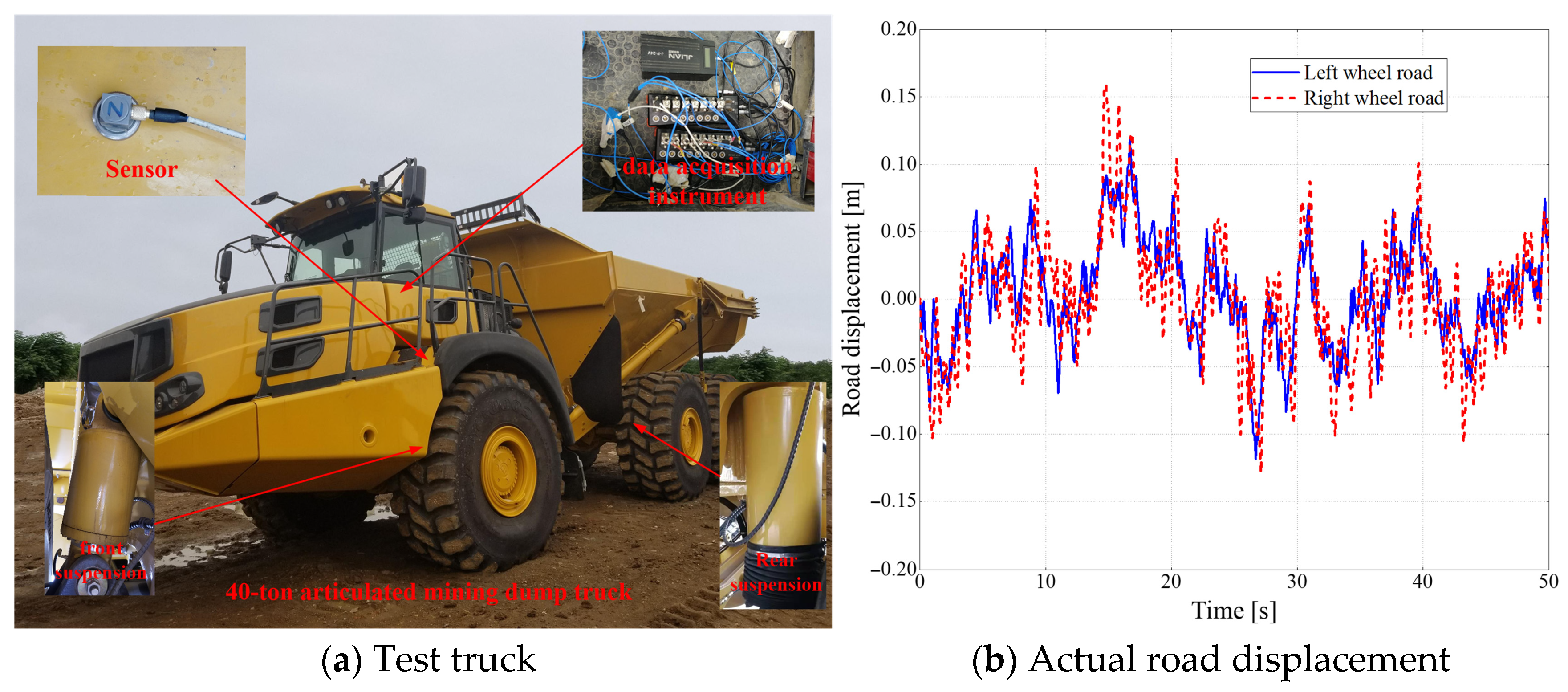
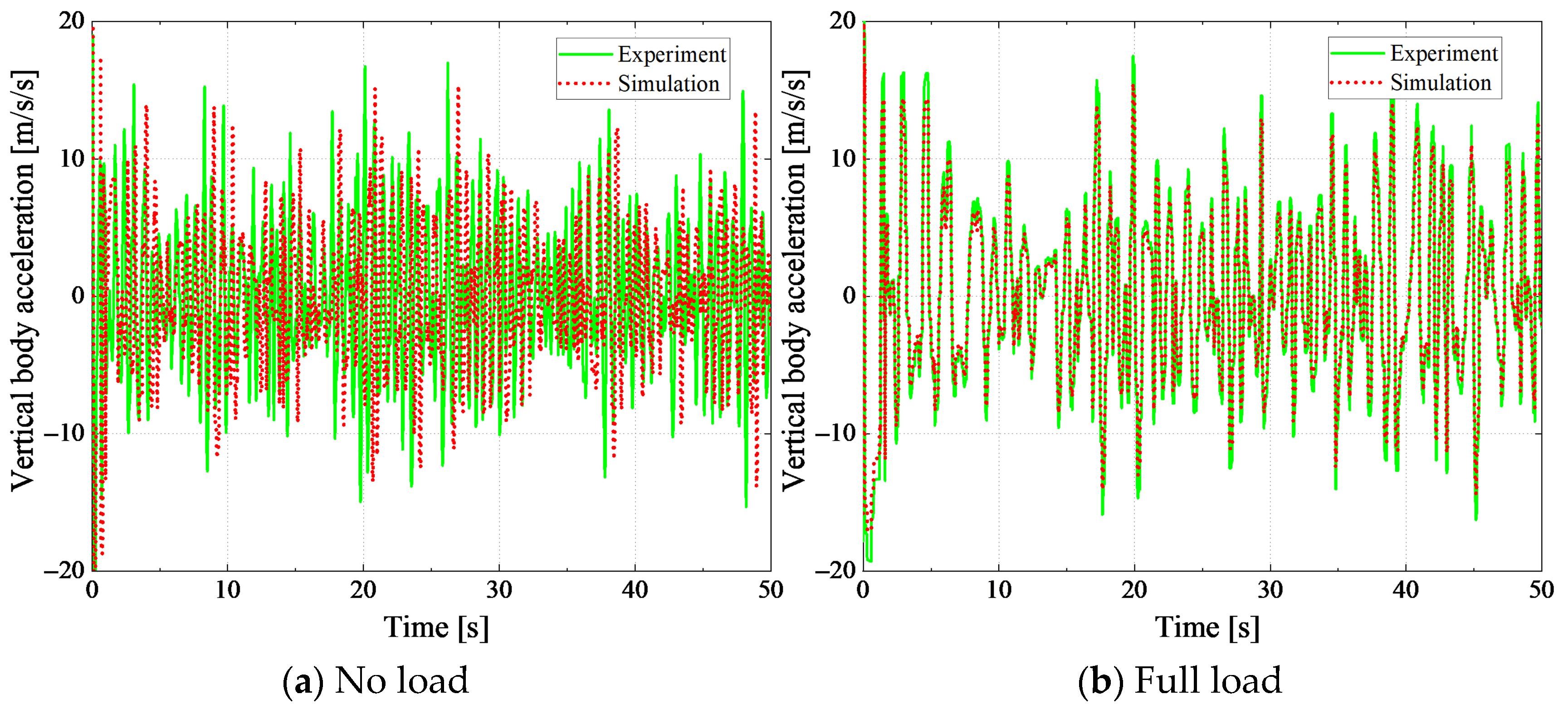
Considering that the mining dump truck is too large and is a multi-axis vehicle, and that the laboratory currently has a four-channel shock test table that cannot perform scaffolding testing, road tests are conducted. Data acquisition instruments are installed on the actual truck (Figure 3a), collecting the actual vertical body acceleration results of the mining dump truck (both at speeds of 36 km/h with no load and 18 km/h with full load), while collecting the real road traveled by the mining dump truck to import the displacement information (Figure 3b) into the road model of the simulation, obtaining the simulated vertical body acceleration results and analyzing the test with the simulation results, as shown in Figure 4, to verify the validity of the established hydro-pneumatic suspension model and the whole vehicle model.
Figure 4 and Table 2 show that there is better consistency between the experimental results and the simulation results. The hydro-pneumatic suspension model and the whole-truck model constructed are correct and have higher accuracy. There is a certain error in the simulation results compared to the experimental results, which is because the simulation model was constructed under ideal conditions, without considering many nonlinear factors such as friction between rubber pads and various structural components in the frame and engine vibration.

3. MPC Controller Design and Multi-Dimensional Synergistic Optimization

Based on the validated whole-truck nonlinear dynamics model established in Section 2, this section focuses on the design of the active hydro-pneumatic suspension controller. To address the challenge of multiple target conflicts under different operating conditions, a multi-dimensional synergistic optimization control (MDSOC) strategy is constructed using the model prediction control (MPC) framework. First, the formula for the MPC cost function is introduced; second, the specific synergistic rules for different scenarios are defined.

3.1. MPC Controller Design

Model predictive control (MPC) is employed as the hydro-pneumatic suspension control scheme in this study. A feedback correction mechanism was employed by MPC to improve prediction accuracy: comparing system output measurements with model predictions in real time and obtaining prediction errors and providing feedback to the prediction model, thereby dynamically correcting subsequent output predictions to ensure the accuracy of prediction results. It has outstanding advantages in dealing with optimization problems constrained within a limited time range and has wide applications in the suspension control field. MPC not only improves longitudinal pitch, lateral roll and vertical acceleration, but also optimizes dynamic tire load and reduces road damage.
Linearize the nonlinear model established in the previous research [25] to meet the requirements of high real-time application scenarios for hydro-pneumatic suspension control. The linear state space equation for the entire vehicle can be written as:
x ˙ ( k + 1 ) = A M x ( k ) + B M w ( k ) + E M u ( k ) y ( k ) = C x ( k ) + D u ( k )
where A M = 0 0 1 1 0 0 0 0 1 0 A 1 A 2 K s d m s 0 A 1 A 2 C s d m s A 1 A 2 C s d m s K s d K c m s A 1 A 2 K s d m u k t m u A 1 A 2 C s d m u A 1 A 2 C s d c t m u K s d K c m u 0 0 0 0 0 , A M = 0 0 1 1 0 0 0 0 1 0 A 1 A 2 K s d m s 0 A 1 A 2 C s d m s A 1 A 2 C s d m s K s d K c m s A 1 A 2 K s d m u k t m u A 1 A 2 C s d m u A 1 A 2 C s d c t m u K s d K c m u 0 0 0 0 0 , B M = 0 1 0 c t m u 0 , E M = 0 0 C s K c m s C s K c m u K c , C = A 1 A 2 K s d m s   0   A 1 A 2 C s d m s     A 1 A 2 C s d m s   K s d K c m s , D = C s K c m s .
If the current time is taken as k, then the state k + Np can be predicted as follows:
x ( k + 1 | k ) = A M x ( k ) + B M w ( k ) + E M u ( k ) x ( k + N c | k ) = A M x ( k + N c 1 | k ) + B M w ( k + N c 1 | k ) + E M u ( k + N c 1 | k ) x ( k + N p | k ) = A M x ( k + N p 1 | k ) + B M w ( k + N p 1 | k ) + E M u ( k + N p 1 | k )
where Nc is the control time domain; Np is the prediction time domain.
In the suspension control system of the entire vehicle, it is necessary to comprehensively consider the multi-dimensional dynamic response of the vehicle body, including longitudinal, lateral, and vertical acceleration, as well as key indicators such as pitch, roll, and vertical vibration. In actual driving conditions, there are certain differences in road surface excitation between the wheels on both sides of the vehicle, and the direction of vehicle motion always undergoes dynamic changes. The above dynamic parameters can effectively characterize the overall smoothness performance of the vehicle during driving. The mining dump truck is selected as the object, and an optimized objective function to achieve optimal control is designed in this study. The objective function is as follows:
J = J   r i d e + J   l o a d + J   p i t c h + J   r o l l
where Jride represents a function of the vehicle comfort; Jload represents a function of the grip ability of tires; Jpitch represents a function of vehicle pitch motion; Jroll represents a function of vehicle roll motion on front and rear axles.
J r i d e = j = 0 N q r i d e z ¨ s k + j | k z ¨ s d k + j | k 2
where qride represents the vehicle acceleration system weighted output error.
J l o a d = j = 0 N q l o a d k t i z u j k + j | k z r j k + j | k 2
where i ∈ [fl, fr, ml, mr, rl, and rr] represent six wheels of the whole truck; qload represents the dynamic tire load weighted output error.
J p i t c h = j = 0 N q p i t c h θ ¨ k + j | k θ ¨ d k + j | k 2
where qpitch represents the vehicle pitch acceleration weighted output error.
J r o l l = j = 0 N q r o l l ϕ ¨ f k + j | k ϕ ¨ f d k + j | k 2 + j = 0 N q r o l l ϕ ¨ r k + j | k ϕ ¨ r d k + j | k 2
where qrollfront and qrollrear represent the front- and rear-axle body roll angle acceleration weighted output error.
There are certain limitations to the active force generated by active hydro-pneumatic suspension in practical applications. Therefore, this limitation is considered in the form of constraints in the MPC controllers’ design to ensure that the MPC quantity is within the capability range of active hydro-pneumatic suspension.
The active hydro-pneumatic suspension output force includes two parts: adjustable damping force and gas elastic force. When the damping force changes, the corresponding elastic force also changes; that is, the total active force changes. Therefore, considering that the damping force is related to the relative velocity of the mass on and off the spring, the constraint is set as follows:
0 F D i c max c min f d
The suspension system should ensure that its movement is always within a safe operating range during operation, avoiding impact on the limit blocks at both terminals, reducing the overall vehicle comfort and shortening the suspension system service life. Therefore, the restrictions on suspension working space are as follows:
0 f d i f d max
where fdmax represents the maximum suspension working space motion limit.

3.2. Multi-Dimensional Synergistic Optimization

Considering that MDSOC mainly involves the pitch, roll, and vertical vibration of mining cars, ensuring that the pitch angle is the main optimization control objective to improve the ride comfort of the vehicle:
min Δ N ( k ) J J = J   l o a d + J   p i t c h   s . t .   Y min k Y k Y max k             u min k u k u max k             Δ u min k Δ u k Δ u max k             0 F D i c max c min f d             0 f d i f d max
Ensure that pitch angle is the primary control objective to improve the vehicle’s driving stability:
min Δ N ( k ) J J = J   l o a d + J   r o l l   s . t .   Y min k Y k Y max k             u min k u k u max k             Δ u min k Δ u k Δ u max k             0 F D i c max c min f d             0 f d i f d max
Taking vertical acceleration as the main control objective, while improving ride comfort, minimize the degree of vehicle damage to the road surface as much as possible:
min Δ N ( k ) J J = J   r i d e + J   l o a d + J   p i t c h + J   r o l l   s . t .   Y min k Y k Y max k             u min k u k u max k             Δ u min k Δ u k Δ u max k             0 F D i c max c min f d             0 f d i f d max

4. Analysis and Verification of MDSOC Results

This section focuses on the performance of the MDSOC-MPC for active hydro-pneumatic suspension, which proves that the designed control strategy can coordinate the longitudinal anti-pitch and lateral anti-roll properties of the body on the basis of ensuring the riding comfort and driving smoothness of the vertical vehicle. MPC is based on longitudinal, lateral, and vertical multi-dimensional synergistic optimization as the control target, to ensure that the designed MPC strategy does not affect the control effect of the dynamics of each of the three axes of the body. The MDSOC-MPC for active hydro-pneumatic suspension is simulated under D-class road conditions in mining areas, and the simulation results are compared with those of active hydro-pneumatic suspension with a single control objective in the longitudinal, lateral, and vertical directions, respectively.

4.1. Longitudinal Motion Control Performance Analysis

Firstly, to investigate the longitudinal anti-pitch performance of MDSOC-MPC for active hydro-pneumatic suspension, the longitudinal kinematic performance under emergency braking conditions was simulated and analyzed.
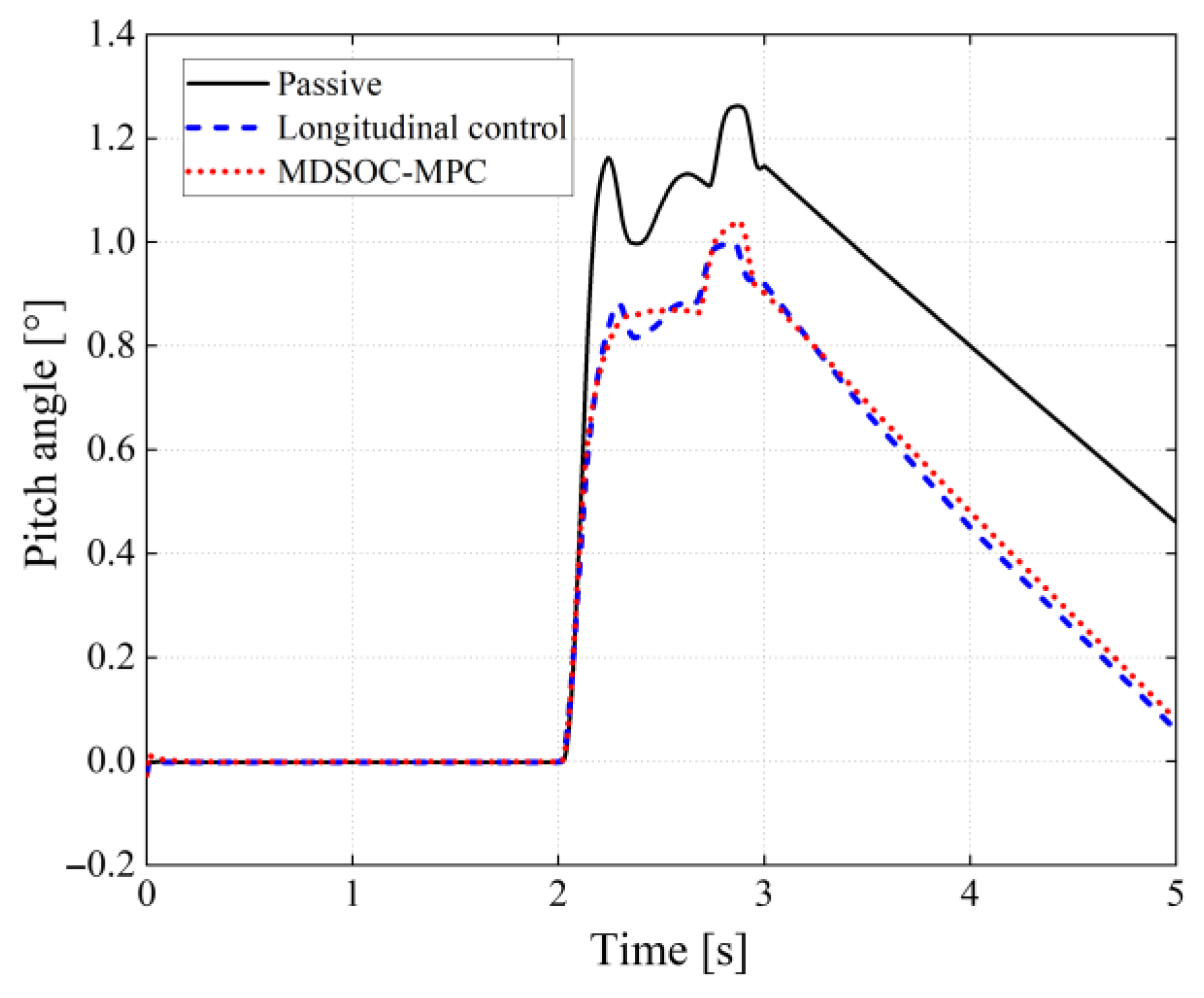
Emergency braking can verify the anti-nodding effect of an MDSOC-MPC for active hydro-pneumatic suspension under emergency braking situations for mining dump trucks. After driving the mining dump truck at a constant speed of 54 km/h for 2 s, emergency braking was applied until parking. The simulation results are shown in Figure 5.
From Figure 5 and Table 3, it can be seen that the MDSOC-MPC for active hydro-pneumatic suspension reduces the root mean square pitch angle of mining dump trucks by 18.2% compared to passive hydro-pneumatic suspension during braking, which is basically consistent with the 20.6% of active hydro-pneumatic suspension with longitudinal pitch as the control objective. This indicates that the MDSOC-MPC for active hydro-pneumatic suspension designed in this study can effectively suppress the pitch situation of mining dump trucks under emergency braking. The MDSOC-MPC for active hydro-pneumatic suspension can achieve the control effect of single longitudinal pitch while coordinating the longitudinal, lateral, and vertical dynamic performance, without compromising the control effect of longitudinal pitch performance due to synergistic control.

4.2. Performance Analysis of Lateral Motion Control

In order to investigate the lateral anti-roll performance of the MDSOC-MPC for active hydro-pneumatic suspension, simulations were carried out to verify the performance under two operating conditions, that of single-shift line and double-shift line, respectively.
(1)
Single-shift line condition
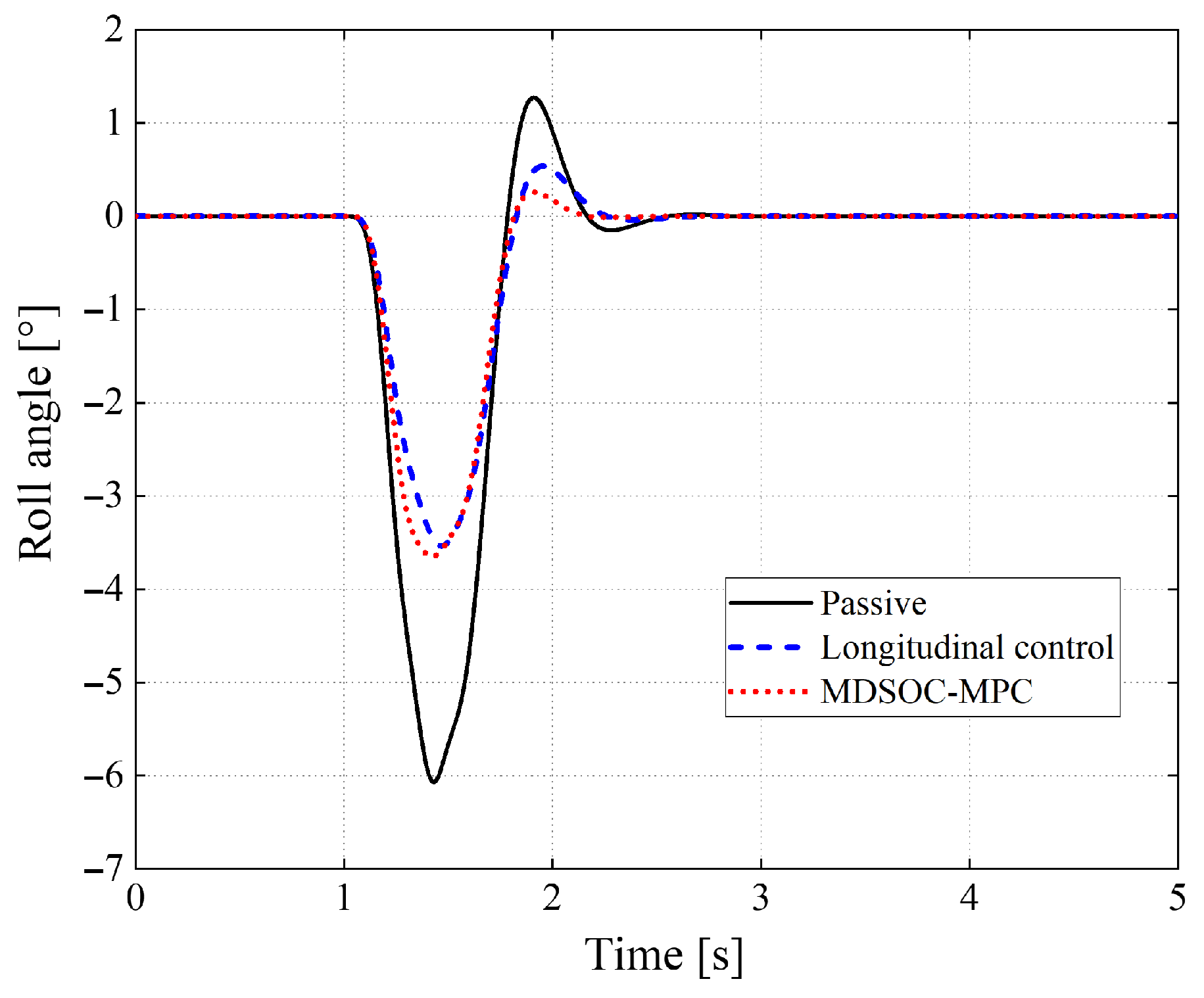
The single-shift condition simulation simulates the lateral motion state of the vehicle when the mining dump truck encounters an unexpected situation in the mining area to avoid obstacles. The mining dump truck travels at 54 km/h for 1 s in the initial state in the simulation, then the steering wheel rotates 150 degrees within 1 s and quickly straightens, with the side tilt of the entire process produced by the body of the vehicle as shown in Figure 6.
As shown in Figure 6 and Table 4, compared to the roll angle peaks of passive hydro-pneumatic suspension under single-move line conditions, the MPC-based active hydro-pneumatic suspension lateral control strategy and the MDSOC-MPC for active hydro-pneumatic suspension were reduced by 41.9% and 40.4%, respectively. This means that the MDSOC-MPC for active hydro-pneumatic suspension can effectively inhibit the lateral roll of the mining dump truck in emergency obstacle avoidance conditions.
(2)
Double-shift line condition
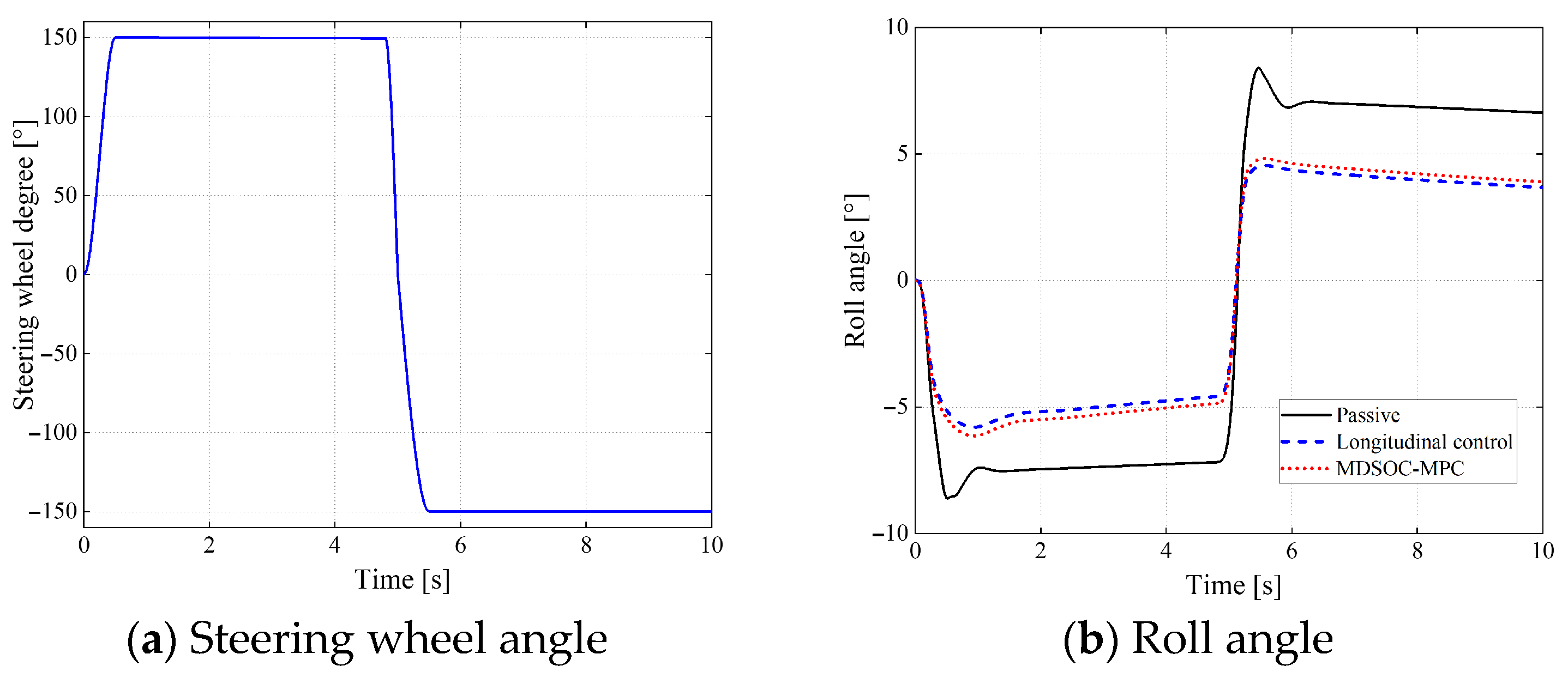
The double-shift line condition simulates the mining dump truck lateral motion on the mining road, changing lanes in the forward sudden state and returning to the original lane driving state. The mining dump truck remains in the initial state of 54 km/h in the simulation, turning the steering wheel 150 degrees in the initial 0.5 s time, then maintaining the steering wheel angle unchanged, the steering wheel is rapidly reversed by 300 degrees in 0.7 s starting from the fourth 4.8 s and maintained until the end of the simulation.
As shown in Figure 7, the passive hydro-pneumatic suspension has a significant deterioration of the body roll angle due to the steering wheel being turned at too large an angle for a short period of time and overshooting of the roll angle after the completion of the steering, a process that can further affect both ride comfort and driving stability. Active control can make the truck’s side roll transition smoother. Compared to the passive hydro-pneumatic suspension’s peak roll angle of 8.62 degrees, the MPC-based active hydro-pneumatic suspension lateral control strategy and MDSOC-MPC have roll peak angles of only 5.85 and 6.03 degrees. The effect of the MDSOC-MPC for active hydro-pneumatic suspension on the lateral roll angle is almost identical to the horizontal-control effect of the MPC-based active hydro-pneumatic suspension lateral control strategy. Therefore, it can be assumed that the MDSOC-MPC for active hydro-pneumatic suspension is able to reduce the vehicle roll when the vehicle is not decelerating under the double-shift line driving condition.

4.3. Vertical Motion Control Performance Analysis

To verify the improvement effect of the MDSOC-MPC for active hydro-pneumatic suspension on the performance of vertical direction dynamical performance, it was compared to the MPC-based active hydro-pneumatic suspension vertical control strategy. The control truck was driven uniformly at a speed of 36 km/h on the D-class road surface, with the corresponding time domain and frequency domain analyses results shown in Table 5.
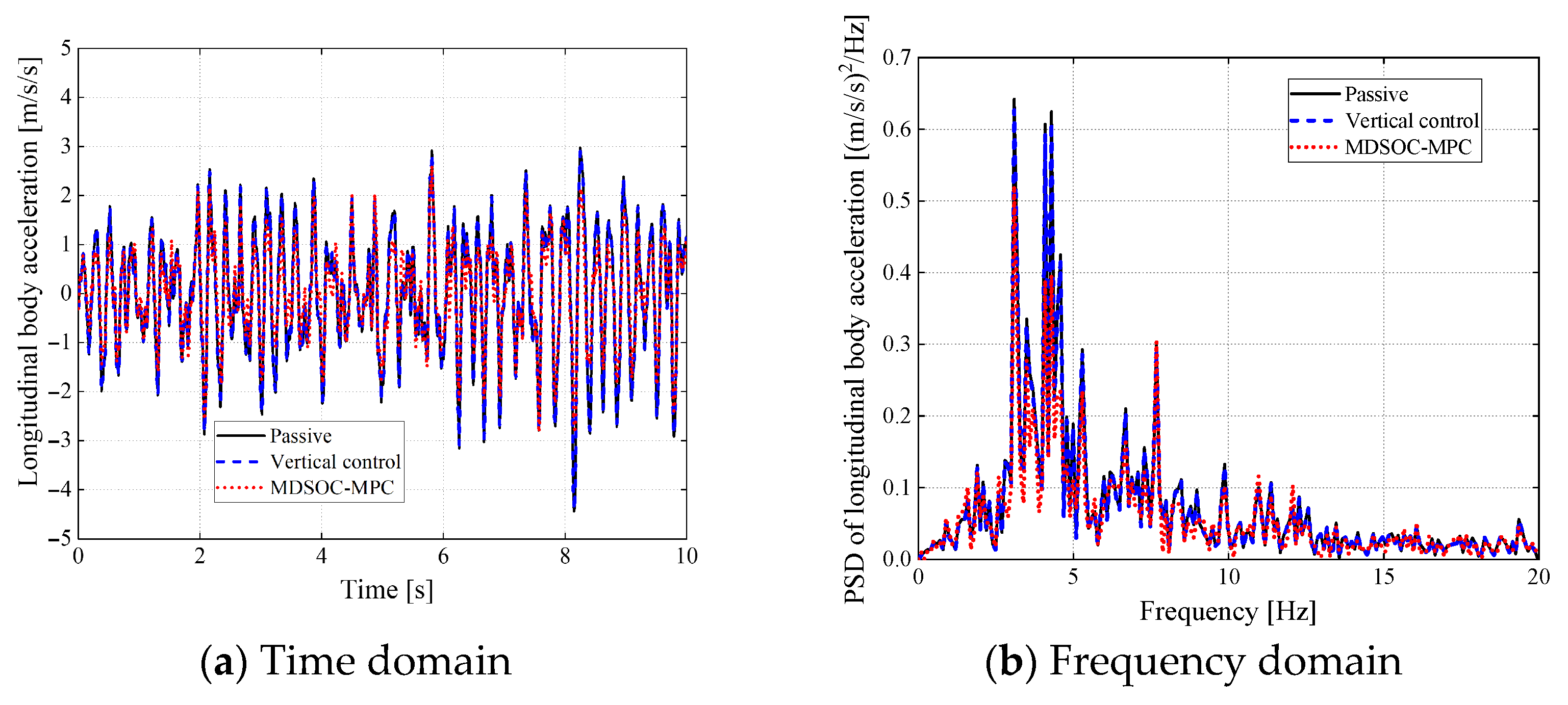
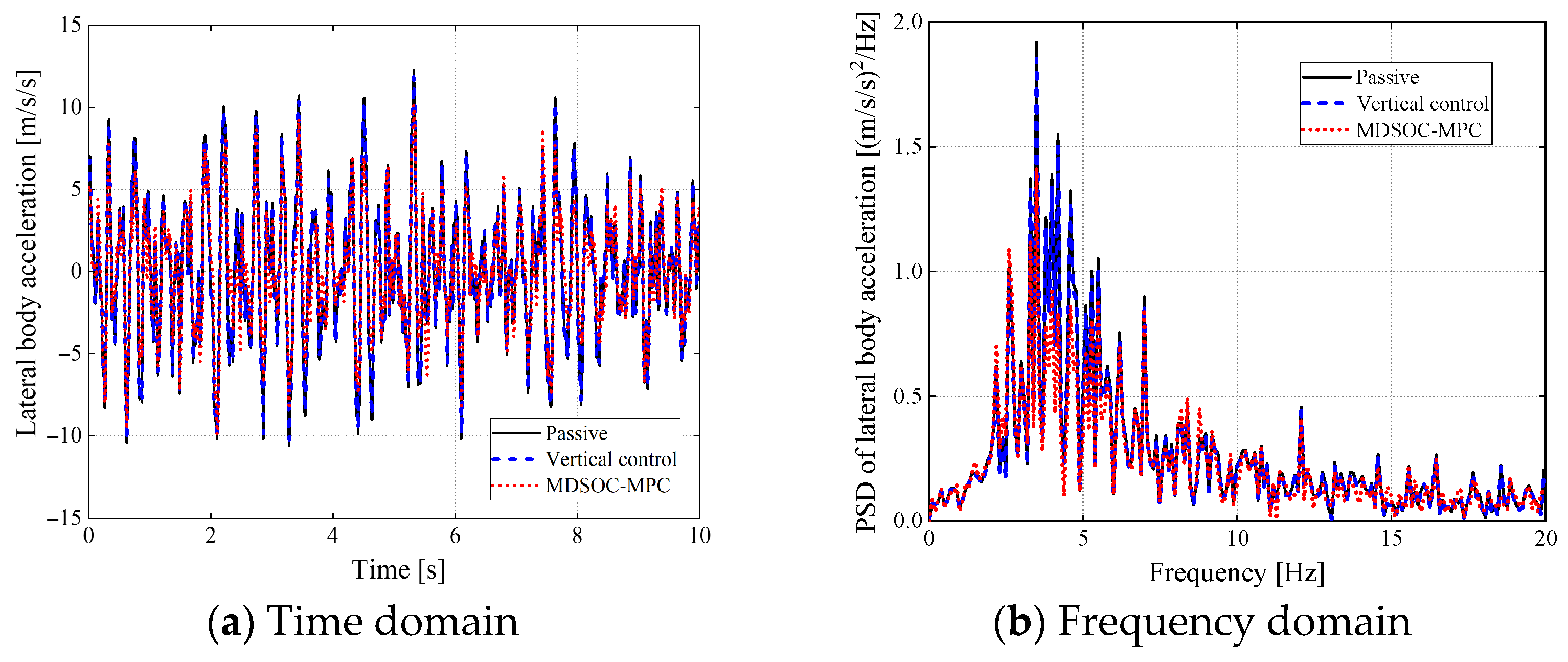
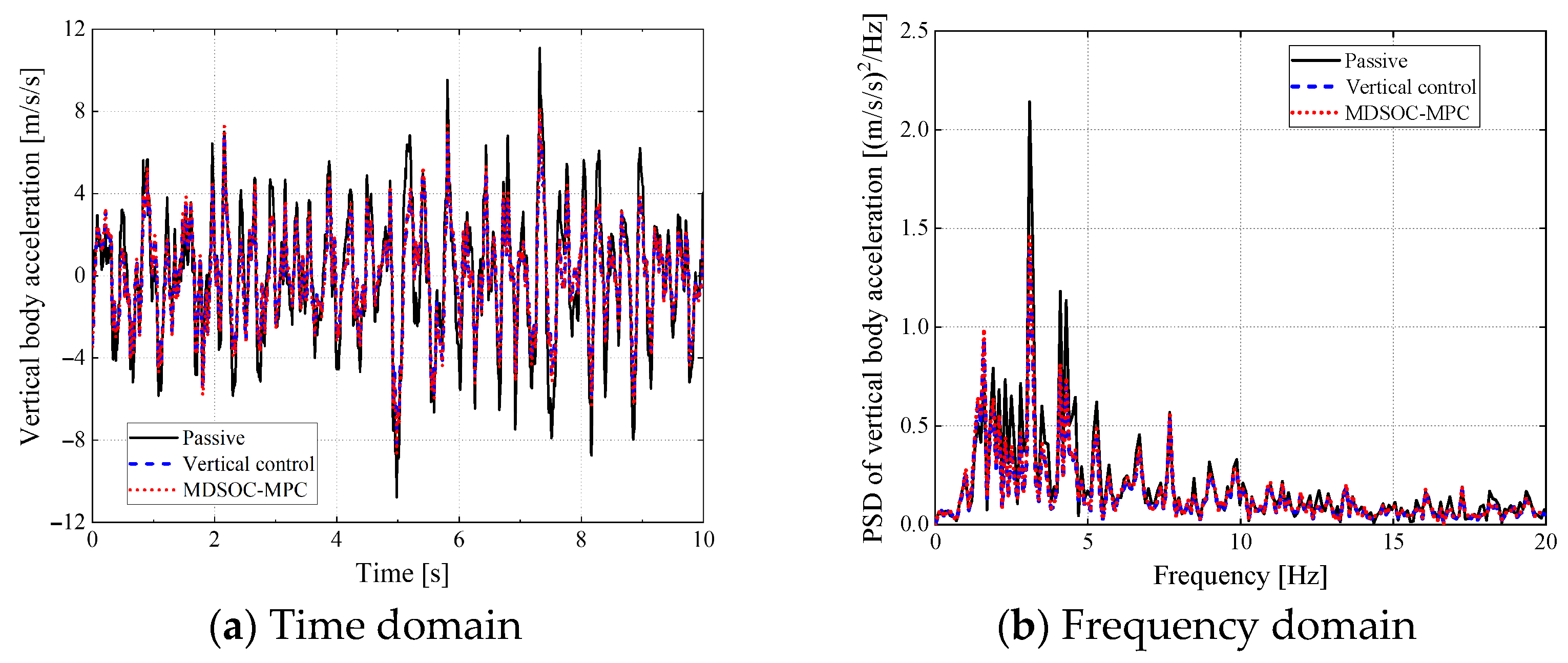
Compared to the passive hydro-pneumatic suspension, the longitudinal, lateral, and vertical body acceleration of the MPC-based active hydro-pneumatic suspension vertical control strategy were reduced by 2.5%, 3.1%, and 26%, respectively, while the longitudinal, lateral, and vertical body acceleration of the MDSOC-MPC for active hydro-pneumatic suspension were reduced by 22%, 21.5%, and 21.2%, respectively. The degree of vertical acceleration optimization (21.2%) was slightly less than the dynamic performance optimization effect of the vertical control (26%), but the MDSOC-MPC significantly improved the vertical and lateral dynamic performance while weakening the vertical dynamic performance (Figure 8, Figure 9 and Figure 10 and Table 5). Compared to the vertical control, the vertical acceleration spectral density of the MDSOC-MPC at 4–12.5 Hz (human sensitivity range) was also significantly reduced. The longitudinal, lateral and vertical body acceleration by multi-dimensional synergistic optimization clearly has better optimization effects in the low frequency band, significantly reducing the human body’s resonance frequency. Moreover, due to the high rigidity of the wheel of the mining dump truck, the intrinsic frequency of its wheels is high, exceeding the intrinsic frequency range of the human body. Therefore, there is only the body resonance peak in Figure 10, and the truck’s longitudinal, lateral, and vertical holding capacity have been significantly improved. Overall, it is believed that the MDSOC-MPC for active hydro-pneumatic suspension does not attenuate the control effect of vertical dynamics compared to a single vertical control strategy.
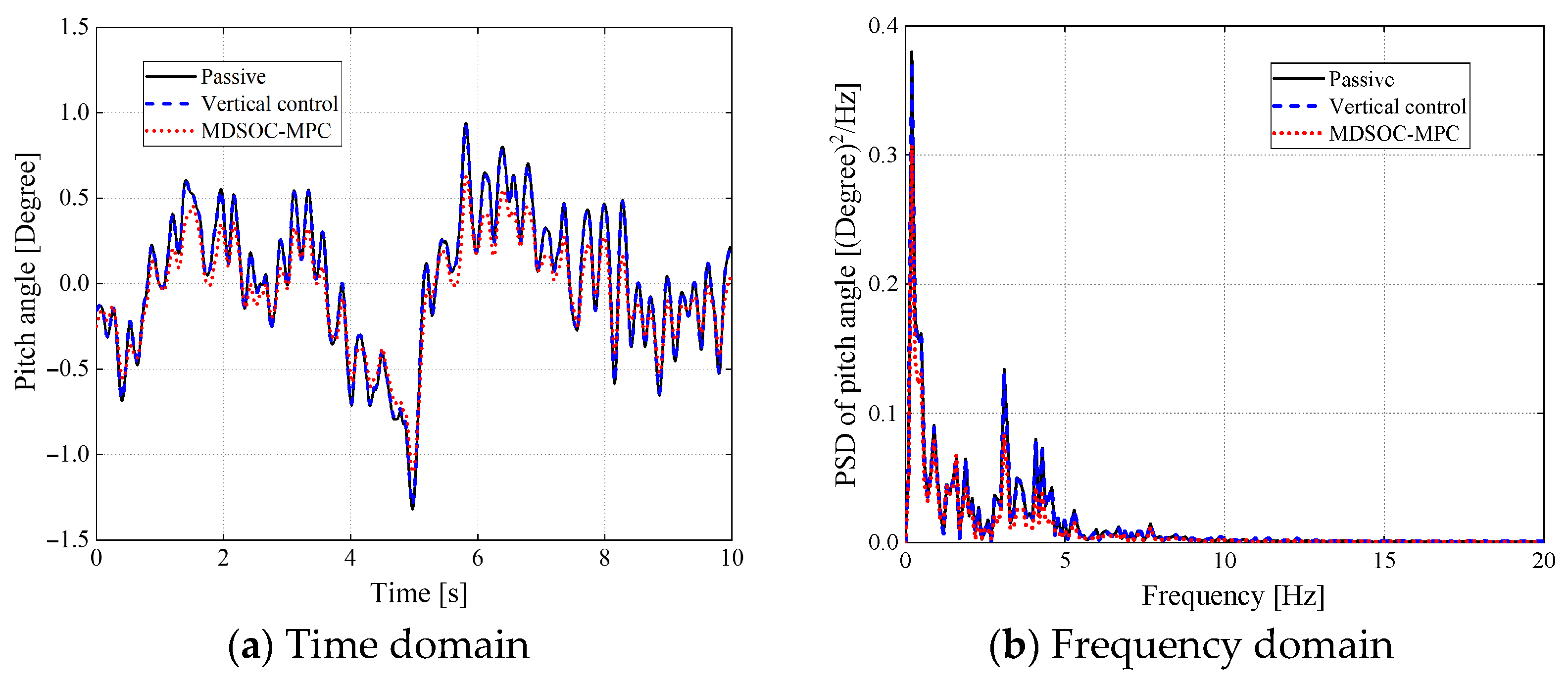
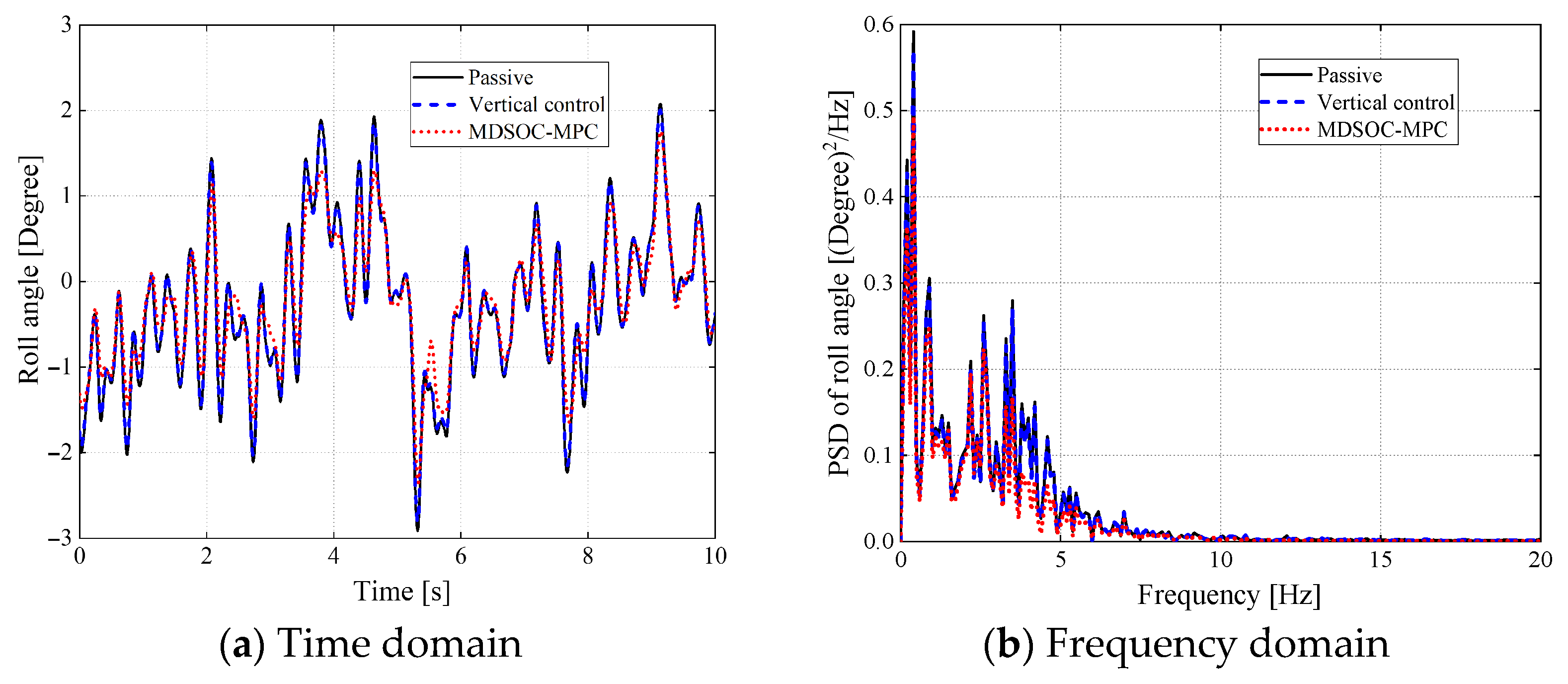
Compared to the passive hydro-pneumatic suspension, the body pitch angle and roll angle controlled only had a small optimization (less than 3.5%) due to the vertical control, while the mining dump truck controlled by multi-dimensional synergistic optimization had improved pitch angle by 22% and roll angle by 21.5%. Especially within the resonance frequency range of 1–2 Hz, the power spectral density of the pitch angle and roll angle of the active hydro-pneumatic suspension with MDSOC-MPC has been greatly reduced. The pitch angle and roll angle in the corresponding frequency domain diagram are also significantly lower than those of passive hydro-pneumatic suspension and the MPC-based active hydro-pneumatic suspension vertical control, which also reflects the optimization effect in the longitudinal and lateral directions in Figure 11 and Figure 12. This shows that the MDSOC-MPC for active hydro-pneumatic suspension can play a role in coordinating and optimizing truck dynamics in the longitudinal and lateral directions on the mining road.
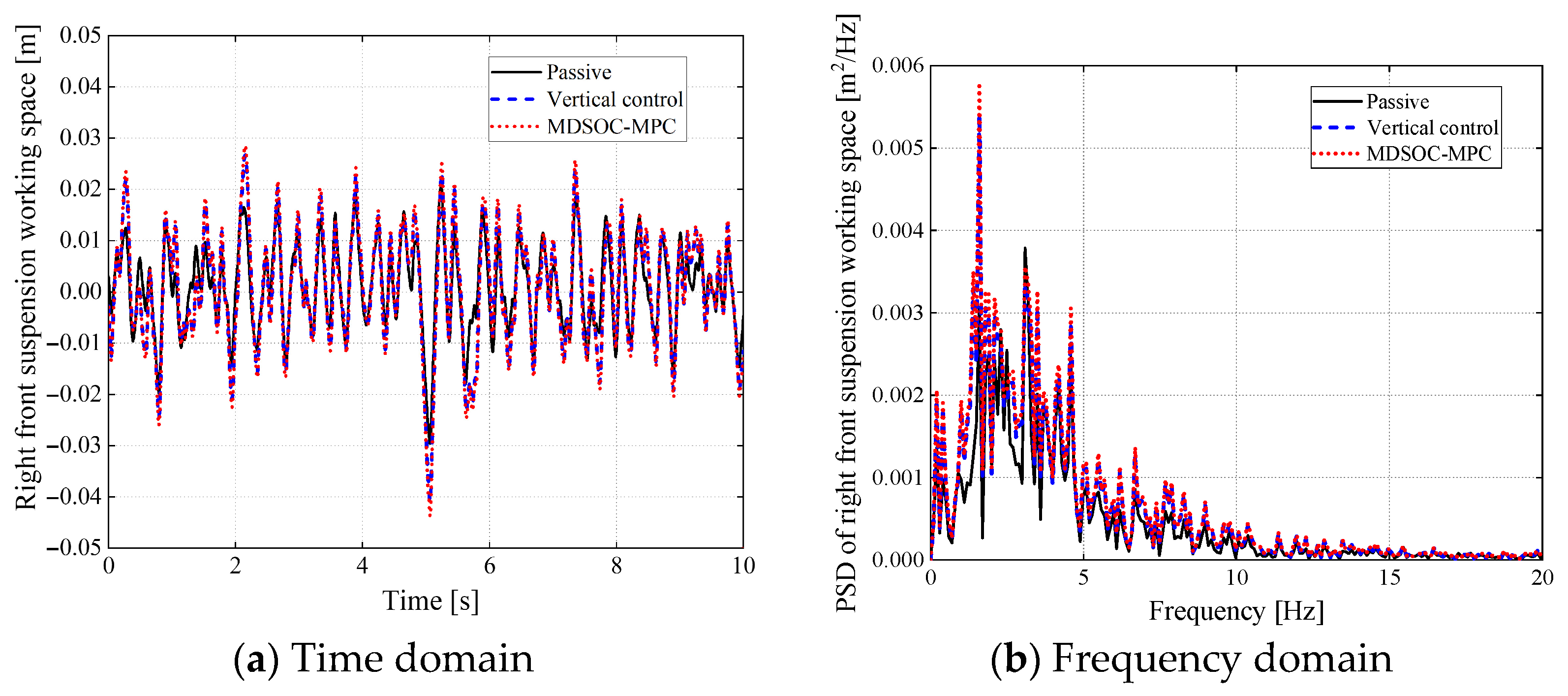
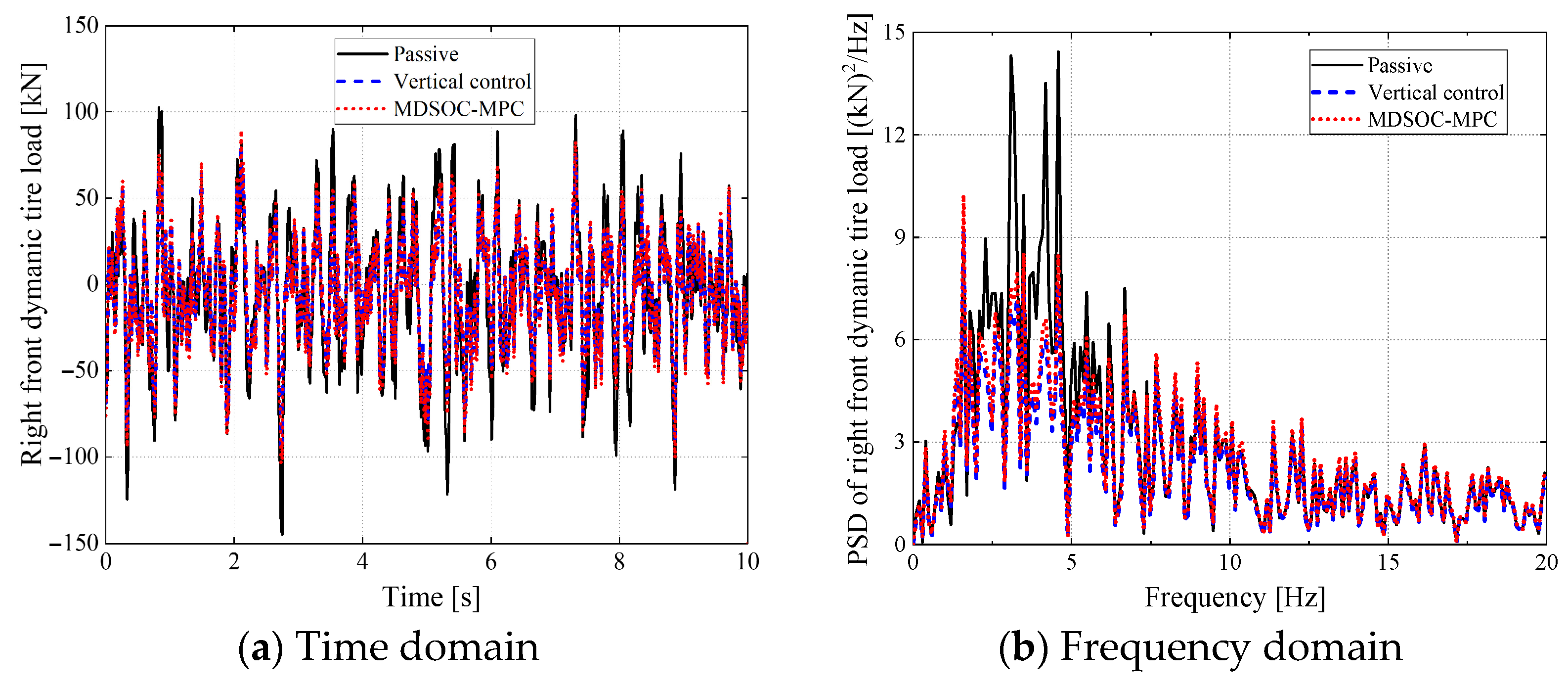
As shown in Figure 13 and Figure 14, compared to passive hydro-pneumatic suspension, the MDSOC-MPC for active hydro-pneumatic suspension and vertical control strategy both worsened right front suspension working space by 36.9% and 28.6%, respectively, but their maximum working space values did not exceed 120 mm, which is still smaller than the total working space range of the hydro-pneumatic suspension used in this study (within acceptable range). Meanwhile, the right front dynamic tire load of the MDSOC-MPC for active hydro-pneumatic suspension and vertical control strategy were reduced by 20.8% and 28.3%, respectively. This also shows that the MDSOC-MPC for active hydro-pneumatic suspension designed in this study can integrate and coordinate the truck’s longitudinal, lateral, and vertical dynamics performance, improving the truck’s driving handling while reducing the degree of damage to the road surface, thereby improving the lifespan of the mining area roads and improving the length and efficiency of mining area operations.

5. Conclusions

This study addressed the multi-dimensional synergistic optimization control (MDSOC) problem of the active hydro-pneumatic suspension for mining dump trucks. A precise hydro-pneumatic suspension and hinged mining truck full-vehicle-dynamics model was established, and an MDSOC architecture of the active hydro-pneumatic suspension based on model prediction control was proposed. Comparison analysis with traditional single longitudinal, lateral, and vertical model prediction control showed that: the square root value of the pitch angle was reduced by 18.2% under emergency braking conditions; the square root value of the roll angle were decreased by 40.4% and 30% under single-shift and double-shift conditions, respectively; under D-class random road excitation, the square root values of the longitudinal, lateral, and vertical body acceleration were decreased significantly by 22%, 21.5%, and 21.2%, respectively; while the square root values of the pitch angle and the roll angle decreased by 22.5% and 20.2%, respectively. In summary, the MDSOC-MPC for active hydro-pneumatic suspension proposed in this study can synthesize and coordinate vehicle longitudinal, lateral, and vertical dynamics performance, improving vehicle turnability while reducing the degree of damage to the road surface, thereby improving the usability of mining area roads and improving mining area operation time and efficiency.
It should be noted that, although the proposed method shows significant comprehensive control effects in the scenarios considered, the dynamic latency and saturation of its executors, the computational real-time of its control policies, and its robustness under unmodeled external interference have not been systematically evaluated. Future work will extend the existing framework, combining road surface pre-targeting information, improve the robustness of MDSOC-MPC with parameter uncertainty-considered design, consider dynamics and a wider range of operational environments, and validate the effectiveness and stability of the MDSOC-MPC through vehicle testing.

Author Contributions

Conceptualization, L.Y.; Methodology, M.Z. and L.Y.; Software, M.Z. and H.C.; Validation, L.Y.; Formal analysis, M.Z.; Investigation, M.Z. and H.C.; Data curation, H.C.; Writing—original draft, M.Z. and L.Y. All authors have read and agreed to the published version of the manuscript.

Funding

This research was funded by the National Natural Science Foundation Project of China (grant numbers 52504162).

Institutional Review Board Statement

Not applicable.

Informed Consent Statement

Not applicable.

Data Availability Statement

Data are contained within the article.

Conflicts of Interest

The authors declare no conflict of interest.

References

  1. Liu, Q.; Liu, X.; Li, B.; Liu, S.; Li, Y.; Luo, Y.; Sha, T. Characteristics and experimental research on semi-active suspension of mining dump truck under parallel fuzzy control strategy. Proc. Inst. Mech. Eng. Part C J. Mech. Eng. Sci. 2025, 239, 9174–9190. [Google Scholar] [CrossRef]
  2. Wang, G.; Wang, W.; Suo, X.; Du, T.; Wang, D.; Liu, X. Multi-objective parameter optimization of a novel hydraulically interconnected suspension for tri-axle mining dump trucks. J. Vib. Control 2025, 31, 3585–3598. [Google Scholar] [CrossRef]
  3. Yang, Y.; Liu, C.; Lai, S.K.; Chen, Z.; Chen, L. Frequency-dependent equivalent impedance analysis for optimizing vehicle inertial suspensions. Nonlinear Dyn. 2025, 113, 9373–9398. [Google Scholar] [CrossRef]
  4. Suo, X.; Jiao, S.; Wang, G.; Wang, H.; Ma, X. Research on the vibration damping performance of hydro-pneumatic suspension of mine dump truck. Vibroeng. Procedia 2018, 20, 113–119. [Google Scholar] [CrossRef][Green Version]
  5. Arutyunyan, G.; Kartashov, A.; Gazizullin, R.; Kiselev, P.; Zaitsev, A.; Tarasyuk, I. Selection of a rational type of front suspension for mining dump trucks with payload capacity up to 240 tons. J. Min. Geotech. Eng. 2022, 18, 25–40. [Google Scholar] [CrossRef]
  6. Zhu, W.; Zhao, Z.; Zhou, X.; Cao, X.; Ye, M.; Cao, C.; Alam, M.M. Research on Damping Hole Optimization of Hydro-Pneumatic Suspension for Mining Trucks under Variable Load Conditions. Actuators 2024, 13, 163. [Google Scholar] [CrossRef]
  7. Zhao, Y.; Xu, H.; Deng, Y.; Wang, Q. Multi-objective optimization for ride comfort of hydro-pneumatic suspension vehicles with mechanical elastic wheel. Proc. Inst. Mech. Eng. Part D J. Automob. Eng. 2018, 233, 2714–2728. [Google Scholar] [CrossRef]
  8. Ekoru, J.E.D.; Nyandoro, O.T.C.; Chingozha, T. An Udwadia-Kalaba Equation based active seat suspension controller for mining dump trucks. IFAC PapersOnLine 2016, 49, 184–189. [Google Scholar] [CrossRef]
  9. Yang, L.; Wang, R.; Meng, X.; Sun, Z.; Liu, W.; Wang, Y. Performance analysis of a new hydropneumatic inerter-based suspension system with semi-active control effect. Proc. Inst. Mech. Eng. Part D J. Automob. Eng. 2020, 234, 1883–1896. [Google Scholar] [CrossRef]
  10. Wang, R.; Zhao, X.; Ding, R.; Chen, J. Research on the Dynamic Performance of a New Semi-Active Hydro-Pneumatic Suspension System Based on GA-MPC Strategy. World Electr. Veh. J. 2026, 17, 93. [Google Scholar] [CrossRef]
  11. Jeong, S.; Jeong, Y. Development of Virtual Reference-Based Preview Semi-Active Suspension System. Actuators 2026, 15, 67. [Google Scholar] [CrossRef]
  12. Yang, Y.; Liu, C.; Chen, L.; Zhang, X. Phase deviation of semi-active suspension control and its compensation with inertial suspension. Acta Mech. Sin. 2024, 40, 523367. [Google Scholar] [CrossRef]
  13. Duan, Y.; Dong, Z.; Bai, D.; Zhou, Z.; Li, G.; Wang, S. Vehicle Height Control of Active Hydro-pneumatic Suspension Considering Ride Comfort. IAENG Int. J. Appl. Math. 2025, 55, 861–867. [Google Scholar]
  14. Yang, J.; Chen, K.; Ding, Z.; Zhao, C.; Zhang, T.; Jiao, Z. A Multi-Mode Active Control Method for the Hydropneumatic Suspension of Auxiliary Transport Vehicles in Underground Mines. Appl. Sci. 2025, 15, 6871. [Google Scholar] [CrossRef]
  15. Yuchang, L.; Shuai, W.; Geqiang, L.; Bo, M.; Zhenle, D.; Donglin, L. Optimal parameter identification of hydro-pneumatic suspension for mine cars. Int. J. Simul. Multidiscip. Des. Optim. 2024, 15, 26. [Google Scholar] [CrossRef]
  16. Ali, D.; Frimpong, S. Artificial intelligence models for predicting the performance of hydro-pneumatic suspension struts in large capacity dump trucks. Int. J. Ind. Ergon. 2018, 67, 283–295. [Google Scholar] [CrossRef]
  17. Zhou, X.; Ma, N.; Liu, J.; Zhang, J.; Li, L. Experimental study on vibration isolation performance of mining dump truck suspensions for improving ride comfort. J. Vibroeng. 2025, 27, 1525–1543. [Google Scholar] [CrossRef]
  18. Zou, J.; Guo, S.; Guo, X.; Xu, L.; Wu, Y.; Pan, Y. Hydraulic integrated interconnected regenerative suspension: Modeling and mode-decoupling analysis. Mech. Syst. Signal Process. 2022, 172, 108998. [Google Scholar] [CrossRef]
  19. Xu, F.; Zhou, C.; Liu, X.; Wang, J. GRNN inverse system based decoupling control strategy for active front steering and hydro-pneumatic suspension systems of emergency rescue vehicle. Mech. Syst. Signal Process. 2022, 167, 108595. [Google Scholar] [CrossRef]
  20. Guanpeng, C.; Yue, J.; Yuanjiang, T.; Xiaojun, X. Revised adaptive active disturbance rejection sliding mode control strategy for vertical stability of active hydro-pneumatic suspension. ISA Trans. 2023, 132, 490–507. [Google Scholar] [CrossRef]
  21. Sun, A.; Yu, C.; Xie, F.; Gao, Y.; Shi, X. Ride comfort improvement by back propagation-active disturbance rejection control in semi-active hydro-pneumatic suspension of mining dump truck. J. Vib. Control 2025, 31, 2378–2394. [Google Scholar] [CrossRef]
  22. Lee, J.; Oh, K.; Yi, K. A novel approach to design and control of an active suspension using linear pump control–based hydraulic system. Proc. Inst. Mech. Eng. Part D J. Automob. Eng. 2019, 234, 1224–1248. [Google Scholar] [CrossRef]
  23. Yang, L.; Wang, R.; Ding, R.; Liu, W.; Zhu, Z. Investigation on the dynamic performance of a new semi-active hydro-pneumatic inerter-based suspension system with MPC control strategy. Mech. Syst. Signal Process. 2021, 154, 107569. [Google Scholar] [CrossRef]
  24. Yang, L.; Wang, R.; Sun, Z.; Meng, X.; Zhu, Z. Multi-objective optimization design of hydropneumatic suspension with gas–oil emulsion for ride comfort and handling stability of an articulated dumper truck. Eng. Optim. 2023, 55, 291–310. [Google Scholar] [CrossRef]
  25. Yang, L.; Wang, G.; Cui, H.; Liu, W.; Zhang, L. Longitudinal, Lateral, and Vertical Coordinated Control of Active Hydro-Pneumatic Suspension System Based on Model Predictive Control for Mining Dump Truck. Machines 2026, 14, 133. [Google Scholar] [CrossRef]
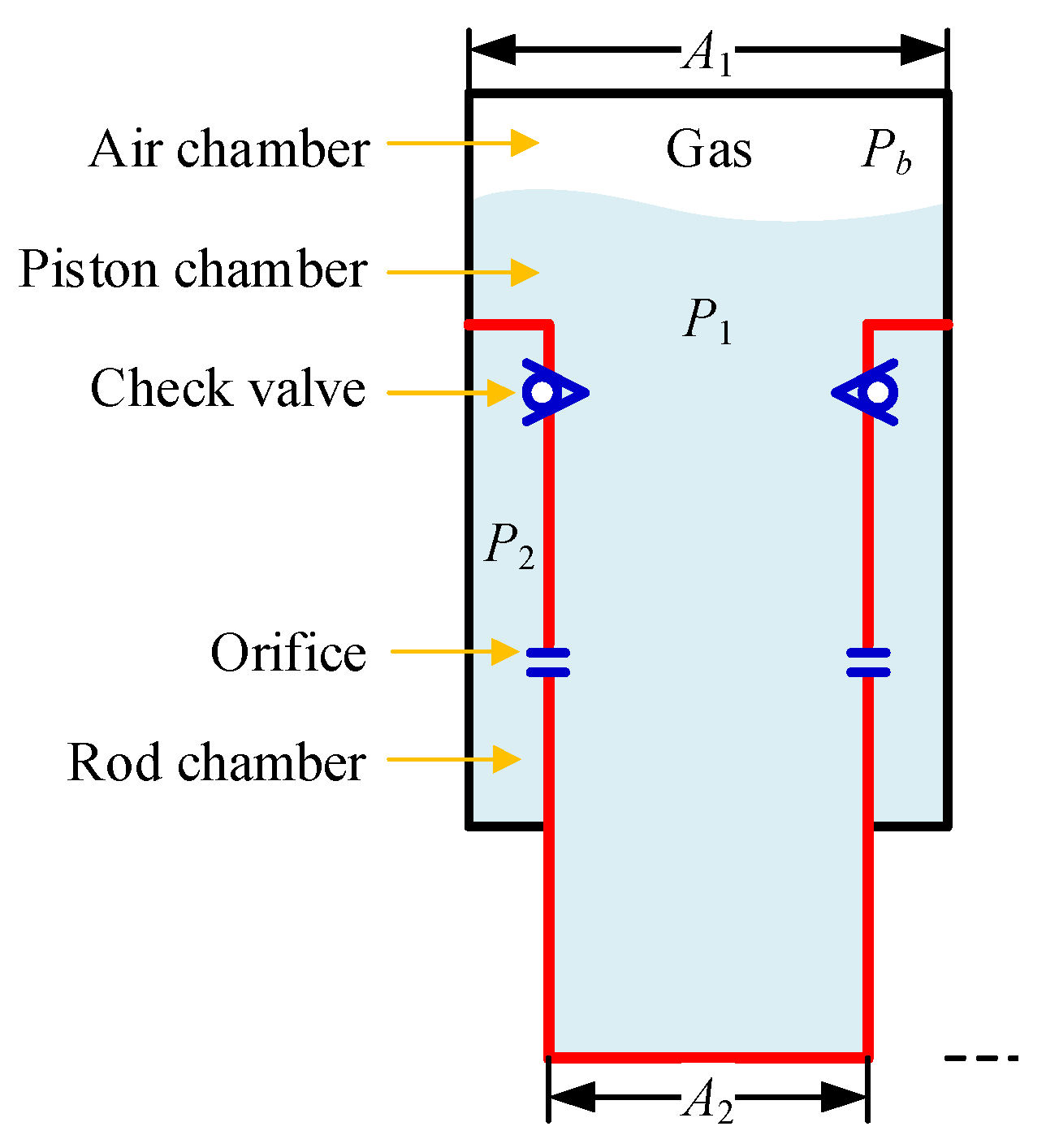
Figure 1. The structure of hydro-pneumatic suspension.
Actuators 15 00159 g001
Figure 2. Whole-truck model of articulated mining dump truck.
Actuators 15 00159 g002
Figure 3. Test truck and actual road displacement.
Actuators 15 00159 g003
Figure 4. Comparison between simulation and experiment of vertical body acceleration.
Actuators 15 00159 g004
Figure 5. Pitch angle under the emergency braking state.
Actuators 15 00159 g005
Figure 6. Roll angle under single-shift line condition.
Actuators 15 00159 g006
Figure 7. Steering wheel angle and body roll angle under double-shift line condition.
Actuators 15 00159 g007
Figure 8. Longitudinal body acceleration under vertical motion.
Actuators 15 00159 g008
Figure 9. Lateral body acceleration under vertical motion.
Actuators 15 00159 g009
Figure 10. Vertical body acceleration under vertical motion.
Actuators 15 00159 g010
Figure 11. Pitch angle under vertical motion.
Actuators 15 00159 g011
Figure 12. Roll angle under vertical motion.
Actuators 15 00159 g012
Figure 13. Right front suspension working space under vertical motion.
Actuators 15 00159 g013
Figure 14. Right front tire dynamic load under vertical motion.
Actuators 15 00159 g014
Table 1. Whole-vehicle related parameters.
ParameterUnitValue
Vehicle unload masskg34,000
Vehicle full load masskg74,000
Front body masskg2650
Rear body masskg2950
Sprung masskg24,200
Front axle unsprung masskg3300
Middle axle unsprung masskg3300
Rear axle unsprung masskg3200
Distance from mass center to front axlemm2710
Distance from mass center to middle axlemm1740
Distance from mass center to rear axlemm3690
Mass center heightmm1520
Wheelbasemm2600
Front tire pressurebar4.25
Rear tire pressurebar4.75
Tire diametermm1860
Tire widthmm765
Tire vertical stiffnessN/m4,000,000
Tire dampingN·m/s28,000
Table 2. Comparison between simulation and experiment RMS values of vertical body acceleration.
IndexNo LoadFull Load
ExperimentSimulationErrorExperimentSimulationError
RMS values of vertical body acceleration (m/s2)5.545.009.7%4.894.3311.5%
Table 3. Peak values of pitch angle under the emergency braking state.
IndexPassive Hydro-Pneumatic SuspensionLongitudinal ControlMDSOC-MPC
Peak values of pitch angle (degrees)1.261.001.03
Table 4. Peak values of roll angle under lateral motion.
IndexConditionPassive Hydro-Pneumatic SuspensionLateral ControlMDSOC-MPC
Peak values of roll angle (degrees)Single-shift line6.073.533.62
Double-shift line8.625.856.03
Table 5. Comparison of simulation results of vehicle vertical dynamic performance.
IndexPassive Hydro-Pneumatic SuspensionLateral ControlOptimizationMDSOC-MPCOptimization
Longitudinal body acceleration (m/s2)1.191.162.5%0.9422%
Lateral body acceleration (m/s2)4.134.003.1%3.2421.5%
Vertical body acceleration (m/s2)3.112.3026%2.4521.2%
Pitch angle (degrees)0.400.392.5%0.3122.5%
Roll angle (degrees)0.940.913.2%0.7520.2%
Right front suspension working space (m)0.00840.0108−28.6%0.0115−36.9%
Right front tire dynamic load (kN)39.4128.2728.3%31.2320.8%
Disclaimer/Publisher’s Note: The statements, opinions and data contained in all publications are solely those of the individual author(s) and contributor(s) and not of MDPI and/or the editor(s). MDPI and/or the editor(s) disclaim responsibility for any injury to people or property resulting from any ideas, methods, instructions or products referred to in the content.