
Review

Immune Dysregulation in HIV-TB Co-Infection: Role of Cytokines and T Cell Biomarkers—A Narrative Review

by
Catherine Keiko Gunawan
1,
Anton Sumarpo
2,* and
Agnes Rengga Indrati
3
1
Medical Profession Study Program, Faculty of Medicine, Maranatha Christian University, Bandung 40164, Indonesia
2
Department of Clinical Pathology, Faculty of Medicine, Maranatha Christian University, Bandung 40164, Indonesia
3
Department of Clinical Pathology, Faculty of Medicine, Padjajaran University—Hasan Sadikin General Hospital, Bandung 40161, Indonesia
*
Author to whom correspondence should be addressed.
Pathogens 2026, 15(1), 51; https://doi.org/10.3390/pathogens15010051 (registering DOI)
Submission received: 21 November 2025 / Revised: 28 December 2025 / Accepted: 29 December 2025 / Published: 3 January 2026
(This article belongs to the Special Issue HIV/AIDS Co-Infections and Non-AIDS Co-Morbidities)

Abstract

Immune dysregulation is a hallmark of human immunodeficiency virus (HIV) infection, characterized by persistent immune activation and systemic inflammation that drive T cell exhaustion and senescence, contributing to disease progression and non-AIDS comorbidities, most notably tuberculosis (TB). With rising HIV prevalence, the incidence of HIV-TB co-infection continues to rise, highlighting the need to understand their immunopathological interplay. This narrative review aims to examine the association between immune dysregulation in HIV-TB co-infection, with a focus on cytokine profiles and immunological biomarkers. Relevant literature was retrieved from multiple databases, with evidence demonstrating differential expression of cytokines—IL-17A, IFN-γ, TNF, IL-10, IL-6, IL-4, and IL-2—and T cell activation markers, such as CD38 and HLA-DR on CD4+ T cells in latent and active TB among HIV-infected individuals. These immune mediators are consistently co-expressed at higher levels in active TB compared to latent TB, suggesting heightened immune activation of both innate and adaptive immune responses in HIV-TB co-infection. However, these findings are largely based on observational data, and the precise mechanism by which cytokine and T cell biomarker dysregulation contributes to HIV-TB pathogenesis remains incompletely understood, underscoring the need for larger, mechanistic studies to address these gaps in the pathogenic pathway.

Graphical Abstract

1. Introduction

Human immunodeficiency virus (HIV) remains one of the most consequential infectious diseases due to its profound and lasting impact on the immune system [1]. Rather than simply depleting immune cells, HIV drives a complex cascade of dysregulation, marked by chronic activation, persistent inflammation, and progressive loss of immune balance, which together compromise host defense and increase susceptibility to opportunistic infections [2,3]. The global scale of this problem underscores its significance, with over 1 million new infections occurring each year and around 40 million people currently living with HIV (PLHIV) worldwide, yet only about three-quarters having access to antiretroviral therapy (ART) [4,5,6]. Accumulating data indicate that individuals with untreated or ineffective ART have as much as a tenfold higher likelihood of progressing to active TB compared to HIV-uninfected individuals, reflecting both an elevated propensity for latent TB reactivation and increased susceptibility to acquiring new Mtb infection [7,8,9].
The interaction between HIV and TB exemplifies a true “syndemic,” referring to two diseases acting synergistically to amplify morbidity and mortality [10,11]. Approximately 10% of PLHIV with latent TB will develop active TB disease each year. This co-infection contributes significantly to global TB mortality, with an estimated 1.25 million TB-related deaths annually, including about 161.000 deaths among PLHIV. TB remains the leading cause of death among PLHIV worldwide, demonstrating the disproportionate impact of HIV-associated TB disease [12].
Effective control of Mtb requires a well-orchestrated cellular immune response that balances pathogen clearance with limited tissue damage. Macrophages act as the primary host cells for Mtb [13,14]. Their anti-bacterial capacity depends heavily on activation by CD4+ T-helper (Th1) cells through cytokines such as IFN-γ and TNF-α, which promote phagolysosomal fusion and granuloma formation—the hallmark of TB immunity [15,16]. In parallel, cytotoxic CD8+ T cells contribute by recognizing Mtb antigen presented via class 1 molecules of the major histocompatibility complex (MHC) and release IFN-γ and TNF- α to enhance macrophage function [17,18]. However, CD8+ T cells also secrete regulatory cytokines such as IL-10 and TGF-β, which can paradoxically favor Mtb persistence by suppressing the protective immune response [17,19].
In contrast, HIV infection profoundly disrupts this finely tuned immune balance through CD4+ T cell depletion and functional impairment, compromising the production of IFN-γ and other key cytokines necessary for macrophage activation [20]. As a result, granuloma integrity is weakened, and Mtb containment becomes impaired [21]. This gives rise to central paradox: despite persistent immune activation and systemic inflammation, the host remains unable to provide antimicrobial protection. Hence, the immune system exists in a hyperactivated yet ineffective state—failing to eliminate Mtb while simultaneously promoting immunopathology. This paradoxical immune dysfunction underlies the increased susceptibility, rapid progression, and poor outcomes observed in HIV-TB co-infection [22,23,24,25].
Throughout this review, immune dysregulation is interpreted within commonly recognized stages of HIV and TB infection, including untreated HIV, ART-treated infection, and the period of immune reconstitution following ART initiation, as well as latent TB infection, active TB disease, and TB-associated immune reconstitution inflammatory syndrome (TB-IRIS). These stages are used as conceptual frameworks to aid interpretation, acknowledging heterogeneity in study populations across the literature.
Given its clinical significance, the immunological mechanisms driving this synergistic relationship remain incompletely understood. The paradox of heightened inflammation coupled with impaired antimicrobial protection—particularly in the context of disrupted T cell function, macrophage activation, and cytokine imbalance—remains an area of active investigation [26]. Understanding these disruptions is essential for identifying immunologic correlations of protection and improving therapeutic strategies. This narrative review aims to synthesize current evidence on how HIV alters the host immune response required for Mtb control, with particular attention to CD4+ T cell-mediated immunity, chronic immune activation, and altered cytokine signaling.

2. Foundational Immunopathogenesis of HIV and TB Infections

2.1. Immunopathogenesis of HIV Infection

The hallmark of acquired immunodeficiency syndrome (AIDS) pathogenesis is a progressive depletion of CD4+ T lymphocytes, accompanied by profound impairment of cellular immunity and increasing susceptibility to opportunistic infections [27]. Although AIDS typically manifests decades after initial infection, CD4+ T cell loss begins rapidly during acute infection and continues throughout the disease course [28]. Early hypotheses proposed that disease progression resulted from slow viral-mediated destruction; however, subsequent evidence demonstrated that HIV replication is continuous and dynamic, even during clinical latency [29].
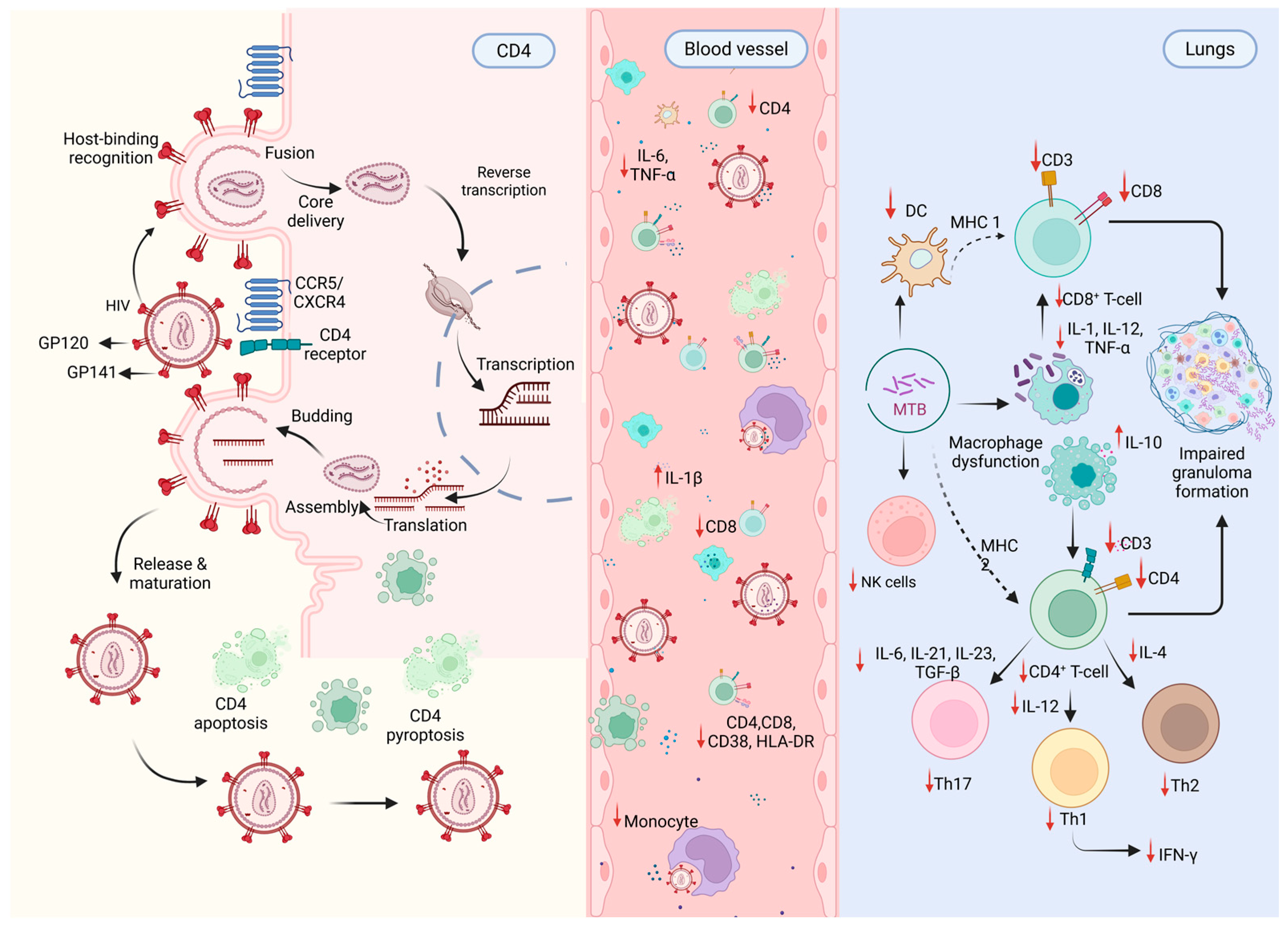
The immunopathogenesis of HIV infection begins when the viral envelope glycoprotein gp120 binds to the host CD4 receptor, which serves as the primary site of viral attachment. This interaction induces a conformational rearrangement, exposing binding domains for specific chemokine receptors—mainly CCR5 and CXCR4 [30]. A major advance in understanding HIV pathogenesis was the discovery of the chemokine co-receptors—CCR5 and CXCR4—which mediate viral entry [31,32,33]. In early infection, CCR5-tropic (R5) viruses preferentially target and destroy memory CD4+ T cells in mucosal and lymphoid tissues. As infection progresses, CXCR4-tropic (X4) variants may emerge, expanding viral tropism to naïve and central-memory subsets and accelerating immune decline [34,35]. Yet, direct cytopathic effects alone cannot explain the magnitude of CD4+ T cell loss. Most CD4+ T cell deaths occur in bystander cells that are not productively infected [36]. In these cells, incomplete reverse transcription of HIV triggers accumulation of viral DNA intermediates, leading to caspase-1-dependent pyroptosis—a highly inflammatory form of programmed cell death that amplifies tissue damage and immune activation [35,37]. Productively infected cells undergo apoptosis, while uninfected activated T cells die through activation-induced cell death (AICD). CD8+ cytotoxic T lymphocytes further contribute to depletion by eliminating infected targets via perforin/granzyme and Fas–FasL pathways [38,39].
These mechanisms—direct viral killing, pyroptosis, apoptosis, and immune-mediated cytotoxicity—are compounded by chronic immune activation, microbial translocation from a compromised gut mucosa, and lymphoid tissue fibrosis [40,41]. Together, they erode the regenerative capacity of the CD4+ T cell compartment. Conceptually, CD4+ T cell depletion unfolds in three phases: (1) rapid destruction of CCR5+ effector-memory T cells during acute infection, (2) partial regeneration from central-memory precursors, and (3) eventual homeostatic collapse as central-memory pools are exhausted [27]. Thus, CD4+ depletion reflects a multifactorial process integrating direct viral cytopathology, bystander death, immune activation, and disrupted lymphoid architecture—all converging to drive immunodeficiency [27,42].
The chronic immune activation that contributes to CD4+ T cell depletion also underlies a gradual functional decline in surviving T cells, culminating in a state of exhaustion marked by impaired effector activity and proliferative capacity. T cell activation is a precisely orchestrated, multistep process governed by three sequential signals that ensure effective immune defense while maintaining self-tolerance: antigen recognition, co-stimulation, and termination [43]. Upon antigen recognition through the T cell receptor (TCR) interacting with MHC molecules on professional antigen-presenting cells (APCs), T cells receive a primary activation signal [44,45]. Full activation requires a second, co-stimulatory signal, most prominently the engagement of CD28 with its ligands CD80 or CD86, which drives proliferation, survival, and effector differentiation. Additional costimulatory receptors, such as CD27, OX40 (CD134), ICOS (CD278), CD40L (CD154), and CD226, further amplify and sustain T cell responses [43,46].
Following pathogen clearance, inhibitory signals are induced to restore immune homeostasis [47]. These are mediated by immune checkpoint receptors—including programmed cell death protein (PD-1), cytotoxic T-lymphocyte-associated antigen 4 (CTLA-4), lymphocyte activation gene 3 (LAG-3), and T cell immunoglobulin and mucin-domain-containing protein 3 (TIM-3)—which transiently limit T cell activity and prevent immunopathology [48,49,50]. During chronic infections such as HIV, persistent antigen exposure and inflammatory signaling drive sustained expression of these inhibitory pathways, leading to a progressive loss of T cell effector function known as T cell exhaustion [51,52]. This dysfunctional state is characterized by impaired proliferation, diminished cytokine production, and altered metabolic capacity. Among inhibitory receptors, PD-1 serves as a central mediator of exhaustion [53]. Upon engagement with its ligands, PD-L1 or PD-L2, PD-1 recruits the phosphatases SHP1 and SHP2 to the immunological synapse, resulting in dephosphorylation of key signaling intermediates—including CD3ζ, ZAP-70, PLC-γ1, and the CD28–PI3K–AKT pathway [54,55]. This attenuation disrupts downstream PKCθ, mTOR, and Ras/MAPK/ERK signaling, suppressing activation and promoting metabolic quiescence. The severity of exhaustion further correlates with co-expression of additional inhibitory receptors such as CTLA-4, LAG-3, TIM-3, TIGIT, 2B4 (CD244), and CD160 [43,56].
Functionally, exhausted CD8+ T cells undergo a hierarchical decline in activity: initial loss of IL-2 production and proliferative capacity is followed by reduced polyfunctionality and TNF-α secretion, culminating in severely diminished IFN-γ production and cytotoxic potential. Although initially defined in CD8+ T cells, exhaustion also affects CD4+ T cells in chronic HIV infection. Exhausted CD4+ T cells exhibit impaired production of IL-2, IFN-γ, and TNF-α, as well as reduced helper function, further exacerbating CD8+ T cell dysfunction and perpetuating immune dysregulation. Multiple factors contribute to the onset and maintenance of T cell exhaustion in HIV. Continuous viral replication sustains antigenic stimulation, while chronic immune activation and inflammation create a suppressive environment. Immunoregulatory cytokines such as IL-10—induced by persistent type I and II interferon signaling—further inhibit T cell proliferation and effector cytokine synthesis. Collectively, these factors establish a self-reinforcing loop of immune activation, checkpoint upregulation, and functional decline that impairs effective viral control [43].
The chronic antigenic stimulation and immune activation that drive T cell exhaustion in HIV also accelerate immunosenescence, a process of premature immune aging marked by irreversible cell-cycle arrest and loss of proliferative potential. Under physiological conditions, cellular senescence serves as a protective mechanism to prevent genomic instability; however, in chronic HIV infection, this process becomes pathologic [57]. CD4+ T cells are inherently long-lived and undergo repeated rounds of activation and proliferation, rendering them particularly susceptible to replicative stress and telomeric attrition. Notably, the progressive decline of T cell proliferation observed during aging occurs alongside gradual telomere shortening—a key hallmark of cellular senescence [58].
In chronic HIV infection, persistent immune activation and sustained antigenic stimulation impose continuous proliferative and oxidative stress on T lymphocytes, driving premature cellular senescence [59]. Under physiological conditions, telomeres shorten gradually by 50–100 base pairs per cell division, serving as a molecular indicator of replicative history and a safeguard against uncontrolled proliferation. In contrast, during chronic HIV infection, the gradual loss of telomeres accelerates up to nearly 250 base pairs per division, due to persistent inflammatory signaling and metabolic dysregulation [60]. When telomeres reach a critically short length, affected cells undergo irreversible growth arrest and acquire a senescent phenotype. This process is compounded by defective DNA repair mechanisms, which amplify telomeric instability and contribute to replicative exhaustion, diminished immune renewal capacity, and progressive CD4+ T cell depletion [57,61].
Viral proteins encoded by HIV further potentiate this senescent state [62]. The Tat protein induces NF-κB-mediated oxidative stress and mitochondrial dysfunction, while Nef disrupts autophagy pathways, impairing cellular quality control and accelerating telomere damage [63,64]. Through these mechanisms, HIV actively promotes cellular stress responses that compromise T cell viability and perpetuate chronic immune dysfunction. Senescence-associated changes are not confined to CD4+ T cells but are also evident in CD8+ T cell populations, which exhibit shortened telomeres, reduced telomerase activity, and increased expression of markers such as CD57 and KLRG1 [65,66,67]. Notably, decreased telomerase activity in CD8+ T cells correlates with elevated CD38 expression, reflecting heightened immune activation and serving as an indicator of disease progression. These findings highlight T cell senescence as both a hallmark and a pathogenic driver of immune deterioration in HIV infection, linking viral persistence to the accelerated aging of the adaptive immune system [57].

2.2. Immunopathogenesis of TB Infection

TB is currently recognized not only as an infectious disease, but also as an immune-mediated disorder in which disease outcome depends on the dynamic interaction between Mtb and the host immune system. Following exposure, approximately 90% of immunocompetent individuals with Mtb enter a latent infection state, while only about 10% of individuals progress to active TB infection (ATBI) [68]. The factors contributing to these outcomes reflect both bacterial virulence and host immune regulation. While Mtb lacks classical exotoxins, its pathogenicity lies in its ability to manipulate host immune responses through virulence factors that interfere with phagosome maturation, antigen presentation, and macrophage antimicrobial effector functions [69,70,71].
The immune response associated with the Mycobacterium tuberculosis infection (MTBI) begins with the innate immune system, which provides the first line of defense against the infection. Airway epithelial cells (AECs) and alveolar macrophages are among the earliest cells to encounter the pathogen [72]. Beyond its role as a physical barrier, AEC display several immunological function, recognizing Mtb through pattern recognition receptors (PRRs) such as Toll-like receptors (TLRs) and NOD-like receptors (NLRs). Their activation leads to the release of inflammatory mediators that recruit macrophages, neutrophils, dendritic cells (DCs), and natural killer (NK) cells to the site of infection [19].
Among these, macrophages play a central role as the first line of defense that functions to phagocytose cellular debris and pathogens in both fixed and free forms [73]. Upon recognition with Mtb components such as glycolipids and peptidoglycan via TLR2, TLR4, NOD2 and Dectin-1, the resident macrophages in the lungs engulf the bacilli and attempt to destroy the pathogen through phagolysosomal fusion, acid hydrolases, and the generation of reactive oxygen and nitrogen intermediates [71]. Beyond its role in phagocytoses, Mtb has evolved multiple mechanism resisting intracellular killing, including inhibition of phagosome–lysosome fusion and modulation of macrophage lipid metabolism, leading to the production of proinflammatory cytokines, such as TNF-α, IL-12, and IL-1β, further activating immune pathways [74,75,76].
As a key effector cell of innate immunity, natural killer (NK) cells are subsequently recruited and activated through cytokine- and receptor-mediated interactions. Through the secretion of IFN-γ and IL-22, NK cells potentiate macrophage antimicrobial activity, thereby restricting early mycobacterial replication [77]. In parallel, dendritic cells internalize mycobacteria and migrate to regional lymph nodes, where they present antigens to naive T cells. By upregulating CD80/CD86 and secreting IL-12, DCs drive the differentiation of CD4+ T cells toward the Th1 phenotype, bridging innate and adaptive immunity [78].
As infection progresses, these cellular interactions culminate in the formation of the tuberculous granuloma—a hallmark structure of TB immunopathogenesis [79]. The core of the granuloma consists of infected macrophages, epithelioid cells, and multinucleated giant cells surrounded by a mantle of CD4+ and CD8+ cells, B cells, neutrophils, and fibroblasts [80,81]. The functional role of granuloma, however, remains a subject of ongoing debate. While it serves as a protective barrier that confines Mtb and limits in dissemination, it may also facilitate bacterial persistence that contributes to disease progression and tissue damage. Within this microenvironment, factors such as hypoxia, nutrient limitation, and altered cytokine signaling promote immune evasion and metabolic adaptation of the pathogen that promote Mtb immune evasion. This balance between immune containment and bacterial persistence underlies the establishment of latent TB infection (LTBI)—a state of immune equilibrium in which viable Mtb persist without presenting clinical outcomes [19].

3. The Immunological Nexus: Dysregulation in HIV-TB Co-Infection

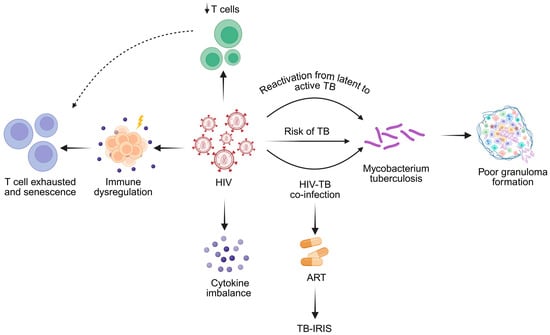
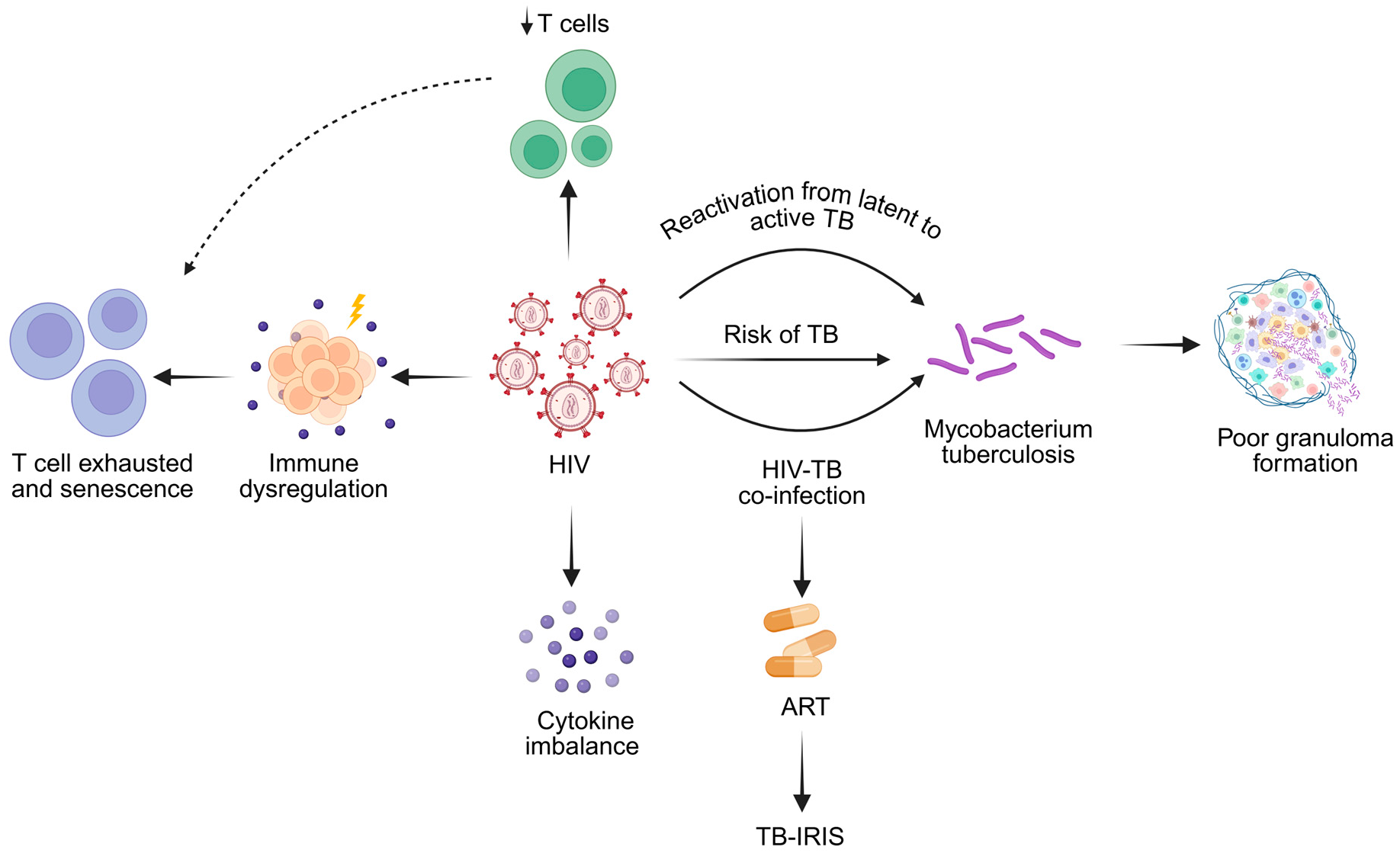
The immunological mechanisms discussed in this section primarily reflect HIV-TB co-infection in ART-naïve individuals or in those with incomplete viral suppression, where CD4+ T cell depletion and chronic immune activation are most pronounced. HIV-TB co-infection establishes a complex immunological interplay, in which the effects of HIV-induced CD4+ T cell depletion along with chronic immune activation converge with the immune mechanisms necessary for controlling TB infection. This intersection creates a syndemic, characterized by simultaneous immune dysregulation, systemic inflammation, and impaired pathogen-specific responses, ultimately increasing susceptibility to active TB [11]. The resulting syndemic reflects the dynamic interaction between viral and bacterial pathogens, shaping both disease progression and the host immune landscape (Figure 1).

3.1. Compromised Granuloma Function

CD4+ T cell depletion is one of the defining features of HIV infection [80,83]. CD4+ T cells serve as the central facilitators of both cellular and humoral immune responses and are maintained by tightly upregulated homeostatic mechanisms. HIV selectively targets these cells—the central coordinators of adaptive immunity—by binding to the CD4 receptors, entering the cell and replicating within it [29,84]. The resulting viral replication not only destroys infected cells but also induces bystander death of surrounding uninfected T cells through inflammatory and immune-mediated pathways. As this relentless cycle of destruction outpaces cellular renewal, the immune system gradually loses its capacity to maintain homeostasis, resulting in CD4+ T cell depletion [29,41,42].
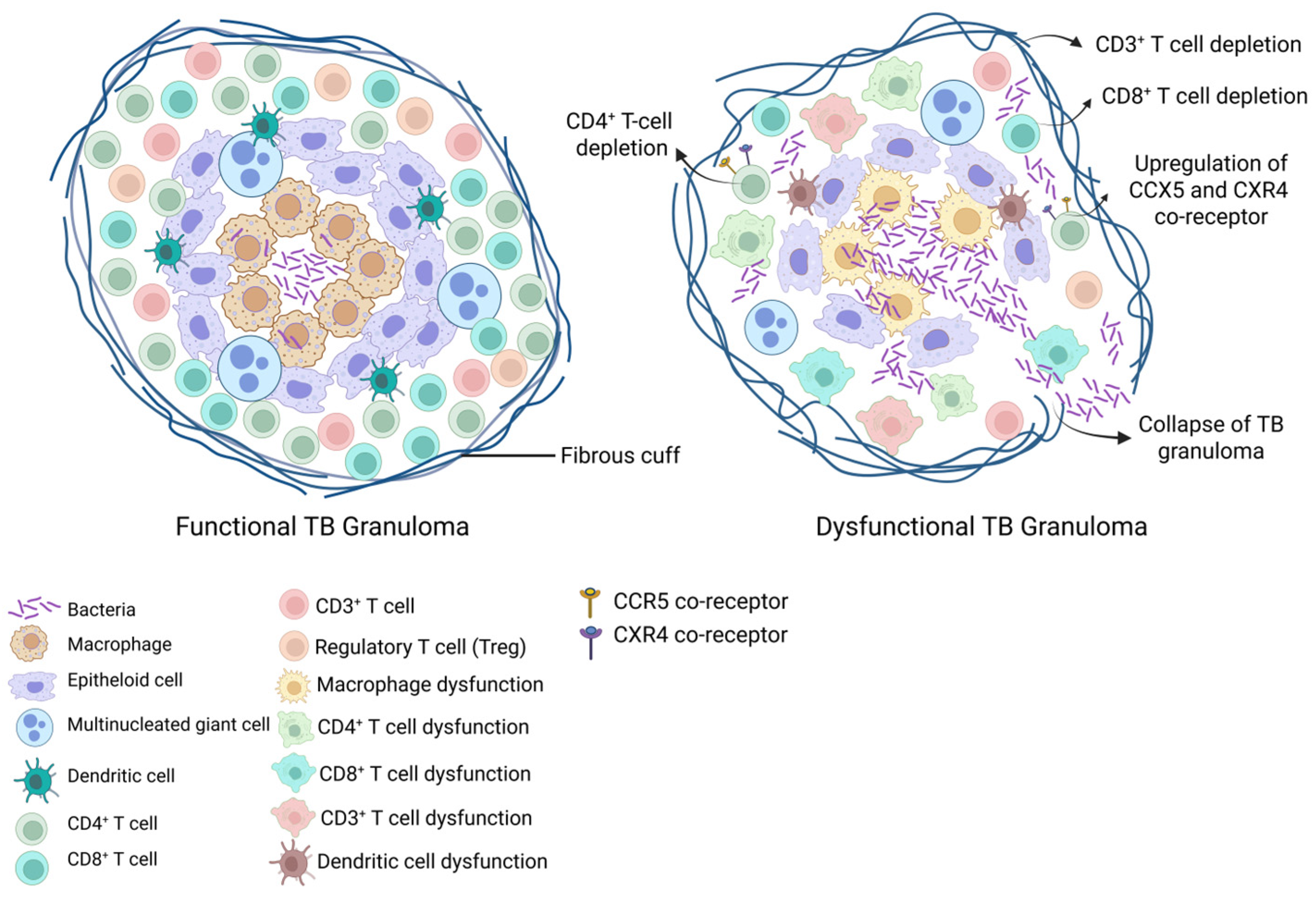
Paradoxically, the formation and stability of granulomas—defining features of Mtb infection—depend critically on CD4+ T cells [85,86,87]. Granulomas are organized aggregates of macrophages and other myeloid cells—such as DCs, neutrophils, eosinophils, multinucleated giant cells, and mast cells—encircled by lymphocytes, including T cells, B cells, NK cells, and innate lymphoid cells [88,89,90,91]. A positive association has been reported between the abundance of CD4+ T cells in granulomatous tissue and the structural integrity of granuloma, indicating that higher CD4+ T cell presence promotes well-formed granulomas and effective bacterial containment, intertwined with the host’s immune competence [92,93].
In the setting of HIV-TB co-infection, the dual role of CD4+ T cells—as both the primary targets of HIV and the key mediators of granulomas in TB immunity—becomes critically evident. HIV-driven CD4+ T cell depletion, coupled with macrophage and dendritic cell dysfunction, disrupts granuloma architecture and compromise bacterial control [94,95,96,97]. HIV-TB co-infection has been shown to reduce the proportion of CD4+, CD3+, and CD8+ T cells within granulomatous tissues, resulting in fewer lymphocytes available to sustain the granulomatous response [98,99,100]. Moreover, Mtb-specific pulmonary CD4+ T cells expressing IFN-γ and TNF-α cytokines essential for macrophage activation and bacterial containment are markedly depleted in HIV-infected individuals [96]. The inflammatory environment within granulomas enhances HIV replication. Granulomas contain multiple HIV-susceptible cell types, expressive CCR5 and CXCR4, facilitating local viral propagation [101,102]. This localized viral expansion accelerates CD4+ T cell loss within the granuloma, disturbing the delicate balance between pro- and anti-inflammatory cytokines required for bacterial control. In addition, early CD4+ T cell depletion irreversibly disrupts granulomatous T cell composition, and even after partial peripheral immune reconstitution, granulomas fail to recover their structural integrity, leading to increased bacterial growth, sustained inflammation, and continued recruitment of target cells that support HIV replication, creating a vicious cycle that exacerbate both HIV-TB infections [103,104].
In HIV-infected individuals exposed to Mtb, impaired phagocytosis by macrophages and dendritic cells hinders bacterial clearance, while reduced antigen presentation delays T cell activation and recruitment to infection sites. Consequently, granulomas formed under these conditions are poorly organized and inefficient at containing bacteria (Figure 2). HIV-induced macrophage dysfunction further limits bacterial killing capacity, amplifying bacterial replication and viral spread. The breakdown of granuloma structure prevents the establishment of latent TB infection and instead promotes dissemination and progression to ATBI [97,105,106]. This breakdown in granuloma integrity reflects the central paradox of HIV-TB co-infection: a state of profound cytokine dysregulation in which the immune system is intensely hyperactivated yet unable to control infection effectively.

3.2. Dysregulation of Cytokine Networks

HIV infection leads to a profound deterioration of immune function, notably through the depletion of CD4+ T cells and impairment of macrophage activity, thereby comprising the host’s capacity to contain Mtb growth. Conversely, Mtb infection adversely impacts the immune system in individuals with HIV, accelerating the progression from HIV infection to AIDS. This process is mediated by pro- and anti-inflammatory cytokines that trigger signaling cascades in T cells and monocytic cells, ultimately enhancing HIV transcription through the activation of the of transcription factors NF-kB (Nuclear factor-kB) and NFAT (Nuclear factor of activated T cells) [107,108]. Under physiological conditions, an effective immune response depends on a delicate equilibrium between pro-inflammatory and regulatory (anti-inflammatory) cytokines. This balance ensures pathogen clearance while preventing excessive inflammation [109]. However, in the case of HIV-TB co-infection, this balance is profoundly disturbed, leading to an immune response that favors disease progression rather than protection [26].
In the context of HIV and TB infection, both pathogens exhibit disrupt cytokine signaling, yet their coexistence results in a deeper and more persistent state of immune dysregulation [110,111]. During Mtb infection, T cell differentiation within granulomatous foci leads to increased expression of the CCR5 and CXC4 co-receptors on the surface of CD4+ T cells, enhancing their susceptibility to HIV infection, as these co-receptors mediate viral entry into host cells [112]. Notably, Mtb-specific CD4+ T cells are particularly prone to HIV-mediated depletion compared with naive cells, resulting in a localized loss of antigen-specific T cells at the site of infection. This heightened susceptibility is largely attributed to the upregulation of CCR5 on CD4+ T cells and other immune cell subsets following Mtb infection [107].
Physiologically, CCR5 mediates immune cell recruitment to infection sites, promoting granuloma organization and effective antimycobacterial activity. However, as CCR5 serves as a principal co-receptor for HIV, its upregulation inadvertently promotes viral access and accelerates CD4+ T cell depletion [113]. Conversely, Mtb infection induces sustained cytokine release to promote granuloma maintenance and bacterial containment, often accompanied by increased CD4+ T cell recruitment. When both pathogens coexist, their immunopathological mechanisms converge synergistically—Mtb-driven CCR5 upregulation amplifies HIV infectivity, while HIV-mediated CD4+ depletion weakens Mtb control. The outcome is a self-perpetuating cycle of immune activation and cytokine imbalance that undermines bacterial containment and simultaneously facilitates viral replication and dissemination [11].
A key feature observed in HIV-TB co-infection is the disruption of the Th1/Th2 cytokine balance [114]. HIV-TB co-infected individuals exhibit markedly reduced levels of IFN-γ, TNF-α, and IL-2 compared to patients with either infection alone [115]. These cytokines are central to macrophage activation, T cell proliferation, and granuloma integrity. IFN-γ promotes classical macrophage activation, enhances phagolysosomal fusion, and upregulates MHC-II expression, thereby improving antigen presentation and cytotoxic T cell responses [116,117]. Genetic defects in IFN-γ signaling or its receptor results in impaired granuloma formation and heightened susceptibility to MTb infections, underscoring its pivotal role. A decline in IFN-γ during HIV-TB co-infection therefore translates into defective macrophage function and diminished containment of Mtb within granulomas [118].
TNF-α, produced by activated macrophages and T cells is another indispensable cytokine in TB immunity [119]. It facilitates granuloma formation by promoting cell recruitment and enhancing macrophage bactericidal activity [120]. At the same time, TNF-α plays a paradoxical role in HIV infection. While serving protection against Mtb, it activates the NF-κB transcription pathway, enhancing HIV replication within macrophages and T cells [121]. Nevertheless, HIV-TB co-infection has been associated with reduced TNF-α production, leading to weaker granulomatous responses and accelerated bacterial proliferation [115].
Similarly, IL-2 supports T cell clonal expansion, NK cell activation, and the functional maturation of cytotoxic lymphocytes, contributing to the containment of both viral and bacterial infections responses [122]. Yet, IL-2 can also stimulate HIV replication in activated T cells, creating a complex feedback loop that further distorts immune regulation. In HIV–TB co-infection, decreased IL-2 levels reduce effector cell proliferation and antigen-specific responses, while excessive viral replication continues to fuel immune exhaustion [123,124].
In contrast, regulatory cytokines such as IL-4 and IL-10 are often upregulated to counterbalance excessive inflammation [43,125,126]. However, in HIV-TB co-infection, this compensatory mechanism becomes maladaptive. IL-4, produced by activated CD4+ T cells, basophils, and mast cells, promotes Th2 polarization and suppresses macrophage-mediated killing [115,127]. Elevated IL-4 expression has been linked to enhanced susceptibility to Mtb infection, as it downregulates the Th1 response required for bacterial clearance. Although certain IL-4 gene polymorphisms have been associated with slower HIV progression through reduced viral replication, excessive IL-4 activity compromises antimycobacterial immunity by shifting the cytokine landscape toward a Th-2 dominant profile [128].
IL-10, a potent anti-inflammatory cytokine secreted by monocytes, macrophages, dendritic cells, and regulatory T cells, further exacerbates this dysfunction. It inhibits the synthesis of pro-inflammatory mediators and downregulates MHC-II expression on antigen-presenting cells, effectively dampening T cell activation [129]. High IL-10 concentrations observed in HIV–TB co-infected individuals suppress macrophage activation and impair bacterial killing, aggravating disease progression. Moreover, reduced IL-10 clearance and persistent immune activation perpetuate chronic immune dysfunction, reinforcing the cycle of inadequate pathogen control and sustained inflammation [130].
While key Th1 cytokines are suppressed, several other inflammatory mediators—such as IL-8, IL-12, and IL-18—are often elevated during HIV–TB co-infection, reflecting a compensatory yet pathological hyperactivation of the immune system [108,131]. IL-8 acts as a chemokine that recruits T cells and neutrophils to granulomatous sites, but its overexpression in HIV infection may protect infected cells from apoptosis, facilitating viral persistence [132,133]. IL-12, primarily produced by dendritic cells and macrophages, is essential for the differentiation of naive CD4+ T cells into Th1 effectors and for the induction of IFN-γ production [134]. However, in the setting of HIV–TB co-infection, this pathway becomes dysregulated—elevated systemic IL-12 coexists with reduced local IFN-γ activity, suggesting functional disconnection between cytokine signaling and cellular responses [108,135]. Similarly, IL-18, a pro-inflammatory cytokine that enhances IFN-γ production and CD8+ T cell cytotoxicity, is frequently upregulated in HIV–TB patients. Paradoxically, excessive IL-18 can induce HIV replication, promote immune hyperactivation, and contribute to CD4+ T cell depletion, accelerating immunopathogenesis [108,136].
This complex cytokine disequilibrium—characterized by suppressed Th1 cytokines (IFN-γ, TNF-α, IL-2) alongside aberrant increases in IL-8, IL-12, and IL-18—undermines granuloma stability and alters the immune regulation toward chronic, ineffective inflammation [108]. The concurrent reduction in Th17 and gamma delta (γδ) T cell populations, both important sources of IL-17 and other pro-inflammatory mediators, further diminishes mucosal immunity and bacterial control [137]. IL-17 deficiency impairs neutrophil recruitment and epithelial defense, allowing greater Mtb dissemination and exacerbating tissue pathology [138]. Consequently, the immune response in HIV–TB co-infection transitions from a protective, localized reaction to a disseminated, pathological inflammation incapable of achieving bacterial containment or viral suppression.

3.3. T Cell Phenotypes as Markers of Disease

Beyond the disruption of soluble cytokine networks, the paradox of immune hyperactivation alongside functional ineffectiveness is vividly manifested in the altered phenotypes of T cells. Alterations in T cell phenotypes have been found to disrupt the delicate balance between pro- and anti-inflammatory responses. Within granulomatous structures that contain Mtb in latency, T cell populations serve as key immunological components. In parallel, HIV-induced dysregulation of these T cells can compromise granulosa integrity, leading to its disorganization and subsequent release of the pathogen into the lungs, resulting in increased proliferation in the absence of an effective immune response [139]. Despite their essential role in host immunity, shifts in T cell populations during HIV-TB co-infection are considered major regulatory drivers of the disease’s immunopathogenesis [140].
In the context of HIV co-infection, however, this protective axis is severely disrupted. Activated CD4+ T cells upregulate CCR5 and CXCR4, enhancing their susceptibility to viral entry [35]. Consequently, Mtb-specific CD4+ T cells are preferentially depleted, compromising granuloma stability and local immune control, while the loss of IL-2-producing cells accelerates viral replication, creating a self-reinforcing cycle of immune depletion [15]. While compensatory proliferation initially replenishes CD4+ cell populations, persistent antigenic stimulation and chronic inflammation gradually drive these cells toward functional exhaustion—exhibiting impaired proliferation, reduced secretion of IL-2 and IFN-γ, and skewing toward terminal effector- or regulatory-like phenotypes [8].
Persistent engagement of inhibitory receptors—including PD-1, TIM-3, and LAG-3—not only disrupts TCR signaling but also reprograms downstream metabolic pathways [141]. Specifically, PD-1 upregulation inhibits PI3K/Akt signaling, reduces glucose uptake, and compromises mitochondrial respiration, collectively increasing susceptibility to apoptosis [142]. Additional changes in the surface receptors further reinforce the exhausted state. Downregulation of CD127 limits survival signaling and memory maintenance, while sustained CD38 expression signals chronic activation and systemic inflammation. Meanwhile, transcription factors such as BATF, IRF4, and TOX reshape the chromatin landscape, driving CD4+ T cells toward a hyporesponsive, exhausted state that persist even after antigen clearance [143]. In the co-infection, this exhaustion further undermines Th1 responses, compromises macrophage activation, and diminishes mucosal barrier integrity, creating a permissive environment for both bacterial persistence and viral replication.
While CD4+ T cells play a role in early activation and are susceptible to exhaustion, studies on T cell exhaustion have predominantly centered on CD8+ T cells [104]. CD8+ T cells, as the cytotoxic arm of adaptive immunity, complement helper functions by eliminating Mtb-infected macrophages and virally infected cells. Activation of CD8+ T cells is initiated through MHC class 1-restricted antigen presentation by dendritic cells and infected macrophages, driving differentiation into effector cytotoxic T lymphocytes (CTLs) capable of secreting perforin, granzyme B, and IFN-γ [144]. Under chronic antigen exposure, persistent Mtb or HIV infection drives CD8+ T cells toward functional exhaustion. Initially, these cells proliferate and secrete cytokines efficiently; however, sustained stimulation imposes a continuous demand, promoting terminal differentiation at the expense of naive and central memory pools [17,145,146]. Mtb-specific CD8+ T cells exhibit bioenergetic insufficiency, with impaired oxidative phosphorylation and limited glycolytic flexibility, reducing cytotoxic capacity [147].
In parallel, continuous HIV exposure similarly reduces proliferative capacity, IL-2 and IFN-γ production, and β-catenin-dependent TCF transcriptional programs critical for maintenance of stem-like memory subsets, ultimately restricting long-term immune surveillance [43,148,149]. Similarly to CD4+ T cells, exhaustion is marked by upregulation of inhibitory receptors, including PD-1, TIM-3, LAG-3, and CTLA-4, which collectively suppress TCR signaling, cytokine secretion, and recall responses [150]. Phenotypically, exhausted CD8+ T cells downregulate costimulatory molecules (CD28, CD27) while expressing terminal differentiation and senescence markers such as CD57, alongside CD127 loss, indicating compromised survival and proliferative potential. The CD57+CD127 subset in co-infected individuals sustains inflammatory cytokine production (TNF-α, IL-6) despite functional impairment, fostering a microenvironment permissive for pathogen persistence [108].
The unconventional T cell, encompassing a variety of cell subsets, including mucosal-associated invariant T (MAIT) cells, gamma delta (γδ) T cells, and invariant natural killer T (iNKT) cells, is linked to providing innate-like rapid responses to microbial antigens [151,152]. MAIT cells, recognizing riboflavin-derived metabolites via MR1, are early responders during Mtb infection, producing IFN-γ, TNF-α, IL-17, and IL-22 [153]. Conversely, MAIT cells are numerically depleted and functionally impaired in HIV-TB co-infection. Persistent antigen exposure induces PD-1 upregulation and dysregulated chemokine receptor expression, limiting trafficking and predisposing MAIT cells to exhaustion [154,155]. γδ T cells, particularly the Vδ2 subset, respond independently of MHC to phosphoantigens with cytotoxic and cytokine-mediated antimicrobial activity [156]. Chronic co-infection depletes circulating Vδ2 cells, expands tissue-resident Vδ1 populations, and induces aberrant CD4+CD8+ co-expression alongside reduced effector function. Elevated PD-1 and diminished CD127 expression denote progressive exhaustion, while sustained HLA-DR and CD38 reflect ongoing activation. Similarly, iNKT cells, which recognize glycolipid antigens via CD1d, are depleted among CD4+CD8 subsets and show expansion of CD4CD8+ and double-negative populations. Despite reduced numbers, these cells maintain CD107a expression and secret proinflammatory mediators, amplifying CD4+ T cell activation and neutrophil recruitment, thereby contributing to tissue immunopathology [157] (Figure 3).

4. Immunological Spectrum: Active vs. Latent TB in HIV Co-Infection

4.1. Immunological Hallmark of Active TB Infection (ATBI)

The immunological distinctions between latent and active TB in PLHIV are shaped not only by mycobacterial burden, but also by HIV disease stage and ART status, which modulate the magnitude and quality of host immune response. The gradual depletion of naive and memory CD4+ T cells are the ultimate hallmark of HIV infection [36]. HIV infection alters the T helper (Th) cell equilibrium by suppressing Th1-mediated responses and enhancing Th2 activity—a phenomenon described as the Th1/Th2 shift. This imbalance arises from the preferential replication of HIV within Th2-like cells, which favor viral persistence more effectively than Th1 cells. The viral envelope glycoproteins gp120 and gp160 play critical roles in this process. By binding to the CD4 receptor, gp120 triggers Th2-associated IL-4 production, which inhibits Th1 differentiation and promotes IgE synthesis [158]. Furthermore, gp120 contributes to oxidative stress through the upregulation of cytochrome P450 2E1 (CYP2E1), enhancing the generation of reactive oxygen species (ROS). The resulting oxidative damage, including telomeric DNA injury, promotes tissue injury and apoptosis [159]. Concurrently, HIV-induced cell death occurs through both caspase-3-dependent apoptosis in permissive CD4+ T cells and caspase-1-mediated pyroptosis in non-permissive cells, amplifying local inflammatory responses [160].
The reduction in CD4+ T cells significantly weakens immune defense, predisposing individuals to opportunistic infections such as Mtb. Inhaled as infected droplets, Mtb primarily infects alveolar macrophages, initiating localized inflammatory signaling that recruits macrophages, neutrophils, and other immune cells to form granuloma—a characteristic of latent TB infection (LTBI) [14,161]. Within granulomas, the coordinated activity of CD4+ and CD8+ T cells, together with cytokines, maintains a dynamic balance between bacterial containment and immune-mediated tissue injury [162].
In the case of HIV-TB co-infection, as HIV progresses, this equilibrium progressively shifts. As HIV replication advances, peripheral CD4+ T cell (pCD4) depletion disrupts granuloma organization, resulting in coexistence of well-structured and poorly formed granulomas [159,163]. The concurrent reduction in CD8+ T cell cytotoxicity and IFN-γ production weakens macrophage activation, allowing Mtb replication and increased bacterial burden [126]. In parallel, the cytokine general environment becomes increasingly dysregulated; notably, TNF-α and IL-6 are upregulated, while the regulatory cytokine IL-10 is downregulated, fostering a hyperinflammatory environment that supports both HIV and Mtb persistence. Chronic antigenic stimulation and sustained inflammation lead to upregulation of immune checkpoint receptors—including PD-1, CTLA-4, LAG-3, and TIM-3—on T cells, further driving functional exhaustion [164,165]. Collectively, these processes delineate the immunological spectrum of TB in the context of HIV co-infection, driving the progression from latent to active disease. The continuous deterioration of immune regulation permits increasing Mtb replication, enhanced cytokine dysregulation, and systemic hyperinflammation—culminating in active TB disease, driven by this immune dysfunction [165].

4.2. Immunological Hallmark of Latent TB Infection (LTBI)

Latent tuberculosis infection (LTBI)—a state of persistent immune response to stimulation by Mtb without evidence of clinical manifestations—has a distinct immune–inflammatory profile, characterized by a functionally competent, controlled Th1 response and Mtb-specific T cells [164,166]. This immune landscape reflects a delicate balance between proinflammatory and regulatory mechanisms that enable long-term bacterial containment while minimizing immunopathology.
Individuals with LTBI exhibit a distinct immune–inflammatory profile featuring functionally active Mtb-specific memory CD4+ and CD8+ T cells with maintained cytolytic potential and controlled activation status [164,166]. Rather than global immune activation, LTBI demonstrates selective and efficient T cell responses, ensuring pathogen control without collateral tissue damage. This containment is supported by an intricate regulatory network mediated largely by regulatory T cells (Tregs), which preserve immune homeostasis and prevent excessive inflammation [167]. In the case of LTBI, both CD4+ and CD8+ Tregs have been recognized to contribute to this regulation. CD4+ Tregs, defined by CD4+CD25+FOXP3+ expression, employ both contact-dependent and -independent mechanisms that suppress effector T cell activity. These mechanisms include modulation of APCs through CTLA-4 engagement, suppressing multiple cell types through secretion of anti-inflammatory cytokines such as IL-10, TGF-β, and IL-35 and depletion of IL-2, which limits effector T cell proliferation [168,169]. In parallel, CD8+ Tregs, a heterogenous population of CD8+ lymphocyte-expressing regulatory markers—CD122, CD25, CD103, GITR, CTLA-4, and PD-1—exert inhibitory effects through similar pathways, releasing IL-10 and TGF-β, as well as inhibitory cell-to-cell interaction through CTLA-4 and PD-1 signaling pathways, and have the immunosuppressive capacity to engage in cell contact-dependent and -independent mechanisms to suppress immune response [169,170,171] (Table 1).
Furthermore, LTBI displays differential expressions of immune checkpoint and regulatory genes that reinforce this balanced state. Upregulation of CD44, TIGIT, and LAG3, alongside reduced expression of IDO2, ADORA2A, LAIR1, and TNFSF14, indicates a regulatory profile that favors effective pathogen control while limiting excessive inflammation. CD44 has been implicated in shaping immune responses through its influence on macrophage polarization and the recruitment of immune cells, facilitating granuloma stability, whereas LAG3 and TIGIT serve as inhibitory checkpoints, preventing overactivation and terminal T cell exhaustion [172]. These regulatory adjustments allow LTBI to sustain Th1-mediated bacterial control with limited systemic inflammation.
Cytokine modulation also contributes significantly to this equilibrium. TNF-α influences granuloma integrity and limits bacterial dissemination, while IL-12 regulates IFN-γ production and the cytotoxic activity of T cells [173]. Conversely, anti-inflammatory cytokines such as TGF-β1 and IL-10 have been shown to regulate lymphoid and myeloid derived cells, susceptible to mycobacterial persistence in TB infection [135,174].
Progression from LTBI to ATBI reflects a collapse of this immune balance. As LTBI transitions to ATBI, the systemic inflammation intensifies, reflected by elevated levels of C-reactive protein (CRP), IL-6, and TNF-α and heightened expression of CD4+ and CD8+ T cells expressing HLA-DR and CD38 [24,174]. Chronic antigen exposure combined with sustained inflammatory signaling drives T cell dysfunction and exhaustion, marked by increased PD-1, TIM-3, and LAG-3 expression and reduced IFN-γ/IL-2 co-expression [26,175,176]. Moreover, Th1 and TH17 cytokines (IFN-γ, TNF and IL-2, and IL-17a) are markedly elevated, while Th2 cytokines (IL-4, IL-10, and IL-6) contribute to the counterproductive anti-inflammatory environment, particularly the setting of co-infection with HIV [26,175]. This cytokine disequilibrium disrupts granuloma structure and facilitates bacterial reaction. Moreover, increased IL-6 activity enhances monocyte expansion and bacterial growth, linking systemic inflammation directly to disease activity [177].
The contrasting immunological landscapes of LTBI and ATBI highlight potential biomarkers for disease classification. Elevated CRP, soluble urokinase plasminogen activator receptor (suPAR), and IL-6 levels correlate strongly with ATBI, which strongly reflects systemic inflammation and immune activation [177,178,179]. Similarly, sCD14 and increased T cell activation markers such as CD38 and HLA-DR are associated with active disease, particularly in HIV-co infection, where they parallel decreased CD4+ cell counts (Figure 4) (Table 1) [24]. Collectively, these cytokines and immune mediators contribute to the transition from LTBI to ATBI, amplifying inflammation and driving disease progression.

5. Clinical Implications and Future Directions

The extensive immune dysregulation outlined above extends far beyond mechanistic insight and translates into pressing clinical challenges. This is reflected in the inconsistent performance of conventional diagnostic approaches and the emergence of severe inflammatory complications in HIV-TB co-infection.

5.1. Impact on Diagnostics and Prognosis

The distinct immunoinflammatory signatures observed in LTBI and ATBI underscore critical challenges in current diagnostic strategies, particularly in PLHIV. Conventional tools such as the tuberculin skin test (TST) and interferon -γ release assays (IGRAs), although routinely employed for latent TB screening, have limited diagnostic accuracy in ATBI [180]. Their reliance on a functional host immune response becomes their primary weakness in HIV-TB co-infection. The very T cell depletion and exhaustion (e.g., loss of IFN-γ-producing cells) that defines the co-infection pathogenesis causes these tests to frequently yield false-negative or indeterminate results, failing to distinguish active from latent infection [181,182].
Similarly, bacteriological confirmation remains suboptimal. Low bacterial loads in sputum (paucibacillary disease) are common in immunocompromised hosts, reducing the sensitivity of smear microscopy and even molecular assays [182,183]. This diagnostic gap highlights the pressing need for biomarkers that capture the underlying pathological activity rather than merely indicating immune sensitization, a direction supported by the immune mediators outlined in the review. Moving beyond single-analyte assays, integrated biomarker signatures may offer substantially greater diagnostic and prognostic precision. Elevated systemic inflammatory markers such as IL-6, CRP, and suPAR are strong indicators of the pathological and ineffective inflammation that defines ATBI, in contrast to the more regulated immune state of latent infection. Similarly, quantification of T cell activation (CD38+ and HLA-DR+) and exhaustion (PD-1+) markers may generate a prognostic signature of immune dysfunction that closely aligns with disease progression [184,185,186]. The multi-dimensional nature of immune disruption in HIV-TB co-infection supports the use of a multi-biomarker approach that is likely to offer superior diagnostic performance compared to existing single-analyte assays, which frequently lack sensitivity or yield absent signals in immunocompromised individuals.

5.2. Therapeutic Considerations: TB-IRIS and Host-Directed Therapies

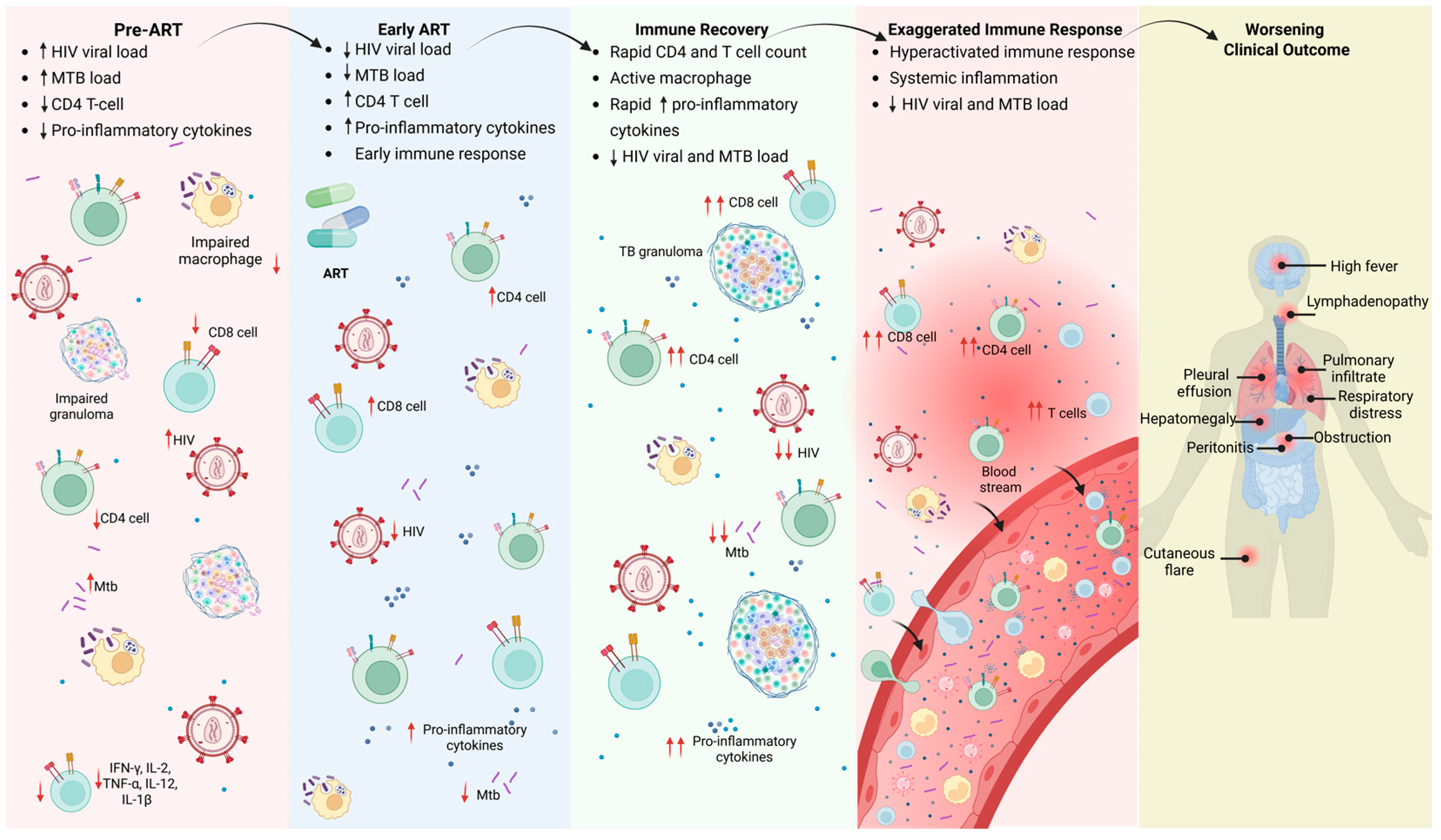
Following ART initiation, understanding the immune paradox of HIV-TB co-infection also reshapes the therapeutic framework, revealing significant challenges alongside opportunities for intervention. One of the most critical manifestations of this dysregulated immunity is TB-associated immune reconstitution inflammatory syndrome (TB-IRIS) [187]. This paradoxical deterioration following ART initiation reflects the abrupt reactivation of immune pathways—including TNF-α, IL-6, and IL-18—that were previously suppressed or functionally chaotic [188]. Elevated pre-ART inflammatory signatures and heightened T cell activation carry the greatest risk, illustrating that TB-IRIS constitutes an amplified expression of the very immunopathology described throughout this review [189].
This evolving understanding underscores the potential role of host-directed therapies (HDTs) as an important adjunct to conventional antimicrobial treatment. HDTs shift the therapeutic focus from solely targeting MTB to correcting the underlying immune dysregulation that characterizes HIV-TB co-infection [190]. These approaches generally fall into two complementary categories: attenuating pathological inflammation, either through broad-acting anti-inflammatory agents or through selective cytokine inhibitors, and reinstating effective, pathogen-specific immunity, including the use of immune-modulating strategies such as checkpoint inhibitors [191,192,193]. Taken together, these insights suggest that future HIV-TB management will require a coordinated, multi-layered strategy: antibiotics to eliminate the bacillus, ART to restore CD4+ T cell function, and HDTs to fine-tune the immune response by promoting localized Th1-mediated protection while suppressing the excessive systemic inflammation that contributes to disease severity and TB-IRIS (Figure 5).
Notably, the dissociation between viral control, CD4+ T cell recovery, and effective antimycobacterial immunity is not exclusive to TB-IRIS, but is also observed in a distinct population of PLHIV known as elite controllers.

5.3. Insights from Elite Controllers: Implication in HIV-TB Immunopathogenesis

Elite controllers (ECs) represent immunological outliers that provide a unique opportunity to interrogate HIV-associated immune dysregulation beyond conventional disease trajectories. An intriguing perspective emerges from the study of ECs, a rare subset of PLHIV who maintain durable viral suppression in the absence of ART and preserve near-normal circulating CD4+ T cell counts [194]. Despite this favorable immunovirological profile, emerging evidence suggests that ECs remain susceptible to tuberculosis at rates comparable to non-controllers, highlighting that preservation of peripheral CD4+ T cell numbers alone is insufficient to confer protection against MTBI [195].
Although data on HIV-TB co-infection in ECs remain limited, emerging evidence indicates that ECs exhibit profound perturbations in monocyte homeostasis and phenotype despite effective viral control—including altered monocyte subset proportion and functional marker expression [196,197]. Given the central role of monocytes and macrophages in Mtb uptake, granuloma formation, and cytokine regulation, such qualitative innate immune perturbation could plausiby contribute to impaired antimycobacterial responses in ECs.
From a translational perspective, ECs represent a valuable natural model to disentangle mechanisms of HIV-associated immune dysregulation independent of profound CD4+ T cell depletion. Comparative studies examining granuloma architecture, cytokine networks, and tissue-resident immune responses in ECs versus ART-treated and untreated individuals may offer critical insights into immune correlates of protection and inform host-directed therapeutic strategies in HIV-TB co-infection [198].

6. Conclusions

HIV-TB co-infection remains a formidable syndemic, defined by a central immunological paradox in which chronic systemic inflammation coexists with profound functional immune exhaustion. As synthesized in this review, this paradox disrupts the very mechanisms required for pathogen control—undermining granuloma stability, distorting cytokine networks, and driving sustained T cell activation, dysfunction, and exhaustion. A clear understanding of these processes establishes the foundation for meaningful clinical advances. Such mechanistic insight enables the refinement of diagnostic strategies, supports the development of robust prognostic biomarker profiles, and guides the design of HDTs aimed at correcting the underlying immune dysregulation. A deeper understanding of immunopathological processes—rather than reliance on pathogen-centric strategies alone—will be fundamental in improving clinical outcomes in this deadly co-infection.

Author Contributions

Conceptualization, C.K.G. and A.S.; writing—original draft preparation, C.K.G. and A.R.I.; writing—review and editing, C.K.G., A.S., and A.R.I.; supervision, A.S. and A.R.I. All authors have read and agreed to the published version of the manuscript.

Funding

This research received no external funding.

Institutional Review Board Statement

Not applicable.

Informed Consent Statement

Not applicable.

Data Availability Statement

The data are contained within the article.

Conflicts of Interest

The authors declare no conflicts of interest.

Abbreviations

The following abbreviations are used in this manuscript:
HIVHuman immunodeficiency virus
AIDSAcquired immunodeficiency syndrome
TBTuberculosis
HIV-TBHuman immunodeficiency virus–tuberculosis
ILInterleukin
IFN-γInterferon gamma
TNF-αTumor necrosis factor alpha
CDCluster of differentiation
HL-DRHuman leukocyte antigen–DR isotype
PLHIVPeople living with human immunodeficiency virus
ARTAntiretroviral therapy
Th1T-helper 1
MTBMycobacterium tuberculosis
MHCMajor histocompatibility complex
TGF-βTransforming growth factor-beta
TB-IRISTB-associated immune reconstitution inflammatory syndrome
Gp120 Glycoprotein 120
CCR5C-C chemokine receptor 5
CXCR4C-X-C motif chemokine receptor 4
DNADeoxyribonucleic acid
AICDActivation-induced cell death
APCAntigen presenting cells
ICOSInducible T cell Costimulator
PD-1Programmed cell death protein
CTLACytotoxic T-lymphocyte-associated antigen 4
LAG-3Lymphocyte activation gene 3
TIM-3T cell immunoglobulin and mucin-domain-containing protein 3
PD-L1/L2Programmed cell death ligand ½
SHP1/P2Scr homology region 2 (SH2) domain-containing phosphatase 1/2
ZAP-70Zeta-chain-associated protein kinase 70
PLC-γ1Phospholipase C-gamma 1
PI3K–AKTPhosphatidylinositol 3-kinase-protein kinase B
PKCθProtein kinase C theta
mTORMammalian target of rapamycin
RasMAPK/ERKRat sarcoma viral oncogene–mitogen-activated protein kinase–extracellular signal-regulated kinase
TIGITT cell immunoreceptor with immunoglobulin and immunoreceptor tyrosine-based inhibitory motif domains
NF-κBNuclear factor-kB
KLRG1Killer cell lectin-like receptor G1
ATBIActive tuberculosis infection
MTBIMycobacterium tuberculosis infection
AECsAirway epithelial cells
PRRsPattern recognition receptors
TLRsToll-like receptors
NLRsNOD-like receptors
DCsDendritic cells
NKNatural killer
LTBILatent tuberculosis infection
NFATNuclear factor of activated T cells
TCRT cell receptor
BATFBasic leucine zipper ATF-like transcription factor
IRF4Interferon regulatory factor 4
CTLsCytotoxic T lymphocytes
TCFT cell factor
MAITMucosal-associated invariant T cells
iNKTInvariant natural killer T cells
IgEImmunoglobulin E
CYP2E1Cytochrome P450 2E1
ROSReactive oxygen species
pCD4Peripheral CD4
TregsRegulatory T cells
IDO2Indoleamine 2,3-dioxygenase 2
ADORA2AAdenosine A2A receptor
LAIR1Leukocyte-associated immunoglobulin-like receptor 1
TNFSF14Tumor necrosis factor superfamily member 14
CRPC-reactive protein
suPARSoluble urokinase plasminogen activator receptor
TSTTuberculin skin test
IGRAsInterferon -γ release assays
HDTsHost-directed therapies
ECsElite controllers

References

  1. Balasubramaniam, M.; Pandhare, J.; Dash, C. Immune Control of HIV. J. Life Sci. 2019, 1, 4. [Google Scholar] [CrossRef]
  2. Pandiyan, P.; Younes, S.A.; Ribeiro, S.P.; Talla, A.; McDonald, D.; Bhaskaran, N.; Levine, A.D.; Weinberg, A.; Sekaly, R. Mucosal regulatory T cells and T helper 17 cells in HIV-associated immune activation. Front. Immunol. 2016, 7, 195156. [Google Scholar] [CrossRef]
  3. Masenga, S.K.; Mweene, B.C.; Luwaya, E.; Muchaili, L.; Chona, M.; Kirabo, A. HIV–Host Cell Interactions. Cells 2023, 12, 1351. [Google Scholar] [CrossRef]
  4. Govender, R.D.; Hashim, M.J.; Khan, M.A.; Mustafa, H.; Khan, G. Global Epidemiology of HIV/AIDS: A Resurgence in North America and Europe. J. Epidemiol. Glob. Health 2021, 11, 296. [Google Scholar] [CrossRef]
  5. Carter, A.; Zhang, M.; Tram, K.H. Global, regional, and national burden of HIV/AIDS, 1990–2021, and forecasts to 2050, for 204 countries and territories: The Global Burden of Disease Study 2021. Lancet HIV 2024, 1, 807–822. [Google Scholar] [CrossRef]
  6. UNAIDS. Global HIV&AIDS Statistic—Fact Sheet; Joint United Nations Programme on HIV/AIDS: Geneva, Switzerland, 2023; Available online: https://www.unaids.org (accessed on 25 December 2025).
  7. Goletti, D.; Pisapia, R.; Fusco, F.M.; Aiello, A.; Van, R. Epidemiology, pathogenesis, clinical presentation and management of TB in patients with HIV and diabetes. Int. J. Tuberc. Lung Dis. 2023, 27, 284. [Google Scholar] [CrossRef]
  8. Bruchfeld, J.; Correia-Neves, M.; Kallenius, G. Tuberculosis and HIV Coinfection. Cold Spring Harb. Perspect. Med. 2015, 5, a017871. [Google Scholar] [CrossRef] [PubMed]
  9. Lawn, S.D.; Myer, L.; Edwards, D.; Bekker, L.G.; Wood, R. Short-term and long-term risk of tuberculosis associated with CD4 cell recovery during antiretroviral therapy in South Africa. AIDS 2009, 23, 1717–1725. [Google Scholar] [CrossRef]
  10. Vignesh, R.; Balakrishnan, P.; Tan, H.Y.; Yong, Y.K.; Velu, V.; Larsson, M.; Shankar, E.M. Tuberculosis-Associated Immune Reconstitution Inflammatory Syndrome—An Extempore Game of Misfiring with Defense Arsenals. Pathogens 2023, 12, 210. [Google Scholar] [CrossRef]
  11. Azevedo-Pereira, J.M.; Pires, D.; Calado, M.; Mandal, M.; Santos-Costa, Q.; Anes, E. HIV/Mtb Co-Infection: From the Amplification of Disease Pathogenesis to an “Emerging Syndemic”. Microorganisms 2023, 11, 853. [Google Scholar] [CrossRef] [PubMed]
  12. World Health Organization. Background and Burden of HIV-Associated TB. WHO TB Knowledge Sharing Platform; World Health Organization: Geneva, Switzerland, 2024; Available online: https://tbksp.who.int/en/node/2763 (accessed on 25 December 2025).
  13. Queval, C.J.; Brosch, R.; Simeone, R. The macrophage: A disputed fortress in the battle against Mycobacterium tuberculosis. Front. Microbiol. 2017, 8, 311458. [Google Scholar] [CrossRef]
  14. Ahmad, F.; Rani, A.; Alam, A.; Zarin, S.; Pandey, S.; Singh, H.; Hasnain, S.E.; Ehtesham, N.S. Macrophage: A Cell With Many Faces and Functions in Tuberculosis. Front. Immunol. 2022, 13, 747799. [Google Scholar] [CrossRef] [PubMed]
  15. Bromley, J.D.; Ganchua, S.K.C.; Nyquist, S.K.; Maiello, P.; Chao, M.; Borish, H.J.; Rodgers, M.; Tomko, J.; Kracinovsky, K.; Douaa, M.; et al. CD4+ T cells re-wire granuloma cellularity and regulatory networks to promote immunomodulation following Mtb reinfection. Immunity 2024, 57, 2380. [Google Scholar] [CrossRef]
  16. Cheng, H.; Ji, Z.; Wang, Y.; Li, S.; Tang, T.; Wang, F.; Peng, C.; Wu, X.; Cheng, Y.; Liu, Z.; et al. Mycobacterium tuberculosis produces d-serine under hypoxia to limit CD8+ T cell-dependent immunity in mice. Nat. Microbiol. 2024, 9, 1856–1872. [Google Scholar] [CrossRef] [PubMed]
  17. Lin, P.L.; Flynn, J.A.L. CD8 T cells and Mycobacterium tuberculosis infection. Semin. Immunopathol. 2015, 37, 239–249. [Google Scholar] [CrossRef]
  18. Lindestam Arlehamn, C.S.; Lewinsohn, D.; Sette, A.; Lewinsohn, D. Antigens for CD4 and CD8 T Cells in Tuberculosis. Cold Spring Harb. Perspect. Med. 2014, 4, a018465. [Google Scholar] [CrossRef] [PubMed]
  19. de Martino, M.; Lodi, L.; Galli, L.; Chiappini, E. Immune Response to Mycobacterium tuberculosis: A Narrative Review. Front. Pediatr. 2019, 7, 350. [Google Scholar] [CrossRef]
  20. Tolomeo, M.; Cascio, A. The Complex Dysregulations of CD4 T Cell Subtypes in HIV Infection. Int. J. Mol. Sci. 2024, 25, 7512. [Google Scholar] [CrossRef]
  21. Foreman, T.W.; Nelson, C.E.; Kauffman, K.D.; Lora, N.E.; Vinhaes, C.L.; Dorosky, D.E.; Sakai, S.; Gomez, F.; Fleegle, J.D.; Parham, M.; et al. CD4 T cells are rapidly depleted from tuberculosis granulomas following acute SIV co-infection. Cell Rep. 2022, 39, 110896. [Google Scholar] [CrossRef]
  22. Yang, H.; Liu, Q.; Wu, Y.; He, K.; Zeng, Q.; Liu, M. Paradoxical tuberculosis-associated immune reconstitution inflammatory syndrome in initiating ART among HIV-Infected patients in China-risk factors and management. BMC Infect. Dis. 2024, 24, 5. [Google Scholar] [CrossRef]
  23. Verma, R.; Chakraborty, R. A Clinico-Immunological Perspective of Paradoxical Reaction in HIV-ve Tuberculous Meningitis with Therapeutic Possibilities. Neurol. India 2025, 73, 678–691. [Google Scholar] [CrossRef]
  24. Sullivan, Z.A.; Wong, E.B.; Ndungu’u, T.; Kasprowicz, W.O.; Bishai, W.R. Latent and active tuberculosis infection increase immune activation in individuals co-infected with HIV. EbioMedicine 2015, 2, 334–340. [Google Scholar] [CrossRef]
  25. Esmail, H.; Riou, C.; Bruyn, E.D.; Lai, R.P.J.; Harley, Y.X.R.; Meintjes, G.; Wilkinson, K.A.; Wilkinson, R.J. The immune response to mycobacterium tuberculosis in HIV-1-coinfected persons. Annu. Rev. Immunol. 2018, 36, 603–638. [Google Scholar] [CrossRef]
  26. Sharan, R.; Bucşan, A.N.; Ganatra, S.; Paiardini, M.; Mohan, M.; Mehra, S.; Khader, S.A.; Kaushal, D. Chronic immune activation in TB/HIV co-infection. Trends Microbiol. 2020, 28, 619. [Google Scholar] [CrossRef]
  27. Okoye, A.A.; Picker, L.J. CD4+ T cell depletion in HIV infection: Mechanisms of immunological failure. Immunol. Rev. 2013, 254, 54. [Google Scholar] [CrossRef]
  28. Le Hingrat, Q.; Sereti, I.; Landay, A.L.; Pandrea, I.; Apetrei, C. The Hitchhiker Guide to CD4+ T-Cell Depletion in Lentiviral Infection. A Critical Review of the Dynamics of the CD4+ T Cells in SIV and HIV Infection. Front. Immunol. 2021, 12, 695674. [Google Scholar] [CrossRef]
  29. Vijayan, K.V.; Karthigeyan, K.P.; Tripathi, S.P.; Hanna, L.E. Pathophysiology of CD4+ T-Cell Depletion in HIV-1 and HIV-2 Infections. Front. Immunol. 2017, 8, 580. [Google Scholar] [CrossRef] [PubMed]
  30. Kwong, P.D.; Wyatt, R.; Robinson, J.; Sweet, R.W.; Sodroski, J.; Hendrickson, W.A. Structure of an HIV gp120 envelope glycoprotein in complex with the CD4 receptor and a neutralizing human antibody. Nature 1998, 393, 648. [Google Scholar] [CrossRef] [PubMed]
  31. Nickoloff-Bybel, E.A.; Festa, L.; Meucci, O.; Gaskill, P.J. Co-receptor signaling in the pathogenesis of neuroHIV. Retrovirology 2021, 18, 24. [Google Scholar] [CrossRef] [PubMed]
  32. Zhang, Z.; Zhang, H.; Zheng, L.; Chen, S.; Du, S.; Xiau, J.; Patel, D.J. CXCR4 mediated recognition of HIV envelope spike and inhibition by CXCL12. Nat. Commun. 2025, 16, 8653. [Google Scholar] [CrossRef]
  33. Grande, F.; Occhiuzzi, M.A.; Rizzuti, B.; Loele, G.; Luca, M.D.; Tucci, P.; Svicher, V.; Aquaro, S.l.; Garofalo, A. CCR5/CXCR4 Dual Antagonism for the Improvement of HIV Infection Therapy. Molecules 2019, 24, 550. [Google Scholar] [CrossRef]
  34. Zhang, C.; Zhu, R.; Cao, Q.; Yang, X.; Huang, Z.; An, J. Discoveries and developments of CXCR4-targeted HIV-1 entry inhibitors. Exp. Biol. Med. 2020, 245, 477. [Google Scholar] [CrossRef]
  35. Jasinska, A.J.; Pandrea, I.; Apetrei, C. CCR5 as a Coreceptor for Human Immunodeficiency Virus and Simian Immunodeficiency Viruses: A Prototypic Love-Hate Affair. Front. Immunol. 2022, 13, 835994. [Google Scholar] [CrossRef]
  36. Février, M.; Dorgham, K.; Rebollo, A. CD4+ T Cell Depletion in Human Immunodeficiency Virus (HIV) Infection: Role of Apoptosis. Viruses 2011, 3, 586. [Google Scholar] [CrossRef]
  37. Doitsh, G.; Galloway, N.L.K.; Geng, X.; Yang, Z.; Monroe, K.; Zepeda, O.; Hunt, P.W.; Hatano, H.; Sowinski, S.; Munoz-Arias, I.; et al. Pyroptosis drives CD4 T-cell depletion in HIV-1 infection. Nature 2014, 505, 509. [Google Scholar] [CrossRef]
  38. Malyshkina, A.; Littwitz-Salomon, E.; Sutter, K.; Zellinsky, G.; Windmann, S.; Schimmer, S.; Paschen, A.; Streeck, H.; Hasenkrug, K.J.; Dittmer, U. Fas Ligand-mediated cytotoxicity of CD4+ T cells during chronic retrovirus infection. Sci. Rep. 2017, 7, 7785. [Google Scholar] [CrossRef] [PubMed]
  39. Volpe, E.; Sambucci, M.; Battistini, L.; Borsellino, G. Fas–Fas Ligand: Checkpoint of T Cell Functions in Multiple Sclerosis. Front. Immunol. 2016, 7, 382. [Google Scholar] [CrossRef] [PubMed]
  40. Zevin, A.S.; McKinnon, L.; Burgener, A.; Klatt, N.R. Microbial translocation and microbiome dsybiosis in HIV-associated immune activation. Curr. Opin. HIV AIDS 2016, 11, 182. [Google Scholar] [CrossRef]
  41. Doitsh, G.; Greene, W.C. Dissecting How CD4 T Cells Are Lost During HIV Infection. Cell Host Microbe 2016, 19, 280. [Google Scholar] [CrossRef]
  42. Cao, D.; Khanal, S.; Wang, L.; Li, Z.; Zhao, J.; Nguyen, L.N.; Nguyen, L.N.T.; Dang, X.; Schannk, M.; Thakuri, B.K.C.; et al. A Matter of Life or Death: Productively Infected and Bystander CD4 T Cells in Early HIV Infection. Front. Immunol. 2021, 11, 626431. [Google Scholar] [CrossRef] [PubMed]
  43. Fenwick, C.; Joo, V.; Jacquier, P.; Noto, A.; Banga, R.; Perreau, M.; Pantaleo, G. T-cell exhaustion in HIV infection. Immunol. Rev. 2019, 292, 149. [Google Scholar] [CrossRef]
  44. Szeto, C.; Lobos, C.A.; Nguyen, A.T.; Gras, S. TCR Recognition of Peptide–MHC-I: Rule Makers and Breakers. Int. J. Mol. Sci. 2020, 22, 68. [Google Scholar] [CrossRef]
  45. Conley, J.M.; Gallagher, M.P.; Berg, L.J. T cells and gene regulation: The switching on and turning up of genes after T cell receptor stimulation in CD8 T cells. Front. Immunol. 2016, 7, 182769. [Google Scholar] [CrossRef]
  46. Fu, Y.; Lin, Q.; Zhang, Z.; Zhang, L. Therapeutic strategies for the costimulatory molecule OX40 in T-cell-mediated immunity. Acta Pharm. Sin. B 2020, 10, 414–433. [Google Scholar] [CrossRef]
  47. Zarrin, A.A.; Monteiro, R.C. Editorial: The Role of Inhibitory Receptors in Inflammation and Cancer. Front. Immunol. 2020, 11, 633686. [Google Scholar] [CrossRef] [PubMed]
  48. De Sousa Linhares, A.; Leitner, J.; Grabmeier-Pfistershammer, K.; Steinberger, P. Not All Immune Checkpoints Are Created Equal. Front. Immunol. 2018, 9, 402607. [Google Scholar] [CrossRef]
  49. Anderson, A.C.; Joller, N.; Kuchroo, V.K. Lag-3, Tim-3, and TIGIT co-inhibitory receptors with specialized functions in immune regulation. Immunity 2016, 44, 989. [Google Scholar] [CrossRef]
  50. Velu, V.; Shetty, D.D.; Larsson, M.; Shankar, E.M. Role of PD-1 co-inhibitory pathway in HIV infection and potential therapeutic options. Retrovirology 2015, 12, 14. [Google Scholar] [CrossRef] [PubMed]
  51. Wallace, Z.; Kopycinski, J.; Yang, H.; McCully, M.L.; Eggeling, C.; Chojnacki, J.; Dorrell, L. Immune mobilising T cell receptors redirect polyclonal CD8+ T cells in chronic HIV infection to form immunological synapses. Sci. Rep. 2022, 12, 18366. [Google Scholar] [CrossRef]
  52. Saeidi, A.; Zandi, K.; Cheok, Y.Y.; Wong, W.F.; Lee, C.Y.Q.; Cheong, H.C.; Yong, Y.K.; Larrson, M.; Shankar, E.M. T-Cell Exhaustion in Chronic Infections: Reversing the State of Exhaustion and Reinvigorating Optimal Protective Immune Responses. Front. Immunol. 2018, 9, 2569. [Google Scholar] [CrossRef] [PubMed]
  53. Mu, W.; Patankar, V.; Kitchen, S.; Zhen, A. Examining Chronic Inflammation, Immune Metabolism, and T Cell Dysfunction in HIV Infection. Viruses 2024, 16, 219. [Google Scholar] [CrossRef]
  54. Arasanz, H.; Gato-Cañas, M.; Zuazo, M.; Ibanez-Vea, M.; Breckpot, K.; Kochan, G.; Escors, D. PD1 signal transduction pathways in T cells. Oncotarget 2017, 8, 51936. [Google Scholar] [CrossRef]
  55. Patsoukis, N.; Duke-Cohan, J.S.; Chaudhri, A.; Aksoylar, H.I.; Wang, Q.; Council, A.; Berg, A.; Freeman, G.J.; Boussiotis, V.A. Interaction of SHP-2 SH2 domains with PD-1 ITSM induces PD-1 dimerization and SHP-2 activation. Commun. Biol. 2020, 3, 128. [Google Scholar] [CrossRef]
  56. Wherry, E.J.; Kurachi, M. Molecular and cellular insights into T cell exhaustion. Nat. Rev. Immunol. 2015, 15, 486–499. [Google Scholar] [CrossRef] [PubMed]
  57. Cohen, J.; Torres, C. HIV-associated cellular senescence: A contributor to accelerated aging. Ageing Res. Rev. 2016, 36, 117. [Google Scholar] [CrossRef]
  58. Huang, L.; Zhang, M.; Bai, D.; Qu, Y. Deciphering the impact of TERT/telomerase on immunosenescence and T cell revitalization. Front. Immunol. 2024, 15, 1465006. [Google Scholar] [CrossRef]
  59. Stojanovic, B.; Jovanovic, I.; Stojanovic, M.D.; Stojanovic, B.S.; Kovacevic, V.; Radosavljevic, I.; Jovanovic, D.; Kovacevic, M.M.; Zornic, N.; Arsic, A.A.; et al. Oxidative Stress-Driven Cellular Senescence: Mechanistic Crosstalk and Therapeutic Horizons. Antioxidants 2025, 14, 987. [Google Scholar] [CrossRef] [PubMed]
  60. Zhao, J.; Nguyen, L.N.T.; Nguyen, L.N.; Dang, X.; Cao, D.; Khanal, S.; Schank, M.; Thakuri, B.K.C.; Ogbu, S.C.; Khanal, S.; et al. ATM Deficiency Accelerates DNA Damage, Telomere Erosion, and Premature T Cell Aging in HIV-Infected Individuals on Antiretroviral Therapy. Front. Immunol. 2019, 10, 467074. [Google Scholar] [CrossRef]
  61. Victorelli, S.; Passos, J.F. Telomeres and Cell Senescence—Size Matters Not. EBioMedicine 2017, 21, 14. [Google Scholar] [CrossRef] [PubMed]
  62. Sokoya, T.; Steel, H.C.; Nieuwoudt, M.; Rossouw, T.M. HIV as a Cause of Immune Activation and Immunosenescence. Mediat. Inflamm. 2017, 2017, 6825493. [Google Scholar] [CrossRef]
  63. Fiume, G.; Vecchio, E.; Laurentiis, A.D.; Trimboli, F.; Palmieri, C.; Pisano, A.; Falcone, C.; Pontoriero, M.; Rossi, A.; Scialdone, A.; et al. Human immunodeficiency virus-1 Tat activates NF-κB via physical interaction with IκB-α and p65. Nucleic Acids Res. 2011, 40, 3548. [Google Scholar] [CrossRef]
  64. El-Amine, R.; Germini, D.; Zakharova, V.V.; Tsfasman, T.; Sheval, E.V.; Louzada, R.A.N.; Dupuy, C.; Bilhou-Nabera, C.; Hamade, A.; Najjar, F.; et al. HIV-1 Tat protein induces DNA damage in human peripheral blood B-lymphocytes via mitochondrial ROS production. Redox Biol. 2017, 15, 97. [Google Scholar] [CrossRef] [PubMed]
  65. Bănică, L.; Vlaicu, O.; Jipa, R.; Abagiu, A.; Nicolae, I.; Neaga, E.; Otelea, D.; Paraschiv, S. Exhaustion and senescence of CD4 and CD8 T cells that express co-stimulatory molecules CD27 and CD28 in subjects that acquired HIV by drug use or by sexual route. Germs 2021, 11, 66. [Google Scholar] [CrossRef] [PubMed]
  66. Bellon, M.; Nicot, C. Telomere Dynamics in Immune Senescence and Exhaustion Triggered by Chronic Viral Infection. Viruses 2017, 9, 289. [Google Scholar] [CrossRef] [PubMed]
  67. McLeish, E.; Sooda, A.; Slater, N.; Kachigunda, B.; Beer, K.; Paramalinga, S.; Lamont, P.J.; Chopra, A.; Mastaglia, F.L.; Needham, M.; et al. Uncovering the significance of expanded CD8+ large granular lymphocytes in inclusion body myositis: Insights into T cell phenotype and functional alterations, and disease severity. Front. Immunol. 2023, 14, 1153789. [Google Scholar] [CrossRef]
  68. Gong, W.; Wu, X. Differential Diagnosis of Latent Tuberculosis Infection and Active Tuberculosis: A Key to a Successful Tuberculosis Control Strategy. Front. Microbio. 2021, 12, 745592. [Google Scholar] [CrossRef]
  69. Kahwati, L.C.; Feltner, C.; Halpern, M.; Woodell, C.L.; Boland, E.; Amick, H.R.; Weber, R.P.; Jonas, D.E. Primary Care Screening and Treatment for Latent Tuberculosis Infection in Adults: Evidence Report and Systematic Review for the US Preventive Services Task Force. JAMA 2016, 316, 970–983. [Google Scholar] [CrossRef]
  70. Henry, B.W.; Schaible, U.E.; Achkar, J.M. The knowns and unknowns of latent Mycobacterium tuberculosis infection. J. Clin. Investig. 2021, 131, e136222. [Google Scholar] [CrossRef]
  71. Zhuang, L.; Yang, L.; Li, L.; Ye, Z.; Gong, W. Mycobacterium tuberculosis: Immune response, biomarkers, and therapeutic intervention. MedComm 2024, 5, e419. [Google Scholar] [CrossRef]
  72. Barclay, A.M.; Ninaber, D.K.; Veen, S.V.; Hiemstra, P.S.; Ottenhoff, T.H.M.; Does, A.M.V.D.; Joonsten, S.A. Airway epithelial cells mount an early response to mycobacterial infection. Front. Cell Infect. Microbiol. 2023, 13, 1253037. [Google Scholar] [CrossRef]
  73. Samanta, A.; Maity, S.; Hazra, R.; Jayaraman, A.; Mahapatra, S.K. Macrophage polarization or repolarization in tuberculosis. Asian Pac. J. Trop. Med. 2024, 17, 435–444. [Google Scholar] [CrossRef]
  74. Chen, X.; Xiao, Z.; Xie, X.; Liu, X.; Jiang, M.; Yuan, C.; Yang, L.; Hu, J. TNF-α-Induced NOD2 and RIP2 Contribute to the Up-Regulation of Cytokines Induced by MDP in Monocytic THP-1 Cells. J. Cell Biochem. 2018, 119, 5072–5081. [Google Scholar] [CrossRef]
  75. Shukla, S.; Richardson, E.T.; Drage, M.G.; Boom, W.H.; Harding, C.V. Mycobacterium tuberculosis Lipoprotein and Lipoglycan Binding to Toll-Like Receptor 2 Correlates with Agonist Activity and Functional Outcomes. Infect. Immun. 2018, 86, e00450-18. [Google Scholar] [CrossRef] [PubMed]
  76. Ochoa, A.E.; Congel, J.H.; Corley, J.M.; Janssen, W.J.; Nick, J.A.; Malcom, K.C.; Hisert, K.B. Dectin-1-Independent Macrophage Phagocytosis of Mycobacterium abscessus. Int. J. Mol. Sci. 2023, 24, 11062. [Google Scholar] [CrossRef]
  77. Abebe, F. Immunological basis of early clearance of Mycobacterium tuberculosis infection: The role of natural killer cells. Clin. Exp. Immunol. 2021, 204, 32. [Google Scholar] [CrossRef]
  78. Azarov, I.; Peskov, K.; Helmlinger, G.; Kosinsky, Y. Role of T Cell-To-Dendritic cell chemoattraction in T Cell priming initiation in the lymph node: An agent-based modeling study. Front. Immunol. 2019, 10, 443009. [Google Scholar] [CrossRef]
  79. Carow, B.; Hauling, T.; Qian, X.; Kramnik, I.; Nilsson, M.; Rottenberg, M.E. Spatial and temporal localization of immune transcripts defines hallmarks and diversity in the tuberculosis granuloma. Nat. Commun. 2019, 10, 1823. [Google Scholar] [CrossRef] [PubMed]
  80. Huang, Z.; Luo, Q.; Guo, Y.; Chen, J.; Xiong, G.; Peng, Y.; Ye, J.; Li, J. Mycobacterium tuberculosis-Induced Polarization of Human Macrophage Orchestrates the Formation and Development of Tuberculous Granulomas In Vitro. PLoS ONE 2015, 10, e0129744. [Google Scholar] [CrossRef]
  81. Jacobs, A.J.; Mongkolsapaya, J.; Screaton, G.R.; McShane, H.; Wilkinson, R.J. Antibodies and tuberculosis. Tuberculosis 2016, 101, 102–113. [Google Scholar] [CrossRef]
  82. World Health Organization. Global Tuberculosis Report 2024; World Health Organization: Geneva, Switzerland, 2024; Available online: https://www.who.int/teams/global-programme-on-tuberculosis-and-lung-health/tb-reports/global-tuberculosis-report-2024/tb-disease-burden (accessed on 28 December 2025).
  83. Hingrat, Q.L.; Sette, P.; Xu, C.; Rahmberg, A.R.; Tarnus, L.; Annapureddy, H.; Kleinman, A.; Brocca-Cofano, E.; Sivanandham, R.; Sivanandham, S.; et al. Prolonged experimental CD4+ T-cell depletion does not cause disease progression in SIV-infected African green monkeys. Nat. Commun. 2023, 14, 979. [Google Scholar] [CrossRef]
  84. Lee, H.G.; Cho, M.Z.; Choi, J.M. Bystander CD4+ T cells: Crossroads between innate and adaptive immunity. Exp. Mol. Med. 2020, 52, 255–1263. [Google Scholar] [CrossRef]
  85. Subbian, S.; Tsenova, L.; Kim, M.J.; Wainwright, H.C.; Visser, A.; Bandyopadhyay, N.; Joel, S.B.; Karakousis, P.C.; Murrmann, G.B.; Bekker, L.G.; et al. Lesion-Specific Immune Response in Granulomas of Patients with Pulmonary Tuberculosis: A Pilot Study. PLoS ONE 2015, 10, e0132249. [Google Scholar] [CrossRef]
  86. Ramakrishnan, L. Revisiting the role of the granuloma in tuberculosis. Nat. Rev. Immunol. 2012, 12, 352–366. [Google Scholar] [CrossRef]
  87. McCaffrey, E.F.; Donato, M.; Keren, L.; Chen, Z.; Delmastro, A.; Fitzpatrick, M.G.; Gupta, S.; Greenwald, N.F.; Baranski, A.; Graf, W.; et al. The immunoregulatory landscape of human tuberculosis granulomas. Nat. Immunol. 2022, 23, 318–329. [Google Scholar] [CrossRef] [PubMed]
  88. Garcia-Rodriguez, K.M.; Bini, E.I.; Gamboa-Domínguez, A.; Espitia-Pinzon, C.I.; Huerta-Yepez, S.; Bulfone-Paus, S.; Hernandez-Pando, R. Differential mast cell numbers and characteristics in human tuberculosis pulmonary lesions. Sci. Rep. 2021, 11, 10687. [Google Scholar] [CrossRef]
  89. Hortle, E.; Oehlers, S.H. Host-directed therapies targeting the tuberculosis granuloma stroma. Pathog. Dis. 2020, 78, 15. [Google Scholar] [CrossRef]
  90. Bohrer, A.C.; Castro, E.; Hu, Z.; Queiroz, A.T.L.; Tocheny, C.E.; Assmann, M.; Sakai, S.; Nelson, C.; Baker, P.J.; Ma, H.; et al. Eosinophils are part of the granulocyte response in tuberculosis and promote host resistance in mice. J. Exp. Med. 2021, 218, e20210469. [Google Scholar] [CrossRef] [PubMed]
  91. Cronan, M.R. In the Thick of It: Formation of the Tuberculous Granuloma and Its Effects on Host and Therapeutic Responses. Front. Immunol. 2022, 13, 820134. [Google Scholar] [CrossRef]
  92. Huang, S.; Liu, M.; Zhang, H.; Song, W.; Guo, W.; Feng, Y.; Ma, X.; Shi, X.; Liu, J.; Liu, L.; et al. HIV-MTB Co-Infection Reduces CD4+ T Cells and Affects Granuloma Integrity. Viruses 2024, 16, 1335. [Google Scholar] [CrossRef] [PubMed]
  93. Martinot, A.J. Microbial Offense vs Host Defense: Who Controls the TB Granuloma? Vet. Pathol. 2018, 55, 14–26. [Google Scholar] [CrossRef]
  94. Diedrich, C.R.; Mattila, J.T.; Klein, E.; Janssen, C.; Phuah, J.; Sturgeon, T.J.; Montelaro, R.C.; Lin, P.L.; Flynn, J.L. Reactivation of latent tuberculosis in cynomolgus macaques infected with SIV is associated with early peripheral T cell depletion and not virus load. PLoS ONE 2010, 5, e9611. [Google Scholar] [CrossRef] [PubMed]
  95. Kauffman, K.D.; Sallin, M.A.; Sakai, S.; Kamenyeva, O.; Kabat, J.; Weiner, D.; Sutphin, M.; Schimel, D.; Via, L.; Barry, C.E.; et al. Defective positioning in granulomas but not lung-homing limits CD4 T-cell interactions with Mycobacterium tuberculosis-infected macrophages in rhesus macaques. Mucosal Immunol. 2018, 11, 462–473. [Google Scholar] [CrossRef]
  96. Larson, E.C.; Ellis-Connell, A.; Rodgers, M.A.; Balgeman, A.J.; Moriarty, R.V.; Ameel, C.L.; Baranowski, T.M.; Tomko, J.A.; Causgrove, C.N.; Maiello, P.; et al. Pre-existing SIV infection increases expression of T cell markers associated with activation during early Mycobacterium tuberculosis co-infection and impairs TNF responses in granulomas. J. Immunol. 2021, 207, 175–188. [Google Scholar] [CrossRef] [PubMed]
  97. Hoerter, A.; Arnett, E.; Schlesinger, L.S.; Pienaar, E. Systems biology approaches to investigate the role of granulomas in TB-HIV coinfection. Front. Immunol. 2022, 13, 1014515. [Google Scholar] [CrossRef]
  98. Khayumbi, J.; Sasser, L.E.; McLaughlin, T.A.; Muchiri, B.; Ongalo, J.; Tonui, J.; Ouma, S.G.; Campbell, A.; Odhiambo, F.H.; Kiprotich, C.; et al. Active Tuberculosis Is Associated with Depletion of HIV-Specific CD4 and CD8 T Cells in People with HIV. AIDS Res. Hum. Retroviruses 2024, 40, 417. [Google Scholar] [CrossRef] [PubMed]
  99. Amelio, P.; Portevin, D.; Hella, J.; Reither, K.; Kamwela, L.; Lweno, O.; Tumbo, A.; Geoffrey, L.; Ohmiti, K.; Ding, S.; et al. HIV Infection Functionally Impairs Mycobacterium tuberculosis-Specific CD4 and CD8 T-Cell Responses. J. Virol. 2018, 93, 1728–1746. [Google Scholar] [CrossRef]
  100. Kaplan, R.; Hermans, S.; Caldwell, J.; Jennings, K.; Bekker, L.G.; Wood, R. HIV and TB co-infection in the ART era: CD4 count distributions and TB case fatality in Cape Town. BMC Infect. Dis. 2018, 18, 356. [Google Scholar] [CrossRef]
  101. Cicchese, J.M.; Evans, S.; Hult, C.; Joslyn, L.R.; Wessler, T.; Millar, J.A.; Marino, S.; Cilfone, N.A.; Mattila, J.T.; Linderman, J.J.; et al. Dynamic balance of pro- and anti-inflammatory signals controls disease and limits pathology. Immunol. Rev. 2018, 285, 147–167. [Google Scholar] [CrossRef]
  102. Gideon, H.P.; Phuah, J.Y.; Myers, A.J.; Bryson, B.D.; Rodgers, M.A.; Coleman, M.T.; Maiello, P.; Rutledge, T.; Marino, S.; Fortune, S.M.; et al. Variability in Tuberculosis Granuloma T Cell Responses Exists, but a Balance of Pro- and Anti-inflammatory Cytokines Is Associated with Sterilization. PLoS Pathog. 2015, 11, e1004603. [Google Scholar] [CrossRef]
  103. Chang, E.; Cavallo, K.; Behar, S.M. CD4 T cell dysfunction is associated with bacterial recrudescence during chronic tuberculosis. Nat. Commun. 2025, 16, 2636. [Google Scholar] [CrossRef]
  104. Lin, P.L.; Rutledge, T.; Green, A.M.; Bigbee, M.; Fuhrman, C.; Klein, E.; Flynn, J.L. CD4 T Cell Depletion Exacerbates Acute Mycobacterium tuberculosis While Reactivation of Latent Infection Is Dependent on Severity of Tissue Depletion in Cynomolgus Macaques. AIDS Res. Hum. Retroviruses 2012, 28, 1693. [Google Scholar] [CrossRef]
  105. Dallmann-Sauer, M.; Fava, V.M.; Malherbe, S.T.; MacDonald, C.E.; Orlava, M.; Kroon, E.E.; Cobat, A.; Boisson-Dupuis, S.; Hoal, E.G.; Abel, L.; et al. Mycobacterium tuberculosis resisters despite HIV exhibit activated T cells and macrophages in their pulmonary alveoli. J. Clin. Investig. 2025, 135, e188016. [Google Scholar] [CrossRef] [PubMed]
  106. Auld, S.C.; Staitieh, B.S. HIV and the tuberculosis “set point”: How HIV impairs alveolar macrophage responses to tuberculosis and sets the stage for progressive disease. Retrovirology 2020, 17, 32. [Google Scholar] [CrossRef] [PubMed]
  107. Nosik, M.; Ryzhov, K.; Kudryavtseva, A.V.; Kuimova, U.; Kravtchenko, A.; Sobkin, A.; Zverev, V.; Svitich, O. Decreased IL-1 β Secretion as a Potential Predictor of Tuberculosis Recurrence in Individuals Diagnosed with HIV. Biomedicines 2024, 12, 954. [Google Scholar] [CrossRef]
  108. Nosik, M.; Belikova, M.G.; Ryzhov, K.; Avdoshina, D.; Sobkin, A.; Zverev, V.; Svitich, O. Unique Profile of Proinflammatory Cytokines in Plasma of Drug-Naïve Individuals with Advanced HIV/TB Co-Infection. Viruses 2023, 15, 1330. [Google Scholar] [CrossRef] [PubMed]
  109. Al-Qahtani, A.A.; Alhamlan, F.S.; Al-Qahtani, A.A. Pro-Inflammatory and Anti-Inflammatory Interleukins in Infectious Diseases: A Comprehensive Review. Trop. Med. Infect. Dis. 2024, 9, 13. [Google Scholar] [CrossRef]
  110. Deveci, F.; Akbulut, H.H.; Turgut, T.; Muz, M.H. Changes in Serum Cytokine Levels in Active Tuberculosis With Treatment. Mediat. Inflamm. 2005, 2005, 256. [Google Scholar] [CrossRef]
  111. Rawlings, S.A.; Torres, F.; Wells, A.; Lisco, A.; Fitzgerald, W.; Margolis, L.; Gianella, S.; Vanpouille, C. Effect Of HIV Suppression on The Cytokine Network in Blood and Seminal Plasma: A Longitudinal Study. AIDS 2022, 36, 621. [Google Scholar] [CrossRef]
  112. Faivre, N.; Verollet, C.; Dumas, F. The chemokine receptor CCR5: Multi-faceted hook for HIV-1. Retrovirology 2024, 21, 2. [Google Scholar] [CrossRef]
  113. Bohórquez, J.A.; Jagannath, C.; Xu, H.; Wang, X.; Yi, G. T Cell Responses during Human Immunodeficiency Virus/Mycobacterium tuberculosis Coinfection. Vaccines 2024, 12, 901. [Google Scholar] [CrossRef]
  114. Kaur, R.; Dhakad, M.S.; Goal, R.; Bhalla, P.; Dewan, R. Study of TH1/TH2 Cytokine Profiles in HIV/AIDS Patients in a Tertiary Care Hospital in India. J. Med. Microbiol. Diagn 2016, 5, 1000214. [Google Scholar] [CrossRef]
  115. Nosik, M.; Ryzhov, K.; Rymanova, I.; Sobkin, A.; Kravtchenko, A.; Kuimova, U.; Pokrovsky, V.; Zverev, V.; Svitch, O. Dynamics of Plasmatic Levels of Pro- and Anti-Inflammatory Cytokines in HIV-Infected Individuals with M. tuberculosis Co-Infection. Microorganisms 2021, 9, 2291. [Google Scholar] [CrossRef]
  116. Mehta, A.K.; Gracias, D.T.; Croft, M. TNF Activity and T cells. Cytokine 2016, 101, 14. [Google Scholar] [CrossRef]
  117. Su, X.; Yu, Y.; Zhong, Y.; Giannopoulou, E.G.; Hu, X.; Liu, H.; Cross, J.R.; Ratsch, G.; Rice, C.M.; Ivashkiv, L.B.; et al. Interferon-γ regulates cellular metabolism and mRNA translation to potentiate macrophage activation. Nat. Immunol. 2015, 16, 838–849. [Google Scholar] [CrossRef]
  118. Shanmuganathan, G.; Orujyan, D.; Narinyan, W.; Poladian, N.; Dhama, S.; Parthasarathy, A.; Ha, A.; Tran, D.; Velpuri, P.; Nguyen, K.H.; et al. Role of Interferons in Mycobacterium tuberculosis Infection. Clin. Pract. 2022, 12, 788–796. [Google Scholar] [CrossRef]
  119. Alves da Silva, D.A.; Da Silva, M.V.; Oliveira Barros, C.C.; Dias Alexandre, P.B.; Timoteo, R.P.; Catarino, J.S.; Sales-campos, H.; Machado, J.R.; Rodrigues, D.B.R.; Oliveira, C.J.; et al. TNF-α blockade impairs in vitro tuberculous granuloma formation and down modulate Th1, Th17 and Treg cytokines. PLoS ONE 2018, 13, e0194430. [Google Scholar]
  120. Kumar, A.; Coquard, L.; Herbein, G. Targeting TNF-Alpha in HIV-1 Infection. Curr. Drug Targets 2016, 17, 15–22. [Google Scholar] [CrossRef] [PubMed]
  121. Pasquereau, S.; Kumar, A.; Herbein, G. Targeting TNF and TNF Receptor Pathway in HIV-1 Infection: From Immune Activation to Viral Reservoirs. Viruses 2017, 9, 64. [Google Scholar] [CrossRef]
  122. Chin, S.S.; Guillen, E.; Chorro, L.; Achar, S.; Ng, K.; Oberle, S.; Alfei, F.; Zehn, D.; Altan-Bonnet, G.; Delahaye, F. T cell receptor and IL-2 signaling strength control memory CD8+ T cell functional fitness via chromatin remodeling. Nat. Commun. 2022, 13, 2240. [Google Scholar] [CrossRef]
  123. Kahan, S.M.; Wherry, E.J.; Zajac, A.J. T Cell Exhaustion During Persistent Viral Infections. Virology 2015, 479, 180. [Google Scholar] [CrossRef] [PubMed]
  124. Riou, C.; Bunjun, R.; Müller, T.L.; Kiravu, A.; Ginbot, Z.; Oni, T.; Goliath, R.; Wilkinson, R.J.; Burgers, W.A. Selective reduction of IFN-γ single positive mycobacteria-specific CD4+ T cells in HIV-1 infected individuals with latent tuberculosis infection. Tuberculosis 2016, 101, 25. [Google Scholar] [CrossRef]
  125. Indrati, A.G.; Kosasih, F.N.; Fadhilah, F.; Pratiwi, A.; Muthiah, U.; Logito, V.; Sumarpo, A.; Haryanto, J.; Munaya, S.; Rosmiati, N.M.D.; et al. Elevated Levels of Pro-Inflammatory Interleukin-6 in HIV immunological Non-Responders Among the Indonesian Population. Diagnostics 2025, 15, 959. [Google Scholar] [CrossRef]
  126. Diedrich, C.R.; O’Hern, J.; Gutierrez, M.G.; Allie, N.; Papier, P.; Meintjes, G.; Coussens, A.K.; Wainwright, H.; Wilkinson, R.J. Relationship Between HIV Coinfection, Interleukin 10 Production, and Mycobacterium tuberculosis in Human Lymph Node Granulomas. J. Infect. Dis. 2016, 214, 1309–1318. [Google Scholar] [CrossRef]
  127. Zhu, J. T helper 2 (Th2) cell differentiation, type 2 innate lymphoid cell (ILC2) development and regulation of interleukin-4 (IL-4) and IL-13 production. Cytokine 2015, 75, 14. [Google Scholar] [CrossRef]
  128. Pooran, A.; Davids, M.; Nel, A.; Shoko, A.; Blackburn, J.; Dheda, K. IL-4 subverts mycobacterial containment in Mycobacterium tuberculosis-infected human macrophages. Eur. Respir. J. 2019, 54, 1802242. [Google Scholar] [CrossRef] [PubMed]
  129. Iyer, S.S.; Cheng, G. Role of Interleukin 10 Transcriptional Regulation in Inflammation and Autoimmune Disease. Crit. Rev. Immunol. 2012, 32, 23. [Google Scholar] [CrossRef] [PubMed]
  130. Souriant, S.; Balboa, L.; Dupont, M.; Pingris, K.; Kviatcovsky, D.; Cougoule, C.; Lastrucci, C.; Bah, A.; Gasser, R.; Poincloux, R.; et al. Tuberculosis exacerbates HIV-1 infection through IL-10/STAT3-dependent tunneling nanotube formation in macrophages. Cell Rep. 2019, 26, 3586. [Google Scholar] [CrossRef] [PubMed]
  131. Chang, C.C.; Crane, M.; Zhou, J.; Mina, M.; Post, J.J.; Cameron, B.A.; Lloyd, A.R.; Jaworowski, A.; French, M.A.; Lewsin, S.R. HIV and co-infections. Immunol. Rev. 2013, 254, 114. [Google Scholar] [CrossRef]
  132. Yan, L.; Xu, K.; Xiao, Q.; Tuo, L.; Luo, T.; Wang, S.; Yang, R.; Zhang, F.; Yang, X. Cellular and molecular insights into incomplete immune recovery in HIV/AIDS patients. Front. Immunol. 2023, 14, 1152951. [Google Scholar] [CrossRef]
  133. Taylor, G.H.; Williams, A.A.; Garzino-Demo, A. Highly active antiretroviral therapy reduces pulmonary IL-8 in HIV-positive women smokers. Pathog. Dis. 2016, 74, 115. [Google Scholar] [CrossRef]
  134. Qazi, B.S.; Tang, K.; Qazi, A. Recent Advances in Underlying Pathologies Provide Insight into Interleukin-8 Expression-Mediated Inflammation and Angiogenesis. Int. J. Inflam. 2011, 2011, 908468. [Google Scholar] [CrossRef]
  135. Wang, H.; Ruan, G.; Li, Y.; Liu, X. The Role and Potential Application of IL-12 in the Immune Regulation of Tuberculosis. Int. J. Mol. Sci. 2025, 26, 3106. [Google Scholar] [CrossRef]
  136. Ihim, S.A.; Abubakar, S.D.; Zian, Z.; Sasaki, T.; Saffarioun, M.; Maleknia, S.; Azizi, G. Interleukin-18 cytokine in immunity, inflammation, and autoimmunity: Biological role in induction, regulation, and treatment. Front. Immunol. 2022, 13, 919973. [Google Scholar] [CrossRef] [PubMed]
  137. Zayas, J.P.; Mamede, J.I. HIV Infection and Spread between Th17 Cells. Viruses 2022, 14, 404. [Google Scholar] [CrossRef] [PubMed]
  138. McCarthy, M.K.; Zhu, L.; Procario, M.C.; Weinberg, J.B. IL-17 Contributes to Neutrophil Recruitment but Not to Control of Viral Replication During Acute Mouse Adenovirus Type 1 Respiratory Infection. Virology 2014, 456, 259. [Google Scholar] [CrossRef] [PubMed]
  139. Diedrich, C.R.; O’Hern, J.; Wilkinson, R.J. HIV-1 and the Mycobacterium tuberculosis granuloma: A systematic review and meta-analysis. Tuberculosis 2016, 98, 62–76. [Google Scholar] [CrossRef]
  140. Shen, X.; Wu, T.; Ji, X.; Yang, K.; Wang, L.; Peng, Y.; Huang, G.; Shen, H.; Sha, W. Mycobacterium tuberculosis infection depressed cytotoxic T cells activity owing to decreasing NKG2C and increasing NKG2A expression. Mol. Immunol. 2023, 162, 133–142. [Google Scholar] [CrossRef]
  141. Cianciotti, B.C.; Magnani, Z.I.; Ugolini, A.; Camisa, B.; Merelli, I.; Vavassori, V.; Potenza, A.; Imparato, A.; Manfredi, F.; Abbati, D.; et al. TIM-3, LAG-3, or 2B4 gene disruptions increase the anti-tumor response of engineered T cells. Front. Immunol. 2024, 15, 1315283. [Google Scholar] [CrossRef]
  142. Quan, Z.; Yang, Y.; Zheng, H.; Zhan, Y.; Luo, J.; Ning, Y.; Fan, S. Clinical implications of the interaction between PD-1/PD-L1 and PI3K/AKT/mTOR pathway in progression and treatment of non-small cell lung cancer. J. Cancer 2022, 13, 3434. [Google Scholar] [CrossRef]
  143. Jenkins, E.; Whitehead, T.; Fellermeyer, M.; Davis, S.J.; Sharma, S. The current state and future of T-cell exhaustion research. Oxf. Open Immunol. 2023, 4, iqad006. [Google Scholar] [CrossRef]
  144. Le Bon, A.; Etchart, N.; Rossmann, C.; Ashton, M.; Hou, S.; Gewert, D.; Borrow, P.; Tough, D.F. Cross-priming of CD8+ T cells stimulated by virus-induced type I interferon. Nat. Immunol. 2003, 4, 1009–1015. [Google Scholar] [CrossRef]
  145. Collins, D.R.; Gaiha, G.D.; Walker, B.D. CD8+ T cells in HIV control, cure and prevention. Nat. Rev. Immunol. 2020, 20, 471–482. [Google Scholar] [CrossRef] [PubMed]
  146. Xiao, J.; Wang, F.; Yan, H.; Wang, B.; Su, B.; Lu, X.; Zhang, T. Memory stem CD8+T cells in HIV/Mtb mono- and co-infection: Characteristics, implications, and clinical significance. Front. Cell Infect. Microbiol. 2024, 14, 1485825. [Google Scholar] [CrossRef]
  147. Russell, S.L.; Lamprecht, D.A.; Mandizvo, T.; Jones, T.T.; Naidoo, V.; Addicott, K.W.; Moodley, C.; Ngcobo, B.; Crossman, D.K.; Wells, G.; et al. Compromised Metabolic Reprogramming Is an Early Indicator of CD8+ T Cell Dysfunction during Chronic Mycobacterium tuberculosis Infection. Cell Rep. 2019, 29, 3564. [Google Scholar] [CrossRef] [PubMed]
  148. Alrubayyi, A.; Moreno-Cubero, E.; Hameiri-Bowen, D.; Matthews, R.; Rowland-Jones, S.; Schurich, A.; Peppa, D. Functional Restoration of Exhausted CD8 T Cells in Chronic HIV-1 Infection by Targeting Mitochondrial Dysfunction. Front. Immunol. 2022, 13, 908697. [Google Scholar] [CrossRef] [PubMed]
  149. Rutishauser, R.L.; Deguit, C.D.T.; Hiatt, J.; Blaeschke, F.; Roth, T.L.; Wang, L.; Raymond, K.A.; Starke, C.E.; Mudd, J.C.; Chen, W.; et al. TCF-1 regulates HIV-specific CD8+ T cell expansion capacity. JCI Insight 2021, 6, e136648. [Google Scholar] [CrossRef]
  150. Reiser, J.; Banerjee, A. Effector, Memory, and Dysfunctional CD8+ T Cell Fates in the Antitumor Immune Response. J. Immunol. Res. 2016, 2016, 8941260. [Google Scholar] [CrossRef]
  151. Zou, S.; Xiang, Y.; Guo, W.; Zhu, Q.; Wu, S.; Tan, Y.; Yan, Y.; Shen, L.; Feng, Y.; Liang, K. Phenotype and function of peripheral blood γδ T cells in HIV infection with tuberculosis. Front. Cell Infect. Microbiol. 2022, 12, 1071880. [Google Scholar] [CrossRef]
  152. Pellicci, D.G.; Koay, H.F.; Berzins, S.P. Thymic development of unconventional T cells: How NKT cells, MAIT cells and γδ T cells emerge. Nat. Rev. Immunol. 2020, 20, 756–770. [Google Scholar] [CrossRef]
  153. Jiang, J.; Chen, X.; An, H.; Yang, B.; Zhang, F.; Cheng, X. Enhanced immune response of MAIT cells in tuberculous pleural effusions depends on cytokine signaling. Sci. Rep. 2016, 6, 32320. [Google Scholar] [CrossRef]
  154. Chengalroyen, M.D. Current Perspectives and Challenges of MAIT Cell-Directed Therapy for Tuberculosis Infection. Pathogens 2023, 12, 1343. [Google Scholar] [CrossRef]
  155. Balfour, A.; Schutz, C.; Goliath, R.; Wilkinson, K.A.; Sayed, S.; Sossen, B.; Kanyik, J.P.; Ward, A.; Ndzhukule, R.; Gela, A.; et al. Functional and Activation Profiles of Mucosal-Associated Invariant T Cells in Patients With Tuberculosis and HIV in a High Endemic Setting. Front. Immunol. 2021, 12, 648216. [Google Scholar] [CrossRef]
  156. Zhao, Y.; Lin, L.; Xiao, Z.; Li, M.; Wu, X.; Li, W.; Li, X.; Zhao, Q.; Wu, Y.; Zhang, H.; et al. Protective Role of γδ T Cells in Different Pathogen Infections and Its Potential Clinical Application. J. Immunol. Res. 2018, 2018, 5081634. [Google Scholar] [CrossRef]
  157. Kinjo, Y.; Illarionov, P.; Vela, J.L.; Pei, B.; Girardi, E.; Li, X.; Li, Y.; Imamura, M.; Kaneko, Y.; Okawara, A.; et al. Invariant NKT cells recognize glycolipids from pathogenic Gram-positive bacteria. Nat. Immunol. 2011, 12, 966. [Google Scholar] [CrossRef]
  158. Hokello, J.; Tyagi, K.; Owor, R.O.; Sharma, A.L.; Bhushan, A.; Daniel, R.; Tyagi, M. New Insights into HIV Life Cycle, Th1/Th2 Shift during HIV Infection and Preferential Virus Infection of Th2 Cells: Implications of Early HIV Treatment Initiation and Care. Life 2024, 14, 104. [Google Scholar] [CrossRef]
  159. Indrati, A.R.; Sumarpo, A.; Atmadja, P.; Wisesa, R.R.; Ghozali, M.; Judistiani, R.T.D.; Setiabudiawan, B. Exploring alternative cytokines as potential biomarkers for latent tuberculosis infection in pregnant women. PLoS ONE 2022, 17, e0270552. [Google Scholar] [CrossRef] [PubMed]
  160. Bell, L.C.K.; Noursadeghi, M. Pathogenesis of HIV-1 and mycobacterium tuberculosis co-infection. Nat. Rev. Microbiol. 2018, 16, 80–90. [Google Scholar] [CrossRef] [PubMed]
  161. Long, R.; Divangahi, M.; Schwartzman, K. Chapter 2: Transmission and pathogenesis of tuberculosis. Can. J. Respir. Crit. Care Sleep Med. 2022, 6, 22–32. [Google Scholar] [CrossRef]
  162. Sarathy, J.P.; Dartois, V. Caseum: A Niche for Mycobacterium tuberculosis Drug-Tolerant Persisters. Clin. Microbiol. Rev. 2020, 33, e00159-19. [Google Scholar] [CrossRef]
  163. Bhattacharya, D.; Danaviah, S.; Muema, D.M.; Akilimali, N.A.; Moodley, P.; Ndung’u, T.; Das, G. Cellular architecture of spinal granulomas and the immunological response in tuberculosis patients coinfected with HIV. Front. Immunol. 2017, 8, 289771. [Google Scholar] [CrossRef] [PubMed]
  164. Jayaraman, P.; Jacques, M.K.; Zhu, C.; Steblenko, K.M.; Stowell, B.L.; Madi, A.; Amderson, A.C.; Kuchroo, V.K.; Behar, S.M. TIM3 Mediates T Cell Exhaustion during Mycobacterium tuberculosis Infection. PLoS Pathog. 2016, 12, e1005490. [Google Scholar] [CrossRef]
  165. Dyck, L.; Mills, K.H.G. Immune checkpoints and their inhibition in cancer and infectious diseases. Eur. J. Immunol. 2017, 47, 765–779. [Google Scholar] [CrossRef]
  166. Coleman, M.; Nguyen, T.A.; Luu, B.K.; Hill, J.; Ragonnet, R.; Trauer, J.M.; Fox, G.J.; Marks, G.B.; Marais, B.J. Finding and treating both tuberculosis disease and latent infection during population-wide active case finding for tuberculosis elimination. Front. Med. 2023, 10, 1275140. [Google Scholar] [CrossRef] [PubMed]
  167. Rocamora-Reverte, L.; Melzer, F.L.; Würzner, R.; Weinberger, B. The Complex Role of Regulatory T Cells in Immunity and Aging. Front. Immunol. 2021, 11, 616949. [Google Scholar] [CrossRef]
  168. Sharma, A.; Rudra, D. Emerging Functions of Regulatory T Cells in Tissue Homeostasis. Front. Immunol. 2018, 9, 883. [Google Scholar] [CrossRef] [PubMed]
  169. Bolivar-Wagers, S.; Larson, J.H.; Jin, S.; Blazar, B.R. Cytolytic CD4+ and CD8+ Regulatory T-Cells and Implications for Developing Immunotherapies to Combat Graft-Versus-Host Disease. Front. Immunol. 2022, 13, 864748. [Google Scholar] [CrossRef] [PubMed]
  170. Yu, Y.; Ma, X.; Gong, R.; Zhu, J.; Wei, L.; Yao, J. Recent advances in CD8+ regulatory T cell research. Oncol. Lett. 2018, 15, 8187. [Google Scholar] [CrossRef]
  171. Dowling, M.R.; Kan, A.; Heinzel, S.; Marchingo, J.M.; Hodgkin, P.D.; Hawkins, E.D. Regulatory T Cells Suppress Effector T Cell Proliferation by Limiting Division Destiny. Front. Immunol. 2018, 9, 2461. [Google Scholar] [CrossRef]
  172. Liu, Y.; He, C.; Zhao, H.; Zhong, W.; Sun, S.; Li, Z.; Shi, J. Association between hematological inflammatory markers and latent TB infection: Insights from NHANES 2011–2012 and transcriptomic data. Front. Cell. Infect. Microbiol. 2025, 15, 1556048. [Google Scholar] [CrossRef]
  173. Robert, M.; Miossec, P. Reactivation of latent tuberculosis with TNF inhibitors: Critical role of the beta 2 chain of the IL-12 receptor. Cell Mol. Immunol. 2021, 18, 1644. [Google Scholar] [CrossRef]
  174. Gunasekaran, H.; Ranganathan, U.D.; Bethunaickan, R. The importance of inflammatory biomarkers in detecting and managing latent tuberculosis infection. Front. Immunol. 2025, 16, 1538127. [Google Scholar] [CrossRef]
  175. Indrati, A.R.; Sumarpo, A.; Haryanto, J.; Rosmiati, N.M.D.; Munaya, S.; Turbawaty, D.K.; Wisaksana, R. Identification of cytokine signatures in HIV-infected individuals with and without Mycobacterium tuberculosis co-infection. Biomed. Rep. 2024, 21, 131. [Google Scholar] [CrossRef]
  176. Tan, Y.; Tan, Y.; Li, J.; Hu, P.; Guan, P.; Kuang, H.; Liang, Q.; Yu, Y.; Chen, Z.; Wang, Q.; et al. Combined IFN-γ and IL-2 release assay for detect active pulmonary tuberculosis: A prospective multicentre diagnostic study in China. J. Transl. Med. 2021, 19, 289. [Google Scholar] [CrossRef]
  177. Hamilton, F.; Schurz, H.; Yates, T.A.; Gilchrist, J.J.; Moller, M.; Naranbhai, V.; Ghazal, P.; Timpson, N.J.; Parks, T.; Pollara, G. Altered IL-6 signalling and risk of tuberculosis disease: A meta-analysis and Mendelian randomisation study. medRxiv 2023, 6, 23285472. [Google Scholar]
  178. Saripalli, A.; Ramapuram, J. C-Reactive Protein as a Screening Test for Tuberculosis in People Living with HIV in Southern India: A Cross-Sectional, Observational Study. J. Clin. Med. 2022, 11, 3566. [Google Scholar] [CrossRef]
  179. Rasmussen, L.J.H.; Petersen, J.E.V.; Eugen-Olsen, J. Soluble Urokinase Plasminogen Activator Receptor (suPAR) as a Biomarker of Systemic Chronic Inflammation. Front. Immunol. 2021, 12, 780641. [Google Scholar] [CrossRef] [PubMed]
  180. Shan, Q.; Li, Y.; Yuan, K.; Yang, X.; Yang, L.; He, J.Q. Distinguish active tuberculosis with an immune-related signature and molecule subtypes: A multi-cohort analysis. Sci. Rep. 2024, 14, 29564. [Google Scholar] [CrossRef] [PubMed]
  181. Yang, Q.; Han, J.; Shen, J.; Peng, X.; Zhou, L.; Yin, X. Diagnosis and treatment of tuberculosis in adults with HIV. Medicine 2022, 101, e30405. [Google Scholar] [CrossRef] [PubMed]
  182. Dhana, A.; Hamada, Y.; Kengne, A.P.; Kerkhoff, A.D.; Rangaka, M.X.; Kredo, T.; Baddeley, A.; Miller, C.; Gupta-Wright, A.; Fielding, K.; et al. Tuberculosis screening among HIV-positive inpatients: A systematic review and individual participant data meta-analysis. Lancet HIV 2022, 9, e233. [Google Scholar] [CrossRef]
  183. Pongpirul, W.; Phutrakool, P.; Pongpirul, K. Diagnostic Modality Influences Tuberculosis Detection in People Living with HIV: Eight Years of Data from a Thai Referral Center. Diagnostics 2025, 15, 2327. [Google Scholar] [CrossRef]
  184. Reviono, R.; Saptawati, L.; Redhono, D.; Suryawati, B. Good Agreement between an Interferon Gamma Release Assay and Tuberculin Skin Tests in Testing for Latent Tuberculosis Infection among HIV-Infected Patients in Indonesia. J. Korean Med. Sci. 2019, 34, e259. [Google Scholar] [CrossRef]
  185. Schutz, C.; Meintjes, G.; Almajid, F.; Wilkinson, R.J.; Pozniak, A. Clinical management of tuberculosis and HIV-1 co-infection. Eur. Respir. J. 2010, 36, 1460–1481. [Google Scholar] [CrossRef]
  186. Del-Giudice, M.; Gangestad, S.W. Rethinking IL-6 and CRP: Why they are more than inflammatory biomarkers, and why it matters. Brain Behav. Immun. 2018, 70, 61–75. [Google Scholar] [CrossRef] [PubMed]
  187. Shankar, E.M.; Vignesh, R.; Ellegård, R.; Barathan, M.; Chong, Y.K.; Bador, M.K.; Rukumani, D.V.; Sabet, N.S.; Kamarulzaman, A.; Velu, V.; et al. HIV–Mycobacterium tuberculosis co-infection: A ‘danger-couple model’ of disease pathogenesis. Pathog. Dis. 2014, 70, 110–118. [Google Scholar] [CrossRef] [PubMed]
  188. Wong, K.; Nguyen, J.; Blair, L.; Banjanin, M.; Grewal, B.; Bowman, S.; Boyd, H.; Gerstner, G.; Cho, H.J.; Panfilov, D.; et al. Pathogenesis of Human Immunodeficiency Virus-Mycobacterium tuberculosis Co-Infection. J. Clin. Med. 2020, 9, 3575. [Google Scholar] [CrossRef] [PubMed]
  189. Gopal, R.; Rapaka, R.R.; Kolls, J.K. Immune reconstitution inflammatory syndrome associated with pulmonary pathogens. Eur. Respir. Rev. 2017, 26, 160042. [Google Scholar] [CrossRef]
  190. Tian, N.; Chu, H.; Li, Q.; Sun, H.; Zhang, J.; Chu, N.; Sun, Z. Host-directed therapy for tuberculosis. Eur. J. Med. Res. 2025, 30, 267. [Google Scholar] [CrossRef]
  191. Tiwari, D.; Martineau, A.R. Inflammation-mediated tissue damage in pulmonary tuberculosis and host-directed therapeutic strategies. Semin. Immunol. 2023, 65, 101672. [Google Scholar] [CrossRef]
  192. Lyu, M.Y.; Lai, H.L.; Peng, H.R.; Luo, H.; Zhou, J.; Ma, W.A.Q.; Zhang, C.Y.; Ruan, H.X.; Liu, Y.; Chen, J.; et al. Immunotherapy for tuberculosis: Current strategies and future directions. Mil. Med. Res. 2025, 12, 68. [Google Scholar] [CrossRef]
  193. Kaufmann, S.H.E.; Dorhoi, A.; Hotchkiss, R.S.; Bartenschlager, R. Host-directed therapies for bacterial and viral infections. Nat. Rev. Drug Discov. 2017, 17, 35. [Google Scholar] [CrossRef]
  194. Gebara, N.Y.; Kamari, V.E.; Rizk, N. HIV-1 elite controllers: An immunovirological review and clinical perspective. J. Virus Erad. 2019, 5, 163–166. [Google Scholar] [CrossRef]
  195. Lopez, M.; Soriano, V.; Peris-Pertusa, A.; Rallon, N.; Restrepo, C.; Benito, J.M. Elite controllers display higher activation on central memory CD8 T cells than HIV patients successfully on HAART. AIDS Res. Human Retroviruses 2011, 27, 157–165. [Google Scholar] [CrossRef] [PubMed]
  196. Krishnan, S.; Wilson, E.M.P.; Sheikh, V.; Rupert, A.; Mendoza, D.; Yang, J.; Lempicki, R.; Migueles, S.A.; Sereti, I. Evidence for innate immune system activation in HIV type 1-infected elite controllers. J. Infect. Dis. 2013, 209, 931–939. [Google Scholar] [CrossRef] [PubMed]
  197. Benito, J.M.; Jimenez-Carretero, D.; Valentin-Quiroga, J.; Mahillo, I.; Ligos, J.M.; Restrepo, C.; Cabello, A.; Lopez-Collazo, E.; Sanchez-Cabo, F.; Gorgolas, M.; et al. Long-term elite controllers in HIV-1 infection exhibit a deep perturbation of monocyte homeostasis. Int. J. Mol. Sci. 2025, 26, 3926. [Google Scholar] [CrossRef] [PubMed]
  198. Blankson, J.N. Control of HIV-1 replication in elite suppressors. Discov. Med. 2010, 9, 261–266. [Google Scholar]
Figure 1. Global trends and geographic distribution of HIV-TB syndemic: (a) TB and HIV-TB co-infection are shown per 100,000 population per year, while HIV infection is presented per 1,000,000 population per year. (b) Global distribution of HIV-TB co-infection. Darker shades signify countries with the heaviest syndemic burden. Data adapted from World Health Organization estimates on TB Disease Burden, 2024 [82].
Pathogens 15 00051 g001
Figure 2. Functional vs. dysfunctional TB granuloma. The functional granuloma shows a well-organized structure with activated macrophages, epithelioid cells, multinucleated giant cells, dendritic cells, and abundant CD4+ and CD8+ T cells that work together to contain Mycobacterium tuberculosis. In contrast, the dysfunctional granuloma exhibits marked CD4+ and CD3+ T cell depletion, macrophage dysfunction, and disrupted immune cell layering, allowing collapse of TB granuloma. Original schematic illustration created for this study.
Pathogens 15 00051 g002
Figure 3. Transition from functional to dysfunctional T cells. The functional T cells express balanced co-stimulatory (CD28 and CD27) and inhibitory receptors (PD-1, TIM-3, LAG-3, and CTLA-4), producing IL-2 and IFN-γ to sustain effective immunity. The shift to dysfunctional T cells revealed an upregulation of inhibitory receptors (PD-1, TIM-3, LAG-3, CTLA-4), activation markers (CD38, HLA-DR), and senescence markers (CD57). This drives progression toward an exhausted/senescent state, resulting in an inflammatory yet ineffective immune environment. Arrows (↑/↓) indicate increased/decreased expression of these markers during the transition. Original schematic illustration created for this study.
Pathogens 15 00051 g003
Figure 4. HIV infection promotes susceptibility to Mycobacterium tuberculosis through multilevel immune disruption. HIV-driven CD4+ T cell depletion and chronic immune activation impair both innate and adaptive immune responses, accompanied by increased pro-inflammatory cytokine production. In the lung microenvironment, dysfunctional macrophage and dendritic activity, impaired antigen presentation, and altered T helper cell differentiation compromise effective granuloma formation. These immune abnormalities facilitate Mtb persistence and disease progression during HIV-TB co-infection. Arrows indicate the direction of cellular interactions and trafficking; upward (↑) and downward (↓) arrows denote relative upregulation or downregulation of immune pathways and mediators. Original schematic illustration created for this study.
Pathogens 15 00051 g004
Figure 5. Immunological changes across stages of HIV-TB co-infection, from untreated HIV infection (pre-ART) to early ART initiation and subsequent immune recovery. In the absence of ART, high HIV viral load drives CD4+ T cell depletion, impairs macrophage function, and disrupts granuloma containment of Mycobacterium tuberculosis. ART initiation promotes rapid immune restoration, characterized by CD4+ T cell expansion and heightened pro-inflammatory cytokine responses. In a subset of susceptible individuals, this abrupt immune reconstitution triggers exaggerated inflammation, resulting in tissue damage and clinical manifestations of TB-IRIS. Upward arrows (↑) denote increased immune activation, and downward arrows (↓) denote decreased activation, while double upward arrows (↑↑) and double downward arrows (↓↓) indicate a more pronounced increase and decrease, respectively.
Pathogens 15 00051 g005
Table 1. Immunological feature in active and latent TB in HIV-TB co-infection.
FeaturesATBILTBI
Systemic inflammation↑ IL-6, TNF-α, CRP, suPARMinimal systemic
inflammation
T cell activation↑ CD38+, HLA-DR+ in CD4 and CD8 T cellMild T cell activation
T cell exhaustion↑ PD-1, TIM-3, LAG-3Lower exhaustion marker
Cytokine profileIL-2, IL-5, IL-6, IP-10, IL-13, IFN-γ, and TNF-αTightly regulated cytokine profile
ATBI (active TB infection); LTBI (latent TB infection). Upward arrows (↑) indicate increased expression of immune markers.
Disclaimer/Publisher’s Note: The statements, opinions and data contained in all publications are solely those of the individual author(s) and contributor(s) and not of MDPI and/or the editor(s). MDPI and/or the editor(s) disclaim responsibility for any injury to people or property resulting from any ideas, methods, instructions or products referred to in the content.