Article

Between Flesh and Miracle: Phenomenological Dimensions of Pain and Healing in The Green Mile


by
Ulugbek Ochilov
1,2,*,
Shuhrat Sirojiddinov
3,
Muhabbat Baqoyeva
1,
Feruza Khajieva
1,
Otabek Fayzulloyev
1,
Bakhtiyor Gafurov
4,
Kakhramon Tukhsanov
1,
Dilnoza Sharipova
1,
Makhmud Babaev
1,
Gulrukh Bobokulova
1,
Shahnoza Kholova
1 and
Shahnoza Tuyboeva
1
1
Interfaculty Department of Foreign Languages, Bukhara State University, Bukhara 200114, Uzbekistan
2
Department of History and Foreign Languages, Asia International University, Bukhara 200100, Uzbekistan
3
Department of Foreign Philology, Alisher Navo’i Tashkent State University of Uzbek Language and Literature, Tashkent 100174, Uzbekistan
4
Department of English Language, Bukhara State Medical Institute, Bukhara 200118, Uzbekistan
*
Author to whom correspondence should be addressed.
Humanities 2026, 15(4), 57; https://doi.org/10.3390/h15040057
Submission received: 9 December 2025 / Revised: 31 March 2026 / Accepted: 2 April 2026 / Published: 9 April 2026

Abstract

This article examines the interaction between phenomenological illness theory and magical realism in Stephen King’s The Green Mile. It uses ideas from phenomenological psychopathology and illness narrative theory to explain how King presents supernatural events through a restrained and matter-of-fact narrative register. Instead of considering magical realism as a genre or a mere literary device, the article views magical realism as a stylistic mode that is produced by the tension between realistic descriptions and unexplained supernatural moments. Through a close reading of King’s prose, especially his diction, narrative voice and bodily descriptions, this study shows that John Coffey’s healing acts represent the otherwise incommunicable experience of suffering. These supernatural events make visible forms of institutional violence such as prison brutality, racial injustice and execution, which are often invisible in traditional realist narratives. This article also argues that magical realism is not limited to Latin American literature but can function effectively in American popular fiction. Finally, the findings suggest that, while magical realism may be helpful in exposing injustice and suffering, it may also have the danger of aestheticizing pain rather than fully transforming it into political critique.

1. Introduction

When John Coffey places his hands on the warden’s dying wife in Stephen King’s The Green Mile, transferring her malignancy into his own body before expelling it as a dark, writhing mass of insect-like fragments, the scene is an example of what phenomenologists call the fundamental alienation of suffering—the experience of one’s body becoming radically unhomelike (Svenaeus 2015). This moment is significant not merely for its dramatic impact but because it is so precisely stylistically constructed: King makes the impossible happen in the same flat, attentive, material register from which he describes the routine of prison life, integrating the supernatural seamlessly into the narrative’s realistic texture. This sustained stylistic tension, the hallmark of magical realism as understood in terms of a narrative mode rather than a genre, is the central focus of this study.
King’s (1996) serial novel and Darabont’s film The Green Mile (1999) situate supernatural healing within the brutal materiality of Cold Mountain Penitentiary’s death row in 1935 Louisiana in what Laws (2017) would call ”magic at the margins”—a space of ontological and social liminality in which the miraculous occurs precisely in the midst of concentrated suffering. As a stylistic mode, magical realism in this context does not indicate a departure into fantasy or allegory; instead, it functions, as Faris (2004, p. 7) argues, through the ‘defocalization’ of the real, introducing elements that cannot be explained by the laws of the natural world but are treated by the narrative as entirely unremarkable. King’s prose is always doing this defocalization: the extraordinary is written in the same measured, documentary tone as the ordinary, creating the characteristic ontological double vision of the mode.
Despite the wealth of scholarship on magical realism as a postcolonial literary mode and the recent interest in phenomenological approaches to illness narratives, the intersection of the two frameworks in contemporary popular fiction has received little attention. While some recent research has been done on the ethical, racial and transcultural aspects of King’s narratives (Ochilov 2025; Ochilov et al. 2026), a sustained stylistic analysis of magical realism at the level of prose, diction and narrative voice remains lacking. The few studies that deal with The Green Mile do so primarily from the perspectives of trauma studies (Thabeti 2022) or genre analysis (Nair and Dwivedi 2023) without looking at how prose itself creates magical realist effects at the level of language and narrative voice. Second, the intersection of illness, religious symbolism and phenomenological experience in King’s carceral narrative has not been systematically explored, even though the text is deeply engaged with the phenomenology of bodily suffering.
A further clarification is necessary regarding the terminology. Throughout this article, the term ‘rational’ and cognate expressions such as ‘traditional rational processes’ are understood in the culturally and epistemologically specific sense of Euro-American, Cartesian–Newtonian frameworks of knowledge—frameworks that set matter and spirit, real and imaginary, as discrete ontological categories. As a stylistic mode, magical realism defies these frameworks by occupying the space between them (Chin 2021; Faris 2004).
Magical realism defies the Cartesian dichotomies of the mind and body and the real and imaginary. When these frameworks meet phenomenological inquiry, they provide a theoretical account of fiction’s capacity to function as (to put it in Carel’s (2021) terms) a phenomenological tool, as a way of accessing dimensions of experience that resist conventional empirical capture. Stilwell and Harman (2021) suggest that phenomenological research needs to be renewed with deeper engagement with enactivist approaches emphasizing the role of meaning arising from active engagement between organisms and environments, which is consistent with the mode’s refusal of passive realist representation.
This study interrogates the phenomenological workings of magical realism in The Green Mile to represent, critique and problematize embodied suffering. Three research questions organize the analysis: First, how does the magical realist stylistic mode of the narrative translate phenomenological notions of embodiment, alienation and unhomelike being into narrative form through specific strategies? Second, to what extent does Coffey’s supernatural curing represent an epistemic rupture revealing the carceral and racialized violence obscured in bodies? Third, what are the ethical implications of the magical realist mode to frame the suffering of marginalized subjects, especially with respect to whether that marginalized definition politicizes or unintentionally aestheticizes suffering?
These questions are based on recent theoretical developments. Phenomenologists are increasingly aware that illness and pain are ontological transformations that impact the basic structures of being-in-the-world (Fuchs and Schlimme 2009; Sik 2025; Scarinzi 2020). Simultaneously, magical realism scholars have moved beyond treating this mode as purely aesthetic. Chin (2021) demonstrates the ontological ambiguity of magical realism and how it opens up spaces for alternative systems of knowledge and Ammari and Salman (2025) discuss the mode’s struggle with trauma in the contemporary literature. Murtaza et al. (2021) specifically identify magical realism as particularly suited to expressing human suffering because it refuses to domesticate pain in conventional realist frameworks.
The Green Mile requires attention because it stages these issues by way of the accessibility of popular fiction while remaining complex with the problems of embodiment, trauma and institutional violence. The suffering of more than one kind—the wrongfully condemned Black man, the physical suffering of the execution, and the moral complicity of the guards who administer systemic violence—is foregrounded in the text, mediated both through a hyper-realistic descriptive register (which conveys brutality in its material facticity) and the supernatural register of magical realism (which renders the invisible visible). Bărbuleț (2024) examines the implicatures of conversation in the film version, arguing that magical elements are used to generate figurative meanings that transcend dialogic language, and at the level of the prose of the novel, these are used in a similar capacity as an implication rather than an explication to create spaces of interpretation where the reader must actively construct the meaning of suffering that resists straightforward representation. King accomplishes this through a unique narrative voice—the retrospective first-person narration of Paul Edgecombe, a witness with the colloquial authority of a witness and the moral weight of a confessor—that gives the supernatural the same credibility as the realistic.
In response to the gaps noted above, the current study focuses not on a thematic summary or plot paraphrase of King’s prose but on a close stylistic reading. The theoretical scheme that has been formulated below is not an abstract interpretive overlay imposed on events in the narrative; it is an operational lens trained directly on diction, syntax, rhythm of sentence, the voice of the narrative and the register of descriptions in the analysis. This methodological emphasis overcomes a major shortcoming in previous readings of The Green Mile, which have tended to identify its magical elements thematically without showing how the prose itself creates magical realist effects: how King’s particular choices of words, syntax and narrative stance create the ontological double vision that defines the mode.

2. Literature Review

2.1. Magical Realism, Phenomenology and the Representation of Suffering

Magical realism presents literary critics with a fundamental challenge of conceptualization. The term was coined by the German art critic Roh ([1925] 1995) in the context of post-Expressionist painting and later adapted by Alejo Carpentier’s concept of lo real maravilloso and applied to a variety of literary traditions on several continents (Zamora and Faris 1995). Therefore, it is analytically misleading to treat magical realism as primarily or exclusively Latin American in origin or character, as earlier critical accounts tended to do. As Faris (2004, p. 1) observes, while the works of Gabriel Garcia Marquez became the dominant paradigm for the Anglo-American reception of the mode, Garcia Marquez himself never called his fiction ‘magical realist’—a term retrospectively applied to his works by critics and often in such a way that obscured the heterogeneous genealogy of the tradition. Contemporary scholarship has come to see magical realism as a truly global literary mode, with important manifestations in African fiction (Ben Okri, Amos Tutuola), South Asian writing (Salman Rushdie), European literature (Günter Grass, Angela Carter, Werner Bergengruen), whose historical–allegorical prose reflects tensions between realism and metaphysical order (Bergmann 2022), North American fiction (Toni Morrison) and, as the present study argues, popular American genre fiction (Stephen King). This global expansion of magical realism into contemporary Anglophone and popular fiction has also been explored in recent studies of supernatural realism and transcultural narrative forms in King’s fiction (Ochilov 2026).
The critical turn towards a more globally inclusive understanding of the mode has been consolidated by the study of how magical realism is defined within collaborative digital encyclopedic discourse by Figlerowicz and Mertehikian (2023), which shows that the definitional parameters of magical realism are constantly being contested and expanded. Bowers (2004) offers a helpful synthesis of this expanded tradition, identifying magical realism’s key features—irreducibly ontological ambiguity, the matter-of-fact treatment of the impossible and the disruption of linear causality—as features that are found across cultures and literary traditions rather than being associated with any particular national or regional context. Chin reinforces this point, insisting that it is less the geographic origin that is characteristic of the mode than “its characteristic epistemological troublesome point: which is the need for readers to inhabit a narrative world in which different orders of reality are beginning to co-exist without way of explanation” (Chin 2021, p. 1795).
This ontological ambiguity makes magical realism especially effective in representing experiences that conventional realism cannot: trauma, dislocation and cultural marginalization. Critically, however, as Bowers (2004) and Faris (2004) stress, the mode must be distinguished from fantasy, allegory and Gothic. In fantasy, the supernatural is an entirely separate world order, while in allegory, it is a transparently decodable symbol. In contrast, in magical realism, the supernatural is presented as an undisturbed extension of the same reality that contains realistic elements—neither explained, symbolically flagged, nor rendered as a departure from the norm. This distinction is crucial for our understanding of how King uses the mode in The Green Mile: indeed the supernatural elements do not form a separate fictional register but exist in the same material, social and institutional world as the realistic narrative.
Murtaza et al. (2021) make a compelling case in their reading of Aimee Bender’s The Particular Sadness of Lemon Cake, as magical realism depicts suffering by refusing to domesticate pain in familiar narrative structures. Their work makes it seem that magical elements are functioning not as escapist fantasy but as phenomenological expressions of suffering: the magical becomes a surrogate for the way suffering is felt for those who experience it, capturing the ability of pain to make the world strange and unhomelike. This view is consistent with Ammari and Salman’s (2025) discussion of existentialist magical realism in Saadawi’s Frankenstein in Baghdad, in which the magical is born out of trauma and collective violence and represents authentic manifestations of trauma rather than its mystification.
Laws (2017) places magical realism in a geographic and spatial context, arguing that magic takes place exactly at the margins—spatial, social and epistemological—where dominant systems of knowledge meet alternative modes of knowing. His work on magical realist human geography illustrates some ways in which marginalized communities use this mode to legitimize forms of experience rejected by hegemonic epistemologies. This geographic–epistemological marginality is important in understanding The Green Mile’s setting on death row, where condemned prisoners exist in liminal spaces between life and death, citizenship and abjection. However, Chin (2021) is careful not to sentimentalize magical realism as inherently progressive or emancipatory, noting that there is debate about whether the mode’s aesthetic strategies are subversive of power structures or merely add exotic color to items consumed by privileged readers.
Within American popular fiction specifically, King’s relationship with magical realism has not received systematic critical attention despite the obvious relevance of the mode to much of his fiction. Studies of American magical realism have been focused primarily on writers such as Toni Morrison and Louise Erdrich (Bowers 2004), whose use of this mode is explicitly linked to histories of racial and colonial violence. King’s use of magical realism in The Green Mile acts in similar territory: the supernatural appears at the very place the Civil Rights Movement and the Black Power Movement were unearthed, in the intersection of racial injustice, institutional violence and the boundaries of formal systems of knowledge. Positioning King within a longer tradition of magic realism in the rest of the world opens up critical territory that genre-based work has ignored.
Phenomenological approaches to suffering have developed complex conceptual tools for understanding the transformation of pain in embodied existence. Svenaeus (2015) offers a basic account, suggesting that chronic pain causes deep alienation, making the body unhomelike—no longer a transparent medium for engagement with the world but an obdurate, oppressive presence that constrains action. Drawing on the notion of Unheimlichkeit by German philosopher Martin Heidegger, Svenaeus shows how chronic pain results in the disruption of the basic structure of being-in-the-world, turning lived space from a field for invitation to action into a space of threat and limitation. His later work (Svenaeus 2019) accords this trauma an analysis of end-of-life ethics and illustrates how dying well is dependent upon temporal and social structures that enable a meaningful confrontation with mortality.
Sik (2025) draws on medical phenomenology and critical theory to try and make the case that illness experiences are not simply individual but constitute social suffering, that is, a reflection and reproduction of social inequality. His work demonstrates the value of phenomenological analysis in understanding the ways in which bodies become places where greater social violence is acted out, a view that is crucial to understanding The Green Mile’s rendering of the racialized carceral violence. Similarly, Bueno-Gómez (2017) makes a distinction between suffering and pain, arguing that suffering occurs when pain disrupts the capacity to make meaning and threatens biographical continuity. Suffering is not only a matter of bodily sensations but also an existential crisis.
Recent studies have adapted the embodied predictive processing theory to phenomenological inquiries. Kiverstein et al. (2022) hypothesized a new definition of pain: the failed prediction—that is, the catastrophic gap between the body’s predictive model (anticipation) and the actual sensory signals. Tabor et al. (2017) take this insight even further by looking at how embodied pain negotiates the limits of possible action: pain limits not only actual movement but also imagined possibilities, giving rise to what is phenomenologically a foreclosure of futurity.
Stilwell et al. (2025) made an important contribution by identifying pain experiences that overwhelm and dissolve the boundaries of self. Based on recollections of adults’ worst episodes of pain, they demonstrated that extreme pain can trigger a mode of suffering in which the structure of the self disintegrates. This phenomenological annihilation speaks to The Green Mile’s theme of transferred suffering, in which Coffey takes the pain of others and imbues it into his own body. Carel (2021) makes the provocative argument that pathology might work as a phenomenological tool as illness provides special epistemic access to dimensions of experiences (blinded by the transparency of health).
Johnson et al. (2023) talk about the insidious characteristics of pain metaphors in saying that literary/cultural ways of pain are not limited to merely descriptions but encourage ways of understanding and responding to suffering. Livytska (2019) discusses empathy and qualia from an intersemiotic perspective on suffering in fiction, showing that literary texts provide conditions for empathic engagement with pain that exceed the achievements of clinical descriptions. The combination of these phenomenological frameworks with the analysis of the stylistic effects of magical realism forms the theoretical foundation for the engagement of the present study with King’s narrative.

2.2. Religious Symbolism, Martyrdom and Trauma

The pervasive Christian symbolism of The Green Mile calls for a consideration of scholarship on religious symbolism, martyrdom and trauma. Barrett (2023) discusses the religious symbolism that provides meaning to life and acts as an interpretive resource for making sense of suffering and mortality. His work implies that religious symbols are not simply decorative elements of experience but constitutive elements that affect how life is experienced. However, as Van Liere (2024) shows, martyrdom narratives continue to have their affective power in largely secular societies and they combine suffering and meaning in ways that serve powerful political functions.
Downie (2022) complicates celebratory accounts by examining Christian shame and religious trauma by proving that the frameworks of Christianity and especially the Protestant emphasis on sin and unworthiness can cause significant psychological damage, especially among those who internalize religious shame. Panchuk (2024) makes a good job of providing a comprehensive account of religious trauma, demonstrating the ways in which religious structures can be places of incredible harm for marginalized people. Her work implies that there is always a risk of religious symbolism causing re-trauma to those it is meant to comfort, as sacred stories have been used in the past to justify the violence against marginalized groups—a concern directly applicable to The Green Mile’s use of a Christ figure narrative for a wrongfully condemned Black man.
Beliakova and Timofeeva (2025) examine the martyr narrative of Navalny in Russian opposition politics and show the role that martyrdom rhetoric plays in political resistance while warning against politicizing suffering so that the systems that produce such suffering are obscured. Fabre (2022) explores the thin path to martyrdom in the Jesuit tradition and demonstrates that it requires certain social and theological conditions. Laneri (2024) traces the historical transition from ritual to god concepts in the ancient Near East, which helps put the deep roots of religious symbolism in human responses to suffering and mortality into perspective.
Scott et al. (2017) explore the commodification of suffering in modern consumer culture, which argues that narratives of pain and trauma are consumed as authentic experiences by what they call the ‘saturated self.’ Their work does raise important questions about whether The Green Mile’s popular success is a function of the cultural patterns of consuming narratives of racialized Black suffering for White moral edification, which intersect with the ‘magical Negro’ critique (Roelofs and Holland 2025) that is addressed in the analysis that follows.

3. Theoretical Framework

This study mobilizes an integrative approach to the phenomenon of embodied suffering in ways that can draw more fruitful productive dialogue between phenomenological theories of embodied suffering and the analysis of magical realism as a stylistic mode for a close reading of King’s narrative prose. Rather than viewing phenomenology and magical realism as distinct analytical lenses that are applied in sequence, the framework views them as mutually illuminating perspectives on the same object: the literary construction of embodied experience at the extremes of pain, alienation and injustice.
Phenomenology starts with the premise that embodiment is the basic structure of being-in-the-world. In everyday life, this embodiment is relatively transparent; we are not consciously aware of our bodies but experience the world through them as a taken-for-granted medium (Scarinzi 2020). Suffering fundamentally disrupts this transparent embodiment of the self. Svenaeus (2015) shows that chronic pain transforms the body from a transparent medium to an opaque obstacle, creating unhomelikeness—a translation of Heidegger’s Unheimlichkeit that describes suffering’s ability to make one’s own body feel alien, threatening and hostile.
As Bueno-Gómez (2017) argues, suffering arises in particular when pain affects the ability to make meaning and turns bodily sensations into an existential crisis. Building on this, in Kiverstein et al. (2022), pain is reformulated as failed prediction: a catastrophe of prediction failure, a catastrophic mismatch between anticipatory models and actual sensation, but in this scenario, such prediction failure anticipates not only that one will not act but also that there will be no imagining the possibility of acting; this phenomenon causes a phenomenological contraction of the self’s temporal horizon, which the analysis below will follow in King’s rendering of carceral space.
Magical realism, as a literary mode, is characterized by what Faris (2004, p. 7) terms an ‘irreducible element’—something that cannot be explained by the laws of the natural world as understood by Euro-American rationality—presented within an otherwise realistically rendered narrative world. Crucially, this element is not flagged as unusual or symbolic but is treated as an undisturbed part of the same reality that contains realistic elements. Zamora and Faris (1995) identify this dual ontology as the defining feature that distinguishes magical realism from fantasy (which creates an entirely separate world) and from allegory (which uses the impossible as a transparent symbol). Bowers (2004) adds that the characteristic ironic distance of the mode, the narrator’s refusal to resolve the tension between the realistic and the impossible, is as important as the presence of magical elements themselves.
Carel (2021) argues that pathology may serve as a phenomenological tool, providing epistemic access to basic structures of existence hidden by the transparency of health. This argument applies directly to magical realism: the supernatural elements of the mode serve as epistemological tools that reveal otherwise invisible dimensions of reality, above all those related to suffering and marginalization (Murtaza et al. 2021).
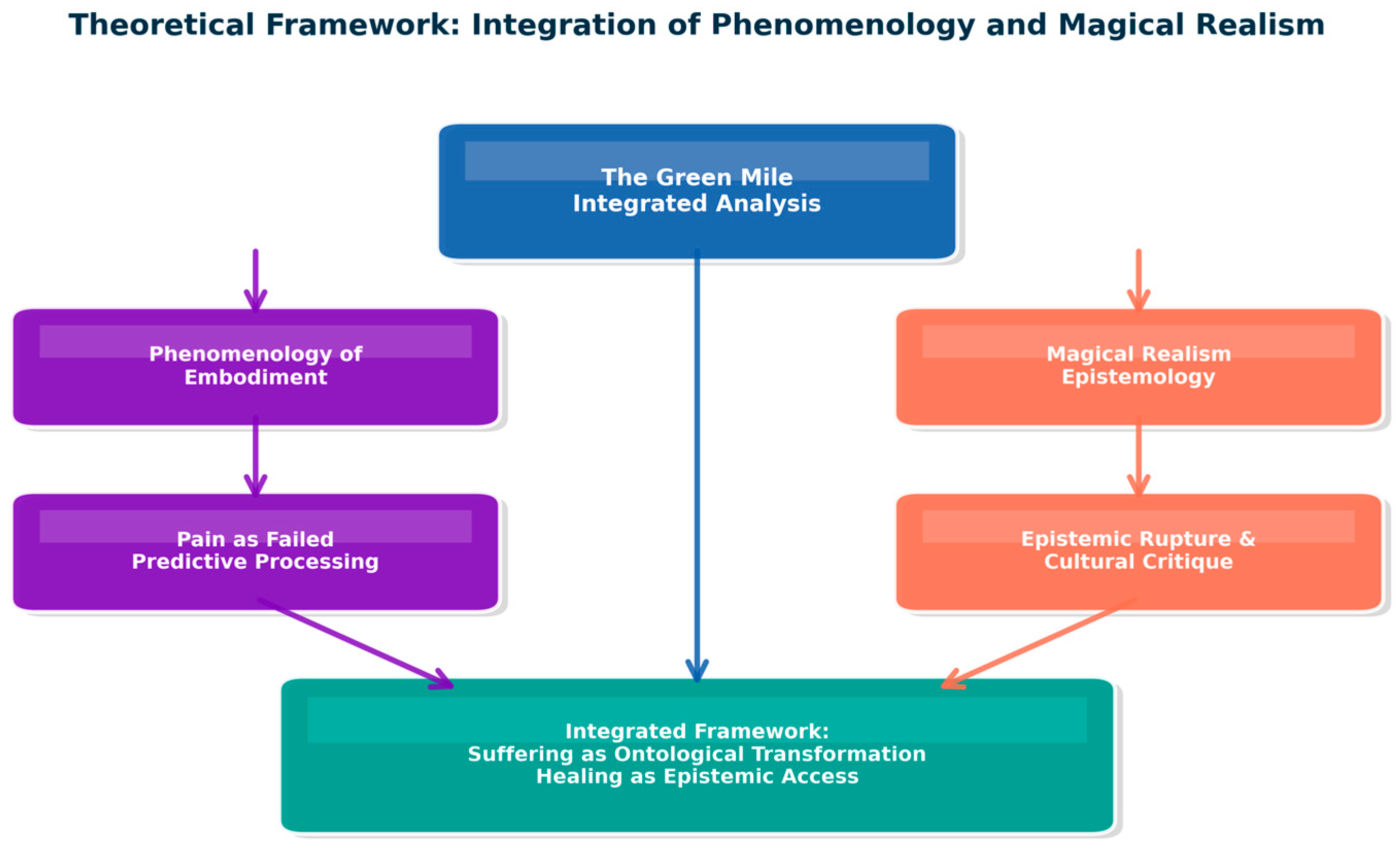
This integrated framework (Figure 1) links phenomenological theories of embodied suffering with the epistemological functions of magical realism as a stylistic approach, illustrating the ways in which both approaches reject Cartesian dualism and consider embodiment fundamental in the production of knowledge. Crucially, the framework is operationalized through close reading: it is used to direct attention to the specific features of King’s prose (narrative voice, descriptive register, modulation between realism and supernatural modes) as the location for the concrete enactment of these theoretical insights. The sections that follow do not use these frameworks as abstract templates but proceed from specific passages, sentences and word choices in King’s text to the phenomenological and magical realist categories that illuminate them. Whereas theory comes before the analysis and its purpose is preparatory and not self-sufficient, the interpretive weight lies in the prose.

4. Analysis: Embodied Suffering and Magical Healing

4.1. The Unhomelike Body in the Carceral Space

The Green Mile opens with bodies in the foreground and Cold Mountain Penitentiary’s death row is a place where bodies are essentially objects to be controlled, surveilled and ultimately destroyed. The architecture of the prison is an example of what Svenaeus (2015) calls unhomelikeness on an institutional scale: prisoners cannot move freely, cannot control bodily functions in private and cannot use their bodies as transparent media for action. The institutional structure turns living bodies into what Fernandez (2020) calls objectified bodies—things to be processed rather than subjects with their own existence.
King’s prose is always mindful of the micro-textures of corporeal experience in ways that establish a realistic baseline against which the supernatural is later contrasted. Consider the novel’s opening description of Paul Edgecombe’s narration from the perspective of an elderly man in a nursing home, looking back across more than six decades: “This is my considering. I think of it as a long mile of memory. It is the place I have to go through to get to the past” (King 1996, p. 1). The metaphor of walking that organizes the whole story, the ‘green mile’ as the length of linoleum between death row and the electric chair, functions as an extension of this attentiveness. In the novel, space is experienced mostly as the movement of the body through it: constrained, directed, terminal (Mekhana 2025).
The most revelatory passage for establishing the novel’s phenomenological realism is the description of Eduard Delacroix’s urinary tract infection, which afflicts Paul Edgecombe at the narrative’s beginning. King depicts the condition in meticulous, clinically precise detail: the burning sensation, the frequency of urination and the dizzying physical misery of a body in minor but persistent malfunction. This extended description serves an important structural function, as it sets the realistic baseline to which Coffey’s miraculous cure will be compared and shows that King’s writing is thus already placed in a phenomenological orientation: in Svenaeus’s (2015) sense, suffering is translated not as abstract pain but as the conversion of the body from transparent medium to intractable obstacle.
When Eduard Delacroix’s execution goes horribly wrong—Percy Wetmore having deliberately sabotaged the sponge so that Del’s head catches fire—the narrative reaches an extreme of what Stilwell et al. (2025) call suffering that overwhelms and dissolves the self. King’s description is remarkable in its refusal of euphemism and insistence on physical specificity. Percy deliberately fails to mention the salt water, so the execution does not happen quickly, and as King shows, Del burns. The prose does not aestheticize the horror but instead reports it with the same documentary flatness as the description of routine prison procedures. Edgecombe recalls: “I could smell something that was like the world’s worst barbecue and hear Del screaming” (King 1996). The simile—"the world’s worst barbecue”—makes a characteristic magical realist move in reverse: instead of making the extraordinary mundane, it makes the mundane horrifying by inserting it into the extraordinary. It is the very features that make the image unbearable rather than reassuring that are the colloquial register (“world’s worst”) and the familiar domestic reference (“barbecue”). Del’s pain is not redemptive, meaningful or transcendent; it is simply and utterly destructive, consuming him completely.
John Coffey’s embodiment is a profound paradox that the magical realist stylistic mode brings to light. His imposing physical presence at first evokes racialized stereotypes of Black male danger—he is described as enormous, dark and somehow oceanic in his physical presence. However, Coffey’s actual embodied reality systematically reverses these associations: he is terrified of the dark, gentle with the prison mouse Mr. Jingles and capable of miraculous healing by bodily contact. King introduces Coffey in a passage that encapsulates this paradox with great precision: “He was a huge man, the biggest I had ever seen outside of a fairground freak show… and [he] came onto the Mile with his hands in cuffs and his ankles in irons, yet somehow managing to look like a man who was taking a stroll” (King 1996). The catalogue of physical enormity—carefully enumerated, realistically grounded—is immediately qualified by this surprising contrast. The adverb “somehow” is doing precise work here: it is the one word that puts irreducible ontological ambiguity in an otherwise documentary sentence. Edgecombe does not explain; he witnesses and records what he sees. The supernatural ease that is part of Coffey’s character is present from his first appearance, captured not as fantasy but as a dissonance in the realistic fabric of the description. His tears—he is weeping when first introduced—mark a further disruption of the stereotyped body: this enormous, physically terrifying man is in the grip of an emotion usually associated with vulnerability. King’s choice of present tense immediacy in the framing—“came onto the Mile”, “managing to look”—anchors the paradox in lived, observed time rather than symbolic retrospection.
The most phenomenologically striking element of the narrative is Coffey’s transference of suffering. When he cures Melinda Moores of her brain tumor, he literally absorbs the malignancy into himself before expelling it as a dark, writhing, insect-like cloud. This transference materializes what Bueno-Gómez (2017) calls the incommunicability of suffering—the basic difficulty in communicating pain in a way that others truly comprehend. What is significant for the present analysis is the prose technique by which King renders this impossible event in the same realistic register as the surrounding descriptions. Malignancy is described in the same attentive, material vocabulary as bodily symptoms throughout the novel—it has texture, movement, and physical substance. King’s verbs here are clinical and kinetic: the dark matter “pours”, “swarms”, “buzzes”; the diction is that of a natural history observation rather than a supernatural sight. Coffey groans and sweats and shudders; these are the documented responses of a body in extreme pain and King locks them into the same physiological register that he uses for the urinary tract infection or the burned flesh of the Delacroix execution. The supernatural content (the transfer of disease, the expulsion of insects) is set within a surrounding framework of absolutely realistic physiological description, creating the typical magical realist effect: the reader is unable to separate the impossible from the plausible because both are written in the same language. There is no change in diction, elevation of register or grammatical flagging that would indicate a crossing into another ontological zone. The prose continues.
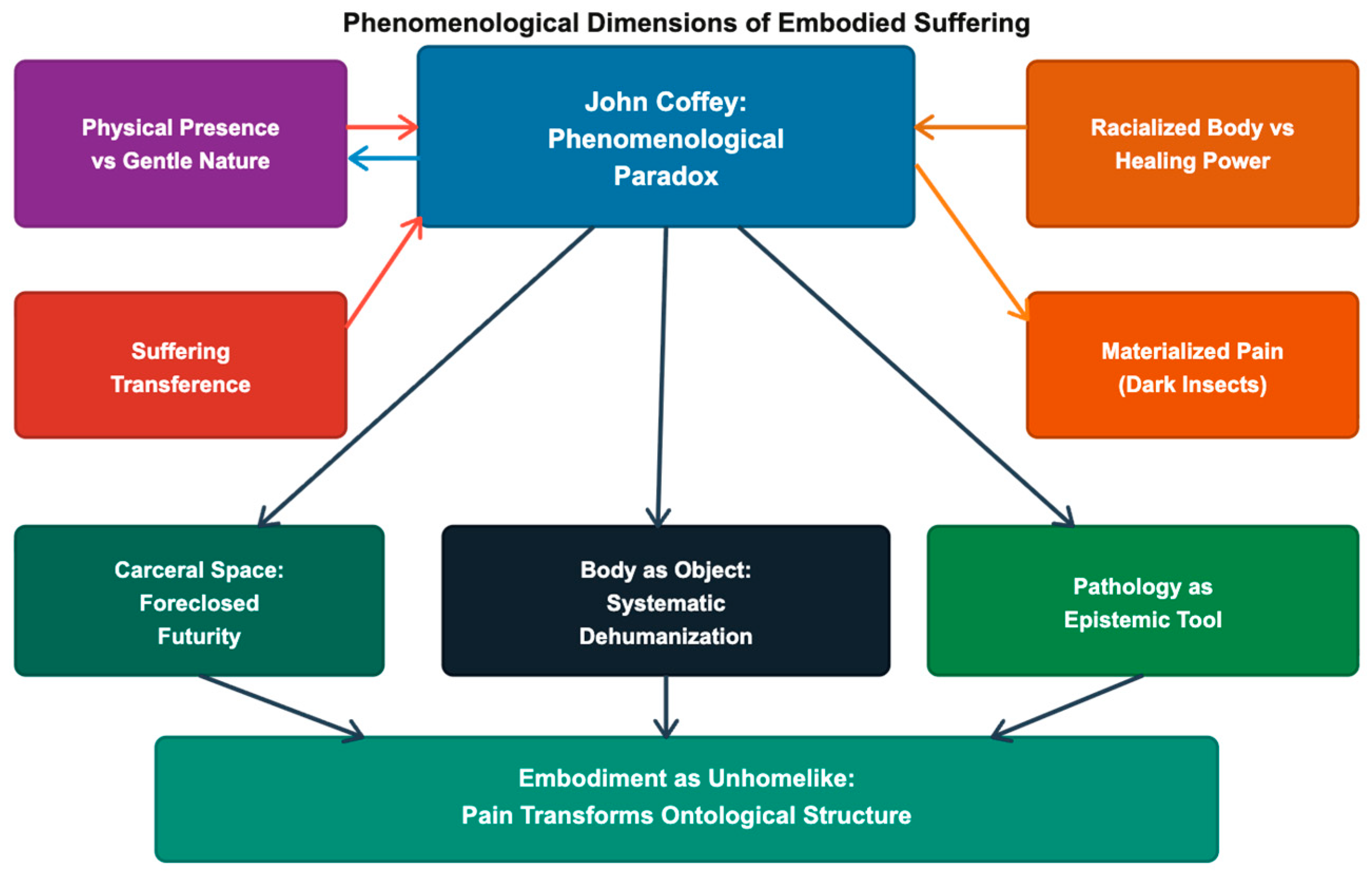
John Coffey’s embodiment as a multilayered phenomenological paradox (Figure 2) is organised around tensions between his physical presence and his gentle nature, his racialized body and his supernatural healing powers and his capacity for suffering transference materialized as pain expelled through the body. As Bărbuleț (2024) points out, Coffey’s healing is based on direct physical contact, which is what Morgan et al. (2025) call the imperative of being present with the suffering body.
The three tensions synthesized in Figure 2 are grounded in specific moments of King’s prose, as analyzed above. The first tension—between physical enormity and gentle nature—is enacted in Coffey’s entrance scene, in which the careful enumeration of his physical bulk is immediately undercut by the adverb “somehow” and then by the revelation of his tears. The second tension—between the racialized body and healing power—is produced by the malignancy transference scene, in which the verbs of a natural history observation (“pours”, “swarms”, “buzzes”) are used, and then by the revelation of his tears. The third tension—suffering transference as the paradoxical form of Coffey’s gift—is most fully expressed in the final speech, in which fragmented syntax and colloquial diction render supernatural empathy as exhaustion. Figure 2 no longer appears as a text superimposed on some abstraction of the text itself but as a map of the tensions that the prose itself creates.
Kiverstein et al.’s (2022) embodied predictive processing model offers a way to phenomenologically understand Coffey’s healing. In their story, pain is a breakdown in prediction, a devastating clash of what you expect and then what you get. Coffey’s supernatural ability may be interpreted as a function of the ability to directly alter the predictive models of others and reset maladaptive anticipatory patterns associated with pain and illness. His healing touch does not simply eliminate pathology but changes the sufferer’s entire embodied relationship with the world, restoring the transparent embodiment that Svenaeus (2015) describes as the defining feature of health.
The carceral environment works in the novel as an institutionalized place of unhomelikeness. Death row forecloses futurity—with a fixed date for execution, the temporal horizon is foreclosed—and at the same time, death row forecloses bodily autonomy—the autonomy of the body in the most intimate of fields. King makes this phenomenological claustrophobia by accumulation: the smells, sounds and rhythms of a space in which every moment is imbued with the awareness of approaching death. This is not Gothic’s symbolic darkness but the magical realist’s inhabited reality: the supernatural healing that occurs in this space is not a fantasy escape from it but a revelation of its deepest contradictions.
Percy Wetmore is the carceral system’s reduction of persons to manipulable objects. His sadism towards prisoners is a reflection of the systematic dehumanization that is necessary for the institution (Fernandez 2020). The realization of Coffey’s humanity by the guards because of his repeated embodied proximity confirms the phenomenological insistence that embodiment is the foundation of ethical life (Fuchs and Schlimme 2009; Scarinzi 2020). However, this focus on embodied proximity runs the risk of romanticizing suffering in ways that Scott et al. (2017) find to be the commodification of authentic experience by the saturated self.
A key aspect of King’s magical realism technique that warrants sustained attention is the control of the rhythm of the prose and the structure of the sentences. Throughout the novel, supernatural occurrences are brought not in syntactic fanfare but in abrupt, almost anticlimactic, flatness. When Paul first realizes that Coffey has healed him, the story provides a series of declarative monosyllables: short subject–verb constructions, a deliberate avoidance of subordinate clauses, no hedging or qualification. The same paratactic lack of detail governs the descriptions of protocols for execution and inspection of the cells. This syntactic equivalence—the equal grammatical weight given to bureaucratic procedure and impossible miracle—is King’s main tool of defocalization. The reader’s eye is given no stylistic cues that one order of events is more credible than the other—more significant—than that. Prose withholds the evaluative italics, the dramatic parenthetical, the explanatory aside that conventional realism would provide when the world is misbehaving. What results is not ambiguity in the sense of not knowing what to make of things but a kind of ontological deadpan: in the world of the novel, it just happens that there is indeed both the electric chair and supernatural healing and the prose about it is indifferent to the fact. Faris’s (2004) defocalization is, at the very least, as much a feature of sentence structure as it is of narrative stance and King’s prose incarnates it with unusual consistency.

4.2. Magical Realism as Epistemic Rupture and Cultural Critique

The magical elements in The Green Mile operate as epistemic breaks, associating truth with respect to violence through the carceral landscape, racialized injustice and power—the institutions that represent conventional realist conventions—whereby invisible power relations cannot generate visible truths. Laws (2017) shows that magical realism emerges at the margins—geographic, social and epistemological—where dominant forms of knowledge meet alternative ways of knowing the world. Cold Mountain Penitentiary’s death row resides exactly in such a marginal space: a liminal space in which the power of death in the state exercises itself but is largely invisible to the wider society.
The stylistic mechanism by which King achieves this epistemic rupture is worth examining in detail in this study. When Coffey heals Paul Edgecombe’s urinary tract infection, the scene is rendered with characteristic tonal flatness. Paul talks of feeling “a tingling warmth” sweeping through his body, followed by the sudden, total stopping of the pain: “Then it was over. So was my urinary infection. Both the heat and the miserable throbbing pain were gone from my crotch, and the fever was likewise gone from my head… it was gone, all right” (King 1996, p. 77). The simplicity of the prose (a monosyllabic sentence following a factual observation) is the very technique by which the impossible is made credible. There is no great build-up, no flagging of the atmosphere, no symbolic preparation; the supernatural event is treated with the same matter-of-fact brevity as the narrative uses to describe the routine of the prison. This is the characteristic defocalization that Faris (2004) identifies as essential to the mode: the fantastic is made not extraordinary but simply and quietly true.
This stylistic strategy is the core of the moral argument of the narrative. By framing Coffey’s healing within the same documentary register as the superfluous, totalizing frames of the realistic surrounding material, King implicitly locates Coffey’s aberrant distortions in order alongside the two mundane forms that surround it: Coffey’s heuristic supernatural endowment is as actual and consequential as the institutional machinery of execution. This challenges the epistemological hierarchy that dismisses forms of knowing that are associated with the marginalized subject, Coffey’s body knowledge, his direct access to truth from touch, as irrational or impossible. The epistemic rupture is not just a plot event inscribed in the prose; Coffey’s way of knowing is as legitimate as the formal legal procedure.
Bărbuleț’s (2024) analysis of conversational implicatures in The Green Mile film suggests that magical realism operates by implication, the recruitment of gaps and silences that require audiences to constructively build meaning. The story never provides a naturalistic account of Coffey’s powers or domesticates the supernatural by subordinating it to a rational framework (Chin 2021; Figlerowicz and Mertehikian 2023). This refusal leaves intact the ontological ambiguity of the mode while forcing readers to come to terms with experiences that are beyond conventional knowledge.
Coffey’s greatest healing act—curing Melinda Moores’ brain tumor—occurs outside the prison, requiring the guards to smuggle him out at great risk. This geographical displacement has symbolic significance: true healing is impossible in the carceral space. Prisons are, to put it in the terms of Mucha et al. (2025) in a different register, anti-healing spaces—spaces designed to create and reproduce suffering rather than to relieve it. The dual functions of magical realism in The Green Mile (Figure 3) simultaneously have epistemic rupture functions—disclosing unknown truths about carceral violence and racialized injustice—and cultural critiques of institutional power.
The most important epistemic break in the narrative is Coffey’s transfer of memory to Paul Edgecombe so that he can directly witness the murders of the Detterick sisters. King renders this supernatural vision in vivid sensory detail: Paul not merely has images but also the physical reality of another’s traumatic knowledge, complete with bodily sensations not his own. This magical transmission bypasses the formal legal knowledge systems (police investigations, trials, and testimonies) that have wrongly convicted Coffey. The technique of the style is important: the memory transfer is told in the same attentive and sensory terms as Paul’s direct experience and Coffey’s supernatural testimony is made as epistemologically vivid as a conventional witness. King thus uses the prose itself to argue that Coffey’s body knowledge—his direct, haptic access to truth—is more reliable than the institutionalized procedures of the justice system. This is the epistemic critique that the magical realist stylistic mode makes possible—not through argument but through the experiential authority of the narrative voice.
It is worth pausing here to consider more closely the particular rhetorical function of Paul Edgecombe’s narrative voice in the creation of epistemic authority. Edgecombe tells the story as a very old man writing from a nursing home more than sixty years after the events he describes; his retrospective certainty is both humanly plausible—old men are certain about what they witnessed—and formally essential to the magical realist mode. The presence of a narrator who hesitated, offered other explanations, apologized for the impossibility of what he is reporting would indicate that the supernatural has to do with a different—less reliable—ontological register. Edgecombe refuses to accept such signals. His diction is working class and matter of fact; his similes and metaphors are domestic and concrete (“the world’s worst barbecue”, “pieces of glass in my head”); his evaluations of morality are direct but never melodramatic. This is the voice of a witness rather than that of a visionary. Magical realism, in Bowers’s (2004, p. 24) formulation, requires a narrator who treats the impossible with the aplomb of a man who has long since accepted what he knows he saw; King’s choice of Edgecombe precisely fulfils this function. The narrative authority thus becomes part and parcel of the epistemological argument of the mode: if a man like this, saying the thing in a voice like this, says that the thing happened, then, within the world of the novel, this thing happened upon this “mode“. The institutional knowledge systems that convicted Coffey are by contrast represented through the cold passive constructions of legal procedure—“he was tried”, “he was found”, “he was sentenced”—a grammatical evasion of agency that enacts the impersonality of institutional violence with its own kind of precise prose.
Ammari and Salman (2025) propose that existentialist magical realism is a way to deal with trauma by not normalizing atrocities through conventional realistic representation. The magical elements in The Green Mile are similarly unwilling to domesticate carceral violence. Coffey’s supernatural abilities make the prison the ontological opposite of flourishing: an institutional structure so at odds with human life that miraculous intervention is needed for even minimal justice to be achieved. But the epistemic role of magical realism has disturbing implications. By identifying resistance to carceral violence in supernatural intervention, as opposed to collective political activity, the story runs the risk of depicting systemic injustice as something that can be remedied only by miracles and exceptions rather than institutional juxtaposition. Chin (2021) raises the concern of romanticizing magical realism as solely progressive as the genre has the potential to exoticize marginalized cultures and aestheticize political struggles.
The Green Mile works through this tension. Coffey’s supernatural abilities make visible the injustices that exist in the structure of society, and they also place him in the position of what critics have called ‘magical Negro’—a problematic trope of fiction in which the supernatural gifts of Black characters exist primarily to serve the moral development of White protagonists. Edgecombe’s spiritual awakening by seeing Coffey’s suffering contextualizes the story of Off the Paved Path in such a way that centers the White experience of Black suffering rather than the Black experience of racist violence (Roelofs and Holland 2025). This choice of focalization is an example of a larger tendency in which the suffering of marginalized subjects becomes an occasion for the ethical development of privileged ones rather than a place of political analysis.

4.3. Religious Symbolism, Martyrdom and Ethical Ambiguity

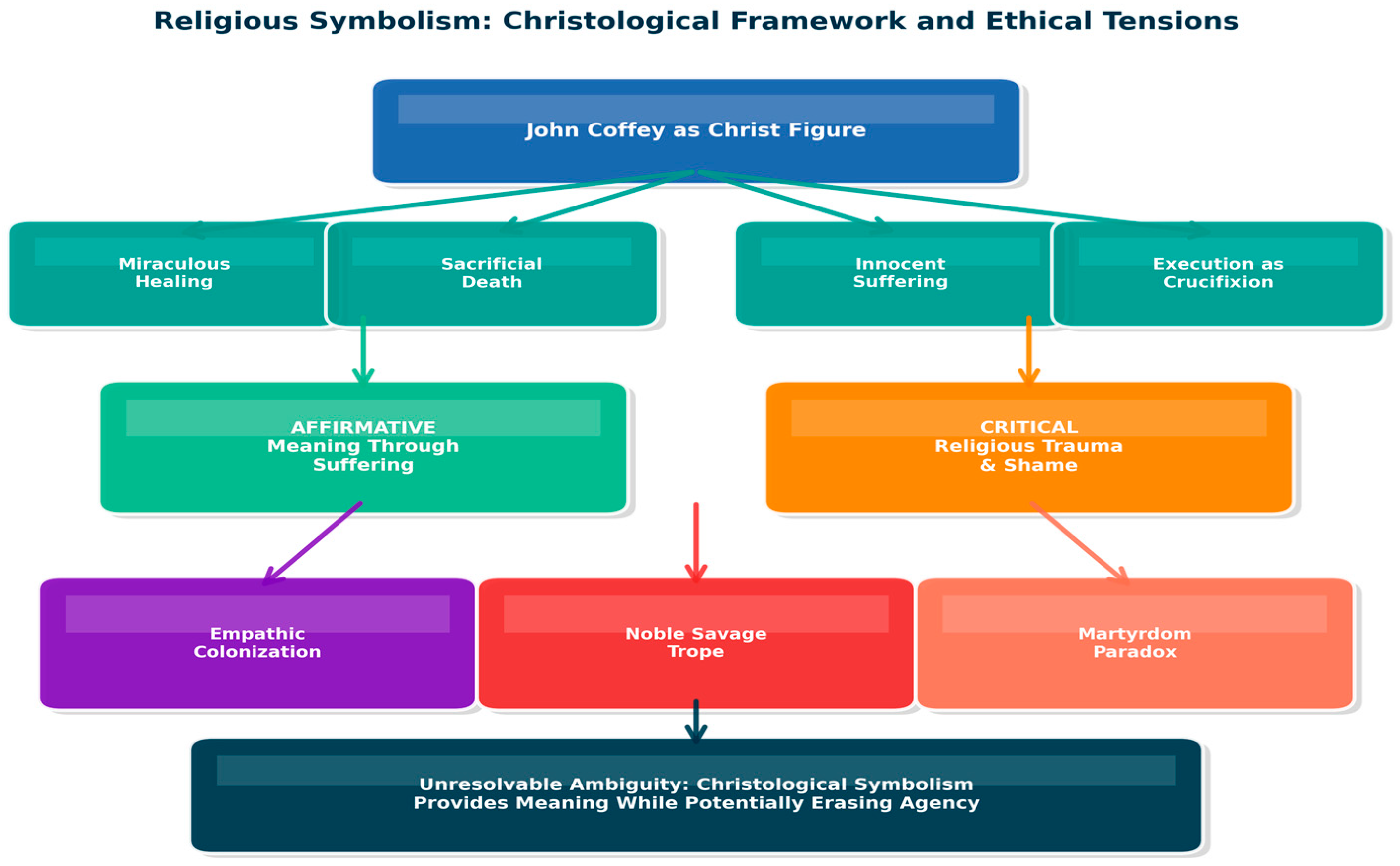
The Green Mile’s Christian symbolism needs to be carefully analyzed in light of scholarship on religious symbolism, martyrdom and trauma. Coffey’s initials (J.C.), miraculous powers of healing, execution in spite of innocence and explicit comparisons to Christ provide a clear Christological framework. Barrett (2023) argues that religious symbolism helps to make life more meaningful by offering resources for interpretation of suffering and mortality. Crucially, King uses this structure not by direct typological announcement but by an accumulation of understated detail so that Paul Edgecombe never directly calls Coffey a Christ figure, but the narrative is organized in such a way as to present the iconographic material, the healing touch and the innocent condemnation, the voluntary acceptance of death, in such a sequence that its symbolic valence is left for the reader to fill in. The declarative plainness of the prose leaves the Christological parallel open without driving it home, which is itself a form of magic realism’s lack of insistence and lack of hierarchy: both the sacred and the institutional are located in the same dull descriptive register. The Christological frame (Figure 4) structures the narrative using a series of parallels—miraculous healing, sacrificial death, innocent suffering and execution as crucifixion—that produce both readings: affirmation (the meaning making of suffering, Barrett (2023)) and critical (the meaning making of religious trauma, Downie (2022)) readings are possible.
At the level of prose style, the Christological framework is carried out through such mechanisms as allusion, juxtaposition and the modulation of narrative voice rather than the explicit argument of typology. Paul Edgecombe’s narration from extreme old age serves the purpose of retrospective witness: he has lived long enough to know what he saw and his testimony is cast in the form of a kind of confessional testimony. The scene in which Coffey is strapped into the electric chair is rendered in the language of sacrifice rather than execution: King’s close attention to the gestures and expressions of the condemned man, his lack of resistance and his apparent peace all work to convert institutional murder into something approaching martyrdom. The prose withholds easy judgment—the guards themselves are not presented as villains but as functionaries caught within a system—and this withheld judgment is itself a form of ethical complexity that the magical realist mode enables.
The climactic speech in which Coffey describes his willingness to die is perhaps the most celebrated passage in the novel and its prose is worthy of close attention: “I am tired, boss. Dog-tired. I am so tired of all the pain I feel and hear in the world every day. There is too much of it. It is like pieces of glass in my head all the time” (King 1996). The register here is radically simple—short declarative sentences, colloquial diction, the domestic simile of “pieces of glass”—but the content is an expression of a phenomenological insight of considerable depth. Coffey’s supernatural empathy is described as a kind of suffering instead of a gift: His permeability to the pain of others has made ordinary existence intolerable. This is the breaking down of self-boundary under extreme pain in the most basic possible prose, as described by Stilwell et al. (2025). The Christological parallel is implicit rather than stated—this is a man choosing death because continued life in a world of suffering is unbearable—but the magical realist flatness of the description prevents it from becoming sentimental or allegorical in nature. The impossible (supernatural empathy) and the realistic (exhaustion, the decision to die) are in the same semantic space. Notably, the structure of this fragment is interesting: “Dog-tired” is a sentence without a subject; “tired”, repeated in three successive clauses, is an accumulation rather than an argument; “too much” is a qualitative judgment that does not admit of quantification. This is not the language of visionary martyrdom—there is no ‘I die so that others may live’—but the language of exhaustion so complete it is theological. King’s choice of the colloquial contraction “It’s” over any formal construction is itself a defocalizing gesture: the world’s suffering is rendered not in the elevated register that would signify Christological symbolism but in the idiom of ordinary weariness. The magical realist effect is achieved not in spite of the prosaicness of the prose but because of it.
This affirmative reading is complicated by Downie’s (2022) work on Christian shame and religious trauma. She shows how Christian frameworks can do psychological damage on a profound level, especially when religious stories are used in racist frameworks. The story situates Coffey as a Christ figure in a White supremacist carceral setting where a Black man is suffering for the benefit of others. Panchuk (2024) demonstrates how religious frameworks can be places of immense harm for the marginalized believer—the religious symbolism of The Green Mile is treacherous territory.
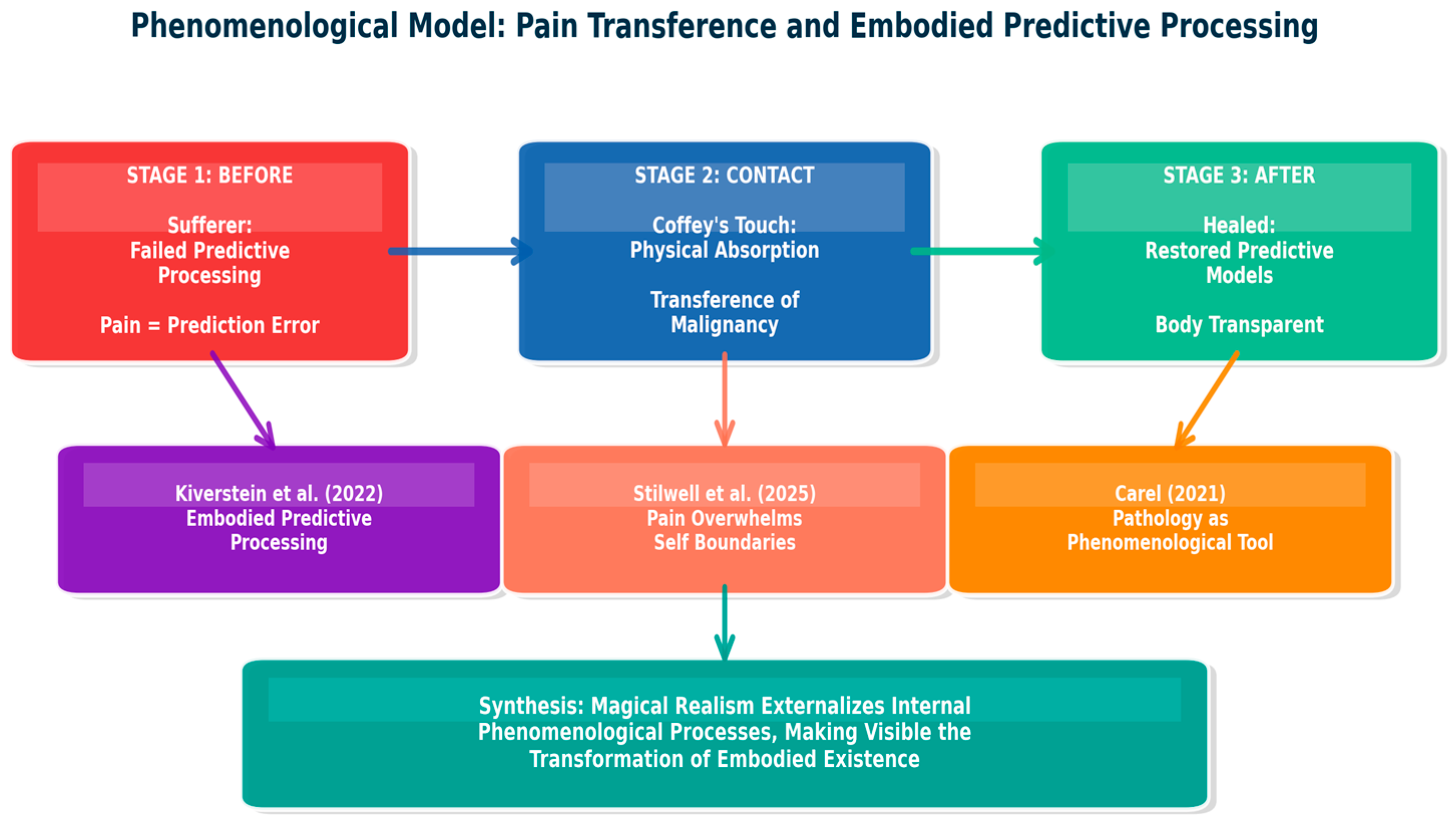
Van Liere (2024) traces secular transformations of martyrdom, demonstrating how martyr narratives continue to have affective power in secular societies. The Green Mile uses Christian imagery to mobilize secular martyrdom in a largely secular story. This is at the same time powerful—because it appeals to deep cultural resources and is able to sensitize readers to injustice—and worrisome because it tends to turn political critique into aesthetic or spiritual contemplation (Beliakova and Timofeeva 2025). Ethical ambiguity is ultimately irresolvable. Coffey’s healing mechanism (Figure 5) can be understood in terms of embodied predictive processing as the restoration of failed predictive models (the three-stage process of failed prediction (before), physical absorption through touch (contact) and restored transparency (after)), which is a literalization of the phenomenological insight that pain disrupts the body’s transparent relationship with the world. In King’s prose, every step in this journey is given clinical attention: Melinda Moores’ pre-coffee intervention is narrated in the vocabulary of neurological deterioration; the scene of contact uses the verbs of disease in transit; and after the healing, the story comments on the return of ease to her body and face with the same documentary matter of factness that defines all King’s physiological descriptions. The three-stage model is not an analytical imposition on the text; it maps a structure that King’s prose enacts.

5. Discussion

The analysis shows that The Green Mile uses magical realism not as escapist fantasy but as a stylistic mode that acts as a phenomenological instrument—one that makes visible the otherwise invisible dimensions of carceral and racialized violence. The foregoing close reading shows how King’s prose achieves this by certain stylistic means: the matter-of-fact treatment of the supernatural in a hyper-realistic descriptive context, the use of Edgecombe’s colloquial but morally weighty narrative voice and the careful modulation between documentary realism and ontological impossibility that characterizes the magical realist mode.
Svenaeus’s (2015, 2019) concept of the unhomelike body is particularly productive here: Coffey’s supernatural powers are a literal materialization of phenomenological alienation and his capacity to absorb others’ pain is a dramatization of what transparent embodiment’s disruption actually looks and feels like. The analysis of specific passages—the Delacroix execution, the healing of Paul’s infection, the memory transfer and Coffey’s final speech—shows that King’s prose is constantly performing the magical realist strategy of defocalization (Faris 2004): the impossible is brought to the same realistic ontological register as the possible so that the reader cannot attribute it to a separate, fantastic ontological register. This stylistic equivalence is not simply a formal function, but it constitutes an epistemic argument regarding the legitimacy of alternative forms of knowledge of the kind systematically dismissed by institutional frameworks.
The analysis also shows serious ethical tensions in the representation of marginalized suffering in the novel. The Christological frame is problematic in relation to what Downie (2022) and Panchuk (2024) debate as religious trauma: the use of Christian imagery by the racist to justify anti-Black violence in the past in ways that used Christianity to justify anti-Black violence. While the identification of the innocent Black victim with Christ critiques carceral injustice (Barrett 2023; Van Liere 2024), such symbolic strategies can also contribute toward the reinforcement of structures that they are critiquing, especially because it suffers from Yilmaz and Erturk’s (2021) documentation of martyrdom discourse’s appropriation to support violence. This tension becomes most visible at the level of prose in the execution scene: in the thoroughgoing way that King renders Coffey’s composure, his voluntary acceptance of it, his seeming peace, all putting themselves into the language of voluntary sacrifice—yet all institutional mechanisms giving rise to such death, the straps, the cap, the warden’s procedural authority, are described in the imperative documentary register without authorial intervention. On one side, “the narrative withholds judgment and again not neutrally but in particular ways controlled the conditions in which Black death becomes incorporated into the White moral narrative instead of becoming politically murderous”.

6. Conclusions

This study illuminates the political ambivalence of magical realism as a narrative device. Laws (2017) shows how the mode expresses marginalized systems of knowledge in opposition to hegemonic epistemologies and The Green Mile certainly uses its supernatural elements to expose carceral violence. There is, however, a tendency for this mode to aestheticize political struggles, Chin (2021) and Figlerowicz and Mertehikian (2023) write, to make material injustices palatable, rather than urgent. The Green Mile’s popular success may reflect what Scott et al. (2017) identify as the commodification of suffering in contemporary culture—raising questions about whether the text’s aesthetic power constitutes a political critique or displaces political engagement.
This study contributes to magical realism scholarship in two ways. First, it shows that the global applicability of magical realism goes all the way to American popular fiction in ways that are analytically productive, rather than merely expansive: King’s deployment of the mode is not simply an import of a Latin American technique but an independent mobilization of magical realist stylistic strategies in response to specifically American conditions of racial and carceral violence. This supports Faris’s (2004) and Bowers’s (2004) arguments for a de-centered and globally inclusive understanding of the mode. Second, this study shows that close reading—attention to diction, narrative voice, descriptive register and the modulation between the realistic and the supernatural modes—is critical to understanding how magical realism works as literature rather than as a thematic category. Previous readings of The Green Mile have identified its magical realist features but have not analyzed how the prose produces them. The present study has shown these effects to come from at least four identifiable stylistic mechanisms including the paratactic equivalence between documentary procedure and impossible event; the systematic use of defocalization through the choice of the adverb “somehow” and the undifferentiated descriptive register; the fragment syntax and colloquial diction of Coffey’s climactic speech; and the passive construction grammar of institutional violence set against Edgecombe’s active witnessing first-person voice. Together, these constitute what is recognizable as a repertoire of practices of magical realism in prose that are at work within the framework of American popular fiction.
The contribution to phenomenological studies of popular fiction is equally significant in this regard. The analysis shows that the concepts of phenomenology—unhomelikeness, transparent embodiment, the foreclosure of futurity and pain as failed prediction—are not simply theoretical constructs but interpretive tools that help shed light on particular textual effects in King’s prose. The Green Mile is, among other things, a sustained phenomenological inquiry into what it means to live in a suffering body in an institution devoted to the production of suffering. The magical realist stylistic mode allows for such an investigation by externalizing the phenomenological structures in ways that conventional realism cannot.
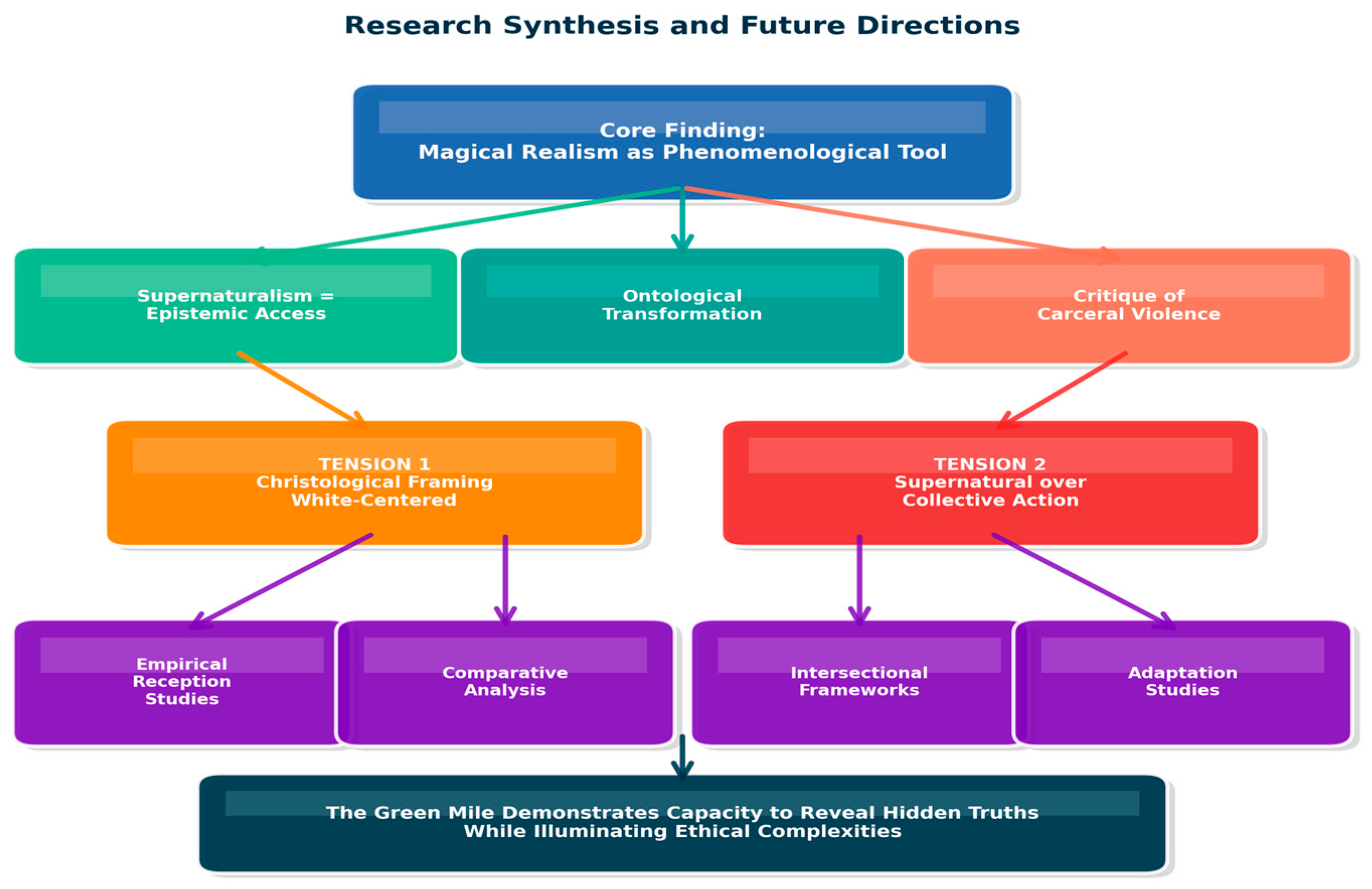
This study has several limitations that should be considered in future research. The current analysis is selective and deals with certain passages of the novel, not a comprehensive account of its six-part structure. Empirical reception studies could examine the magical realism of The Green Mile in terms of actual reader and viewer reception (Tal-Or and Razpurker-Apfeld 2020). A comparative analysis of magical realist representations in varying cultural contexts may provide some insights on whether King’s strategies are embedded in larger patterns (Ammari and Salman 2025). An intersectional analysis that includes gender, class and disability would add to our understanding of the representation of suffering (Beresford 2023; Morgan et al. 2025). Adaptation studies comparing the prose strategies of the novel to Darabont’s translation of it to the film would shed light on how magical realist effects are achieved—or lost—in the transition from one medium to the other. The research synthesis (Figure 6) identifies these four directions as productive extensions of the present study.
Ultimately, The Green Mile is an example of magical realism’s ability to make visible what dominant epistemologies render invisible while at the same time demonstrating the ethical risks of such visibility (Livytska 2019). The phenomenological depth of the narrative—its close attention to the transformation of embodied existence through suffering—co-exists with disturbing representational politics that risk the transformation of political injustice into a consumable spectacle. This coexistence may itself be magical realism’s most important phenomenological insight: that genuine attention to suffering necessarily entails ethical ambiguity and that rendering pain visible always risks instrumentalizing it (Tabor et al. 2017; Bueno-Gómez 2017).
Despite its ethical ambiguities, the magical realist stylistic mode of The Green Mile is committed at the most fundamental level to representing lived experience in its irreducible complexity. Both phenomenology and magical realism resist the reduction in the understanding of suffering and refusal to domesticate pain into the familiar structures (Svenaeus 2015, 2019; Sik 2025). The supernatural aspects of the story enable suffering to be strange and not easily domesticated, even though it makes it visible to readers. Whether this is a sufficient political response to carceral injustice is an urgent question that needs to be interrogated further by readers, scholars and activists who are committed to the abolition of the structures that cause such suffering.

Author Contributions

Conceptualization, U.O. and O.F.; data curation, U.O. and F.K.; formal analysis, U.O., F.K., K.T., D.S. and S.K.; funding acquisition, U.O.; investigation, U.O., O.F. and S.T.; methodology, U.O., S.S., F.K., K.T., D.S.; software, M.B. (Muhabbat Baqoyeva); validation, M.B. (Muhabbat Baqoyeva); visualization, F.K.; resources, S.S.; supervision, U.O.; writing—original draft preparation, U.O., S.S., M.B. (Muhabbat Baqoyeva), F.K., O.F., B.G., K.T., D.S., M.B. (Makhmud Babaev), G.B., S.K. and S.T.; writing—review and editing, U.O., S.S., M.B. (Muhabbat Baqoyeva), F.K., O.F., B.G., K.T., D.S., M.B. (Makhmud Babaev), G.B., S.K. and S.T.; project administration, U.O. All authors have read and agreed to the published version of the manuscript.

Funding

This research received no external funding.

Data Availability Statement

The data presented in this study are available in this article. No new data were created or analyzed in this study.

Conflicts of Interest

The authors declare no conflicts of interest.

References

  1. Ammari, Deema, and Dina Salman. 2025. ‘Magical Realism’ Existentialized in Saadawi’s Frankenstein in Baghdad. World Journal of English Language 15: 236. [Google Scholar] [CrossRef]
  2. Barrett, Nathaniel F. 2023. Religious Symbolism and the Experience of Life as Meaningful: Addition, Enhancement, or Both? Religions 14: 88. [Google Scholar] [CrossRef]
  3. Bărbuleț, Gabriel-Dan. 2024. Conversational Implicatures in Magic Realism Movies—The Green Mile. Incursions into the Imaginary 15: 138–61. [Google Scholar] [CrossRef]
  4. Beliakova, Nadezhda, and Zhanna Timofeeva. 2025. Religious Symbolism and Political Resistance: Navalny’s Martyr Narrative in the Russian Opposition. Religions 16: 40. [Google Scholar] [CrossRef]
  5. Beresford, Andrew. 2023. Martyrdom, Motherhood, and the Aetiology of Infanticide: The Legend of Saints Quiricus and Julitta in Early Iberian Art and Literature. Magnificat Cultura I Literatura Medievals 10: 205–54. [Google Scholar] [CrossRef]
  6. Bergmann, Katja. 2022. Werner Bergengruen: Ein Deutschbaltischer Dichter zwischen Grenzen und Zeiten. Berlin: Be.Bra Wissenschaft Verlag. [Google Scholar]
  7. Bowers, Maggie Ann. 2004. Magic(al) Realism. London: Routledge (Taylor & Francis Group). [Google Scholar]
  8. Bueno-Gómez, Noelia. 2017. Conceptualizing Suffering and Pain. Philosophy, Ethics, and Humanities in Medicine 12: 7. [Google Scholar] [CrossRef]
  9. Carel, Havi. 2021. Pathology as a phenomenological tool. Continental Philosophy Review 54: 201–17. [Google Scholar] [CrossRef] [PubMed]
  10. Chin, Gabriel. 2021. Magical realism and literature. Textual Practice 38: 1793–97. [Google Scholar] [CrossRef]
  11. Downie, Alison. 2022. Christian Shame and Religious Trauma. Religions 13: 925. [Google Scholar] [CrossRef]
  12. Fabre, Pierre-Antoine. 2022. Conclusion: The Narrow Road to Martyrdom. Journal of Jesuit Studies 9: 125–35. [Google Scholar] [CrossRef]
  13. Faris, Wendy B. 2004. Ordinary Enchantments: Magical Realism and the Remystification of Narrative. Nashville: Vanderbilt University Press. [Google Scholar]
  14. Fernandez, Anthony Vincent. 2020. Embodiment and Objectification in Illness and Health Care. Journal of Clinical Nursing 29: 4403–12. [Google Scholar] [CrossRef]
  15. Figlerowicz, Matylda, and Lucas Mertehikian. 2023. An Ever-Expanding World Literary Genre: Defining Magic Realism on Wikipedia. Journal of Cultural Analytics 8: 1–27. [Google Scholar] [CrossRef]
  16. Fuchs, Thomas, and Jann E. Schlimme. 2009. Embodiment and Psychopathology: A Phenomenological Perspective. Current Opinion in Psychiatry 22: 570–75. [Google Scholar] [CrossRef] [PubMed]
  17. Johnson, Mark I., Matt Hudson, and Cormac G. Ryan. 2023. Perspectives on the Insidious Nature of Pain Metaphor. Frontiers in Pain Research 4: 1224139. [Google Scholar] [CrossRef]
  18. King, Stephen. 1996. The Green Mile. New York: Scribner. [Google Scholar]
  19. Kiverstein, Julian, Michael D. Kirchhoff, and Mick Thacker. 2022. An Embodied Predictive Processing Theory of Pain Experience. Review of Philosophy and Psychology 13: 973–98. [Google Scholar] [CrossRef]
  20. Laneri, Nicola. 2024. From Ritual to God in the Ancient Near East. Cambridge: Cambridge University Press. [Google Scholar] [CrossRef]
  21. Laws, Jennifer. 2017. Magic at the margins: Towards a magical realist human geography. Cultural Geographies 24: 3–19. [Google Scholar] [CrossRef]
  22. Livytska, Inna. 2019. Empathy and Qualia: Intersemiotic View on Suffering Representation in Fiction. In The Iconization of Suffering in Literary and Interdisciplinary Perspectives. Bangalore: HAL. [Google Scholar]
  23. Mekhana, Anilkumar. 2025. Theyyam as a Ritualistic Catharsis: Cultural Trauma, Collective Memory and Socio-Religious Subversion in Kerala. Smart Moves Journal IJELLH 13: 13–18. [Google Scholar] [CrossRef]
  24. Morgan, Leona, Sarojini Nadar, and Ines Keygnaert. 2025. ‘Stay with the Body’: Facilitating Integrative Silence in Community-Based Sexual Trauma Care. European Journal of Psychotraumatology 16: 2510020. [Google Scholar] [CrossRef]
  25. Mucha, Anna, Anita Pollak, and Ewa Wojtyna. 2025. Effect of Virtual Walk in Green or Urban Spaces on Pain Perception. Scientific Reports 15: 27586. [Google Scholar] [CrossRef] [PubMed]
  26. Murtaza, Aemen, Mamona Yasmin Khan, and Masroor Sibtain. 2021. Magical Realism: Portrayal of Human Suffering in The Particular Sadness of Lemon Cake by Aimee Bender. Global Social Sciences Review VI: 246–55. [Google Scholar] [CrossRef]
  27. Nair, Aswathy, and Laxmidhar Dwivedi. 2023. Modern Horror Thrillers: A Traumatic and Linguistic Study. World Journal of English Language 13: 76. [Google Scholar] [CrossRef]
  28. Ochilov, Ulugbek. 2025. Magic at the Crossroads: Moral Dissonance and Repair in the Wizarding World. Humanities 14: 148. [Google Scholar] [CrossRef]
  29. Ochilov, Ulugbek. 2026. Transcultural Magical Realism: A Comparative Analysis of Stephen King’s American Supernatural Fiction and Nazar Eshonqul’s Central Asian Narratives. Cogent Arts & Humanities 13: 2628406. [Google Scholar] [CrossRef]
  30. Ochilov, Ulugbek, Mehriniso Ochilova, Makhzuna Shoyimkulova, Mirzobek Akhmadov, Alisher Asadov, Feruza Adambaeva, Botir Ahrorov, Munavvar Amonova, Hulkar Salimova, and Gulrukh Kakhkhorova. 2026. Race, Disability and Abolition in Stephen King’s The Green Mile. Genealogy 10: 2. [Google Scholar] [CrossRef]
  31. Panchuk, Michelle. 2024. Religious Trauma. Cambridge: Cambridge University Press. [Google Scholar] [CrossRef]
  32. Roelofs, Monique, and Norman S. Holland. 2025. The Role of the Aesthetic in Decolonial Critique. Latin American and Latinx Visual Culture 7: 26–47. [Google Scholar] [CrossRef]
  33. Roh, Franz. 1995. Magic Realism: Post-Expressionism. In Magical Realism: Theory, History, Community. Edited by Lois Parkinson Zamora and Wendy B. Faris. Durham: Duke University Press, pp. 15–31. First published 1925. [Google Scholar]
  34. Scarinzi, Alfonsina. 2020. Ecology of the Brain. Journal of the British Society for Phenomenology 51: 88–89. [Google Scholar] [CrossRef]
  35. Scott, Rebecca, Julien Cayla, and Bernard Cova. 2017. Selling Pain to the Saturated Self. Journal of Consumer Research 44: 22–43. [Google Scholar] [CrossRef]
  36. Sik, Domonkos. 2025. Illness Experience and Social Suffering: Synthesizing Medical Phenomenology and Critical Theory. The Journal of Medicine and Philosophy 50: 326–40. [Google Scholar] [CrossRef] [PubMed]
  37. Stilwell, Peter, and Katherine Harman. 2021. Phenomenological Research Needs to Be Renewed. International Journal of Qualitative Methods 20: 1–15. [Google Scholar] [CrossRef]
  38. Stilwell, Peter, Mael Gagnon-Mailhot, Anne Hudon, Virginia McIntyre, Keith Meldrum, Marie-Gabrielle Pagé, Shaun Gallagher, and Timothy H. Wideman. 2025. When Pain Overwhelms the Self. The Journal of Pain 32: 105413. [Google Scholar] [CrossRef]
  39. Svenaeus, Fredrik. 2015. The phenomenology of chronic pain: Embodiment and alienation. Continental Philosophy Review 48: 107–22. [Google Scholar] [CrossRef]
  40. Svenaeus, Fredrik. 2019. To die well: The phenomenology of suffering and end of life ethics. Medicine, Health Care and Philosophy 23: 335–42. [Google Scholar] [CrossRef]
  41. Tabor, Abby, Edmund Keogh, and Christopher Eccleston. 2017. Embodied Pain—Negotiating the Boundaries of Possible Action. Pain 158: 1007–11. [Google Scholar] [CrossRef]
  42. Tal-Or, Nurit, and Irene Razpurker-Apfeld. 2020. When the Physical Coldness in the Viewer’s Environment Leads to Identification with a Suffering Protagonist. International Journal of Psychology 56: 394–406. [Google Scholar] [CrossRef]
  43. Thabeti, Huda Al. 2022. Representation of Traumatic Symptoms in Stephen King’s The Green Mile and Secret Window, Secret Garden. Ankara: Akademisyen Kitap Portalı. [Google Scholar] [CrossRef]
  44. Van Liere, Lucien. 2024. Dying for What? Secular Transformations of Martyrdom. Religions 15: 1334. [Google Scholar] [CrossRef]
  45. Yilmaz, Ihsan, and Omer F. Erturk. 2021. Pro-Violence Sermons of a Secular State. Religions 12: 659. [Google Scholar] [CrossRef]
  46. Zamora, Lois Parkinson, and Wendy B. Faris, eds. 1995. Magical Realism: Theory, History, Community. Durham: Duke University Press. [Google Scholar]
Figure 1. Theoretical framework: phenomenology and magical realism as stylistic modes. Note: The framework depicts the confluence of the phenomenological approaches to embodied suffering (left) and the epistemic functions of magical realism as a stylistic mode (right) in the analysis of The Green Mile. The synthesis at its center represents the ways in which both approaches think about suffering as an ontological transformation and healing as coming to access hidden dimensions of experience. The central axis—a close reading of King’s prose—suggests that theoretical application is always based on textual analysis. The arrows indicate the directional relationships between the theoretical components.
Humanities 15 00057 g001
Figure 2. Phenomenological dimensions of embodied suffering in The Green Mile. Note: John Coffey is the central phenomenological paradox of tensions between physical presence and tender nature, racialized stereotypes and healing power and suffering transference through materialized pain. The lowest tier contextualizes these dimensions in the carceral space of death row, systematic dehumanization and Carel’s (2021) concept of pathology as an epistemic tool. The framework illustrates how embodiment is ‘unhomelike’ through the ontological transformation brought about by pain and institutional violence.
Humanities 15 00057 g002
Figure 3. Magical realism as a stylistic mode: epistemic functions and cultural critique. Note: The following figure charts the dual modes of operation of magical realism as a stylistic mode in The Green Mile. Upper level: Epistemic rupture (the revelation of braided actualities as a result of stylistic defocalization) and cultural critique (the interpellation of institutional violence due to the coexistence of the realistic and supernatural registers). Middle level: Four mechanisms—direct witness via memory transfer, geographic transgression, carceral system critique and racialized injustice made visible. Lower level: Contrasting implications—affirmative potential (implication and gap to engage the reader) and problematic dimension (privileging supernatural over collective political action). The synthesis recognizes an ambivalent epistemology of the magical realist representation.
Humanities 15 00057 g003
Figure 4. Religious symbolism: Christological framework and ethical tensions. Note: John Coffey as a Christ figure fixes multiple religious parallels (second tier), which produce competing interpretations (middle tier). Affirmative readings find meaning in suffering and critical readings find the potential for religious trauma and aestheticizing racist violence. Three tensions of ethics are pointed out—empathic colonization (White witness experience centered over Black suffering); the noble savage trope (supernatural powers ascribed to racialized identity); and the martyrdom paradox (victimization vs. agency). The synthesis acknowledges an unresolvable ambiguity of having Christological symbolism both to make meaning and to destroy the political agency of the marginalized subject.
Humanities 15 00057 g004
Figure 5. Phenomenological model: pain transference and embodied predictive processing. Note: The three-stage model describes Coffey’s healing process using the embodied predictive processing theory (Kiverstein et al. 2022). Stage 1 (Before): The sufferer has failed predictive processing where the disease is a prediction error. Stage 2 (Contact): Coffey’s touch produces physical absorption and transference of the malignancy. Stage 3 (After): The healed individual is characterized by restored predictive models and transparent embodiment that Svenaeus (2015) describes as the phenomenological condition of health. The phenomenological dissolution of self in the face of extreme pain as described by Stilwell et al. (2025) is also reflected in the model. (Stilwell et al. 2025) The model illustrates the process of magical realism, externalizing internal phenomenological processes in such a way as to make visible the transformation of embodied existence via a realistic prose register, making the impossible structurally continuous with what is possible.
Humanities 15 00057 g005
Figure 6. Research synthesis and future directions. Note: The central finding makes magical realism a phenomenological stylistic mode and not an escapist fantasy. Three contributions of the scholarly kind are identified: (1) the supernatural as means for epistemic access in King’s prose; (2) suffering as an epistemic transformation that is rendered ontological through particular stylistic strategies; and (3) a cultural critique of carceral violence through the magical realist defocalization of institutional reality. Two irresolvable ethical tensions are still present: the White-centered Christological framing and the substitution of the supernatural for collective political action. Four future research directions are found: empirical reception studies, comparative cross-cultural analysis, intersectional frameworks (race, class, gender, disability) and adaptation studies of cross media translations. The synthesis is the ability of The Green Mile to reveal hidden truths while at the same time enacting the normative ethical complexities of such revelations.
Humanities 15 00057 g006
Disclaimer/Publisher’s Note: The statements, opinions and data contained in all publications are solely those of the individual author(s) and contributor(s) and not of MDPI and/or the editor(s). MDPI and/or the editor(s) disclaim responsibility for any injury to people or property resulting from any ideas, methods, instructions or products referred to in the content.