


Abstract
Working carers deserve to receive more and more attention from welfare regimes and workplaces. Using the work–family interface approach, we analyzed the effects of the Family Audit workplace measures—an Italian work–life balance policy—on couple well-being. The research was carried out through a Computer-Assisted Web Interviewing survey which was addressed to the employees of the organizations that participated in the policy program in 2015. The results showed that the measures implemented by the companies were able to improve the perception of couple well-being of working carers, but they did not trigger a cultural change that would permit the elimination of differences due to gender in work–family balance. The most effective measures were characterized by high levels of flexibility. These features allow the reduction of the negative effects produced by some socio-biographic variables, some work-related aspects, and aspects related to the Mediterranean welfare regime.
1. Introduction: The Subject and the Open Questions
People daily engaged in balancing paid work and providing informal care to family members—the so-called working carers or caregiver employees—represent a challenge that is becoming ever more urgent for welfare systems and for employers (Kroger and Yeandle 2013; Abendroth and den Dulk 2011).
As was underlined in the new road map for work–life balance (European Commission 2015), provision of care is a challenge faced by people throughout all the phases of their working life and in particular, during their old age. This can place individuals under considerable strain, as they struggle to balance their job with the care needs of their relatives and, in some cases, the care of young children too; this is the so-called sandwich generation (Miller 1981). The European Quality of Life Survey 2016 (Eurofound 2017) demonstrates some relevant key points. The categories of workers most likely to have a poor work–life balance are blue-collar workers, those on fixed-term contracts, and those working long hours. In addition, the number of children is a key factor leading to issues in work–life balance. While this finding may not be surprising, it does reinforce the urgency of developing childcare services, especially if societies wish to counterbalance the impact of demographic ageing and encourage higher birth rates. While work–life balance is less problematic in continental and Nordic countries, it seems more difficult to achieve in eastern and southern Europe. The differential development of welfare state arrangements and working time flexibility probably explain these discrepancies. For many societies in Europe, there is a growing gap between the need for long-term care and the availability of formal care provision, underlining the need to support informal carers. The profile of carers and the priority given to work–care balance is generally not high, and there is a lack of reference to informal carers in many existing policy documents.
Women still provide most of the care, whether for their own children, grandchildren or for relatives, friends, and neighbors with a disability or infirmity. When it comes to providing care on a daily basis, twice as many women are involved (Eurofound 2017). Altogether, 12% of people of a working age are involved in the regular care of a disabled or an infirm person. However, the proportion of people providing regular care varies considerably across countries. While this depends on ability to access and afford formal care, it may also be related to the expectations within societies of families to provide care for their own relatives. Finally, the report shows that the intensity of care provision increases with age, with older people spending almost double the number of hours as younger people. However, most carers are also working: 73% of men and 58% of women caring for a disabled person are employed. Being a carer and working at the same time does not automatically mean being at a disadvantage in terms of quality of life. The findings show that the social and economic situation of carers who combine work and care is better than that of non-working carers. The health rates of non-working carers are lower; they find it more difficult to make ends meet, they usually live in lower income households, and they tend to feel somewhat lonely more often and undervalued by others for their efforts (Eurofound 2017).
As for Italy, the multi-purpose 2011 ISTAT (Italian National Institute of Statistic) survey indicated at least 15,182,000 people who regularly take care of someone in the family context; this is a good 38% of the population aged between 15–64. Carers are typically (more than 55%) women aged between 45 and 55. Even though some of them are working, 60% of female carers have left their jobs to devote themselves to the full-time care of family members (on average 7 h a day of direct assistance and 11 h of supervision a day) (ISTAT 2016). From this data, it is clear why the search for a subjective well-being and satisfactory work–life balance is a topic that is at the center of discussions regarding the structuring and supply (national and European) of welfare systems. Creating a satisfactory work–life balance seems to have become even more difficult due to a series of emergencies that took place during the last decade in Europe and especially in Italy: The socio-economic crisis and its consequences on the restructuring of welfare policies (Arts and Gelissen 2010; Ferragina and Seeleib-Kaiser 2011) and the economic system (Addabbo et al. 2017); the explosion of communication technologies that has profoundly changed both times and places of work (Ollier-Malaterre and Foucreault 2017; Greenhaus and Kossek 2014); changes in labor markets (Gallie 2017); the increase in the presence of women in the workforce (Bonoli 2007; Esping-Andersen 2009); the ever accelerating redefinition of roles between genders and generations (Lewis 2006; Lister et al. 2007; ISTAT 2016); the increased instability of couple relationships (Bianchi and Milkie 2010).
From a gender perspective, these changes—along with others—have triggered a “silent revolution” that has radically changed both the public and the private dimensions of the “mid-century compromise” between family and work (Crouch 1999). They have produced a number of phenomena—some of which are particularly relevant to the research that we present, such as the postponement and renouncing of parenthood (Esping-Andersen et al. 2015) and the renouncing of participation in the labor market (Vuksan et al. 2012)—which are becoming relevant topics in Italy (Mauceri and Valentini 2010). For these reasons, work–life balance could become a new social risk for some categories of citizens and in particular women. Esping-Andersen (2009) defines these dramatic changes as an “incomplete revolution” for women. The problems that persist concern the fact that women are increasingly present in the “public sphere” (e.g., look at the female labor force participation rate); by contrast, men’s commitment in the private sphere and in care duties, in particular, did not increase proportionally (ISTAT 2016; Saraceno 2011). The greatest social problems revolve around the gap between the number of actual children and the number of children desired and the imminent risk that new social inequalities and polarizations could arise. This risk affects, in particular, people in lower social classes who are less educated and who have less economic, social, and cultural capital available. In this way the incomplete female revolution produces, and not erases, new forms of inequalities.
The austerity measures adopted by the government, together with the necessity to prevent new social risks, and the process adopted by companies to re-define their social role produce the progressive entry of workplace organizations into the welfare scenario. In Italy, in order to denote the array of non-public welfare provisions which have been expanding in the last decade, the debate has recently coined a new label: “Secondo Welfare”. The adjective “second” has a triple connotation: Temporal (these are forms of provision that are grafted on the trunk of the “first”, state-based welfare edifice that was built during the 20th century); functional (second-line provisions and initiatives are typically a complementary addition to, not a replacement of, first-line and state-based provisions); financial (the secondo welfare typically mobilizes extra, non-public resources, made available by a wide range of economic and social actors) (Ferrera and Maino 2014).
In this new multi-stakeholder governance, it is interesting to analyze how companies are fulfilling a role as providers of work–life balance measures aimed at improving working carers’ well-being (Eurofound 2018).
“Well-being” is defined, based on the socio-political literature, as the state of an individual with regard to the subjective perception of satisfaction relating to people’s different needs (Almudena 2012). In the literature, the concept has been studied by applying different indicators: Individual assets such as income; employment; health status; the presence of decent housing, etc.; as well as psychological measures such as satisfaction, self-esteem, and emotional equilibrium. Campbell et al. (1976), as well as Andrews and Withey (1976) and others (Rettig and Leichtentritt 1999) consider it a set of satisfactions linked to areas of life such as marriage, work, free time, family, and accommodation. Griffin (1988) defines well-being as the positive response to basic needs. Finally, for Sen (1985, 1993), the primary feature of well-being can be seen in terms of how people “function in the broadest sense”, which here extends to families.
This paper is written from a family policy perspective, providing a framework that can be used to assess the effects of policies on the well-being of the relationship between the couple in the family, directly or indirectly, intentionally or not (Moreno Minguez 2013; Craig and Mullan 2010).
According to our approach, the family is the most immediate and ineluctable human setting, linking genders and generations by involving people and their relationship in the care of children and, increasingly, their aging parents (Frankle 1976). In particular, we adopted a systemic perspective, thereby, according to Sen (1985, 1993), family well-being can be conceptualized as the ability of the family members to perform their various and specific functions (socializing, caring for children and the elderly, supporting the partner, etc.) when adequately supported by public policies. The way a family performs its tasks greatly varies depending on the phase of the life course in which the family finds itself. This, in turn, is strongly influenced not only by the biographical characteristics of its members (age, sex, qualification, employment, the number of children, the presence of elderly people, etc.) but also by a series of cultural variables (Ollier-Malaterre 2017) which belong to the social policies of a specific country. From the point of view of policy systems—and taking the culture of the country into account—the well-being of the family can be conceptualized and measured as a subjective perception of the satisfaction that each member of the family has of the way in which they carry out their daily tasks (socialization, physical and moral care, economic maintenance, social control of the members), in the various phases of life, based on the services and measures it has received (Kuitto 2016).
The literature that studies the effects of work–life balance measures in the workplace often refers to the theory of “multiple roles” (both work and family responsibilities). The personal perception of satisfaction (regarding physical and mental health and the quality of relationships) increases both for men and women according to their commitment in different spheres of life (Barnett and Hyde 2001).
Regarding the phenomena described above, this research aimed to focus on this specific aspect of family well-being that is not sufficiently explored in the literature. In particular, we were interested in the impact of workplace welfare measures on the subjective perception of the working carer regarding couple well-being. The well-being of the couple is one of the dimensions of family well-being, together with well-being in the relationship with the children and well-being related to the relationship with the elderly. Up to today, it has been treated as a rather marginal topic (Shockley and Shen 2016). Research has mostly focused on subjects that precede well-being such as work or family stress (Byron 2005), family roles (Sahibzada et al. 2005), and work load commitments (De Simone et al. 2014).
2. The Research
2.1. The Policy: Innovative Governance between Government and Companies
In 2000, Italy adopted a legislative system, which is at the leading edge in Europe, to support maternity and paternity: Law 53 provided positive actions to be taken in the workplace to support employees in their care duties (Article 9)2 (Gottardi 2010, 2016). This law is innovative with respect to the rights guaranteed and the instruments identified. However, in its implementation, a variety of problems have arisen (Gavio and Lelleri 2007; Macchioni 2008; Cannito 2019). The innovative implementation of a national work–life balance policy, the Family Audit, falls within the framework of this legislation.
The Family Audit is based on a well-developed methodology. A working group is set up within the organization, which is advised by an external consultant. After carrying out an audit, each organization develops a three-year Family Work–Life Balance Plan listing actions that the organization plans to take in five areas (work organization, work–family balance culture, communication, fringe benefits and services, new technologies). Its implementation is monitored by an external evaluator. The work–life balance plan is arranged under five headings divided into nine topics: Work organization (time scheduling work process workplace: Telecommuting, decentralized work, etc.); work–family balance culture (expertise of management and development of the human resources managing the work–family balance policy, e.g., equal opportunities, maternity leave); communication (finding new tools for internal and external communication); fringe benefits and services (financial aid: Bonus schemes, insurance, etc.; family services: Medical health support, counseling, family support during school breaks, canteen, use of company equipment, time-saving services, parental support, etc.); new technologies (orientation to ICT services: Using new technologies to optimize working time both for the employees and the organization).
The Family Audit standard is an innovation of the company certification systems (Malfer 2012). Alongside the existing consolidated certification practices, on an international level, regarding product quality, environmental quality, and ethical quality (SA8000), the company certification of family quality is introduced to the corporate auditing system, aimed at balancing work and family. This is a relatively new innovation in Europe and in Italy. In Germany, a first form of audit (Berufundfamilie) was introduced in 1995 by the Hertie Foundation (Hoessle 2016) and today, Austria, Slovenia, Luxembourg, and the Alto Adige Region are following the same path (Ricca 2016).
In 2012, the Department of Policies for the Family of the Italian Government wanted to introduce the auditing system in the National Plan for the Family and started the first national experimentation of the Family Audit1.
In 2014, The European Institute for Gender Equality (EIGE) identified the Family Audit as an Italian good practice with the aim to enhance the effective implementation of gender mainstreaming strategies in the EU2.
In 2015, the Italian Government published a call for companies interested in obtaining this certification, offering technical advice from accredited professionals who help companies to identify, implement, and evaluate the initiatives and measures for conciliation in six macro-areas: Work organization, culture of conciliation, communication, benefits and services, family district, and new technologies (Malfer et al. 2014). Thereafter, 50 organizations with different characteristics were selected: 21 public organizations, 29 private and non-profit organizations, organizations from 14 Italian Regions, 12 companies with up to 15 employees, 20 companies from 16 to 100, and 18 with over 100 employees. In the end, based on the report of the professional evaluator accredited by the Board of the Family Audit, the Italian Government conferred the Family Audit certification to compliant companies, confirming their sustainability in terms of work–family balance.
2.2. Hypothesis and Methodology
Departing from this context, which particularly concerns Italy, the analysis that we present focuses on the effects that some work–balance policies—provided by workplace organizations thanks to technical and financial support from the government—have on the well-being of couple relationships of working carers.
In our research project, individual subjective satisfaction with regard to the well-being of the couple is one of the dimensions of family well-being and when the workers are able to perform their functions and roles within their family relationships adequately, the outcome of the policies3 has been successful. We assume that this relationship could be mediated both by the workload and by family care (see Knijn and Kremer 1997; Kremer 2007; Lister et al. 2007).
In the questionnaire, satisfaction was measured in terms of the subjective well-being of the relationship between cohabiting partners. In particular, there were five dimensions that made up this well-being index and these concerned both instrumental aspects and expressive aspects4: 1. Sharing of household tasks; 2. sharing care tasks (can refer to children and the elderly); 3. partaking in leisure activities together; 4. availability for dialogue; and 5. mutual support. The formulation of the questions was centered around the subjective improvement of the well-being of the couple: “Now let us present to you some situations concerning the relationship with your cohabiting partner. Since your company has activated the Family Audit measures, how much has your perception of the well-being regarding your couple relationship improved? Please indicate the level to which you agree with the proposed statements. Please choose, for each line, a single number between 1 (disagree) and 10 (completely agree). If the proposed condition has never been experienced, check the box in the right-hand column “not applicable to me” (NP).
At the beginning of the questionnaire, all the measures included in the action plans presented by the various companies were reported, and employees were asked to indicate the measures which they made use of. The index of the measures of the Family Audit used was then constructed by calculation, adding up the number of positive responses of the respondents, i.e., counting the number of measures used. In the subsequent analyses, partial indexes of measures were used, taking into account five areas of intervention in which the standard Family Audit invites companies to take action to support their employees: 1. Flexible organization of work; 2. new technologies; 3. monetary aid and benefits; 4. communication and information; 5. services. The partial indexes of measures, referring to the different areas of intervention, were also constructed by calculating the measures used and then standardizing them, to make them comparable with each other despite the fact that the measures within the individual areas have different numbering. More specifically, we hypothesized that:
Hypothesis 1.
There is a positive relationship between the use of the measures and the subjective well-being perceived with regard to the couple relationship. As the number of Family Audit measures increases, we hypothesize that the perception of the well-being of a couple increases because, having different measures at their disposal, the couple is more likely to identify those that are more closely matchable with their preferences, projects, and their family organization.
Hypothesis 1a.
We hypothesize that in the context of Mediterranean and family-based welfare systems, such as in Italy (Ferrera 1996), where it is above all women who are involved in family care activities, it is women who perceive the biggest impact of the measures.
Hypothesis 2.
There are some measures that have a greater impact on the subjective perceived satisfaction with regard to couple well-being. The greatest impact can be seen with flexible measures. This kind of measures can be more easily adapted by workers to fit their own arrangements within the couple, depending on their care and professional loads.
Hypothesis 2a.
We hypothesize that in the context of Mediterranean and family-based welfare systems, such as the one in Italy (Ferrera 1996), women especially should perceive a greater improvement in couple well-being due to the use of flexible measures because it allows them to structure their “double shift” better.
2.3. The Survey and Its Characteristics
The research presented here was based on a CAWI (Computer-Assisted Web Interviewing) questionnaire that was addressed to the employees of the organizations that took part in the first national Family Audit certification procedure in 2015.
The survey took place between April and June 2016. The questionnaire was filled out by the workers and their cohabiting partners on a digital platform made available by the relevant governing body. To complete the questionnaires, a platform called L3-LifeLong Learning was used by the Provincia Autonoma di Trento (Independent Province of Trento). This platform was created by the University of Trento based on previous experience within the academic context. It consisted of a Learning Management System (LMS) based on the metaphor of virtual learning communities (Colazzo et al. 2009).
The questionnaire was divided into three sections: (1) “Work–life balance measures”, aimed at distinguishing the measures the employee made use of; (2) “subjective well-being”, dedicated to distinguishing the effects that the Family Audit measures had on the quality of the personal, working, and family quality of life of the employee; (3) “socio-demographic and family characteristics”, which outlined the personal data of the respondent, in addition to a series of characteristics concerning the professional profile and the nuclear family.
The research population was made up of employees of Italian organizations who took part in the National Family Audit. We chose to proceed with a stratified sampling (Corposanto 2001).
In the first layer, a sample made up of representing companies with respect to size, ownership (public or private), and territorial location was built up from the research population (North, Center, South) (Table 1).

Table 1.
Organizations sampled based on selection characteristics.
A total of 42 Companies took part in the Family Audit throughout the country (initially 50 companies were involved), and 21 were selected for the research, maintaining the proportions by geographical area and type of ownership (Table 2).
Table 2.
Employees that completed the survey based on the selection characteristics of the organizations.
The invitation to fill in the questionnaire was sent to all the employees who had used at least one Family Audit measure and who had care duties (children under 16, or elderly parents, or other non- self-sufficient relatives).
The valid questionnaires collected were 846 (46.2% of the population that met the selection criteria). The majority of respondents were women (504, equal to 59.6% of the sample), mainly middle-aged (51.3% between 40 and 50 years), with an average age of 44.4 years. The sample was composed almost exclusively of workers with an Italian citizenship (94.9%), the majority of whom were married (72.5%) or cohabitant (15.1%), while only 4.7% were unmarried and 7.3% were separated, divorced, or widowed. Regarding their level of education, we dealt with a sample of subjects who were mostly in possession of a high school diploma (49.5%) or who had a degree or postgraduate education (38.2%). Considering their professional qualification, most profiles collected were of independent office workers (36.1%) or executive office workers (21.3%), followed by mid-level office workers (18.6%).
3. Data and Results
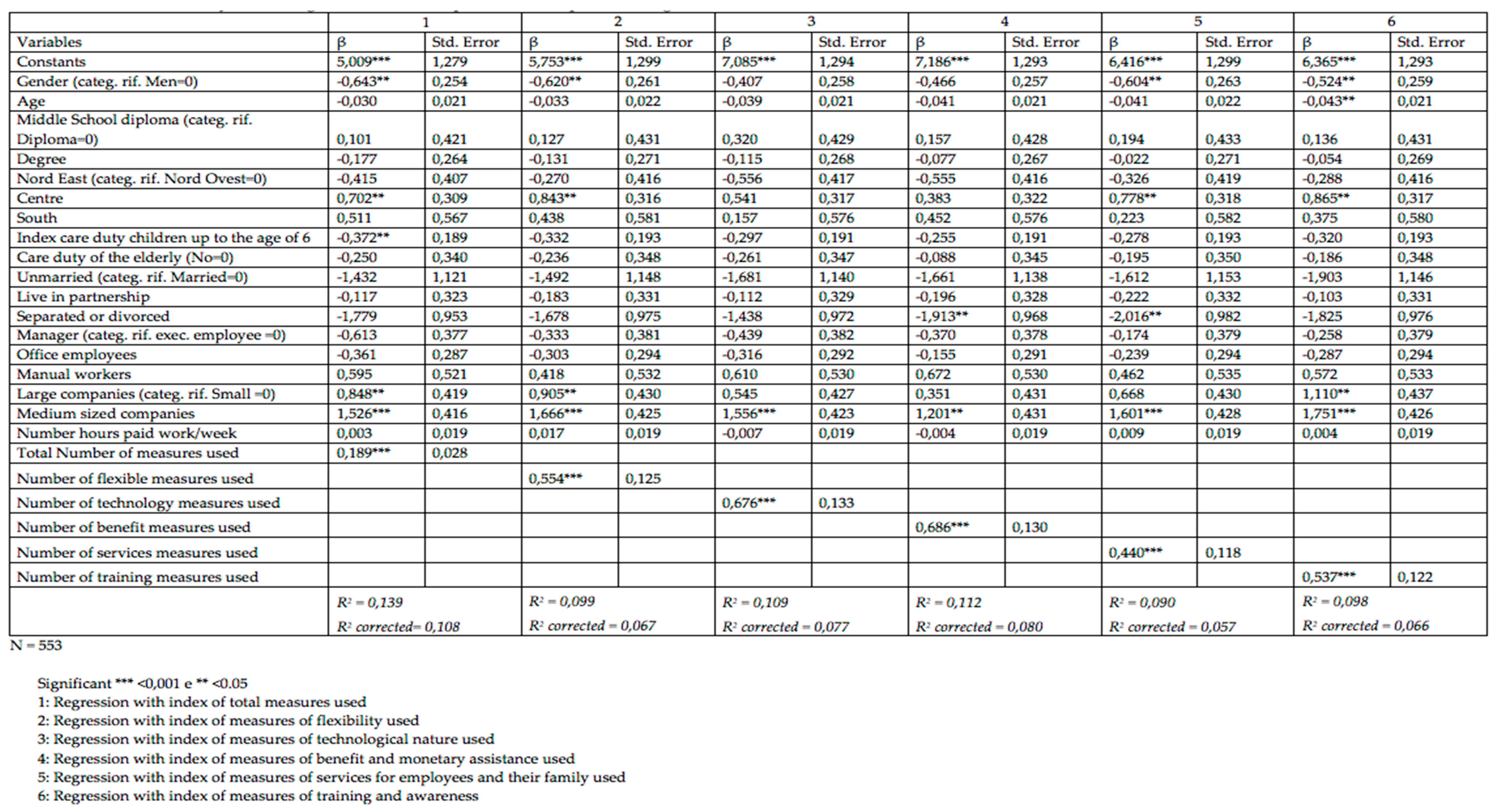
In order to test our working hypotheses, we resorted, after having proceeded with the mono and bivariate analysis, to multiple linear regression (Correll et al. 2007; Barbaranelli 2003) (Figure 1).
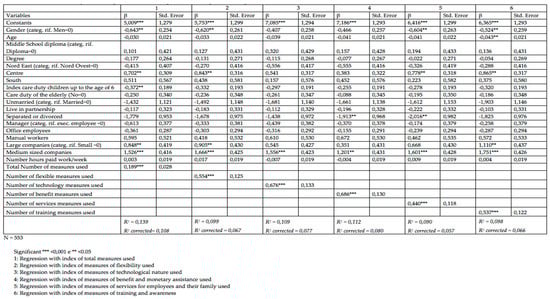
Figure 1.
Index of family well-being in relation to the partner—Multiple linear regression.
Regarding the first hypothesis (H1), the relationship between the perceived improvement in the well-being of a couple5 (dependent variable) and the number of measures used (independent) was studied. As control variables, the following were included in the model: Gender, age, educational qualification, geographical area, care duties for children up to six years, care for the elderly, marital status, professional qualification, company size, and number of hours worked per week. From the data shown in Table 3, it is noted that, as the number of measures used by an employee increased, the individual perception of well-being within the relationship with the partner increased.
Table 3.
Index of couple well-being. Flexibility measures. Multiple linear regression. Variables included in the model: Gender, age, educational qualification, geographical area, care duty for children up to 6 years, care of elderly people, marital status, professional qualification, company size, number of hours worked/week.
The gender variable (H1a) was significant and indicated that men perceive greater well-being than women. It suffices to say that, with all the other variables placed at a constant equal to zero, the average value of well-being for men was that indicated by the constant in the table (5.00), while that of women was 4.37 (5.00–0.643), therefore more than half a point lower on the scale of 1–10.
It was above all the workers of Central Italy employed in medium and large enterprises who perceived greater benefits regarding the well-being of the couple.
With regard to the goodness of fit of the model, we observed a value of the corrected coefficient of determination R2 of 0.108, indicating that almost 11% of the variance of the welfare is explained by the independent variables included in the model presented here.6
With respect to the variables referring to the nuclear family, it was observed that employees with a care duty of children between the ages of 0 and 6 reported a lower increase in well-being related to the couple in contrast to those who did not have this type of responsibility. With respect to the variable referring to duty of care of elderly relatives, there was no significant finding. This was due to the fact that only 16.3% of the sample had this responsibility and the measures implemented by the companies do not explicitly provide for these needs. If 0.10 is maintained as the level of significance, it is also possible to consider the marital status as a significant variable and to state that employees with broken-down family ties (separations/divorces) reported a slighter increase in the perception of the improvement of the well-being of the couple.
Let us now turn to the hypothesis (H2) analyzing the effects of the different types of additive sub-indices of measures on the perception of the improvement of well-being in the relationship with a partner. With regard to flexibility measures7, it was noted that the situation remained unchanged from the above, except for the fact that the care load index, referring to the presence of pre-school children, lost significance. The flexibility measures intervened on the perception of the improvement of the couple relationship regardless of the duty of care that the employee had of children and elderly. These measures seemed to play an important role in determining the improvement of such well-being because, all other dimensions being equal, for each unit variation of the flexibility measures index (therefore, the index being a mere calculation of the number of flexibility measures used), there was an increase of about half a point of the couple well-being index.
When the focus was placed on technological measures, the data showed an interesting fact: The gender variable—which from the previous analysis, as expected, presented a certain importance—now lost its significance. This indicates that the use of these types of measures brings about an increase in the perception of the improvement of the well-being of a couple, irrespective of whether the employee is a man or a woman. After a careful analysis of the Family Audit program implemented, these measures are usually addressed to employees returning from maternity leave. It gives them the opportunity to not reduce their working time (opting, for example, for part-time work) by giving them the option to work remotely, thereby being able to also respond to family needs.
The use of measures related to financial aid and benefits showed, instead, an interesting finding in respect of the marriage status variable. The separated or divorced employees showed a very low increase in the perception of the improvement of well-being of the couple, highlighting a difficulty in contrast to their colleagues. The values recorded in correspondence with the gender variable and the care duty index suggested that these were mostly separated or divorced female employees who were therefore faced with the care load of more than one nuclear family.
The services provided by the Family Audit for employees and/or their families8 affect the perception of couple well-being and report an important difference for the variable of gender (still in favor of male employees) and for the age variable (with greater benefits for younger employees9). The geographical area in which the workers lived (with a greater advantage for the central area) and the size of the company they worked for (with an advantage for medium-sized companies) were also significant. The family services seem to provide help to the separated and divorced employees even if the increase in the perception of well-being of the couple was very limited.
Finally, the use of communication, training, and information measures on conciliation issues10 had the same trend seen above, with the exception of the age-related variable: These measures seemed to be more useful for young employees rather than those at a more mature age.
Given the role that was played by the flexibility measures used in determining the improvement of the perception of the well-being of the couple, it was decided to analyze the impact of the individual measures by focusing the analysis on the most relevant ones to verify hypothesis (H2). The data showed that flexible time, part-time, as well as smart-working have a positive impact on the subjective perception of the improvement of couple well-being (Table 3).
The lowest impact was recorded for the part-time measure. This measure is used mostly by women, and while on the one hand, it responds effectively to the need of balancing family and work, on the other hand it poses financial constraints and sometimes even constraints on their professional profiles. Women working part-time often occupy positions for which they are over-qualified and see their careers slow down; part-time work, in the Italian context, often gives rise to the phenomenon of ceiling glass. The impact of smart-working and, to a slightly lesser extent, flexible work time, on the subjective perception of well-being of the couple remains evident (H2a). During the analysis, we also created two sub-indexes of the family well-being index dividing the instrumental and expressive elements11. In particular, we created a sub-index called family work–care relationship index; it included two variables: Sharing of household tasks; sharing care tasks (can refer to children and/or the elderly). The second sub-index was called the emotional and supportive couple relationship index, and it included three variables: Partaking in leisure activities together; availability for dialogue; and mutual support. The sub-indexes did not present different outputs of analysis in respect of the couple relationship well-being index. This means that all the variables we identified to explain the couple relationship well-being contributed in the same way to explain the phenomenon.
4. Conclusions
Our analysis of the data showed that the Family Audit measures had a significant impact on the perception of the improvement of the well-being of the couple relationship for the employees who took care of children or/and elderly. However, this impact was mediated by some elements that may be relevant for future reflection by the various parties involved: Individuals on the institutional level (who promoted and financed the Family Audit), the companies that implemented it, and finally the researchers who are trying to understand the factors and the social mechanisms that create enabling interfaces between family and work (Ireson et al. 2016).
The analysis made it possible to verify that the increased use of work–life balance measures is related to the perception of improvement in the well-being of a couple. This evidence seems to indicate clearly that if work–life balance measures are conceived and implemented within a structured path that has its starting point in the analysis of the company context and the needs of the employees, these measures can be considered interfaces that are capable of influencing the subjective perception of couple well-being. Contrary to what we hypothesized, starting from the data of the Italian context, the measures seem to produce greater satisfaction for men, rather than for women.
If the perception of improvement in the well-being of the couple increases with the increase in the number of measures used, nothing is yet said regarding the difference between the types of measures. We wanted to focus the analysis on the types of measures that seem to have the biggest influence on the improvement of the subjective perception of the well-being of a couple, those oriented towards work flexibility. In fact, the analysis showed that the measures that are most correlated to improved perception are those related to the area of work flexibility and ICT, in particular those that allow a “smart” organization of work. It can therefore be concluded that the Family Audit programs which could have the greatest impact on the perception of the improvement of the well-being of the couple are more complex and articulate, i.e., those that have implemented measures in all areas of intervention, with particular reference to measures containing high levels of flexibility. These types of measures are most often used by workers to carve out a balance between family and work that is as personalized as possible, starting from the arrangement within the couple itself and its care duties.
Regarding the variables referred to on the couple level, as well as the characteristics of the family, there was a lower perception of the increase in well-being produced by the use of Family Audit measures for women, for those who had broken-down family relationships (separations or divorces), and for those who cared for preschoolers (0–6 years). The analysis therefore seems to indicate that the measures put in place by companies, although definable in terms of social innovation—both from the point of view of the process and of the product (Macchioni 2014)—are not sufficient to trigger significant changes in the perception of couple well-being. The data showed that the work–life balance measures implemented by companies cannot cancel the effects of the gender variable, because men seem to perceive greater well-being, and while women use the measures in order to keep the balance between work and family, they seem to reproduce even perverse effects on this balance.
In conclusion, we can state that the work–life balance programs implemented by workplace organizations through the Family Audit certification are able to increase the perception of couple well-being, but they are not yet relevant in identifying a daily work–life balance. When the employees were asked which elements were fundamental in everyday life to reconcile family and work responsibilities, they replied, in the first place, “personal organizational capacity” (respectively 45.5%) and, in the second place, “aid from the partner” (30.6%); in the third place was the presence of an “extended family network willing to help” (27.5%), relegating to the last places “corporate welfare” (24.9%) and “presence of adequate services in the area” (22.4%). This seems to indicate that, from the perception of workers, personal strategies and aid coming from the informal social network are still fundamental, as much other research has already shown (ISTAT 2016).
The fact that the impact perceived was mediated by the gender variable, with lower perceptions of improvement of couple well-being for women, suggests three considerations which highlight the limitations of this work and launch new research paths. The first concerns the possibility of analyzing how the different items that make up couple well-being, and in particular those related to the sharing of domestic and care tasks, are related to gender models. The second consideration refers to an interpretative hypothesis to be verified, according to which women perceive improvements of couple well-being less than men because they tend to re-invest the time and resources freed from the work–life balance measures into the care of their families and homes. This creates a paradoxical situation whereby women no longer need work–life balance tools but they need them to increase their commitment to what Hochschild (1989) calls “double shift”.
The third consideration concerns the institutional level of organization of the policy. In fact, it can be hypothesized that the characteristics identified by Esping-Andersen in the familial welfare system also play an important role in the perception of well-being by mediating the effect produced by the measures. Even Morgan (2012), more recently, when analyzing the work–family policies of some European countries by using the social investment approach, has included Italy (together with Spain and Austria) in the cluster of “slow moving” countries. This indicates that welfare is still essentially based on money transfers and is poor in services for early childcare and long–term care sectors. Furthermore, in this cluster of countries there is still a strong involvement of family members in informal and unpaid care activities. What is still missing in the Italian context is a coordination of the various work–life balance policies so that the innovative measures are able to produce the desired effects in terms of gender equality and family well-being.
Author Contributions
Conceptualization, R.P.; methodology, E.M.; formal analysis, E.M.; writing—original draft preparation, E.M.; writing—review and editing, E.M.; supervision, E.M.; project administration, R.P. and E.M.; funding acquisition, R.P.
Funding
This research received external funding.
Conflicts of Interest
The authors declare no conflict of interest.
References
- Abendroth, Anja-Kristin, and Laura den Dulk. 2011. Support for the work-life balance in Europe: The Impact of State, Workplace and Family Support on Work-Life Balance Satisfaction. Work, Employment and Society 25: 234–56. [Google Scholar] [CrossRef]
- Addabbo, Tindara, Amélia Bastos, Sara Falcão Casaca, Nata Duvvury, and Áine Ní Léime. 2017. Gender and labour in times of austerity: Ireland, Italy and Portugal in comparative perspective. In Women, Gender and Work. Social Choices and Inequalities. Ginevra: International Labour Office, vol. 2, pp. 357–81. ISBN 9789221308690. [Google Scholar]
- Almudena, Moreno Minguez. 2012. Family Well-Being. European Perspectives. Berlin: Springer Science & Business Media. [Google Scholar]
- Andrews, Frank, and Stephen Withey. 1976. Social Indicators of Well Being. New York: Plenum Press. [Google Scholar]
- Arts, Wil A., and John Gelissen. 2010. Models of the Welfare State. In The Oxford Handbook of the Welfare State. Edited by Francis G. Castles, Stephan Leibfried, Jane Lewis, Herbert Obinger and Christopher Pierson. Oxford: Oxford University Press, ISBN 9780199579396. [Google Scholar]
- Barbaranelli, Claudio. 2003. Analisi dei dati. Tecniche Multivariate per la Ricerca Psicologica e Sociale. Milano: LED—Edizioni Universitarie di Lettere Economia e Diritto, ISBN 9788879163385. [Google Scholar]
- Barnett, Rosalind Chait, and Janet Shibley Hyde. 2001. Women, Men, Work and Family. American Psychologist 56: 781–96. [Google Scholar] [CrossRef]
- Bianchi, Suzanne M., and Melissa A. Milkie. 2010. Work and Family Research in the First Decade of the 21st Century. Journal of Marriage and Family 72: 705–25. [Google Scholar] [CrossRef]
- Bonoli, Giuliano. 2007. Time Matters. Postindustrialization, New Social Risks, and Welfare State Adaptation in Advanced Industrial Democracies. Comparative Political Studies 40: 495–520. [Google Scholar] [CrossRef]
- Byron, Kristin. 2005. A Meta-Analytic Review of Work-Family Conflict and Its Antecedents. Journal of Vocational Behavior 67: 169–98. [Google Scholar] [CrossRef]
- Campbell, Angus, Philip E. Converse, and Willard L. Rodgers. 1976. The Quality of American Life. Perceptions, Evaluations, and Satisfactions. New York: Russel Sage Foundation. [Google Scholar]
- Cannito, Maddalena. 2019. Beyond “Traditional” and “New”: An Attempt of Redefinition of Contemporary Fatherhoods Through Discursive Practices and Practices of Care. Men and Masculinities, 1–19. [Google Scholar] [CrossRef]
- Colazzo, L., A. Molinari, and N. Villa. 2009. Lifelong Learning and Virtual Communities in Public and Private Companies. Paper presented at ICELW 2009—International Conference on E-Lerning in the Workplace, New York, NY, USA, June 10–12. [Google Scholar]
- Corposanto, Cleto. 2001. Tecniche del Sondaggio D’opinione. Trieste: LINT, ISBN 88-8190-128-5. [Google Scholar]
- Correll, Shelley J., Stephen Benard, and In Paik. 2007. Getting a Job: Is There a Motherhood Penalty? American Journal of Sociology 112: 1297–338. [Google Scholar] [CrossRef]
- Craig, Lyn, and Killian Mullan. 2010. Parenthood, Gender and Work-Family Time in the United States, Australia, Italy, France and Denmark. Journal of Marriage & Family 72: 1344–61. [Google Scholar] [CrossRef]
- Crouch, Colin. 1999. Social Change in Western Europe. Oxford: Oxford University Press, ISBN 9780198780687. [Google Scholar]
- De Simone, Silvia, Jessica Lampis, Diego Lasio, Francesco Serri, Gianfranco Cicotto, and Daniela Putzu. 2014. Influences of Work-Family Interface on Job and Life Satisfaction. Applied Research Quality Life 9: 831–61. [Google Scholar] [CrossRef]
- Esping-Andersen, Gøsta. 2009. The Incomplete Revolution: Adapting to Women’s New Roles. Cambridge: Polity Press, ISBN 0745643167, 9780745643168. [Google Scholar]
- Esping-Andersen, Gøsta, Bruno Arpino, and Léa Pessin. 2015. How do changes in Gender Role Attitudes towards Female Employment influence Fertility? A Macro-Level Analysis. European Sociological Review 31: 370–82. [Google Scholar] [CrossRef]
- Eurofound. 2017. European Quality of Life Survey 2016: Quality of Life, Quality of Public Services, and Quality of Society. Luxembourg: Publications Office of the European Union, ISBN 978-92-897-1622-2. [Google Scholar]
- Eurofound. 2018. Striking a Balance: Reconciling Work and Life in the EU. Luxembourg: Publications Office of the European Union. [Google Scholar]
- European Commission. 2015. Measures to Address the Challenges of Work-Life Balance in the EU Member States, Iceland, Liechtenstein and Norway. Luxembourg: Publications Office of the European Union, ISBN 978-92-79-54060-8. [Google Scholar]
- Ferragina, Emanuele, and Martin Seeleib-Kaiser. 2011. The welfare regime debate: Past, present, future? Policy & Politics 39: 583–611. [Google Scholar] [CrossRef]
- Ferrera, Maurizio. 1996. The «Southern Model» of Welfare in Social Europe. Journal of European Social Policy 6: 16–37. [Google Scholar] [CrossRef]
- Ferrera, Maurizio, and F. Maino. 2014. Social Innovation Beyond the State. Italy’s Secondo Welfare in a European Perspective. Working Paper-2 Welfare. Available online: http://secondowelfare.it/allegati/ferrera_maino_wp2_2014_2wel.pdf (accessed on 28 December 2018).
- Frankle, Charles. 1976. Controversies and Decisions. The Social Science and Public Policy. New York: Russell Sage Foundation. [Google Scholar]
- Gallie, D. 2017. The Quality of Work in a Changing Labour Market. Social Policy & Administration 51: 226–43. [Google Scholar] [CrossRef]
- Gavio, Francesca, and Raffaele Lelleri. 2007. La fruizione dei congedi parentali in Italia nella pubblica amministrazione, nel settore privato e nel terzo settore. Monitoraggio dell’applicazione della legge n. 53/2000 dal 2001 al 2004. In Famiglie e Bisogni Sociali: La Frontiera Delle Buone Prassi. Milano: FrancoAngeli, pp. 256–87. [Google Scholar]
- Gottardi, Donata. 2010. La legislazione e le politiche sulla conciliazione: l’Italia nel quadro europeo. Sociologia del Lavoro 119: 23–38. [Google Scholar]
- Gottardi, Donata. 2016. Introduzione. Le Modifiche al Testo Unico Maternità-Paternità e la Conciliazione tra vita Famigliare e vita Professionale. Ragionando di d.lgs. n. 80/2015 e Dintorni La Conciliazione delle Esigenze di cura, di vita e di Lavoro. Il Rinnovato T. U. n. 151/2001 ai sensi del d. lgs. n. 80/2015. Torino: Giappichelli, pp. 1–12. [Google Scholar]
- Greenhaus, Jeffrey H., and Ellen Ernst Kossek. 2014. The contemporary career: A work-home perspective. Annual Review of Organizational Psychology and Organizational Behavior 1: 361–88. [Google Scholar] [CrossRef]
- Griffin, James. 1988. Well-Being: Its Meaning, Measurement and Moral Importance. Oxford: Oxford Clarendon Press, ISBN 9780198248439. [Google Scholar]
- Hochschild, Arlie R. 1989. The Second Shift. Working Parents and the Revolution at Home. New York: Viking Press, ISBN 978-0142002926. [Google Scholar]
- Hoessle, U. 2016. Reconciling Work and Life. Experiences from Germany. Seattle: WWS Worldwide. [Google Scholar]
- Ireson, Rachelle, Bharati Sethi, and Allison Williams. 2016. Availability of caregiver-friendly workplace policies: An international scoping review. Health and Social Care in the Community 6: e1–e14. [Google Scholar] [CrossRef] [PubMed]
- ISTAT. 2016. I Tempi Della vita Quotidiana. Roma. Available online: http://www.istat.it/it/archivio/193098 (accessed on 28 December 2018).
- Knijn, Trudie, and Monique Kremer. 1997. Gender and the Caring Dimension of Welfare States: Toward Inclusive Citizenship. Social Politics: International Studies in Gender, State & Society 4: 328–61. [Google Scholar] [CrossRef]
- Kremer, Monique. 2007. How Welfare States Care. Culture, Gender and Parenting in Europe. Amsterdam: Amsterdam University Press. [Google Scholar]
- Kroger, T., and S. Yeandle. 2013. Combining Paid Work and Family Care: Policies and Experiences in International Perspective. Bristol: Policy Press, ISBN 978-1447306825. [Google Scholar]
- Kuitto, Kati. 2016. From social security to social investment? Compensating and social investment welfare policies in a life-course perspective. Journal of European Social Policy 26: 442–59. [Google Scholar] [CrossRef]
- Lewis, Jane. 2006. Work/Family Reconciliation, Equal Opportunities and Social Policies: The Interpretation of Policy Trajectories at the EU Level and the Meaning of Gender Equality. Journal of European Public Policy 13: 420–37. [Google Scholar] [CrossRef]
- Lister, Ruth, Fiona Williams, Anneli Anttonen, Jet Bussemaker, Ute Gerhard, Jacqueline Heinen, Stina Johansson, Arnlaug Leira, Birte Siim, Constanza Tobío, and et al. 2007. Gendering Citizenship in Western Europe: New Challenges for Citizenship Research in a Cross-National Perspective. Bristol: Policy Press. [Google Scholar]
- Macchioni, Elena. 2008. Sostegni alla maternità e alla paternità nella legge 53/2000: Quali possibili sviluppi nell’ottica di livelli più avanzati di conciliazione. In La cura Della Famiglia e il Mondo del Lavoro. Milano: Franco Angeli, pp. 195–271. [Google Scholar]
- Macchioni, Elena. 2012. Welfare aziendale. Buone pratiche di conciliazione famiglia-lavoro. Roma: Osservatorio Nazionale sulla Famiglia. [Google Scholar]
- Macchioni, Elena. 2014. Culture e Pratiche di Welfare Aziendale. Dalla Responsabilità alla Cittadinanza D’impresa. Mimesis Edizioni: Milano-Udine, ISBN 978-8857524719. [Google Scholar]
- Malfer, Luciano. 2012. Family Audit: La Nuova Frontiera del noi. Linee Guida per la Certificazione Aziendale. Milano: FrancoAngeli, ISBN 9788856858822. [Google Scholar]
- Malfer, Luciano, C. Cittadino, M. Franch, and R. Prandini. 2014. Family Audit: La Certificazione Familiare Aziendale. Analisi di Impatto. Milano: FrancoAngeli, ISBN 8891703656, 9788891703651. [Google Scholar]
- Mauceri, Sergio, and Alessia Valentini. 2010. The European delay in transition to parenthood: The Italian case. International Review of Sociology 20: 111–42. [Google Scholar] [CrossRef]
- Miller, Dorothy A. 1981. The ‘Sandwich’ Generation: Adult Children of the Aging. Social Work 26: 419–23. [Google Scholar] [CrossRef]
- Moreno Minguez, Almudena. 2013. Family Well-Being. European Perspectives. Amsterdam: Springer. [Google Scholar] [CrossRef]
- Morgan, Kimberly J. 2012. Promoting Social Investment Through Work-Family Policies: Wich Nations Do It and Why? In Towards a Social Investment Welfare State? Ideas, Policies and Challenges. Bristol: Policy Press, pp. 153–80. ISBN 9781847429254. [Google Scholar]
- OECD. 2013. OECD Guidelines on Measuring Subjective Well-Being. Paris: OECD Publishing. [Google Scholar]
- Ollier-Malaterre, Ariane. 2017. Care across the globe: The impact of national culture and structure. Sociologia e Politiche Sociali 3: 9–22. [Google Scholar] [CrossRef]
- Ollier-Malaterre, Ariane, and Annie Foucreault. 2017. Cross-national Work-Life Research: Cultural and Structural Impacts for Individuals and Organizations. Journal of Management 43: 111–36. [Google Scholar] [CrossRef]
- Parsons, Talcot, and Neil J. Smelser. 1956. Economy and Society: A Study in the Integration of Economic and Social Theory. Glencoe: The Free Press. [Google Scholar]
- Rettig, Kathryn, and Ronit Leichtentritt. 1999. A General Theory for Perceptual Indicators of Family Life Quality. Social Indicators Research 47: 307–42. [Google Scholar] [CrossRef]
- Ricca, M. 2016. I Benefici Economici Della Certificazione Family Audit. Conto Economico della Conciliazione. Cassa Rurale di Fiemme, Collana “TrentinoFamiglia”. Available online: https://www.trentinofamiglia.it/Documentazione/Pubblicazioni (accessed on 28 December 2018).
- Sahibzada, Khatera, Leslie B. Hammer, Margaret N. Neal, and Daniel C. Kuang. 2005. The Moderating Effects of Work-Family Role Combinations and Work-Family Organizational Culture on the Relationship Between Family-Friendly Workplace Supports and Job Satisfaction. Journal of Family Issues 26: 820–39. [Google Scholar] [CrossRef]
- Saraceno, Chiara. 2011. Beyond Care. The Persistent Invisibility of Unpaid Family Work. Sociologica 1: 1–16. [Google Scholar]
- Sen, Amartya. 1985. Commodities and Capabilities. Amsterdam: Elsevier Science Publishers B.V. [Google Scholar]
- Sen, Amartya. 1993. Economics and the Family. In Family, Kinship and Marriage in India. Edited by Patricia Uberoi. Delhi and New York: Oxford University Press, pp. 452–66. [Google Scholar]
- Shockley, Kristen M., and Winny Shen. 2016. Couple Dynamics: Division of Labor. In The Oxford Handbook of Work and Family. Oxford: Oxford University Press, ISBN 9780199337538. [Google Scholar]
- Vuksan, Mirjana, Allison Williams, and Valorie Crooks. 2012. Family friendly policies: Accommodating end-of-life caregivers in workplaces. International Journal of Workplace Health Management 5: 4–14. [Google Scholar] [CrossRef]
| 1 | |
| 2 | For more information, see: https://eige.europa.eu/gender-mainstreaming/good-practices/about. |
| 3 | To examine the approach in depth, see: www.stiglitz-sen-fitoussi.fr; (OECD 2013). |
| 4 | We identified these five variables thanks to three qualitative research projects done between 2009 and 2012 with the same design of the research we present in this paper. The research focus was to analyze how the work–life balance measures put in place by companies affect employees’ quality of life on the following levels: Personal, professional, and family. We chose these three different areas due to the work of (Parsons and Smelser 1956) titled “Economy and Society”, written in 1956. These research projects involved, through in-depth interviews, 150 employees from different organizations and sectors. (For more information see: Macchioni 2012). |
| 5 | The analysis in its main components regarding the original variables identified two factors. The first one was able to explain as much as 81.8% of the total variance, to which all the items related to the relationship with the children and the partner can be contributed, and the second was able to explain 9.6% of the overall variance, to which the items related to elderly or non-self-sufficient relatives can be contributed. |
| 6 | Instead of using the coefficient of determination R2—of which the value, with all other conditions being equal, increases with the number of variables inserted in the model—we refer to the corrected R2 coefficient that takes into account the number of independent variables inserted (R2 corrected = R2 (nK)/n − 1, where K indicates the number of predictors included in the model and N the number of cases. R2 is therefore a coefficient that is exempt from the approximation error due to the number of predictors considered in the model. This corrected coefficient, unlike the non-corrected one, can decrease if the variables added to the model provide a modest contribution to the explanation of the variance of the dependent variable (Barbaranelli 2003). |
| 7 | The three most common measures in the plans are: Teleworking, remote work, or smart working (26 actions); team work, the reorganization of tasks, and the mapping of skills (20 actions); flexible entry-exit time or personalized work time (20 actions). |
| 8 | On the other hand, family services refer to 43 actions that include a company nursery, various forms of baby-sitting, summer activities for children and teenagers, services for families in need of assistance, psychological support desks, recreational initiatives for employees and family members, and job orientation for the children of employees. |
| 9 | This data can be explained by the analysis of the plans of companies which do not have services to support the care needs of elderly family members, and/or in conditions of fragility, the services present, although limited, concern the needs related to families with children of a school-going age, also because the sample we analyzed had an average age of 44 years. |
| 10 | The macro-area Communication consisted of two fields of action: Training, i.e., all those actions aimed at raising awareness of the services and practices for work–life reconciliation and acquiring skills through structured courses and surveys, i.e., all activities aimed at collecting reconciliation needs, through needs analysis, business climate analysis, monitoring, and evaluation of reconciliation plans. Of the 129 total actions of this macro-field, 99 concerned training and 30 concerned surveys. |
| 11 | It is possible to ask the authors for the outputs of the analysis. |
© 2019 by the authors. Licensee MDPI, Basel, Switzerland. This article is an open access article distributed under the terms and conditions of the Creative Commons Attribution (CC BY) license (http://creativecommons.org/licenses/by/4.0/).