
Addressing Menstrual Stigma: A Scoping Review on Menstrual Health Interventions in India




Abstract
1. Introduction
1.1. Enactment of (Menstrual) Stigma
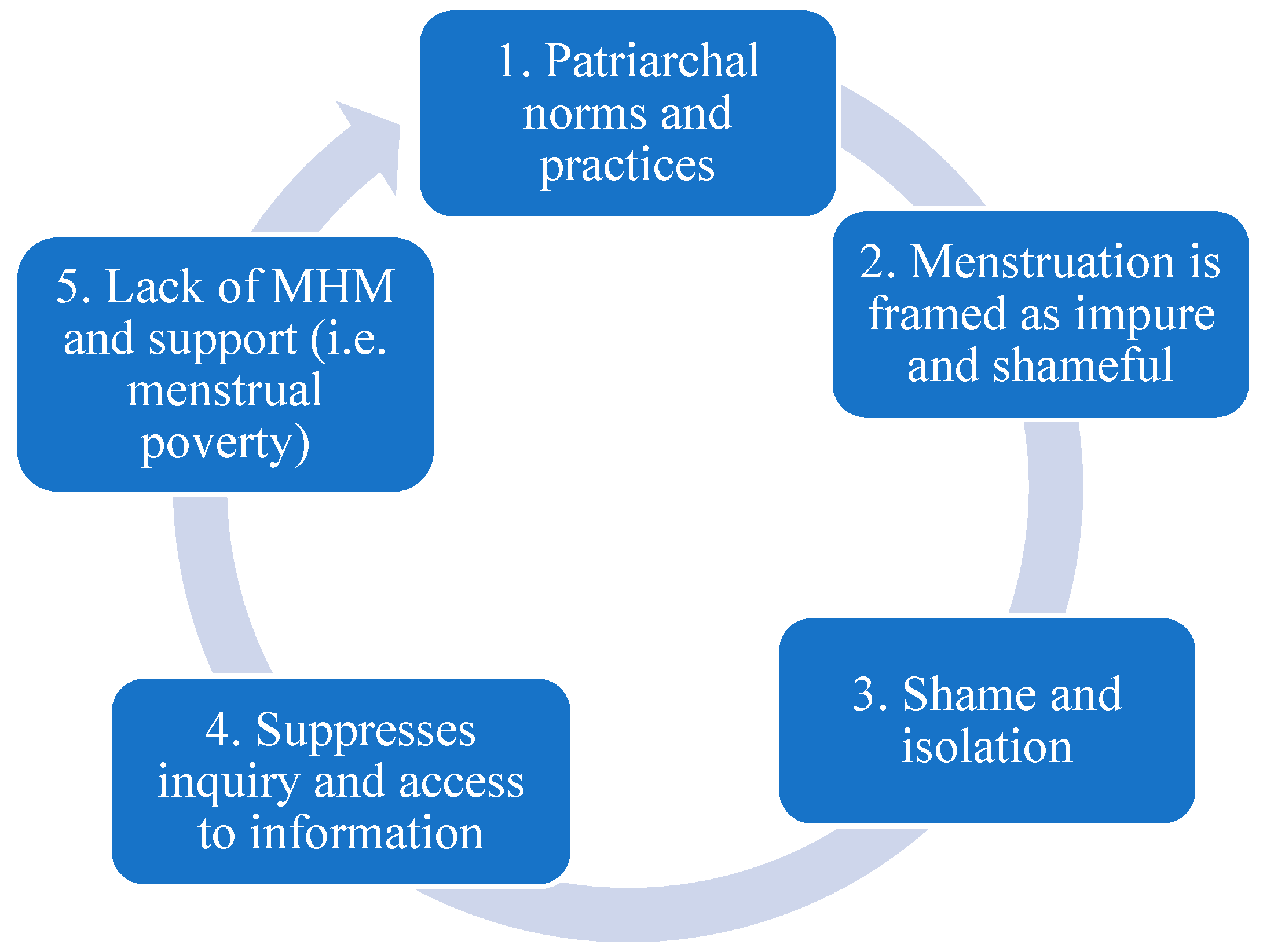
1.2. Menstrual Stigma in India
1.3. Menstrual Stigma as a Social Determinant of Health
2. Materials and Methods
2.1. Sources and Search Strategy
2.2. Inclusion and Exclusion Criteria
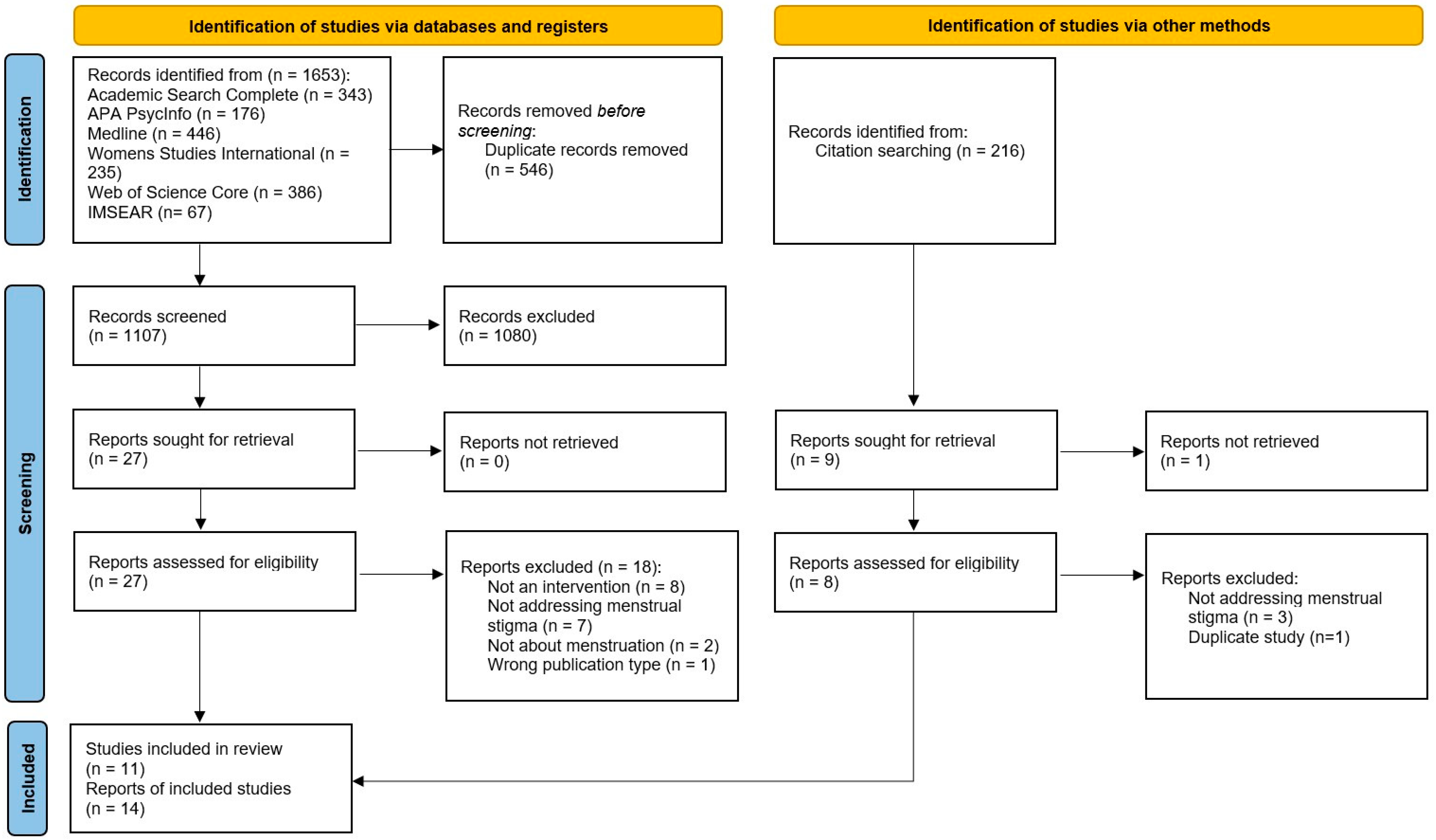
2.3. Study Screening
2.4. Methodological Limitations
2.5. Data Extraction
3. Results
3.1. Summary of Included Studies
3.2. Populations
3.3. Interventions
3.4. Study Characteristics and Assessment
3.5. Study Findings
3.6. Recommendations from the Included Studies
4. Discussion
Methodological Limitations
5. Conclusions
Author Contributions
Funding
Institutional Review Board Statement
Informed Consent Statement
Data Availability Statement
Conflicts of Interest
Abbreviations
| MHM | Menstrual health management |
| MHMP | Menstrual health management product |
| STI | Sexually transmitted infection |
| WASH | Water, sanitation, and hygiene |
Appendix A. Scoping Table
| No. | Source Article | Study Location | Participants | Type of Intervention | Intervention Objective | Study Design | Intervention Indicator(s) | Intervention Outcomes/Study Findings | Study Recommendations |
| 1 | (Arora et al. 2013) | Haryana State, Ambala District Rural villages | School girls (grade 9–10) 50% middle class, 32% lower class N = 200 | Sexual Education: One educational lecture using audio-visual aids about the science of menstruation, hygiene practices, and menstruation ‘myths’, followed by a discussion and Q&A session. | Assessing status of hygiene, knowledge and practices pre- and post- intervention. | Quantitative. (1) Pre-test questionnaire (2) Lecture (3) Post-test questionnaire (2 months) | Changes in behaviors (e.g., hygiene practices, isolation) and knowledge (e.g., physiology, health outcomes) | No significant difference in ‘restrictions’. Significant improvements in knowledge and practices of the science of the menstrual cycle and menstrual hygiene management (MHM). | Form peer groups so girls can discuss issues of menstruation openly. Include this type of health education in school curriculums |
| 2 | (Bhagwat and Jijina 2020) | Gujarat State, Vardodara District Rural villages | Women, Schoolgirls (age 14–17) Lower-middle class N = undisclosed | Income generating activity: Using a social enterprise model, a local NGO encourages women to buy a machine to produce menstrual pads. The NGO trains the women in hygiene practices, pad production, and selling techniques, including Indigenous social marketing (e.g., use of folk songs). The women produce and sell pads to the women in their community and provide education on menstrual hygiene. NGO hosts educational sessions with schoolgirls about MHM. | Project Sakhi (1) Provide low-cost sanitary pads for the community, (2) Provide employment and financial independence, (3) Teach girls and women about MHM. | Qualitative. Observations and semi-structured interviews with project founders, village women working for the project and adolescent girls, NGO worker. Data analysis via thematic network analysis. | (1) Access to and affordability of menstrual hygiene products, (2) generation of revenue, (3) providing employment and livelihood, (4) environmental considerations. Evaluation of the model in the Indian context (i.e., sustainability, material supply chain). | The initiative normalized conversations about menstruation and participants reported feeling more comfortable discussing menstruation after being enrolled in the program. Participants remain unclear about the science of the menstrual cycle. | Interventions must include lessons on female anatomy and the menstrual cycle to educate girls and women to address myths associated with the ‘cultural rules’. Mothers need more education to help teach their daughters about menstruation. |
| 3 | (Dharmalingam 2022) | Tamil Nadu State, Thoothukudi District | Rural, adolescent Unmarried, female college students (age 17–20) Mixed socio-economic status 97.6% first generation students N = 80 | Sexual education. (1) animated video on menstrual hygiene, (2) 30-min lesson on female physiology and hygienic practices using visual aids, (3) Q&A session. | Improve participants’ menstrual hygiene practices; improve attendance. | Quantitative. Pre and post-intervention self-administered, semi-structured questionnaire. assessing (1) socio-demographics, (2) knowledge on menstruation, and (3) menstrual hygiene practices | Knowledge and beliefs about menstruation | Physiological knowledge and practices regarding MHM improved. The intervention managed to address incorrect beliefs about menstruation, which may help break misconceptions and myths. | Age-appropriate lectures on menstrual health and hygiene should be included in the school curriculum. Include appropriate waste management strategies related to menstrual products. |
| 4 | (Dongre et al. 2007) | Maharashtra State, Wadha District 23 villages | Girls (age 12–19). 75% attended school Phase 1: 71.1% reached menarche (2003) Phase 2: 75.5% reached menarche (2007) N = 420 | Peer to Peer education. (1) The authors and local health professionals developed education materials (i.e., flip books), (2) train adolescent girls to become peer educators and (3) peer educators trained other girls in the community through quarterly sessions | Health worker supported training of adolescent girls in the local Kishori Panchayat (girl groups) to train other girls; understand impacts to awareness and behavior | Mixed methods. (1) Needs assessment: structured survey, three focus groups (2) Development of the flip book (3) Disseminating messages and training youth educators, and (4) Impact evaluation three years later (survey, qualitative trend analysis, arts-based methods). | Improvement in MHM. Awareness of menstruation before menarche, ability to visit doctors with menstrual complaints. Changes in MHM behaviors (i.e., drying clothes in a dry area). | Knowledge about MHM significantly increased, and taboos and embarrassment surrounding menstruation decreased. | Use NGOs and local girls’ groups as an educational resource in the absence of parents or teachers. |
| 5 | (Dorle et al. 2019) | Karnataka State, City of Bagalkot | College students (age 17–19) Mixed socio-economic status (42.7% middle class) N = 115 | Sexual education. Education on the causes of menstruation and healthy menstrual practices: three lectures with audio-visual aids (flipbook from local NGO), followed by a Q&A discussion. | (1) Assess baseline knowledge, (2) inform students about MHM, and debunk myths related to social restrictions (e.g., access to kitchens and places of worship) and isolation practices, (3) assess the impact of health education as an intervention. | Quantitative. (1) Pre-test, structured questionnaire (2) Receive training in MHM and the science of the menstrual cycle via a lecture format (3) Re-administer the questionnaire after three months. No control group. | (1) Change in beliefs/knowledge about menstruation (e.g., it is a normal phenomenon, menstruation, it is not a literal curse from God, menstrual blood is not impure, etc.), (2) Change in practices (e.g., hygiene practices, self-isolation, access/avoid kitchen space, visit/avoid holy places). | Highly significant post-intervention change in MHM knowledge and practices. Positive changes in potentially harmful beliefs. Fewer participants followed the ‘restrictions’ post-intervention, which indicated an increased level of informed choice on the matter. | Learning about menstruation should be part of the middle school curriculum. Boys should have correct knowledge to help guide their female family members. Younger girls need the intervention. Need community public health awareness for menstruation among mensurating girls and women. |
| 6 | (Dwivedi et al. 2020) | Rajasthan State, Keru village, Jodhpur (rural) | Schoolgirls (age 11–19). Mixed social classes. N = 100 | Peer to Peer. Education program using the comic book “Menstrupedia”. 10 peer educators were trained. Each peer educator was assigned a group of 8 participants to teach. | Improve menstrual hygiene awareness (PRAGATI [PeeR Action for Group Awareness through Intervention]) | Quantitative. (1) Pre-test survey including demographics, multiple choice questions related to behavior, knowledge (e.g., anatomy physiology, nutrition) and practices (e.g., hygiene). (2) Post-test one month after the training using the same survey. The post-test was administered to participants only (i.e., not peer trainers). | Change in knowledge, attitude, and practices related to menstrual hygiene. | Knowledge—science of the menstrual cycle and MHM—increased post-intervention. Perceptions of ‘cultural rules’ changed, and fewer followed the ‘restrictions’. Participants experienced a heightened comfort in talking openly about menstruation with their peers. | Use peer-group education as an intervention to improve the level of knowledge on less-talked about and sensitive issues (i.e., menstrual stigma). |
| 7 | (Reshmi et al. 2015) | Karnataka, Kolar District. Two taluks (administrative areas); Bangarpet Taluk (intervention site; T1), Malur Taluk (control site; T2) | Adult women (mean age 31.4) 95% married 35% low-caste 90% had ration cards 87–97% below poverty line N = 400 | Sexual education. Three-day workshop. Increase awareness of menstrual health and hygiene of women in pre-established ‘Self-Help Groups’ (SGH) using Information Education Communication (IEC). | Improved knowledge, attitudes, and practices (KAP) of menstrual hygiene among SHGs; goal to ‘educate and empower’ | Quantitative. Household surveys and focus groups. 15 workshops across three days with 75 SGHs. (1) Pre-test in T1 and T2 via household surveys and focus groups, (2) 15 three-day workshops in T1; T2 was a control group (no workshops were held here) (3) Post-test, same methods as the pre-test. Note: this source reported on household survey results only. | Change in KAP (e.g., social restrictions, menstrual blood (im)purity) in the test group (T1) compared to the control group (T2). | Significant improvement in knowledge about and management of menstruation in T1. The intervention proved insignificant in changing behavior and attitude towards ‘cultural rules’. T2 (control group) showed similar trends as T1. Efficacy of the intervention was unclear; maybe T2 women have been influenced by T1 women. | Need appropriate cost-effective strategies to address issues through information, education, and behavior change. Longer and more comprehensive interventions are needed to break misconceptions and malpractices related to social taboos. |
| 8 | (Parmar et al. 2008) | Western India, two rural villages | (1) Girls and women (ages 12–60), varying levels of literacy Low-income households N = 100 | Technology. Comparative study of (a) information sessions using a personal computer (PC) with a conventional health information system, to the (b) “Personal Health Information” (PHI) System–an interactive, non-text-based technology, based on context-specific issues that allow participants to review and discuss the information in groups. | Compare the outcome of PHI vs. PC influence on behavior change, including participants’ raised awareness and change of individual and social beliefs and practices regarding (a) menstruation and maternal health, (b) following correct health practices, and (c) improving personal health information dissemination. | Quantitative. (1) Assess local beliefs and practices (2) Divide participants into two groups. Village A = PCs; Village B = PHI. Each village had access for two months, with health providers available during set hours | Measure engagement through 1. The number and nature of questions asked related to ‘social issues’, practices, challenging existing beliefs, and personal experiences. 2. Number of times participants return to PC/PHI for more information. | Prior to the study, participants did not discuss menstruation and maternal health amongst themselves or with health professionals. Compared to Village A, more Village B (PHI) participants re-visited the intervention to learn more, were more willing to discuss private and/or taboo topics, and were more willing to confront social issues related to maternal health and MHM. The PHI was the more effective intervention to address taboos associated with menstruation and maternal health. | A combination of planned behavior theory and persuasive technology can play a positive role in design and development of health information systems for rural users. |
| 9 | (Ramaiya et al. 2019) | Uttar Pradesh State, three districts (Mirzapur, Jaunpur, Sonebhadra) | Unmarried girls (age 12–19) 90% in Scheduled Caste, Scheduled Tribe and Other Backward Caste. <50% temporarily housed. N = 188 (pre-menarche) N = 2212 (post-menarche) [parents and community health workers were part of the intervention, but were not participants in the study] | Sexual education. Life skills training. 3-year implementation of the holistic ‘Community Package’ program, GARIMA. Intervention design: (1) participants received a poster, personal diary, read storybooks, and watched films about menstruation, (2) local health workers and ‘peer educators’ received training about menstruation, (3) peer educators led monthly, participatory group meetings with girls where they determined the topics of discussion, (4) one-on-one discussions with peer trainers and health workers, (5) monthly meetings with study-participants’ mothers (6) group meetings with study-participants’ fathers. | GARIMA (implemented by UNICEF and local NGOs): Break the culture of silence around menstruation by addressing harmful social norms; normalize menstruation; reduce restrictions on menstruating persons; improve health and hygiene, especially among adolescent girls. | Quantitative. Post-test only, case comparison design with test and control groups. The post-test used a structured questionnaire related to knowledge, attitudes and practices (KAP) of participants in relation to menstruation. Compared responses between test and control groups. Bivariate and multivariate analysis used to correlate behaviors with attitudes on cultural rules (e.g., self-isolation, restrictions). | Knowledge, attitudes, interpersonal communication and restrictions related to menstruation and hygiene practices (e.g., change and disposal of sanitary products, bathing) | The test group showed positive results in relation to MHM and attitudes towards menstruation. They had a higher chance of having open communication with family and friends. Intervention unsuccessful in changing attitudes related to socio-religious or personal restrictions. | Interventions must involve families, peers and community members, and address restrictions directly, in order to improve attitudes towards menstruation. |
| 10 | (Sood et al. 2021) | 1. Personal beliefs and perceptions of practice of MHM behaviors (e.g., use of materials, disposal, school attendance, food demands, privacy, interaction with boys) 2. Social restrictions: what participants “cannot do” (structural barriers), what participants “will not do” (personally imposed barriers), what participants “should not do” (socially imposed barriers) | GARIMA participants challenged restrictions to a higher degree than the control group. Participants adopted practices related to good MHM. | More studies need to focus on changing social norms. Must assess social norms as a multi-dimensional (i.e., personal beliefs, perception of others’ beliefs, uptake of desired behaviors). Evaluations need indicators of change that can be applied in multiple contexts. | |||||
| 11 | (Block et al. 2023) | Quantitative. Case-comparison evaluation; questionnaire administered to 4 groups: (a) no intervention (control), (b) mediated practical guidance (MPG) intervention (i.e., film, storybooks, posters), (c) inter-personal practical guidance (IPG) (i.e., girl meetings, mothers’ and fathers’ groups) (d) MPG and IPG together. | KAP: Level of comfort in accessing menstrual hygiene supplies; ability to converse with other participants about menstrual supplies; knowledge of use and disposal of menstrual products. | IPG + MPG intervention (d) demonstrated the greatest odds of predicting correct MHM. Participants in the GARIMA intervention were more likely to discuss MHM (i.e., addressing the “culture of silence”) and were more comfortable in accessing supplies. | Practical interventions need to address the “culture of silence”. Family members and teachers need programming in order to support their daughters and students. | ||||
| 12 | (Surbhi and Anand 2019) | Rajasthan State, Kadampur Village (rural), Tilonia District | Girls (age 10–19) N = 23 | Sexual education. Arts-based workshop. Participants watch videos about menstrual health, then share their experiences using ‘grassroots comics’ (i.e., a four-paneled comic drawn by the participant, depicting a story relating to menstruation) | “Break the Silence” on menstruation; promote the adoption of eco-friendly, low-cost, sanitary napkins. | Arts-based. (1) ‘Ice breaker’ exercises (2) Assess current practice and knowledge of participants (3) Discuss menstrual health using videos as a teaching aid and conduct Q&A, sharing of experiences (foundation for comic content) (4) Choose comics to create a book to use as reference material for discussion. | Differentiate between science and ‘myths’; willingness to discuss menstruation. | Prior to workshop, participants were aware of ‘cultural rules’ and ‘restrictions’, had limited knowledge on MHM, and were suspicious of health education programmes. After the workshop, participants could differentiate between myths and evidence. Participant knowledge regarding MHM increased, and comfort with health workers improved. | Information must be shared with girls in ways that are also acceptable to parents and community members. Interventions must include mothers, grandmothers, and teachers to ‘break the silence’, and share information menstrual health. |
| 13 | (Vagha et al. 2023) | Maharashtra State, rural villages | School girls (age 13–16). N = 250 | Sexual education. A one-hour lecture on menstrual hygiene. | Assess knowledge, attitudes, practices; improve menstrual hygiene practices; measure the effect on adhering to cultural rules and isolating practices. | Quantitative. (1) Pre-test structured questionnaire (2) One-hour lecture (3) Post-test administer the same questionnaire two months later. | Behavior change (i.e., hygiene practices); knowledge about menstruation and hygiene practices. | Most participants had no knowledge about menstruation before menarche. The intervention facilitated MHM and changed potentially harmful beliefs around menstruation. Decrease in school absenteeism. However, little impact on practices around ‘cultural rules’ was witnessed. | Include menstrual hygiene education and counselling in school curriculums |
| 1 | The authors recognize the theoretical distinction between gender and sex and acknowledge the importance of using precise terminology. However, for clarity and consistency, and to reflect the language used in the reviewed articles, the terms “girls and women” will be used throughout this article to refer to individuals who were assigned female at birth and who identify as girls or women. |
References
- Alekhya, Gajjala, Swayam Pragyan Parida, Prajna Paramita Giri, Jasmina Begum, Suravi Patra, and Dinesh Prasad Sahu. 2023. Effectiveness of School-Based Sexual and Reproductive Health Education among Adolescent Girls in Urban Areas of Odisha, India: A Cluster Randomized Trial. Reproductive Health 20: 105. [Google Scholar] [CrossRef] [PubMed]
- Anu, Christina, Gayathri Priya, and S. Rajeswari. 2014. The Effectiveness of Laptop-Assisted Teaching Regarding Menstrual Hygiene on Knowledge and Attitude among Adolescent Girls at Selected Schools in Chennai. Journal of Science 4: 615–19. [Google Scholar]
- Arora, Anjili, Mittal, D. Pathania, J. Singh, C. Mehta, and R. Bunger. 2013. Impact of health education on knowledge and practices about menstruation among adolescent school girls of rural part of district Ambala, Haryana. Indian Journal of Community Health 25: 492–97. [Google Scholar]
- Arora, Nikita. 2017. Menstruation in India: Ideology, politics, and capitalism. Asian Journal of Women’s Studies 23: 528–37. [Google Scholar] [CrossRef]
- Benoit, Cecilia, Michael Jansson, Michaela Smith, and Jackson Flagg. 2018. Prostitution Stigma and Its Effect on the Working Conditions, Personal Lives, and Health of Sex Workers. Journal of Sex Research 55: 457–71. [Google Scholar] [CrossRef]
- Bhagwat, Ankita, and Parisha Jijina. 2020. A Psychosocial Lens on an Indigenous Initiative to Address Menstrual Health and Hygiene in Indian Villages. Social Work in Public Health 35: 73–89. [Google Scholar] [CrossRef]
- Block, Suzanne, Michael K. Hauer, Alex Ezeh, and Suruchi Sood. 2023. Menstrual management among adolescent girls in Uttar Pradesh, India: An examination of interpersonal and mediated communication as delivery mechanisms for practical guidance. Frontiers in Reproductive Health 4: 1025376. [Google Scholar] [CrossRef]
- Bobel, Chris. 2019. Introduction: What a Girl Needs. In The Managed Body. Cham: Palgrave Macmillan, pp. 1–42. [Google Scholar] [CrossRef]
- Boruah, Beeva, Annamika Hakmaosa, and Sudipta Hajong. 2022. A study on the knowledge and practices of menstrual hygiene among the adolescent girls of Nagaon, Barpeta District, Assam. Journal of Family Medicine and Primary Care 11: 5918–23. [Google Scholar] [CrossRef]
- Budimelli, Swapna, and Kalyan Chebrolu. 2019. Determinants of menstrual hygiene among the adolescent girls in a South Indian village. International Journal of Community Medicine And Public Health 6: 3915–21. [Google Scholar] [CrossRef]
- Chandra-Mouli, Venkatraman, and Sheila Vipul Patel. 2017. Mapping the knowledge and understanding of menarche, menstrual hygiene and menstrual health among adolescent girls in low- and middle-income countries. Reproductive Health 14: 30. [Google Scholar] [CrossRef]
- Chattopadhyay, Aparajita, Vani Sethi, Varsha P. Nagargoje, Abhishek Saraswat, Niikita Surani, Neeraj Agarwal, Vikas Bhatia, Manisha Ruikar, Sachdev Bhattacharjee, Rabi N. Parhi, and et al. 2019. WASH practices and its association with nutritional status of adolescent girls in poverty pockets of eastern India. BMC Women’s Health 19: 89. [Google Scholar] [CrossRef]
- Choudhary, Neha, and Manoj K. Gupta. 2019. A comparative study of perception and practices regarding menstrual hygiene among adolescent girls in urban and rural areas of Jodhpur district, Rajasthan. Journal of Family Medicine and Primary Care 8: 875–80. [Google Scholar] [CrossRef]
- Crichton, Joanna, Jerry Okal, Caroline W. Kabiru, and Eliya Msiyaphazi Zulu. 2013. Emotional and Psychosocial Aspects of Menstrual Poverty in Resource-Poor Settings: A Qualitative Study of the Experiences of Adolescent Girls in an Informal Settlement in Nairobi. Health Care for Women International 34: 891–916. [Google Scholar] [CrossRef] [PubMed]
- Deligeoroglou, Efthimios, and George Creatsas. 2012. Menstrual disorders. Endocrine Development 22: 160–70. [Google Scholar] [CrossRef] [PubMed]
- Deshmukh, Varsha, Gurpreet Kaur Sandhu, Laxmi Rachakonda, Manisha Kakde, and S P. Andurkar. 2019. Knowledge, attitudes and practices (KAP) regarding menstruation among girls in Aurangabad, India and their correlation with sociodemographic factors. International Journal of Reproduction, Contraception, Obstetrics and Gynecology 8: 979. [Google Scholar] [CrossRef]
- Dharmalingam, Gracy Paulin, M. Megala, and S. Prarthana. 2022. Effectiveness of Health Education in Improving Menstrual Hygiene Knowledge and Practices among Adolescent Girls of Rural India. Healthline (Gujarat India) 13: 130–37. [Google Scholar] [CrossRef]
- Dongre, Amol R., Pradeep R. Deshmukh, and Bishan S. Garg. 2007. The Effect of Community-Based Health Education Intervention on Management of Menstrual Hygiene among Rural Indian Adolescent Girls. World Health & Population 9: 48–54. [Google Scholar] [CrossRef]
- Dorle, Ashok S., Simmy Gavel, and Basavaraj S. Mannapur. 2019. Impact of Health Education on Knowledge and Practices about Menstruation among College Going Adolescent Girls. Medica Innovatica 8: 21–25. [Google Scholar]
- Dutta, Arijita, Aishika Chakraborty, and Olivia Sarkar. 2024. Experiences of menstrual restrictions: Freedom lost and never regained. International Journal of Educational Research Open 7: 100347. [Google Scholar] [CrossRef]
- Dwivedi, Rakhi, Charu Sharma, Pankaj Bhardwaj, Kuldeep Singh, Nitin Joshi, and Prem Prakash Sharma. 2020. Effect of peer educator-PRAGATI (PeeR Action for Group Awareness through Intervention) on knowledge, attitude, and practice of menstrual hygiene in adolescent school girls. Journal of Family Medicine and Primary Care 9: 3593–99. [Google Scholar] [CrossRef]
- Ene, Nkemdilim, Obansanjo Afolabi Bolarinwa, Chris Adedigba, James Oyeleye, Israel Boboye, Union Nwosu, Fayokemi Olususi, Philip Oluwayemi, and Sylvester Reuben Okeke. 2024. “If I use pad, I feel comfortable and safe”: A mixed-method analysis of knowledge, attitude, and practice of menstrual hygiene management among in-school adolescent girls in a Nigerian city. BMC Public Health 24: 1721. [Google Scholar] [CrossRef] [PubMed]
- Garg, Shallu, Anu Bhardwaj, Anshu Mittal, and Suresh Bhonsla. 2020. A study of menstrual hygiene management in urban and rural adolescent girls in Ambala (Haryana). Indian Journal of Community Health 32: 120–23. [Google Scholar] [CrossRef]
- Garg, Suneela, and Tanu Anand. 2015. Menstruation related myths in India: Strategies for combating it. Journal of Family Medicine and Primary Care 4: 184. [Google Scholar] [CrossRef] [PubMed]
- Garg, Suneela, Nandini Sharma, and Ragini Sahay. 2001. Socio-cultural aspects of menstruation in an urban slum in Delhi, India. Reproductive Health Matters 9: 16–25. [Google Scholar] [CrossRef]
- Gaur, Damini. 2023. Helping Girls Deal with Issues Around Menstruation|UNICEF India. New Delhi: UNICEF India. Available online: https://www.unicef.org/india/stories/helping-girls-deal-issues-around-menstruation (accessed on 28 May 2023).
- Ghosh, Nilanjana, and Limalemla Jamir. 2023. Men and menstruation in India: Time for frank discussions. Indian Journal of Medical Ethics 8: 341–42. [Google Scholar] [CrossRef]
- Goel, Manish Kumar, and Mittal Kundan. 2011. Psycho-Social Behaviour of Urban Indian Adolescent Girls during menstruation. The Australasian Medical Journal 4: 49–52. [Google Scholar] [CrossRef]
- Goel, Palak, Rajesh Kumar, Gajendra S. Meena, and Suneela Garg. 2018. Association of sociodemographic characteristics with KAP regarding menstrual hygiene among women in an urban area in Delhi. Tropical Journal of Obstetrics and Gynaecology 35: 158–64. [Google Scholar] [CrossRef]
- Goel, Tanvi, Vijay Silan, Sanjay Jha, and Pankaj Yadav. 2023. Traditional Dietary Practices and Related Taboos during Menstruation among Women of Rural Households in Haryana: A Qualitative Study. Indian Journal of Public Health Research & Development 14: 336–40. [Google Scholar] [CrossRef]
- Goffman, Erving. 1986. Stigma; Notes on the Management of Spoiled Identity. New York [E-book]. Touchstone: Simon and Schuster, Inc. First published 1963. [Google Scholar]
- Gold-Watts, Anise, Marte Hovdenak, Marguerite Daniel, Subramanian Gandhimathi, Rajami Sudha, and Sheri Bastien. 2020. A qualitative study of adolescent girls’ experiences of menarche and menstruation in rural Tamil Nadu, India. International Journal of Qualitative Studies on Health and Well-Being 15: 1845924. [Google Scholar] [CrossRef]
- Gundi, Mukta, and Malavika A. Subramanyam. 2019. Menstrual health communication among Indian adolescents: A mixed-methods study. PLoS ONE 14: e0223923. [Google Scholar] [CrossRef]
- Haque, Syed Emdadul, Mosiur Rahman, Kawashima Itsuko, Mahmuda Mutahara, and Kayako Sakisaka. 2014. The Effect of a School-Based Educational Intervention on Menstrual Health: An Intervention Study among Adolescent Girls in Bangladesh. BMJ Open 4: e004607. [Google Scholar] [CrossRef] [PubMed]
- Hatzenbuehler, Mark L., Jo C. Phelan, and Bruce G. Link. 2013. Stigma as a Fundamental Cause of Population Health Inequalities. American Journal of Public Health 103: 813–21. [Google Scholar] [CrossRef] [PubMed]
- Hennegan, Julie, Alexandra K. Shannon, Jennifer Rubli, Kellogg J. Schwab, and G. J. Melendez-Torres. 2019. Women’s and girls’ experiences of menstruation in low- and middle-income countries: A systematic review and qualitative metasynthesis. PLoS Medicine 16: e1002803. [Google Scholar] [CrossRef] [PubMed]
- Hennegan, Julie, Inga T. Winkler, Chris Bobel, Danielle Keiser, Janie Hampton, Gerda Larsson, Venkatraman Chandra-Mouli, Marina Plesons, and Thérèse Mahon. 2021. Menstrual health: A definition for policy, practice, and research. Sexual and Reproductive Health Matters 29: 31–38. [Google Scholar] [CrossRef]
- Hyttel, Maria, Camilla Faldt Thomsen, Bianca Luff, Halvor Storrusten, Viola Nilah Nyakato, and Marianne Tellier. 2017. Drivers and challenges to use of menstrual cups among schoolgirls in rural Uganda: A qualitative study. Waterlines 36: 109–24. [Google Scholar] [CrossRef]
- Johnston-Robledo, Ingrid, and Joan C. Chrisler. 2020. The Menstrual Mark: Menstruation as Social Stigma. In The Palgrave Handbook of Critical Menstruation Studies; Edited by Chris Bobel, Inga T. Winkler, Breanne Fahs, Katie Ann Hasson, Elizabeth A. Kissling and Tomi-Ann Roberts. Cham: Palgrave Macmillan. Available online: http://www.ncbi.nlm.nih.gov/books/NBK565611/ (accessed on 26 January 2026).
- Kansiime, Catherine, Laura Hytti, Ruth Nalugya, Kevin Nakuya, Prossy Namirembe, Shamirah Nakalema, Stella Neema, Clare Tanton, Connie Alezuyo, Saidat Namuli Musoke, and et al. 2020. Menstrual Health Intervention and School Attendance in Uganda (MENISCUS-2): A Pilot Intervention Study. BMJ Open 10: e031182. [Google Scholar] [CrossRef]
- Katiyar, Kalpana, Harisvansh Chopra, Sunil K. Garg, Shivam K. Bajpai, Tanveer Bano, Seema Jain, and Arun Kumar. 2013. KAP study of menstrual problems in adolescent females in an urban area of Meerut. Indian Journal of Community Health 25: 217–20. [Google Scholar]
- Kaur, Navpreet, and Roger W. Byard. 2021. Menstrual health management: Practices, challenges and human rights violations. Medico-Legal Journal 89: 241–46. [Google Scholar] [CrossRef]
- Khan, Themrise, Seye Abimbola, Catherine Kyobutungi, and Madhukar Pai. 2022. How we classify countries and people—And why it matters. BMJ Global Health 7: e009704. [Google Scholar] [CrossRef]
- Khanna, Renu, Manushi Sheth, Parigna Talati, Krishna Damor, and Bhanu Chauhan. 2022. Social and economic marginalisation and sexual and reproductive health and rights of urban poor young women: A qualitative study from Vadodara, Gujarat, India. Sexual and Reproductive Health Matters 29: 2059898. [Google Scholar] [CrossRef]
- Krishnamurthy, Logeswari, Jeram Parmar, and Deodatt M. Suryawanshi. 2021. A Comparative Study of Direct Health Intervention and Peer-Led Intervention on Menstrual Hygiene Management of Adolescent Girls in Rural India. International Journal Of Community Medicine And Public Health 8: 3008. [Google Scholar] [CrossRef]
- Link, Bruce G., and Jo C. Phelan. 2001. Conceptualizing Stigma. Annual Review of Sociology 27: 363–85. [Google Scholar] [CrossRef]
- Link, Bruce G., and Jo Phelan. 2014. Stigma power. Social Science & Medicine 103: 24–32. [Google Scholar] [CrossRef] [PubMed]
- Link, Bruce G., and Mark L. Hatzenbuehler. 2016. Stigma as an Unrecognized Determinant of Population Health: Research and Policy Implications. Journal of Health Politics, Policy and Law 41: 653–73. [Google Scholar] [CrossRef]
- Logeswari, K., Jeram Parmar, and Deodatt M. Suryawanshi. 2021. Socio-cultural barriers for menstrual hygiene management among adolescent school girls of southern India. International Journal of Community Medicine And Public Health 8: 1868. [Google Scholar] [CrossRef]
- Mason, Linda, Muthusamy Sivakami, Harshad Thakur, Narendra Kakade, Ashley Beauman, Kelly T. Alexander, Anna Maria van Eijke, Kayla F. Laserson, Mamita B. Thakkar, and Penelope A. Phillips-Howard. 2017. ‘We do not know’: A qualitative study exploring boys perceptions of menstruation in India. Reproductive Health 14: 174. [Google Scholar] [CrossRef]
- McAllister, Josie, Fran Amery, Melanie Channon, and Jennifer Thomson. 2025. Where is menstruation in global health policy? The need for a collective understanding. Global Public Health 20: 2448272. [Google Scholar] [CrossRef]
- Mohammadi, Qudsia. 2022. A KAP study on menstruation and assessment of dietary habits among school girls (12–16 years) of private educational institutions in Hyderabad. Journal of Advanced Scientific Research 13: 92–101. [Google Scholar] [CrossRef]
- Mucherah, Winnie, and Kendra Thomas. 2017. Reducing barriers to primary school education for girls in rural Kenya: Reusable pads’ intervention. International Journal of Adolescent Medicine and Health 31: 20170005. [Google Scholar] [CrossRef]
- Muralidharan, Arundati. 2019. Constrained Choices? Menstrual Health and Hygiene Needs Among Adolescents in Mumbai Slums. Indian Journal of Gender Studies 26: 12–39. [Google Scholar] [CrossRef]
- Ottsen, Patricha. 2020. “We are not bad, and we’re not doing anything wrong!”-Exploring girls’ Menstrual Inclusion in India. Bachelor Thesis, Lund University, Lund, Sweden. [Google Scholar]
- Page, Matthew J., Joanne E. McKenzie, Patrick M. Bossuyt, Isabelle Boutron, Tammy C. Hoffmann, Cynthia D. Mulrow, Larissa Shamseer, Jennifer M. Tetzlaff, Elie A. Akl, Sue E. Brennan, and et al. 2021. The PRISMA 2020 statement: An updated guideline for reporting systematic reviews. BMJ 372: n71. [Google Scholar] [CrossRef] [PubMed]
- Parasuraman, Gomathy, Vinodhini Vijay, S. Balaji, B. Nisha, Ruma Dutta, Timsi Jain, and Eshwar P. Anantha Eshwar. 2022. Impact of health education intervention on menstruation and its hygiene among urban school-going adolescent girls in Thiruvallur, Tamilnadu. Journal of Family medicine and Primary Care 11: 5271–76. [Google Scholar] [CrossRef] [PubMed]
- Parmar, Vikram, David Keyson, and Cees Debont. 2008. Persuasive Technology for Shaping Social Beliefs of Rural Women in India: An Approach Based on the Theory of Planned Behaviour. In Persuasive Technology. Edited by Harri Oinas-Kukkonen, Per Hasle, Marja Harjumaa, Katarina Segerståhl and Peter Øhrstrøm. Berlin/Heidelberg: Springer, vol. 5033. [Google Scholar]
- Patgiri, Rituparna. 2022. The Role of Food in Constructing Womanhood: A Study of Menstruation in Guwahati. Society 59: 149–56. [Google Scholar] [CrossRef]
- Patrick, Madeleine, Nicole Stephan, Thea Mink, Tanushree Bhan, Barbra Mary Aine, Nabutuwa Viola Matanda, Amelia Conrad, Sheela S. Sinharoy, and Bethany A. Caruso. 2025. Knowledge, attitudes, and support of women’s menstrual experiences: A cross-sectional survey of men in Kampala, Uganda. Health & Place 93: 103439. [Google Scholar] [CrossRef]
- Perianes, Milena Bacalja, and Dalitso Ndaferankhande. 2020. Becoming Female: The Role of Menarche Rituals in “Making Women” in Malawi. In The Palgrave Handbook of Critical Menstruation Studies; Edited by Chris Bobel, Inga T. Winkler, Breanne Fahs, Katie A. Hasson, Elizabeth A. Kissling and Tomi-Ann Roberts. Cham: Palgrave Macmillan. Available online: http://www.ncbi.nlm.nih.gov/books/NBK565641/ (accessed on 26 January 2026).
- Peters, Micah D. J., Casey Marnie, Andrea C. Tricco, Danielle Pollock, Zachary Munn, Lyndsay Alexander, Patricia McInerney, Christina M. Godfrey, and Hanan Khalil. 2020. Updated methodological guidance for the conduct of scoping reviews. JBI Evidence Synthesis 18: 2119–26. [Google Scholar] [CrossRef]
- Prasanna, Citra Karunakaran. 2016. Claiming the public sphere: Menstrual taboos and the rising dissent in India. Agenda 30: 91–95. [Google Scholar] [CrossRef]
- Rajagopal, Shobhita, and Kanchan Mathur. 2017. ‘Breaking the silence around menstruation’: Experiences of adolescent girls in an urban setting in India. Gender & Development 25: 303–17. [Google Scholar] [CrossRef]
- Rakshit, Nibedita. 2021. Celebration of menarche: Welcoming womanhood in the indigenous ways. Indian Journal of Health, Sexuality and Culture 7: 60–63. [Google Scholar]
- Ramaiya, Astha, Alka Malhotra, Carmen Cronin, Sarah Stevens, Kelli Kostizak, Animesh Sharma, Shailesh Nagar, and Surushi Sood. 2019. How does a Social and Behavioral Change Communication Intervention Predict Menstrual Health and Hygiene Management: A Cross-Sectional Study. BMC Public Health 19: 1039. [Google Scholar] [CrossRef]
- Ramaiya, Astha, and Suruchi Sood. 2019. What is the relationship between menstruation-related restrictions and menstrual health and hygiene management? A mixed method, community-based, cross-sectional study in rural India. Waterlines 8: 268–85. [Google Scholar] [CrossRef]
- Rani, Patil Sudha. 2014. Knowledge and Practices of Menstrual Hygiene among Married Adolescents and Young Women in Chittoor District Of Andra Pradesh: India. Journal of Nursing and Health Science 3: 6–15. [Google Scholar] [CrossRef]
- Rastogi, Sheya, Aparna Khanna, and Pulkit Mathur. 2021. Educational interventions to improve menstrual health: Approaches and challenges. International Journal of Adolescent Medicine and Health 33: 20190024. [Google Scholar] [CrossRef] [PubMed]
- Reshmi, R. S., Manoj Gupta, Dhirendra Kumar, and Fehmida Visengrawala. 2015. An intervention to empower and engage the self-help groups for menstrual hygiene in Karnataka, India. International Journal of Reproduction, Contraception, Obstetrics and Gynecology 4: 15–22. [Google Scholar] [CrossRef][Green Version]
- Robinson, Oliver. C. 2023. Probing in qualitative research interviews: Theory and practice. Qualitative Research in Psychology 20: 382–97. [Google Scholar] [CrossRef]
- Rohatgi, Aishwarya, and Sambit Dash. 2023. Period poverty and mental health of menstruators during COVID-19 pandemic: Lessons and implications for the future. Frontiers in Global Women’s Health 4: 1128169. [Google Scholar] [CrossRef]
- Romans, Sarah, Rose Clarkson, Gillian Einstein, Michele Petrovic, and Donna Stewart. 2012. Mood and the Menstrual Cycle: A Review of Prospective Data Studies. Gender Medicine 9: 361–84. [Google Scholar] [CrossRef]
- Sabna, E. S., and Dixit Shalini. 2025. Caste, Space, and Menstruation: Exploring Intersectional Experiences in Rural Rajasthan. Women’s Reproductive Health, 1–19. [Google Scholar] [CrossRef]
- Saroj, Shashi Kala, Srinivas Goli, Juel Rana, and Bikramaditya K. Choudhary. 2020. Availability, accessibility, and inequalities of water, sanitation, and hygiene (WASH) services in Indian metro cities. Sustainable Cities and Society 54: 101878. [Google Scholar] [CrossRef]
- Selvi, K. Tamil, and S. Ramachandran. 2012. Socio-cultural Taboos concerning Menstruation: A Micro Level Study in the Cuddalore District of Tamil Nadu, India. International Journal of Scientific and Research Publications 2: 1–7. [Google Scholar]
- Sharma, Shantanu, Devika Mehra, Nele Brusselaers, and Sunil Mehra. 2020. Menstrual Hygiene Preparedness Among Schools in India: A Systematic Review and Meta-Analysis of System-and Policy-Level Actions. International Journal of Environmental Research and Public Health 17: 647. [Google Scholar] [CrossRef]
- Siabani, Soraya, Hanie Charehjow, and Maryam Babakhani. 2018. Knowledge, Attitudes and Practices (KAP) Regarding Menstruation among School Girls in West of Iran: A Population Based Cross-Sectional Study. Available online: https://opus.lib.uts.edu.au/handle/10453/131518 (accessed on 26 January 2026).
- Sibert, Peyton. 2025. Analyzing Florida’s LGBTQIA+ Censorship Laws and their Anti-Democratic Attack on Education. Dialogue: The Interdisciplinary Journal of Popular Culture and Pedagogy 12: 3. [Google Scholar]
- Singh, A. J. 2006. Place of Menstruation in the Reproductive Lives of Women of Rural North India. Indian Journal of Community Medicine 31: 10. [Google Scholar] [CrossRef]
- Singh Malik, Vendana, Vijeta Singh, Krishan Kumar, Sanjay Kumar, and Rakesh Behmani. 2023. A Systematic Review of Menstruation Related Restrictions in India. Indian Journal of Health and Wellbeing 14: 357–60. [Google Scholar]
- Sivakami, Muthusamy, Anna Maria van Eijk, Harshad Thakur, Narendra Kakade, Chetan Patil, Sharayu Shinde, Nikita Surani, Ashley Bauman, Garazi Zulaika, Yusuf Kabir, and et al. 2015. Effect of menstruation on girls and their schooling, and facilitators of menstrual hygiene management in schools: Surveys in government schools in three states in India, 2015. Journal of Global Health 9: 010408. [Google Scholar] [CrossRef]
- Sommer, Marni. 2010. Where the education system and women’s bodies collide: The social and health impact of girls’ experiences of menstruation and schooling in Tanzania. Journal of Adolescence 33: 521–29. [Google Scholar] [CrossRef]
- Sommer, Marni, Margeret Smith, and David Cladworthy. 2017. A Toolkit for Integrating Menstrual Hygiene Management (MHM) into Humanitarian Response. New York: Columbia University and International Rescue Committee. [Google Scholar]
- Sood, Suruchi, Keli Kostizak, Astha Ramaiya, and Carmen Cronin. 2021. Measuring the effectiveness of communication programming on menstrual health and hygiene management (MHM) social norms among adolescent girls in India. Global Public Health 16: 578–89. [Google Scholar] [CrossRef]
- Ssewanyana, Derrick, and Byron Bitanihirwe. 2019. Menstrual hygiene management among adolescent girls in sub-Saharan Africa. Global Health Promotion 26: 105–8. [Google Scholar] [CrossRef]
- Statistica. 2025. Countries with the Largest Population 2025. Hamburg: Statista. Available online: https://www.statista.com/statistics/262879/countries-with-the-largest-population/ (accessed on 26 January 2026).
- Sukumar, Deepthi. 2020. Personal Narrative: Caste Is My Period. In The Palgrave Handbook of Critical Menstruation Studies. Edited by Chris Bobel, Inga T. Winkler, Breanne Fahs, Katie A. Hasson, Elizabeth. A. Kissling and Tomi-Ann Roberts. Singapore: Springer, pp. 137–42. [Google Scholar] [CrossRef]
- Surbhi, and Sarita Anand. 2019. Notes From the Field: Using Grassroots Comics to Break the Silence on Menstruation. Indian Journal of Gender Studies 26: 171–82. [Google Scholar] [CrossRef]
- Thakur, Harshad, Anette Aronsson, Seema Bansode, Cecilia Stalsby Lundborg, Suchitra Dalvie, and Elisabeth Faxelid. 2014. Knowledge, Practices, and Restrictions Related to Menstruation among Young Women from Low Socioeconomic Community in Mumbai, India. Frontiers in Public Health 2: 72. [Google Scholar] [CrossRef]
- Tricco, Andrea C., Erin Lillie, Wasifa Zarin, Kelly K. O’Brien, Heather Colquhoun, Danielle Levac, David Moher, Micah D. J. Peters, Tanya Horsley, Laura Weeks, and et al. 2018. PRISMA Extension for Scoping Reviews (PRISMA-ScR): Checklist and Explanation. Annals of Internal Medicine 169: 467–73. [Google Scholar] [CrossRef]
- Tshomo, Tashi, Mongal Singh Gurung, Safieh Shah, Julita Gil-Cuesta, Peter Maes, Rinchen Wangdi, and Jamba Tobden. 2021. Menstrual Hygiene Management—Knowledge, Attitudes, and Practices Among Female College Students in Bhutan. Frontiers in Reproductive Health 3: 703978. [Google Scholar] [CrossRef] [PubMed]
- Tuli, Anupriya, Shaan Chopra, Neha Kumar, and Pushpendra Singh. 2018. Learning from and with Menstrupedia: Towards Menstrual Health Education in India. Proceedings of the ACM on Human-Computer Interaction 2: 174:1–174:20. [Google Scholar] [CrossRef]
- Tuli, Anupriya, Shruti Dalvi, Neha Kumar, and Pushpendra Singh. 2019. “It’s a girl thing”: Examining Challenges and Opportunities around Menstrual Health Education in India. ACM Transactions on Computer-Human Interaction 26: 1–24. [Google Scholar] [CrossRef]
- Tyler, John H., and Magnus Lofstrom. 2009. Finishing High School: Alternative Pathways and Dropout Recovery. The Future of Children 19: 77–103. [Google Scholar] [CrossRef]
- UNICEF. 2019. Guidance on Menstrual Health and Hygiene|UNICEF. Available online: https://www.unicef.org/documents/guidance-menstrual-health-and-hygiene (accessed on 26 January 2026).
- UNICEF. 2025. Menstrual Hygiene Products|UNICEF Supply Division. Available online: https://www.unicef.org/supply/menstrual-hygiene-products (accessed on 26 January 2026).
- Vagha, Keta, Shraddha Sawhney, Ashish Varma, Jayant D. Vagha, and Naman Mishra. 2023. Assessment of the Impact of a Short-Term Intervention on Menstrual Hygiene Practices of Adolescent Girls in Rural Parts of Central India. Curēus 15: e44933. [Google Scholar] [CrossRef]
- Van Lonkhuijzen, Renske, Franshelis Garcia, and Annemarie Wagemakers. 2023. The Stigma Surrounding Menstruation: Attitudes and Practices Regarding Menstruation and Sexual Activity During Menstruation. Women’s Reproductive Health 10: 364–84. [Google Scholar] [CrossRef]
- Vashisht, Aditi, Rambha Pathak, Rashmi Agarwalla, Bilkish N. Patavegar, and Meely Panda. 2018. School absenteeism during menstruation amongst adolescent girls in Delhi, India. Journal of Family & Community Medicine 25: 163–68. [Google Scholar] [CrossRef]
- Venegas, Mar. 2022. Relationships and sex education in the age of anti-gender movements: What challenges for democracy? Sex Education 22: 481–95. [Google Scholar] [CrossRef]
- Venegas, Mar. 2025. Anti-Gender Mobilisations, ‘Gender Ideology’, and the Assault on Democracy: The Battle over Gender and Sexuality Equality Education in Southern Europe. Revista de Sociología de la Educación—RASE 18: 47–67. [Google Scholar] [CrossRef]
- Veritas Health Innovation. 2021. Covidence Systematic Review Software, Veritas Health Innovation, Melbourne, Australia. Available online: www.covidence.org (accessed on 26 January 2026).
- WHO. 2010. Violence Prevention: The Evidence. Available online: https://www.who.int/publications/i/item/violence-prevention-the-evidence (accessed on 26 January 2026).
- WHO. 2024. Menstrual Health is a Fundamental Human Right. Geneva: WHO. Available online: https://www.who.int/europe/news/item/15-08-2024-menstrual-health-is-a-fundamental-human-right (accessed on 26 January 2026).
- World Bank Group. 2025a. Menstrual Health and Hygiene. Washington, DC: World Bank Open Data. Available online: https://www.worldbank.org/en/topic/water/brief/menstrual-health-and-hygiene (accessed on 26 January 2026).
- World Bank Group. 2025b. World Bank Open Data—Female Population of India. Washington, DC: World Bank Open Data. Available online: https://data.worldbank.org (accessed on 26 January 2026).
- World Economic Forum. 2025. What’s the Menstrual Health Gap and Why Should We Close It? Geneva: World Economic Forum. Available online: https://www.weforum.org/stories/2025/01/menstrual-health-and-sustainable-development/ (accessed on 16 January 2025).
- Yaliwal, Rajasri G., Aruna M. Biradar, Shreedevi S. Kori, Subhashchandra R. Mudanur, Shivakumar U. Pujeri, and Mohd Shannawaz. 2020. Menstrual Morbidities, Menstrual Hygiene, Cultural Practices during Menstruation, and WASH Practices at Schools in Adolescent Girls of North Karnataka, India: A Cross-Sectional Prospective Study. Obstetrics and Gynecology International 2020: 6238193. [Google Scholar] [CrossRef]



| Database Name | Platform | Coverage Justification |
|---|---|---|
| Academic Search Complete | EBSCOhost | Multidisciplinary |
| APA PsycInfo | EBSCOhost | Health |
| Women’s Studies International | EBSCOhost | Population (women) |
| Web of Science Core Collection 1 | Clarivate | Multidisciplinary |
| Index Medicus for South East Asia Region (IMSEAR) | World Health Organization | Health, Region (India) |
| Medline All | Ovid | Health |
Disclaimer/Publisher’s Note: The statements, opinions and data contained in all publications are solely those of the individual author(s) and contributor(s) and not of MDPI and/or the editor(s). MDPI and/or the editor(s) disclaim responsibility for any injury to people or property resulting from any ideas, methods, instructions or products referred to in the content. |
© 2026 by the authors. Licensee MDPI, Basel, Switzerland. This article is an open access article distributed under the terms and conditions of the Creative Commons Attribution (CC BY) license.
Share and Cite
Ottsen, P.; Mellor, A.; Benoit, C.; Premji, Z. Addressing Menstrual Stigma: A Scoping Review on Menstrual Health Interventions in India. Soc. Sci. 2026, 15, 96. https://doi.org/10.3390/socsci15020096
Ottsen P, Mellor A, Benoit C, Premji Z. Addressing Menstrual Stigma: A Scoping Review on Menstrual Health Interventions in India. Social Sciences. 2026; 15(2):96. https://doi.org/10.3390/socsci15020096
Chicago/Turabian StyleOttsen, Patricha, Andrea Mellor, Cecilia Benoit, and Zahra Premji. 2026. "Addressing Menstrual Stigma: A Scoping Review on Menstrual Health Interventions in India" Social Sciences 15, no. 2: 96. https://doi.org/10.3390/socsci15020096
APA StyleOttsen, P., Mellor, A., Benoit, C., & Premji, Z. (2026). Addressing Menstrual Stigma: A Scoping Review on Menstrual Health Interventions in India. Social Sciences, 15(2), 96. https://doi.org/10.3390/socsci15020096