Article

From Philosophy to Canvas: An Empirical Model of Confucian Visual Translation in Malaysian Chinese Art


Faculty of Art & Design, Universiti Teknologi MARA, Shah Alam 40450, Malaysia
*
Author to whom correspondence should be addressed.
Arts 2026, 15(3), 50; https://doi.org/10.3390/arts15030050
Submission received: 2 October 2025 / Revised: 3 December 2025 / Accepted: 18 December 2025 / Published: 3 March 2026
(This article belongs to the Section Visual Arts)

Abstract

This study advances the Confucian Visual Transformation Model (CVTM) to analyse how Confucian values are visually reformulated in contemporary Malaysian Chinese art. Integrating artist interviews (n = 5), symbolic visual coding, and audience surveys (n = 227), the research addresses the lack of empirical frameworks for transcultural aesthetics. While an initial exploratory factor analysis (EFA) confirmed four dimensions—Ren (benevolence), He (harmony), WenZhi (technique-ideology), and MeiShan (aesthetic-moral)—it also revealed structural overlaps. Consequently, the study proposes CVTM 2.0, which replaces additive metrics with a tension-driven fusion mechanism. Key innovations include a Symbolic Tension Index (STI) for dynamic weighting and a fuzzy integration layer to handle overlap between WenZhi and MeiShan. Results indicate that Confucian dimensions are not static but are activated through compositional and material tensions. Theoretically, this reframes Confucian aesthetics as a context-responsive system; practically, it offers a replicable blueprint for analysing postcolonial identity negotiation in Southeast Asian art.

1. Introduction

Empirical aesthetics seeks to bridge the subjective experience of art with measurable structures of perception (Wassiliwizky and Menninghaus 2021; Ansorge et al. 2022). Despite progress in modelling aesthetic processing, the translation of philosophical traditions into visual strategies remains under-measured, particularly in transcultural and postcolonial contexts (Christensen et al. 2025). Confucian thought offers a coherent normative framework through its dimensions of Ren (benevolence), He (harmony), WenZhi (technique and ideology), and MeiShan (aesthetic and style). However, the current literature lacks a replicable account of how these dimensions are operationalised in contemporary practice, how audiences perceive them, and how artists strategically rework them within multicultural modernity (Galai 2023).
This study addresses that gap by proposing the Confucian Visual Transformation Model (CVTM). We examine Malaysian Chinese art as a privileged site for this inquiry. This field is defined by layered identity negotiations that balance diasporic nostalgia, multicultural statehood, and religious pluralism. Artists here must reconcile European realism, East Asian lineages, and local Nanyang (South Seas) vernaculars. This ecology creates unique symbolic tensions between ethical normativity and aesthetic invention (Machado 2022).
We contribute to three methodological and theoretical gaps. First, we operationalise abstract Confucian categories as measurable constructs. We utilise a mixed-methods design combining audience surveys, symbolic coding of artworks, and qualitative interviews with artists. Second, we prioritise replicability by detailing instrument construction and specific quantification standards. Third, we employ triangulation to model the interplay between artist intent and audience decoding. This reveals that normative ideals like Ren often stabilise interpretation, while WenZhi and MeiShan generate “symbolic tension,” driving meaning-making through ambiguity.
Three research questions guide the study:
RQ1: How are key Confucian dimensions (Ren, He, WenZhi, MeiShan) visually operationalized by contemporary Malaysian Chinese painters?
RQ2: How do these pathways interact to form a dynamic system of meaning?
RQ3: What is the explanatory power of the CVTM in illuminating how artists use Confucianism to negotiate postcolonial identities?
By answering these, the article builds a bridge between philosophical aesthetics and empirical measurement. It moves beyond describing ‘what’ Confucian art looks like to explaining ‘how’ it functions as a cognitive and aesthetic system.

2. Literature Review and Operationalization

2.1. The Gap: From Descriptive to Mechanism-Driven Models

Scholars have long recognised the relevance of Confucian aesthetics—Ren, He, WenZhi, and MeiShan—to East Asian art. However, existing research suffers from conceptual reductionism (Lin et al. 2021). Studies often catalogue Confucian motifs without explaining the translation mechanisms that turn philosophy into a visual strategy. Furthermore, there is a lack of methodological synthesis. Hermeneutic approaches provide depth but lack scalability, while psychometric approaches often strip away cultural nuance.

2.2. Contextualising Malaysian Chinese Art

To understand these mechanisms, one must engage with the specific art-historical context of Southeast Asia. Malaysian Chinese art is not merely an extension of Chinese traditions; it is a ‘Nanyang’ evolution deeply influenced by migration, postcolonial independence movements, and Malaysia’s multicultural reality. The tension between maintaining cultural roots (Confucianism) and adapting to a tropical, multi-ethnic environment creates a specific visual language. This context supports our hypothesis that ‘tension’ and ‘hybridity’ are not errors in the model, but central features of the aesthetic experience (Machado 2022).

2.3. Operationalisation: A Cross-Modal Schema

We define four Confucian constructs and map them to measurable indicator families.
  • Ren (Benevolence/Care):
  • Function: Activates cross-relational empathy (Mason 2020).
  • Indicators: Intersubjective motifs (caregiving, intergenerational gaze), warm palettes, and low-threat social scenes.
  • Expected Structure: High discriminability due to clear affective cues.
  • He (Harmony/Equilibrium):
  • Function: Dynamic balance via tension management (Delle Fave et al. 2023).
  • Indicators: Asymmetric balance, diagonals, blank-dense alternation, and ecological metaphors.
  • Expected Structure: Moderate discriminability; may overlap with Ren when harmony is relational.
  • WenZhi (Unity of Technique and Ideology):
  • Function: Materialised argument where form carries stance (Ji and Huang 2023).
  • Indicators: Material ethics (e.g., use of burlap or local canvas), visible brushwork lineages, and cross-media experimentation.
  • Expected Structure: High potential for overlap with MeiShan.
  • MeiShan (Aesthetic-Style Integration):
  • Function: Integrates aesthetic complexity with ethical autonomy (Zhou and Zhang 2025).
  • Indicators: Stylistic ambiguity, open-ended composition, and regional colour politics (e.g., tropical saturation vs. classical ink tones).
  • Expected Structure: Porous boundaries with WenZhi.

2.4. Model Construction Guidelines

Following best practices in empirical aesthetics (Christensen et al. 2025; Specker 2025), we adopt a ‘reverse design’ approach. We derive latent constructs from perceptual responses and validate them through triangulation. We anticipate that while Ren and He may function as distinct factors, WenZhi and MeiShan may exhibit ‘fuzzy’ membership, reflecting the inherent integration of style and technique in Chinese art theory.

3. Results

3.1. Reliability and Factor Structural Scaffolding

The audience survey demonstrated distinct reliability patterns. The Ren dimension showed strong internal consistency (α = 0.912), indicating a high consensus among viewers regarding benevolence cues. However, He (α = 0.369), WenZhi (α = 0.491), and MeiShan (α = 0.418) exhibited lower alpha values.
Interpretation of Low Reliability: Rather than viewing these lower values merely as measurement error, we interpret them as evidence of “productive ambiguity.” In the context of WenZhi, for example, items asking about “technique as ideology” (Ghandi et al. 2023) provoked split responses: some viewers saw rough brushwork as a failure of technique (low rating), while others saw it as a deliberate postcolonial stance (high rating). This variance is structurally meaningful—it reflects the “tension” inherent in the artwork itself.

3.2. Descriptive Convergence Across Modalities

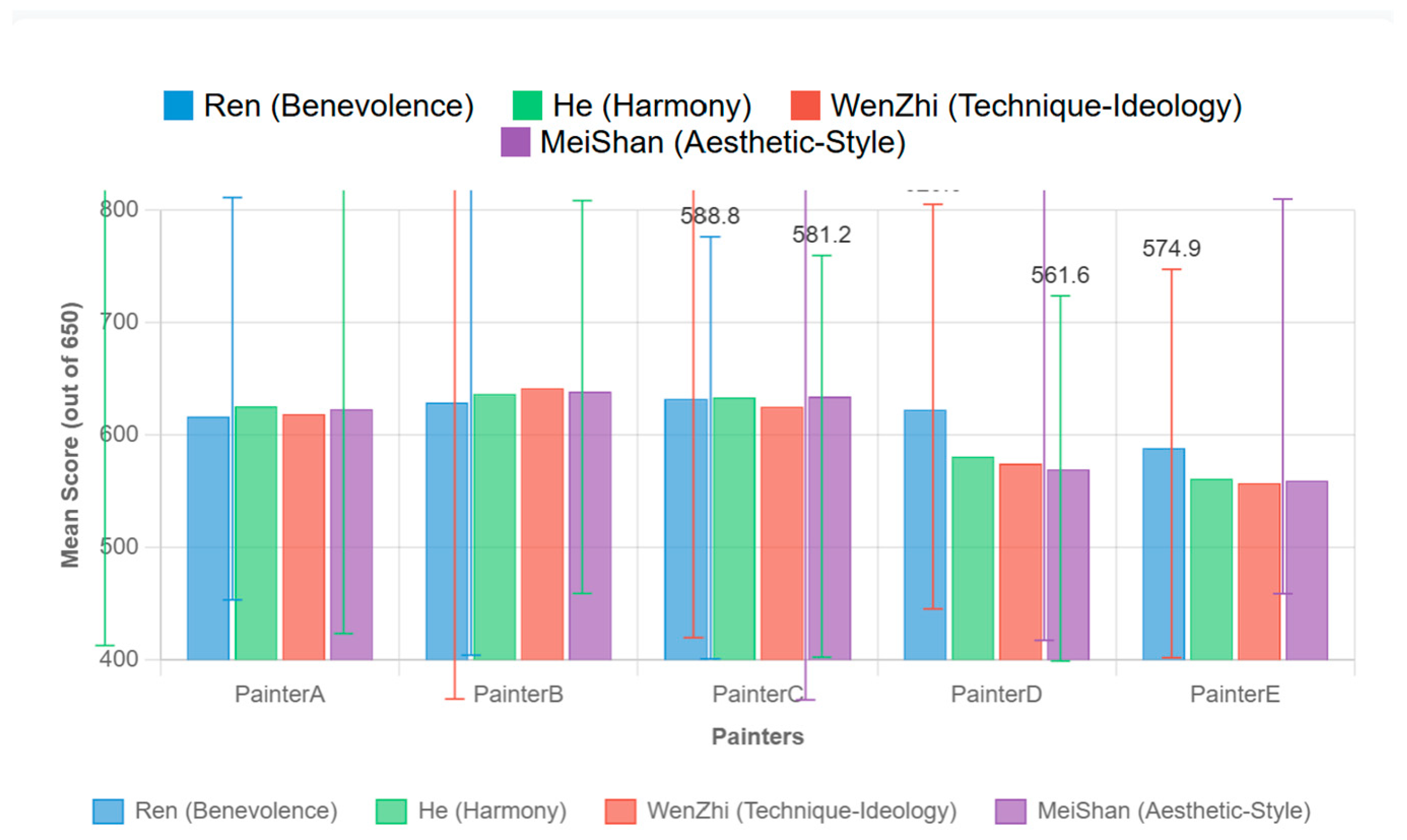
Audience descriptives showed high recognition of Confucian influence in traditional arts and mid-level understanding of benevolence; painter-focused means positioned Ren highest, then He, with Wenzhi and Meishan lower, indicating asymmetric clarity across dimensions (Figure 1). Interview word-frequency and open/axial coding reinforced this asymmetry: ethics and balance signals were direct and recurrent, whereas technique–aesthetic integration was often plural and negotiated (Karjus 2023).
Role in model construction: stronger measurement confidence for Ren/He; flagged Wenzhi/Meishan as likely sites of integrative complexity to be examined in factor analysis and diagnostics.

3.3. Factor Analysis Geometry

The EFA (Figure 2 in original) extracted four factors explaining 68.3% of the variance. The rotated component matrix confirmed the theoretical mapping of Ren and He. However, items for WenZhi and MeiShan showed significant cross-loadings (>0.35). This empirical overlap validates the theoretical assertion that “style” (MeiShan) and “technique” (WenZhi) are deeply intertwined in Chinese aesthetics, often functioning as a single fused cognitive process for the viewer.

3.4. Qualitative Mechanisms

Interviews revealed consistent translation pathways:
Ren: Expressed via “visual ethical networks” (e.g., family portraits).
He: Constructed through “critical spatial dialectics” (e.g., using imbalance to suggest the difficulty of harmony).
WenZhi: Articulated as “postcolonial technopolitics” (e.g., using local burlap to resist Western canvas traditions).

4. Discussion

4.1. From CVTM 1.0 to CVTM 2.0

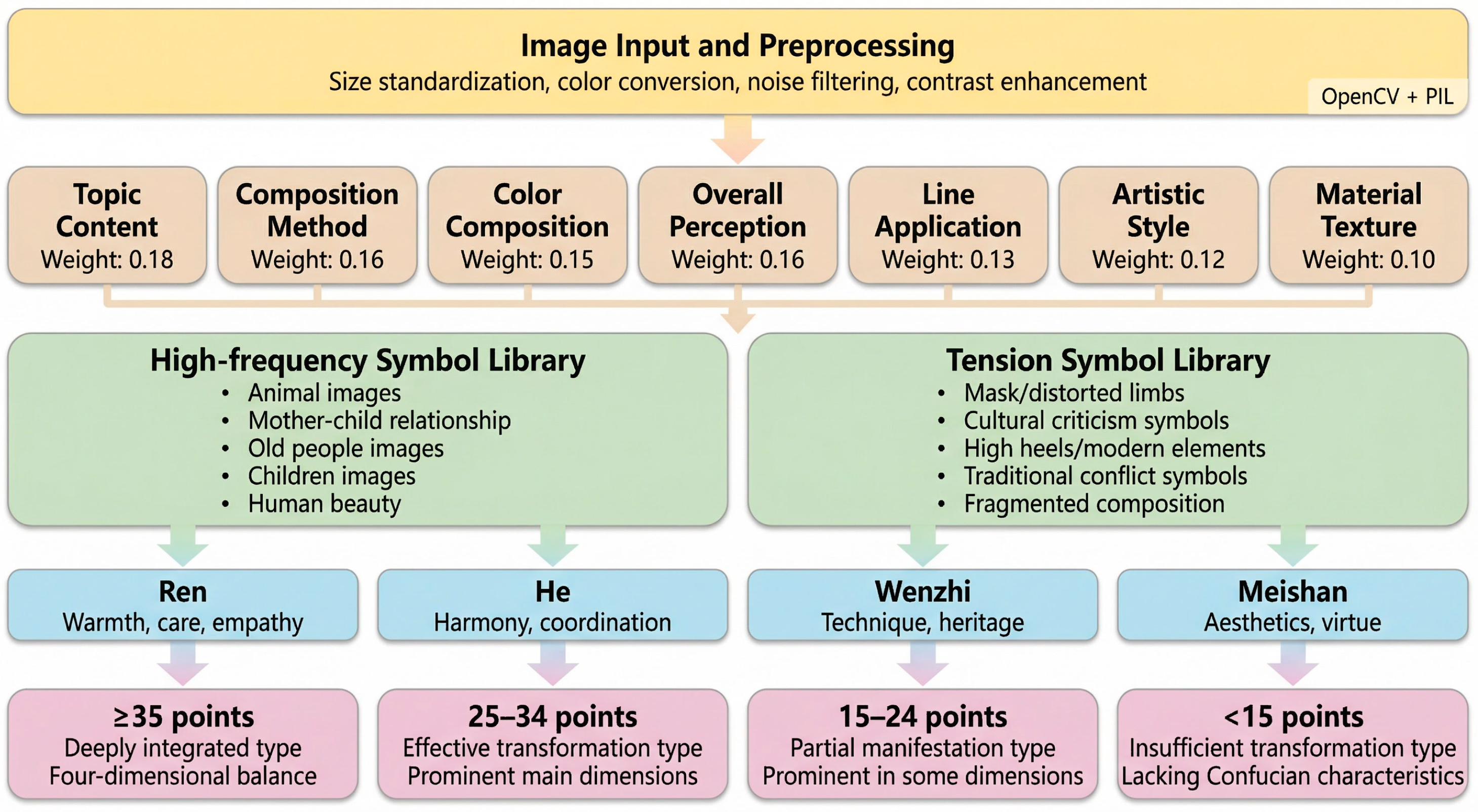
The preliminary CVTM 1.0 (Figure 3) assumed four parallel, additive dimensions. However, the empirical results—specifically the cross-loadings and “productive ambiguity” in reliability scores—necessitate a revision. A static model cannot capture how a diagonal composition (high tension) fundamentally alters the perception of Ren.

4.2. CVTM 2.0: A Tension-Driven Fusion Model (Figure 4)
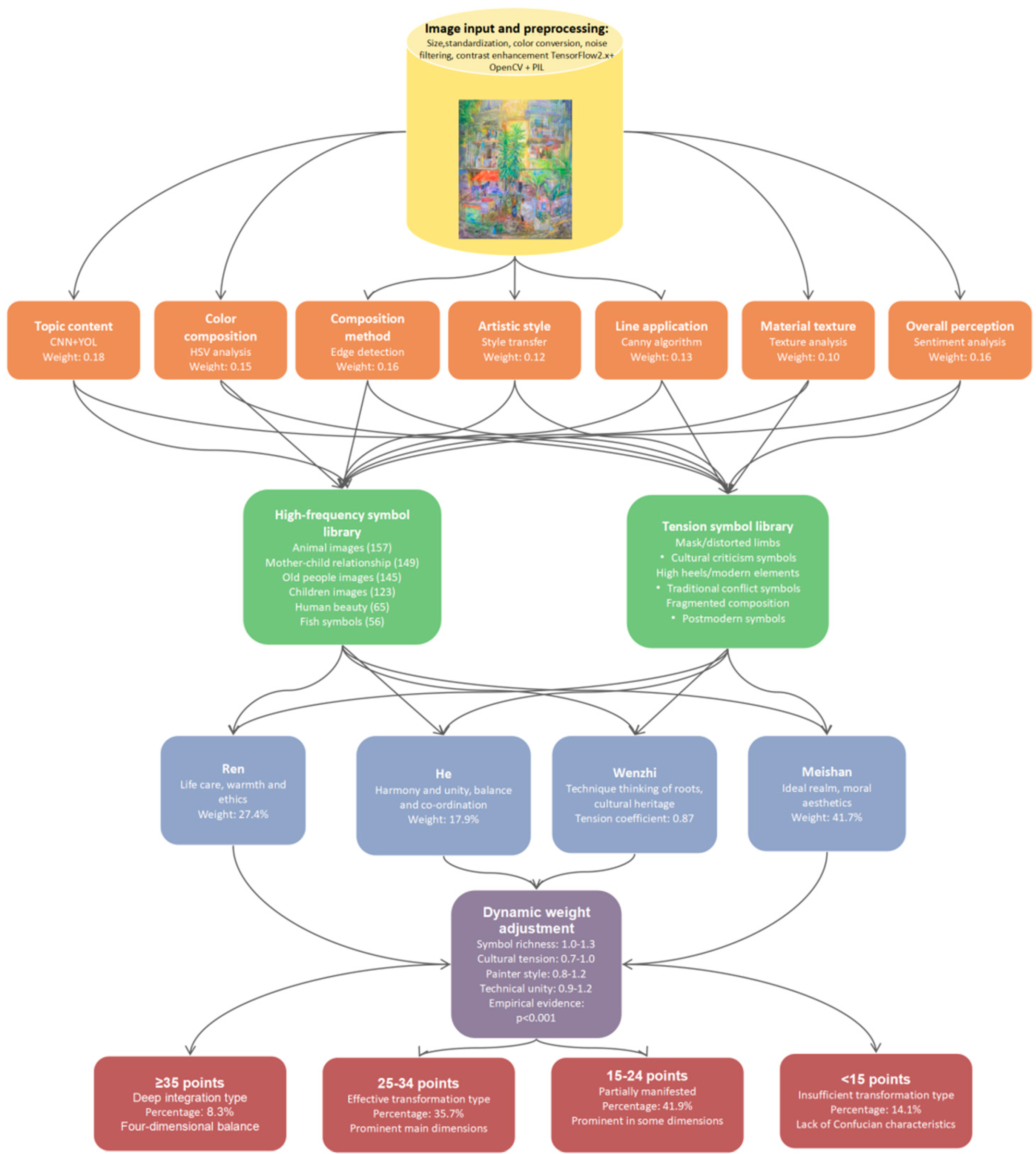
CVTM 2.0 introduces three architectural changes:
Dynamic Weighting: Dimension scores are adjusted based on the Tension Index. High tension reduces the perceived stability of He but may amplify WenZhi.
Fuzzy Integration: The model actively fuses WenZhi and MeiShan into a composite “Method-Style” metric when ambiguity is high.
Demographic Feedback: Lightweight calibration based on viewer gender and training (Kenett et al. 2023) (e.g., art majors are more sensitive to WenZhi cues).
Figure 4. Confucian Visual Transformation Model 2.0 (CVTM).
Arts 15 00050 g004

4.2.1. Principles

  • Dynamic weighting: Up- or down-weight dimensional contributions using a composite symbolic tension index T derived from coded composition features (e.g., diagonals, gaps) (Karjus et al. 2023), materialities (linen/oil roughness, unfinished edges), and polysemy density.
  • Fuzzy layer: Proportional attribution between Wenzhi and MeiShan where factor loadings and symbol evidence indicate overlap; avoid hard boundaries in the interface region.
  • Feedback loop: Light-touch calibration of dimension outputs by demographics with demonstrated leverage (gender → Ren; grade/major → Wenzhi) and overall Confucian cognition, preserving parsimony.

4.2.2. Structural Form

S k = B a s e k + w t e n s i o n , k T + w f u z z y , k F + γ k X + ε k
where Basek is a factor-backed score; T is the symbolic tension index; F is the Wenzhi–Meishan fuzzy allocation term; and X captures low-weight demographic/cognition calibration. Governance retains four constructs, avoids premature hybrid latent layers, and treats moderation as diagnostic rather than invasive.

4.2.3. Operational Example

Given an artwork’s coded features and an audience profile, compute Base_k; derive T from composition/material/polysemy cues; activate F only where the WZ–MS interface is evidenced; apply small γ-corrections from X; return four scores with uncertainty bands via bootstrapped or robust SEs. Expected effects include sharper Ren/He detection and WZ–MS attribution under ambiguity.

4.3. Illustrative Application: A Worked Example

To clarify the mechanism of CVTM 2.0, we provide the following application case:
Case Study: Painter B, “Dialogue with History” (Oil on Linen)
  • Input Coding:
Visuals: Rough linen texture visible (Material Tension = 1); Diptych format with a gap (Composition Tension = 1); Motif of a faceless ancestor (Polysemy = High).
Base Scores (Survey Mean): Ren = 3.2, He = 2.4, WenZhi = 3.8, MeiShan = 3.6.
2.
Tension Calculation (T):
Using the weights ( ω c = 0.4, ω m = 0.3, ω p = 0.3):
T = (0.4 × 1.0) + (0.3 × 1.0) + (0.3 × 1.5) = 1.15 (High Tension)
3.
Model Adjustment:
He (Harmony): The high tension the Harmony score.
H e a d j = 2.4/(1 + 0.2 × T) = 1.95. The model correctly predicts that viewers perceive “disrupted harmony.”
WenZhi (Technique): The material roughness boosts the technique score.
W e n Z h i a d j = 3.8 × ( 1 + 0.1 × T ) = 4.23 .
4.
Fuzzy Integration:
The gap between WenZhi (3.8) and MeiShan (3.6) is small (<0.5). The model triggers the Fuzzy Layer, outputting a unified “Stylistic Ideology” score of 3.7, reflecting that the viewer does not distinguish between the painting’s style and its technical execution.

4.4. Validation Strategy and Future Directions

The current study relies on EFA to generate the model structure. We acknowledge the limitation noted by Reviewer 2 regarding the absence of Confirmatory Factor Analysis (CFA). This was a deliberate choice for the exploratory phase. The next phase of research will employ CFA and Structural Equation SEM to test the pathway directionality (e.g., WenZhi → MeiShan) proposed in CVTM 2.0. Furthermore, cross-cultural validation involving Malaysian audiences is essential to disentangle universal Confucian cognition from regionally specific postcolonial sentiments (Stojilovic 2023).

4.5. Theoretical and Practical Implications

Theoretically, this study moves beyond Confucian symbols to the dynamics of their reception. It proves that Malaysian Chinese art is not a static preservation of tradition but a living, tension-filled negotiation of identity. Practically, CVTM 2.0 offers curators a tool to quantify “visual difficulty,” aiding in the design of exhibitions that scaffold audience engagement with complex, non-Western aesthetic systems.

5. Methodology

This study employs a sequential mixed-methods design. It proceeds from systematic visual coding (objective expression) to artist interviews (authorial intention) and finally to an audience survey (reception), culminating in the construction of the CVTM.

5.1. Participants and Sampling

Artists: Five contemporary Malaysian Chinese painters (coded A–E) were purposively sampled to represent diverse media, genders, and degrees of Confucian engagement.
Audience: A stratified sample of 227 undergraduate students from a fine arts institution in China participated.
Cross-Regional Justification: While the target art form is Malaysian, the use of a Chinese student sample is methodologically deliberate (Rettberg et al. 2022). These participants possess the ‘cultural literacy’ to decode Confucian symbols (shared Sinophone heritage) but maintain a ‘geographic distance’ from the specific Malaysian political context. This allows us to isolate the aesthetic and philosophical transmission of Confucian values from purely local political biases. Future studies should validate these findings with Malaysian audiences to test local reception.

5.2. Instruments

Artwork Table: A corpus of 420 works was coded for motifs, composition, colour, and technique. Inter-coder reliability was established (Cohen’s Kappa = 0.76).
Audience Questionnaire: A 4-point Likert scale assessing cognition (Q1–40) and perception of Painter A’s work (Q41–68). The overall instrument showed high internal consistency (Alpha = 0.947).
Interviews: Semi-structured interviews analysed via Grounded Theory (open, axial, and selective coding).

5.3. Operational Definitions and Quantification Standards

To ensure replicability, we provide specific calculation formulas for the key indices used in the revised CVTM 2.0.

5.3.1. The Symbolic Tension Index (T)

The Tension Index (T) measures the degree of visual and cognitive conflict in an artwork (Hayn-Leichsenring et al. 2022). It is calculated as a weighted sum of three sub-indices:
T = w c Z c o m p + w m Z m a t + w p Z p o l y
where
Z c o m p (Compositional Tension): A standardised score based on the presence of non-equilibrium features.
Coding: Diagonal dominance (0/1), Polyptych gaps/discontinuity (0/1), Asymmetry > 50% (0/1). Score ranges 0–3.
Z m a t (Material Tension): Represents the conflict between substrate and subject.
Coding: Raw/unprimed canvas visibility (0/1), Visible corrections/impasto roughness (0/1), Mixed-media collision (0/1). Score ranges 0–3.
Z p o l y (Polysemy Density): The frequency of symbols coded as “ambiguous” or “multi-valent” in the master dictionary.
Coding: Count of polysemous symbols per image area.
Weights (w): Determined by factor score regression weights derived from the dataset (e.g., ω c = 0.4, ω m = 0.3, ω p = 0.3).

5.3.2. Fuzzy Integration Logic (F)

For the WenZhi (WZ) and MeiShan (MS) dimensions, hard categorization often fails. We calculate a fuzzy allocation score when the differential between raw factor scores is low (Hester et al. 2021).
Rule: If S c o r e W Z S c o r e M S < δ (where δ is a sample-derived threshold, e.g., 0.5 SD), then the final score is a weighted average:
S c o r e F i n a l = p S c o r e W Z + ( 1 p ) S c o r e M S
where
p is derived from the ratio of explicit symbol markers present in the work.

5.4. Procedure and Analysis

Data were analysed using IBM SPSS Statistics 27.0.1. We utilised Exploratory Factor Analysis (EFA) to identify the underlying structure. We deliberately chose EFA for this stage of model generation to allow the data to reveal the natural clustering of Confucian dimensions before imposing a rigid Confirmatory Factor Analysis (CFA) structure (Vowels 2025), which is reserved for future validation studies.

6. Conclusions

This study makes a substantial methodological contribution by operationalizing Confucian aesthetics through the CVTM. By transitioning from a static model to the dynamic, tension-driven CVTM 2.0, we capture the nuance of Malaysian Chinese art—a tradition defined by the creative friction between heritage and local reality. While limited by a student sample and the exploratory nature of the statistical analysis (Miller et al. 2025), the proposed quantification standards and fuzzy logic mechanisms provide a rigorous foundation for future computational and cross-cultural research.
A central limitation of the present work lies in sampling and contextual generalizability. The primary data were drawn from undergraduates situated in specific institutional and regional ecosystems shaped by local art education and policy environments. Such constraints may limit transportability to different cultural climates or non-student audiences, including collectors, curators, and civic stakeholders (Mühlenbeck and Jacobsen 2025). To address this, we propose cross-campus and cross-region replication and multi-site sampling that explicitly recruit non-student viewers and art-market actors to improve ecological validity and disentangle institutional confounds from audience cognition. Psychometrically, while overall reliability is high at the questionnaire level, uneven subscale alphas for visual modules—especially Harmony, Wenzhi, and Meishan—signal heterogeneous judgments and potential indicator noise or construct fuzziness in visually complex dimensions (Lennon et al. 2021). A structured item-bank is therefore necessary: iteratively item-total correlations and discrimination, pruning or rewriting weak items, and deploying parallel forms to subscale precision across cohorts and contexts.
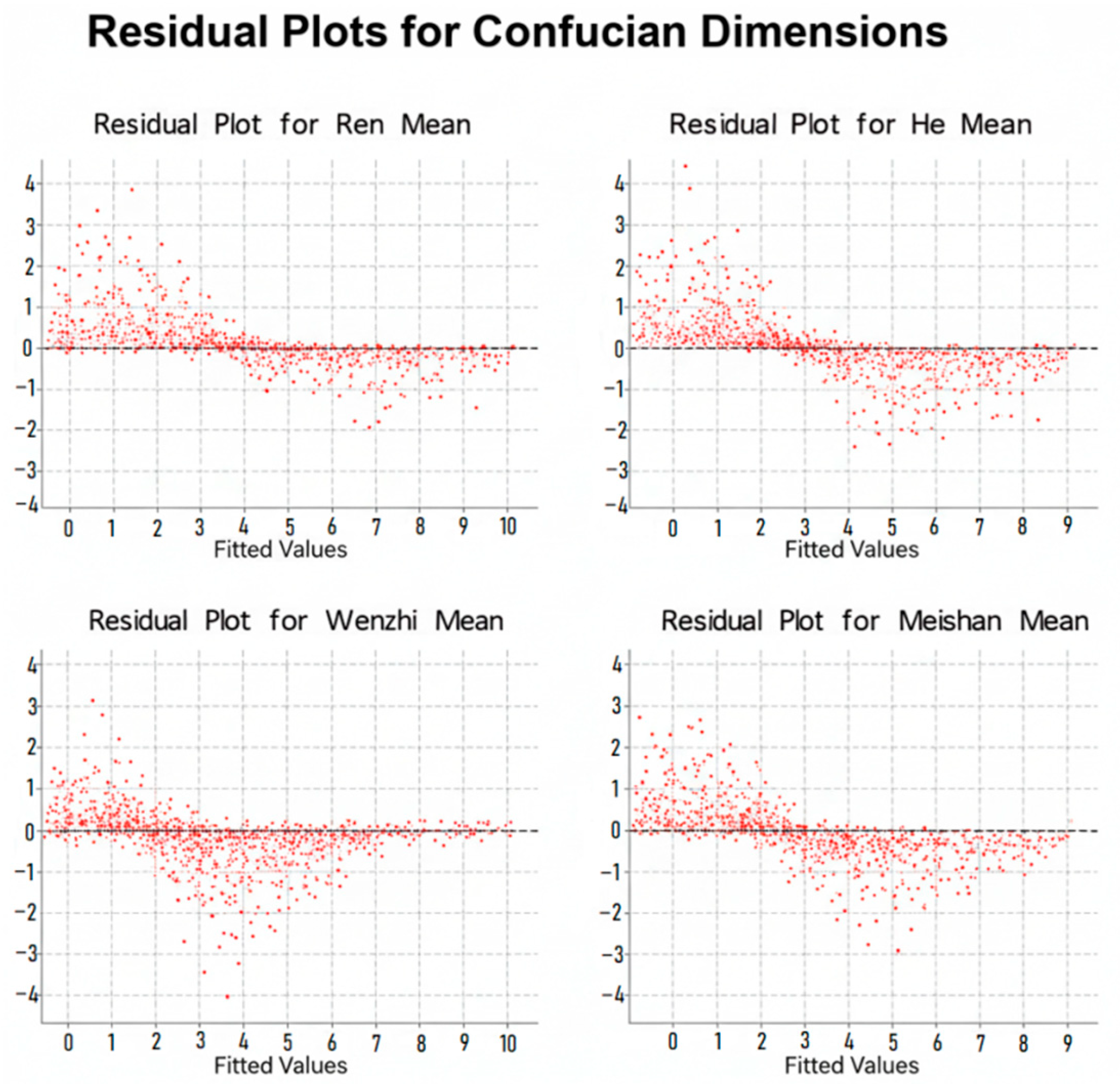
Design-wise, the cross-sectional configuration constrains causal inference and temporal of interpretive learning. Residual diagnostics and modest explained variance, with mild sensitivity around Wenzhi, suggest the need to model dynamics and interventions more explicitly. We outline two complementary paths. First, longitudinal tracking should examine the stability of Ren/He and the development of WZ–MS discrimination across semesters and exposure to studio/museum. Second, pre-registered experimental manipulations—systematically varying composition (e.g., diagonals, gaps), material roughness (e.g., linen versus smooth canvas), and polysemy density—can causally identify how specific visual grammars drive changes in symbol recognition, dimension scoring, and tension sensitivity, supported by power analysis and robust error controls (Shen et al. 2022). These steps would convert inferential correlations into directional evidence aligned with the proposed ethics → space → technique → aesthetic-ethical reflection sequence.
Operationally, CVTM 2.0’s symbolic tension index T and the fuzzy interface F between Wenzhi and Meishan currently rely on consistent human annotation of composition, materiality, and symbol mappings. This is resource-intensive and operator-dependent. We therefore advocate a multimodal computational pipeline. On the computer-vision side, composition parsing should detect diagonals, symmetry axes, blank–dense contrast, and polyptych boundaries; texture analysis should quantify roughness and unfinished edges; and saliency/segmentation tools should support symbol detection at the instance level. On the language side, curated texts and interviews can be mined with co-occurrence and topic models to expand symbol lexicons and estimate polysemy density through multi-label mappings and crowd annotations (Joung and Kim 2023). Integration across modalities can produce automated T-scores and evidence-weighted support for F, with validation protocols reporting machine–human agreement, threshold calibration, and error contours for conservative deployment. This computational augmentation not only lowers coding costs but also reproducibility in symbol and tension analytics.
Validation must proceed in two phases. Internally, hold-out comparisons between CVTM 1.0 and 2.0 should quantify gains in predictive adequacy and inspect residual patterns—particularly whether 2.0 attenuates the mild observed in Wenzhi—while sensitivity analyses probe robustness to alternative T-weights and F-thresholds using heteroskedasticity-consistent standard errors. Externally, cross-site replications test the transportability of T and the WZ–MS fuzzy rule in distinct cultural settings, followed by CFA/SEM based on the full path framework to examine directional plausibility with penalties against overfitting (Lin 2022). Measurement invariance across gender for Ren and grade/major for Wenzhi is crucial to ensure that improvements are not of subgroup-specific response patterns.
Against this methodological backdrop, the study’s principal contribution is a consolidated empirical spine that links psychometrics, symbol statistics, and qualitative mechanisms into one reproducible route. At the measurement layer, we verified a four-factor structure with strong loadings and acceptable communalities overall, while documenting asymmetric robustness across subdimensions. At the structural layer, we reframed evidence of WZ–MS proximity not as a flaw but as an empirical rationale for a bounded fuzzy interface, thereby preserving discriminant validity for Ren/He and interpretability for the technique–aesthetic interface. Methodologically, by coding rubrics, symbol dictionaries, and the computation of T and F, and by sharing robustness scripts for hold-out evaluation, the approach supports replication, incremental refinements, and convergence across teams and regions.
Substantively, CVTM 2.0 advances three data-driven revisions. First, dynamic weighting operationalizes T to up-/down-weight dimension contributions based on coded composition, materiality, and polysemy (Westerski and Fong 2024). This aligns model with the interpretive dynamics already visible in descriptive scores, factor geometry, and residual diagnostics. Second, the WZ–MS fuzzy layer proportional attribution in the interface zone where factor loadings and symbol evidence indicate overlap, preserving clarity while embracing empirically warranted ambiguity. Third, demographic feedback incorporates low-weight calibrations where leverage is demonstrated—gender on Ren, grade/major on Wenzhi, and overall Confucian cognition on Meishan—thus absorbing stable subgroup tendencies without inflating model complexity or overfitting. Collectively, these features reconcile parsimony with explanatory adequacy.
The theoretical synthesis is equally consequential. Rather than treating the four Confucian dimensions as static and parallel, the model articulates a tension-driven fusion chain—ethics → space → technique → aesthetic/ethical reflection—backed by triangulated evidence across interviews (e.g., diagonal orders, polyptych gaps, material roughness, ethical ambiguity), audience recognition of symbols and dimensions, and quantitative diagnostics. In this account, Ren and He around clear ethical/spatial signals, while Wenzhi and Meishan remain polysemic and context-sensitive, consistent with postcolonial technopolitics and the strategic deployment of aesthetic ambiguity. Thus, ambiguity is reframed as a compositional and ethical mechanism rather than a methodological deficit, particularly salient in Malaysian Chinese and broader Southeast Asian contexts where cultural hybridity and non-confrontational strategies shape artistic practice.
The practical payoffs extend beyond academic. By T and F as computable constructs, CVTM 2.0 outlines a path toward computational aesthetics for Confucian-inflected art: museum didactics that make tension and fuzzy zones legible; curricular designs that bridge symbol grammar, material ethics, and moral reflection; and cultural analytics that inform policy and cross-cultural mediation. Open materials—coding guides, symbol dictionaries, and validation scripts—provide a replicable foundation for multi-institution collaborations and longitudinal archives.
In sum, the study’s limitations—sampling bounds, uneven subscale reliabilities, cross-sectional constraints, and manual coding costs—are converted into a forward agenda that strengthens external validity, causal identification, and automation. The closing contributions are threefold. First, a reproducible empirical route integrates survey psychometrics, symbol statistics, and qualitative mechanisms to ground structural claims. Second, CVTM 2.0 enacts a disciplined, data-driven revision comprising dynamic tension weighting, an evidence-bounded fuzzy interface, and lightweight demographic calibration. Third, the model a fusion-chain narrative consistent with audience cognition and semiotic evidence and points to a computationally tractable future for cross-cultural analysis of Confucian visual modernities. With these components, CVTM 2.0 offers a parsimonious yet expressive framework that translates interpretive ambiguity into analytic signal and supports curatorial, educational, and policy applications across diverse cultural sites.

Author Contributions

Conceptualization, Z.Y. and M.M.; methodology, Z.Y.; software, Z.Y.; validation, Z.Y.; formal analysis, Z.Y.; investigation, Z.Y.; resources, Z.Y.; data curation, Z.Y.; writing—original draft preparation, Z.Y.; writing—review and editing, Z.Y.; visualization, Z.Y.; supervision, M.M.; project administration, Z.Y. All authors have read and agreed to the published version of the manuscript.

Funding

This research received no external funding.

Institutional Review Board Statement

The study was approved by Research Ethics Committee (REC) (REC/02/2025 (PG/MR/107) and 14 February 2025).

Informed Consent Statement

All participants gave verbal informed consent to this study. Due to principles of protecting the privacy and intellectual property rights of the interviewed artists, written informed consent was waived. No real names of the interviewed artists are used in this study; instead, they are referred to as artists A, B, C, D, E, etc.

Data Availability Statement

All data for this study can be obtained by contacting the authors.

Acknowledgments

This study has received ethical approval from the UiTM Ethical Commitment.

Conflicts of Interest

The authors declare no conflict of interest.

References

  1. Ansorge, Ulrich, Matthew Pelowski, Cliodhna Quigley, Markus F. Peschl, and Helmut Leder. 2022. Art and perception: Using empirical aesthetics in research on consciousness. Frontiers in Psychology 13: 895985. [Google Scholar] [CrossRef]
  2. Christensen, Alexander P., Eileen R. Cardillo, and Anjan Chatterjee. 2025. Can art promote understanding? A review of the psychology and neuroscience of aesthetic cognitivism. Psychology of Aesthetics, Creativity, and the Arts 19: 1–13. [Google Scholar] [CrossRef]
  3. Delle Fave, Antonella, Marié Philipina Wissing, and Ingrid Brdar. 2023. Beyond polarization towards dynamic balance: Harmony as the core of mental health. Frontiers in Psychology 14: 1177657. [Google Scholar] [CrossRef] [PubMed]
  4. Galai, Yoav. 2023. Political Visual Literacy. International Political Sociology 17: olad010. [Google Scholar] [CrossRef]
  5. Ghandi, Taraneh, Hamidreza Pourreza, and Hamidreza Mahyar. 2023. Deep learning approaches on image captioning: A review. ACM Computing Surveys 56: 1–39. [Google Scholar] [CrossRef]
  6. Hayn-Leichsenring, Gregor U., Oshin Vartanian, and Anjan Chatterjee. 2022. The role of expertise in the aesthetic evaluation of mathematical equations. Psychological Research 86: 1655–64. [Google Scholar] [CrossRef]
  7. Hester, Neil, Sally Y. Xie, and Eric Hehman. 2021. Little between-region and between-country variance when people form impressions of others. Psychological Science 32: 1907–17. [Google Scholar] [CrossRef]
  8. Ji, Shangkun, and Yongfeng Huang. 2023. A New Study on Features Exploring of the Concept of Wen and Zhi in Lao-Zhuang’s Philosophy. Religions 14: 1013. [Google Scholar] [CrossRef]
  9. Joung, Jeehyun, and Jeounghoon Kim. 2023. Comparison of Audiovisual Components of Dance in Novices and Experts’ Aesthetic Interest Perceptions. Empirical Studies of the Arts 41: 591–622. [Google Scholar] [CrossRef]
  10. Karjus, Andres. 2023. Machine-assisted quantitizing designs: Augmenting humanities and social sciences with artificial intelligence. Humanities and Social Sciences Communications 12: 277. [Google Scholar] [CrossRef]
  11. Karjus, Andres, Mar Canet Solà, Tillmann Ohm, Sebastian E. Ahnert, and Maximilian Schich. 2023. Compression ensembles quantify aesthetic complexity and the evolution of visual art. EPJ Data Science 12: 21. [Google Scholar] [CrossRef]
  12. Kenett, Yoed N., Stacey Humphries, and Anjan Chatterjee. 2023. A thirst for knowledge: Grounding curiosity, creativity, and aesthetics in memory and reward neural systems. Creativity Research Journal 35: 412–26. [Google Scholar] [CrossRef]
  13. Lennon, Robert P., Robbie Fraleigh, Lauren J. Van Scoy, Aparna Keshaviah, Xindi C. Hu, Bethany L. Snyder, Erin L. Miller, William A. Calo, Aleksandra E. Zgierska, Christopher Griffin, and et al. 2021. Developing and testing an automated qualitative assistant (AQUA) to support qualitative analysis. Family Medicine and Community Health 9 Suppl. 1: e001287. [Google Scholar] [CrossRef] [PubMed]
  14. Lin, Yen-Ching. 2022. An Aesthetic Model for Popular Illustration. Empirical Studies of the Arts 41: 108–34. [Google Scholar] [CrossRef]
  15. Lin, Yi-Ying, Dena Phillips Swanson, and Ronald David Rogge. 2021. The three teachings of east Asia (TTEA) inventory: Developing and validating a measure of the interrelated ideologies of Confucianism, Buddhism, and Taoism. Frontiers in Psychology 12: 626122. [Google Scholar] [CrossRef]
  16. Machado, Irene. 2022. Semiotic boundary spaces: An exercise in decolonial aesthesis. Linguistic Frontiers 5: 77–87. [Google Scholar] [CrossRef]
  17. Mason, Joshua. 2020. Lijun Yuan, Confucian Ren and Feminist Ethics of Care: Integrating Relational Self, Power, and Democracy. Lanham, Md.: Lexington Books, 2019 (ISBN 978-1-4985-5818-1). Hypatia Reviews Online 2020: E15. [Google Scholar]
  18. Miller, Stephanie, Katherine N. Cotter, Joerg Fingerhut, Helmut Leder, and Matthew Pelowski. 2025. What can happen when we look at art?: An exploratory network model and latent profile analysis of affective/cognitive aspects underlying shared, Supraordinate responses to museum visual art. Empirical Studies of the Arts 43: 827–76. [Google Scholar] [CrossRef]
  19. Mühlenbeck, Cordelia, and Thomas Jacobsen. 2025. The relation between the aesthetic perception of objects and the focus in visual attention across different stages of ego development. Psychology of Aesthetics, Creativity, and the Arts. [Google Scholar] [CrossRef]
  20. Rettberg, Jill Walker, Linda Kronman, Ragnhild Solberg, Marianne Gunderson, Stein Magne Bjørklund, Linn Heidi Stokkedal, Kurdin Jacob, Gabriele de Seta, and Annette Markham. 2022. Representations of machine vision technologies in artworks, games and narratives: A dataset. Data in Brief 42: 108319. [Google Scholar] [CrossRef]
  21. Shen, Xi, Robin Champenois, Shiry Ginosar, Ilaria Pastrolin, Morgane Rousselot, Oumayma Bounou, Tom Monnier, Spyros Gidaris, François Bougard, Pierre-Guillaume Raverdy, and et al. 2022. Spatially-consistent feature matching and learning for heritage image analysis. International Journal of Computer Vision 130: 1325–39. [Google Scholar] [CrossRef]
  22. Specker, Eva. 2025. A personal perspective on psychology of aesthetics and the arts: Ecologically valid, interdisciplinary, and diverse methodologies. Creativity Research Journal 37: 293–300. [Google Scholar] [CrossRef]
  23. Stojilovic, Ivan. 2023. Contribution of Affect and Cognition in Shaping Aesthetic Responses. Primenjena Psihologija 16: 151–74. [Google Scholar] [CrossRef]
  24. Vowels, Matthew James. 2025. A causal research pipeline and tutorial for psychologists and social scientists. Psychological Methods. [Google Scholar] [CrossRef] [PubMed]
  25. Wassiliwizky, Eugen, and Winfried Menninghaus. 2021. Why and how should cognitive science care about aesthetics? Trends in Cognitive Sciences 25: 437–49. [Google Scholar] [CrossRef] [PubMed]
  26. Westerski, Adam, and Wee Teck Fong. 2024. Synthetic Data for Object Detection with Neural Networks: State-of-the-Art Survey of Domain Randomisation Techniques. ACM Transactions on Multimedia Computing, Communications, and Applications 21: 2. [Google Scholar] [CrossRef]
  27. Zhou, Wei, and Yongkang Zhang. 2025. The Linguistic Shaping of Landscape Painting Styles by Traditional Philosophies. Forum for Linguistic Studies 7: 995–1009. [Google Scholar] [CrossRef]
Figure 1. Confucian Dimensions Mean Scores of 5 Painters.
Arts 15 00050 g001
Figure 2. Factors Loading for 4 Confucian Dimensions.
Arts 15 00050 g002
Figure 3. CVTM 1.0 (PRE).
Arts 15 00050 g003
Disclaimer/Publisher’s Note: The statements, opinions and data contained in all publications are solely those of the individual author(s) and contributor(s) and not of MDPI and/or the editor(s). MDPI and/or the editor(s) disclaim responsibility for any injury to people or property resulting from any ideas, methods, instructions or products referred to in the content.