1. Introduction
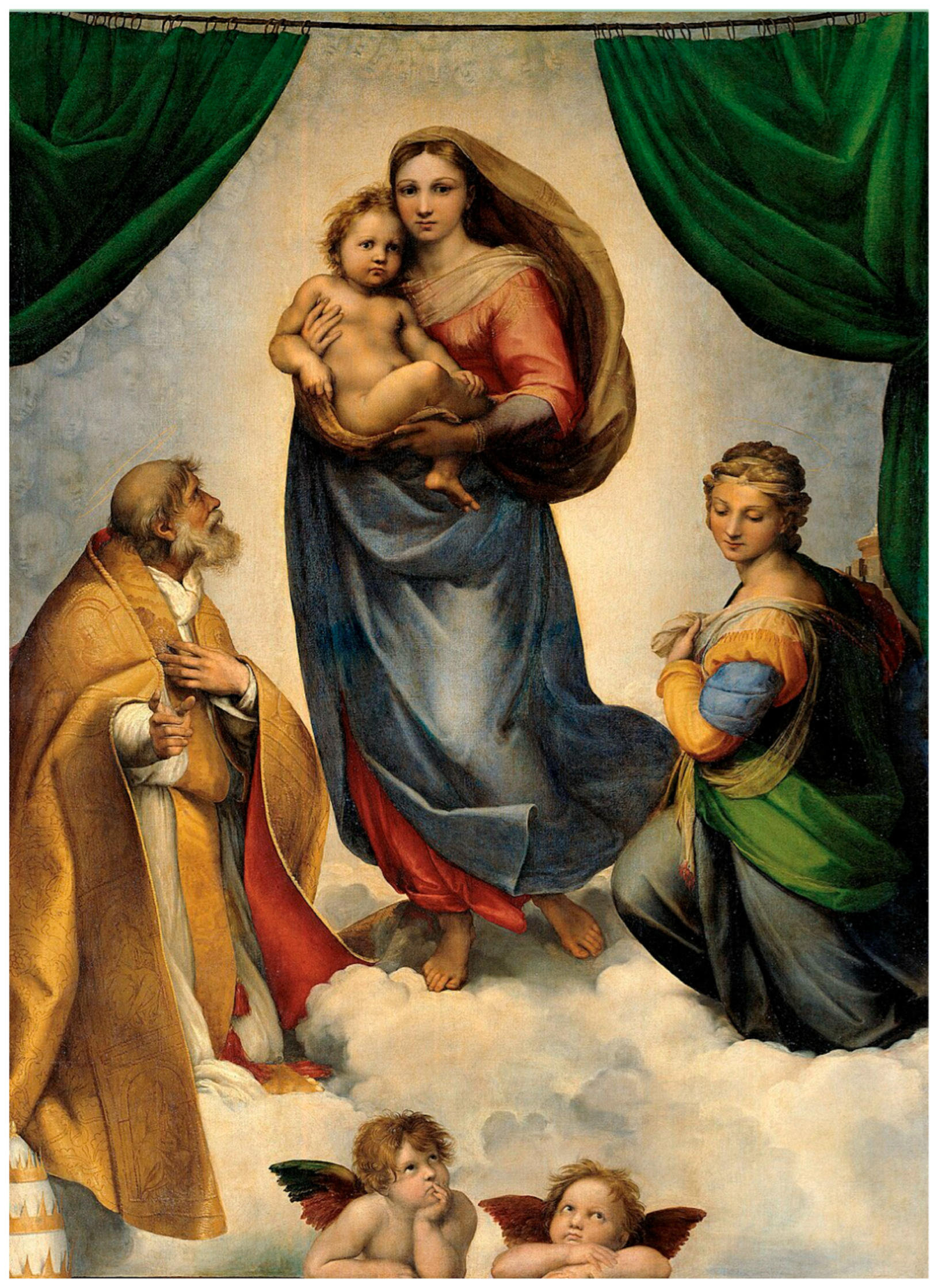
This study examines Raphael Sanzio’s Sistine Madonna (
Figure 1) as a system of visual engineering—as a process in which the artist constructs the internal logic of pictorial space.
Such a perspective makes it possible to move beyond an iconographic interpretation of the painting and to understand it instead as a dynamic structure in which form and meaning operate as a unified mechanism of visual impact.
Although the painting has been the subject of extensive scholarship, the role of Raphael as a constructor of visual systems has received comparatively little attention. One illustrative example is the curtain, which has even been the focus of a dedicated study: J. C. Eberlein’s “The Curtain in Raphael’s Sistine Madonna” (The Art Bulletin,
Eberlein 1983). Eberlein interprets it primarily as a theological and symbolic arch that reveals the spiritual dimension of the scene. In the present article, however, the curtain is regarded first of all as an architectural and compositional necessity—a structural element that ensures the spatial stability and internal dynamics of the image.
The constructive approach to pictorial space has also been addressed in broader theoretical discussions of Renaissance art. In
Perspective as Symbolic Form (
Panofsky [1927] 1991), Erwin Panofsky described the Renaissance construction of space as an act of ordering the world: the artist relates each form to all others, turning the image into a system of measures and mutual weights. Martin Kemp, in
The Science of Art (
Kemp 1990), later expanded this view by portraying Renaissance painters as visual scientists, structuring their images through principles of optics, perspective, and chromatic modeling. From this lineage of thought, Raphael’s Sistine Madonna may be seen not as a culmination but as an experimental instance—one in which the artist explores atmospheric structure, atypical illumination, and spatial coherence as tools of perceptual construction.
Such experimental treatment of perceptual construction also sets the Sistine Madonna apart from Raphael’s other Madonna paintings. His earlier compositions tend toward stillness, self-contained harmony, and devotional intimacy, whereas this work introduces an unprecedented degree of movement: the curtain opens, the saints gesture upward, and the Virgin advances directly toward the viewer. The narrative format is equally unusual, presenting not a quiet maternal scene but an unfolding apparition. Through this dynamic and its distinctive mode of showing the Madonna, the painting constitutes a singular moment in Raphael’s treatment of the theme.
Recent scholarship has further expanded the interpretive field of the Sistine Madonna.
Ji (
2023) examines Raphael’s visual rhetoric and expressive strategies within the broader framework of Renaissance humanism, focusing on ideal harmony rather than structural design, while
Edwards (
2023) explores the painting’s perception across different material and museum contexts, emphasizing its optical and environmental transformations. Together, these studies illustrate the diversity of recent perspectives and situate the present article within the broader scholarly conversation on Raphael’s pictorial logic. Against this background, the following analysis shifts attention from rhetorical or environmental readings to the constructive logic of perception—the visual engineering through which Raphael organizes space, light, and movement into a coherent system of impact.
A different, almost inverse perspective is offered by Marcia B. Hall in
The Sacred Image in the Age of Art (
Hall 2011). Discussing artists such as Titian and Caravaggio, Hall introduces the notion of “making strange,” a strategy that seeks to create reflective distance and a controlled sense of detachment in sacred painting. If we invert this principle—if we imagine not the estrangement but the deliberate engineering of empathy—then Raphael’s Sistine Madonna becomes its conceptual opposite: a system designed to absorb rather than repel the viewer. It is precisely through this reversal that the present study grounds the notion of visual engineering, proposing that Raphael’s Sistine Madonna constructs an empathic visual field—a perceptual space designed not to distance but to absorb.
In this respect, Raphael’s perceptual construction stands in gentle contrast to the painterly distance described by José Ortega y Gasset in
The Dehumanization of Art (
Ortega y Gasset 1968). Ortega presents the painter as the most detached observer, but the Sistine Madonna deliberately collapses that distance: the apparition is engineered at the threshold of the viewer’s space. In this sense Raphael positions himself not outside the vision but within its affective core—arguably closer to the miracle than his commissioners, and certainly no less than the monks of San Sisto for whom the painting was created.
A related sensitivity to how structure conveys thought can also be traced in later studies. David Summers’s
Real Spaces (
Summers 2003) and Ingrid Rowland’s writings on Raphael (
Rowland 1994) both consider how Renaissance artists used compositional order as a mode of reasoning and representation. Although their focus remains on the intellectual rather than perceptual dimension, their analyses imply that pictorial structure itself carries intentional design—an insight that underlies the present study’s notion of visual engineering.
Understanding the Sistine Madonna as a model of visual construction requires an interdisciplinary approach. Any analysis that seeks to grasp its constructive logic must draw on both art theory and the cognitive sciences, tracing how perception, emotion, and structure interact in the making and viewing of images. The interdisciplinary dialogue between psychology, aesthetics, and art history has its own genealogy: beginning with Rudolf Arnheim, whose work established the basis for discussing visual order in psychological terms, and extending to later thinkers such as David Freedberg, Vilayanur Ramachandran, and Semir Zeki, who have explored perception as an active and affective process.
Rudolf Arnheim proposed the idea of vision as a structural process in
Art and Visual Perception (
Arnheim 1954) and
Visual Thinking (
Arnheim 1969), treating perception as a form of active organization rather than passive reception. His model of visual order as a dynamic equilibrium of forces anticipates later notions of perceptual construction in cognitive science. Building on this tradition of understanding perception as a structured activity, David Freedberg expanded the discussion to the emotional register. In
The Power of Images (
Freedberg 1989), Freedberg explores the psychodynamics of visual response—how images evoke bodily reactions such as fear, awe, or empathy, which are often underrepresented in scholarly accounts. His concept suggests that the construction of images involves not only structural order but also the channeling of affective intensities—a view that aligns with the present study’s notion of visual engineering. From this standpoint, one might ask: does the power of such images presuppose that the artist himself first experiences these emotions? In the case of Raphael’s Sistine Madonna, the question gains additional weight. How can a painting designed for distant, elevated viewing possess such intimate force when seen up close? Perhaps the answer lies in the way its compositional logic carries affect across spatial thresholds—projecting emotion outward even as it draws the viewer in.
This intersection between structure and emotion opens toward more recent approaches in visual cognition and neuroaesthetics, which emphasize that perception itself is constructive. Richard Wollheim’s notion of “seeing-in” (
Wollheim 1987) and Michael Baxandall’s concept of the “period eye” (
Baxandall 1972) both describe the artwork as a system that engineers the viewer’s visual reasoning. More recently,
Zeki (
1999) and Vilayanur Ramachandran with William Hirstein (
Ramachandran and Hirstein 1999) have approached vision itself as an act of biological construction—a form of perceptual engineering that parallels Raphael’s structural organization of light and space. These perspectives provide a contemporary context for the term visual engineering, linking Renaissance pictorial logic to current models of visual cognition.
Extending this line of reasoning, the composition of the Sistine Madonna is considered here as a multilayered system built according to the principles of visual engineering. Such a view requires several complementary modes of analysis capable of identifying how the different constructive levels of the painting function together.
Methodological Framework: The Concept of Visual Engineering
The present study employs the term “visual engineering” not as a poetic metaphor but as an operational model for analyzing the compositional logic of Renaissance painting. Within this concept, the Sistine Madonna can be seen as a dynamic system of vision—an interplay of architecture, light, and meaning that transforms a static representation into a figurative experience.
The method proceeds through four analytical stages, each corresponding to a particular constructive level of Raphael’s Sistine Madonna.
- —
Structural Mapping focuses on the architectural supports, draperies, and framing devices that establish spatial hierarchy.
- —
Gradient Field Analysis examines the atmospheric layer that mediates between the material frame and the luminous portal, defining the angelic zone as a gradient of density and ascent that announces the divine apparition.
- —
Distribution of Luminous Weights considers the arrangement of light and color as instruments of balance, focus, and optical stability.
- —
Semantic Integration brings these levels together, showing how their structural interplay generates theological meaning.
Together, these procedures define the operational sense of “visual engineering” as a mode of perceptual construction. They provide a methodological foundation for the subsequent analysis, allowing the painting to be understood not as a static composition but as an engineered system of vision—a dynamic architecture in which spatial, luminous, and semantic hierarchies are built and regulated.
In applying this framework to Raphael’s Sistine Madonna, the analysis moves through the painting’s constructed space, tracing how its perceptual architecture is assembled and activated. The image reveals itself as a coherent system in which structural supports, atmospheric transitions, luminous separations, and symbolic cues operate together rather than as isolated devices. Material elements establish the conditions of stability; the atmospheric field modulates the movement toward the apparition; light organizes depth and directs attention; and symbolic coherence emerges through the internal logic of these interactions. In this interdependent configuration, the painting functions as a deliberately structured environment of vision, where each constructive device reinforces the others in shaping a continuous perceptual experience.
Through this framework, the Sistine Madonna can be understood as a work in which Raphael achieves an architectural mode of perception without any visible architecture—transferring to light, atmosphere, and perceptual design the constructive functions that, in works such as the Vatican Stanze or the School of Athens, were carried by actual architectural structures. Within this engineered balance, the painting achieves a state of visual and symbolic equilibrium, where spatial structure and theological intent become inseparable aspects of a single coherent act of perception.
2. Historical and Perceptual Context
To understand how Raphael worked within the constraints of a papal commission—where artistic invention operated under defined political and liturgical parameters—one must first recall the historical circumstances of the painting’s creation. Although the patronage of Pope Julius II and the political iconography of his pontificate have been widely studied (
Hall 1999;
Jones and Penny 1983), the relationship between the papal geopolitical strategy and the rationale behind specific artistic commissions remains insufficiently examined.
The role of Piacenza as a strategic node of the Holy League campaigns (1511–1513), and as a site where religious imagery became an instrument of territorial consolidation, has not yet been explored in depth. Following Julius II’s capture of Piacenza in 1512, it is reasonable to assume that the pope sought to consolidate a circle of allies in the newly acquired territory. The Benedictine community of San Sisto would have fit naturally into this strategy—both through its potential loyalty and through its economic significance as a major landholder in the region. In the political economy of war, any monastery controlling agricultural resources could become as relevant to a commander as an ally on the battlefield; patronage, in this context, functioned as a gesture of alliance as much as of piety.
Although the fact of the commission raises no doubts among historians, the precise mechanism and history of its financing remain unrecorded in accessible sources. Archival documentation—such as a specific mandate of the Camera Apostolica or posthumous payments and obligations related to this commission under Pope Leo X—has not yet been identified. Within the framework of this study, it is therefore worth noting that the commission coincided with the capture of Piacenza and its transition into the sphere of papal authority. In this context, payment for such a gift to the Benedictine monastery of San Sisto would have carried considerable symbolic weight for any pontiff, whether Julius II completed the transaction himself or Leo X contributed afterward.
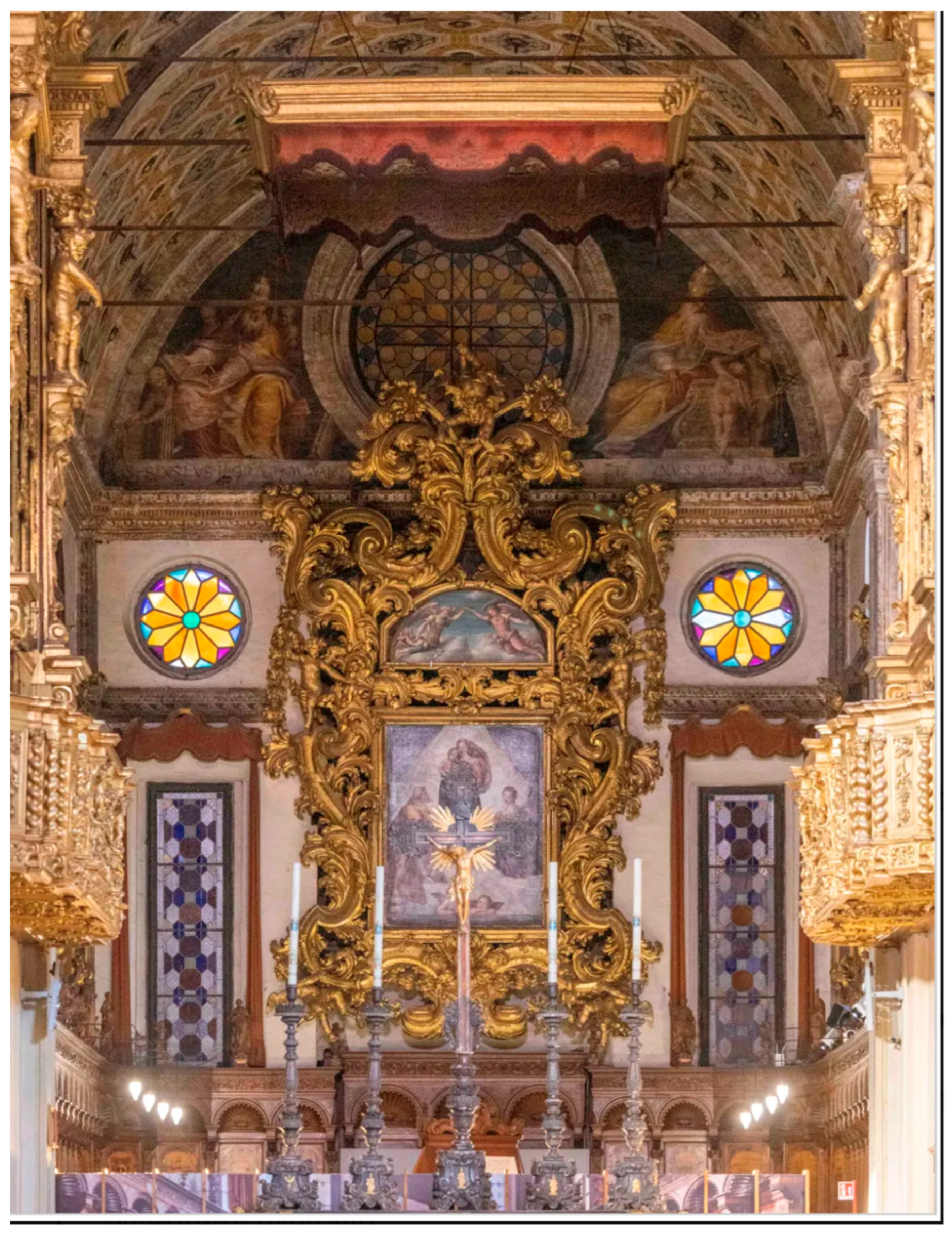
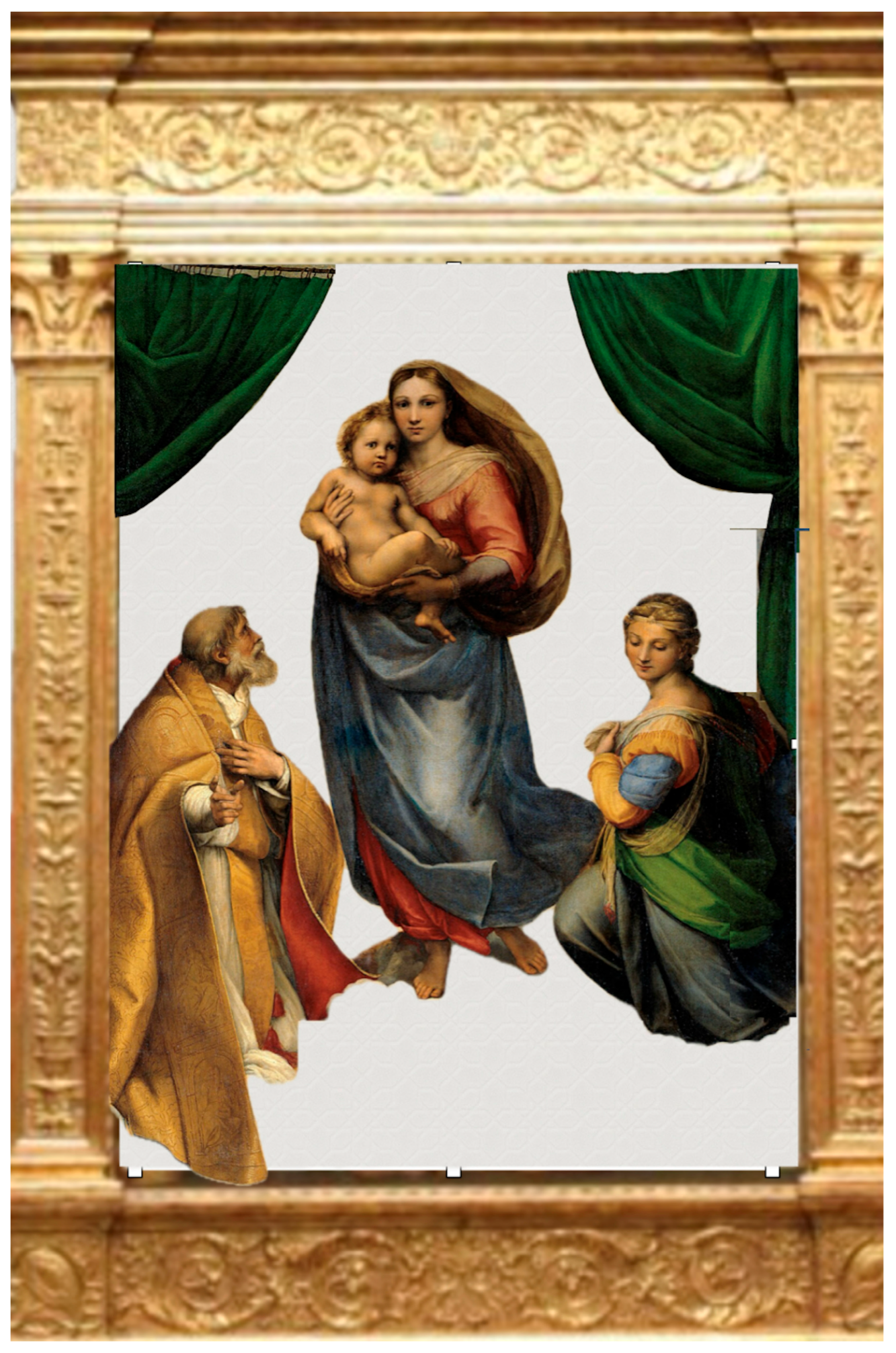
The Sistine Madonna therefore operates as a visual extension of papal diplomacy—a sacred image that also served as a symbolic seal of territorial power. The original placement of the painting in the high altar of San Sisto (
Figure 2) implied two distinct viewing groups with fundamentally different spatial relations.
The first consisted of the monastic community, located in the choir directly before the altar, viewing the painting from a distance of approximately 5–10 m at a steep upward angle, under strong lateral illumination. The second comprised the lay congregation standing in the nave, some 40–50 m away. For them, the painting functioned not as a close devotional image but as an optical symbol integrated into the architecture of the apse—a third “window” of heavenly space between the two real ones.
Such a duality of viewpoints required Raphael to devise a specific engineering of composition: a system capable of sustaining multiple perceptual readings. From afar, the scene reduces to three equal figures framed by the curtain, which visually prolongs the architectural order of the church. At close range, the framework contracts, and the hierarchy shifts from scale to symbolic role; the curtain becomes an internal architectural device that generates spatial and semantic tension within the pictorial field.
After the painting’s relocation from Piacenza to Dresden in 1754, these original perceptual and architectural conditions were lost, transforming its visual operation entirely. The analysis that follows therefore focuses on the internal architecture of the composition—on how the painting constructs its own spatial logic and organizes the viewer’s perception independently of the church setting.
Although Raphael’s preparatory sketches for the Sistine Madonna have not survived, the structure of the work itself allows for a reconstruction of the artist’s compositional problem-solving:
- (1)
To achieve equilibrium between figures—proportional clarity and visual weight;
- (2)
To create a deceptive balance among the protagonists, presenting three while directing perception toward one;
- (3)
To establish chromatic and textural unity;
- (4)
To develop a light system that connects pictorial space to the act of perception.
Each of these compositional objectives finds its counterpart in a corresponding structural level within the painting, translating problem into construction.
- (1)
The material framework of drapery and curtain defines the equilibrium of spatial weight and enclosure.
- (2)
The atmospheric gradient of clouds and light mediates the illusion of balance, guiding attention while sustaining perceptual ambiguity.
- (3)
The radiant zone surrounding the Madonna establishes the hierarchy—a luminous order that organizes both figures and meaning.
- (4)
The inner, heart-shaped contour concentrates movement and significance, transforming the optical axis into a locus of sacralized, personal perception.
Each of these levels will be considered in turn.
3. The Structural Analysis of the Sistine Madonna: A System of Visual Engineering
3.1. Architectural Framework: The Curtain and the Saints
The first constructive level of Raphael’s composition is defined by the material framework—the architecture of the curtain and the tactile presence of the fabrics (
Figure 3).
This initial frame establishes the hierarchy of figures; the same principle of structural distribution will later reappear in the light, gradient, and symbolic strata of the painting. The curtain forms an arch that is technically completed by Saint Barbara and logically by Saint Sixtus.
The papal pluvial of Sixtus carries the same tactile density as the curtain above—not as its mirror, but as its structural counterpart, the lower echo of the same design. The green drapery descends from above, the yellow rises to meet it from below, while the white alb of Sixtus merges softly with the clouds, binding the figure to the atmosphere. Together, these fabrics form a single constructive continuum in which Sixtus no longer acts as a character but as part of the compositional architecture.
On the opposite side, the yellow–blue sleeve of Saint Barbara creates a subtle defocus, dispersing the viewer’s attention through color, while simultaneously closing the visual corridor toward the Virgin. Unlike Sixtus, Barbara is technically connected to the curtain; her role in the compositional balance is therefore stabilizing rather than active. In a tightly grouped composition, Raphael introduces what might be called an inhibitor—a figure that dampens, diffuses, and stabilizes both chromatic and semantic balance.
Sixtus, thrust forward, extends the direction of movement for the Virgin and generates a muted yet visible mass. Barbara, by contrast, provides an effect of tonal equilibrium for the entire ensemble: the gray–black hue of her garment acts as the terminal weight of the spectrum, closing the lower register of the frame. The frame composed of Sixtus, Barbara, and the curtain exists within a unified field of texture, its lines of folds and details rhythmically echoing one another and accentuating the active verticals that support the Madonna’s ascent.
The spatial system of the painting presents a paradox: traditional perspective is almost entirely absent. Behind the figures there is neither architecture nor landscape, but the flat plane of a curtain, deprived of depth. Yet the viewer perceives the scene as a forward motion.
Raphael confronted a structural dilemma—how to create the sensation of space without the dimension itself.
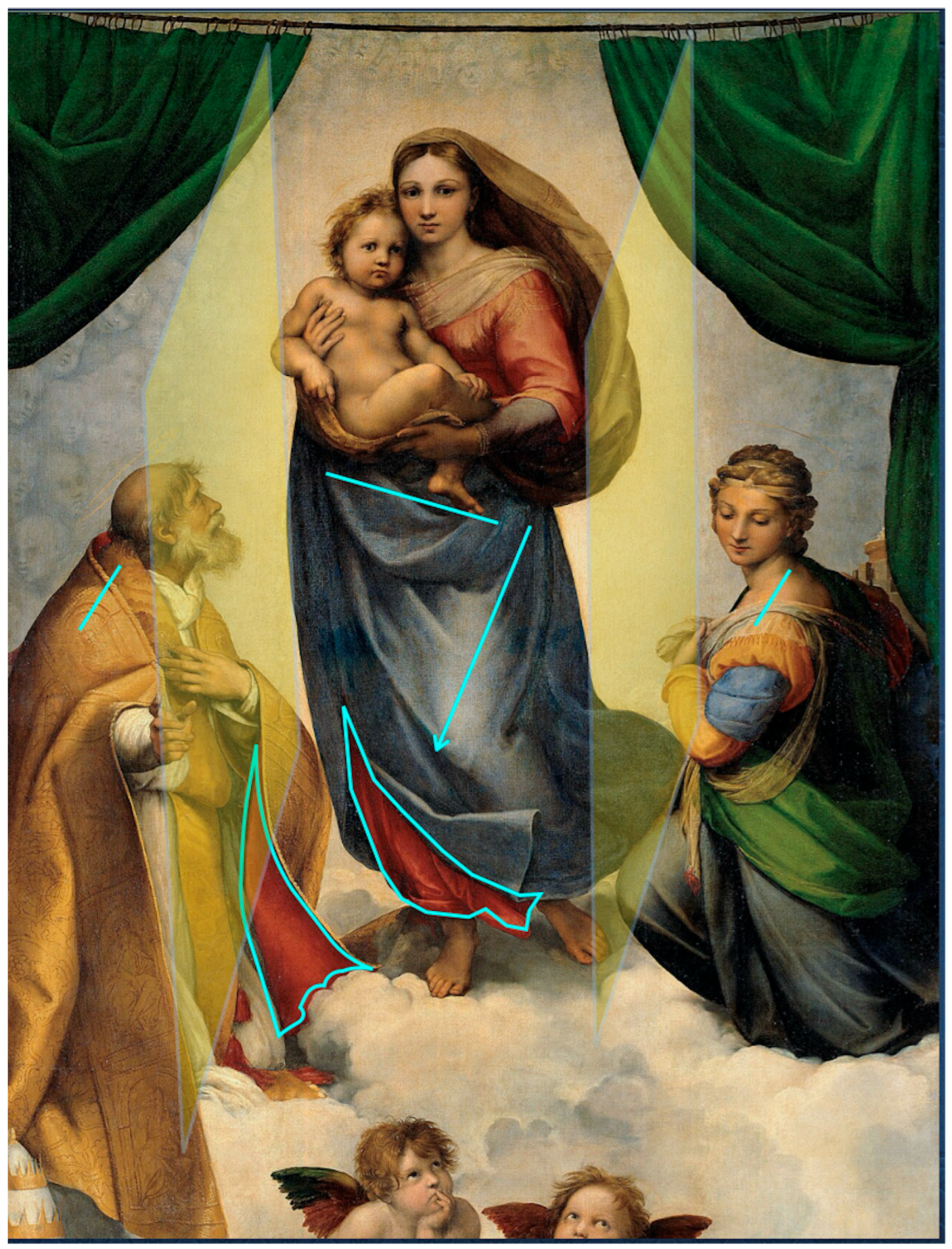
The solution lies in the construction of a corridor formed by the figures of the saints. By slightly turning the shoulders of Sixtus and Barbara and shifting their weight along a diagonal, Raphael transforms a static group into a passable passage, directing the gaze toward the center and upward. The difference in texture amplifies this effect: the heavy, matte cope of Sixtus contrasts with the vivid reflections and light accents of Mary’s veil, focusing attention on the vertical axis of the composition. The hanging sleeve of the cope performs a special function—it does not form a diagonal, yet it extends the depth, acting as an optical compensator that creates a soft continuation of space without disturbing the frontal symmetry of the scene.
Thus Raphael achieves a paradoxical effect: depth emerges without perspective, as the result of the interaction between mass, light, and gesture (
Figure 4).
Yet Raphael deliberately excludes the Virgin herself from this frame. She is not a component of the construct but an apparition sustained by it. No curtain appears above her head: the artist grants her precedence in every structural hierarchy. By parting the drapery, he leaves only a narrow visual crossbar—a frame that does not confine but releases air and movement, allowing the composition to rise and breathe. Raphael opens the space above the Madonna and positions Sixtus and Barbara so that their restrained stillness heightens her ascent and her freedom of air.
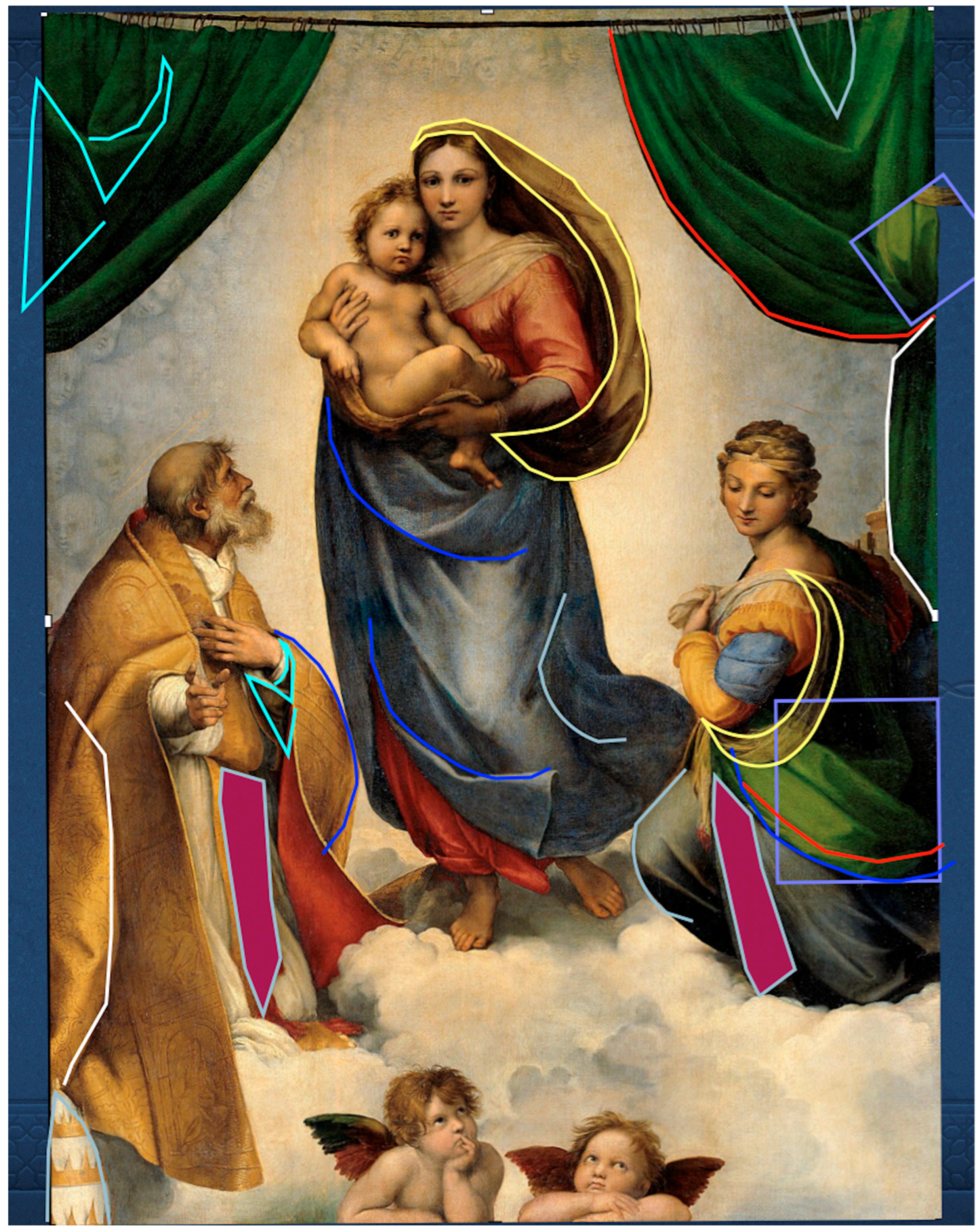
To link the structural frame and define the hierarchy of figures within this first level of visualization, Raphael fills the space with a network of visual rhymes.
Each accent performs a specific function, as illustrated in
Figure 5 and marked here by distinct colors (
Figure 5):
- —
Red indicates the line of the right-hand curtain, which, together with the color of Barbara’s clothing, literally “stitches” her into the framework;
- —
Blue marks the fold of the curtain and Sixtus’s sleeve, “sewing” together the left side of the frame, not literally but visually and logically;
- —
White traces at both edges the folds that establish the limits of the drapery and the corresponding pluvial pleat, forming a symmetrical enclosure for the Madonna;
- —
Crimson accents act as balancing weights, providing equilibrium to the entire construction;
- —
Soft blue and yellow arcs initiate the motion of the Madonna’s ascent and resonate as echoes in the folds of Barbara’s robe and Sixtus’s vestment, leading the viewer’s gaze upward.
This network of rhymes operates not as decoration but as a mechanism of hierarchy: through rhythm, color, and directional weight Raphael organizes the internal logic of perception.
In the upper and lateral zones, these rhymes function structurally, forming the frame of the scene; in the central zone, they operate dynamically, animating the Madonna’s movement; in the lower zone, they act as stabilizers, securing the visual weight of the system. Thus Raphael constructs not symmetry but structural rhythm—composition that “speaks” through repetition and displacement of lines.
The upper zone of the composition is already defined and closed by the curtain, yet a significant portion of the canvas is occupied by the lower cloudy register. The two small angels perform the same engineering function as the drapery: they prevent the gaze from “sinking” and lingering in the neutral area of the Virgin’s bare feet.
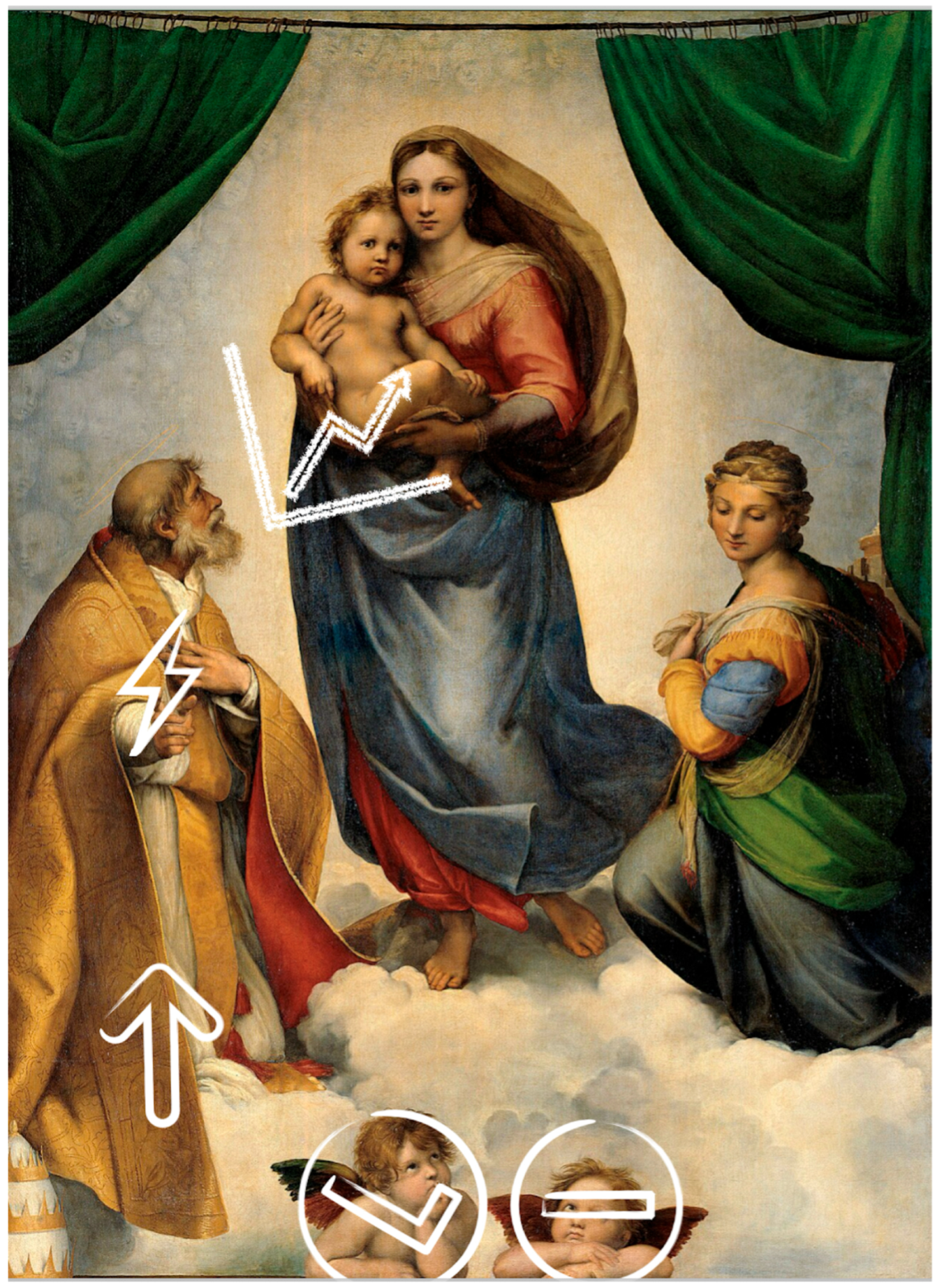
Raphael’s task here is to draw the viewer out of visual and perspectival comfort. Hence the two small figures—iconographically passive but visually charged with sharp, contrasting wings that act as guides. Their gazes are directed upward. One angel’s hands and wings form a compact blocking support; the other’s gesture—an elbow resting on the ledge—and the extended wing create a dual vector (gesture + wing) that leads the viewer’s attention toward the long descending sleeve of Sixtus.
The gaze then consciously “slides” along this extended, tranquil line of fabric, and at its end a sharp focal provocation—the gesture of Sixtus’s right hand—reorients the vision upward, to the figure of the Madonna (
Figure 6). The length and calm weight of the sleeve are therefore not incidental: they are part of a calculated mechanism of visual redirection. Thus the upper engineering is mirrored and balanced by a lower counter-engineering: the drapery and the clouds function as interdependent levels within a single system of controlled perception.
3.2. Atmospheric Gradient and the Dynamics of Space
In this section I introduce the concept of the atmospheric gradient—a visual structure that has not been explicitly defined within Raphael studies.
In existing literature, the zone of angelic heads surrounding the Madonna has usually been described in devotional or atmospheric terms—as a
halo of angels, a
cloud of cherubs, or a
luminous crown. Such recurring expressions in art-historical commentary and museum catalogs emphasize the symbolic and affective function of this zone rather than its structural role within the composition. Scholarly analyses (
Hall 2011) likewise focus on the luminous and rhetorical dimensions of the surrounding light but do not interpret it as an independent constructive layer.
Yet Raphael’s atmosphere is not one of gentle diffusion. Its texture reveals a far more complex behavior of light: a dense pattern of flickering heads and color patches that produces visual turbulence.
In the present study, this zone is defined as an architectural and dynamic medium—an operative stratum within Raphael’s visual engineering that functions as a transitional layer between the material framework anchored by the saints and the luminous portal of the vision.
It may be defined more precisely as a “turbulent gradient”—not a smooth transition, but a vibrating field where local forms generate an oscillating atmosphere. The color shifts remain within a narrow spectral range, yet they produce a sense of motion and inner tension. Such a gradient does not soften space; it energizes it, turning air into an active substance. Against this oscillating environment, the movement of the Madonna acquires an opposite vector—a trajectory beyond the boundaries of the construction.
When viewed from a distance of about fifty meters—as it would have been seen in the interior of San Sisto—the small details, the angelic heads, dissolve, and the entire upper part appears as a single turbulent gradient of shimmering sky. In this perspective, Raphael solves not a narrative but an engineering problem: how, within the limited surface of a panel measuring two by two and a half meters, to show not a static figure but the emergence of a divine gift from eternal space into the earthly realm.
However, the turbulence of this zone has not only an optical but also a constructive function. When viewed up close, it becomes clear that Raphael did not strive for a smooth celestial tone or a gentle haze; on the contrary, he deliberately creates an almost boiling, rhythmically charged surface, where heads and patches of light act as variable elements of the atmosphere.
In developing the second frame, the painter faced a distinctly structural problem.
Its lower part was already occupied by clouds—dense, coloristically active masses on which the figures of the saints rest. This solution determines the overall balance of the painting: if the upper zone were left calm and smooth, the curtain would press downward on the composition, while the richly painted clouds below would pull the viewer’s gaze downwards. Raphael needed an equivalent counterweight in terms of energy, and he found it in the atmosphere itself.
The upper part of the frame becomes a mirror of the lower one, but more refined: instead of billowing clouds there is a multitude of tiny angelic heads, organized not ornamentally but as a pulsating field. These heads perform the same function as the clouds: they redistribute visual weight and guide the viewer’s gaze upward, providing a transition from the dense material zone of the curtain to the luminous space of the apparition.
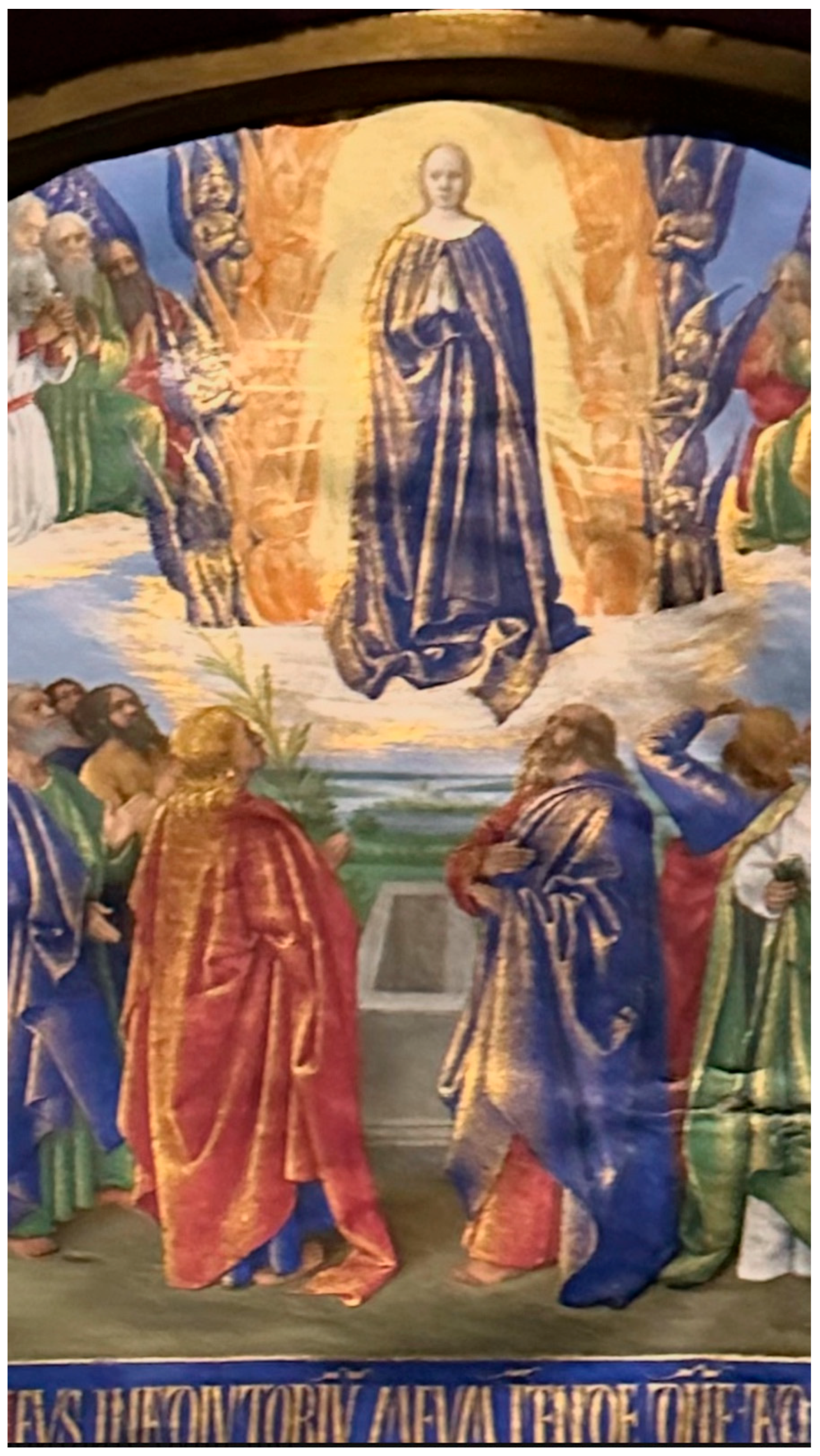
Raphael, of course, was not the first to depict a sky composed of angelic heads. As early as Jean Fouquet’s
Hours of Étienne Chevalier, the artist formed a halo in the Assumption of the Virgin (
Figure 7) by literally constructing a heavenly architecture from figures.
A closer precursor within Raphael’s own oeuvre is the Madonna di Foligno, where the artist first experiments with a vertically stratified composition—earth, cloud, and luminous sphere—anticipating the structural layering that Raphael would later intensify in the Sistine Madonna.
However, Raphael’s solution is fundamentally different: he abandons ornamental enclosure and creates a dynamic field in which the heads dissolve into the atmosphere, and the variation in angles and density transforms the air into a buzzing space. This device cannot be regarded as simply decorative; it operates as a mechanism of optical engineering, generating a continuous transition between the curtain’s material frame and the luminous portal where the apparition of Mary takes place.
Raphael does not go against tradition but moves beyond it, combining two methods of different epochs. The very principle of a “sky composed of figures” goes back to late Gothic practice, but Raphael merges it with a pictorial concern of the High Renaissance—the refinement of color and the construction of atmospheric space. Instead of simply dissolving forms in light, as Giovanni Bellini or Leonardo da Vinci did with sfumato, Raphael builds the transition differently—through a multilayered interaction of color and form that creates the effect of a shimmering sky. Thus emerges not an iconographic but an engineering model of atmosphere, in which each figure becomes not a character but a particle of movement and air.
3.3. The Portal of Light
The third constructive frame is associated with light.
This is a rare device in Raphael’s work. A review of some twenty images of his Madonnas allows us to state with confidence that in this case the artist demonstrates absolute originality with respect to his own style. Usually, Raphael does not surround the image of the Mother of Christ with any distinct nimbus or aura; his Madonnas are typically defined by soft atmospheric light or architectural framing consistent with the High Renaissance tradition.
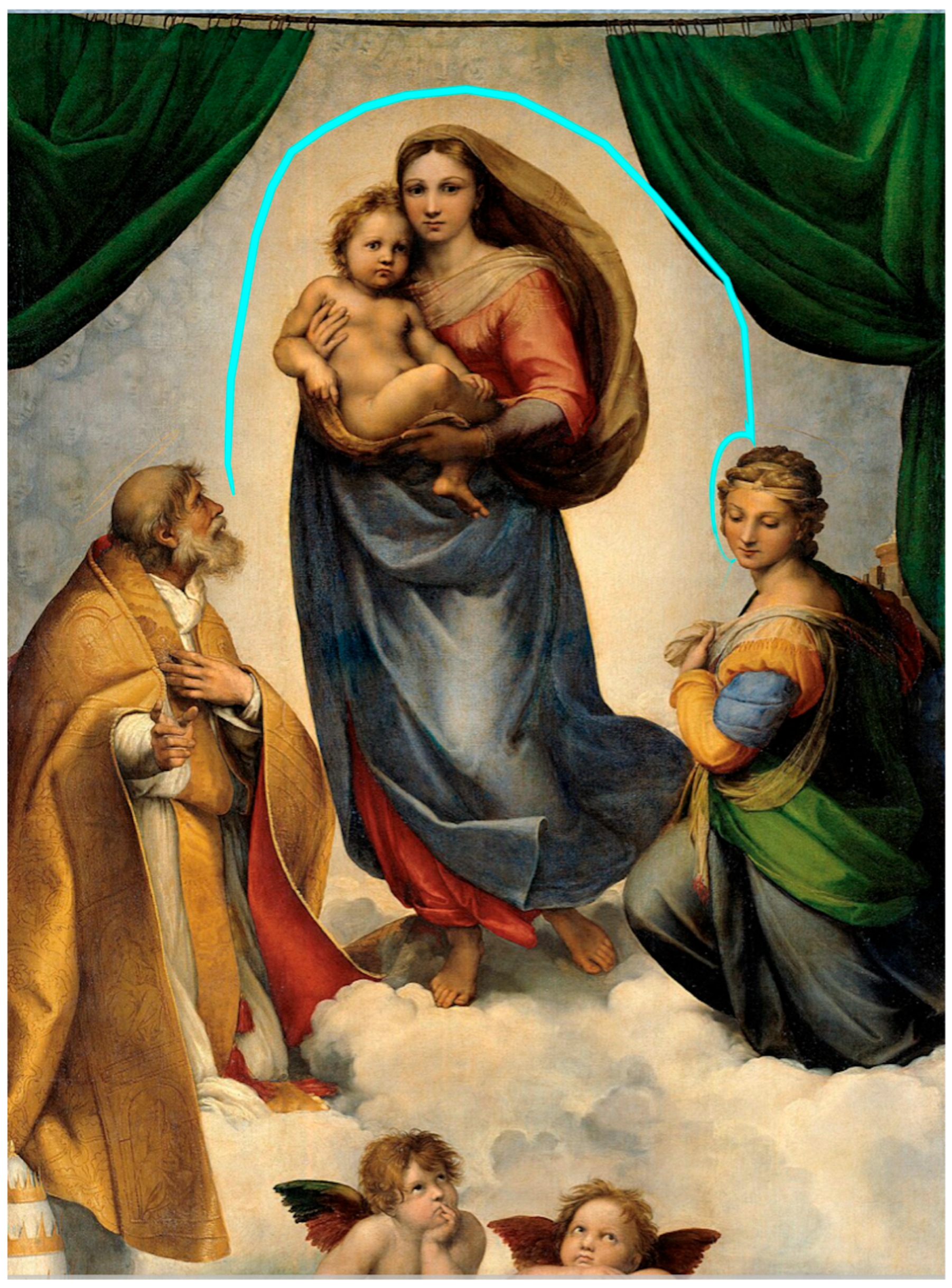
In the Sistine Madonna, however, the radiance is different: it is dense and tactile, resembling a thick illuminated mist. This effect probably serves two purposes. The first is the complete separation of Mary and Christ from all other figures in the painting, including those that appear only contourally, as part of the architectural composition. The second is the connection with the preceding frame of the angelic gradient: the luminous field continues its atmosphere, yet on a different level—not aerial but energetic. In this zone, light becomes an active constructive medium, transitional between matter and vision—a kind of portal through which the figure’s movement takes place (
Figure 8).
Upon close examination, it becomes clear that the luminous field surrounding the figure of the Madonna does not form any regular geometric shape—neither an oval, a rectangle, nor any other closed figure. The contour of radiance is uneven and mobile: it seems to fluctuate in response to the Virgin’s movement, expanding in some areas and contracting in others.
On the left side, it is not only visibly narrower than on the right but also almost straightened, while on the right the boundary of light virtually repeats the motion of Mary’s veil.
This irregularity can hardly be regarded as an error or technical inaccuracy; on the contrary, it appears to have been deliberately introduced as a means to animate the light and to endow it with the character of a dynamic substance. Thus, the radiance ceases to be a decorative aura and becomes part of the compositional mechanics, in which light itself participates in the Madonna’s movement.
This phenomenon is unique in Raphael’s painted work. Among all his paintings, only in his final work—the Transfiguration (1520; unfinished at his death, Pinacoteca Vaticana)—can a comparably dense luminous frame be found. Yet its purpose is different: the radiant cloud surrounding Christ is symmetrically balanced on all sides and does not convey directed motion.
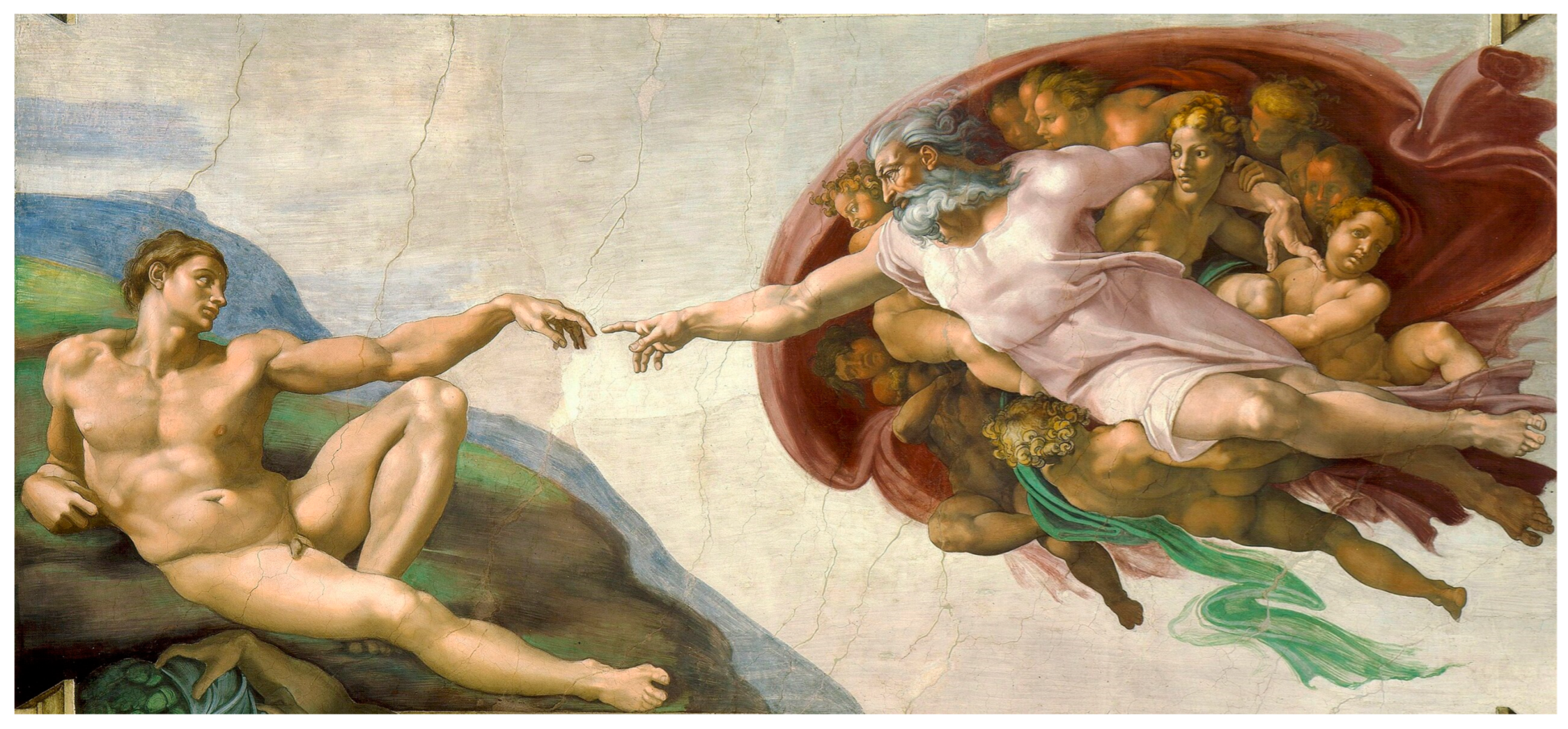
A structurally relevant parallel appears in Michelangelo’s fresco The Creation of Adam (c. 1511), painted shortly before Raphael undertook the Sistine Madonna (
Figure 9). The reference here concerns not illumination but the constructive principle of enclosure. The membranous contour that surrounds God functions as a dynamic boundary of revelation—an active frame that concentrates motion and meaning. It is this structural logic of an enclosing threshold, rather than any luminous effect, that provides an instructive analogy for Raphael’s atmospheric architecture in the Sistine Madonna.
Although Raphael would have found it neither necessary nor appropriate to employ so overt and anatomical a boundary around his central figure, the two works share a comparable concern with the dynamics of revelation. Any direct influence must remain speculative, yet Raphael—who knew the freshly completed Sistine ceiling—could hardly have been unaffected by the extraordinary inventiveness of Michelangelo’s framing devices.
3.4. Engineering of the Image
The three external frames of the composition—the curtain, the atmosphere, and the light—complete the construction of space. Yet Raphael’s engineering does not end at the outer boundaries of the painting: its operation continues within. The next level is the engineering of the Mary’s image itself, where the dynamics of drapery and the flow of light become the means of expressing inner motion. At this stage, Raphael shifts his attention to the figure of the Madonna and Child—the core where all compositional vectors converge.
As the main element of this system, he introduces a new structural element—the Virgin’s veil. More than an accessory, it acts as a mediator between light and body, gathering motion and focus around the figure. Through this addition, Raphael internalizes the architectural logic of the outer frames: the drapery of Mary becomes a micro-architecture that concentrates the forces of air and illumination within the image itself.
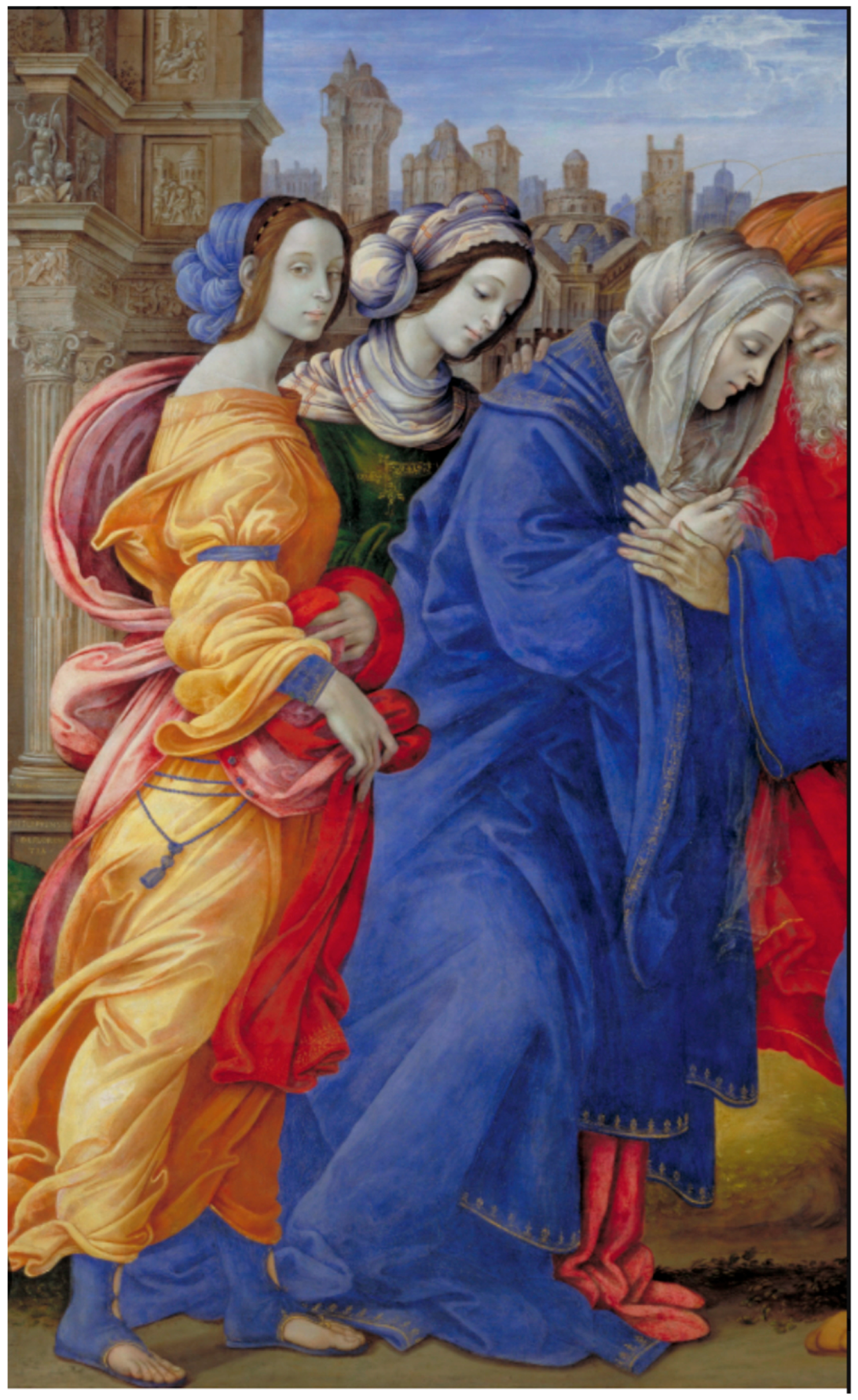
A corresponding precedent appears in Filippo Lippi’s Visitation (c. 1445–1450, National Gallery of Art, Washington), where the Virgin’s veil performs a structural rather than a symbolic function (
Figure 10).
Lippi uses the veil of the young woman in yellow as a counterweight that stabilizes the movement of the adjacent leaning figure, its folds generating both a vector of balance and a sense of volume within the composition. This logic of equilibrium continues the tradition inherited from Botticelli, who treated drapery as a graceful device of compositional stability.
It is precisely at this point that Raphael breaks the continuity of tradition: in the Sistine Madonna, the veil no longer serves as a stabilizing ornament but becomes a structural agent that drives the whole system of light and motion. He transforms a passive instrument of balance into an active medium of revelation—the very moment where matter turns into vision.
Both precedents demonstrate how, within a brief span of the Renaissance, the manipulation of drapery could evolve from a mechanical counterbalance into a source of light and movement.
Raphael concentrates the entire air of the painting within Mary’s figure. Her veil functions as a sail—an element that gives the image both volume and lightness. Yet in Raphael’s Sistine Madonna, its meaning extends beyond pure plasticity. It is not merely a detail of drapery, but an energetic condenser of the scene—a visual explosion from which the moment of apparition emerges. Without it, the painting would lose its breath: this element transforms Mary’s appearance from a movement into a revelation.
The veil acts as a second halo, not symbolic but spatial. It governs the luminous zone around Mary, where matter becomes air and movement becomes light. Thus the engineering of the composition reaches its completion—from the curtain that defines the space to the sail that isolates the principal figure and establishes her visual and semantic primacy.
3.5. Symbolic Engineering
At the final level of the composition, all spatial and pictorial vectors converge on the image of the Madonna. Raphael structures the painting so that every preceding layer—architectural, atmospheric, and luminous—culminates in this point of perception. Within this focus, the figures of Mary and the Child form a self-contained configuration that operates as the emotional and structural core of the image.
Having reached this point in the analysis, I would like to propose a hypothesis that, while consistent with the analytical framework of this study, nonetheless stands somewhat apart from its methodological structure, as it concerns a visual motif rather than a compositional system. Even within this clearly defined constructive order, one visual alignment resists complete explanation—something that, once seen, cannot be unseen.
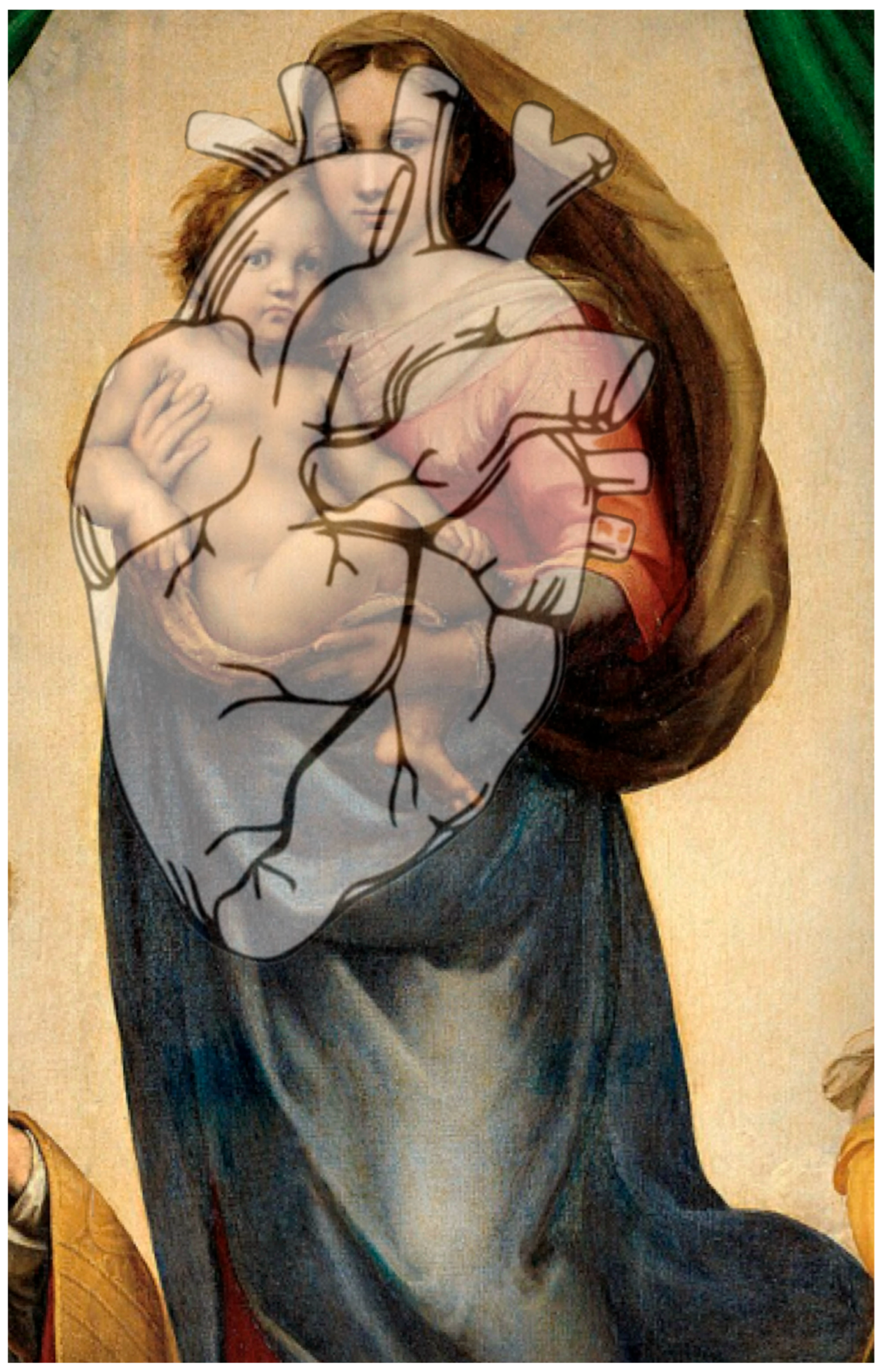
On close examination, the combined contour of the two figures—from the fold of the garment beneath Mary’s right hand to the curve of her veil—outlines a shape structurally analogous to a human heart. To my knowledge, this structural analogy has not yet been noted in the existing literature, although it seems consistent with the painting’s constructive logic.
The correspondence between the principal compositional lines (
Figure 11) and the anatomical structure of the heart can be observed directly:
- —
Mary’s shoulder and the arc of her veil trace the curve of the aortic arch;
- —
The Child’s head coincides with the area of the superior vena cava;
- —
His right shoulder outlines the right atrium;
- —
The drapery across his chest and arm corresponds to the right ventricle;
- —
The intersection of their hands forms the axis of the interventricular septum;
- —
The Child’s legs define the lower pole of the figure, corresponding to the base of the heart;
- —
The deep fold of Mary’s skirt encircling the group functions as the pericardium—the external membrane that contains the energy within the form.
This central configuration resonates with Renaissance philosophy, in which the heart was conceived as a point of passage between dimensions, the human and the divine. In
Theologia Platonica (
Ficino 1482), Marsilio Ficino describes the heart as the sedes animae—the seat of the soul where body and spirit converge. Giovanni Pico della Mirandola, in his
Oratio de hominis dignitate (
Pico della Mirandola 1486), writes that humanity is “bound to God through love,” and that love itself constitutes the anatomy of divine presence. Within this horizon, Raphael’s composition translates philosophy into structure: the heart becomes a structural locus of connection, where the circulation of light and form enacts the transition between the earthly and the celestial.
A related form of enclosing logic appears in Michelangelo’s Creation of Adam (
Figure 8), whose membranous contour—often interpreted as an anatomical metaphor for the human brain—as discussed earlier in
Section 3.3. While no direct line of influence can be established, Raphael was certainly familiar with the freshly completed Sistine ceiling, and the broader visual language of its dynamic enclosures could well have shaped his sensitivity to structurally charged boundaries. In this context, the heart-shaped configuration in the Sistine Madonna may be understood as Raphael’s own variation on the idea of a symbolic enclosure: a concentrated zone in which motion, meaning, and theological emphasis converge.
I cannot claim that Raphael intentionally embedded the image of a human heart—there is no direct evidence of such a decision—but the convergence of form, function, and cultural context is sufficiently consistent to make such a hypothesis plausible. Nevertheless, the form of this final semantic frame undeniably exists, incorporating the structural elements described above. It may therefore be regarded as another manifestation of Raphael’s engineering of vision—his continuous effort to reconcile the physical, the spiritual, and the optical within a single system of form.
3.6. Constructive Variants Across Raphael’s Madonnas
Although the Sistine Madonna represents the most fully integrated realization of Raphael’s constructive logic, related experiments appear both before and after it in his oeuvre. These works demonstrate that Raphael approached spatial framing, atmospheric mediation, and directional illumination not as fixed formulas but as flexible constructive strategies, tested and recalibrated across different commissions.
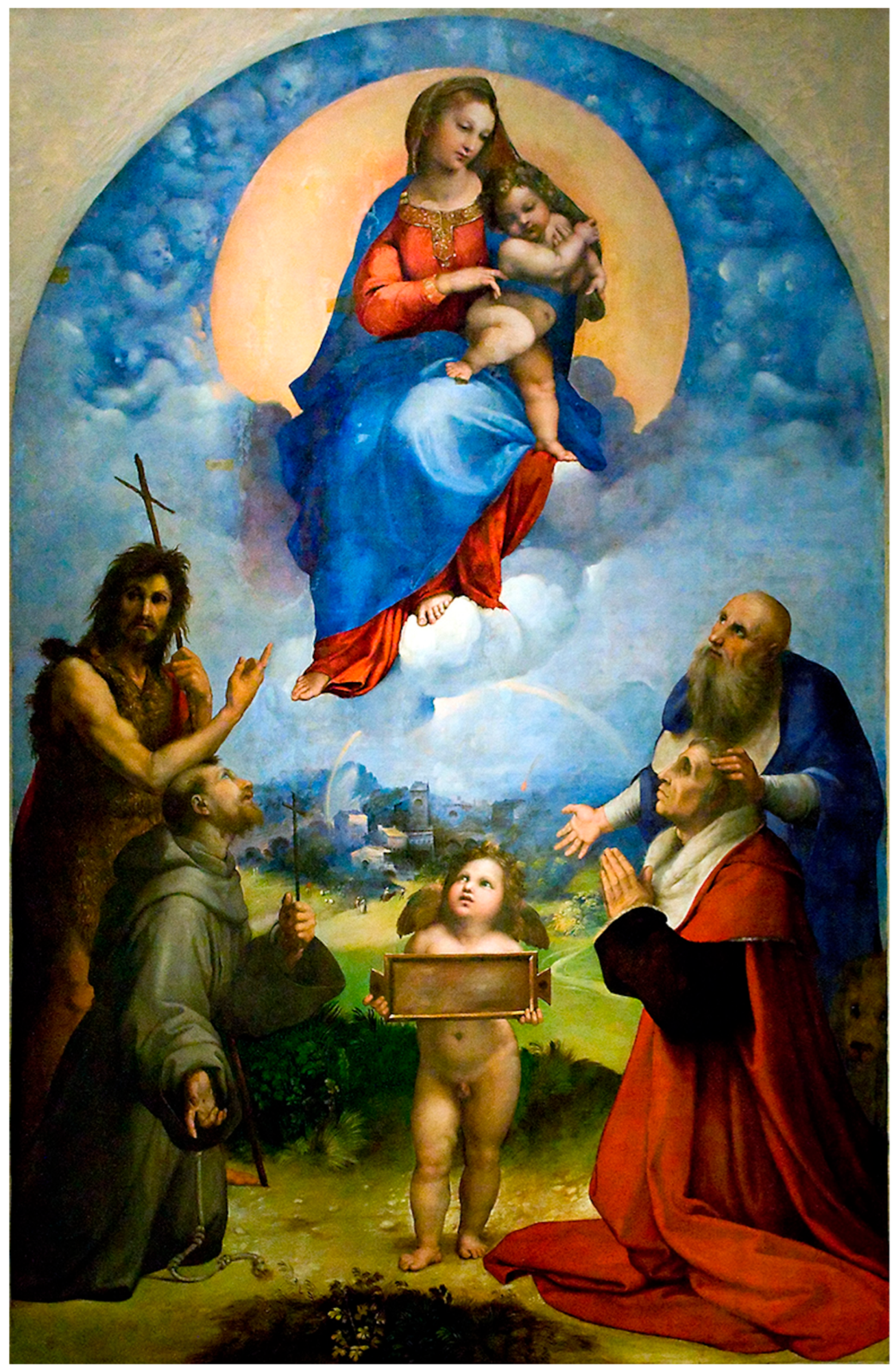
A preliminary form of this logic appears in the Madonna di Foligno (
Figure 12), where Raphael develops a vertically stratified composition that anticipates the layered spatial engineering of the Sistine Madonna. Yet the principle here operates in a compositional inversion. Whereas the green curtain in the Sistine Madonna descends from above to frame the apparition, the Foligno altarpiece deploys an analogous green-toned mass along the lower register, forming a mirrored counterpart to the later architectural arch. The donor group, the putti, and their chromatic correspondences generate a downward-oriented support that anchors the Virgin to the earthly realm and establishes continuity between the terrestrial and celestial zones.
Yet the constructive system of the Madonna di Foligno remains discontinuous. The composition in depth breaks into layers that do not interlock: the lower group functions as a separate register rather than a structural continuation of the upper one. The Virgin appears oversized in relation to the excessively distant landscape and remains visually foreign to the cloud mass surrounding her, as the circular mandorla forms a rigid halo that neither supports nor integrates with the surrounding atmosphere. Spatial depth collapses between mismatched planes: the putti and the forward edge of the donors are pushed so far toward the viewer that the divine apparition occurs behind them, leaving their reactions compositionally unanchored; the figures of the second tier are placed too close to the Virgin, producing an effect of visual flattening, even though their gestures are directed toward an event conceived as distant and elevated. Illumination likewise fails to unify the scene: a rightward light source brightens the far landscape more strongly than the donors in front of it, inverting atmospheric logic. As a result, the vertical axis relies on compensatory devices—the putti, the small dark pool below, and the strongly whitened knee of the Virgin, which acts as an additional luminous support, pushing the viewer’s gaze upward and preventing it from sinking into the void between the tiers. The work thus captures a transitional stage in which constructive principles are tested in isolated components but not yet fused into a coherent architectural whole, as they will be in the Sistine Madonna.
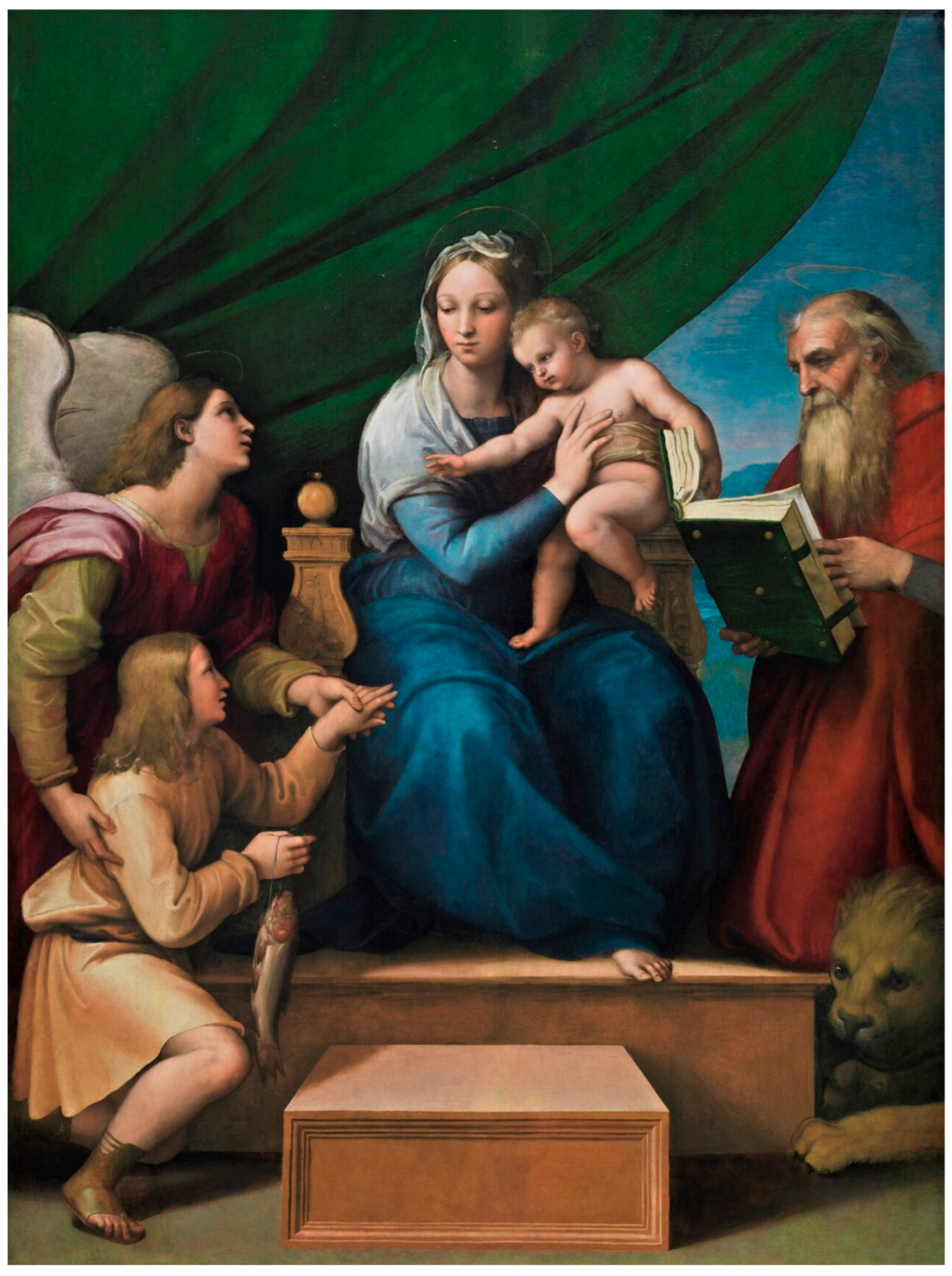
A later and markedly different constructive variant appears in the Madonna of the Fish (1513–1514), painted after the Sistine Madonna. Here (
Figure 13), Raphael does not return to the earlier unresolved problems but instead recalibrates his constructive system through alternative means. The architectural throne defines the Virgin’s spatial primacy with absolute clarity, while the sharply angled green curtain introduces a dynamic vector. Its diagonal motion runs from right to left, generating a perceptual flow toward the Virgin and Child. This motion is intercepted by the large white kerchief and the Child’s hand, which act as a luminous block that fixes the viewer’s gaze on Mary’s face. Raphael opposes this material vector with an inverse luminous one: light enters from left to right, moving from the angel’s wings toward Mary’s gaze and the descending drapery. The collision of these opposing flows produces a locus of heightened tension, intensifying both dynamism and focal clarity. Chromatic masses are orchestrated with comparable precision: the boy with the fish absorbs movement in muted tones; the angel’s saturated but tonally dull garment avoids visual competition; and the vivid red of Saint Luke counterbalances the active weight of the curtain.
Taken together, the Madonna di Foligno and the Madonna of the Fish show that Raphael’s constructive thinking unfolded not as a linear progression toward the Sistine Madonna, but as a series of experiments in spatial engineering. The Dresden painting synthesizes these investigations most completely, but it stands within a broader continuum of constructive strategies that precede and follow it, revealing Raphael’s sustained engagement with the architecture of vision.
4. Conclusions: Toward a Definition of the Engineering of Vision
Summarizing the step-by-step analysis, the concept of visual engineering emerges as a synthesis of all constructive levels identified in the Sistine Madonna. At each level: architectural, atmospheric, luminous, and symbolic, Raphael establishes a precise correspondence between spatial order and perceptual action.
The functional elements of the composition operate as supports, levers, and counterweights within an integrated system. Through this mechanism, the painting regulates the viewer’s gaze, balances distribution of visual tension, and transforms material structures into vehicles of meaning.
The second frame, which by its form and function should be static, generates internal movement and tension necessary for the Virgin’s climactic emergence.
Raphael counterbalances the restlessness of the upper zone—the small heads behind the Madonna—by the calmness of the clouds below, which share the same material nature, like two complementary strata of a single atmosphere.
The third frame—a dense, atypical radiance—breaks through the stability of the earlier layers, opening a direct aperture of light.
Finally, the fourth—the heart-shaped contour of the central group—forms the innermost synthesis of all levels, a metaphysical confirmation that the architecture of vision culminates in the architecture of meaning.
Thus, the composition of the Sistine Madonna demonstrates not only the perfection of Raphael’s pictorial thought but also the rare engineering logic of image construction for his time. Among all of Raphael’s works, this one stands apart: it does not repeat the formulas of harmony he had discovered, but overturns them, creating a new harmony—spatial, energetic, and profoundly spiritual.
Perhaps here Raphael became more than a painter: he became a constructor of vision.
He builds not a scene but a system of transitions—from the earthly to the divine, from the material to the spiritual, and from observation to revelation.
Whatever the degree of interpretation, one thing remains evident: Raphael created not only a painting but an architecture of vision, inexhaustible to this day. The constructive logic outlined here could be applied to other works of Raphael or his contemporaries, revealing whether similar perceptual strategies appear elsewhere in Renaissance painting.