Article

Material History of Ethiopic Manuscripts: Original Repair, Damage, and Anthropogenic Impact

1
ARCHES Research Group, University of Antwerp, 2000 Antwerpen, Belgium
2
Department of History and Heritage Management, Bahir Dar University, Bahir Dar 079, Ethiopia
*
Author to whom correspondence should be addressed.
Arts 2025, 14(6), 173; https://doi.org/10.3390/arts14060173
Submission received: 12 October 2025 / Revised: 7 December 2025 / Accepted: 10 December 2025 / Published: 15 December 2025
(This article belongs to the Section Visual Arts)

Abstract

Ethiopic manuscript studies have become a rapidly expanding field in recent decades. However, most research has focused on cataloging and textual analysis. This study examines the material traces of original addenda, patterns of deterioration, and desecration of indigenous conservation ethics. A combination of codicological and paleographic methods was used. This approach is vital for documenting historical features, understanding the context of use, and informing conservation efforts. The research involved assessing twenty-eight physical manuscripts from two collections in Addis Ababa, Ethiopia. Additionally, twenty-seven digital copies from the Endangered Archives Program, the Hill Museum & Manuscript Library, and the University of Cambridge Digital Library repositories were consulted. The findings revealed original features like holes, repairs, and scribal corrections. Damage such as tears, creases, dirt, fading, erasures, and recent writing was also identified. These results reveal the material history of the manuscripts. Furthermore, both domestic and international stakeholders have adversely affected these manuscripts through erasure, dispossession, and appropriation. This study proposes ethical guidelines for recent additions to the manuscripts and for preserving the original addendum. It also underscores the necessity for additional material research, enhancements in conservation practices, and efforts to raise awareness.

1. Introduction

Ancient manuscript heritage has inestimable value and requires systematic material studies and conservation research. Material features that reflect the social contexts of manuscript production and use constitute fundamental elements of scholarly investigation (Gobbitt 2014). Scribes and parchment makers often leave discernible imprints on manuscripts, which are shaped by their cultural backgrounds, intended purposes, levels of skill and knowledge, and geographic locations. These cultural traces are crucial for deepening our understanding of manuscript history (Kwakkel 2015). In addition, manuscripts contain abundant evidence on how these artifacts were handled by both their producers and subsequent users (Aikenhead 2020). For example, repairs made to manuscripts can reflect the owner’s social status, the craftsmanship involved, the cultural value attributed to the object, and the extent of its use (De Vries 2016). Furthermore, identifying the nature and causes of damage is essential for developing an effective conservation and management plan and for promoting awareness of the proper care of collections (De Valk 2018). Therefore, a careful examination of the material aspects of manuscripts is vital in order to inform conservation strategies (De Vries 2016). Accordingly, this study explores the material history of Ethiopic manuscripts.
Ethiopia is one of the few countries in Africa with a unique indigenous ancient writing tradition. This writing culture used a variety of support materials. Stone and, in rare cases, iron were used as writing materials in northern Ethiopia before the second century A.D. Later, in the third and fourth centuries, stone, metal, clay, and wood became dominant (Winslow 2015; ተፈራ 2002). Parchment, which is the primary subject of this study, has served as a principal and long-established writing material in Ethiopia. An archeological study has traced the origins of parchment production back to the middle of the first millennium BC. Tools used in the preparation of parchment were discovered at the Seglamen site and dated to the Pre-Aksumite period (Phillipson 2013). Paper was introduced as a writing medium later. Its widespread use is evident in the Islamic manuscripts of eastern Ethiopia (Mirza 2017)
Extensive use of parchment for writing has been recorded since the introduction of Christianity to the country in the fourth century AD (ተፈራ 2002). In particular, the arrival of the Nine Saints in the late fifth century gave momentum to manuscript production, with surviving evidence such as the sixth-century Gospels preserved at Enda Abba Garima (Dawit 2019; Nosnitsin 2023a). The Nine Saints translated religious texts from Greek into Geez (ጌታቸው 2020). There are also claims of translations from Syriac (Dawit 2023; Babu 2022). The number of surviving manuscripts gradually increases from the 14th century onwards. The manuscripts are the products of indigenous composition and translations from foreign languages such as Greek, Syriac, and Arabic (ማማሩ 2015; ጌታቸው 2020). They cover a wide range of subjects, including religion, philosophy, history, law, politics, culture, and science (Mersha 2011a).
In line with this, the Ethiopian orthodox church contributes a lot to the development of the national literary tradition and art (Dawit 2019; ጀማነህ 1963). The role of church education (Abnet Temhrt) had a significant contribution to the continuity of the book craft in the country (ጌታሁን 1960). Currently, many churches and monasteries own ancient codices and scrolls, invariably written on parchment. The production of parchment manuscripts in the country has also survived to the present day (Krzyzanowska 2015; Tomaszewski and Gervers 2015). These manuscripts continue to serve both the spiritual and secular aspects of life in the country (Yirga 2020). They are primary sources of history and preserve indigenous knowledge (Gezae 2024). Culturally, manuscripts symbolize scholarship and are revered as sacred objects (Mersha 2011b). They are icons for cultural legacy from a glorious past, featuring a variety of themes, textures, esthetics, scripts, calligraphy, miniatures, and designs (Yonas n.d.).
Ethiopic manuscripts are increasingly drawing scholarly attention, particularly from the fields of philology, codicology, and conservation studies. Philological studies have played a pivotal role in the cataloging of Ethiopic manuscripts preserved in European collections (Elagina 2023; Lusini 2017). Substantial efforts in the modern cataloging of Ethiopian manuscripts commenced in the 1970s with the initiation of the Ethiopian Manuscript Microfilm Library (EMML) project (Getachew 1975; Macomber 1975a, 1975b; Stewart 2017). Additionally, the two-volume contributions from the Ethiopian Heritage Authority (EHA), based on the inventories, were crucial (ሰለሞን 2011; ተስፋዬ 2010). Recently, the Department of Linguistics and Philology at Addis Ababa University and the Department of Geez at Bahir Dar University have both contributed valuable theses on manuscript cataloging, showcasing their dedication to advancing this important field (Admasu 2011; Alemnew 2022; Ayalew 2009; Ayinekulu 2020; Fitsumbirhane 2009; Minasse 2009; Tesfaye 2011; Worku 2010; ማማሩ 2015).
Scholarly contributions also focused on ethnographic studies of the materials and techniques used in manuscript production (Sergew 1981; Winslow 2015; ተፈራ 2002). Codicological studies that focus on the material aspects of Ethiopic codices are another emerging topic (Balicka-Witakowska et al. 2015; Dege-Müller 2014; G/Mariam 2020; Nosnitsin 2023b; Del Sasso 2022, 2023; Teshager 2019). In addition, material characterization aimed at conservation has been conducted (Bausi et al. 2020; Nosnitsin 2014; Nosnitsin et al. 2014; Vadrucci et al. 2023; Weronika and Tomaszewski 2016; Wion 1999). Furthermore, the state of traditional preservation was examined (Gezae 2018; Girmay 2016; Mersha 2011a).
The studies reviewed above suggest that scholarly inquiry into the materials and conservation practices of Ethiopic manuscripts is still in its early stages. This can be attributed to several factors. The lack of scholars specializing in Ethiopic manuscript studies and the methodological gap are the primary bottlenecks (Nosnitsin 2012). The scholars focus solely on the textual aspect and the cover and decorative parts of the manuscripts. The socio-political conditions, the geographical remoteness, the inaccessible location, and the scattered distribution halted the progress of the research (Ayinekulu 2020; Minasse 2009; Tesfaye 2011; Teshager 2019). There is also a lack of awareness about the physical attributes of these valuable manuscripts (Gezae 2018). The decelerated development of modern conservation practices, introduced after the 1950s, has also had its own impact (Hagos 2023).
This study aims to address the research gap in Ethiopian manuscript studies noted above and, as such, focuses on the material features of manuscripts. Material features such as original additions, marks of use, damage, deliberate erasure, and desecration will be the primary focus of this study. The objective is to answer questions such as: What are the main physical features of the bookblocks of Ethiopic manuscripts? Which forms of deterioration/degradation are observed on the manuscripts? How were the manuscripts subjected to human-induced damage and loss? The discussion is divided into three sections for thematic presentation. The first section looks at the features of the manuscripts that appear to be damaged but are not. The second and third sections are about actual damage and loss to the manuscripts. It is divided into two parts: natural deterioration and desecration.

2. Result and Discussion

2.1. A Look at Historical Features

2.1.1. Evidence of Original Damage and Repairs

The assessment revealed the presence of original holes within the bookblock of the manuscripts. The originality of holes can be discerned through the coherence of words, phrases, and sentences. The Haymanote Abew (collection of homilies) manuscript in Debre Mariam Monastery on Lake Tana is an illustrative example of the case. On f33r of this manuscript, the scribe wrote a single word in two places due to the hole (Haymanote Abew n.d.). The same case is visible on IES MS 76 at f46r, as shown in Figure 1a (Psalter (IES MS 76) n.d.). In addition, the codices, including IES MS 3164 (f40), IES MS 439 (f32 & 38), IES MS 50 (f35, 40, & 130), IES MS 377 (f3, 26, & 101), are some of the notable examples with small original holes (Book of Jubilees n.d.; Hagiography of Abriham Yshaq and Yakob n.d.; Liturgy n.d.; Psalter (IES MS 50) n.d.).
The size and location of holes determine the nature of the stitching and function of the folios. The unstitched holes are found either at the edge of the folio or as small gaps that do not affect the writing. In rare cases, leaves with bigger holes are used as end leaves (Sergew 1981). The holes have a regular circular, oval, or crescent shape. A Gospel, at the University of Cambridge, has unsewn small circular holes in the middle of the texts on 8r and 85r (Gospel Book n.d.). The book of Cyril in the same collection has a crescent-shaped hole on the edge of f62 (Figure 1b) (Cyril n.d.).
Holes in parchment typically occur as a result of defects in the original skins, as well as damage incurred during skinning, dehairing, cleaning of the flesh side, and stretching on the frame (Vnouček 2022). Apart from these causes, the frequency of holes in Ethiopic manuscripts may also result from the absence of liming, which necessitates dehairing through repeated scraping (Winslow 2015). Holes provide essential clues about historical parchment-making practices, enabling researchers to identify the species used and to differentiate the hair side from the flesh side of the skin (Vnouček 2022). This denotes the importance of distinguishing original holes from subsequent damage and preserving the former to enable informed conservation decisions.
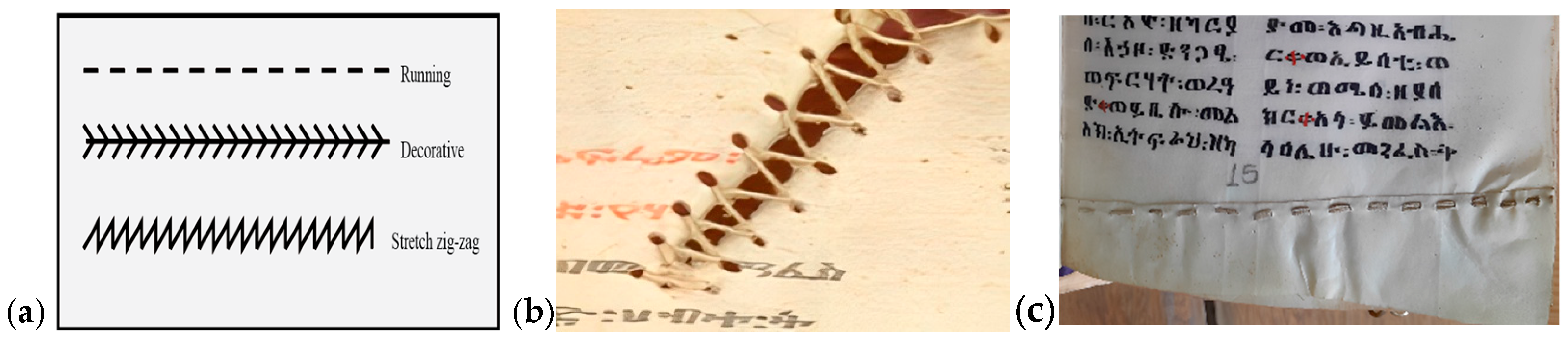
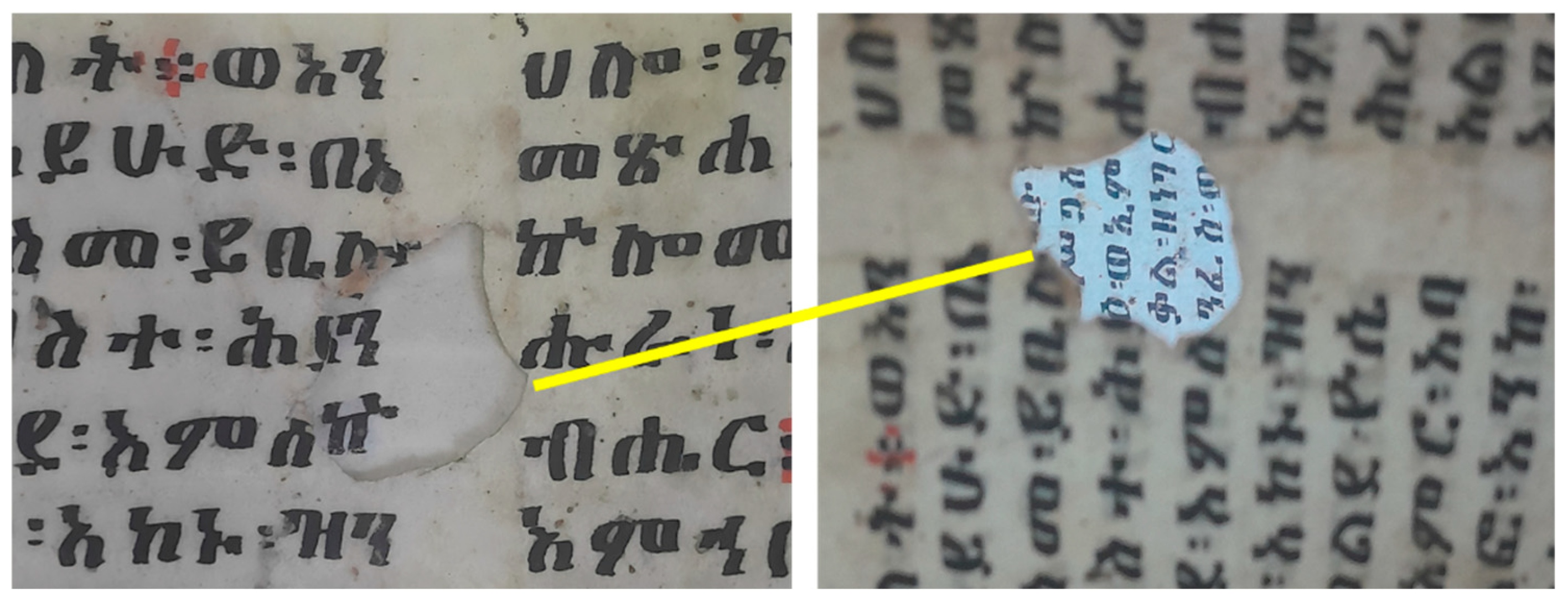
Conversely, larger holes within the writing columns are stitched using a variety of materials. The Service Book (ff. 17–18) and Gospel Book (f. 52) in Cambridge have stitched holes (Gospel Book n.d.; Service Book n.d.). As indicated in Figure 2a, the most common patterns of stitching are the running stitch, the decorative stitch, and the stretch zig-zag stitch. A sample zig-zag stitch taken from f134 of a codex at IES is presented below in Figure 2b (Genealogy of Ethiopian Kings n.d.). Similarly, large gaps were mended using additional parchment as the mending material and threads, as evidenced in Figure 2c (Homily of Mikael n.d.). Prior to the 19th century, stitching threads for holes and gaps were made of sinew, parchment, and cotton. Gut was also used to cover the holes (Winslow 2015). The sinew, parchment, and gut could be collected from the animals slaughtered for their skin.
Original repairs on ancient manuscripts commonly appear as patches and stitching (Aikenhead 2020; Vnouček 2022). These types of stitching compensate for the inherent defect in the raw material and serve as protection from further damage and as decoration (Aikenhead 2020; Housley 2015). However, in the case of Ethiopic manuscripts, the stitches appear to have been done solely to prevent further damage. Stitching, in this case, is used to maintain the parchment’s functionality. Original repairs deserve close examination to evaluate their technical characteristics, structural design, and implications for long-term preservation (Sciacca 2010, p. 58).

2.1.2. Scribes, Corrections, and Additions

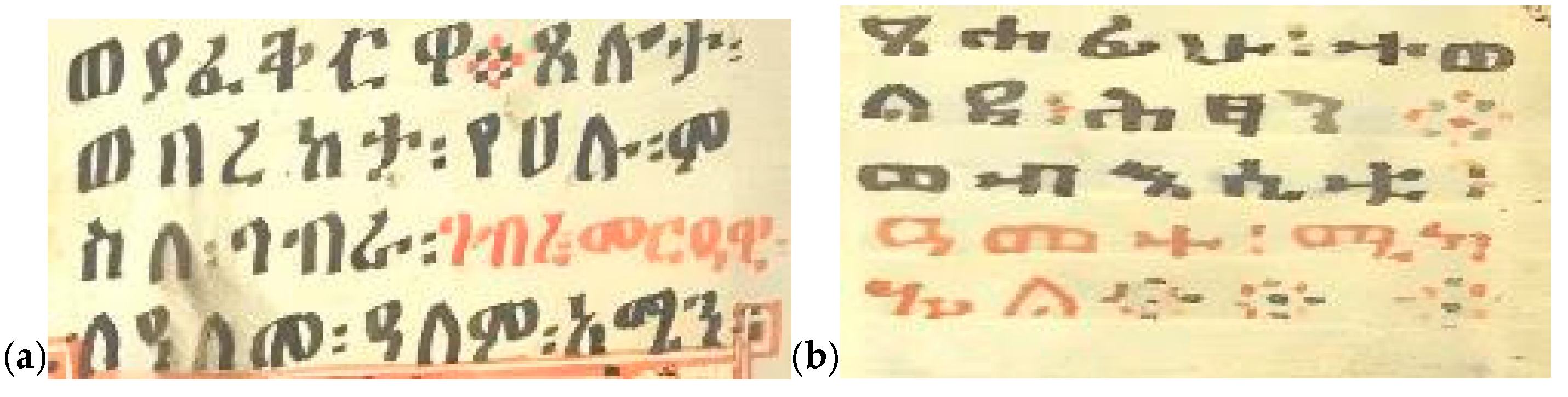
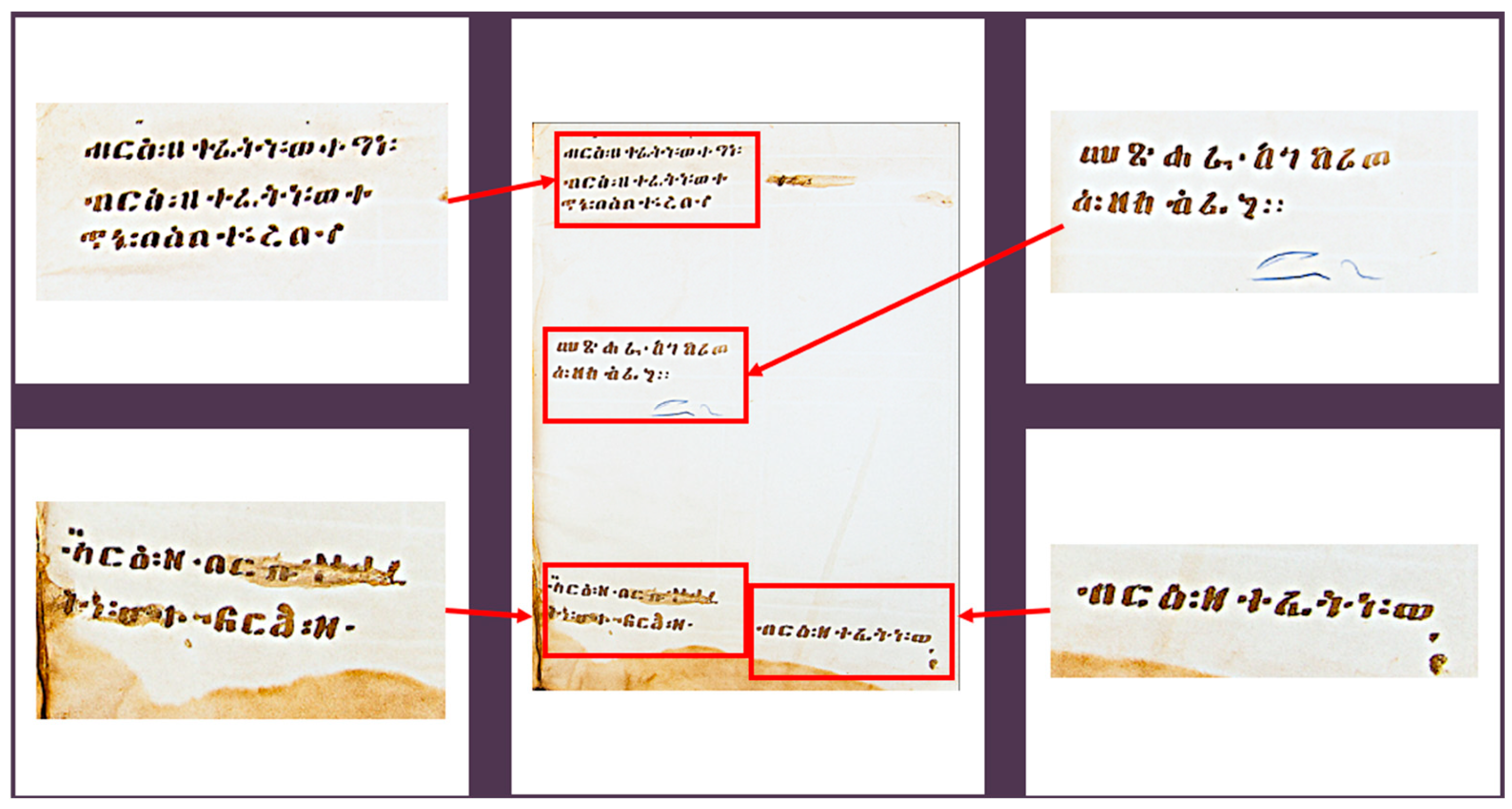
This section addresses writing interventions that may influence the material characteristics of the manuscripts. This emanates from differences in ink and pigments resulting from the involvement of several scribes, as well as corrections and additions. There was a longstanding tradition among institutions, noble patrons, and royal families to commission multiple scribes for the production of books (Guidi 1961). For instance, ten royal scribes participated in the production of an Old Testament book commissioned by Queen Mariam Sena, the wife of Emperor Sarsa-Dengel (r. 1563–1597) (Old Testament n.d.a). In addition, variations in calligraphic styles also indicate the participation of multiple scribes, as evidenced in the codex IES MS 777. In this codex, the miracles of Mary were written by Gebre Merawi (Figure 3a), whereas the miracles of Jesus were written by Tewolde Hitsan (Figure 3b) (Hagiography of Abriham Yshaq and Yakob n.d.)
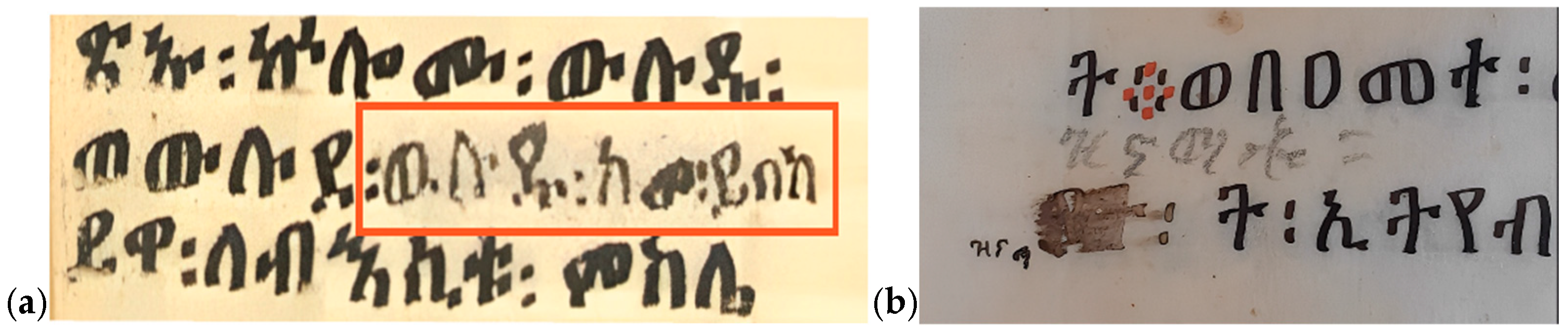
The corrections in the context of Ethiopic manuscripts have two forms. The first method involves rewriting the original text over the erased text, while the second involves adding corrections in the intercolumnar spaces or along the margins. As shown in Figure 4a, for example, in IES MS 439 (70r), a small correction is visible on the erased original text (Book of Jubilees n.d.). Another form of correction occurs between the writing lines (Figure 4b) (Hagiography of Saints n.d.). In these corrections, variations in calligraphic style and ink color are clearly discernible, indicating a distinct intervention from the original scribe.
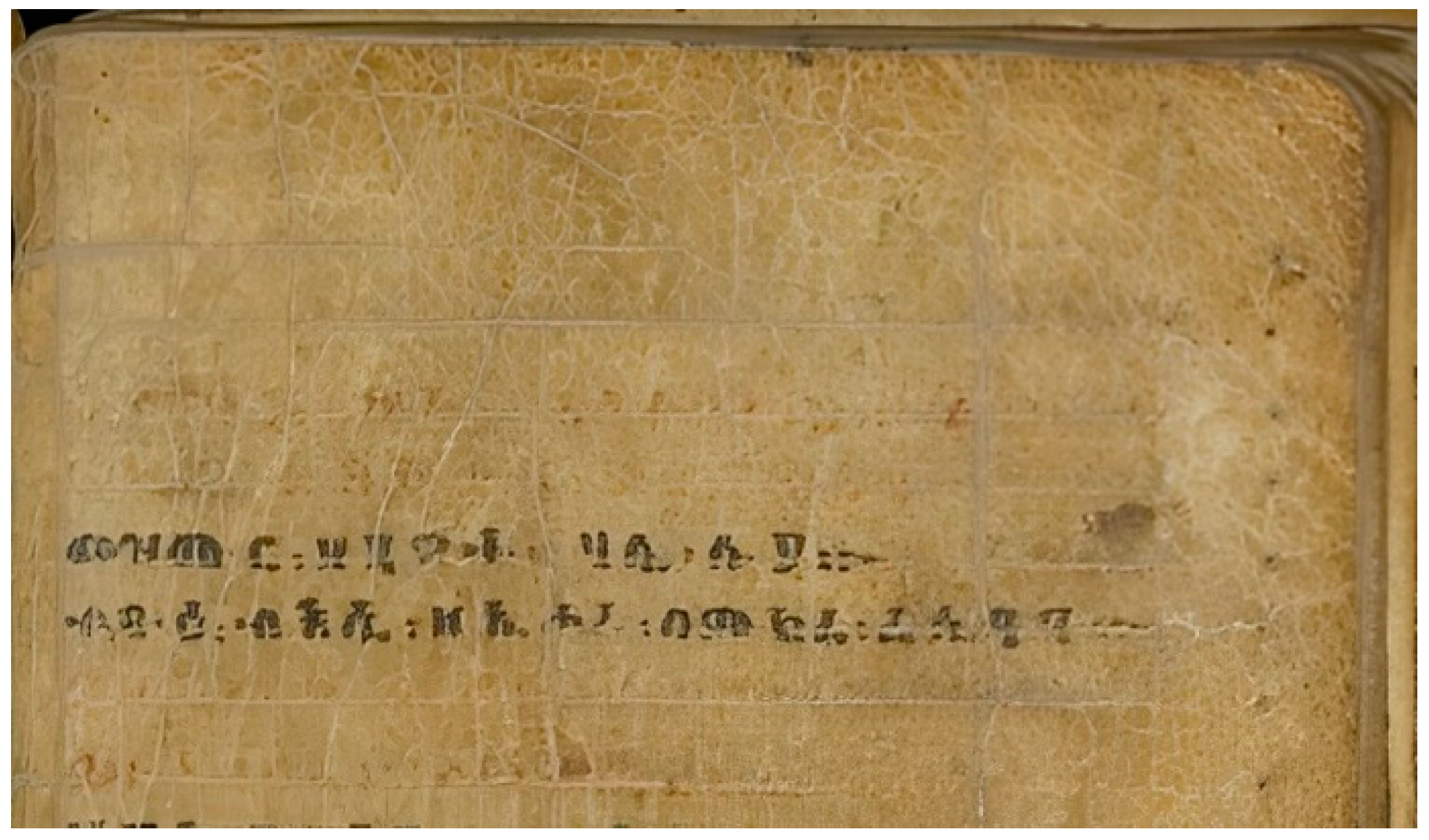
Additions are often found in the form of testing ink, testing reed pen, and notes. To test the ink or the reed pen, the phrase በስመ: አብ:ወወልድ: ወመንፈስቅዱስ (in the name of the Father, the Son and the Holy Spirit), ፈቲነብርዕ (testing reed pen), and ንዌጥንበረድኤተ እግዚአብሔር (we begin with the help of God) are commonly written. The Books of Hawi and Ankritos from Kibran Gebreil’s monastic collection have pen-testing texts (Book of Ankritos n.d.; Book of Hawi n.d.). The Book of Ankritos includes an ownership note and several ink pen trials (Figure 5). The folios used for testing inks and pens are typically the end leaves, as exemplified by the Miracle of Mary manuscript from Bichena Giyorgis (UNESCO 1970). Because the end leaves are close at hand, scribes frequently used them for ink trials and ownership notes (Trettien 2024, p. 161). Sometimes the scribes also wrote words from the main content of the books.
The manuscripts also contain supplementary notes, including inventories of church property, records of gift transfers, commercial transactions, and other (Ancel 2016, pp. 271–83). A religious order prohibiting the entry of women into the monastery of Daga Estifanos is written in the Homily of Michael at f2r found in the monastery’s collection (Homily of Michael n.d.). The Fetha Nagest (Law of Kings) codex preserved at the monastery of Zur Amba in South Gondar contains four end leaves (f1–2 & 175–176) of annotations documenting land sales, purchases, and gift transfers (Fetha Nagest (EMML 7601) n.d.). In particular, the gift and commercial exchanges are secular themes. This evidence suggests that contracting parties perceived manuscripts as reliable instruments of protection and permanence, which facilitated their willingness to enter long-term contractual arrangements (ዳንኤል 2008). Furthermore, some of these later additions appear as prayers. Individuals who owned these codices often wrote personal texts, such as prayers to Jesus and Mary (e.g., አቡነዘበሰማያት and በሰላመቅዱስገብራኤል), as shown in a manuscript found at the University of Cambridge (Praise of Mary n.d.).
The textual aspects of different scribes, corrections, and additions give voice to the history of each manuscript by reflecting its production, transmission, dissemination, and reception, involving authors, editors, artisans, commentators, readers, sellers, owners, and other agents (Ciotti and Lin 2016). These features are significant in Ethiopic manuscripts, as they convey the history of the manuscripts (Ancel 2016; Teshager 2019). Nevertheless, such histories also reveal differences in material composition (Cohen et al. 2024). An investigation of an Ethiopic manuscript from Ura Mesqel confirms material variation between the original writing and later additions (in the form of corrections) (Bausi et al. 2020). The material differences in Ethiopian inks and pigments originate from the diversity of recipes (Wion 1999). These differences influence the degradation behavior of ink, which is determined by the composition of the ink, pigments, minerals, and binding agents, and environmental conditions (Panda et al. 2021).

2.2. Common Deterioration

2.2.1. Surface Dirt Stains and Fading

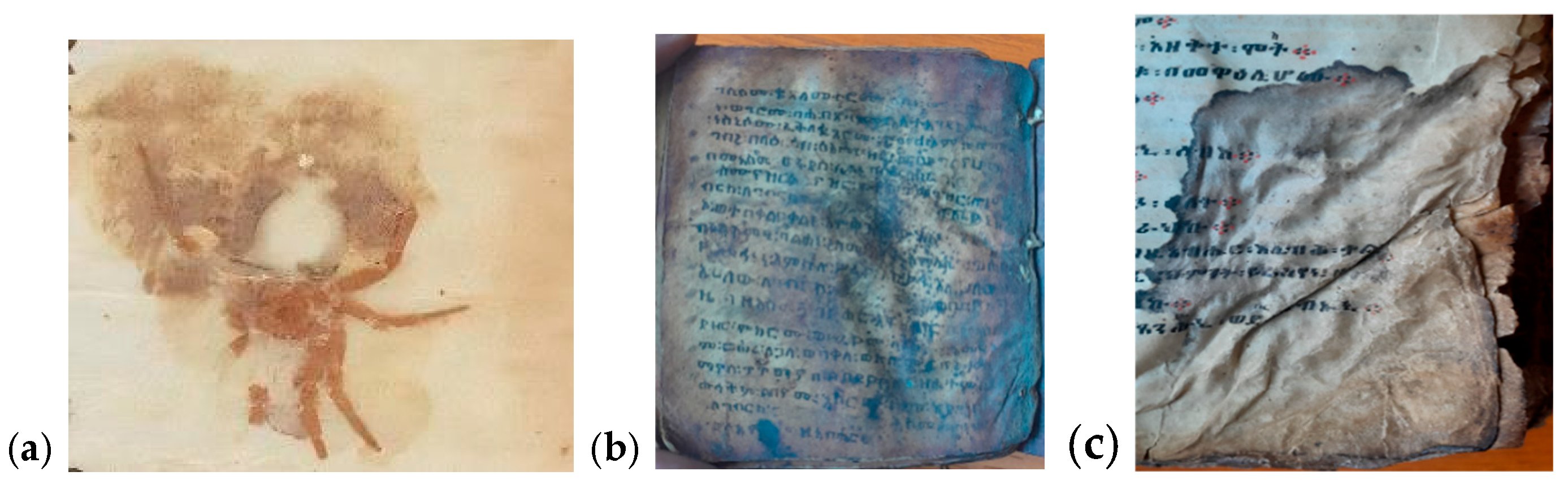
Observations on the collections indicate that Ethiopic manuscripts found in Ethiopia are more severely damaged by surface dirt and stains than those in Europe. The reason for this disparity can be a subject for further investigation. However, possible cleaning treatments carried out by custodians, the time of entry into collections, and use for daily religious practices may contribute significantly to the difference in the level of damage. Nevertheless, as shown in Figure 6a, traces of surface dirt and the remains of a dead insect are also visible in the collections housed at the Cambridge University Library (Cyril n.d., 18th–19th century).
Comparatively, manuscripts in the collections of Romanat Qidus Michael and May Wayni are severely deteriorated, particularly from dust staining (The Acts of Ananya n.d.; The Book of Consolation n.d.; Tomaszewski and Gervers 2015). The manuscripts from the Institute of Ethiopian Studies exhibit similar patterns of deterioration. In the most severe circumstances, the dust stain covers several folios in the text block. The last folio of IES MS 98 shows clear evidence of surface dust stains, which nearly cover the entire page (Figure 6b) (Hagiography of Saint Gebere Menfes Kidus n.d.). As shown in Figure 6c, water damage is another problem that can be seen on Ethiopic manuscripts (Psalter (IES MS 50) n.d.).
Surface dirt and stains on parchment manuscripts can be induced by moisture, dust, soot, blood, iron rust, adhesives residues, and microorganisms (Abdel-Maksoud et al. 2020). These types of deterioration are clear signs of intensive use, poor storage conditions, poor cleaning, and attack by insects and rodents (De Valk 2018). The marks observed on the Ethiopic manuscripts also reveal the same pattern. In addition, studies in the collections of northern Ethiopia confirm intensive use and storage in unsuitable environmental conditions (Gezae 2018; Girmay 2016; Tomaszewski and Gervers 2015).
Fading can result from damage to the writing surface, intentional erasure, or natural aging (Keith and Easton 2003). The material characteristics of the writing inks and pigments can also affect fading (Panda et al. 2021). The observed codices show fading on the initial pages, in the red rubrication, and along the tidelines. A prayer book at IES, shown in Figure 7, could serve as a bold example of the fading of rubrication (Psalter and Angels Praise Her n.d.). This fading is attributed to mechanical stress from frequent opening, and the effect diminishes in subsequent pages.
The more frequent fading of red ink compared to black ink is linked to deficiencies in the binding medium, inadequate fermentation processes, or the inherent properties of the materials, such as red pepper and red earth, used in their preparation (Mazen et al. 2021; Panda et al. 2021). Black ink appears more susceptible to fading due to moisture, as illustrated in Figure 6c (Psalter (IES MS 50) n.d.). This property of black ink is linked to its carbon-based composition and its solubility in water (Wion 1999).

2.2.2. Tear and Creases

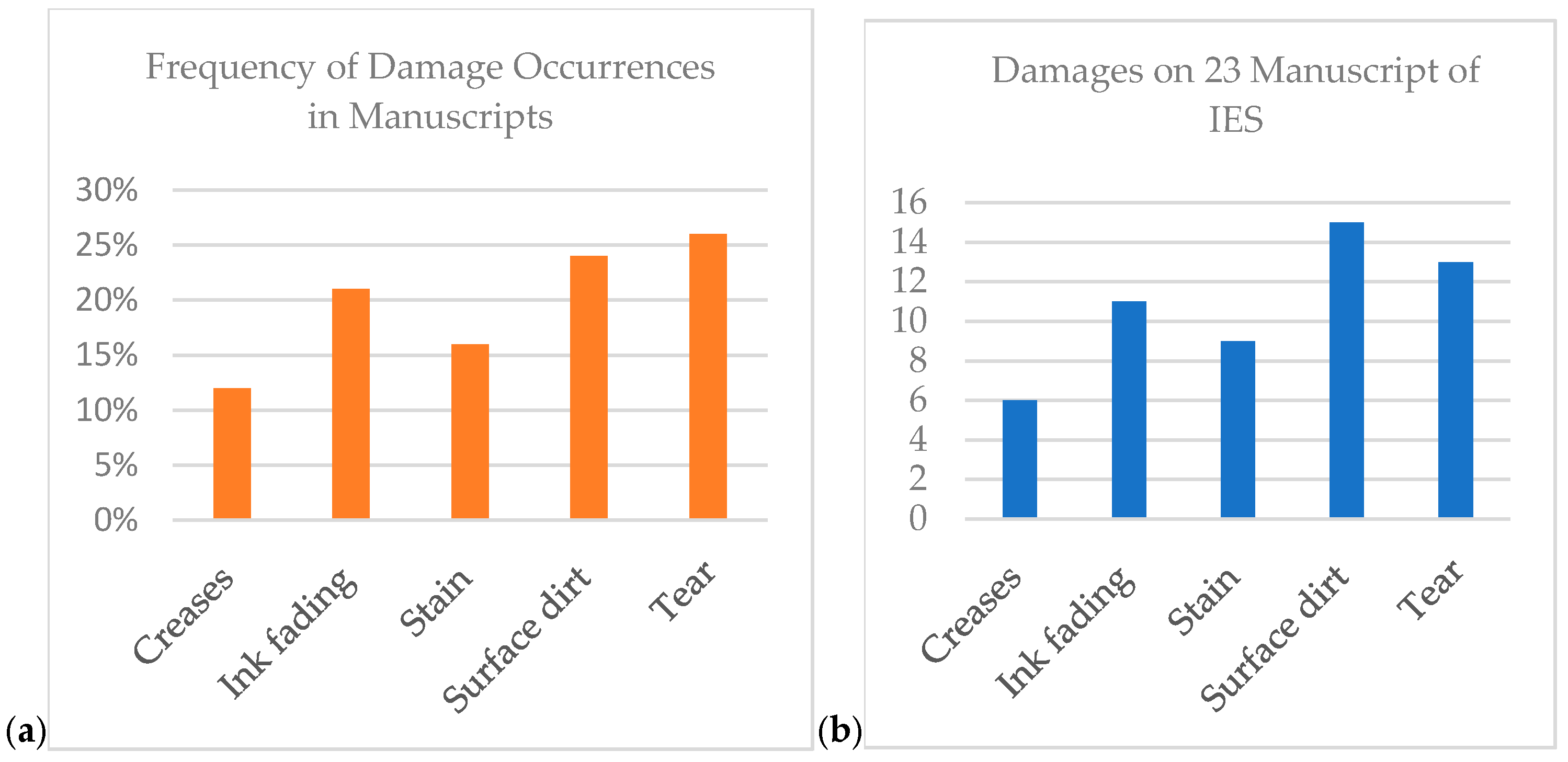
In this section, illustrative examples of tears from the studied manuscripts are presented. A folio fragment from the University of Cambridge has tears across the left edge (Service Book n.d.). Another codex of the same collection has eight holes caused by insect attack (Ethiopian Manuscripts 19th century). Tearing is the most recurrent type of damage in the IES collection (Figure 8a). Twenty-five percent of the recorded damage of the studied manuscripts from the IES collection had a tear. Surface dirt is also present on a significant number of the manuscripts (Figure 8b).
In comparison with the original damage holes discussed in the previous section, tears have an irregular shape, as shown in Figure 9 (Gospel of John n.d.). The edges of the codices have more tears than the interior folios. The tears are more severe in older manuscripts. This indicates that manuscripts from the sixteenth and seventeenth centuries are more likely to have tears than those from the eighteenth and nineteenth centuries. The severity of the tears is therefore related to both use and age.
Tears and creases are indicative traits of physical deterioration in Ethiopic codices, typically resulting from multiple contributing factors. In the case of Ethiopic codices, pests are one of the causes of tears. Pests could enter the collection through the openings in traditional church and storehouse buildings (Gezae 2018). Poor storage conditions, mold growth, and construction defects attract pests to collections (De Valk 2018, pp. 101 and 148). High humidity in the former cave-like storage areas may have created favorable conditions for mold growth. Both natural caves and constructed cave-like structures served as repositories during times of crisis (Mersha 2011a). In addition, the continued use of codices for religious practices, whether in churches or in private hands, also increases the risk of tears and creases (Elagina 2023). Furthermore, creases are caused by improper storage and shelving. Traditionally, codices, whether large or small, have been stored horizontally on top of each other (Di Bella and Sarris 2021).
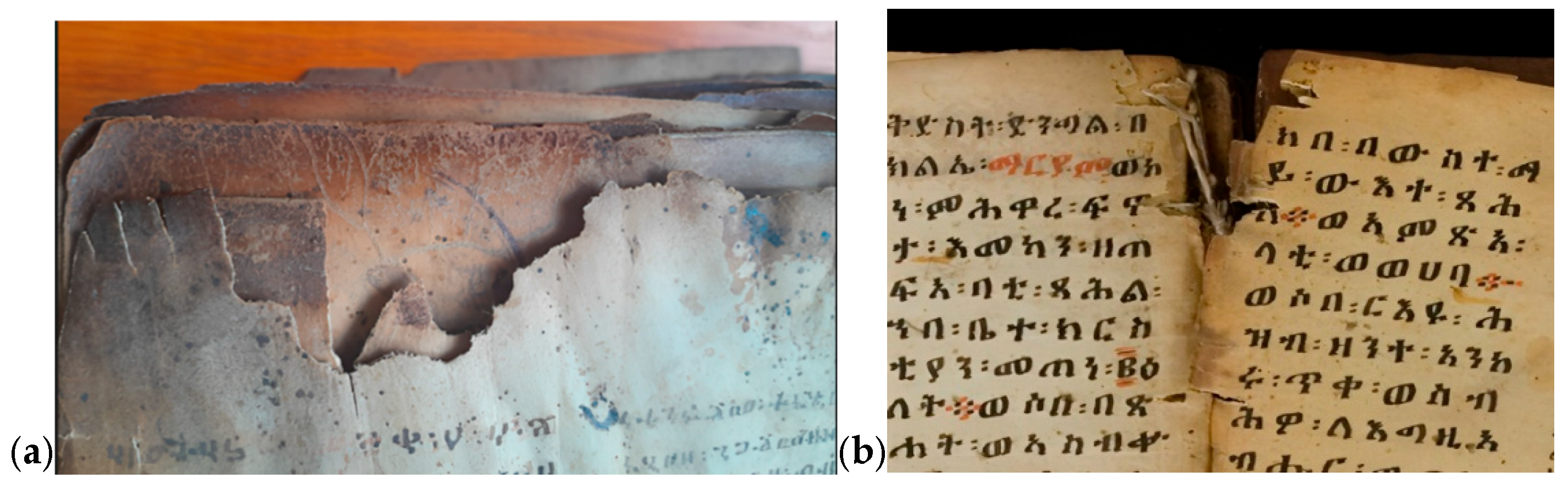
The codices exhibit additional signs of deterioration, including material loss and breaks in the binding threads and folios. The material loss ranges from small fragments to entire leaves. The leading causes are pest attacks and mechanical stress. Figure 10a, IES MS 76, shows material loss at the top edge due to pest attack (Psalter 16th century). The tension from the stitches is causing the sewing threads to tear through the folios. In this case, IES MS 26, shown in Figure 10b, the thread is causing material loss (Harp of Praise, Ritual for Penitential Baptism, Hymn to Mary with the Saints n.d.).

2.3. The Desecration of the Spiritual Order

2.3.1. Spiritual Order for Physical Preservation

This section addresses anthropogenic factors that damage and desecrate spiritual orders. There are paratexts in Ethiopic manuscripts that convey messages intended to deter future transgressions against the manuscripts. This spiritual order is often expressed in the form of anathemas. Anathema is execration, an anathema, or a denunciation by ecclesiastical authority against social misbehavior (James Bible Dictionary n.d.). This definition is workable in the Ethiopian context. It involves excommunication, cursing, confinement, and the establishment of systems. In short, it is the means of dissecting the misbehaving individual in his flesh and spirit (ኅብረት 2007, pp. 7–12; ዳንኤልገብረ መስቀል ቀኖ 2019).
The spiritual orders found in these codices serve to safeguard them against deletion, rewriting, theft, and appropriation. It is common to find a phrase ዘሠረቃ፡ ወዘፈሐቃ፡ ወዘተአገላ፡ ወዘንሥአ፡ በኃይሉ፡ ለዛቲመጽሐፍ… ውጉዘ፡ ለይኩን (anyone who steals, erases, harms, and takes it by force… shall be execrated). Priests have the authority to pass anathemas, as priests within the Ethiopic Christian tradition are considered as examples of Peter and Paul, as it is revealed in Matthew 16: 18–19 (ኅብረት 2007, p. 17). As a result, the paratexts in the manuscript cement the order by including the phrase በአፈ/በሥልጣነ፡ ጴጥሮስ፡ ወጳውሎስ፡ ውጉዘ፡ ለይኩን (execrated in the word/authority of Peter and Paul). This tradition has been important in protecting the cultural heritage from crimes. During Emperor Menelik’s reign, for instance, his soldiers had taken ecclesiastical objects. The emperor was informed about the case and asked the soldiers to return the objects taken from the church. The priests also pronounced execrations upon the soldiers who refused to return. This was effective in collecting the objects (ኅብረት 2007, pp. 25–26).

2.3.2. Desecrated Spiritual Orders

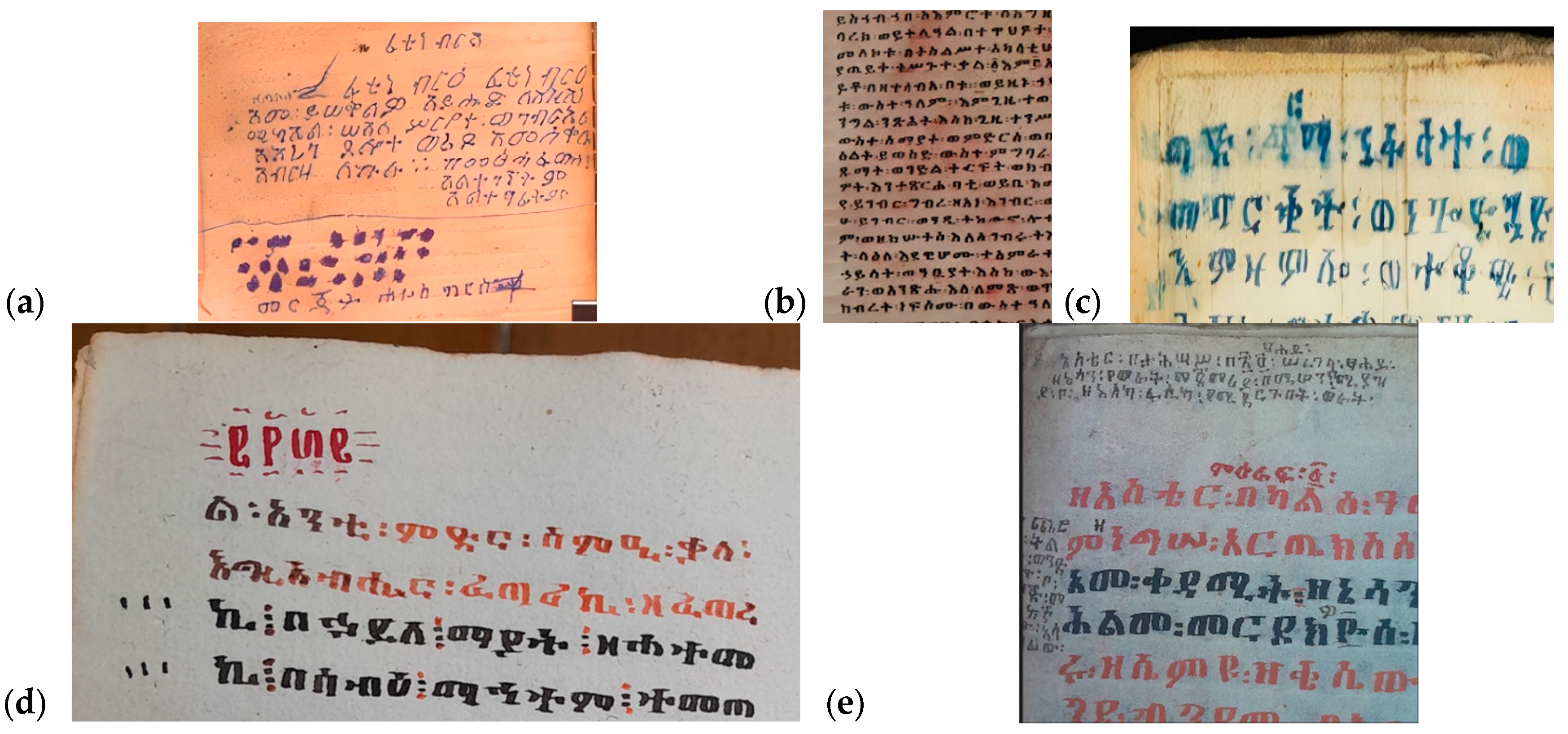
Both local and foreign actors have desecrated these spiritual orders, causing extensive damage and contributing to the loss of invaluable cultural heritage. Domestically, the damage was perpetrated through recent additions, erasure, and removal from its original location. Recent additions in this sense mean notes made with pen, pencil, and permanent markers. Such writings in Ethiopic manuscripts appear in various forms, including tests of writing materials, ownership claims, corrections, rewrites, notes on content, records of commercial exchanges, and donations to churches. As observed in the (Book of Antiphonal Chants n.d.), folio 19v, from the Monastery of May Wayni (Figure 11a), a recent ownership note has been written using a pen (Book of Antiphonal Chants n.d.). The most frequently used colors in writing are blue, red, black, and purple. There are also cases in which letters written with pen or marker bleed through or transfer to other pages. The Gospel from Romanat Qeddus Mika’el and the Book of Images from IES exhibit such damage, as indicated in Figure 11b,c (Four Gospels n.d.; Image of Mary n.d.). Writing of page numbers and comments is also a later addition by either readers or the custodian, as shown in Figure 11d,e (Job and Jeremiah n.d.; Old Testament n.d.b).
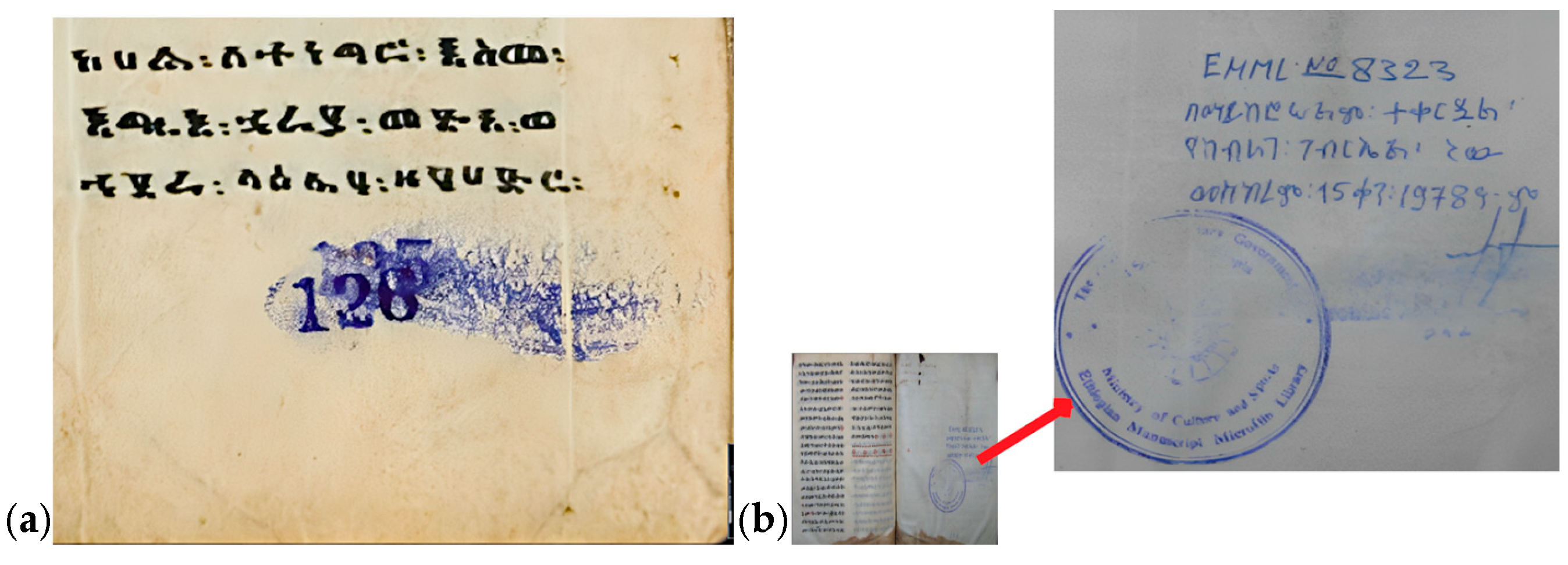
Writing and stamping during digitization have similar effects. The custodians and individuals in charge of digitization wrote page numbers and notes. Digitization often involves writing page numbers on the manuscripts using a pencil and pen. Initially, the codices didn’t include page numbers, but the assessment reveals that the libraries have now added page numbers using Arabic numerals. There are drops of ink within the text block and page numbers that bleed and spread into large areas, as shown in Figure 12a (Psalter and Angels Praise Her n.d.). Stamps have been put on manuscripts by monasteries and libraries. The manuscripts digitized by EMML (Figure 12b) reveal that the library’s stamp persisted through the digitization process (Book of Ankritos n.d.). Similarly, digital copies from the Endangered Archives Programme confirm the continued practice of stamping by the owner institution.
Private and institutional owners used to replace the names of former custodians. More often, the names of scribes and commissioners were replaced by those of the latter owners. The Book of Praises at IES is a good example of this. In the initial pages, the name Hailu Atinafu was written in pencil. However, at the end of the prayer, the name Gebre Mariam is written in the original ink. This book belonged to Gebre Mariam and was later owned by Hailu Atinafu (Praises of Mary, Gate of Light, Angels Praise Her n.d.). In addition, many codices changed hands at various times, despite the prohibition of the spiritual orders. Erasure can be carried out in two ways: first, by rubbing the text with a wet cloth; second, by scraping the writing lines with a sharp blade (ተፈራ 1987).
Although the effect of inks from pens and markers on manuscripts remains a topic for experimental research, these additions disrupt both the esthetic and historical authenticity of the manuscripts (Steele and Webster 2025, p. 62). In addition, commercial pens are unsuitable for manuscripts because their inks are soluble, smear easily, fade, and become acidic over time (Paper-Based Records 2022). Furthermore, ink transfer, bleeding, and ghosting on Ethiopic manuscripts have become increasingly evident. These problems arise from recent additions, such as writing on faded or erased parts, notes in the margins, adding page numbers, and stamping. These ongoing addenda must be halted through training and awareness creation efforts.
International agents also dishonored the spiritual order by taking them outside. The scribes wrote the prohibition of buying, selling, and taking by force. The term ወዘንሥአ፡ በኃይሉ፡… ውጉዘ፡ለይኩን (the one who has taken by force shall be accursed) is frequently mentioned for this purpose. The Law of Kings (148r) at the University of Cambridge is an instructive example of the case (Fetha Nagest (Or. 2122) n.d.). Nevertheless, manuscripts have been transported to the northern hemisphere since the 15th century. The agents were travelers, missionaries, military personnel, and scholars. As a result, more than 6500 manuscripts are now dispersed across Europe and North America. The Biblioteca Apostolica Vaticana, the Bibliothèque nationale de France, and the British Library hold the largest collections of Ethiopic codices (Yirga 2020).

3. Materials and Methods

This study examined fifty Ethiopic manuscripts dating from the 16th to the 19th centuries. Some of these were physical copies, while others were digital copies (Table 1). The physical copies consisted of twenty-eight manuscripts from the Institute of Ethiopian Studies (IES) and the National Archives and Library Service (NALS), observed in November 2024 and June 2025. The selection method for the manuscripts was random sampling using the catalog of the IES and NALS. The remaining twenty-seven were digital copies from the Endangered Archives Programme (EAP), the Hill Museum and Manuscript Library (HMML), and the University of Cambridge Digital Library. Digital archives were selected through purposive sampling based on the manuscripts’ geographical origin. The physical copies of the digitized manuscripts in the EAP and HMML collections are located in the northern, northwestern, and central regions of Ethiopia. The digital collection in the University of Cambridge Digital Library includes manuscripts that arrived in the UK from the 1860s onward. Examining both physical and digital copies of manuscripts enabled the identification of similarities and differences in features, historical experience, and deterioration across regions. Table 1 lists the number of manuscripts observed, along with their numbers and locations.
The manuscripts from these collections and digital archives were analyzed using paleographic and codicological methods. Paleography is the systematic study of all aspects of hand-written books (Brown n.d.). It is used to identify the original physical holes from later damage and writings of different scribes. It is also used to understand the violence against established preservation ethics (reconstruct the anthropogenic factors), specifically erasure, rewriting, and relocation. Codicology, alternatively known as book archeology, is an emerging field of study that examines the historical and cultural aspects of manuscripts based on physical structure and distinctive features (Şeşen 2024). Descriptive codicology is used here to discuss the diverse types of damage in the bookblocks of manuscripts. Furthermore, the literature from journal articles, books, and web sources was consulted to aid interpretation and analysis.

4. Conclusions

Ethiopic manuscripts are among the world’s oldest writing traditions. However, this manuscript tradition lacks appropriate material and conservation research. This issue arises from a lack of specialized scholars, limited accessibility, and insufficient and slow-paced conservation efforts. Examining the historical context through physical analysis is crucial for the effective conservation of manuscripts. To this end, an observational study using mixed-methods paleography and codicology was conducted on selected collections. The observation of the collections revealed original holes, as well as sewn repairs, corrections, and text additions. Additionally, surface dirt, stains, fading, tears, creases, erasure, and material loss, induced by both natural and human factors, are evident. This study highlights the importance of employing multiple methods to examine the material aspects of manuscripts, including identifying original holes versus later damage, distinguishing original additions from subsequent writings, and recognizing traditional preservation efforts. It underscores the importance of respecting the physical history of manuscripts, acknowledging the value of paratextual features for material studies, and understanding the common physical damage found in Ethiopic manuscripts. Efforts to conserve this heritage must include establishing ethical guidelines for handling any future additions. It also emphasizes the significance of delineating methodologies for interpreting recent writings as material historical sources while concurrently addressing the issue of ink bleeding that arises from them. This study recommends further investigation to elucidate the underlying processes that lead to red ink fading more than black ink, as well as the effects of pen and permanent markers.

Author Contributions

Conceptualization, S.A.Y., N.O.S., T.D.K., T.B.B., B.T., A.S.D. and A.D.D.; methodology, S.A.Y., N.O.S., T.D.K., T.B.B., B.T., A.S.D. and A.D.D.; formal analysis, S.A.Y.; investigation, S.A.Y., N.O.S. and T.B.B.; resources, S.A.Y.; writing—original draft, S.A.Y.; writing—review & editing, N.O.S., T.D.K., T.B.B. and B.T.; visualization, S.A.Y.; supervision, N.O.S., T.D.K. and T.B.B.; project administration, N.O.S. and T.D.K. All authors have read and agreed to the published version of the manuscript.

Funding

This work was supported by the VLIR-UOS under Grant (TEAM2022—77992).

Institutional Review Board Statement

Not applicable.

Informed Consent Statement

Not applicable.

Data Availability Statement

The original contributions presented in this study are included in the article. Further inquiries can be directed to the corresponding author.

Conflicts of Interest

The authors declare no conflicts of interest.

References

  1. Abdel-Maksoud, Gomaa, Hisham Emam, and Nahla Ragab. 2020. From Traditional to Laser Cleaning Techniques of Parchment Manuscripts: A Review. Advanced Research in Conservation Science 1: 52–76. [Google Scholar] [CrossRef]
  2. Admasu, Wondwosen. 2011. A Catalogue of Some Manuscripts in Ankober Medhanialem Church Museum. Master’s thesis, Addis Ababa University, Addis Ababa, Ethiopia. [Google Scholar]
  3. Aikenhead, Lydia. 2020. Hol(e)y Moly!: Historical Damage and Repairs in Medieval Manuscripts. New York: The Morgan Library & Museum. [Google Scholar]
  4. Alemnew, Walle. 2022. Catalogue of The Manuscripts of Ṭayru Giyorgis Church, South Gondar. Master’s thesis, Bahir Dar University, Bahir Dar, Ethiopia. [Google Scholar]
  5. Ancel, Stéphane. 2016. Travelling Books: Changes of Ownership and Location in Ethiopian Manuscript Culture. In Tracing Manuscript in Time and Space Through Paratexts, Studies in Manuscript Cultures. Berlin: De Gruyter, pp. 269–99. [Google Scholar]
  6. Ayalew, Hailemariam. 2009. Catalogue of Some Selected Manuscripts in Beta Mariam Church (Lalibela). Master’s thesis, Addis Ababa University, Addis Ababa, Ethiopia. [Google Scholar]
  7. Ayinekulu, Mulugeta. 2020. Catalogue of Hagiographical Manuscripts of Ura Kidanä Mǝḥrät Monastery. Master’s thesis, Bahir Dar University, Bahir Dar, Ethiopia. [Google Scholar]
  8. Babu, Blessen. 2022. Cultural Contacts between Ethiopia and Syria: The Nine Saints of the Ethiopian Tradition and Their Possible Syrian Background. In Ethiopian Orthodox Christianity in a Global Context Entanglements and Disconnections. Buckinghamshire: Brill, pp. 42–61. [Google Scholar]
  9. Balicka-Witakowska, Ewa, Alessandro Bausi, Denis Nosnitsin, and Claire Bosc-Tiessé. 2015. Ethiopic codicology. In Comparative Oriental Manuscript Studies: An Introduction. Hamburg: COMSt. [Google Scholar]
  10. Bausi, Alessandro, Antonella Brita, Marco di Bella, Denis Nosnitsin, Ira Rabin, and Nikolas Sarris. 2020. The Aksumite Collection or Codex Σ (Sinodos of Qǝfrǝyā, ms C3-IV-71/C3-IV-73, Ethio-SPaRe UM-039): Codicological and Palaeographical Observations. With a Note on Material Analysis of Inks. Comparative Oriental Manuscript Studies Bulletin 6: 127–71. [Google Scholar]
  11. Book of Ankritos (AM-IV-738). n.d. 19th Century. Bahir Dar: Kibran Gebriel Monastry.
  12. Book of Antiphonal Chants. n.d. 17th Century. London: British Library. Available online: https://eap.bl.uk/archive-file/EAP526-1-89=436 (accessed on 7 June 2025).
  13. Book of Hawi (EMML 7603). n.d. 19th Century. Collegeville: vHMML. Available online: https://w3id.org/vhmml/readingRoom/view/201130 (accessed on 18 June 2025).
  14. Book of Jubilees (IES MS 439). n.d. 1505. Addis Ababa: Institute of Ethiopian Studies.
  15. Brown, Julian. n.d. What is Palaeography? Amherst: University of Massachusetts Amherst. Available online: https://people.umass.edu/eng3/fcd/documents/Brown_WhatIsPalaeography.pdf (accessed on 11 October 2023).
  16. Ciotti, Giovanni, and Hang Lin. 2016. Tracing Manuscripts in Time and Space Through Paratexts. Berlin and Boston: Walter de Gruyter GmbH. [Google Scholar]
  17. Cohen, Zina, Hahn Oliver, Ira Rabin, and Aengus Ward. 2024. Centenary Paper: Of inks and scribes: The composition of a thirteenth-century Castilian manuscript—British Library Res 20787. Bulletin of Hispanic Studies 101: 703–20. [Google Scholar] [CrossRef]
  18. Cyril, (Add. 1569). n.d. 18th–19th Century. [Dataset]. Cambridge: University of Cambridge Digital Library. Available online: https://cudl.lib.cam.ac.uk/view/MS-ADD-01569 (accessed on 18 March 2024).
  19. Dal Sasso, Eliana. 2022. Describing Ethiopian Bookbinding in TEI. Journal of the Text Encoding Initiative, 1–33. [Google Scholar] [CrossRef]
  20. Dal Sasso, Eliana. 2023. Ethiopian and Coptic Sewing Techniques in Comparison. In Tied and Bound: A Comparative View on Manuscript Binding. Berlin: De Gruyter, pp. 251–84. [Google Scholar]
  21. Dawit, Girma. 2019. Ge’ez Literature and Medieval Ethiopian Hagiographies in the course of Ethiopian Literature. International Journal of English Literature and Culture 7: 121–29. [Google Scholar]
  22. Dawit, Girma. 2023. Ethiopic Literature in Medieval Ethiopia. Journal of Liaoning Technical University 17: 8. [Google Scholar]
  23. Dege-Müller, Sophia. 2014. The Ethiopian Psalter: An Introduction to its Codicological Tradition. The Anglo-Ethiopian Society News File. Available online: https://www.academia.edu/9305145/The_Ethiopian_Psalter_An_Introduction_to_its_Codicological_Tradition (accessed on 10 August 2025).
  24. De Valk, Marijn. 2018. Library Damage Atlas: A Tool for Assessing Damage. Antwerp: Vlaamse Erfgoedbibliotheek. [Google Scholar]
  25. De Vries, Herre. 2016. Reading the Book’s History. Understanding the Repairs and Rebindings on Islamic Manuscripts in the Vatican Library and Their Implications for Conservation. Journal of Islamic Manuscripts 7: 339–83. [Google Scholar] [CrossRef]
  26. Di Bella, Marco, and Nikolas Sarris. 2021. The Conservation of a Fifteenth-Century Large Parchment Manuscript of Gädlä Sämaʿtat from the Monastery of ʿUra Mäsqäl: Further Conservation Experiences from East Tigray, Ethiopia. Care and Conservation of Manuscripts 18. Copenhagen: Museum Tusculanum Press. [Google Scholar]
  27. Elagina, Daria. 2023. Materiality and community: Digital approaches to Ethiopic manuscript culture. In Can’t Touch This: Digital Approaches to Materiality in Cultural Heritage. London: Ubiquity Press, pp. 95–119. [Google Scholar]
  28. Fetha Nagest (EMML 7601). n.d. 18th Century. Collegeville: vHMML. Available online: https://w3id.org/vhmml/readingRoom/view/201128 (accessed on 20 March 2024).
  29. Fetha Nagest (Or. 2122). n.d. 19th Century. Cambridge: University of Cambridge. Available online: https://cudl.lib.cam.ac.uk/view/MS-OR-02122/303 (accessed on 21 March 2024).
  30. Fitsumbirhane, Desta. 2009. Catalogue of Some Selected Manuscripts of Dabra Sayon Church Ziway Island (Lulu Guddo Island. Master’s thesis, Addis Ababa University, Addis Ababa, Ethiopia. [Google Scholar]
  31. Four Gospels. n.d. 17th Century. [Dataset]. London: British Library. Available online: https://eap.bl.uk/archive-file/EAP254-1-4=249 (accessed on 4 August 2024).
  32. Genealogy of Ethiopian Kings, through King Iyasu II 1755, Petition and Supplication. n.d. Late 17th Century–Early 18th Century. [Dataset]. London: British Library. Available online: https://eap.bl.uk/archive-file/EAP286-1-1-628=-344 (accessed on 7 August 2024).
  33. Getachew, Haile. 1975. A Catalogue of Ethiopian Manuscripts Microfilmed for the Ethiopian Manuscript Microfilm Library, Addis Ababa, and for the Monastic Manuscript Microfilm Library, Collegeville. Collegeville: Monastic Manuscript Microfilm Library, St. John’s Abbey and University, vol. 4. [Google Scholar]
  34. Gezae, Haile. 2018. The Limits of Traditional Methods of Preserving Ethiopian Ge’ez Manuscripts. Libri 68: 33–42. [Google Scholar] [CrossRef]
  35. Gezae, Haile. 2024. Reclaiming and Unlocking Ancient Heritage Knowledge from Ethiopia’s Ancient Cultural Heritage. Libri 74: 349–67. [Google Scholar]
  36. Girmay, Marshet. 2016. Traditional Cultural Heritage Management Practice in Church Property: The case of Dakewa Kidane Meheret, Dabat Wäräda. Ethiopian Renaissance Journal of Social Sciences and the Humanities 3: 39–56. [Google Scholar]
  37. G/Mariam, Tamirat. 2020. Ethiopian Manuscripts and Archives: Challenges and Prospects. PJAEE 17: 4214–27. [Google Scholar]
  38. Gobbitt, Thom. 2014. Materiality, stratigraphy and artefact biography: Codicological features of a late-eleventh-century manuscript of the Lombard laws. Studia Neophilologica 86: 48–67. [Google Scholar] [CrossRef]
  39. Gospel Book. n.d. 18th Century. [Dataset]. Cambridge: Cambridge Digital Library. Available online: https://cudl.lib.cam.ac.uk/view/MS-OR-01802 (accessed on 20 January 2025).
  40. Gospel of John (ብ.ቤ.መ 39). n.d. 19th Century. Addis Ababa: National Archives and Library Service.
  41. Guidi, Ignatius. 1961. Annales Iohannis I, Iyasu I, et Bakaffa. Louvain: Secrétariat du CorpusSCO. [Google Scholar]
  42. Hagiography of Abriham Yshaq and Yakob (IES MS 377). n.d. 14th to 15th Century. Addis Ababa: Institute of Ethiopian Studies.
  43. Hagiography of Saint Gebere Menfes Kidus (IES MS 98). n.d. 17th Century. Addis Ababa: Institute of Ethiopian Studies.
  44. Hagiography of Saints (ብ.ቤ.መ 214). n.d. 17th Century. Addis Ababa: National Archives and Library Service.
  45. Hagos, Abrha Abay. 2023. Manuscripts’ Digitization in Northern Ethiopia: Challenges and Heritage Crises. ECAS 2023 Conference Paper. Paper Presented at European Conference on African Studies, Cologne, Germany, May 31–June 3; Available online: https://nomadit.co.uk/conference/ecas2023/paper/73114 (accessed on 5 October 2025).
  46. Harp of Praise, Ritual for Penitential Baptism, Hymn to Mary with the Saints. n.d. 16th Century–19th Century. [Dataset]. London: British Library. Available online: https://eap.bl.uk/archive-file/EAP286-1-1-7=277 (accessed on 15 January 2025).
  47. Haymanote Abew (EMML 8610). n.d. 18th Century. Collegeville: vHMML. Available online: https://w3id.org/vhmml/readingRoom/view/201460 (accessed on 20 March 2024).
  48. Homily of Michael (EMML 8734). n.d. 16th Century. Collegeville: vHMML. Available online: https://w3id.org/vhmml/readingRoom/view/201492/ (accessed on 15 June 2015).
  49. Homily of Mikael (ብ.ቤ.መ 226). n.d. 19th Century. Addis Ababa: National Archives and Library Service.
  50. Housley, Marjorie. 2015. Holes and Holiness in Medieval Manuscripts—Medieval Studies Research Blog: Meet Us at the Crossroads of Everything. Notre Dame: University of Notre Dame. [Google Scholar]
  51. Image of Mary, Image of Jesus, Image of George. n.d. 19th Century. [Dataset]. London: British Library. Available online: https://eap.bl.uk/archive-file/EAP286-1-1-13=271 (accessed on 4 February 2025).
  52. Job and Jeremiah (ብ.ቤ.መ 14). n.d. 19th Century. Addis Ababa: National Archives and Library Service.
  53. Keith, T. Knox, and Roger L. Easton, Jr. 2003. Recovery of Lost Writings on Historical Manuscripts with Ultraviolet Illumination. In IS and TS PICS Conference. New York: Society for Imaging Science & Technology, vol. 6, pp. 301–6. [Google Scholar]
  54. James Bible Dictionary. n.d. Available online: https://kingjamesbibledictionary.com/Dictionary/Anathema (accessed on 20 March 2024).
  55. Krzyzanowska, Magdalena. 2015. Contemporary Scribes of Eastern Tigray (Ethiopia). Rocznik Orientalistyczny LXVIII: 73–101. [Google Scholar]
  56. Kwakkel, Erik. 2015. Decoding the material book: Cultural residue in medieval manuscripts. In The Medieval Manuscript Book: Cultural Approaches. Edited by Michael Johnston and Michael Van Dussen. Cambridge: Cambridge University Press, pp. 60–76. [Google Scholar]
  57. Liturgy (IES MS 3164). n.d. 16th–18th Century. Addis Ababa: Institute of Ethiopian Studies.
  58. Lusini, Gianfrancesco. 2017. The stemmatic method and Ethiopian philology: General considerations and case studies. Rassegna Di Studi Etiopici 1: 75–86. [Google Scholar]
  59. Macomber, William F. 1975a. A Catalogue of Ethiopian Manuscripts Microfilmed for the Ethiopian Manuscript Microfilm Library, Addis Ababa, and for the Monastic Manuscript Microfilm Library, Collegeville. Collegeville: Monastic Manuscript Microfilm Library, St. John’s Abbey and University, vol. 2. [Google Scholar]
  60. Macomber, William F. 1975b. A Catalogue of Ethiopian Manuscripts Microfilmed for the Ethiopian Manuscript Microfilm Library, Addis Ababa, and for the Monastic Manuscript Microfilm Library, Collegeville. Collegeville: Monastic Manuscript Microfilm Library, St. John’s Abbey and University, vol. 3. [Google Scholar]
  61. Mazen, Bataa, Badawi Ismail, Rushdya Rabee Hassan, and Mahmoud Ali. 2021. Damage caused by black inks to the chemical properties of archaeological papyrus—Analytical study. Pigment & Resin Technology ahead-of-print. [Google Scholar]
  62. Mersha, Alehegn. 2011a. Medieval Ethiopian Manuscripts Contents, Challenges, and Solutions. Bulletin of the Department of Linguistics and Philology 37: 37–63. [Google Scholar]
  63. Mersha, Alehegn. 2011b. Towards a Glossary of Ethiopian Manuscript Culture and Practice. Aethiopica International Journal of Ethiopian and Eritrean Studies 14: 145–62. [Google Scholar]
  64. Minasse, Ashenafi. 2009. A Catalogue of Some Selected Manuscripts in Abba Afase Church. Master’s thesis, Addis Ababa University, Addis Ababa, Ethiopia. [Google Scholar]
  65. Mirza, Sana. 2017. The visual resonances of a Harari Qur’ān: An 18th-century Ethiopian manuscript and its Indian Ocean connections. Afriques. Débats, Méthodes et Terrains d’histoire 8: 64–87. [Google Scholar]
  66. Nosnitsin, Danis. 2012. Ethiopian Manuscripts and Ethiopian Manuscript Studies. A brief Overview and Evaluation. Gazette Du Livre Médiéval 58: 1–16. [Google Scholar] [CrossRef]
  67. Nosnitsin, Danis. 2014. Ethio-SPaRe Cultural Heritage of Christian Ethiopia: Salvation, Preservation and Research. Hamburg: Hamburg University. [Google Scholar]
  68. Nosnitsin, Danis. 2023a. Ethiopian Manuscript Studies Yesterday and Today. Available online: https://www.aai.uni-hamburg.de/en/ethiostudies/research/ethiospare/pdf/ppp-nosnitsin-2013-brussels.pdf (accessed on 18 March 2024).
  69. Nosnitsin, Danis. 2023b. Lesser-known Features of the Ethiopian Codex. In Movements in Ethiopia, Ethiopia in Movement. Addis Ababa: Centre Français des Études Éthiopiennes, Tsehai Publishers, Addis Ababa University, vol. 1, pp. 73–88. [Google Scholar]
  70. Nosnitsin, Denis, Emanuel Kindzorra, Oliver Hahn, and Ira Rabin. 2014. A “Study Manuscript” from Qäqäma (Tǝgray, Ethiopia): Attempts at Ink and Parchment Analysis. Comparative Oriental Manuscript Studies Newsletter 7: 28–31. [Google Scholar] [CrossRef]
  71. Old Testament (Add. 1570). n.d.a. 16th Century. Cambridge: Cambridge Digital Library. Available online: https://cudl.lib.cam.ac.uk//view/MS-ADD-01570=-1570 (accessed on 20 May 2024).
  72. Old Testament (ብ.ቤ.መ 15). n.d.b. 19th Century. Addis Ababa: National Archives and Library Service.
  73. Panda, Siva Sankar, Neena Singh, and M. R. Singh. 2021. Development, characterization of traditional inks for restoration of ancient manuscripts, and application on various substrates to understand stability. Vibrational Spectroscopy 114: 103232. [Google Scholar] [CrossRef]
  74. Paper-Based Records. 2022, College Park: National Archives. Available online: https://www.archives.gov/preservation/holdings-maintenance/paper (accessed on 17 September 2025).
  75. Phillipson, Laurel. 2013. Parchment Production in the First Millennium BC at Seglamen, Northern Ethiopia. African Archaeological Review 30: 285–303. [Google Scholar] [CrossRef]
  76. Praise of Mary (Add. 1888.2). n.d. 18th Century. Cambridge: Cambridge Digital Library. Available online: https://cudl.lib.cam.ac.uk//view/MS-ADD-01888-00002=-1890 (accessed on 18 February 2024).
  77. Praises of Mary, Gate of Light, Angels Praise Her. n.d. 19th Century. [Dataset]. EAP286/1/1/19. London: British Library. Available online: https://eap.bl.uk/archive-file/EAP286-1-1-19=265 (accessed on 13 April 2024).
  78. Psalter and Angels Praise Her. n.d. 19th Century. [Dataset]. EAP286/1/1/3. London: British Library. Available online: https://eap.bl.uk/archive-file/EAP286-1-1-3=281 (accessed on 19 March 2024).
  79. Psalter (IES MS 50). n.d. 18th Century. Addis Ababa: Institute of Ethiopian Studies.
  80. Psalter (IES MS 76). n.d. 16th Century. Addis Ababa: Institute of Ethiopian Studies.
  81. Sciacca, Christine. 2010. Stitches, Sutures, and Seams: ‘Embroidered’ Parchment Repairs in Medieval Manuscripts. In Medieval Clothing and Textiles. Woodbridge: The Boydell Press, vol. 6, pp. 57–92. [Google Scholar]
  82. Sergew, Hableselassie. 1981. Book Making in Ethiopia. Leer: Karstens Brukkers B.V. [Google Scholar]
  83. Service Book (Add. 3682). n.d. 18th Century. Cambridge: Cambridge University Library. Available online: https://cudl.lib.cam.ac.uk//view/MS-ADD-03682/56=-65.75 (accessed on 4 June 2025).
  84. Şeşen, Yasin. 2024. Application of codicology science in Ottoman manuscripts. RumeliDE Dil ve Edebiyat Araştırmaları Dergisi 41: 569–88. [Google Scholar] [CrossRef]
  85. Steele, Gemma, and Hayley Webster. 2025. Getting Inked? A Survey of Current Institutional Marking Practices in Rare Books and Special Collections. RBM: A Journal of Rare Books, Manuscripts, and Cultural Heritage 26: 52. [Google Scholar] [CrossRef]
  86. Stewart, Columba. 2017. A Brief History of the Ethiopian Manuscript Microfilm Library (EMML) 2017. In Studies in Ethiopian Languages, Literature, and History. Festchrift for Getatchew Haile Presented by His Friends and Colleagues, Äthiopistische Forschungen 83. Edited by Adam Carter McCollum. Wiesbaden: Harrassowitz. [Google Scholar]
  87. Tesfaye, Samuel. 2011. A Cataloging of Some Manuscripts in Dabra Brhan Sllase Church. Master’s thesis, Addis Ababa University, Addis Ababa, Ethiopia. [Google Scholar]
  88. Teshager, Habtie S. 2019. Codicology of Gondärian Manuscripts (ca. 1650—1800). Ph.D. thesis, Addis Ababa University, Addis Ababa, Ethiopia. [Google Scholar]
  89. The Acts of Ananya. n.d. 18th Century. Endangered Archives Programme. London: British Library. Available online: https://eap.bl.uk/archive-file/EAP254-1-9 (accessed on 15 March 2024).
  90. The Book of Consolation. n.d. 17th Century. Endangered Archives Programme. London: British Library. Available online: https://eap.bl.uk/archive-file/EAP254-1-40=213 (accessed on 5 March 2024).
  91. Tomaszewski, Jacek, and Michael Gervers. 2015. Technological aspects of the monastic manuscript collection at May Wäyni, Ethiopia. In Dust to Digital: Ten Years of the Endangered Archives Programme. Cambridge: Open Book Publishers, pp. 89–133. Available online: https://books.openedition.org/obp/2228?lang=en (accessed on 9 April 2024).
  92. Trettien, Whitney. 2024. Re-using Manuscripts in Late Medieval England: Repairing, Recycling, Sharing by Hannah Ryley (review). Manuscript Studies: A Journal of the Schoenberg Institute for Manuscript Studies 9: 158–61. [Google Scholar] [CrossRef]
  93. UNESCO. 1970. Catalogue of Manuscripts Microfilmed by the UNESCO Mobile Microfilm Unit in Addis Ababa and Gojjam Province. Addis Ababa: Ministry of Education and Fine Arts, Department of Fine Arts and Culture. Available online: https://www.vhmml.org/readingRoom (accessed on 15 December 2023).
  94. Vadrucci, Monia, Davide Bussolari, Massimo Chiari, Claudia De Rose, Michele Di Foggia, Anna Mazzinghi, Noemi Orazi, Carlotta L. Zanasi, and Cristina Cicero. 2023. The Ethiopian Magic Scrolls: A Combined Approach for the Characterization of Inks and Pigment Composition. Heritage 6: 1378–96. [Google Scholar] [CrossRef]
  95. Vnouček, Jiří. 2022. Hole Repairs as Proof of a Specific Method of Manufacture of Late Antique Parchment. Restaurator. International Journal for the Preservation of Library and Archival Material 43: 93–110. [Google Scholar] [CrossRef]
  96. Weronika, Liszewska, and Jacek Tomaszewski. 2016. Analysis and conservation of two Ethiopian manuscripts on parchment from the collection of the University Library in Warsaw. In Care and Conservation of Manuscripts 15. Copenhagen: Museum Tusculanum Press, pp. 183–201. [Google Scholar]
  97. Winslow, Sean Michael. 2015. Ethiopian Manuscript Culture: Practice and Context. Ph.D. thesis, University of Toronto, Toronto, ON, Canada. [Google Scholar]
  98. Wion, A Anaïs. 1999. An Analysis of 17th-century Ethiopian Pigments. In The Indigenous and the Foreign in Christian Ethiopian Art. On Portuguese-Ethiopian Contacts in the 16th–17th Centuries. Edited by Manuel João Ramos and Isabel Boavida. Aldershot: Ashgate, pp. 103–12. [Google Scholar]
  99. Worku, Belay. 2010. A Catalogue of Some Selected Manuscripts in Hayq St.: Estiphanos Abune Iyasus Mo’a Monastery. Master’s thesis, Addis Ababa University, Addis Ababa, Ethiopia. [Google Scholar]
  100. Yirga, Gelaw Woldeyes. 2020. Holding living bodies in graveyards: The violence of keeping Ethiopian manuscripts in Western institutions. M/C Journal 23: 1–14. [Google Scholar] [CrossRef]
  101. Yonas, Yilma. n.d. Ethiopian Manuscript Heritage: Ethiopic Manuscript and the Role of ARCCH. Available online: https://www.academia.edu/28794775/Ethiopian_Manuscript_Heritage_Ethiopic_Manuscript_and_the_Role_of_ARCCH (accessed on 6 November 2025).
  102. ኅብረት, የሺጥላ. 2007. ትምህርተ ውግዘት. አዲስ አበባ. [Google Scholar]
  103. ማማሩ, ስማቸው. 2015. በምስራቅ ጎጃም ዞን የምትገኘው የከንቺ ማርያም ገዳም የእጅ ፅሁፎች መዘርዝር. [ኤ.ም.ኤ]. ባህር ዳር: ባህርዳር ዩኒቨርሲቲ. [Google Scholar]
  104. ሰለሞን, መሰለ. 2011. ታሪካዊ የብራና መጽሐፍት. አዲስ አበባ: የቅርስ ጥናት ጥበቃና ልማት ባለስልጣን, vol. 2. [Google Scholar]
  105. ተስፋዬ, አራጌ. 2010. ጥንታዊ የብራና መጽሐፍት ካታሎግ. አዲስ አበባ: የቅርስ ጥናት ጥበቃና ልማት ባለስልጣን, vol. 1. [Google Scholar]
  106. ዳንኤል, ክብረት. 2008. ጥንታዊ የብራና መጽሐፍት እንድ ሰነዶች ምዝገባና ማረጋገጫ ጽ/ቤት. ሐቃፊ ሀገር ካልኣይ ጉባኤ ግዕዝ ጥንቅር. አዲስ አበባ: ባህልና ቱሪዝም ምኒስቴር የቋንቋና የባህል እሴቶች ዳይሬክቶሬት. [Google Scholar]
  107. ዳንኤልገብረ መስቀል ቀኖ. 2019. ያልተፈታው ውግዘት. አዲስ አባባ. [Google Scholar]
  108. ጀማነህ, አላብሰው. 1963. የመጀመሪያው ብሔራዊ ቤተ መጽሐፍት በኢትዮጵያ. በኢትዮጵያ የፓሌ ኦንቶሎዥና አርኬኦሎዢ ጥናቶች. አዲስ አበባ: የኢትዮጵያ ንጉሰ ነገስት መንግስት የጥንታዊ ታሪካዊ ቅርሶች አስተዳደር. [Google Scholar]
  109. ጌታሁን, ኪዳነማርያም. 1960. ጥንታዊ የቆሎ ተማሪ. አዲስ አበባ: ትንሳኤ ማተሚያ ድርጅት. [Google Scholar]
  110. ጌታቸው, ኃይሌ. 2020. ከግዕዝ ስነ ፅሑፍ ጋር ብዙ አፍታ ቆይታ. አዲስ አበባ: ብራና መፅሐፍት መደብር. [Google Scholar]
  111. ተፈራ, ፈቃደስላሴ. 1987. የብራና መጽሐፍት ግኝትና አጠባበቅ. በኢትዮጵያ ብራና መጽሐፍት ማይክሮፊልም ድርጅት ሲምፖዚየም. አዲስ አበባ: አዲስ አበባ የኒቨርሲቲ. [Google Scholar]
  112. ተፈራ, ፈቃደስላሴ. 2002. ጥንታዊ የብራና መጽሐፍት አዘገጃጀት. አዲስ አበባ: አዲስ አበባ የኒቨርሲቲ ፕረስ. [Google Scholar]
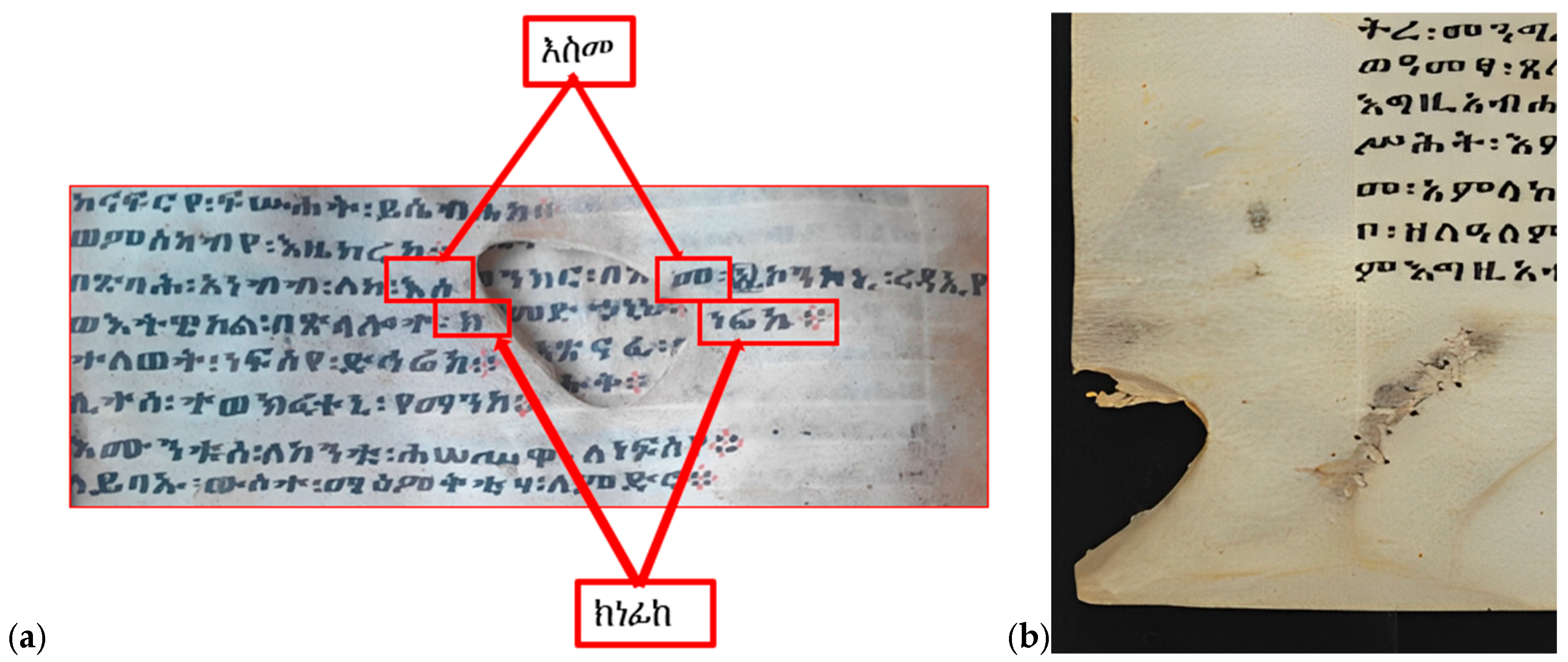
Figure 1. (a). Fragmentary words due to original hole, IES MS76 f46r (photo: authors); (b). crescent-shaped hole in the book of Cyril, Add. 1569 (photo: University of Cambridge Digital Library).
Arts 14 00173 g001
Figure 2. (a). Types of stitch patterns used for original repairs (photo: authors), (b). Stretch zig-zag stitch (photo: Endangered Archives Program), (c). Mended folios ብ.ቤ.መ 226 (photo: authors).
Arts 14 00173 g002
Figure 3. Two scribes in one codex IES MS 777 (photo: authors): (a). Miracles of Mary; (b). Miracles of Jesus.
Arts 14 00173 g003
Figure 4. (a). Correction IES MS 439 (70r) and (b). ብ.ቤ.መ 214 (Photo: authors).
Arts 14 00173 g004
Figure 5. Book of Ankritos (n.d.) with notes to test ink and pen f2r (Photo: Amhara Culture and Tourism Bureau).
Arts 14 00173 g005
Figure 6. (a). Remains of dead insect Add. 1569, f9v (Photo: Cambridge University Digital Library); (b). dirt stain: IES MS 98, f84v (Photo: authors); (c). water damage: IES MS 50, f52r (Photo: authors).
Arts 14 00173 g006
Figure 7. Faded rubrication: IES MS 12, f1r (Photo: Endangered Archives Program).
Arts 14 00173 g007
Figure 8. (a). Percentage of recorded damages on twenty-three manuscripts, (b). The Number of manuscripts with different types of damage.
Arts 14 00173 g008
Figure 9. Tear in the middle of a folio ብቤመ 39 (Photo: authors).
Arts 14 00173 g009
Figure 10. (a). Pest damage IES MS 76, f14–19 (Photo: authors); (b). Tear caused by thread stress IES MS 26, f145v–146r (photo: Endangered Archives program).
Arts 14 00173 g010
Figure 11. (a). pen writing and erasing; (b). ink transfer from marker writing; (c). bleeding pen writing. (photos: Endangered Archives program), (d). page numbers written using marker, and (e). comments and chapter number written as letter interventions (Photo: authors).
Arts 14 00173 g011
Figure 12. (a). Drops of ink on the text block (Photo: Endangered archives program); (b). Stamp and pen writing during microfilming at AM-IV-738, f128r (Photo: Amhara Culture and Tourism Bureau).
Arts 14 00173 g012
Table 1. Geographic distribution, number, and production period of sample manuscripts.
No.Physical LocationCollection/Digital Archive Sample ManuscriptsPeriod of ProductionType of Copies Observed
1IES, Addis Ababa, Ethiopia IES collection 2316th–19th century Physical
2NALS, Addis Ababa, Ethiopia NALS collection 517th–19th century Physical
3Gondar & Gojjam, Northwestern Ethiopia Hill Museum & Manuscript Library1016th–19th century Digital
4University of Cambridge, UKUniversity of Cambridge Digital Library716th–19th century Digital
5Romanat Qidus Michael & May Wayni, Northern Ethiopia Endangered Archives Programme1016th–18th century Digital
Disclaimer/Publisher’s Note: The statements, opinions and data contained in all publications are solely those of the individual author(s) and contributor(s) and not of MDPI and/or the editor(s). MDPI and/or the editor(s) disclaim responsibility for any injury to people or property resulting from any ideas, methods, instructions or products referred to in the content.